




Abstract
Background
Despite the importance of advance care planning (ACP), a process that optimizes future medical treatment and end-of-life care, for at-risk populations, rates of patient-provider ACP conversations are extremely low among Black women with breast cancer. Community health workers (CHWs) are well-positioned to support patients in engaging in ACP conversations with their providers; yet research on integrating CHWs to promote ACP is scant. The current study examined multilevel facilitators and barriers to successful ACP conversations among Black women from the perspective of providers and CHWs who serve this community.
Methods
Providers and CHWs were recruited from an academic medical center in a large urban city. Retrospective qualitative data on barriers and facilitators to ACP conversations, as well as CHWs' training needs, were collected from two focus groups (N = 5 providers, N = 5 CHWs) and one individual interview (N = 1 provider), and transcribed and coded for themes.
Results
All providers reported working primarily with Black patients, and identified stigma and time constraints as major barriers to ACP discussions; they also identified the structural barriers and injustices that their patients face during medical care. CHWs reported having a trusted relationship with their patients and flexibility in their care that would allow for ongoing ACP conversations, discussing their ability to serve as a bridge between the patient and provider. However, CHWs discussed that they lacked the tools and skills to have ACP conversations, largely because existing formal trainings in ACP are cost prohibitive.
Discussion
Competing priorities of the provider to discuss/treat the patient’s disease and medical mistrust were major barriers to successful ACP conversations among Black women with breast cancer, leading to ACP completion occurring late in treatment. CHWs are uniquely qualified to overcome multilevel barriers to ACP and establish trusting relationships with patients in order to facilitate earlier and ongoing communication between patients and providers.
Keywords
Introduction
Advance care planning (ACP) is an ongoing process of communication and shared decision-making in which patients establish goals and preferences for future care and codify these decisions in written documents, such as a living will, health care power of attorney, Medical Orders for Life-Sustaining Treatment (MOLST)/Physician Orders for Life-Sustaining Treatment (POLST) form, and do not resuscitate (DNR)/do not intubate (DNI) orders.1–3 ACP is crucial to ensuring that patients receive care that is concordant with their values and wishes and allows them to make choices about their care now in the event that they become incapacitated and are unable to make medical decisions in the future.2,3 Among patients with cancer, ACP is associated with benefits such as improved quality of life, reductions in unnecessary hospitalizations and futile, aggressive cancer treatments at end of life, and increased use of palliative care and hospice.4,5
Although breast cancer mortality rates have declined significantly in recent decades, Black women in the United States die from breast cancer at disproportionate rates compared to white women, despite having a lower incidence. 6 Black women with breast cancer are more likely to be diagnosed with more aggressive subtypes of breast cancer, such as triple-negative breast cancer, and are more likely to be diagnosed at more advanced stages of breast cancer. 1 Black women also commonly experience socioeconomic and social barriers to high-quality health care, including limited or no health insurance coverage, as well as perceived and structural discrimination. 7 Despite the importance of ACP for at-risk populations, rates of patient-provider ACP conversations are lower among Black patients with advanced cancer than white cancer patients. 1 As a result, Black patients with advanced cancer are less likely to receive care that is concordant with their preferences and are more likely to receive aggressive end of life care and forgo hospice. 8
Individual- and systems-level factors contribute to racial disparities in ACP uptake (Figure 1). These individual factors (eg, a patient’s understanding of their illness and ACP, spiritual and religious beliefs, and treatment preferences) intersect with mistrust of the healthcare system due to historic injustices and structural racism, as well as with the need for more training and standardization in ACP among oncology providers.
9
A Community Health Worker (CHW) is a frontline public health worker who is a trusted member of the community in which they serve.
10
This trusting relationship enables CHWs to serve as liaisons between health care services and the community in order to facilitate access and improve the quality of the services provided. The CHW care model is designed to address the social and structural barriers to care by providing services like psychosocial support, care coordination, and health education.
11
Recent evidence demonstrates that CHWs can increase engagement in ACP and improve symptom management, ultimately reducing hospitalizations and emergency room visits and increasing utilization of palliative care and hospice.
12
However, much more research is needed to understand the potential role of CHWs in ACP among diverse and vulnerable populations like Black women with breast cancer.
12
Therefore, the aim of the current study was to examine multilevel facilitators and barriers to successful ACP conversations among Black women with breast cancer from the perspective of providers and CHWs who serve this community. We also aimed to identify strategies needed to effectively integrate CHWs in promoting ACP in order to ensure that Black women with breast cancer receive care that is concordant with their preferences and goals across the cancer treatment continuum. Disparities in advance care planning (ACP) experienced by minoritized groups.
Methods
The reporting of this retrospective, qualitative study conforms to COREQ guidelines. 13
Participants
The study team recruited participants at a major academic medical center in a large urban city via convenience sampling. Physicians and advanced practice providers (ie, physician assistants, nurse practitioner), who specialized in oncology or palliative medicine, and CHWs, who provided direct service to patients, were recruited for the study. The research team contacted 21 potential participants via direct email, which included an introduction to the P.I., the study, and invitation to participate. The final sample consisted of 6 providers and 5 CHWs.
Procedure
Two 60-minute semi-structured focus groups and one interview (N = 6 providers, N = 5 CHWs) were conducted virtually via Zoom during the summer of 2021; the individual interview was completed with one provider (n = 1) who had scheduling conflicts with the focus group session. After providing verbal informed consent, each participant completed a de-identified, pre-interview questionnaire (investigator-initiated) and provided information on demographics, the patient population they served, and previous ACP training or exposure. The focus groups and interview were co-led by two licensed clinical psychologists (PM and MT) and conducted using a focus group guide (see Supplementary Table) to facilitate discussion. Providers discussed their previous experiences, current practices, and attitudes regarding ACP, including challenges to having ACP conversations with their patients who are Black women, as well as factors that lead to good ACP conversations. They also discussed thoughts about integrating CHWs into ACP discussions with cancer patients. CHWs similarly discussed their experience and exposure to ACP and barriers and facilitators to ACP conversations with their patients, as well as their training needs regarding ACP with cancer patients. Participants received a gift card for completing the pre-interview questionnaires and participating in the focus groups. The study was approved as an Exempt study by the Institutional Review Board (approval # IRB21-0160).
Data Analysis
The focus groups and interview were audio recorded and transcribed by a member of the research team. Researchers also took notes during the interview process. Participants did not review the transcripts nor provide feedback on the findings. Qualitative data analysis was conducted using The Framework Method. 14 Two independent coders (one master’s level and one doctoral level) created a preliminary codebook after an initial review of the transcripts. Next, the two coders worked collaboratively to finalize the codebook, and establish primary codes, secondary codes, and tertiary codes. Once the codebook and definitions were established, the coders used Dedoose software (version 9) 15 to independently code the transcripts. The coders used Dedoose’s analyze feature, qualitative code application, to extract the main themes from the transcripts. In order to maintain consistency in coding, the coders met regularly to refine codes, merge codes, clarify code definitions, and independently re-coded multiple times. Codes that were frequently applied were extracted to identify the main themes from each focus group and interview.
Results
Sample Characteristics of Providers (A) and Community Health Workers (B).

Abbreviations: ACP, advance care planning; CHW, community health worker.
All CHWs (N = 5) reported providing health education/information in their current position, and most reported providing healthcare access navigation services. Some CHWs reported receiving training in cancer prevention or screening, but only one had experience with active cancer treatment, and none with palliative care; about half had previous experience with ACP. All reported serving Black/African American patients, although only two worked with cancer patients.
Barriers to ACP with Black Women with Breast Cancer
Illustrative Quotes from Provider and Community Health Worker Focus Groups.
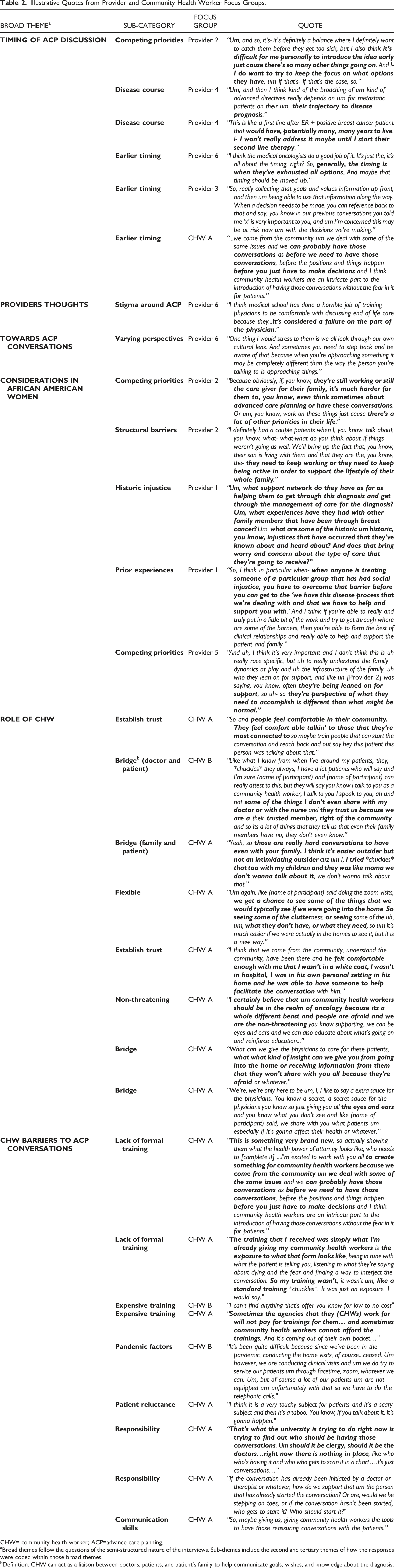
CHW= community health worker; ACP=advance care planning.
aBroad themes follow the questions of the semi-structured nature of the interviews. Sub-themes include the second and tertiary themes of how the responses were coded within those broad themes.
bDefinition: CHW can act as a liaison between doctors, patients, and patient’s family to help communicate goals, wishes, and knowledge about the diagnosis.
Provider barriers to initiating ACP
Two main themes arose when providers identified their own needs and barriers to ACP conversations: time constraints and stigma. Providers identified time constraints as a major barrier to initiation and maintaining ACP conversations, a barrier exacerbated by competing priorities on the part of the provider and patient. With limited time during appointments, “it’s difficult for me personally to introduce the idea early just cause there’s so many other things going on...I do want to try to keep the focus on what options they have” (Provider 2, breast medical oncology). Rather than talking about what will happen if treatment fails, the provider wants to focus on the possible treatment options. Timing of ACP conversations is also dependent on the patient’s disease course and “their trajectory to disease prognosis” (Provider 4, breast medical oncology). If a provider has a patient that “would have, potentially many, many years to live” then they “won’t really address it [ACP] maybe until [the provider] start[s] their [the patient’s] second line therapy” (Provider 4, breast medical oncology). One provider attributed this reluctance to talk about end-of-life care to stigma that a patient dying means “a failure on the part of the physician” (Provider 6, radiation oncology). A provider noted that they may wait until “they’ve exhausted all options” (Provider 6, radiation oncology) before discussing ACP due to this fear of failure, instead of at an earlier time when there may be less pressure to make any decisions.
Structural barriers to ACP for patients
When providers were asked to identify the needs of their Black/African American patients, two main themes emerged: structural barriers related to patients’ roles and responsibility in their family life and prior experiences and interactions with the health system and the role of historic injustice. Providers recognized the importance of a patient’s culture and family obligations and the significant impact this plays into the decision to engage in conversations on ACP in a timely manner. These considerations are often at odds with the provider’s goals when attempting to discuss ACP, noting “we all look through our own cultural lens. And sometimes you need to step back and be aware of that because when you’re approaching something it may be completely different than the way the person you’re talking to is approaching things” (Provider 6, radiation oncology). If the patient is “still working or still the care giver for their family, it’s much harder for them to, you know, even think sometimes about advanced care planning or have these conversations… there’s a lot of other priorities in their life” (Provider 2, breast medical oncology). Having these conversations, especially when seen as a sign that treatment may not be successful can be difficult when “[the patient is] being leaned on for support” (Provider 5, geriatric oncology) by their families. A patient may “need to keep working or they need to keep being active in order to support the lifestyle of their whole family” (Provider 2, breast medical oncology). This creates a misalignment of goals between the patient and provider, as a patient’s “perspective of what they need to accomplish is different than what might be normal” (Provider 5, geriatric oncology).
Providers described that prior experiences and interactions with the healthcare system affect the way that Black women with breast cancer approach healthcare decisions, including ACP. These experiences range from personal and family experiences to stories from friends and other patients: “…what experiences have they had with other family members that have been through breast cancer?” (Provider 1, palliative medicine). One provider urged others to consider surrounding factors around a patient’s diagnosis, asking “… what support network do they have as far as helping them to get through this diagnosis and get through the management of care for the diagnosis? Um, what experiences have they had with other family members that have been through breast cancer?” (Provider 1, palliative medicine). These are all factors that are often overlooked when considering the complex interplay between a patient’s culture and their willingness to engage in difficult conversations, and the complexity is further amplified with Black women who have faced systemic racism and injustice. One provider brought this up by asking us to consider these larger systemic barriers saying, “what are some of the historic...injustices that have occurred that they’ve known about and heard about ...does that bring worry and concern about the type of care that they’re going to receive?” (Provider 1, palliative medicine). Thus, providers note that “when anyone is treating someone of a particular group that has had social injustice, you have to overcome that barrier before you can get to the ‘we have this disease process that we’re dealing with and that we have to help and support you with’” (Provider 1, palliative medicine). A provider may think it is an appropriate time to have an ACP conversation, yet the conversation will not be successful if these barriers are not addressed first.
CHW barriers to ACP conversations
When CHWs were asked about barriers to ACP conversations, the primary themes that arose were lack of formal training and unclear responsibility within the healthcare team. CHWs discussed the major barrier of having a gap in ACP knowledge, as “this [ACP] is something very brand new” (CHW A, worked with older adults with chronic disease) in the CHW model of care. Although most CHWs in the study had no experience working in oncology or palliative medicine settings, a few reported that their patients, especially older adult patients, managing chronic conditions have brought up concerns around end of life care to CHWs. For CHWs who have had experience in discussing ACP with their patients, the training that they received was informal. One CHW reported “the training that I received was simply what I’m already giving my community health workers…the exposure to what the [power of attorney] form looks like…so my training wasn’t…like a standard training” (CHW A). CHWs mentioned cost as prohibitive factor to ACP training: “sometimes the agencies that [CHWs] work for will not pay for trainings for them…and sometimes community health workers cannot afford the trainings” (CHW A).
Another barrier that was discussed was the lack of clarity of the role CHWs had in completing ACP with patients. CHWs were worried about “stepping on toes” (CHW A) if a medical provider or psychologist already started the conversation with their patients, and they were unsure about how to support ACP conversations that were initiated. CHWs discussed an overall lack of clarity in which member of the medical team should initiate ACP conversations, noting “that’s what the University is trying to do right now is trying to find out who should be having those conversations…should it be clergy, should it be doctors?..right now there is nothing in place” (CHW A). CHWs also agreed that they should have some training in basic principles in oncology so that they can have a general understanding of cancer-related treatments/processes so they can better work together with the healthcare team to facilitate ACP with Black cancer patients. One CHW highlighted “I certainly believe that um community health workers should be in the realm of oncology because it’s a whole different beast, and people are afraid and we [CHW] are the non-threatening...” (CHW A).
Integrating community health workers into facilitating advance care planning conversations
One major theme discussed was that CHWs have a unique, trusting relationship with patients. CHWs are often members of the community, which helps mediate the power dynamic that patients often face with medical providers. As one CHW noted, “people feel comfortable in their community. They feel comfortable talkin’ to those that they’re most connected to” (CHW A). One CHW reported that a patient once said, “‘some of the things I don’t even share with my doctor or with the nurse’”, highlighting the reason for patients’ openness being “they trust us because we are a... Trusted member, right of the community” (CHW B, worked with older adults with chronic disease). Patients may be hesitant to talk to providers due to discomfort and/or mistrust, but CHWs noted that this discomfort may also extend to their own family: “a lot of things that [the patients] tell us that even their family members… don’t even know” (CHW B). ACP conversations can be broad but can also be heavy conversations that are difficult to have with loved ones. As one CHW spoke from personal experience: “those are really hard conversations to have even with your family. I think it’s easier [to have with an] outsider but not an intimidating outsider... I tried... That too with my children and they was like mama we don’t wanna talk about it” (CHW A). CHWs see themselves as the safe, unbiased, third-party bridge for their patients to share their wishes and goals of care across various medical settings.
Another benefit of including CHWs in ACP conversations is that CHWs are flexible and are able to meet patients where they are, including in the patient’s home or, as during the pandemic, virtually. One CHW said, “we get a chance to see some of the things that we would typically see if we were going into the home. So, seeing some of the clutter..., or seeing...what they don’t have, or what they need” (CHW A). Having these conversations in a safe place, such as at home, can mean that “[the patient feels] comfortable enough with me that I wasn’t in a white coat, I wasn’t in hospital, I was in his own personal setting in his home and he was able to have someone to help facilitate the conversation” (CHW A). CHWs can help foster a sense of safety and comfort for patients while having difficult conversations about ACP. In addition, CHWs can be the bridge for physicians, as patients may share things with CHWs that they do not feel comfortable sharing with a doctor. One CHW asked, “what kind of insight can we give you [the physician] from going into the home or receiving information from them [the patient] that they won’t share with you all because they’re afraid” (CHW A). In this sense, CHWs say they can be the “eyes and ears” (CHW A) for physicians because CHWs have the opportunity to see personal and intimate aspects of the patient’s life. CHWs expressed a desire to have a role in ACP conversations with patients, demonstrating excitement “to create something for community health workers because we come from the community … we deal with some of the same issues” (CHW A). CHWs also discussed their potential role in early initiation of ACP conversations, noting that CHWs “can probably have those conversations…before we need to have those conversations…before you just have to make decisions.” Integrating CHWs into ACP conversations would allow greater depth to these long-term conversations and help foster trust between the patient and the healthcare system. CHWs have the potential to serve as a trusted, cultural bridge in facilitating ACP conversations, thereby aligning patient, family and provider goals with care.
Discussion
The current study elucidated multilevel facilitators and barriers to initiating ACP conversations with this population, and explored ways in which CHWs are uniquely qualified to have these conversations with patients in order to convey the benefits of ACP and facilitate early completion. Results of this study revealed that CHWs have the potential to improve ACP by establishing trust with the patient in order to bridge the goals of the provider and the patient.
Both providers and CHWs emphasized that medical mistrust is a major barrier to engaging in ACP conversations with Black women with breast cancer. Research demonstrates that few Black patients with advanced cancer are interested in discussing advanced directives with their oncologist, 5 and discomfort sharing information with providers is often worsened by previous negative healthcare experiences. A history of medical injustice and systemic racism exacerbate feelings of mistrust between Black patients and their medical providers, 16 and medical mistrust is a driving factor in low ACP utilization among Black individuals. 16 As a result, Black patients diagnosed with advanced cancer are also less likely to receive end of life care that is aligned with their wishes. 8 Given that trust and positive relationship with providers increase the likelihood of ACP conversations, 17 our findings suggest that the trusting relationships and rapport that CHWs have with Black women with breast cancer are critical.
CHWs are often members of the community they serve, so they have an inherent understanding of their patients’ perspectives regarding the healthcare systems. CHWs are also able to flexibly provide services to their patients, for instance meeting them in the patients’ own homes, to create a safe, comfortable space for their patients to share and discuss their care needs.
Another finding is that stigma related to ACP can affect timing of these conversations, causing them to occur later. Providers discussed that ACP is seen sometimes as an indicator that treatment failed, or that the provider was not successful in treating the patient. As a result, providers may wait to initiate conversations given the patient’s prognosis or treatment trajectory. Results also showed that even when providers are ready to have ACP conversations, patients may not be ready to prioritize ACP completion. In these instances, flexibility in care by CHWs, which can include more face-to-face time and longer follow up with patients, can be leveraged to increase readiness and preparedness to initiate ACP conversations. Furthermore, the fact that CHWs work to establish ongoing trust with patients and address their social determinants of health over time can support approaching ACP as a safe experience that continuously unfolds over time.
Emerging evidence shows that incorporating CHWs in cancer and palliative care has direct benefit on patient outcomes and use of support care services.9,18,19 CHW-led interventions for ACP have demonstrated an increase in ACP among patients with advanced cancer, including higher rates of documentation of advanced directives and goals of care. 18 A pilot study with African American patients found that when CHWs encouraged ACP and use of palliative care, documentation of advanced directives increased from 24% – 75% over a one-year period. 9 Our findings suggest that several cross-cutting components may increase successful ACP conversations with Black women with breast cancer, such as starting the conversations early, engaging in the conversations in an ongoing and routine manner, empowering patients and involving important stakeholders, and clearly soliciting goals and wishes in order to align care with patients’ priorities (Figure 2). Future programs and interventions should consider whether there is role clarity regarding who will initiate ACP conversations, CHWs’ basic understanding of key cancer terms and euphemisms, and the CHWs’ ability to assess and support patient readiness and preparedness, as well as continuously bridge communication with care team.
Components of a successful advance care planning (ACP) conversation: Synthesis of findings.
Limitations
Findings of the current study should be interpreted within the context of its limitations. Importantly, our data were collected as part of a larger project that aims to inform the development of a CHW-led intervention. The study utilized a small convenience sample of providers and CHWs employed by the same major academic medical center in a large urban city, which likely does not represent the experiences of providers and CHWs in other settings and limits the generalizability of our results. However, participants were recruited from a large, urban academic medical center that serves a large proportion of patients who are Black women (ie, 30% of patients with breast cancer). Focused research with more representative samples, including providers and CHWs employed in other geographic and healthcare settings such as community, rural, and federally-qualified healthcare settings, is urgently needed in order to ensure that diverse Black women with breast cancer are represented and supported in ACP.
Conclusion
ACP is critical to ensuring patients receive care that is concordant with their values and goals; however, trust and effective, culturally-sensitive communication are needed to initiate ACP conversations with patients, particularly among minoritized populations. Our findings suggest that CHWs are uniquely qualified to overcome multilevel barriers to ACP and establish trusting relationships with patients in order to educate patients on the benefits of ACP and facilitate ongoing communication between patients and providers.
Supplemental Material
Supplemental Material - Advance Care Planning With Black Women with Breast Cancer: A Community Health Worker Model
Supplemental Material for Advance Care Planning With Black Women with Breast Cancer: A Community Health Worker Model by Marcia M. Tan, PhD, MPH, Dario M. Villamar, Clarissa Huard, MPH, Lian Nicholson, MA, Heidy N. Medina, PhD, MPH, and Patricia I. Moreno, PhD in Cancer Control
Footnotes
Acknowledgments
We would like to thank the providers and community health workers that gave their valuable time to participate in this research.
Declaration of Conflicting Interests
The author(s) declared no potential conflicts of interest with respect to the research, authorship, and/or publication of this article.
Funding
The author(s) disclosed receipt of the following financial support for the research, authorship, and/or publication of this article: This work was supported by the National Cancer Institute under grant number P20 CA233307 (MMT).
Research and Ethics Statement
All procedures performed in studies involving human participants were in accordance with the ethical standards of the institutional and/or national research committee and with the 1964 Helsinki declaration and its later amendments or comparable ethical standards. The study was approved by the University of Chicago’s Institutional Review Board. This study was approved by University of Chicago Institutional Review Board (approval # IRB21-0160) as an exempt study. All individual participants gave verbal informed consent to participate in the study. This article does not contain any studies with animals or cell line research performed by any of the authors.

Supplementary Material
Supplemental Material for this article is available on the online.
References
Supplementary Material
Please find the following supplemental material available below.
For Open Access articles published under a Creative Commons License, all supplemental material carries the same license as the article it is associated with.
For non-Open Access articles published, all supplemental material carries a non-exclusive license, and permission requests for re-use of supplemental material or any part of supplemental material shall be sent directly to the copyright owner as specified in the copyright notice associated with the article.
