




Abstract
Cervical cancer (CC) has a high incidence and mortality and is accompanied by lack of organized CC screening programs, lack of health-care facilities, and a lack of human papillomavirus (HPV) vaccination among female population in the world, particularly China. We recruited 487 females who visited the outpatient department of the First People’s Hospital of Yunnan Province from November 2015 to January 2016 to complete a standardized-designed questionnaire. We found that only 39.6% of the females knew about the role of HPVs in the development of cervical cancer. Moreover, none of the females knew that HPV could cause penile carcinomas, perianal carcinomas, and head and neck carcinomas. The majority of the participants acquired information about cervical cancer, HPV, and the HPV vaccine from medical workers. Only 15.6% of the recruited females had heard about the HPV vaccine. The overall HPV vaccine acceptance rate was higher (91.2%) if the vaccine was available free of cost. In this study, we found high acceptability of the HPV vaccine in Chinese women and high awareness about cervical cancer. However, very low levels of knowledge about HPVs and their role in cancer development among the recruited women is alarming. Therefore, it is very important to initiate educational programs to raise awareness and knowledge about cervical cancer, HPV, and the HPV vaccine in this region.
Keywords
Background
The human papillomavirus (HPV) is one of the most common sexually transmitted infections of the reproductive tract in the world. 1 The roles of high-risk HPVs (HR-HPVs) in different cancers, including oropharyngeal, anal, cervical, vaginal, vulvar, and penile, have been established. 2 The incidence of HPV-associated cancers has increased over the last 50 years, and the predominance has shifted from a female to a male cancer. 2 -4 Cervical cancer is one of the most preventable human cancers; its prevention is based on early diagnosis and treatment. 4,5 The prevalence and mortality of cervical cancer have significantly decreased in developed nations due to widespread applications of Pap smear tests and vaccination. However, developing countries lack well-organized screening programs, which results in greater mortalities in these countries. 6
According to the World Health Organization and the estimates of different published studies, there are 3 leading causes of the increased cervical cancer prevalence and mortality in developing countries of the world: (1) a lack of well-organized cervical cancer screening programs, (2) a lack of health-care facilities, and (3) a lack of HPV vaccination among female population in the world particularly China. 7 -9
Knowledge and awareness about cervical cancer, HPV, and the efficacy of the HPV vaccine in the prevention of cervical cancer are very low in the world, especially in China. Some studies have demonstrated that awareness about cervical cancer and HPV is substantially different among different populations in China. 10 -12 Moreover, previously reported studies from various well-developed areas in China with high levels of social and economic disparity make the findings less applicable to all of China. 12 Therefore, the current study was designed to assess the following: (1) knowledge in HPV positive versus HPV negative women about cervical cancer, HPV and the HPV vaccine among Chinese women in the Yunnan province, (2) the factors associated with knowledge about HPV, the HPV vaccine, and HPV-associated cancers.
Methodology
Type of Study
This is a cross-sectional descriptive study. The questionnaires were administered by an interviewer; every women who had an appointment was invited to participate. A standardized questionnaire was designed based on previously published study. 13
Ethical Approval
All the participants voluntarily signed the documented consent prior to their participation, and the security, anonymity, and the privacy of participants were respected rigorously in this study. The ethics committee of the Kunming University of Science and Technology formally reviewed and approved our study.
Study Population
This survey was conducted by the Faculty of Life Science and Technology of Kunming University of Science and Technology in partnership with the First Peoples’ Hospital of Yunnan Province. Women who visited the outpatient department of the First Peoples’ Hospital of Yunnan Province were recruited from November 2015 to January 2016.
A copy of the questionnaire was sent to a gynecologist who worked in the outpatient department of the Yunnan First Peoples’ Hospital. She agreed to appoint female doctors for the collection of data from the patients. Before beginning the interview, a cover letter that described the aim of the study, conveyed a guarantee of secrecy, and highlighted that the patient’s decision to participate would not affect her medical checkup was given to the patient. The overall response rate was 74.9% (487/675).
All women were interviewed by a trained interviewer in their local Chinese dialect in an isolated room using a standardized questionnaire to elicit information about the subjects’ demographic and social variables, sexual behavior, medical and reproductive histories, and smoking and drinking habits. After questioner process, a qualified gynecologist did the pelvic examination and sample collection process. One cervical sample was collected with a cyto-brush (Hybribio) for HPV diagnosis.
DNA Extractions and HPV Testing
The DNA extraction process was completed through the DNA Extraction Kit (Qiagen, Valencia, California) by following the recommendation of manufacturer. Samples that tested positive for β-globin were analyzed by polymerase chain reaction (PCR) amplification of HPV DNA. The HPV-positive samples were confirmed by PCR with universal L1 primer MY09/11 and GP5/6 systems; DNA from HeLa and Caski cell lines was used as positive controls, and mixtures without sample DNA were used as negative controls. The HPV genotypes were determined using an HPV GenoArray Test Kit (Hybribio, Chaozhou, China), according to the manufacturer’s instructions. Geno-Array is an L1 consensus primer-based PCR assay that is capable of amplifying 23 HPV genotypes, including 13 HR-HPV genotypes (HPV-16, 18, 31, 33, 35, 39, 45, 51, 52, 56, 58, 59, and 68), 3 Potential High-Risk (PHR)-HPV genotypes (HPV-53, 66, and 81), and 7 low-risk HPV genotypes (HPV-6, 11, 42, 43, 44, and 61).
Data Analysis
The data collected from the participants were transferred into a database, and descriptive and inferential statistics were applied using SPSS version 20.0 (SPSS Inc, Chicago, Illinois, for Windows). The participants were divided into HPV-positive and HPV-negative subgroups to examine the relationships of cervical cancer with the HPV-related knowledge, attitudes, behaviors, and intentions of the participants. We applied the χ2 test to examine differences between the groups. Awareness and knowledge about HPV, cervical cancer, and the HPV-vaccine are presented as percentages. The associations of various variables with the knowledge and awareness about cervical cancer, HPV, and the HPV vaccine were calculated with a logistic regression model. All statistical tests were 2-sided, and P values <.05 were considered statistically significant.
Results
A total of 487 women were included in this study. Among them, 92 were found to be HPV DNA-positive (18.9%, 92/487), and 395 were HPV-negative. The mean age of the 487 women was 38.3 years (38.3 ± 9.0, confidence interval [CI]: 37.4-39.1), and there was no significant difference in age between the HPV-negative (38.3 years [median = 38], standard deviation [SD] = 9.1, CI: 37.4-39.2) and HPV-positive groups (38.1 years [median = 38], SD = 9.4, CI: 36.1-40.0; P = .81). The sociodemographic characteristics are presented in Table 1.
Demographic Characteristics of the Participants.

A total of 78.6% (383/487) women had heard about cervical cancer. Knowledge about cervical cancer prevention through screening was significantly higher among the HPV-negative group (55.9%) than the HPV-positive group (67.4%). Fifty-eight percentage (251/487) of the participants had acquired information about cervical cancer from medical workers. Medical workers acted as a source of knowledge about cervical cancer for significantly more of the HPV-positive women (66.7%) than the HPV-negative women (58.9%). Similarly, the levels of knowledge about HPV and its role in cervical cancer were higher among the HPV-negative women (HPV: 53.2, role in cervical cancer [CC] 38.7%) than the HPV-positive women (HPV: 42.4, role in CC 43.5%). The level of knowledge about the role of HPV in other related cancers was significantly higher among the HPV-positive women (20.6%) than the HPV-negative women (9.1%; Table 2).
Levels of Knowledge About HPV and Its Vaccination Among the HPV-Positive and HPV-Negative Groups.a

Abbrevaition: HPV, human papillomavirus.
aThe variables indicate significant differences (P = .05); n = number of participants.
The overall levels of awareness and knowledge about the HPV vaccine were very low among both groups. The levels of knowledge about the HPV vaccine and its role in cervical cancer prevention were significantly higher among the HPV-positive (25.0%, role in CC prevention: 20.6%) women than the HPV-negative women (13.8%, role in CC prevention: 9.1%). The level of willingness to receive the HPV vaccine was high in both groups. Surprisingly, none of the women knew that HPV vaccine could also be used for men (0%, 0/487).
We also collected data regarding the participants’ high or low levels of knowledge and awareness about the risk factors for cervical cancer (Table 3), HPV (Table 4) and the HPV vaccine (Table 5). The levels of knowledge and awareness about cervical cancer and HPV were significantly higher among populations with higher education levels, higher income, and higher job status (Tables 3 and4). Furthermore, migrant women (P = .004), women of other ethnicities (P = .028), older women, and married women had significantly higher levels of knowledge about cervical cancer and HPV (Tables 3 and 4). The levels of knowledge and awareness about the HPV vaccine were low among all groups and were significantly lower among the illiterate (P = .001) and agricultural workers (P = .004; Table 5).
Logistic Regression Analysis of the Levels of Knowledge About Cervical Cancer.

Abbreviations: CI confidence interval; IUD, intrauterine device; OR, odds ratio.
Logistic Regression Analysis of the Levels of Knowledge about HPV.

Abbreviations: CI, confidence interval; IUD, intrauterine device; OR, odds ratio.
Logistic Regression Analysis of the Levels of Knowledge About the HPV Vaccine.
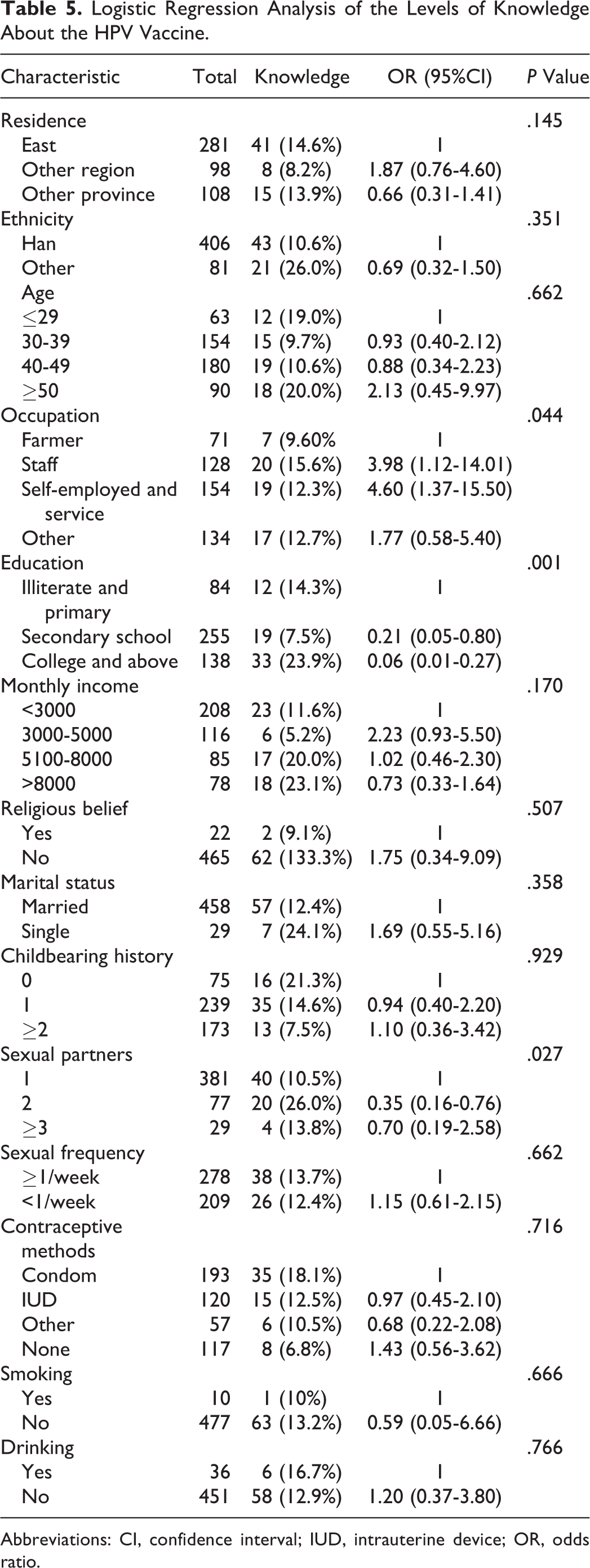
Abbreviations: CI, confidence interval; IUD, intrauterine device; OR, odds ratio.
Discussion
Vaccination against HPV is a possible long-term solution for eradicating cervical cancer in developing countries, particularly in China, where a prophylactic HPV vaccine has already been approved. Yunnan province has a unique geographical location, highly complex topography, and large variations in elevation. Yunnan Province is a land of 26 Chinese ethnic groups. The health-care facilities in this region are inadequate, and there is a lack of well-organized cancer registries and gynaecological screening and HPV testing programs. In 2014, our group took initiative and reported HPV prevalence and its genotype distribution among various ethnic groups in Yunnan province. 14 -16 Recently, cervical cancer screening test is available in almost all public hospitals. The current study is the first to assess the levels of awareness and knowledge about cervical cancer, HPV, and the HPV vaccine among women in the Yunnan province, which is a developing area located in the southwest of China. Considering the substantial differences in the levels of knowledge and awareness about HPV-related cancer, HPV, and HPV vaccine acceptance among women across the world, and especially in China, this survey will be helpful for designing strategies for cervical cancer control via HPV screening and vaccination in Yunnan province, China.
The findings indicate a good level of knowledge and awareness about cervical cancer (85.4%); however, the level of knowledge and awareness about HPV was moderate (51.1%), and the level of knowledge and awareness about the HPV vaccine was very low (15.4%). Numerous previously reported surveys have demonstrated that 50% to 85% of women know about cervical cancer in Asia, 17,18 which is in accordance with the observations of our study. Human papillomavirus awareness was higher in Denmark (75.8%) and Sweden (74.8%) compared with Norway (62.4%) and Senegal (63%), 19,20 while studies from Yunnan, China (52.6%), Xinjiang, China (0.14%, 10 out of 7100), and Brazil (37%) have reported low levels of knowledge and awareness about HPV that are consistent with the findings of this study. 13,21,22 However, the levels of knowledge and awareness about HPV observed in the present study are higher than those in previously reported studies 13,23 but are still low. A low level of knowledge about HPV is recognized as a major hurdle for the implementation HPV vaccination programs. Therefore, it is very important that persistent public education efforts be initiated to communicate the information to the population through printed, electronic and social media, and debates with medical doctors and workers to raise awareness about HPV infection and the HPV vaccine.
Yunnan province is located at the threshold of the Himalayas in the south of the People’s Republic of China and has a unique geographic location, a highly complex topography, and large variations in elevation. Different regions of Yunnan province have distinct topographical features. Northwestern Yunnan is a sparsely populated area with large mountains, a dry landscape, and cold weather. The southeast region is highly populated, the land is flat, and the weather is hot. We determined the levels of knowledge and awareness about HPV-related cancer, HPV, and the HPV vaccine among HPV-positive and -negative women. We found that knowledge about cervical cancer was higher among HPV-negative than HPV-positive women. However, knowledge about HPV and its vaccine was substantially higher among the HPV-positive than the HPV-negative women. It is well-established that the levels of knowledge and awareness about HPV and its vaccine are very heterogeneous among the general population and specific target groups. 24 -26 Some studies have revealed very low levels of awareness, 27,28 eg, the level of knowledge and awareness about HPV and its vaccine among Danish women is 10%, 29 which is very low compared with the observations of the present study. This difference might be due to the massive HPV and HPV vaccination awareness campaign organized by the Ministry of Health and implemented through electronic and print media during cervical cancer screenings.
In the present study, the level of knowledge about the HPV vaccine was very low (15.1%), and a similar level has been reported in Brazil. 22 We suggest the prioritization of the initiation of a high-level public education campaign regarding the HPV vaccine that will explicitly address knowledge deficits among general populations. Most of the participants stated that they would be vaccinated if the vaccine was available free of cost. Many studies have reported favorable attitudes toward vaccination in China 13,21,23 and other countries. 17,22 Yunnan is an underdeveloped province of China, and the poverty level is slightly higher than that of the rest of China; thus, many people in this province do not have enough money to pay for the HPV vaccine. Based on these observations, we suggest that the HPV vaccine must be introduced in Yunnan province under a government-subsidized program rather than by the private sector. Another main barrier to vaccination acceptance is concern about side effects. A lack of knowledge about HPV may make it difficult for women to make appropriate decisions. Therefore, clear and sustained educational programs may be needed in both rural and urban areas before the initiation of an HPV vaccination campaign.
The limitations of this study include the fact that the sample was not representative of the general Yunnan population because recruitment was limited to one region of the province. Further extended quantitative and qualitative research involving other areas of the country will provide more relevant information on this issue.
Conclusion
In this study, we found high acceptability of the HPV vaccine in Chinese women and high awareness about cervical cancer. However, very low levels of knowledge about HPVs and their role in cancer development among the recruited women is alarming. Therefore, it is very important to initiate educational programs to raise awareness and knowledge about cervical cancer, HPV, and the HPV vaccine in this region.
Footnotes
Authors’ Note
The protocol of this study accorded with the principles of the Declaration of Helsinki and was approved by the Ethics Committee at Kunming University of Science and Technology and the Centers for Disease Control and Prevention (CDC) in Yunnan Province, China (2015RA012). Written consent was individually obtained from each participant. The aggregate data supporting findings contained within this manuscript will be shared upon request submitted to the corresponding author. Identifying patient data will not be shared. Li Yuanyue, and Li Shanshan equally contributed to the work and should be regarded as co-first authors; Zulqarnain Baloch and Wu xiaomei designed the study, Li Yuanyue and Li Shanshan performed the data analysis and wrote the paper. Jamal Khan, and Li Shanshan contributed to the collection of the data from the participants. Zulqarnain Baloch and Xia Xueshan supervised the study. All of the authors have read and approved the final manuscript.
Acknowledgments
We sincerely thank Dr Songmei Shan for her assistance during the data collection.
Declaration of Conflicting Interests
The author(s) declared no potential conflicts of interest with respect to the research, authorship, and/or publication of this article.
Funding
The author(s) disclosed receipt of the following financial support for the research, authorship, and/or publication of this article: This study was supported by research grants from the Natural Science Foundation of China (81260248), the Scientific and Technological Innovation Talent Support Project (2015HC030), and the Key and New Product Development Project of Yunnan Province and the Science and Technology Agency of Yunnan Province, China (2014FB090). The funders played no role in the study design, data collection and analysis, the decision to publish, or the preparation of the manuscript.
