



Abstract
Attachment scripts emerge from early experiences with caregivers and comprise implicit expectations about others’ availability in times of difficulty. Their assessment relies on narrative production, conventionally in interview settings, using word prompts to activate this implicit knowledge. As detecting attachment scripts without an interview would add flexibility to attachment assessment, we investigated audio-recording and typing as alternative modalities. Participants (N = 156) produced narratives in a conventional interview setting (interview modality, 2 storylines), orally (audio-recording modality, 2 storylines), and by typing (text modality, 2 storylines), and filled in coping (Brief-COPE) and personality (Mini-IPIP) measures. Narratives were transcribed and scored for richness of attachment-related content. The three modalities did not substantially differ regarding the produced narratives’ length or attachment-related content. The narratives from all storylines converged in a single factor, independent of modality. Attachment-related content in the interview modality marginally predicted emotional support coping. Higher scores in the personality disposition, intellect/imagination predicted longer narratives in the interview but not the audio-recording modality, indicating potential influence, in the interview modality, from participant characteristics. Together, our findings suggest that narrative production-based attachment script measurement may not uniquely require conventional interview settings and indicate the potential usefulness of alternative modalities that allow widespread attachment script assessment.
Keywords
Bowlby (1977, 1982) suggested that the emotional bonds human infants form with their caregivers in early stages of life, termed attachment bonds, serve as a foundation on which later relationships, beliefs and expectations regarding one’s worthiness and others’ availability, and strategies for managing distress, build upon. Frequent experiences with sensitive and supportive caregivers in times of need lead to the acquisition of event schemas called secure base scripts or attachment scripts (Mikulincer & Shaver, 2007; H. S. Waters & Waters, 2006) that gather this implicit procedural knowledge about security-instilling interactions and distress management. Attachment scripts can be thought of as early representations comprising expectations regarding the availability and responsiveness of significant others, behaviors of approaching them in times of distress, and the likelihood of comfort resulting from such approaching (Mikulincer et al., 2001; Psouni & Apetroaia, 2014). These expectations can be construed as “if-then” statements, such as “If I encounter an obstacle and become distressed, I can approach my caregiver for help; They will be available and helpful; I will experience relief and comfort from proximity to this person; Things will be good again” (Mikulincer et al., 2009). Although attachment scripts emerge in specific contexts with caregivers (Bowlby, 1969; Di Folco et al., 2017), they are assumed to later become generalized, guiding expectations in friendships and romantic partnerships (Bowlby, 1988; Bretherton, 1987; Fivush, 2006).
Because the knowledge summarized in attachment scripts is acquired early in life, it is kept implicit and not possible to access upon explicit request. However, it has been demonstrated that, if they exist, attachment scripts can be activated by prompt words and manifested in narratives produced using these words (Psouni & Apetroaia, 2014; H. S. Waters et al., 1998). Several instruments based on prompted narrative methods have been developed in recent years and demonstrated good psychometric qualities (Psouni & Apetroaia, 2014; H. S. Waters et al., 1998; T. E. A. Waters, Fraley, et al., 2015). These methods present word prompts that loosely suggest a sequence of events, or event schema, which in attachment theory is called the secure base/safe haven cycle: regular activity interrupted by a difficulty, a main character signaling for help, an attachment figure offering help and support, resolution of the difficulty and regulation of the main character’s affect, and facilitation of a return to comfort and felt security (Psouni & Apetroaia, 2014; H. S. Waters & Waters, 2006; see Table 1A for example). Thus, the word prompts can be thought of as primes aimed at activating the event schemas (Molden, 2014), while the produced narratives are the responses that result from this activation (Higgins & Eitam, 2014).
Word Prompts and Examples of High and Low Scriptedness Narratives from the “Accident” Storyline. (1A) Word Prompts for the “Accident” Storyline (Psouni & Apetroaia, 2014).
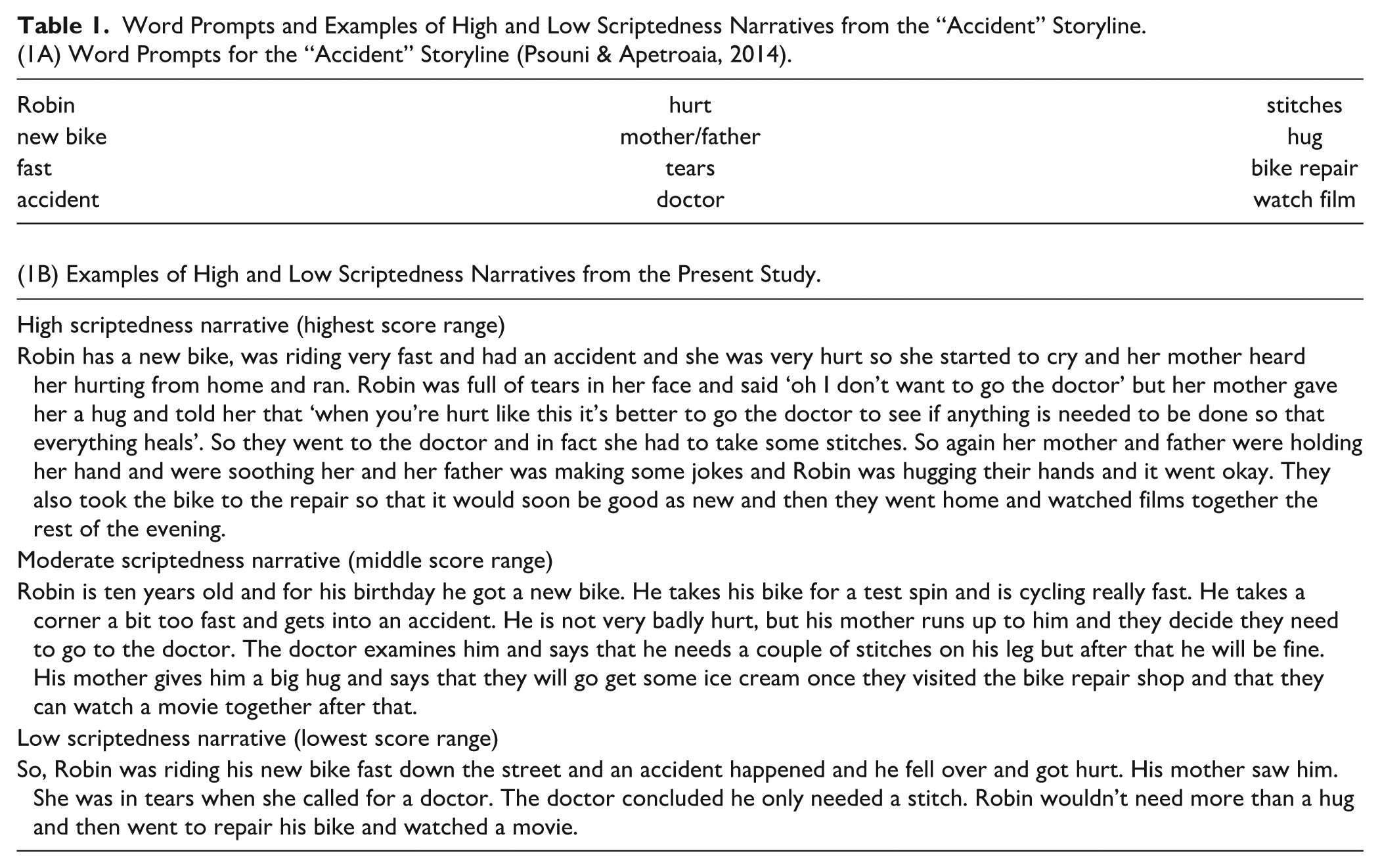
The extent to which a narrative reflects clear and elaborate content, rich in supportive interactions and emotional exchange, has been termed scriptedness (H. S. Waters et al., 1998). The measure of scriptedness is distributed on a single continuous dimension that indexes implicit procedural knowledge about security-instilling interactions and distress management (T. E. A. Waters, Fraley, et al., 2015), through an indication of how elaborate the event schemas of secure base / safe haven interactions are. Scriptedness has been empirically linked to autobiographic evidence of sensitive interactions with caregivers and felt security (Psouni & Apetroaia, 2014; Steele et al., 2014), to sensitive caregiver support during childhood (Vaughn et al., 2016), and to attachment security and coherent thinking about attachment relationships as reflected in attachment interviews, in mothers (Coppola et al., 2006), adolescents (Dykas et al., 2006), and children (Psouni & Apetroaia, 2014). Associations with self-reported attachment security have been positive but low (Dykas et al., 2006; Psouni & Apetroaia, 2014). Scriptedness is also associated with perceived social acceptance and general competence in middle childhood (Psouni et al., 2015), and functional adaptive responses to stressors in middle childhood and adolescence (Psouni & Apetroaia, 2014). Finally, associations have been shown with caregiving and care-seeking behavior (T. E. A. Waters et al., 2013), as well as observed quality of interaction and self-reported relationship satisfaction in adult romantic relations (Dagan et al., 2021; T. E. A. Waters et al., 2018). Narrative-based assessment of attachment scripts is thus used as an index of attachment security (e.g., Psouni, 2019; Schoenmaker et al., 2015).
Narrative methods of attachment script assessment ask participants to tell their stories to a test leader. H. S. Waters and Waters (2006) emphasized the importance of audio-recording the told narratives, to capture their content and structure as it is being produced. Thus, the procedure for narrative-based attachment script assessment has relied on a test leader recording the narratives, reflecting an assumption that a listener is necessary (Dykas et al., 2006; Psouni & Apetroaia, 2014; T. E. A. Waters, Bosmans, et al., 2015). While the presence of a listener in an interview setting is beneficial for quality data collection in many ways, the resource-intensive nature of an interview setting makes it challenging to implement in large-scale and/or online-based assessment contexts.
To gauge if the above challenge can be mitigated, we ask whether less resource-intensive methods of collecting narratives can also capture attachment script knowledge. In this regard, two novel modalities may be potential alternatives to an interview. First, given that humans are inherently social and acquire and share knowledge through social interactions, it is natural to assume that storytelling requires a listener. Indeed, the presence of a listener is important for the cognitive and emotional aspects of recalled autobiographical memory narratives (Elmi et al., 2019; Fioretti et al., 2017). However, it is unknown whether a listener is necessary for the word-prompted narrative-based paradigm of attachment script assessment. Hence, it is worth testing whether narratives that are audio-recorded by the narrator (audio-recording modality) can be an alternative option.
Second, we note that human communication via text has been increasingly prevalent in society and that digital tools are becoming a primary medium in human communication. With 66% of Americans checking their phones on average 160 times a day (Pickard-Whitehead, 2020), and 95% of all text messages being read within three minutes (Worldwide Texting Statistics, 2018), it may be argued that people habitually use texting as telling, to narrate, and share their stories. Indeed, written and oral personal story narratives are no different in terms of patterns of cognitive organization (Özyıldırım, 2009), and while text messages are based on simpler vocabulary than oral communication, they are often more intimate and inclusive of affective states (Holtgraves & Paul, 2013). This indicates that word-prompted narratives generated in text form may be comparable to those generated in oral form in terms of their capacity to reflect secure base knowledge. Thus, it is worth testing whether narratives that are typed by the narrator (text modality) may also be an alternative.
The Present Study
The use of attachment scripts as an index of attachment security, along with the embeddedness of digital tools in communication, makes it worth investigating the possibilities for assessing narrative-based attachment scripts in test modalities other than the conventional, resource-intensive, interview modality. Therefore, the present study addresses whether different modalities can be used interchangeably. In this regard, two questions are asked:
Finally, narratives may vary depending on individual background characteristics and personality dispositions, in terms of both content (e.g., Dunlop et al., 2020) and language use, in self-narratives (e.g., Hirsh & Peterson, 2009) and text messaging (Holtgravess, 2011). For example, loneliness is associated with perceptions of text messaging as less intimate, and social anxiety with a preference to text, rather than tell, for more affect-expressive and intimate communication (McKenna et al., 2002; Reid & Reid, 2007). Although word-prompted narratives of attachment are different from daily communications or freely narrating personal stories, it is worth exploring the potential influences of individual background characteristics and personality dispositions in generating word-prompted attachment narratives in different ways. Hence, a third research question, exploratory in nature, is addressed:
Method
Below, we report our methods in detail, including measures in the study, all manipulations, determination of sample size, and data curation procedures, also regarding excluded data. While the study design and analysis were not pre-registered, all data, materials, and analysis code are available. Data were analyzed using SPSS version 29 and Jamovi.
Participants
There were N = 156 participants (female n = 107, 68.6%; male n = 46, 29.5%; non-binary n = 3, 1.9%) between 19 and 80 years of age (missing n = 8, M = 27.7, SD = 10.3, 27% between 19 and 22, 42.7% between 23 and 26, and 20.9% between 27 and 39, and 9.5% between 41 and 80 years of age). A majority (66.7%) had completed 3 years of post-high-school education, 23.7% had completed postgraduate studies, while 9.4% had education corresponding to 12 full-time years. Participants identified themselves as either native (25%) or fluent (75%) English speakers. The majority (75%) reported using text messaging in their everyday life “a lot” or “a great deal,” while 25% reported “a moderate amount” or “a little” use of text messaging. Participants were recruited through social media platforms and posters set up at a university campus in Sweden, where the study was conducted. A majority (59.6%) of the participants were from Europe/the United Kingdom, followed by North America (19.2%), Asia (16.7%), Africa (1.9%), South America (0.6%), and unknown (1.9%).
Design
We employed a within-subjects, repeated measures design, with three modalities of story production: (a) narrating stories in an interview setting, after receiving oral instructions by the experimenter and with prompt words shown written on a card (interview modality), (b) audio-recording stories within a digital survey, with instructions and prompt words shown in written form on screen (audio-recording modality), and (c) typing stories in a text-box within the digital survey, with instructions and prompt words shown in written form on screen (text modality). Each modality included two storylines, making up to six different storylines in total.
Materials
Narrative-based Assessment of Attachment Scripts was used to assess event schemas of secure base knowledge in different relational contexts (parent–child and partner/friendship). Six storylines were used, adapted from three different measures, all with the same principles and underlying assumptions: “math test,” “accident,” and “moves away” were borrowed from the Secure Base Script Test (SBST, Psouni & Apetroaia, 2014), “the party” and “tennis match” were inspired from Dykas and colleagues (2006), and “camping trip” was borrowed from Attachment Script Assessment (ASA, H. S. Waters & Waters, 2006). The story “moves away” was adapted to be about two adult close friends. The relationship between the story characters in “tennis match” and “camping trip” was not specified, leaving participants to decide whether the co-protagonist was a romantic partner or a close friend. All character name probes were unisex (e.g., Robin, Kim, and Cameron) to avoid dictating gender and sexual orientation of the characters. The six storylines were counterbalanced in the three conditions of narrative production across participants, with each condition containing one title depicting a parent-child relationship (“math test,” “accident,” or “the party”), and one depicting a close friendship or romantic relationship (“tennis match,” “camping trip,” or “moves away”). Each storyline was used once per participant. Each participant produced six narratives in total.
Narratives were scored in line with instructions for narrative-based attachment script assessment (Dykas et al., 2006; Psouni & Apetroaia, 2014; H. S. Waters & Waters, 2006), on a 7-point scale indicating scriptedness, namely, how much they reflect a prototypical secure base—safe haven cycle, and thus, the implicit knowledge of secure attachment interactions. High scriptedness scores denote stories that contain rich knowledge of secure base interactions and are complete and coherent. Co-protagonists (caregivers, romantic partners, or close friends) are portrayed as sensitive and attentive, paying attention to the psychological states of the main character, and promptly and appropriately offering help in difficult situations, resulting in resolution of the difficulty and affect regulation. Importantly, highly scripted narratives include descriptions of emotional states and how those states change as a result of interpersonal exchange (Psouni & Apetroaia, 2013; H. S. Waters & Rodrigues-Doolabh, 2004). Thus, the support received by the main character in distress must extend beyond the instrumental to include emotional interactions that help manage distress. A score of 4 denotes narratives that involve just sufficient secure base content to suggest a rudimentary script (Psouni & Apetroaia, 2014; T. E. A. Waters et al., 2019; see also scoring manuals of SBST; Psouni & Apetroaia, 2013, and of ASA; H. S. Waters & Rodrigues-Doolabh, 2004). Lower-ranked stories contain few or no elements of secure base interaction. They may contain sequences of events without emotional content, “odd” content such as exclusion of the attachment figure from the story, or they may be so short as to be incoherent. Table 1B presents examples of high-scriptedness and low-scriptedness narratives.
The Brief-COPE (Carver, 1997) was used to assess various coping responses of the participants. It consists of 14 subscales with two items for each scale. The subscale of interest in the current study was Using Emotional Support coping (e.g., “I get emotional support from others”), while the remaining subscales were used for a control purpose. The participants were given various responses to stress and responded to how often they tend to present the mentioned responses on a 4-point Likert-type scale ranging from 1 (I usually don’t do this at all) to 4 (I usually do this a lot). In this study, Cronbach’s α for Using Emotional Support coping was .85. Values regarding other coping strategies ranged from .26 to .90. Only subscales with Cronbach’s α coefficients >.70 were used in analyses: Active coping (α = .71), Substance use (α = .90), Using instrumental support (α = .87), Positive reframing (α = .80), Self-blame (α = .78), Religion (α = .87), and Humor (α = .88).
The Mini-IPIP (Donnellan et al., 2006) was used to assess the five dimensions of personality. It consists of 20 items, 4 items per dimension: Extraversion (e.g., “Talk to a lot of different people at parties”), Agreeableness (e.g., “Sympathize with others’ feelings”), Conscientiousness (e.g., “Get chores done right away”), Neuroticism (e.g., “Have frequent mood swings”), and Intellect/Imagination (e.g., “Have a vivid imagination”). Items are responded to on 5-point scales. The original study reported reliability coefficients from .65 for Intellect/Imagination to .77 for Extraversion (Donnellan et al., 2006). Cronbach α coefficients in the current study were similar (extraversion: .80, agreeableness: .71, conscientiousness: .75, neuroticism: .71, and intellect/imagination: .72).
Background information: Participants answered questions about their age, gender, level of education, country of origin, fluency in English, and familiarity with texting.
Procedure
The study was administered via an online survey tool (Qualtrics, Provo, UT). After giving informed consent and responding to the background questions, participants carried out the study tasks in the following order: narrative production (text or audio-recording), personality measure, narrative production (audio-recording or text), and coping measure. The order of text and audio-recording modalities was randomized within the survey. For the conventional narrative production, participants were interviewed face-to-face, counterbalanced at the beginning or end of the session. All participants received the same instructions for all modalities: We are interested in how different people make up stories. To guide you make your story, there is a list of words that loosely suggest what the story is about. Please take a minute to read the words and tell the first story that comes to your mind. Remember that this is not a test of creativity, but feel free to elaborate your story with details.
For the interview modality, the task was introduced by the test leader, who acted as interviewer/listener and recorded the narratives. For the other two modalities (audio-recording/text), instructions were presented on the screen within the digital survey. The only way the instruction differed based on modality was that, at the end of the generic instruction, participants were reminded to “. . .write quickly, as if you are telling someone, without worrying about spelling mistakes and such” in the text modality, and “If you need to stop in the middle of a story to think about it, or if you would like to start again, that’s no problem” in the interview and audio-recorded modalities. Participants met the researchers (authors) in an interview room at the university campus for the interview session before or after they completed the survey. Interviews were conducted individually, and participants completed the survey alone, without the presence of a test-leader researcher, at a time and place of convenience within the same day. Overall, participation took around 25 minutes. Participants were offered coffee and a sweet as a token of gratitude for their participation. No other compensation was given. Finally, participants were debriefed and thanked for their participation.
These study procedures did not employ any manipulation and involved negligible risk of harm, as the included self-report measures are broadly used in research with both community and risk samples, and narrative tests have been used with child, adolescent, and adult samples, with no negative incidents. The study was approved by a local ethics committee.
Data Preparation and Analysis Plan
One hundred seventy-eight individuals took part in the study, but 22 participants had missing narratives in at least two modalities due to a technical error of the recording module built into the survey or skipping a narrative production task, and their data were removed from the dataset. There were no differences in terms of coping, personality or background variables between the removed participants (n = 22) and the final sample (N = 156), except that removed participants were older (M = 32.8, SD = 14.4) than the final sample (M = 27.7, SD = 10.3), t(186) = 2.1, p = .021. Missing values (6.9% of total) were imputed using Expectation Maximization (EM; Gold & Bentler, 2000). Two variables (i.e., age and narrative length) deviated significantly from normal distribution, mainly due to highly positive skewness, and were log-transformed.
Audio-recorded and interviewed narratives were first transcribed verbatim, then all narratives were scored by one senior reliable ASA/SBST coder with extensive experience in coding attachment script narratives and other attachment measurements (fourth author) and two reliable SBST coders, formally trained and tested reliable 1 year prior to the study (first and third authors). Interrater reliability (intra-class correlation; two-way mixed, average measures on consistency) for stories that were coded by all three raters (approximately 95% of total material) ranged from .97 to .98. Coding disagreements >1 were resolved in conference. With support from the high interrater reliability among the three coders, the first author scores were used for analysis. Mean sub-scores were calculated for each modality (interview, audio-recorded, and text).
First, to compare scriptedness scores and narrative length, respectively, from the three modalities, we used linear mixed modeling where data (i.e., scriptedness and narrative length) across modalities were nested within the participants. Second, to investigate if scriptedness scores predicted Using Emotional Support coping while controlling for the effects of individual characteristics, narrative length and other coping, an ordinary least squares regression was run, respectively, with interview, audio-recording and text modality sub-scores. This particular subscale of coping was chosen because of its integral part in secure base script knowledge, that is, the sense of security that comes with knowing that not only instrumental but also emotional support will be available in times of distress, as also reflected in the operationalization and coding instructions for scriptedness. Finally, a moderation analysis was run using linear mixed modeling to explore whether individual characteristics influence the link between the interview modality and each of the novel modalities (audio-recording and text), respectively, regarding both scriptedness and narrative length. In the models regarding interview and recording modalities, we explored personality traits, age, gender, education, and command of English as potential moderators. In the models examining the link between the interview and text modalities, we included one additional moderator, that is, familiarity with texting in daily communication. To avoid the risk of nested covariate interactions suppressing potential effects of the primary nested variable, we conducted these analyses both with and without narrative length. As results without the potential confound (narrative length) did not produce different patterns than those when controlling for narrative length (reported separately in Tables 5 and 6, middle and last columns), we report below results from the models including the control variable.
Based on the most parameter-rich model (22 predictors: 11 study variables, 10 interaction terms, and 1 control; see Table 6), an a priori power analysis using an F-test for detecting a medium effect size (f =.15) with an alpha level of .05 and a desired power of .80 indicated a required sample of N = 163 — slightly above our final N of 156. Because all other models contained fewer predictors, their required sample sizes were all below 163 for the same effect size and power.
Results
Correlations Between the Study Variables
Table 2 presents the descriptive statistics of and the correlations between the study variables. Narrative length and scriptedness score within each modality were moderately and positively correlated, which is not surprising, as, by definition, very short narratives obtain low scores. The correlations between scriptedness from the interview modality and those from the novel modalities were also positive: .64 and .59, respectively, for the audio-recording and text modalities, indicating both some overlap and some variation across the modalities.
Descriptive Statistics and Correlations Between the Study Variables.
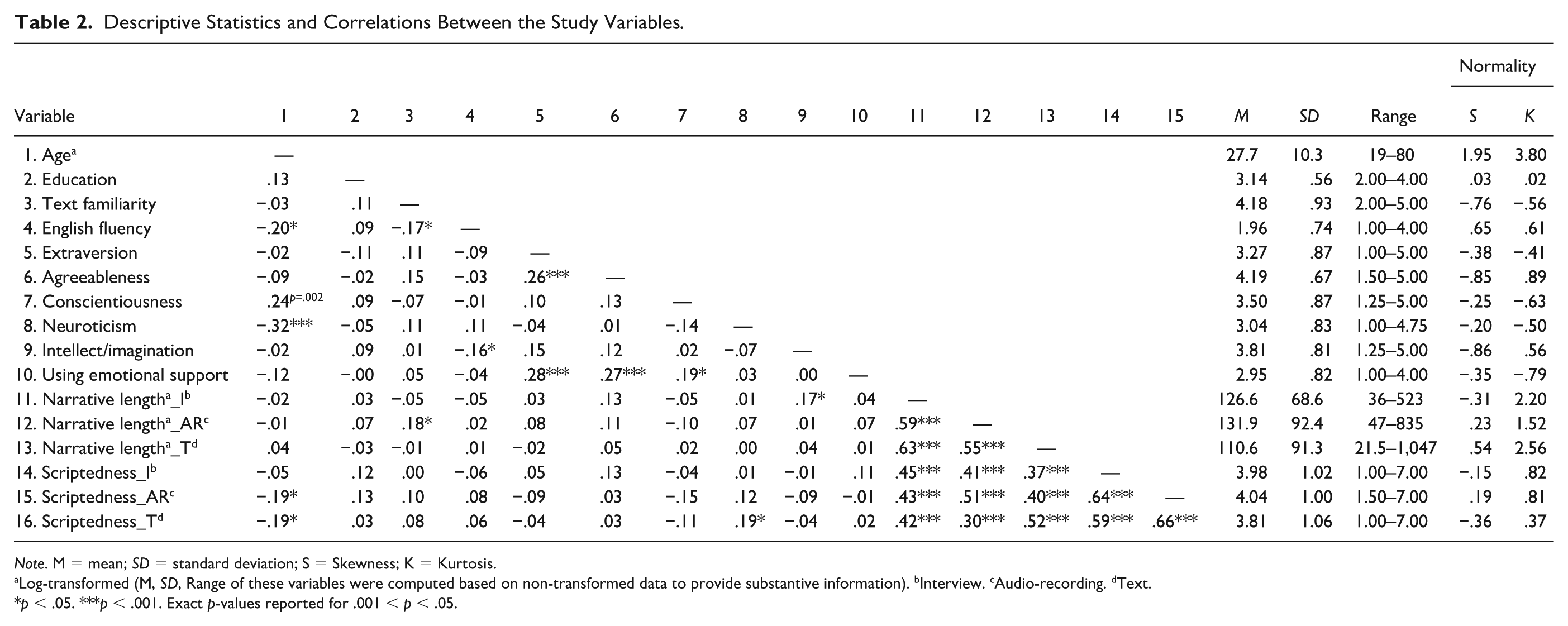
Note. M = mean; SD = standard deviation; S = Skewness; K = Kurtosis.
Log-transformed (M, SD, Range of these variables were computed based on non-transformed data to provide substantive information). bInterview. cAudio-recording. dText.
p < .05. ***p < .001. Exact p-values reported for .001 < p < .05.
To check for internal consistency of the narratives produced with the six storylines, independently of modality, Exploratory Factor Analysis (EFA) was carried out on the scriptedness scores of the six produced stories, using maximum likelihood extraction with Oblimin rotation to allow interrelations between extracted factors. The same analysis was conducted regarding the narrative lengths of the six produced stories. Scriptedness scores from the six stories loaded highly on a single factor (loadings ranging from .57 to .81, M = .71, Cronbach’s α = .86). Similarly, narrative lengths from the six stories also loaded on a single factor (loadings ranging from .61 to .90, M = .77, Cronbach’s α = .90).
Are Recording and Text Modalities Different From the Interview Modality?
A linear mixed model revealed an effect of modality on narrative length (Table 3). Post hoc tests, both with and without Bonferroni correction, showed that the average narrative length was shorter in text modality compared to audio-recording and interview modalities. The narrative length from audio-recording and interview modalities did not differ.
Modality Comparison.
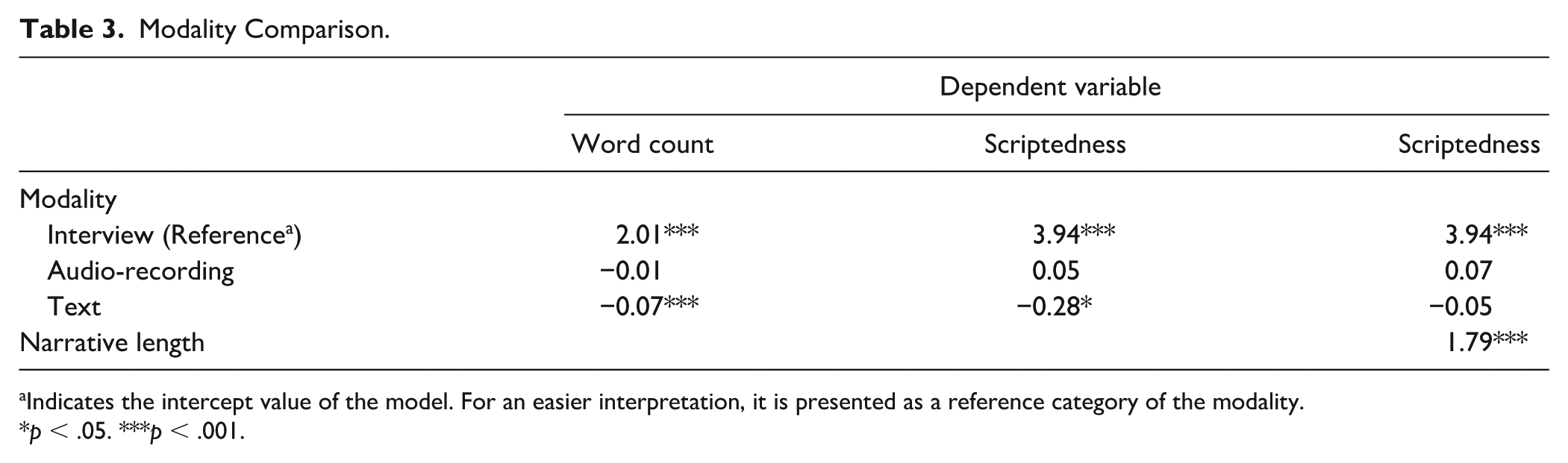
Indicates the intercept value of the model. For an easier interpretation, it is presented as a reference category of the modality.
p < .05. ***p < .001.
Results on scriptedness scores followed a similar pattern. Scriptedness from the audio-recording and interview modalities did not differ, but the scriptedness score was lower in text compared to both audio-recording and interview modalities. Given the correlation between narrative length and scriptedness, we repeated the analysis including narrative length as a control variable. This eliminated the above-reported differences in scriptedness scores between modalities, indicating that the lower scriptedness observed in the text modality, compared to other modalities, is likely attributable to shorter narrative lengths.
Do Scriptedness Scores Predict Using Emotional Support Coping?
Using emotional support coping was regressed on the scriptedness score within each modality. As shown in Table 4, the score for using emotional support coping was not significantly predicted by scriptedness. Nonetheless, the score from the interview modality was a marginally significant, positive predictor of using emotional support coping. This suggests that participants whose narratives indicated richer and more coherent attachment script knowledge in the interview modality tended to report seeking emotional support from others in times of distress more often than those whose narratives indicated little or no attachment script knowledge.
Predicting Using Emotional Support Coping.
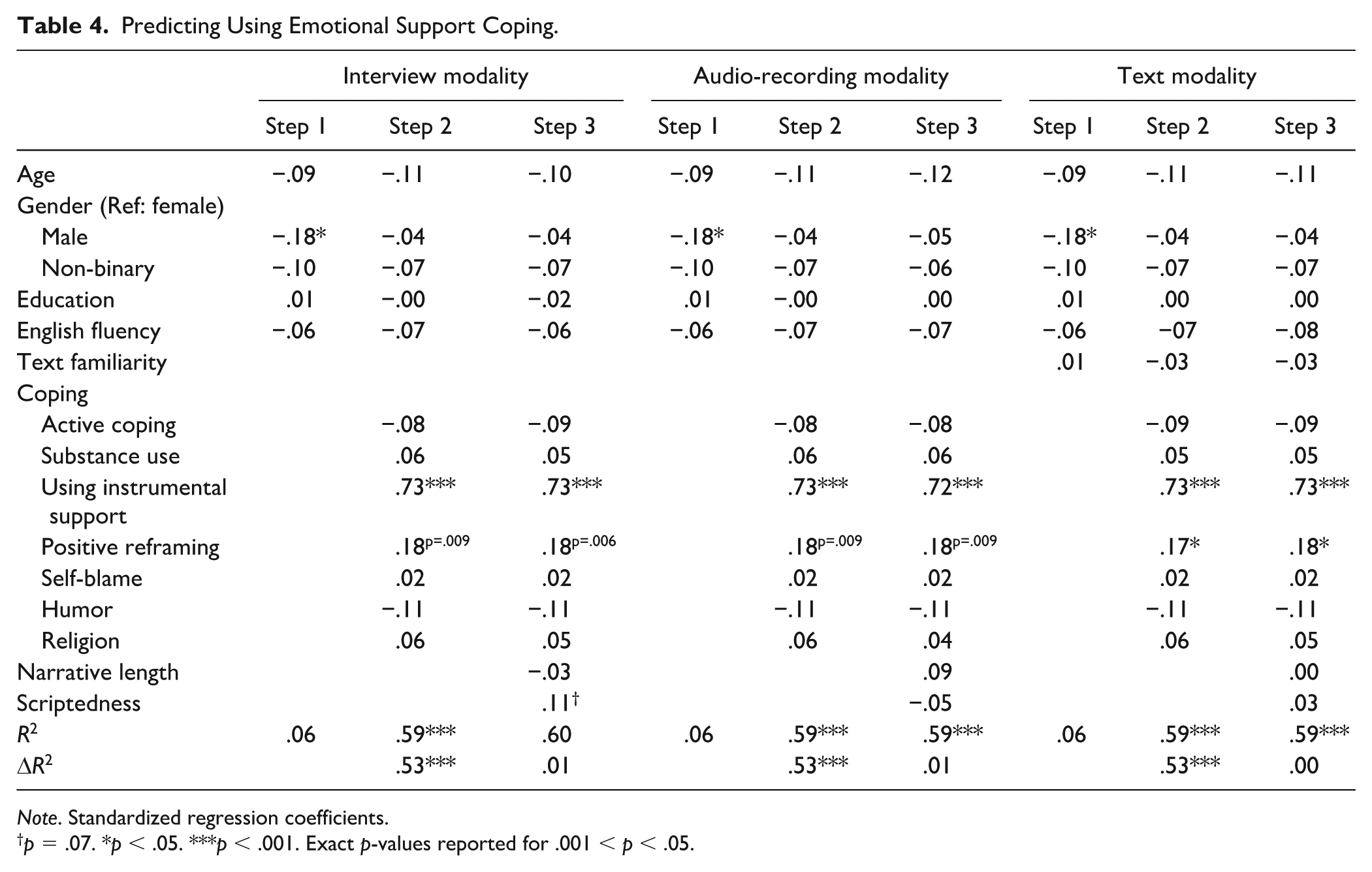
Note. Standardized regression coefficients.
p = .07. *p < .05. ***p < .001. Exact p-values reported for .001 < p < .05.
Do Individual Characteristics Influence Responses in the Novel Modalities Compared to the Interview Modality?
A linear mixed model examining the effects of moderators on the relationship between narrative length in the interview modality and the recording modality identified one significant interaction (Table 5; Figure 1). Specifically, while narrative length in the audio-recording modality was independent of participants’ levels of intellect/imagination, this personality disposition enhanced narrative length in the interview modality.
Test of Interaction Between Modality (Interview vs. Audio-Recording) and Study Variables.
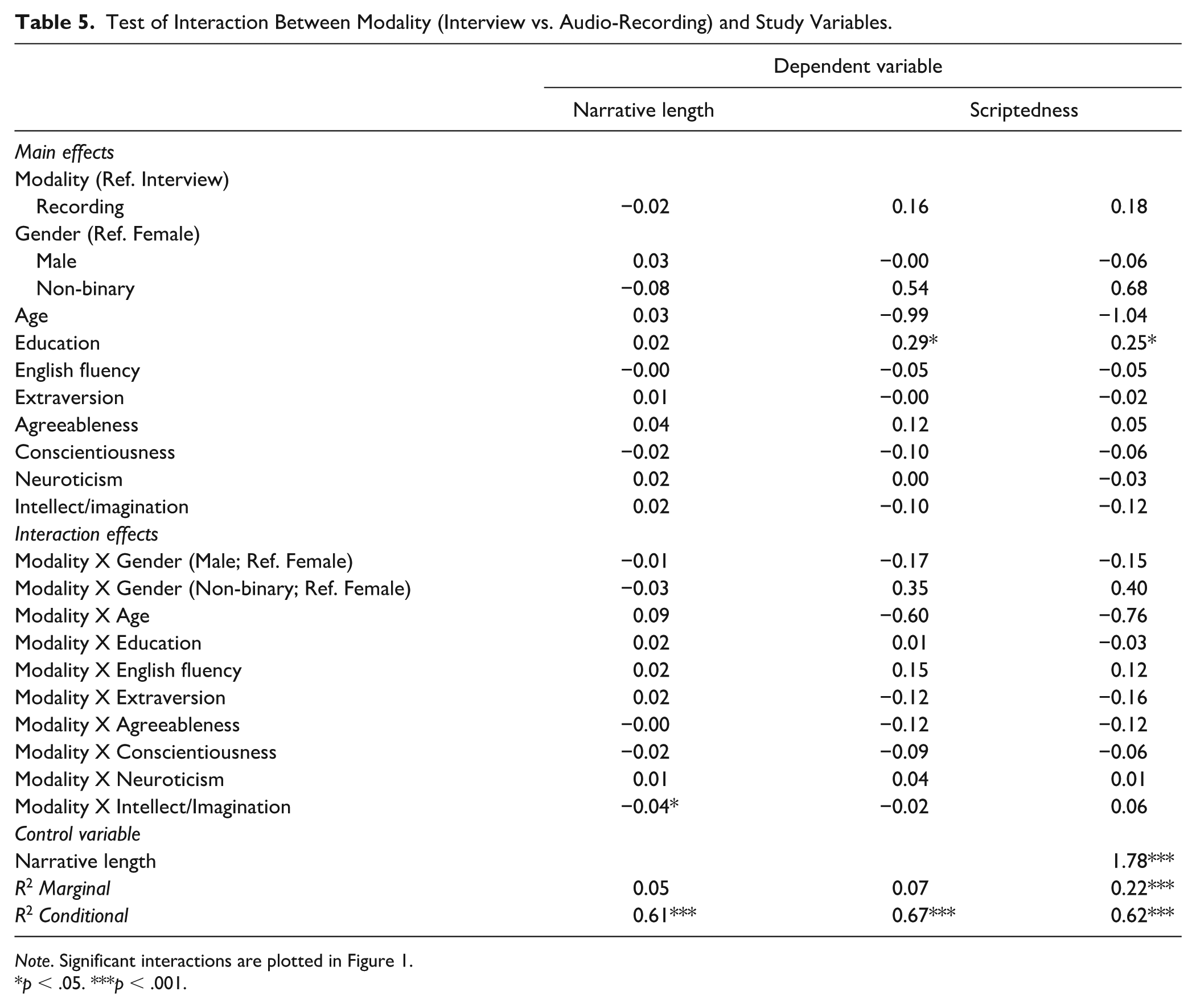
Note. Significant interactions are plotted in Figure 1.
p < .05. ***p < .001.
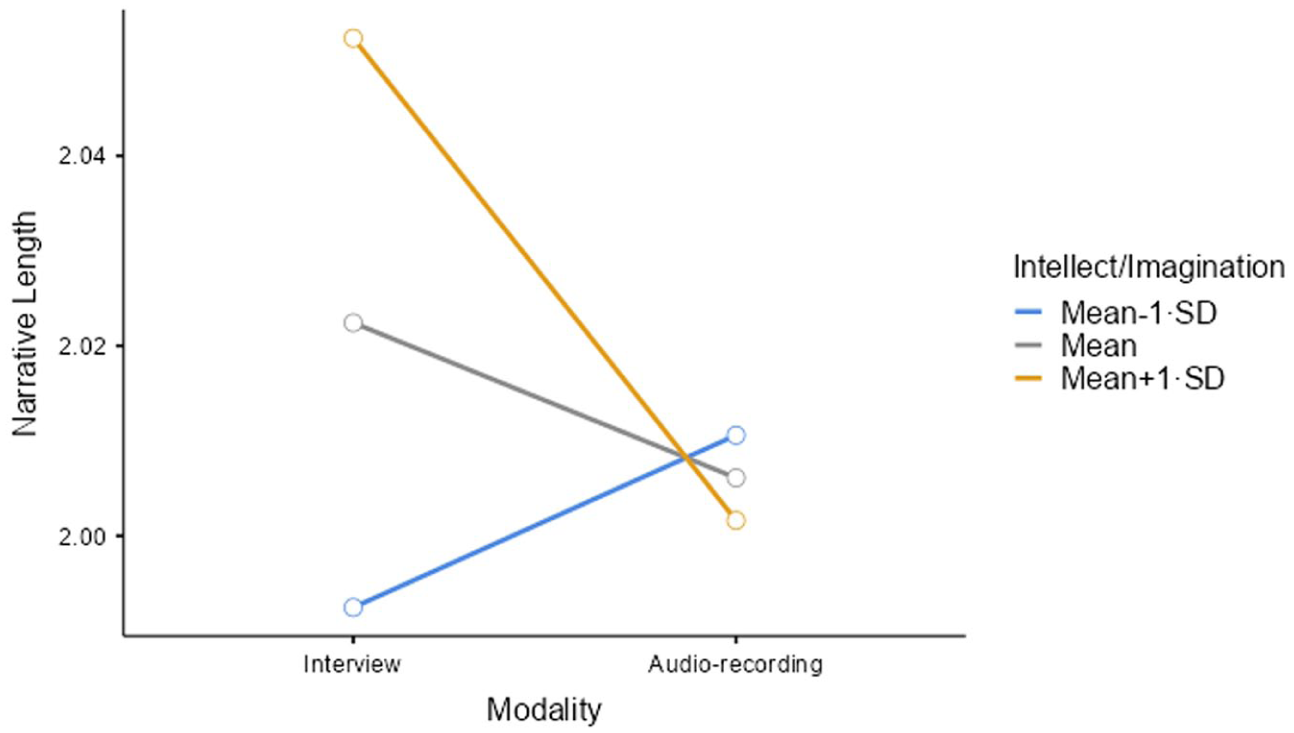
Significant Interaction Modality X Intellect/Imagination (From Table 5).
The analyses comparing the interview to the text modality (see Table 6) revealed no significant interaction regarding narrative length or scriptedness.
Test of Interaction Between Modality (Interview vs. Text) and Study Variables.
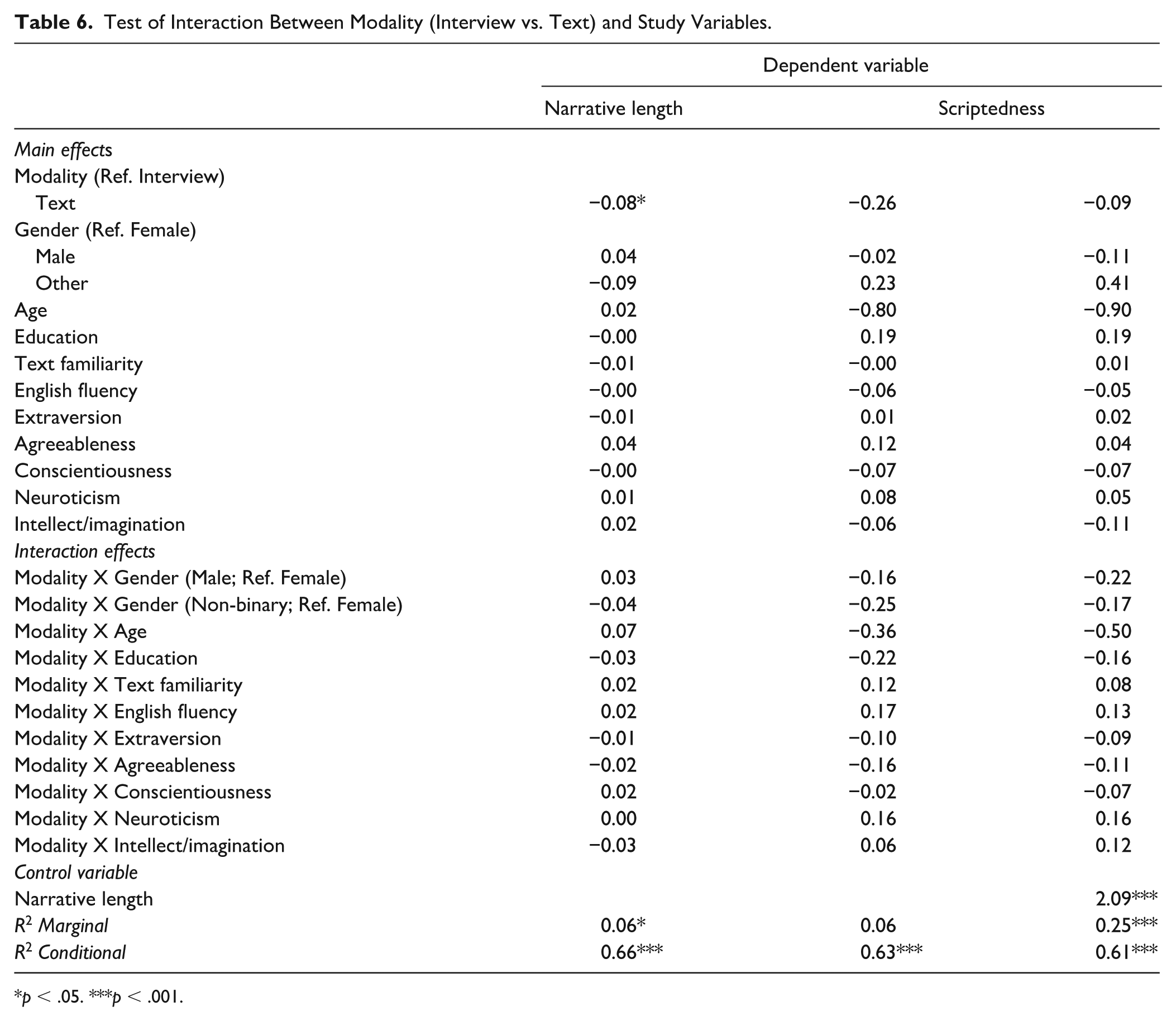
p < .05. ***p < .001.
Discussion
The study investigated whether orally produced word-prompted narratives for assessment of attachment scripts require the presence of a listener, as in the conventional interview setting, or whether oral production without the presence of a listener is sufficient. We also investigated whether narratives can instead be written (texted) rather than told, without significantly different results. Results revealed that the narrative length and scriptedness of orally produced narratives in the interview and audio-recording modalities showed no difference; while the text modality yielded shorter narratives. However, scriptedness in the narratives from the text modality did not differ from scriptedness in narratives from the other two modalities after controlling for narrative length. Independent of production modality, scriptedness scores from the six storylines converged in one factor, as did the respective narrative lengths. Thus, results indicated only minor deviation from modality invariance. Moreover, scriptedness of narratives from the interview modality was a marginally significant, positive predictor of using emotional support coping. This link did not reach significance for the novel modalities, implying some limitations for use in their current form. Notably, the personality disposition intellect/imagination influenced the similarity between narratives produced by different modalities.
Are Prompted Narratives Generated in the Interview Modality Different From Those Generated in the Recording and Text Modalities?
The narratives that were audio-recorded without a listener were very similar to those told to a listener in interviews, in terms of both scriptedness and length. Perhaps oral narrative production involves the same cognitive mechanisms in the context of word-prompted narrative production, regardless of whether a listener is present or not. Notably, the interviewer/listener is not very active when testing adults. Thus, we cannot make any claims regarding narrative production in children, for whom the facilitation from an interviewer may be critical (Psouni & Apetroaia, 2013).
The above similarity between the audio-recorded and interviewed narratives suggests that written task instructions may be equally effective as the oral instruction by an interviewer/listener. However, our findings indicate that typed narratives tend to be shorter and reflect lower levels of secure base/safe haven scripted knowledge. This may result from the fact that speaking is faster than typing, so within a given time frame of engagement with the task, typing is likely to result in shorter narratives and, consequently, fewer details. Even though narrative length itself does not dictate scriptedness, very brief narratives tend to lack details of interaction between the story characters, which renders them lower scriptedness scores. In this regard, it is important to point out that, after controlling for the effects of narrative length, scriptedness scores did not differ between the three modalities.
Does Scriptedness Generated in Different Modalities Similarly Predict a Theoretically Related Behavior, That Is, Using Emotional Support Coping?
One fundamental aim of the current study was to investigate whether we can capture attachment script knowledge using more convenient modalities than the conventional, interview modality. Such handier modalities may potentially be useful in both research and clinical settings. Consistent with attachment theory and previous research, we could demonstrate some criterion validity for scriptedness from the interview modality in relation to using emotional support coping, thus supporting the validity of narrative-based assessment of attachment script knowledge via interview. However, this was not the case for the recording and text modalities, indicating some limitations of the novel, less resource-intensive modalities to be considered as valid for the measurement of attachment script knowledge.
While scriptedness scores likely reflect one’s previous experiences of relying on and getting support from others in times of difficulty, theoretically supporting a relation between scriptedness and seeking and using emotional support as a coping strategy, the magnitude of this relation might vary. The specific situation, the nature of the stressor, one’s available coping resources, and the simultaneous use of different coping strategies may affect coping beyond one’s attachment scripts. While the current study controlled for the degree of reliance on other coping strategies, other potential confounding factors were not addressed. Thus, further research is necessary for criterion validation of the novel modalities.
Furthermore, as the current study was not aimed at establishing construct and convergent validity of the word-prompted narrative-based assessment of attachment scripts, no self-reported attachment measure was included. Previous studies have established convergent validity with self-report measures of attachment (Psouni & Apetroaia, 2014; T. E. A. Waters et al., 2021), but results on the relationship between self-reported attachment dimensions and scriptedness are also mixed (e.g., Dykas et al., 2006; McLean et al., 2014; Mikulincer et al., 2009), which is why we instead tested the predictive power of scriptedness scores from different modalities on the theoretically related outcome of the coping strategy “using emotional support.”
However, consistent with the assumption of generalized representation of scripted attachment (Bretherton, 1987; Fivush, 2006), our results demonstrate relational invariance, as scriptedness scores from the six different storylines converged in one factor regardless of the relationship context of the storyline. Notably, in our study, these narratives were also produced within different test modalities. Even though the typed narratives yielded shorter and slightly less scripted narratives, our findings of convergence imply that the generalized cognitive representations—event schemas—related to secure base/safe haven interactions and the expectations regarding help seeking, receiving, and getting comfort (Bowlby, 1988; Bretherton, 1987; Bretherton & Munholland, 2008; Fivush, 2006) are, in fact, robust and reflected in similar ways regardless of how they are produced.
Do Background Characteristics and Personality Dispositions Influence Narrative Length and Scriptedness in Different Modalities?
From the tests of our extensive list of five background characteristics and five personality dispositions as potential moderators, there were no interactions with modality regarding scriptedness, suggesting that participant individual characteristics and personality dispositions in general were not important in narrative production in different modalities. A single interaction regarding narrative length was detected between the interview and recording modalities, concerning intellect/imagination as personality disposition.
Individuals with a stronger intellect/imagination personality disposition produced longer narratives in the traditional interview modality when a listener is present, while narrative length in the recording modality was independent of this individual disposition. Although the prompted narrative method has been shown to primarily reflect attachment script knowledge, its story-completion format likely engages imagination. Our results suggest that the presence of a listener may further stimulate intellectual and imaginative expression in individuals predisposed to those features, leading to longer narratives. While task instructions remind participants that the narrative production in this context is not a creativity test, it appears that the presence of a listener in the conventional interview modality probes such processes in individuals with a strong imaginative/creative disposition. However, the supposed creative expression did not appear to influence attachment-related content of narratives in a similar way. This indicates that the length of narratives may be explained by creative details rather than details of secure base/safe haven interactions that the measure aims to assess. Therefore, while it might be useful to consider potential influences of personality dispositions, our finding regarding the intellect/imagination trait does not seem to pose a threat to the validity of the measure.
Word-Prompted Script Assessment in Attachment Research
The word-prompted narrative production methods make assumptions about how people engage with the task, assuming that they will not try to surprise the reader or try to entertain themselves when given an opportunity to generate a story. While the generation of a story partially relies on conscious or unconscious associative processes (Lubart, 2009), as well as the affective states of the writer (Russ, 2009), it could also serve to reinforce a fantasy or a desired affective state. Thus, despite being instructed otherwise, elements of creativity, humor, or callous endings may be found in the narratives, which may obscure the secure base content.
Narrative production is a central component of several highly reliable attachment assessment interview methods (e.g., the Adult Attachment Interview [AAI]; George et al., 1984). Principles for assessing the narratives produced in attachment interviews are strongly rooted in the understanding of defense strategies, information processing, and attentional (in)flexibility (Hesse, 2008; Main, 1990), but also in principles based on Grice’s (1975, 1989) maxims, reflecting features that make an interview narrative an “ideally rational, coherent, and cooperative conversation” (Hesse, 2008, p. 556). The makings and assessment principles of attachment interview narratives (e.g., from the AAI) are thus well-supported and well-understood. By contrast, the makings of short narratives about a fictional character in word-prompted narratives are much less well-understood. We hope that the current study contributes to deepening this understanding, thus reducing the gap between the usefulness of the two narrative methods.
Limitations
To test the significance of oral vs. typed narrative production as well as the importance of a listener (present vs. absent), independently of one another, would require a 2 × 2 factorial design with four conditions (oral with a listener, oral without a listener, typed with a “listener,” typed without a listener). However, setting up a “typed with a listener” condition was not feasible.
While instructions repeatedly reminded participants to type as they speak and not edit their stories, we cannot rule out the possibility that narrative production in the typed modality might have involved some thinking and editing. Indeed, while presenting evidence of interchangeability of the interview and audio-recorded test modalities, our findings challenge whether typing one’s narratives is likely to produce stories similar to those produced orally. Since participation was completed in two sessions (narrative production by interview was carried out separately), potential confounding from tiredness seems unlikely but cannot be entirely excluded.
While the sample size of the current study is generally considered acceptable given a medium effect size, our results indicated small effect sizes, suggesting that a greater number of participants would be required to reliably detect moderation effects. Hence, some moderation effects may not have reached significance due to the small sample size. Future studies with larger sample sizes may reveal additional moderators of the link between interview and other novel modalities for assessing attachment scripts with the word-prompted narrative method.
While our EFA result supported a one-factor solution, indicating that modality did not seem to make meaningful variations in producing narratives, it should be noted that, with six variables, it is inherently difficult to support multifactor solutions unless variations across modalities are highly substantial. Hence, future studies need to increase the number of stories to complete for each modality. This allows for the possibility of more rigorously testing whether meaningful variations across modalities exist, using more advanced methodologies such as bi-factor EFA that can explicitly model and test such modality effects.
Finally, some constraints on generalizability ought to be mentioned. Our sample is more representative of the younger and more educated segments of the general population. While we controlled for, in all our analyses, and could establish that our results were independent of all background characteristics (gender, age, education, texting-familiarity, command of English), future research may further establish the robustness of the novel modalities across broader demographic groups. Furthermore, notwithstanding their high proficiency in English, not all participants were native English speakers, necessitating further research in different language populations and native speakers. While our findings of interchangeability of interview and oral (recorded) narrative production modalities are promising, the extent to which they can be generalized is dependent on further research, as the novel modalities have not been tested in children, adolescents, vulnerable groups, or individuals with intellectual difficulties or limited schooling.
Implications/Conclusion
In the present study, we systematically challenged the premise that word-prompted narrative production can only occur in interview conditions. Taking into consideration the technology-driven changes in everyday communication, we defined two plausible alternative modalities for word-prompted narrative production using mobile technologies: audio-recording the narrative within a survey and typing the narrative within a survey. Our results show relative invariance across modalities in terms of producing narratives, but also reveal some limitations of the novel modalities in predicting other related constructs. Notably, the presence of a listener in the conventional interview modality appears to probe imaginative creative processes in individuals with this disposition, while the recording modality, which also involves orally narrating the stories, does not. Thus, even though the creative processes do not appear to be related to actual scriptedness, caution is advised when implementing the different modalities. Gathering robust evidence on the usability of the audio-recorded narrative production modality is likely to promote widespread testing and allow reaching out to different groups of individuals, location-independently. The present study provides initial indications that this may be possible.
Footnotes
Acknowledgements
We gratefully acknowledge Daniel Schad for technical solutions to support recordings over the internet, and Fabian Carlsson for help with transcription and data management. Not least, we thank Katarina Bernhardsson for valuable feedback on the workings of narrative production.
Author Contributions
GH: Conceptualization, Methodology, Investigation, Data curation, Formal analysis, Writing—Original Draft, Writing—Review and Editing, Visualization; YK: Formal analysis, Writing—Review and Editing, Supervision. CC: Investigation, Writing—Original Draft, Visualization; EP: Conceptualization, Methodology, Data curation, Formal analysis, Writing—Original Draft, Writing—Review and Editing, Supervision, Project administration, Funding acquisition.
Declaration of Conflicting Interests
The authors declared no potential conflicts of interest with respect to the research, authorship, and/or publication of this article.
Funding
The authors disclosed receipt of the following financial support for the research, authorship, and/or publication of this article: The study was partly funded by the Swedish Research Council (2019-02787) and the Crafoord Foundation (2019–1024), both awarded to Elia Psouni. The funders had no role in study design, data collection and analysis, decision to publish, or preparation of the manuscript.
