



Abstract
Past research shows strong links between object attachment and hoarding but has relied on poorly validated measures of object attachment. The Object Attachment Security Measure (OASM; David & Norberg, 2022b) was developed to address this limitation. This study evaluates the construct validity and measurement invariance of the OASM across age groups, genders, and hoarding severity. Participants were 777 individuals recruited via Prolific. Confirmatory factor analysis confirmed the correlated two-factor structure with two subscales: secure object attachment (SOA) and insecure object attachment (IOA). Measurement invariance testing showed strict invariance across age, gender, and hoarding severity. SOA and IOA had moderate to strong correlations with hoarding, and weaker associations with other psychopathology. IOA showed stronger correlations with hoarding than SOA, and the relationship between SOA and hoarding was no longer significant after accounting for IOA. These findings support the construct validity of OASM and reaffirm the central role of insecure object attachment in hoarding.
Keywords
Objects are typically valued for their usefulness, beauty, or monetary worth, but interestingly, these qualities are often not inherent in objects that people truly value. Items such as childhood toys, photo albums, or a child’s drawing may not cost much or have any practical or aesthetic value, but nevertheless can hold personal significance. These cherished objects have intrinsic sentimental value regardless of their extrinsic value because they are linked to memories of loved ones or important moments in one’s life. This emotional attachment to objects (or object attachment) is defined as an “affect-laden possession-specific bond between a person and an object or objects” (Kellett & Holden, 2014).
Similar to our attachment to people, object attachment triggers a range of positive emotions such as pride and affection, but it can also involve more complex and even negative emotions, such as nostalgia and sadness (Yap & Grisham, 2020). The complexity of object attachment is also apparent in the wide range of reasons why inanimate objects can be transformed from being mere objects to holding deep personal significance (Brown, 2001; David et al., 2024; Kings et al., 2021). People become attached to certain possessions because they see them as extensions of their identity and accomplishments (e.g., a trophy or a graduation certificate), or the object may be a repository of important autobiographical memories (e.g., a souvenir or childhood possession; Yap & Grisham, 2019). Many of these items are treated as if they have human-like qualities (i.e., anthropomorphized) and are loved as much as significant others (Neave et al., 2016).
Object attachment occurs across the lifespan and regardless of gender. In childhood, object attachment is observed in children’s use of transitional objects for comfort and safety (e.g., a teddy bear), and as a temporary substitute for the attention and love of absent caregivers (Richins & Chaplin, 2021; Winnicott, 1953). People continue to use transitional objects into adulthood (Dozier & Ayers, 2021; Hooley & Wilson-Murphy, 2012), with many inanimate objects holding special significance as they continue to provide a sense of identity and meaning, and serve as tangible connections to others and the past (Belk, 1988; Csikszentmihalyi & Halton, 1981). Similarly, research shows that in older adults, cherished objects play an important function of maintaining connections with significant others, personal values, identity, and memories (Coleman & Wiles, 2020; Sherman & Newman, 1977). Sentimental attachment to possessions is reported in all genders and some studies have shown no significant difference between men and women in levels of object attachment (Kwok et al., 2018; Sherman & Newman, 1977). However, there may be some gender differences in the types of items and meanings attributed to these items, with women placing more emphasis on sentimental value (David et al., 2024) while more men value objects for instrumental reasons (Dittmar, 1989, 1991).
In addition to specific items of personal significance, object attachment can also reflect a person’s general attitudes and emotional connections with belongings. The strength and nature of this emotional attachment to personal possessions can vary between individuals, with some people valuing and having stronger emotional bonds with their possessions. Others, such as minimalists, may have weak emotional bonds to possessions (Wilson & Bellezza, 2022). Not surprisingly, strong attachment to possessions is a prominent feature in people who hoard. Studies have consistently shown that people with hoarding disorder report high levels of object attachment (Kellett & Holden, 2014), form emotional attachments to objects very quickly (Grisham et al., 2009), and attach indiscriminately to a wide range of possible objects (Mogan et al., 2012; Yap & Grisham, 2020).
People with and without hoarding not only differ in the strength of object attachment, but they also differ in the quality of the object attachment. Drawing on attachment theory, Nedelisky and Steele (2009) argued that object attachment, like interpersonal attachment, can manifest as either secure or insecure. They suggested that individuals with high hoarding symptoms have higher levels of insecure object attachment; these individuals express intense fears of losing their possessions, have a strong need to remain in close proximity to their belongings, rely on these items to feel secure, and feel vulnerable when separated from them. Nedelisky and Steele investigated this idea by adapting an interpersonal attachment questionnaire (Reciprocal Attachment Questionnaire: RAQ; West et al., 1987) to assess object attachment (RAQ-A). They administered the scale to a sample of 30 participants with obsessive-compulsive disorder, of whom 14 had significant hoarding symptoms. Results showed that hoarding was significantly associated with inanimate object attachment security such that with higher levels of hoarding symptoms, insecure object attachment also increased. However, they found no significant difference in overall insecure object attachment when comparing participants with and without high hoarding symptoms, possibly due to the small sample size. Nevertheless, when examining subscale responses, they found that participants with high hoarding symptoms were significantly more fearful of losing their possessions; and while they were more likely to seek comfort from inanimate objects, they were less able to use these objects during times of need (Nedelisky & Steele, 2009).
Yap and Grisham (2019) replicated Nedelisky and Steele’s findings in a larger community sample (n = 532) and demonstrated that insecure object attachment, as measured by the RAQ-A inanimate object attachment security subscale, had a strong positive correlation with hoarding severity (r = .59). Insecure object attachment also emerged as the strongest and most unique predictor of hoarding severity when included in a regression model alongside other aspects of object attachment. In line with attachment theory, Yap and Grisham suggested that hoarding may represent an attempt to compensate for unmet relational needs, but as the attachment to objects is insecure, hoarding invariably fails to truly fulfill those needs and instead paradoxically becomes a source of anxiety and insecurity.
Nedelisky and Steele (2009) acknowledged that the RAQ-A has not been psychometrically evaluated. Furthermore, due to difficulties in finding appropriately worded items, they were not confident in the measure’s ability to truly capture the construct. A new self-report measure of insecure object attachment called the Object Attachment Security Measure (OASM), was developed to address these limitations (David & Norberg, 2022b). The authors collated items from previous object attachment scales and consulted hoarding disorder experts. To examine psychometric properties of the OASM, they administered it together with other measures of object attachment and hoarding to a large community sample. Using exploratory factor analysis (EFA), they extracted two factors with five items each, measuring secure and insecure object attachment. The secure object attachment (SOA) subscale comprised items that measured the extent to which participants felt that their possessions were important in their lives (e.g., My possessions are special to me). The insecure object attachment (IOA) subscale comprised items that assessed distress about being separated from possessions (e.g., I would feel never-ending distress if I no longer had my possessions). A confirmatory factor analysis (CFA) showed good model fit for the correlated two-factor model. Demonstrating good convergent validity, the OASM subscales were positively correlated with hoarding severity. The insecure attachment subscale showed stronger correlations with the RAQ-A than the secure subscale. The OASM also showed weak correlations with a quality-of-life measure, indicating good divergent validity. It also had excellent internal consistency reliability (alpha = .91 for both subscales) and good test–retest reliability (SOA’s intraclass correlation coefficient [ICC] = .793, IOA’s ICC = .857). More recently, in a pilot study of an online program to reduce overconsumption, Norberg et al. (2024) showed that participants who completed the intervention significantly decreased insecure object attachment, as measured by the OASM, relative to a waitlist control group, further supporting the OASM’s construct validity and sensitivity to change.
Unlike secure and insecure interpersonal attachment, which exist on opposite ends of the attachment security continuum, it was acknowledged that secure and insecure object attachment are likely to be separate dimensions (David & Norberg, 2022b). While most people experience secure object attachment, as evidenced in their attachments to cherished possessions, high insecure object attachment is associated with higher levels of maladaptive hoarding or compulsive buying. Consistent with the idea that secure and insecure object attachment are distinct dimensions, they were found to correlate positively (David & Norberg, 2022b). Furthermore, when both secure and insecure object attachment were entered as predictors of hoarding or compulsive buying, only insecure object attachment made a unique and signification contribution (David & Norberg, 2022b).
Although David and Norberg (2022b) demonstrated that the OASM has excellent psychometric properties, there were some limitations. The mean age of the validation sample was 32.1 years (SD = 31.1), and participants were mostly female (60.5%). Given that hoarding severity increases with age (Kellman-McFarlane, 2019), further research is needed to assess the measure across age groups. And while the prevalence of hoarding is the same for males and females, women appear to report stronger sentimental attachment to objects than men. It is therefore possible that the OASM may not function similarly across men and women. Finally, although object attachment exists on a continuum, it is unclear whether the OASM is equally valid for people with low and high hoarding symptoms.
The aim of the current study is to replicate and extend the initial study which developed and introduced the OASM (David & Norberg, 2022b). To this end, we first evaluated the factor structure and measurement invariance of the OASM in a large sample of adults from a wider age range, with equal representation of male and female participants, and encompassing sufficient participants with high hoarding symptoms. We hypothesized that the CFA would show acceptable model fit for a positively correlated two-factor structure and that upon assessing measurement invariance, the measure would be equally valid across genders, age groups, and hoarding severity groups.
We then sought to replicate and extend David and Norberg (2022b) by evaluating the convergent and divergent validity of the OASM, and its usefulness in predicting hoarding. For convergent validity, we examined the associations between OASM subscales and hoarding and hoarding-related cognitions. For divergent validity, we examined the associations between OASM subscales and other measures of psychopathology. We hypothesized strong positive associations between OASM and hoarding measures, demonstrating good convergent validity, and weaker associations with other psychopathology including depression, anxiety, autism, and obsessive-compulsive disorder, demonstrating good divergent validity.
Given that insecure object attachment is considered the maladaptive component of object attachment, we also hypothesized that insecure object attachment would be more strongly correlated to hoarding and other measures of psychopathology than secure object attachment. Furthermore, we expected that only insecure object attachment would significantly predict hoarding symptoms when both secure and insecure object attachment were entered as predictors, replicating previously reported findings (David & Norberg, 2022b).
Method
This study was conducted in accordance with the Declaration of Helsinki and approved by the institutional ethics boards of the Australian Catholic University and Anglia Ruskin University. We report in this method section how we determined our sample size, all data exclusions, and all measures in the study. No manipulations were used in this study.
Participants
Participants were 777 individuals recruited via an online crowdsourcing service (Prolific.com). Mean age was 47.41 (SD = 12.74). To ensure representation across the age range, participants were recruited across three bands (aged 25–40, 41–55, and 56–70). We recruited 259 participants in each age group to ensure that we had sufficient participants within each group for the multigroup CFA (Kline, 2011). Demographic characteristics of the sample are presented in Table 1. Using the recommended cutoff scores for the SI-R (Kellman-McFarlane, 2019), there were 668 individuals with low hoarding symptoms (SI-R ≤ 38) and 109 individuals with high hoarding symptoms (SI-R ≥ 39).
Demographic Characteristics (N = 777).
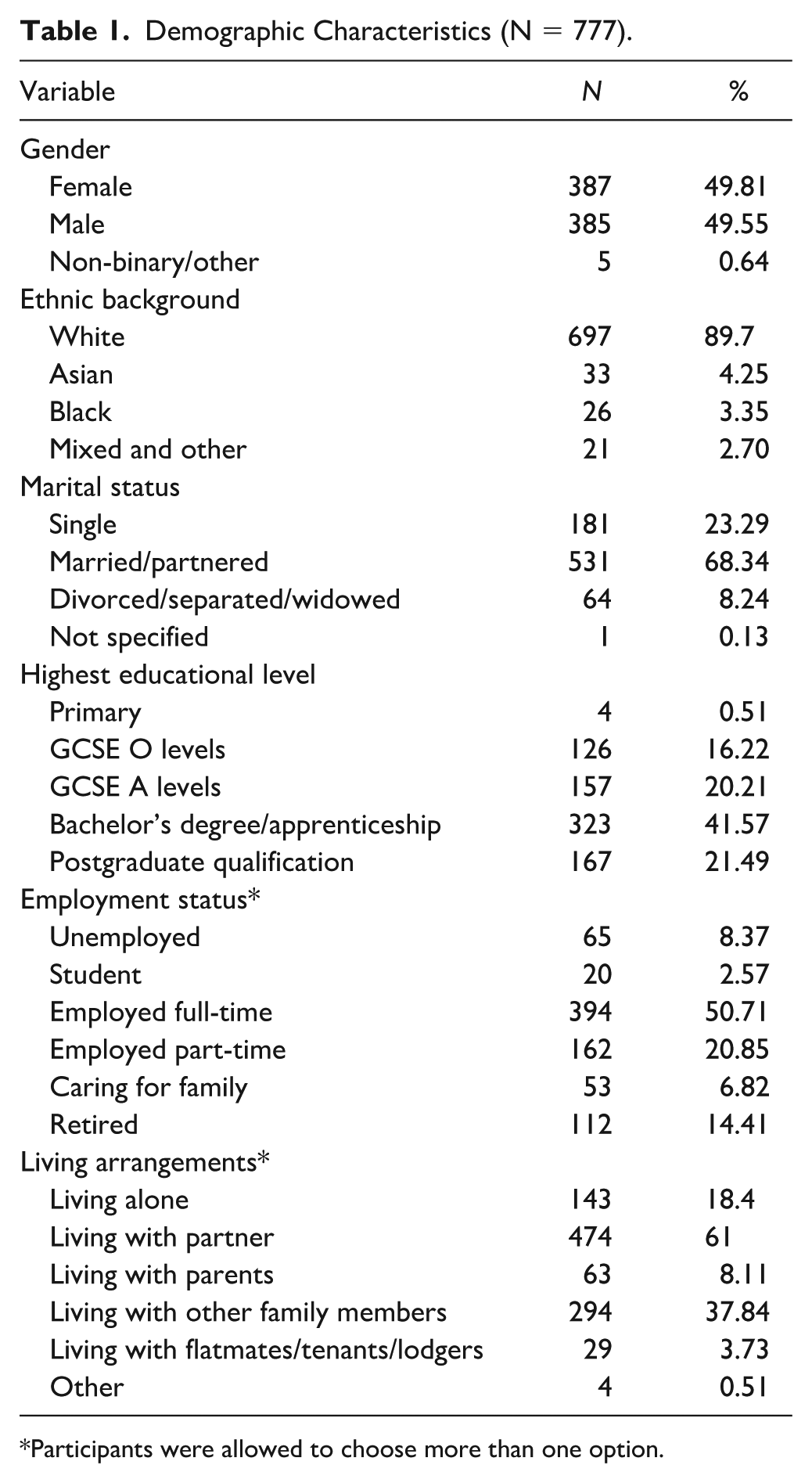
Participants were allowed to choose more than one option.
Measures
This study is part of a larger research project that included several self-report measures. The following measures were used in the current study.
The Object Attachment Security Measure (OASM; David & Norberg, 2022a, 2022b) comprises two subscales; the secure object attachment (SOA) subscale and the insecure object attachment (IOA) subscale. Both subscales have five items each and participants respond on a 7-point Likert-type scale from 1 (not at all) to 7 (very much so). Higher scores indicate stronger object attachment. As indicated, David and Norberg (2022b) showed that the OASM has excellent psychometric properties. The internal consistency reliability of the secure and insecure object attachment scales were very good in the current study (α = .94 and .88, respectively).
Measures to Evaluate Convergent Validity
The Saving Inventory–Revised (SI-R; Frost et al., 2004) is a 23-item measure of hoarding severity comprising three subscales that measure excessive acquisition, difficulties in discarding, and clutter. Participants respond to items on a 5-point Likert-type scale from 0 (none) to 4 (almost all/complete). The SI-R has excellent psychometric properties (Frost et al.) and is the most frequently used measure of hoarding severity in research and in clinical practice. The internal consistency reliability of the SI-R was very good in the current study (α = .95).
The Clutter Image Rating Scale (CIR; Frost et al., 2004) is a pictorial self-report measure of clutter in three rooms in the home—the living room, bedroom, and kitchen. Each room comprises nine color photos depicting levels of clutter from 1 (least cluttered) to 9 (most cluttered). Participants respond by selecting the picture that “comes closest to the level of clutter in the corresponding room in your home.” An average of score for the three rooms is calculated as an indication of the overall level of clutter. The measure has highly correlated with the SI-R and has very good psychometric properties (Frost et al., 2004). The internal consistency reliability of the CIR in our sample is very good (α = .81).
The Hoarding Rating Scale—Self Report (HRS-SR; Nutley et al., 2020; Tolin et al., 2010) is a 5-item measure of hoarding severity. Participants respond to items assessing clutter, difficulties in discarding, acquisition, emotional distress, and impairment on a 9-point scale from 0 (no problem) to 8 (extreme). The HRS-SR has very good psychometric properties (Nutley et al., 2020) and the internal consistency of the measure in our sample is excellent (α = .91).
The Saving Cognitions Inventory (SCI; Steketee et al., 2003) is a 24-item measure of hoarding-related cognitions. Each item describes a thought that might be triggered when deciding to discard a possession. Participants indicate the extent to which they experience each thought on a 7-point Likert-type scale from 1 (not at all) to 7 (very much). Four subscales tap into different hoarding-related cognitions. The emotional attachment subscale has 10 items that measure sentimental attachment to objects. The memory subscale has five items that measure the need to use objects to remember things. The control subscale has three items that measure the need to have control over one’s possessions. The responsibility subscale has six items and measures feelings of responsibility over possessions. The SCI has very good psychometric properties (Steketee et al., 2003). In the current study, the internal consistency reliability of these subscales ranged from acceptable to very good (emotional attachment α = .95; control α = .74; responsibility α = .83, memory α = .84).
Measures to Evaluate Divergent Validity
The Patient Health Questionnaire 9 (PHQ-9; Kroenke et al., 2001) is a nine-item measure of depression, and the Generalized Anxiety Disorder 7 (GAD-7; Spitzer et al., 2006) is a seven-item measure of anxiety. The items of the PHQ-9 and GAD-7 describe symptoms of depression and anxiety respectively and participants rate how often they were bothered by these symptoms in the last 2 weeks, from 0 (not at all) to 3 (nearly every day). Both measures are widely used self-report screening tools with strong psychometric properties (O’Connor, Henninger, et al., 2023; O’Connor, Perdue, et al., 2023). The PHQ-9 and GAD-7 showed strong internal consistency reliability in this study (α = .91 and .93, respectively).
The Autism Spectrum Quotient–10 (AQ-10; Allison et al., 2012) is a shortened 10-item version of the AQ-50. Items describe autism symptoms and participants rate on a 4-point scale the extent to which they agree or disagree with these statements from 1 (definitely agree) to 4 (definitely disagree). Item responses are recoded to scores of 0 or 1 point such that the total scale score ranges from 0 to 10. The scale has good psychometric properties (Allison et al., 2012). The internal consistency reliability of the AQ-10 in the current study was assessed using the Kuder-Richardson Formula 20 due to the dichotomously scored items (KR-20; Kuder & Richardson, 1937) and showed weak internal consistency (KR-20 = .61).
The Obsessive Compulsive Inventory–12 (OCI-12; Abramovitch et al., 2021) is the shortened 12-item version of the OCI-R and is a widely used measure of obsessive-compulsive disorder (OCD) symptoms. Participants rate on a 5-point scale from 0 (not at all) to 4 (extremely) the extent to which a symptom distressed or bothered them during the past month. The OCI-12 has very good psychometric properties (Abramovitch et al., 2021) and had excellent internal consistency reliability in the current study (α = .91).
Other measures administered to participants but not used in the current study are noted in the Supplemental Materials (Table S5).
Procedure
Participants were recruited via Prolific.com—an online crowdsourcing service designed for the recruitment of participants for research. Participants sign up to Prolific.com and receive notifications to participate in research studies for payment. Over 66,000 UK-based individuals actively complete research studies, and previous research has shown that Prolific participants produce high-quality data (Douglas et al., 2023).
Participants were invited to the study between October 2023 and July 2024. Data collection was stratified by age cohort to ensure similar numbers between groups. Participants were directed to an online survey platform (gorilla.sc). After viewing the participant information letter, participants provided informed consent on the online survey platform. The survey included seven attention checks, and the order of questionnaires was presented randomly. Additional questionnaires were presented but not part of this study. Individuals who failed more than one attention check were excluded. Participants were paid £6.00 for completing the survey.
Data Analysis
We used JAMOVI version 2.3.26.0 with the SEMLj module that uses the lavaan R package (Gallucci & Jentschke, 2021; Rosseel, 2012) to conduct the confirmatory factor analyses and evaluate measurement invariance. All other analyses were conducted using SPSS version 29.
CFA and Measurement Invariance Testing
Preliminary analyses showed that there were no missing values. We used Maximum Likelihood with Robust Standard Errors (MLR) estimation and scaled versions of fit indices for all CFA because assumption testing indicated that the multivariate normality assumption was violated. Factor loadings for the first indicator of each latent construct were fixed to 1. The correlated two-factor model similar to the model presented in David and Norberg (2022b) was evaluated using four model fit indices; the comparative fit index (CFI), Tucker–Lewis index (TLI), standardized root mean square residual (SRMR), and the root mean square error of approximation (RMSEA) with its 90% confidence interval (CI). We report the chi-square test (χ2), but did not use it as a fit criterion due to its sensitivity to large sample sizes, which often results in statistical significance. Good model fit was indicated by CFI and TLI ≥ 0.95, SRMR and RMSEA ≤ 0.05. Acceptable model fit was indicated by CFI and TLI ≥ 0.90, and RMSEA from 0.07 to 0.08 (Hu & Bentler, 1999).
To examine measurement invariance, we conducted three multigroup CFA across three age groups (25–40, 41–55, 56–70), genders (male and female), and hoarding severity groups. The hoarding severity groups were determined using the recommended clinical cutoff score for the SI-R (Kellman-McFarlane, 2019) resulting in a low hoarding group (SI-R ≤ 38, n = 668) and a high hoarding group (SI-R ≥ 39, n = 109).
To test full measurement invariance, we followed the standard stepwise procedure and compared the unconstrained model (configural) with increasingly constrained models; we examined metric invariance by constraining factor loadings across groups, scalar invariance by constraining factor loadings and intercepts. Finally, we examined strict invariance by constraining factor loadings, intercepts, and residuals variances. As there were only five participants who did not identify as either male or female, they were excluded from the gender analysis. Similar to the first CFA, CFI, TLI, RMSEA, and SRMR are reported. We compared model fit using differences in CFI and RMSEA, as ΔCFI < .01 and ΔRMSEA < .015 suggest negligible differences in model fit (Cheung & Rensvold, 2002). We evaluated the internal consistency reliability of the OASM with Cronbach’s alpha and MacDonald’s omega.
Convergent and Divergent Validity
Preliminary analyses and assumption testing for the evaluation of convergent and divergent validity indicated positive skewness for some scales. Therefore, Spearman’s correlations were reported for all correlational analyses. In total, 30 correlations were conducted to examine convergent and divergent validity, which increased the risk of Type 1 errors. We therefore applied a Bonferroni correction and adjusted the alpha to .0017. Fisher’s r-to-Z transformations and Steiger’s z were computed to compare correlations using an online calculator (Lee & Preacher, 2013; Steiger, 1980). To evaluate if there were significant differences in correlations between convergent and divergent validity, we compared the IOA-SIR correlation with the correlations between IOA and PHQ-9, GAD-7, OCI-12, and AQ-10. To examine if IOA was more strongly associated with psychopathology than SOA, we compared the correlations between IOA and psychopathology (SIR, PHQ-9, GAD-7, OCI-12, and AQ-10) with correlations between SOA and the same variables. Bonferroni correction for nine comparisons yielded an adjusted alpha of .0056.
Finally, to examine whether insecure object attachment predicted hoarding severity after accounting for secure object attachment, we conducted a multiple regression analysis and entered secure and insecure object attachment as predictors of hoarding severity measured with the SI-R. All assumptions were met for this analysis, and there were no signs of multicollinearity (VIF = 1.80) even though secure and insecure object attachment were correlated.
Results
Confirmatory Factor Analysis
Descriptive statistics for all OASM items are presented in Table 2. All secure object attachment items were normally distributed but several insecure object attachment items showed a slight positively skew.
Descriptive Statistics for Object Attachment Security Measure Items (N = 777).
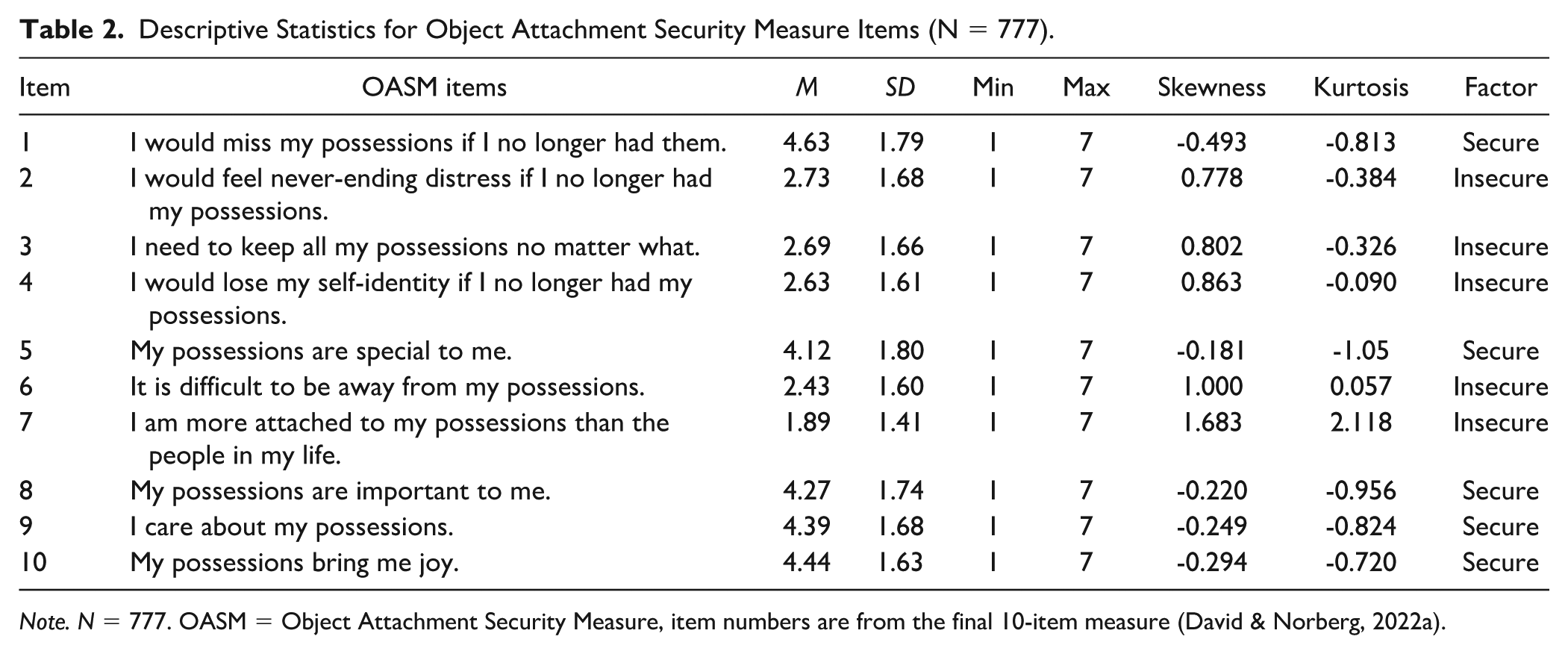
Note. N = 777. OASM = Object Attachment Security Measure, item numbers are from the final 10-item measure (David & Norberg, 2022a).
Figure 1 shows the path diagram for the correlated two-factor model. Standardized factor loadings (β) for items ranged from .60 to .95 and were all statistically significant. As expected, due to the large sample size, the chi-square test was significant, χ2 = 190 (df = 34), p < .001. Three model fit indices indicated good model fit (CFI = 0.965, TLI = 0.954, SRMR = 0.036) and the RMSEA indicated acceptable model fit, RMSEA = 0.077, 90% CI = [0.067, 0.087]. Reliability indices showed excellent internal consistency for both subscales (Secure α = .94, ω = .94; Insecure α = .88, ω = .89). Please see Supplemental Materials Table S1 for factor loadings for all items.
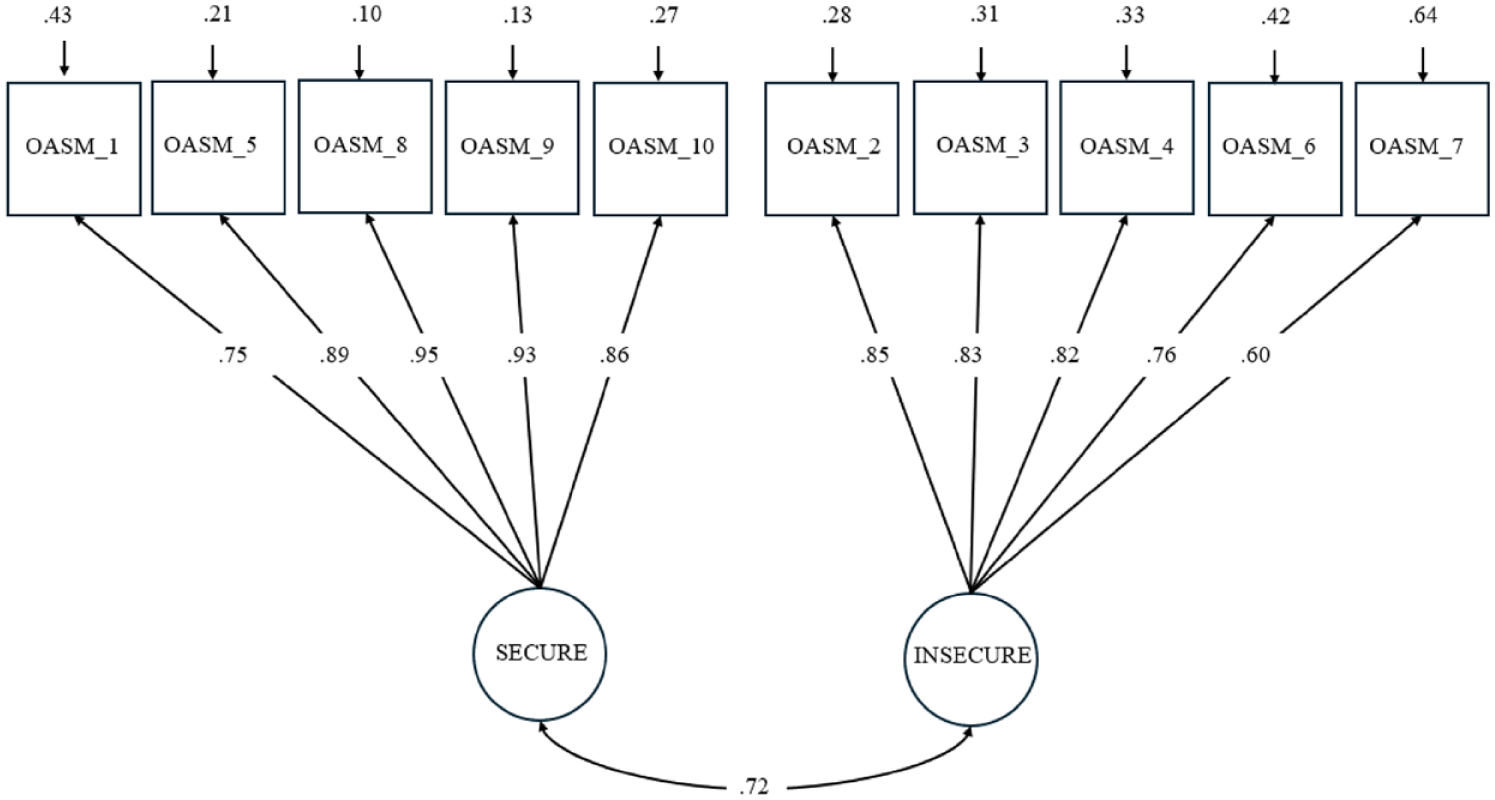
Confirmatory Factor Model for the Object Attachment Security Measure (n = 777).
Measurement Invariance
We assessed measurement invariance across age (group 1: 25–40, group 2: 41–55, group 3: 56–70), gender (female and male), and hoarding severity groups (Low Hoarding: SI-R ≤ 38, High Hoarding: SI-R ≥ 39) to ensure that the secure and insecure object attachment were equivalently assessed by the OASM across these groups.
We found acceptable model fit for all multigroup models. As shown in Table 3, there was acceptable fit for the configural models. Factor loadings for the configural models are included in Supplemental Materials (Tables S2–S4). Model comparisons showed that metric, scalar, and strict invariance were upheld. The changes in CFI and RMSEA were all within accepted thresholds (ΔCFI ≤ 0.01, ΔRMSEA ≤ 0.015) indicating that the OASM measured secure and insecure object attachment consistently across age, gender, and hoarding groups.
Fit Indices and Model Comparisons for Measurement Invariance Across Age, Gender, and Hoarding Severity Groups.
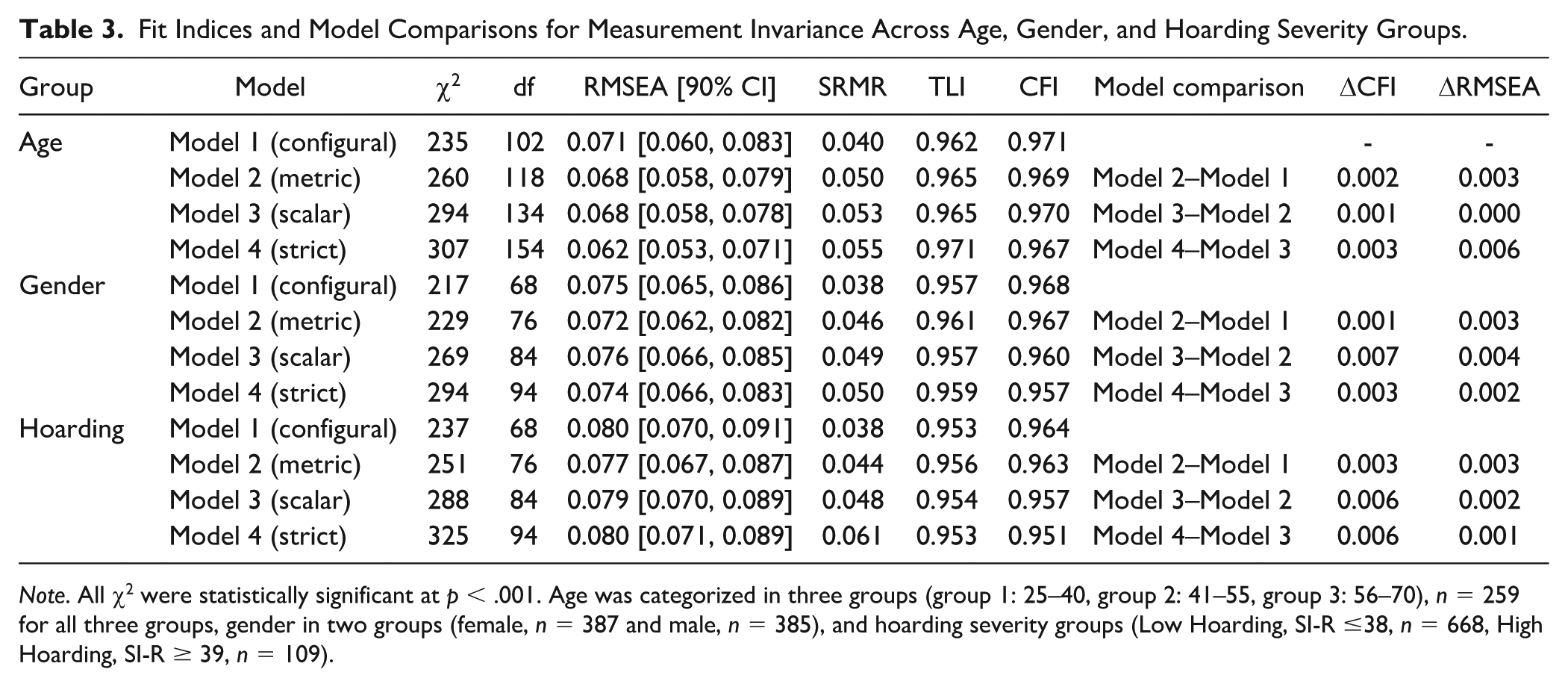
Note. All χ2 were statistically significant at p < .001. Age was categorized in three groups (group 1: 25–40, group 2: 41–55, group 3: 56–70), n = 259 for all three groups, gender in two groups (female, n = 387 and male, n = 385), and hoarding severity groups (Low Hoarding, SI-R ≤38, n = 668, High Hoarding, SI-R ≥ 39, n = 109).
Means, standard deviations, and analysis of variance (ANOVA) tests comparing summed scores of IOA and SOA between these groups are presented in Table 4. The analyses showed significant differences in insecure object attachment between age groups. Tukey’s post hoc tests showed that age group 1 (25–40) and age group 2 (41–55) had significantly higher insecure object attachment than age group 3 (56–70), t (774) = 4,39, p < .001 and t (774) = 2.57, p = .03 respectively. Both insecure and secure object attachment were significantly higher in the high hoarding group compared with the low hoarding group. All other group comparisons were not significant.
Differences Between Age Groups, Genders, and Hoarding Severity Groups in Insecure and Secure Object Attachment.
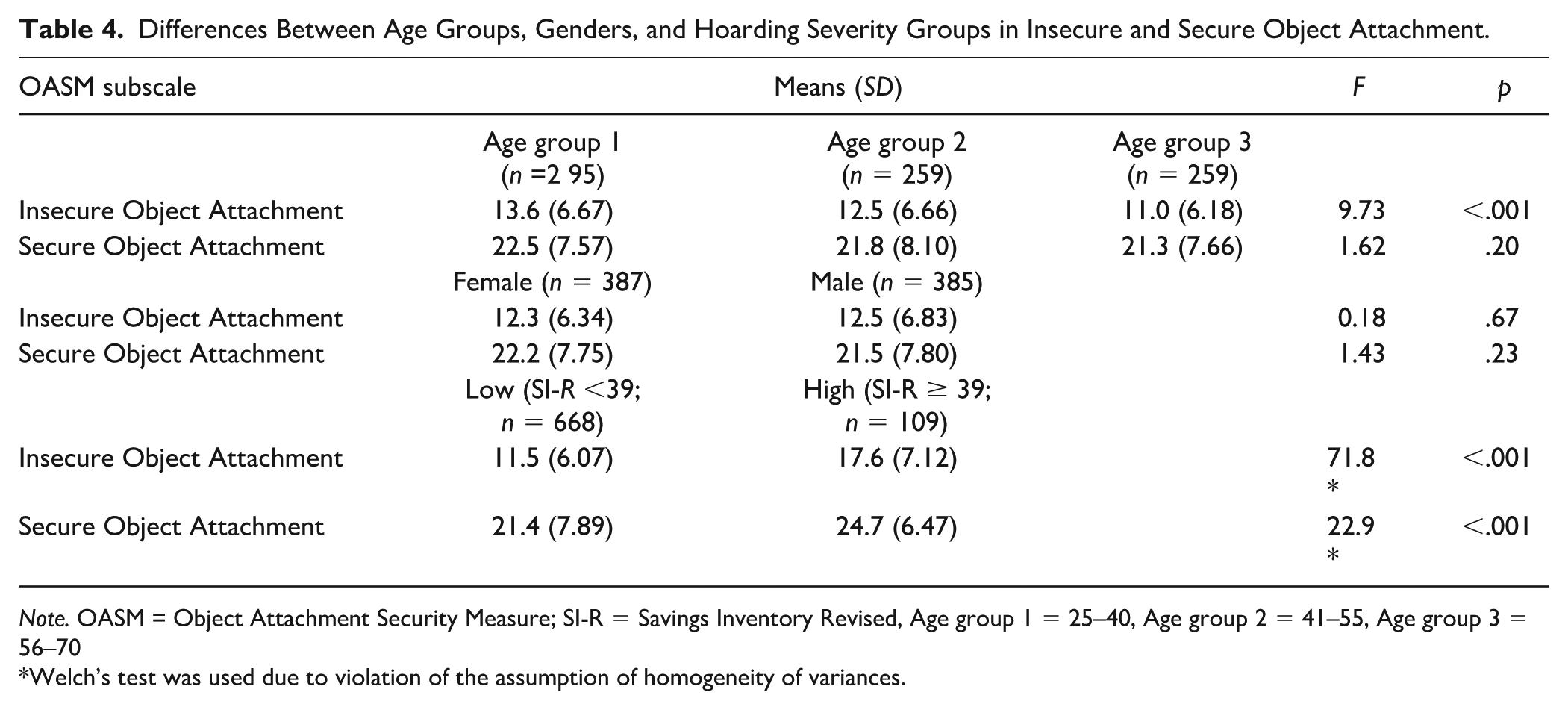
Note. OASM = Object Attachment Security Measure; SI-R = Savings Inventory Revised, Age group 1 = 25–40, Age group 2 = 41–55, Age group 3 = 56–70
Welch’s test was used due to violation of the assumption of homogeneity of variances.
Convergent and Divergent Validity
To replicate David and Norberg (2022b), we evaluated convergent validity by examining correlations between the OASM subscales and the HRS-SR, CIR, SCI and SIR scales. For divergent validity correlations were examined between OASM subscales and PHQ-9 (depression), GAD-7 (anxiety), OCI-12 (obsessive-compulsive disorder), and AQ-10 (autism). Correlations are reported in Table 5. As expected, we found moderate to strong correlations between insecure object attachment and hoarding severity and hoarding-related cognitions. By contrast, weak to moderate correlations were found for associations with depression, anxiety, OCD, and autism.
Spearman’s Correlations for Convergent and Divergent Validity.
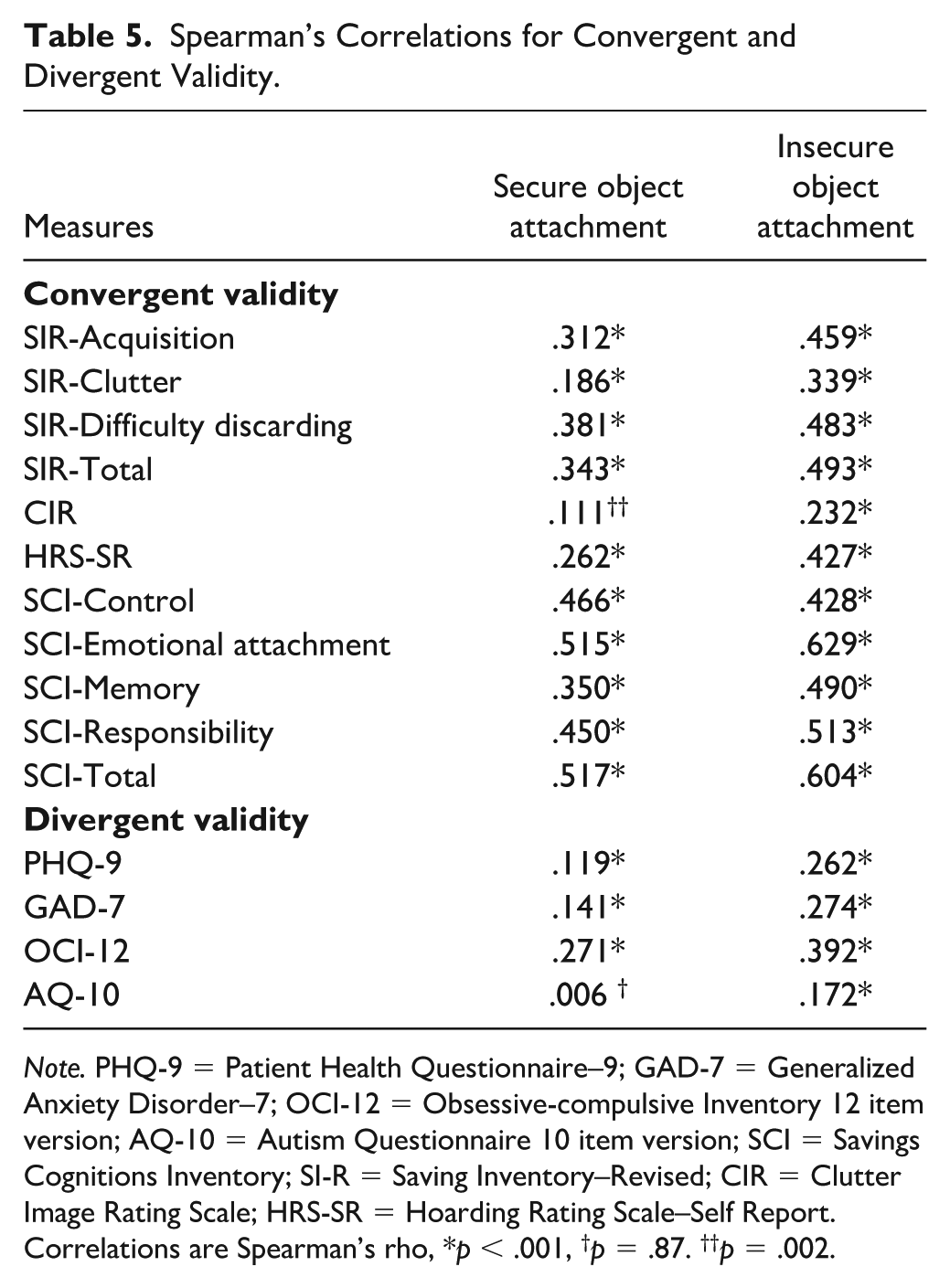
Note. PHQ-9 = Patient Health Questionnaire–9; GAD-7 = Generalized Anxiety Disorder–7; OCI-12 = Obsessive-compulsive Inventory 12 item version; AQ-10 = Autism Questionnaire 10 item version; SCI = Savings Cognitions Inventory; SI-R = Saving Inventory–Revised; CIR = Clutter Image Rating Scale; HRS-SR = Hoarding Rating Scale–Self Report. Correlations are Spearman’s rho, *p < .001, †p = .87. ††p = .002.
We compared the correlation between IOA and SIR with the correlations between IOA and the divergent validity measures (PHQ-9, GAD-7, OCI-12, and AQ-10) using Steiger’s z. Results showed that the IOA-SIR correlation was significantly greater than the correlations between IOA and PHQ-9 (z = 6.96, p < .001), GAD-7 (z = 6.45, p < .001), OCI-12 (z = 3.04, p = .002), and AQ-10 (z = 8.27, p < .001).
For the IOA and SOA correlations, analyses showed that IOA had significantly higher correlations than SOA with all psychopathology variables; SIR (z = 6.09, p < .001), PHQ-9 (z = 5.28, p < .001), GAD-7 (z = 4.93, p < .001), OCD-12 (z = 4.68, p < .001), and AQ-10 (z = 6.03, p < .001).
Predicting Hoarding From IOA and SOA
When secure and insecure object attachment were entered into a regression model to predict hoarding severity using the SI-R, we found that insecure object attachment made a significant unique contribution to the model (B = 1.047, SE = 0.095, β = .467, t = 10.99, p < .001.), but secure object attachment did not (B = 0.19, SE = 0.080, β = .010, t = 0.242, p = .809).
Supplemental materials related to this article include detailed factor loading tables for the confirmatory factor analysis and measurement invariance testing (Tables S1–S4) and further information about measures administered to participants but not used in the current study (S5). These materials provide transparency and support the reproducibility of the analyses reported in the article.
Discussion
The results supported the study hypotheses. The first CFA showed good model fit for the OASM’s correlated two-factor structure with secure and insecure object attachment showing a strong positive correlation. Our assessment of measurement invariance showed that the OASM was equally valid across genders (males and females), age groups (young, middled aged, and older adults), and low and high hoarding severity groups. The OASM subscales also demonstrated excellent internal consistency reliability.
Replicating David and Norberg (2022b), we found significant moderate to strong correlations between object attachment and hoarding (SIR and HRS) and hoarding-related cognitions (SCI), demonstrating good convergent validity. Extending David and Norberg’s earlier findings, we also found weak to moderate correlations with depression, anxiety, OCD and autism, demonstrating divergent validity.
The one exception was the clutter image rating scale, which showed a weak correlation with SOA and moderate correlation with IOA. This is consistent with the correlations between object attachment and the SIR clutter subscale which had the weakest correlation of the SIR subscales. This finding may have been due to restriction of range in clutter for our non-clinical community sample. The lower correlation may also have been due to method variance, as the CIR uses a pictorial format.
Compared with secure object attachment, we found significantly stronger correlations between insecure object attachment and psychopathology (i.e., hoarding, obsessive-compulsive disorder, depression, and anxiety). This further supports the importance of separating secure from insecure object attachment and is consistent with the idea that insecure object attachment is the maladaptive component of object attachment.
Also replicating David and Norberg (2022b), we found that insecure object attachment significantly predicted hoarding symptoms even after accounting for secure object attachment, but secure object attachment was no longer a predictor of hoarding severity after accounting for insecure object attachment. This finding is consistent with previous research (David & Norberg, 2022b; Yap & Grisham, 2019). It demonstrates that insecure object attachment plays a central role in hoarding behavior, and that the association between secure object attachment and hoarding may arise primarily from their associations with insecure object attachment.
The CFA findings are consistent with David and Norberg (2022b) and confirm that the OASM has excellent psychometric properties. Importantly, our study is the first to demonstrate strict measurement invariance for the secure and insecure object attachment subscales across genders, age, and hoarding severity groups. Fulfilling strict invariance supports the robustness and validity of the OASM. It shows that the subscales are equally valid across age, gender, and hoarding severity, and indicates that any differences in object attachment between these groups are not due to measurement errors.
The finding that the OASM is valid in both low and high hoarding groups indicates that we can confidently use it in hoarding research. Furthermore, it also indicates that the OASM can be used for assessing object attachment in non-clinical research (e.g., in environmental psychology or consumer psychology). As the bulk of the research in object attachment has been in hoarding disorder, object attachment tends to be viewed as a negative or maladaptive psychological construct. Given that secure object attachment is not associated with hoarding after accounting for insecure object attachment, it is possible that secure object attachment might play a protective role or might be associated with wellbeing. This hypothesis would be consistent with observations from previous research indicating the benefits of having connections with cherished possessions (Csikszentmihalyi & Halton, 1981; Sherman & Newman, 1977). Future research focusing on secure object attachment using the OASM to differentiate the positive aspects of object attachment from the negative, might uncover areas where secure object attachment is adaptive. It may be that fostering secure object attachment while decreasing insecure object attachment might lead to more conscious and respectful relationships with our possessions and could pave the way to addressing issues that have resulted from consumerism, such as overconsumption and excessive waste (Bläse et al., 2024; Salimath & Chandna, 2021). Examining secure and insecure object attachment from a developmental perspective might also provide further insights into whether and how relationships and experiences with belongings in early childhood might be associated with the development of identity and self-regulation (Norman, 2024).
Limitations and Further Research
There are several limitations to our study that should be acknowledged. First, although our sample includes a sizable number of individuals with high levels of hoarding symptoms, we did not conduct clinical interviews to confirm their diagnoses. Further research with participants who have a diagnosis of hoarding disorder would lend further support for the use of the OASM in hoarding research. Another limitation is the use of an online crowdsourcing service to recruit participants. Some researchers have questioned the reliability and validity of crowdsourced data and have noted concerns about bots rather than humans completing surveys (Webb & Tangney, 2024). We have taken these concerns seriously and screened the data carefully for invalid responses, followed best practice recommendations, and included attention checks to ensure that participants read items carefully (Keith & McKay, 2024; Strickland et al., 2022). In addition, our use of Prolific for data collection boosts our confidence of the validity of data. Webb and Tangney (2024) used Amazon’s Mechanical Turk (MTurk) platform to collect data and previous research show that Prolific produces higher quality data than MTurk (Douglas et al., 2023; Peer et al., 2017).
While our study evaluated measurement invariance across genders and ages, it was limited to only males and females and to participants aged from 25 to 70. We will need to conduct further research into the validity of the OASM in participants who are under 25 and over 70, and in participants who identify as non-binary and gender fluid to extend these findings. Furthermore, all participants in our study were from the United Kingdom, and therefore, the cross-cultural validity of the OASM will need further evaluation.
In our evaluation of the OASM’s validity, we used the SCI to assess convergent validity in addition to hoarding severity measures because of the strong association between the SCI and hoarding severity (Steketee et al., 2003). Recent research has shown that hoarding is positively associated with additional constructs including motivations to acquire and save (David et al., 2024), loneliness (Yap et al., 2023, 2024), and emotion regulation difficulties (Grisham et al., 2022). Likewise, for divergent validity, we limited our evaluation to depression, anxiety, OCD, and autism. Future research examining the associations between object attachment and a wider range of constructs may yield a more comprehensive understanding of secure and insecure object attachment.
Finally, an issue that requires further research and consideration is the labeling of the secure object attachment subscale. Unlike secure and insecure interpersonal anxious attachment, which are on opposite ends of a single dimension (Stein et al., 2002), secure and insecure object attachment are positively correlated and exist as two separate dimensions. As secure object attachment is not the opposite of insecure object attachment, the naming of secure object attachment as “secure” might be misleading. We recommend relabeling this construct as “sentimental object attachment” to prevent confusion. Conversely, perhaps secure object attachment is appropriate if it is shown to be an adaptive form of object attachment. Further research examining whether secure object attachment has a buffering effect against hoarding might justify its current label.
Conclusion
Although insecure object attachment has been identified as a key driver of hoarding disorder, research in this area was hampered by the lack of a psychometrically sound measure. The development of the OASM has addressed this limitation. Our study confirms the psychometric properties of the OASM, validates its use across different genders, age groups, and hoarding severity groups, and supports its use in research and clinical settings. Further research should examine the applicability across cultures, in clinical samples, and in longitudinal research. Finally, the findings reaffirm the centrality of insecure object attachment in hoarding. This construct warrants further investigation; finding ways of decreasing insecure object attachment in treatment could improve treatment outcomes for hoarding disorder.
Supplemental Material
sj-docx-1-asm-10.1177_10731911251378650 – Supplemental material for The Object Attachment Security Measure: Assessing Convergent and Divergent Validity, Confirmatory Factor Analysis, and Measurement Invariance Across Age, Gender, and Hoarding Severity
Supplemental material, sj-docx-1-asm-10.1177_10731911251378650 for The Object Attachment Security Measure: Assessing Convergent and Divergent Validity, Confirmatory Factor Analysis, and Measurement Invariance Across Age, Gender, and Hoarding Severity by Keong Yap, Jane Scott and Sharon Morein-Zamir in Assessment
Footnotes
Acknowledgements
The authors would like to thank Rachel van Marle for her assistance with data collection.
Data Availability Statement
Data is available by emailing the corresponding author.
Declaration of Conflicting Interests
The authors declared no potential conflicts of interest with respect to the research, authorship, and/or publication of this article.
Funding
The authors received no financial support for the research, authorship, and/or publication of this article.
Ethical Approval and Informed Consent
The study was approved by the Anglia Ruskin University Research Ethics Committee (ETH2223-6749) and the Australian Catholic University Human Research and Ethics Committee (2024-3489E). All participants gave informed consent to participate in the online survey.

Supplemental Material
Supplemental material for this article is available online.
References
Supplementary Material
Please find the following supplemental material available below.
For Open Access articles published under a Creative Commons License, all supplemental material carries the same license as the article it is associated with.
For non-Open Access articles published, all supplemental material carries a non-exclusive license, and permission requests for re-use of supplemental material or any part of supplemental material shall be sent directly to the copyright owner as specified in the copyright notice associated with the article.
