



Abstract
The aim of this experiment was to examine the relationship between individual attentional control capabilities and learning from video-based lectures with differing amounts of visual stimuli. Research suggests that extraneous stimuli in lectures, such as visual instructor presence, may increase cognitive load, thus inhibiting learning. This experiment explored how lecture format (slides that filled the screen vs. a virtual classroom), instructor presence, and attentional control ability impacted learning outcomes. Participants engaged in a battery of attention tasks, watched a lecture, and were quizzed on the lecture material. Attentional ability level interacted with instructor presence, where instructor presence improved learning for individuals with poor attentional capacity but slightly harmed learning for those with better attentional capacity. There were no main effects of instructor presence or lecture format. Despite the additional stimuli that instructor presence adds to a lecture, it is possible that the speaker’s image may increase engagement.
Keywords
Introduction
In recent years, pre-recorded video-based lectures and lectures administered remotely in video format have risen in popularity. Online education has seen widespread global adoption due to the convenience and flexibility that come along with it (Yuan et al., 2021). Within video-based lectures, it is common for the lecturer to be visually present somewhere on the screen. A survey of 218 massive online open courses (MOOCs) found that 94.5% of course videos showed instructors on screen (Yuan et al., 2021). The format in which instructors are presented varies. Common forms of instructor presentation include picture-in-picture, in-person lecture capture (Chen & Wu, 2015), and image with voiceover (Yuan et al., 2021). Picture-in-picture lecture format refers to the presence of a small frame, containing a video of the lecturer, being placed within a larger frame. This is the typical layout for lectures delivered through video-conferencing software, such as Zoom. Lecture capture is the practice of recording a lecture that is being given live in a classroom. Image with voiceover refers to the visual component of a lecture, such as a slideshow or whiteboard, being presented on the screen with only the lecturer’s voice overlaid, their image is absent.
Despite this normative practice, definitive evidence does not exist as to whether the visual presence of the instructor improves or even significantly impacts the retention of learned material. A systematic review of instructor presence in instructional videos found that results related to learning outcomes are mixed, and often null (Henderson & Schroeder, 2021). No study included in the aforementioned review consistently found that visual presence aids learning. Furthermore, the seductive-details hypothesis suggests that learning is not necessarily deepened when the speaker’s image is present in an educational video (Harp & Mayer, 1998). Although the speaker’s image may be entertaining and draw interest from the learner, it is not relevant to the material being presented. The results of Mayer et al. (2003) and Moreno et al. (2001) were consistent with this hypothesis, finding that students who learned with an agent present on the screen did not score significantly higher on assessments than those who learned with no agent on screen. These studies concluded that while the agent’s voice is important for improving learning, the agent’s physical image is not. The agent’s image on the screen is an extraneous element that either is ignored (and has no effect) or is examined (and has a distracting effect) by the learner.
However, some studies found that the presence of an instructor had a significant benefit on performance under a certain condition in that specific study. When students watched and responded to questionnaires related to both an easy and a difficult video lecture (Wang & Antonenko, 2017), instructor presence aided participants on the test for the easy lecture, but not for the difficult lecture.
The aforementioned findings suggested that including a visual representation of a lecturer may impact cognitive load. Cognitive load broadly refers to the amount of mental resources being taxed during a certain task (Henderson & Schroeder, 2021; Sweller, 1988). When an instructor is visible, the image of a person speaking is a detail that a student must process in addition to the lecture so it may increase cognitive load. This image is present in addition to other visual stimuli in the lecture, such as content on a projected whiteboard, settings buttons, a participant list and more. The nature of and amount of extraneous visual stimuli in a video lecture is dependent on the lecture format.
Wang and Antonenko (2017) concluded that easy lectures resulted in a lower cognitive load, making more resources available to attend to the lecturer than when watching difficult lectures. Following this logic, the impact on cognitive load imposed by a visual instructor was substantial enough that when cognitive resources were already allocated to a difficult task, people wouldn’t pay attention to the image of the instructor. Furthermore, cognitive load theory states that when the cognitive load exceeds the capacity of the individual, learning will not be possible (Henderson & Schroeder, 2021; Sweller, 1988).
Attention is a key facet of cognition and individuals differ in their personal attentional control capabilities (Burgoyne et al., 2023). Attentional control refers to one’s ability to regulate information processing in service of goal-directed behavior. It allows individuals to maintain focus on task-relevant information while resisting distraction and interference by external events and internal thoughts. The literature suggests that if there is an instructor on screen in an educational video, it will draw visual attention (Chen & Wu, 2015; Henderson & Schroeder, 2021; Wang & Antonenko, 2017). It is possible that individuals with poor attentional control would have a more difficult time retaining information from a lecture with a high amount of visual stimuli, such as instructor presence, in a video lecture in comparison to individuals with better attentional control.
To further investigate the impacts of visual stimuli inclusion on learning from video lectures, this study explored the effects of manipulating instructor presence and format in video lectures. Further, this experiment examined whether or not learning outcomes for individuals with poor attentional control would be hindered by a high amount of visual stimuli in a lecture in comparison to individuals with better attentional control.
Method
Participants
One hundred thirty-four students (82 females, 50 males, two non-binary individuals) at a large university in the southern United States were recruited via the university’s online research participation system. The average age was 19 (SD = 1.1; Range = 18–23). Participants received class credit for their participation in the study.
Materials
Participants engaged in a battery of three attention control tasks embedded in Qualtrics, the Stroop Squared, Flanker Squared, and Simon Squared tasks (Burgoyne et al., 2023). Completing all three tasks took roughly 9 min.
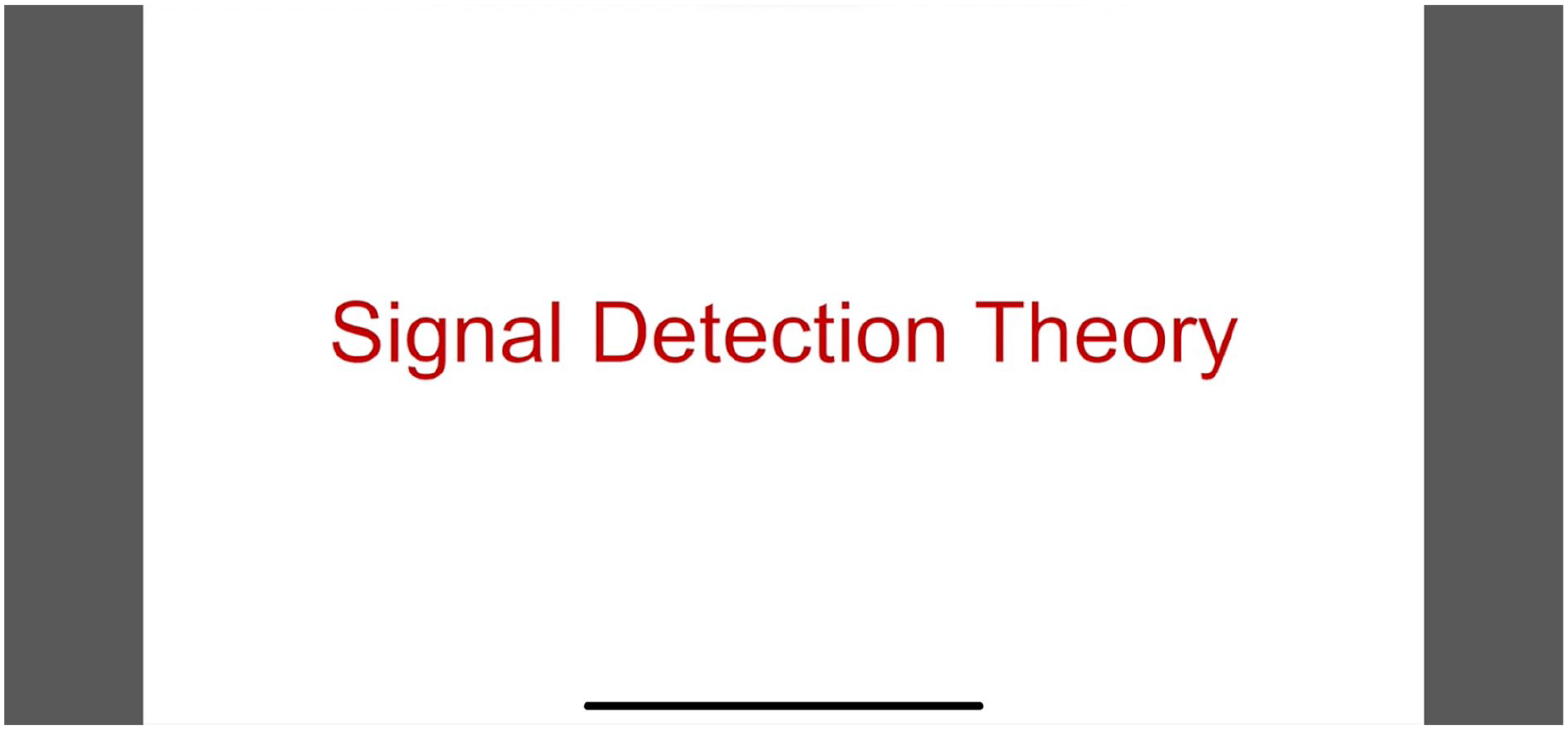
A 10-min lecture covering signal detection theory was used in this study. This topic was chosen because it was thought that most students would not have prior knowledge of this psychological theory due to its novelty. The lecture was designed to be moderately challenging. Four conditions of this lecture were created by manipulation of the independent variables, though the content and timing of each video were identical. The lecture conditions were: (a) Slides with a video of the instructor speaking overlaid (Figure 1), (b) Slides without instructor presence (Figure 2), (c) Video capture of a virtual classroom with an instructor present (Figure 3), (d) Video capture of a virtual classroom without instructor presence (Figure 4). The slides-based lecture format was similar to viewing a lecture delivered through a video-conferencing platform. The virtual classroom environment was meant to simulate in-person lecture capture.

Slides-based lecture with instructor present.
Slides-based lecture with instructor absent.
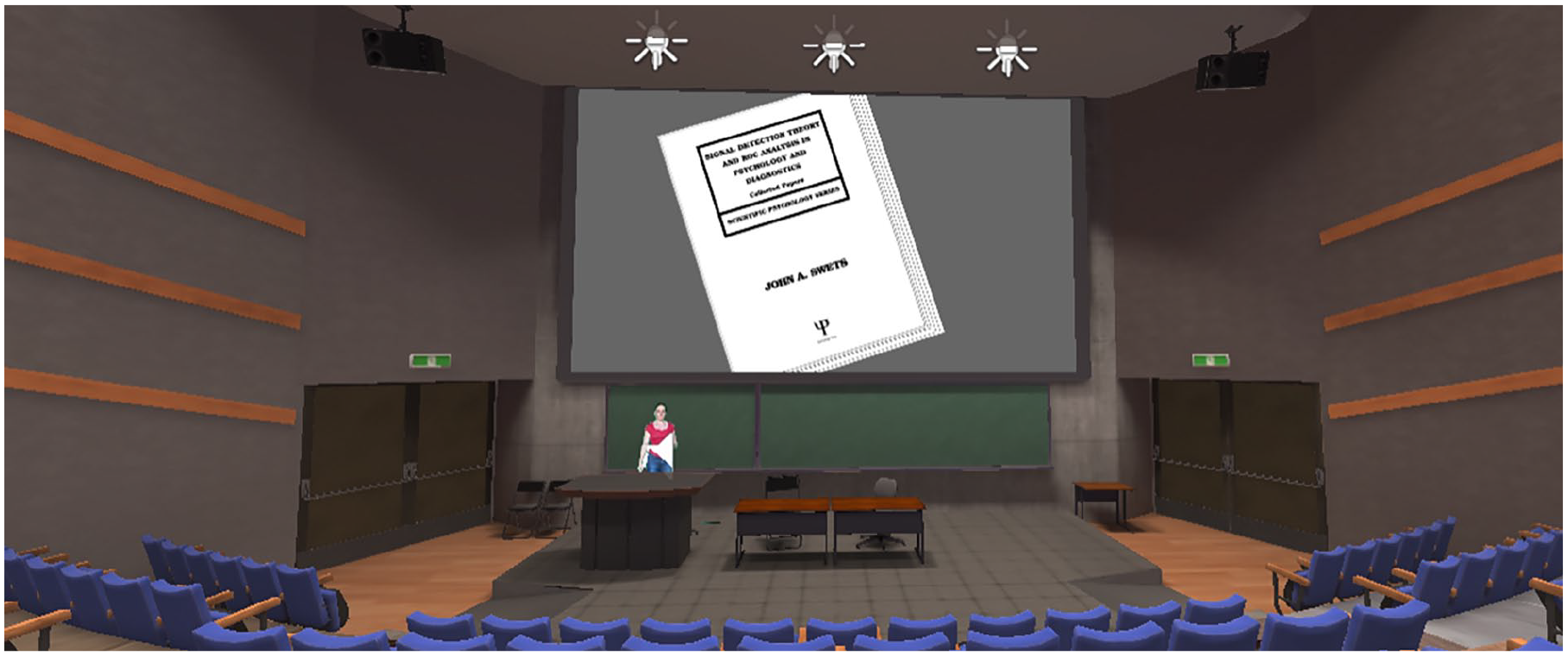
Virtual classroom lecture with instructor present.
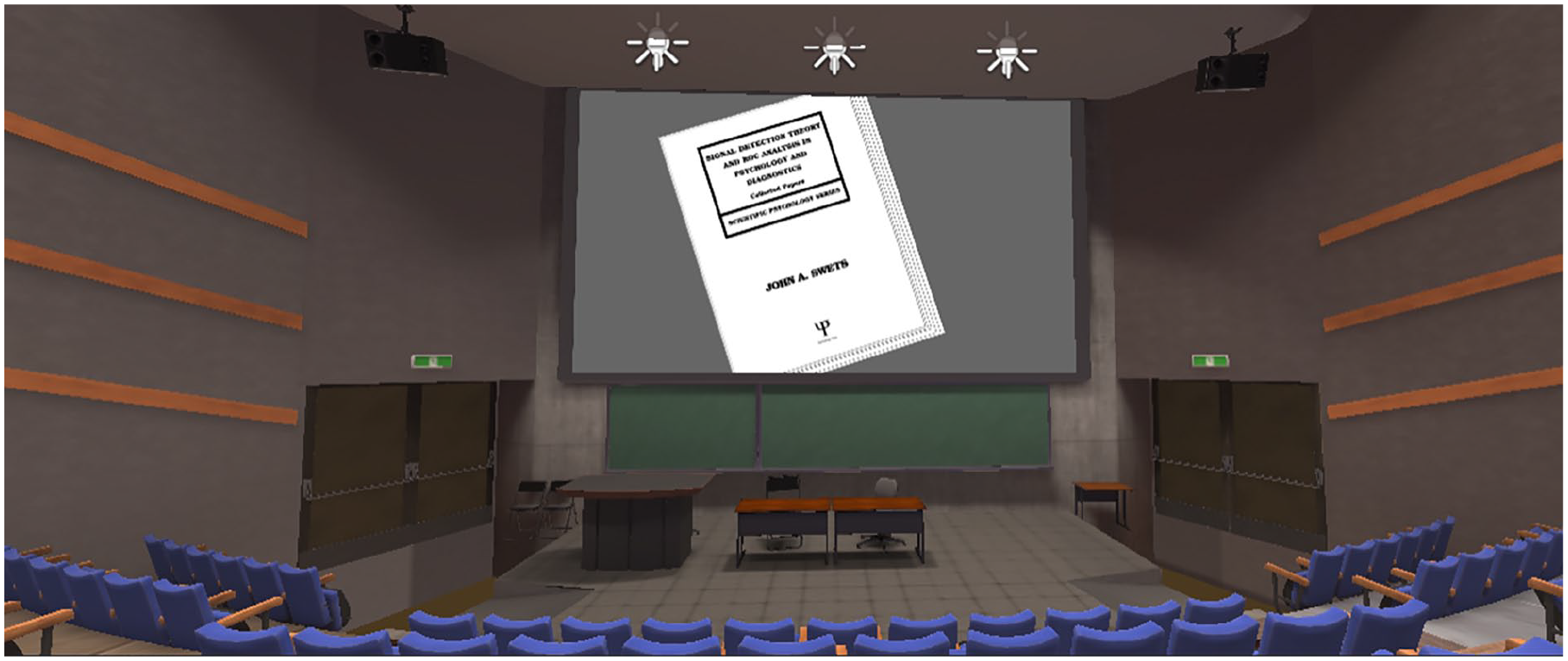
Virtual classroom lecture with instructor absent.
Three short questionnaires were administered during the study. The first was a demographics questionnaire which inquired about the participants’ age, gender, racial identity, native language, academic standing and college major. A second questionnaire asked mainly about learning preferences. It included questions asking participants to rate their prior knowledge about signal detection theory, interest in watching a lecture related to psychology, preferences related to visual instructor presence, preferences for various formats of lectures, and the likelihood of experiencing distraction in various formats of lectures. Lastly, a brief three-item questionnaire asked participants to rate their interest in the lecture that they viewed, how distracting they found the lecture to be and how likely they would be to sign up for a class in the format of the lecture condition that they were assigned to.
A 25-question post-lecture quiz was used to assess retention of the material covered in the signal detection theory lecture. All questions on this quiz were multiple choice and based on information stated explicitly in the lecture video.
Design
This experiment employed a 2 × 2 between-subjects design. The independent variables were instructor presence (presence vs. absence) and video lecture format (slides-based lecture vs. virtual classroom). Four lecture conditions were created by manipulation of the variables. Participants were randomly assigned to one of the four conditions.
The dependent measure was the learning outcomes from each lecture condition, measured as performance on a 25-question quiz about the lecture. Individual differences in attention control were collected. Scores were split at the median to create a factor of attention with two groupings of attentional ability level, high and low. Participants took the attentional control test prior to viewing the lecture.
Procedure
Participants began the study by engaging in the attentional control task. Participants self-reported their attention control score and then they were prompted to fill out a set of demographic questions and a questionnaire about lecture format preferences. Upon completion of the first two questionnaires they viewed the video lecture. Once the video was viewed in full participants engaged in the 25-question post-lecture quiz. A short questionnaire about interest in the signal detection lecture followed the quiz.
Results
A three-way ANOVA was conducted to determine the effects of attentional ability level, lecture format and instructor presence on lecture retention test scores. The assumption of homogeneity of variances was violated, as assessed by Levene’s test for equality of variances, p = .035. A statistically significant three-way interaction between video lecture format, instructor presence, and attentional ability level was found, F (1, 122) = 4.33, p = .04, (Figure 5).
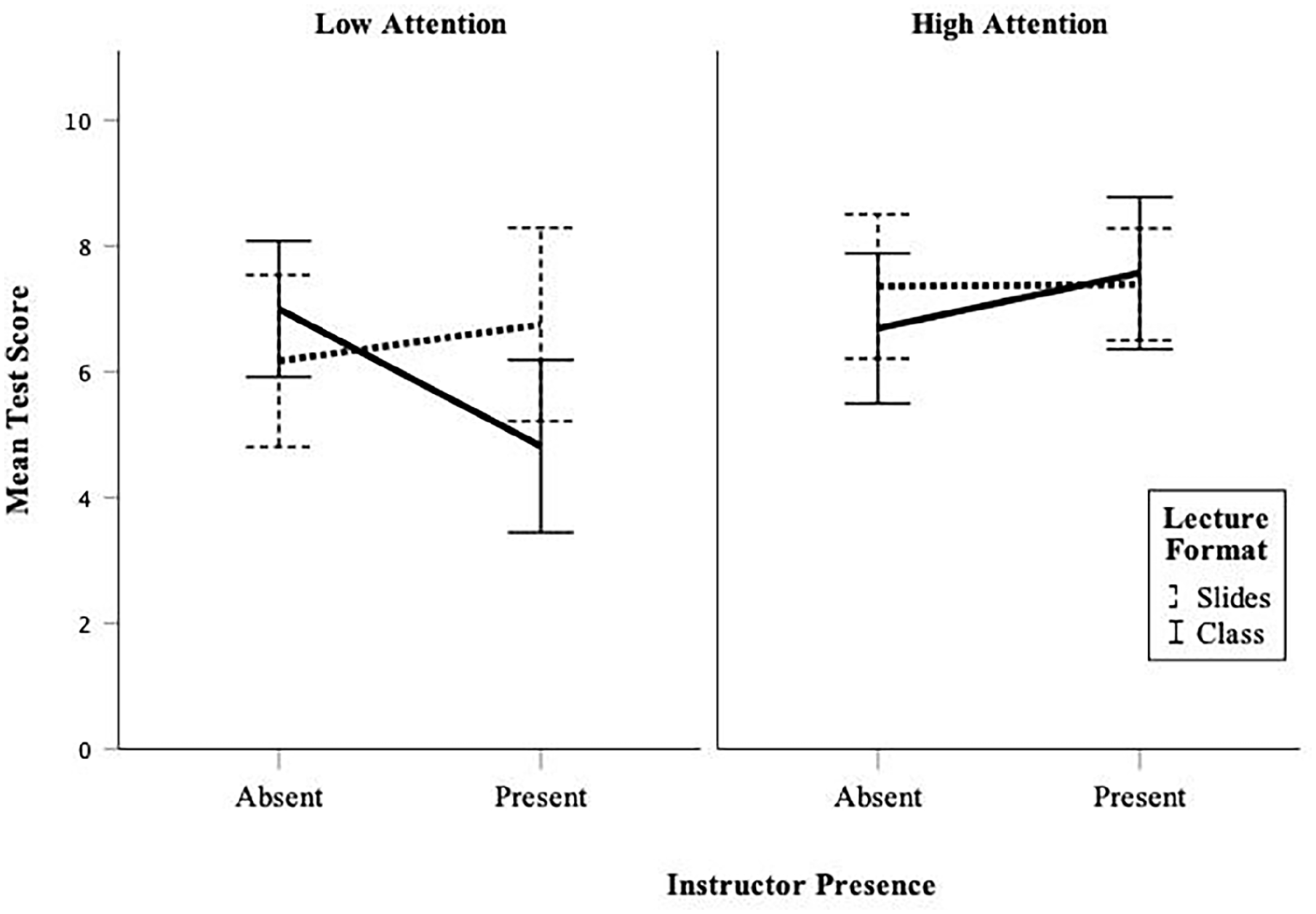
Plot depicting the significant interaction between attentional ability level, visual instructor presence and lecture format.
Two-way ANOVAs on the factors of instructor presence and lecture format were run for each attention ability level to decompose the 3-way interaction. There was a statistically significant two-way interaction between lecture format and instructor presence for individuals in the low attentional ability group, F (1, 122) = 4.861, p = .03, but not for individuals in the high attentional ability group, F (1, 122) = .499, p = .48. There was a statistically significant simple simple main effect of instructor presence for individuals in the low attentional ability group that viewed a virtual classroom format lecture, F (1, 122) = 5.676, p = .02, but not for individuals in the low attentional ability group that viewed a slides-based lecture, F (1, 122) = .457, p = .500.
All simple simple pairwise comparisons were run for individuals in the low attentional ability group that viewed a virtual classroom format lecture with a Bonferroni adjustment applied. Test Scores in the instructor absent group were 7 (SEM = .56) and 4.818 (SEM = .72) in the present group. There was a statistically significant mean difference between instructor presence and instructor absence of 2.182, 95%CI [0.369, 3.995], p = .02.
A significant main effect was found for attentional ability level, F (1, 122) = 6.06, p = .02. No main effects were found for instructor presence, F (1, 122) = .16, p = .69, or video lecture format, F (1, 122) = .84, p = .36.
Discussion
This work has implications for the design of educational resources and learning environments. People tend to prefer instructional videos where an instructor is visually present (Yuan et al., 2021). Despite that, the seductive-details hypothesis suggested that learning is not necessarily deepened when the speaker’s image is present in an educational video (Harp & Mayer, 1998). The results suggest that visual instructor presence does not have a significant impact on learning. A main effect of visual instructor presence was not found. This is consistent with the mixed findings of previous studies. Lecture format was also not found to have a significant impact on learning through ANOVA analysis. Therefore, evidence was not found that any one of the four lecture conditions was optimal for learning for the majority of participants.
Attentional ability level had a significant impact on learning outcomes. Individuals in the high attention group performed better on the lecture retention test than individuals with low attention. Additionally, a three-way interaction between attentional ability level, instructor presence, and lecture format was found. This interaction revealed that individuals with poor attentional capacity performed best in the virtual classroom lecture with the instructor absent. The virtual classroom may have aided performance for individuals with low attentional ability due to the familiar context that it provides. The simulated classroom environment can convey the context of instruction in a physical classroom, which may have helped these individuals to focus on the content (Chen & Wu, 2015). Additionally, the absence of an instructor’s image may have aided low attention individuals as it is one less detail that the individual must devote visual attention to (Chen & Wu, 2015; Henderson & Schroeder, 2021; Wang & Antonenko, 2017).
The findings contribute to the discussion of the benefits and drawbacks of online learning and designing online learning materials with consideration for social presence. It is possible that different lecture formats and designs work best for specific individuals, as indicated by the range in test scores under different video conditions. Future research should explore the implications of allowing customization of video lecture preferences.
This study was limited by its inability to test in-person lecture capture as a lecture format. Conducting future research which looks at the effects of instructor presence and absence in in-person lectures would expand the discussion on instructor visual presence. A second limitation of this study was the short length of the lecture. Research indicates that students’ attention tends to decline 10 to 15 min into a lecture (Wilson & Korn, 2007). The lecture that participants watched was within the threshold of heightened attention, as it was roughly ten minutes. This is also much shorter than a standard class period in a college-level course. Perhaps significant effects of instructor presence and lecture format would be seen if this methodology were replicated in a future study that included a longer lecture. Lastly, performance on the lecture retention test was worse than expected. Out of 25 questions, 15 were excluded from analyses due to mean performance below chancel. It is not clear whether difficulty lied in only the test questions or if the lecture was too difficult. Still, poor performance was problematic because it may have harmed our ability to accurately capture the impacts of instructor presence and lecture format on learning. If the material in the study was unusually difficult to learn, this may not be a true depiction of learning.
Conclusion
Instructor visual presence does not aid or harm learning outcomes, despite the fact that people prefer to consume educational content that includes a visual representation of an instructor (Yuan et al., 2021). Furthermore, the amount of visual stimuli in a lecture is not a determinant of ease of learning. Although instructor presence and lecture format manipulation presented an opportunity to decrease the amount of visual stimuli in a lecture, a main effect was not found for either variable.
Individuals with poor attentional capacity performed best in the virtual classroom lecture with the instructor absent. This suggests that even for those with poor attentional capacity, the lecture condition with the lowest amount of visual stimuli is not necessarily optimal as the virtual classroom format contained more visual elements than the slides-based lecture. Conversely, the absence of an instructor’s image results in a slight decrease in the visual elements on screen. Thus, visual stimuli quantity is not the only factor impacting learning; factors such as personal preference and familiarity of the learning environment or context may be as impactful. Furthermore, the degree to which each of these factors impacts learning may be specific to the individual learner. It is imperative that customization be considered for optimizing learning through technology.
Footnotes
Declaration of Conflicting Interests
The author(s) declared no potential conflicts of interest with respect to the research, authorship, and/or publication of this article.
Funding
The author(s) received no financial support for the research, authorship, and/or publication of this article.