




Abstract
The imperfections in the driving automation system have challenged older adults because the takeover process is cognitively and physically demanding. Due to the wrist being more vibration-sensitive, the haptic display on the smartwatch could be a good option to warn the driver. However, the preference between two vibrotactile patterns, dynamic patterns (vibrating sequences at different locations on the smartwatch) and static patterns (vibrating at certain locations on the smartwatch), is still unclear. Therefore, this study examined the effects of vibrotactile patterns between younger (mean age = 30.97) and older adults (mean age = 69.45) using a national survey. Three hundred forty respondents’ data were collected. The results showed that static patterns received higher usefulness and satisfaction scores than dynamic patterns. However, no age differences were found. These findings provide a potential guide for the next-generation takeover warning system on wrist-wearable devices in the automated system.
Automated vehicles still require human drivers to resume manual control occasionally. This takeover task is cognitively and physically demanding (McDonald et al., 2019) and may create extra challenges for older adults who are experiencing age-related declines in perceptual, cognitive, and physical abilities (Harada et al., 2013; Huang et al., 2022). To enhance older adults’ safety during the takeover, exploring efficient takeover requests is necessary (S. Petermeijer, Bazilinskyy et al., 2017).
Previous studies have shown that takeover requests using haptic sensory channels, such as a vibrotactile signal on the seat, are a viable option to warn younger and older adults in the takeover process (Huang & Pitts, 2022a, 2022b). There are two common formats for haptic displays to convey vibrotactile patterns: static patterns (stimuli generated at a fixed location on certain body parts) and dynamic patterns (stimuli generated sequentially at different locations on certain body parts). While comparing two vibrotactile patterns objectively using driving metrics, the results revealed that static patterns have shorter reaction times compared to dynamic patterns during takeovers (Miyoshi et al., 2023; S. M. Petermeijer, Cieler et al., 2017). However, the subjective rating between both patterns is still unknown. Understanding drivers’ preferences is important to ensure the usability and accessibility of the takeover request design. This is particularly important for older adults since they generally have a lower new technology acceptance rate (Diepold et al., 2017). Therefore, the goal of this study is to evaluate the effects of age and vibrotactile patterns on subjective ratings of haptic display. Given that the wrist is more sensitive to vibration than other body parts (Dim & Ren, 2017; Zheng et al., 2021), in this study, we used the smartwatch for conveying takeover requests.
A national survey was conducted on a crowdsourcing platform—Prolific. We investigate two types of avoidance maneuver scenarios: lateral steering and longitudinal braking. In both scenarios, we employed a 2 (age groups: younger, older) × 4 (vibrotactile patterns, see Figure 1 for more details) full factorial design. The survey received 340 valid responses, including 158 in younger (mean age = 30.97) and 182 in older (mean age = 69.45) age groups. After completing the consent and demographics form, each participant was presented with the survey, containing two sections (a) lateral steering scenario section and (b) longitudinal braking scenario section. In each section, they were asked to watch the video of each scenario. Next, four corresponding vibrotactile patterns were presented in an animated format with sound effects. Finally, participants were required to rate nine items (five related to usefulness and four to satisfaction) using a 5-point (1–5) Likert scale (Van Der Laan et al., 1997) on the four vibrotactile patterns for their respective scenarios.
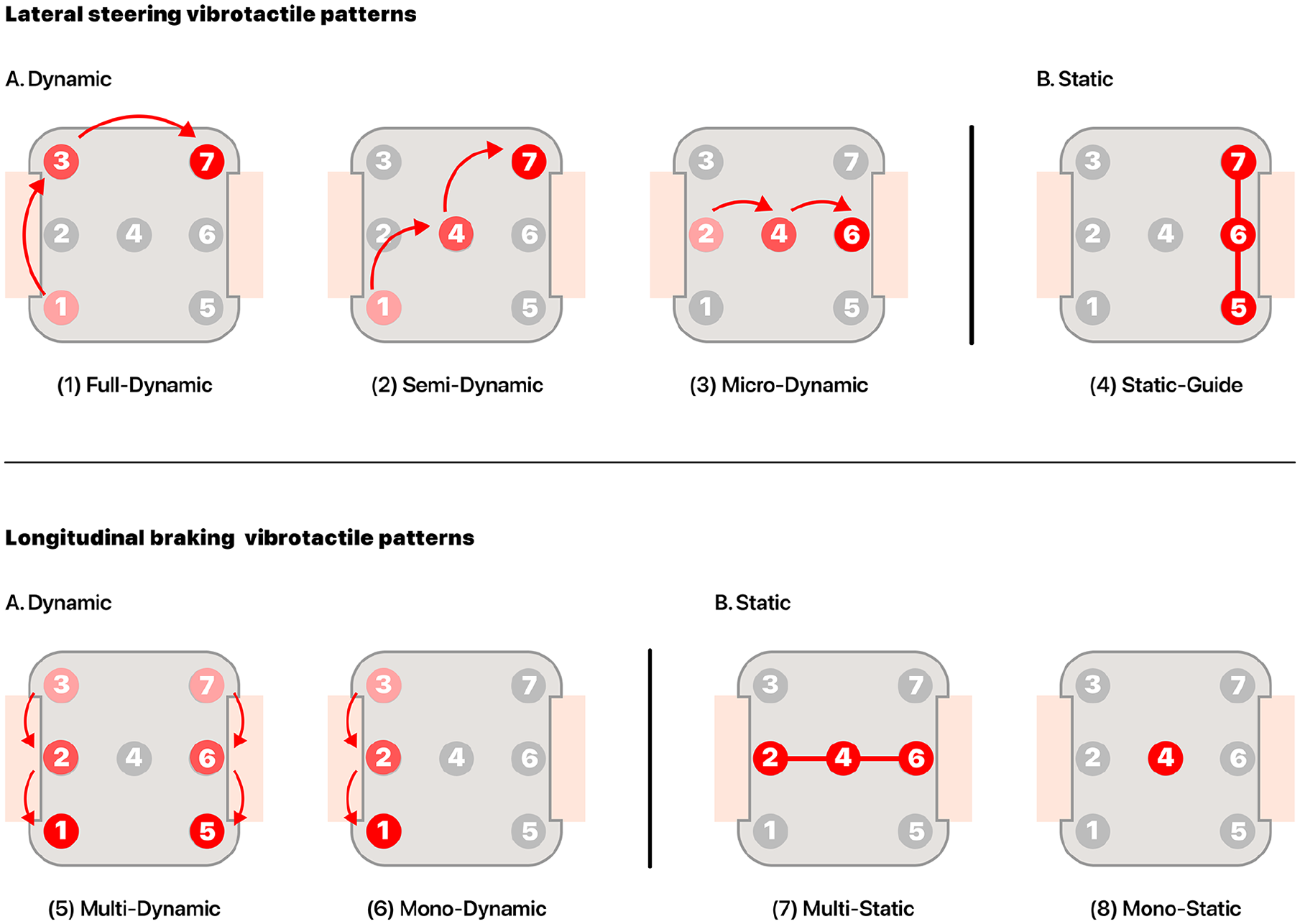
Lateral steering and longitudinal braking vibrotactile patterns used in this study.
Results showed that the static patterns had significantly higher usefulness and satisfaction scores than dynamic patterns in both scenarios. This suggests that static patterns may be more effective for takeover requests. More research is needed to understand the fundamental cause of these differences. Additionally, no significant differences were found between age groups in both scenarios, indicating that the vibrotactile patterns designed in this study are effective for both younger and older adults. Overall, the findings of this study may provide an initial guide for designing haptic displays that interact with automated vehicles, particularly through wrist-wearable devices such as smartwatches.
Footnotes
Declaration of Conflicting Interests
The author(s) declared no potential conflicts of interest with respect to the research, authorship, and/or publication of this article.
Funding
The author(s) disclosed receipt of the following financial support for the research, authorship, and/or publication of this article: This study was supported by the National Science Foundation (PI: Gaojian Huang; Award #: 2153504).
