



Abstract
Strategies to enhance drivers’ initial trust in Autonomous Driving before their first interactions are crucial. This study aimed to investigate the factors shaping the nature of initial trust. We conducted an online survey and examined the relationships between the structure of initial trust and several demographic factors. The results showed that, in general, drivers’ initial trust in Autonomous Driving contained faith and dependability, with dependability emerging as the most significant indicator. However, demographic factors influenced the structure of initial trust. Females, the elderly, unmarried and childless individuals, those with lower personal income, residents in regions outside the top metropolitan areas, or individuals only involved in part-time jobs tended to exhibit a stronger reliance on faith in establishing initial trust. These findings confirmed that targeted design and promotion for different populations with different demographic characteristics are necessary to improve drivers’ initial trust in Autonomous Driving.
Introduction
Human trust in Autonomous Driving (AD) has been widely explored, since a low level of trust may hinder social acceptance of AD (Hutson, 2017), and increased trust can conversely increase the use of AD (Rajaonah et al., 2006). Trust in AD should have four development stages—dispositional trust, initial trust, ongoing trust, and post-task trust. Dispositional trust refers to drivers’ propensity to trust, and initial trust develops from dispositional trust when drivers have just recognized but not used AD. Then, ongoing trust forms from initial trust during interaction with AD, and post-task trust refers to trust formed after completing an interaction with AD. To date, ongoing trust has been found to influence drivers’ dependency and use behavior of AD during interaction and can be dynamically influenced by drivers’ perceived system and situational characteristics. However, besides the perceived real-time characteristics of the system and driving situation, the development of ongoing trust should be based on initial trust (Gao et al., 2021). Consequently, manipulating drivers’ initial trust before the first interaction may be an effective way to manipulate drivers’ ongoing trust in AD.
Structure of Initial Trust in AD
To effectively manipulate initial trust in AD, it’s important to understand its structure because this reveals the fundamental basis of trust (Muir, 1994). According to Muir (1994), trust in automation consists of three components: predictability (the perceived consistency and desirability of recurrent automation behaviors), dependability (the extent of automation can be relied on), and faith (an expectation with no doubt about uncertain interactions and beyond behavioral evidence). For initial trust, predictability should be the dominant component. Nevertheless, the results of Muir and Moray’s (1996) subsequent experiment showed that, instead of predictability, faith had the greatest impact on initial trust. Similarly, studies on the structure of driver trust in driving automation showed that dependability mostly predicted drivers’ initial trust before experiencing driving automation, although the predictors changed slightly due to prior knowledge of driving automation, (Lee et al., 2021). These findings all seem inconsistent with Muir’s (1994) theory, and no study has addressed further evidence on the structure of initial trust in AD with dispositional trust.
Effects of Demographic Factors on the Structure of Trust
Demographic factors can shape initial trust in AD, given that dispositional trust is shaped by personal and sociocultural variables, such as gender, age, and cultural background (Gao et al., 2021). Therefore, investigating the relationships between such factors and initial trust can support further implications that dispositional trust-related factors can be better predictors of drivers’ initial trust in AD.
Despite the absence of substantial evidence regarding the correlation between initial trust formation and specific demographic factors, a recent study on mobile social commerce shed light on a notable distinction: females tend to rely more on rational assessments of product characteristics, while males exhibit a preference for trusting intuitive instincts that surpass readily available evidence (Leong et al., 2021). This observation appears to challenge traditional gender stereotypes. Typically, males are associated with traits such as independence, rationality, and a focus on personal objectives, whereas females are often characterized by their sensitivity, intuition, passion, and inclination toward communal goals (Leszczynski, 2009). Nonetheless, additional verification is imperative to generalize these findings to the realm of trust in AD.
In this study, we considered demographic factors including not only gender, but also age, marital and fertility status, personal income, region, and occupation, and hypothesized that these demographic characteristics contribute to shaping different structures of initial trust in AD.
Methods
Participants and Procedure
The ethical review board of the University approved this study (approval number: 2020R369). We randomly and anonymously recruited 212 Japanese people possessing a Japanese driver’s license from the sample pool of the Internet Research Company Macromill, Inc. to finish an online survey. Participants were all voluntarily to finish the questionnaires without any prejudice, and paid as agreed. According to Macromill, Inc., the top 3% of samples with extremely short response times were removed, and there were finally 206 samples (103 males and 103 females) aged 18 to 69 years (M = 44.6, SD = 11.8).
The survey entities were nine fully automated driving systems (FADS) developed by nine randomly chosen automobile brands that have recently developed driving automation. According to SAE (2018), FADS can operate vehicles under all road conditions just as a skilled human driver and does not need any supervision from human drivers. We gave the participants an introduction regarding this survey and the definition of FADS from SAE (2018) and instructed them that each automobile brand would sell cars with FADS. Then, participants completed a questionnaire including a 7-point Likert trust scale—to measure their initial trust in each FADS. Following Lee et al.’s (2021) research, we used Muir and Moray’s (1996) four-item human-automation trust scale, including one item to quantify overall initial trust, and three respectively to measure the three components of initial trust: predictability, dependability, and faith. Finally, we collected participants’ information on gender, age, marital and fertility status, personal income, region, and occupation.
Data Analyses
Item scores of predictability, dependability, faith, and overall trust were respectively averaged. Then normality tests using the Shapiro-Wilk test were performed on the overall trust scores within each demographic variable group. To verify our hypothesis, we employed linear regression analyses of predictability (P), dependability (D), and faith (F) in overall trust (O), based on the hypothesis: O = P + D + F, proposed by Muir and Moray (1996). Given the high correlations among the four factors (rs > 0.8), suggesting potential multicollinearity, a stepwise linear regression was employed as a common method to address this issue (Slinker & Glantz, 1985) was performed. Since only one participant was aged 10 to 19 years, this age group was eliminated from analyses. Similarly, analyses for personal income were performed after eliminating samples of “Do not know / Unanswered” since those samples were meaningless to the results. Then, we only selected five major occupations (see Table 1) for regression analyses, due to the small sample size of the others. All analyses were conducted in SPSS 26.0.
Descriptive and Stepwise Regression Results for Different Demographic Characteristics.
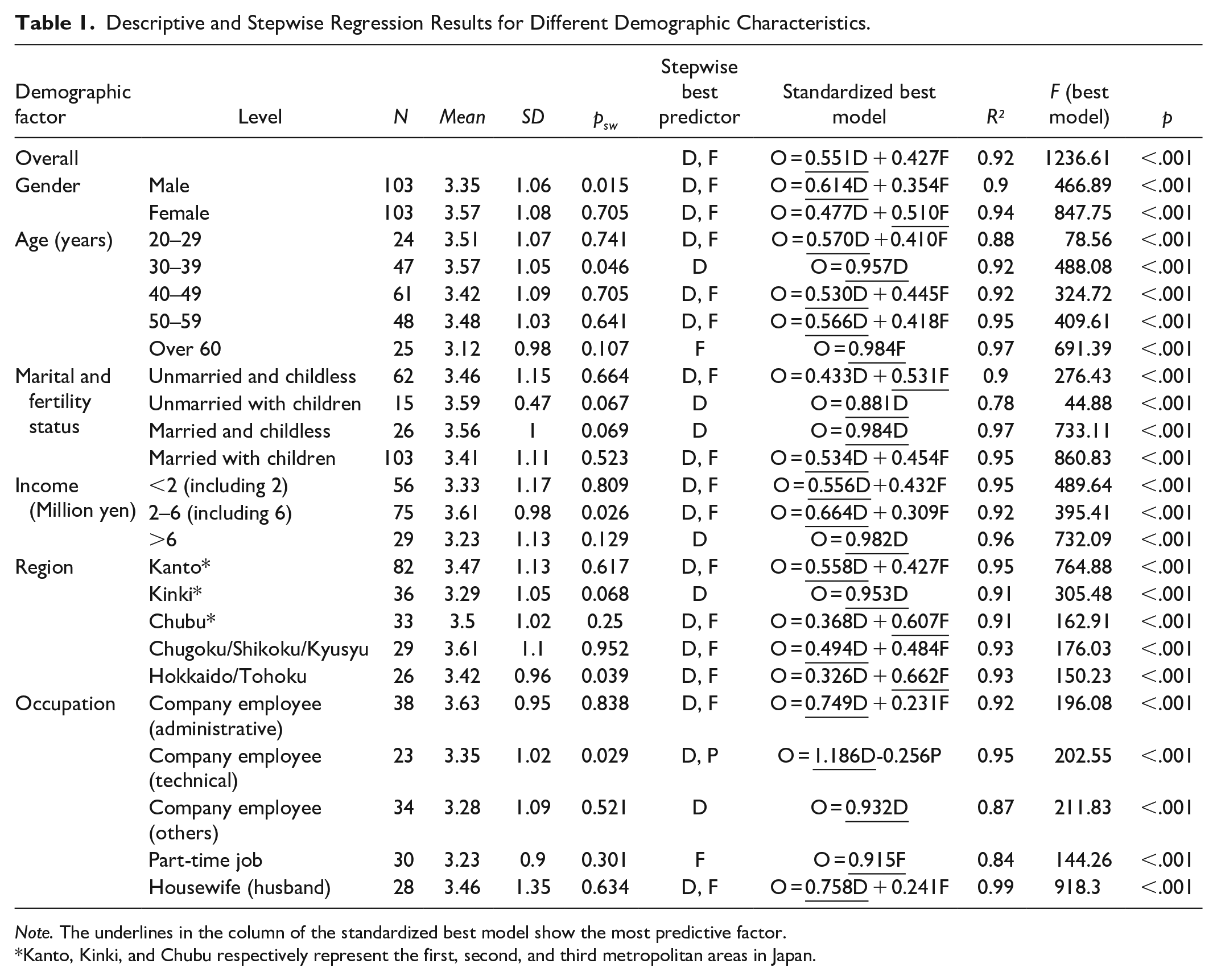
Note. The underlines in the column of the standardized best model show the most predictive factor.
Kanto, Kinki, and Chubu respectively represent the first, second, and third metropolitan areas in Japan.
Results
The descriptive values, Shapiro-Wilk Test p-values (psw) for the normality tests, and the results of stepwise linear regressions are listed in Table 1. Overall trust scores for most groups followed a normal distribution (p > .05).
In general, dependability and faith were the common predictors of overall trust, among which dependability was the most predictive one. However, certain inconsistencies existed in different populations. (a) The more predictive attribution was dependability for males but faith for females, although dependability and faith were the common predictors for both males and females; (b) For drivers aged 30 to 39, dependability was the only predictor, whereas for those over 60, faith was the only predictor, and for those aged 20 to 29 and 40 to 59, predictors included both dependability and faith, between which dependability was more predictive. (c) For unmarried and childless people, dependability and faith were the common predictors, with faith being the most predictive. For unmarried people with children and married people without children, dependability was the only predictor. For married people with children, dependability and faith were the common predictors, and dependability was the most predictive. (d) The higher the personal income, the more dependability dominates overall trust. For people whose personal income was over 6 million Japanese yen, overall trust was no longer dominated by faith. (e) For people from the Kanto and Kinki regions, which were the two top metropolitan areas in Japan, dependability was the more predictive or the only attribution. However, for people from other regions, dependability tended to be less predictive and faith tended to be more predictive. (f) For technical company employees, dependability was an extremely strong predictor and predictability was a negative predictor. For administrative company employees, dependability and faith were the common predictors, and dependability was the most predictive. For other company employees besides administrative and technical company employees, dependability was the only predictor. For people engaging in only part-time jobs, faith was the only predictor.
Discussion
Combining the results, demographic factors could influence the structure of drivers’ initial trust in AD. Overall, initial trust contains faith and dependability, among which dependability is the stronger indicator. Nevertheless, drivers with different genders, ages, marital and fertility statuses, personal income, regions, and occupations developed initial trust based on different factors. Therefore, targeted design and promotion of AD for different populations are necessary.
First, different strategies are necessary for males and females. Since femininity is often seen as sensitive, intuitive, and passionate, females may develop initial trust relying more on feelings and beliefs beyond existing behavioral evidence of AD. Instead, masculinity is often seen as independent and rational (Leszczynski, 2009), thus males may rely more on judgments about the extent to which AD can be counted on to correctly perform its function. Similarly, females generally use machines as tools for interaction and communication with others, whereas males pay more attention to exploring the latest functional features of machines (Höflich & Rössler, 2002).
The relationships between drivers’ economic levels and trust manipulation strategies are also potential research approaches. As the economic level rises, people may develop initial trust in AD relying more on judgments based on objective evidence instead of feelings and beliefs. This seems to be consistent with the population and regional distribution of knowledge, cognition, attitude, and usage intention regarding new technologies. New technologies tend to be firstborn and become popular in regions with higher economic levels. Moreover, according to Maslow’s hierarchy of needs (Huitt, 2007), once a higher economic level is achieved, people will start to release themselves from the control of physiological and safety needs, and have more energy to focus on learning new things.
Different trust manipulation strategies are also necessary for people of different ages, marital and fertility statuses, and occupations. Based on our results, people who were elderly, unmarried and childless, or engaging only part-time jobs tended to develop trust relying more on their feelings and beliefs. Whereas, younger people, married and with children, or engaging in technical occupations tended to develop trust relying more on judgments based on objective evidence. These differences may be related to different degrees of rational thinking that play an important role in building trust (Joshipeters, 2016). Rational thinking refers to a way of thinking based on evidence and logical reasoning (Stanovich, 2011). For instance, compared to people engaging in part-time jobs, people engaging in technical occupations may have more rational thoughts than emotional attachments toward new technologies. In addition, the negative relationships between age and technical self-efficacy and perceived quality, usefulness, and ease of use of technology (e.g., Kraus et al., 2020) could also be possible interpretations of the influences of age on initial trust structure.
This study has several limitations. First, the number of participants considering some demographic characteristics, such as “20 to 29 years” of age, was limited to have a fruitful discussion. In addition, due to the lack of enough samples, we cannot analyze certain demographic characteristics such as genders beyond the binary (non-binary folks). Second, this study followed the trust measurement and statistical methods used by Muir and Moray (1996). Future studies could apply alternative analysis methods with newer frameworks of human-automation trust. Finally, due to the omission of the more specific variables related to certain demographic factors, we cannot provide direct interpretations of underlying reasons why individuals developed different structures of initial trust in AD.
Despite the limitations, our findings have practical implications for practitioners, such as original equipment manufacturers, for the targeted design and promotion of AD. It is important to help different populations develop initial trust based on their specific trust structures. For example, emotional aspects in the designs and promotions of AD should be highlighted more for users who are female, the elderly, unmarried and childless, possess lower personal income, reside in regions outside the top metropolitan areas, or engage in only part-time jobs. Moreover, it is also necessary to adopt targeted strategies based on the trust structures of different populations to avoid excessive trust that can lead to misuse of automation (Muir & Moray, 1996).
Conclusion
This study conducted an online survey and found that the structure of initial trust in AD differed across different populations with different genders, ages, marital and fertility status, personal income, region, and occupations. Specifically, drivers who are female, the elderly, unmarried and childless, possess lower personal income, reside in regions outside the top metropolitan areas, or engage in only part-time jobs tended to place greater reliance on faith in developing initial trust in Autonomous Driving. These findings underline the importance of targeted design and promotion of AD for different populations.
Footnotes
Declaration of Conflicting Interests
The author(s) declared no potential conflicts of interest with respect to the research, authorship, and/or publication of this article.
Funding
The author(s) disclosed receipt of the following financial support for the research, authorship, and/or publication of this article: This work was supported by Japan Society for the Promotion of Science (grant number 17KT0153 and JPJSBP 120228804) awarded to M.I.