



Abstract
Higher levels of driving automation make effective takeover requests critical. The wrist’s sensitivity to vibration makes wristband devices a potential carrier for sending these requests. However, the impacts of conveying takeover requests through directional vibrotactile patterns such as dynamic patterns (sequential stimuli occurring at different locations on the wrist) and static patterns (fixed stimuli at the same locations on the wrist) are unclear. Therefore, this study examined the effects of directional vibrotactile patterns on takeover performance among younger and older adults. Participants responded to four patterns (two dynamic, one static, and one baseline) in a simulated SAE Level 3 automated vehicle. Takeover performance was evaluated using reaction time and takeover time. The results show that the static and baseline patterns had shorter reaction and takeover times compared to the dynamic patterns. In addition, younger adults react faster to takeover requests compared to older adults. Findings provide important insights for the future design of human-machine interfaces via wristband devices for automated vehicles.
Current automated vehicles still require human takeover, that is, resuming the manual control when the automation fails. Given that the takeover task is very cognitively and physically demanding (McDonald et al., 2019), it can be more challenging for older adults (aged 65 or above), due to their general age-related decline in perceptual, cognitive, and physical abilities (Harada et al., 2013; Huang et al., 2022). Therefore, reliable takeover requests are necessary to help older adults take over successfully.
Previous studies show that conveying takeover request information through the haptic channel is more effective when vision and auditory channels are occupied (Brewster & Brown, 2004). Two main vibrotactile patterns were used to provide directional warning information to catch drivers’ attention and guide the driver’s behavior: (1) dynamic patterns: sequential stimuli occur at different locations on specific body parts; (2) static patterns: fixed stimuli occur at the same locations on specific body parts. The differences between the two directional vibrotactile patterns have only been compared when the haptic information was presented on the seat back, pan, and driver’s waist (Meng et al., 2015; Petermeijer et al., 2017). However, it is still not clear the effects of the two directional vibrotactile patterns on takeover performance when the haptic information is presented on drivers’ wrists for both younger and older drivers. This is important given that the wrist is more sensitive to vibration compared to other body parts, such as the waist, chest, back, and neck (Dim & Ren, 2017; Zheng et al., 2021), and applying takeover requests on the wrist area may shorten the overall time needed to complete the takeover. Therefore, the goal of this study was to examine the effects of directional vibrotactile patterns on takeover performance among younger and older age groups.
The study employed a 2 (age groups: younger, and older adults) × 4 (vibrotactile patterns: Baseline, Full-Dynamic, Semi-Dynamic, and Full-Static, see Figure 1) full factorial design, with 20 younger (mean age = 21.5) and 20 older (mean age = 70.6) adults. Participants were required to sit in a simulated SAE Level 3 automated vehicle and complete four driving sessions. During each session, vibrotactile takeover requests (TORs) were sent via a wristband device due to random sudden obstacles ahead, and drivers needed to perform the takeover task after receiving the signals. The TORs included 2 dynamic and 1 static vibration pattern that guided the driver’s behavior after the takeover, and 1 baseline pattern that only served warning purposes. In total, each participant experienced sixteen vibrotactile takeover requests (i.e., each vibrotactile pattern repeated four times in one drive session) in four separate drive sessions. Takeover performance was evaluated using reaction time (time between TORs and automation deactivation) and takeover time (the first conscious action to the vehicle) (McDonald et al., 2019).
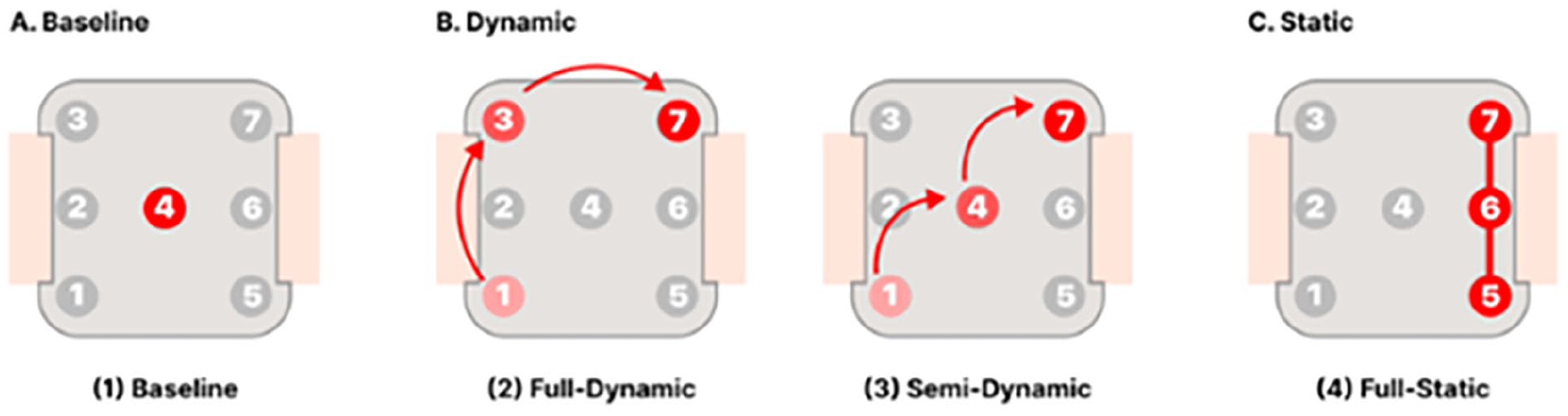
Vibrotactile patterns used in this study.
Results showed that static and baseline patterns had (statistically significant) shorter reaction and takeover times compared to the two dynamic patterns. Also, an age-related difference was found, in that younger adults had faster reaction times than older adults. Overall, the findings of this study may inform the design of human-machine interfaces via wristband haptic displays (e.g., a smartwatch with haptic features) for future automated vehicles.
Footnotes
Declaration of Conflicting Interests
The author(s) declared no potential conflicts of interest with respect to the research, authorship, and/or publication of this article.
Funding
The author(s) disclosed receipt of the following financial support for the research, authorship, and/or publication of this article: This study was supported by the National Science Foundation (PI: Gaojian Huang; Award #: 2153504).