



Abstract
This study provided additional evidence to support the OR-Stretch Web- App as a potential ergonomic intervention in the operating room. Overall, the ORStretch Web-App was beneficial to surgeons’ physical performance, mental focus, and discomfort. However, improving the Web-App to be user-friendly, and developing strategies to align the microbreaks with appropriate time spots during surgeries to not interrupt surgical workflow are among the key factors that need attention. Additionally, no significant differences in the surgeons’ subjective evaluation of the Break-30 and Break-60 scheduling strategies were found. However, the data and surgeons’ feedback implied that taking microbreaks every 30 min (Break-30 condition) may not be ideal, especially during long or complicated surgical procedures.
Introduction
Work-related pain, discomfort, and musculoskeletal symptoms are prevalent problems among surgeons (A. Park et al., 2010; Stucky et al., 2018; Szeto et al., 2009). Not only can surgeons’ ability to perform surgical procedures be negatively affected by work-related pain and discomfort, but their quality of life can be compromised (McDonald et al., 2011). An ergonomic intervention that has shown evidence of reducing surgeons’ pain and enhancing physical performance and mental focus is intraoperative microbreaks (Hallbeck et al., 2017; A. E. Park et al., 2017). The OR-Stretch Web-App has been specifically designed for surgeons to facilitate taking intraoperative stretching microbreaks (Abdelall et al., 2018). While a previous study on a small group of surgeons demonstrated that taking microbreaks using the OR-Stretch Web-App could help surgeons ergonomically by reducing fatigue and improving physical performance and mental focus (Abdelall et al., 2018), more comprehensive evaluations of this intervention are crucial in its deployment. The main goal of the current study is to compare two break scheduling strategies using the OR-Stretch Web-App in the operating room (OR).
Method
This study was a part of a larger study investigating several factors that may influence the usability, acceptability, and implementation of the OR-Stretch Web-App. Here, two different break scheduling strategies using the OR-Stretch Web-App have been evaluated. Attending surgeons from an academic hospital were invited to take intraoperative microbreaks using the OR-Stretch Web-App, which is a free web-based app that provides an interface to set up an alarm to take microbreaks at predetermined intervals of time. Following each alarm, the app provides surgeons with instructions via an about one-min video guide on how to perform stretching without scrubbing out.
Two break scheduling strategies were used: the first strategy reminded surgeons to take a microbreak every 30 min (Break-30), while the second reminded surgeons to take a microbreak every 60 min (Break-60). Both strategies allowed the surgeons to snooze the alarm for 10 min (only one time per alarm) if desired. After each data collection, the surgeons completed a questionnaire that recorded the impact of taking microbreaks on their physical performance, mental focus, body pain/discomfort, and level of fatigue (5-level scale: much worse, worse, no change, better, much better). At the end of the study, the surgeons were also asked about their overall feedback and the main barriers to using the OR-Stretch Web-App intraoperatively.
Results
Fourteen surgeons participated in this study. Each surgeon performed the same surgical procedure for the two data collections (Break-30 and Break-60 conditions). One of the surgeons did not complete the Break-30 condition. The order of the Break-30 and Break-60 conditions was randomized for the 14 surgeons. Surgeons’ opinions about the impact of taking microbreaks on their physical performance, mental focus, body pain/discomfort, and level of fatigue were mostly positive (Table 1). Only one surgeon reported that taking breaks every 30 min negatively affected their mental focus (Table 1). There were no statistically significant differences between the two break scheduling strategies (Break-30 and Break-60 conditions) when evaluating the OR-Stretch Web-App.
Percentage of Surgeons’ Responses for Taking Microbreaks Every 30 min (Break-30) and Every 60 min (Break-60).
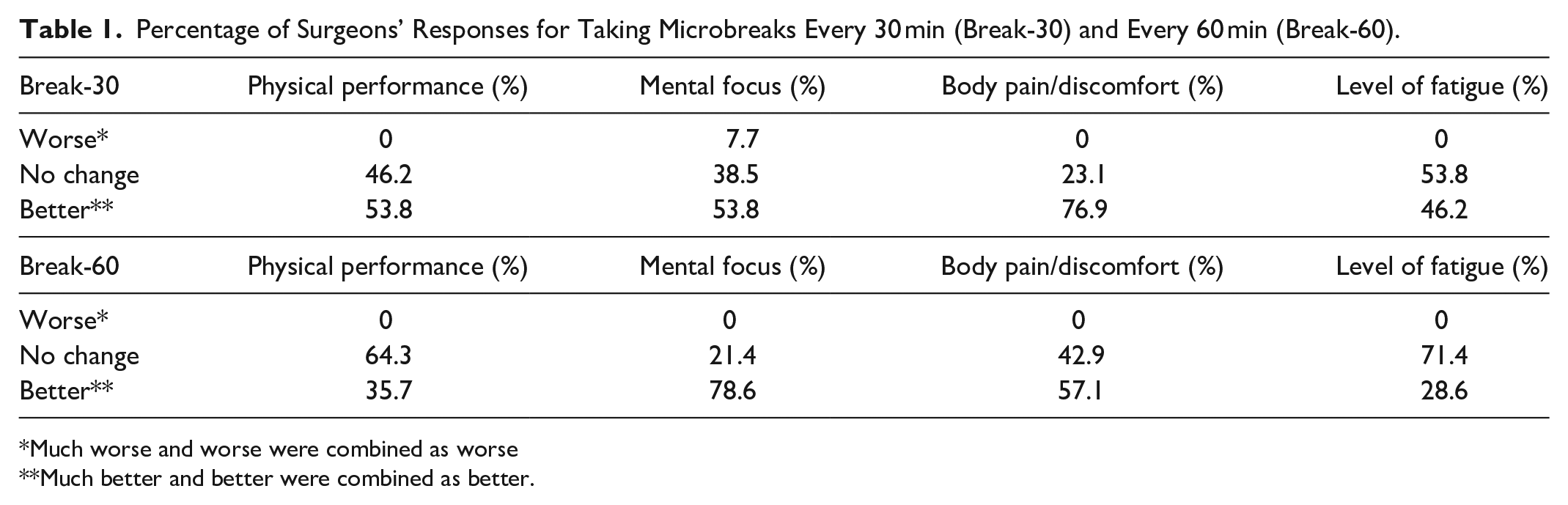
Much worse and worse were combined as worse
Much better and better were combined as better.
Surgeons’ main feedback regarding the OR-Stretch Web-App could be summarized as follows: (1) Make the Web-App easier to use (e.g., fewer clicks to use the Web-App (to start, keep going, and stop the Web-App), make the video auto-full-screen), (2) Create specialized stretching moves based on surgical approach type (e.g., robotic vs. laparoscopic vs. open surgeries). The main reported barrier toward the OR-Stretch Web-App implementation into the OR was primarily noted to be interruptions in workflow, especially during complicated surgical procedures or complex sections of the surgery when the alarm-based system did not necessarily align with an appropriate time to stretch. It should be noted that one surgeon mentioned that taking microbreaks every 30 min (Break-30 condition) in a long case was too frequent.
Discussion
This study provided additional evidence to support the OR-Stretch Web-App as a potential ergonomic intervention in the OR. Overall, the OR-Stretch Web-App was beneficial to surgeons’ physical performance, mental focus, and discomfort. However, improving the Web-App to be user-friendly, and developing strategies to align the microbreaks with appropriate time spots during surgeries to not interrupt surgical workflow are among the key factors that need attention. Additionally, no significant differences in the surgeons’ subjective evaluation of the Break-30 and Break-60 scheduling strategies were found. However, the data and surgeons’ feedback implied that taking microbreaks every 30 min (Break-30 condition) may not be ideal, especially during long or complicated surgical procedures.
Footnotes
Declaration of Conflicting Interests
The author(s) declared no potential conflicts of interest with respect to the research, authorship, and/or publication of this article.
Funding
The author(s) received no financial support for the research, authorship, and/or publication of this article.
