



Abstract
The widespread use of wearable technologies in research settings has made it easier to assess health-related indices. However, information is limited regarding participant compliance when using these wearable technologies in military settings. This study assessed participant compliance when wearing Ōura rings for periods of up to 210 days (182 participants, four military commands). In our results, compliance followed a power decay function with substantive differences across commands and across both demographic and occupational factors. Overall compliance was approximately 40% after 80 days of wearing the device, ~30% after 125 days, and ~20% after 210 days. Higher ranking individuals had better compliance compared to subordinate military members. This difference increased consistently for the first 2 months of wearing the device, reaching 20% to 50% depending on the command. Personnel seniority and in-person interaction with researchers are important factors that should be taken into consideration when conducting longitudinal studies in military environments.
Introduction
Background
The proliferation of wearable technology has made it much easier for individuals and the research community to assess health-related indices—to include estimates of sleep—by monitoring psychophysiological signals on the body (de Zambotti et al., 2016; Ferreira et al., 2021). Wearable devices can play an important role in fatigue management systems (Reifman et al., 2024). Not surprisingly, the military has a great deal of interest in using such devices to monitor active-duty service members (ADSMs) in efforts to reduce fatigue-related risks and improve readiness and operational performance. In particular, the Government Accountability Office (GAO, 2021) has recommended to Congress that the US Navy (USN) incorporate methods to (1) monitor sleep and fatigue-related data to assist Commanders with decision-making; and (2) use the collected data to identify factors that contribute to inadequate sleep and fatigue.
Along these lines, several ongoing projects are assessing sleep and fatigue in military settings. These include the US Army’s Measuring and Advancing Soldier Tactical Readiness and Effectiveness (MASTR-E), the largest DoD human performance science and technology program. MASTR-E plans to combine tactical health measures of individual soldiers into a commander’s dashboard (https://www.armytimes.com/news/your-army/2023/04/28/army-fielding-new-tactical-feedback-tool-with-fitness-program-features/). Another such program is the US Navy’s Command Readiness, Endurance, and Watchstanding (CREW) program, a joint effort between the Naval Health Research Center (NHRC) and the Commander, Naval Surface Forces Pacific (CNSP) (DoD, 2023).
Wearables come in different forms; recent advances in miniaturizing wearable technology have led to the development of “smart” rings. Current research efforts are investigating the technical feasibility and user acceptability of wearable devices in austere warship environments (Kubala et al., 2024). However, the information available on participant compliance when wearing rings in naval settings is generally limited to studies of short duration with Sailors on underway US Navy ships. In such studies, members of a research team are typically onboard the ship, supporting the data collection and reinforcing participant compliance. While these studies have great value, the widespread use of wearable devices to assess participants’ sleep and health status must consider compliance over extended periods of time without the presence of the research team. The data we present in this study focuses specifically on this gap, that is, assessing participant compliance when wearing Ōura rings for periods between 71 and 210 days without the continuous presence of a research team.
Scope
The aim of this study is to provide insight into the long-term use of wearable devices in military operational environments. Specifically, the study had two objectives. The first objective was to assess the compliance of Sailors in wearing the Ōura ring for long periods of time while performing their duties. The second objective was to determine if demographic and occupational factors were associated with compliance in wearing the ring.
Methods
Study design
The study we present herein is based on a retrospective analysis of pre-collected data.
Participants
We used the data of 182 participants (132 [72.5%] males) from four military commands, two San Diego-based US Navy (USN) watchfloors (“A”: 44 participants, data collection period = 71 days; “B”: 31 participants, 74 days), a US Marine Corps (USMC) aircraft squadron (“C”; 58 participants; 125 days), and a USN watchfloor in the Pacific Northwest (“D”; 49 participants; 210 days). Data collection took place between 2021 and 2024.
Procedures
All participants were issued an Ōura ring with setup instructions and were asked to wear the device as much as possible throughout the entire longitudinal data collection period. The research team monitored individuals using an online Ōura dashboard (Ōura Teams). Approximately once per month, the team reached out to participants who had missing data. This same procedure was followed on the Pacific Northwest watchfloor for the first 4 months of that study. Thereafter, the research team did not reach out to the participants.
Analysis
The study sample included 24 (13.2%) officers (11 O1-O3, 13 O4-O6) and 158 (85.9%) enlisted (21 E1-E3, 115 E4-E6, 22 E7-E9). The ratio between officers and enlisted did not differ among commands (Fisher’s exact test, p = .560) and the sex ratio was equivalent between officers and enlisted (p = .810). However, the two watchfloors in the San Diego area (A and B) had approximately 38% females compared to approximately 19% for the other two commands (C and D).
Statistical analysis was conducted with JMP statistical software (JMP Pro 17; SAS Institute; Cary, NC). The criterion used to identify the days in which a ring was worn was based on whether that day included any sleep episode. Based on our earlier studies on ships and military commands, the probability of a full 24-hour period without any sleep was quite low (<0.001%).
Results
The median participant compliance was 47.4% (IQR = 63.4%) with substantive differences both among participants and commands. Median compliance over the entire 210-day data collection in command D was only 15.4% (IQR = 25.8%); however, it was 56.8% (IQR = 60.9%) in command C, 70.3% (IQR = 64.4%) in command B, and 76.1% (IQR = 53.2%) in command A.
Using general linear model (GLM) analysis (overall model: R2adjusted = .261, F(6, 175) = 14.6, p < .001; Box-Cox transformation was applied), we assessed the effect on compliance of occupational group (E1-E6, E7-O6), rank group (E1-E3, E4-E6, E7-E9, O1-O3, O4-O7) nested within occupational group, sex, and duration of the data collection period in the ADSM’s command. The classification of participants in these specific occupational groups (E1-E6, E7-O6) was based on an exploratory assessment of the effect of rank group (E1-E3, E4-E6, E7-E9, O1-O3, O4-O7) on compliance.
Results showed that the senior group (which included senior enlisted E7-E9 and officers O1-O6) had higher compliance than the E1-E6 enlisted personnel group (p < .001) and that compliance decreased with longer data collection periods (p < .001). Sex was not a statistically significant predictor factor (p = .344).
Figure 1 shows the overall compliance over the course of the 210 days of data collection. In both cases, compliance has been normalized and weighted by command. The color-coded areas and the corresponding titles (e.g., C+D) show the commands that participated in each time period. Continuous lines show the approximation trend using smoothing splines. Our data showed that compliance for all participants was ~40% at ~80 days into the study period (i.e., when participants started wearing the ring), ~30% at ~125 days, and ~20% at ~210 days.
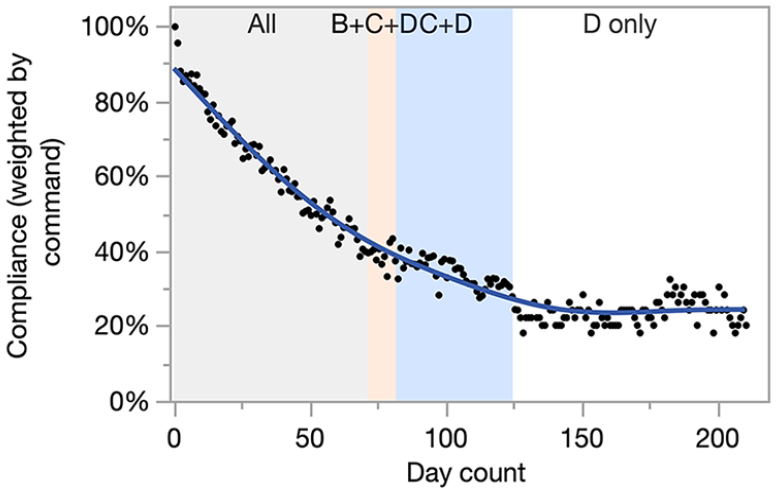
Aggregated compliance with wearing the ring.
Figure 2 shows compliance by command. Of note, a consistent trend exists in all commands for the first approximately 50 days. After this time point, the rate of decrease in compliance is lower in command C compared to commands A, B, and D.
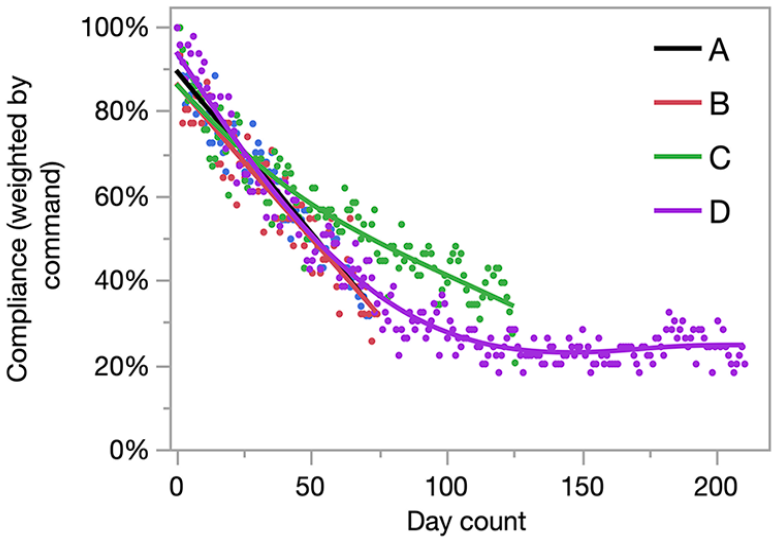
Compliance with wearing the ring by command.
Next, we explored the fit of nonlinear models to the compliance data, independently for each command and to all data aggregated as one sample. Even though other models showed a higher goodness of fit (e.g., cubic model), power decay models were chosen as a parsimonious approach. The power models followed the equation y = a + b*Day^c, in which a is the intercept, b is the slope, and c is the power. As shown in Table 1, the fit of all independent models had an R2 of .887 or better. The power decay model of all data aggregated together (with overall compliance weighted by command) had an R2 of .937.
Power Model Fit.
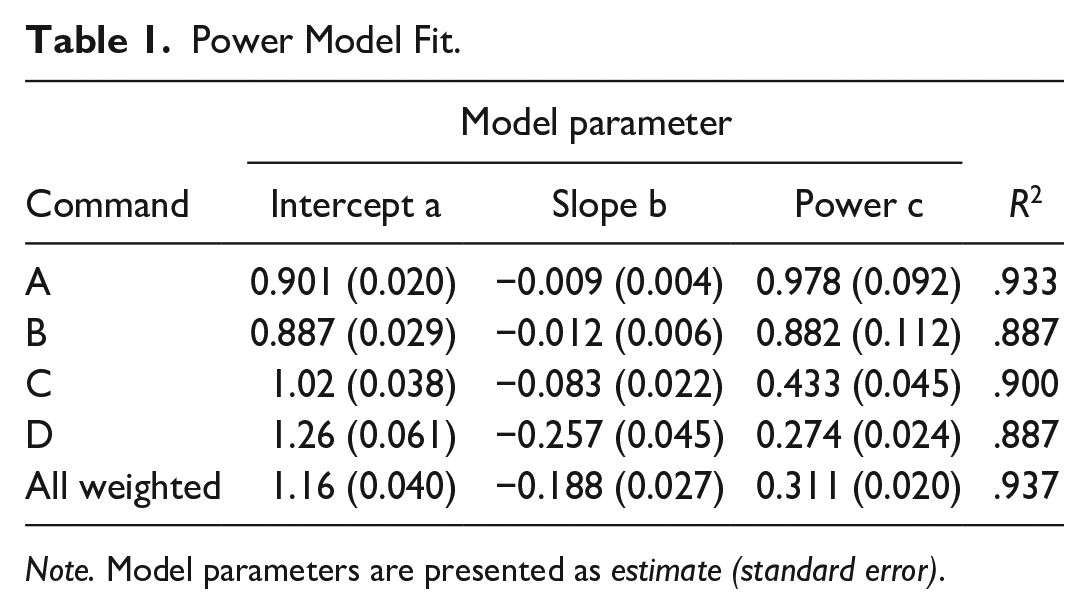
Note. Model parameters are presented as estimate (standard error).
Lastly, we further explored the differences between the E1-E6 and E7-O6 occupational groups. As shown in Figure 3, these differences are fairly consistent for all four commands with the compliance of the E6-O6 being higher than the E1-E6 group.
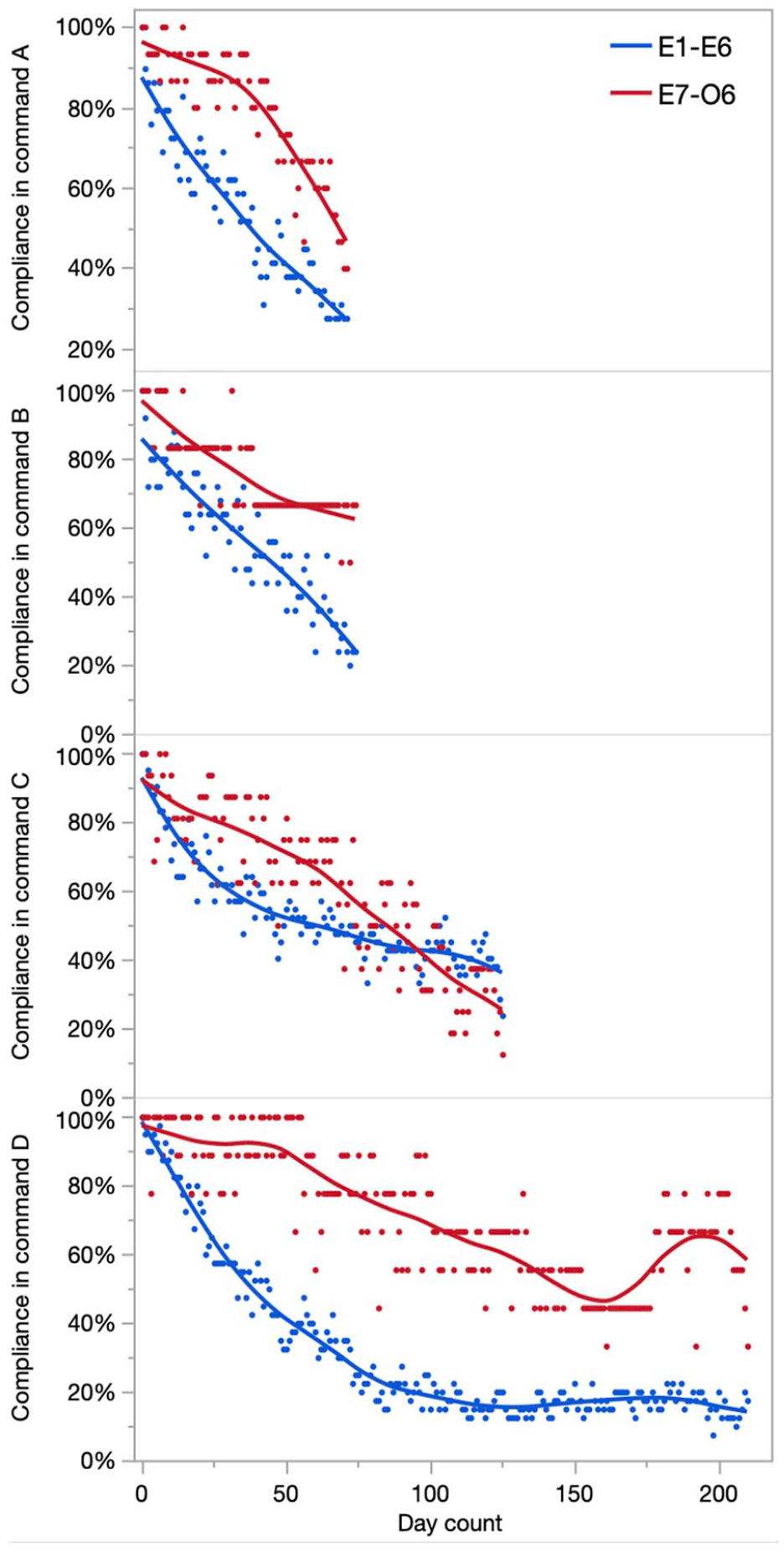
Compliance with wearing the ring by command and occupational group (E1-E6, E7-O6).
Focusing on the aggregated compliance for all commands combined, the median difference was 29% (IQR = 17.9%) over the entire 210-day data collection period. Specifically, the median difference in command A is 25.5% (IQR = 16.4%), 20.0% (IQR = 20.0%) in command B, 9.82% (IQR = 21.9%) in command C, and 42.5% (IQR = 23.6%) in command D.
Of note, the difference in compliance between the E6-O6 and the E1-E7 groups seems to be increasing up to 2 months after starting to wear the device. Also, compliance of the E7-O6 groups seems to decrease below the E1-E6 group after approximately 110 days but this phenomenon is not evident in any of the other three commands (Figure 4).
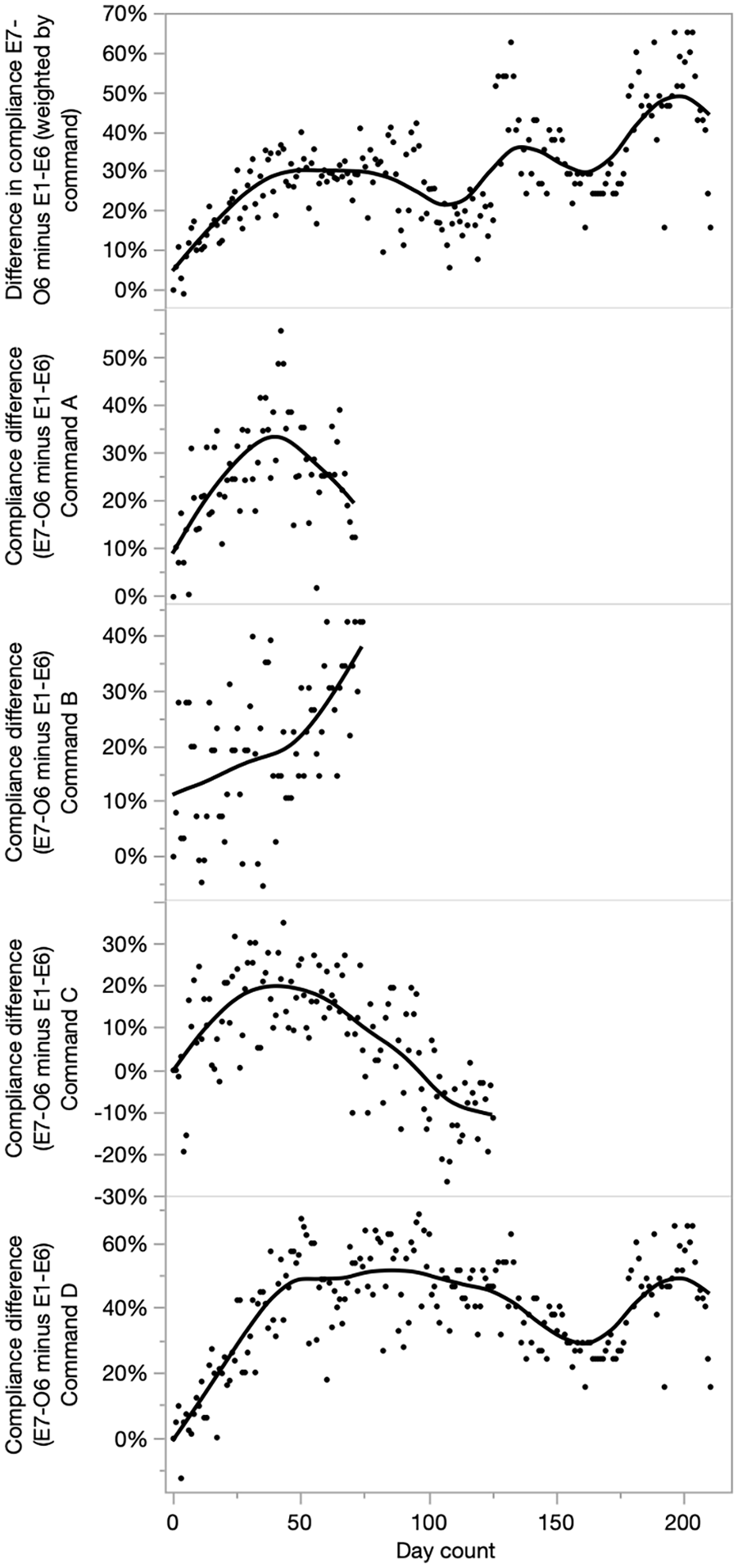
Compliance differences between the E7-O6 and the E1-E6 groups.
Discussion
Our results showed that substantive differences in compliance over time follow a power decay function. In particular, our data showed that compliance for all participants was ~40% at ~80 days after starting to wear the device, ~30% at ~125 days, and ~20% at ~210 days. Future efforts should explore the generalizability of the power decay model on data from other commands and explore other decays as needed. In general, the validity of our model in the first 2 months is evident. However, more data should be collected to assess the utility of the identified model for longer periods of time.
The most important finding from our study, however, is that personnel seniority should be taken into consideration by researchers when conducting longitudinal studies in military environments. The difference in compliance between the E1-E6 and the E7-O6 groups consistently increased up to 2 months after starting to wear the device, reaching 20% to 50% depending on the command.
Based on our data, we did not identify any sex-related differences in compliance. Future studies should further evaluate the effect of sex on the use of wearables using larger and more diverse groups.
Of note, our data suggest that the method chosen to monitor compliance and reach out to participants is an essential issue. Specifically, our data from command D provide evidence that face-to-face interaction improves compliance. This factor is evident in the approximately 10% increase in compliance following a visit from members of the research team in command D on day ~170. This approach, however, may not be feasible for large and geographically distributed cohorts. Also, our data suggest that the aforementioned improvement is predominantly evident in the senior group (E7-O6) but not in the junior group (E1-E6).
These results should be interpreted with caution because only one of the studies had a data collection period of 210 days whereas the other three had data collections between ~70 and 125 days. Therefore, follow-up studies should investigate further long-term compliance and the demographic and/or occupational characteristics associated with compliance for short, mid, and long term studies.
Footnotes
Declaration of Conflicting Interests
The author(s) declared no potential conflicts of interest with respect to the research, authorship, and/or publication of this article.
Funding
The author(s) disclosed receipt of the following financial support for the research, authorship, and/or publication of this article: This study was prepared for the Defense Suicide Prevention Office (DSPO) and the Naval Information Forces (COMNAVIFOR). It was supported by funding from DSPO and the Naval Postgraduate School, Naval Research Program (PE 0605853N/2098) - NRP Project ID: NPS-23-N055-A.
Disclaimer
The views expressed in this study are those of the authors and do not necessarily reflect the official policy or position of the Department of the Navy, the Department of Defense, or the U.S. Government.
