



Abstract
Background:
Hallux valgus, the most common forefoot deformity, frequently leads to corrective foot surgery. Despite high surgical rates, patient dissatisfaction remains prevalent, and its causes are unclear. Surgeons often focus on radiologic corrections, assuming greater corrections yield higher satisfaction. This study aimed to investigate whether traditional radiologic measurements, rotational parameters associated with first metatarsal pronation (eg, lateral head shape and tibial sesamoid position), and routinely collected demographic variables (eg, age, body mass index [BMI], occupational status) can predict patient-reported outcomes following chevron osteotomy.
Methods:
In this retrospective analysis, we included 89 female patients who underwent chevron osteotomy from 2016 to 2018. Patients were evaluated on average 6.5 years postoperatively (range 5-8 years). Demographic variables, including age at surgery, BMI, occupational status, and activity level, along with radiographic variables, such as the hallux valgus angle (HVA), intermetatarsal angle (IMA), lateral head shape, and tibial sesamoid position, were collected pre- and postoperatively. The primary outcome was the Manchester-Oxford Foot Questionnaire (MOxFQ) pain subscore; secondary outcomes included visual analog scale (VAS) pain scores, and Likert scale satisfaction.
Results:
A statistically significant association was observed between greater correction of the HVA and improved MOxFQ pain subscores (P = .014). Higher preoperative HVA values were associated with lower postoperative pain scores, indicating improved outcomes (P = .043), whereas higher postoperative HVA values were associated with increased pain, suggesting worse outcomes (P = .022). Despite these findings, the overall association of both preoperative and postoperative radiologic measurements, as well as demographic factors, for patient-reported outcomes was limited, with a pseudo-R2 value of just 0.0267. VAS pain scores showed no significant associations (all P > .05). Although the Likert satisfaction scale correlated with preoperative HVA (P = .049) and postoperative HVA (P = .026), the predictive strength of these variables remained modest.
Conclusion:
In this minimum-5-year retrospective study of 89 female patients who underwent chevron osteotomy and had not undergone a later secondary procedure, we found that HVA radiographic correction with a chevron osteotomy was weakly associated with improved pain and satisfaction.
This is a visual representation of the abstract.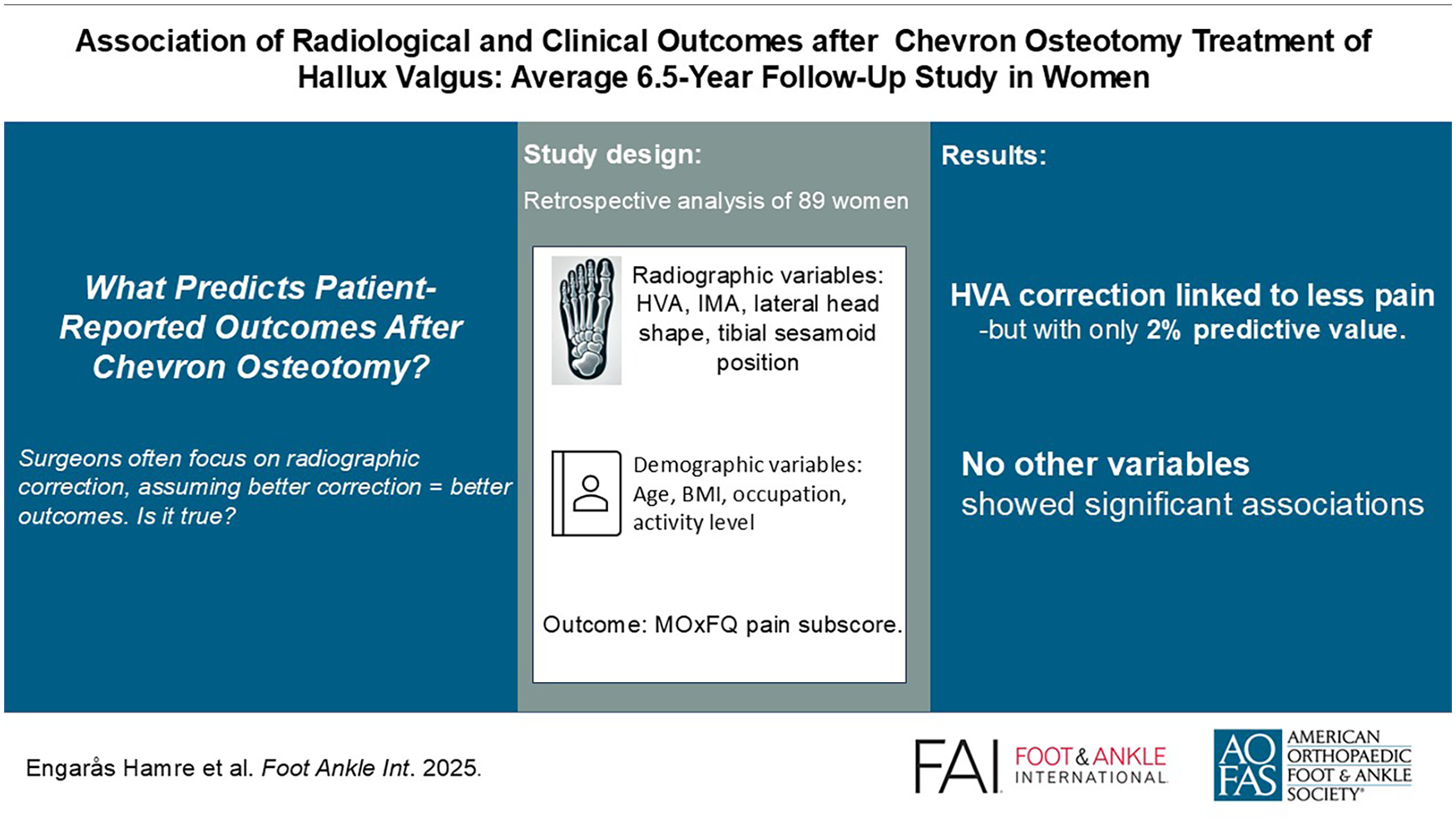
Keywords
Get full access to this article
View all access options for this article.
References
Supplementary Material
Please find the following supplemental material available below.
For Open Access articles published under a Creative Commons License, all supplemental material carries the same license as the article it is associated with.
For non-Open Access articles published, all supplemental material carries a non-exclusive license, and permission requests for re-use of supplemental material or any part of supplemental material shall be sent directly to the copyright owner as specified in the copyright notice associated with the article.
