




Abstract
Research on the determinants of public attitudes on the environment requires a focus on factors influencing values and responses across countries. One important influence is the global expansion of university education in recent decades, with increased higher education attainment emerging as a potentially important factor affecting public support for the environment across countries. This paper provides evidence on the impact of higher education attainment on environmental attitudes at the global level using data from 37 countries in the World Values Survey (WVS). The key finding from this analysis is a statistically significant positive relationship between higher education attainment and a preference for environmental protection over the exclusive support of economic growth, one that persisted in key sub-samples delineated by gender, generation, and country income level. This suggests that the impact of higher education on shaping environmental views is significant, persistent, and pervasive, with important implications for both environmental and education policy.
Introduction
Addressing environmental challenges requires global cooperative efforts to identify and share solutions to issues such as climate change, pollution standards, and threats to biodiversity. However, these responses require the collaboration of governments who must draw on public support in the formulation and shaping of environmental policy in view of the trade-offs between the long-term benefits of these policies and their short-term economic costs. More generally, governments need to establish a consensus for achieving sustainable competitiveness through the redefining of core values and priorities and associated measures of sustainable economic development (Vaníček et al., 2025, p.2).
The transition to approaches that bring into balance environmental and economic considerations needs to be underpinned by a change in public values and acceptance relating to sustainable responses. For this reason, research on the determinants of public attitudes on the environment requires a focus on factors shaping values and responses, both within and across countries. One such influence is that of education. Numerous studies have identified education at all levels, from primary to higher education, as a crucial factor in shaping environmental values, with schools and universities providing opportunities for students to learn about ecological systems, environmental issues, and sustainable practices (Sonetti et al., 2019; Urbaniak et al., 2024; van Tol, 2023).
The impact of higher education attainment is of particular interest, given its increasing prominence in recent decades through a global ‘elite-mass-universal’ shift in participation, with the emergence of high participation university systems where between 30% and 50% of the population have access to bachelor-degree qualifications (Trow, 2007). Estimates of tertiary (higher education and advance vocational) attainment among 25–34 year-olds in the OECD countries confirm this, with the share of this age group possessing a tertiary qualification rising from 27% in 2000 to 48% in 2021 (OECD, 2022).
This global expansion in higher education participation, coupled with evidence of the impact of education in general on environmental attitudes, raises the question of how higher education currently shapes public attitudes to the environment. In this paper, we examine this issue using cross-country data World Values Survey (WVS), a major international collection on public attitudes, sourcing data from Wave 7 (2017–2021), the most recent finalised collection of the WVS. This represents a sample of 26,574 respondents from 37 countries.
We focus on a WVS question asking respondents to select between two hypothetical statements regarding the trade-off between the environment and economic growth and examine the factors influencing the propensity of respondents to favour pro-environmental sentiments. The next section identifies these key factors and suggests a set of hypotheses, followed by a discussion of the WVS dataset and variables. We then present results from the analysis, which are discussed in relation to the hypotheses. In our concluding section, we reiterate the significance of this work, map out potential opportunities to extend it, and identify tentative implications of the findings from the research for policymakers.
Determinants of Environmental Attitudes: Literature Review and Hypothesis Development
In a review of the literature on environmental values, Gifford and Nilsson (2014) summarised their findings from studies examining personal and social factors that influence reported attitudes, reaching the conclusion that In short, we know that environmental concern and pro-environmental behaviour are influenced by many factors. The models that have been proposed, although well-intentioned, probably are too simple…and…attempting to fully account for variation in environmental concern and pro-environmental behaviour is a seriously complex enterprise (p. 151).
A review of the literature confirms this view, revealing a myriad of models and variable clusters used to explain environmental attitudes. Research consistently identifies a set of factors that shape environmental attitudes, particularly in the context of trade-offs with economic development. Drawing on these findings, we outline a set of hypotheses to be tested in the current paper.
Education
Education plays an important role in understanding environmental values and achieving sustainable development. This occurs through distinct, but interacting, direct and indirect channels. Direct channels see people acquire knowledge, develop skills, and establish competencies through structured or semi-structured learning where participants both exposed to information about environmental issues or accrue capabilities which enable them to seek out and process such information. In addition, universities function as knowledge creation centres in relation to environmental issues, both for their immediate regions and the broader community (Pedro et al., 2022; van Tol, 2023). Indirect channels, by contrast, operate where increased educational attainment raises individual and collective levels of income and human capital, leading to stronger preferences for positive environmental outcomes and a greater capacity to pay for such outcomes (Chankrajang and Muttarak, 2017; Meyer, 2015).
Examining this interplay, Meyer (2015) used changes in compulsory education laws as an instrumental variable for analysing the impact between education levels and concerns for the environment in a cross-country European sample. He found that an extra year of education is expected to increase the likelihood that an individual will engage in a variety of pro-environmental behaviours, such as reduced use of disposable products, separating waste for recycling, reduced car usage and purchasing environmentally labelled products. Tianyu and Meng (2020) used changes in education law in China to examine the impact of higher education participation on the willingness to pay for pro-environmental measures, finding a positive statistically significant effect, with a noticeably stronger effect for post-tertiary education participation.
However, these impacts vary by context. In a recent study using cross-sectional survey data from 37 countries, Piao and Managi (2024) examined the impact of a series of personal and social factors on the propensity to engage in pro-environmental behaviours, using a quantile regression approach. They analysed the impact of both knowledge of environmental issues and general educational attainment, finding that both were significant across response quartiles, but specific knowledge of environmental issues had an increasingly important effect across the spectrum, whereas the effect of educational attainment was heterogenous, peaking around the middle of the distribution, with the effect declining in influence, but remaining statistically significant and positive, among the top quartile of the sample in terms of enacting pro-environmental behaviours. One explanation for this effect may be the divergence in offerings among universities. In a survey of the curriculum of US public universities, Vallee (2024) found that only 27 of 540 institutions, or around 5%, have an environmental literacy graduation requirement. Sousa et al. (2021) studied students at a university in Portugal and found that most students had both significant environmental knowledge as well as a commitment to environmentally responsible actions in relation to recycling and energy consumption. Urbaniak et al. (2024) in a study at a US institution found significant differences in knowledge of, and support of, issues around sustainability between academic disciplines, with STEM students more inclined to indicate pro-sustainability attitudes and behaviours than other students.
Finally, there is evidence to suggest that higher education participation affects environmental attitudes through socialisation whereby people’s value sets are influenced by their education experience, notably where higher education graduates exhibit more pronounced socially liberal attitudes, a common finding in sociological studies (Surridge, 2016; Weakliem, 2002), suggesting that education influences individuals’ political and social alignments and their propensity to support environmental causes.
Based on this evidence, we hypothesise that higher education graduates will have a greater propensity to favour environmental protection over economic growth.
People with higher education qualifications are more likely to favour environmental protection.
Gender
Gender has emerged prominently in the literature explaining the differences in attitudes and perceptions towards the environment. Several studies report evidence of a significant gender gap in attitudes on the environment, with women expressing higher levels of concern about environmental issues than men (Leal et al., 2024; Meyer, 2015; Welsch, 2022).
In a related context, other work has focused on the role of social capital in shaping attitudes towards environmental performance. Dulal et al. (2011) found that measures of social capital that encompass gender inclusiveness are associated with higher levels of environmental performance at the cross-country level, a result that held after controlling for country income level.
Liu and Liu (2021) surveyed 1007 business students in a vocational college in China and found that female students showed statistically significant higher levels of sustainability consciousness in terms of their environmental attitudes, economic attitudes, and the social dimension of sustainability behaviour. Olsson and Gericke (2017) found similar results but also correlate gender with age. Their findings using a sample of 2413 Swedish students aged 12-19 revealed a gender gap that increased over the age span. Zhao et al. (2021) found that gender norms may play a role in relation to environmental considerations and consumption decisions, with women more inclined to display positive intentions to purchase products based on environmental characteristics. However, Bord and O’Connor (1997) observed that while gender differences are evident in health- and ecological-risk perceptions, the effect becomes statistically insignificant once health-risk perceptions are controlled for. Similarly, Hayes (2001) found no evidence for a gender effect in a cross-national study that could not control for this factor. Both studies posit a gender gap due to perceptions of vulnerability to risk. This argument is extended by Torgler and García-Valiñas, 2007 who observed that the literature on environmental attitudes and behaviours over the two decades preceding their study provided mixed evidence on the influence of gender. Their own study of attitudes in Spain reflected this trend, showing mixed results in terms of the effect size (albeit consistently positive) and statistical significance of gender on the preference for environmental protection.
The impact of this effect in relation to economic-environmental trade-offs is generally identified as a gender gap in relation to perceptions among women of a more direct trade-off existing. For instance, Ibáñez et al. (2020) found that women were more likely than men to ‘think the current model is not a sustainable model’ (p.8). On balance, we anticipate that women are more likely than men to favour environmental protection in a trade-off with economic growth.
Women are more likely than men to favour environmental protection.
Age Cohort and Generation Effects
Given the emergence of environmental concerns over the past 40 years, it is intuitive to think that a respondent’s age influences their tendency to value the environment more strongly relative to the economic growth and development via a generation or cohort effect. Weaver (2002), in a study of environmental attitudes across five countries – United States, Great Britain, West Germany, Russia and Japan – found that younger respondents were more likely to endorse statements relating to concerns about the environment than older respondents. However, this effect may be ambiguous in certain contexts, with some studies on pro-environmental behaviour indicating that older respondents are more likely to exhibit greater levels of engagement in relation to practices such as recycling and green consumption more generally (see for instance, Ayalon, 2024). A study by Aleixo et al. (2021) of 1257 Portuguese higher education students showed that older students have more knowledge about the environment and sustainable development goals (SDGs). The same study also showed that students in the 17–19 age group were the most concerned about the effects of climate change while students in the 27+ age group are more likely to recycle.
We anticipate that environmental preferences are stronger among WVS respondents in younger age cohorts.
Younger cohorts are more likely to favour environmental protection.
Social Class, Household Composition, and Income Level
Pro-environmental attitudes tend to scale with income and social class. More affluent and socially advantaged households and individuals are more likely to express beliefs and engage in behaviours aligned with positive environmental concern and intention (Gifford & Nilsson, 2014).
Gladstone and Bellezza (2024) examined the influence of social status on green consumption in the UK and identified an S-shaped relationship between the two. They found significant growth in green consumption from low to middle social status levels. However, among high status individuals, this growth tended to level off, possibly influenced by a saturation effect where the relatively straight-forward pro-environmental choices had already been made.
Another recent study, using data from the Eurobarometers survey between 2007 and 2020 found evidence for only limited differences in respondents’ level of concern about environmental issues based on socioeconomic status in Europe (Cicuendez-Santamaria, 2024).
Analysis of household composition and environmental concerns indicates that households with children may have stronger views about environmental protection. Welsch (2022) found a positive and statistically significant impact of the presence of children in a household with willingness to pay to mitigate climate change. Davidson & Freudenburg (1996) found that concerns about health and safety issues relating to environmental degradation were more important to women with children at home.
De Silva and Pownall (2014), in a study looking at data from over 1400 households in the Netherlands, concluded that gender and education effects are more important than income level in determining individual preferences towards the environment, social wellbeing and financial wellbeing. They found that higher education attainment is associated with valuing reductions in carbon dioxide emission, with this effect more pronounced among university-educated females, and observable across income levels. While income was not statistically significant as a driver of environmental values, but there is also an observable effect among homeowners, in comparison with those renting their homes.
Welsch (2022) looked at two opposing ideas about why people choose to act on climate change in Europe. The first, rational choice theory, suggests that if many others are already making costly efforts, some people will do less themselves, that is, the free-rider effect. The second, social norm theory, suggests that when climate action becomes the accepted norm, people are more likely to join in. Welsch found a threshold point: below it, the free-rider effect dominates, but beyond it, social norms encourage more positive action.
To the extent that income affects environmental preferences, we anticipate it will have a positive influence, but are less certain about its likely statistical significance.
People in high-income and/or status households are more likely to favour environmental protection.
Religion
In their review, Gifford and Nilsson (2014) observed that empirical research on the impact of religious belief on environmental concern was inconclusive. There is evidence suggesting that religion may negatively influence environmental attitudes, with stronger religiosity, religious commitment, and frequent church attendance linked to weaker environmental concern (Arbuckle & Konisky, 2015; Boyd, 1999; Clements et al., 2014). One theory posits that religion, particularly Western Christianity, promotes anti-environmental views through themes of human dominance over nature (White, 1967). However, this view is challenged by others who argue that religious values, such as prosocial and nurturing principles, can foster greater environmental concern (Djupe & Hunt, 2009). Supporting this, studies show that practices like prayer and religious participation are associated with stronger environmental concern (Boyd, 1999; Kanagy & Willits, 1993; Mostafa, 2016). Additionally, evidence suggests that religious values can enhance environmentalism when activated (Biel & Nilsson, 2005), though both positive and negative effects have been observed depending on specific religious beliefs (Johnson et al., 2017; Shin & Preston, 2021).
Previous studies have also focused on religious affiliation, and again, the evidence is somewhat mixed on the role of religious participation and environmental outcomes (Christianity – Schultz et al., 2000; Islam – Rice, 2006; Hinduism – Narayanan, 2001). Weaver (2002) finds that religious service attendance was not a significant factor in relation to respondent views on whether ‘Environmental Problems have Human Consequences’ in any country except the United States, where it had a statistically significant negative influence. However, a similar effect was not observed in relation to whether ‘Human Actions have Environmental Consequences’.
Studies building on Inglehart’s (1995) work on values have linked secularist and postmaterialist beliefs to stronger commitments to environmentalism (McAllister & Studlar, 1999; Oreg & Katz-Gerro, 2006).
In view of the evidence, we hypothesise that people with stated religious beliefs are less likely to favour environmental protection relative to economic growth.
People with stated religious beliefs are less likely to favour environmental protection.
Stated Political Values and Politics
Meyer (2015) observed that while a noticeable effect was attributable to the impact of additional education on stated environmental concerns, the mechanism for this impact was uncertain as to the extent this reflects increased knowledge and concern about the external impact of choices relating to the environment or is a by-product of extra years of education resulting in ‘be better citizens through the curriculum, and pro-environmental behaviour is but one manifestation of this effect’ (p. 116) or alternatively, increased exposure to education results in increased contact with people who exhibit stronger concerns about environmental issues. Parts of the literature focus on this effect. For instance, Welsch (2022) identified significant positive effects of two social attitudinal (‘moral norm’) variables measuring a sense of consequence and sense of responsibility, respectively, on the willingness to pay for climate mitigation. A right-leaning political orientation was associated with a significant negative effect on willingness to pay. In contrast, Weaver (2002) identified respondents with liberal values in the United States as being more likely to endorse the view that ‘Human Actions have Environmental Consequences’. However, Nawrotzki (2012) finds that this phenomenon may only be restricted to developed countries, with evidence in a cross-country study indicating that right-leaning conservatives in developing countries express stronger concerns for the environment than left-leaning liberals.
Koshy et al. (2023) studied perceived values in relation to a general set of life domains such as family, work and politics and found significant effects in relation to politics in general, while also identifying a separate effect due to more intense beliefs relating to left-leaning and globalist political positions. In a study of European countries, Pantera, 2025 found that an important aspect of the environmental debate – global integration and action in relation to responses – predominantly influenced left-leaning respondents, providing evidence for this contention in the environmental context. However, a recent paper by D’Ecclesiis et al. (2025) identified the complexity of this relationship in relation to environmental issues, with a noticeable divergence between personal and party-political attitudes.
Various studies have found that countries with democratic institutions have greater capacity to deal with environmental issues (Bernauer & Koubi, 2009; Leffel et al., 2021), with recent work indicating that lower income countries with democratic institutions are less likely to see detrimental environmental impacts from economic activity (Bernauer et al., 2025).
People with stated ‘left’ and/or ‘globalist’ positions are more likely to favour environmental protection.
Country Income and Environmental Performance
Franzen (2003) identified a positive relationship between country income, as measured by gross domestic product (GDP) and environmental concern. The study attributed this to the role of economic resources, suggesting that wealthier citizens were better able to consider and realistically fund solutions to collective environmental problems. He also referenced Inglehart’s (1995) findings from the World Values Survey which linked rising economic prosperity with the emergence of postmaterialist values, as another possible explanation of this effect.
Gifford and Nilsson (2014) observed that citizens of wealthier countries were more likely to hold activist views on global environmental issues relatively to the local concerns of those from poorer countries. This reflects work on the Environmental Kuznets Curve (EKC), which posits that perceived and/or actual environmental outcomes may form a parabola relationship regarding per capita income, with moderate levels of problems/expectations at lower income levels giving way to greater levels of concern as countries industrialise and rising income levels drive up both energy consumption and expectations around environmental performance. A recent paper by Said (2024) identified both financial development and education levels as factors affecting energy policy reduction – and by extension, increases in energy utilisation – in Latin America, with both forces tied to increases in national output and energy use in middle-income countries.
Within the EKC framework it is expected that such concerns are typically addressed at higher income levels through a combination of increased resources devoted to environmental issues and a stronger collective political to act. More affluent countries tend to exhibit higher levels of environmental concern (Brechin & Bhandari, 2011; Brechin & Kempton, 1994; Diekmann & Franzen, 1999; Dulal et al., 2011; Dunlap & York, 2008; Franzen, 2003; Gelissen, 2007).
We hypothesise that public concern about the environment-economic growth trade-off tracks the EKC, with lower levels of support in low-income countries where growth takes precedence, with support peaking in middle-income countries where growth has taken place and environmental concerns are emerging, with a moderation seen in high-income countries where local and more immediate concerns have been addressed and less immediate global concerns may dominate discussion.
People in middle-income countries are more likely than those in low- or high-income countries to support environmental protection.
Data and Methodology
Data Sources and Variable Description
The analysis used data from 26,574 participants in 37 countries, collected as part of Wave 7 of the WVS (2017 to 2021). The inclusion of countries was based on data availability from Wave 7, with a listing of countries by GDP per capita provided below.
The dependent variable was constructed from responses to a question that asked respondents to choose between two statements on the trade-off between the environment and economic growth: Q111. Here are two statements people sometimes make when discussing the environment and economic growth. Which of them comes closer to your own point of view? (Read out and code one answer): 1. Protecting the environment should be given priority, even if it causes slower economic growth and some loss of jobs. 2. Economic growth and creating jobs should be the top priority, even if the environment suffers to some extent. 3. Other answer (code only if volunteered)
The validity of this type of question is confirmed by Kenny (2021), who undertook a validity study of similar questions in the British Election Study (BES), albeit with responses reported on a scale, and found evidence to demonstrate that such questions can be considered to be valid measures of respondent support for environmental protection (Kenny, 2021, p. 160).
On this basis, responses to Q111 were used to construct the dependent variable in this study – a binary variable created on the basis of respondent choices between ‘Protecting the environment…’ (coded as ‘1’) and ‘Economic growth and creating jobs…’ (coded as ‘0’). The minimal number of ‘Other answer’ responses were excluded as they were coded only if volunteered.
A set of explanatory variables was constructed, following those identified in Koshy et al., 2023. These included. • Gender: 1 = female; 0 = male (The WVS only provides a binary definition of gender). • Higher education: 1 = higher education; 0 = otherwise. • Generation: Post-War (respondent born from 1928 to 1945) (base, omitted in the analysis); Boomers I (1946–1954); Boomers II (1955 to 1964); Generation X (1965–1980); Millennials (also known as ‘Generation Y’) (1981–1996). • Marital status: Married (base); living together; divorced; separated; widowed; single. • Children: Number of children. Continuous variable. • Non-migrant: 1 = born in country; 0 = otherwise. • Mother higher education background: 1 = mother has higher education degree; 0 = otherwise. • Father higher education background: 1 = father has higher education degree; 0 = otherwise. • Employed: 1 = person is working; 0 = otherwise. • Work sector: Public sector (base); private industry; private non-profit. • Social class: Self-nominated – upper (base); upper middle; lower middle; working; lower. • Income level: Self-nominated – upper income (base); medium income; low income. • Religion: 1 = person nominates a religion; 0 = otherwise. • Politics: To capture the influence of political inclinations and activism, we followed Koshy et al. (2023) and included four variables sourced from WVS questions on political attitudes (the Politics variables), coded as follows: ○ Politics: 1 = very/somewhat interested; 0 = not very/not at all (from: Q199. ‘Interest in politics’) ○ Left: 1 = left; 0 = right (Q240. ‘Left-right political scale’) ○ Country: 1 = very close/close; 0 = not very/not at all (Q257. ‘Feel close to your country’) ○ World: 1 = very close/close; 0 = not very/not at all (Q259. ‘Feel close to your world’)
These factors capture attributes identified in the literature as being important to environmental discussion – an interest in politics, particularly left-leaning politics and related global issues (Pantera, 2025; Weaver 2022).
In addition, country-specific variables were included from other sources. • GDP per capita: GDP per capita was calculated at purchasing power parity (PPP). It was sourced from the online CIA World Factbook (Central Intelligence Agency, 2025), for the year 2018, a year proximate to the WVS Wave 7 collection. The 37 countries in the total sample were classified as follows: ○ High GDP per capita (>US$25,000) (base) – Andorra; Australia; Cyprus; Hong Kong SAR; Japan; Germany; Greece; Macau SAR; Malaysia; New Zealand; Puerto Rico (treated distinctively from the US in the WVS); Romania; Russia; South Korea; Taiwan ROC; Turkey; United States (US). ○ Middle GDP per capita (US$10,000 – 25,000) – Argentina; Brazil; Chile; Colombia; Ecuador; Indonesia; Mexico; Peru; Serbia; Thailand; Tunisia; Ukraine. ○ Low GDP per capita (<US$10,000) – Bangladesh; Bolivia; Ethiopia; Nicaragua; Nigeria; Philippines; Tajikistan; Zimbabwe. • We included three variables on environmental performance from external sources. The first two measures capture country-level performance on the environment (per capita carbon dioxide emissions; and a broader measure of environmental performance), while the third captures variations in country-level environmental vulnerability: ○ CO2: Carbon dioxide (CO2) emissions (metric tonnes per capita) (World Bank, 2022) ○ EPI: Environmental Performance Index (EPI) (Wolf et al., 2022) ○ EVI: Environmental Vulnerability Index (EVI) (South Pacific Applied Geoscience Commission, 2005).
Summary Statistics
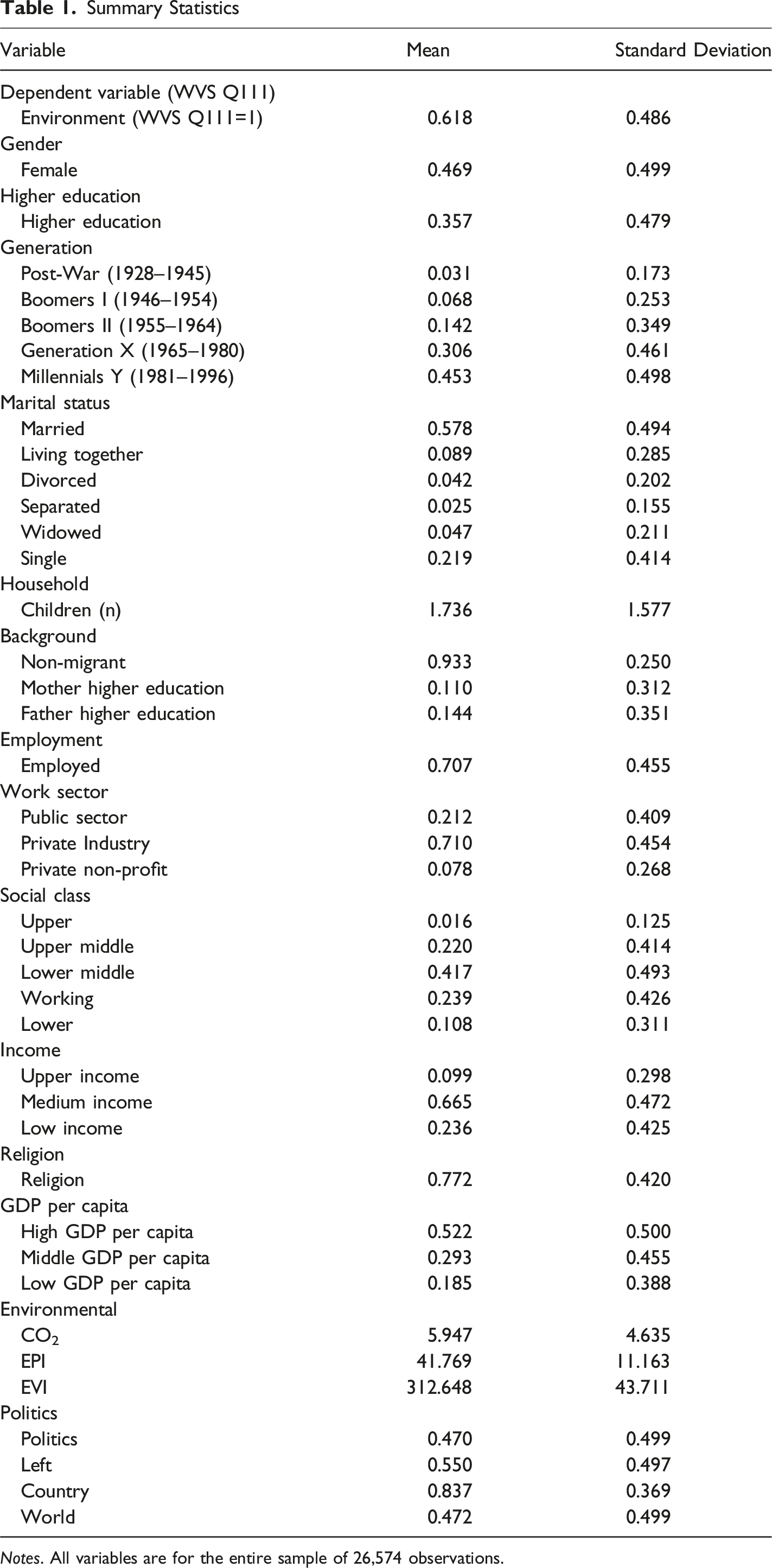
Notes. All variables are for the entire sample of 26,574 observations.
Methodology
The analysis was undertaken using the entire sample (n = 26,574). We estimated a logistic regression model, with the dependent variable being a binary variable based on responses to Q111 and including all regressors, with a sensitivity analysis undertaken for models with either subsets of the independent variables or the main model tested on cohort sub-samples (e.g. models for male and female respondents).
Results
Results for the Main Model and Truncated Versions
Note. ***, **, and * denote statistical significance at the 0.001, 0.01, and 0.05 levels, respectively. ‘Omitted’ categories are omitted in all models.
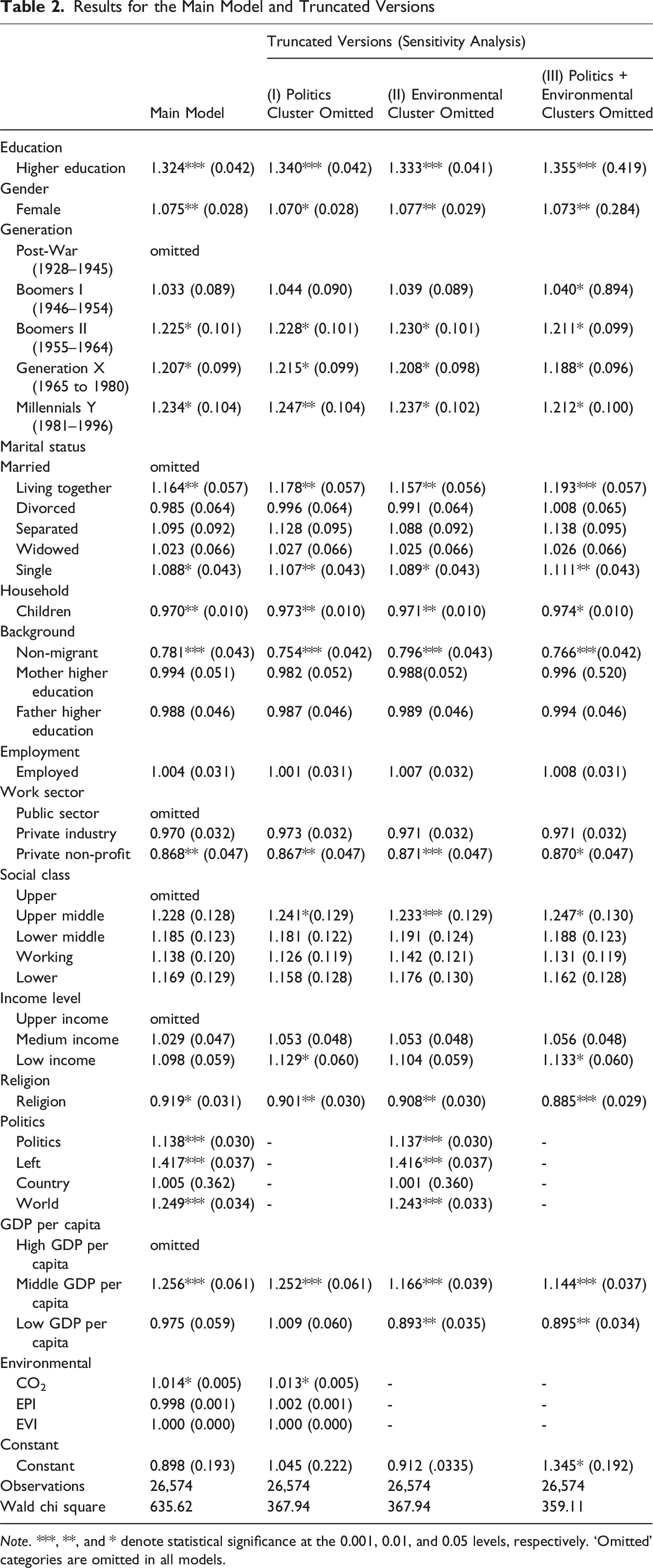
The parameters estimates can be interpreted as the propensity to nominate environmental protection for the given factor, with estimates of an odds ratio of 1.000 indicating the factor (e.g. Female in Gender and relative to male) does not affect the odds of the respondent prioritising environmental protection; an odds ratio above 1.000 indicating an increased propensity to do so; and estimates of the odds ratio below 1.000, indicating a reduced propensity to do so.
Turning to the results themselves, the estimates of the odds ratio for the factor of primary focus in this paper, higher education attainment, indicated it was associated with a strong and significant effect (Main Model, Higher Education: 1.324 [odds ratio], p < 0.001). This effect was robust across all specifications.
A positive and statistically significant gender effect was observed in the Main Model (Female: 1.075, p < 0.01), with similar estimates attributable to this effect being observed with the inclusion of the Social and Environmental variable clusters, both separately and in combination, as per the truncated versions of the model. Overall, the odds ratio shows that female respondents were 7% more likely than male respondents to nominate the environmental statement as better representing their views.
There was a noticeable split across generations in terms of nominating the environmental response to Q111, with the Post-War (omitted) generation and older boomers (Boomers I) less likely to do so compared with younger generations. However, these observed effects are generally only statistically significant at the 0.05 level. One aspect of this finding that needs further attention is the stronger effect for Boomers II, certainly in terms of the generations who proceeded them, but also to some extent in relation to the Generation X, the generation born immediately after them.
People in non-marital relationships (Living Together) or single (Single: 1.088, p < 0.05), were more likely to nominate the environmental statement than married people, while respondents with children were less likely to do so (Children: 0.970, p < 0.01) – suggesting a compounding effect in relation to married couples with children.
Respondents born in their reporting countries were less likely to nominate the environmental statement than those who had migrated, at a high level of statistical significance (Non-migrant: 0.781, p < 0.001). Another background variable, higher education attainment among parents, had no significant impact on respondents’ probability of nominating environmental concerns.
No direct effects were observed in relation to employment status (Employed). Among employed respondents, private sector workers appeared less likely than public sector workers to privilege environmental concerns in their assessment of the trade-off with economic growth, but with a statistically significant effect only observable among those in the non-profit sector (Private Non-Profit: 0.868, p < 0.01).
Household class and income effects were both relatively muted and mixed, with some statistically significant positive effects associated with respondents being classified in the Upper Middle class, compared with the omitted category of Upper class, with weaker effects associated with household income level.
Effects associated with stated religious and political values were important. Respondents who nominated themselves as religious were less likely to nominate the environmental option, although this effect became weaker and statistically less significant with the inclusion of variables in the Social and Environmental clusters (Religion: 0.919, p < 0.05). Three variables associated with political attitudes had statistically significant influences on the dependent variable: Politics (1.138, p < 0.001), Left (1.417, p < 0.001), and World political outlooks (1.249, p < 0.001).
Turning to country-level effects, respondents from middle GDP per capita countries were more likely to nominate environmental concerns (Middle GDP per capita:1.256, p < 0.001). While there was a minimal effect associated with country carbon dioxide emission (CO 2 : 1.014, p < 0.05), no substantial or significant effects were associated with variations in the environmental cluster, the EPI and EVI variables.
Findings on Hypotheses (Main Model)
Note. ***, **, and * denote statistical significance at the 0.001, 0.01, and 0.05 levels, respectively.
Discussion
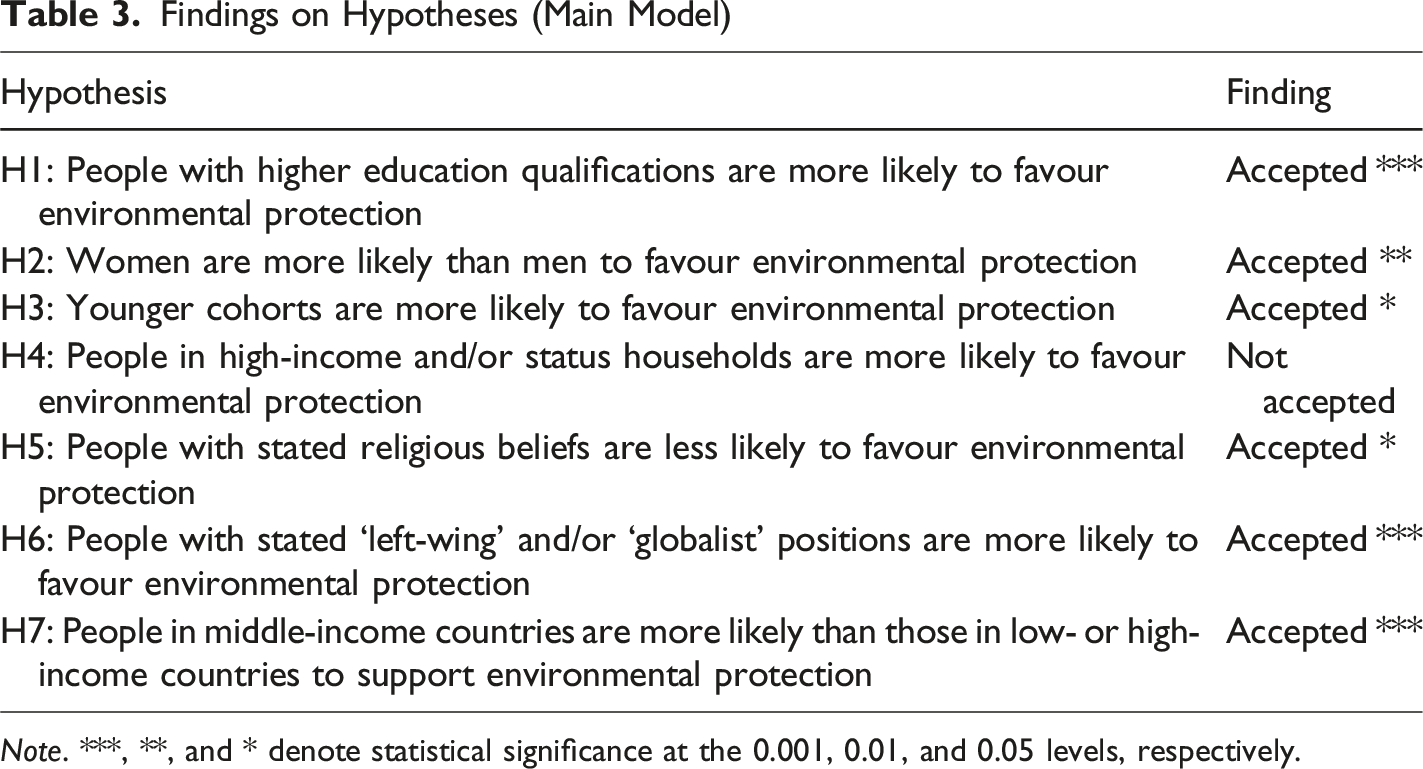
The core finding around the influence of higher education indicates that it is a significant factor in shaping attitudes, even in the presence of related control variables. The rejection of the hypothesis around income level and class status, indicates that social distinctions based on educational attainment may be more important than related measures of status attainment in explaining people’s responsiveness to environmental issues across a wide range of countries. It also affirms work on the importance of general education in fostering support for the environment.
One interesting finding is that with higher education attainment included in the model, three of the political variables (Politics, Left, World) had highly significant effects, confirming Hypothesis 7. This suggests that an orientation towards political movements engaged with environmental and global issues is as important as higher education background in explaining preferences for environmental protection, an interesting finding given the commonly observed overlap between the two (Pantera, 2025).
The findings on gender and generation status confirmed those from the literature, with female respondents more likely to support environmental protection than their male counterparts and younger generations providing stronger levels of support compared with the default Post-War generation, but with no real evidence of a gradient across the generations. One reason for this might be the inclusion of higher education controls, with younger generations tending to have increased rates of higher education participation than those in the older cohorts.
The focus of this analysis was on the influence of higher education on respondent attitudes to the environmental-economic growth trade-off. After finding a consistent After finding a consistent positive and substantial effect associated with higher education, we estimated the Main Model (all control variables) across key sub-samples: Gender (Female/Male), Generation (Post-War to Millennials) and GDP Per Capita (Low to High). Estimates of the odds ratio for Higher Education in each sub-sample are reported in Figure 1. Higher Education parameter estimates, Main Model, Total and Sub-Samples. Notes: Estimates of the impact of higher education attainment (Higher Education parameter) on the propensity to nominate the protection of the environment as a priority over economic growth in an estimation of the Main Model across the main sample (‘Total’) and various sub-samples. Estimates greater than 1.000 (delineated by the black line) indicate that Higher Education is associated with an increase in the likelihood of a respondent expressing a preference for environment protection, with dark green dots indicating that this estimate is statistically different from 1.000 at the 0.01 level of significance and lighter green at the 0.05 level. ‘Total’ refers to the estimated higher education attainment effect reported in the Main Model in Table 2.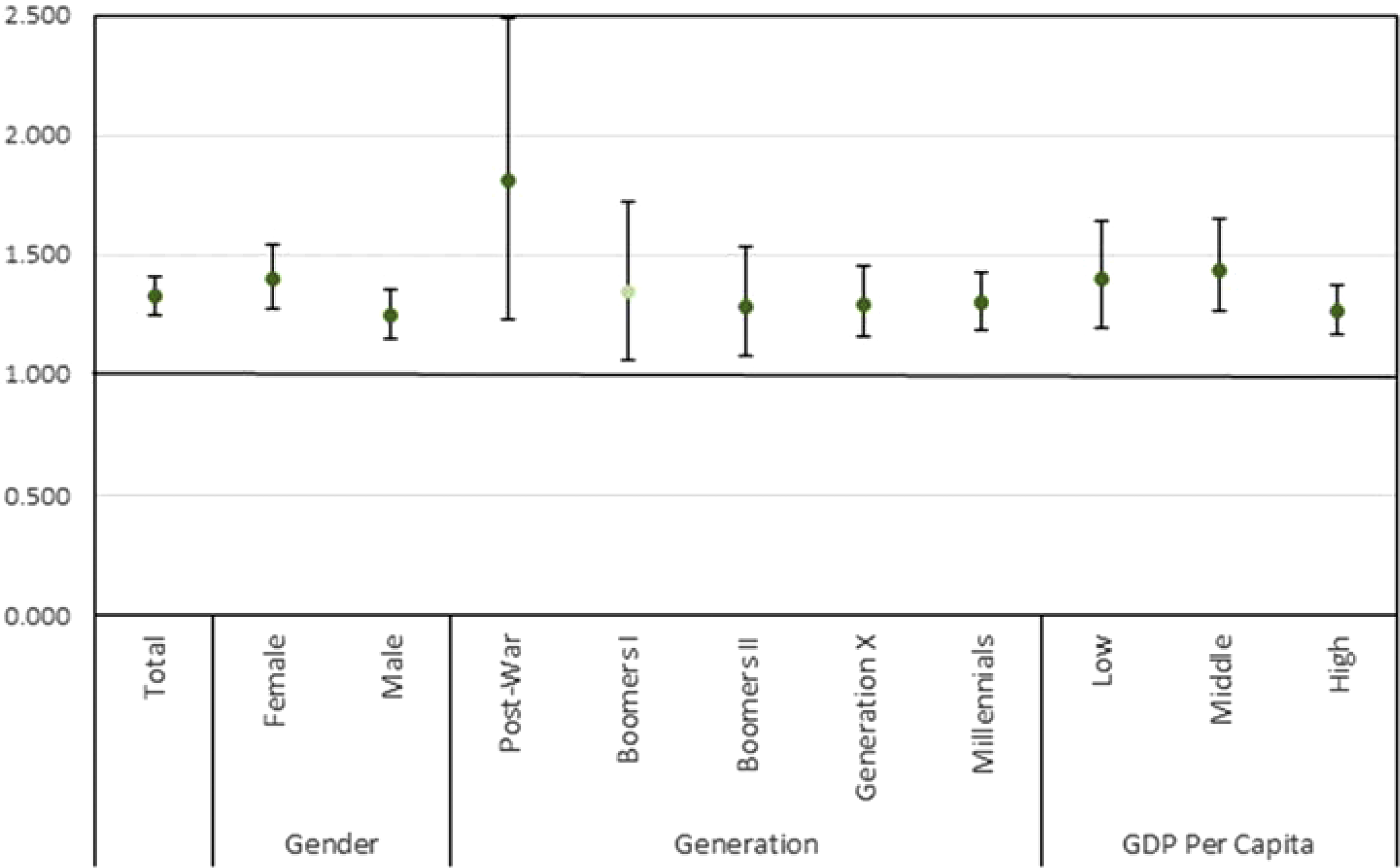
As above, these estimates of the odds ratio represent the likelihood of occurrence (i.e. an expressed preference for environmental protection) where the respondent has a higher education qualification in a particular sub-sample. For instance, the Female and Male estimates correspond to the observed effect of the Higher Education variable in sub-samples of female and male respondents, respectively, and similarly, for the generation and the GDP per capita group sub-samples.
These estimates show a consistent level of influence across sub-populations, but with a notably higher influence in the Post-War I sub-sample, where fewer respondents had higher education degrees and among respondents in High GDP Per Capita countries, where higher education attainment has increased dramatically in recent decades (Trow, 2007).
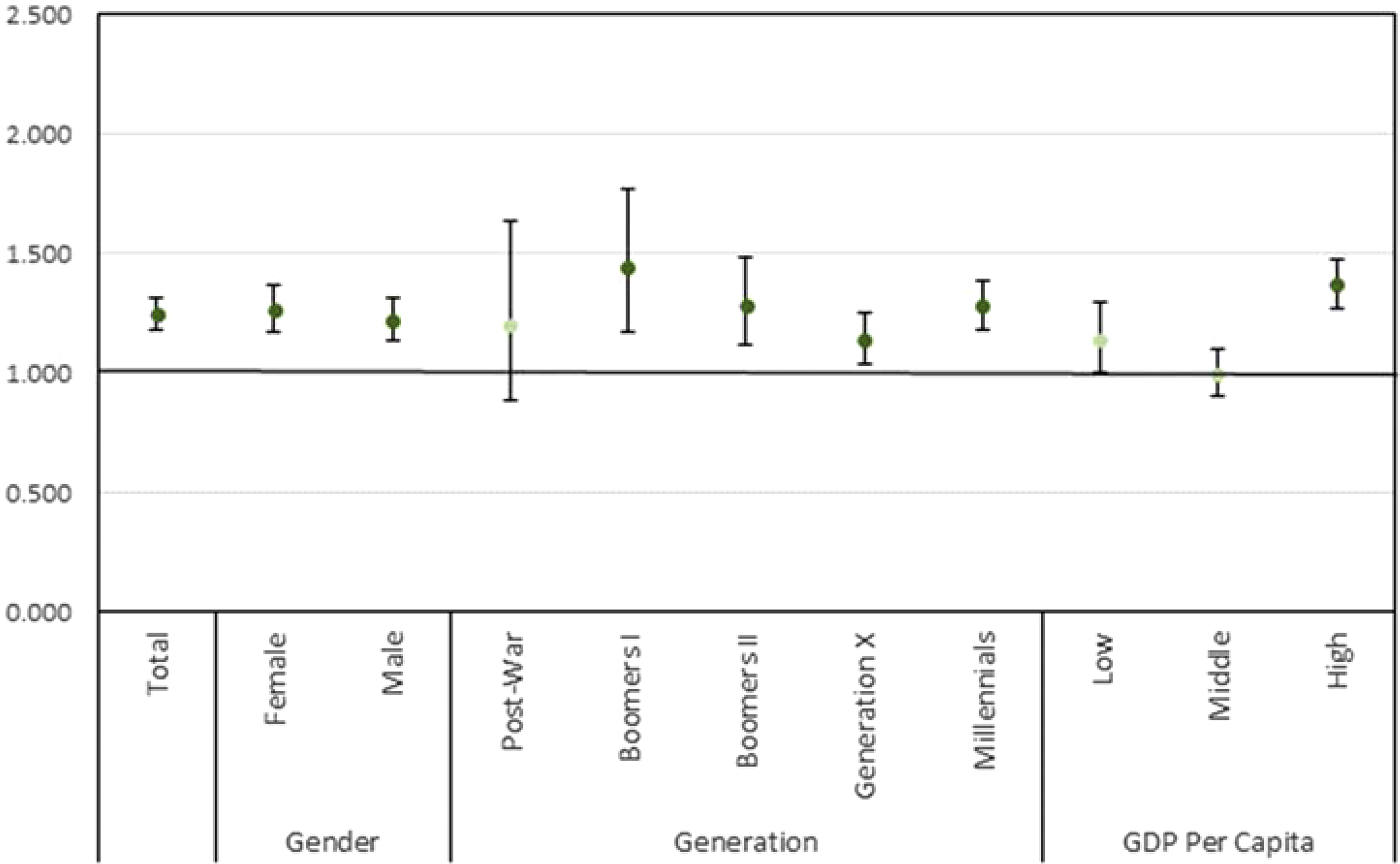
We undertook a similar analysis using the Politics cluster of variables yielded two strong, positive influences on environmental preferences – a left-leaning political outlook (Left) and an identification with world rather than country outcomes (World). Figures 2 and 3 report odds ratios for these two variables in the Main Model across all sub-samples for gender, generation and country income. These show, that after controlling for higher education attainment, left-leaning and global political sympathies strongly influence environmental attitudes, particularly among the first group of Boomers (those born between 1946 and 1954) and respondents from high GDP per capita countries, implying that while higher education attainment has been a key driver in shaping attitudes towards the environmental-economic growth trade-off, particular post-War political attitudes around globalisation and the role of government in general, have also had an impact – however, they are also in part the products of the expansion in higher education in many countries in recent decades (Surridge, 2016), and one which is the source of current discussion globally (Vaníček et al., 2025). Left parameter estimates, Main Model, Total and Sub-Samples. Notes: Estimates of the impact of a left-leaning political outlook (Left parameter) on the propensity to nominate the protection of the environment as a priority over economic growth in an estimation of the Main Model across the main sample (‘Total’) and various sub-samples. Estimates greater than 1.000 (delineated by the black line) indicate that Left variable is associated with an increase in the likelihood of a respondent expressing a preference for environment protection, with dark green dots indicating that this estimate is statistically different from 1.000 at the 0.01 level of significance and lighter green at the 0.05 level. ‘Total’ refers to the estimated higher education attainment effect reported in the Main Model in Table 2. World parameter estimates, Main Model, Total and Sub-Samples. Notes: Estimates of the impact of a global outlook (World parameter) on the propensity to nominate the protection of the environment as a priority over economic growth in an estimation of the Main Model across the main sample (‘Total’) and various sub-samples. Estimates greater than 1.000 (delineated by the black line) indicate that World variable is associated with an increase in the likelihood of a respondent expressing a preference for environment protection, with dark green dots indicating that this estimate is statistically different from 1.000 at the 0.01 level of significance and lighter green at the 0.05 level. ‘Total’ refers to the estimated higher education attainment effect reported in the Main Model in Table 2.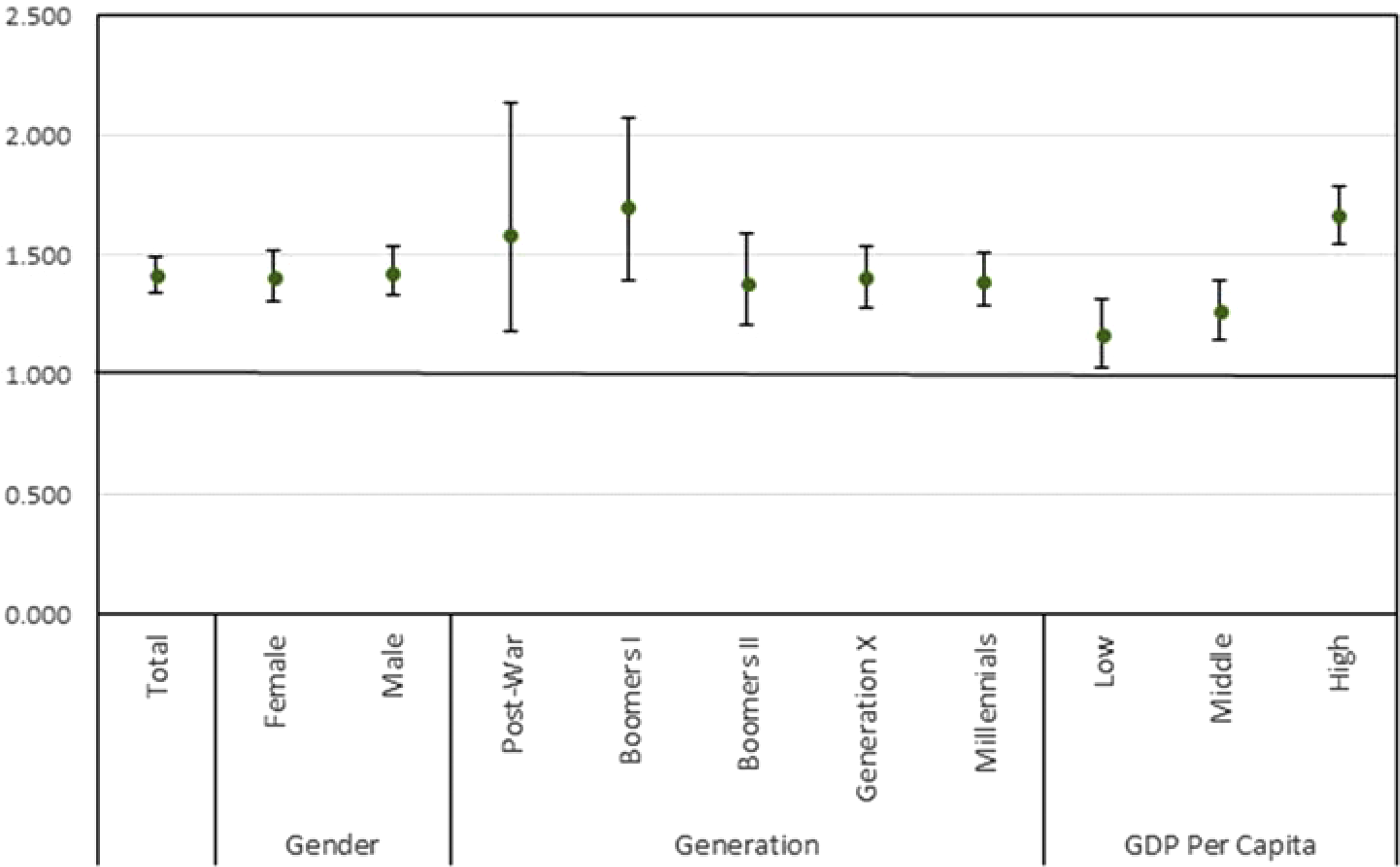
Conclusion
The findings from the analysis of cross-country WVS data speak to the unique role of higher education attainment in modern societies.
Importantly, they confirm the robust relationship between higher education attainment and positive environmental values, in this case, a preference for environmental protection over the exclusive support of economic growth. The effect is largely observed to be relatively stable across gender, generation and country income sub-samples, with a noticeable decline in importance among younger generations relative to the oldest generation – the Post-War generation, or the parents of the Boomers, suggesting that the relatively lower rates of higher education attainment among people of that generation may have accentuated the disparity in response patterns between graduates and non-graduates in those cohorts. Nevertheless, a statistically significant effect is still observed among WVS respondents from younger generations.
The core finding raises the question of the true channel through which higher education attainment shapes environmental attitudes among graduates. An extension of this work would look at critical factors identified by studies such as Surridge (2016), who identified differences in graduate responses based on educational discipline background, and postulated that socialisation was a key mechanism for linking education levels and left-leaning or liberal values, including those associated with environmental protection. Education’s role may also be moot if people self-select into courses in part to study issues such as environmental protection – another potential avenue for future research on this question.
A related finding of consequence is the influence of country per capita GDP on citizens’ views on the economic-environmental trade-off, with respondents in middle-income countries (per capita GDP of US$10,000 to 25,000) more likely to endorse environmental considerations than respondent in either high or low per capita income countries. We postulate that this may reflect an EKC-style effect, with respondents in middle-income countries more likely to be aware of environmental degradation as a cost of economic growth in places where income levels have yet to bolster remediation efforts. This raises a related question on the extent to which higher education attainment shapes country-level responses to economic, technological and environmental challenges as nations become richer and whether progress in addressing such challenges is framed in a national or global context.
We find evidence for equally strong influence of political opinion in shaping support for environmental protection relative to economic growth, even after controlling for the effect of higher education attainment. This is an interesting finding in view of the recent literature on political orientation and environmental concerns that indicates a disconnection between the two (D’Ecclesiis et al., 2025), suggesting that higher education attainment, or perhaps educational engagement in general, may ameliorate differences across the pollical divide on environmental issues.
While this work points to further studies on education, development, and sustainability, it does challenge policymakers to examine the extent to which ideation around environmental issues and responses is formed in higher education and ways in which the opportunity for critical thinking and exposure to debate about important environmental issues currently provided in higher education settings could be further extended to parts of the compulsory education system.
Footnotes

Ethical Considerations
Ethical approval and informed consent statements: This study only uses publicly available data from the World Values Survey and other public secondary sources, including the World Bank.
Author Contributions
Helen Cabalu: Project outline; literature review; project design and methodology; drafting and finalisation of paper. Paul Koshy: Project outline; literature review; project design and methodology; drafting and finalisation of paper. Vicar Valencia: Project outline; literature review; project design and methodology; data analysis; drafting of paper.
Funding
The authors received no financial support for the research, authorship, and/or publication of this article.
Declaration of Conflicting Interests
The authors declared no potential conflicts of interest with respect to the research, authorship, and/or publication of this article.
Data Availability Statement
The data set for this study is not publicly available. However, the paper outlines data sources, primarily, the collections of the World Values Survey.