




Abstract
Specialization in tourism exposes the economy of Hawai‘i to external shocks that trigger collapses in tourist numbers. Furthermore, Hawai‘i's economic growth has diminished for decades as the dominance of tourism has not generated productivity growth. In response, policy makers in Hawai‘i increasingly emphasize diversification. This article examines a spatial economics perspective to explain why Hawai‘i is so specialized, and to sketch policy for diversification and growth. Isolated, small, and open economies tend to be more specialized in one or a few industries because increasing returns to scale generates a coordination problem for new industries. By targeting industries that use related know-how, or a Hawai‘i-specific resource, Hawai‘i can access productivity gains from the scale of related and location-bound industries.
Hawai‘i's economy is extraordinarily specialized in tourism, resulting in vulnerability to external shocks and diminishing growth in productivity (Kato & Mak, 2013). In response to the economic impact of the COVID-19 pandemic, policy makers in Hawai‘i increasingly emphasize diversification. Alternative industries are asking for support. For example, recent research examined policies to support the agriculture (La Croix & Mak, 2021a) and film industries (La Croix & Mak, 2021b). Some economists are concerned that diversification policy will fund special interests rather than genuine economic development initiatives. Ultimately, the challenge is how to balance the tendency to specialize with the need to promote resilience and productivity growth.
This article discusses how spatial economics explains why Hawai‘i is so specialized to sketch strategies for diversification policy. Only this perspective explains why some industries are more difficult in Hawai‘i and why a select few are so bound to the state. As a result of spatial externalities, distance, and internal and external increasing returns to scale, isolated, small, and open economies tend to specialize (Bond-Smith & McCann, 2020). Specialization in tourism is a response to Hawai‘i's unique set of spatial constraints and local advantages and disadvantages.
But these arguments are far more nuanced and complex than simply distance, scale, and a tropical location. Specialization is more than comparative advantage—it is internal and external increasing returns to scale interacting with the mobility of factors of production that generates a coordination problem for new industries. The insights in this article would also be applicable to community-scale analyses of isolated towns and rural areas across the United States. Understanding how the spatial economic perspective affects the industrial structure and economic development of different places generates very different policy implications in small and isolated places based on local characteristics, endowments, and local market failures. The spatial economy perspective makes diversification policy in Hawai‘i a kind of riddle, with logical, though counterintuitive, local solutions.
This problem of specialization and volatility is not unusual in small, isolated, and open economies (Bos et al., 2020; Eskelinen et al., 1998; Forero et al., 2021). Other states in less densely populated parts of the country are also more specialized, such as Alaska, Nevada, Colorado, and Maine, though Hawai‘i is far more isolated than anywhere else. There are productivity benefits from comparative advantage and establishing an industry with sufficient scale due to increasing returns, but very small economies can probably only do this in very few areas. The choice of specialization is a result of hysteresis and resource endowments. As a result, such economies typically specialize in a natural resource industry since those natural resources cannot be extracted anywhere else. In many states, this is mining and oil and gas extraction. In the past, and in many rural communities, it is primarily agriculture, forestry, and fishing. It is more difficult for other industries to become established in small, open, and isolated economies because there are productivity benefits from locating these activities in closer proximity due to increasing returns to scale (Krugman, 1991).
The spatial economics perspective understands that the location choices of individuals and their economic activities are affected by internal, external, increasing, and decreasing returns to scale due to fixed costs and spatial transaction costs. Spatial transaction costs increase to serve customers located further away and decrease if more customers and suppliers are in close geographic proximity. External increasing returns can generate coordination and hold-up problems for economic development (Matsuyama, 1991; Rodrik, 1996) such that a firm is only competitive once the industry reaches a sufficiently large scale. As a result, new activities are slow to develop until complementary investments are made to increase the scale of customers and suppliers in proximity. Coordination problems can be solved by industrial policy (Rodrik, 2004, 2008) that stimulates either private (Morck & Nakamura, 2007) or public investment (Murphy et al., 1989; Rosenstein-Rodan, 1943) to establish the critical scale for a self-sustaining industry or to stimulate agglomeration economies (Kline, 2010).
Such investments describe the recent strategies of several oil-rich countries building extravagant cities and expanding services to prepare for an eventual shift away from oil. But it also provides a narrative for Hawai‘i's various past specializations and the potential solutions to diversify its economy. King Kamehameha III made a series of changes to Hawai‘i's land tenure system, known as the Great Māhele, that allowed private investment to enable sufficient scale for plantation agriculture. In the late 1960s, Hawai‘i Governor Jack Burns built freeways, several tunnels, housing, a shopping center, an industrial area, and most importantly, airport infrastructure, to diversify the economy away from plantation agriculture. Stagnating productivity in tourism implies that such industry policy initiatives might be necessary once again. While some may object to this larger role for government, government spending also provides for risk reduction, which is important when Hawai‘i is exposed to significant external risks (Rodrik, 1998).
The difficulty with such policies is identifying suitable opportunities and structuring policy to take advantage of market-based incentives and discovery processes. This avoids the pitfalls of “picking winners” and incentivizes productivity growth. Such policy initiatives are uniquely local because they build on existing strengths, capabilities, and resources, and address uniquely local problems and market failures. Similarly, the economic history and the narrative of how a particular place specialized in its comparative advantage is a very local story. It would not be possible to include detailed case studies for multiple economies to explain such narratives in one article. While this article focuses on the story of Hawai‘i, the lessons from this approach can also be widely applied to other small, open, and specialized economies around the world.
The intuitive responses for an isolated economy facing stagnation are to reduce spatial transaction costs, attract footloose activities that could relocate, and support industries that used to be strong. For example, many are hopeful that the work-from-anywhere trend will bring high-value opportunities; some advocate for tax credits to expand the footloose film and television industry; and others want subsidies to reestablish agriculture and locally sourced foods. But declines in spatial transaction costs do not necessarily lead to development in isolated places because greater advantages accrue to the more connected places. While the Internet means people can work from anywhere, it also means that the most connected places can serve everywhere. Similarly, attractive subsidies or tax breaks might attract tech businesses or film makers, but footloose industries are also more likely to leave than to become sources of long-term economic growth. Finally, industry policy is often unsuccessful because it persists with supporting a failing industry for far too long. Reestablishing agriculture seems like a good use of land, but Hawai‘i-grown food is still usually more expensive than imported food and unlikely to lower living costs. Rather, diversification policy will only be successful if it can take advantage of the set of forces that already generate specialization.
The economic geography, spatial economics, and innovation literature provide insights for such a policy. McCann (2009) described how economic geography explains the paradox of New Zealand's specialized economy and lagging productivity. He suggested strategic investments to increase connectivity, as well as to increase value-added in key industries. Saunders et al. (2021) argued for a mission-oriented innovation research program. Balland et al. (2019) suggested that initiatives should focus on activities related to core strengths and use economic complexity to identify valuable industries. Bond-Smith and McCann (2020) implied that small economies should target existing clusters with a higher degree of within-industry spillovers, since these are less footloose and likely to remain. Skilling (2020) argued that large firms provide the productivity frontier in small, advanced economies, but that large firms might also face too little competition to incentivize innovation in small markets (Bond-Smith, 2022a). The European Union's Smart Specialization policy to help lagging regions in Europe provided a suitable guide for supporting local areas of opportunity (McCann & Ortega-Argiles, 2015). Recent testimony from the Brookings Institution at the U.S. Senate Committee on Environment and Public Works emphasized the importance of local and regional leaders (The future of regional economic development and implications for the U.S. Economic Development Administration Programs, 2021). Similarly, Dani Rodrik (2022) and policy specialists at the World Bank (Ketels & Duch, 2022) emphasized the importance of location- and sector-specific policy. I take insights from all these perspectives.
This article relates to research on regional economic development. New and existing industries will form clusters of related industries. This can be thought of as an extension of the clusters approach (Porter, 1998, 2000, 2011), as promoted by the U.S. Economic Development Administration in its comprehensive economic development strategies (CEDS). Much of the economic development literature has focused on subsidies and incentives (McGahey, 2008). I briefly discuss the importance of not picking winners, such that investments focus on enabling activities that address market failures rather than direct subsidies. But the concept of picking winners is nuanced by narrowing the scope of broad programs to focus on the most promising opportunities. Florida (2002a, b, c) emphasized the importance of quality of life to attract what he coined the “creative class.” While others may question the direction of causality, this may not matter in Hawai‘i. Nonetheless, I emphasize the need to attract creatives from the fields that are more likely to remain in Hawai‘i in the long term.
This article also relates to a growing literature about the economic impact and response to the COVID-19 pandemic. Brodeur et al. (2021) provided an initial survey of COVID-19 economic research. Handwerker et al. (2020) examined labor markets. Altig et al. (2020) examined the increase in uncertainty. Usher (2022) examined the experiences of surfers traveling and hosting visitors during the pandemic, emphasizing the need for Hawai‘i to diversify coastal economies. In Hawai‘i, Fuleky (2022) developed nowcasts of the economic impacts of the pandemic using high-frequency indicators. Bond-Smith and Fuleky (2022) discussed the economic effects of the pandemic on Hawai‘i by comparing outcomes to the 2019 forecast. The common theme in these papers is that economies are unlikely to return to their prepandemic situation and new approaches may be needed. A similar rhetoric is promoted in policy circles (World Economic Forum, 2020).
Recognizing this need from both scholarly research and policy, in this article, I provide a forward-looking survey of the spatial economic perspective of the economy of Hawai‘i and sketch a strategy for diversification to provide resilience to future shocks. The approach is similar to growth diagnostics (Hausmann et al., 2008; Rodrik, 2010): finding a narrative that is consistent with the observed development issues and prescribing a suitable policy response, though a full diagnostic exercise is more than the page limits of one article. Since my narrative and response are related to a unique set of circumstances and local capabilities, the resulting policy is a uniquely Hawai‘i economic development strategy. Even with this narrowly defined scope, my principles for economic development can be widely applied to other small, open, and isolated economies, and especially to tourism-dependent economies.
Why So Specialized?
Three key characteristics explain a lot about Hawai‘i's economy: isolation, scale, and economic integration. But, as I explain in this article, these factors have nuanced and complex impacts.
Isolation
Hawai‘i is a long way from the rest of the United States. Geographically, Hawai‘i is not even in North America. It is in Oceania—specifically in Polynesia, though that is more of a cultural description than a location. Market access measures such as distance explain significant variations in economic outcomes (Redding & Venables, 2002, 2004). Government regulation and infrastructure can also contribute to isolation. For example, the antiquated Jones Act requires companies shipping between U.S. ports to use U.S.-built ships and crew, generating significant transaction and transportation costs that many industries may be unable to overcome to be competitive in Hawai‘i.
Spatial transaction and transportation costs incentivize geographic proximity. This means many traded businesses will be more competitive if located in the continental states. This also means that traded imports to Hawai‘i face greater costs that push up the costs of living and production. As a result of these circular forces, economic activity in Hawai‘i is always based on an immobile and local factor of production—Hawai‘i's climate—because these activities are unable to occur anywhere else.
Scale
Hawai‘i is small. If it were bigger, a sufficiently large local home market would allow it to take advantage of the productivity benefits of internal and external increasing returns to scale to supply both local and export markets (Krugman, 1991).
The limited availability of land pushes up the cost of building space. Ninety-two percent of the area in a 50-km radius around Honolulu is not developable because much of it is ocean, mountains, or conservation area. This makes Honolulu the most land-constrained city in the United States (La Croix, 2016). As a result, the cost of holding inventory or hosting space-intensive production is exorbitant. As with transport costs, many industries may be unable to overcome the cost of building space for production in Hawai‘i to be competitive in mainland markets. This may also explain why some of the industrial composition skews toward services in Hawai‘i.
Economic Integration
The United States has a large domestic tourist market. Access to this large home market provides Hawai‘i with sufficient scale in one industry—tourism—because the many amenities that tourists come to visit cannot relocate. Tourism generates a large export income from Asia as well. While the tourists visiting Hawai‘i spend less money than they used to, the number of tourists continues to grow, reaching a record 10.4 million in 2019 (Hawai‘i Tourism Authority, 2020). So, integration with the United States gives it the ability to gain scale and productivity in its comparative advantage, implying even greater specialization.
O‘ahu and the big island of Hawai‘i are well connected, having international airports with frequent flights to and from large cities such as Tokyo, Seoul, and Los Angeles. Travel between all the islands requires neighbor islands 1 to have airports, so it is straightforward to expand those on the smaller islands to include long-distance travel. But connectivity may imply even greater specialization patterns because of productivity gains from increasing returns to scale when a region becomes connected to more markets and other needs can be fulfilled by imports. The impact of connectivity depends upon where a place is connected in the network. Places connected to the ends of a network could be expected to become more specialized while those in more central locations become hubs of activity (Glückler, 2007). When it was a hub for crossing the Pacific, Hawai‘i's economy was fruitful. Now it is no longer in the middle of the network but at its peripheral endpoint.
The Combined Effect
These effects interact to generate system-level effects that impact small and isolated places differently (Desmet & Rossi-Hansberg, 2014). While the Internet reduces spatial transaction costs that make it easier for economic activity to spread out, the economic world is, counterintuitively, becoming even more curved (McCann, 2008). This is because, as spatial transaction costs decline, economic activity can take greater advantage of increasing returns to scale by expanding production in some places and dispensing with other superfluous locations (Krugman, 1991). For example, in 2002, Hawai‘i switched from being a state with net exports to one with net imports (Liou, 2020). The change was caused by Amazon's offering of free shipping to Hawai‘i for orders over a certain amount. E-commerce makes it more efficient for well-connected places to sell everywhere, so production tends to cluster into fewer places.
While the Internet makes it easier for University of Hawai‘i academics and Hawai‘i's businesses to collaborate with domestic and foreign colleagues (Forman & van Zeebroeck, 2012, 2019), new collaborations often require proximity (Catalini, 2017) because innovations are often only spurred when people meet serendipitously. Serendipity does not yet occur as easily over the Internet. Furthermore, the trust that is required for collaboration can often only be built by meeting face-to-face and “talking story.” 2 This is especially important for skilled nonroutine tasks, where measuring performance is difficult. It is certainly easier for academics to attend conferences as the cost of travel has declined, but the shift to online conferences might reduce the serendipitous benefits. The Internet can substitute face-to-face communication, but often it is complementary to face-to-face communication, particularly for building trust and generating serendipity (McCann, 2007). As a result, the greatest advantages of the Internet for collaboration also occur in the places that most frequently connect people in person—large-scale and highly connected cities—and that is not in Hawai‘i. Most of all, this issue affects those early in their careers, implying headwinds for the economic trajectory in Hawai‘i and another explanation for declining growth. This is a modern version of the core–periphery outcome in the New Economic Geography (Krugman, 1991). Since Honolulu is not as large or as well connected as other major cities in the United States, dispensing with production in superfluous locations implies even greater specialization in Hawai‘i.
All these factors combine to imply external increasing returns to scale. As noted above, external increasing returns generate a coordination problem: a firm is not productive until its industry, supply chain, and other relevant external scales reach a sufficient size. The combination of small-scale and mobile factors of production means that such scale is never achieved across a diverse range of industries. This means that Hawai‘i will tend to overspecialize because the diversity of other industries that are typically assumed in economic models are prevented from emerging. Furthermore, these effects may be exacerbated by Hawai‘i's extremely restrictive housing market (Inafuku et al., 2022). Housing constraints may limit the rapid emergence of scale in any diversification efforts and reduce productivity growth because it generates a spatial misallocation (Hsieh & Moretti, 2019).
As a result of economic geography, isolated, small, and open economies tend to be much more specialized in one or a few industries (Bond-Smith & McCann, 2020; McIntyre et al., 2018). This is a response to their relatively higher spatial transaction costs, increasing returns to scale, and open integration. Small, advanced, open, and isolated economies gain scale in single, locally bound industries that benefit from increasing returns to scale, while other industries face a coordination problem preventing their emergence. The selection of a specialization is a historical accident, such as a natural resource endowment, institutional change, or big investment. Businesses that use natural resources, such as Hawai‘i's climate, cannot simply shift elsewhere. These are industries that must locate in Hawai‘i.
The Economic Case for Diversification
There are many reasons to diversify the economy of Hawai‘i. Tourism puts pressure on infrastructure and the environment. Tourists using homes and apartments could push up the cost of homes (Barron et al., 2021). As visitor numbers set records, the social cost of tourism may increase relative to the benefits (Mak, 2017, 2018a). Declining resident sentiment was reinforced during the pandemic when incomes were protected by federal assistance, cementing a view that tourists were a problem, rather than a source of income. Perhaps most importantly, many Kānaka Maoli 3 are justifiably concerned about the commercialization of their culture and disregard for cultural values. Furthermore, the high cost of living has long generated significant out-migration (Mak & Tyndall, 2020) and spurred concerns for kamaʻāina 4 and Kānaka Maoli to remain in Hawai‘i. While all these reasons are important, the scope of such a project would be well beyond this article. Instead, this section focuses on the economic case. I note the importance of these other aspects as components of the solutions presented later in this article.
Short- and Long-Term Risks
Hawai‘i's economy has faced multiple waves of specialization since traders first arrived, starting with sandalwood, then whaling, different types of plantation agriculture, and tourism (La Croix, 2019). A relatively hands-off approach initially allowed tourism to expand rapidly, though declining resident sentiment, environmental impacts, and declining visitor spending now require a more managed approach (Mak, 2018a, 2021). While tourism has proven more stable than commodities and Hawai‘i made the transition to tourism fairly well, its economy is still very specialized (La Croix, 2021).
This intense specialization makes Hawai‘i's economy vulnerable to external shocks, exposing its residents to economic volatility and risk. Initially, after both 9/11 (Bonham et al., 2006) and the COVID-19 pandemic (Bond-Smith & Fuleky, 2022), Hawai‘i's tourism economy crashed as people avoided traveling in planes and travel restrictions were put in place to reduce transmission of COVID-19. Figure 1 shows the number of tourists and their spending since 1975. Both tourist numbers and their spending are punctured by external shocks such as the Asian Financial Crisis, 9/11, the Great Recession, and the COVID-19 pandemic.
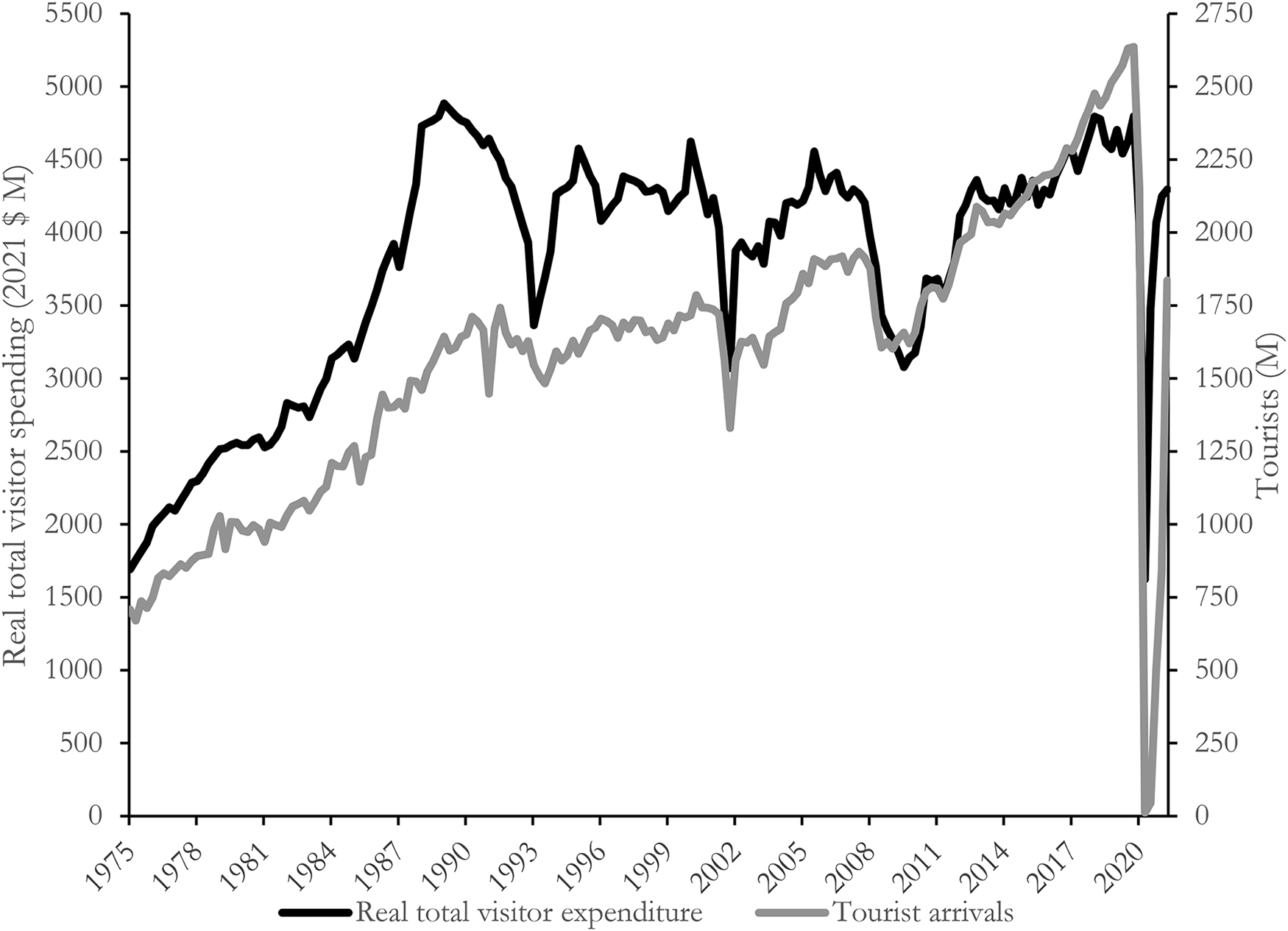
Quarterly tourist numbers and spending.
Many of these impacts are short to medium term. Vaccinations have lessened the epidemiological impact of COVID-19. Americans craving a return to normalcy after a year without travel returned in record numbers in the summer of 2021. But international tourism is slower to recover, with travel restrictions continuing in Japan and other countries. As a result, tourism in Hawai‘i generated a slower economic recovery than in the rest of the United States. These sharp economic shocks might also have lasting scars (Fuentes & Moder, 2020; Huckfeldt, 2022).
But Hawai‘i's extreme specialization also presents a long-term risk. Real tourism spending essentially stopped growing around 1990. It has long been understood that industries tend to experience stagnating growth or even decline as technological progress slows (Kuznets, 1929). On this basis, Kato and Mak (2013) pointed out that slowing technological improvement in air transport explained the end of growth in tourism for Hawai‘i. While the slowdown in tourism has allowed the state to become slightly less specialized since 1990, no other sector has emerged with significant growth. As a result, Hawai‘i's economic growth has failed to keep up with the rest of the United States (see Figure 2). Per capita gross domestic product (GDP) grew significantly after statehood until the end of the Cold War, followed by the so-called “lost decade,” and limited growth after the Great Recession. Real GDP per capita peaked in 2005 at almost $67,000 (in 2021 dollars) but did not reach this peak again until 2019. In comparison, real GDP per capita in the United States grew 17% in that time. Based on these trends, Hawai‘i faces a risk of becoming one of the “left-behind places” (Hendrikson et al., 2018) or “places that don’t matter” (Rodríguez-Pose, 2018).
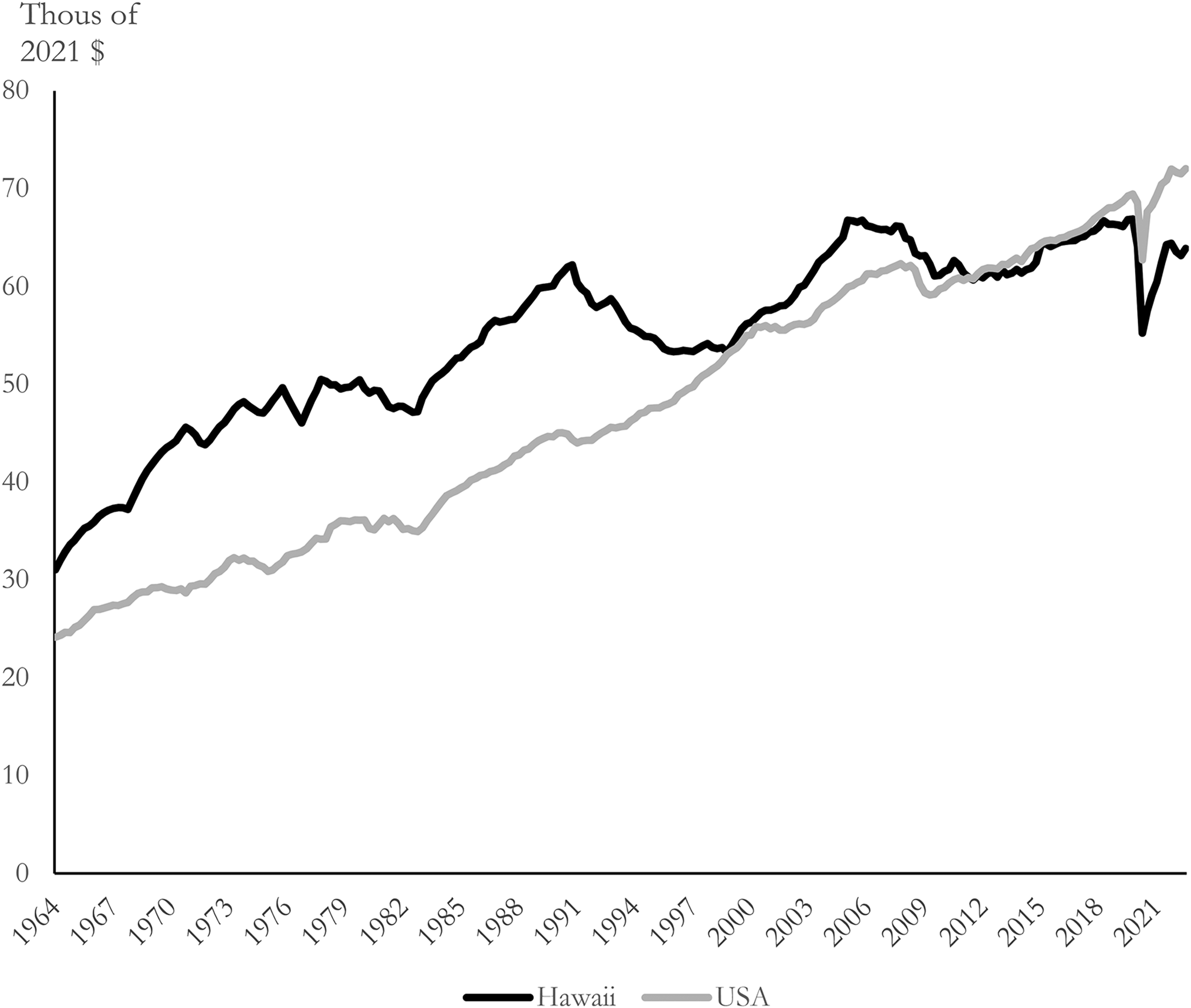
Real per capita gross domestic product (GDP; in 2021 dollars) for Hawai‘i and the United States
Domestic Comparisons
If scale and isolation are indeed the causes of specialization in Hawai‘i, then it should be expected that the industrial concentration of Hawai‘i is similar to Alaska, Maine, or Montana—isolated states with a small population. Given that these states’ major cities are less than half the size of the Honolulu metro area, better comparisons might be New Mexico or Nevada—states in less dense parts of the country with comparable (though relatively less isolated) major cities.
Shown in Figure 3, a Herfindahl index based on the number of employees on nonfarm payrolls in 10 broad industry sectors is used to compare industry specialization by state. I measure specialization by employment because it describes how people experience specialization. 5 An index value of 1 implies that all employment is in one industry only. In March 2020, prior to the impacts of the pandemic, Hawai‘i was the third most specialized state, surpassed only by Nevada and Alaska.
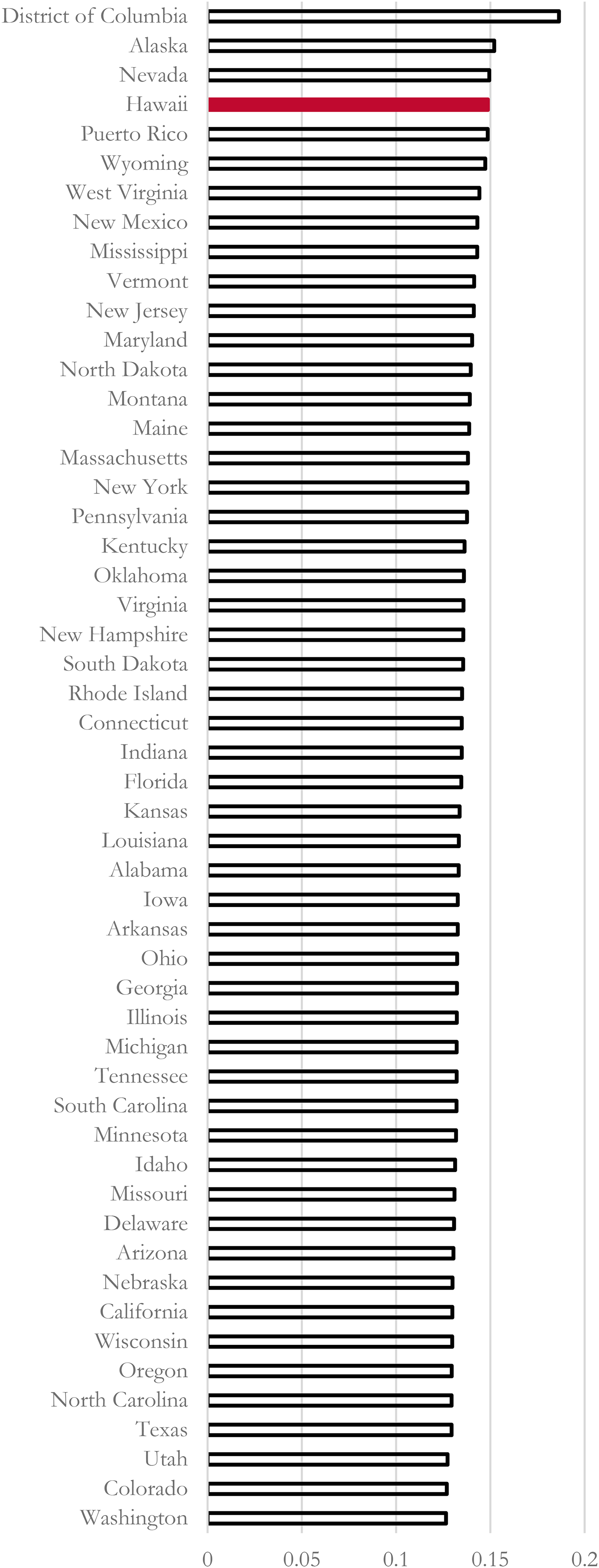
Herfindahl index of nonfarm employment in 10 industry sectors by state plus the District of Columbia and Puerto Rico, in March 2020.
While this is just a snapshot, for the most part, the concentration index in each state has been relatively stable over time. This implies that the factors contributing to the industrial structure are also not changing, such as location. The one exception to this is states that have cities with significant population growth. For example, specialization has declined significantly in Nevada over the last 20 years as Las Vegas’ population grew, and the scale of its economy developed and reduced its extreme industry concentration in tourism.
Adapting an analysis from the International Monetary Fund of small countries (McIntyre et al., 2018) to the United States, I calculate the average concentration measured by an average annual Herfindahl concentration index for 2008 through 2020 based on 20 industries and compare it to the average annual growth rate in nonfarm earnings over the same period. As with the study of small countries, states with greater industrial concentration typically had lower growth (Figure 4).
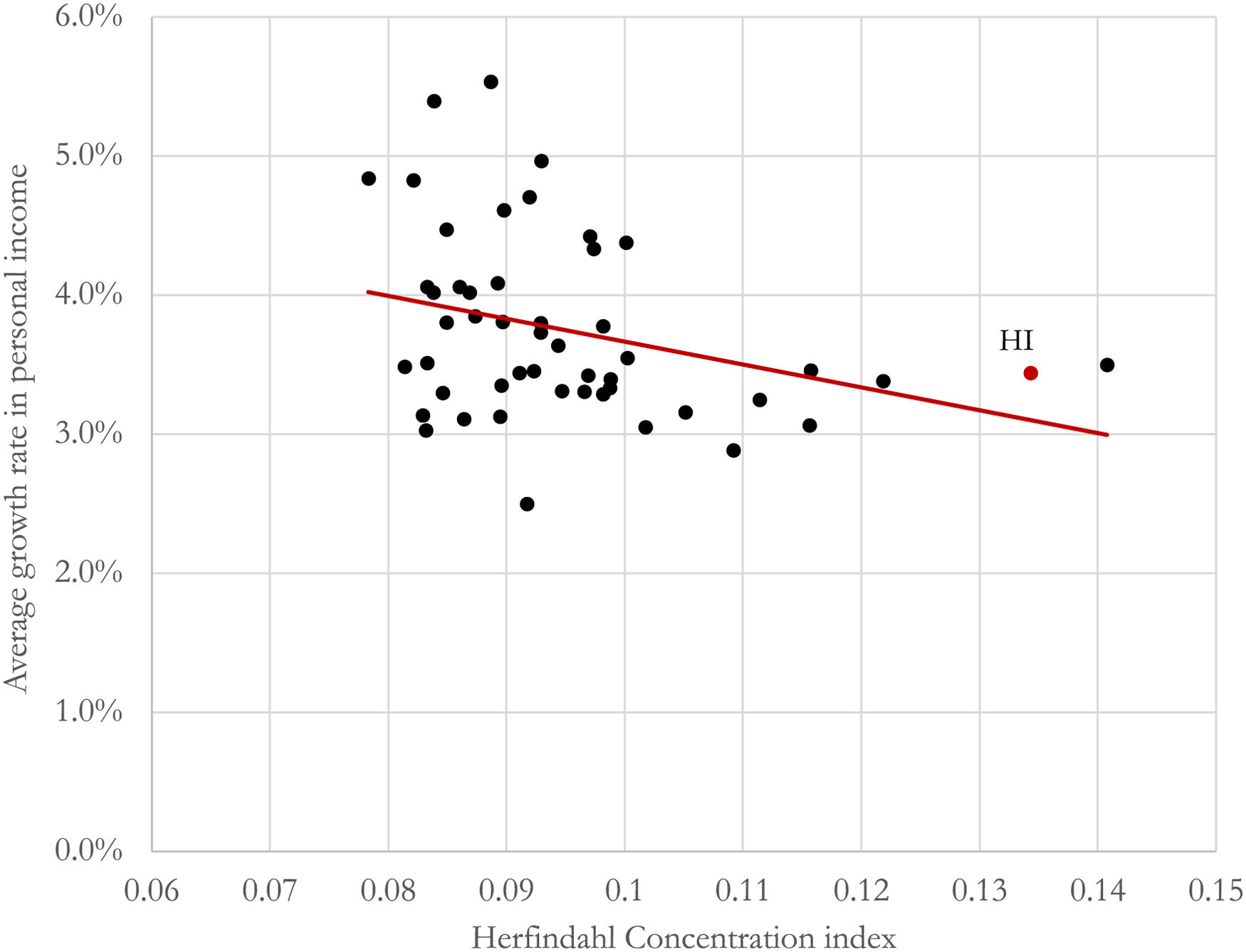
Average Herfindahl index: 20 industry sectors by state versus average annual growth rate in state personal income, 50 states.
International Comparisons
These stories of specialization and volatility are not unusual for small, isolated, and open economies. Other global examples of isolated economies provide a concurring diagnosis.
Western Australia (WA) is separated from the main population centers in Australia by thousands of miles of desert. It, too, has a specialized boom-and-bust economy that started with a gold rush and now exports massive amounts of iron ore to China. WA's economy is frequently rocked by external shocks due to volatile commodity prices (Bond-Smith et al., 2019). Like sandalwood or sugar, commodities are often subject to global competition, the trade or regulatory environment, exhaustion of a resource, or technological changes.
The term tyranny of distance is often used to describe how isolation has affected Australia's development. 6 There is now optimism that the internet will create new opportunities to overcome isolation. However, as I will explain, the tyranny of distance still applies in many ways and is arguably stronger than ever because of the internet. Both internal and external increasing returns to scale suggest that productivity depends on the scale of activity. This implies that larger firms are more productive than smaller firms, that larger local industries are more productive relative to other places, and that larger cities are more productive than smaller cities. There are several mechanisms that generate returns to scale with implications for the location of economic activity (Bond-Smith, 2021). Globalization and Internet technologies allow industries to leverage local scale (firm, industry, and city) to now supply the world from large, well-connected cities. This especially applies to any knowledge-based activities, where a large and dense urban environment provides benefits such as labor-market pooling or knowledge spillovers. As a result, much activity is hosted by fewer, but better-connected locations, dispensing with superfluous places.
New Zealand's economy is specialized in agriculture and food (Destremau & Siddharth, 2018). Like Hawai‘i, it has a rich Polynesian heritage and natural resources predominantly based on its climate. Its Māori culture is viewed as a national treasure. 7 It is highly integrated with, yet isolated from, a much larger nearby economy, Australia. And it has strong links to economies in Asia. New Zealand was once one of the most productive economies in the world, first exporting Kauri for masts on tall ships and flax for making rope when it was the strongest fiber available at the time. In the middle of the last century, it mostly exported wool and lamb to its colonial parent, the United Kingdom. New Zealand has also experienced waves of specialization followed by economic shocks, such as when technology or trading relationships went out of their favor (McCann, 2009).
In contrast, four small, advanced economies are praised for achieving substantial growth (Yusuf, 2021): the United Arab Emirates (UAE), especially Dubai, Ireland, Panama, and Singapore, all emphasize the combination of foreign direct investment and high-skilled immigration to develop industrial manufacturing, services, or both. The combination of the latest technologies with advanced skills allowed Ireland and Singapore to develop high-value industrial capabilities, and all four countries developed high-value tradable services in sectors such as financial, legal, transport, and others. These were all essentially public investment solutions to the coordination problem that are mostly not available to Hawai‘i. These four economies are all strategically located. Dubai has a central Middle East location, allowing it to emerge as a hub for the entire supraregion. Ireland is a gateway to the European Union's massive single market. Singapore is strategically positioned along trade routes though Southeast Asia. And Panama hosts the canal between the Pacific and Atlantic oceans. While Hawai‘i also hosts clusters in finance and insurance, and transport and logistics (Bonham & Coffman, 2017), geography also matters. Hawai‘i was once strategically located as a hub in the middle of the Pacific, but modern globalization has since bypassed it.
Strategically located countries such as Singapore, Ireland, Panama, and the UAE can diversify by becoming central hubs that combine capital and skills, but this is more difficult in isolated places. Specialization in an industry based on its natural resources and increasing returns to scale enables small, isolated, and open economies such as Hawai‘i, WA, and New Zealand to prosper despite their small size and isolation. Due to the attraction of its climate, natural beauty, and host culture, Hawai‘i finds that scale by specializing in the tourism industry. Of course, these places should also try to increase value by expanding skills and capital, but their economies will likely remain very specialized, amplifying external shocks and increasing risk. To address this challenge, these economies need tailored economic policies that account for scale, isolation, connectivity, resources, economic geography, and cultural riches.
Why Doesn’t Innovation Generate Industrial Diversity in Hawai‘i?
Innovation is promoted in Hawai‘i as the solution to diversify the economy, but innovation is affected by economic geography (Audretsch & Feldman, 1996; Feldman, 2016). Furthermore, poorly designed innovation policies or research and development (R&D) tax credits have had little benefit (Kato et al., 2009; La Croix & Mak, 2021c).
Figure 5 charts patents per 1,000 people employed in science and engineering occupations by state, plus Puerto Rico and the District of Columbia. The science and engineering normalization accounts for differences in the sizes of states and their industrial structures. Even allowing for its small science and engineering sector, Hawai‘i is ranked 48th.
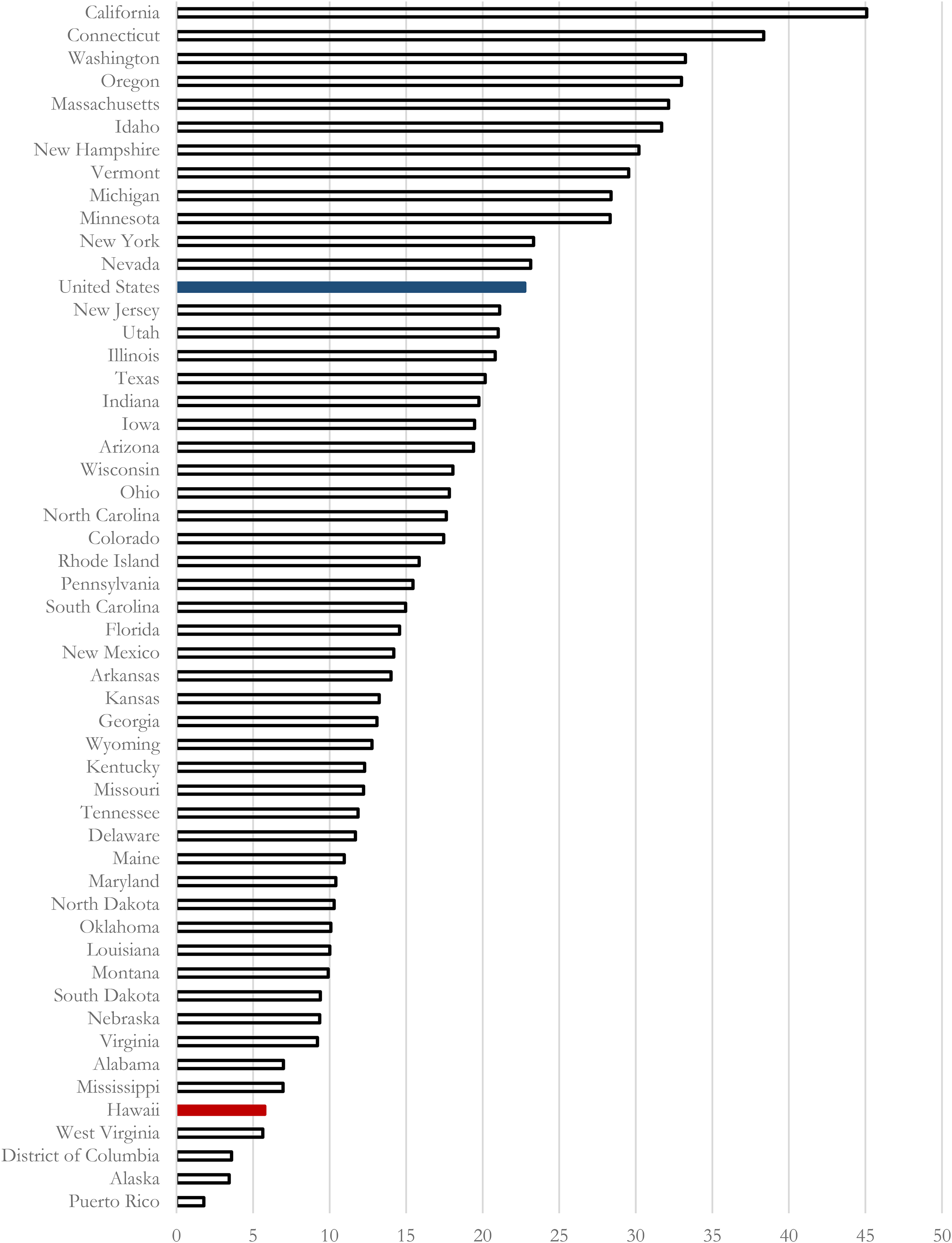
Patents per 1,000 scientists and engineers by state in 2018.
While patents are not a perfect measure of innovation, the data imply that Hawai‘i isn’t very innovative. Furthermore, industry specialization and patent output are negatively correlated (see Figure 6). Local diversification enables knowledge spillovers between industries (Jacobs, 1969), which are especially important for young industries (Neffke et al., 2011) in “nursery cities” (Duranton & Puga, 2001), making innovation even more challenging in highly specialized places.
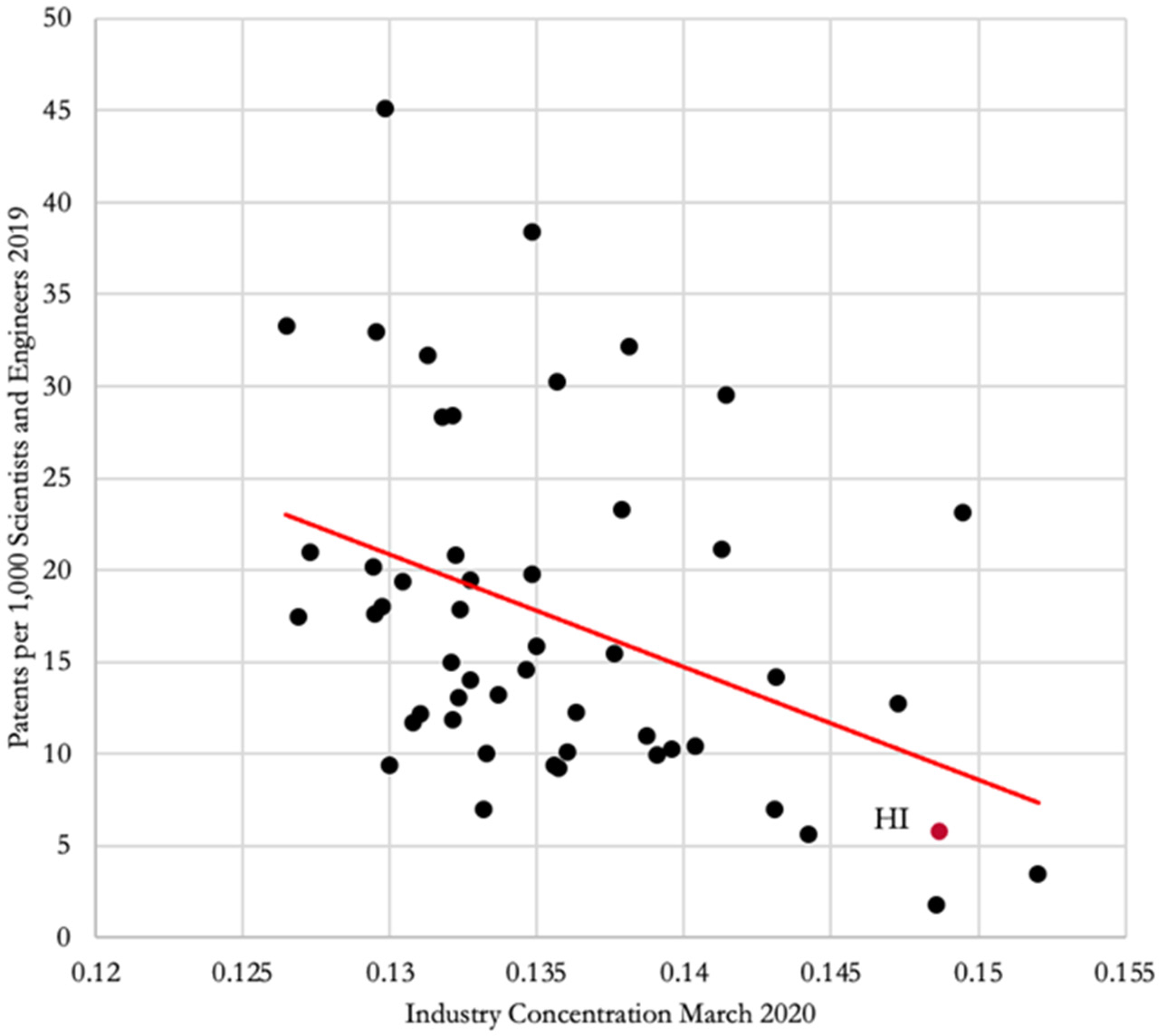
Patents per 1,000 scientists and engineers by state in 2019 versus industry concentration.
Like Hawai‘i, the other states ranked poorly for patents are small, isolated, specialized, without significant cities, and often have dispersed populations. Think of Alaska, Puerto Rico, Montana, South Dakota, and Maine, for example, where small scale and isolation make innovation less likely. As a result, fewer engineers, scientists, or entrepreneurs choose to live in these places. The engineers and scientists who do live there tend to be less innovative because there are fewer knowledge spillovers and fewer opportunities for serendipity. These rankings have been very stable over time. With one exception, Hawai‘i has ranked between 47 and 49 out of 52 every year since 2003. 8
Innovation-based growth diversifies economies because new ideas generate new and more productive industries (Hausman et al., 2007; Hidalgo et al., 2007). But innovation is even more clustered than businesses (Florida, 2005), in large part because much knowledge cannot be documented. Hausmann (2016) called it “know-how.” Know-how is very local. It is embedded in people, tasks, routines, and business. Innovation builds on existing know-how. Innovation combines know-how in new ways. Innovation clusters around people with know-how and people with know-how choose to go where other people with compatible know-how already are.
The most innovative places are highly connected, with large numbers of skilled workers having useful know-how. Rarely does an entrepreneur have all the ideas. It is serendipity that yields chance meetings between those who have the compatible know-how that generates new products and improvements. Serendipity is more likely if you are surrounded by other entrepreneurs, scientists, and engineers with useful know-how. And, just as an aspiring actor goes to Hollywood, aspiring entrepreneurs go to Palo Alto, New York, and Boston because they are hoping to find people with the know-how to make their idea work. Crescenzi et al. (2019) described this modern geography of innovation as a “hub-to-hub system” in which innovation clusters in only a handful of highly connected places and generates regional divergence. This has concentrated economic growth and innovation in only a few superstar cities (Gyourko et al., 2013). Unfortunately for Hawai‘i, Honolulu is not one of those cities. With this understanding of innovation, it is no surprise that Hawai‘i has low rates of innovation.
Entrepreneurs move to superstar cities to access venture capital. Investors in risky start-ups want to trust that the ideas are promising and that the entrepreneurs have their fiscal interests in mind. So, investors either locate alongside entrepreneurs or hire a local manager they trust. Even when Hawai‘i generates new tech start-ups, they often end up relocating to Silicon Valley to access venture capital and know-how.
This geography of innovation also explains why it is difficult for Hawai‘i to establish its own tech cluster. For innovation in isolated places, it is necessary for knowledge spillovers to be sufficiently high and transaction costs sufficiently low that a business prefers to be in the peripheral cluster (Bond-Smith & McCann, 2020). The tech industry intuitively appeals because it seems easy for these activities to locate in Hawai‘i despite its isolation. But it is also easier for tech businesses in other places to serve more customers, including in Hawai‘i. This implies greater advantages in places that do not face the tyranny of distance.
What Has Been Done to Diversify Hawai‘i? Why Didn’t It Work?
The desire to diversify is not new, but it has become especially salient during the COVID-19 pandemic. Hawai‘i's statewide CEDS for the 2016 to 2020 period noted the importance of diversification (Economic Development Alliance of Hawai‘i and State of Hawai‘i Office of Planning, 2016). Unfortunately, it offered broad aspirations that could apply to almost every place in America. Similarly, O‘ahu's draft CEDS for 2022 to 2026 promoted diversification (Oahu Economic Development Board, 2022), but was too broad and poorly targeted (Bond-Smith, 2022b). The cluster approach is prescribed by the U.S. Economic Development Administration but is powerless if it covers the entire economy. Otherwise, requirements such as healthy residents, housing, and public safety are framed as clusters for diversification, when they are no such thing. These types of broad-brush aspirations do not address Hawai‘i's unique challenges. But perhaps the issue is more fundamental, since organizations based around existing businesses are unlikely to draw up a strategy to benefit new industries.
Like many states, Hawai‘i has implemented research and development (R&D) tax credit policies in an attempt to encourage the tech industry. While R&D tax credits are important, poorly designed policies can make tax credits ineffective. In the past, Hawai‘i's 100% tax credit attracted businesses simply seeking the cash flow of a refundable credit, rather than wanting to make genuine investments in innovation. Furthermore, the original credit was directed toward strategic industries, though, as I will explain, aspirations for a tech industry might not be the best target for Hawai‘i. Although the policy has been significantly improved, it is currently too small to contribute to economic growth, and its first-come-first-served rationing approach might even discourage tech firms from applying (La Croix & Mak, 2021c).
Many states seeking to diversify offer incentives to attract footloose industries. Intuitively, these industries are attractive because they can switch locations easily and bring demand to both up- and down-stream industries. For example, in Hawai‘i, the film industry is discussed as an economic activity to attract (La Croix & Mak, 2021b). Similarly, aspirations for a tech industry frequently hope to attract a major business to relocate. Some cities offer incentives to host special events while others support large stadiums that attract a professional sport franchise. But any filmmakers, tech firms, or top-tier sports franchises that might come to Hawai‘i for an incentive are also easily attracted elsewhere. Ultimately, as with other tax competition policies, most incentive plans are a race to the bottom where taxpayers foot the bill, and investors, rather than locals, reap the rewards. While some incentives could be used to establish or expand an industry, or to reward businesses for positive externalities, Hawai‘i should avoid playing tax competition.
Policy makers and others have long argued that Hawai‘i's geographic position makes it a natural gateway between Asia and the United States. In some ways this is true, but it is also misleading. Hawai‘i was once a gateway, providing a hub for crossing the Pacific when planes did not have the range that they do today. For shipping, Hawai‘i has provided a strategic position for the U.S. Navy since before it became a U.S. territory. But these characteristics have not recently worked in Hawai‘i's favor. Modern shipping routes across the Pacific usually go to Long Beach before trade is rerouted back to Hawai‘i (due to the Jones Act). Arguably, the Jones Act might be contributing to specialization in Hawai‘i because it acts as a tariff on ship transport, but not air. However, even if foreign ships were allowed to dock in Hawai‘i en route to the mainland, it is not clear that shipping patterns would change much (Olney, 2019). Economies of scale in shipping and external economies from the very large mainland market would provide productivity benefits for shipping that might even exceed the additional distance costs of routing trade to Hawai‘i by way of Long Beach.
To some extent, Hawai‘i has diversified its sources of tourists. Business and convention travel makes use of the same hotels that recreational tourists require. Building the Hawai‘i Convention Center could be thought of as resolving a coordination problem, or a public goods problem, in that the main benefits of a convention center accrue to the hotels hosting delegates, rather than the convention center itself. While the convention center itself has performed poorly financially (Mak, 2018b), this might be more of a governance and management issue that could potentially be resolved with more transparent accountability or privatization. In any case, addressing the initial coordination problem by state investment provided the opportunity for a more diversified tourism industry.
Hawai‘i frequently ranks poorly for its ease of doing business. Of course, policy makers in Hawai‘i should aim to ensure taxes are not too high, reduce unnecessary regulatory burdens, and make it easy to start a business, but Hawai‘i has done little so far to improve things. In any case, improving the business environment is not a panacea for the economy. Once good institutions are in place, and many are by being part of the United States, the places that perform well do so because production is a circular dynamic that reinforces existing advantages and disadvantages. New York and California are not necessarily great states for doing business from a best practice policy perspective, but they are places where people are more innovative because other innovative people live there, and investors want to be near opportunities. Tech especially clusters in these places to benefit from knowledge spillovers. These are places where initial advantages led to greater economic activity, which led to additional advantages and persistent economic activity. Taxes are not the main determinants of where business takes place. For example, Amazon did not choose to put its second headquarters in the state offering the greatest tax breaks. It chose Virginia and New York primarily for access to talented workers (Smale, 2018). Rather, the ease of doing business and reducing the regulatory burden may all be desirable policies to support local economies, but they are not a diversification policy because they do not address the local causes of specialization.
While tax competition attracts footloose activities (Andersson & Forslid, 2003; Blöchliger & Campos, 2011) that also easily shift away, taxes still matter (Moretti & Wilson, 2017). When assessing new revenue proposals, it is important to recognize that high tax increases would discourage affected workers and businesses. While California and New York have high-income taxes and still sustain vibrant tech industries despite their high tax rates, these are places where local benefits of agglomeration and clustering exceed the cost of higher taxes (Brülhart et al., 2012). It is a privilege that tech businesses want to locate there for other reasons despite taxes, which Hawai‘i, unfortunately, does not have.
Remote work is now touted as an opportunity of which Hawai‘i residents could take advantage. Remote work could generate export revenue by providing labor output to clients on the mainland. While remote work was already increasing before the pandemic (Clancy, 2020), it is not yet clear how remote work will go in the long term. COVID-19 restrictions showed that remote work certainly works temporarily for teams that have already established trust in person (Dingel & Neiman, 2020). But the increases in productivity that occur as people build trust will take longer with remote teams or may not happen at all. And, as with tax incentives for footloose industries, the people (and employers) willing to work remotely in Hawai‘i are also very mobile. As such, this could also imply substantial cost savings from offshoring remote work entirely (Brinatti et al., 2021). Any jobs with even a few tasks that require face-to-face interaction are likely to be hybrid, requiring workers to commute on a regular, though less frequent basis, which would be impractical to mainland cities from Hawai‘i. There might be an increase in locals living on O‘ahu's North Shore, in Kahului, or in Hilo and regularly commuting to Honolulu, though not every day, but remote work is unlikely to attract significant activity from the continent. For hybrid remote work, the greatest advantages accrue to the outer suburbs and exurbs of large, highly connected metropolitan areas and significant commuter towns that are maybe a 2- or 3-hour drive away (Bond-Smith & McCann, 2022). As a result, the diversification opportunity of remote work is probably smaller for Hawai‘i than for other states and cities. Or at least Hawai‘i's remote work strategy must account for the nuance of Hawai‘i's geography.
Overall, it seems that Hawai‘i's efforts to diversify are mostly in vain. The spatial economic perspective finds that Hawai‘i will naturally overspecialize in its comparative advantage due to external economies generating coordination or hold-up problems that limit the entry of other industries. Pushing back against comparative advantage is difficult because the spatial economy reinforces that specialization as other industries shift to places where they are more competitive. Initiatives to support footloose industries are unable to attract industries that can be sustained in the long run. There is a danger that the focus on footloose activity, such as remote work, will continue to persist in vain. And efforts to support R&D have been poorly designed and poorly targeted. There are many other issues that remain unsolved, such as the ease of doing business, the Jones Act, and housing regulation (Inafuku et al., 2022), but resolving these would not address diversification. Yet the few successes point to how solutions could be crafted. These have typically been from opportunities within tourism itself, where the important factors of production are bound to Hawai‘i but may require governments to address specific market and government failures that limit these opportunities.
What Are the Opportunities to Diversify?
The implication of these spatial economic arguments is that Hawai‘i specialized in tourism in response to its small scale and isolation because it really had no other choices. As a result, its economic fortunes are largely dependent on external drivers for productivity in tourism and demand for vacations. Hawai‘i’ is in a difficult position—in the middle of the Pacific Ocean, rather than part of the core U.S. economy. Ultimately, this means O‘ahu will probably never be a “Silicon Island.” Hawai‘i is probably not going to be a significant gateway for business, travel, or trade between Asia and the United States. And remote work combined with regular infrequent commuting will be impractical from Hawai‘i. But there are ways to promote diversification and growth that build on the same principles that otherwise explain industrial specialization and Hawai‘i's unique economic geography. Some characteristics of Hawai‘i are perfectly suited to particular activities. Hawai‘i's proximity to Asia, its cultural and social networks to both the United States and Asia, key changes in technology, and importantly, recent changes in the global economy could be suitable for particular niches.
Below I sketch four potential initiatives to support Hawai‘i's diversification strategy and long-term economic development. These initiatives identify areas of potential based on this spatial economic perspective where barriers can be addressed, and support can be provided for the missing pieces to allow these opportunities to flourish. It is also important that such initiatives are monitored with measurable targets and reviewed at regular intervals, refined, and adjusted to ensure Hawai‘i is on track to meet its aspirations. Furthermore, effective governance structures are required to abandon failing initiatives and avoid corruption or cronyism.
Strategic Geography
My first recommendation is to focus on how Hawai‘i's geographic characteristics and factor endowments are uniquely good for particular activities. Don’t try to be Silicon Valley, be Hawai‘i! Businesses that develop based on Hawai‘i's economic geography with local elements as key factors of production are unable to emerge anywhere else. More importantly, they are unable to relocate anywhere else.
A resilient diversification policy, counterintuitively, develops fewer footloose activities. These are businesses that remain even if other places offer generous incentives because Hawai‘i has something so special to offer that they prefer to remain, despite the benefits in other places. Development can still involve incentives to establish new activities, but they should be targeted at strategic areas that are chosen based on Hawai‘i's advantages to avoid subsidy or tax competition with other places. There will be many bold proposals that take strategic advantage of Hawai‘i's location to carve out a particular niche. It requires outside-the-box thinking based on deep knowledge of industries, geography, and Hawai‘i itself. The crucial question to ask is: In what activities is Hawai‘i's geography better than anywhere else?
Some strategic geographic features include connectivity to multiple trans-Pacific Internet cables, Hawai‘i's captivating scenery, feasible flight routes between Asia and South America, and the only truly tropical location in the United States for agriculture, aquaculture, and fishing. Internet connectivity has not been advantageous for Hawai‘i in the past because its location was not strategically better than California. But the expansion of Asia's tiger economies in recent decades means that Hawai‘i is now strategically placed to benefit from international Internet traffic. It is not the full-blown tech industry that previous R&D tax credits failed to attract, it is a niche that leverages Hawai‘i's location to its advantage. Flights from Honolulu to as far as Buenos Aires or Sao Paulo would not push against the current length of the world's longest flights. 9 This means that Honolulu could potentially emerge as a hub between Asia and South America. Similarly, Hawai‘i makes a desirable meeting place for deals between business people in the growing economies of China and Brazil. Hawai‘i's scenery is a magnet for film makers so policies that protect Hawai‘i's natural treasures and govern their sustainable use provide support for a resilient content industry. A tourism industry based on the sustainable use of Hawai‘i's natural amenities does not require Hawai‘i to win hosting rights for big events. And the benefit of social capital in a sports industry built around the University of Hawai‘i community is locally bound.
Geography is also influenced by policy. While much of Hawai‘i's economic opportunities rely on the productivity benefits of the service-oriented agglomeration economies of Honolulu, there are also opportunities for the neighbor islands to benefit from their proximity and connectivity to O‘ahu and connectivity to the mainland. There is a risk that productivity growth on the neighboring islands continues to lag if they remain dependent on tourists. There is a role for the state to address the internal geography and connectivity between the islands. Ensuring affordable, reliable, physical, and digital connectivity between the islands for residents will provide the neighboring islands with access to some of the services and infrastructures that benefit the urban economy in Honolulu.
Remote Work
While the greatest advantages of hybrid remote work are likely to accrue to the hinterlands of the largest globally connected cities (Bond-Smith & McCann, 2022), there are various niches of remote work that might be advantageous in Hawai‘i. Covid-19 has highlighted how easy it is to temporarily work remotely in established teams and still be productive. Hawai‘i might be able to attract temporary remote workers taking a sabbatical or “workation.” This is a diversification of tourists to Hawai‘i, but they will come for longer periods, pay taxes, and hopefully do business. O‘ahu's transient vacation rental system should target such long-stay working visitors, though new restrictions may limit this opportunity.
Again, these ideas are not completely new. For example, the Movers and Shakas Program 10 is a very small program designed to attract temporary remote workers when tourism disappeared entirely during the initial stages of the pandemic. The Department of Business, Economic Development and Tourism (DBEDT) and the Department of Labor and Industrial Relations have a remote work pilot project to demonstrate remote work in the state and inform potential employers and employees. 11 Since many of these discussions are already taking place in Hawai‘i, the key recommendation is with respect to the focus, scope, governance, and policy processes that shape the remote work strategy.
Hawai‘i should ultimately try to attract remote workers who might leave their remote jobs and create new opportunities for residents in the state. These are most likely to be workers in areas where Hawai‘i already has existing capabilities or returning kamaʻāina. If either of these groups works remotely for a while in Hawai‘i, they are likely to serendipitously meet others with whom they can collaborate or work in similar or related industries. These are the people with knowledge they can share and transfer to locals. These are people who are more likely to stop working remotely and set up new businesses in Hawai‘i, creating job opportunities where locals can work, rather than returning to the continent. Those who do return will have established networks in Hawai‘i that could generate new activity. Incentives to work remotely in Hawai‘i could be offered to these groups in return for participating in community-based events that would increase serendipity. Combined with support for R&D in relevant industries and business incubators, Hawai‘i could develop a cluster of start-up businesses in its niche areas of expertise starting with attracting potential entrepreneurs to work remotely.
Support Strengths
This targeted scope ties into my third recommendation—support Hawai‘i's strengths. Diversification initiatives often fail because there are reasons the economy is so specialized, most notably due to comparative advantage. But diversification does not mean Hawai‘i stops doing what it is already good at. Tourism will likely remain the dominant export industry. Unfortunately, the spatial economy perspective means that there is not really much choice. The issue is finding ways to upgrade the level of value added, or extracted, from tourism to generate productivity growth locally.
Productivity growth has been lackluster because the mix of tourists has gradually changed from high-spending Japanese visitors in the 1980s to roaming American tourists experiencing Hawai‘i's free natural amenities. Yet the discontent of locals and the pressure on environmental ecosystems implies that visiting Hawai‘i's natural amenities are not really free. Taxing tourists, charging access fees, and taxing owners of vacant holiday homes internalizes externalities, and rations access in a sustainable manner. It extracts a greater value-added margin from Hawai‘i's natural capital that would remain in the state, as well as incentivizes more efficient use of any overused attractions. This revenue could fund diversification initiatives, lower income taxes for residents, and support local services. If residents felt more of the benefits of tourism, they might feel more appreciative of their economic contribution.
Importantly, adding real value to tourism also means that Hawai‘i's cultural and environmental amenities need to be genuine and respected. Native Hawaiians need the opportunity to shape tourism in a truly authentic way. The recent switch to the Council for Native Hawaiian Advancement for marketing Hawai‘i is probably a good start. If native Hawaiians have ownership of how their culture is promoted and receive its economic benefits, they can find ways to generate new opportunities that are consistent with their values and minimize negative impacts. Similarly, the environment is a critical and valuable resource of unique importance to Kānaka ʻŌiwi and Hawai‘i's tourism industry, as well as critical for living on small islands in the middle of the ocean. Protecting and restoring Hawai‘i's native culture and environmental ecosystems will generate higher value added by increasing the value of economic outputs, and by reducing the negative externalities of overuse.
The support strengths initiative would also look for new tourism activities that command a premium. For example, New Zealand promoted adventure tourism such as bungy jumping and skydiving to increase the value added of tourism. The Maldives and Bora Bora offer overwater accommodation. Hawai‘i already offers boat trips to snorkeling, diving, and fishing spots, but there are likely to be other activities and accommodation options that command a higher value. Fine dining and shopping also contribute. Visitors who come for short trips typically spend more per day, so promoting such trips might add more value than visitors extending their stay. Business and conference travel has been poorly managed (Mak, 2018b), so better governance of the Hawai‘i Convention Center would probably generate more value added. And now that a more competitive conference travel industry has emerged in private hotels, perhaps the conference center could be privatized. The authentic “made in Hawai‘i” brand offers opportunities to promote genuine Hawaiian souvenirs, but if these products are also exported to the mainland, it offers the opportunity for visitors to reminisce about their experience long after they return home. Engaging in tourism experience research—to understand both the things that tourists value and how to provide these services—would yield additional opportunities.
Supporting strengths also means finding ways to transfer existing capabilities to new activities. Rather than being specialized solely in tourism, Hawai‘i specializes in a range of capabilities that are transferable between multiple industries. This means identifying Hawai‘i's strengths within the variety of tasks, skills, and professions of the tourism sector; finding the range of industries that make use of these capabilities; and then making sure that they are adequately supported. Industry training, R&D, and innovation in these areas will help to rebalance Hawai‘i's economy and the dominance of tourism by finding new ways to make productive use of the things at which Hawai‘i excels. In this way, the dominance of tourism is limited by competition for factors of production rather than outright bans or moratoria on tourism development. This is not picking winners; these are professions and capabilities that have already picked Hawai‘i. Industry policy is not about sustaining declining industries for too long either. Support policies should focus on activities, rather than particular businesses, so that the entrepreneurial discovery process can flourish, and capabilities can transfer between industries as the economy evolves.
Smart Diversification
Finally, diversification initiatives need to be smart by focusing limited resources on the most promising opportunities. The most viable opportunities are those that make use of existing capabilities. These are industries that are closely related to Hawai‘i's existing strengths. And because these industries make use of local capabilities, they are probably less footloose and more likely to remain in Hawai‘i in the long run. Investment in new but strategic capabilities would provide the missing pieces that can be combined with existing strengths for new activities. Such initiatives will vary by the identified opportunities. Some opportunities will require new skills that could be addressed by initiatives to attract skilled residents or to retrain existing residents in new skill sets. Other opportunities will require specific infrastructure. Some will involve coordination problems that require the government to step in as an initial investor to build enabling infrastructures. And others will be related to technology and innovation, requiring investment in research funding in relevant domains.
This is the essence of the European Union's “smart specialization” policy (Foray, 2011; McCann & Ortega-Argilés, 2015). Smart specialization recognizes that regions cannot do everything, so need to focus on their core strengths and diversify into related areas that can use existing capabilities (Balland et al., 2019). A 2017 report by the University of Hawai‘i Economic Research Organization identified several industry clusters in Hawai‘i (Bonham & Coffman, 2017). A strategy for smart specialization supports the capabilities that bind these clusters but may be useful for other industries not already present. In this way, a smart diversification strategy targets new industries that can leverage existing clusters and make use of similar capabilities.
This approach is also local. Smart diversification initiatives on Maui might look very different than those on the Big Island or in Honolulu, since the local capabilities are very different. Honolulu's service sector offers opportunities that small cities on the neighboring islands cannot offer. The Big Island has a greater ability to find a scale in agriculture. Maui's strengths are probably much more focused on tourism, but this expertise might offer options in hospitality education. Where there are common interests, the islands should work cooperatively. Areas such as aquaculture, tropical food, and astronomy offer opportunities for collaboration.
Smart diversification is also not the same as picking winners. It is supporting areas of opportunity and allowing the entrepreneurial discovery process to determine the winning businesses (Foray et al., 2009). Selecting areas of opportunity requires a bottom-up process in which locals determine the vision for Hawai‘i supported by evidence to justify funding proposals. Such a vision will also incorporate Hawai‘i's cultural values of Malama ‘aina and Malama Kai. 12 It will understand the skills, tasks, and capabilities of Hawai‘i's existing residents. That vision requires the deep personal knowledge of locals, so it cannot be articulated by a single scholar in a research article. This community process is also vital to generate support for diversification initiatives (The future of regional economic development and implications for the U.S. Economic Development Administration Programs, 2021).
Interestingly, the CEDS initiative has similar intentions as smart specialization, though it is light on evidence and uses too broad of a brush in its proposals. Like smart specialization (European Commission, 2020), CEDS is a prerequisite for regions to access funding (Economic Development Alliance of Hawai‘i and State of Hawai‘i Office of Planning, 2016). Updating CEDS strategies with concrete, evidence-based proposals that target the specific barriers to development in areas of strength and opportunity would be relatively straightforward to implement. It will reform regulations and programs that are preventing industries such as agriculture from thriving. It will identify new activities and capabilities that are common to more of Hawai‘i's potential opportunities and make proposals for funding to address the reasons why these opportunities have not emerged on their own. R&D, training, or critical infrastructure can support those activities and capabilities so that the entrepreneurial discovery process will determine the most productive ideas.
What Now?
This perspective from spatial economics gives a counterintuitive answer. It is neither to continue specializing in Hawai‘i's comparative advantage nor to attract a wide range of footloose industries with generous incentives. It is the less footloose industries that are more likely to be viable in the long term. These are industries that make use of Hawai‘i's geography or are related to Hawai‘i's existing strengths since they rely on locally bound capabilities. These principles underpin the four proposed initiatives to identify diversification opportunities.
The next question is to figure out what is preventing these opportunities from emerging already. These are likely to be various coordination or hold-up problems, government failures, or other market failures that may be more prevalent in small markets. These are industries that become competitive once established at a sufficient scale but lack a business case for private investment in the necessary components. There may be a piece of infrastructure, various vertical linkages, missing skills, or other public goods. A diversification policy would invest in the infrastructure, research, and capabilities necessary for entrepreneurs to take advantage of these opportunities. In this way, market processes incentivize productivity growth. Incentives could be used in a limited fashion to accelerate scale. But initiatives must also be allowed to fail. A failing initiative is not a failure of diversification policy unless a poorly performing initiative is allowed to persist. A transparent governance process would allow any failing initiatives to be abandoned or modified if they are not achieving their intended outcomes. Over many initiatives, a strong and transparent governance process should allow the successes to outweigh the failures.
Diversification is a gradual process. Even Hawai‘i's tourism industry took some time to become the dominant industry and is likely to continue to dominate Hawai‘i's economy well into the future. Prosperity does not come from hurting tourism, but from finding a sustainable way to use Hawai‘i's natural attractions and to demonstrate respect for its indigenous people. Diversification does not mean finding an alternative to tourism. Rather, it aims for:
resilience to balance the dominance of the tourism industry by providing for sources of prosperity when external shocks affect tourism numbers, and new pathways for productivity growth and economic expansion when record tourist numbers might be reaching the limits of physical capacity and community tolerance.
Diversification will be a process of finding many new, relatively small opportunities in which Hawai‘i can develop various niches with sufficient scale for productivity and a unique Hawai‘i factor that enables resilience. Government, community, private, and partnership initiatives can all contribute to this process. Identifying new opportunities builds on deep local knowledge of Hawai‘i's human capital, location, industry structure, culture, and communities. Such a vision will understand the values, skills, tasks, and capabilities of Hawai‘i's residents. People and businesses that are committed to their communities will last longer than footloose industries. The diversification strategy will look for the little bit extra that is needed for ventures in targeted domains to get off the ground. All locals could get behind a bottom-up diversification process that creates a Hawai‘i economy with a resilient future.
Footnotes
Declaration of Conflicting Interests
The author declared no potential conflicts of interest with respect to the research, authorship, and/or publication of this article.
Funding
The author received no financial support for the research, authorship, and/or publication of this article.
