




Abstract
The growing human population in Africa is putting increasing pressure on habitats and wildlife outside of protected areas. The wildlife conservancy model in Namibia empowers rural communities to decide on the use of wildlife. Namibia started to implement the conservancy model in the 1990s and provides relevant experience from which other countries can learn. We reviewed the conservancy model in northwest Namibia to identify lessons for other countries. Our core work included case studies on six conservancies. We confirmed success factors for conservancies include: investment and revenues, strong governance and support from NGOs, as has been identified in previous studies. We conclude that a comprehensive wildlife monitoring programme is also a critical success factor. The wildlife monitoring method in conservancies in Namibia has been consistent since 2001, and the results show that populations have recovered and stabilised, although there are ongoing risks to wildlife and habitats in this fragile landscape.
Introduction
There is growing pressure on wildlife and habitats in sub-Saharan Africa because of the rapid increase in human population and livestock, as well as droughts and other events linked to climate change (UNCBD, 2020; WWF, 2020). This will continue to increase local competition in rural areas for water resources, grasslands and other natural resources (Hunninck et al., 2017; Chase & Landen, 2019; IUCN, 2020; Carpenter, 2021). The need for the planning and implementation of wildlife conservation strategies that focus on habitats and biodiversity outside of protected areas is therefore growing in importance.
The community conservancy model on wildlife conservation in Namibia empowers rural communities to decide on the use of their wildlife, for example, through joint venture agreements with private investors and operators in wildlife tourism. This provides opportunities for alternative livelihoods (Figure 1). The joint venture agreements are set up so that an agreed percentage of revenues is provided to the communities for wildlife protection activities (e.g. salaries of wildlife rangers) and for benefit distribution to conservancy members (e.g. to repair local water points). The model aims to increase the perceived value of wildlife and to raise the commitment of local communities to wildlife conservation (Adamowizc et al., 2011; Cooney et al., 2017; NACSO, 2021; Nilsson et al., 2016; Snyman, 2012). The model could be an effective mechanism to include in national conservation strategies in many other countries. Main components of the wildlife conservancy model.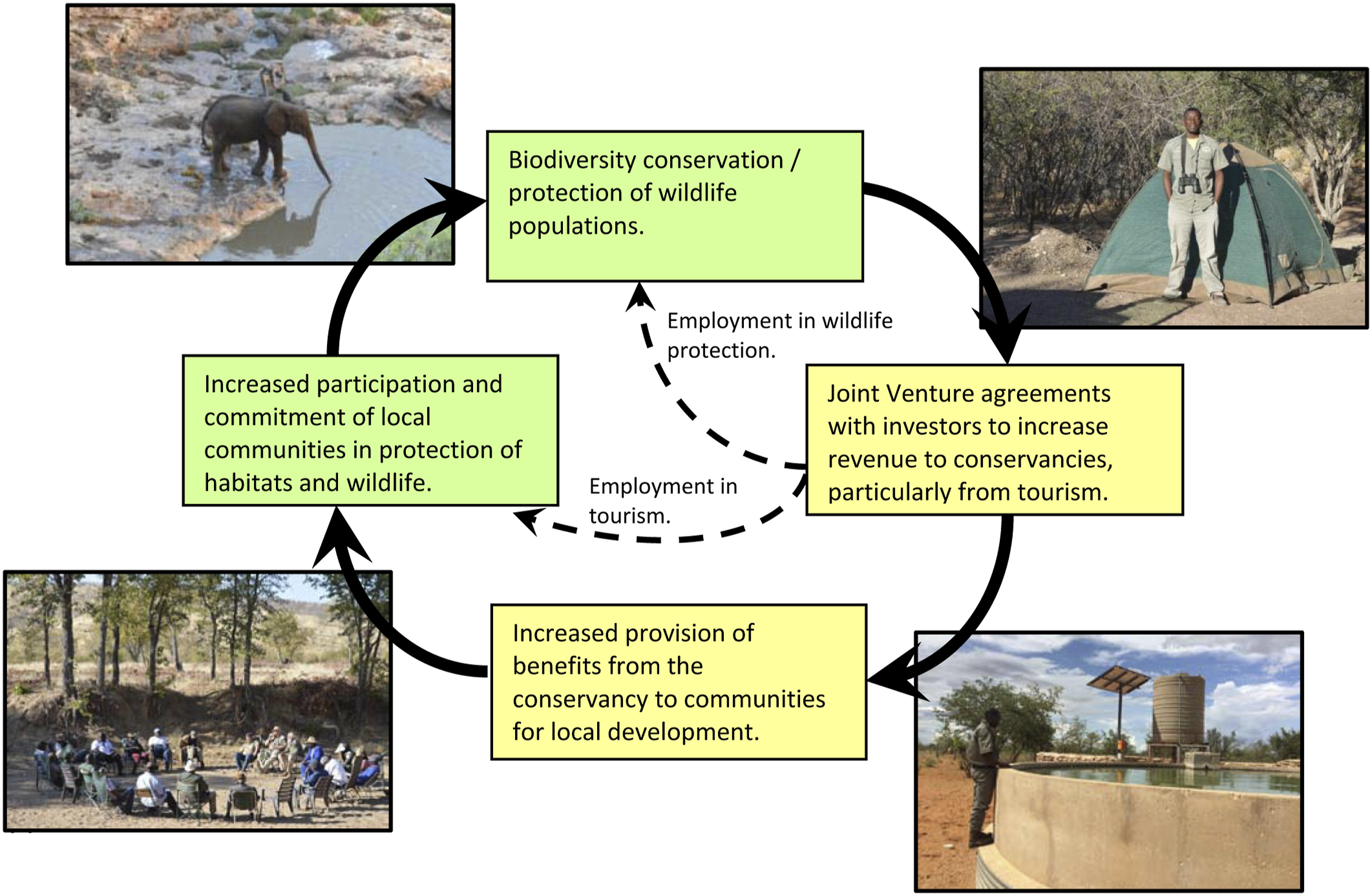
There is experience of community wildlife conservancies in several other African countries including Kenya, Zimbabwe, Zambia and Tanzania (Taylor, 2009; Child & Barnes, 2010). It is Kenya and Namibia that have the most extensive programmes, and both have a structured legal and institutional framework for implementation of the conservancy model (Weaver & Skyer, 2003; Mascia & Mills, 2018; Ntuli & Muchapondwa, 2018; Oduor, 2020). Kenya has 76 community conservancies and the total area covered by conservancies, including private conservancies, is 64,000 km2 (KWCA, 2022). Namibia has 86 community conservancies, which cover an area of 166,000 km2 (NACSO, 2022). The development of conservancies in Kenya has been more iterative, being formalised into a legal structure in 2013 (Nelson et al., 2021). Namibia has the most extensive experience of a conservancy model with an established legal framework set up by the Government of Namibia in the 1990s.
As a potential method to address the serious decline in wildlife populations, the community conservancy model was first planned in Namibia in the late 1980s, initially through an informal system of community wildlife rangers, known in Namibia as game guards, funded by donors (Owen-Smith, 2010; Humavindu & Stage, 2015; Jacobsohn, 2019). In the 1970s and 1980s, wildlife populations in communal areas of northwest Namibia had rapidly declined because of subsistence and commercial poaching by South African forces and later by local communities (NACSO, 2021), as well as from the severe droughts in the early 1980s (Berry, 1997). This was a time with lack of control of wildlife protection due to years of conflict in northern Namibia and into Angola during the Namibian War of Independence (Bollig & Olwage, 2016). The first conservancies were gazetted in 1998, eight years after the country’s independence. Most of the first conservancies were in the desert and semi-desert habitats of the Kunene Region in the northwest of the country. Since then, the total land area of the community conservancies has increased to about 20% of the total land area of the country (NACSO, 2022). This compares to the area of about 140,000 km2 (17%) designated as National Parks in Namibia (MEFT, 2021). About 9% of Namibia’s human population live in wildlife conservancies (WWF, 2018).
Much of the area of northwest Namibia includes ephemeral river valleys, for example, the large catchment of the Hoanib River, with springs and some boreholes providing water sources for wildlife. Livestock farming is the dominant livelihood for the communities in the area (Bollig, 2020; Heydinger, 2021). There are high levels of poverty, with 39% of the population in the Kunene Region classified as poor in 2011 (i.e. individuals living on less than 1USD/day) (GRN, 2015; Heydinger et al., 2019). The communities have been heavily impacted by times of drought, particularly in the 8 years from 2013 to 2020. Many people suffered from major livestock loss because of lack of vegetation in the severe droughts of 2018–2019, pushing many families further into poverty (Inman et al., 2020). The vast rural area of the Kunene Region is characterised by very low population density (typically 0.5–1.5 persons/km2 in rural areas, NACSO, 2017) and has limited transport and communication infrastructure (e.g. lack of phone network coverage).
The objective of this review was to carry out case study evaluations of conservancies in Namibia to identify the impacts, challenges and lessons from the conservancy model, in the context of the increasing pressures on the people, wildlife and landscape in northwest Namibia due to recent droughts and risks of future climate change events.
The many years of experience of Namibia with the community conservancy model in northwest of the country mean that it provides a great opportunity to learn and draw conclusions on the model, from which other countries with similar challenges in rural areas can benefit. Previous research on the conservancy model in Namibia has tended to focus on the institutional and economic aspects (for example: Silva & Mosimane, 2012; Bollig & Schwieger, 2014; Humavindu & Stage, 2015; Morton et al., 2016). These are important aspects, but the impacts on wildlife populations are also important performance indicators as wildlife conservation is a core objective of the model (MET, 1995; Owen-Smith, 2010; MET, 2013b). This review adds to other published research because it provides a more rounded assessment that includes ecological aspects alongside institutional and socio-economic aspects.
Methods
This review is based on six case studies of conservancies and a structured analysis of published papers on the conservancy model in Namibia. The findings from the review are also supported by over 35 years of combined experience of working and travelling in the Kunene Region by the core authors.
Our core team carried out case study visits to six conservancies in the Kunene Region of Namibia. The six conservancies included in this study were: Orupupa, Ehi-Rovipuka, Omatendeka, Anabeb, Sesfontein and Ozondundu (Figure 2a). The conservancies were specifically selected in order to facilitate comparison of their practices and impacts, and to and ensure useful lessons. The selection method was through a review of background data on the conservancies (NACSO, 2017) and consultation with non-government organisations (NGOs) that support the conservancies. The selection process ensured a mix of conservancies, some of which had received significant revenue, and some that had received very low revenue. The selection was also for six conservancies that are adjoining and cover a wildlife corridor of changing landscapes from highland areas bordering Etosha National Park in the east of the study area to lower semi-desert plains in the west of the study area bordering Skeleton Coast National Park (Owen-Smith, 2010). This aspect of the selection of conservancies was made to facilitate comparison of wildlife data. From top left: (a) Map of the Kunene Region showing the six case study conservancies, (b) results of the annual game count for mountain zebra (Equus zebra hartmannae) for Anabeb Conservancy (NASCO, 2021b), (c) results of the annual game count for mountain zebra, aggregated and averaged for conservancies in the northwest of Namibia for which zebra were observed (NASCO, 2021b), (d) Ozondundu Conservancy has scenic views, but less wildlife and much fewer tourists, and (e) Anabeb Conservancy is on the tourist route and has relatively abundant wildlife.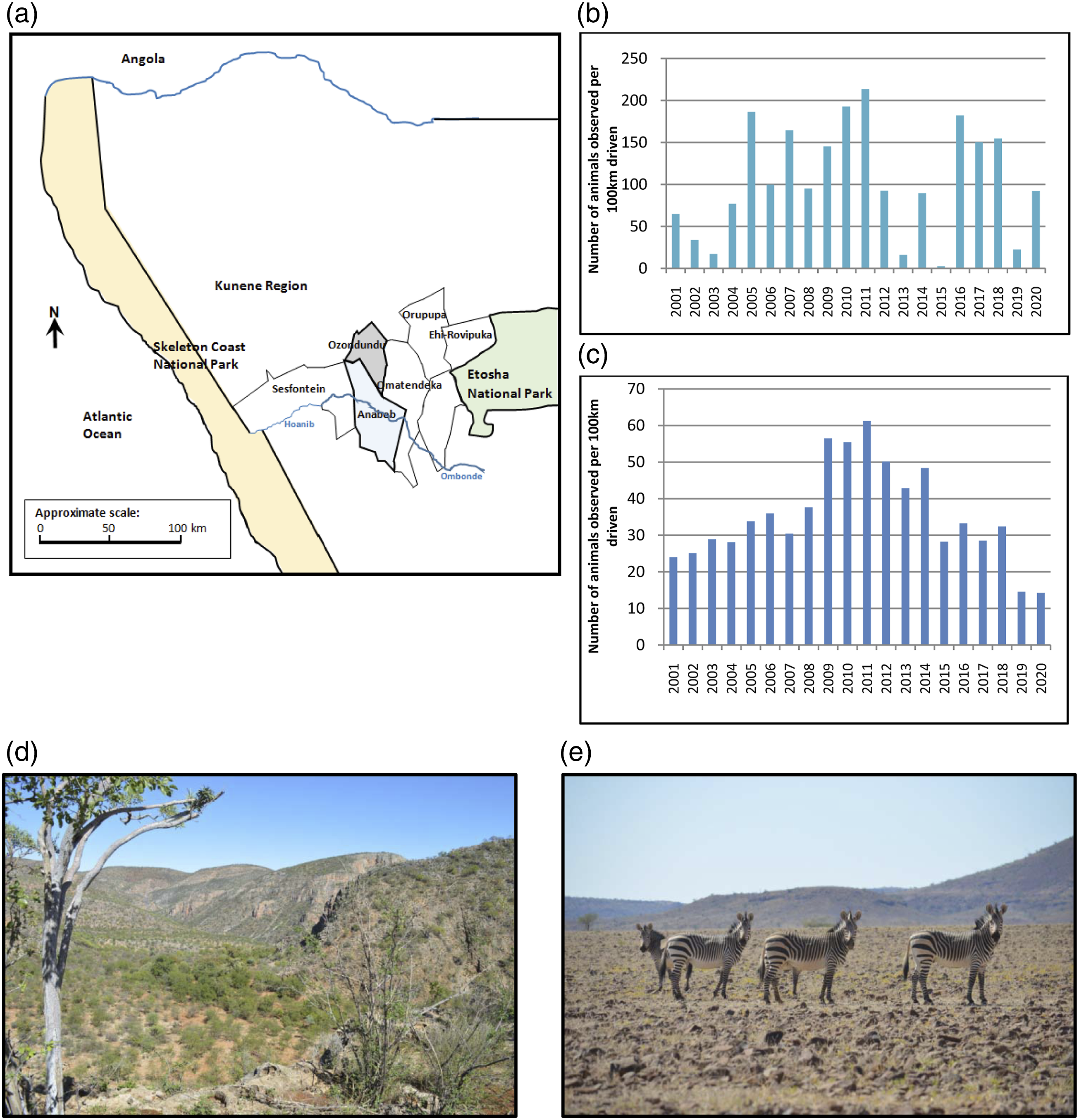
Semi-structured interviews were carried out as group discussions (up to 12 participants) in the six conservancies. There was one main discussion session with each conservancy. Participants included the conservancy Chairpersons, management teams and game guards. On average, half a day was spent with each conservancy during the core consultation work of six main interview sessions. Additional meetings were held at later dates to follow-up on the findings. In addition, consultation meetings were carried out with national and regional policy-makers, NGOs and tourism operators. The main interviews at the conservancies were designed to be semi-structured, facilitating discussions on planned topics, which included the history of the conservancy; the main impacts of the conservancy model; the national policy framework; conservancy governance; status of private investment in tourism and revenue streams; community engagement and participation; wildlife monitoring and results; the influence of the conservancy model on wildlife populations and the main challenges and scope for improvement in the conservancy model. The semi-structured approach facilitated our descriptive analysis of common trends in feedback, but also gave flexibility during the discussions for additional questions to encourage focus on important topics identified during the meetings. The case study work was completed in 2021.
Our assessment included a review of the core institutional components of the conservancy model as well as some high-level descriptive analysis of available wildlife data. The data set that was analysed had been collected by the conservancies in the Annual Game Counts, carried out each year since 2001. The game counts record the number of sightings per 100 km driven on fixed routes. The data set has been published up to 2018 (NACSO, 2018) by the Ministry of Environment, Forestry and Tourism (MEFT) and the Namibian Association of Community Based Natural Resource Management (CBNRM) Support Organisations (NACSO), and some data for individual conservancies has been published to 2020 (NACSO, 2021a; NACSO, 2021b).
Results and Discussion
Success Factors
Based on the case studies, other consultation meetings and literature review, we have identified that the main factors contributing to success of conservancies in terms of ecological conservation and community development are: • Integration of the conservancy model into national policy and legislation. • Setting up robust governance structures at community conservancies. • Investment and revenues. • Employment of wildlife rangers. • Community participation and commitment. • Central support for promoting and facilitating investments in tourism. • Monitoring of wildlife populations.
We carried out a systematic search to identify relevant publications that included a review of components of the conservancy model in Namibia. We used the Clarivate Web of Science database for this, and we excluded publications that focused only on the Zambezi Region in northeast Namibia, the other area in Namibia where there is a high number of conservancies. For those documents published since 2015, we checked the references to identify other relevant publications not found in the database search. The result of this process was the identification of 56 publications relevant to the review of the conservancy model in northwest Namibia. The publications had several inter-linked aspects to the reviews, but we identified their core focus. For 38 of the 56 publications, the core focus was on governance-type aspects, including funding mechanisms, economic benefits and/or local rights to land and resources. Community participation (six of 55), tourism (six), trophy hunting (three) and climate impacts (two) were other core themes. The majority of the published reviews therefore focused on governance-related aspects. Only one publication had a core focus on wildlife monitoring systems (Stuart-Hill et al., 2005). Only seven of the other publications included some assessment of impacts of the conservancy model on wildlife.
We provide our findings on the success factors in the section below. We include the important component of wildlife monitoring practices and systems.
Integration of the Conservancy Model into National Policy and Legislation
An important lesson from Namibia is that the conservancy model was formally adopted into the national policy and legal frameworks from an early stage. The model cuts across the functions of several different government institutions, including those responsible for wildlife protection, tourism, land management, environment and water resources. The inclusion of the conservancy approach into national policy (MET, 1995) provides direction for the relevant activities of these institutions. The conservancy model has also been integrated into national legislation (GRN, 1996).This provides the legal basis for rural communities to set up a conservancy. The communities are then empowered to manage and benefit from wildlife. One important component of this is that the legal framework allows investors in tourism (and trophy hunting operators) to sign joint venture agreements with the relevant conservancy, including sharing an agreed proportion of revenues or profits. The model allows the conservancy to make income from wildlife-related activities and to use revenues to employ game guards and for community development (Bandyopadhyay et al., 2009; Boudreaux & Nelson, 2011; Lapeyre, 2011; Gargallo, 2015; Lubilo & Hebinck, 2019). The conservancy model therefore provides a structured legal mechanism that empowers communities to make decisions on the use of their natural resources.
Setting up Robust Governance Structures at Community Conservancies
Our consultation confirmed the importance that the conservancy management organisations are set up on a formal and structured basis in Namibia. The legal framework requires that conservancies each have a management committee, a formal constitution and should hold an annual general meeting (GRN, 1996; MET, 2013a). The committee members should represent ‘blocks’, which are areas that in total cover all villages in the area of the conservancy (Vaughan & Long, 2007). Traditional Authorities have strong influence over community behaviour and the six case study conservancies include at least one representative from the relevant Traditional Authorities in their management committees. One important lesson is that much time and effort has been required to set up the conservancies in Namibia, starting with planning the geographical area. In practice, this includes many community meetings to discuss and agree boundaries with neighbouring conservancies/communities. Conservancies are also required to set up monitoring and reporting systems. The monitoring covers wildlife abundance and governance indicators (NACSO, 2021; Stuart-Hill et al., 2005).
We noted from our consultation that the support of NGOs, and the donors providing the funding for the NGOs, has been essential in terms of dialogue with communities on the benefits of the conservancy model, and providing training to the conservancy management teams, to game guards and to other employees of the conservancy. This point was also identified in other studies (Lapeyre, 2010; IRDNC, 2011; Mufune, 2015; Kavita & Saarinen, 2016). The training modules provided include financial management and book-keeping, project management, tourism management and wildlife monitoring. IRDNC (Integrated Rural Development and Nature Conservation), a Namibian NGO, was established in 1990s and has provided focused support to the community conservancies; and NACSO (the Namibian Association of CBNRM Support Organisations) has an important co-ordination role as the umbrella organisation for the relevant NGOs. One challenge is that conservancy committees are elected every three to four years, and often training has to be repeated to develop the capacity of the new committee members.
Investment and Revenues
Our evaluation confirmed that revenues and employment from tourism and other sources are critical to the sustainability of the conservancy model and to the participation and commitment of the communities to wildlife conservation (as had been concluded in several previous studies on such aspects, for example, Cooney et al., 2017; Naidoo et al., 2016; Scanlon & Kull, 2009; Störmer et al., 2019). Feedback from interviews emphasised that the creation of local employment at the tourism facilities is an important factor and the revenues received by the conservancies are used for management of the conservancy organisation, wildlife protection activities (including salaries of game guards), as well as giving benefits to the communities.
Example benefits identified during our consultation include handouts of meat provided for community events (e.g. funerals), particularly following trophy hunting activity, and fuel for diesel pumps at water points. Some conservancies that receive higher revenues do fund investment in water resources infrastructure and improvements at schools and local roads (Humavindu & Stage, 2015). There was widespread feedback during our interviews that the benefits are a major reason for the shift in community attitudes towards better protection of wildlife. The importance of transparent benefit distribution was also emphasised during our consultation and has been identified in several previous studies (Bollig, 2016; Morton et al., 2016; Schnegg & Kiaka, 2018). However, over 50% of conservancies in the Kunene Region have received minimal revenues since they were gazetted (NACSO, 2017), so their game guards receive low salaries and provision of benefits to the communities is minimal.
A few investors in tourism also fund specific community development projects, as well as providing the agreed financial contributions to the relevant conservancy. Simple additional investments during the development of tourist infrastructure can also help to get buy-in from communities. For example, camp sites need infrastructure for water supply and storage. In parallel, some of the investment could be channelled into infrastructure to protect community water points from elephants (Loxodonta africana) and create separate waterholes for elephants and other wildlife near the camp site as a tourist attraction. This practice will reduce human-elephant conflict and enhance the tourist experience.
Employment of Wildlife Rangers (Game Guards)
The six conservancies studied here each employed in 2018 between five and nine game guards. Our experience is that the game guards have an important role in dialogue with communities to encourage participation in wildlife protection, particularly at times of human-wildlife conflict. For conservancies that receive low revenues from tourism and other sources the game guards are paid on a part-time basis. The activities of game guards are organised so that each covers a specified area and that the whole conservancy is covered by those areas of responsibility. This means that each game guard in the six case study conservancies covers between 150 km2 and 400 km2 (NACSO, 2017), which is a major challenge because of the lack of vehicles. Some conservancies received one vehicle from a donor organisation soon after registration, but funding for fuel and vehicle maintenance has been a challenge.
Community Participation and Commitment
The common feedback from our interviews was that the change in attitudes of the local people has been central to the success of the conservancy model, in particular a reduction in local poaching for bushmeat. Benefits and local employment are the main drivers for community commitment to the conservancy model and wildlife conservation. This point on community attitudes to wildlife conservation is backed up by conclusions from several other studies (for example, Angula et al., 2018; Jacobsohn, 2019; NACSO, 2021; Silva & Mosimane, 2012; Störmer et al., 2019).
The tourism sector in Namibia employed an estimated 114,000 people in 2019 before the global Covid-19 pandemic, which was over 15% of the employed population (WTTC, 2020). There was almost no tourism in Namibia for much of the pandemic, with records showing a 90% reduction in tourist arrivals in 2020 (Namibia Economist, 2021). This has had a major impact on the funding of conservancies and has worsened the problem of paying low salaries to game guards. This brings challenges related to the motivation of some game guards. Many people working in the tourism sector have lost their jobs or had salary cuts as a result of the pandemic. The lack of tourism revenues means that the contributions to conservancies from tourism companies have reduced to almost zero, and during the times of travel restrictions in 2020 and 2021, there were minimal benefits being provided to the communities from conservancies. Feedback from additional consultation of conservancy committees and game guards in 2021 has highlighted the concern that this serious situation is resulting in a reduced commitment of some local communities to wildlife conservation. Some of the more recent publications on CBNRM in Namibia have emphasised these ongoing challenges (Cruise & Sasada, 2021; Drake et al., 2021; Gargallo, 2021; Heffernan, 2022).
Central Support for Promoting and Facilitating Investments in Tourism
It is important that conservancies have central support in terms of the legal framework, capacity development and practical organisation aspects. Several tourism investors and operators have been consulted as part of our review. The common feedback is that, although the overall legal framework establishing the conservancy model in national policy and law is an essential aspect, the critical factor that is constraining investment in tourism in the Kunene Region is the policy of the regional Land Board that the time period for leaseholds is restricted to 10 years in communal areas. The National Land Policy (MLRR, 1998) and the Communal Land Reform Act (GRN, 2002) do indicate that leaseholds up to 99 years are available. There is a lack of consistency between national and regional policy on potential leasehold periods (as emphasised also by Massyn, 2004), and credible investors will not make major investments (e.g. in lodges) for a leasehold of 10 years because the returns on investment would be low over that time period and there are risks that the leasehold or joint venture agreement would not be extended after the 10 years. Many opportunities for tourism investment and associated local employment are therefore not being taken up in the Kunene Region. Central support to conservancies in terms of legal advice and co-ordinating applications for longer leaseholds would be beneficial.
There is also potential for a more regional and integrated approach to activities to attract investment in tourism. For example, Ozondundu and Orupupa Conservancies are currently off the typical tourist routes. These conservancies have been working to attract tourist investment but their management teams have not been successful. As well as the constraints of a lack of local business and marketing experience, there is a lack of practical local infrastructure for communication with investors (many villages have no phone reception and no internet connection). NGOs have been providing support, but with limited budget. Some conservancies have set up low-budget community camp sites (e.g. Anabeb Conservancy), but they have difficulty in marketing to tourists. A centralised approach would be beneficial in identifying potential investors, showing them the tourism sites and opportunities and introducing them to the conservancy management teams. A central organisation would be in a much better position than individual conservancies to carry out such tasks. Ideally such a central organisation would operate at least partly on a commercial basis so that there is sustainability to the role, but it is important that the conservancies themselves keep the decision-making role and the responsibility for the wildlife. Some central organisations exist in Namibia for marketing to tourists and carrying out bookings at private lodges. They could provide a useful support role to conservancies by marketing and facilitating co-operation between conservancies (e.g. on game drives and elephant tracking tourism products).
Monitoring of Wildlife Populations
Since the conservancy model was started in the early 1990s, wildlife populations in the Kunene Region have been widely reported to have recovered by the early 2000s. This was after the period of instability and hostilities through the 1980s, and serious droughts in the early 1980s, had resulted in severe reductions in some species because of uncontrolled poaching for bushmeat (Jones & Weaver, 2009; Owen-Smith, 2010; Bollig & Olwage, 2016; Jacobsohn, 2019). The reported recovery of wildlife in the 1990s is based mainly on aerial surveys (NACSO, 2021). From the early 2000s, the main wildlife monitoring in the conservancies has been the Annual Game Count, which is organised once a year by MEFT, NACSO and WWF.
The method of the Annual Game Count involves observations taken from vehicles along fixed routes, and the data normalised on the basis of sightings per 100 km driven. In practice, there are limitations to this method. Not only does the vehicle noise frighten some animals away before they are observed but also the sight lines in much of the typically rugged and mountainous region mean that many animals might be close by but not be observed. However, the positive point is that the method has been consistent for 20 years, and this facilitates the analysis of trends in wildlife data. In the Kunene Region, 25 out of 38 conservancies currently take part in the count (NACSO, 2021a). All six case study conservancies included in our study have taken part since 2001. All six conservancy management teams stated that the Annual Game Count helps to build team work amongst the game guards and with the community and is an important factor in community participation in wildlife conservation. The game count also enhances co-operation between conservancies.
The game count monitoring teams will record sightings of rare and endangered species, such as elephants, rhino (Diceros bicornis), lions (Panthera leo), leopards (Panthera pardus) and cheetah (Acinonyx jubatus). However, the monitoring of these species is carried out by each game guard throughout the year, and sightings recorded in Event Books, along with other events such as incidents of human-wildlife conflict. The approach of the Annual Game Count and the use of Event Books provide a comprehensive wildlife monitoring programme in the conservancies. The monitoring systems have been set up, and training provided by the NGOs, in a way that has fostered a strong sense of ownership of the monitoring programme by the conservancies (Stuart-Hill et al., 2005).
The relevant NGOs involved in wildlife conservation and CBNRM work together and publish the monitoring results on a conservancy basis and scaled up results for the region (NACSO, 2020; 2021b). There are many factors that influence wildlife in the individual conservancies. For example, several species migrate because of localised rainfall (Garstang et al., 2014; Gosling et al., 2019). Analysis of data from an individual conservancy therefore does not provide reliable conclusions on the trends in wildlife populations. As an example, Figure 2b provides the results of the Annual Game Count for one species, Hartmann’s mountain zebra, for Anabeb Conservancy. This chart does show the possible local impacts of some of the severe drought years in 2013, 2015 and 2019 for the mountain zebra, but it is uncertain whether much of the population had died or whether they had moved away to find water and vegetation in other conservancies. Figure 2c provides the similar chart for the Annual Game Count for mountain zebra, but aggregated for all the participating conservancies in the Kunene Region at which the species was observed. The data also covers counts in the three concession areas of Palmwag, Hobatere and Etendeka. This regional analysis provides much more confidence and demonstrates that, having reportedly recovered in the 1990s, the overall populations of mountain zebra were steady in the 2000s but have decreased in the 2010s, partly because of the major drought years from 2013 to 2020. The data set provides similar results for several other species (e.g. springbok (Antidorcas marsupialis), kudu (Tragelaphus strepsiceros) and gemsbok (Oryx gazella)).
NACSO prepares and prints posters of results for individual conservancies and provides them to the conservancies so that they can be used to raise community interest and help with ongoing commitment to wildlife conservation. Knowledge of the results of the monitoring is particularly important for the motivation of game guards and community members that were involved in annual game counts.
Although wildlife data needs to be scaled up to a regional level to assess trends in species populations, the data for individual conservancies can provide some useful specific conclusions. For example, in this case, the conservancies studied were located across an east-west axis along one route of the migration to the west that occurs after the rainy season (Owen-Smith, 2010), and comparing the data for different species along the migration corridor is interesting. Figure 3 compares the results for different conservancies on that axis and shows that in June, soon after the end of a rainy season, the populations of Mountain zebra tend to be highest in Anabeb. Local feedback indicates that it is likely that many of these zebra would move back east once the grasslands of the fertile basalt areas have died back. Monitoring at other times of the year would provide useful results, subject to available funds for the monitoring, particularly in terms of planning protection of wildlife corridors and associated habitats. Comparison of Annual Game Count sightings of Mountain Zebra (per 100 km driven) for conservancies along a west to east line (derived from (NACSO, 2018)).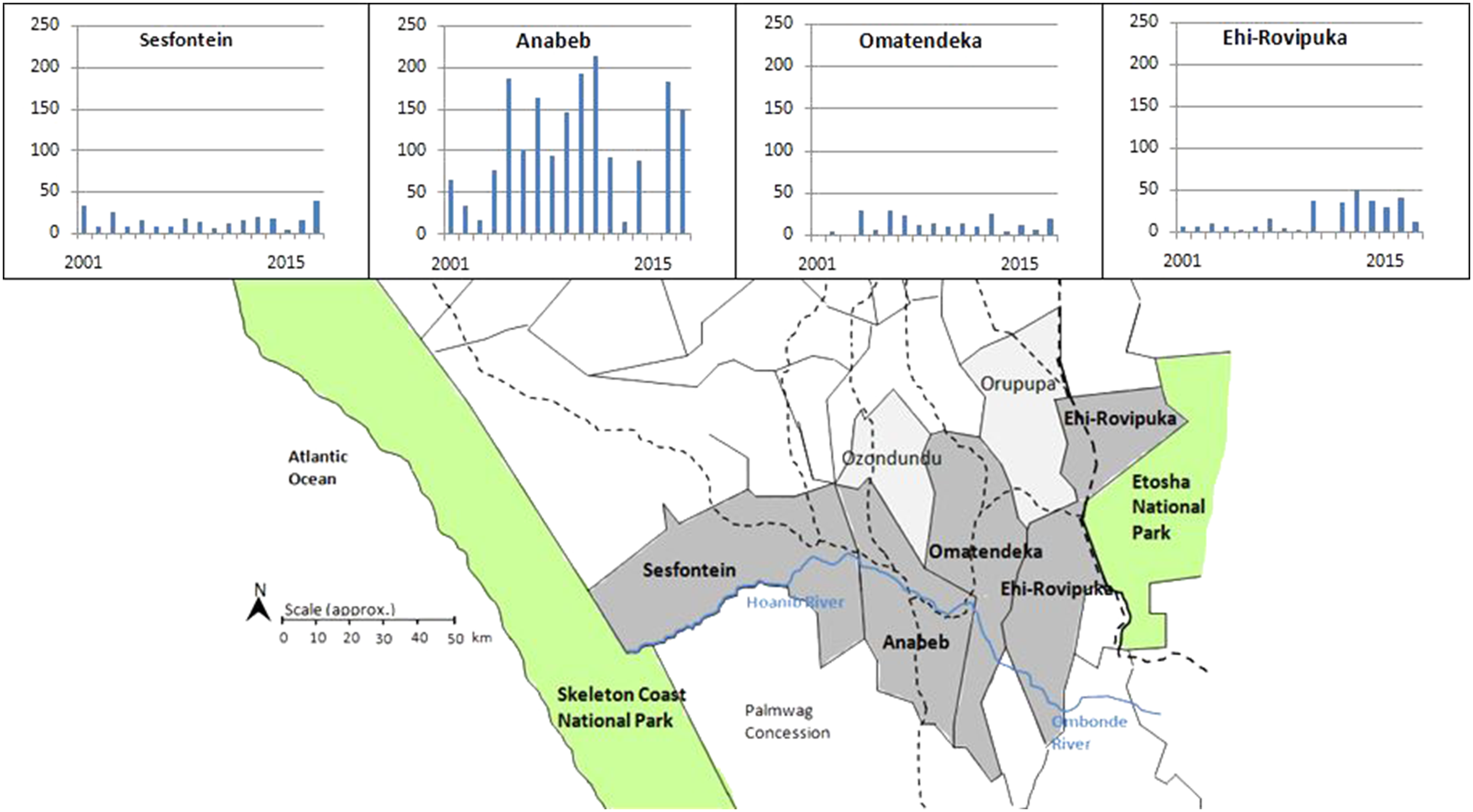
The recovery and stabilisation of wildlife populations after the 1990s, even with potential decreases during recent drought years, is a significant success given the growing human population, and particularly the larger livestock herds, which are increasing the competition for natural resources (Hunninck et al., 2017; IUCN, 2020). There was widespread feedback from all six conservancies consulted during our study that these positive results on wildlife populations have been a result of the implementation of the conservancy model. This is due to the resulting perception of local communities in terms of the benefits of the wildlife (as also identified in previous studies such as Naidoo et al., 2011; Silva & Mosimane, 2012; Störmer et al., 2019), as well as the importance of local decision-making on utilisation of natural resources and local accountability for wildlife conservation provided by the model (Boudreaux & Nelson, 2011; Mufune, 2015; Jacobsohn, 2019).
Lessons from More Detailed Comparison of Two Conservancies
The lessons from our research are particularly demonstrated by comparison of Ozondundu Conservancy (Figure 2d) and Anabeb Conservancy (Figure 2e). Ozondundu has so far had no investment since it was established in 2003, and therefore receives limited revenues, can only pay low salaries to game guards and only on a part-time basis and has no local employment in tourism. Community engagement in wildlife protection has so far been a result of the strong management team at the Ozondundu Conservancy, but there have been recent challenges with a perceived increase in poaching for bushmeat. Anabeb Conservancy received N$7.2 m (equivalent to over USD 0.5 m) in 2016 from tourism (NACSO, 2017), nearly 10% of its population was employed in tourism or wildlife protection before the Covid pandemic, and it was able to purchase an additional vehicle. The conservancy provides benefits across the communities and is able to give compensation for livestock loss from predator attacks. Feedback from the Conservancy Management Team was that local people in the villages in Anabeb Conservancy are now much more committed to wildlife protection than before the Conservancy was established. Although there are many factors that affect the performance of conservancies, the comparison of Anabeb and Ozondundu demonstrates the essential aspect of gaining revenues. Anabeb has benefited because it covers an area with several tourist attractions (e.g. desert elephants). However, there are potential tourism sites in Ozondundu that could be developed (e.g. at scenic springs visited by elephants).
Conclusions and Lessons
The rapid human population increase across much of Africa, as well as the likely impacts of climate change, will continue to put pressure on natural resources. Community participation in protection of habitats and wildlife will be essential. The conservancy model combines wildlife protection, local employment and community development. It raises the perceived value of wildlife and engages communities in wildlife protection, and it could have a significant role in future wildlife conservation strategies in many parts of Africa. The main lessons that are applicable to other countries in Africa, based on our case studies in Namibia, are: • Communities in conservancies in the Kunene Region of Namibia have been taking pride in being given responsibility to manage wildlife. However, a long-term approach is needed for changing attitudes and behaviour of communities. Even at the start, the conservancies take much time to set up in terms of agreement on boundaries. An important aspect of the success is that the Government of Namibia created the legal framework for the conservancy model in the 1990s and has actively supported the conservancy programme since then. The long-term support of NGOs (e.g. NACSO and IRDNC) has also been a positive influence on conservancy development in Namibia. • The required skills and experience of the management teams at the conservancies need to be developed. In general, local people are highly skilled and experienced as livestock farmers but have limited experience in organisational management. Training in this is important, including in negotiation skills, so that agreements with private investors can be properly and fairly developed. • Game guards are employed by the conservancies and have a particularly important role in dialogue with the local communities, raising awareness and encouraging local participation in wildlife conservation. • It is not just governance aspects, such as ensuring benefits to communities for participation in wildlife conservation, that are important. A comprehensive wildlife monitoring programme is also needed to assess the performance of conservancies. In Namibia, the use of the simple method of the Annual Game Count for 20 years has been important, so that the trends in wildlife populations can continue to be compared. The Annual Game Count has involved the participation of game guards and some community members, and is an important aspect of building community commitment and motivation to wildlife conservation. NGOs help by analysing the data and they are dedicated to providing posters of the results to the conservancies as these help to motivate communities in wildlife conservation. • Revenues are critical to the sustainability and success of conservancies in terms of engaging communities in wildlife protection and employment of game guards. Early investment in tourist facilities is important, even if this is in low-level camp sites just to gain momentum and start revenue generation. Such camp sites help local employment and can provide revenues towards salaries of game guards. Higher revenues can facilitate benefits to local communities (e.g. investments in water points) to increase the support to wildlife conservation. • An important priority in Namibia therefore is to facilitate more investment in tourism in the conservancies, including planning of routes and sites with a more holistic approach. Many conservancies have had no investment in tourism and other revenue sources are minimal (e.g. from trophy hunting). More support is needed to conservancies in identifying potential tourism investors and marketing local tourist camps and attractions, including encouraging conservancies to co-operate on shared tourist sites and shared benefits. Such central support does need proper funding. • In Namibia, some conservancies have had significant success in engaging local communities in wildlife protection, and wildlife populations across the Kunene Region increased and then stabilised after severe reductions in the 1980s, although there have been decreases in recent years, mainly because of the severe drought. There is still much work to do to encourage investment in tourism and the sustainability of wildlife populations in the Kunene landscape remains fragile. In the conservancies that have no revenues and cannot provide employment or benefits to the communities, the feedback is that poaching for bushmeat has been increasing.
Footnotes
Declaration of Conflicting Interests
The author(s) declared no potential conflicts of interest with respect to the research, authorship, and/or publication of this article.
Funding
The author(s) received no financial support for the research, authorship, and/or publication of this article.
