



Abstract
In the remote, semi-desert landscape of the highlands, west of Etosha National Park, competition between humans and elephants for natural resources is likely to increase because of climate change. The aim of this study was to assess priorities and measures to reduce human–elephant conflict in the highlands, and identify lessons learnt. The approach included interviews with community game guards, site visits to water points and analysis of data recorded by game guards on incidents of elephant damage. We conclude that upgrades to water points, including protection walls, concrete dams and solar pumps to ensure water is permanently available for people and elephants, are having a positive impact. Local feedback is that there has been a decrease in serious damage to water points over the last 5–10 years. There has been an increase in small-scale vegetable gardens and we recommend a programme of pilot projects to test protection measures at gardens.
Introduction
In the 2021 assessment of the IUCN Red List of Threatened Species, the classification of the African savannah elephant (Loxodonta africana) was uplisted from Vulnerable to Endangered (Gobush et al., 2021). The change in Red List status was based on an estimated 30% reduction in population of the African savannah elephant since 2006 and reflects the increasingly serious risk to the species population. The IUCN has identified addressing human-elephant conflict as one of the measures of critical conservation importance (Thouless et al., 2016).
The elephant range in Namibia includes a small population in the northwestern parts of the country, to the west of Etosha National Park. There has been much research carried out on the population of desert-adapted elephants, particularly in the lower Hoanib river catchment to the west of Sesfontein (Brown & Ramey, 2022; Leggett, 2019; Leggett et al., 2011; Viljoen 1987, 1989; Viljoen & Bothma, 1990). There has been minimal research on elephants elsewhere in northwest Namibia. This includes the Northern Highlands, a remote, mountainous and arid area of about 12,000 km2 located just to the west of Etosha National Park (Figure 1). In the most recent IUCN African Elephant Status Report, the population in northwest Namibia, including the Northern Highlands, was estimated to be 314 elephants (Thouless et al., 2016). Location of the Northern Highlands in northwest Namibia, including the area shown as the dashed line that is the known elephant range in northwest Namibia and Etosha National Park (from the African Elephant Status Report in 2016 by Thouless et al., 2016), and also showing the core six community conservancies in the Northern Highlands in this study.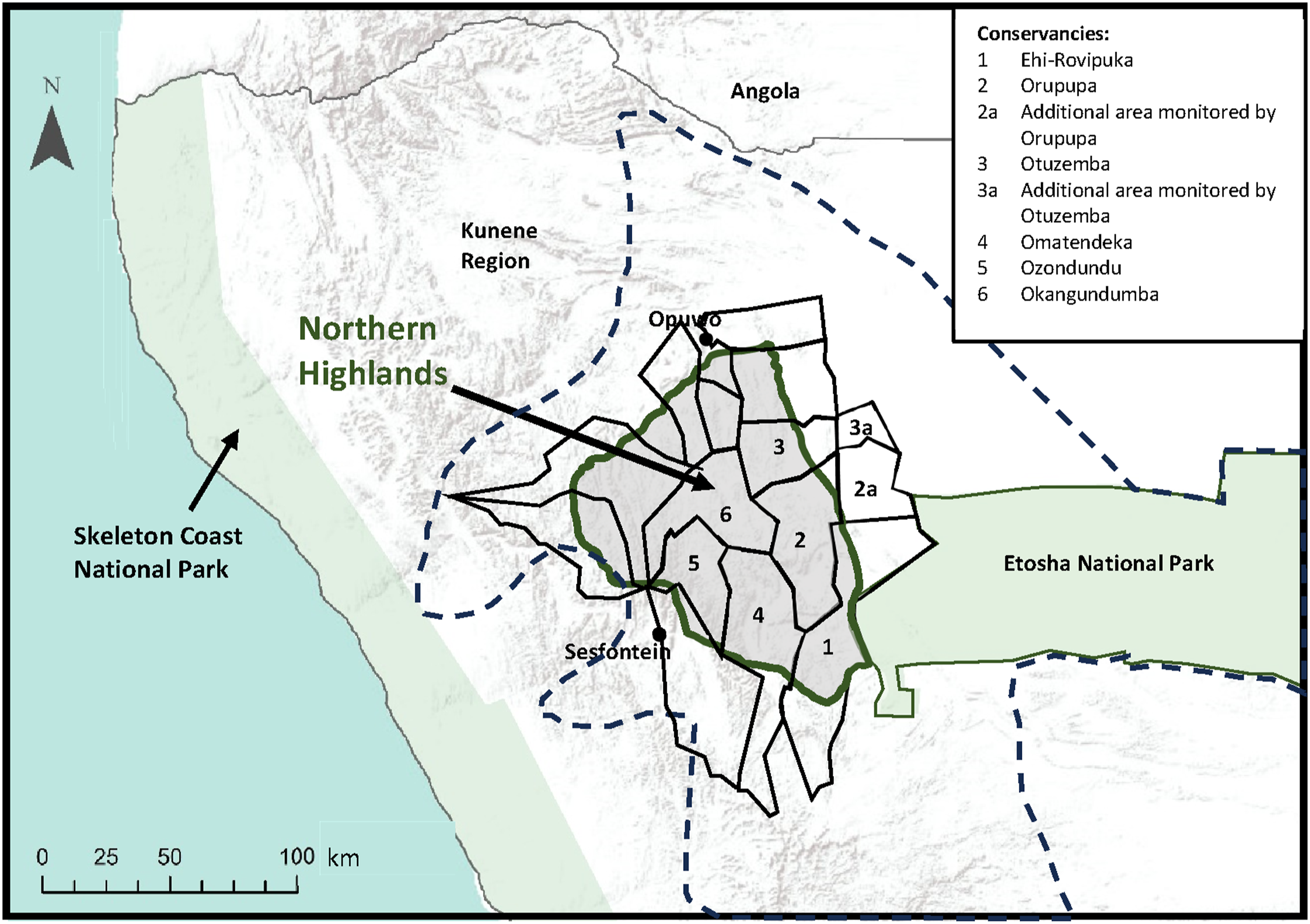
The African savanna elephant would usually be associated with the flat plains of Africa. The elephant population in the Northern Highlands is interesting because they walk up steep slopes, a behaviour that might not be associated with an animal of such a large size (Wall et al., 2006). These elephants live alongside the rural communities, which are some of the poorest people in Namibia (GRN, 2015; Heydinger et al., 2019). Livestock farming (cows and goats) is the main livelihood for the local people, with some farmers moving from villages to cattle posts for a few months of the year when there is fresh vegetation. Northwest Namibia is an extremely arid area, described as desert to semi-desert habitat. Water is critical to the local wildlife, and to the communities and their livestock (Figure 2), and annual rainfall in the Northern Highlands is typically only 50–200 mm (Namibia Meteorological Service, 2023). Water flows in the ephemeral rivers for only a few days or weeks per year and, when it occurs, rainfall tends to be highly localised and intense, often leading to soil erosion. It has been anticipated that climate change will have an increasing influence on the future stability of this fragile ecosystem (Niang et al., 2014; Turpie et al., 2010; WMO, 2021). Water point at Okatapati, Okangundumba Conservancy, December 2022.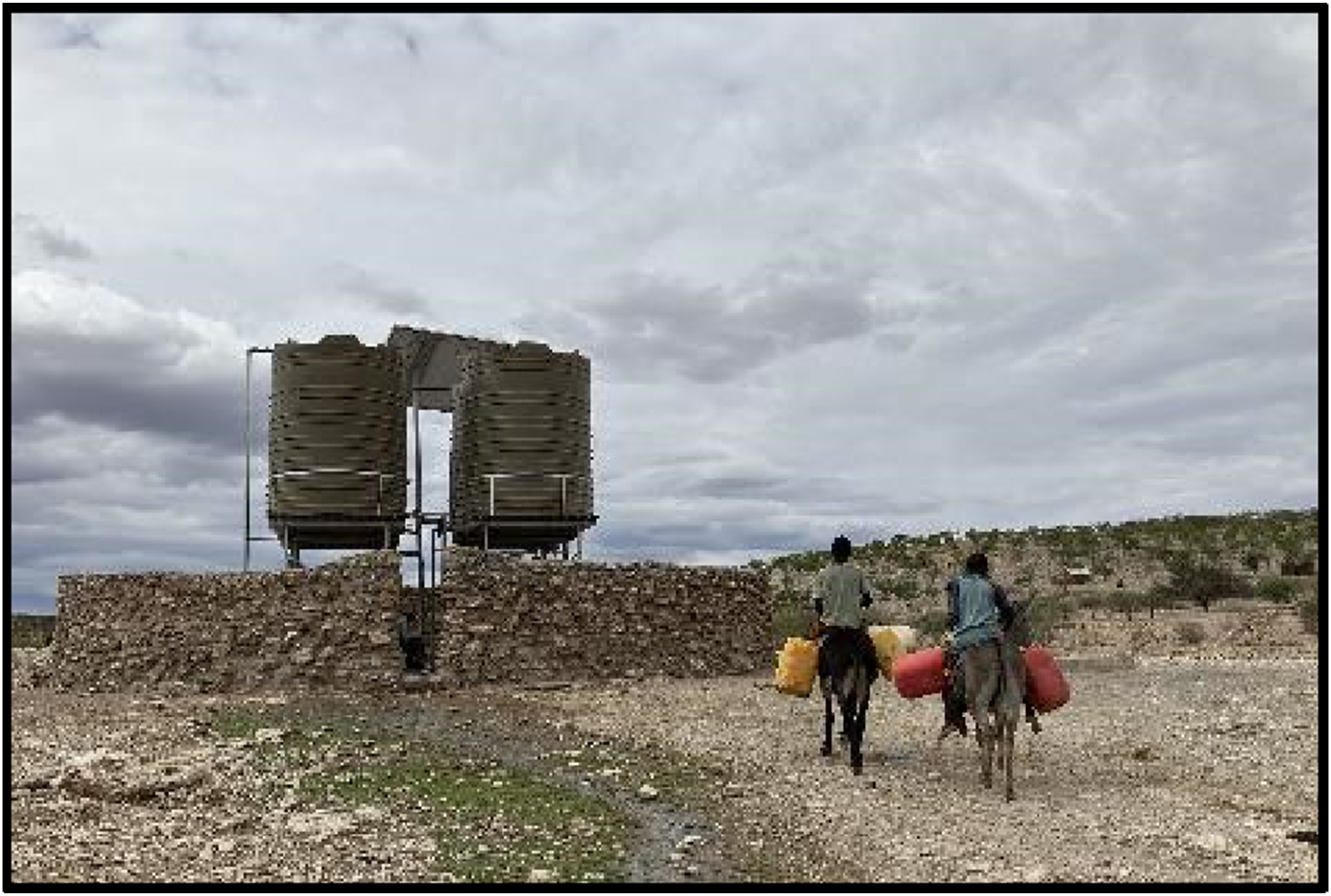
Human–elephant conflict at community water points and vegetable gardens in northwest Namibia is a particular problem that is adding to challenges for the local communities (Hunninck et al. 2017; MEFT/NACSO, 2022; MEFT, 2021). There was a high loss of livestock in 2018–2019 because of the lack of vegetation following several years of droughts since 2013 (Sasscal, 2023), which has added to problems of local poverty (Inman et al., 2020). Following the loss of livestock, there has been an increase in vegetable gardens set up by the communities (Figure 3). The main crop is maize, but other crops and vegetables are also grown. Vegetable gardens at Ekoto, Orupupa Conservancy, with evidence of a visit by an elephant, February 2022.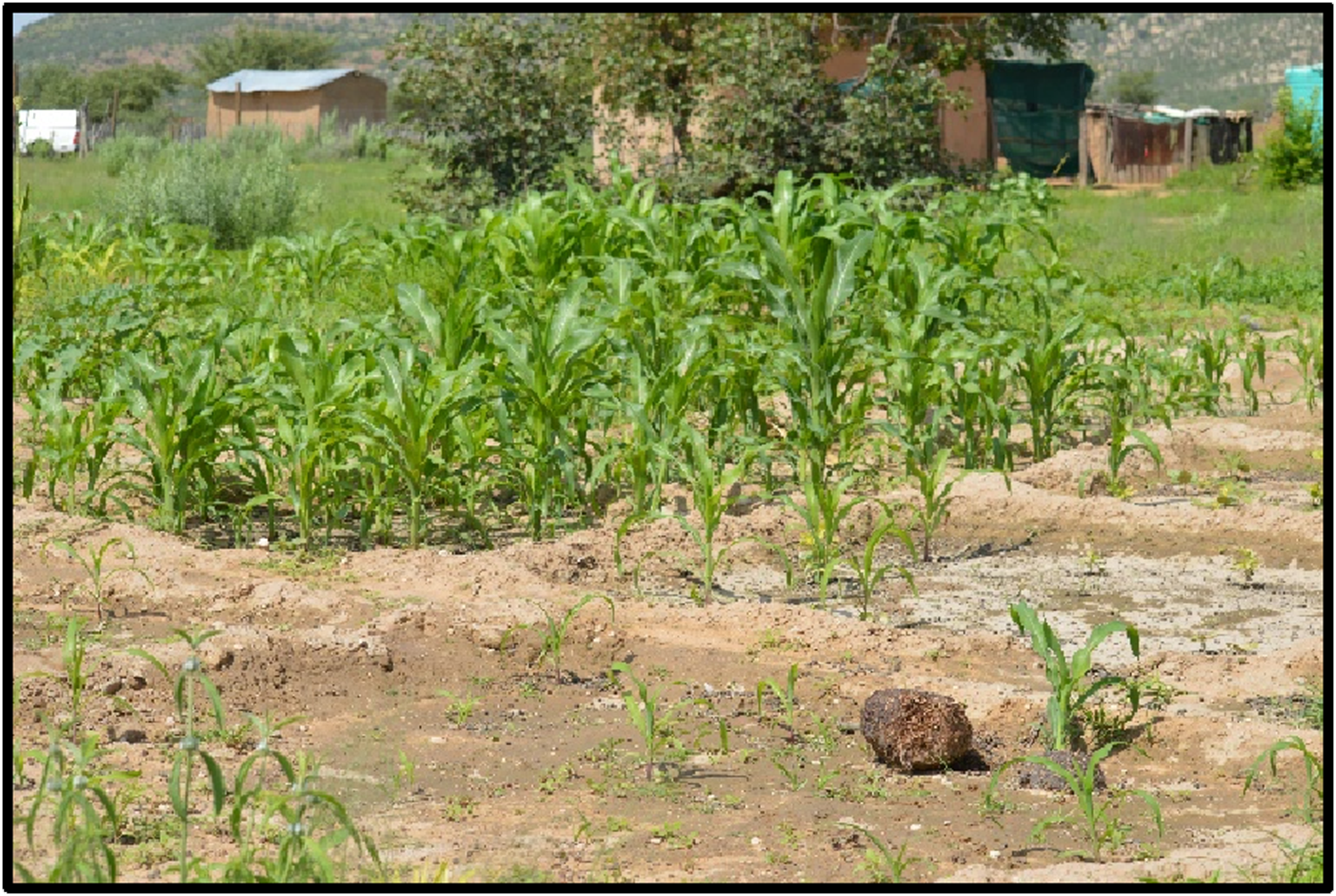
Northwest Namibia, including the Northern Highlands, is a remote area where there are practical difficulties in the enforcement of wildlife conservation laws. Community commitment to wildlife protection is therefore important. Since the 1990s, the community conservancy model has been implemented, and conservancies now cover a large proportion of the communal land in the northwest (MEFT/NACSO, 2022), including the Northern Highlands. The conservancy programme has resulted in improved awareness and higher commitment of local communities to wildlife protection in the northwest (Angula et al., 2018; Boudreaux & Nelson, 2011; Jacobsohn, 2019; Owen-Smith, 2010; Störmer et al., 2019; Wenborn, Svensson, et al., 2022). The set up includes the employment of community game guards at each conservancy. In the Northern Highlands, some of the game guards have had over 20 years of service in their roles. The responsibilities of game guards include raising awareness in the local community to encourage wildlife and habitat conservation, investigation of incidents of human-wildlife conflict, and recording data on wildlife (e.g. on foot patrols).
Although there has been minimal published research on the elephants in the Northern Highlands, including a lack of detailed study on trends in human-elephant conflict, there is much knowledge in the local communities. In particular the community game guards have built up local ecological knowledge on the elephants and their movements (Wenborn, Nijman, et al., 2022). The game guards maintain records of incidents of elephant damage in Event Books. The records include date and location of the incident, type of damage and complainant, and the number of elephants if known. The Event Books have provided a tool for consistent monitoring and in most conservancies in northwest Namibia there are records going back over 10 years. The Event Book system was set up by the Ministry of Environment, Forestry and Tourism with the support of Namibian wildlife NGOs, and extensive training has been provided to game guards.
The data on incidents involving elephants, recorded in Event Books, has been analysed by the Ministry of Environment, Forestry and Tourism and wildlife NGOs. The analysis tends to be at high-level, aggregated for the northwest and also published for individual conservancies (NACSO, 2024). It has been identified that additional assessment of Event Book data would be beneficial at a level of spatial detail to identify hotspots at individual villages and temporal detail to identify trends in terms of incidents in different months. Tavolaro et al. (2022) did review patterns of human-wildlife conflict, covering all incidents (i.e. including predator species) across conservancies in Namibia, and Wenborn et al. (2022) carried out an analysis of incidents of human-elephant conflict hotspots in Orupupa Conservancy, both studies concluding that more detailed analysis would be useful to identify hotspots and trends in conservancies. The National Elephant Conservation and Management Plan for Namibia includes the strategic objectives to plan local interventions to protect the elephants and their habitats in northwest Namibia, and in particular to reduce the incidents of human-elephant conflict (MEFT, 2021). It identifies that more research is needed on human–elephant conflict in northwest Namibia to inform mitigation strategies.
The local ecological knowledge and data in Event Books present an opportunity for assessment of monitoring data and identification of lessons from local practices to mitigate human–elephant conflict in the Northern Highlands. There has been much research published, and pilot projects tested elsewhere in Africa, on methods to reduce human–elephant conflict (e.g. Kioko et al., 2008; King et al., 2013; Ndlovu et al., 2016), but local assessment on the ground, specific to the Northern Highlands, is important given that the applicability of measures greatly depends on the local situation and context (Hoare, 2012; IUCN, 2020; Save the Elephants, 2022).
The aim of this study was therefore to inform the planning and prioritisation of mitigation measures through carrying out: • an on the ground assessment of priorities and measures in the Northern Highlands to reduce human-elephant conflict and to identify lessons learnt; and • a detailed analysis of monitoring data in community Event Books to identify potential trends and hotspots.
Method
Our method involved a combination of collating local ecological knowledge, analysing records in Event Book, and field observations in the study area. We carried out semi-structured interviews with 34 community game guards from December 2022 to February 2023. The topics discussed included their perception of trends in human-elephant conflict, measures taken to reduce incidents, the main concerns of the community related to elephants, and whether individual male elephants or female-led herds cause more incidents. Game guards were also asked their opinion on statements about elephant behaviour using a Likert scale of strongly agree, agree, etc. The game guards had between one and 30 years of experience with a mean of 10.3 years.
Descriptive analysis of incidents of human–elephant conflict recorded in Event Books was carried out at spatial and temporal levels, identifying villages with the most incidents and the trends in different types of incidents over time. The Event Books for the six main conservancies were copied for the analysis, with the help of the game guards, and with the permission of the conservancy chairpersons for Ehi-Rovipuka, Orupupa, Otuzemba, Omatendeka, Ozondundu and Okangundumba (Figure 1). During time spent with game guards in the research study (at different times during 2021, 2022 and 2023), we visited 107 locations of water sources, including 65 water points (five of which were hand pumps), 10 earth dams and 32 springs. Observations were made on the infrastructure, types of pump, state-of-repair and evidence of elephant presence and damage by elephants. Vegetable gardens at 18 villages were also visited during the study to observe any measures taken to protect the gardens.
Results and Discussion
Trend in Incidents
During the interviews, the 34 game guards were asked for their perception on the trends in human-elephant conflict, and whether incidents had been increasing or decreasing since 2012. Most game guards made the point that the number of incidents varies from year to year, with more game guards (47%) perceiving that there had been an overall increase in incidents, 12% decrease and 29% saying there had been no overall change. However, according to the data recorded in Event Books (Figure 4), the total number of incidents involving elephants across the six conservancies does not confirm the increase in total incidents over the last 10 years perceived by a higher proportion of game guards. The totals for different types of incident are shown in Figure 4, including at water points, vegetable gardens and other incidents (which tend to be damage to kraals and other structures, or injury or killing of livestock by elephants near water points). The results do indicate that the number of incidents reported at vegetable gardens increased in 2020 and 2021, a reflection of the communities setting up more vegetable gardens after the loss of livestock in the drought years of 2018 and 2019. Total incidents involving elephants recorded in Event Books in six conservancies (Ehi-Rovipuka, Orupupa, Otuzemba, Omatendeka, Ozondundu and Okangundumba).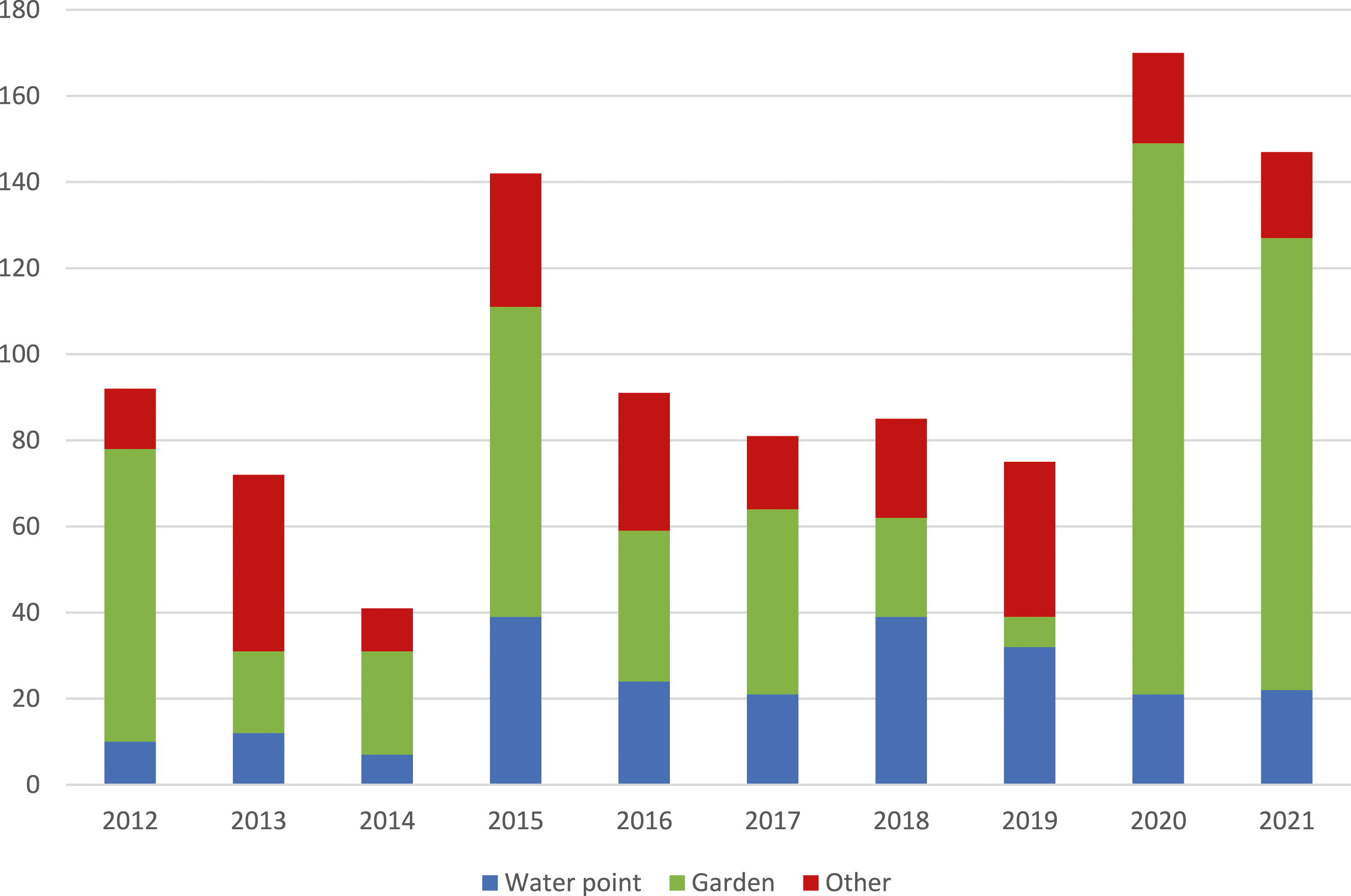
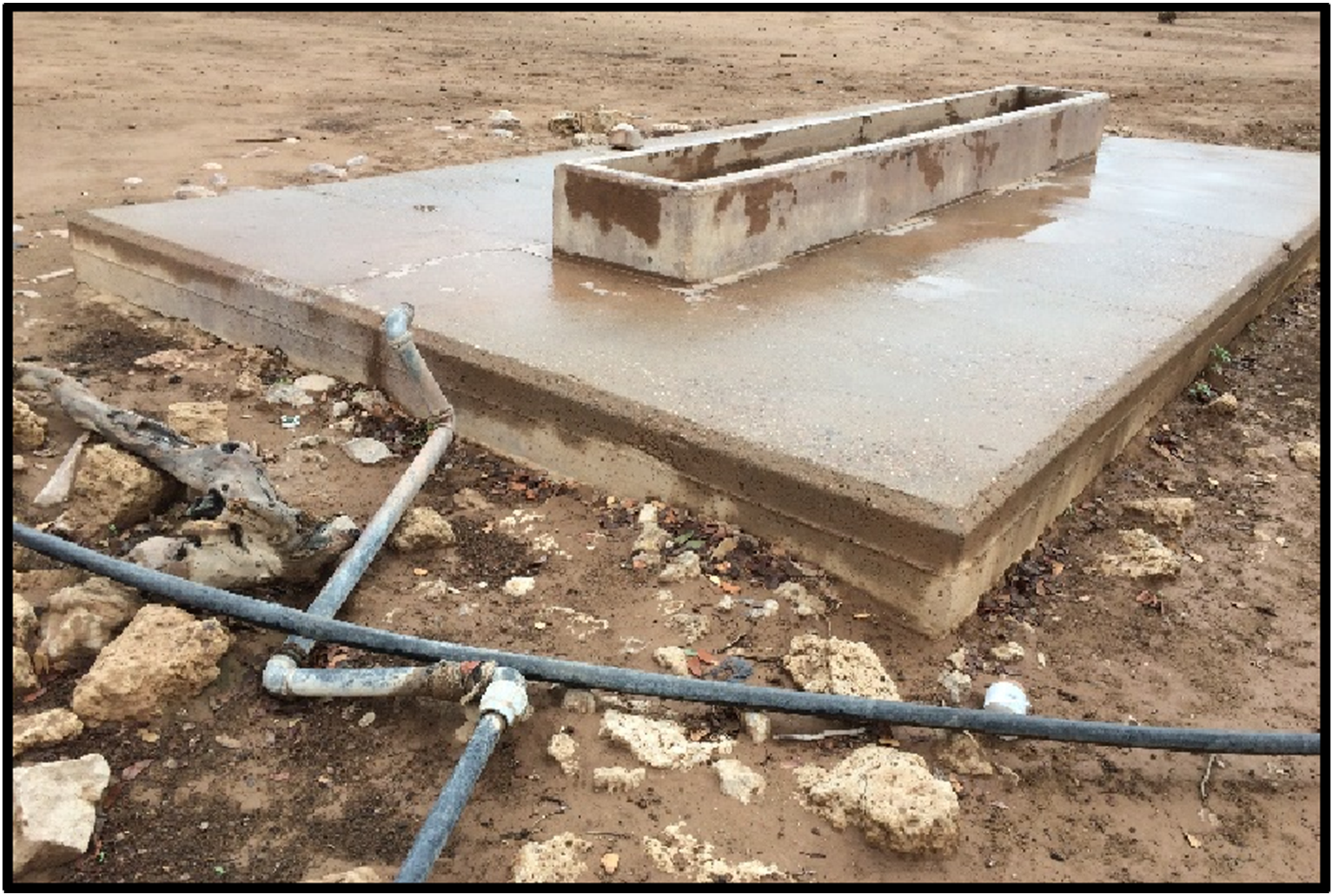
Even though the frequency of reported incidents is low in most villages, and there are more incidents at vegetable gardens than water points, it is the damage of an incident by elephants at a water point that can have the most substantial impact on the local community. When water point infrastructure is damaged, in practice it often takes much time to repair, partly because of the large distances to travel to suppliers to buy parts and equipment, as well as because of the costs. This can leave communities without nearby access to water for several weeks. Problems can include damage to storage tanks for drinking water (Figure 5) or to pipework (Figure 6). Water point at Okarindi, Otuzemba Conservancy. The plastic tank for storage of drinking water could no longer be used because of damage by elephants, which had pierced a hole in the tank with a tusk, and pulled out the pipe; photo taken January 2021. Elephants broke the pipework to the trough at Okazorongua in Orupupa Conservancy, potentially because they found no water in the concrete dam but they could smell water in the pipes; photo taken April 2021.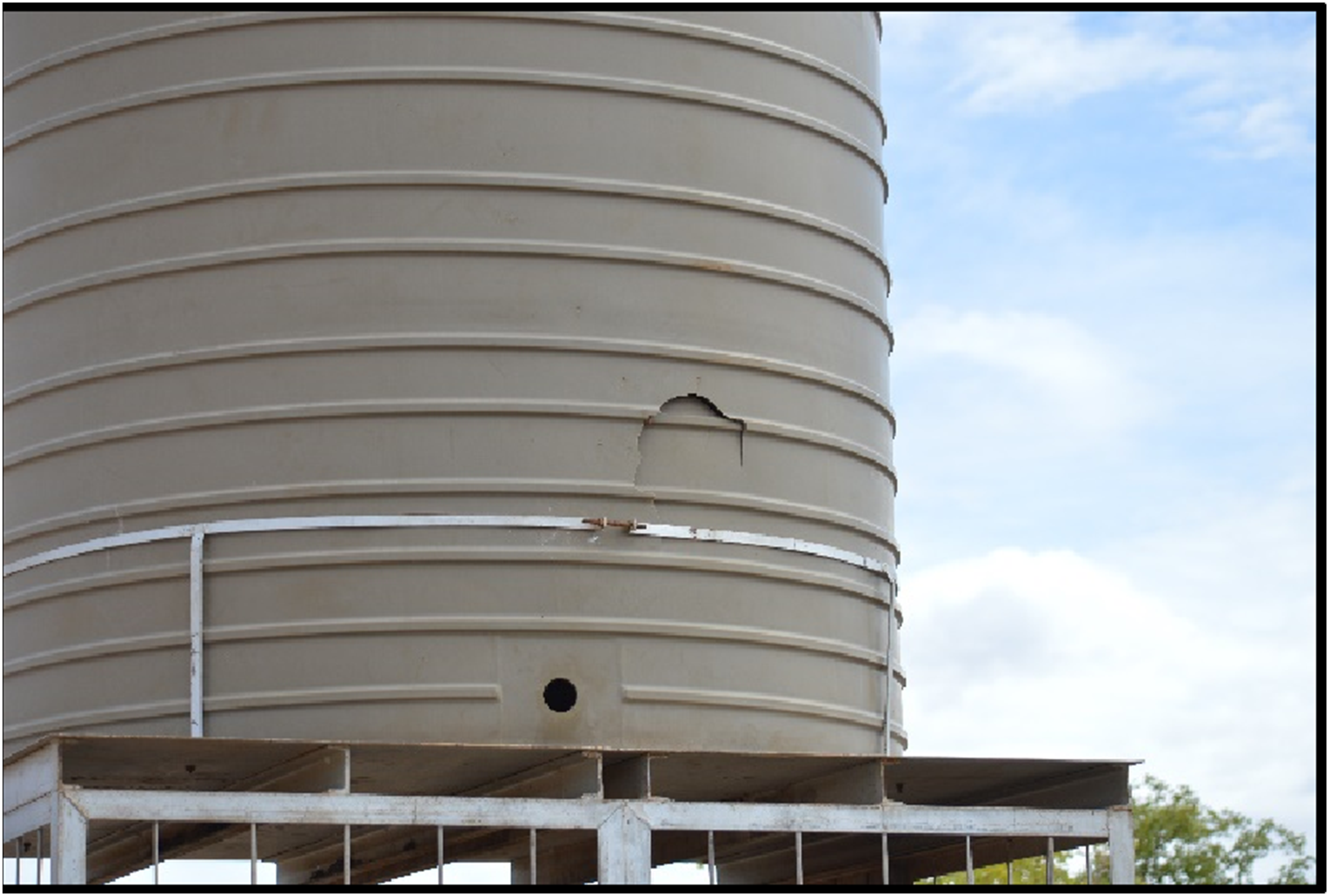
When asked about the main concerns of communities in relation to human–elephant conflict, the feedback from game guards was that the communities are currently more concerned about crop raiding at vegetable gardens than damage to water points. The perception of game guards is that the number of serious incidents of damage by elephants at water points is going down, partly because several water points have been upgraded to include protection from elephants. However, the game guards are concerned overall that human–elephant conflict is eroding the local commitment to wildlife protection that has successfully been built up under the community conservancy programme.
Local people are also concerned about their safety in terms of interactions with elephants, both when they take livestock to water points and when they are trying to keep elephants away from vegetable gardens. Actions by communities to try to frighten elephants away include making loud noises and throwing stones. There was common feedback from game guards that there are specific problem elephants that cause more damage, and these tend to be individual males. In terms of problems at vegetable gardens, 17 game guards (50%) said that the individual males cause most of the damage. 29% said the female herds cause the most damage, partly because, when they enter a vegetable garden, the high number of elephants means that many vegetables are taken or trampled. In Omatendeka and Ozondundu in particular, the game guards are familiar with two individual males that tend to cause more problems. In a study on elephant stress levels, Hunninck et al. (2017) found higher stress levels in elephants in the community areas of Kunene Region than in Etosha National Park, based on analysis of dung samples for indicator chemicals of physiological stress. That study concluded that the reason was the more interactions between elephants and people in the community areas.
Identification of Hotspots of Incidents of Human-Elephant Conflict
The Event Book data include location of incidents in terms of nearest village or cattle post, which enables analysis of hotspots of human–elephant conflict. The map of the six conservancies in this study (Figure 7) shows the total number of incidents at different locations over the 10 years of 2012–2021. These include incidents at water points, vegetable gardens and other types. Location of human–elephant conflict incidents recorded by game guards in six conservancies between 2012 and 2021.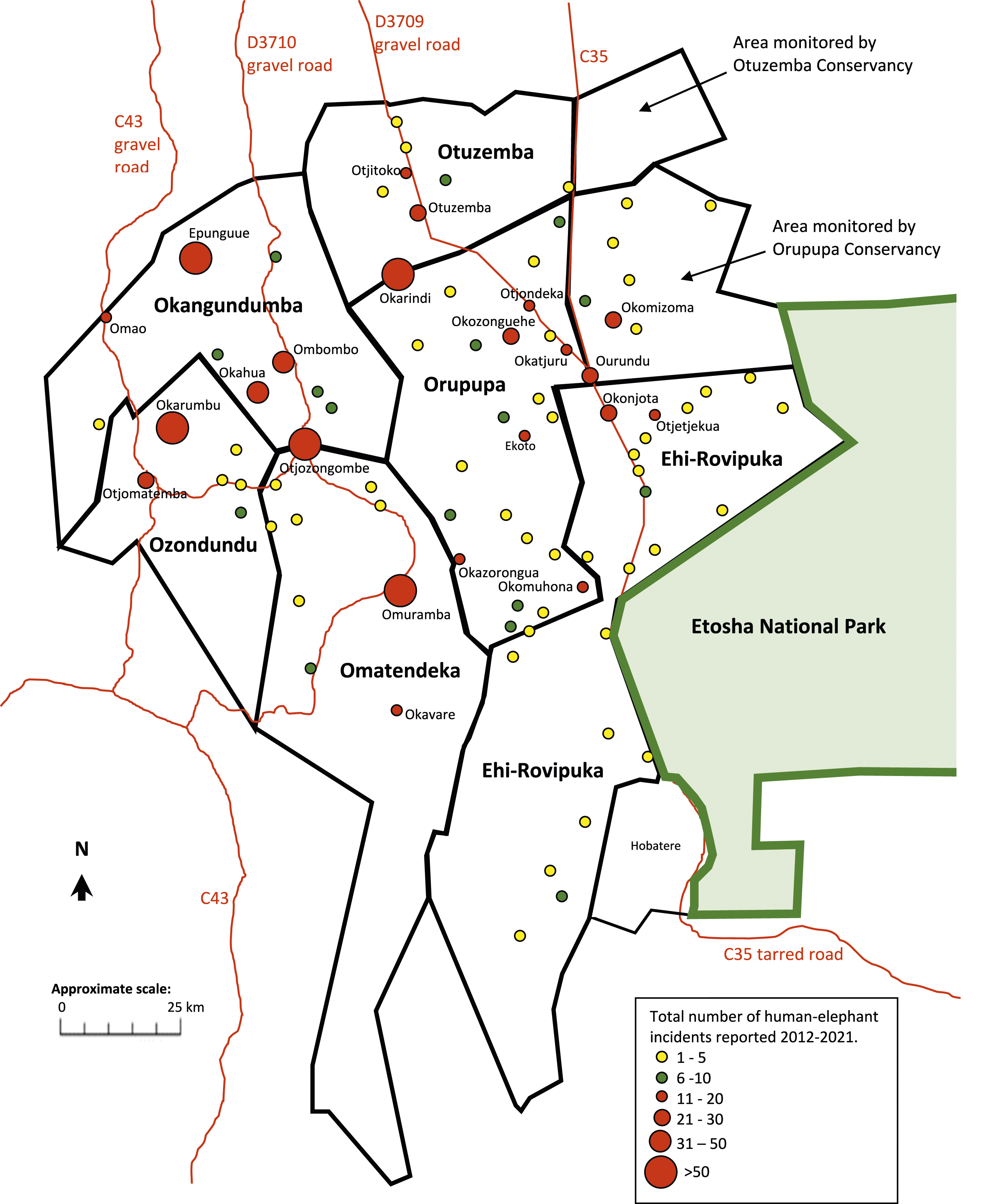
The main hotspots for incidents are in the western part of the Northern Highlands, including Epunguue (Okangundumba Conservancy), Okarumbu (Ozondundu), Otjozongombe (on the boundary between Okangundumba and Omatendeka), Omuramba (Omatendeka) and Okarindi (on the boundary between Otuzemba and Orupupa). It might be expected that more incidents would be reported in villages with more people, also because there are likely to be more vegetable gardens. However, the results show that this is not necessarily the case because, although the human populations of Omuramba and Otjozongombe villages are relatively high, Epunguue, Okarumbu and Okarindi are all small villages that have evolved from cattle posts. The map in Figure 7 does show several smaller hotspots near the roads. Much of the human population in the Northern Highlands lives in villages near the main roads, and therefore a high proportion of water points and vegetable gardens are nearer the roads, and higher reported incidents near roads would be expected.
One of the most interesting results is that our analysis of Event Book data shows the majority of incidents have been located in the mountainous landscape in the six conservancies. There have been fewer incidents in the flatter landscapes such as north-eastern Orupupa and northern Ehi-Rovipuka, despite there being several villages, water points and vegetable gardens in those areas. The D3709 gravel road in Otuzemba and northern Orupupa, and the C35 tar road in northern Ehi-Rovipuka, are approximate dividing lines between the mountainous area west of the roads and the flat landscape east of the roads and in Etosha National park. The results indicate that elephants might be moving across Ehi-Rovipuka and north-eastern Orupupa from Etosha National Park, to spend time in the more mountainous landscapes. This is different to expectations that elephants cause more incidents in areas closer to national parks (Eustace et al., 2022). Okangundumba and Orupupa have had the most incidents per unit area over the ten years, at 2.4 and 2.1 incidents per year reported per 100 km2, respectively. Eri-Rovipuka Conservancy, nearest Etosha National Park, has recorded 0.5 incidents per year per 100 km2. The incidents are higher per unit area in parts of the conservancies that have more human population, as would be expected because there are more water points, more vegetable gardens and more people to report the incidents. For example, in southern Omatendeka, an area of about 620 km2 south of Okavare (Figure 7) had zero incidents reported from 2012 to 2021, mainly because there are very few human settlements. Therefore all the incidents in Omatendeka were in the more mountainous north of the conservancy, where the human population are located.
Trend in Incidents for Different Months
The information on incidents recorded in Event Books includes the date of the incident, and the analysis provides useful information on elephant movements at different times of year. There are several potential factors influencing elephant movements in the Northern Highlands, including timing of the rains, availability of water points, and vegetation. The rains tend to fall at some stage in the months of January to April. A few vegetable gardens are next to natural springs but most rely on rains, and vegetables tend to be planted after the first rains and ripen around April to May. Figure 8 presents all incidents involving elephants recorded in the six conservancies over the 10 years from 2012 to 2021 and shows the total incidents recorded each month. The highest number of incidents are occurring in April and May because these are the main months for growing vegetables in gardens. During these incidents, elephants cause damage to the fences, as well as taking vegetables. As illustrated by the standard error bars, there has been a large variation over the 10 years in the number of incidents in vegetable gardens in April and May. The maximum was 47 incidents at gardens across the six conservancies in May 2021. In May of 2019, a year with a serious drought, there were no incidents reported at vegetable gardens because many elephants would have moved out of the area to find vegetation and water (and the communities were growing fewer vegetables because there was no rain). Mean number of recorded incidents per month over 10 years, showing standard error bars, in six conservancies (2012–2021) (Ehi-Rovipuka, Orupupa, Otuzemba, Omatendeka, Ozondundu and Okangundumba).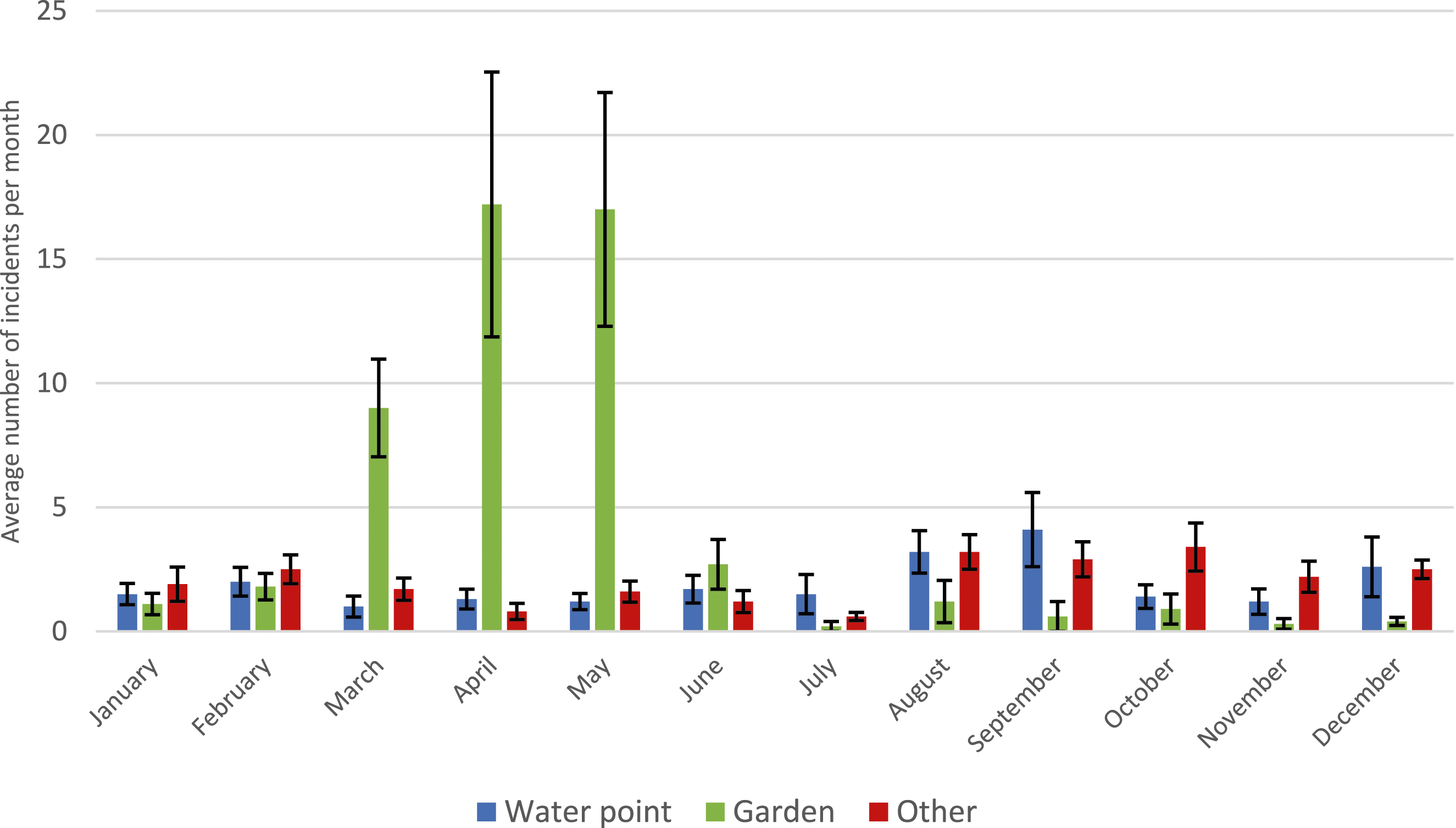
The 34 game guards were also asked whether they agreed or disagreed with the statement: ‘Elephants wait until vegetables are ripe before taking them from vegetable gardens’. 92% of the game guards agreed or strongly agreed. There is a common opinion with the game guards that elephants spend time in the mountains in the rainy season, where their preferred vegetation has fresh leaves, but come down to the valleys towards the end of the rainy season to take ripe vegetables. As would be expected, the results also indicate more incidents at water points in the dry season (i.e. June to December), when there is less standing water available elsewhere in the Highlands.
Mitigation Measures
Incidents at community water points are not frequent, but can have high impact through damage to pipes, taps, plastic water tanks that hold drinking water for people, protection walls, metal holding dams, and sometimes to the pumping equipment. At the water points, although elephants tend to visit more at night, they sometimes come close to people and their livestock during the day, and this can result in actions from stressed elephants that could cause damage.
Out of the 60 community water points (excluding hand pumps) visited during our research, 78% had protection walls around the core infrastructure (e.g. protecting the pumps, plastic tanks for drinking water and usually a tap for filling containers). An incident in 2020 at the water point at Otjamusirika cattle post in northern Orupupa might have been avoided if there had been a protection wall around the pump and water tank (Figure 9). The damage could not be immediately repaired, and for several months people and livestock were walking 5 km to Otjondeka village to obtain water. Damage by elephant at Otjamusirika, Orupupa Conservancy. The plastic water tank had been pushed off the raised platform above the pump protection cage and pushed about 100m away. Photo taken March 2021.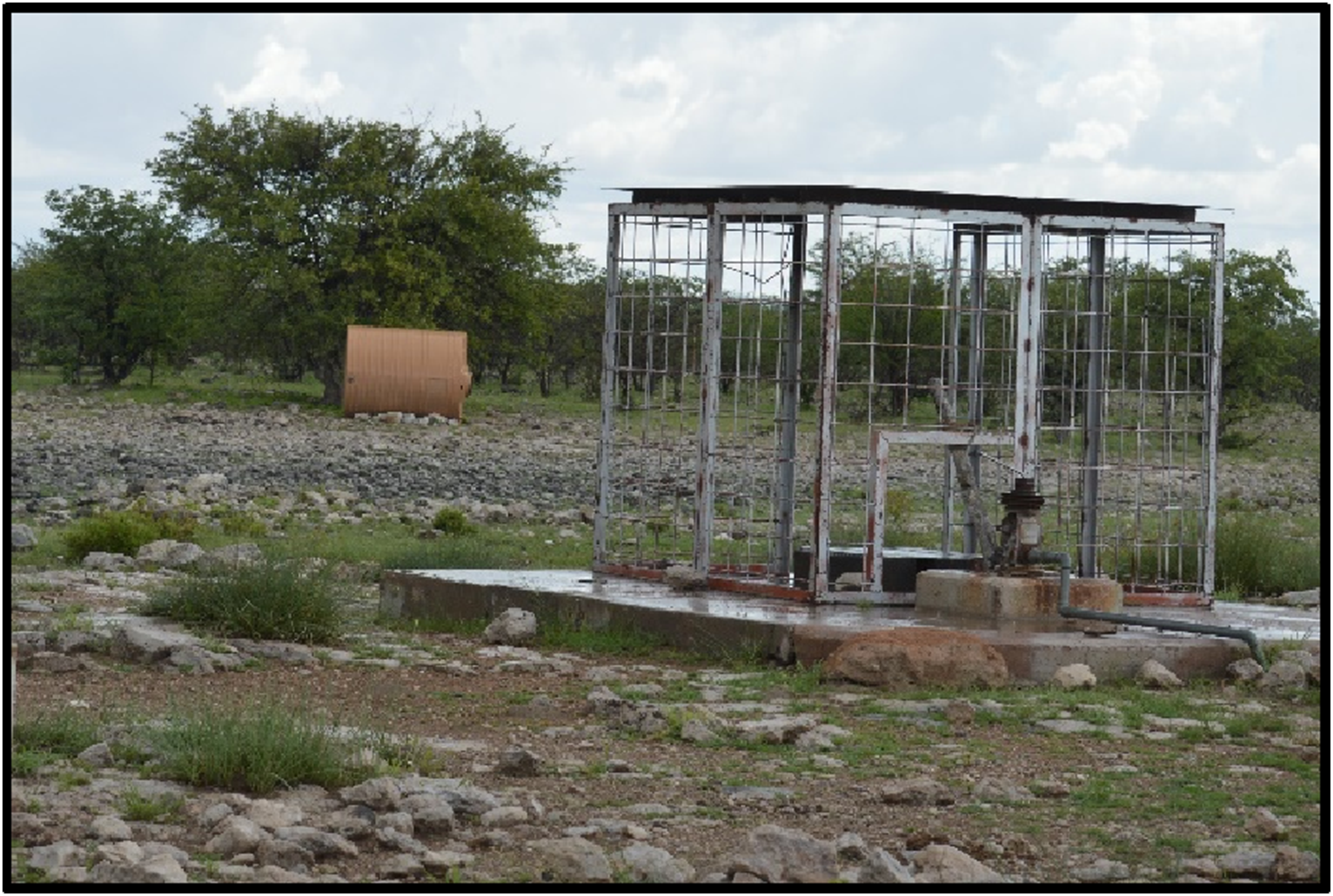
55% of the water points visited had a concrete holding dam, used to store water for livestock. Several of the others had a corrugated metal holding dam, which can be damaged by elephants (Figure 10). It is better practice to have a concrete holding dam, preferably at a height so that smaller elephants can drink. An elephant damaged this metal holding tank by leaning on top to drink water, Ekango, Orupupa Conservancy, photo taken December 2022.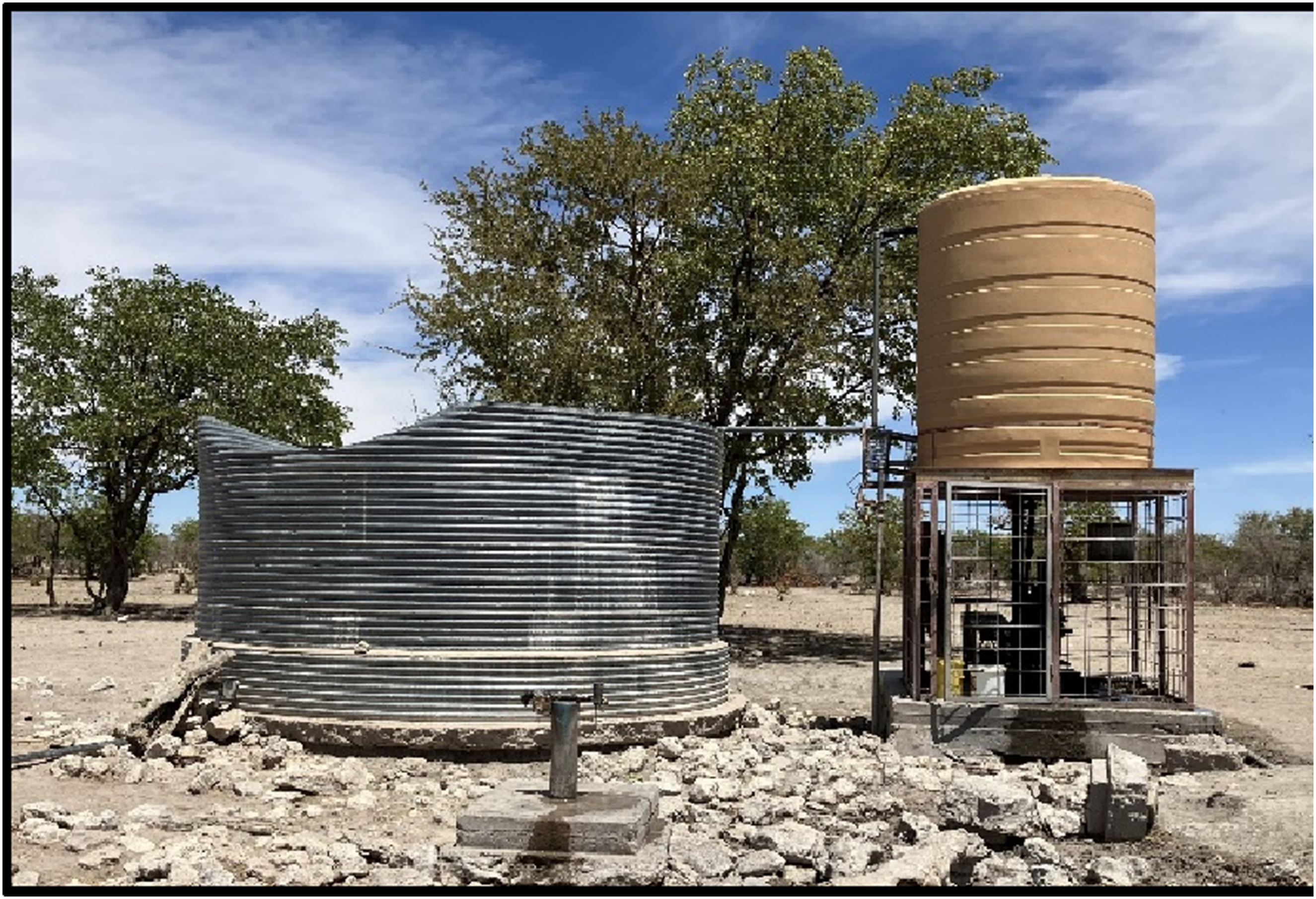
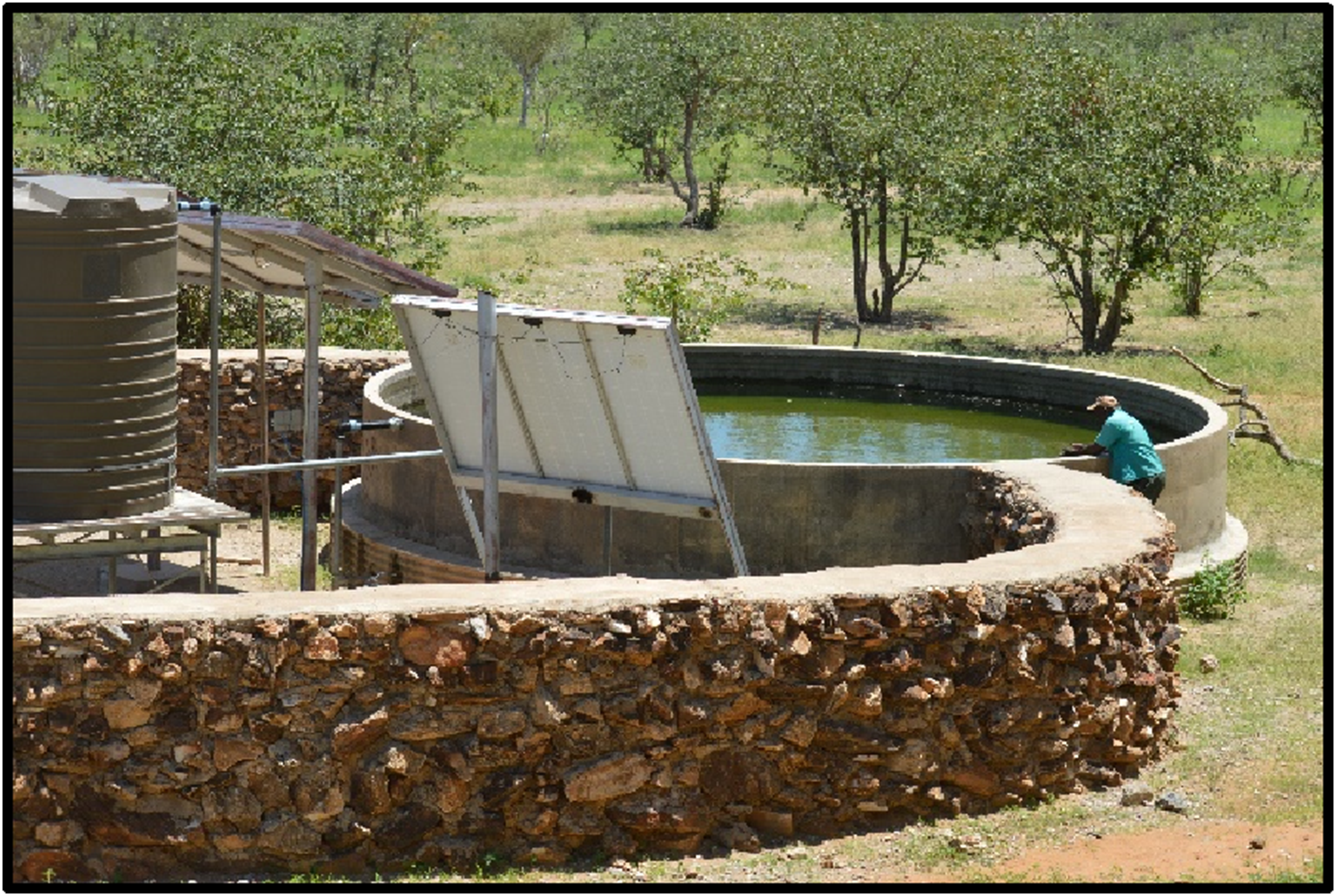
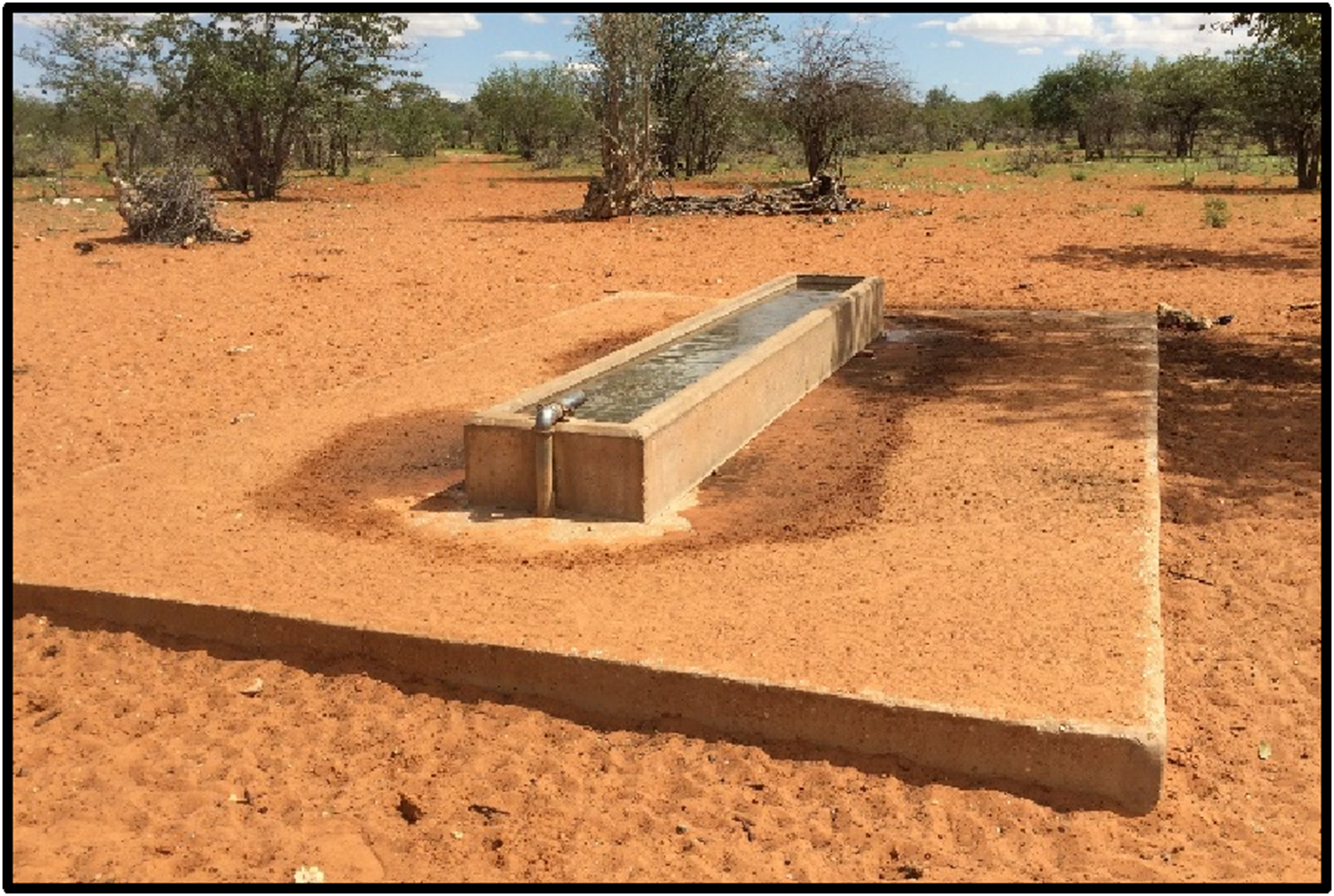
Elephants each drink 150 L/day on average (IEF, 2023; Schnegg & Kiaka, 2018). Even when elephants have not damaged any infrastructure, but have drunk the water that had been pumped into a holding dam for livestock, this often results in a cost for the village in terms of the diesel needed to pump the extra groundwater. Although such incidents are not recorded in Event Books, they do affect community attitudes towards elephant conservation. Villages then tend not to leave dams full, to avoid losing the costs of diesel, and this can then lead to damage when elephants find empty dams but can smell water in the pipes and in the drinking water tanks (Figure 11). The Government of Namibia has been funding protection infrastructure and upgrades of water points in the Northern Highlands, and, according to game guards, the replacement of diesel pumps with solar pumps has had a particularly positive impact. This helps to ensure that water is permanently available in the holding dams for people and elephants, and, although there is a capital cost for the solar pump and panels, operational costs are then minimal compared to diesel pumps. These measures help to address negative community attitudes to elephants because of the cost saving on diesel fuel. Out of the 60 water points visited, 40% had been converted to solar. Figure 12 provides an example of good practice at water points, with a concrete holding dam, protection around the drinking water tank, and a solar pump; and Figure 13 shows the practice of protecting pipes to troughs. Elephants returned to this water point 2 km from Ekoto in Orupupa Conservancy to find no water in the holding tank. They caused damage by pulling out the pipes. Photo taken February 2022. Water point near Enduu, southern Ehi-Rovipuka Conservancy, with solar pump and showing concrete dam for holding drinking water for livestock. Elephants drink from these concrete dams. March 2022. Pipe to the trough is installed underground and built into the concrete next to the trough, which is good practice to mitigate damage by elephants. Orumatupa, March 2021.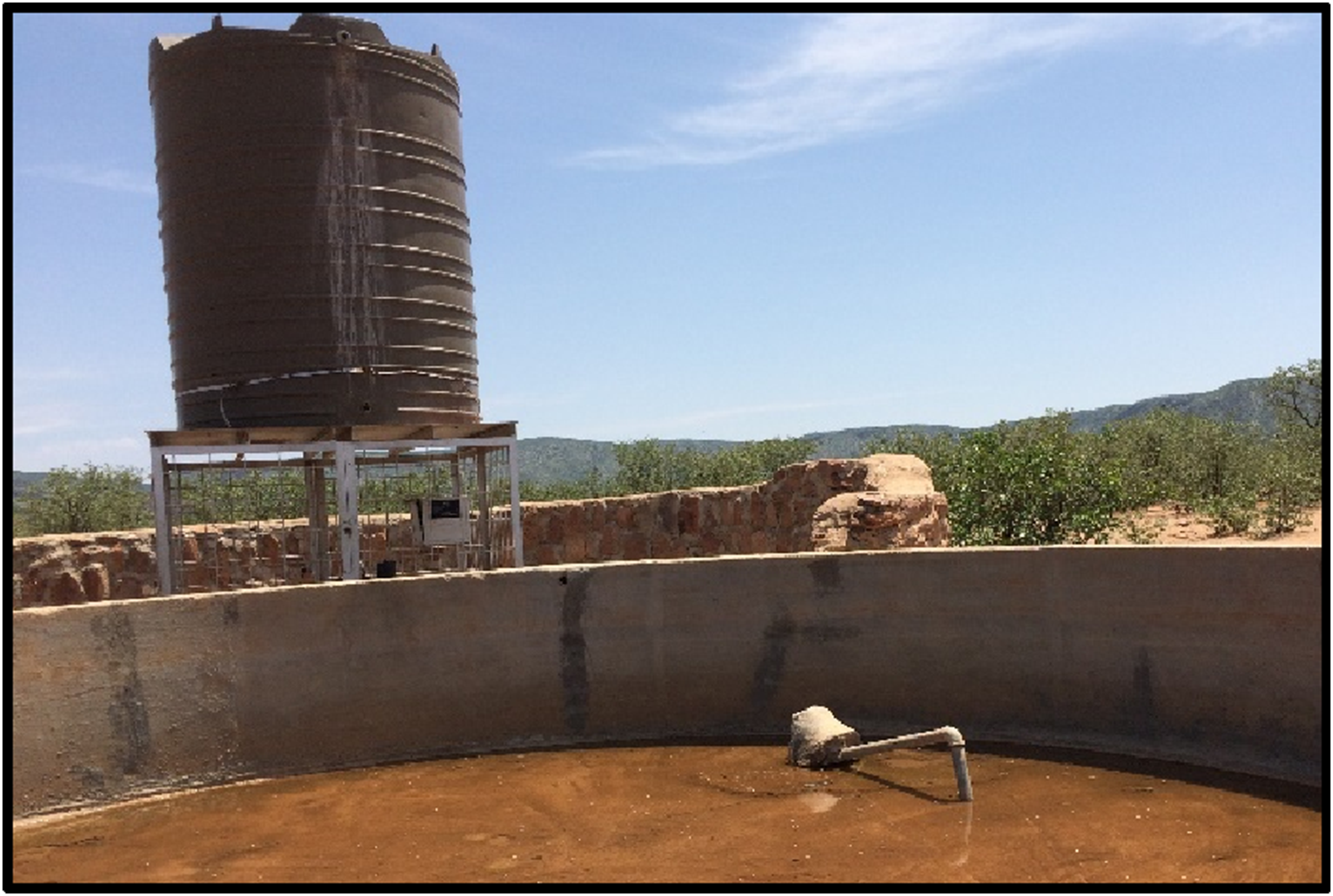
Additional good practice to improve safety and reduce conflict at water points is to build separate holding dams for elephants about 1 km from the water point (Shiweda et al., 2023). At seven of the water points visited (12%), a separate elephant dam had been constructed about 1 km from the main water point, but only at four of the seven had the separate dam been connected by water pipes. The solar pumps need to have sufficient power to pump the water to the separate dams, and the pipes must be buried underground. The separate dam encourages elephants to stay away from the community water points. This has helped at Okauua in Orupupa Conservancy (Figure 14). Separate water dam for elephants at Okauua in Orupupa Conservancy, 0.5 km from the borehole/ community water point. This has had some success in keeping elephants away from the community. Photo taken March 2021.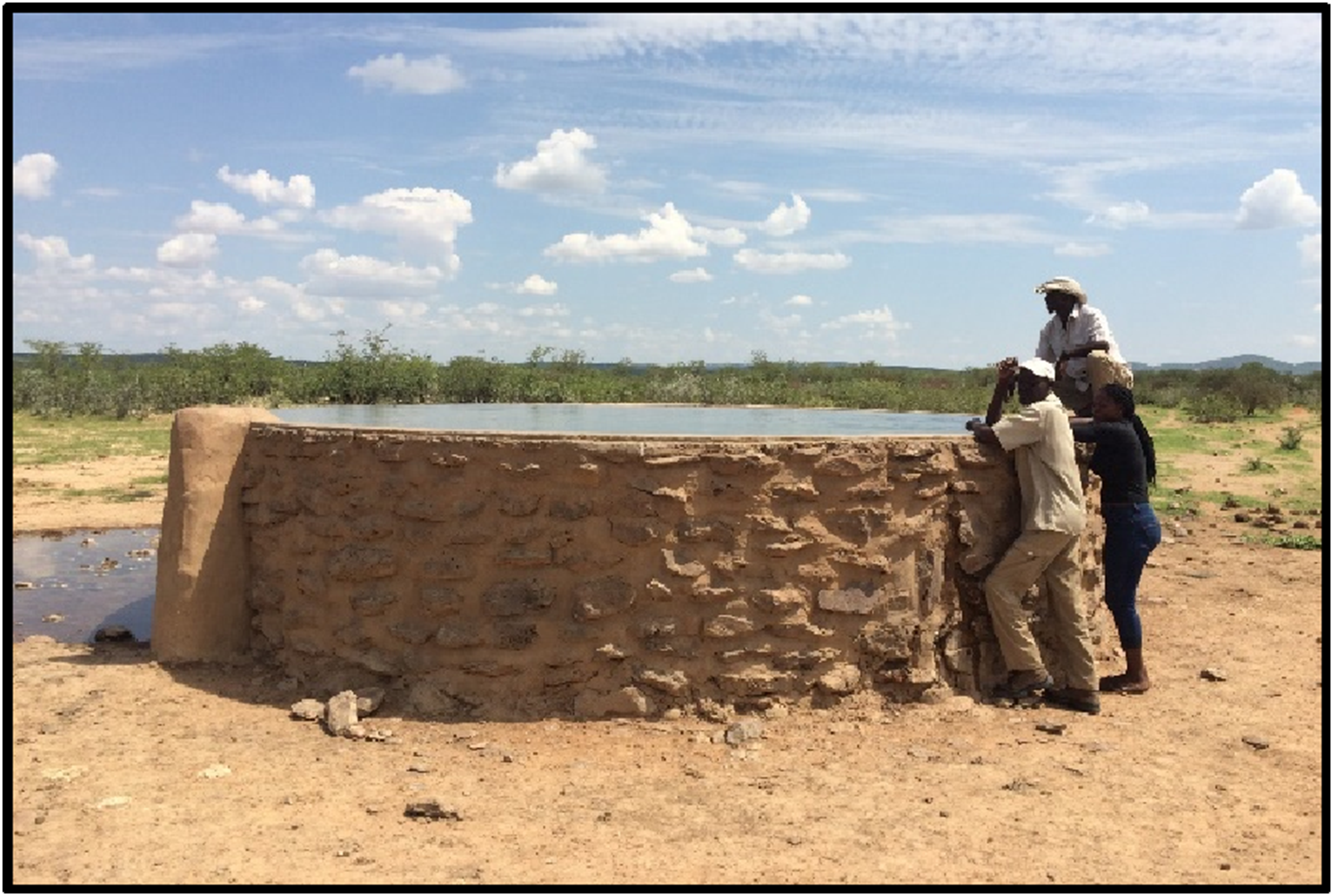
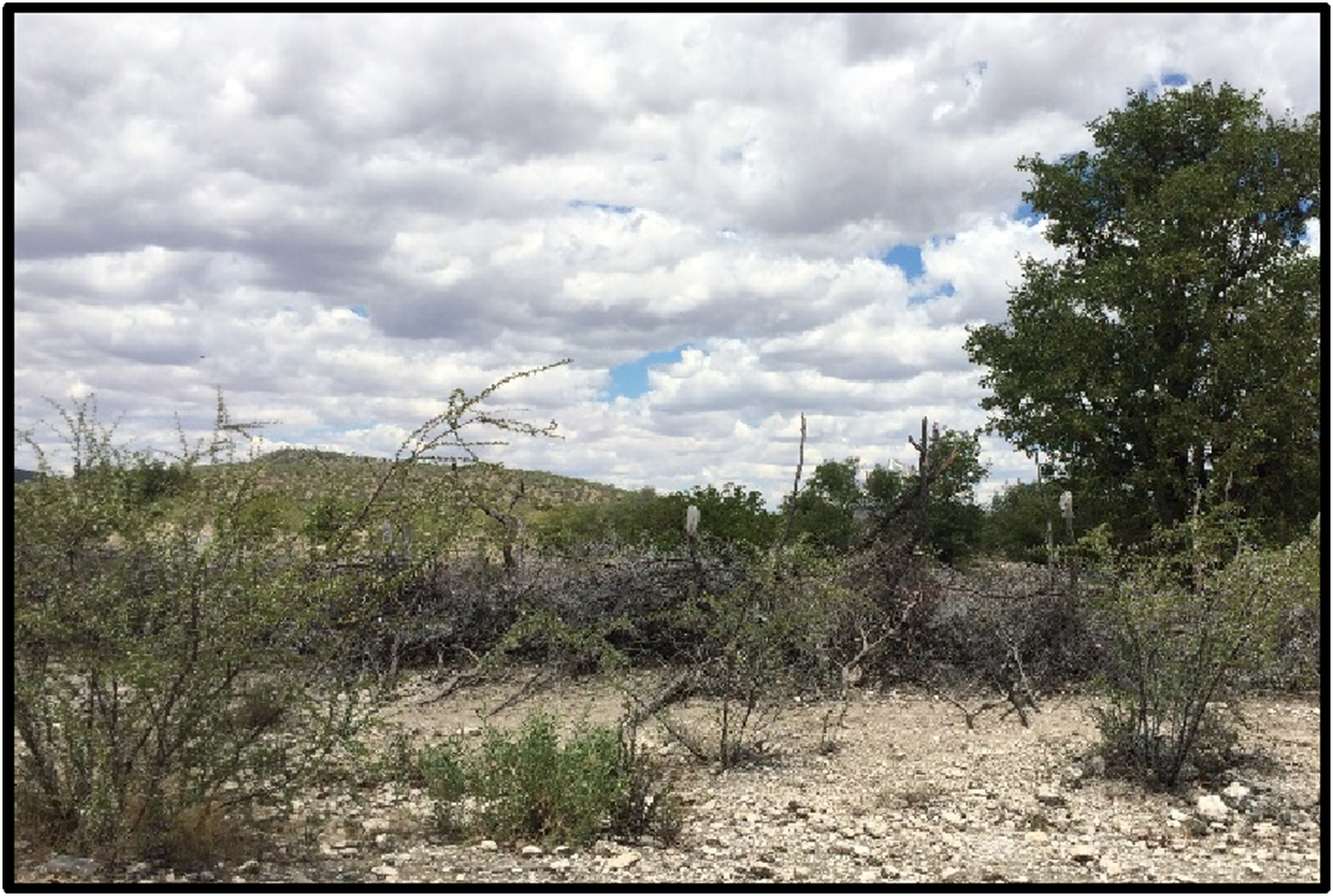
There have been minimal mitigation measures tested at vegetable gardens in the Northern Highlands (Figures 15 and 16), perhaps in part because incidents involving elephants at vegetable gardens had a relatively small impact before 2019 compared to other types of human–wildlife conflict. According to game guards, some people try to keep elephants away by burning a mix of chillies and cow dung, but generally people try to keep elephants away by making noises and use of spotlights if available. These approaches have safety risks for the people involved. Several game guards, particularly in Orupupa and Okangundumba conservancies, said that the increase in damage at vegetable gardens and loss of crops since 2020 is constraining the impacts of the community conservancy programme in that some local people are becoming negative about elephants and less motivated to their protection. Some compensation for damage to large vegetable gardens is provided by the Government of Namibia, but in practice compensation systems in remote areas are difficult to implement properly and most gardens in the Northern Highlands are smaller than the criteria for compensation. The applicability of mitigation measures depends on practical factors related to the local situation where the conflict is occurring. Based on the projects on mitigating human–elephant conflict at crops areas and vegetable gardens elsewhere in Africa (Hoare, 2012; King et al., 2013; Kioko et al., 2008), and knowledge of the local context in the Northern Highlands, it is likely that electric fences would be the most applicable measure for protecting vegetable gardens the Highlands, although there would be affordability problems in terms of capital costs. The many publications on mitigation measures include guidance handbooks (IUCN, 2001; World Bank, 2020; Save the Elephants, 2022). Vegetable garden at Ekoto, Orupupa Conservancy, February 2022. At some gardens, plastic bottles were tied to the fence as local people think that this might make elephants nervous to enter. Vegetable garden at Okozonguehe, Orupupa Conservancy, March 2021. Fences are often constructed of branches from thorn bushes, with the aim of keeping away other herbivores as well as elephants, although in practice elephants can easily get through these fences.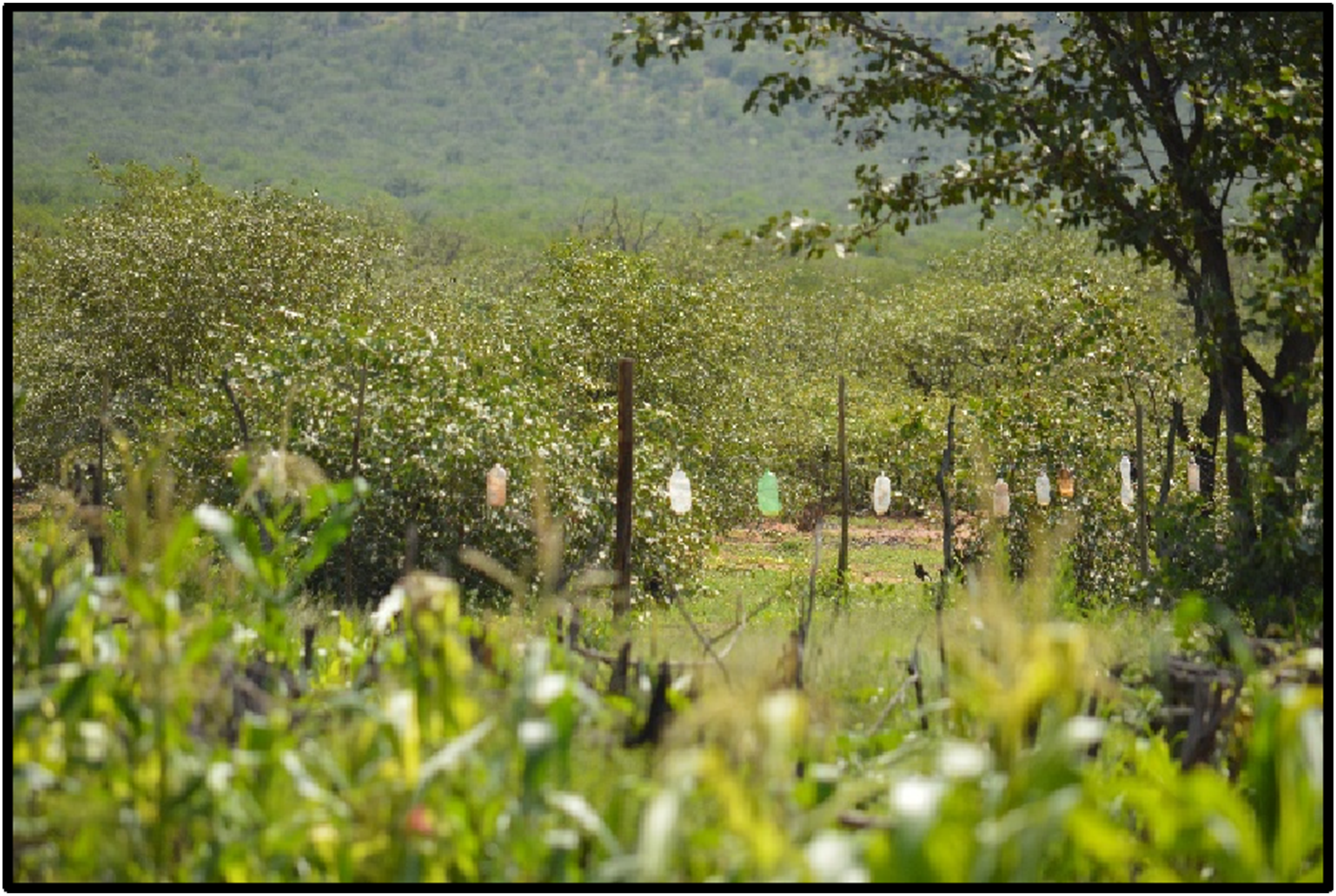
Conclusions
There has been a gap in research on human–elephant conflict in northwest Namibia, including the Northern Highlands. The game guards each cover an area of their conservancy and regularly interact with the local communities in that area. Their experience means that they are familiar with elephant behaviour in their conservancy and particularly in their local area. Their knowledge, combined with the Event Book records, is useful to indicate the trends and hotspots of human–elephant conflict in the conservancies. The combination during this research of collating local ecological knowledge, analysing Event Book data, and field observations in the study area, provides confidence in the results and conclusions.
Although there is some uncertainty in the Event Book data, because it is likely that not all incidents are recorded, the monitoring does provide a useful indication of trends. The Event Book data indicates that the annual number of incidents recorded in the Northern Highlands is up and down over time, but there was no clear increase since 2012 except in 2020 and 2021 when local people set up more vegetable gardens following the loss of livestock in the 2018–2019 drought. The larger number of vegetable gardens has resulted in more incidents involving elephants. According to game guards, most people in the local communities have now become more concerned about damage at vegetable gardens by elephants than damage at water points.
The community conservancy programme, which has been implemented across northwest Namibia, including the Northern Highlands, since the 1990s, has had some success in terms of fostering the commitment of local people to participate in wildlife conservation. The feedback from game guards is that the increase in damage at vegetable gardens and loss of crops since 2020 has the potential to erode the commitment of some local people to the conservation of elephants and this presents the risks to the sustainability of the conservancy programme.
Although there are more incidents at vegetable gardens than water points, in practice the incidents at water points can have more impact on the communities. This is because if pipes or tanks are damaged, it can take several weeks to repair the damage, partly because of the costs and partly because of the practicalities of bringing in spare parts to these remote villages. One of the main actions funded by the Namibian Government has been to convert diesel pumps at water points to solar pumps. This helps to ensure the holding dams are kept full of water for people and elephants. It reduces the probability of damage by elephants that become stressed when they find no water in the dams but they can smell water in the pipes and tanks.
The perception of game guards is that incidents at water points have been decreasing as a result of the programme of upgrades to water points to include protection walls, concrete dams (rather than metal), and solar pumps. Although the Event Book data does not show a decrease in incidents at water points for the six conservancies from 2012 to 2021, the local feedback and site visits to water points do give confidence that serious damage at water points is becoming less frequent. These protection measures are needed as soon as possible at other water points that have not yet been upgraded. This is particularly important considering the likely increase in competition for water resources between humans and elephants because of potential future climate change events (Schnegg & Kiaka, 2018; Zeidler et al., 2013). At several water points, a beneficial next step would be to install separate dams for elephants, further away from villages, to reduce the safety risks of interactions between humans and elephants at the main community water points. These upgrades to water points for reduction of human–elephant conflict in the northwest are included in the National Elephant Conservation and Management Plan (MEFT, 2021).
The results of the Event Book analysis have identified hotspots of human–elephant conflict, at which mitigation measures, such as protection of water points and electric fences at vegetable gardens, can be prioritised. One of the most interesting conclusions is that the analysis shows the majority of incidents have been located in the mountainous landscape in the six conservancies, with fewer incidents in the flatter landscapes such as north-eastern Orupupa and northern Ehi-Rovipuka, despite there being several villages, water points and vegetable gardens in those areas. The results indicate that elephants might be moving across Ehi-Rovipuka and north-eastern Orupupa from Etosha National Park, to spend time in the more mountainous landscapes.
The records in Event Books include dates of the incidents and show that the highest number of incidents per month are in April and May at the end of the rainy season when the vegetables in gardens are growing. Management measures, such as communication systems on movements of elephants, where there is phone network, or use of electric fences, could focus on implementation in these months.
It is evident from discussions with the game guards that the training and support from the Ministry of Environment, Forestry and Tourism and the wildlife NGOs has resulted in strong commitment to the monitoring system by the conservancies and their game guards, as had been the intention at an early stage in the monitoring system (Stuart-Hill et al., 2005). Their knowledge and commitment can provide value through their involvement on the ground in research, and in planning, piloting and monitoring solutions to human–elephant conflict. The applicability of measures greatly depends on the local situation and context, for which the game guards have good knowledge and experience. The game guards would benefit from more equipment, including walking boots, binoculars, spotlights and wildlife reference books. Further research is more important related to mitigation measures at vegetable gardens than at water points. At the water points, investment is needed to roll out proven solutions, whereas pilot projects at vegetable gardens are needed to test different measures under controlled and monitored circumstances. Such measures should include the higher cost solution of electric fences and a lower-cost option of burning chillies, potentially combining with organised communication systems between villages to warn of movements of known problem elephants.
Footnotes
Acknowledgements
We thank Kenneth Uiseb, Deputy Director for Wildlife Research and Monitoring at the Ministry of Environment, Forestry and Tourism in Namibia, and also thank all the Conservancy chairpersons and game guards for their support.
Declaration of Conflicting Interests
The author(s) declared no potential conflicts of interest with respect to the research, authorship, and/or publication of this article.
Funding
The author(s) received no financial support for the research, authorship, and/or publication of this article.
