




Abstract
This study utilises data from the International Social Survey Program (ISSP), Religion module of 2018, to provide a comparative analysis between attitudes towards civil rights (ATCR) and religious beliefs (RB) in thirty-three countries, examining the influence of religion and socio-demographic factors on both latent variables. The study measures ATCR and RB for each respondent using the Fuzzy Hybrid TOPSIS method. Subsequently, Fuzzy Clustering Analysis is applied to ACTR and RB to extend the Classical Apostle Model using a Fuzzy Clustering ECO-Extended Apostle model that categorises individuals into four groups: Religious Conservatives, Non-Religious Conservatives, Non-Religious Liberals, and Religious Liberals, based on their religious beliefs and support for civil rights. The results indicate that parents’ religion impacts both ATCR and RB. Those with atheist or agnostic parents tend to endorse civil rights more openly and are less religious. Additionally, religious event attendance is also a key determinant in shaping ATCR and RB. Furthermore, other sociodemographic factors such as age, gender, income, occupation, and political orientation also play crucial roles.
Keywords
Introduction
The current world is experiencing an unprecedented revolution in terms of civil rights struggles, spreading across every corner of the globe (Park & Banchefsky, 2019). This significant transformation is substantiated by many noteworthy advancements, such as marriage rights extended to LGBTQI+ individuals in numerous countries (Flores, 2019) and women have successfully obtained positions in parliaments and governments (Lu, 2020). Moreover, across a broad spectrum of political and social settings, encompassing both Western and non-Western contexts, there are vibrant dialogues and legislative initiatives actively addressing issues of discrimination and gender equality (López-Martínez et al., 2022).
However, despite significant progress made in many parts of the world, there are still many regions where homosexuality remains a punishable offence under the law, and women struggle to find their place in civil, political, and public society (Gengler et al., 2021; Lowe et al., 2021). Sometimes, even expressing dissent can lead to extreme punishments, such as the death penalty. An example is Iran, where women are fighting for their freedom, as exemplified by the tragic case of Mahsa Amini, whose death was related to a dispute over her choice of clothing (Amnesty International, 2023).
It is essential to note that these issues are sometimes associated with religious beliefs and legal systems based on religion. However, this is not solely an issue limited to Islamic societies, as even in some Western democratic systems, the role of women and issues related to gay marriage remain subjects of heated debates. For example, political parties with Christian and conservative positions, such as Vox in Spain or Fidesz in Hungary, are known for their traditionalist stances on social issues, particularly concerning family models (Lavizzari & Pirro, 2023; Marton, 2023). As affirmed by Lavizzari & Pirro (2023); Marton, (2023), these parties often oppose new and alternative family models, justifying their positions in the name of their interpretation of Christian faith and traditional culture, expressing their contrariety to laws promoting same-sex marriage and adoption by same-sex couples, arguing that this goes against the principles of the Christian family tradition, which they see as the union of a man and a woman.
On the other hand, it is crucial to recognize that religious authorities play a crucial role in energizing and supporting the fight for civil rights. They demonstrate that religion and faith can be a positive inspiration for promoting equality and human rights. A notable example is Don Andrea Gallo in Italy, a religious figure who embraced the cause of LGBTQ+ rights (Gatti, 2022). Additionally, Pope Francis has made significant statements regarding homosexuality, displaying an attitude of acceptance and inclusion. His famous quote, “Who am I to judge?” reinforces the message of love, tolerance, and understanding towards LGBTQ+ individuals as children of God. This open and inclusive approach has represented a significant change in tone and has positively influenced the dialogue within the Catholic Church on this issue (Giffin, 2021).
This study is based on the Religion of the International Social Survey Program (ISSP) module, conducted in 2018. Thirty-three countries were chosen to compare two latent variables: Attitudes Towards Civil Rights (ATCR) and Religious Beliefs (RB). The aim is to analyse how various religious and socio-demographic characteristics influence these variables. First, ATCR and RB are measured for each respondent through a Fuzzy Hybrid TOPSIS (The Technique for Order of Preference by Similarity to Ideal Solution) method. Thus, a Fuzzy Clustering Analysis (FCA) is used to group respondents based on common characteristics. Then, based on the clusters obtained, the Fuzzy Clustering ECO-Extended Apostle model extends the Classical Apostle Model to group individuals into four categories: Religious Conservatives, who have strong religious beliefs and limited support for civil rights such as those of LGBTQI+ individuals, abortion, and gender equity; Non-Religious Conservatives, characterised by low values of ATCR and RB; Non-Religious Liberals, denoting those who, despite not holding strong religious beliefs, exhibit strong sensitivity towards civil rights; and finally, Religious Liberals, represented by those with high values of ATCR and RB.
The paper is structured as follows: the next section summarizes the current literature on ATCR and RB. It then presents the data, followed by an illustration of the methodology used. Next, it presents and discusses the results, and finally, it concludes with some remarks.
Theoretical Framework
Attitudes Towards Religious Beliefs
Worldwide, religious beliefs constitute a fundamental pillar of human culture and spirituality (Saraglou, 2011). In his comprehensive overview of global religions, Morales’s (2002) work delves into the essence and distinctive characteristics of various belief systems that have endured throughout history and continue to thrive nowadays. One of the major religions Morales (2002) explored is Christianity, rooted in the life and teachings of Jesus recorded in the New Testament. Meanwhile, Islam revolves around the Quran as the central sacred text that guides the lives of Muslims. This faith serves as a spiritual compass for Christians and Muslims worldwide. Another ancient belief system examined by the author is Judaism, which emphasizes the covenant between God and the Jewish people. In this context, the Torah and the Talmud are important sacred texts and moral guides for Jews.
However, Morales (2002) does not limit his examination to monotheistic religions alone. He explains Hinduism as a multifaceted belief system that includes the veneration of various deities, including Brahma, Vishnu, and Shiva. Hinduism incorporates crucial principles such as reincarnation, karma, and pursuing spiritual liberation, called Moksha. Furthermore, he describes Buddhism as a relentless pursuit of truth and enlightenment. These religious beliefs go far beyond simple rituals of worship and prayer. They profoundly influence everyday life, shaping individuals’ moral compass, personal values, and societal dynamics, as Smith (2003) stated.
Attitudes toward these religious beliefs represent a crucial aspect of society and profoundly influence individuals’ cultural, social, and political dynamics (Yusuf et al., 2019). This topic can be explored in various contexts, considering different perspectives and facets, such as religious tolerance, secularization, and political discourse (Aguas, 2019; Kanol, 2021; Neusner & Chilton, 2008). Religious tolerance, for example, is the acceptance of diverse religious customs and traditions (Tojiboeva, 2020), characterized by positive attitudes and actions toward other religious faiths (Neusner & Chilton, 2008).
Most world religions teach treating others as one would like to be treated, as illustrated by Jesus’ Parable of the Good Samaritan (Luke 10:25–37) (Preston et al., 2010). Studies show that religiosity correlates with pro-social attitudes (Oviedo, 2016) and cooperative behaviours (Yilmaz & Isler, 2019). However, religion may be paradoxical, promoting love, peace, and hostility (Coward, 1986). Believers may exhibit hostility towards out-groups people (Batson et al., 1993), such as Christians showing greater hostility towards non-believers compared to the opposite (Kanol, 2021).
In this context, secularization represents a socially and culturally relevant phenomenon that has significantly influenced attitudes towards religious beliefs worldwide (Aguas, 2019). This process implies a gradual decrease in the importance of religion in people’s lives, with a growing tendency to separate the religious sphere from the secular one (Casanova, 2009). As in Inglehart and Welzel (2010), this often reflects societal values and priorities changes. People may become more oriented towards scientific progress, individualism, and material well-being, relegating religion to a marginal role in their lives. This fact can lead to indifference or apathy towards religious beliefs (Breen & Reynolds, 2011; McPhetres et al., 2021).
On the other hand, there is also an increase in religious pluralism, with the coexistence of various faiths and beliefs (Asadu et al., 2020), making people more open to religious differences, especially among the young, but at the same time, less inclined to strictly follow a religion (Yandell, 2016). However, while secularization does not necessarily imply hostility towards religion (Lambert, 1999), it can lead some people to develop critical or negative opinions towards religious institutions (Mahmood, 2009).
Attitudes Towards Civil Rights
LGBTQI+ Rights
In an era where secularism advocates for civil rights and equality (Stonebanks, 2019), there are still many situations in which homosexuality or gender discrimination are far from overcome (Edenborg, 2023; Hoominfar & Zanganeh, 2021; Hylton et al., 2017; Tanne, 2023). Flores (2019) examines acceptance levels towards LGBTQI+ individuals in 174 countries in this context. He finds that the overall trend indicates an increase in acceptance of LGBTQI+ individuals, but this result is primarily evident in the West, as Asian countries do not show particular sensitivity to the issue, and even in Russia or Iran, the trend is strongly negative. Therefore, opinions towards LGBTQI+ individuals still vary significantly across our globe. Nonetheless, scientific interest tends to grow over the years, especially among academics in the United States, the United Kingdom, and Canada (Yeo et al., 2023).
As reported by Lowe et al. (2021), in some countries, such as India, Iran, Malaysia, and Pakistan, same-sex relationships are a criminal offence, even punishable by life imprisonment, and numerous “honour” anti-gay abuses against lesbians, gays, bisexuals, and transgender individuals are reported. However, this is not just a geographical context where East societies are more prone to negative attitudes towards LGBTQI+ individuals. For instance, Thepsourinthone et al. (2020) claim that Australian men are likelier to express adverse reactions towards gays, stemming from a sense of threatened masculinity. On the other hand, Wilson (2020) examines attitudes towards LGBT people and their rights in Europe. The author explores public opinions and perceptions of lesbian, gay, bisexual, and transgender individuals in various European countries. The article analyses how public opinions and state policies can vary significantly from one country to another, reflecting a diversity of cultural and political attitudes. Therefore, as Dotti Sani and Quaranta (2022) and Takács and Szalma (2019) indicate, Nordic countries show a more positive trend towards LGBTQI+ rights, while Eastern Europe diverges significantly from this progression. Paradigmatic examples are the cases of Russia and Hungary, where laws against “propaganda” of fundamental human rights of LGBTQI+ people are implemented (Loriga, 2020; Nuñez-Mietz, 2019).
Individual socioeconomic context and other factors might also be crucial in explaining the attitudes towards LGBTQI+. In this regard, Jäckle and Wenzelburger, (2015) conducted a comprehensive analysis across 79 countries to examine the effects of demographic characteristics and religiosity on attitudes towards homosexuality. Among countries, the results show that individual and social demographic characteristics are influential, with men, older individuals, low-education, and married people being more homophobic compared to women, younger individuals, those with higher education, and unmarried individuals, respectively. Gender is one of the most discussed individual characteristics influencing attitudes, with a gender gap observed in most countries. Men tend to have not only negative feelings towards gay, lesbian, bisexual, and transgender individuals in general but also more negative attitudes towards gay men than lesbians (Besen & Zicklin, 2007; Burke et al., 2017; Dodge et al., 2016; Gerhardstein & Anderson; 2010; Herek, 2000; Hinrichs & Rosenberg, 2002; Meaney & Rye, 2010).
Besides gender, several studies have found that education plays a role in shaping attitudes. People with higher levels of education are more likely to support gay and lesbian individuals, homosexuality, and same-sex marriage (Schwadel & Garneau 2017). University students are more likely to be exposed to diverse ideas and come into contact with gay and lesbian individuals, leading to more tolerant views through direct contact (Adamczyk & Liao, 2019).
Another factor that could influence attitudes towards the LGBTQI+ community is religious affiliation (Prairie et al., 2019). For example, monotheistic religions like Christianity, Islam, and Judaism often teach a traditional view that considers homosexuality sinful (Whitley, 2009). This issue is reflected in the opinions of religious individuals, as evidenced by studies indicating that Muslims tend to have more homophobic opinions than Christians in Germany and Türkiye (Sakalli, 2016). Furthermore, religious people, in general, tend to be more homophobic than those who do not follow a religion, with wildly diverging results among religions -negative attitudes among Muslims and very positive attitudes among Buddhists (Jäckle & Wenzelburger, 2015; Çetiner & Van Assche, 2021).
Gender Equity
Civil Rights are highly discussed in the political agenda in numerous parliaments worldwide. This subject is characterised by a political duality ranging from the relentless pursuit of more significant gender equity and civil rights to the staunch defence of traditional conceptions of gender roles to preserve cultural identities (Pineda, 2021). On one hand, movements and political efforts aim to obtain more rights and promote gender equality in all aspects of society (Park & Banchefsky, 2019). These efforts include the fight for women’s rights, the promotion of equal pay, the protection of LGBTQI+ rights, and the defence of individual freedoms (Cullen, 2021). On the other hand, a current of thought wishes to preserve traditional conceptions of men’s and women’s roles in society (Ali et al., 2011). This political view often seeks to protect and maintain the status quo based on entrenched notions of masculinity and femininity and safeguarding traditional cultural identities (Elomäki et al., 2023).
In some cultures, for example, any “violation” of the standard gender roles of a man or woman is seen as a threat or harm to family honour. Some scholars report a high level of approval for “honour”-based violence, honour killings, against women who have violated “natural” codes, such as behaving in a manner considered sexualised (Eisner & Ghuneim, 2013; Gengler et al., 2021).
The scholarly appeal of this topic is generating increasing interest in various thematic areas. In this regard, Ali et al. (2011) explore the perspectives of Pakistani men and women regarding marital role expectations and how fulfilling these marital role expectations influences marital conflict. They argue that the man is still anchored to the theme of being a “provider and protector,” while that of a “house administrator” remains the fundamental role of women. Meanwhile, Kowalski and Scheitle (2020) examine general and specific gender differences among sexual identity groups. They demonstrate that when it comes to equality of domestic and family roles, LGBTQI+ individuals are more likely than heterosexuals to reject traditional gender roles. However, the opinion does not appear to differ significantly between heterosexual and gay men when expressing opinions on gender roles in the public sphere, particularly regarding the suitability of women holding political office (Kowalski & Scheitle 2020).
Nevertheless, not only sexual identity can be considered key to greater or lesser openness to women’s rights and gender equity. Socioeconomic contexts can significantly influence attitudes towards gender equity (Breda et al., 2020). These factors shape people’s perspectives and beliefs about gender roles, equality, and women’s rights in society. In this context, Rivera-Garrido (2022) asserts that education plays a crucial role in shaping attitudes towards gender equity, and individuals with higher levels of education tend to be more supportive of gender equality. Similarly, economic factors such as income and job opportunities can influence attitudes towards gender equity. People with access to better job opportunities and economic stability may be more inclined to support gender equality (Acevedo & Shah, 2015).
Also, the role of cultural and religious factors in influencing gender attitudes is of fundamental importance because these aspects can profoundly shape how a society conceives and practices gender equity (Shnabel, 2016). In some cultures and religions, traditional gender roles are deeply rooted in history and core beliefs (Winkel, 2019). These cultures and religions may promote the idea that there are well-defined roles for men and women based on models established over centuries (Brooks & Bolzendahl, 2004). In such contexts, the more religious people are, the more they are anchored to traditional gender values, often implying that men are seen as the head of the family and women as responsible for domestic care and family (Eliason et al., 2017).
Data
We use data from the Religion Module of the International Social Survey Programme (ISSP) in 2018, a continuous cross-national collaboration programme that runs annual surveys on topics important for the social sciences, such as Religion. The dataset contains a total of 46,267 observations from 33 different countries, including Austria, Bulgaria, Chile, Taiwan, Croatia, Czech Republic, Denmark, Finland, France, Georgia, Germany, Hungary, Iceland, Israel, Italy, Japan, South Korea, Lithuania, New Zealand, Norway, Philippines, Russia, Slovak Republic, Slovenia, South Africa, Spain, Suriname, Sweden, Switzerland, Thailand, Türkiye, the United Kingdom, and the United States.
The ISSP questions extracted for this study covered a range of topics, including respondents’ parents' religions, personal attitudes towards main religions, perceived threats of main religions, and other sociodemographic characteristics, such as gender, age, education, main status, religion of belonging at present, attending at religious events, party voted at last elections, self-placement on the top-bottom of society, legal partnership status, and place of living. South Africa is the most prominently represented country, accounting for 5.9% of the total observations, followed by Switzerland at 5.1%, while Austria, Bulgaria, and Chile constitute approximately only 2.2% of the dataset. A substantial proportion of respondents have mothers that profess Catholicism (33.9%), followed closely by Protestants (23.8%). Additionally, 10.8% of respondents claim to have a mother who do not profess any religion. Data are similar for the father’s religion representation. The dataset portrays a balanced gender distribution, with 46% of respondents being male and 54% female. The age distribution is diverse, with the largest cohort falling within the 46–55 age range (17.6%). Regarding education, around 26% of respondents have completed upper secondary education. Concerning main status, the majority (54.8%) are engaged in paid work, while 21.4% are retired. More than 25% do not profess any religion, and most attend to religious events not at all (33.9%) or less frequently than once a year (14.1%). A small percentage (3.7%) attend services several times a week or more often. Respondents generally express positive or neutral attitudes toward various religious groups, including Christians, Muslims, Hindus, Buddhists, Jews, and atheists/non-believers. “Somewhat positive” attitudes are the most common, although some variations exist. Many respondents lean towards the centre-left (30%) and centre/liberal (18.9%) positions on the political spectrum. Small percentages are found for far-left (6.5%) or far-right (5.8%) political views. More than 50% are married and residing in big cities (30.4%) or the suburbs/outskirts of big cities (13.8%). For additional descriptive statistics, please refer to Table A1 in the Appendix.
We have also extracted three distinct items to measure the individuals’ attitudes towards civil rights (ATCR), complemented by a comprehensive set of ten items specifically designed to gauge their religious beliefs (RB). (See Table S2.) Each item is associated with a specific semantic scale, indicating the range or intensity of responses that participants can provide to help interpret the responses on each item. In the context of the Attitudes Towards Civil Rights (ATCR) latent variable, it gauges individuals' perspectives using two distinct response formats. Specifically, it examines their opinions on same-sex relationships and abortion using a scale ranging from “always wrong” to “not at all wrong.” Additionally, it assesses their views on gender roles using a different scale that spans from “strongly agree” to “strongly disagree.”
The latent variable of religious beliefs measures individuals’ religious beliefs using three distinct scales. The first one to gauge the believing in God, from “I don’t believe in God” to “I know God really exists and I have no doubts about it”, to measure the beliefs about God in the past and now from “I don’t believe in God now and I never have” to “I believe in God now and I always have”. Thus, other religious beliefs are measured, such as the afterlife, heaven, miracles, and supernatural powers of deceased ancestors, through a scale from “Yes, Definitely” to “No, Definitely Not”, and, finally, it measures the divine interaction of life’s purpose by using a scale from “Strongly Agree” to “Strongly Disagree”. The Religious Beliefs items (3)–(10) have been reverse coded to proxy that the higher scores express a higher religious belief.
The Cronbach alphas were calculated to evaluate the internal consistency of our Latent Variables (LVs), ATCR, and RB. The internal consistency for RB is notably high, with a value of 0.87, indicating a robust reliability. However, for ATCR, the internal consistency is slightly lower at 0.56. This result can be attributed to the limited number of items included in the measurement of this LV (Tavakol & Dennick, 2011).
Methods. The Fuzzy-Hybrid TOPSIS and the Fuzzy Clustering ECO-Extended Apostle Model
The Fuzzy-Hybrid TOPSIS
The responses provided by questionnaires often result in ambiguity and fail to provide a clear and concise representation of the interviewee’s opinion, as the answers are subjective and vague (de Sáa et al., 2014). In this context, the Fuzzy Logic approach is particularly effective in dealing with uncertain and ambiguous information, such as that collected from opinion surveys (Indelicato & Martín, 2023). It provides an adequate tool to handle vague information in a way that can be evaluated and analysed more accurately (Chakraverty et al., 2019).
This study applies the fuzzy approach to managing vague and uncertain information collected through the ISSP questionnaire (2018; Religion module). First, Attitudes Towards Civil Rights (ATCR) and Religious Beliefs (RB) indicators are calculated using the Fuzzy-Hybrid TOPSIS approach. Subsequently, through the Fuzzy-Clustering Analysis, an Apostle model is developed to group respondents based on their questionnaire responses.
This section summarises all phases of the adopted methodology. Figure 1 provides a graphical representation of the sequential steps. Note that the first three steps have been previously described in the Data section. The fuzzy clustering ECO-Extended apostle model.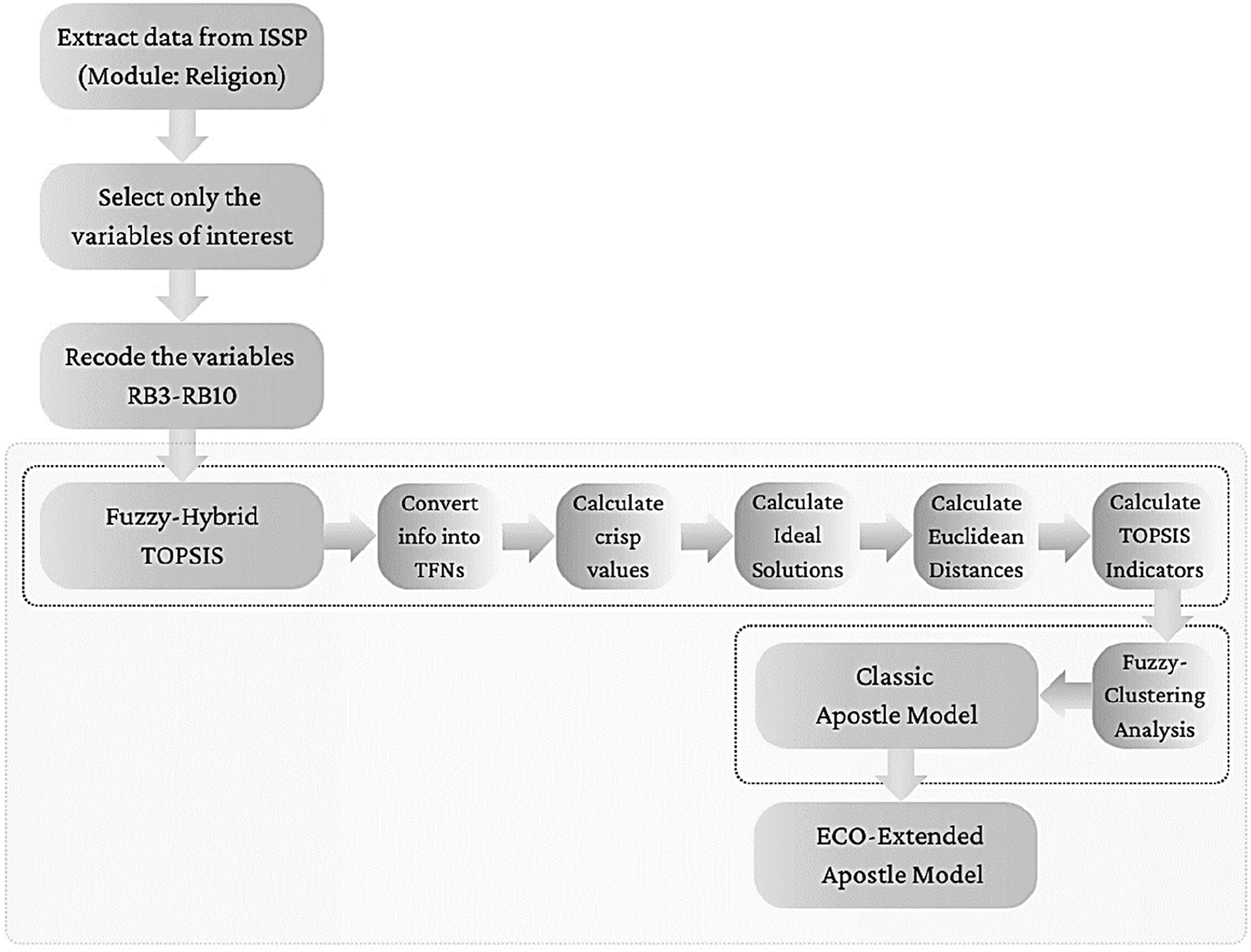
Fuzzy Logic is a versatile approach for adapting nuanced information from multi-dimensional semantic scales and for making advancements in various applications and disciplines. In Multiple Criteria Decision Making (MCDM) techniques, the development of mathematical models addresses a wide range of empirical applications in various fields (Kumar, 2017). For example, it is applied in education (Di Nardo & Simone, 2019) or social sciences (Indelicato & Martín, 2023).
Triangular Fuzzy Numbers.
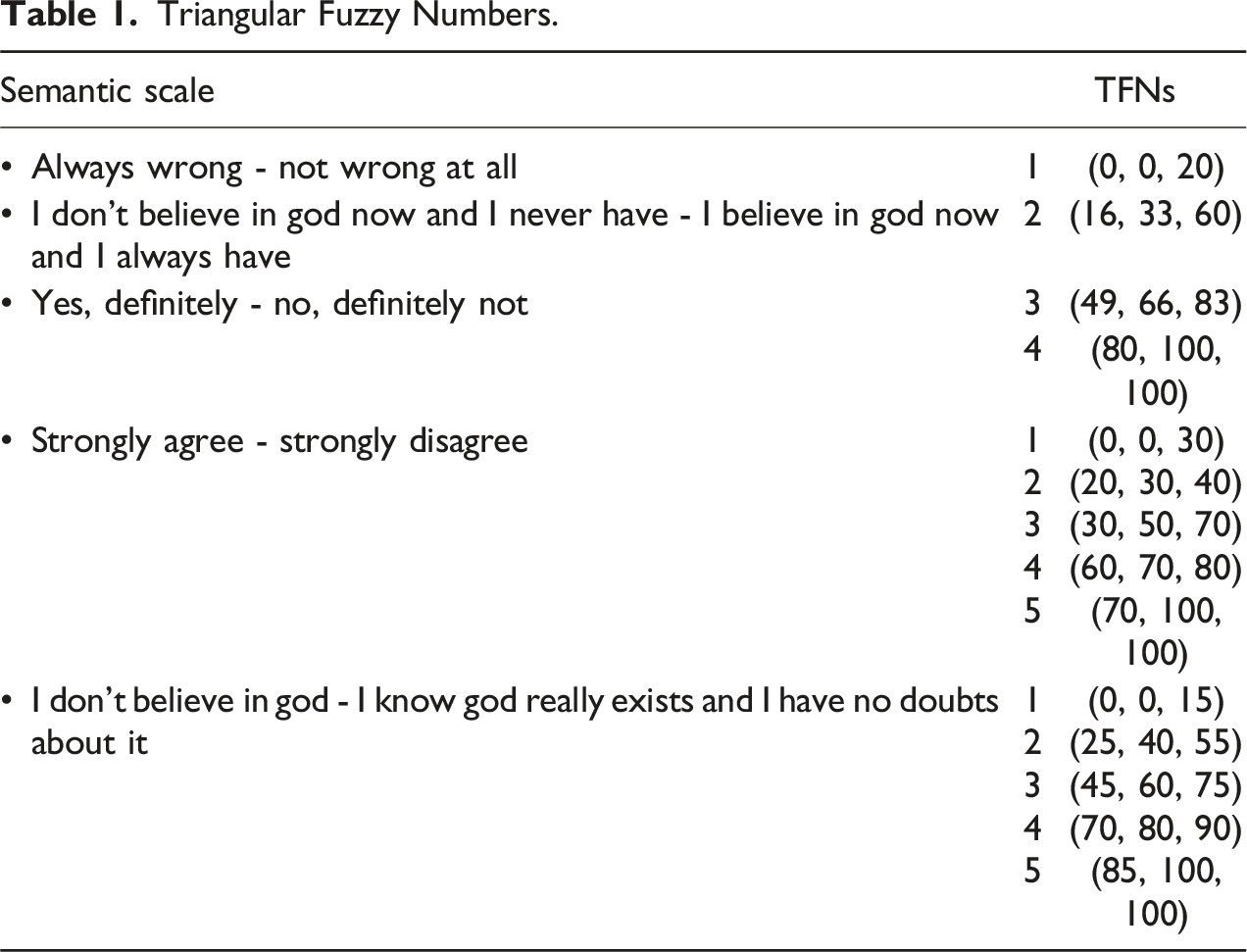
This division was chosen for clarity without sacrificing generality. In each category, the provided information is vague, so each consecutive semantic ordinal point is represented by a triplet 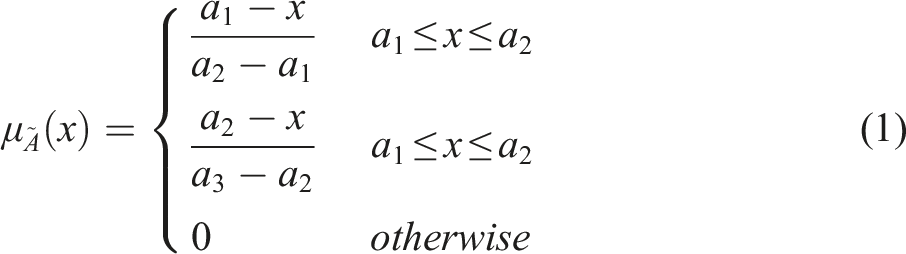
This process generates a matrix of Triangular Fuzzy Numbers (TFNs) known as the TFN Information Matrix. However, analysing this matrix in its original form can be complex. Therefore, a defuzzification process is applied to synthesize the information, resulting in an information matrix with crisp values (
A widely used method for this defuzzification involves calculating the weighted average of the TFN triplet (Indelicato & Martín, 2023). According to this method, the crisp value 
Once the defuzzified crisp information matrix (
To calculate the PIS and NIS, the following formulas are used:

After obtaining the PIS and NIS, Euclidean distances are calculated between each observation and the ideal solutions. The Euclidean distance between an observation and the PIS, (

The TOPSIS ATCR and RB indexes are then calculated as follows:
The TOPSIS indicator is a relative index, with higher values indicating, respectively, positive attitudes towards civil rights and strong religious beliefs. This classification enables a comparative analysis of groups.
ECO-Extended Apostle Model
The “Apostle Model” was developed by the Harvard Business School in the mid-1990s as a tool to improve the performance of organizations that offer products to customers (Jones & Sasser, 1995; Schaefer, 2013). Initially, it was conceived to compare customer loyalty with customer satisfaction (Figure 2(a)). The model splits customers into four categories: “Apostles,” who are highly satisfied and loyal and can influence other customers; “Hostages,” who are dissatisfied but loyal because they have no alternatives; “Mercenaries,” who choose cheaper products even if they are satisfied; and “Defectors,” who are neither satisfied nor loyal and are ready to switch to different products (Hadi et al., 2019; Jones & Sasser, 1995). The Apostle Model is based on two fundamental dimensions: loyalty and satisfaction. In the context of this study, we have extended the concept of the Apostle Model (satisfaction vs. loyalty) to our two latent variables, ATCTR and RB. In this context, the resulting quadrants are identified as follows (Figure 2(b)): • “Religious Liberals” represent individuals with strong RB and high ATCR, • “Non-Religious Liberals” are individuals with low RB but high ATCR, • “Non-Religious Conservatives” are individuals with low RB and low ATCR, • “Religious Conservatives” are individuals with strong RB but low ATCR. Apostle model.
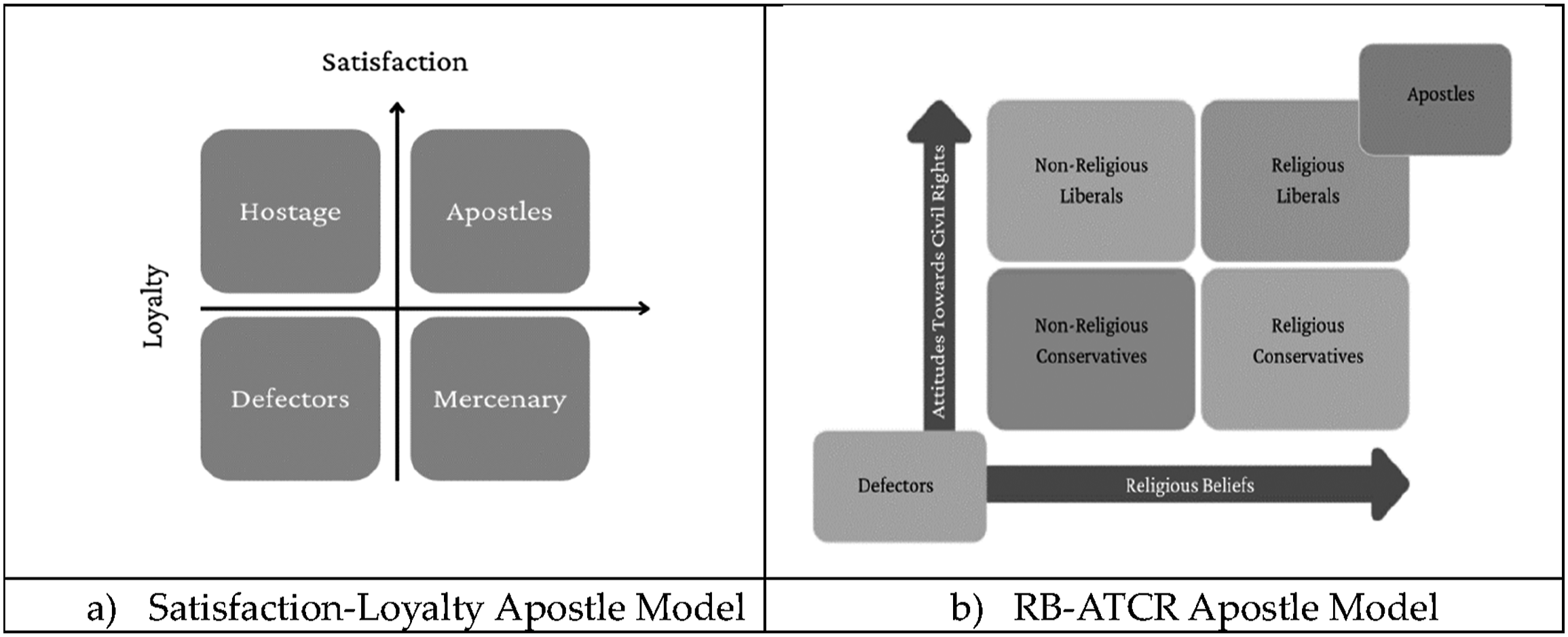
The adaptation of the Apostle Model allows us to categorize individuals more specifically based on their positions on these two important latent variables.
The analysis of the profiles for each individual is based on the Fuzzy Cluster Analysis (FCA). One of the main advantages of the FCA is its flexibility in not requiring the division of the sample into different clusters (Indelicato & Martín, 2022). Therefore, we obtain a membership function for each respondent that measures the degree of similarity with specific representative individuals (Kruse et al., 2007). Here, three clusters are considered for both indicators, ATCR and RB: Most, concerning the highest values; least, indicating the lowest values; and intermediate, which provides medium values.
The method is an extension of the Bagged cluster algorithm introduced by Leisch (1999) or also referred to by D'Urso et al. (2013, 2015, 2016) as the fuzzy C-means algorithm for fuzzy data and can be formulated as follows:


Following Martín et al. (2020), the term
In line with the research conducted by Indelicato and Martín (2022), we extend the Apostle Model by introducing a parameter α. An increase in the alpha parameter leads to a contraction of the area occupied by pure categories, consequently reducing the size of the ‘pure' quadrants. This adaptation transforms the original model, divided into four quadrants, into an extended version comprising sixteen quadrants. This approach allows us to more precisely identify and classify the so-called “Pure” cases, which exhibit markedly high or low values for each indicator within each quadrant (see Figure 3). The fuzzy clustering ECO-Extended apostle model.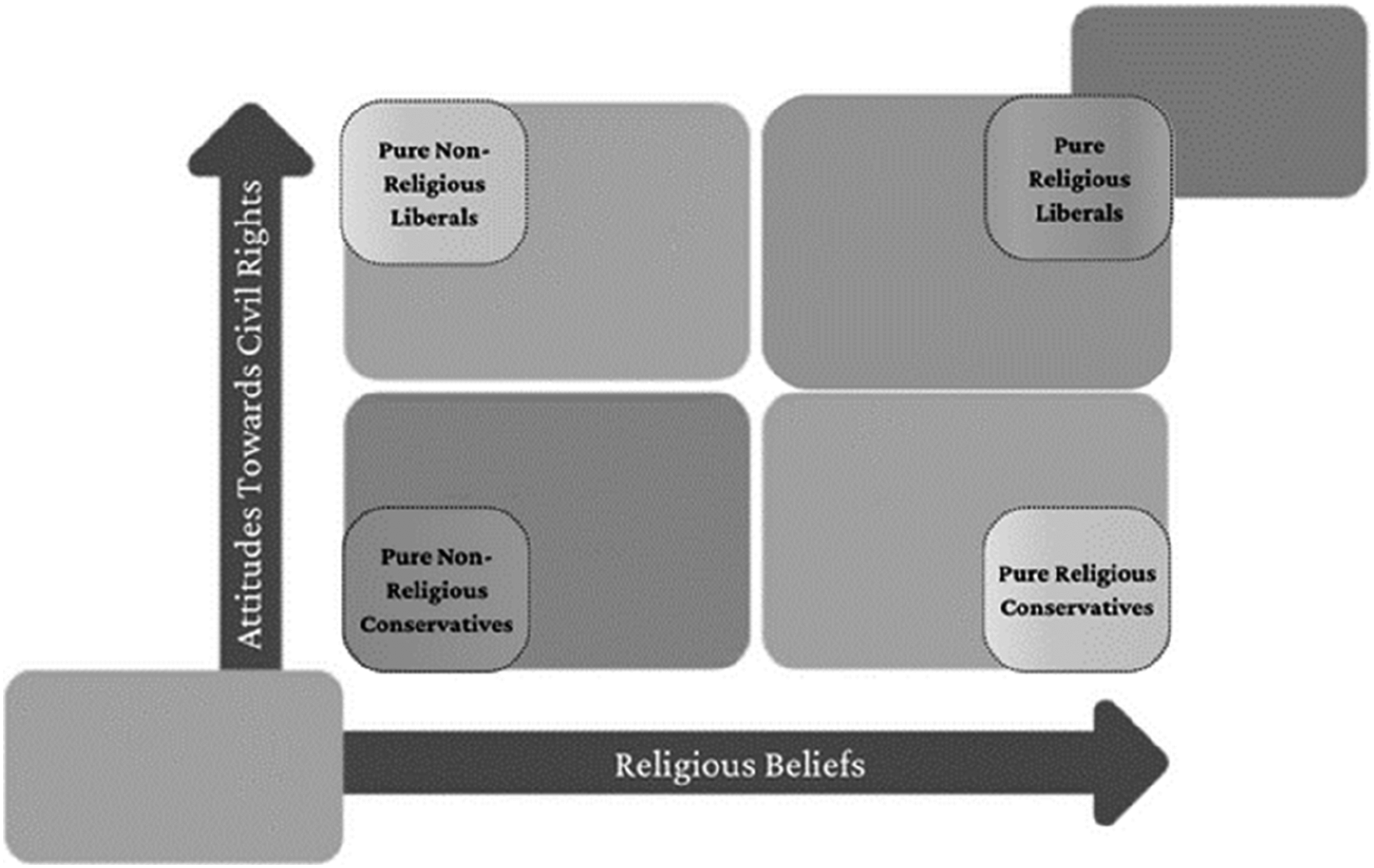
Let us assume that 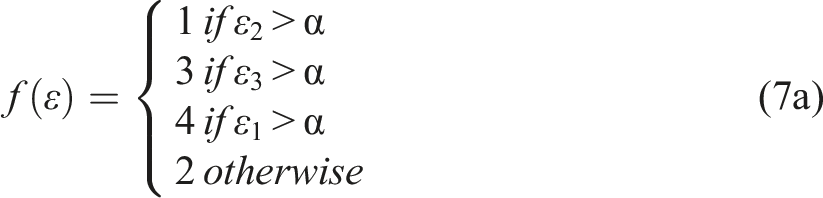
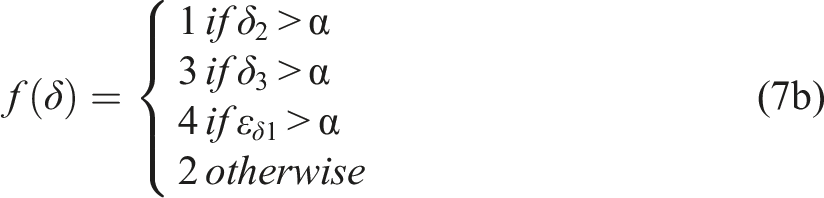
Results
Attitudes Towards Civil Rights and Religious Beliefs
The application of the initial steps of the aforementioned methodology, related to Fuzzy-Hybrid TOPSIS, provides results regarding the indicators measuring Attitudes Towards Civil Rights (ATCR) and Religious Beliefs (RB) of the respondents (Eq. (1) – Eq. (5)). The indicators calculated at the individual level have been averaged by segmentation variables such as country, religion of the mother and father, attitudes towards Christians, Muslims, Hindus, Buddhists, Jews, and atheists, perception of threats from Christians, Muslims, Hindus, Buddhists, Jews, and atheists, education, main status, religion, attendance at religious events, political orientation, self-placement in the society, marital status, and place of residence (rural or urban) (Table S3).
At the country level, the results show that are Spain and the Nothern countries those with higher ATCR values, meaning that have more positive attitudes towards civil rights, while Eastern countries present the lowest values. On the other hand, Türkiye and the Philippines show higher religious beliefs, while Denmark, Sweden, and Norway are the least religious countries. Those with non-religious parents show greater openness to civil rights, as do the Protestants’ descendants. Meanwhile, those who have Muslim or other religions parents exhibit stronger religious beliefs than the rest of the sample. Generally, positive attitudes towards civil rights are not associated with positive attitudes towards religions (Christian, Hinduism, Buddhism, Judaism) and atheism, with the exception of those who are more open towards Muslims, who also tend to exhibit higher values of ATCR but lower values of RB.
The analysis also explores how various demographic and socioeconomic characteristics influence ATCR and RB values. Gender and age do not appear to show significant differences, while education reveals a clear distinction between individuals with higher levels of education and those with primary education. The former group tends to be more supportive of civil rights than the latter one. Conversely, higher RB values are observed among individuals with secondary or primary school education. Individuals in paid employment or students tend to be more supportive of civil rights, whereas those engaged in domestic work show lower values of ATCR. In the same context, students and apprentices tend to have lower RB values, while the category of individuals involved in domestic work exhibits the highest RB values.
The findings underscore a substantial divergence among religious groups. Individuals identifying as “No religion” tend to exhibit more favorable attitudes towards civil rights and are logically less influenced by religious beliefs. In contrast, those who belong to the Islamic faith display the lowest levels of support for civil rights and maintain the highest degrees of religious beliefs. Moreover, the frequency of attending religious services emerges as a critical determinant. Those who attend services several times a week or more often show the most conservative stances regarding civil rights and the most pronounced adherence to religious beliefs.
The results also shed light on the self-placement of top-bottom in society, revealing discernible attitudinal disparities. Individuals in the highest rank bracket express the most positive attitudes towards civil rights. Conversely, those in the lower ranks exhibit more negative values of ATCR and greater religious beliefs. Also, political orientation significantly moulds attitudes, as far-left individuals exhibit strong support for civil rights and low religious beliefs compared to those leaning right or identifying themselves as conservatives.
The findings highlight differences in attitudes based on marital status. People who have never been married or formed civil partnerships tend to be more supportive of civil rights while maintaining a moderate level of religious beliefs. In contrast, those who are divorced or widowed tend to exhibit lower support for civil rights. Additionally, individuals living in suburban areas consistently display higher levels of support for civil rights (ATCR) and lower levels of religious beliefs (RB). These results will be discussed in further detail in Section 7.
(Non) Religious Conservatives versus Liberals
As previously mentioned, through the Fuzzy Clustering ECO-Extended Apostle Model (Eq. (6)- Eq-(7)), this study considers four pure categories of respondents: Religious Conservatives, represented by those with strong religious beliefs and less support for civil rights such as LGBTQI+ rights, abortion, and gender equity; Non-Religious Conservatives, characterized by low values of ATCR and RB; Non-Religious Liberals, indicated as those who, despite not holding strong religious beliefs, exhibit strong sensitivity towards civil rights; and finally, Religious Liberals, represented by those with high values of both ATCR and RB.
Cluster Distribution of the Classic Apostle Model versus Fuzzy Clustering ECO-Extended Apostle Models.
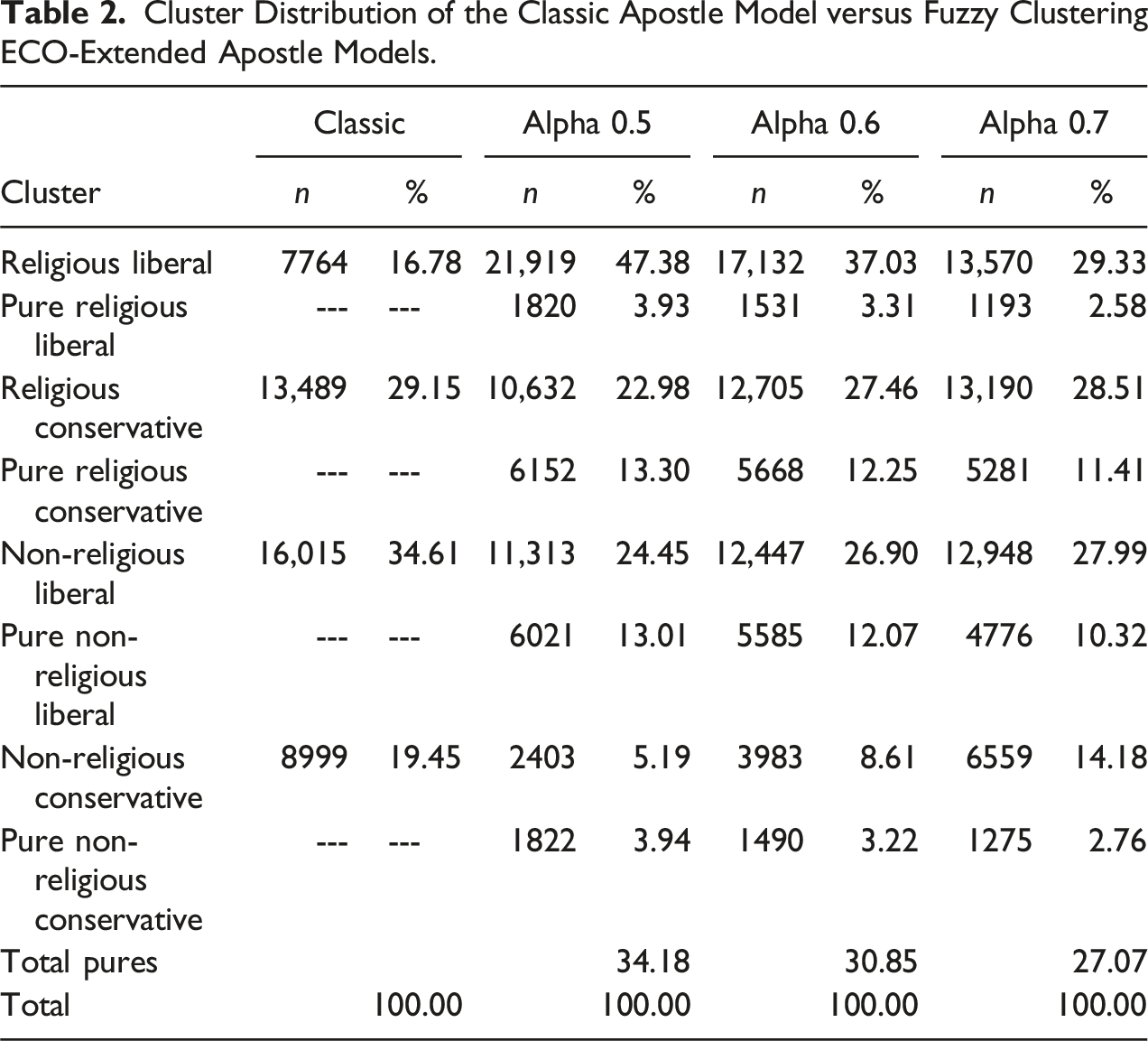
In the Classical Apostle Model, most respondents predominantly identify as either Religious Conservatives (29.2%) or Non-Religious Liberals (34.9%). Non-Religious Conservatives constitute 19.5%, while Religious Liberals comprise 18.8% of the sample. Discernible differences become apparent when considering the Extended models with alpha, particularly in the Religious Liberals category. Here, the percentage increases with the introduction of alpha but decreases with larger alpha values. Additionally, the percentage of Non-Religious Liberals exhibits an ascending trend from alpha 0.5 to alpha 0.7, increasing from 24.45% to 27.99%. However, this upward shift contrasts with the transition from the Classic Model to the extended version (alpha 0.5). Similarly, the Non-Religious Conservatives group experiences a decrease in the transition from the Classic to the Extended Model but exhibits an increase from alpha 0.5 to alpha 0.7, ascending from 5.19% to 14.18%. Religious Conservatives’ respective proportions fall when considering the extended models, and this decrease is reverted with alpha values larger than 0.5.
We could extract the proportions within the “Pure” categories by incorporating different alpha parameters into the model. The findings reveal that the Pure categories are significantly smaller than the aggregated categories. Specifically, the percentage of respondents exclusively aligning with Pure Religious Liberals shows a gradual decrease from 3.93% in alpha 0.5–2.58% in alpha 0.7. A parallel trend is evident in the Pure Religious Conservative category, declining from 13.30% in alpha 0.5–11.41% in alpha 0.7. The Pure Non-Religious Liberal group undergoes a decrease from 13.01% in alpha 0.5–10.32% in alpha 0.7, and a similar decrease is observed in the percentage of Pure Non-Religious Conservatives, decreasing from 3.94% in alpha 0.5–2.76% in alpha 0.7.
Introducing alpha parameters enhances the accuracy of clustering respondents, contributing to increased precision in categorising individuals based on their religious beliefs and attitudes towards civil rights. Specifically, a higher alpha can result in more pronounced “discrimination” between pure categories. This heightened discrimination proves beneficial in studies where researchers seek to identify and analyse distinct clusters within a population. In situations where respondents’ beliefs may exhibit ambiguity or fall into multiple categories, the extended model provides a mechanism to address such complexity. Adjusting the alpha parameter according to the research needs allows a more nuanced representation of the diversity and hybrid nature of beliefs within the surveyed population. Thus, researchers can leverage the flexibility of the extended model by employing different alpha values for sensitivity analysis. This approach allows them to explore how variations in the alpha parameter impact the results, providing a comprehensive view of the model’s performance and assessing the robustness of the obtained categorisations.
Religion and Religious Traits Analysis
To explore the impact of religion on respondents, we construct a contingency table. In this table, the columns are delineated by the four Pure quadrants derived through the ECO-Extended Apostle Model method (with alpha set to 0.5). Meanwhile, the rows categorize individuals based on their sociodemographic characteristics.
A contingency table is a matrix that displays variables’ (multivariate) frequency distribution and is widely used in survey and scientific research (Govaert & Nadif, 2010; Greenacre, 1988). It provides a primary framework for understanding interactions. Furthermore, we use the chi-square independence test to analyse the contingency table of our four categorical “pure” groups, assessing whether there is a significant association between the categories of the variables. To identify the cells that contribute most to the total chi-square score, we calculate the chi-square statistic for each cell. Cells with positive residuals are coloured in blue, indicating a positive association between the variables related to the corresponding row and column. Conversely, cells with negative residuals are coloured in red, suggesting a negative association between the variables related to the corresponding row and column.
The results clearly show that descendants of those who profess Catholicism or Other Asian Religion are positively associated with the group of pure Religious Liberals. In contrast, the offsets of Muslims and Orthodoxos are positively correlated with those with a very negative attitude towards civil rights and strong religious beliefs. On the other hand, the groups most positively associated with pure Non-Religious Conservatives are represented by those with Buddhist parents, while those who have Atheist or Protestant parents are more associated with pure non-Religious liberals (Figure S1(a) and Figure S1(b), in the Appendix).
The respondents’ religion can also be defined as an important proxy for religious beliefs. Agnostics or atheists fall into the group of pure Non-Religious Liberals, while those who follow the Quran or are Catholics show a clear positive association with pure Religious Conservatives. Catholics are also those with stronger religious beliefs who also have positive attitudes towards civil rights, while Buddhists fall into the pure Non-religious Conservative category (Figure S1(c)).
Furthermore, attendance at religious events marks a clear difference between the analysed groups. Those who attend religious events at least once a year have a positive association with being pure Religious Conservatives, while they show a negative association with the rest of the groups with high values of ATCR and low values of RB. Conversely, those who never attend church have a more positive correlation with pure Non-Religious Liberals and a negative correlation with Religious Conservatives (Figure S1(d)).
Socioeconomic and Demographic Analysis
The same analysis is also performed using some socioeconomic and demographic segmentation variables. At country level, United States show more association with pure Religious Liberas, while, Georgia, Philippines, South Africa, and Türkiye are more pure Religious Conservatives. Furthermore, Eastern European countries and Japan show the lowest values of ATCR and highest values of RB, while Northern countries show the highest values of ATCR and the lowest values of RB (Figure S2(a)).
Gender seems to influence both ATCR and RB indicators. Males are more positively associated with pure Non-Religious Conservatives and less with Religious Liberals, while females are more associated with those with strong religious beliefs but are also sensitive to civil rights. Young people and those with high levels of education tend to be included within the group of Pure Non-Religious Liberals, while the elderly and those with low education levels have conservative values and strong religious beliefs (Figure S2(b)). Furthermore, those in paid work and self-placed at the top of society tend to be liberal and non-religious, while those engaged in domestic work and with low self-placement are more likely to fall into the group of Pure Religious Conservatives. Instead, Pure Non-Religious Conservatives are represented by the retired, while Non-Religious Liberals by students (Figure S2(c)).
Finally, the political party voted for in the last elections also marks a significant division among the pure Non-Religious Liberals, Non-Religious Conservatives, Religious Liberals, and Religious Conservatives. The former is more associated with respondents who voted for left-wing parties. Those who are purely non-religious and conservative are more likely to have voted for the liberals, while purely religious and conservative individuals are more likely to have voted for centre-right parties (Figure S2(d)).
Discussion
Religion is an essential element of human society that can influence people’s attitudes and actions in various areas, including civil rights (Silva & Manzi, 2018). This study examines the relationship between religion and attitudes towards civil rights in thirty-three countries. In this context, parents’ religion emerged as a factor shaping attitudes toward civil rights and individuals' religious beliefs. Religious education, or the transmission of Christian values and culture rather than Islam, seems to be a proxy factor for these variables. Those with atheist or agnostic parents are more open to civil rights and have fewer religious beliefs than other sample segments. The result supports Taira’s (2017) results and, in Spain, Martínez-Torrón and Velasco (2016) results, where they explain how atheists promote a discourse of tolerance and equity, often complemented by hostility toward religions. However, Guenther (2019) highlights that in some contexts, atheists are seen as perpetuating gender inequalities. On the other hand, those with Muslim parents exhibit a weak sensitivity to civil rights. Following Rijalullah (2022), Muslim sons and daughters are the most religious but are less open to LGBTQ+ rights, abortion, and gender equity. In this regard, Rijalullah (2022) explains that those who have Muslim parents receive a strong religious education and maintain a strong observance of Islamic worship, including the denial of different family structures.
Personal affiliations also significantly influence shaping both religiosity and levels of openness to civil rights. Our results highlight that those who profess Catholicism fall into the category of individuals defined as “Religious Liberals.” The result emphasizes that following religious principles and receiving religious education leads to adherence to religious dogma and promotes equity and tolerance toward others. According to Giffin (2021), this result may be connected to the new narrative advanced by Pope Francis, who argues against judging homosexuals since they are also children of God.
This more inclusive approach by the Pope may have positively influenced the opinions and perceptions of Catholics, leading some of them to be more open and tolerant toward LGBTQ+ individuals. In other words, contrary to Edgell and Tranby (2007), it appears that people who maintain a strong religious faith and a connection to their faith through membership in a specific religious denomination may be more inclined to interpret religious principles in an open context and adopt a more progressive view on civil rights, including LGBTQ+ rights and gender equity. This perspective suggests that religion can positively promote equity and tolerance when interpreted in a context of openness and inclusivity.
On the other hand, the results indicate that those who follow the religion of Allah and the teachings of the Prophet Muhammad have a strong and solid religious faith but demonstrate low sensibility toward the rights of LGBTQ+ individuals and women rights. In line with this, according to Islamic law, homosexuality is considered a sin (Ahmady, 2023), and in some Muslim-majority countries, homosexuality is punishable by law (Edison & Hank, 2023; Flores, 2019). Furthermore, as emphasized by Unal (2022), the role of women in Muslim societies is often still tied to the traditional roles of mother and wife. However, an increasing number of Muslim feminist groups are fighting against the instrumental use of the veil, advocating for policies to combat violence against women, following the Istanbul Convention on preventing and combating violence against women and domestic violence (Council of Europe, 2011).
Additionally, the method used in the study allows us to provide an overview of sociodemographic characteristics that may play a role in categorizing respondents as (Non)Religious Conservatives or Liberals. Relevant characteristics include gender, age, or education, for example. According to Jäckle and Wenzelburger (2015), women, young people, those with higher education, and those with higher incomes can be defined as non-religious and liberal. In line with numerous previous studies, the phenomenon of certain men exhibiting a greater resistance towards gender equity and LGBTQ+ rights can potentially be attributed to their perception of these issues as threats to traditional masculinity norms (Besen & Zicklin 2007; Burke et al., 2017; Dodge et al., 2016; Gerhardstein & Anderson 2010; Hinrichs & Rosenberg 2002; Meaney & Rye 2010). Conversely, young and well-educated individuals often inhabit more diverse and inclusive environments, exposing them to many perspectives and life experiences (Bragg et al., 2018).
Finally, analysing the intricate and controversial relationship between religion and politics is also important. The influence of religion on political dynamics is multifaceted, presenting both positive and negative dimensions. In some circumstances, religion can catalyse democratic values, upholding principles such as tolerance, compassion, and fairness (Yablon, 2010). However, religion can be manipulated in other situations to support discriminatory and repressive policies, perpetuating social divisions and injustice (Cervi et al., 2020; Piumatti, 2017). Our research highlights the broad impact that political parties linked to Christian culture and tradition exert on religious beliefs and attitudes towards civil rights among their electors, as observed in our countries. Indeed, parties with strong ties to Christian culture often adopt more conservative positions on crucial civil rights issues, including same-sex marriage and abortion (Bernárdez-Rodal et al., 2020; Reingold et al., 2020). This intricate intertwining of religion, politics and civil rights underlines the need for continued examination and nuanced understanding, as it has far-reaching implications for the democratic process and the quest for social justice in contemporary societies. It prompts us to explore how political ideologies and religious affiliations intersect and shape the broader socio-political landscape, influencing marginalised individuals’ and communities' rights and freedoms.
Conclusion
There are various studies in the literature that address the intrinsic relationship between religiosity and civil rights (Brooks & Bolzendahl, 2004; Eliason et al., 2017; Jäckle & Wenzelburger, 2015; Prairie et al., 2019; Sakalli, 2016; Shnabel, 2016; Whitley, 2009; Winkel, 2019; Çetiner & Van Assche, 2021). However, this study, in addition to complementing and validating the findings of previous research, introduces a new methodology named the Fuzzy Clustering ECO-Extended Apostle Model to analyse four different profiles: (a) Individuals who are open to civil rights with strong religious beliefs, referred to as Religious Liberals; (b) Individuals who are open to civil rights but not religious, defined as Non-Religious Liberals; (c) Non-religious individuals who are not sensitive to civil rights, namely Non-Religious Conservatives; and (d) Religious individuals hostile to civil rights, termed Religious Conservatives.
The results demonstrate that the religion of parents, one’s religious affiliation, and various socioeconomic and demographic characteristics such as age, gender, education, self-placement in society, and political orientation play a fundamental role in shaping individuals’ religious values and attitudes toward civil rights. Catholics and women represent Religious Liberals, while Non-Religious Conservatives are grouped by the elderly, individuals with lower education, and those who vote for centre-right parties. In turn, Religious Conservatives can be represented by Muslims, and Non-Religious Liberals by those who do not profess any religion and by those who voted for left-wing parties.
Limitations and Future Research
As with any other study, further research in the future is necessary to address some of the limitations present in our current analysis. First, it should be noted that the analysis was based only on a single wave. Relying solely on data from the 2018 ISSP survey does limit our ability to capture potential changes in attitudes over time. Longitudinal analysis would undoubtedly offer valuable insights into evolving trends and dynamics. However, due to the study’s specific focus and resource constraints, it is necessary to confine the analysis to the data available from the 2018 wave. Incorporating data from other waves would significantly expand the scope and complexity of the research, requiring additional resources and potentially diverting focus from the core objectives of the current study. This aspect certainly merits further exploration, and it could be a fruitful avenue for future research endeavours to provide a more comprehensive understanding of evolving trends in this domain. Furthermore, future research should aim at replicating and extending our findings in different cultural and regional contexts. This would contribute to a more comprehensive understanding of how cultural dynamics shape the relationships between religious beliefs and civil rights attitudes across a wider range of societies.
Our study included only some socioeconomic and demographic covariates. However, despite limitations in the number of covariates, we carefully selected those most directly relevant to our research questions based on prior literature and theoretical considerations. Moreover, we recognise that adding more covariates would significantly increase complexity and might potentially compromise our ability to delve deeply into the core relationships we already explored. Nevertheles, comparing the identified group distributions with objective measures of democracy or civil rights could provide valuable insights. It would be interesting to explore some global indicators such as Freedom House’s “Freedom in the World” report, World Bank’s “Worldwide Governance Indicators” and Varieties of Democracy (V-Dem) project datasets.
Another interesting topic that deserves a further exploration is the potential influence of macro-level variables on the distribution of the four identified types. It is highly likely that factors like predominant religion, cultural norms, social and economic conditions, and even historical events play a significant role in shaping individual beliefs and values, which could ultimately influence their categorization into one of the four types. Even if that macro-level variables may likely contribute to the observed distribution, definitively establishing causal relationships can be challenging. Thus, further research will aim to compare, for example, different socio-cultural context that profess the same faiths.
Supplemental Material
Supplemental Material - Religious Beliefs and Civil Rights: Comparative Analysis Through the Fuzzy Clustering ECO-Extended Apostle Model
Supplemental Material for Religious Beliefs and Civil Rights: Comparative Analysis Through the Fuzzy Clustering ECO-Extended Apostle Model by Alessandro Indelicato and Juan Carlos Martín in Cross-Cultural Research
Footnotes
Author Contributions
Conceptualisation A.I., and J.C.M; methodology, J.C.M.; software, A.I., and J.C.M; validation, A.I., and J.C.M.; investigation, A.I., and J.C.M.; data curation, A.I., and J.C.M.; writing—original draft preparation, A.I., and J.C.M.; writing—review and editing, A.I., and J.C.M. All authors have read and agreed to the published version of the manuscript.
Declaration of Conflicting Interests
The author(s) declared no potential conflicts of interest with respect to the research, authorship, and/or publication of this article.
Funding
The author(s) disclosed receipt of the following financial support for the research, authorship, and/or publication of this article: This study was funded by the research fellowship “Catalina Ruiz,” provided by Gobierno de Canarias and the Agencia Canaria De Investigación Innovación Y Sociedad De La Información (ACIISI), through the Universidad de Las Palmas de Gran Canaria (Spain).

Supplemental Material
Supplemental material for this article is available online.
Author Biographies
References
Supplementary Material
Please find the following supplemental material available below.
For Open Access articles published under a Creative Commons License, all supplemental material carries the same license as the article it is associated with.
For non-Open Access articles published, all supplemental material carries a non-exclusive license, and permission requests for re-use of supplemental material or any part of supplemental material shall be sent directly to the copyright owner as specified in the copyright notice associated with the article.
