




Abstract
Given the importance of comparing different groups in terms of perceptions of justice and justice effects, it is essential that the instrument used to measure perceptions behaves the same way across all groups. This study investigates the measurement invariance of the four-factor structure of organizational justice across nine Arab countries. Multiple-group confirmatory factor analysis is used with 2,914 employees working in the public sector to represent the variety of cultures among the Arab nations. We assess organizational justice using a measure developed by Alkhadher and Gadelrab primarily for Arab cultural perspectives of justice. This study shows that the four-dimensional model of justice is valid across the nine countries at the configural, metric, and scalar invariance. Fit indices showed sufficient to optimal fit, and difference test values were not significant across the set of the increasingly constrained confirmatory factor models. According to these results, we conclude that comparisons could be made safely on the justice latent variable level across the nine Arab groups. Moreover, justice dimension intercorrelations were found to be moderate to high and independent of cultural groups.
Organizational justice is a dominating theme of organizational life (De Cremer, 2005). Justice is defined in terms of the perception of fair treatment and the impact of this perception on behavior (Masterson, Lewis, Goldman, & Taylor, 2000). Previous researchers have emphasized the importance of employees’ justice perceptions of the distribution of outcomes and rewards (Adams, 1965) and the evaluation of the process that determines these outcomes (Thibaut & Walker, 1975). Employees’ perceptions of justice extend to concerns about treatment by authority (Bies & Moag, 1986) and whether procedures are explained clearly and timely (Greenberg, 1993). This concern for justice by individuals may reflect intrinsic motives for fairness (Lerner, 2003), belongingness (Gillespie & Greenberg, 2005), security (Colquitt, Greenberg, & Scott, 2005), and control over outcomes (Folger, 1977).
Whether a person perceives a specific treatment as fair is dependent on the different histories of societies, human culture, and contemporary settings (Streicher, Jonas, Maier, & Frey, 2012). Therefore, justice is considered a very sensitive psychological and social concept where individuals in different cultures may have different interpretations and perceptions of it (Gelfand, Erez, & Aycan, 2007; Tsui, Nifadkar, & Ou, 2007). Individuals do care about being treated fairly, but how they assess fairness is determined by cultural variables (Fischer, 2016). Most of the findings in the literature have been drawn from samples located in Western communities (Henrich, Heine, & Norenzayan, 2010). Fewer studies about organizational justice perception have been conducted with Arab communities (Alkhadher & Gadelrab, 2016; Fischer et al., 2011; Gadelrab & Alkhadher, 2017). In their systematic review of the research, Silva and Caetano (2016) found that one of the least examined regions in the organizational justice literature is the Middle East, which is mostly Arab countries. Findings from one culture cannot be assumed generalizable to other cultures without empirical evidence. Therefore, it is important to compare the perceptions of justice and the impacts on the behavior of different groups. This comparison is meaningful only if the measuring instrument is assessing justice in an equal way across the groups. No cross-cultural comparisons can be made without first ensuring that the factor structure is comparable across these cultures.
Studying organizational justice perceptions with more diverse samples has its essential theoretical and practical implications. Given the very limited studies on perceptions of organizational justice in Arab communities, this study explores the factor structure of the newly developed Arabic measure of organizational justice (AMOJ; Alkhadher & Gadelrab, 2016; Gadelrab & Alkhadher, 2017) using samples drawn from nine Arab countries from two continents. The study includes data from Jordan, Kuwait, Oman, Saudi Arabia, and Syria in Asia and Algeria, Egypt, Morocco, and Tunisia in Africa. To explore the equivalence of the factor structure of this measure across these countries, our study conducts both multigroup confirmatory factor analysis and means-covariance structure analysis. The study also tries to investigate if cultural dimensions, specifically Individualism-Collectivism and Power Distance, as identified by Hofstede (Hofstede, Hofstede, & Minkov, 2010), can explain individuals’ perceptions to justice events at work.
Arab Culture and Values
Twenty-two countries form what is known as the Arab world; all are members of the League of Arab States (2017). Twelve of them are located in Western Asia (Bahrain, Iraq, Jordan, Kuwait, Lebanon, Oman, Palestine, Qatar, Saudi Arabia, Syria, United Arab Emirates [UAE], and Yemen), and 10 in northern and eastern Africa (Algeria, Comoros, Djibouti, Egypt, Libya, Mauritania, Morocco, Somalia, Sudan, and Tunisia). The area is home to 380 million people, only 5% of the world’s population. Arabic is the official language of Islam, one of the six official languages of United Nations, and the fifth most spoken language in the world. However, French and English languages are widely spoken in countries with a history of Western colonialism.
Religion is an integral part of Arab daily life. Most individuals in Arab countries are Muslim (Sunni and Shi’a), and a minority are Christian. There are notable populations of ethnic and religious minorities, such as Berber-Amazigh and Kurds. The area has the largest proportion of young people in the world with 38% of Arabs less than the age of 14. The region has witnessed 17% of the world’s conflicts between 1948 and 2014, 45% of the world’s terrorist attacks, 47% of the world’s internally displaced people, and 57.5% of all world refugees (United Nations Development Program, 2016).
Harb (2016) identified five cultural characteristics prominently featured in the Arab world: a high level of religion, morality (i.e., respect, humility, and fairness), the culture of honor tightly linked to reputation, generosity and hospitality, and family values. These characteristics were also identified in previous studies (Abu Rida, 1998; Feghali, 1997; Gallup, 2012; Gregg, 2005).
The Hofstede Cultural Dimensions model provides a framework to study the cultural values of a society and to understand the goals that motivate its individuals (Hofstede, 1980; Hofstede et al., 2010). Although Hofstede’s studies did not include any specific Arab country, he used a small sample from 10 Arab countries (Egypt, Iraq, Jordan, Saudi Arabia, Kuwait, Lebanon, Libya, Morocco, Syria, and UAE). Arabs tend to be more collectivistic and score low on individualism (26th on Individualism; scores from 25 to 46), have moderate levels of tolerance toward ambiguities (27th on Uncertainty Avoidance; scores from 65 to 85), and moderate levels of competitiveness (23rd on Masculinity-Femininity; scores from 40 to 70). They have high power differentials between individuals (7th on Power Distance; scores from 70 to 95) and highly normative and restrained social systems (low Pragmatism; scores from 7 to 36; and low Indulgence; scores from 4 to 52). Noticeably, there is an approximate 25-point difference between the samples on each of the six dimensions. Harb (2016) observed an absence of apparent clusters within the scores, which could reflect “the unity and diversity of the region” (p. 10). In addition, the World Values Survey (Inglehart et al., 2015) of nearly 100 countries including 13 Arab countries classified Arabs as highest on traditional values (religion, family ties, and respect for authority) and high on survival values (low trust and concerns for physical and economic security).
Similar to societies, organizations also have cultures (Allen & Kraft, 1982). Organizational culture is a distinctive system of values, beliefs, and work relationships that distinguish one organization from another (Deal & Kennedy, 1982). Industrial/Organizational and management scholars have noted that the Arab region has its own social and cultural environment that is reflected in the design and operation of its organizational processes and managerial systems. The most obvious forces that shape its organizational environment are religion, traditional values, and language (Ali, 1995; Weir, 1995).
The region has management systems similar to most other developing countries (Debrah & Budhwar, 2004), such as sensitivity to the norms of the local culture and limited participation in decision making. Arab societies have highly normative social systems, which are reflected in daily business practices. Islamic values and ethics affect the management of human resources (Robertson, Al-Habib, Al-Khatib, & Lanoue, 2001). For Muslim managers and employees, management practices are strongly influenced by their religious beliefs and instructions stemming from the Quran (the holy book of Islam) and Sunnah (what the Prophet Muhammad said, did, or conducted) (Ali & Al-Owaihan, 2008). The management styles in Arab work organizations are more autocratic and paternalistic, and decision making is centralized with significant hierarchical structures (Baddar, Davies, & Ryals, 2010).
Employees in Arab countries must establish good working relationships with their direct superiors and cooperate and work well with others (Dedoussis, 2004). Arab societies are highly collectivistic, and social networks are deeply rooted in the Arab business model as self-protection, to attain benefits, and to maintain feelings of unity (Al-Moharby, 2011). Conducting business in the Arab region usually necessitates first establishing a relationship and connections (“Wasta”) before discussing the intended business (Iles, Almhedie, & Baruch, 2012). “Wasta” is a type of favoritism and a process that enables an employee to achieve goals and benefits through connections with key personnel in the organization (Mohamed & Mohamed, 2011).
Selection is often conducted subjectively depending on personal contacts and nepotism. The only selection tool used for most work organizations is the interview. Assessment tests are rarely used. Leaders are often selected on the basis of seniority, and performance appraisals are conducted confidentially and are subjective from the top-down.
The public sector places priority on recruiting locals, whereas the private sector often employs expatriates. In some Gulf countries such as Kuwait, Qatar, and the UAE, wages in the public sector normally exceed the private sector, which is the main reason that locals are reluctant to work in the latter (Mellahi, 2006). However, large private organizations tend to offer higher pay but lower job security. After the recent economic crisis, job security in the public sector has been reduced and job seekers must wait longer to obtain employment. However, once a position is filled, it is difficult to fire employees in the public sector even for poor performance. The manager can transfer a low performing employee to another job or another location. It is obvious that some of the aforementioned practices violate fairness principles and ethical standards.
Finally, the Arab region suffers from major economic and political obstacles. Abed (2003) identified the root causes of the economic problems faced by the business community in the Middle East, including slow political reform, dominance of the public sector, immature financial markets, and significant trade restrictions. The region also suffers from high unemployment rates (Mellahi, Al-Hinai, 2000) as well as a lack of privatization and weak local entrepreneurial cultures (Abed, 2003). Details on the business environment in the Arab world can be found in Budhwar and Mellahi (2006).
The Arab World Competitiveness Report (The World Bank, 2018) reported optimistic views. The report noted, “The region’s growing young, educated, and technologically connected population presents an unprecedented opportunity to foster development” (p. 11). Infrastructure and technological readiness are two areas where Arab countries have made the most significant progress over the past 10 years compared with the Organisation for Economic Co-Operation and Development (OECD) countries. The Arab region also has some of the world’s most competitive economies, such as UAE, Qatar, and Saudi Arabia, which ranked 17th, 25th, and 30th, respectively, out of 137 countries on the Global Competitiveness Index. However, the report stated that innovation, technological readiness, higher education and training, and labor market efficiency are four areas where the region lags farthest behind advanced economies.
Justice and Culture
Emerging pieces of evidence from Western and non-Western literature confirm a four-dimension structure of justice perceptions (distributive, procedural, interpersonal, and informational justices), and that these factors tend to relate to four different outcomes (Colquitt, 2001; Colquitt, Long, Rodell, & Halvorsen-Ganepola, 2015; Colquitt & Shaw, 2005; Fischer et al., 2011; Gadelrab & Alkhadher, 2017; Streicher et al., 2008). Using confirmatory factor analysis and multigroup analysis, Fischer et al. (2011) showed that Colquitt’s (2001) four-dimensional model of organizational justice is supported and fits well across samples from 13 countries including the three Arab countries of Egypt, Lebanon, and Saudi Arabia. However, they noted that perceptions of justice are more highly intercorrelated in power distance and collectivistic samples, whereas score reliabilities are lower in collectivistic settings.
Using Kuwaiti samples, Alkhadher and Gadelrab (2016) explored the dimensionality of organizational justice and its construct and concurrent validity for an AMOJ they developed to ensure relevancy to the sample’s culture. The confirmatory factor analysis (CFA) found four-factor structures similar to what Colquitt (2001) and Fischer et al. (2011) found in their studies. The four dimensions showed significant correlations to four relevant outcomes. Moreover, multiple-sample confirmatory factor analyses results have emphasized the existence of the four-factor structure in both Kuwaiti and Algerian samples (Alkhadher, Zain-Aldean, & Gadalreb, 2018). The factors showed acceptable values of internal consistency coefficients in both samples, and the configural and metric measurement invariances were achieved. However, the highest level of measurement invariance and scalar invariance did not meet.
Researchers have found that culture may affect the perception of distributed justice. For example, collectivists tend to prefer equality and need over equity, as allocation procedures, more than individualists do (Chen, Meindl, & Hui, 1998; Murphy-Berman, Berman, Singh, Pachauri, & Kumar, 1984). In cultures with high power distance, individuals tend to prefer equity over equality (Fischer & Smith, 2003). Leung and Kwong (2003) showed that when calculating needs, collectivists in vertical societies tend to see the extended family or employee relations as lifelong obligations compared with individualistic societies that emphasize short-term obligations.
Collectivism can also affect procedural justice perception. The national model suggested by Tyler and Lind (1992) proposes that procedural justice provides information about individuals’ positions within their group and whether they are valued, which determines the extent of compliance with authorities. In hierarchical societies, individuals pay less attention to procedural justice information (Lind, Tyler, & Huo, 1997) as their relative position is decided by the cultural context rather than by the need for such information. Therefore, an individual’s ability to discriminate between the four dimensions of justice may be reduced in such communities (Fischer et al., 2011). In a recent study, Summereder, Streicher, and Batinic (2014) showed that collectivism is associated with a preference for consistent procedures whereas individualism is connected to a preference for having a voice. Voice was found to be exclusively important for low power distance individuals, whereas consistency emerged to be important regardless of power distance. One given explanation is that individualistic/low power distance persons focus on their self-interest-driven influence and, therefore, favor voice, which is reported as the most important condition of procedural justice in Western countries (Lind, Kanfer, & Earley, 1990; Tyler, 2000). In contrast, collectivistic/high power distance persons have no interest in sticking out of the group, but in reliability of procedures and, therefore, favor consistency.
Interpersonal justice perceptions could also be influenced by collectivism and power distance. Social sensitivity had more effect on fairness perception in collectivistic than individualistic societies (Tata, Fu, & Wu, 2003). Collectivists tend to react less negatively to managers’ critiques where individualists show a more negative reaction and have less trust when facing less interpersonal fairness (Leung, Su, & Morris, 2001). Moreover, using meta-analysis with studies representing 23 countries, Fischer and Maplesden (2006) concluded that greater power distance was linked with lower levels of interpersonal justice.
The Current Study
The previously cited studies examined organization justice perceptions in a limited number of Arab countries out of the 22 countries that make up the Arab world. Therefore, we cannot assume that the same results found in these studies are generalized to Arab countries. This study uses the newly developed Arab measure to assess its dimensionality across nine major Arabic nations.
We assess the ability to generalize the four-factor scale developed by Alkhadher and Gadelrab (2016) across nine Arab countries in Asia and Africa. To maximize variability, the samples were obtained from countries with varied results on individualism-collectivistic dimension (Egypt, 25; Jordan, 30; Saudi Arabia, 25; Kuwait, 25; Morocco, 46; and Syria, 35) and the power distance dimension (Egypt, 70; Jordan, 70; Saudi Arabia, 95; Kuwait, 90; Morocco, 70; and Syria, 80) (Hofstede, 2017). There were no data available for all nine countries.
Based on the previous studies and the evidence that justice perception could function universally (Alkhadher & Gadelrab, 2016; Fischer et al., 2011; Norenzayan & Heine, 2005), we expected that individuals in Arab countries would make reasonable distinctions among the four justice dimensions (distributive, procedural, interpersonal, and informational justices). Accordingly, we hypothesize the following:
Method
Samples and Procedures
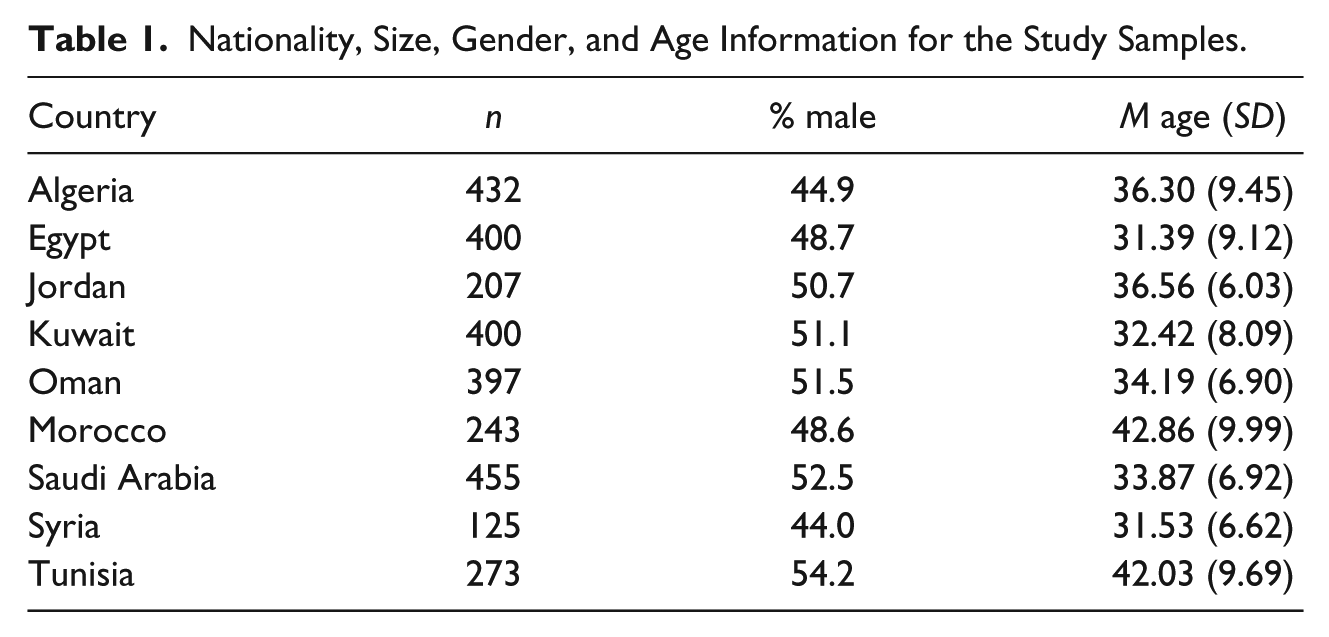
Survey participants were recruited by the authors during work time. They are personally contacted and presented with a paper-and-pencil version of the measure used. Completion of the questionnaire was entirely voluntary, and responses were anonymous. In total, 2,914 mostly college employees completed questionnaires with no missing responses. All are working in comparable public sector positions such as education and government organizations, but not military type organizations. Samples were available from nine countries: Algeria, Egypt, Jordan, Kuwait, Oman, Morocco, Saudi Arabia, Syria, and Tunisia. Our goal was to collect data representing different Arab countries in terms of location and cultural dimensions to represent the diversity of Arab cultures. The sample sizes ranged from 125 in Syria to 455 in Saudi Arabia. This variation in sample size reflects accessibility, where in Syria, for example, it was very difficult reaching the subject due to the conflict situation. Size, age, and gender characteristics of the study samples are reported in Table 1.
Nationality, Size, Gender, and Age Information for the Study Samples.
Measure: The AMOJ
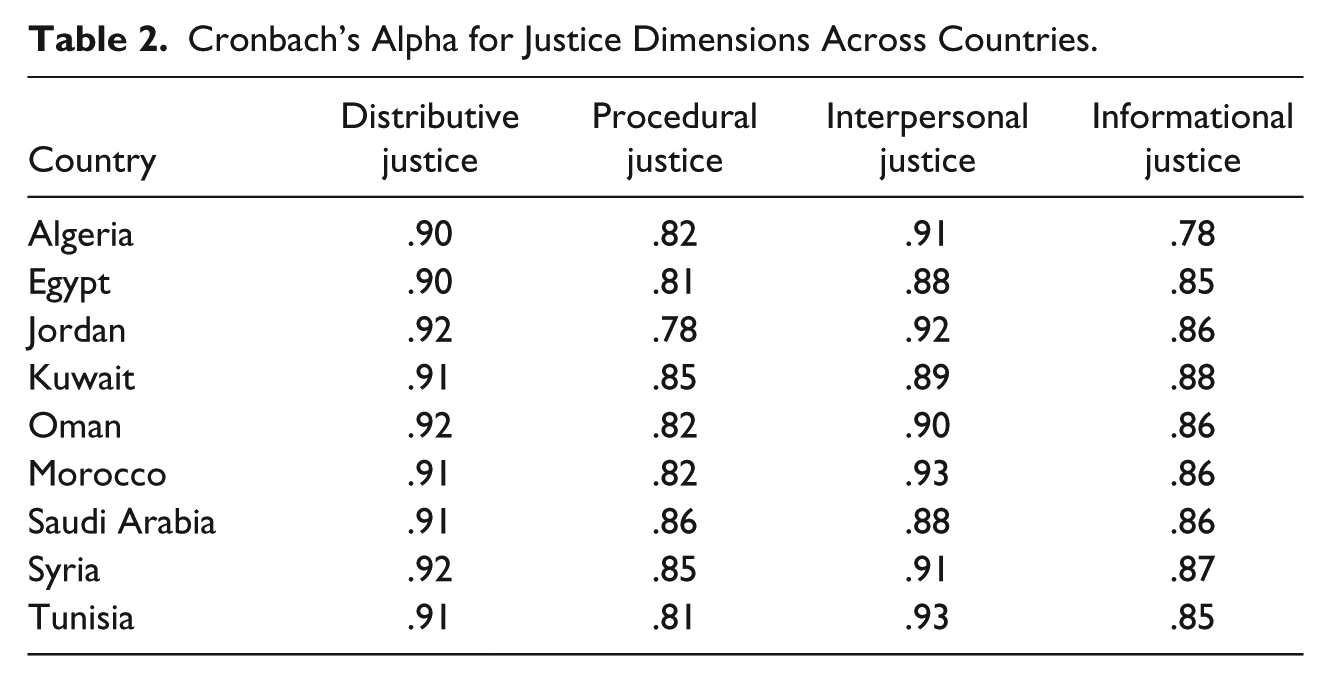
We used the AMOJ (Alkhadher & Gadelrab, 2016). The AMOJ consists of 17 questions intended to measure distributive (five items), procedural (four items), interpersonal (four items), and informational (four items) aspects of organizational justice. Answers were recorded on a 5-point Likert-type scale with the labels “(1) strongly disagree” to “(5) strongly agree.” This measure is designed specially to suit the Arabic culture. It demonstrated good psychometric properties and robust factorial structure. A complete description of the rationale for developing the AMOJ is found in Alkhadher and Gadelrab (2016), and a comparison between the AMOJ and the Colquitt’s (2001) measure of organizational justice is presented by Gadelrab and Alkhadher (2017). Justice dimensions’ alpha reliabilities across the nine samples are presented in Table 2. In general, the internal consistencies among dimensions’ measures as reflected by Cronbach’s alpha are adequate. In addition, at the beginning of the questionnaire, each respondent was asked to provide age and gender.
Cronbach’s Alpha for Justice Dimensions Across Countries.
Data Analysis
We tested whether the same items measure the four organizational justice factors across the nine groups using the Kuwaiti sample as the reference group as the AMOJ was originally developed in Kuwait. Multiple-group CFA is performed using the weighted least square means and variance (WLSMV) estimator (Muthen, du Toit, & Spisic, 1997). WLSMV is found to be a robust estimator (compared to regular maximum likelihood [ML] and generalized least squares [GLS] estimators) when the variables’ categorical and multivariate normal distribution is not assumed (Brown, 2006) which is the case in current data analyses. Measurement invariance is tested by comparing progressively restricted models (Van De Schoot, Schmidt, De Beuckelaer, Lek, & Zondervan-Zwijnenburg, 2015).
The lowest level of measurement invariance is configural invariance. At this level, we tested the equivalence of the four-factor structure across the nine countries. Therefore, the nine four-factor models were estimated simultaneously. If the configural measurement holds, the overall model fit should be at least acceptable. The next level is called the metric invariance, which builds upon configural invariance. In addition to requiring the organizational justice factors being measured by the same items, metric invariance requires the factor loadings of those items to be equal across the nine countries. This level of invariance is essential because attaining metric invariance indicates that each organizational justice factor has the same meaning to participants across groups. To assess metric invariance, we compared the fit of the metric model with the fit of the configural model. If there is no significant difference in model fit, then there is an evidence of equal factor loadings across groups. Statistically, attaining metric invariance suggests that group comparisons of factor variances and covariances are defensible. However, it does not justify the comparisons of group means. The next level is the scalar invariance. It requires that the item intercepts also be equal across groups. Item intercepts are considered the origin or starting value of the scale that the organizational justice factors are based on. To assess scalar invariance, the fit of the scalar model is compared with the fit of the metric model. Scalar invariance is met if there is no significant difference in model fit. Achieving scalar invariance allows for mean comparisons across groups. The final level of invariance is called strict factorial invariance. In this level, further restriction of equality of item error terms across groups is added. This level of invariance is considered important in testing the hypothesis of the reliability of organizational justice dimensions across groups.
An additional level of measurement invariance that could be of special interest is called the structural invariance. At this type of invariance, models are specified to test the invariance of variances, covariances, and the means of the latent variables (Vandenberg & Lance, 2000). We believe it is important to further investigate the equivalence of variability, correlation, and mean for the corresponding organizational justice factors across Arab cultures. If this level of measurement holds, then it can be said that people across different groups do perceive organizational justice dimensions in the same way.
To evaluate fit, we used several fit indices in addition to the chi-square statistic, given some challenging properties of chi-square statistics in evaluating model fit (Bollen, 1989). The root mean square error approximation (RMSEA) developed by Browne and Cudeck (1993) is used to represent a lack of fit index with values less than .05 indicating optimal fit and with values greater than .05 and less than .08 indicating sufficient fit (Marsh, Hau, & Wen, 2004). The comparative fit index (CFI, Bentler, 1990) and the Tucker–Lewis index (TLI; Bentler & Bonett, 1980) were also used to evaluate incremental fit, with values above .97 indicating optimal fit, values between .97 and .95 indicating sufficient fit, and values between .95 and .90 indicating acceptable fit (Marsh et al., 2004). We used the drop-in model fit between the less constrained and the more constrained models as evidence of misfit. We used TLI and CFI larger than .01 as indicating invariance misfit when comparing two hierarchically constrained models (Cheung & Rensvold, 2000). All analyses were carried out using Mplus 8.0 (Muthen & Muthen, 1998-2017).
Results
Testing the Measurement and Structural Invariance Across the Nine Countries (Hypothesis 1)
The first level of measurement invariance, configural invariance, is tested by specifying the four-factor structure of organizational justice across the nine sample groups representing the different Arab countries. A summary of the results of testing the invariance of AMOJ across groups is presented in Model A, Table 3. The results show that it perfectly fits the data, indicating that the four-factor structure is invariant across the groups. Goodness-of-fit indices were at their optimal values: χ2(1017) = 1,064.764 (p < .05), RMSEA = .012, 90% confidence interval (CI) = [0, .020], CFI = .999, and TLI = .999. Item-factor loadings for each item on its specified factor are illustrated in Table 4. All items were loaded significantly (p < .01) on their specified factors for all groups. It is clear from Table 4 that corresponding item-factor loadings across groups were close and comparable. However, there are some instances of items being loaded higher or lower than their corresponding loadings in other groups. For example, Item 9 has .9 loading on the procedural justice factor for Kuwait group, where the same item-factor loading of the other groups was approximately .7.
Summary of the Results for Testing the Measurement and Structural Invariance.
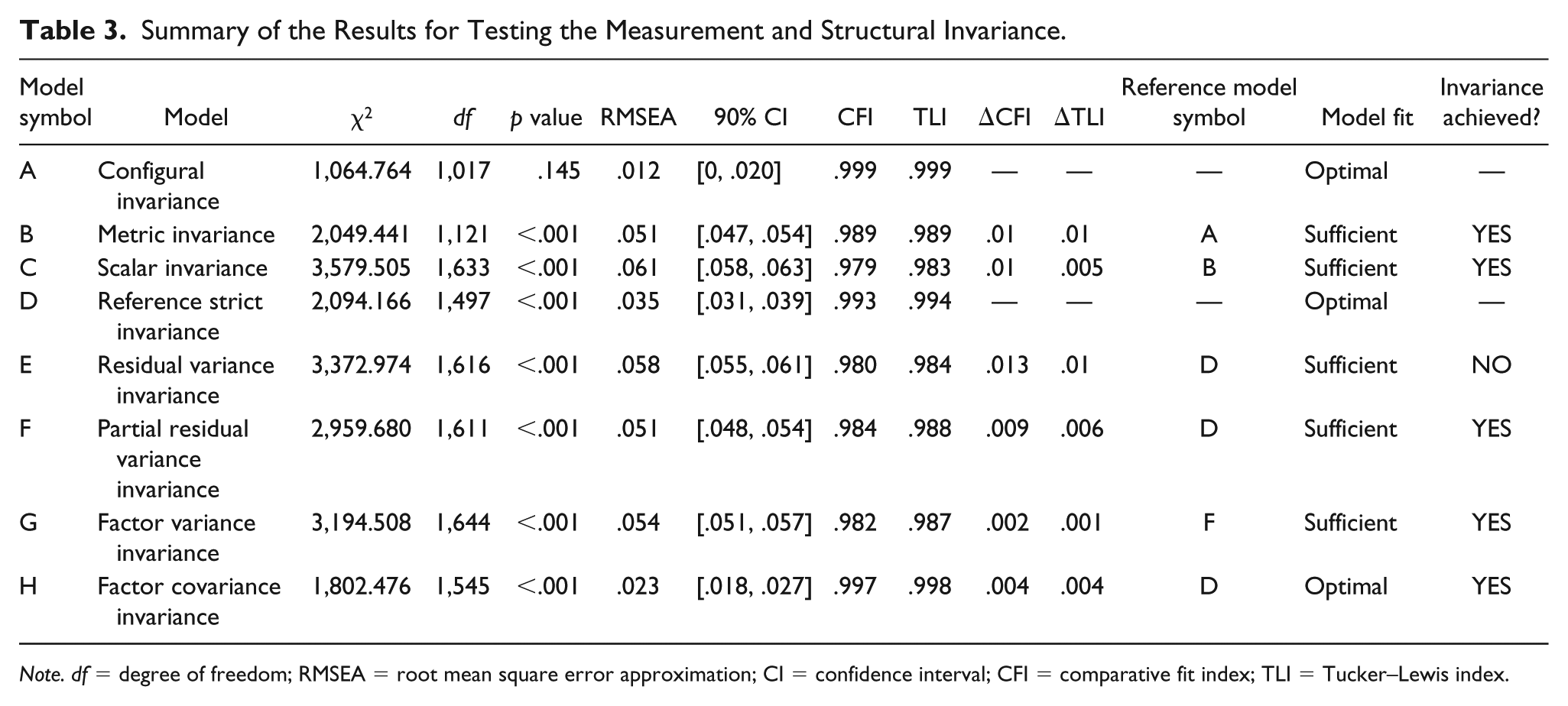
Note. df = degree of freedom; RMSEA = root mean square error approximation; CI = confidence interval; CFI = comparative fit index; TLI = Tucker–Lewis index.
Standardized Item-Factor Loadings and Correlations Between Each Pair of Factors Across Countries Using AMOJ.
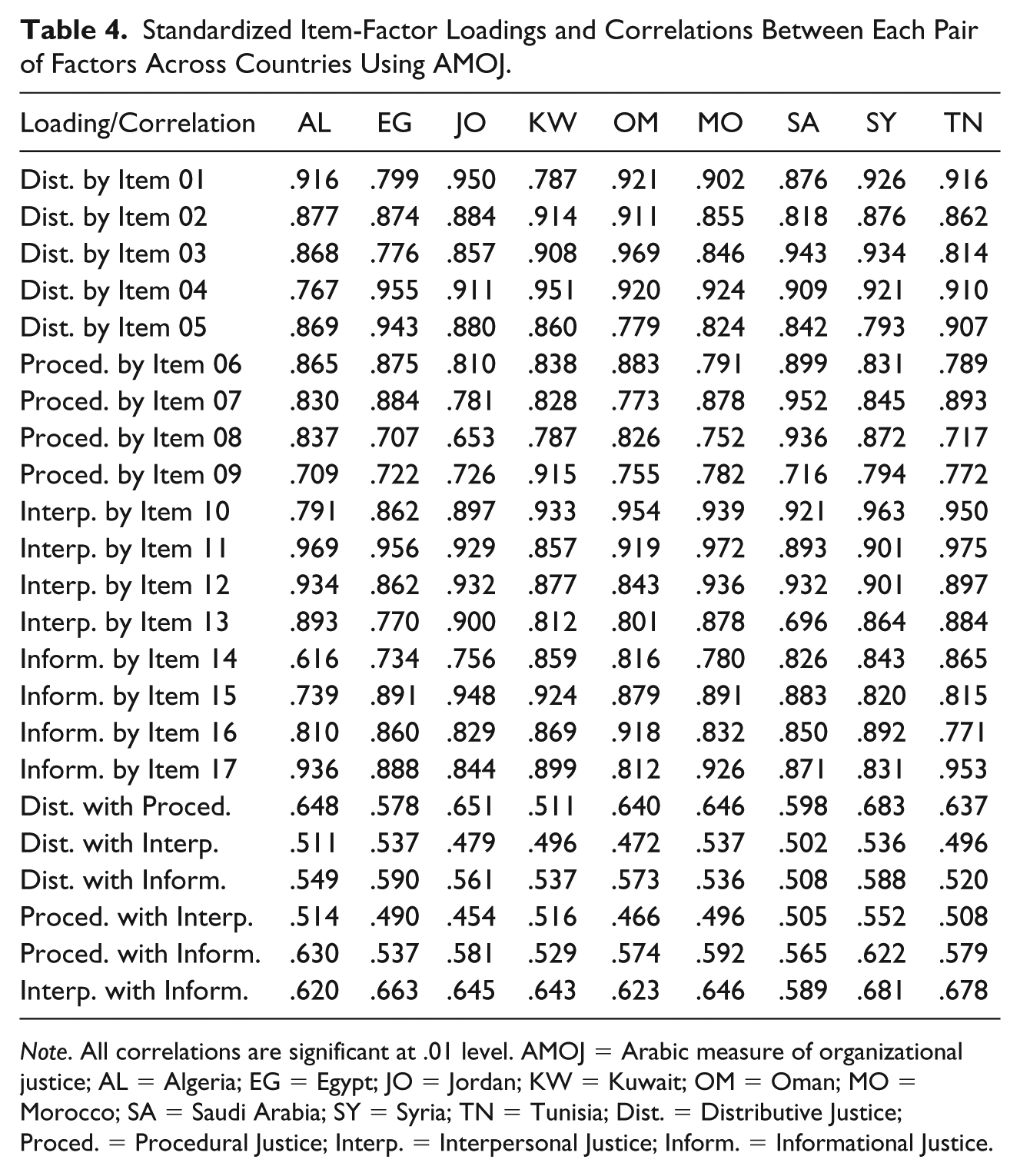
Note. All correlations are significant at .01 level. AMOJ = Arabic measure of organizational justice; AL = Algeria; EG = Egypt; JO = Jordan; KW = Kuwait; OM = Oman; MO = Morocco; SA = Saudi Arabia; SY = Syria; TN = Tunisia; Dist. = Distributive Justice; Proced. = Procedural Justice; Interp. = Interpersonal Justice; Inform. = Informational Justice.
As the configural invariance is fully supported, the item-factor loadings were then constrained to be equal across groups to test the metric invariance (Model B, Table 3). Model B fit results indicated sufficient fit: χ2(1121) = 2,049.441 (p < .001), RMSEA = .051 (90% CI = [.047, .054]), CFI = .989, and TLI = .989. Although the χ2 test value was significant, all other fit indices referred to adequate model-data fit. On average, samples with the highest contribution to the overall χ2 were Oman (17.83%) and Saudi Arabia (14.69%). The decline in model fit between Model B and Model A is tested using ΔCFI and ΔTLI. Values of both ΔCFI and ΔTLI were .01, indicating no significant drop-in fit between the two models. These results support the equivalence of factor loadings across groups and indicating the viability of organizational justice variances and covariances across groups.
The scalar invariance model (Model C, Table 3) adequately fitted the data: χ2(1633) = 3,579.505 (p < .001), RMSEA = .061 (90% CI = [.058, .063]), CFI = .979, and TLI = .983. Again, the χ2 test value was significant; however, all other fit indices were at their sufficient values. Samples with the highest contribution to the overall χ2 were Algeria (16.26%), Kuwait (14.89%), and Saudi Arabia (14.69%). On the contrary, results of the decline in fit revealed that the imposition of equivalence of the corresponding organizational justice item intercepts across groups resulted in a nonsignificant decline in the fit. Values of both ΔCFI and ΔTLI were at or below the .01 criterion, respectively. These results indicate that mean comparison between groups is tenable.
To test the strict factorial invariance, Model D is specified as a reference model for the purpose of comparison. In this model, all item residual variances were set free. Therefore, the equality of error terms model (Model E) could be tested. Although the fit of Model E was sufficient, ΔCFI value was .013, which is greater than .01, indicating invariance misfit. Reviewing the modification indices, we found that residuals for Items 7 and 8 in the Saudi Arabia sample, Item 3 in Oman sample, and Items 4 and 14 in Algeria sample were not invariant with the other samples. Therefore, a partial residual variance invariance model (Model F) was specified after freeing the aforementioned parameters and was fitted to the data. Model F showed adequate fit: χ2(1611) = 2,959.680 (p < .001), RMSEA = .051 (90% CI = [.048, .054]), CFI = .984, and TLI = .988. The highest contribution to the overall χ2 was from Egypt (15.43%), Oman (13.56%), Saudi Arabia (13.08), and Algeria (12.95%). Values of both ΔCFI and ΔTLI were below the .01 cutoff, indicating the partial equivalence of the residual variances for the invariant items across groups.
Factor variance invariance was then tested by constraining the factor variances to be equal across the nine groups (Model G, Table 3). The fit of this model was sufficient: χ2(1644) = 3,194.508 (p < .001), RMSEA = .054 (90% CI = [.051, .057]), CFI = .982, and TLI = .987. The highest contribution to the overall χ2 was from Saudi Arabia (16.19), Algeria (15.94%), Egypt (14.65%), and Oman (13.92%). Values of both ΔCFI and ΔTLI were below the .01 cutoff, indicating that constraining the justice factor variances to be equal across groups did not significantly worsen model fit as compared with Model F. This suggests that reliabilities are equivalent across culture groups. In general, results of testing measurement and structural invariance of organizational justice across the nine Arab countries support Hypothesis 1.
Testing Equality of Covariance Invariance Across the Nine Countries (Hypotheses 2a and 2b)
To test Hypotheses 2a and 2b, we fitted a model specification by constraining covariances among organizational justice latent variables to be equal across groups (Model H, Table 3) based on the reference restrict model (Model D). Because Model H is just a constrained version of Model D, Models D and H are considered hierarchical nested models. Therefore, Model H fit is tested against Model D. Model H showed optimal fit to the data: χ2(1545) = 1,802.476 (p < .001), RMSEA = .023 (90% CI = [.018, .027]), CFI = .997, and TLI = .998. The highest contribution to the overall χ2 was from Kuwait (17.05%), Syria (13.33%), and Jordan (12.92%) samples. Compared with Model D, Model H specification did not worsen the fit in a significant way. Values of ΔCFI and ΔTLI were as low as .004, indicating the equivalence of factor interrelations among justice latent variables. This can be further inferred from the lower part of Table 4, where the correlation between justice variables lies. All correlations could be described as moderate with .5 to .7 values. Although, we stated Hypotheses 2a and 2b because we expected to find different correlations among the four justice dimensions according to the reported variability in power distance and individualism scores among Arab countries (Hofstede, 2017), the two hypotheses are not supported by the data.
Discussion
This study investigated the equivalence of the measurement structure of the AMOJ across a wide range of Arab countries. The AMOJ was developed specifically for the Arabic culture using the emic–etic approach. Colquitt and Shaw (2005) reviewed several issues related to the design of organizational justice measure. These issues include considering the type of justice (i.e., distributive, procedural, interpersonal, and informational), the source of justice (human agent vs. formal organization), the context of justice (a specific event or more general context), and the measurement approach (direct “how fair” items or indirect items focusing on justice rules). From this perspective, the AMOJ focus is general; the items’ statements are not developed to assess specific workplace situations, and they do not refer directly to individuals’ own personal experiences. Kray and Lind (2002) have demonstrated that individuals use information about the fairness experiences of others to form their impressions of fairness. Thus, the main goal of the AMOJ is to form a global assessment of the employees’ perception of justice of a specific entity. The general focus of the AMOJ may explain the results of the current study.
Results of our study supported the claim that the AMOJ is a suitable instrument to assess organizational justice in Arab cultures. Configural invariance was fully supported across the nine Arab samples studied. This result supports the distinct nature of the four dimensions of organizational justice, not only in a specific culture but across all Arab cultures. The equivalence of factor loadings and item intercepts across groups are sufficiently supported. These results support the plausibility of making comparisons among the four dimensions of justice across the Arab countries. In addition, the equality of error terms, factor variance invariance, and mean structure invariance are partially supported. Some error terms for some samples were not invariant with the other samples. Error terms represent the unique residuals specific to particular items. Therefore, it is very hard to give a specific explanation of the lack of invariance of these error terms.
Testing equality of covariance invariance across the nine countries supported the equivalence of factor interrelations among justice latent variables across groups. Power distance refers to the degree to which less powerful individuals are tolerant of an unequal distribution of power (Hofstede, 2001). Therefore, we expected to find higher intercorrelations among organizational justice dimensions for Arabic countries with higher power distance scores (i.e., Kuwait and Saudi Arabia) than their counterparts with lower power distance scores (i.e., Egypt, Jordan, and Morocco). Individualism concerns the degree that individuals are emphasizing individual rights, self-fulfillment, and self-autonomy. Therefore, we expected to find lower intercorrelations among organizational justice dimensions for Arab countries with high individualism scores (i.e., Morocco and Syria) compared with their counterparts for Arab countries with low individualism scores (i.e., Egypt, Kuwait, and Saudi Arabia). Neither of these expectations is supported by our findings. Although there are some differences among the cultures regarding power distance and individualism, Arab countries are always described as a homogeneous group in terms of Hofstede’s model of national culture (Obeidat, Shannak, Masa’deh, & Al-Jarrah, 2012). In their study, Fischer et al. (2011) tested the measurement invariance of organizational justice across 13 Western and non-Western nations including Egypt and Saudi Arabia. They found that in hierarchical and collectivistic cultures, justice dimensions are more strongly correlated. Our intercorrelations among justice dimensions in our Arab samples were similar to those reported by Fischer et al. (2011) for non-Western nations, especially for Egypt and Saudi Arabia.
On the contrary, the general focus of the instrument used in the current study may explain the nonsignificant differences among the culture groups with regard to the covariance pattern of the justice dimensions. The correlations between the justice dimensions were at least moderate and significant for all culture groups. Generally speaking, compared with specific event measures, more general measures, such as AMOJ, may produce a more general justice impression and, accordingly, higher correlations between justice dimension because justice in general context measures assesses the overall extent to which an employee was treated fairly according to the dimension of justice being studied (distributive justice, procedural justice, interpersonal justice, and informational justice).
Limitations
Some of our groups had small sample sizes, such as Syria (n = 125), which might affect the quality and generalizability of our results. It was hard to collect more data from Syria given the civil war. Second, we used convenience sampling in collecting our data, which might introduce bias and reduced the external validity of the results. However, we tried to address this concern by using the large sample size (N = 2,914). Third, we used a heuristic criterion in evaluating deterioration of fit when comparing a model with less and more restricted models (ΔCFI and ΔTLI of equal or less than .01; Cheung & Rensvold, 2000). Although such criterion is well known and widely used in most measurement invariance research, it is not based on the statistical significance test, and some researchers considered it ambiguous (Little, 2000). Finally, in the current study, we used scores for societal-level cultural indicators measuring power distance and individualism from a recent study of Hofstede (2017). Another approach was to assess the cultural indicators directly using measures of power distance and individualism variables. Rather, we preferred to use data from the Hofstede’s comprehensive study to benefit from the accuracy of data collected from a large database of employees.
Implications and Future Research
Results of the current research may have practical implications. For example, the AMOJ could be used safely as a measure for assessing perceptions of organizational justice, not only with the nine nations that we studied but also with the 22 Arab countries constituting the Arab world. In addition, it is also safe to compare factor variance, and covariances and group means across the Arab nations using the AMOJ. Another important implication of our results is the plausibility of assessing perceptions of justice using the same instrument (AMOJ) in business settings that have a diversity of Arab employees coming from different Arab cultures. These business environments are common in the Arab workplaces, especially in the gulf area.
The high correlations found between organizational justice dimensions for all Arab culture groups may have practical implications. For example, although the Arab employees from all countries have the capability to distinguish among the four dimensions of the organizational justice (given the optimal fit of the four-factor model in all culture groups), there is less informative value contained in these justice perceptions. These results may imply that employees in Arab cultures may evaluate their organizations in a holistic way in terms of justice. This implication may be somewhat related to the general focus of the AMOJ measure; an issue needs further investigation in the future research.
From a measurement perspective, we used a sophisticated estimation method (WLSMV) available in programs such as MPLUS. WLSMV method is more appropriate for our data variables (i.e., AMOJ items) measured on an ordinal scale. WLSMV is considered a less bias estimator compared with the widely used ML in invariance research when the values between categories are not equidistant, and when the ordinal variable is skewed or kurtotic (Finney & DiStefano, 2013). These conditions are expected in such data, and therefore, we strongly recommend greater adoption of this estimation technique in cross-cultural justice work.
There is relatively little research concerning justice on the Middle East and North Africa (MENA) region, and little of the research that is conducted there is published in Arab-language journals and it is not available to non-Arabic speakers. We think that the availability of a psychometrically solid measure of organizational justice might encourage researchers to include the region in cross-cultural studies and facilitate future work on cross-cultural differences in justice perceptions.
In the current research, we used two of Hofstede dimensions of culture values; however, future research may examine the relationship of the perceptions of organizational justice not only with those dimensions but also with development indicators, such as gross national product, literacy, infant mortality, life expectancy, and freedom index. Such indicators are updated and published regularly by the United Nations Development Program (UNDP). The latest Arab Human Development Report (AHDP) has been published in 2016 and is available online (http://www.arab-hdr.org).
Footnotes
Declaration of Conflicting Interests
The author(s) declared no potential conflicts of interest with respect to the research, authorship, and/or publication of this article.
Funding
The author(s) disclosed receipt of the following financial support for the research, authorship, and/or publication of this article: This project (OP05/16) has been financially supported by Kuwait University.