




Abstract
Work precarity, referring to the work-related psychological state of insecurity, instability, and powerlessness, is on the rise. Despite being employed, workers are increasingly exposed to work precarity due to the global disparities of access to decent work. Paid domestic cleaning (PDC) workers represent a vulnerable group, exposed to adverse employment conditions and limited labor rights and protections. Yet, the working conditions in PDC have not been studied in the light of precariousness and precarity. Drawing from the work precarity framework (WPF), the present study utilizes semi-structured interviews with 24 PDC workers in Switzerland to investigate if and how they experienced work precarity in the face of adverse working conditions, and to what extent they could access protective resources against such precarity. Experiences of precarity stemmed from insufficient and insecure income, lack of labor protections and rights, lack of social recognition, and unsafe physical and psychological working conditions. Participants reported negative work-related outcomes in terms of health impairment, social stigmatization, and ambivalent attitudes towards their job. Moreover, protective personal, social, and institutional resources were identified as limited or inconsistent. Among the study’s contributions, we highlight precarity-derived challenges vulnerabilized workers face. Implications for research, policy, and practice will be discussed.
Keywords
Introduction
Inequalities of access to decent employment persist worldwide (ILO, 2023b). One related issue is that despite being employed, workers endure conditions marked by insecurity, instability, and powerlessness (Blustein, Allan, et al., 2022; Kalleberg & Vallas, 2017). Precarious working conditions stem from poor work quantity and continuity, economic insecurity, insufficient organizational power and protections, and a lack of physical and psychological safety (Blustein et al., 2019; Tompa et al., 2007). Such conditions expose workers to feelings of insecurity and powerlessness in the workplace, referred to as work precarity, and lead to negative well-being outcomes such as poor mental health (Allan et al., 2021). Work precarity may constitute a common experience in occupations that are socially undervalued and characterized by nonstandard and informal work arrangements, and therefore, it is mostly attributed to underprivileged or minority workers (Flores et al., 2021; ILO, 2023a). Paid domestic cleaning (PDC) workers offer a compelling example of a workforce particularly exposed to adverse and precarious working conditions. In terms of conditions, cleaning in private households entails regular contact with waste, strenuous physical demands, low wages, and an uncertain quantity and continuity of work putting workers at a greater risk of contracting diseases, suffering from chronic injuries, or struggling with economic insecurity (D’Souza, 2010; Zock, 2005). Worse, PDC workers can be exposed to physical and psychological violence from employers (Murray et al., 2022; Zulfiqar & Prasad, 2022). As a result, PDC provides workers limited means to fulfill their basic needs. However, it is still unclear if and how the working conditions in PDC translate into experiences of work precarity.
Parallel to the difficulties and adverse conditions PDC workers face, positive experiences and resources were also identified in previous literature (Hodzi et al., 2021). For example, studies showed how some workers appreciated caring for their employers (Khan et al., 2023), deployed strategies to find meaning in work (Bosmans et al., 2016), or reported job satisfaction despite difficult working conditions (Barbiano di Belgiojoso & Ortensi, 2019; Léné, 2019). In addition, some workers reported fair working environments and positive relationships with their employers (De Villiers & Taylor, 2019), while others benefited from family support or a strong sense of purpose to deal with their work demands (Hobson et al., 2018; Hodzi et al., 2021). Although such positive experiences and resources may act as important protections against an array of work stressors, studies adopting a psychological approach to investigate explicitly the issue of dealing with precarious work have not yet been conducted among PDC workers. Consequently, investigating workers’ experiences using the work precarity concept is a relevant approach to uncovering the difficulties specifically related to precarious work and the role of resources at workers’ disposal.
In the present study, we explored work precarity among a sample of PDC workers in Switzerland. Drawing from the work precarity framework (WPF; Allan et al., 2021), we conducted a qualitative study using semistructured interviews to investigate participants’ perceptions of their working conditions and the main challenges they face in accessing protective resources against work precarity. We focused on PDC workers because cleaning work is associated with additional risks at work compared to other domestic activities, such as health risks caused by the physical demands of cleaning or social devaluation of cleaning professions, which could contribute to increasing their sense of insecurity and powerlessness in the workplace (Ashforth & Kreiner, 2014; D’Souza, 2010).
Distinguishing Work Precarity from Precarious and Dirty Work
Research interest in precarious work has grown in recent decades, highlighting the relevance of investigating the insecure and unstable nature of contemporary work (Blustein et al., 2019; Kalleberg & Vallas, 2017). Authors have called for more work psychology research on issues related to precarity in the workplace (Blustein et al., 2019, 2024). Allan and colleagues (2021) contributed to responding to such calls by proposing the WPF to link contextual antecedents and particular moderators to objectively precarious working conditions (i.e., precarious work), subjective workers’ experiences (i.e., work precarity), and work-related outcomes (e.g., mental health).
Building on the propositions of the psychology of working theory (Duffy et al., 2016), marginalization factors, and socioeconomic constraints are first presented as important antecedents of precarious work and work precarity (Allan et al., 2021). Precarious work is understood as an opposite concept to that of decent work, defined as work characterized by minimally acceptable conditions and rights for workers). However, the WPF proposed a more detailed definition of precarious work revolving around five conditions (Allan et al., 2021). First, precarious work is distinct from full-time and stable employment arrangements and provides rather uncertain quantity and continuity of work, such as temporary or contingent work. Second, precarious work is associated with economic insecurity derived from low levels of income and the absence of benefits (e.g., retirement funds). Third, workers usually lack sufficient power and control over their working conditions, for example, having limited or no access to collective bargaining structures and initiatives that could advocate for better conditions. Fourth, precarious work is characterized by a lack of protections and rights at work (e.g., protections against harassment or lack of paid leaves), and fifth, by psychologically and physically unsafe working conditions (e.g., abuse or risk of injuries).
In addition to the five conditions that characterize precarious work, we argue for the consideration of a sixth condition that addresses negative social views of one’s work which may exacerbate the experience of insecurity or powerlessness and increase negative work-related outcomes such as one’s occupational identity and self-efficacy. Indeed, precarious work also involves degrading work experiences which have been studied under the notion of dirty work (Ashforth & Kreiner, 1999). Dirty work refers to shared negative social evaluations perceiving some occupational activities as degrading or disgusting (Ashforth & Kreiner, 1999). Work is often regarded as dirty when associated with physical (e.g., contact with dirt, dangerous conditions), social (e.g., contact with stigmatized populations, servile roles), and/or moral taint (e.g., sinful activity, use of deceptive methods; Ashforth & Kreiner, 2013). Being involved in dirty work comes with greater exposure to unfavorable working environments and threats to workers’ well-being (Simpson & Simpson, 2018), adding up to the societal stigma of being in a situation of precarity (Blustein et al., 2024). Accordingly, precarious work describes conditions exposing workers to objective situations of uncertainty, insecurity, and power imbalance including social stigmatization.
Nonetheless, an exclusive focus on objective indicators is insufficient, because individuals can experience identical conditions differently based on their specific resources or vulnerabilities (Allan et al., 2021; Urbanaviciute et al., 2021). Hence, authors have called for a better investigation of the subjective experiences of workers involved in precarious work (Allan & Blustein, 2022; Blustein, Smith, et al., 2022). Indeed, such experiences may help us understand why specific work modalities (e.g., temporary work) exacerbate experiences of precarity (Allan et al., 2023), whereas certain resources alleviate risks and stressors (Allan et al., 2020). As a result, the WPF is intended to complement investigations of objectively precarious work with the study of work precarity, referring to “the individual, psychological experience of insecurity, instability, and powerlessness related to one’s work” (Allan et al., 2021, p. 3).
Work precarity can be broken down into three distinct categories, namely precarity of, at, and from work (Allan et al., 2021). Precarity of work refers to feeling uncertain about one’s ability to secure sufficient quantity and continuity of work in the future (e.g., income insecurity, fear of job loss). Precarity at work includes experiences of threats to one’s psychological or physical safety at the workplace (e.g., harassment). Precarity from work reflects people’s insecure or uncertain ability to meet their basic survival needs (e.g., food insecurity). Experiencing work precarity affects various work-related outcomes such as job attitudes and behaviors, identity (e.g., perceived self-efficacy), and mental health (De Cuyper et al., 2009; Lewchuk, 2017). Moreover, the authors have identified moderators as protectors of work precarity, such as work volition (i.e., perceived freedom of work choice; R. D. Duffy et al., 2016), resources and capital (e.g., network opportunities, savings), social support (e.g., family financial help), and social class (Allan et al., 2021).
Paid Domestic Cleaning: An Emblematic Case of Precarious and Dirty Work?
Previous research on the domestic work sector has reported adverse working conditions that we can associate with precarious work. Occupations in the domestic work sector (e.g., cleaning, babysitting, elderly care) are subject to exploitative conditions characterized by low and unstable incomes, scattered working hours with multiple employers, and informal employment contracts (Banerjee & Wilks, 2022; Khan et al., 2023). Cleaning work in particular exposes workers to more health risks due to handling waste and using corrosive chemicals (Zock, 2005). Moreover, domestic workers are deprived of sufficient benefits and rights, caused in particular by limited collective organization and negotiation power (Hobson et al., 2018). Indeed, domestic work is often performed alone in dispersed households, contributing to workers’ vulnerability in accepting precarious work arrangements (Barua & Haukanes, 2020).
Domestic work (and cleaning activities in particular) have been previously associated with physically and socially dirty work because workers are in contact with waste and have servile relationships with employers (Bosmans et al., 2016). PDC has also been considered among the most socially undervalued occupations generally performed by marginalized women in various sociocultural contexts (M. Duffy, 2007; Zulfiqar & Prasad, 2022). The lack of social recognition for PDC workers was also observed in the abuse and humiliation perpetrated by employers through verbal threats, harassment, or physical aggression (Murray et al., 2022; Zulfiqar & Prasad, 2022). Such findings corroborate studies on dirty work highlighting how workers are not only threatened by social stigmatization but also exposed to insecure conditions and unfair treatment at work (Hughes et al., 2017; Simpson & Simpson, 2018). Furthermore, dirty work was perceived as detrimental to workers’ health in public discourses (Mejia et al., 2021), including social representations of adolescents who, when anticipating their school-to-work transition, associate dirty work with precarious conditions and their negative impacts on well-being (Borges et al., 2024). Therefore, precarious and dirty work are intertwined notions that present a more complete description of unfavorable conditions characterizing PDC.
The Swiss Context: Labor Market, Welfare System, and Migration Policies
Switzerland is characterized by a wealthy and competitive economy as well as a stable and resilient labor market with structurally low unemployment rates, providing favorable working opportunities for a large portion of the workforce (Murphy & Oesch, 2018). The country is also characterized by a liberal-conservative welfare regime, which could have mixed effects on work precarity (Bonoli & Champion, 2015). On the one hand, along with the steady growth of its economy since the 1990s, Switzerland has progressively increased its public expenses and caught up with other European countries in terms of protective social policies (Afonso & Visser, 2014). On the other hand, the Swiss welfare regime showed its limits during the COVID-19 pandemic, as parts of the employed population—including domestic workers—were threatened by poverty due to job loss and lack of governmental support (Bonvin et al., 2021).
In 2022, 24.9% of the population aged 15 and over in Switzerland was of foreign nationality (FSO, 2023). Italian, German, Portuguese, French, and Kosovo nationals were the most common nationalities reported (FSO, 2023). In addition, the Swiss government estimated in 2015 that between 58’000 and 105’000 migrants without legal status were living in the country, the majority of whom came from Central and South America (SEM, 2015). Switzerland is characterized by restrictive migration policies (Murphy & Oesch, 2018), which by excluding part of the migrant population from stable legal status, expose them to precarious work such as in informal domestic occupations (Ferro-Luzzi et al., 2023). It appears, then, that while favorable and stable employment opportunities are generally prevalent among Swiss inhabitants, some groups, such as underqualified, migrant, and/or young workers, face barriers when aiming to attain and secure decent work (Masdonati et al., 2019).
In Switzerland, the median monthly wage corresponds to 6788 Swiss francs (i.e., roughly 8017 USD; FSO, 2022). Given the liberal nature and the decentralized organization of the Swiss labor market, there is no national minimum wage legally imposed at a national level. However, based on the most recent recommendations for the sector (SECO, 2024), PDC workers should expect a minimal amount of 20 Swiss francs per hour (i.e., around 23 USD). In 2022, the ILO estimated the Swiss monthly minimum wage adjusted with the purchasing power parity indicator at 3226 USD, corresponding to about 2730 Swiss francs, for full-time employment (ILO, 2024). This is one of the highest values worldwide and stands out from other wealthy neighboring nations such as Germany (i.e., 2363 USD), or France (i.e., 2016 USD; ILO, 2024). However, it should be noted that fixed living expenses, such as health insurance and housing costs, are not included in these calculations, which brings us to relativize the actual monthly amount available for our participants. Moreover, many PDC workers report below-minimum wages, and a majority have part-time work arrangements (EAER, 2022).
The Present Study
The present study built on the WPF to investigate work precarity among PDC workers in Switzerland. More specifically, we aimed to examine (a) if workers in PDC faced precarious working conditions, (b) how they experienced work precarity, and (c) to what extent potential resources may have protected them from such precarity. In doing so, we sought to complement and articulate the literature on precarious and dirty work and respond to calls for more research in this field (Allan et al., 2021; Blustein et al., 2019), focusing on a specific group at greater risk of enduring unfavorable employment (Restubog et al., 2021). Moreover, conducting this study in Switzerland was particularly interesting, because the Swiss context may offer more resources to limit work precarity and support resources and policies to protect workers from work precarity.
We chose a qualitative design to address our aims for three main reasons. First, qualitative methods are suited to investigate the experiences of hard-to-reach populations (Creswell & Poth, 2018). In our case, PDC workers were composed of workers accumulating marginalization factors in terms of gender, immigration background, precarious legal status, lack of proficiency local language, or weak educational background (Jokela, 2019). Second, qualitative methods contribute to empowering participants by encouraging them to attribute meaning to their experiences, strive for their voices to be heard, and denounce the injustices they are subjected to (Creswell & Poth, 2018; Levitt et al., 2018). Third, our qualitative analysis could complement the WPF by explicitly studying work precarity with marginalized populations in a specific context, thus responding to calls for more research on this matter (Allan et al., 2021).
Method
Recruitment Process
After receiving approval from the academic ethical committee, two partner organizations were mobilized for recruitment and sampling. Gatekeepers represent valuable research partners when studying vulnerable workforces. They facilitate access to and trustful bonds with hard-to-reach populations and offer their expertise to help researchers make adapted sampling and data analysis decisions (Crowhurst, 2013; Restubog et al., 2023). Our first partner coordinates an information desk and local state platform assisting domestic workers to ensure their social security contributions. Our second partner supports marginalized women receiving entry-level training in occupations such as PDC.
Purposive sampling strategies were used, as they are suited for reaching vulnerable workers (Restubog et al., 2023). First, we used a random purposeful strategy with our first partner (Creswell & Poth, 2018). We aimed at recruiting participants who were over 18 years old, working in PDC in Switzerland, and proficient in French, English, Portuguese, or Spanish. Using the organization’s e-mail database, a message in the four languages was sent to all PDC workers detailing the study’s objectives. A supermarket voucher of 50 Swiss francs (i.e., about 58 USD) was also offered, corresponding to two working hours paid 5 Swiss francs above wage recommendations. The first 20 participants who contacted us by phone or e-mail were selected and interviewed.
Second, we used a maximum variation sample strategy in three phases (Creswell & Poth, 2018). First, the authors decided to drop three participants who did not align with the inclusion criteria and recruit three additional participants with more seniority, intending to uncover distinct experiences in contrast with the collected data. In Phase 2, demographic information and preliminary field notes were discussed with our associative partners, bringing us to identify the need to recruit two underrepresented groups: undocumented migrants representing a vulnerable subgroup and participants providing coaching and training to newcomers because they could potentially share more positive experiences of PDC. Two participants of each configuration were interviewed using our partner organization’s network and a waiting list with supplementary interested workers who contacted us and provided their current legal status. In Phase 3, we applied a pragmatic saturation approach to stop data collection at 24 participants (Braun & Clarke, 2021b). Pragmatic saturation involves performing interpretative judgments based on researchers’ experience, study goals, common practices, and methodological recommendations. In addition to this approach, we involved our partner organizations to ensure that our sample held enough information power (i.e., richness and relevance of data; Braun & Clarke, 2021b) and case diversity for studying work precarity.
Participants and Data Collection
Participants’ Demographic Characteristics.
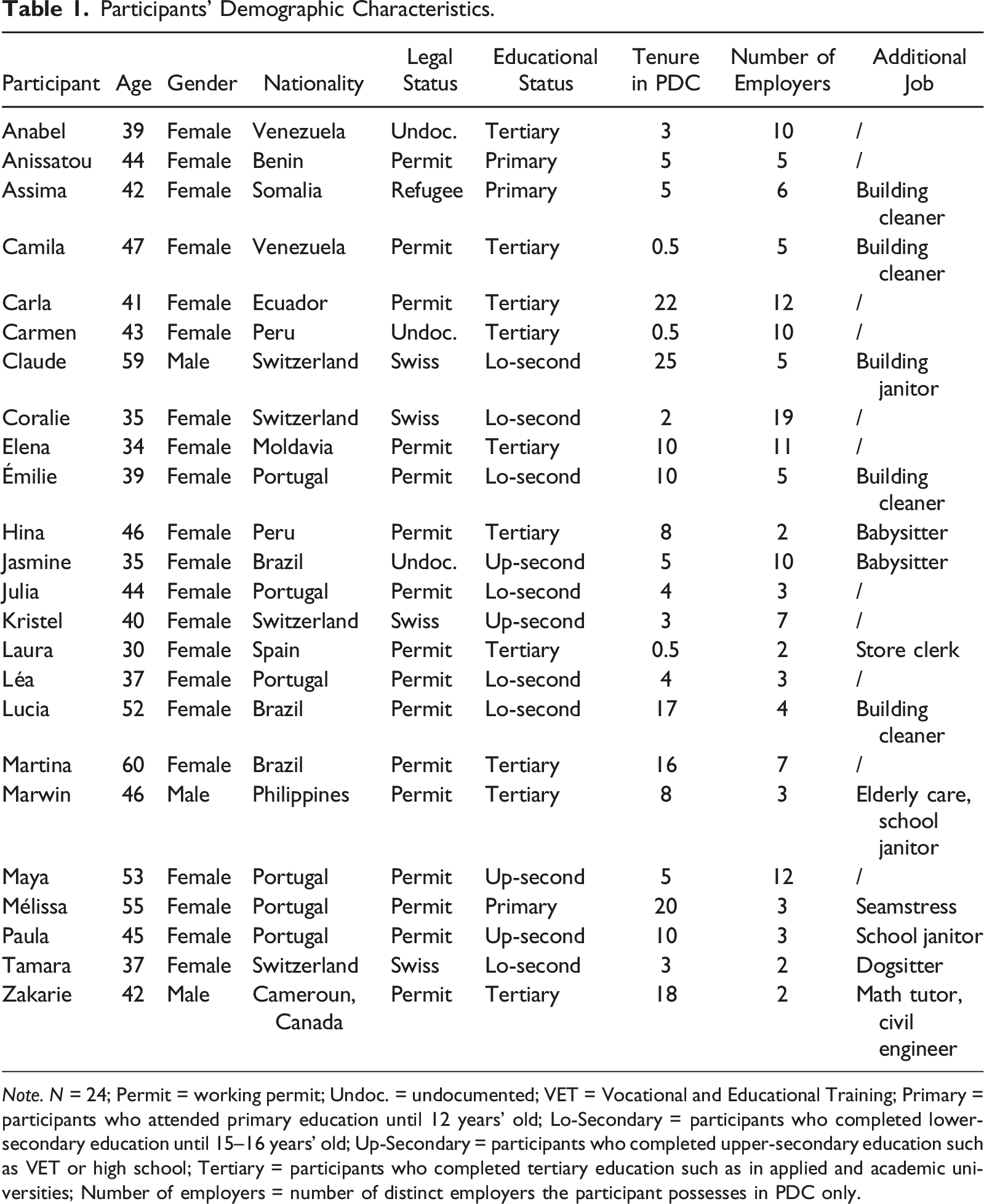
Note. N = 24; Permit = working permit; Undoc. = undocumented; VET = Vocational and Educational Training; Primary = participants who attended primary education until 12 years’ old; Lo-Secondary = participants who completed lower-secondary education until 15–16 years’ old; Up-Secondary = participants who completed upper-secondary education such as VET or high school; Tertiary = participants who completed tertiary education such as in applied and academic universities; Number of employers = number of distinct employers the participant possesses in PDC only.
Data were collected through semistructured interviews conducted by the first author (a male doctoral student in vocational and organizational psychology) and two female students engaged in vocational and health psychology master’s programs. Each interviewer performed about a third of the interviews and was proficient in French and either English, Spanish, or Portuguese. Hence, the interviewers met the participants individually and no translators were involved. Interviews were performed at participants’ homes (eight), at the university (five), or online (11) depending on participants’ preferences. By letting participants choose the most comfortable setting, we aimed to increase participation and decrease the power imbalance between researchers and participants (Restubog et al., 2021). The interview guide was elaborated using the WPF and dirty work literature. Our protocol included six sections (see Appendix A) among which (a) current work experiences regrouping sources of satisfaction, difficulties, and resources (e.g., “Can you tell me more about a typical day at work from the time you wake up until you go to bed?”), (b) work-related concerns such as precarity at work (e.g., “When you go to work, do you have any apprehensions?”), and (c) perceptions of the social image of PDC (e.g., “What do people think of your work?).
Three pilot interviews were conducted with PDC workers through convenience sampling to improve the interview guide and interviewers’ performance before data collection (Creswell & Poth, 2018). To ensure fidelity during data collection (Levitt et al., 2018), the interviewers and authors met regularly to discuss issues, needs, and first ideas, which enabled reflexivity and engagement throughout data collection (Braun & Clarke, 2022b). Field notes were also produced after each interview to summarize the interviews’ content and analysis reflections (Braun & Clarke, 2022b). The 24 research interviews lasted from 56 to 126 minutes (M = 83.5) and were transcribed verbatim from audio recordings. Nine interviews required translation, as four interviews were conducted in Spanish, four in Portuguese, and one in English (McKenna, 2022).
The research team was composed of the three interviewers (i.e., the two master students and the first author) and the second and third authors who are a female doctoral student, and a male associate professor in vocational and organizational psychology respectively. Data analysis was exclusively performed by the three authors and led by the first author. All five members possess first- or second-generation immigrant backgrounds (i.e., Brazil, Iran, Portugal and Sri Lanka). The three interviewers had family members involved in PDC which facilitated rapport-building during interviews. However, interviewers’ proximity to the population under study may have also produced biases and assumptions. The master students and the first author were close to a particular type of worker: migrant women with a stable residence permit, most often married, who worked in PDC to earn extra income for the household. Hence, the interviewers confronted their assumptions before data collection by conducting pilot interviews, participating in meetings with partner organizations, and observing short training sessions for PDC workers (e.g., health at work). This further exposition to the field of study allowed us to broaden our knowledge of different populations involved in PDC (e.g., undocumented workers, men) and their challenges (e.g. single parenthood, work-life balance, severe precarity). In addition, the first author’s counseling practice and associative engagements contributed to a vulnerability-oriented approach to analysis. Despite these precautions, the presence of participants with unforeseen backgrounds (i.e., Swiss nationals or highly educated participants) in our sample required adjustments to better understand their unique experiences such as losing social status. Therefore, the assistance of the second and third authors during the data collection and analysis process was essential. The second author, who recently arrived in Switzerland, had extensive counseling practice in Brazil allowing her to challenge interpretations resulting from reflexive interview notes and to bring new insights into the experiences of our participants, particularly those from Latin American countries, which represent the majority of our extra-European participants. The auditor’s background as an asylum seeker, and his extensive research experience and counseling practice with marginalized populations, helped provide theoretical foundations and a broader interpretation of our data.
Analytical Strategy
A reflexive thematic analysis (Braun & Clarke, 2006, 2019) approach was applied to data. This type of analysis is relevant to our research aims and conceptual framework because by combining both phenomenological and critical traditions of qualitative inquiry, it encourages researchers to critically address the roles of social context and inequalities (Blustein et al., 2019; Braun & Clarke, 2021a). Moreover, reflexive thematic analysis helps produce accessible findings and actionable recommendations for stakeholders (Sandelowski & Leeman, 2012).
Based on Braun and Clarke’s (2022b, 2022a) recommendations, and to ensure utility during analysis (Levitt et al., 2018), all authors engaged in data familiarization by first independently reading transcripts and field notes from interviewers. The first author also participated in data collection, transcription, and translation of interviews, contributing to data familiarization (Braun & Clarke, 2006). Secondly, the first and second authors independently generated initial codes from the integrality of the data. Then, initial themes were constructed from codes. At this stage, the three authors held several meetings to rectify or combine codes, review potential themes by discussing their coherence and consistency, define and name the final set of themes relevant to our research aims, and review the final report (Braun & Clarke, 2022b; Byrne, 2022). During data collection and analysis, the third author served as an auditor to ensure dependability throughout the process (Nowell et al., 2017). This was achieved by ensuring that the methodological and analytical decisions were made based on a clear shared rationale, and by providing feedback on intermediary and final analysis reports. Based on Motulsky’s (2021) indications and our participant’s vulnerability, member checking was not performed in the present study. Our rationale stemmed from the risk of overburdening our participants, who would have to sacrifice income to participate, without the certainty of gaining in research quality (Motulsky, 2021).
Findings
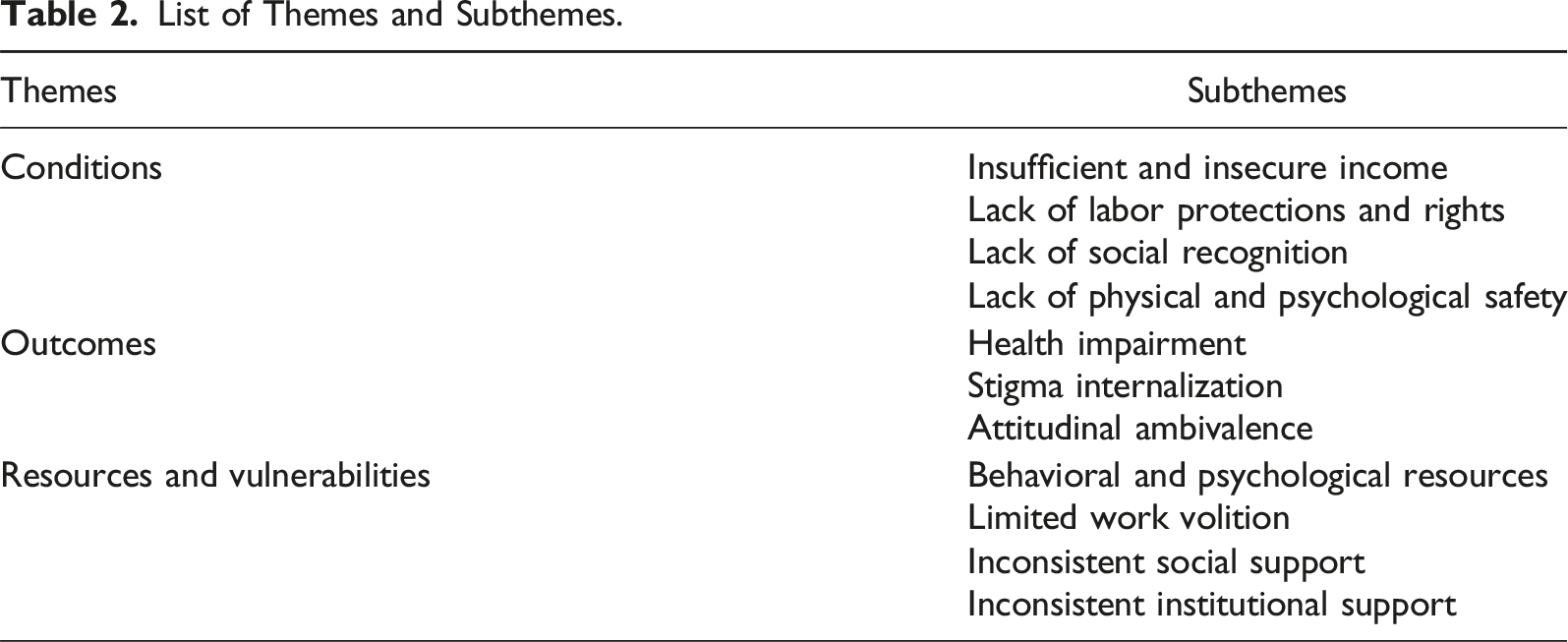
List of Themes and Subthemes.
Conditions
Participants reported precarious working conditions, starting with the insufficient and insecure income prevalent in PDC. Even though some employers paid fairly, participants’ total income was perceived as insufficient compared to the high cost of living in Switzerland or subsequent expenses, such as commuting from one employer to another. Moreover, participants’ occupational activity was fragmented into multiple contracts or sometimes holding other positions (e.g., store clerk or school janitor). The accumulation of multiple employers stemmed from efforts and concerns to limit the impact of potential job loss and secure a decent wage, as Martina explained: “You must try to have lots of customers, lots of hours of work. […] If I only worked for [cleaning company], I wouldn’t be able to live.” Yet, employment fragmentation did not prevent participants from having insufficient income. For instance, Laura expressed how she struggled to make ends meet despite two jobs and her partner’s financial support, stating that “between my two jobs, I hardly earn 2,000 (Swiss Francs) […] but I must pay for housing, health insurance, everything that comes.” Due to their undocumented immigrant status, some participants also reported feeling powerless and exploited, such as Jasmine: “It took me 3 months to find a job, and the [employer’s origin], she paid me 5 francs an hour.” This amount is fairly lower than national recommendations for a minimum of 20 Swiss Francs per hour for unqualified domestic workers (SECO, 2024).
Furthermore, workers’ incomes were also insecure due to contractual uncertainty. Work arrangements were uncertain in terms of the volume and the continuity of work. The number of hours varied weekly or monthly due, for example, to last-minute cancellations or changes in employers’ needs and expectations. Moreover, uncertainty also stems from abrupt and unexpected dismissal because informal contractual agreements can be easily broken. Maya expressed the issue of a fluctuating and uncertain income as follows: There are customers (i.e., employers) who, because of their financial situation, have stopped or intend to stop. If I find myself with a gap of 1500 (Swiss) francs, it’s enormous, and that’s what I fear, that one day a customer decides to stop, and then a second one […] This job is not secure, it’s not stable, because if you work for a company like [company name] or with a fixed contract and you’re stable, it’s okay, you have the same salary every day. But here, you don’t know if you’re going to get the same salary every day.
Hence, insufficient and insecure incomes not only compromise participants’ ability to secure a decent living but also generate daily concerns to deal with. Carmen illustrated this state of constant worries and vigilance regarding her expenses: It worries me a lot because with the houses and hours I have, declared or not, I fix a monthly budget. From there, I withdraw what I must pay for food and emergencies in case something happens to my children.
Beyond their immediate needs and everyday budget, economic concerns also undermine participants’ confidence in their ability to ensure longer-term needs for decent living, particularly after retirement, as summed up by Assima: “It scares me because if I don’t manage to earn well, I won’t live well.”
The lack of labor protections and rights also contributed to uncertainty and insecurity. Participants reported being only partially able to benefit from labor-market rules and protective regulations, such as claiming temporary sick leave or other officially paid leaves (e.g., maternity, vacations) due to employers’ non-conformity with labor laws or lack of institutional support, as in Martina’s case: There are laws in Switzerland to regulate cleaning work, but they (employers) don’t follow them. […] With these people, we’re helpless. I’ve tried to find help, to contact organizations that deal with this in [town]. But the last time I went there, the (administrative) lady told me, “Madam, if you want to stay and work in Switzerland, this is how it works.”
The combination of permanent economic insecurity and lack of labor protections pressured participants to compromise their health and well-being to secure sufficient income. Émilie illustrated one such dilemma experienced during her pregnancy: During my pregnancy, everything happened to me: I had diabetes, and my baby had a high probability of having trisomy 21. You must stop working because if you don’t, you can lose your baby, but I thought, “If I stop working, I won’t earn any money, as it’s (paid) by the hour.” So, I worked until two weeks before she was born, with difficulty, but I worked.
Participants also experienced depreciative and demeaning views conveyed by others, which undermined the social recognition of their work roles and contributions. When asked if PDC is subject to social devaluation, Claude was unequivocal, reporting the image of PDC as an unskilled and worthless job, bringing people to think that if “you’re not intelligent then you will be cleaning houses, you suck.” Other participants were more nuanced, such as Maya, who received mixed feedback on her work: “Some people think it’s a worthy job because it’s hard. Others say that being a cleaning lady is a job anyone can do, so it’s degrading. Sometimes people look at you as if you were shit, to be honest.” In Maya’s case, the lack of recognition and respect translated into degrading situations at work, such as excessive and unjustified suspicions addressed by employers: “(My employer) was always behind me, watching what I was doing and putting money everywhere […] a coin in the toilet, on the floor, or in the bedroom to see if you can be trusted.” Other participants shared feelings of being disrespected and invisible to employers who only note their work when they were unsatisfied. As Léa explained, “It’s a bit ungrateful sometimes because often people don’t notice what you’ve done. On the other hand, they quickly notice what you’ve missed.”
The lack of social recognition stemmed also from the disapproval of significant others. Coralie’s decision to change jobs and work full-time in PDC had mixed reception: “It surprised a few people, because generally, with cleaning ladies, we think immediately of the cliché of Portuguese or Spanish, this sort of thing. So, a Swiss woman setting up her own business was surprising.” In other cases, PDC prompted strong reactions from family members. Lucia recalled how her sisters were ashamed of her job: “My sister told me, ‘I don’t go out with someone who cleans’”; to them, cleaning was “essentially for people who haven’t had the opportunity to study, it was just for poor people.”
The last theme identified regarding working conditions depicted a lack of physical and psychological safety. Anissatou explained how physically strenuous cleaning can be: “You need your arms most of all. You must wash the bathtub, bend down, clean the sink, and that really requires stamina.” She also described exposure to toxic substances, stating, “When you put certain products on, you inhale and it makes you cough, so that’s the hardest part. You must wear gloves because it damages your hands.” Participants were also exposed to psychologically unsafe conditions in various forms, such as abusive or excessive demands, as reported by Anabel: “Every time I arrived, the only thing I heard from this lady (employer) was ‘Quick, quick, quick.’ She wanted me to clean up to the ceiling.” Others described acts of intimidation or humiliation such as shouting, threats of dismissal, or degrading remarks and demands, as Tamara recalled: “You (employer) give me a toothbrush to clean your toilets? Seriously, do you think I’m in prison or what? They don’t do that to you even in prison.”
Dealing with the fragile equilibrium between economic and physical security, participants reported deteriorating health and rising worries about their sustained ability to work in the future, as Elena explained, stating, “The future is uncertain, as I say to myself, ‘Right now I can perform 8 or 9 hours (of work) a day, but in 10 years, will I be able to do it?’” Work–life balance was also put on standby to secure financial stability. When asked if she had time for herself or her family, Camila responded: No [laughs], I’m hoping opportunities to have time for myself will come along, but I must wait. You’re in a phase where you want to achieve goals, and to do that, you have to make sacrifices. […]. I don’t have time for my family, either. I don’t have time, and I can’t give it physically and emotionally, because I’m so tired of being out of the house for almost 12 hours.
Some participants decided to reduce their workload to deal with work–life conflicts, but for those who were deprived of alternative sources of income (e.g., partners, family, savings), decreased work equated to increased economic insecurity. The permanent feeling of being torn between professional duties and extraprofessional needs is illustrative of precarious working conditions.
Concerning participants’ working conditions depending on employers, they also reported working for fair ones who trusted them, were flexible in their expectations and demands, and respected their work. Although these observations are comforting, they still point out the precarious situation of PDC workers, who are highly dependent on employers’ goodwill and personal qualities—their fairness and compliance with regulations—to secure decent conditions.
Outcomes
Participants reported negative consequences of working in PDC at various levels, namely health impairment, stigma internalization, and attitudinal ambivalence. In terms of health-impairment outcomes, all participants reported either physical symptoms of heavy work demands, such as musculoskeletal disorders (“now I must be cautious, otherwise I suffer from my back.” [Mélissa]) stress-related pathologies (“I now have high blood pressure and diabetes because of stress and fatigue (from the pace) I maintain.” [Marwin]), or symptoms of psychological suffering due to adverse working conditions (“I wanted to cry, and I didn’t like myself […]. It was all part of a depression I was developing, and I didn’t want to admit.” [Julia, referring to relational difficulties with her employer]).
Signs of stigma internalization were also observed in participants’ accounts, referring to the impact of degrading and demeaning social views of PDC on their perceived social and professional status. For example, participants with a high educational background were ashamed of working in PDC, as explained by Zakarie, who held an engineering degree and a part-time job as a civil engineer alongside his activity in PDC: “(My colleagues) don’t know I wash dishes or do cleaning work. I don’t give them all the details. I said that I work for a private individual and sometimes I give private lessons.” Camila, who had a career as a judge in her home country before migrating, experienced PDC as a hurtful downgrade to her social and professional status: “Sometimes, I’m depressed and I say to myself, ‘God, after studying so much in my life and after being what I’ve been, cleaning houses today while I had people cleaning mine in my country is not easy.’” Alongside her status decline, Camila internalizes the stigma that unskilled immigrants with low school attainment should content themselves with low career aspirations: “I have to force myself to see that it (PDC) is also perfect for me because I’m not a normal case; I am not just any lawyer, I’m an immigrant, so I must also consider it as perfect, too.”
Lastly, attitudinal ambivalence was identified through mixed or competing feelings regarding PDC. On one hand, participants maintained work engagement and satisfaction by mobilizing various strategies, such as considering their actual employment as a bridge toward better career options (“I see it as stages I have to pass through to get to where I want to be.” [Laura]), focusing on enjoyable job contents (“Many women and men do this work reluctantly. […] That’s not my case, because I enjoy what I do.” [Elena]) or drawing on their contribution to others to feel useful and appreciated (“In domestic cleaning, I feel useful. For example, I have two elderly people who are very happy when I arrive.” [Lucia]).
On the other hand, such strategies led to mitigated satisfaction, often accompanied by regrets about former career choices or disengagement from current work. Indeed, participants’ obligation to focus on survival needs at the expense of career aspirations prompted them to settle for the least-worst decision among a set of unattractive alternatives, as Lucia reported. I don’t know about others, but the truth is that I don’t like cleaning. I am forced to, it’s the way I found to work. Someone could tell me, “You can work in a supermarket.” I could, but I don’t want to do that either, because at least cleaning allows me to get out for some fresh air when I am moving from one house to another.
Furthermore, Elena’s case well illustrated the coexistence of mixed or contradictory attitudes and feelings of helplessness and self-blame when reflecting on her career path, as she stated, “I think I could have done better. Did I work hard enough? […] Did I invest too much in the family to the detriment of myself as a professional? Yes.”
Resources and Vulnerabilities
Our analyses also brought us to observe the availability (or lack thereof) of participants’ resources. By resources, we refer to personal, social, or contextual factors that alleviate participants’ work precarity by providing them with more employment opportunities and better working conditions or helping them cope with work-related demands. More specifically, we identified four subthemes to describe participants’ resources (i.e., behavioral and psychological resources) and vulnerabilities (i.e., limited work volition, inconsistent social support, and inconsistent institutional support).
Personal resources stemmed from participants’ proactive and assertive behaviors. By actively searching for new employment opportunities, enhancing their professional network, and investing in their career development (e.g., continuous education in another sector), they could claim better working conditions, resist abusive employers, and negotiate decent employment arrangements. To illustrate this, Carla displayed a strong sense of personal control and agency to overcome her vulnerabilities: “With employers, if I can’t take it anymore, I leave, but I’m always replacing them with someone new. That was how I got paid vacations and sickness leave, even without a working permit.”
Alongside these behavioral strengths, other resources were also identified in terms of positive psychological states, protective mental dispositions, or personal beliefs. Examples of such resources arose in Kristel’s optimistic attitude (“I’m a positive person, I try to see the good side of things because we have to move forward.”), Carmen’s sense of resilience (“With the experience of cleaning houses, you realize that you have the strength to do anything, you have the courage to do anything.”), and Hina’s faith (“I think the most important thing for me is that I’ve come to hold on to my faith. […] I think that’s something that has supported me a lot until now and allows me to move forward.”).
However, regardless of their strengths and efforts, participants were limited in their work volition in the face of various hindering factors, such as a low educational background (“All my job applications have been rejected, as I’m not yet trained as a healthcare assistant.” [Paula]), a precarious legal status (“I want to find a job that gives me financial stability, but I can’t because I can’t get a working permit.” [Jasmine]), or the combination of a language barrier and family duties (“Sometimes I say to myself, ‘I’m young, what am I doing in cleaning? I could do something else.’ It used to be because of my French, but now with my daughter, I’ll stay like this while she needs me.” [Emilie]). Thus, it appears that, despite personal resources that may help them cope with the adversity and demands of their current work, participants are also exposed to vulnerability processes and structural barriers that hinder possible evolutions and limit their career options to PDC. Carla’s words depict this feeling of helplessness and entrapment: “Now it’s too late. I can’t see myself as a cleaner when I’m fifty, but I’m sure I’ll carry on cleaning because I won’t be able to study.”
Our results show the inconsistent role of social networks, representing supportive resources for some participants while adding to the pressure for others. For example, whereas family provides financial support for Léa to maintain a reasonable workload (“My husband also works, so what I do is enough to put a little butter on the bread.”), Anissatou must strive for more income as the main breadwinner for her family (“I have my mum and dad back home. They need me, so I must continue pushing forward.”). Furthermore, different types of relations contribute in different ways. For instance, whereas family generally offers emotional support and understanding through hard times (“My husband has always given me strength and told me, ‘Find something else because you can leave this (employer)’” [Julia]), employers also support participants in more instrumental (e.g., by facilitating language learning, recommending new employers) or administrative (e.g., by helping in legal status procedures) ways. However, it also appears that participants often benefit from insufficient or inefficient social support, because their personal networks are marked by the same vulnerabilities and stigmas that they face. Jasmine illustrated this concept in talking about her aunt as her only relative in Switzerland, describing, “I couldn’t rent anything because I didn’t earn enough. My aunt was on AI [invalidity insurance) and people on AI have difficulties getting a flat, so she couldn’t help me with that, either.”
Finally, inconsistent institutional support was also observed. On one hand, holders of a work permit or Swiss nationals, such as Claude, were eligible for social benefits, which helped reduce financial pressures and worries: “Financially, I could sincerely live without my employers, but it allows me to offer myself something if I feel like it.” On the other hand, members of marginalized populations, such as undocumented workers, could only count on local associations to provide exceptional, short-term, or emergency support, as Jasmine recalled: “I lost a lot of work during the [COVID-19] pandemic, as I was working for elderly people. It was [humanitarian institution] that helped me pay the rent and gave me a voucher for food.” It appears once again that legal status is crucial when it comes to accessing sustainable supports that help alleviate precarity.
Discussion
The present study built on the WPF to investigate work precarity among PDC workers in Switzerland. In the following section, we discuss our main findings based on our study objectives, which were aimed at understanding (a) if workers in PDC faced precarious working conditions, (b) how they experienced work precarity, and (c) to what extent they could access protective resources against such precarity.
PDC as a Precarity Trap
Precarious work accumulates sources of insecurity and strain stemming from unstable employment, insufficient income, lack of workers’ rights, and lack of protection from physically and psychologically unsafe working conditions (Kalleberg & Vallas, 2017). Our findings echo the five conditions proposed by the WPF (Allan et al., 2021), indicating that PDC may represent an emblematic form of precarious work because it (a) involves insecure and fragmented employment based on informal work agreements with numerous employers; (b) leads to economic insecurity due to low and unregulated wages, hidden costs (e.g., commuting, working material), or lack of social benefits; (c) requires workers with limited power to negotiate for decent work arrangements, leaving them isolated and highly dependent on employers’ generosity or compliance with laws and regulations; (d) regroups particularly vulnerable workers (e.g., undocumented or unskilled) who cannot claim workplace protections and rights because they fear retaliation and denunciations; and (e) exposes workers to physically and psychologically unsafe working conditions.
Our investigations of participants’ predominant concerns also show that PDC workers may experience all three forms of work precarity, as Allan and colleagues (2021) proposed, namely precarity of (e.g., fear of work discontinuity), at (e.g., fear of physical injury or psychological abuse) and from work (e.g., fear of unsatisfied basic needs). In the face of unpredictable variations in work quantity and continuity, participants experienced a state of permanent uncertainty about their abilities to secure their immediate and long-term financial needs. To cope with such uncertainty, participants were forced to make sacrifices such as maintaining a high workload or accepting unsafe and indecent working conditions, thus compromising their health in the long run, or overlooking initiatives to develop their career (e.g., language or vocational training) due to fatigue and lack of time.
Literature on precarious work has drawn attention to the impact of income insecurity on life and work choices and its related psychological costs. Bosmans (2023) found that workers’ precarious employment status leads to postponing important personal and household decisions, such as getting married, having a child, or undertaking a career change. It is possible to explain such disruption and reframing of life goals through individuals’ tendency to deploy a scarcity mindset in situations of precarity and poverty, in which they allocate their main attention and cognitive resources to solving the immediate sources of scarcity (Sayre, 2023). In our findings, such psychological efforts are invested in unsolvable dilemmas opposing immediate survival needs and distal goals to preserve health and well-being. Thus, precarious work may act as a career trap by hindering workers’ ability and agency to perform future-oriented decisions and engage in activities to escape precarity.
PDC as Precarious and Dirty Work
Drawing on the literature on dirty work (Ashforth & Kreiner, 1999), we proposed social stigmatization as a sixth condition that may interact with actual employment conditions to exacerbate work precarity. Our results show the broad impact of PDC’s negative social image on working conditions, thus endangering workers’ physical and psychological safety. Participants reported being exposed to risks of diseases or injuries, in line with studies on other cleaning workers such as garbage collectors (Hughes et al., 2017) or external cleaning agents (Deery et al., 2019), and echoing workplace hazards generally identified in dirty work (Simpson & Simpson, 2018). Furthermore, our results highlight the power imbalance that may open the door to employers’ degrading and abusive behaviors, reminding us that the social taint attached to dirty work may also compromise workers’ psychological safety (Khan et al., 2023). It has also been argued that dirty work’s lack of recognition undermines access to labor rights and protections by contributing to a situation of legal invisibility (Rabelo & Mahalingam, 2019), which we also observed in our participants’ discourses. Moreover, it appears that the combination of poor social recognition and gendered perceptions that fail to recognize women-dominated occupations—as is the case for PDC—as real work could further exacerbate such invisibility.
Finally, dirty work’s bad reputation may also affect workers’ access to social support, as illustrated by our participants’ occasional experiences of incomprehension of, rejection by, or conflicts with family members. It appears, then, that an intersection of social and physical taint (Terskova & Agadullina, 2019), marginalized identities (e.g., low-status and immigrant women; Duffy, 2007), and lack of occupational prestige (Ashforth & Kreiner, 2014) can contribute to depriving PDC workers of sufficient social support.
PDC as Unsafe and Isolated Work
In the previous sections, we discussed how PDC can impact workers’ career development by limiting their opportunities to escape precarity and attain decent work. Other negative consequences of PDC were identified in terms of health impairment, stigma internalization, and attitudinal ambivalence. Independently from their tenure in PDC, all participants experienced adverse working conditions with negative consequences for their physical and mental health. Such results, in line with former studies (Lewchuk, 2017), are all the more alarming because the solitary and invisible nature of PDC work prevents external interventions or institutional support to prevent psychosocial risks, thus exposing workers to long-term hazards.
In addition to workplace stressors, our results also highlight the role of social pressures in demeaning workers’ sense of identity and self-esteem. Although previous studies on dirty work have highlighted workers’ collective strategies to preserve a positive occupational identity (Ashforth & Kreiner, 1999), our participants generally expressed difficulties in dealing with the social stigmatization of PDC, accompanied by feelings of regret, self-devaluation, and worthlessness. Again, it is important to note that, as PDC is performed alone in dispersed households, it may deprive workers of supportive and collective occupational identities via social validation from peers or managers (Ashforth & Kreiner, 2013).
Finally, our participants’ ambivalent attitudinal outcomes echo previous studies highlighting that the search for meaning and satisfaction in precarious work is a complex and equivocal task. Valenzuela and colleagues (2023) well illustrated precarious workers’ tensions between positive (e.g., learning opportunities or economic independence) and negative (e.g., restrictions and barriers for future career development) aspects of their work. Other authors have also considered that, despite their precarious and indecent working conditions, workers can still mobilize strategies to experience meaningfulness (Blustein et al., 2023), although such experiences are subject to day-to-day or task-to-task variations (Shim et al., 2022). To explain this phenomenon, it is possible to draw on the satisfaction paradox, which posits that workers in so-called bad (dirty/low-status) jobs paradoxically report higher levels of satisfaction through a reframing process that brings them to focus on work’s positive attributes while lowering their aspirations to enhance job satisfaction (Léné, 2019).
PDC as an Attractor of Vulnerabilized Workers
Alongside the negative outcomes presented previously, our analysis also identified limited personal resources to overcome the lack of social and institutional support. Some participants reported important personal resources in terms of human capital (e.g., former educational attainment), social capital (e.g., emotional and instrumental support from significant others), or psychological capital (e.g., sense of control over work and proactivity to negotiate favorable working arrangements). However, these resources were limited, only occasionally present, and generally insufficient to overcome precarity. For instance, even though emotionally significant, participants’ social networks were generally marked by similar socioeconomic vulnerabilities and thus instrumentally impotent to support them. The positive impact of participants’ former education was also hindered by their legal and immigration status, which prevented the official recognition of former diplomas and degrees. It appears that, despite their personal resources and efforts, participants must bear the weight of acute and overwhelming marginalizing factors. For instance, in line with former studies (Clark & Bower, 2016; McWhirter & McWha-Hermann, 2021), our results show that parental situation (e.g., being a single mother) or immigration status (e.g., being a recent migrant with a precarious legal situation and poor language skills) constrain labor integration and career development. It seems, then, that the intersection of the factors involved in being a migrant woman contributes to a vulnerability process (Spini et al., 2017) that hinders individuals’ capacity to avoid or to escape PDC, thus contributing to their entrapment in precarious work.
Limitations, Future Research Directions, and Implications for Practice
Several limitations must be considered with our results. First, our study focused on shared experiences of work precarity among a very specific sample of workers in a women-dominated occupational sector, recruited in the French-speaking part of Switzerland and based on their proficiency in a set of languages used for the interviews (i.e. French, Spanish, Portuguese, and English). Future research could expand and focus on distinct populations and other occupational sectors with varying distributions of gender, cultural communities, contractual stability, or workplace characteristics. Second, as we focused mainly on the experience of work precarity in PDC without fully considering the influence of previous work experiences and challenges, the life course and career trajectories preceding PDC remain unexplored. Past experiences of resource deprivation, trauma, or oppression may have impacted the present work experiences, for instance by reducing participants’ expectations towards work, increasing their risk of developing mental health issues, or limiting their ability to stand up for decent work arrangements or to access important resources (e.g., supportive relationships). Thus, future research guided by the WPF could explore the role of structural constraints and related vulnerabilizing processes as drivers toward precarious work. In the same direction, a more dynamic investigation, based on daily variations or longitudinal evolutions of well-being, could identify individual strategies or contextual factors acting as protectors against work precarity.
Despite its limitations, the present study contributes to the literature on precarious work by highlighting experiences of work precarity among vulnerabilized workers in Switzerland. Our study provided detailed illustrations of conditions contributing to work precarity and degrading work experiences in PDC. Moreover, our results enriched our understanding of specific challenges such as social isolation, entrapment in precarity, and unsolvable dilemmas that may be transferable to workers in distinct national contexts and occupational sectors.
Furthermore, our findings provide potential avenues for policies and interventions to enable domestic workers to attain more decent work or more meaningful career opportunities. Interventions at the policy level must account for the specificities of domestic work, which is performed secluded from an overarching organization. In Switzerland, this occupational sector requires stronger regulations, better monitoring, and greater social recognition efforts to guarantee basic employment standards. The domestic work sector is currently excluded from most labor laws. Hence, regulation efforts require the implementation of a national collective agreement with legal protections adapted to the specificities of the sector. More precise and comprehensive statistics on workers’ characteristics and working arrangements are also needed. National and regional campaigns could better highlight the important role of domestic workers and make employers more aware of their responsibilities. Greater social recognition could also stem from the development of continuous training opportunities specific to domestic work. In addition, PDC workers need support from intermediary institutions with legal authority to mediate and monitor employer-employee relations. Such institutions could counsel both parties during disputes, denounce law violations, promote best practices among employers, and ultimately strengthen workers’ rights and remedies. Finally, workers would benefit from career development support and services in or outside of PDC. Our results show that participants generally lacked the time, energy, and financial resources to invest in career counseling. This calls for the development of tailored career interventions, more adapted to the needs and constraints of this type of workforce. This can be addressed by improving the inclusivity and efficacy of the existing services, for example, through financial incentives, flexible office hours, or holistic interventions, combining social work, legal advice, and career counseling, that support workers in multiple life domains.
Conclusion
The present study investigated experiences of work precarity among PDC workers in Switzerland. Our findings revealed that PDC workers face precarious and unsafe conditions due to insecure and insufficient income, lack of labor protections and rights, and exposure to physical and psychosocial risks. Workers also experienced negative outcomes such as health impairment, stigma internalization, and attitudinal ambivalence. Finally, protective personal, social, and institutional resources were identified as limited or inconsistent. It appears then that PDC workers represent a vulnerabilized group, at risk of enduring long-term precarity, because they lack support and protections, and alternative career options and opportunities. Based on our results, we advocate for stronger policies and tailored career counseling services to support domestic workers in Switzerland.
Footnotes
Acknowledgments
We thank Diana Matos Barbosa, Merry Nivetha Anthonipillai, and our partner organizations, Entraide Protestante Suisse (EPER) and Camarada, for contributing to data collection. We also thank Miika Kekki and Nimrod Levin for their helpful comments on earlier versions of this paper.
Declaration of Conflicting Interests
The author(s) declared no potential conflicts of interest with respect to the research, authorship, and/or publication of this article.
Funding
The author(s) disclosed receipt of the following financial support for the research, authorship, and/or publication of this article: Our work was funded by the Young Scholars Grant from the LIVES Centre.
