




Abstract
Digital platforms have reshaped labour markets worldwide, increasing gig work opportunities, particularly for motorbike delivery riders in South Africa, a country grappling with high unemployment. However, these self-employed workers often face a lack of job security, benefits, and protections due to informality, weak labour laws, and deep socioeconomic inequality, highlighting the contrast with the International Labour Organisation’s decent work principles. This research explores the work experiences of platform-based motorbike delivery riders in South Africa, aiming to improve our understanding of platform-based work and decent work experiences in the gig economy. Within a constructivist paradigm, this study adopted a qualitative descriptive design to investigate the experiences of motorbike delivery riders in Gauteng, South Africa, with ten participants each undergoing two interviews. The data were analysed through hybrid thematic analysis. Findings reveal that precarious gig conditions and structural inequalities influence rider’s experiences of decent work, which can be categorised into three interconnected decent work themes: (1) safety and healthcare, (2) income security, and (3) work–life balance. This research underscores the need for context-sensitive applications of the psychology of working theory, acknowledging the complex interplay of economic constraints, access to decent work, and the fulfilment of psychological needs in the gig economy.
Introduction
The rise of digital platforms has transformed labour markets globally, introducing new forms of gig and platform-based work, in which workers perform tasks arranged through digital platforms (Berg et al., 2018; De Stefano, 2016). These platforms have been praised for offering flexibility and providing income opportunities, particularly for those excluded from formal labour markets (Giddy, 2022; Goods et al., 2019). Proponents of platform-based work highlight its ability to create low-barrier entry points for workers in economies with high unemployment rates and informal labour markets, such as sub-Saharan Africa, Latin America, and Southeast Asia (Cieslik et al., 2022). However, an expanding body of research underscores the precarious nature of platform work, raising concerns about income instability, lack of social protection, and the algorithmic control imposed by digital platforms (Goods et al., 2019; Heeks et al., 2021; Ludwig & Webster, 2020). In this regard, the digital platform economy is fundamentally reshaping labour markets by creating a work structure characterised by flexibility, non-standard employment relationships, and increased reliance on digital intermediation (Ludwig & Webster, 2020; Sibiya & Du Toit, 2022). Although being praised for offering job opportunities to youths, migrants, and workers with limited access to traditional employment, platform work has also deepened concerns about worker vulnerability (Cieslik et al., 2022; Da Silva, 2020).
Motorbike delivery riders represent one of the precarious segments of platform labour (Cieslik et al., 2022; Goods et al., 2019; Van Belle et al., 2023). In Africa, and particularly in South Africa, digital labour platforms have grown rapidly due to high mobile internet penetration, rising urbanisation, and the urgent need for employment in economies characterised by persistent inequality and job scarcity (Giddy, 2022; Mokofe, 2022; Van Belle et al., 2023). Studies show that these workers operate under intense pressure to meet delivery deadlines, leading to long working hours, unsafe working conditions, and high accident rates (Da Silva, 2020). Empirical research suggests that platform work in South Africa reinforces existing socio-economic disparities, particularly through the widespread classification of workers as independent contractors (Mokofe, 2022; Sibiya & Du Toit, 2022; Van Belle et al., 2023). This legal status allows platforms to sidestep basic labour protections such as minimum wage, paid leave, and social security. As these workers operate outside the traditional employment relationship, they fall into a regulatory blind spot and are excluded from the rights and benefits afforded to employees (Berg et al., 2018; Goods et al., 2019).
In this regard, the International Labour Organization (ILO) has raised concerns that such exclusion can leave workers without protection of fundamental labour rights (De Stefano, 2016). Therefore, this model of work stands in stark contrast to the ILO’s Decent Work Agenda (DWA), which calls for fair income, security, and social protections for all (Berg et al., 2018). Alongside the Sustainable Development Goals (United Nations, 2015), the DWA aims to create a more sustainable and equitable world by promoting decent work and inclusive economic growth.
Although not specific to any one group, the DWA particularly emphasises the promotion of decent work for precarious and informal workers (International Labour Organization, 1999). Marginalised groups or those experiencing economic constraints, such as working-class, informal, and immigrant workers, are often the implied focus of the DWA, as they are primarily employed in industries and positions that are more likely to have poor working conditions, low pay, and limited opportunities for career advancement (Blustein, 2006, 2008). According to Van Belle et al. (2023) and Goods et al. (2019), platform-based delivery riders consist predominantly of working-class individuals and migrants who face significant socio-economic constraints that influence their access to secure, dignified, and sustainable employment. Unlike workers in formal employment, these riders work as self-employed contractors, without job security, social protection, or standard employment benefits (Van Belle et al., 2023). In this regard, platform-based workers frequently have low wages, long working hours, and no social protection (Cieslik et al., 2022; Goods et al., 2019). Moreover, the physical risks associated with motorbike delivery work, including high rates of road accidents, exposure to crime, and irregular working hours further exacerbate the precarity of this type of work (Da Silva, 2020; Goods et al., 2019). The significance of these working conditions is underscored within the context of South Africa’s high unemployment and widespread precarious work conditions (Ludwig & Webster, 2020; Mokofe, 2022).
While existing studies have predominantly examined platform labour in the Global North (Abkhezr & McMahon, 2022), much less attention has been given to the unique challenges and opportunities faced by gig workers in Africa, where informality, weak labour protections, and socio-economic inequalities shape digital work vastly differently (Cieslik et al., 2022; Mokofe, 2022; Van Belle et al., 2023). In addition, critiques of the DWA suggest that its strong emphasis on statistics and macro-level indicators tends to overlook the nuanced and subjective dimensions of people’s lived experiences at work, which may be better captured through qualitative research (Blustein et al., 2016; Burchell et al., 2013). As such, psychological research on decent work is crucial for gaining an understanding of workers’ subjective experiences (Blustein et al., 2016; Duffy et al., 2020), and is particularly relevant for precarious and informal work that does not meet traditional decent work criteria (Blustein, 2008). By examining the work experiences of platform-based motorbike delivery riders in South Africa, this research offers a more nuanced and contextually relevant understanding of platform-based work and how it relates to decent work in a gig economy.
Decent Work (Agenda)
The DWA was developed by the ILO in response to global challenges such as persistent inequality, poverty, and the need for sustainable development (International Labour Organization, 1999). The DWA recognises that work is more than a source of income; it is also a source of personal dignity, family stability, community peace, and broader economic development. Marginalised groups or those experiencing economic constraints, such as working-class, informal, and immigrant workers, are often the implied focus of the DWA, as they are primarily employed in industries and positions that are more likely to have poor working conditions, low pay, and limited opportunities for career advancement (Blustein, 2006). Additionally, these workers often take up precarious work due to a lack of choice (Allan et al., 2020; Blustein, 2008; Duffy et al., 2016). Precarious employment is typically marked by instability, low wages, limited benefits, restricted career prospects, and pervasive uncertainty (Allan et al., 2021; Blustein, 2006). Workers in such roles often face social marginalisation, financial hardship, monotony, fatigue, and negative health outcomes (Allan et al., 2021; Blustein, 2006). Some scholars argue that precarious work directly contrasts with the ILO’s concept of decent work (Allan et al., 2020; Blustein et al., 2020).
Since the 2000s, decent work has been considered a dynamic and evolving concept that encompasses multiple dimensions aimed at fostering dignity, security, opportunity, and fairness in employment (Ghai, 2003). The ILO identifies ten key indicators that define decent work: employment opportunities; adequate earnings and productive work; decent working time; balancing work, family and personal life; work that should be abolished; stability and security of work; equal opportunity and treatment in employment; a safe work environment; social security; social dialogue; workers’ and employers’ representation; and the economic and social context for decent work (International Labour Organization, 2013). These indicators serve as benchmarks for assessing labour conditions across different contexts. However, the broader economic and social environment also plays a crucial role in shaping decent work experiences, as working conditions are influenced by cultural and social factors (Blustein et al., 2019).
The Psychology of Working Theory
In vocational psychology, the Psychology of Working Theory (PWT) aligns with the DWA in emphasising the attainment of decent work as central to human wellbeing (Blustein, 2008; Duffy et al., 2016). In essence, the PWT posits that access to decent work is essential for fulfilling individuals’ basic needs of survival, social relatedness, and self-determination, which in turn, promote overall wellbeing and job satisfaction (Duffy et al., 2016). Developed to complement existing vocational theories, the PWT seeks to enhance the understanding of work experiences, particularly among individuals from poor and working-class backgrounds (Blustein, 2006, 2008; Duffy et al., 2016). Decent work is considered the heart of the PWT as it focuses on the psychological experiences of individuals in relation to their work, with particular attention to those facing marginalisation and oppression (Blustein, 2006; Duffy et al., 2016). Unlike traditional career theories, the PWT explicitly accounts for the role of contextual factors such as social class, privilege, and autonomy in shaping individuals’ work lives (Blustein et al., 2016; Duffy et al., 2016). These broader social and economic conditions significantly influence individuals’ access to employment opportunities, particularly their ability to secure work that aligns with their values and aspirations (Blustein et al., 2016). Despite the theory’s original intent to foreground the experiences of marginalised workers, most empirical studies have focused on relatively well-educated, middle-class populations, leaving the realities of those in economically constrained positions underexplored (Allan et al., 2014; Kekana et al., 2023; Pereira et al., 2019). As such, while the PWT provides a valuable framework for understanding work experiences, its scope should be expanded to reflect more accurately the lived realities of workers in diverse economic and social contexts.
In the approximately 100 quantitative studies that have tested various propositions of the PWT (Duffy et al., 2024), most studies have conceptualised and measured decent work utilising the Decent Work Scale (DWS) developed by Duffy et al. (2017). This scale measures five dimensions of decent work: safe working conditions, access to healthcare, adequate compensation, free time and rest, and complementary values. Although originally developed in the United States, the DWS has been adapted and tested in various national contexts and languages (see Duffy et al., 2020 for an overview of these cross-cultural studies). Yet, some cross-cultural validations studies revealed subjective dimensions of decent work such as prosocial engagement, professional growth, respect, equality, and autonomy, that are not captured or measured by the DWS, suggesting the scale may not fully encapsulate the construct of decent work (Buyukgoze-Kavas & Autin, 2019; Dodd et al., 2019; Ferreira et al., 2019; Nam & Kim, 2019). These differences highlight the importance of cultural and psychological perspectives in measuring decent work, as individuals’ subjective experiences often extend beyond basic working conditions to include emotional and relational aspects of work (Blustein et al., 2019).
The Present Study
Psychological research on decent work is crucial for gaining an understanding of workers’ subjective experiences particularly for precarious and informal work that does not meet traditional decent work criteria (Blustein, 2008; Duffy et al., 2020). With most decent work studies focusing on well-educated, middle-class populations, the realities of those in low-income and precarious employment contexts are underexplored especially in sub-Saharan countries (Kekana et al., 2023; Pereira et al., 2019). It is against this background that our research qualitatively explored the work experiences of platform-based motorbike delivery riders in South Africa. In line with constructivism as research inquiry (Creswell & Creswell, 2023), our aim was to explore how participants make sense of and experience platform work, and to understand how these align with or undermine the principles of decent work as outlined by the ILO and vocational scholars in existing literature.
Method
Research Design Overview
This research employed a qualitative descriptive research design to explore motorbike delivery riders’ past and present experiences with a focus on their current working conditions. The research approach to inquiry is rooted in a constructivist paradigm (Creswell & Creswell, 2023), where we examined how riders made sense of their daily work. By exploring the lived experiences and prioritising the riders’ own perspectives (Creswell & Poth, 2025), we aimed to uncover the nuances of their working lives, emphasising interpersonal experiences and broader structural factors shaping their work experiences. This aligns with the constructivist view that meanings are shaped by the individual, social and contextual factors (Creswell & Creswell, 2023). This inquiry approach allowed for a rich, contextualised understanding of the realities of motorbike delivery work in contemporary gig economies in South Africa.
Utilising Seidman’s (2013) three-interview series design, allowed participants to construct their own narratives and to highlight what they find meaningful. The rationale for this design was to establish a deep understanding of the participant’s experience by exploring it through a temporal and reflective lens. This approach entails three distinct stages: a focused life history, the details of current experience, and a reflection on the meaning of their current experiences in relation to their past. In this research, these stages were operationalised across two separate encounters; the first interview focused on the participant’s life history, while the second interview combined the exploration of current daily experiences with a concluding reflection on the subjective meaning attached to those experiences. This specific adaptation was chosen to respect the time constraints and high mobility of the delivery riders while still ensuring that the depth required for a reflective narrative was achieved. This semi-structured format ensures flexibility while maintaining a structured framework for synthesis across participants. It also increases credibility through prolonged engagement with the participants (Morrow, 2005).
Researchers’ Positionality
As the research team, we acknowledge that as white, middle-class South African women, our identities and backgrounds differ significantly from the participants who were mainly Black migrant men, positioning us as outsiders to the research context. The first author’s outsider status may have influenced rapport during the interviews and data interpretation, while the second and third authors, though not directly involved in the data collection, shaped the study through their academic standpoints and perspectives on decent work. The influence of the second and third authors, was primarily on the conceptual framing of the research and methodological choices as reflected in their own academic backgrounds. However, this outsider positioning also provided a critical analytical distance, allowing the researchers to approach the data without the preconceived “taken-for-granted” assumptions that can sometimes affect insider researchers (Abalkhail, 2021).
Consistent with a constructivist approach, we acknowledge that knowledge was co-constructed through the dialogues between the first authors and the participants, allowing for the emergence of shared meanings. In line with our commitment to transparency and rigour in our constructivist enquiry to research, we engaged in sustained reflexive discussions to acknowledge, interrogate, and mitigate the influence of our positionalities on the research process. Throughout the research process we were cognisant of our responsibility to take a reflexive stance on our positionality and our own situatedness within the research context and therefore discussions between the three authors were held regularly to monitor our own biases and possible influence (Berger, 2015). By maintaining an “outsider” perspective, we were able to interrogate the structural and interpersonal nuances of the riders’ lives with a high degree of critical curiosity, potentially identifying patterns that an insider might have viewed as commonplace. Furthermore, because we were outsiders to the research context, we took an intentional perspective on the research-participant relationship to establish trust between the first author who conducted the interviews and the participants.
Sampling and Participants
Ten motorbike delivery riders employed by five different platform-based companies operating in Gauteng, South Africa, were selected using a combination of purposive, convenience, and snowball sampling (Suen et al., 2014). Participants were recruited in the well-established northern suburbs of Johannesburg. These areas are generally considered safe and are popular among families and professionals. We purposively selected individuals from five platform-based delivery companies operating in South Africa based on their services to deliver food, groceries, and other consumer goods (platforms were labelled A-E). Potential participants were approached at common gathering spots outside these stores, ensuring diversity by selecting participants from different platforms. Thereafter, snowball sampling was employed by asking the initial participants to refer co-workers to also partake in the research. Ten participants were interviewed twice by the first author (20 interviews). Each interview was transcribed and analysed before conducting the next interview with a new participant. This allowed for the tracking of emerging themes and monitoring when no new themes were arsing. Data saturation occurred as no new themes emerged and the participants indicated that they had no more information to share that they felt was important (Guest et al., 2006).
Participant Demographics (N = 10)
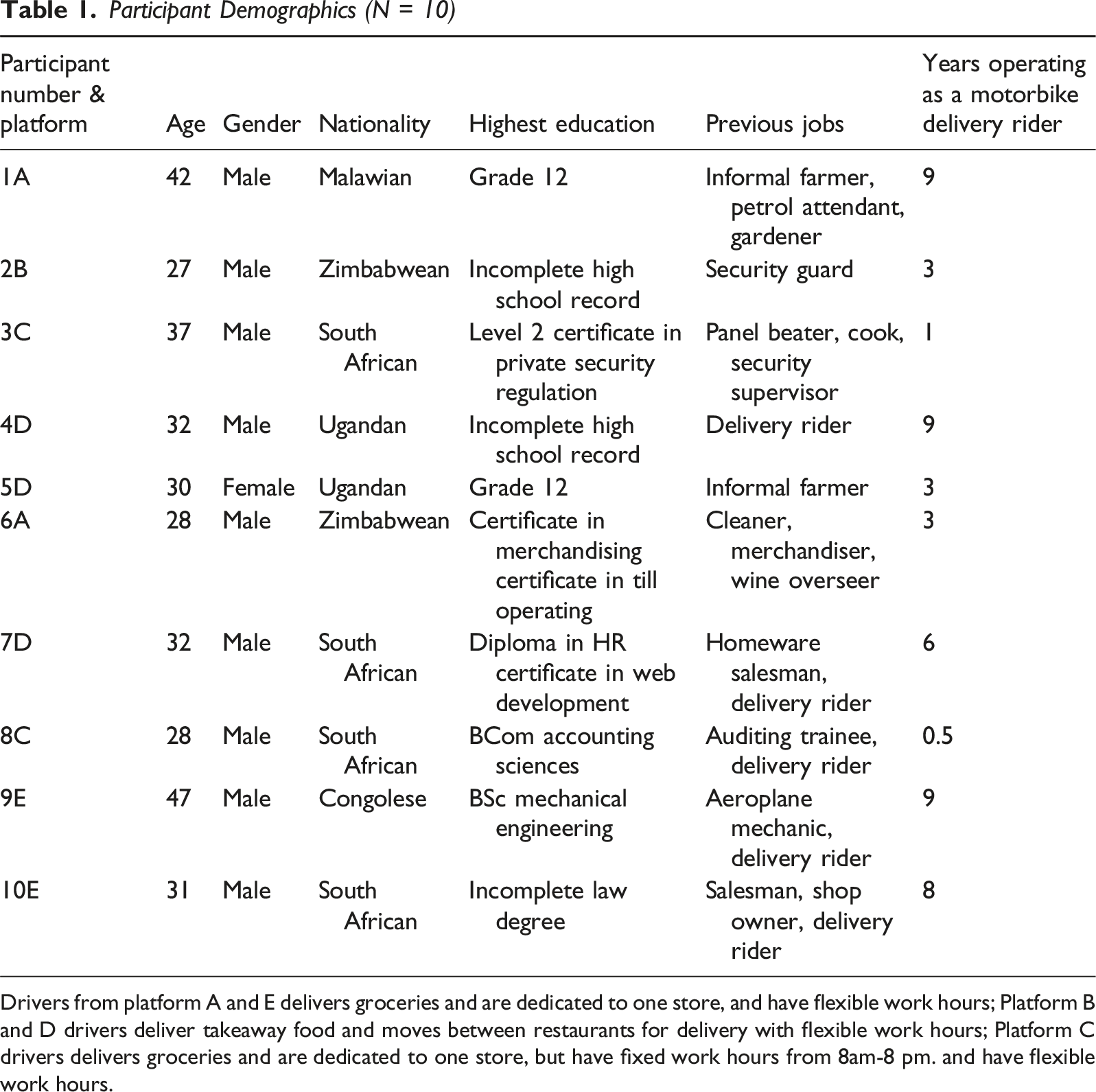
Drivers from platform A and E delivers groceries and are dedicated to one store, and have flexible work hours; Platform B and D drivers deliver takeaway food and moves between restaurants for delivery with flexible work hours; Platform C drivers delivers groceries and are dedicated to one store, but have fixed work hours from 8am-8 pm. and have flexible work hours.
Data Collection
Before data collection commenced, the purpose, procedure, and ethical considerations of the research were communicated to all the participants and ethical clearance was obtained from the academic institution which supported this research (Ethics number EMS171/24). The voluntary nature of participation was emphasised and participants were assured that they could refrain from answering any of the questions and could withdraw from the research at any time without any negative consequences. Following Seidman’s (2013) interview approach, data were collected through in-depth interviews where each participant were interviewed twice (two weeks apart, each interview lasting on average 45 minutes).
The first interview explored the participant’s life history and work trajectory. As per Seidman’s (2013) guidelines, the opening question of the first interview was ‘Please tell me, in as much detail as possible, all the things about your life that you feel are important for me to understand your background’. Follow-up questions were asked to probe participants’ work histories and previous employment experiences. The second interview focused on their current role and experiences as a platform-based delivery rider and the meanings they attach to their current work experiences. This interview began with the question ‘Please tell me, in as much detail as possible, about your experiences as a motorbike delivery rider.’ Follow-up questions included: ‘What is positive about this job?’ ‘What are the challenges of this job?’ and ‘If you could change something about this job, what would it be?’ The second and third interviews as reflected in Seidman’s (2013) approach were combined as meeting participants for a third time would have been logistically challenging and increased the risk of participant attrition. Based on discussions between the three authors, it was decided that the information obtained in the two interviews with each participant was comprehensive enough to not require a third interview. Each interview ended by asking participants if there was any more information which they feel is important or relevant that they would like to share, and follow-up questions.
Communication techniques such as summarising, paraphrasing, and extended pauses were utilised to encourage participants to expand on their responses. At the end of each interview, participants were encouraged and invited to share additional thoughts or ask questions (Seidman, 2013). It was during these concluding summaries that participants frequently indicated they had no further information to share, suggesting that the combined interview format successfully captured a comprehensive narrative. The deliberate use of open-ended, non-leading questions ensured that participants could frame their experiences in their own terms, and minimised the influence of our assumptions during the interview process. All interviews were conducted in English by the first author and were audio-recorded and later transcribed in Microsoft Word for analysis. To ensure anonymity personal identifiers were removed from the transcripts. Data were securely stored on a password-protected computer and only the researchers involved had access to the data.
Data Analysis
For data analyses, a hybrid thematic analysis approach (Swain, 2018) was employed. This approach combines both deductive (theory-driven) and inductive (data-driven) coding to identify themes and sub-themes. It is particularly useful when researchers want to explore predefined theoretical constructs, such as those drawn from existing frameworks, while remaining open to emergent themes that arise from the participants’ experiences. Within the typology established by Braun and Clarke (2022), this approach mirrors a codebook thematic analysis in its use of a structured framework, however, we remained aligned with constructivism by treating those codes as “sensitising concepts” rather than fixed containers. This enabled an analysis that integrates existing frameworks and new insights, making it particularly suitable for expanding theoretical understanding in under-researched contexts like platform work.
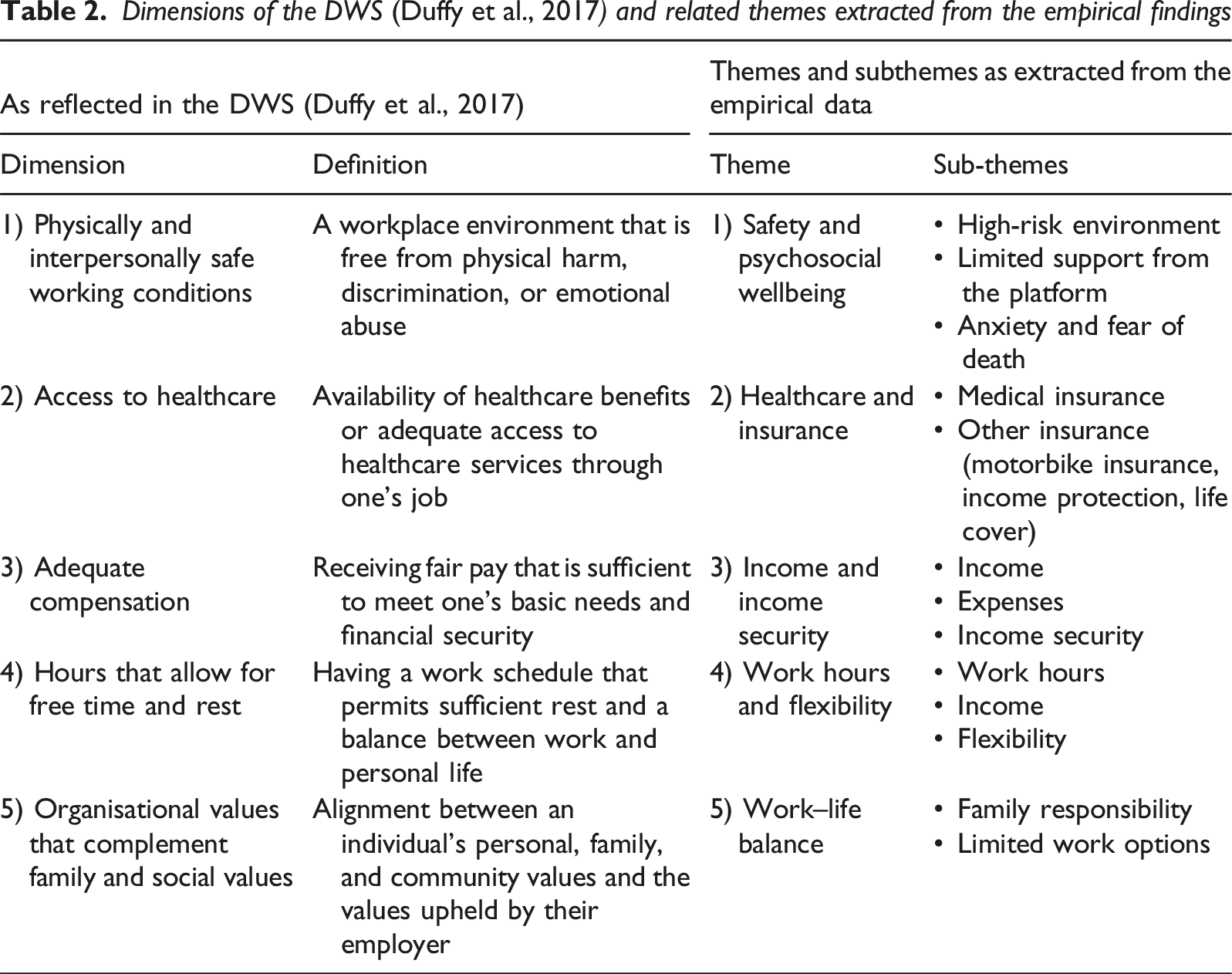
Initial codes were derived from the five dimensions of the DWS (Duffy et al., 2017); (1) safe working conditions, (2) access to healthcare, (3) adequate compensation, (4) free time and rest, and (5) complementary values, were used as the primary codes to sort the raw data. This approach ensured a focused exploration of the ways in which platform-based motorbike delivery riders experienced decent work, while still allowing for emergent insights and a more nuanced understanding of their work experience. The aim of the analysis was not to strictly define these five dimensions of DW, but rather to explore how riders’ experiences aligned with and reflected these dimensions. Following the initial deductive sorting by the first author using ATLAS. ti, the data were exported for collaborative inductive analysis.
During the analyses we first reviewed and revised the alignment of excerpts with the DWS themes. Within each theme, we then inductively identified and sorted the data into sub-themes, which we subsequently defined and named. While the first author conducted the initial deductive sorting, the “further inductive analysis and interpretation” involved all authors in a collaborative review of the sorted data. As such, all authors participated in iterative discussions to refine the final themes. Consistent with Swain (2018), the analysis was not strictly linear but followed a flexible, iterative process in which some stages occurred concurrently. The flexibility was particularly important given that data analysis and data collection took place simultaneously as each participant interview was transcribed and analysed before the follow-up interview took place.
Data Quality and Trustworthiness
Data quality and trustworthiness were established through multiple strategies, addressing credibility, dependability and confirmability (Denzin et al., 2024). To enhance credibility, paraphrasing techniques during the interviews ensured that we captured participants’ intended meanings and interpretations accurately (Creswell & Poth, 2025). The paraphrasing technique allowed the participants to confirm, clarify or expand on their responses, thereby strengthening the authenticity of the data (Tracy, 2010). Conducting a second interview allowed us to check information obtained in the first interview, which strengthened the dependability of the data and stability of findings over time (Nowell et al., 2017). Through iterative discussions between the three authors (peer debriefing sessions), we reached consensus on the final themes, ensuring a reflexive, negotiated interpretation of the data rather than a single, authoritative reading thereof and as such increased the credibility of our findings (Creswell & Poth, 2025; Morrow, 2005; Nowell et al., 2017).
Findings
Dimensions of the DWS (Duffy et al., 2017) and related themes extracted from the empirical findings
Theme 1: Safety and Psychosocial Wellbeing
From the outset, participants mentioned how they operated in a high-risk work environment with minimal support from their platform, concurrently elaborating on the anxiety they associated with riding a bike and essentially the fear of death. Participants unanimously perceived the risk of accidents as significant and explained the subjective dilemma of a trade-off between safety and income.
Whenever you’re driving, you don’t just drive your bike, you’re checking for someone, the car that is in front of you, the back from you, even on the sides. Because people here, their driving, it’s not that good. People, they seem like they are driving with stress. Some of them are drunk, so you must always be careful. Always be vigilant, whenever you are driving.
As such, participants felt they had to be vigilant, and this constant need to anticipate the reckless actions of others was described as heightening their stress levels and reinforcing a sense of vulnerability while working on the road. Given the high prevalence of crime in South Africa, riders explained that they also feared being robbed of their money, cell phones and motorbikes, as illustrated in this excerpt: For Platform B I had to work until late, around like 9 p.m. or 10 p.m., and you know it’s not safe in most of these other places, but you don’t have a choice. You have to go and deliver. So, you’ll find challenges there. They will either try to rob you of your phone or to rob you of your motorbike. (
In addition, if riders were robbed of the cash they had on them, the platform expected them to pay it back regardless of the circumstances. As mentioned by participant E, riders felt that their platform did not care about them and would simply replace them if they were unable to work, “If I die, my own family has to bury me. The company is not liable for that, they’re not going to provide, they’re going to replace me the following day”. (
Furthermore, participants perceived that other road users generally disregarded motorbike riders, which put their lives at risk. In this regard, participant 3C suggested that many people perceived bikers as ‘just foreigners’, which was experienced as disrespecting their role as workers and dehumanising them.
Although most participants highlighted the limited support provided by their platform companies, they did reflect on the strong sense of camaraderie and mutual support they have among each other. Riders would help one another in situations such as breakdowns and felt part of a community of riders as mentioned by participant 10E: When you drive a motorcycle it’s like you are part of the community. If I’m stuck or I get an accident, those guys, they will come and help me. You’re not by yourself. So, it’s like you’re joining a community of guys. So, we’re always working together, we’re always helping each other.
Then, just being on a motorbike; you always have to be cautious. So, it’s something that you’re not comfortable. You’re always, I don’t know how to put it, but it’s like you’re always taking a risk, you know. That’s all I can say, because anything can happen.
In general, the constant state of vigilance and the fear of fatal accidents riders experience were seen as an emotional burden that was associated with a pervasive sense of vulnerability, affecting not only their psychological wellbeing, but also that of their families who worry about their safety.
Theme 2: Access to Healthcare and Insurance
Several concerns and preferences related to healthcare and insurance were raised, especially the absence of medical aid and its percevied significance in their lives. Moreover, riders discussed the lack of other benefits such as paid sick leave, income protection, motorbike insurance, and funeral policies. The combination of these unmet needs, alongside the inherent risks of the job, underscores the precarity of this type of work, which is marked by instability and uncertainty as illustrated in the following excerpt: I think for a lot of the guys the problem is, like, you are working at a job that’s very risky but you don’t have any security or safety net. Like, there’s nothing. If you get an accident, you’re by yourself. If your bike is broken, your bike gets stolen, you’re by yourself. You know we’re not covered for these things. You have to personally take out your own insurance. (
Theme 3: Income and Income Security
The income of riders in the study sample varied, with some earning half that others did for a similar number of hours worked. Despite the variability, most riders reported that this income was better than their income at previous jobs. Although the income was above the minimum wage, it was not always perceived as sufficient to meet their needs. Many shared the view that their earnings were not sufficient to support their families, however, the pay was usually enough to cover basic living expenses.
Interestingly, from the interviews it seemed that riders who were supporting families in South Africa might be more financially burdened than those without dependents or those supporting family abroad, as the cost of living was reported to be higher in South Africa. Foreign participants, particularly those from certain African countries such as Uganda, appeared more satisfied with their income than were South African riders.
It depends, when it’s busy, you can make like R3 500 a week. You can use, like, R1 000 for petrol and to buy food every day, and you need to pay R500 for the account [renting a platform account as his is blocked]. And that bike is not mine. I rent the bike, R500 a week. Then I’m left with 1 500.
Theme 4: Work Hours and Flexibility
In the context of the gig economy workers often have greater flexibility but face unique challenges in managing working time and income. Participants discussed the trade-off between having flexibility to spend one’s time as one chooses and the perceived necessity of working long hours to earn sufficient income.
With Platform D you are flexible. You have your time. You know how to plan your things, you see. You can choose that, if maybe you have something important to do, you can do it during the day. Then work later at night. So, it was a thing of flexibility. (
For now, I would say it’s too much. I would be loving to be working five days a week, but the problem is that I would be not making much. I’m forced to work six days just because I can earn more, more than what I can make in five days. But because now I’m somebody who’s having a family, I need also have to have time for the family. So, if it was just my wish, I’d be okay working five days. (
Interestingly, none of the participants mentioned the physical strain of working long hours. In contrast, they focused on being able to work longer hours because they were not micro-managed. Rather than experiencing physical strain that might be associated with their kind of work, they experienced psychological discomfort due to their fluctuating income and unpredictable events (e.g., a broken motorbike, an accident or a robbery) that were mostly beyond their control. Riders with a lower income (those working for platforms A, B and D) valued their flexibility highly. Riders working for Platform C were satisfied with their income despite having fixed and long working hours (60 hours per week). Therefore, understanding the relative value of income and flexibility appears crucial for evaluating the overall quality of this line of work.
Theme 5: Work–Life Balance
The work–life balance that motorbike delivery riders achieved was described as being shaped by a combination of economic necessity, family responsibilities, and the limited availability of alternative employment. In a context of high unemployment, many riders indicated that they had few viable job options, which they felt compelled them to accept platform-based motorbike delivery work. For those with families, the ability to provide for their dependents was identified as a key motivator, yet the demands of the job often came at the cost of not spending quality time with their family. Foreign riders described an additional layer of complexity, as their work decisions were influenced not only by conditions in South Africa, but also by the economic and social realities of their home countries. The theme of work–life balance explains how riders navigated competing demands, weighing financial security against personal wellbeing as they aspired to balance work and family life.
But it was not something that, it was not easy for me when considering the fact that the roads are too busy and the motorbike is too risky; you know, it’s like, it took me almost like six months thinking about. But because I couldn’t find a job which was less risky, then I’ve ended up joining it and I’ve been doing it up to now. (
The experiences of motorbike delivery riders, as captured in these interviews, paint a picture of the difficult realities they face. The perceived lack of other options appears to force many into this line of work. However, for many this work provides autonomy and flexibility not offered in other jobs, coupled with an income better than the other available options or their previous employments.
Discussion
Overall, our findings showed that the experiences of decent work among platform-based motorbike delivery riders in South Africa were profoundly shaped by the precarious conditions inherent in gig work and the broader socio-economic realities of the country. Using a constructivist approach to inquiry, our qualitative findings offer a more nuanced and contextually relevant understanding of decent work as to what is outlined in the literature (Duffy et al., 2017). Since participants were not explicitly guided toward decent work themes or dimensions but instead were encouraged to describe their own experiences of work, the discussion of themes emerged organically, reinforcing their relevance and applicability in understanding decent work.
Although the initial codes and the five themes extracted aligned with the five dimensions of the DWS (Duffy et al., 2017), our data provide a more concise and contextually grounded understanding of decent work which can be structured around three overarching and interrelated themes for this part of the workforce: (1) safety and healthcare, (2) income security, and (3) work–life balance. Importantly though, these experiences are not independent, but are interconnected and influenced by structural factors, particularly economic insecurity and restricted labour market alternatives.
Safety and Healthcare
Safety and psychosocial wellbeing are fundamental requirements for decent work (Duffy et al., 2017; Ghai, 2003), yet, delivery work challenges traditional notions of workplace safety. All participants described the physical dangers inherent in their work, with the risks of accidents and crime as major work challenges. This is not unique to South Africa as riders in Australia (Goods et al., 2019), Brazil (Da Silva, 2020), Ghana and Kenya (Webster & Masikane, 2021) reported frequent near misses with cars, accidents, and exposure to crime in public spaces. However, unlike conventional jobs, where employers assert some control over the work environment, platform-based delivery takes place in public spaces, on roads and in communities, where risks stem from broader social conditions. As a result, platform companies have limited control over the work environment, making it difficult to enforce workplace protections. For riders, these safety risks are not experienced or expressed in isolation but give rise to concerns related to access to healthcare. Their fear of harm or death appears exacerbated by the limited support from the platform and inadequate access to medical treatment and insurance. In this regard, our findings support the notion reflected in the literature that decent work must ensure access to healthcare (Duffy et al., 2017; Ferreira et al., 2019; Ghai, 2003; International Labour Organization, 2013), yet our participants explained how availability alone is insufficient as healthcare must also be affordable. Most participants in the study sample bore the full cost of medical insurance (i.e., if they chose to take out medical insurance), and might lose their income when unable to work. Beyond medical aid, riders require and expressed their needs for broader insurance coverage, including motorbike insurance, income protection, life insurance, funeral policies, and paid sick leave. Interestingly, motorbike insurance is an anomaly in South Africa: Webster and Masikane (2021) found that 96% of delivery riders in Nairobi, 92% in Accra and only 20% in Johannesburg (South Africa) had motorbike insurance.
Unlike traditional employment, where the employer would provide health benefits and paid leave, gig workers receive neither of these benefits (Lee, 2024). Participants described this as a source of anxiety and stress, as riders fear both the physical and financial consequences of an accident or illness. In this regard, the findings indicate that in addition to access to healthcare, a wider safety net of financial protections is essential to prevent job-related injuries or sick leave from leading to sustained economic hardship. This broad safety net, referred to as social protection or social security, which is also envisioned in the ILO’s Decent Work Agenda (International Labour Organization, 2013, p. 2018), includes benefits in respect of sickness, unemployment, old age, employment injury, and family (Ghai, 2003).
As such, we conceptualised safety and healthcare as a unified theme for decent work of platform riders, which underscores that for these workers, healthcare is central to both their physical and psychological safety. Additionally, our findings illustrate how despite lacking formal protections such as medical aid, participants demonstrated adaptive strategies to manage these constraints and limitations. Some took out private healthcare to manage the risks of injury, or life cover in the event of being unable to work, while others protected themselves by avoiding unsafe areas or by relying on informal co-worker networks for support. Friendships with fellow riders emerged as crucial, with participants describing how they helped each other during breakdowns and accidents. These interpersonal relationships demonstrate how riders manage the physical and emotional risks of their work through the solidarity they build with co-workers.
Income Security
Although adequate compensation is reflected in the DWA, our findings extended our understanding of adequate pay by elaborating on the broader concern of financial stability and protection which platform riders experience or aspire to. In essence, riders expressed the opinion that their pay did not reflect the long hours they worked and the physical risks they faced. Similar concerns have been reported by other high-risk workers in South Africa, such as miners (Hodgskiss et al., 2015) and waste collectors (Chitaka et al., 2022). Furthermore, participants spoke about their income and expenses, while often highlighting the unpredictability of earnings. Many participants reported that fluctuating earnings created financial instability, making it difficult to plan for the future. They expressed a strong desire for stable, predictable income to support both financial and psychological wellbeing. Riders also expressed fears that platforms could reduce pay at any time by hiring more riders or not adjusting delivery rates when fuel prices rose, highlighting the insecure nature of the work. This combination of instability and insecurity reflects key features of precarious work (Allan et al., 2021; Blustein et al., 2020). For these workers, the importance of income security included not only sufficient net income but also access to private insurance products such as income protection, life cover and motorbike insurance. These insurance products were seen as critical to safeguarding them against financial shocks caused by theft, accidents, illness, or inability to work. Consequently, explaining their need for financial stability and security in the face of precarious work conditions. However, despite these challenges, platform work often provided higher pay than did riders’ previous employment. This access to better income is significant, as noted by Heeks et al. (2021) and Cieslik et al. (2022) who found that platform riders in Lagos earned more than those in the informal economy. Therefore, suggesting that although platform work may be more decent in terms of income, it appears to remain highly precarious due to its unpredictable earnings.
Work–life Balance
Our findings more closely illustrate how platform riders navigate the tensions between personal obligation, limited employment opportunities, and the flexible yet demanding nature of their work. Riders’ decisions about where to live, how long to work, and how to manage their time were often shaped by family responsibilities and constrained by a lack of viable work alternatives. Although the flexibility of platform work was reportedly appreciated by all, it was often also described as conditional on financial need rather than genuine choice. Riders adjusted their work hours to meet income targets, and their flexibility was limited by the pressure to remain available in order to earn. Free time and rest are established elements of decent work (Duffy et al., 2017; International Labour Organization, 2013). In gig work, free time and rest are associated with the ability to set one’s work hours and schedule. The present study, among others (for example, Berg et al., 2018; De Stefano, 2016; Goods et al., 2019; Heeks et al., 2021), shows that flexibility in gig work is highly valued, particularly for allowing the participants to choose their work hours. However, such flexibility comes with trade-offs. Due to income instability, many riders felt pressured to work long hours to earn enough (Cieslik et al., 2022; Goods et al., 2019; Heeks et al., 2021). This pressure, though self-imposed, stemmed from financial insecurity rather than employer demands. As a result, the potential benefits of flexibility are undermined as riders often prioritise work over rest, increasing stress rather than supporting their wellbeing. Therefore, suggesting that for flexibility to be genuinely beneficial, it must be accompanied by income security. Without this, flexibility can lead to overwork and instability rather than balance and autonomy (Cieslik et al., 2022; Goods et al., 2019; Heeks et al., 2021). In this regard, our findings reveal that financial stability often takes precedence over personal wellbeing, and work–life balance is fundamentally shaped by economic constraints and a paucity of other work options.
Some riders expressed a desire to spend more time with their families but felt forced to work long hours to earn enough. Some foreigner participants made the difficult decision to have their families live in another country where the cost of living was lower than in South Africa. This separation from their family reflects broader economic conditions, particularly the inability to find work in their home countries (Goods et al., 2019; Shirmohammadi et al., 2023; Webster & Masikane, 2021). For many, high unemployment and limited alternatives meant they had no real choice but to accept these trade-offs.
Overall, the findings show that financial precarity and restricted work options are key factors determining a rider’s ability to achieve work–life balance and fulfil family responsibilities in the way they would like to. In essence, suggesting that decent work is often undermined by the very aspects that are meant to define it such as health, safety, rest, and work–life balance. These elements are often sacrificed in exchange for higher income as the more the riders are willing to forgo these dimensions of decent work, the greater their potential to earn. Therefore, suggesting that the dimensions of decent work do not always hold equal value.
Theoretical Implications and Integration with the PWT
While research on the health outcomes of informal and precarious work is well established (Blustein et al., 2016), our findings highlight that safety concerns are intertwined with access to healthcare. For delivery riders, the physical risks they face on the job are directly tied to their need for immediate and affordable healthcare. Without access to healthcare, these risks were seen as more likely to result in long-term physical and mental harm, suggesting a loop between their unsafe work environment and poor health outcomes. Although income security aligns with the adequate compensation dimension of the DWS, our findings extend beyond pay as income, to encompass broader concerns about risk protection and financial stability. In this way, it resembles the larger concept of social protection, which is a fundamental element of the DWA and refers to protections against life risks such as injury, illness, unemployment, disability, and old age (Ghai, 2003). In this sense, our findings suggest that income and insurance are deeply interconnected in the lived experiences of platform-based delivery riders. Interestingly, participants did not mention government-provided social protection but spoke about their desire for a variety of insurance from private providers. This may be ascribed to the limited availability and poor quality of social protection in Africa. According to the World Social Protection Report, as of 2020, only 47% of the global population had effective access to at least one social protection benefit and this was on 17% in Africa (International Labour Organization, 2013). This lack of public provision may explain why riders see private insurance as a vital component of income security, rather than a separate benefit.
Although in the literature the relationship between decent work and physical and mental health is well established (Duffy et al., 2020; Duffy et al., 2020), our results on safety and healthcare suggest that the influence of employment on health depends more on the work itself and on the related healthcare and insurance provided through the work than simply on the attainment of work. Therefore, physical and mental health is viewed not only an outcome of decent work but also a component thereof (Kekana et al., 2023). In our study, the riders’ experience of risk was linked to factors such as high crime and frequent road accidents in South Africa, rather than to riding a motorbike per se. Therefore, the country context and structural factors appear to be both predictors as well as components of decent work (Cieslik et al., 2022).
However, in general, our findings support the relationship between economic constraints and access to decent work (Blustein et al., 2016). Many riders in the sample entered platform-based delivery work in the context of financial pressure and a lack of alternative income opportunities. Work volition refers to the feeling of choice in one’s decision-making (Duffy et al., 2020), and in this sense, numerous participants indicated that they were motorbike delivery riders because they perceived themselves as desperate for work and having little choice. These constraints were more prominent for migrants, aligning with the role of marginalisation outlined in the PWT.
The PWT proposes that access to decent work increases the likelihood of individuals’ fulfilling their basic psychological needs of, for example autonomy and social relatedness (Duffy et al., 2016; Duffy et al., 2024). Our findings show that the relationship between decent work and need satisfaction is influenced by financial security. Although platform work is often celebrated for offering autonomy and flexibility in working hours, this autonomy and flexibility are frequently constrained by economic pressures, making it somewhat illusory (Goods et al., 2019; Sibiya & Du Toit, 2022).
Regarding the need for social relatedness, participants in our sample would often report limited support from platforms alongside their strong co-worker networks. The participants independently formed safety and support networks outside of formal employer structures, which were describe as playing an important role in promoting their wellbeing. This reinforces the PWT’s view that workplace relationships contribute to wellbeing, while also indicating that these relationships do not need to be structured by the employer. Participants in many instances referred to one another as members of a community who helped one another and, as indicated by Goods et al. (2019), enjoyed social interactions with one another. This finding is in opposition to findings of other studies that have reported interpersonal conflict and violence among blue-collar workers (Anjum & Parvez, 2013; Finstad et al., 2019) and poor co-worker relationships among construction workers in South Africa (Chileshe & Haupt, 2009).
Furthermore, most importantly, our research demonstrates that elements of decent and precarious work often co-exist in the lived experiences of platform-based motorbike delivery riders. These hybrid experiences are shaped by structural conditions such as economic insecurity, informal employment, limited labour protections, and constrained work alternatives. More specifically revealing that although platform-based delivery riders experienced autonomy, flexibility and co-worker support (features typically associated with decent work), these co-existed with income insecurity, safety risks, limited organisational support and social stigma. In this sense, our findings support the non-binary nature of decent and precarious work by showing that participants experienced some, but not all, components of decent work (Blustein et al., 2016), suggesting that a composite score of decent work across the dimensions can hide the significant variations in work experiences.
In this sense, dimensions of decent work were not uniformly valued or experienced. Among the riders interviewed, income security emerged as the most important theme related to their work. Yet, many participants chose to do delivery work despite its physical risks, social stigma, and lack of formal protections, as it was perceived to provide a better income than alternatives available to them. When financial security was uncertain, the value of other work characteristics, such as safety, autonomy or work–life balance appeared less salient. These findings highlighted that the relevance of different decent work dimensions is highly context-dependent and shaped by workers’ adaptive strategies and lived realities.
Our research extends the PWT by reconceptualising context not as a static antecedent to work experiences, but as a multi-level and ongoing influence that continuously shapes how decent work is accessed, experienced and sustained. The PWT has played a foundational role in linking contextual factors, such as marginalisation and economic constraints, with access to decent work and subsequent wellbeing (Blustein et al., 2019; Duffy et al., 2016). Although the PWT offers a robust framework, our findings suggest that its treatment of context as an antecedent variable does not fully capture the complex and recursive ways in which context influences work experiences.
Implications for Practice and Policy
Based on these insights, we suggested the following actions to improve working conditions in platform-based delivery and other forms of informal work. First, co-worker support networks could be strengthened through training in basic roadside assistance or psychological first aid, which would enhance the existing voluntary support among riders without formalising it in ways that undermine autonomy. Second, platforms could explore new income support mechanisms that preserve flexibility while improving financial stability, which may include minimum guaranteed earnings per shift or points systems where riders earn rewards for safe driving or supporting co-workers. Third, private insurance products offered through the app could provide a modular approach to social protection where riders could choose affordable coverage for accident, health or income loss by allocating a portion of their earnings.
To improve counselling services for clients from marginalised or constrained backgrounds we suggest the following: First, counsellors could move beyond traditional interest-based models to explicitly address constrained choices faced by clients in precarious contexts. By acknowledging that many individuals enter work roles out of economic necessity rather than preference, counsellors can help clients navigate the psychological tension between survival and self-determination. Second, given that platform riders navigate a high-risk environment where safety and income are often traded off, career counselling could include a pragmatic “risk-benefit analysis”. This involves helping clients evaluate the hidden cost of work against the perceived benefit of higher immediate income. Third, counsellors could encourage clients to leverage informal peer networks as a primary source of support. Since employers often lack sufficient employee support, clients could be guided to identify and strengthen their private social relationships as “safety nets” that can mitigate the psychological burden of work. Fourth and finally, career counsellors could account for the recursive influence of social realties, such as high levels of unemployment and crime, to help clients manage the emotional and financial complexities of supporting oneself and one’s family. This would enable clients to understand and accept that work-life balance, and wellbeing, are often shaped by global socio-economic disparities rather that individual or employer preferences alone.
Limitations
Although the sample allowed for in-depth exploration of lived experiences, the findings are context-specific and may not be transferable to riders in other geographic areas or socio-economic environments. However, similar results have been found in other countries, indicating the transferability of the findings (Cieslik et al., 2022; Goods et al., 2019; Heeks et al., 2017; Lee, 2024; Webster & Masikane, 2021). Nevertheless, riders operating in other urban or rural areas may face different realities. Although this data collection method aligns with the aim of qualitative constructivist research to center the participant’s voice, it also presents a limitation. The inclusion of only one data source limits the depth of contextual understanding that could be gained from multiple perspectives. For example, incorporating the views of riders’ family members could provide insight into how work affects family life and wellbeing, whereas interviews with platform supervisors or store managers could shed light on organisational support systems.
Conclusion
Overall, our findings suggest that the relationships proposed in the PWT may be less linear and more complex than the model implies. In the lived experiences of platform-based delivery riders, economic constraints, access to decent work, and psychological need fulfilment are not experienced as distinct or sequential stages, but rather as inherently and inextricably linked elements. These dynamics point to a more cyclical or entangled relationship, where progress in one area cannot occur without movement in the other areas. This highlights the need for more context-sensitive applications of the PWT that account for structural and intersecting forms of precarious work in South Africa. Taken together, these findings call for a more nuanced and context-sensitive understanding of decent work, one that foregrounds not only structural realities, but also subjective psychological processes through which dignity, agency and sustainability are attained in everyday work experiences.
Footnotes

Funding
The authors received no financial support for the research, authorship, and/or publication of this article.
Declaration of Conflicting Interests
The authors declared no potential conflicts of interest with respect to the research, authorship, and/or publication of this article.