




Abstract
Scholarly interest in the relationship between decent work and mental health based on the Psychology of Working Theory has recently increased. This study evaluated the indirect effects of survival, social contribution, and self-determination needs satisfaction on the relationship between decent work and trauma-related mental health among military personnel. We conducted a three-wave survey over 1 year. Results showed that decent work predicted satisfaction of the three basic needs. Additionally, survival needs directly predicted posttraumatic stress disorder symptoms, while social contribution and self-determination needs directly predicted posttraumatic growth. Finally, decent work had a significant indirect effect on posttraumatic stress disorder symptoms via survival needs, whereas decent work had significant indirect effects on posttraumatic growth via social contribution and self-determination needs. Our findings suggest that the more military personnel perceive their work as decent and feel that their three basic needs are fulfilled, the more posttraumatic stress disorder symptoms diminish, and posttraumatic growth increases. We discuss the implications and need for follow-up studies.
Keywords
Posttraumatic stress disorder (PTSD) is a mental disorder experienced by individuals who have been directly or indirectly involved in a life-threatening traumatic incident, and it is characterized by psychological symptoms such as emotional hyper-arousal, re-experience of events, and avoidance of stimuli reminiscent of traumatic memory (American Psychiatric Association [APA], 2013). Public emergency services (PES) members, such as military personnel, police officers, and firefighters, are frequently exposed to life-threatening traumatic events at work and are more likely to be diagnosed with PTSD (Chopko et al., 2018; Goodson et al., 2011; International Labour Organization, 2018). Notably, traumatic experiences such as war, military operations, and casualties suffered during missions are common triggers for PTSD in military personnel (Larner & Blow, 2011; Tedeschi, 2011). Military personnel with PTSD symptoms face difficulties engaging in missions due to psychological maladaptation and diminished physical functioning (Hoge et al., 2007). In the current global climate, military personnel are continually exposed to the likelihood of being dispatched as first responders to international security threats, including armed conflicts and natural disasters such as the coronavirus disease pandemic. Due to high levels of traumatic stress, it is crucial to identify the psychological factors that protect against PTSD among military personnel (Hendrikx et al., 2021).
From a positive psychological perspective, people who have experienced trauma can demonstrate growth by successfully coping with the stressful event based on psychological and social resources (Linley & Joseph, 2004), and posttraumatic growth (PTG) is a critical example that explains this psychological transformation (Tedeschi & McNally, 2011). PTG is defined as subjective positive psychological changes attained in response to a life crisis or extreme distress (Tedeschi & Calhoun, 1996). Individuals who experience PTG can appreciate their present lives and reestablish a positive self-concept, ultimately achieving a higher quality of life than they had before the traumatic event (Tedeschi & McNally, 2011). Notably, military personnel who experience PTG readapt to military life and demonstrate functional improvement, thereby contributing to the combat power of their unit (Tedeschi, 2011; Tsai et al., 2016). Therefore, examining the psychological mechanisms that promote PTG in military personnel is crucial to improving their psychological health and strengthening national security (Tedeschi & McNally, 2011).
Among various public service occupations, Navy personnel are subject to life-threatening working environment (e.g., high waves, rapid sea speed, shipwrecks, explosive weapons) and directly or indirectly suffer from PTSD symptoms due to traumatic experiences, such as drowning or sudden death from explosion accidents (Seol & Park, 2015). Furthermore, military missions (e.g., search and rescue, body handling) in disaster situations such as tsunamis, floods, and ship sinking, as well as arduous training, could cause death or life-threatening injuries, raising the need for further research on alleviating their PTSD symptoms (Britt et al., 2016; Carmassi et al., 2020).
Owing to the unique national security situation of the divided country—the Republic of Korea (ROK) and the Democratic Republic of Korea—the ROK Navy is an occupational group that has a high-risk of traumatic stress; this is because its members work in extreme tension caused by the enemies’ armed attacks (Seol & Park, 2015; Sung et al., 2019). For example, 46 Navy sailors died in the Cheonan sinking (2010), which was attacked by the enemy using a torpedo, and survivors suffered from PTSD symptoms, such as re-experiences of the attack, avoidance of ship boarding, and emotional hyper-arousal (Jang & Lee, 2013). As ROK Navy personnel likely have traumatic experiences in life-threatening working conditions and because of the unique national security circumstance in divided countries, it is essential to understand the psychological mechanism within working conditions that affect trauma-related mental health (Seol et al., 2021).
However, studies on the trauma-related mental health of high-risk occupations, including military personnel, have primarily focused on individual characteristics such as age, race, gender, and rank (Hijazi et al., 2015), as well as internal psychological mechanisms like cognitive and emotional processing (Seol et al., 2022; Sung et al., 2019). Therefore, a dearth of research on social determinants, such as working conditions, to predict trauma-related mental health has been reported (Maitlis, 2020). To this end, we aimed to identify the predictive paths to trauma-related mental health in Navy personnel by elucidating the work-related predictor of PTSD and PTG based on the Psychology of Working Theory (PWT) (Duffy et al., 2016).
Psychology of working theory postulates that decent work conditions can positively influence mental health (Duffy et al., 2019) by promoting the satisfaction of three basic human needs: survival, social contribution, and self-determination (Autin et al., 2019). We used a three-wave survey approach to empirically examine the relationships between decent work, the three basic needs, PTSD, and PTG. Such an approach will offer theoretical implications from a PWT lens to help understand the relationship between decent work and mental health symptoms caused by traumatic stress in the working environment. Moreover, the findings will present practical implications for promoting the satisfaction of basic psychological needs and maintaining mental health among PES workers in physically and psychologically stressful work environments by helping them perceive their working conditions as decent (International Labour Organization, 2018).
Theoretical Framework: Psychology of Working Theory
Psychology of working theory has been explicitly formulated to provide a framework for the working life of socioeconomically vulnerable populations (Douglass et al., 2017; Duffy et al., 2016). In vocational psychology, person-environment fit theory (Holland, 1997) and career construction theory (Savickas, 2005) emphasize the impact of intrapersonal factors, such as vocational personality, occupational self-efficacy, and career adaptivity, on satisfactory career experiences. In contrast, PWT considers both intrapersonal and social, economic, institutional, and relational factors to broaden the understanding of individuals’ career experiences (Blustein et al., 2019; Duffy et al., 2016).
Psychology of working theory offers a theoretical framework for understanding the psychosocial constraints for marginalized people (e.g., social discrimination, financial hardship, physically and psychologically at-risk environments) to improve their work lives and promote general well-being. The theory posits that work is a critical factor in people’s lives, and decent work helps people meet basic psychological needs, ultimately contributing to fulfillment and well-being at work (Blustein et al., 2023; Duffy et al., 2016). Several empirical studies have been published using PWT as a theoretical lens in recent years. PWT sheds light on psychological mechanisms that promote mental health, physical health, meaningfulness of work, job satisfaction, and life satisfaction in people from various cultures and occupations (Allan et al., 2020; Blustein et al., 2023; Duffy et al., 2019, 2021; Ferraro et al., 2020; Kozan et al., 2019).
Decent Work
Decent work is a core variable of PWT for describing individuals’ work experiences (Blustein et al., 2016). The International Labour Organization (ILO) of the United Nations first proposed decent work to delineate minimum job standards that ensure ethical labor and improve hazardous working environments (ILO, 2012). Duffy et al. (2017) operationally defined decent work as work that ensures 1) physically and psychologically safe working conditions, 2) access to health care, 3) adequate compensation, 4) hours that allow free time and rest, and 5) organizational values that complement family and social values.
Predominant research questions investigated by empirical studies that utilized the PWT model can be broadly classified into two categories. First, studies investigated the psychosocial predictors that constrain the securing of decent work (e.g., antecedents of decent work). These studies primarily explored the adverse effects of social marginalization and economic constraints experienced by people with disabilities, racial minorities, sexual minorities, and immigrants on work-related psychological factors, such as work volition, and examined how these factors act as barriers to attaining decent work (Douglass et al., 2017; Duffy et al., 2018; Kozan et al., 2019). Second, studies examined the relationship between decent work and perceived general well-being (e.g., outcomes of decent work). More specifically, perceiving one’s work as decent fulfills basic psychological needs, thereby positively predicting individuals’ well-being (Duffy et al., 2021). Of these two research questions attended to by the PWT model, we focused our study on exploring how the perception of decent work influences well-being, specifically mental health (Duffy et al., 2019).
Decent Work and Military Personnel
According to the ILO’s guidelines (2018) on decent work in public emergency services, it is declared that socially, politically, economically, and ethically decent working conditions should be guaranteed for PES workers existing to respond to national crises. PES workers refer to personnel who respond primarily to mitigating national crises such as armed conflicts, bomb disposal against terrorism, body-handling services, and withdrawal operations from disasters and war situations (ILO, 2018). The representative occupation among PES is military personnel.
Based on the ILO’s basic guidelines (2012) for ensuring socially and environmentally non-discriminatory working conditions, the ILO (2018) mentioned that fundamental human rights should be guaranteed among PES workers even in environmentally adverse working conditions during a public mission. Specifically, PES workers should be free from prejudice or stigmatization and guaranteed decent working conditions to prevent them from physical and psychological overstrain and protect their dignity so they can re-perform their duties for the public. Further, these guidelines state that decent work conditions (e.g., adequate wages, safe working conditions, essential health care, eliminating prejudice and stigma) should improve the social and economic disadvantages perceived by the public service member, including military personnel, guaranteeing them psychosocial conditions that reduce social discrimination, ensure health care, and facilitate a sense of well-being in the workplace.
Notably, military personnel who work under inherently dangerous conditions have been a socially stigmatized occupation group that is often perceived as doing “dirty work” (Ashforth & Kreiner, 1999, 2014). According to Ashforth and Kreiner’s dirty work framework (2014), military personnel can be physically stigmatized (e.g., physically tainted) because they work in dangerous environments; they can be morally stigmatized (e.g., morally tainted) because they damage one’s life and property by using weapons. Skopp et al. (2012), who developed Military Stigma Scale, demonstrated social prejudice and occupational stigma that emphasized that military personnel must be mentally strong (e.g., warrior ethos) and able to handle psychological problems on one’s own without social services, such as medical treatment. Moreover, in various cultures, derogatory terms are used for military personnel, such as “ground dogs” in the ROK and “jarhead” in the US, demonstrating that there can be negative social prejudice about their duties.
These public stigmas, propagated through social labeling, separating, stereotyping, and discriminating against military personnel (e.g., sociological perspective, Link & Phelan, 2001), make them aware of social discrimination, inhibit them from seeking treatment, and in the end, negatively influence psychological well-being (Bentein et al., 2017; Britt et al., 2008, 2016; Thornicroft et al., 2016; Wright et al., 2009). Specifically, the ROK Navy personnel who were survivors of the ROK Cheonan sinking (2010) suffered from exacerbated psychological difficulties due to social stigmatization as branded “defeated soldiers” or “losers,” and it worsened their mental health symptoms, including PTSD (Jang & Lee, 2013). In addition, such social stigmatization and perceived social injustice could lead military personnel to avoid seeking effective treatments for PTSD (Skopp et al., 2012). Therefore, it is necessary to ensure a decent work environment that protects military personnel from social stigmatization and disadvantages and supports essential mental health care (ILO, 2018; Thornicroft et al., 2016; Wright et al., 2009). From this point of view, it is essential to examine the relationship between the perception of decent work among stigmatized military personnel and their psychological well-being (ILO, 2018).
Decent Work, Basic Needs Satisfaction, and Mental Health
Past studies that have employed PWT to examine the relationship between decent work and psychological well-being have shown that decent work influences job satisfaction, work fulfillment (Duffy et al., 2016), work engagement (Ferraro et al., 2020), meaningfulness of work (Allan et al., 2019, 2020), physical health (Duffy et al., 2021), and psychological health (Duffy et al., 2019; Ferraro et al., 2020). These studies posit that positive perceptions related to work can bring about adaptive outcomes in the work and life domain (Blustein et al., 2008, 2023; Lysova et al., 2019) and present empirical findings supporting the PWT model (Duffy et al., 2016).
From the PWT perspective, a crucial psychological mechanism through which decent work predicts psychological well-being is the satisfaction of three basic psychological needs: survival, social contribution, and self-determination needs (Autin et al., 2019; Duffy et al., 2016). In addition, many studies have consistently reported that more basic needs are met with an increasing perception of decent work (Blustein et al., 2019; Duffy et al., 2019, 2021).
First, survival needs refer to securing resources essential to an individual’s physical and psychological safety, such as food, a safe living environment, air conditioning and heating, and a living wage (Autin et al., 2019). According to the PWT model, decent work environments that ensure safe working conditions, health care, and adequate compensation will fulfill individuals’ survival needs (Duffy et al., 2016). Second, social contribution needs refer to an individual’s prosocial need to contribute to significant changes in others’ lives through work. Notably, it refers to the need for altruistic relationships based on a sense of connection to a community (Autin et al., 2019; Blustein, 2011). These needs are met in decent work environments where the individual’s values align with that of the organization. Furthermore, decent work ensures constructive social interactions among members (e.g., relational theory of working; Blustein, 2011), facilitating contribution behaviors for colleagues and the organization (Allan et al., 2020). Finally, self-determination needs describe internal motivations to feel autonomous, competent, and related to one’s work (Autin et al., 2019, 2021; Deci & Ryan, 2000; Deci et al., 2017). According to Blustein et al. (2008), self-determination needs are not only primarily determined by personal factors, such as proactive personality and occupational attitudes, but are also significantly influenced by work environments that continuously maintain and fulfill internal motivations. Decent work that guarantees an adequate amount of free time and provides psychological safety is a crucial factor in meeting self-determination needs (Duffy et al., 2016). Based on this theoretical foundation presented by the PWT, empirical studies have been conducted to show that the fulfillment of survival, social contribution, and self-determination needs through decent work serves as important psychological mechanisms which have a positive impact on mental health (Blustein et al., 2016; Duffy et al., 2019, 2021).
However, past studies that examined the relationships between decent work, basic needs satisfaction, and mental health based on the PWT model have only considered the perception of overall health as an index for mental health. Health-related quality of life (HRQOL) or satisfaction with life (SWL) used by Duffy et al. (2019), a comprehensive concept of perceived health status or positive emotion, only measures a broad range of psychological problems (e.g., stress symptoms, depression, emotional problems). Therefore, the HRQOL or SWL cannot provide a detailed understanding of specific psychological disorders experienced by individuals. Hence, a more detailed understanding of the psychological mechanisms through which decent work affects specific psychological problems should be explored to address this notable gap.
Although PWT was conceptualized to address the issues of vulnerable population members who are socially constrained or work in environments that do not secure psychological or physical safety, there is a dearth of empirical research examining the relationship between decent work and their mental health. Specifically, empirical studies on decent work and mental health have not adequately examined the psychological impairments suffered in real life by people facing physical, psychological, and environmental challenges (e.g., sexual minority, low-paid worker, ethnic/racial minority) (Allan et al., 2019, 2020; Douglass et al., 2017; Duffy et al., 2018; Kozan et al., 2019; Smith et al., 2020). Since the demographic characteristics of the socioeconomically disadvantaged population can induce and exacerbate the severity of PTSD symptoms (Boden et al., 2021; Brewin, 2005), exploring the traumatic experiences that affect vulnerable populations is necessary for career psychology. Examining whether perceiving work as decent protects the individual against traumatic experiences of marginalized groups within work environments that cannot assure psychological or physical safety would further the current conceptualization of PWT (Blustein et al., 2016).
In this study, we set military personnel who engage in missions in trauma-vulnerable environments to investigate the effects of their perceived decent work on trauma-related psychological health (Tedeschi, 2011) as the study population. Although individuals may suffer from psychological difficulties due to negative PTSD symptoms following a trauma, they may also undergo PTG through positively perceived psychological and environmental resources (Larner & Blow, 2011; Linley & Joseph, 2004; Park, 2010). Considering this, we attempted to comprehensively consider the psychological path through which decent work is a protective mechanism against PTSD and a promotive mechanism of PTG. To this end, we reviewed the roles of three basic needs satisfaction involved in the critical psychological process between decent work and mental health related to PTSD and PTG based on the PWT model.
Basic Needs Satisfaction, PTSD, and PTG
Survival Needs, PTSD, and PTG
Survival needs describe basic human needs for physical and psychological safety ensuring one’s survival, such as food, water, a safe place, and essential health care (Autin et al., 2019). The fulfillment of survival needs is a critical antecedent to predicting psychological well-being, especially trauma-related mental health (Duffy et al., 2019; Graziano & Elbogen, 2017; Silove et al., 2010). Previous studies demonstrated that trauma survivors suffered exacerbated PTSD symptoms because of dissatisfaction of survival needs due to material hardship (Holmes et al., 2022). For example, trauma survivors face difficulties accessing essential features for survival, such as loss of assets, safe accommodations, food, and electricity (Nobakht et al., 2019). In addition, they required essential health care for effective treatment and financial support to maintain their livelihood (Hoge et al., 2006, 2007). Failure to meet these basic survival needs adversely affects their treatment process and outcomes, resulting in worsening PTSD symptoms (Grieger et al., 2003; Sareen et al., 2010). Therefore, it is important for survivors suffering from traumatic stress to properly meet basic survival needs through psychosocial resources, which can alleviate their trauma-related mental health symptoms (Silove et al., 2010).
Military personnel deployed to unsafe operational areas vulnerable to armed attacks by the enemy frequently have an inadequate food supply and are required to sleep in uncomfortable conditions. These unmet minimum survival needs can elevate the risk of PTSD-related psychological difficulties (Walker et al., 2016), which, if met, can significantly protect them against psychological maladaptation, including PTSD symptoms (Kira et al., 2021). Notably, Kira et al. (2020) reported that retaining the will to survive in a life-threatening situation is a protective factor that can facilitate effective coping and help overcome traumatic stress, making it an essential internal motivator to promote PTG. Thus, appropriately meeting people’s survival needs in a risky work environment by ensuring decent work, providing physical and psychological safety, and guaranteeing health care support is anticipated to be a critical mechanism that alleviates PTSD and promotes PTG.
Social Contribution Needs, PTSD, and PTG
An internal motivation to contribute to the public good promotes an individual’s psychological well-being, such as life satisfaction and meaningfulness, and lowers stress-induced psychological symptoms (Martela & Ryan, 2016; Seol et al., 2021). Notably, social contribution-focused thinking is crucial for people in public service occupations who work in highly stressful environments to maintain their psychological well-being (Loew et al., 2014; Tedeschi & McNally, 2011; Tsai et al., 2016). For example, a sense of purpose to contribute to society through work is a psychological resource that enables positive restructuring of the negative meaning of a traumatic experience (e.g., meaning-making theory; Park, 2010) to alleviate psychological maladaptation and eventually facilitate psychological growth (Maitlis, 2020; Seol et al., 2021). Moreover, people who want to contribute to society can continue interacting with community life within the organization, through which they can secure social resources to help them overcome trauma and achieve psychological growth (Kintzle et al., 2018; Tedeschi & McNally, 2011).
An empirical study on deployed Korean military troops by Seol et al. (2021) showed that a work orientation to contribute to society and the public good could alleviate PTSD while promoting PTG by facilitating a positive meaning-making process in addressing the traumatic event. The authors demonstrated that people who underwent a traumatic event while on an official mission to protect the public could overcome PTSD and achieve PTG through cognitive reinterpretation, where they reframed their traumatic experience as a meaningful act that could improve the general public’s lives. Furthermore, in a study on the antecedents of PTSD among active US soldiers, Loew et al. (2014) reported that the PTSD score was lower among soldiers who perceived that their duty contributed to social security. Tsai et al. (2016) also reported that soldiers with a high altruistic attitude showed increased PTG. Therefore, people who meet their social contribution needs through decent work will be able to re-interpret their traumatic event positively—that it contributed to benefiting society—and it will serve as an internal resource to alleviate PTSD symptoms and achieve PTG following the traumatic event.
Self-Determination Needs, PTSD, and PTG
Studies that examine psychological health based on the self-determination theory (SDT) consistently report that the fulfillment of internal motivations through work is a positive predictor of individuals’ quality of life, including psychological and physical health (Autin et al., 2021; Deci et al., 2017; González et al., 2016; Ng et al., 2012; Ryan et al., 2008). Since the satisfaction of self-determination needs positively predicts successful cognitive, emotional, and behavioral coping with mental health problems (Ntoumanis et al., 2009), meeting self-determination needs can serve as a motivating factor that alleviates PTSD symptoms and facilitates PTG (Bauer et al., 2019; Lumb et al., 2017; Roth et al., 2019).
Among the components of self-determination needs, the satisfaction of autonomy is an essential antecedent to health-promoting behaviors, such as actively diagnosing one’s health, engaging in exercise, and seeking medical treatment. Further, the satisfaction of competence is closely linked to self-efficacy among PTSD survivors in overcoming their psychological problems, thereby serving as an essential motivator for recovery of mental health and growth (Ng et al., 2012; Williams et al., 2006). In addition, the satisfaction of relatedness drives support-seeking behavior within a community to recover from trauma and achieve growth, potentially lowering PTSD and promoting PTG (Armstrong et al., 2014; Lumb et al., 2017). Moreover, fulfilling the three self-determination needs is reported as a crucial predisposing factor of psychological health since they are mutually influential and elevate the overall level of internal motivation for promoting well-being (González et al., 2016; Ng et al., 2012).
The Present Study
This study examined the relationships between decent work, the satisfaction of the three basic needs, PTSD, and PTG based on the PWT framework. As shown in Figure 1, we hypothesized that decent work directly predicted survival, social contribution, and self-determination needs (Hypotheses 1, 2, 3), whereas survival, social contribution and self-determination needs directly predicted PTSD symptoms (Hypotheses 4, 5, 6) and PTG (Hypotheses 7, 8, 9). Finally, we hypothesized that decent work had a significant indirect effect on PTSD symptoms (Hypotheses 10, 11, 12) and PTG (Hypotheses 13, 14, 15) via survival, social contribution, and self-determination needs satisfaction. Hypothesized research model.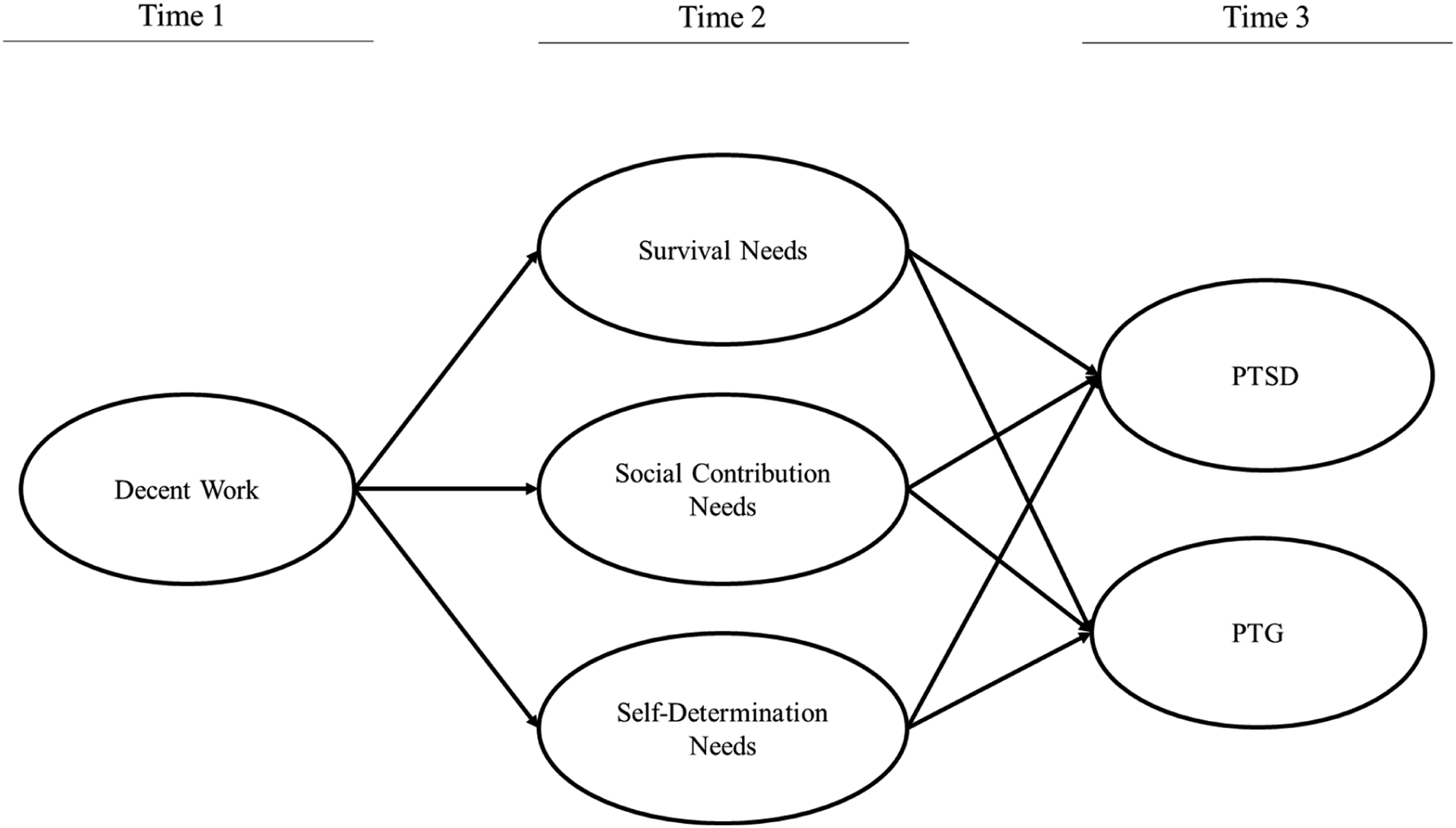
Particularly, this study used self-report questionnaires to investigate the study variables; therefore, the problem of common method bias inflating the correlations between the variables from a single source should be considered (Spector, 2019). Podsakoff et al. (2003) provided methodological strategies, such as temporal and psychological separation of measurement, to effectively minimize common method variance. A time-separated approach can reduce common method variance compared to the cross-sectional design by separating the measurement point of the study variable (e.g., temporal precedence; Conway & Lance, 2010). Based on this, we used the time-separated design for 1 year, measuring the predictive variables (Time 1), mediating variables (time 2), and outcome variables (time 3) at 4-month intervals.
Moreover, the time-separated design has been used in empirical research on physical health in the PWT framework to optimize the design of cross-sectional studies (Duffy et al., 2021). However, more is needed to verify the causal relationship between the variables compared to the longitudinal study design; all variables are repeatedly measured more than three times (Taris et al., 2021). Therefore, because the results examined in this study using the time-separated approach are not conclusive evidence for proving the causal relationship between the variables, careful interpretation should be required regarding causality.
Method
Participants
All participants are midshipmen of the Republic of Korea Naval Academy, where they undergo 4-year military training. Most participants were men (87%, n = 181) and East Asians (99%, n = 205). The mean age of participants was 20.64 years (SD = 1.23). By rank, there were 72 first-year students, 62 sophomores, 53 juniors, and 19 seniors. The participants’ annual salary ranged from KR₩8,270,400 (US$7,222) to KR₩10,275,600 (US$8,793).
Republic of Korea Naval Academy midshipmen have the professional nature of active-duty military personnel in the rank system, education, training system, mission duties in battles, and occupational responsibility. For example, Navy midshipmen are granted the rank of warrant officer, which is legally defined as career military personnel, and are paid a monthly salary for their duty, military education, and training in the corps. In addition, they are responsible for completing military exercises (e.g., landing operations, navigation, anti-terrorism operation, withdrawal operations, rescue training) to cope with national crises such as armed conflicts and disasters. Specifically, during the Korean War, midshipmen participated in several battles, such as regional defense and enemy suppression along with active-duty soldiers (Navy Headquarters, 2018).
Notably, the study’s participants were within the economic disadvantage criteria (e.g., minimum wage) proposed by the PWT framework and the ILO’s guidelines (ILO, 2018). The range of our participants’ salaries was lower than the average annual income (US$50,000) proposed in the PWT framework (see Duffy et al., 2019, 2021) and the annual minimum wage (KR₩20,010,000; US$16,231) in ROK (Ministry of Employment and Labor, 2022). These wages fall short of the ILO’s guidelines that public service workers should not be economically disadvantaged by guaranteeing minimum wages nationally (ILO, 2018). Therefore, it was confirmed that midshipmen both shared the occupational nature of military personnel experiencing social stigmatization (e.g., dirty work framework; Ashforth & Kreiner, 2014) and fell under the economic disadvantage of receiving an annual salary below the minimum wage at the national level. Considering that the participants met social and economic disadvantage criteria for decent work (ILO, 2018), we confirmed that they were suitable for the PWT framework.
Procedure
Before the data collection, this study was approved by the Navy Headquarters in the Republic of Korea and the institutional review boards in the university (IRB number: 7001988-202212-HR-1455-04). To recruit participants, a survey notice containing information on the purpose, date, and place was posted to Naval Academy. In addition, the participants were notified that the present study passed the university IRB’s ethics review and was approved by the Naval Headquarters. Additionally, they were informed that they had the right to refuse to participate in the survey if they felt burdened, and personal information, including PTSD scores, was treated as confidential under the Statistics Act. In total, 496 participants currently serving in the Republic of Korea Naval Academy signed a written informed consent to participate in the study.
Participants completed a paper-and-pencil survey three times at 4-month intervals over 1 year. The questionnaire included items about demographic characteristics, such as gender, race, age, rank, and salary, and the predictive variable, decent work, at Time 1; the mediating variables, survival, social contribution, and self-determination needs, at Time 2; the outcome variables, PTSD symptoms and PTG, at Time 3. The participants arbitrarily created personal identification codes to follow up on multi-wave data, as per the IRB’s ethical guidelines, to ensure anonymity. In total, 496 participants completed the surveys at Time 1, 290 at Time 2, and 206 at Time 3 (Time 1 to Time 3 response rate = 41.5%). The reasons for missing data across Times 1 to Time 3 include voluntary withdrawal or person-level data missing, where identification numbers do not match. There were no missing data at the item level (Newman, 2014).
Measures
Decent Work
Decent work at Time 1 was assessed using the Korean version of the Decent Work Scale (K-DWS), which was validated by Nam and Kim (2019) based on the DWS developed by Duffy et al. (2017). The K-DWS is a 15-item scale comprising five subscales: safe working conditions, free time and rest, adequate compensation, access to healthcare, and organizational values that complement family and social values. Some examples of DWS items are, “I feel emotionally safe interacting with people at work” and “I have a good healthcare plan at work.” Each item was rated on a seven-point Likert scale from 1 (strongly disagree) to 7 (strongly agree). A higher score indicates perceiving one’s work as more decent. The internal consistency of the scale was .89.
Work Needs Satisfaction
At Time 2, the Korean version of the Work Needs Satisfaction Scale (K-WNSS), based on the WNSS developed by Autin et al. (2019) and validated by Kim et al. (2021), was used to examine whether the participants met their basic psychological needs through work. The K-WNSS is a 20-item scale comprising five subscales: survival, social contribution needs, and three self-determination needs (autonomy, competence, and relatedness). Based on the work of Autin et al. (2019) and Kim et al. (2021), who proposed a higher-order self-determination needs model, we structured the K-WNSS to consist of three factors: survival needs, social contribution needs, and self-determination needs. Some of the key items are, “My work allows me to have the resources to pay for utilities, such as water, heating, and electric, on time (survival needs),” “My work allows me to contribute to the greater social good (social contribution needs),” and “My work allows me to feel free to do things my own way (self-determination needs).” Each item was rated on a seven-point Likert scale from 1 (strongly disagree) to 7 (strongly agree), and a higher score indicates greater satisfaction of basic needs through work. The internal consistencies of survival, social contribution, and self-determination needs were .85, .92, and .94, respectively.
Posttraumatic Stress Disorder Symptoms
At Time 3, the severity of PTSD symptoms was assessed using the Korean version of the Posttraumatic Stress Disorder Checklist (PCL-5-K), which was validated by Lee et al. (2020) based on the PCL-5 developed by Weathers et al. (2013). The PCL-5-K is a 20-item self-report questionnaire corresponding to the diagnostic criteria for PTSD in the Diagnostic and Statistical Manual of Mental Disorder-Fifth Edition (DSM-5; APA, 2013). It comprises the following four subscales based on the symptoms criteria: intrusion, avoidance, alterations in arousal and reactivity, and negative alteration in cognition and mood (APA, 2013). One example is, “In the past month, how much were you been bothered by repeated, disturbing, and unwanted memories of the stressful experience?” Each item was rated on a five-point Likert scale ranging from 0 (not at all) to 4 (extremely). A higher score indicates more severe PTSD symptoms. Additionally, we counted the number of participants with a score above the cutoff of 31 (Weathers et al., 2013) to examine the severity of PTSD specifically among our study population. 74 of 206 participants (35.9%) exceeded this cutoff for PTSD. The internal consistency of the PCL-5 in this study was .96.
Posttraumatic Growth
At Time 3, PTG was assessed using the Korean version of the Posttraumatic Growth Inventory (K-PTGI) developed by Tedeschi and Calhoun (1996) and validated by Song et al. (2009). The participants completed the 21-item K-PTGI. This scale comprises five subscales: relating to others, new possibility, personal strength, appreciation of life, and spiritual change. One example is, “I discovered that I’m stronger than I thought I was.” Each item was rated on a six-point Likert scale from 1 (strongly disagree) to 6 (strongly agree), and a higher score indicates a more significant achievement of PTG. The internal consistency of this scale was .97.
Results
Preliminary Analyses
First, we conducted an attrition analysis to evaluate whether a missing data pattern during the three-wave survey systematically occurred. Of the 496 samples, participants who completed all surveys from Time 1–3 (n = 206) and those who withdrew from the study (n = 290) were divided. The demographic variables (i.e., gender, race, age, rank, salary) and the study variable (i.e., decent work) measured at Time 1 were analyzed using the independent-samples t-test on SPSS 25.0 to compare the two groups. The two groups had no significant differences in the demographic variables and the study variable. These results suggested that no systematic differences exist between the two groups. Furthermore, these results implied that the occurrences of missing data were randomly determined, and the missing pattern was unrelated to the study variable over the three rounds of surveys (i.e., missing at random, MAR).
Next, we used full information maximum likelihood (FIML) techniques to handle missing data, which estimated the incomplete data based on all available data (Newman, 2014). FIML is recommended method for structural equation modeling under conditions in which missing data is randomly occurred (Enders & Bandalos, 2001). Moreover, FIML yields unbiased parameter estimates by retaining the total sample size compared to other techniques dealing with missing data, such as listwise deletion, pairwise deletion, or multiple imputation (Schlomer et al., 2010).
Finally, to assess the normality of the variables, which was the basic assumption for using FIML estimation (Enders & Bandalos, 2001), the skewness and kurtosis of the study variables were examined using the criteria: skewness > |3| and kurtosis > |10| (Weston & Gore, 2006). All study variables did not exceed the cutoffs. Thus, we used all study variables of 496 participants were used for further analysis.
Descriptive Statistics and Correlation Analysis
Descriptive statistics and correlation analysis.
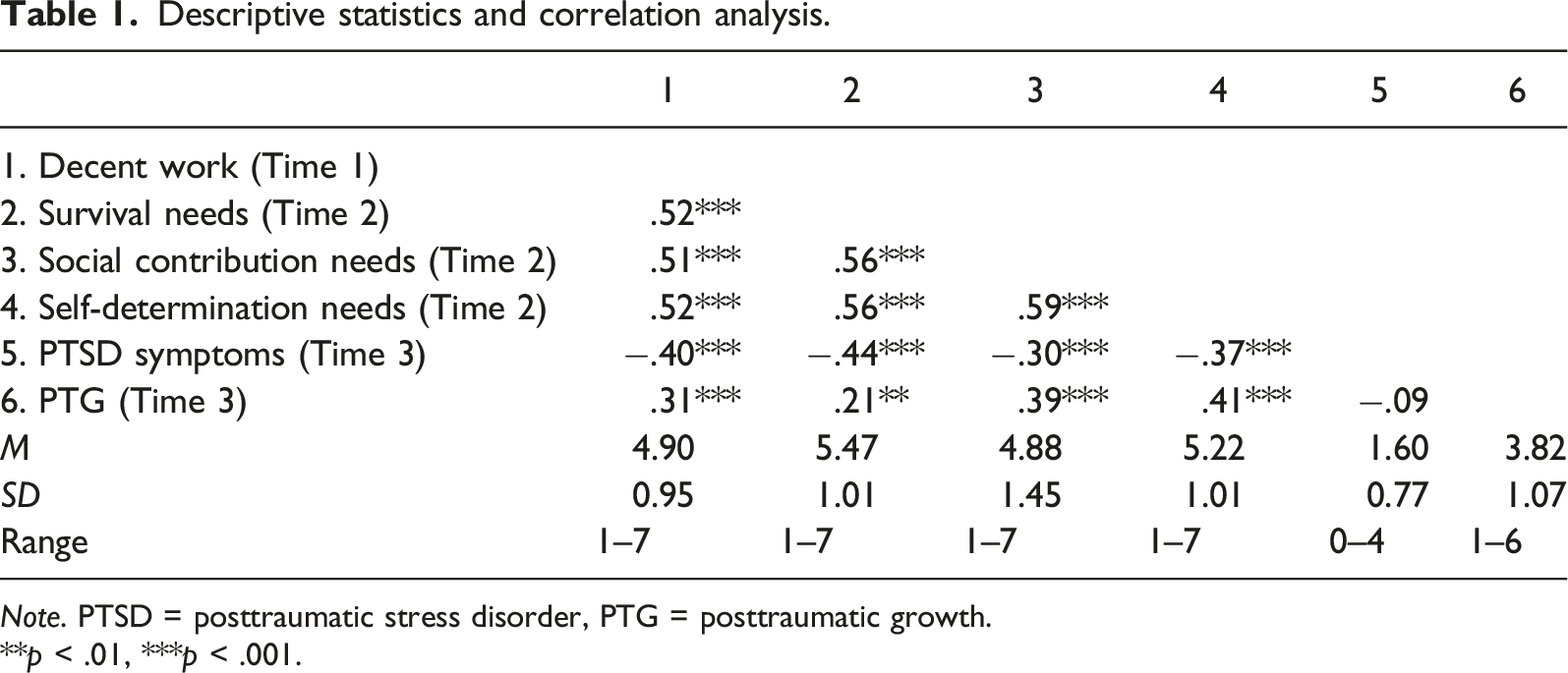
Note. PTSD = posttraumatic stress disorder, PTG = posttraumatic growth.
**p < .01, ***p < .001.
Measurement Model
Before evaluating the structural model, we performed confirmatory factor analysis (CFA) to examine the fit indices of a measurement model using Mplus 7.4. To evaluate the model fit, we used the cutoff criteria of CFI ≥ .95, RMSEA ≤ .05, and SRMR ≤ .05 (Browne & Cudeck, 1992; Hu & Bentler, 1999). The measurement model consisted of six latent factors (i.e., decent work, survival needs, social contribution needs, self-determination needs, PTSD, PTG). Decent work comprised five indicators represented by the subscales of the K-DWS (Nam & Kim, 2019). Among the three basic psychological needs, survival needs and social contribution needs factors each comprised four individual item indicators. Specifically, the self-determination needs factor was constructed according to the higher-order self-determination model based on the suggestions of Autin et al. (2019) and Kim et al. (2021) developing and validating the K-WNSS. The second-order self-determination needs factor comprised the first-order three-factor: autonomy needs, competence needs, and relatedness needs. The first-order three-factor comprised four individual item indicators, respectively. For trauma-related mental health, we used the four-symptom subscales of PCL-5-K as indicators of PTSD and the five subscales of K-PTGI as these of PTG.
Our measurement model demonstrated a good model fit to the data:
Structural Model
The hypotheses were tested by evaluating the structural equation model using Mplus 7.4. The structural model comprised one exogenous factor (decent work) and five endogenous factors (survival needs, social contribution needs, self-determination needs, PTSD, and PTG). According to the results of CFA, the latent self-determination needs factor comprised the three sub-factors: autonomy, competence, and relatedness needs. The structural model showed a good fit to the data: Structural model. Note. The three basic psychological needs variables are correlated with each other, and these lines are not shown for simplicity in the figure. All coefficients are standardized. Solid lines represent significant relationships and dashed lines represent non-significant relationships. **p < .01, ***p < .001.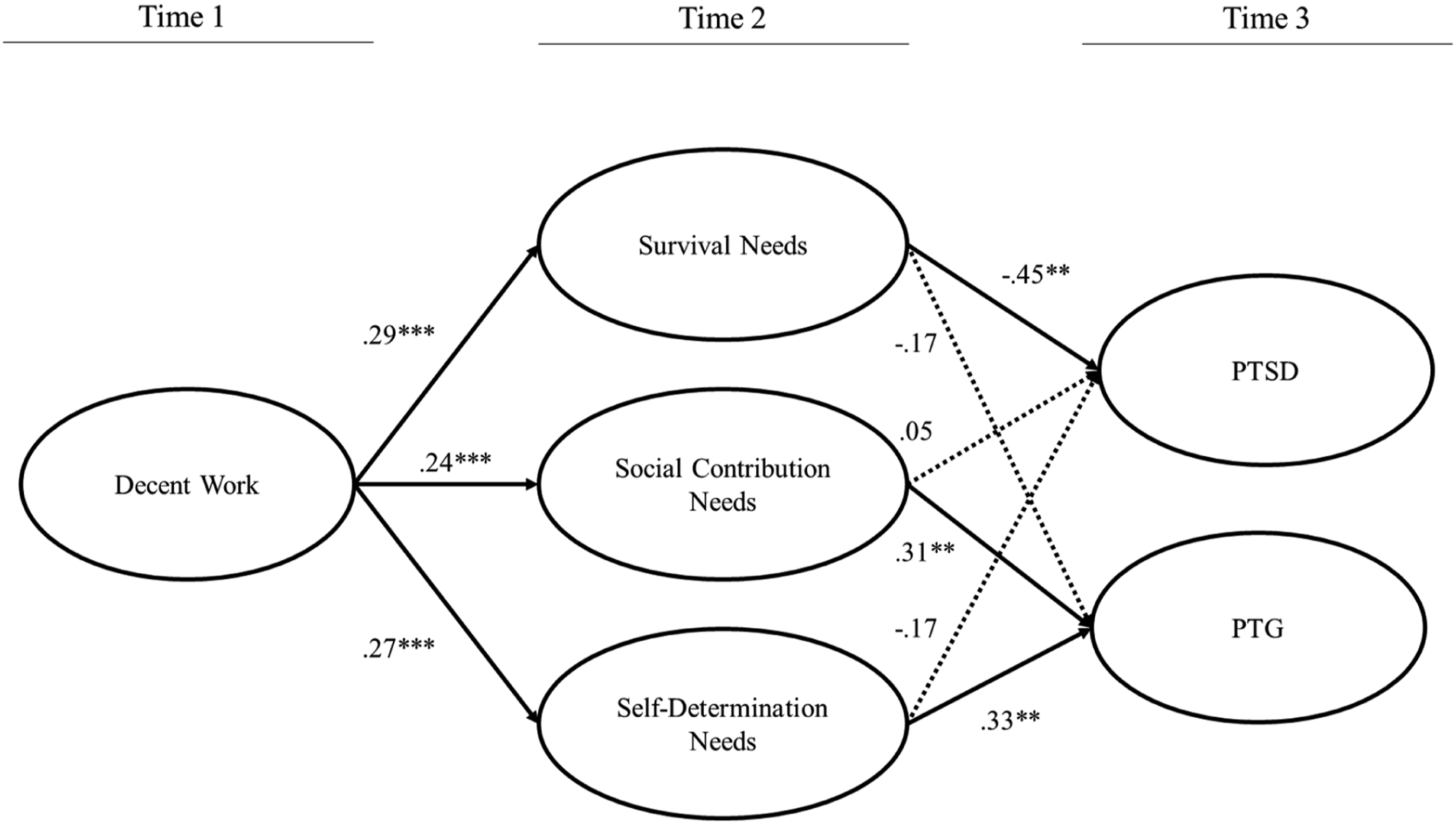
First, statistically significant results indicated that decent work predicted survival needs (β = .29, p < .001), social contribution needs (β = .24, p < .001), and self-determination needs (β = .27, p < .001), supporting Hypotheses 1, 2, and 3. Additionally, survival needs predicted PTSD (β = −.45, p = .001) but did not predict PTG (β = −.17, p = .150). In contrast, social contribution needs predicted PTG (β = .31, p = .008) but did not predicted PTSD (β = .05, p = .700). Likewise, self-determination needs predicted PTG (β = .33, p = .001) but did not predicted PTSD (β = −.17, p = .168). Hence, Hypotheses 4, 8, and 9 were supported, whereas Hypotheses 5, 6, and 7 were not supported.
Standardized indirect effects and bootstrapping test.
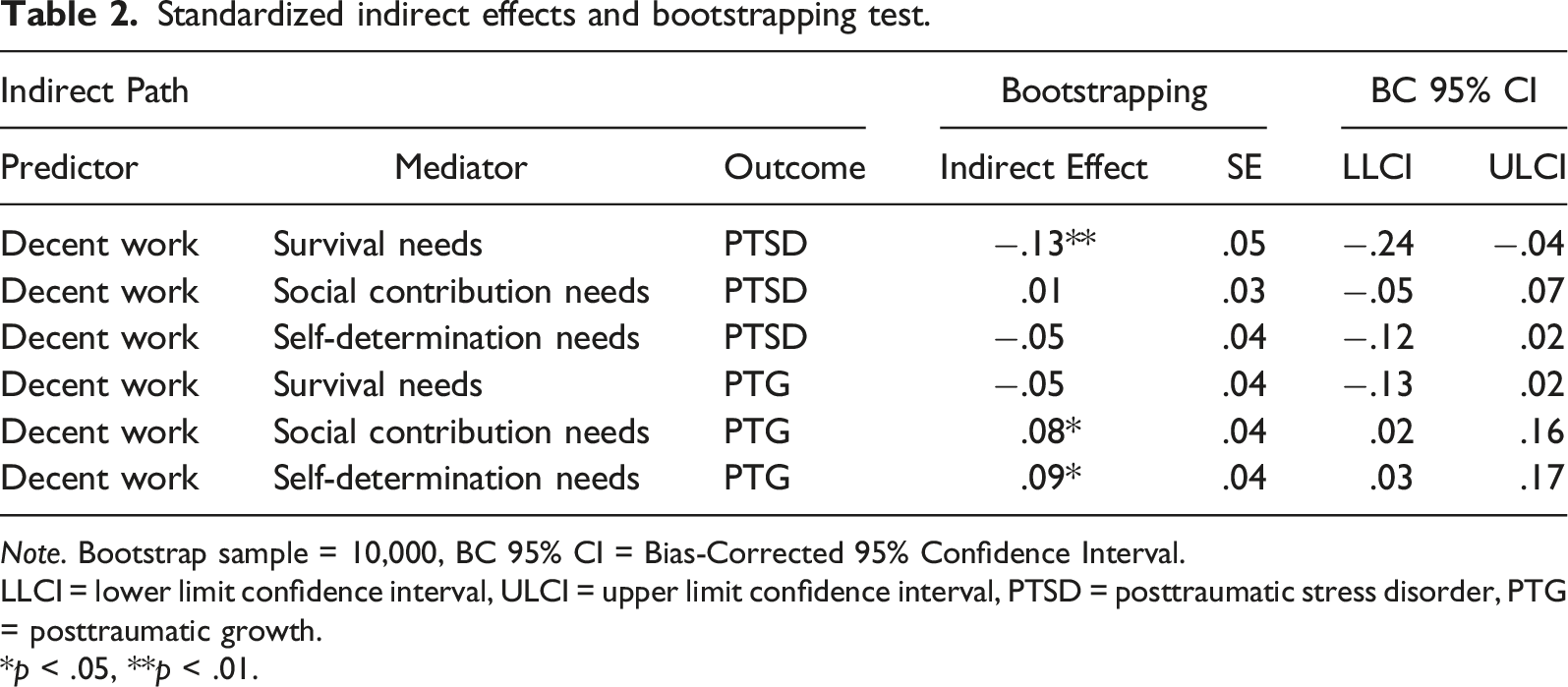
Note. Bootstrap sample = 10,000, BC 95% CI = Bias-Corrected 95% Confidence Interval.
LLCI = lower limit confidence interval, ULCI = upper limit confidence interval, PTSD = posttraumatic stress disorder, PTG = posttraumatic growth.
*p < .05, **p < .01.
Discussion
This study aimed to understand the relationships between decent work, the satisfaction of three basic psychological needs, PTSD, and PTG based on the PWT model. We tested our hypothetical model by performing a three-wave survey over a 1 year, and our results supported nine out of 15 hypotheses. The significant results were as follows. First, for direct paths, decent work positively predicted all three basic needs satisfaction. Regarding the three basic needs, PTSD and PTG, survival needs negatively predicted PTSD, whereas self-determination and social contribution needs positively predicted PTG.
Second, indirect effects were analyzed with the bootstrapping procedure. Our results supported the hypothesized links through which a greater perception of decent work negatively related to PTSD and positively related to PTG via the satisfaction of basic needs. The findings demonstrated that survival needs for PTSD, and social contribution and self-determination needs for PTG were significant mediators of the relationship between decent work and trauma-related mental health.
Theoretical Implication
The major findings that decent work indirectly predicted mental health via the satisfaction of survival, social contribution, and self-determination needs empirically supported the psychological path of the PWT framework (Duffy et al., 2016, 2019). Moreover, our study broadened the PWT model to explain specific mental health symptoms, which were not sufficiently addressed in PWT since previous studies on the relationship between decent work and mental health have primarily examined the overall level of individuals’ perception of their health. Thus, this study presents theoretical implications of decent work in PWT by examining individuals’ mental health in detail, predominantly based on PTSD and PTG.
Specifically, decent work had an indirect effect on the link between decent work and PTSD via survival needs satisfaction, whereas decent work had indirect effects on the link between decent work and PTG via social contribution and self-determination needs satisfaction. Our findings suggested that essential psychological mechanisms involve the unique roles of three basic needs in the relationship between decent work and trauma-related mental health. In particular, the satisfaction of survival needs can be a protective mechanism against psychological problems accompanied by physical symptoms (Duffy et al., 2021). Moreover, the satisfaction of social contribution and self-determination needs can foster individuals’ psychological growth and reestablish positive associations regarding work (Autin et al., 2021).
Practical Implication
Previous studies on the mental health of traumatic high-risk occupation groups, such as PES workers including military personnel, have not adequately discussed social determinants such as working conditions (Maitlis, 2020); these studies primarily focused on individual characteristics or internal cognitive and emotional coping with traumatic experiences. A practical implication of the present study is pertinent to examine the role of decent work as a social determinant of trauma-related mental health symptoms often experienced by military personnel under adverse working conditions and find that decent work can be a protective social factor against PTSD and a promotive factor for PTG. Increasing decent work experience through policy interventions, mechanical support, and counseling would help devise effective interventions that promote the mental health of service personnel working under dangerous conditions.
Furthermore, our findings demonstrated that survival, social contribution, and self-determination needs fulfill unique roles in the relationship between decent work and PTSD or PTG. Therefore, our results can be used to inform selective interventions for high-risk individuals experiencing trauma-induced challenges. For example, immediately after an individual experiences trauma and is experiencing severe PTSD (e.g., acute phase), measures to fulfill their survival needs should be provided by fostering a decent work environment that helps to alleviate PTSD symptoms. Interventions to help survivors grow psychologically beyond recovering the pre-trauma functional state after immediate alleviation of PTSD symptoms (e.g., restructuring phase) should focus on satisfying social contribution and self-determination needs through decent work promoting PTG. Our study presents practical implications for applying the PWT to effectively relieve psychological maladaptation and improve the well-being of vulnerable populations.
Limitations and Future Research
Despite the several theoretical and practical contributions of this study, this study also has a few limitations. First, the study design caused certain restrictions. A time-separated research design to measure predictors, mediators, and outcomes at three different time points does not rigorously establish causality among the variables. Taris et al. (2021) reported that measuring the predictive variable at an earlier time point than the outcome variable only guarantees a lower common method bias (e.g., self-report issue) compared to a cross-sectional study and does not establish causality. Thus, follow-up studies should include all repeatedly measured variables at three or more different time points in a longitudinal structural equation model (Cole & Maxwell, 2003) or random-intercept cross-lagged panel model (RI-CLPM; Mulder & Hamaker, 2021) using the intra-individual variance to rigorously verify the causal relationship between decent work, three basic psychological needs, and trauma-related mental health (Taris et al., 2021).
Second, the study population was limited to military personnel of the ROK, an East Asian country. Future studies should be conducted on more diverse cultures to generalize the findings. Since the scale for the three basic psychological needs, which we chose as the key mediating factor, was developed recently (Autin et al., 2019), it is currently being validated for use in different cultures and contexts (Kim et al., 2021). It is necessary to examine whether there are significant differences in self-determination needs between relatively collectivistic Asian cultures and Western cultures, which are relatively individualistic. Hence, future studies should investigate the differences in the path of decent work and basic psychological needs to predict trauma-related mental health using other military personnel from various countries and cultures.
Finally, our hypothetical model was focused on the pathways through which decent work predicts mental health via the satisfaction of three basic needs. There was a limitation to our examination of the decisive conditions for the three indirect paths from decent work. Therefore, it will be necessary to explore potential moderating variables, such as individual differences (e.g., goal orientation) and workplace context (e.g., leadership or needs supportive climate), that may influence the links between decent work and the satisfaction of each basic psychological needs (Deci et al., 2017). Exploring moderating variables will assist in devising selective interventions that meet the three basic needs. Studies addressing these limitations will discover crucial theoretical evidence for alleviating psychological maladaptation, promoting personal growth, and ultimately enhancing psychological well-being for environmentally vulnerable populations in various cultures and occupations.
Conclusion
This study examined the indirect effects of three basic psychological needs satisfaction in the relationship between decent work, PTSD, and PTG using a three-wave study design over 1 year in a sample of military personnel based on the PWT model. Decent work, a core concept in the PWT, satisfied all three basic psychological needs. In addition, among the three basic needs, survival needs satisfaction acts as a protective factor that can reduce PTSD symptoms, whereas social contribution and self-determination needs satisfaction function as facilitating factors for PTG. Further, this study theoretically supports the PWT perspective and has practical implications for its social application in the workplace that can improve trauma-related mental health in vulnerable populations.
Footnotes
Declaration of Conflicting Interests
The author(s) declared no potential conflicts of interest with respect to the research, authorship, and/or publication of this article.
Funding
The author(s) disclosed receipt of the following financial support for the research, authorship, and/or publication of this article: This work was supported by the Yonsei University Academy Research Funding (ARF) awarded to the first author.
