




Abstract
The goal of the present research was to develop a model of work meaning, consisting of five orientations: job (financial compensation), career (advancement and influence), calling (prosocial duty), social embeddedness (belongingness), and busyness (filling idle time with activities). Two versions of the Work Orientation Questionnaire (WOQ), which measures these five orientations, were developed—for young adults and for working adults. Study 1 describes the development of the WOQ and psychometric properties for young adults. Exploratory (N = 200) and confirmatory (N = 447) factor analyses supported a five-factor solution, and the five scales, which correspond to the five orientations, had adequate internal consistency reliabilities (median = .81). The divergent validity of the WOQ was supported, as shown by the negligible associations of the five orientations with the 12 scales of the Career Decision-Making Profiles questionnaire. In Study 2, the analyses of the responses of 506 employed adults also supported the five-dimensional structure, and four of the WOQ scales were associated with work satisfaction (R 2 = .33). Implications for research and practice are discussed along with future research directions.
Keywords
Work constitutes a critical part of many people’s identity, as it often gives meaning to one’s life (Blustein, 2011). Work means different things to different people. For some people, it is simply a way of paying the bills, passing the time, or progressing professionally; for others, it helps them grow and is a way of making sense of their lives (Dik, Byrne, & Steger, 2013). The goal of the present research was to propose a multidimensional model of the construct of work meaning and develop a measure of it. Research on this concept is important because work meaning influences individuals’ well-being and their attitude to their job and organization (Wrzesniewski, McCauley, Rozin, & Schwartz, 1997; Yugo, 2006).
Although meaning in work and meaning of work are distinct constructs, they are often used interchangeably (Rosso, Dekas, & Wrzesniewski, 2010). Meaning in work refers to the amount of meaning people experience (i.e., meaningfulness; Pratt & Ashforth, 2003), whereas meaning of work refers to the type of meaning one attributes to one’s work (Rosso et al., 2010). The conceptualization of work meaning has also taken multiple forms. In an attempt to clarify them, Roberson (1990) identified three categories of work meaning: work centrality, work values, and work orientation. Work centrality describes the way individuals prioritize their work relative to other aspects of their lives (Paullay, Alliger, & Stone-Romero, 1994). Work values are “the general and relatively stable goals that people wish to accomplish in the process of performing their jobs and the objectives that they seek as products of their jobs” (Savickas, 2014, p. 4). They can be viewed as a construct associated with how work becomes meaningful (Rosso et al., 2010). Nord, Brief, Atieh, and Doherty (1990) proposed that the meaning individuals attribute to their work has a mutual relationship with their work values. Work orientation, which is the focus of the present research, addresses the purpose work serves in an individual’s life as a way of contributing meaning (Bellah, Madsen, Sullivan, Swidler, & Tipton, 1985; Wrzesniewski et al., 1997).
Work Orientation
Bellah et al. (1985) were the first to propose the concept of work orientation. They suggested a tripartite concept describing three ways an individual can derive fulfillment from work—as a job, as a career, and as a calling. Those who see their work as a job tend to focus on the financial compensation. Those who see their work as career oriented are motivated by their desire to acquire higher social status, power, promotion, and advancement in their place of work. Those who see their work as a calling are focused primarily on the social value of their work—they want to make a difference in society and often believe that their work helps make the world a better place. Qualitative research on callings found that a calling is experienced as a job that one is meant to do and as one’s purpose in life (Duffy et al., 2012), which enters into additional life roles (Hunter, Dik, & Banning, 2010).
Wrzesniewski et al. (1997) used Bellah et al.’s (1985) conceptualization to develop a measure of work orientation. Their measure comprised 18 self-report statements (with 7, 3, and 8 items for job, career, and calling, respectively), with a binary (true/false) response. Yugo (2006) reported low reliability for the three scales (job, career, and calling) with a binary response (.53, .55, and .60, respectively); using a 5-point Likert-type response scale slightly improved the reliability of two of the scales (.65, .47, and .77, respectively).
Studies using this concept of work orientation found that the three orientations are associated with different personal and work-related characteristics (Berg, Grant, & Johnson, 2010; Gandal, Roccas, Sagiv, & Wrzesniewski, 2005; Lan, Okechuku, Zhang, & Cao, 2013; Shea-Van Fossen & Vredenburgh, 2014; Wrzesniewski et al., 1997; Yugo, 2006). People with a stronger calling orientation tend to lead their lives outside of work in line with their calling (Berg et al., 2010), and they are more satisfied with their work than those with other orientations (Lan et al., 2013; Wrzesniewski et al., 1997). Dobrow and Heller (2015) found that people with a strong calling orientation tend to focus on following their calling rather than any other factor (e.g., aptitudes or the likelihood of employment) in making their career choice. Shea-Van Fossen and Vredenburgh (2014) found that employees with a job orientation tend to feel less secure in their employment than those with a strong career or calling orientation. They also found that the three orientations were associated differently with individuals’ preference for challenging work—employees with a strong job orientation were more likely to avoid challenging work, whereas those with a strong calling orientation preferred it, and those with a career orientation had no inclination in this regard. In addition, a calling orientation was positively associated with attributing importance to benevolence, career orientation was positively correlated with valuing power and achievement, while job orientation was negatively associated with achievement values (Gandal et al., 2005; Lan et al., 2013). These three work orientations also differed in their association with meaningful work and with job and life satisfaction. Whereas those with a calling orientation were more likely to find their work meaningful (Steger, Dik, & Duffy, 2012) and reported more job and life satisfaction (Yugo, 2006), those with a job or career orientation were less likely to find their work meaningful (Steger et al., 2012) and reported less job and life satisfaction (Yugo, 2006).
Thus far, research in this field (e.g., Cardador, 2008; Wrzesniewski et al., 1997) has focused on the tripartite concept (job, career, and calling orientations) developed by Bellah et al. (1985). However, we argue that these three orientations may not account for the full variety of the meanings individuals may give to their work. Based on previous research and theory, we propose two additional orientations—social embeddedness and busyness. There are already some findings connecting these two orientations with the reasons people go to work, but the relation between these reasons and the work orientations has yet to be discussed.
Social embeddedness-oriented individuals work mainly as a way of being part of a group or an organization. They want to feel that their work provides them with a sense of support and a feeling of belongingness. The need to belong is an essential human motivation, as explained by the belongingness hypothesis (Baumeister & Leary, 1995) and the self-determination theory (Deci & Ryan, 1985). We propose that work can satisfy this fundamental need for a sense of belonging or connection with others for many people. Whereas calling-oriented individuals emphasize the prosocial purposes of the work and seek a line of work that they believe will make the world a better place, social embeddedness–oriented individuals seek a line of work that gives them a feeling of belongingness and a sense of being part of a community. The social embeddedness orientation also addresses the relational aspect of one’s work. It is compatible with Blustein’s (2011) relational theory of working, which suggests that connecting with others is an underlying human function, which we strive for in various situations, including work.
There is also extensive support for adding the busyness orientation to the model. Busyness-oriented individuals work primarily as a way to occupy their time. One primary demographic group where we see this work orientation is retirees who seek to continue working and stay busy (Hayward, Hardy, & Liu, 1994; Maestas, 2010). A related area of research, referred to as “the lottery studies” (Rosso et al., 2010), has indicated that many people prefer to continue working even after they do not need to do so for a living (Arvey, Harpaz, & Liao, 2004; Highhouse, Zickar, & Yankelevich, 2010). Many workers also reported that they found their work a form of activity that occupied their time and that they would become bored and feel useless without it (Morse & Weiss, 1955). This is compatible with Jahoda’s (1982) model, in which a major latent function of work is that it shapes our experience of time, filling our days with planned activities.
The Present Research
To test the extended five-dimensional work orientation model, we carried out two studies. Study 1 describes the development and psychometric properties of the Work Orientation Questionnaire (WOQ). In contrast to previous studies, which focused on employees who had been working for a number of years (e.g., Wrzesniewski et al., 1997), this study focuses on the relevance of work orientation for young adults in the process of career decision-making. Research has suggested that work meaning is rooted in socialization during adolescence (e.g., Dekas & Baker, 2014) and may change throughout one’s life (Shea-Van Fossen & Vredenburgh, 2014). This may imply that individuals at different stages of their career have different views of the meaning of their present and future work. We assume that occupations differ in how well they help fulfill each work orientation. Therefore, it is important to address young adults’ work orientation prior to making their career choice as a way of helping them make their decision. Studies have also showed that having a future vision of one’s vocation early on helps individuals choose their career to be better aligned with their long-term goals (Ferrari, Nota, & Soresi, 2010; Ginevra, Annovazzi, Santilli, DiMaggio, & Camussi, 2018). Hence, Study 1 focused on adapting and testing the proposed work orientation framework for young adults deliberating about their major/s or future career. Study 2 adapted the WOQ for employed adults and tested the associations between work orientations and work satisfaction.
Study 1: Development of the WOQ for Young Adults
The goal of Study 1 was to develop and test the WOQ, which aims to assess the five work orientations: (a) job—those high in this dimension regard their work as a means for income and economic security; (b) career—those high in this dimension regard their work as a channel for advancement and professional development in the workplace; (c) calling—those high in this dimension regard their work as socially valued, helping make the world a better place; (d) social embeddedness—those high in this dimension regard their work as a means of belonging that allows them to be part of a group; and (e) busyness—individuals high in this dimension perceive their work as a way of filling idle time and providing activity.
We tested the WOQ with a sample of young adults deliberating about their major/s or future career. We describe the construction of the questionnaire and report its psychometric properties, including exploratory and confirmatory factor analyses. We also checked the divergent validity of the WOQ by testing its association with the Career Decision-Making Profiles (CDMP; Gati, Landman, Davidovitch, Asulin-Peretz, & Gadassi, 2010).
The CDMP describes the way individuals make career decisions—their career decision-making style (i.e., “the way they collect, perceive, and process information”; Gati et al., 2010, p. 278). Each of the 12 dimensions of the CDMP represents a continuum on a bipolar scale. For six of the dimensions, one of the poles is more adaptive for making career decisions than the other (Gadassi, Gati, & Dayan, 2012; Gadassi, Gati, & Wagman-Rolnick, 2013). The adaptive poles are comprehensive information gathering (vs. minimal), a more internal locus of control (vs. external), little procrastination (vs. much), fast speed of making the final decision (vs. slow), little dependence on others (vs. much), and little desire to please others (vs. much). Based on the six adaptive dimensions, Gati and Levin (2012) defined the Career Decision-Making Adaptability (CDA) score. For the other six dimensions, neither pole was found to be more adaptive than the other: information processing (analytic vs. holistic), effort invested (much vs. little), consulting with others (frequent vs. rare), aspiration for an ideal occupation (high vs. low), willingness to compromise (high vs. low), and use of intuition (much vs. little).
We tested the associations between the five work orientations, on the one hand, and the 12 CDMP scale scores and the CDA score, on the other. We hypothesized that low correlations would emerge between the CDMP dimensions and the five work orientations because the former focus on the way individuals approach and engage in the career decision-making process (“how”)—namely, the ways individuals process information—whereas the latter focuses on the purposes work serves in an individual’s life, as a way of experiencing and attaining meaning—namely, what their work means to them (i.e., content, “what”). These constructs are thus not expected to be associated with each other.
Construction of the WOQ
We began with the 18 “work orientation” items proposed by Wrzesniewski et al. (1997), representing the three dimensions of job, career, and calling. We translated the items into Hebrew and then back translated them into English (with the aid of a bilingual graduate student) to ensure that the items’ original meaning was maintained. Next, we added several items to increase scale reliability, resulting in 10 or 11 items per dimension. We then constructed 10 items for each of the two new dimensions—busyness and social embeddedness—resulting in a 52-item questionnaire. Following the recommendation of Worthington and Whittaker (2006) for reviewing the quality of the items by experts, we asked nine graduate students in career counseling and psychology to read a short description of the five work orientations and then to classify each item into one of the five dimensions. We deleted 19 items due to relatively low (<70%) interjudge agreement, resulting in above 90% mean interjudge agreement for the remaining items. We then incorporated the questionnaire into the “Future Directions” website (www.kivunim.com)—an anonymous, free, public service website in Israel aimed at helping the user making better career decisions. We analyzed the responses of 183 individuals who filled out the questionnaire to test the psychometric properties of the five scales and used item analysis and cluster analysis to explore the distinction among the five dimensions before using factor analysis for a larger sample. The results of these analyses prompted us to remove 8 more items due to low item scale correlation (with the item deleted), resulting in 5 items per dimension and a warm-up item. After this procedure, only 6 items remained from the Wrzesniewski et al.’s (1997) questionnaire. In the following sections, we report the results, based on another large sample of deliberating young adults using the 26-item version of the WOQ.
Method
Participants
The participants were 664 young adults who chose to fill out the questionnaires in Future Directions, a free, public service Israeli website, in return for feedback about aspects of their career decision-making. The data of 17 individuals (2.6%) were excluded from the analyses because (a) their responses to the validity items in the CDMP were questionable (Gati et al., 2010; n = 9) or (b) they filled out one or both questionnaires too fast (i.e., in less than 75 s), which may indicate insufficient attention (n = 8). Of the 647 participants whose data were included in the analyses, 240 (37%) were men and 407 (63%) were women. The participants’ mean age was 24.36 (SD = 4.42), and their mean years of education was 13.08 (SD = 1.99). Half of the participants (n = 329) were employed at the time they completed the questionnaire, most of them (82%) working in temporary jobs that they did not see as part of their future career. Among those who were working, their mean years at their current job was 2.52 (SD = 2.66). To test for differences in the WOQ scale scores between working and nonworking participants, we conducted a series of independent t tests. After using the Bonferroni correction for α inflation (corrected α = .01), only one small difference emerged: the career orientation scale score for participants who were working (M = 4.42, SD = 1.41) was slightly lower than for those who were not (M = 4.72, SD = 1.34), t(645) = −2.75, p = .006, Cohen’s d = .22. Therefore, the results are reported across working status.
Instruments
Demographic questionnaire
The participants were asked to report their gender, age, years of education, and whether they were working. If they were working, they were asked whether they saw their current job as part of their future career (yes/no) and how many years they had been working at this job.
WOQ (version for young adults)
The WOQ consists of 26 items assessing the meaning young adults ascribe to their future work. The questionnaire begins with a warm-up item, “I often think about my future work,” followed by the 25 items representing the five subscales (see Table 1). For example, “If I had enough money, I would not look for work” (represents job orientation), “I hope to achieve a senior position at my future workplace” (career orientation), “I view my future work as my life’s mission” (calling), “My future job will be an opportunity for me to be part of a group or team” (social embeddedness), and “It is hard for me to imagine how I would spend my time without work” (busyness). Participants were asked to rate on a 7-point Likert-type scale how well each item describes them (1 = not at all to 7 = very much). The psychometric properties of the WOQ are presented in the Results section.
Items, Factor Loading, and Communality Estimates for the Work Orientation Questionnaire.
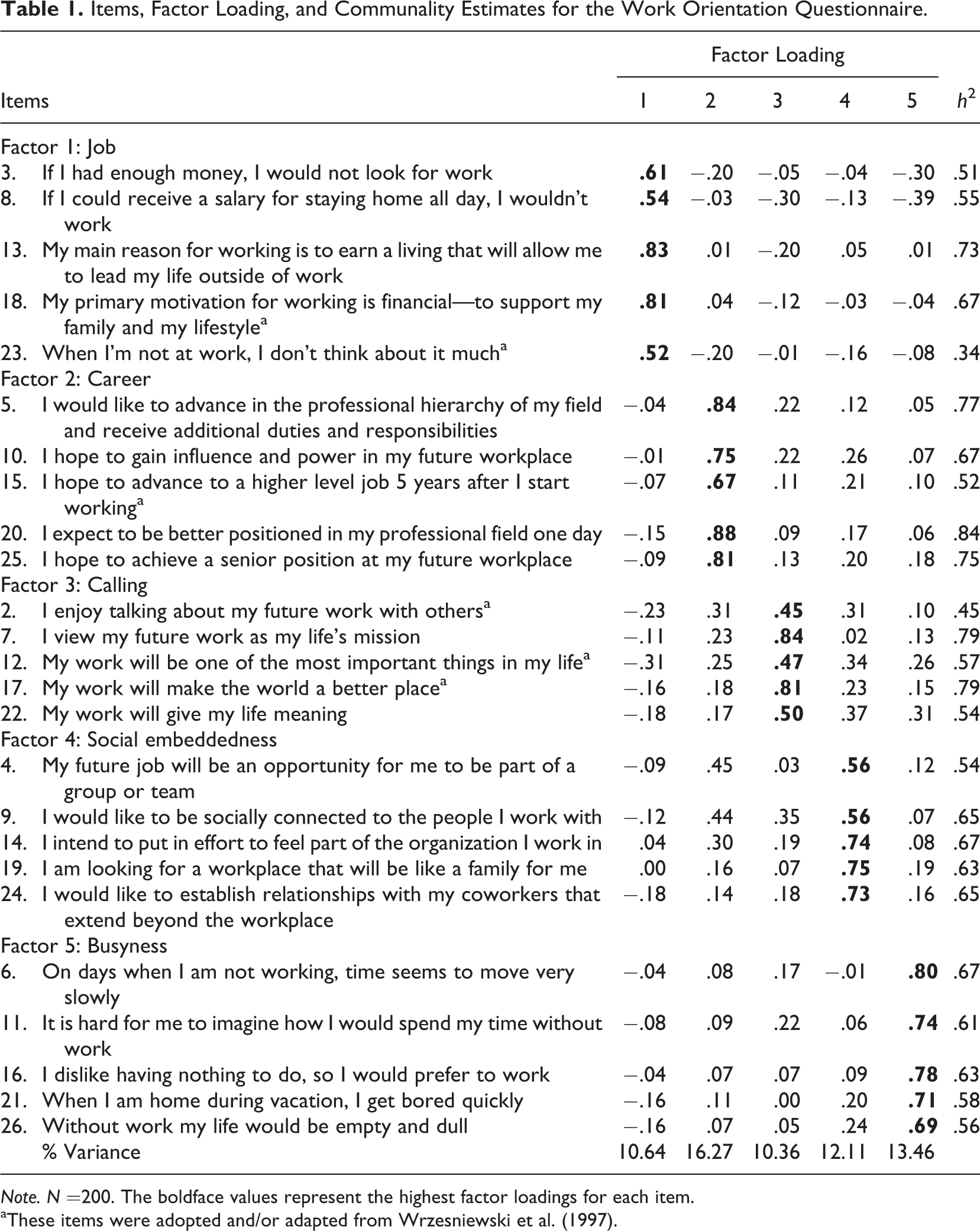
Note. N =200. The boldface values represent the highest factor loadings for each item.
aThese items were adopted and/or adapted from Wrzesniewski et al. (1997).
The CDMP
The CDMP (Gati et al., 2010; Gati & Levin, 2012) assesses individuals’ career decision-making style or profile. It includes 39 items representing the 12 dimensions of the CDMP (3 items for each dimension, 2 validity items, and a warm-up item). The participants were asked to rate how much they agree with each statement on a 7-point Likert-type scale (1 = don’t agree at all to 7 = highly agree). The internal consistency and the test–retest reliabilities, the 1-year stability, and incremental validity of the CDMP were supported in several studies (Gadassi et al., 2013; Gati, Gadassi, & Mashiach-Cohen, 2012; Gati & Levin, 2012). Based on the results for Israeli and American young adults, Gati, Gadassi, and Mashiach-Cohen (2012) reported a median Cronbach’s α internal consistency reliability of .81 and .82 for the 12 dimensions (range = .77–.92 and .75 – .88, for the Israeli and the American samples, respectively). The median Cronbach’s α internal consistency reliability estimate of the 12 dimensions in the present study was .82 (range = .79–.89).
The CDA index (Gati & Levin, 2012) is computed as the mean of six dimensions of the CDMP (after reverse scoring of the last three, so that lower scores on those dimensions represent the adaptive pole): information gathering, locus of control, speed of making the final decision, procrastination, dependence on others, and desire to please others. The concurrent validity of the CDA was supported by its pattern of correlations with career decision self-efficacy (Gadassi et al., 2013), career decision-making difficulties (Willner, Gati, & Guan, 2015), and emotional and personality-related career decision-making difficulties (Gadassi et al., 2012). The Cronbach’s α internal consistency reliability of the CDA in the current study was .87, similar to that reported by Vertsberger and Gati (2015).
Procedure
The participants entered the Future Directions website on their own initiative to get help with career decision-making; they first filled out the background questionnaire and then the CDMP and the WOQ. About half of the participants (n = 332) filled out the CDMP before the WOQ, whereas the others (n = 315) filled out the WOQ before the CDMP. The total time needed to fill out the questionnaires ranged from 13 to 20 min. Finally, the participants received personalized feedback about the way they make career decisions and the meaning they attribute to their future work.
Preliminary Analyses
Order effects
First, we tested whether the order of administration (CDMP before WOQ or vice versa) affected the scale scores. After the Bonferroni correction for α inflation (corrected α = .003), none of the 17 comparisons emerged as significant. Therefore, the results are reported across the two orders of administration.
Gender differences
A series of independent t tests were performed to test for gender differences in the 12 CDMP dimension scores, the CDA index derived from the CDMP, and the five WOQ scores. After the Bonferroni correction for multiple comparisons, a few statistically significant gender differences emerged, but they were small in effect size. Specifically, on the WOQ, men perceived their work as job oriented (M = 4.10, SD = 1.37) more than women did (M = 3.76, SD = 1.31), t(645) = 3.12, p = .002, d = .25. On the CDMP, women had higher scores than men in three dimensions: (a) they were more comprehensive in information gathering (M = 4.82, SD = 1.48) than men (M = 4.43, SD = 1.61), t(645) = 9.60, p = .002, d = .25, (b) reported investing more effort in the process (M = 5.33, SD = 1.17) than men (M = 4.99, SD = 1.40), t(645) = 11.13, p = .001, d = .26, and (c) consulted with others more (M = 5.34, SD = 1.40) than men did (M = 4.87, SD = 1.54), t(645) = 15.62, p = .000, d = .32. Because these effect sizes were fairly small, and the effect sizes in the other 14 comparisons were negligible (d < .15) and statistically insignificant, the results are reported across genders.
Results
The Psychometric Properties of the WOQ
The means, standard deviations, and Cronbach’s α internal consistency reliabilities for the five WOQ scales are presented in the left-hand columns in Table 2. As can be seen, the internal reliabilities of the scales were adequate (median = .81, range = .76–.88). The matrix of intercorrelations among the five scales is presented in Table 2 below the diagonal. The median of the correlations among the scales is fairly low—.30 (interquartile range = .28–.49), indicating that the WOQ scales measure fairly distinct constructs. However, the scales of calling and social embeddedness were highly correlated (r = .58).
Intercorrelations Among the Five Scales of the Work Orientation Questionnaire and Their Means, Standard Deviations, and Cronbach’s α Internal Consistency Reliabilities.
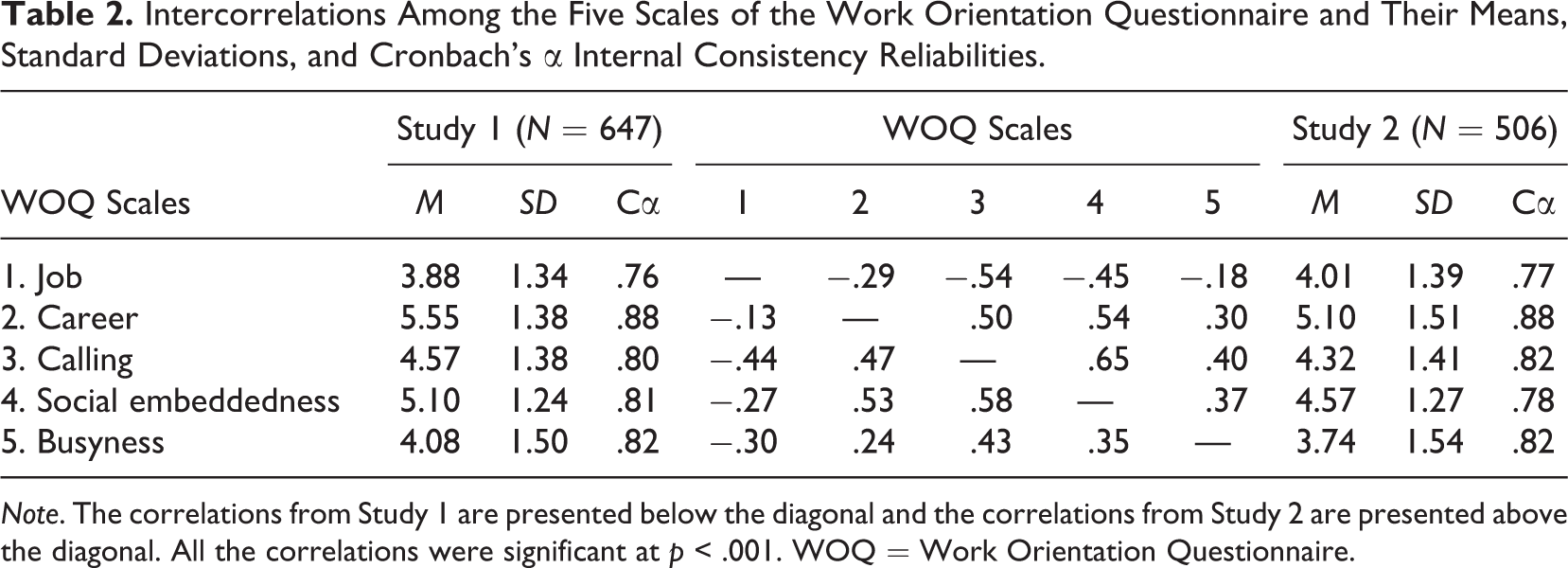
Note. The correlations from Study 1 are presented below the diagonal and the correlations from Study 2 are presented above the diagonal. All the correlations were significant at p < .001. WOQ = Work Orientation Questionnaire.
We then computed the correlations between each item and the five scale scores (with each item excluded from the corresponding scale score). This analysis revealed that all items were more strongly correlated with their own scale than with the other scales. The median of the 25-item scale correlations was .61 (interquartile range = .58–.65). To further explore the pattern of associations among the items, we carried out a cluster analysis on the intercorrelations among the 25 items, using ADDTREE (Sattath & Tversky, 1977). As can be seen in Appendix, the 25 items were perfectly grouped into the five predicted clusters (the linearly accounted for variance was 94%).
The Structure of the WOQ: Exploratory and Confirmatory Factor Analyses (CFA)
We randomly selected 200 cases from the total sample and used the responses to the WOQ items to perform a principal components analysis with varimax rotation. The items, the factor loadings, the eigenvalues, and the variance accounted for by each factor are presented in Table 1. The analysis yielded five components with eigenvalues greater than 1.0, explaining 63% of the cumulative variance (10.64%, 16.27%, 10.36%, 12.11%, and 13.46%, for job, career, calling, social embeddedness, and busyness, respectively). The five factors corresponded with the five proposed dimensions, all 25 items loaded highest on the factor they belong to, with a median item loading of .74 (range from .45 to .88). The loading of all items on the factors they did not belong to was less than |.45|, with only 5-item loadings more than |.34|.
The data from the remaining sample (N = 447) were used in a CFA to verify the hypothesized five-factor model. The CFA using the maximum likelihood model of estimation was conducted by AMOS 21 (Arbuckle, 2012). Good fit is indicated by comparative fit index (CFI) ≥ .90, root mean square error of approximation (RMSEA) ≤ .08, and standardized root mean residual (SRMR) ≤ .09 (Kline, 2011). We compared four models for the internal structure of the WOQ. One model (labeled H: 25-5) represents the hypothesis that the 25 items can be clustered into five scales. The alternative model (A1: 25-5-1) represents the hypothesis that the 25 items can be clustered into the five scales, and the five scale scores can be aggregated into a single total score. The third model (A2: 25-1) represents the hypothesis that the 25 items do not comprise five distinct scales but rather form a single construct. Since the scales of calling and social embeddedness were highly correlated, the fourth model (A3: 25-4) represents the hypothesis that the 25 items are clustered in four scales, with the calling and social embeddedness items loading onto the same factor. We hypothesized that the 25-5 model, which corresponds to the theoretical one and was also supported by the exploratory factor analysis and the cluster analysis, would fit the data better than the alternative models.
The results, summarized in Table 3, showed that while the 25-1 model had a poor fit, both the 25-5 model and the 25-5-1 model had generally good fit indices, except for the CFI (.88 and .87, for the 25-5 and the 25-5-1 models, respectively). However, the 25-5 model fit the data significantly better than the 25-5-1 model, Δχ2(5, N = 447) = 53.73, p < .001. Since the 25-5 model also fits the data significantly better than the 25-4 model, Δχ2(3, N = 447) = 143.67, p < .001, there is no justification for combining calling and social embeddedness into one factor.
Fit Indices for Confirmatory Factor Analysis of the Work Orientation Questionnaire.
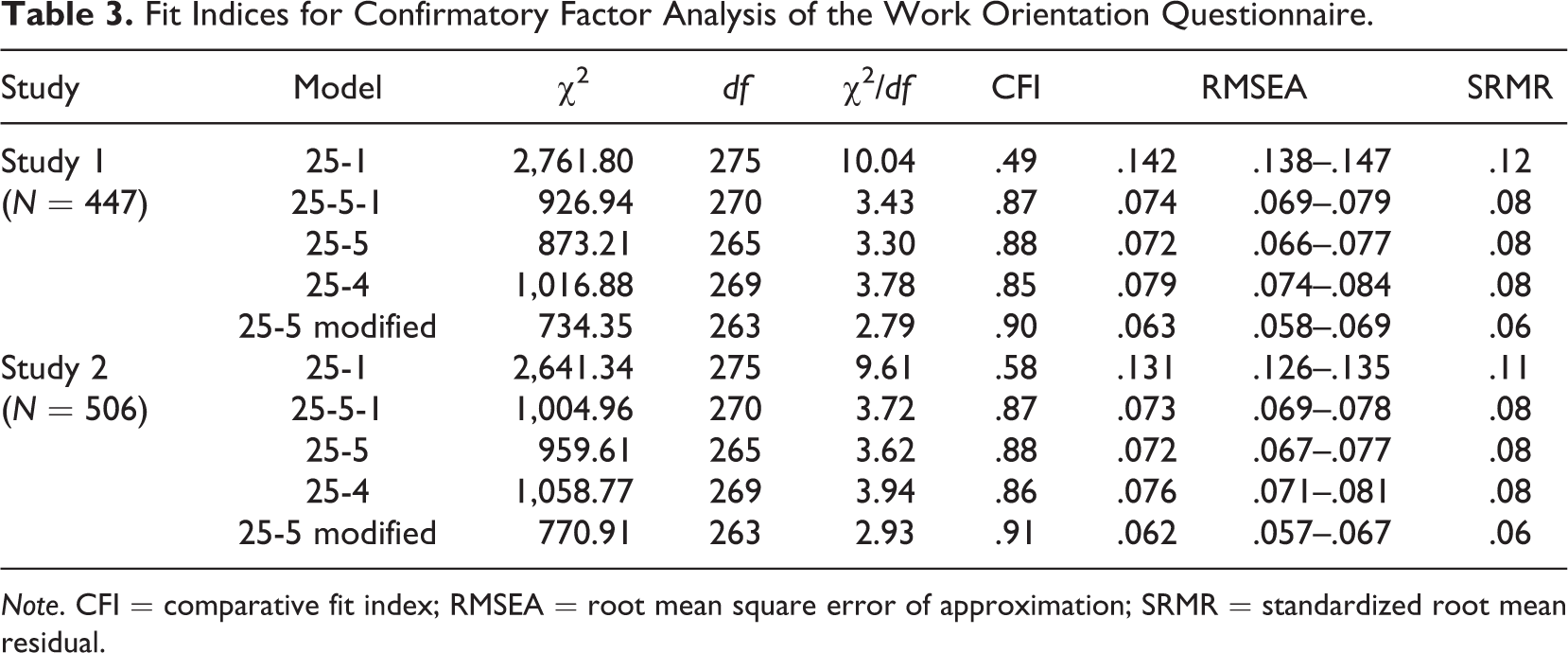
Note. CFI = comparative fit index; RMSEA = root mean square error of approximation; SRMR = standardized root mean residual.
To improve the 25-5 model’s overall fit, we examined the modification indices. We found that we could increase the fit by adding two error covariances between items: (a) Items 7 (“I view my future work as my life’s mission”) and 17 (“My work will make the world a better place”) from the calling scale and (b) Items 13 (“My main reason for working is to earn a living that will allow me to lead my life outside of work”) and 18 (“My primary motivation for working is financial—to support my family and my lifestyle”) from the job scale. Inspection of these items indicated a noticeable overlap in item content, thus justifying the addition of these error covariances. The goodness-of-fit statistics indicate that the modified model has a good fit, χ2(263) = 734.35, p < .001, χ2/df = 2.79, RMSEA = .063 (90% confidence interval [CI] .058, .069), CFI = .90, and SRMR = .06, and that this model fits the data significantly better than the initial model, Δχ2(2, N = 447) = 138.86, p < .001. All 25 items showed significant loadings (p < .001) on the five factors (median loading = .67; interquartile range = .59–.76).
The Divergent Validity of the WOQ
Table 4 presents the Pearson correlations between the five WOQ scale scores, on the one hand, and the 12 CDMP dimension scores and the CDA index, on the other. Due to the large sample size, which leads to statistical significance even for small or negligible correlations, we discuss only correlations that are greater than r = |.20| (p < .01). Of the 65 correlations, only 5 correlations were
Pearson Correlations Between the Five Work Orientation Scales and the 12 CDMP Dimensions and the CDA Score.
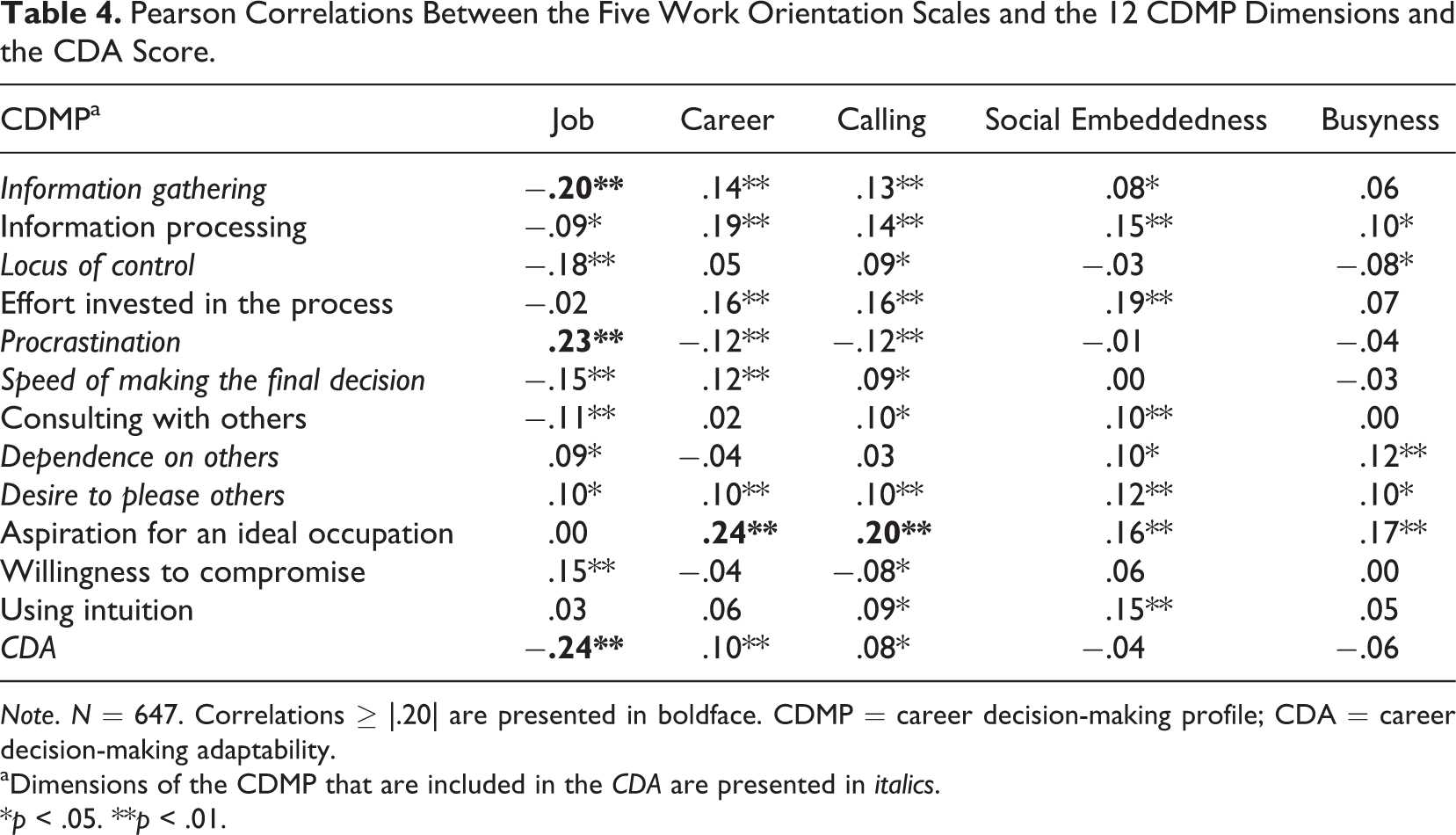
Note. N = 647. Correlations ≥ |.20| are presented in boldface. CDMP = career decision-making profile; CDA = career decision-making adaptability.
aDimensions of the CDMP that are included in the CDA are presented in italics.
*p < .05. **p < .01.
Study 2: The Work Orientations of Employed Adults
The goal of Study 2 was to adapt the WOQ for working adults and test the association of its five dimensions with work satisfaction. If we understand how people view the world of work, we can help them find jobs in organizations or companies that fit their orientation, which should provide them with work satisfaction. Work satisfaction is an important personal construct of well-being (Lent & Brown, 2006). Previous empirical studies have found links between work orientations and work satisfaction. The calling orientation is strongly associated with numerous positive outcomes, such as life satisfaction, career commitment, career maturity, and work satisfaction (see Duffy & Dik, 2013, for a review). Other studies have shown that individuals with job and career orientations were less satisfied with their work than those with a calling orientation (Lan et al., 2013; Wrzesniewski et al., 1997). In addition, Blustein (2011) proposed that the relational aspects of working might facilitate adaptive working experiences. This suggests that there is a link between social embeddedness and work satisfaction. We therefore hypothesized that calling and social embeddedness would be positively correlated with work satisfaction, while the job and career orientations would be negatively associated with it. We had no specific hypothesis regarding the busyness dimension.
Method
Participants
The participants were 506 Israeli employed adults (66% women), who filled out the questionnaires embedded in the Future Directions website (www.kivunim.com) in return for feedback about the meaning they attribute to their work, based on their responses to the WOQ. The mean age of the participants was 30.5 (SD = 8.68). Their mean years of education was 14.8 (SD = 2.65); 99% had 12 or more years of education. Most participants (420, 83%) reported working full time and 86 reported working part time. The employed adults in the sample had diverse occupational backgrounds: business services, consulting, sales, and marketing (22%); science, technology, engineering, and mathematics (16%); law and finance (14%); education (13%); health care and social assistance (8%); while the remaining 27% worked in various other occupations (such as research or security) or did not specify their occupation. We tested for gender differences in the background variables. There was no gender difference in age, t(504) = 1.08, p = .28, or in full-time or part-time jobs, χ2(1, N = 506) = 2.55, p = .11. However, the women had more years of education (M = 15.1, SD = 2.52) than the men (M = 14.2, SD = 2.78), t(504) = −3.77, p < .001, d = .34.
Instruments
Demographic questionnaire
Participants were asked to report gender, age, years of education, and occupation or job and whether they were working full time or part time.
WOQ (version for working adults)
We adapted the WOQ for working adults by revising the items from the future to the present tense. Thus, the items assessed the meaning or role individuals currently give their work or the meaning their work has in their life. For example, the item “I view my future work as my life’s mission” was modified to “I view my work as my life’s mission.” As in the deliberating young adult version, the working adults are asked to rate, on a 7-point Likert-type scale, how well each item describes them (1 = not at all to 7 = very much).
Work satisfaction
To assess how satisfied the participants were with their work, we used a single-item measure used by Gati, Garty, and fassa (1996). The participants were asked to rate how satisfied they were with their work on a 9-point Likert-type scale (1 = not satisfied at all to 9 = very satisfied). The lower bound estimate for the reliability of the work satisfaction rating is .82, based on its correlation with occupational choice satisfaction (r = .67; Thorndike, Cunningham, Thorndike, & Hagen, 1991). Furthermore, Meir and Glass (1995) reported a high correlation (r = .84) between participants’ scores on a single-item measure and the sum of their scores on a 10-item occupational satisfaction questionnaire.
Procedure
As in Study 1, the participants entered the Israeli Future Directions website and filled out the background questionnaire and then the WOQ. The participants were then asked about their current job and their work satisfaction. Finally, they received personalized feedback about the meaning they give to their current work, on the basis of their responses.
Preliminary Analyses
Gender differences
A series of independent t tests were performed to test for gender differences in the five WOQ scores and the work satisfaction score. As in Study 1, a statistically significant gender difference emerged only for the job orientation: Men perceived their work as job oriented (M = 4.26, SD = 1.41) more than women did (M = 3.88, SD = 1.37), t(504) = 2.95, p = .003, d = .26. Because this effect size was rather small and emerged only in one of the five work orientations, the analyses are reported across genders.
Results
The means, standard deviations, and reliabilities of the WOQ for working adults are presented in the right-hand columns of Table 2. As can be seen, the Cronbach’s α internal consistency reliabilities of the five scales were similar to those observed in Study 1—median of .82 and range from .77 to .88. The matrix of intercorrelations among the five scales is presented in Table 2 above the diagonal. The median of the correlations between the scales was .34 (interquartile range = −.33 to .51), similar to those found in Study 1, indicating that the five scales measure distinct constructs. As in Study 1, the correlation between calling and social embeddedness was the highest (r = .65).
CFA
As in Study 1, we used a CFA with maximum likelihood estimation to evaluate the WOQ for working adults and compared the four models for the WOQ’s internal structure that were tested in Study 1 (H: 25-5; A1: 25-5-1; A2: 25-1; A3: 25-4). The results, summarized in the lower part of Table 3, indicated that, as in Study 1, the 25-1 model had poor fit, but the two other models, which explicitly refer to the five scales, fit the data adequately. Both the 25-5 model and the 25-5-1 model had generally good fit indices, but as in Study 1, the 25-5 model fits the data significantly better than the 25-5-1 one, Δχ2(5, N = 506) = 45.35, p < .001. The 25-5 model also fits the data significantly better than the 25-4 model, Δχ2(3, N = 506) = 99.16, p < .001, indicating that there is no justification for combining calling and social embeddedness scales into one factor.
On the basis of the modification indices and inspection of the items’ content, we added the same two error covariances as in Study 1 to the 25-5 model: (a) between Items 7 and 17 in the calling scale and (b) between Items 13 and 18 in the job scale. The goodness-of-fit statistics indicate that the modified model had a good fit, χ2(263) = 770.91, p < .001, χ2/df = 2.93, RMSEA = .062 (.057–.067), CFI = .91, and SRMR = .06, and that it fits the data significantly better than the initial hypothesized model, Δχ2(2, N = 506) = 188.7, p < .001. All 25 items showed significant high loadings (p < .001) on their factor (interquartile range = .60–.74; median loading = .65).
The Association of the WOQ With Work Satisfaction
First, we computed the Pearson correlations between the participants’ scores on the five work orientation scales and their reported work satisfaction. We found that three scale scores correlated positively and significantly with work satisfaction (r = .51 for calling, r = .48 for social embeddedness, and r = .32 for career), while job orientation correlated negatively with it (r = −.41). The correlation between the busyness scale score and work satisfaction was negligible (r = .10, p = .029). We then conducted a multiple regression analysis to determine the relative importance of the five work orientations for work satisfaction. The results of the regression analysis showed that four of the WOQ scales contributed significantly to the prediction of work satisfaction, F(5, 500) = 50.29, p < .001, adjusted R 2 = .33: workers who reported a stronger calling (β = .32, p < .001) or social embeddedness orientation (β = .24, p > .001) and a weaker job (β = −.15, p = .001) or busyness orientation (β = −.16, p < .001) also reported more work satisfaction. Interestingly, a career orientation was not associated with work satisfaction (β = .03, p = .47).
General Discussion
The goal of the present research was to propose an extended multidimensional model for the construct of work meaning and develop a measure for it: the Work Orientation Questionnaire. The construct of work orientation provides a way of describing the types of meaning people find in their work. It thus adds to other constructs describing individual work preferences and values for explaining different work outcomes.
Previous research conceptualized work meaning in terms of three orientations: job, career, and calling (Wrzesniewski et al., 1997). By adding the dimensions of social embeddedness and busyness, we expanded the three-factor model into a five-dimensional one. The social embeddedness and busyness dimensions derive from previous literature which posits that these are additional reasons for people to work (Blustein, 2011; Rosso et al., 2010). In two studies, with young adults and employed adults, we tested and confirmed the five-factor structure of the WOQ and found support for its divergent validity in Study 1 and reported the associations of the five scales scores with work satisfaction in Study 2.
One of the contributions of the present research is the adaptation of the work meaning construct for young adults at the very beginning of their professional life, deliberating about their professional training or college major. The construct of work meaning is important for career decision-making and not only for those who are already working. Pinpointing deliberating individuals’ work orientation may allow career counselors to help them in their decision-making—helping them find the sort of work that maximizes those aspects that are relevant to their work orientation and consequently their satisfaction with this work. Furthermore, the importance of assessing work orientations among deliberating young individuals is compatible with the notion that career counselors should help young adults develop a future vision, as this helps them plan their career with a broader outlook (Ferrari et al., 2010; Ginevra et al., 2018). However, future research should look into the significance of work orientations as a theoretical concept pertaining to the future for deliberating young adults as well as for adults who are already working. An interesting avenue for research could be testing how much individuals change their work orientations from the time before they entering the labor force until they have already started working, on the basis of their different work experiences.
We found that women and men have similar inclinations toward work orientation, except for one area: In both studies, men were more job oriented than women. This may reflect a belief among men that being the primary financial provider for their family is their responsibility (Townsend, 2002), so that they are more likely to perceive their work as a means of acquiring financial benefits.
To demonstrate divergent validity, Study 1 explored the associations between the 5 scale scores of the WOQ and the 12 scale scores of the CDMP questionnaire (Gati et al., 2010; Gati & Levin, 2012). As hypothesized, the WOQ scales, which focus on content-related factors, like values and preferences, had low or negligible correlations with the CDMP scales, which focus on factors describing how individuals process information, thus supporting the notion that work orientation and career decision-making profiles are different constructs. Whereas the former refers to “assumptions that define the subjective essence of the meaning of work—what the work domain represents and what goals an individual seeks to attain through working” (Dekas & Baker, 2014, p. 54), the latter refers to how that (and other) information is taken into account in the way individuals make their career decisions. The lack of association between the CDA score, which represents the adaptability of the individual’s career decision-making, and four of the five WOQ scales supports the distinction between the WOQ as a content assessment and the CDMP as a process assessment. Interestingly, the job orientation score was negatively associated with the CDA score, but the low correlation (r = −.24) is compatible with the claim that the two constructs are distinct. Social embeddedness was not correlated with any of the three social CDMP dimensions (consulting with others, dependence on others, and desire to please others). While those with a strong social embeddedness orientation seek more social connections at work, they do so due to their desire to be surrounded by others and feel a sense of belonging, rather than to fulfill a desire to consult with, please, or depend on others. Thus, each construct reflects a different aspect of social interactions.
Interestingly, we found that both the calling and the career orientations were significantly positively correlated with the aspiration for an ideal occupation as measured by the CDMP (r = .20 and .24, respectively). In contrast to our original predictions, which were based on the CDMP model (Gati et al., 2010), subsequent research (Gadassi et al., 2012 , 2013) found that higher levels of aspiration for an ideal occupation were more adaptive for the career decision-making process. It has been suggested that individuals’ aspiration for an ideal occupation, rather than reflecting their perfectionism or unrealistic views of their possible occupational choices, demonstrates their confidence in their ability to achieve the occupational choice they desire. Future research should focus on testing the association between work orientations and other factors under consideration, such as vocational interests (e.g., Holland, 1997) and aspect-based career preferences (e.g., length of training, income, teamwork, independence, professional advancement; Gati, Garty, & Fassa, 1996).
Study 2 tested concurrent validity by assessing whether the WOQ scales scores are associated with work satisfaction. In a regression analysis, the work orientations measured by the WOQ predicted work satisfaction, accounting for 33% of the variance. As hypothesized, the calling and social embeddedness orientations were associated with greater work satisfaction, whereas the job and busyness orientations were associated with less. These results are consistent with recent research on the positive impact of the calling orientation and the relational aspects of work on healthy career development (Blustein, 2011; Duffy & Dik, 2013) and the negative impact of job orientation on work satisfaction (Lan et al., 2013). Interestingly, and contrary to our prediction, the career orientation was positively associated with work satisfaction; however, in the regression analysis, its score did not contribute to the prediction of work satisfaction. Future research should further test the association between career orientation and work satisfaction, perhaps by searching for moderating or mediating variables that may account for these inconsistent findings.
Limitations and Implications for Future Research and Practice
The first limitation of the present research is that the design was cross sectional and the sample consisted of participants who visited a career decision website. Study 1 included individuals who were actively seeking career information, and thus future research should assess whether they represent the general population of young adults. Furthermore, future research on the WOQ should employ longitudinal designs for exploring whether and how one’s work orientation develops or changes through one’s life span (Shea-Van Fossen & Vredenburgh, 2014), whether particular orientations are more consistent than others across time, and whether particular orientations are more prevalent at different ages and different career stages. It would also be useful to study samples that are more diverse in their levels of career development, age, culture, and socioeconomic status (SES) and to test the associations between SES and work orientations. Future research should aim at testing the measurement invariance for the WOQ across non-Israeli samples, and the WOQ’s test–retest reliability and convergent validity (e.g., with the career anchors orientation inventory; Schein, 1990).
It should also assess the relative weights of work orientations, work values, vocational interests, needs, and aspect-based career preferences in locating promising career options as part of the prescreening stage of career decision-making (Gati & Asher, 2001). It would be useful to explore whether a person–environment fit between one’s work orientation and the respective organizational characteristics yields greater work satisfaction. Researchers have also suggested that individuals may have a work orientation profile, reflecting their multiple orientations toward work (Cardador, 2008; Wrzesniewski et al., 1997). Further research should try to construct a typology of orientations to assess whether people can be classified according to their work orientation profile. Future research could also expand the WOQ model by adding dimensions based on the self-determination theory (Deci & Ryan, 1985), which argues for the importance of autonomy and competence. The subjective meaning of work may be the freedom to live one’s life the way one wants to (i.e., autonomy) or an opportunity to do something that one feels truly competent at and that provides one with things to be curious about and with occasions for growth, learning, and development.
The reported results offer some promising ideas for practical use. The WOQ has adequate psychometric properties and seems to be useful for assessing individuals’ attribution of meaning to work in terms of the five orientations. Career counselors can use it to help their clients discover their salient work orientations and use them to facilitate their career decision-making. First, talking about work orientations can help promote future vision among young adults and thus help design a career plan aligned with their long-term plans. Second, if the individual is deliberating among several career options, his or her salient work orientation could be taken into account along with their aspect-based career preferences (Gati et al., 1996) while evaluating and comparing the alternatives as part of the choice stage of career decision-making (Gati & Asher, 2001). However, along with the assessment of work orientations, it is important to understand what factors limit the clients’ work volition and whether the client feels capable of actualizing his or her dominant work orientation and finding a job that suits it.
Career counselors can use the WOQ to help graduates find the type of organization or company that suits their work orientation and thereby promote work satisfaction, which should lead to improved work outcomes, such as lower turnover, less burnout, increased motivation, and better performance. It can also help the organizations employing these individuals take the actions necessary to increase or maintain employee motivation (Lan et al., 2013). The WOQ can be especially useful for career counselors in vocational rehabilitation settings because work can serve as rehabilitation for individuals with disabilities or long-term illnesses (Dutta, Gervey, Chan, Chou, & Ditchman, 2008; Provencher, Gregg, Mead, & Mueser, 2002). The WOQ can give both the counselor and the individual a deeper understanding of the reasons for seeking work, and the role it can play in their lives, thus fostering their recovery.
Finally, apart from its use by career counselors, the WOQ may also be a useful self-assessment tool for young adults deliberating about their future career. Using the WOQ can provide individuals with insight into their work orientations, thus helping them choose careers that suit these orientations. It may be especially useful during times of transition (e.g., from school to work, or from a part-time to a full-time job).
Footnotes
Appendix
Acknowledgments
The authors thank Ella Angel, Naomi Goldblum, Tony Gutentag, Dana Vertsberger, Shahar Hechtlinger, Nimrod Levin, Zehava Masuri, Zoe Tal, Galy Wolkowicz, and Raz Zur for their helpful comments on an earlier version of this article. This research was supported by the Samuel and Esther Melton Chair of Itamar Gati.
Declaration of Conflicting Interests
The author(s) declared no potential conflicts of interest with respect to the research, authorship, and/or publication of this article.
Funding
The author(s) received no financial support for the research, authorship, and/or publication of this article.