




Abstract
Finding meaning and purpose in work has become increasingly important in today’s volatile world. Work orientations reflect the purpose individuals see in their work. The Work Orientation Questionnaire (WOQ), based on the expanded five-dimensional model of work orientation (Willner et al., 2020), was used to elicit individuals’ purpose of work - calling, job, career, social embeddedness, and busyness. In Study 1 (N = 315 employees), the five work orientations were moderately associated with Schein’s (1990) career anchors supporting the WOQ’s convergent and discriminant validity. Study 2 using 5-year longitudinal data from 206 college graduates, revealed that the motives for selecting a college major had small to negligible associations with the five work orientations. Study 3 (N = 414 employees), applying Holland’s (1997) classification of the six RIASEC environments, found that a calling orientation was most prominent among those working in a Social environment, whereas a job orientation was most prominent among individuals in a Conventional environment. Moreover, work orientations accounted for work satisfaction and career choice satisfaction beyond career anchors, motives for choosing a college major, and work environments. Theoretical and practical implications of cultivating purpose at work are discussed.
Introduction
The second decade of the 21st century has demonstrated numerous changes in the way young adults relate to their work, highlighted by trends such as “the great resignation” and “quiet quitting” (Formica & Sfodera, 2022). In the current capricious labor market, there is an increasing need to find purpose in one’s work (Hirschi, 2018), as the disengagement has been linked to their purpose, values, and needs (Formica & Sfodera, 2022). Accordingly, theories highlighting the needs individuals seek to fulfill through their work as a means to meaningful and decent work are growing in popularity (Blustein et al., 2008; Duffy et al., 2016). Dik and Duffy (2009) have called for researchers and practitioners to focus on the construct of work meaning to increase awareness of one’s purpose in life.
Work meaning reflects the significance the individual ascribes to work (Rosso et al., 2010). It refers to an individual’s beliefs, values, and attitudes toward work, along with viewing work as a way of enhancing one’s sense of meaning in life (Roberson, 1990). Under the larger umbrella of work meaning, extensive research has focused on concepts such as work centrality (Paullay et al., 1994), work values (Savickas, 2014), calling (Dik & Duffy, 2009), and work orientations (Willner et al., 2020; Wrzesniewski et al., 1997). The present research focused on work orientations, defined as a person’s beliefs about the purpose of work in their life as a way of providing meaning (Bellah et al., 1985; Willner et al., 2020; Wrzesniewski et al., 1997).
Work Orientations
The tripartite model of work orientations conceptualized by Bellah et al. (1985) and operationalized by Wrzesniewski et al. (1997) has dominated the field in recent decades. This model highlighted three orientations––calling, job, and career (Wrzesniewski et al., 1997). The calling orientation describes individuals who view their work as their life’s mission, a way to contribute to society to make the world a better place and achieve self-fulfillment. The job orientation describes individuals who view their work as a means to satisfy financial needs, income, and economic security. The career orientation reflects individuals’ approach to their work to advance and develop professionally and acquire additional responsibilities and influence in the workplace.
Most of the research in the field has focused primarily on the calling orientation, with its magnitude compounded by the Work as Calling Theory (WCT; Duffy et al., 2018); however, in the last decade, several researchers sought to update the tripartite model of work orientations (calling, job, and career). Pratt et al. (2013) proposed distinguishing among three sub-dimensions of the calling orientation – craftsmanship (developing mastery), serving (improving the lives of others), and kinship (creating bonds with others at work). Recently, Sawhney et al. (2023) empirically tested these three sub-dimensions. However, (a) they tested it without including the tripartite model’s two other orientations (career and job), and (b) the three-factor structure was not compared with a structure where the three lower-order factors converge under a higher-order calling orientation. Thus, the question concerning the dimensionality of the proposed three sub-orientations of calling remains unresolved.
Jiang and Wrzesniewski (2022) and Schabram et al. (2023) have also recently sought to re-frame the tripartite model, suggesting that the job and calling orientations reflect opposite poles of the same dimension. After reviewing the literature, Schabram et al. (2023) further suggested a four-profile structure, where the job and calling orientations comprise opposite poles of the same dimension, with the career orientation being orthogonal to that unified bipolar dimension. They suggested that, in addition to the three original dimensions of work orientation, there is also a combination of a high calling and high career orientation.
Finally, Willner et al. (2020) proposed to assess the purpose individuals ascribe to their work in a five-orientations model, expanding the traditional model by incorporating social embeddedness and busyness as additional work orientations. Previous theoretical and empirical evidence supported the addition of these orientations. The social embeddedness orientation characterizes individuals who regard their work as a means of belonging and being part of a group (Blustein, 2011), compatible with notions of self-determination theory (SDT; Deci & Ryan, 1985) and the belongingness hypothesis (Baumeister & Leary, 1995). The social embeddedness orientation also resembles the kinship subdimension of calling, as proposed by Pratt et al. (2013). However, Willner et al. (2020) viewed social embeddedness and calling orientations as two discrete dimensions. This view aligns with psychology of working theory (PWT; Duffy et al., 2016), which differentiates between self-determination needs and social needs, and suggests that individuals may seek belonging through their work without necessarily desiring to make the world a better place or sensing a clear calling. The busyness orientation represents individuals who consider their work as a way of filling discretionary time with activity (Kallciu et al., 2022; Sharif et al., 2021). Support for the inclusion of the busyness orientation stems from “lottery studies” findings (Highhouse et al., 2010; Rosso et al., 2010), showing that people prefer to continue working even when they do not need monetary compensation. Further support for the inclusion of this orientation stems from Jahoda’s (1982) model suggesting that work shapes one’s time by infusing it with activity, as well as Masdonati et al.’s (2021) study, which described the structuring of life as a hidden work purpose. The inclusion of these two orientations has been supported by a qualitative study by Kallciu et al. (2022), which found that individuals’ orientation to work aligns with the five orientations in Willner et al.’s (2020) expansion, indicating that the three traditional orientations do not address the full scope of the purpose of work. Additionally, using the SDT framework, Clarke (2022) found that whereas the best predictor for the busyness orientation was amotivation, the best predictor of the social embeddedness orientation was extrinsic motivation.
The expanded five-dimensional model of work orientations was supported by Willner et al. (2020) using the Work Orientation Questionnaire (WOQ) in a study of young Israeli adults deliberating about their future careers and employed adults. In their study, Willner et al. (2020) not only supported the five-dimensional structure but also found that it supported the data better than a four-dimensional structure that combined calling and social embeddedness. Furthermore, Lipshits-Braziler et al. (2021) found that the model and questionnaire were informative for use with workers across three countries––Switzerland, Israel, and Italy. The Work Orientation Questionnaire was also supported by its differential pattern of associations with career values (i.e., individuals’ orientations toward career choices that are value-driven; Abessolo et al., 2021), work values (Stiglbauer et al., 2022), and work motivation (Clarke, 2022). The calling orientation was found to be associated with the specialization career value (Abessolo et al., 2021) and the development and meaning work values (Stiglbauer et al., 2022); the job orientation was associated with the salary value (Abessolo et al., 2021) and money work value (Stiglbauer et al., 2022); the career orientation was associated with the management, mobility, and variety career values (Abessolo et al., 2021) and career and development work values (Stiglbauer et al., 2022); the social embeddedness orientation was associated with the social career value (Abessolo et al., 2021) and the development and relating work values (Stiglbauer et al., 2022); finally, the busyness orientation was slightly associated with the management career value (Abessolo et al., 2021) and with the stimulation work value (Stiglbauer et al., 2022).
This pattern of associations between work orientations and values supports the five-dimensional structure of work orientations, reflecting a differential pattern of associations for calling and social embeddedness, as well as for calling and job orientations that did not yield an inverse pattern of associations. The observed associations suggest that the job orientation is not simply a lack of a calling orientation, and that the social embeddedness orientation may be separate from calling.
Finally, previous research has demonstrated that the five work orientations are differentially associated with both job and career satisfaction (Lipshits-Braziler et al., 2021; Willner et al., 2020). Specifically, Willner et al. (2020) found that greater calling and social embeddedness and lower job and busyness orientations predicted greater work satisfaction and Lipshits-Braziler et al. (2021) found that greater calling and social embeddedness and lower job orientations predicted stronger work engagement.
The Present Research
The present study aimed to extend the validation of Willner et al.’s (2020) expanded five-dimensional model of work orientations in two ways. While previous validation studies addressed the expanded model for work orientations (e.g., Abessolo et al., 2021; Lipshits-Braziler et al., 2021), the present study focuses on the validity of the two additional orientations––social embeddedness and busyness––as well as the distinctions between the job and calling orientations and between the calling and social embeddedness orientations. Specifically, the first goal of the present research was to examine the convergent and discriminant validity of the Work Orientation Questionnaire by testing its associations with various academic and career-related factors: (a) career anchors (Schein, 1990), (b) motives for choosing a college major, and (c) Holland’s RIASEC work environments (1997). The constructs tested in Study 1 and Study 2 aim to further differentiate between work orientations that reflect the purpose of work based on an individual’s beliefs and similar constructs of values and motivations that, at times, are used interchangeably, and researchers have called for further exploration of the differentiation among these constructs (Rosso et al., 2010). The use of career anchors facilitates comparison with previous findings testing the associations of work orientations with similar constructs, such as career and work values (Abessolo et al., 2021; Stiglbauer et al., 2022). However, motives for choosing a college major to test discriminant validity can lend support for the distinction between orientations that reflect purpose and motivations. Finally, the use of work environments in the context of work orientation will shed light on how one’s work environments shape and inform the meaning individuals give to their work; this notion has been previously asserted as important, albeit only sparsely investigated (Rosso et al., 2010; Wrzesniewski et al., 2003). An additional goal was to test the incremental validity of work orientations by examining their unique contribution to explaining career choice satisfaction and work satisfaction beyond academic and career-related factors. Specifically, Study 1’s goal was to test the WOQ’s associations with career anchors (Schein, 1990) among employed adults and to examine to what extent the WOQ can explain work satisfaction over and above the eight career anchors. Study 2 used a longitudinal design to explore whether and how undergraduates’ motives for choosing a college major are associated with their work orientations after five years. Study 2 also examined the contribution of work orientations to predicting career choice satisfaction beyond the motives for choosing a major. Finally, Study 3’s goal was to examine the associations between WOQ and Hollands’ RIASEC work environments among employed adults, as well as the WOQ’s contribution to explaining work satisfaction beyond that of the six RIASEC work environments. All three studies were approved by the institutional IRB.
Study 1 – Work Orientations, Career Anchors, and Work Satisfaction
To further the investigation of the convergent and discriminant validity of the WOQ, we tested its associations with career anchors (Schein, 1990). Whereas work orientations reflect individuals’ beliefs regarding their purpose in work and how the orientations ascribe meaning to their life (Jiang & Wrzesniewski, 2022; Willner et al., 2020), career anchors reflect individuals’ career-related self-concepts, including abilities, skills, and interests they prefer to apply in their work (Cao & Hamori, 2022; Rodrigues et al., 2013).
Schein (1990) developed a model of eight career anchors: (1) technical-functional competence—a commitment to developing skills within a profession; (2) general managerial competence—a desire to assume responsibilities of leading others; (3) autonomy-independence—a desire to work alone with little or no supervision; (4) security-stability—a need for stable employment; (5) service-dedication—a desire to help and assist others; (6) challenge—a commitment to work that is continually challenging; (7) lifestyle—a need to have a balanced lifestyle; and (8) entrepreneurship—a desire to work in environments that require creativity. Cao and Hamori (2022) differentiated among types of anchors: (a) needs-based anchors (i.e., security and lifestyle), (b) talent-based (i.e., technical-functional, managerial, and entrepreneurial), and (c) value-based (i.e., service-dedication) anchors.
Previous research suggested that calling largely overlaps with the service anchor (Rodrigues et al., 2013) and the desire to do challenging work (Shea-Van Fossen & Vredenburgh, 2014); the career orientation was associated with management (Abessolo et al., 2021), achievement, and power values (Gandal et al., 2005; Lan et al., 2013); the job orientation was positively related to financial strain and turnover intentions (Mantler et al., 2022); and the social embeddedness orientation was correlated with social values and desire for work-life balance (Abessolo et al., 2021). Therefore, we hypothesized that the calling orientation would be associated with the service and challenge anchors (H1); the job orientation would be associated with the security anchor (H2); the social embeddedness orientation would be associated with the lifestyle anchor (H3); and the career orientation will be associated with the managerial competence and the autonomy anchors (H4). We had no specific hypothesis regarding anchors associated with the busyness orientation. We posited that the other correlations between work orientations and career anchors would be small or negligible. Finally, to assess the WOQ’s incremental validity, we examined its ability to predict individuals’ work satisfaction beyond career anchors.
Method
Participants and Procedure
Participants were 315 Israeli working adults (68% women) who were recruited via social (e.g., Facebook), professional (e.g., LinkedIn), and private networks through personal email invitations or online posts on relevant websites, communities, and networks. The participants first filled out the background questionnaire, then they completed the WOQ, the work satisfaction item, and the Career Anchors Inventory (completion time ranged from 7 to 12 minutes). The participants received personalized feedback about their salient career anchors and the meaning they attribute to their work (work orientations). The participants’ mean age was 35.3 years (SD = 11.06), and their mean years of education was 15.4 years (SD = 2.87). Most participants (87.3%) were employed when completing the questionnaires. Most (272, 86.3%) worked full-time and had a job tenure of 7.96 years (SD = 9.83); 168 of them (61.1%) viewed their current job as a part of their career trajectory.
Instruments
Background Questionnaire
The participants were asked to indicate their age, gender, years of education, and employment status (working or unemployed). If working, they were asked if they were employed full-time or part-time, whether they see their job as part of their future career (yes/no), their current job position, and how many years they had been working at their current job. The responses regarding their current job position were used to assign the individuals to one of Hollands’ six work environments for subsequent analyses in Study 3.
Work Orientation Questionnaire
(WOQ; Willner et al., 2020). The WOQ assesses the meaning individuals give to their work or the meaning that their work has in their life in terms of five dimensions: calling, job, career, social embeddedness, and busyness. It comprises 26 items with five statements representing each of the five dimensions and a warm-up item. Example items include “I view my work as my life’s mission” (calling), “If I had enough money, I would not continue to work” (job), “I would like to advance in the professional hierarchy of my field” (career), “My work is an opportunity for me to be part of a significant group” (social embeddedness), and “On days when I am not working, time seems to move very slowly” (busyness). The participants were asked to rate on a 7-point Likert-type scale the degree to which each item describes them, ranging from 1 (not at all) to 7 (very much). Based on an Israeli sample of employed adults, Willner et al. (2020) reported a median Cronbach alpha (Cα) internal-consistency reliability of .82 for the five scales (range .77–.88). The Cα internal-consistency reliability estimates of the five orientation scales in the present study were .86, .85, .90, .74, and .82 for calling, job, career, social embeddedness, and busyness, respectively.
Career Anchors Orientation Inventory
(Schein, 1990). The questionnaire includes 40 items on a 7-point Likert-type scale, ranging from 1 (not at all true) to 7 (completely true), representing eight anchors. Example items include “I will feel successful in my career only if I can develop technical or functional skills to a very high level competence” (technical-functional competence), “I am most fulfilled in my work when I have been able to integrate and manage the efforts of others” (managerial competence), “I dream of having a career that will allow me the freedom to do a job my own way and on my own schedule” (autonomy/independence), “I seek jobs in organizations that will give me a sense of security and stability” (security/stability), “I am always on the lookout for ideas that would permit me to start my own enterprise” (entrepreneurial creativity), “I will feel successful in my career only if I have a feeling of having made a real contribution to the welfare of society” (service), “I dream of a career in which I can solve problems or win in situations that are extremely challenging” (challenge), and “I dream of a career that will permit me to integrate my personal, family, and work needs” (lifestyle). The present study used the Hebrew version of the questionnaire, which was translated and validated by Danziger et al. (2008), with adequate internal consistency reliability estimate (the median Cα was .79). Career anchors were associated with job satisfaction (Danziger et al., 2008; Danziger & Valency, 2006; Tremblay et al., 2014), work success (Tremblay et al., 2014), and work attitudes (Bravo et al., 2017). The internal-consistency reliability estimates of the eight subscales in the present sample were: .48 for technical competence, .86 for managerial competence, .75 for autonomy, .82 for security, .82 for entrepreneurial, .78 for service, .77 for challenge, and .78 for lifestyle. Although the reliability estimate for technical competence was reported as aligning with previous studies (Bravo et al., 2017; Costigan et al., 2018), we removed this subscale from subsequent analyses due to its low reliability.
Work satisfaction
(Gati et al., 1996). This is a single-item measure to elicit participants’ satisfaction with their job, using a 9-point Likert-type scale, ranging from 1 (not satisfied at all) to 9 (very satisfied). We used this single-item measure due to its usefulness in eliciting individuals’ work satisfaction as multi-item measures of occupational satisfaction (Meir & Glass, 1995; Thorndike et al., 1991).
Results
Pearson Correlations between the Work Orientations, Motives for Choosing College Major, and Career Anchors.
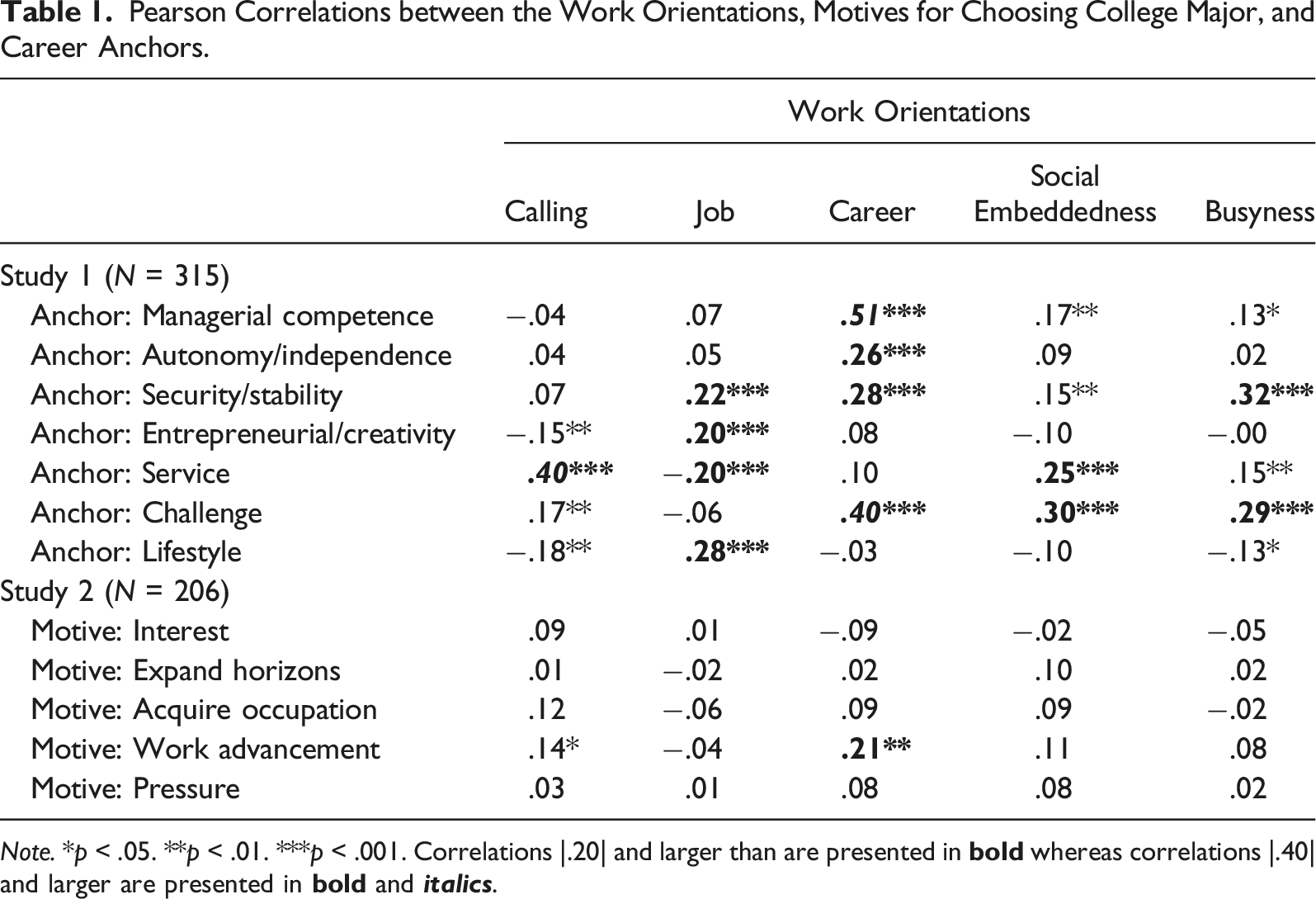
Note. *p < .05. **p < .01. ***p < .001. Correlations |.20| and larger than are presented in
To test the incremental validity of the WOQ by examining its’ contribution to work satisfaction over and above that of the seven career anchors, we carried out a hierarchical multiple regression analysis with gender coded as a dummy variable (Step 1), the seven career anchors (Step 2), and the five work orientations (Step 3) as predictors. In the current study, the variance inflation factor scores (1.18 < VIF <2.43) were less than 5.0, indicating that multicollinearity was not a problem (Kim, 2019).
Hierarchical Multiple Regression Analysis Predicting Work Satisfaction (NStudy 1 = 315).
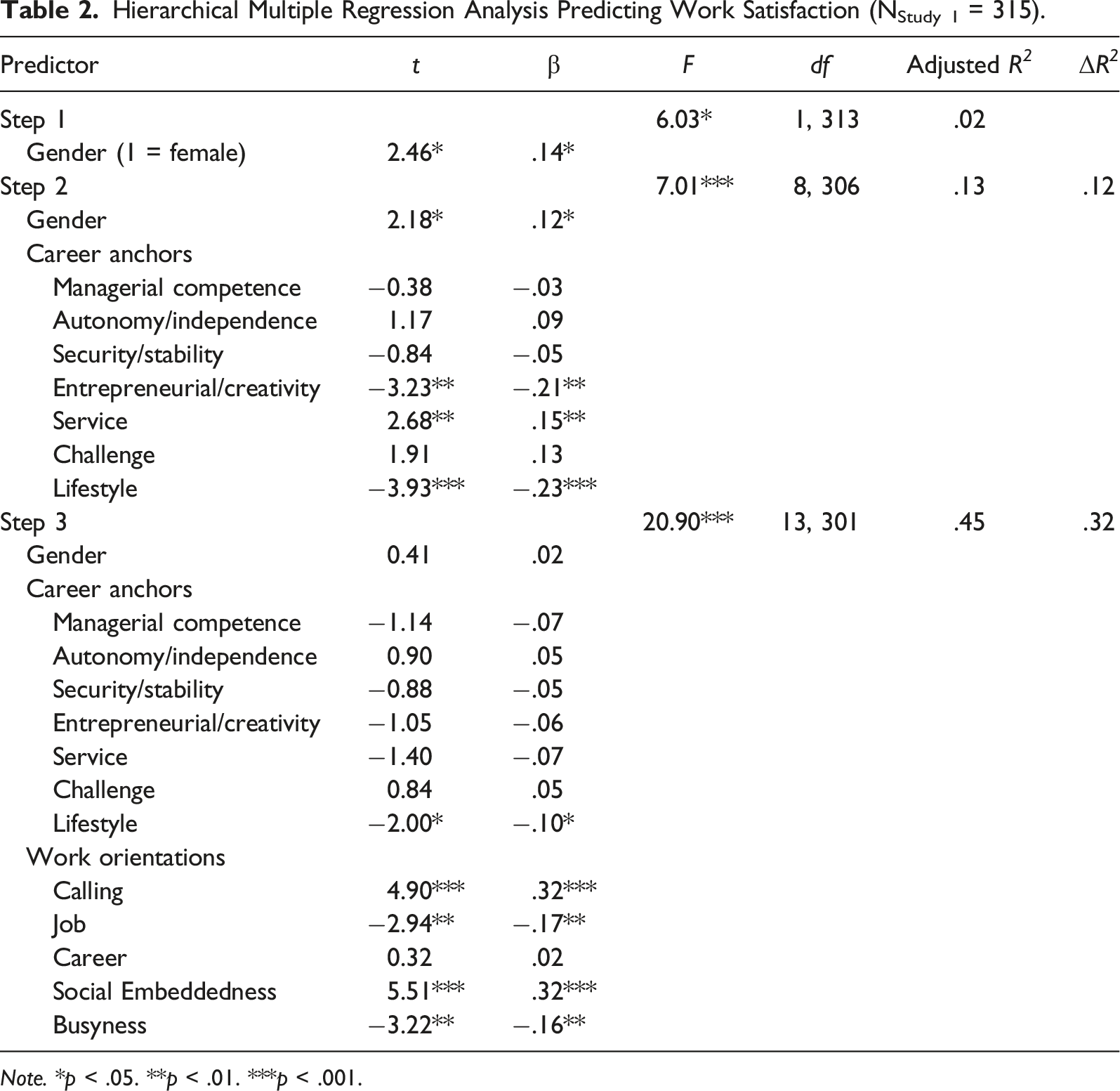
Note. *p < .05. **p < .01. ***p < .001.
Study 2 - Work Orientations in the College-To-Work Transition: A 5-Year Follow-Up
The college-to-work transition greatly impacts individuals’ careers (Stremersch et al., 2021). The choices individuals make and the strategies they use can influence their subsequent career choice satisfaction (Lipshits-Braziler et al., 2019). In today’s world of work, with the labor market constantly fluctuating, the transition is even more challenging for new college graduates with little work experience (Lechner et al., 2016). Research has found that the way students perceive college has a long-term impact on several career domains: their academic performance and educational choices (Lin & Lin, 2017), their future academic plans (Milovanska-Farrington, 2020), the certainty of their choice of a major (PuklekLevpušček & Podlesek, 2019), career decidedness (Bargmann et al., 2022), and vocational identity (Smitina, 2010).
Study 2 had two goals. First, to examine the discriminant validity of the WOQ by testing its associations with the individual’s motives for choosing a college major. The second goal was to test the incremental validity of work orientations to career choice satisfaction beyond motives for choosing a college major. In a 5 year longitudinal design, we first surveyed graduating senior college students regarding their motives to study in their chosen major. Five years later, we contacted the participants, now employed adults, inquiring about their current work orientations and career choice satisfaction.
The literature on academic motivation is broad, using a variety of conceptualizations: perceived benefits of attending college (Norton & Martini, 2017), college expectations (Byrne et al., 2012), motivations (Afzal et al., 2010; Byrne et al., 2012; Cote & Levine, 1997; Skatova & Ferguson, 2014; Yu et al., 2018), and reasons to attend college (Kennett et al., 2011). Based on these studies we elicited the degree to which the following five motives impacted the students’ choice of major: (a) interest – motivated by their interest in the chosen field of study or occupation, (b) expanding horizons – motivated by their desire to expand their knowledge, (c) acquiring a profession – motivated by their desire to acquire an occupation, (d) career advancement – motivated by the fact that this major is a requisite for advancement at work and ones’ career, and (e) external pressure – motivated by significant others pressuring them to enroll in a specific field.
Whereas motives for choosing a college major elicit individuals’ underlying desire to enter a specific field of study or major and represent individuals’ initial motivation toward their chosen profession, work orientations elicit individuals’ general attitudes to work and beliefs about it, which do not necessarily confine to their specific chosen field of study. Accordingly, we expected that mostly small to negligible associations would be found between the motives for choosing a college major and work orientations supporting the WOQ’s discriminant validity. However, we hypothesized that few motives would have weak associations with particular work orientations. Specifically, we hypothesized that the career advancement motive for choosing a college major would be associated with greater career orientation, as those having a career orientation seek jobs to help them advance in their organizational hierarchy (H5). Additionally, the interest motive for choosing a college major will be associated with a greater calling orientation, as individuals with a calling orientation view their work as a means to make the world a better place or as a path to self-fulfillment (H6).
Next, we explored the incremental validity of the WOQ by testing whether work orientations have a unique contribution to the prediction of career choice satisfaction over and above that of the five motives for choosing college majors. Based on previous research (Lipshits-Braziler et al., 2021; Willner et al., 2020), we expected that calling and social embeddedness orientations will be associated with higher career choice satisfaction beyond the contribution of the five examined motives. However, we hypothesized that job orientation will be associated with lower career choice satisfaction. In light of equivocal findings concerning the relationship between the career and busyness orientations on the one hand and work-related satisfaction on the other (Lipshits-Braziler et al., 2021; Willner et al., 2020), we had no expectations for the contribution of these orientations beyond the effect of the five explored motives.
Method
Participants and Procedure
At Time 1, participants were 496 undergraduate students from various academic fields at a large research university in Israel, all in the final semester of their undergraduate studies. The participants comprised those agreeing to complete an online survey regarding their studies, specifically their reasons for studying in their major(s). Five years later (T2), at the beginning of March 2020, a few weeks before the onset of the COVID-19 pandemic, we sent email invitations to these 496 college graduates to participate in a follow-up study regarding the purpose of work in their life. As compensation for participating in the follow-up, participants were offered personalized feedback and entry into a lottery for five cash prizes worth about US$275 for the first prize and four additional prizes of US$70. The 206 college graduates who completed the questionnaire at the follow-up (52.9% women) comprised the present study’s sample. The graduates’ mean age at Time 2 was 30.76 (SD = 2.11), reflecting that most college students in Israel begin their studies 2–5 years after high school graduation (due to the mandatory 2–3 years of military or civil service, commonly followed by a few months to a year backpacking trip). The participants came from various academic fields: science, technology, engineering, and mathematics (STEM; 41%), social sciences and humanities (33%), law, finance, and business (9%), and other fields (17%). Most participants were employed full-time (65%) or part-time (17.5%) when completing the questionnaires at Time 2, whereas the others were unemployed at Time 2 (17.5%). Half the participants (51%) had also completed an MA during the five years between T1 and T2, and an additional 19.4% were still studying toward their MA degree.
Instruments
Background Questionnaire – Time 1
The participants were asked to report their age, gender, college major(s), year of study, and professional experience.
Motives for Choosing a College Major –Time 1
(Bocian & Gati, 2015). The students were presented with five motives for choosing their college major(s): (a) interest, (b) expanding horizons, (c) acquiring a profession, (d) career advancement, and (e) external pressure. For each of these motives, participants were asked to rate the degree of importance for their choice of a major on a 7-point Likert-type scale, ranging from 1 (not at all) to 7 (very much). For those studying in a double major track (n = 103, 50%), these questions were posed for each major separately; we averaged their importance ratings for the five motives across the two majors. These five motives have been previously shown to be useful in predicting the degree of students’ satisfaction with their major (R 2 = .08), college GPA (R 2 = .04), and the contribution of the major to students’ career (R 2 = .16; Bocian & Gati, 2015).
Background Questionnaire –Time 2
Participants were asked to report their age, gender, undergraduate major(s), and whether they continued to a graduate degree (with three options: No, Currently enrolled, and Yes [completed MA studies]), and if so, in which field of studies. They were also asked to report their employment status (full-time, part-time, unemployed), and indicate their current position at work.
Work Orientation Questionnaire – Time 2
(WOQ; Willner et al., 2020). As in Study 1, we used the 26-item version of the WOQ. The median Cα internal-consistency reliability of the five orientations in the present study was .85 (.85, .87, .86, .75, and .82, for calling, job, career, social embeddedness, and busyness, respectively).
Career Choice Satisfaction – Time 2
(Lipshits-Braziler et al., 2019). The participants’ satisfaction with their chosen career was elicited by four questions using a 7-point Likert-type scale, ranging from 1 (not at all) to 7 (very much). The four items were: (1) “If you had to make a career decision again, would you make the same choice?”, (2) “To what extent is your current job compatible with your major at college?”, (3) “How satisfied are you with your job?” and (4) “Do you see your future career as remaining in the same field as your current job?”. This questionnaire has good internal reliability (Cα = .83) and validity (Lipshits-Braziler et al., 2019), linking career choice satisfaction to greater use of productive coping styles, less use of nonproductive coping styles, more advanced decision status, and less decisional distress. At Time 2, the Cronbach α internal-consistency reliability was .77.
Preliminary Analyses
A series of t-tests were conducted to compare participants’ motives to study their chosen major(s) and age between those participating only at Time 1 and those completing the follow-up at Time 2. No statistically significant differences emerged (all p ≥ .184).
Results
Using the R software, we first tested the discriminant validity of the WOQ by computing the Pearson correlations between students’ motives for choosing their college major(s) and their work orientations five years later. The results, presented at the bottom of Table 1, revealed only two weak statistically significant associations: Students who had a greater career advancement motive reported a higher career orientation (r = .21) and a higher calling orientation (r = .14); the other correlations were negligible (−.09 ≤ r ≤ .12), supporting the discriminant validity of the WOQ. We repeated the analyses with the motives for choosing the participants’ primary major, resulting in results similar to the combined motives between the two majors.
Second, to test the incremental validity of the WOQ, we conducted a hierarchical multiple linear regression analysis to explain career choice satisfaction by gender (Step 1), the motives for choosing a college major (Step 2), and work orientations (Step 3). As in Study 1, the VIF scores (1.18 ≤ VIF ≤ 2.43) were less than 5.0, indicating that multicollinearity was not a problem.
Hierarchical Multiple Regression Analysis Predicting Career Choice Satisfaction (NStudy 2 = 206).
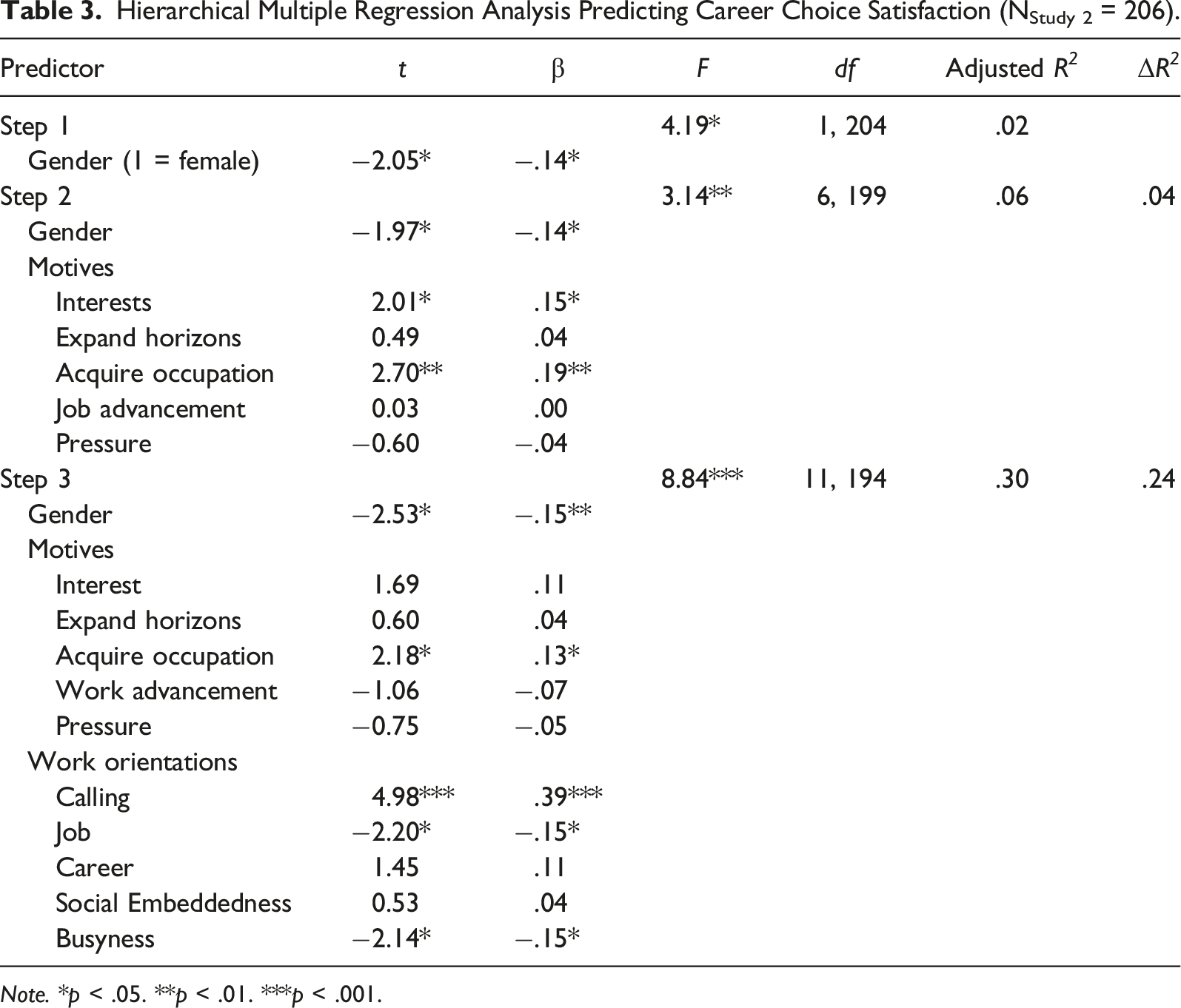
Note. *p < .05. **p < .01. ***p < .001.
Study 3 - Work Orientations, RIASEC Work Environments, and Work Satisfaction
One of the underlying assumptions of work orientations is that one can find a range of work orientations in various professional environments and that they do not fully differentiate between occupations (Willner et al., 2020; Wrzesniewski et al., 1997). However, whereas individuals in any occupation have a variety of work orientations, some occupations may align better than others to one’s work orientations (Willner et al., 2020). Accordingly, Study 3 investigated whether individuals working in different work environments differ in the relative salience of their work orientations. Using the samples from Study 1 and Study 2, Study 3’s goal was to examine the associations between work orientations and Holland’s (1997) six RIASEC work environments, as well as the unique contribution of the WOQ in predicting work satisfaction beyond that of the six RIASEC environments.
Holland (1997) proposed that individuals can be characterized according to their vocational personality type and that there are six corresponding work environments (arranged on a hexagon) – Realistic, Investigative, Artistic, Social, Enterprising, and Conventional (Holland, 1997; Nye et al., 2017). Congruence between one’s vocational personality type and their work environment is expected to lead to better outcomes, including work satisfaction, retention, performance, and success (Holland, 1997; Nye et al., 2017). Working in an environment that is congruent with one’s interests allows employees to express their values, beliefs, abilities, and skills (Holland, 1997). Holland postulated that types and environments of closer proximity on the hexagon are more similar and congruent.
Work orientations have been found to be associated with many work-related behaviors such as work engagement and turnover intentions (Mantler et al., 2022), work satisfaction (Lipshits-Braziler et al., 2021), desire to do challenging work (Shea-Van Fossen & Vredenburgh, 2014), and values (Gandal et al., 2005). However, to date, no study has explored the degree to which work orientations differ in various work environments. Hence, the present study investigated the associations between the five work orientations and the six RIASEC environments.
In both the Social and Enterprising environments, individuals work with people. However, those working in the Social environment aim to help others, whereas those in Enterprising aim to influence and persuade them (Nye et al., 2017). Thus, we hypothesized that individuals in both Social and Enterprising environments will be characterized by higher levels of the social embeddedness orientation (H7). Additionally, due to the pattern of people’s interactions in each environment, we hypothesized that the calling orientation will be relatively more prominent in a Social environment (H8) and the career orientation will be more prominent in an Enterprising environment (H9).
In a Conventional environment, individuals work with very clear rules and instructions (Nye et al., 2017), so we hypothesized that individuals working in this environment will report greater job (H10) and busyness orientations (H11). We had no hypotheses regarding the work orientations of those working in a Realistic, Artistic, or Investigative environment. As work orientations reflect a general belief regarding the purpose of work, and work environments reflect a more concrete actualization of their current choice, we expected that the two constructs would account for different aspects of individuals’ satisfaction with their work. Thus, we examined whether individuals’ work orientations will predict work satisfaction beyond that of the six RIASEC environments.
Method
Participants
The initial sample for Study 3 comprised a combined sample of 480 participants–– 310 from Study 1 and 170 from Study 2, who reported their current job position on the background questionnaire. For 414 of these participants, the job information they provided enabled us to assign them a three-letter Holland RIASEC code (see next section).
Instruments
Holland’s RIASEC Work Environments
We adopted Holland’s (1997) approach to classify occupations according to the six RIASEC work environments, using his Occupations Finder (Holland & Messer, 2017), aligning with previous studies (e.g., Knafo & Sagiv, 2004). Two of the authors independently assigned an occupational title from Holland’s Occupations Finder and recorded the corresponding three-letter RIASEC code for each participant’s reported job title. In cases where the job title was not found in the Occupations Finder (as participants reported their job titles in free text), each author independently identified the closest occupation in the Occupations Finder, and that occupation’s three-letter code was recorded. Of the potential 480 job titles, 26 were too general (e.g., “student job”) and thus could not be assigned a specific occupational title, resulting in no corresponding RIASEC code being recorded.
Of the remaining 454 job titles, for 308 participants, the two authors assigned a three-letter RIASEC code with the same three letters (for 295 identical codes). Regarding the 159 job titles for which there was no expert agreement on the participant’s three-letter code, two additional career experts were invited to similarly classify the jobs, to a three-letter RIASEC code using the Occupations Finder. This resulting in 119 additional job titles being assigned identical three-letter RIASEC codes by at least two of the four experts. The remaining 40 participants whose reported jobs could not be identified in terms of Holland’s RIASEC three-letter code due to the lack of inter-judge agreement were removed from the analysis. Thus, 414 participants (91% out of 454) with a three-letter Holland code were included in the analyses.
Next, we created six binary variables for each work environment (Realistic, Investigative, Artistic, Social, Enterprising, and Conventional) that corresponded with the participants’ three-letter RIASEC code. Thus, for example, RIE was coded as 110010 for
Work Satisfaction
For the Study 1 sample, we used the participants’ reported satisfaction with their work (see Study 1). For the Study 2 sample, we used the responses to “How satisfied are you with your job?” (see Study 2). Because in Study 2 we used a 7-point response scale, we first computed a linear transformation of the work satisfaction ratings to a 9-point scale.
Preliminary Analysis
We examined whether the five work orientations differed between the Study 1 and Study 2 samples. After Bonferroni correction for multiple comparisons, only one of the five orientations emerged statistically significant (corrected p < .01): The job orientation was higher in Study 1 (M = 3.70, SD = 1.55) than among the Study 2 participants (M = 3.21, SD = 1.33), t (412) = −3.25, p = .001, d = 0.33. This difference may be attributed, at least partially, to the greater variability in career status and seniority in the Study 1 sample. As the single statistically significant difference was relatively small, and the other four non-significant effects were small-to-negligible (d
Results
Means (SDs), and MANOVA Results of Work Orientations in the Six RIASEC Environments.
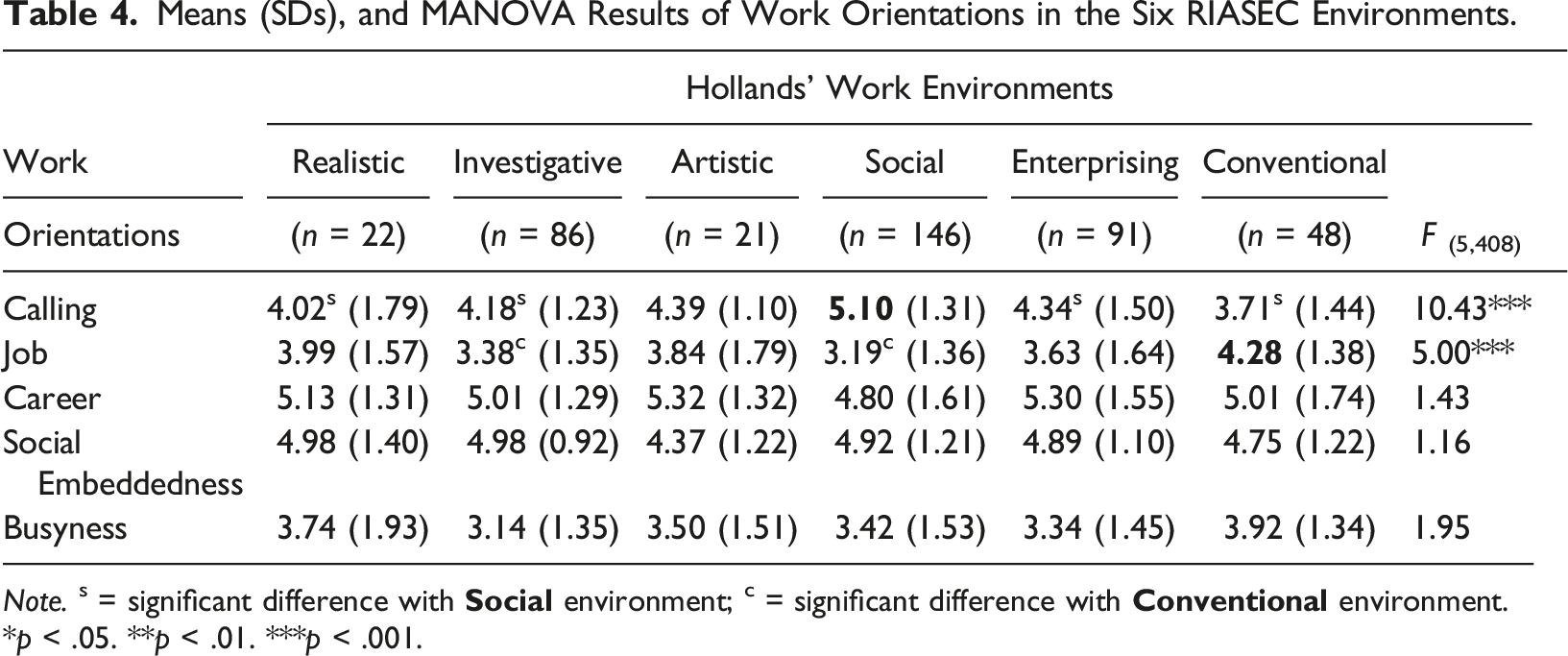
Note. s = significant difference with
*p < .05. **p < .01. ***p < .001.
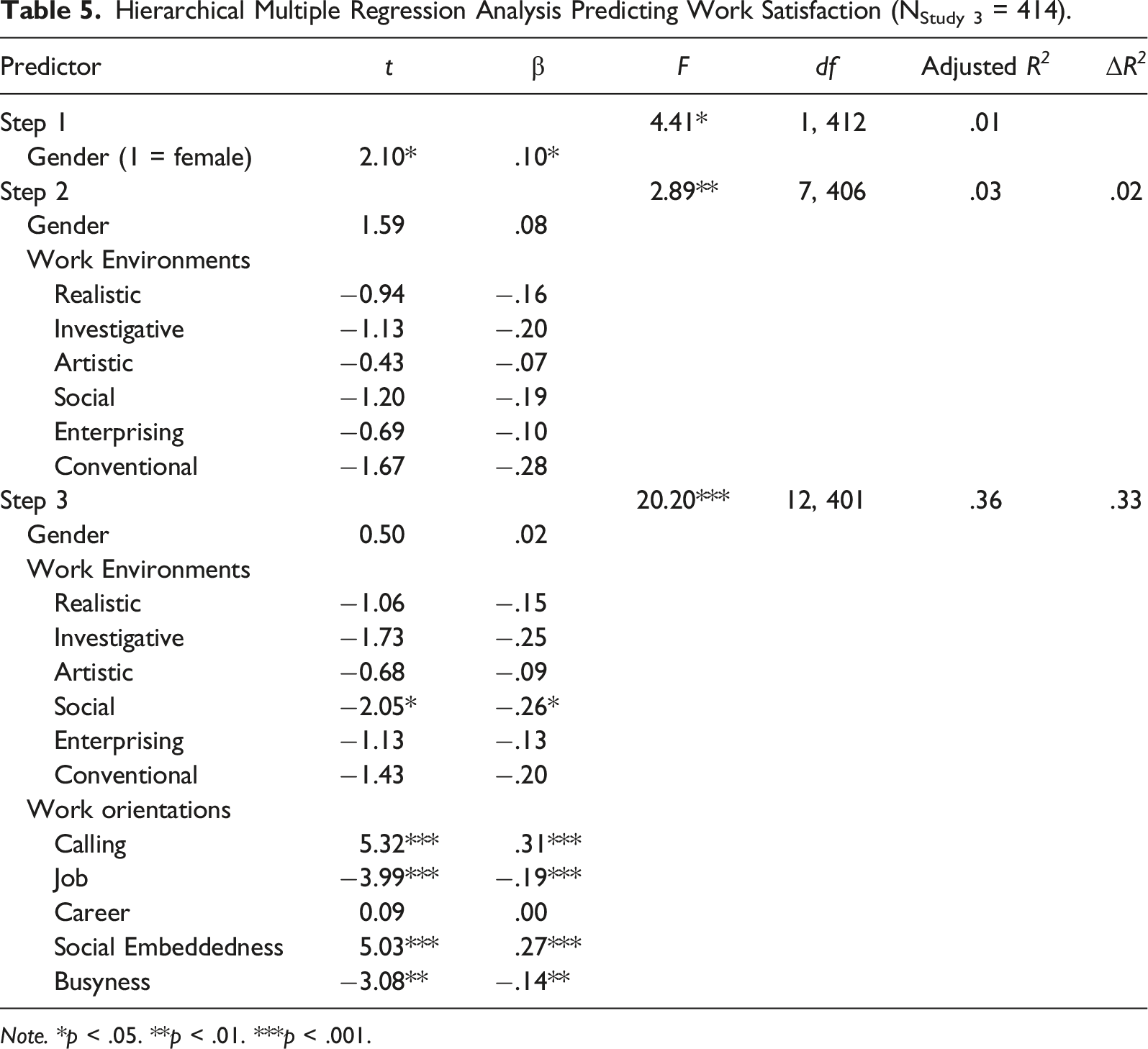
To examine the incremental validity of the WOQ by testing whether individuals’ work orientations predict work satisfaction beyond what can be attributed to the work environments, we first carried out a hierarchical linear regression analysis to test the effect of work orientations on work satisfaction beyond that of gender and Holland’s six RIASEC work environments. To run the analyses, we used a six-digit array with dummy variables of zero or 1 for each participant, representing their three-letter Holland RIASEC code. Thus, for example, RIE was coded as 110010, for RIASEC, respectively. Next, we conducted a hierarchical linear regression analysis to predict work satisfaction, with gender (Step 1), the six RIASEC environments (Step 2), and the five work orientations (Step 3).
Hierarchical Multiple Regression Analysis Predicting Work Satisfaction (NStudy 3 = 414).
Note. *p < .05. **p < .01. ***p < .001.
General Discussion
The present research explored the validity of the expanded model of work orientations in three studies. The convergent and discriminant validity of the expanded model of work orientations was supported by its differential pattern of associations with career anchors, motives for choosing a college major, and RIASEC work environments. The observed associations we found in Study 1 between the career anchors and work orientations align with previous studies (Abessolo et al., 2021; Gandal et al., 2005; Lan et al., 2013) that found similar correlations between the calling orientation and the service anchor, between the job orientation and the security-stability anchor, and between the career orientation and the managerial competences and autonomy anchors. Surprisingly, in the present study, the busyness orientation yielded the strongest association with the security-stability anchor. In contrast, the job orientation had a stronger association with the lifestyle anchor, supporting that job-oriented individuals’ primary objectives are outside of work (Wrzesniewski et al., 1997). Job-orientated and busyness-oriented individuals may seek and acquire security from their work to satisfy different needs. Job-orientated individuals are likely to seek security to focus on their lives outside of work (represented by the effect of the lifestyle anchor), whereas busyness-oriented individuals are likely to seek security to provide structure and challenge in their work (represented by the effect of the challenge anchor). Indeed, Stiglbauer et al. (2022) found that whereas the job orientation was related to money and flexibility work values, the busyness orientation was more closely related to stimulation, development, and career work values.
The motives for choosing a major in Study 2 had only small or negligible associations with work orientations; thus supporting the WOQ’s discriminant validity. Pursuing a college degree for career advancement was the only motive significantly associated with higher calling and career orientations five years later, however, these are small effects. Study 3’s results reflect that differences among the six RIASEC work environments emerged in two work orientations: the calling and job orientations differ moderately among those working in the various Holland environments, indicating that some work environments are more likely to offer opportunities to express certain work orientations than others. A Social environment allows one to work with people, thus providing a suitable work environment for those seeing their work as a calling, enabling them to help others and make the world a better place. This notion aligns with studies focusing on calling in occupations in the Social environment, such as teaching (Jain & Kaur, 2021), nursing (Kallio et al., 2022), and social work (Guo et al., 2014). This effect of calling orientation in the Social environment is substantial, reflecting a moderate-to-large effect size compared with other Holland environments (excluding the Artistic environment).
We also found that individuals in a Conventional work environment were more job-oriented. Previous research found that working in a Conventional work environment was correlated positively with an occupational emphasis on security values and negatively with power values (Knafo & Sagiv, 2004). Thus, the Conventional environment may provide individuals having a strong job orientation with the financial security they need to find meaning in their lives outside the work setting. A better fit between a person’s characteristics and their work environment has been found to elicit better work outcomes (Kristof-Brown et al., 2005; Nye et al., 2017). Thus, future research should examine whether calling-oriented individuals in a Social environment and job-oriented in a Conventional environment derive better work outcomes, such as professional success.
In the present study, no effect emerged for the work environments on the career and social embeddedness orientations; this may stem from the complex Israeli cultural context, which has both collectivistic and individualistic characteristics (Willner et al., 2015). Indeed, in all six environments, the career and social embeddedness orientations were relatively high, suggesting that due to the collectivistic nature of Israeli society, regardless of the workers’ specific work environment, they prefer to be socially embedded. However, at the same time, Israel’s individualistic characteristics may also drive individuals to seek positions of power and advancement, reflecting a career orientation. Future research should examine whether the effects of work environments on the career and social embeddedness orientations emerge in different cultural contexts.
The Incremental Validity of the Expanded Model of Work Orientations
The incremental validity of the expanded five-dimensional model of work orientations was supported by its unique contribution (+24%) in explaining career choice satisfaction beyond that of the motives for choosing a college major and accounting for work satisfaction beyond career anchors and RIASEC work environments–– +31% and +33%, respectively. The contribution of work orientations to career choice satisfaction and work satisfaction exceeded that of the seven career anchors in Study 1, the five motives for choosing a college major in Study 2, and the six RIASEC work environments in Study 3. Thus, work orientations can be considered as an additional significant vocational construct that predicts work satisfaction (Lipshits-Braziler et al., 2021; Willner et al., 2020). Furthermore, the contribution of the busyness orientation to career choice satisfaction, and the contributions of social embeddedness and busyness orientations to work satisfaction underscores the significance of these two additional orientations to the work orientations model, further supporting the expanded five-dimensional model.
Jiang and Wrzesniewski (2022) and Schabram et al. (2023) suggested that the job orientation is likely an absence of calling. However, the pattern of correlations between the calling and job orientations, on the one hand, and career anchors, on the other, suggests that these two work orientations are not mirror images, as could be expected if they represented opposite poles of a single dimension. Furthermore, as the job orientation consistently contributes to the prediction of career choice satisfaction and work satisfaction beyond what can be explained by the calling orientation, it suggests that they explain the different variance values in these two aspects of career satisfaction, requiring further exploration within the work orientations framework. Additionally, the social embeddedness orientation shares some similarities with the calling orientation regarding its pattern of associations to work satisfaction and some of the career anchors. However, the findings clearly differentiated between social embeddedness and calling as they relate to the RIASEC environments and career choice satisfaction. This distinction suggests that while the two are related, the social embeddedness orientation is not merely a sub-dimension of calling, as suggested by Pratt et al. (2013) and Sawhney et al. (2023).
Work Orientations in the Context of the Psychology of Working Theory
The present findings concerning the expanded model of work orientations align with the principles of the psychology of working theory (PWT; Duffy et al., 2016). PWT describes three types of needs that people seek to fulfill through their work: the need for survival and power, the need for social connection, and the need for self-determination. Blustein et al. (2019) suggested that the purpose and meaning of work can be integrated into PWT. In this context, work orientations may offer a framework highlighting what leads individuals to develop their unique purpose of work as well as pursue work opportunities that meet their specific needs. Specifically, the job and career work orientations may fulfill individuals’ needs for survival and power, respectively. Thus, individuals who have a greater need for survival, relying on their work’s financial support and security, may develop a strong job orientation and seek employment that affords them money and security. Whereas individuals with a greater need for economic, social, and psychological power may develop a stronger career orientation, reinforcing their pursuit of advancement and impact within their work. Individuals having a greater need for social connection may develop a stronger social embeddedness orientation and seek a workplace that allows them to belong and feel part of a broader social context. Individuals who seek work to fulfill their need for self-determination may pursue opportunities in an environment that enables self-expression, corresponding to their interests. Finding a suitable work environment may lead to developing a stronger calling orientation compatible with the individual’s need for self-determination. Indeed, previous research has linked perceived calling with facets of self-determination (Dik et al., 2008; Duffy & Autin, 2013).
Whereas the busyness orientation may not appear to have a direct link to PWT, it may be associated with introjected regulation, a component of self-determination theory (SDT; Deci & Ryan, 1985; Van den Broeck et al., 2021), involving pursuing work activities for self-esteem needs. Similarly, individuals with a strong busyness orientation work to fill idle time and as a means to be productive members of society, thus perhaps supporting the fulfillment of the need for self-esteem. Previous lottery studies, supporting the busyness orientation demonstrated that individuals continue working even when their basic needs are fulfilled (Highhouse et al., 2010; Kallciu et al., 2022). However, the consistent negative associations between the busyness orientation and career-related satisfaction imply that self-determination needs remain unfulfilled. The busyness orientation’s role in need fulfillment should be further explored, especially whether this orientation enhances general well-being aside from domain-specific work satisfaction. To conclude, evidence supports that the traditional three-dimensional model of work orientations of job, career, and calling (Wrzesniewski et al., 1997) may cover the basic (survival and power) and self-determination needs. However, the expanded model, incorporating the two additional orientations––social embeddedness and busyness––may shed light on additional psychological needs that can be fulfilled through one’s work. Although much of the research in the field has focused on calling, highlighted by the WCT (Duffy et al., 2018), the current findings emphasize the significance of the two additional work orientations to the career development of employed adults. Thus, the support for the expanded model, as well as orientations present in the original tripartite model, lends support to working with employees who do not have the luxury of pursuing a calling and working for the sake of their self-determination.
Limitations and Future Research
The limitations of this research have to be acknowledged before addressing its implications. First, while the three studies supported the five-dimensional model of work orientations, future research should explore whether additional work orientations emerge, in today’s dynamic world of work. One possible avenue to explore is whether the calling orientation can be split into additional orientations. Indeed, recent research by Sawhney et al. (2023) has suggested three types of calling–craftsmanship, kinship, and serving. For instance, as kinship is reflected in social embeddedness, future research should explore whether a personal growth orientation (craftsmanship) and a greater good orientation (serving), currently clustered under calling, can be regarded as discrete orientations.
Study 2 used a sample of college graduates from a single research university in Israel who may have greater academic and career ambition than students in other colleges or other cultures, and thus may have greater levels of self-actualization needs. Thus, the graduates may be more ambitious and career-oriented in the first place, affecting the associations between the motives for choosing a major and work orientations, as well as possibly impacting their work orientations. We found only weak associations between these two constructs––the career advancement motive was associated with the career and calling orientations. Therefore, future studies should explore the associations between motives for choosing a college major and work orientations in more heterogeneous, diverse, and representative samples, such as multiple higher education institutions or diverse cultural and socioeconomic backgrounds. Using diverse samples would further support the external validity of the study and allow for broader applicability of the findings. Furthermore, the motives for choosing a college major at Time 1 were assessed as part of a larger study on students’ career development. In that study, using a single-item question for each motive was vital for practical reasons. However, future studies should prefer a multi-item measure to assess the associations between work orientations and motives for choosing a major. The five-year gap between Time 1 and Time 2 in Study 2 may also introduce external factors that could have an impact on the findings; thus, future research should seek to identify possible external factors that may have impacted the results.
Additionally, future research should explore the associations among the measures in Study 1 and Study 3 in a longitudinal research design, similar to Study 2. As Study 1’s career anchors and work orientations were collected concurrently, the nature of the association between them is unclear. On the one hand, work orientations may shape future work experiences and, subsequently, career anchors, but on the other hand, one’s career anchors may lead to adopting specific work orientations that affect how individuals choose or craft their careers.
Finally, Study 3 focused on the associations between work orientations and the RIASEC work environments. Whereas some differences were found between the six work environments, deriving conclusions about specific orientations in RIASEC work environments is constrained, thus requiring further research. We coded the participants’ environment based on their work position at the time of data collection but did not examine whether they were working in a work environment that is congruent with their vocational interests. Future research should explore the relationship between work orientations and the RIASEC work environments, while considering the individuals’ interests and, subsequently, their environmental fit.
Implications for Practice
The present research highlights the potential benefit of using the WOQ in multiple settings. The WOQ accounted for work and career choice satisfaction beyond that of individuals’ career anchors and their RIASEC work environments, constructs often considered in career counseling, thus providing an additional assessment option to be used in counseling practice. Furthermore, the associations between the WOQ and both career anchors and the RIASEC environments point to the possibility that work experiences individuals engage in early in their careers may influence subsequent work orientations. Consequently, career counselors can assist their clients in finding work-related activities that align with their work orientations. Thus, helping young adults craft their work experiences in a way that allows them to fully experience their work according to its purpose in their lives can lead to choosing a more meaningful career path. The present research provided further support for the validity of the expanded work orientations model; thus, by completing the WOQ, career counseling clients can be assisted in designing a vision that will help them better align their careers with their long-term goals, as reflected in their purposes for working. Furthermore, career counselors can administer the WOQ as a tool for clients considering transitioning into college, choosing a major, or facing college-to-work or work-to-work transitions. Addressing one’s work orientations during important life transitions may help one become aware of their career development. As a result, they will be better prepared to cope with the challenges presented by increasingly frequent career transitions in today’s volatile job market.
As in previous studies that emphasized the importance of calling to the college-to-work transition (e.g., Zhang et al., 2021), the present study highlighted the importance of two additional work orientations. The current findings suggest that along with calling, the job and busyness orientations have a critical role in career choice satisfaction and work satisfaction and that the social embeddedness orientation is central to work satisfaction. Thus, researchers and counselors should not regard the job orientation as merely an absence of calling but rather a significant orientation worthy of further investigation. Counselors, organizations, and researchers would do well to explore the antecedents and outcomes uniquely associated with the job orientation. For example, since job-oriented employees are more likely to find meaning outside their work, how will their work turnover be affected? Will their career transitions be fewer and more successful? Will their retirement years be fuller and more satisfying than non-job-oriented individuals due to their richer lives outside of work? Finally, the three studies supported the contribution of the additional two orientations––social embeddedness and busyness––to career choice satisfaction and work satisfaction. Thus, these two additional orientations enable professionals to offer their clients a richer palette that could facilitate career planning or work design (such as job crafting). Further understanding of the emergence of additional work orientations and the related processes and outcomes can be used to develop positive self-concepts among many who do not have the privilege of implementing their strong sense of calling (Blustein, 2019).
Footnotes
Acknowledgments
We thank Benny A. Benjamin, Ella Anghel, Charlotte Forman, Jake Kovinsky, Adi Tene, and Amy Bruck for their helpful comments on earlier versions of this paper, and Eitan Bocian for helping in the data collection of Study 2. The study and analysis plan were not preregistered. We have no known conflicts of interest to disclose. Tirza Willner was supported by the Azrieli Foundation. Itamar Gati was supported by the Samuel and Esther Melton chair.
Declaration of Conflicting Interests
The author(s) declared no potential conflicts of interest with respect to the research, authorship, and/or publication of this article.
Funding
The author(s) disclosed receipt of the following financial support for the research, authorship, and/or publication of this article: This work was supported by the The Azrieli Foundation.
