




Abstract
Individuals differ in the strategies, self-efficacy beliefs, and difficulties that characterize their career decision-making process. Although some strategies are deemed adaptive, the differential links of career decision-making strategies to self-efficacy and difficulties, in general and in various cultural contexts, remain unclear. To address this issue, we investigated the associations of 12 career decision-making strategies with self-efficacy and difficulties among 414 adolescents and young adults in the cultural context of the French-speaking part of Switzerland. In doing so, we also sought to develop a French version of the Career Decision-Making Profiles questionnaire (CDMP-F) for assessing career decision-making strategies. Results confirmed the fit of the hypothesized 12-factor model underlying the CDMP-F and the adaptability assumption for six of 12 strategies: information gathering, locus of control, procrastination, speed of making the final decision, dependence on others, and desire to please others. Moreover, differentiated associations were uncovered: high procrastination and external locus of control were linked to lack of motivation; slow speed of making the final decision was linked to general indecisiveness; and high desire to please others was linked to external conflicts. Supporting the structural and construct validity of the CDMP-F and identifying differential associations, implications for research and practice are discussed.
Keywords
Introduction
Investigations of how individuals engage and advance in the career decision-making process have occupied the career counseling literature for many decades. Special attention has been devoted to identifying and describing individuals’ career-related difficulties and their potential antecedents. Bordin (1946) was among the first to propose that individuals’ behavioral characteristics would predict the overall degree of adjustment and the specific types of career-related difficulties individuals should present. In turn, Rounds and Tinsley (1984) referred to career-related difficulties as the “behavioral or cognitive deficits that often are associated with emotional distress and are centered on choosing, entering, continuing, or changing an occupation” (p. 141). Such approaches proposed distinguishing between individuals’ behavioral and cognitive dispositions, on the one hand, and their adjustment reactions to the demands of the environment, on the other.
Subsequently, to inform practice on how to help clients overcome career-related difficulties, the career decision-making process has been analyzed from different perspectives, including the typical strategies, self-efficacy beliefs, and difficulties that characterize individuals during this process. To this end, while a handful of career assessments for measuring career decision-making difficulties have been developed, only a few assessments of career decision-making strategies are currently available for use in research and practice (Ebner et al., 2018; Gati & Levin, 2014). Among these instruments, the Career Decision-Making Profiles questionnaire (CDMP; Gati et al., 2010), representing the most recent and comprehensive model and measure of career decision-making strategies (Gati et al., 2012), comprises 12 dimensions to characterize individuals’ multifaceted ways of perceiving and responding to career decision-making tasks.
The CDMP has been recognized as a psychometrically valid assessment for obtaining reliable information about the use of career decision-making strategies that, in turn, can support intervention planning in career counseling (Gati & Levin, 2014; Levin & Gati, 2015). Furthermore, six of the 12 CDMP strategies have been marked adaptive based on theoretical considerations and empirical findings, namely comprehensive information gathering, internal locus of control, low procrastination, fast speed of making the final decision, low desire to please others, and low dependence on others (Gadassi et al., 2013; Gati & Levin, 2012). These six strategies were associated with various positive outcomes such as higher self-efficacy (Gadassi et al., 2013; Tian et al., 2014), fewer career decision-making difficulties (Tian et al., 2014; Willner et al., 2015), greater satisfaction with university studies (Vertsberger & Gati, 2015), and eventual career success (Ebner & Paul, 2023). Such findings supported assessing clients’ career decision-making strategies during the early stages of counseling for discussing in later stages of counseling how to adopt more adaptive strategies to facilitate making better career decisions (see also Ebner et al., 2018; Ginevra et al., 2012).
Nevertheless, previous studies utilizing the CDMP model did neither analyze nor highlight the potential differential impact of specific CDMP strategies on career decision-making. Instead, studies typically presumed that the six CDMP adaptive strategies have a uniform positive impact on making better career decisions and, respectively, focused on predicting outcomes using the CDMP-derived career decision-making adaptability score (CDA; Gati & Levin, 2012; e.g., Ebner & Paul, 2023). For this reason, although the six adaptive CDMP strategies have been shown to impact the quality of the decision-making process collectively, their unique significance and consequences remain to be clarified. Similarly, although existing frameworks of career decision-making difficulties allow differentiating among the difficulties individuals may experience in career decision-making (e.g., Gati et al., 1996; Hacker et al., 2013; Saka et al., 2008), the question of who will experience which specific difficulty is not yet fully understood (Gati et al., 2019; Xu, 2022).
In this study, we focused on career decision-making strategies as potential antecedents of career decision-making self-efficacy and difficulties, two of the most studied variables in research on the effectiveness of career interventions (Soares et al., 2022; Whiston et al., 2017; see also Lent & Brown, 2020; Osipow, 1999). Our primary goal was to investigate which of 12 career decision-making strategies (as measured by the CDMP; Gati et al., 2010; 2012) would be differentially associated with career decision self-efficacy (as measured by the Career Decision Self-Efficacy Scale, CDSE; Betz et al., 1996), and 10 specific career decision-making difficulties (as measured by the Career-Decision Difficulties Questionnaire, CDDQ; Gati et al., 1996). In identifying the strategies associated with an increased likelihood of experiencing specific difficulties in career decision-making, we sought to inform research and practice of the career decision-making strategies worth addressing when working with clients to increase clients’ self-efficacy or resolve specific difficulties.
In addition, since this research was conducted among French-speaking Swiss adolescents and young adults, a second goal of the present study was to validate a French version of the Career Decision-Making Profiles Questionnaire (i.e., CDMP-F). At present, the CDMP is available in only a small number of languages, including Chinese, English, German, Hebrew, and Italian (Ebner et al., 2018; Gati et al., 2010; Ginevra et al., 2012). However, a French version of the CDMP has not yet been developed and validated, limiting its use in many parts of the world, including, among other countries, Belgium, Burkina Faso, Canada, France, Togo, and Switzerland. Moreover, developing a new language version of the CDMP and validating it in a new cultural context can illuminate the generalizability of previous results on the CDMP. Indeed, existing findings—on the 11-factor CDMP version emerging as only partially measurement invariant between Chinese and U.S. respondents (Guan et al., 2015) or the 12-factor CDMP version validated only in German and Hebrew (Ebner et al., 2018; Gati & Levin, 2012)—are insufficient to establish the cross-cultural generalizability of the updated CDMP model.
Thus, this study sought to pursue two main interrelated goals. On the one hand, this study aimed to uncover the differential associations between the 12 career decision-making strategies measured by the CDMP and career decision self-efficacy, as well as specific career decision-making difficulties (Goal 1). Identifying specific antecedents of various career-related difficulties can inform research and practice on who is more likely to face difficulties and which specific career-related difficulties they will experience. In this respect, building on the findings of previous studies typically treating the six adaptive CDMP strategies uniformly, the present study aimed to determine the unique significance and consequences associated with each strategy. On the other hand, this study aimed to validate a French version of the CDMP (Goal 2). Providing a psychometrically valid French version was deemed crucial, not only for expanding the accessibility and applicability of the CDMP, but also to investigate the cross-cultural generalizability of findings on the CDMP strategies and their consequences. These dual goals aimed to contribute valuable insights for both research and practice in the context of career assessment and counseling. In the following subsections, we review the constructs of career decision-making strategies, self-efficacy, and difficulties in greater detail, highlighting their distinct contribution to the analysis of career-related difficulties.
Career Decision-Making Strategies
The strategies individuals use in career decision-making play a decisive role in determining the quality of the career decision-making process and its outcomes. Often referred to interchangeably as career decision-making styles (Ebner et al., 2018; Gati et al., 2010; Singh & Greenhaus, 2004), career decision-making strategies denote the typical behavioral and cognitive tendencies individuals use to cope with career decision-making. In particular, Harren (1979) proposed that individuals would be best characterized by one dominant career decision-making style (rational, intuitive, or dependent), which he defined as individuals’ “characteristic mode of perceiving and responding to decision-making tasks, or the manner in which the person goes about making decisions” (pp. 124–125).
Instead of labeling individuals based on one dominant style, Gati et al. (2010) proposed characterizing the typical way individuals make career decisions using a multidimensional approach. Gati et al. (2010) formalized this multidimensional approach using the CDMP model and questionnaire, which initially included 11 decision-making strategies: information gathering, information processing, locus of control, effort invested, procrastination, speed of making the final decision, consulting with others, dependence on others, desire to please others, aspiration for an ideal occupation, and willingness to compromise; soon after, the CDMP was revised to include the strategy of using intuition (Gati & Levin, 2012). These 12 career decision-making strategies represent the various “habitual response patterns individuals use to reach career decisions” (Levin & Lipshits-Braziler, 2022, p. 537; see also Gati et al., 2010). In this study, we favor the term career decision-making strategies, rather than style, given its consistency with the general decision-making literature and its better alignment with the notion that individuals have a repertoire of strategies to choose from and that they use in different situations (Singh & Greenhaus, 2004).
One of the assumptions underlying the CDMP was that some strategies are more adaptive for career decision-making (Gati et al., 2010). Based on the findings of Gadassi et al. (2012), Gati and Levin (2012) developed the Career Decision-Making Adaptability score (CDA). This score constituted an empirically-derived, operational definition of career decision-making adaptability, reflecting the degree to which individuals make career decisions after collecting relevant information (comprehensive information gathering), without unnecessary delays (low procrastination, fast speed of making the final decision), or being too dependent on external factors (external locus of control, low dependence on others, low desire to please others). In short, adaptability, within the CDMP model, refers to “the decision-making strategies individuals use to achieve better career decisions” (Levin & Lipshits-Braziler, 2022, p. 537). Subsequent research examining the links of CDMP strategies with indicators of the quality of the process–such as self-efficacy beliefs (Gadassi et al., 2013; Tian et al., 2014), career decision-making difficulties (Tian et al., 2014; Willner et al., 2015), and career adaptability (Ebner et al., 2018; Levin & Lipshits-Braziler, 2022)–supported the adaptability assumption for the six CDMP strategies included in the CDA score. Longitudinal research further validated the CDA, with a lower CDA score predicting dissatisfaction of university students with their studies and a greater likelihood of changing programs two years later (Vertsberger & Gati, 2015), and a high CDA score predicting the career success of workers one year later (Ebner & Paul, 2023).
Career Decision Self-Efficacy
Career decision self-efficacy is a second construct often used to characterize individual differences in the career decision-making process. Self-efficacy refers to “people’s judgments of their capabilities to organize and execute courses of action required to attain designated types of performances” (Bandura, 1986, p. 391). Among the various self-efficacy beliefs, career decision self-efficacy denotes individuals’ confidence in their career decision-making skills, namely for accurate self-appraisal, gathering occupational information, goal selection, making plans for the future, and problem-solving (Betz et al., 1996). In the context of vocational psychology and career counseling, studies have shown that self-efficacy beliefs mediate the relationship between individual dispositions, such as personality traits and emotional intelligence, and career-related outcomes, such as vocational commitment and career decision-making difficulties (e.g., Di Fabio et al., 2015; Jin et al., 2009; Lent et al., 1994). In addition, Lent and Brown (2020) classified career decision self-efficacy as a process-related construct whose assessment can facilitate identifying difficulties in career decision-making. In contrast to other forms of self-evaluations (e.g., self-esteem), as well as career decision-making strategies, career decision self-efficacy is not considered a stable disposition but rather a construct that can be impacted by career interventions (Lent & Brown, 2020; Rossier et al., 2022; Whiston, 2021).
Career Decision-Making Difficulties
Whereas career decision-making strategies describe how individuals approach career decision-making, the term career indecision was initially used to refer to the state of being career undecided (Holland & Holland, 1977; Osipow et al., 1999). Sepich (1987) later maintained that the term career indecision should be considered broader than merely the state of being career undecided and encompass the various problems and difficulties individuals experience in the career decision-making process (see also Gati et al., 1996; Xu & Bhang, 2019). Indeed, subsequent research adopted this view and identified various difficulties that are related to cognitive (e.g., lack of information; Gati et al., 1996), emotional (e.g., anxiety; Saka et al., 2008), and personality (e.g., dependence on others; Hacker et al., 2013) factors. The present study endorses this view, using career indecision to refer to individuals’ specific problems in career decision-making.
The Career Decision-Making Difficulties (CDDQ) taxonomy is among the most comprehensive and validated models of the causes of career indecision (Gati et al., 1996; for a review, see Xu & Bhang, 2019). This taxonomy differentiates between 10 career decision-making difficulties grouped in three main clusters: Lack of Readiness (lack of motivation, general indecisiveness, dysfunctional beliefs), Lack of Information (about the decision-making process, the self, occupations, ways of obtaining information), and Inconsistent Information (unreliable information, internal conflicts, external conflicts). Meta-analyses indicated that this taxonomy is widely used in research on the career decision-making process (Udayar et al., 2020) or the effectiveness of career interventions (Milot-Lapointe et al., 2021; Soares et al., 2022).
In addition to assessing 10 specific causes of career indecision, three difficulty clusters, and a global difficulty estimate, the CDDQ can be used to group individuals into seven career indecision types, representing distinct groups of individuals with specific patterns of career decision-making difficulties (Levin et al., 2022, 2024a): unmotivated, unrealistic, generally uninformed, occupations uninformed, conflicted uninformed, externally conflicted, and internally conflicted. Specifically, five types are characterized by one salient difficulty: lack of motivation for unmotivated, dysfunctional beliefs for unrealistic, overall lack of information for generally uninformed, lack of information about occupations for occupations uninformed, and external conflicts for externally conflicted; the two remaining types, in comparison, are characterized by several different difficulties: lack of information and external conflicts for conflicted uninformed and internal conflicts, unreliable information, and general indecisiveness for internally conflicted. Previous research found that self-related difficulties (i.e., general indecisiveness, lack of information about the self, internal conflicts) and types characterized by self-related difficulties (generally uninformed, conflicted uninformed) were associated with less advancement in the career decision-making process and more significant distress (Anghel & Gati, 2021; Levin et al., 2020, 2024a).
Career Decision-Making Strategies, Self-Efficacy, and Difficulties
Despite some attempts to establish connections between certain behavioral and cognitive tendencies and specific difficulties (e.g., Di Fabio et al., 2015; Jin et al., 2009; Phillips et al., 1984), contemporary taxonomies of career-related difficulties (e.g., Gati et al., 1996; Hacker et al., 2013; Saka et al., 2008) still do not offer comprehensive or conclusive insights into the underlying mechanisms contributing to the emergence of career-related difficulties. Indeed, Xu (2022) pointed out that researchers and practitioners hardly know “the direct causes and consequences of each difficulty” (p. 3); similarly, Levin et al. (2022) maintained that the causes and consequences of difficulties had often been confounded in empirical work. In our view, this state of affairs may have also been partially the result of a blurring between three lines of research on (1) the ways individuals approach the process of career decision-making (i.e., career decision-making strategies), (2) individuals’ self-evaluation of their ability to make career decisions (i.e., career decision self-efficacy), and (3) the types of difficulties they experience in this process (i.e., career decision-making difficulties). Exemplifying this conceptual blurring, these three lines of research have been collectively described as centering around constructs intended to “identify difficulties with the process of decision-making” (Lent & Brown, 2020, p. 6; see also Gati & Levin, 2014; Osipow, 1999; Xu, 2022).
Indeed, scholars have considered career decision-making strategies, self-efficacy, and difficulties as factors accounting for individual differences in the ability to advance in the career decision-making process (Brown & Rector, 2008; Gati & Levin, 2014; Lent & Brown, 2020; Osipow, 1999). Osipow (1999), for example, suggested assessing career decision self-efficacy to identify deficient aspects in individuals’ career decision-making process. Similarly, Gati and Levin (2014) considered the assessments of career decision-making strategies and difficulties as relevant for measuring career indecision. Indeed, previous studies provided substantial evidence for the associations between career decision-making strategies and self-efficacy (Gadassi et al., 2013; Tian et al., 2014), strategies and difficulties (Shin & Kelly, 2015; Willner et al., 2015), as well as between self-efficacy and difficulties (for a meta-analysis, see Udayar et al., 2020). Supplemental Material A provides detailed information about the associations between 12 career decision-making strategies and the three difficulty clusters reported in previous studies.
At the same time, the differences between career decision-making strategies, self-efficacy, and difficulties should not be overlooked. Career decision-making strategies have been conceptualized as individuals’ behavioral tendencies that should predict the quality of adjusting and adapting to the task of career choice (Gati et al., 2010). In comparison, career decision self-efficacy constitutes a self-evaluation of one’s ability to deal with the task of career choice, which is likely impacted by individuals’ actual abilities as well as their experience of difficulty in the process (Betz et al., 1996; Lent & Brown, 2020; Lent et al., 1994). Finally, career decision-making difficulties refer to the perceived difficulty in making career decisions and their specific causes (Gati et al., 1996; Levin et al., 2023). Thus, theoretical considerations and empirical findings suggest that the reported associations among the aggregate scores of these three factors may have masked their distinctiveness. Understanding their distinctiveness and interplay can illuminate how personal tendencies (i.e., individuals’ typical decision-making strategies) contribute to the evolution of career decision-making self-efficacy and difficulties.
The Present Study
The overarching objective of the present study was to advance the understanding of the potential antecedents of career decision-making self-efficacy and difficulties. To this end, we investigated the unique contribution of 12 career decision-making strategies to the emergence of career-related difficulties (Goal 1), utilizing three constructs accounting for individual differences in the career decision-making process: career decision-making strategies, self-efficacy, and difficulties (Lent & Brown, 2020). Previous studies mainly focused on the associations of decision-making strategies with global estimates of career decision-making self-efficacy or career indecision, and in only a few cultural contexts, including China, Israel, and the USA (Gadassi et al., 2013; Tian et al., 2014; Willner et al., 2015). In contrast, in the present study, we focused on examining the contribution of 12 decision-making strategies (as measured by the CDMP; Gati et al., 2010; 2012) to the prediction of the confidence in the ability to make career decisions (as measured by the CDSE; Betz et al., 1996), and 10 specific career decision-making difficulties (as measured by the CDDQ; Gati et al., 1996) in a cultural context that has not been studied before. In doing so, we sought to inform research and practice of the career decision-making strategies worth addressing when working with clients to increase their self-efficacy or resolve specific career-related difficulties. For brevity, the results of previous studies and our expectations for the strength of these correlations in the present study are indicated in Supplemental Material A. Moreover, in addition to using variable-centered analyses, the present study combined person-centered analyses to examine differences in career decision-making strategies across career indecision types. In this regard, person-centered analyses are especially relevant for initial theory creation and informing future case-study research (Howard & Hoffman, 2018), one of the goals of the present study–identifying the antecedents of particular difficulties.
This research, which was conducted in the French-speaking part of Switzerland, also sought to examine the cross-cultural generalizability of the CDMP model. To this end, a second interrelated goal was to translate and validate a French version of the Career Decision-Making Profiles (CDMP) questionnaire (Goal 2). In terms of the structural validity of the CDMP, previous studies confirmed the initial 11-factor structure of the CDMP in Chinese, English, Hebrew, and Italian (Gati et al., 2010; Ginevra et al., 2012; Tian et al., 2014), and its updated 12-factor structure in German and Hebrew (Ebner et al., 2018; Gati & Levin, 2012). Given these results, we hypothesized that the original 12-factor structure of the French version of the CDMP (i.e., CDMP-F) would also be confirmed. Finally, as was done in previous studies (e.g., Ebner et al., 2018; Rossier et al., 2022) to ensure the generalizability of results, the participants whose data were collected and analyzed in the present study represent various populations who typically engage in career planning and decision-making, including middle-school students, high-school students, university students, and young adults in internships and entry-level jobs. Indeed, individuals from the French-speaking part of Switzerland face a series of career decisions in adolescence and early adulthood, such as choosing among academic and vocational tracks in secondary and tertiary education, or among internships and job opportunities in the labor market. With its liberal labor market (Masdonati et al., 2019; Rossier et al., 2022), the French-speaking part of Switzerland represents a cultural context highly relevant to investigating individual differences in the career decision-making process.
Method
Participants and Procedure
Adolescents and young adults from the French-speaking part of Switzerland were recruited for this study through printed announcements in educational institutions and relevant social media groups. Participation in the study was voluntary and in line with the ethical rules of the Swiss Federal Act on Research involving Human Beings (Human Research Act, HRA). Four hundred eighty-four agreed to participate and submitted their responses using a paper-and-pencil version of the study materials (7%) or online via LimeSurvey (93%). The data of 70 (14.5%) participants were excluded from the analyses due to missing data in the main study variables (n = 69) or inadequate responses to at least two of the four embedded validity items (n = 1). Of the remaining 414 participants whose data were included in the main analyses, 37 reported studying in middle school (Mage = 14.76 ± 0.93; 45.9% women), 118 in high school (Mage = 17.13 ± 1.22; 72.9% women), 245 in university (Mage = 22.19 ± 4.14; 83.4% women), and 14 reported other types of activity (Mage = 22.00 ± 2.18; 92.8% women). Eleven participants did not disclose their age, and three indicated “other” as gender.
Measures
Career Decision-Making Profiles Questionnaire (CDMP-F)
Means, Standard Deviations, Reliabilities, and Correlations of the 12 CDMP Strategies.
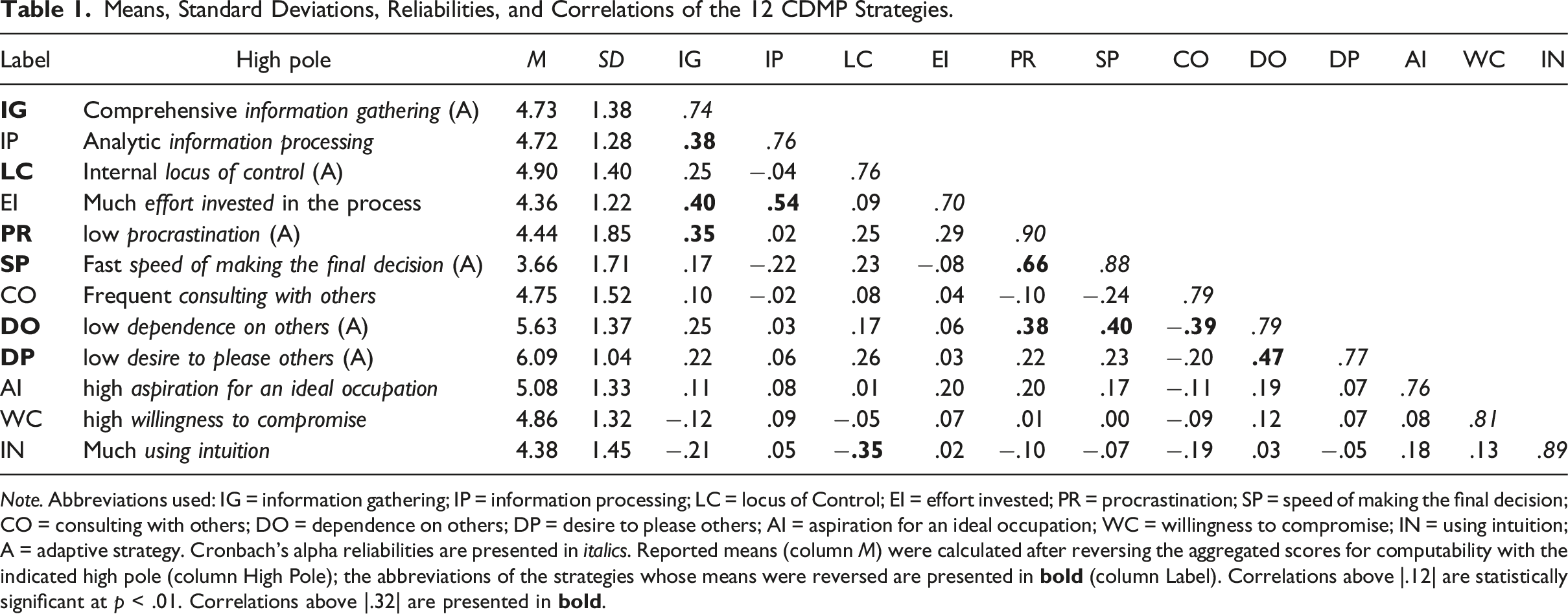
Note. Abbreviations used: IG = information gathering; IP = information processing; LC = locus of Control; EI = effort invested; PR = procrastination; SP = speed of making the final decision; CO = consulting with others; DO = dependence on others; DP = desire to please others; AI = aspiration for an ideal occupation; WC = willingness to compromise; IN = using intuition; A = adaptive strategy. Cronbach’s alpha reliabilities are presented in italics. Reported means (column M) were calculated after reversing the aggregated scores for computability with the indicated high pole (column High Pole); the abbreviations of the strategies whose means were reversed are presented in
Instrument Translation
One of the two main goals of this study was to develop and validate a French version of the CDMP (i.e., the CDMP-F). To this end, we followed a multistep translation-back-translation process informed by the process that was implemented to develop other language versions of the CDMP (e.g., Ginevra et al., 2012; Tian et al., 2014). First, two native French speakers with expertise in career counseling independently translated the 39 CDMP items into French. Second, the two translations were compared, and any discrepancies were discussed until a consensus on a preferred translation was reached. Third, two French-English bilinguals independently back-translated the translated items into English; discrepancies between the two back-translations were discussed until a preferred back-translation was reached. Fourth, the back-translated items were compared to their equivalent items in the original English CDMP, resulting in further revisions of several items. Fifth, the translated and back-translated items were sent to the first author of the English version of the CDMP (Gati et al., 2010) for review and approval. By following this translation process, we aimed to ensure the CDMP-F accuracy and validity for assessing career decision-making strategies. Supplemental Material B presents the CDMP-F items.
Career Decision Self-Efficacy
The 25-item version of the Career Decision Self-Efficacy Scale (CDSE; Betz et al., 1996) assesses confidence in five career decision-making skills: accurate self-appraisal, gathering occupational information, goal selection, making plans for the future, and problem-solving. We used the validated French version of the CDSE (Gaudron, 2013), with items presented on a 5-point Likert-type scale ranging from 1 (no competence at all) to 5 (complete competence). A total score derived from the CDSE provides a global evaluation of career decision self-efficacy. Given previous findings undermining the use of CDSE subdimensions as measured by its French version, the present study only considered a global estimate of career decision self-efficacy (Gaudron, 2013). Gaudron (2013) reported internal reliability of .88 for the total score; in this study, internal reliability was .87.
Career Decision-Making Difficulties
Causes of Career Indecision
The Career Decision-Making Difficulties Questionnaire (CDDQ; Gati et al., 1996; Gati & Saka, 2001) assesses 10 career decision-making difficulties grouped in three major clusters: (a) Lack of Readiness includes lack of motivation, general indecisiveness, and dysfunctional beliefs; (b) Lack of Information includes lacking information about the career decision-making process, the self, occupations, and ways of obtaining additional information; (c) Inconsistent Information includes unreliable information, internal conflicts, and external conflicts. We used the validated French version of the CDDQ (Levin et al., 2023; Rossier et al., 2022), with 34 items presented on a 9-point Likert-type scale ranging from 1 (does not describe me) to 9 (describes me well). Rossier et al. (2022) reported internal reliabilities of .58–.87 for the 10 scale scores. In this study, internal reliabilities ranged from .60 to .89.
Types of Career Indecision
A previous study identified and replicated seven career indecision types based on latent profile analysis of the 10 CDDQ scores: unmotivated, unrealistic, generally uninformed, occupations uninformed, conflicted uninformed, externally conflicted, and internally conflicted (Levin et al., 2024a). In the present study, we relied on the previously reported means and standard deviations of the indicators of the seven career indecision types to classify participants into seven groups. Supplemental Material C presents the Mplus code used to classify participants into types. Then, Supplemental Material D shows that all types included at least 7% of the sample; the median posterior classification probability was .83, supporting the reliability of the 7-profile model.
Transparency and Openness
We report all data exclusions, manipulations, and measures in the study. No other data was collected to validate the CDMP-F. Data is available at https://osf.io/5dt8w (Levin et al., 2024b) analysis codes and research materials are available either in the Supplemental Materials or by request from the first author. Data curation, normality analyses, structural and reliability analyses, and descriptive statistics were conducted and calculated in R, latent profile analysis in Mplus, and data visualization in Python. The design of the study and its analysis were not preregistered.
Results
Validation of the CDMP-F
The means, standard deviations, skewness, and kurtosis values of the 36 CDMP-F items are presented in Supplemental Material B. Inspection of item means and standard deviations indicated that responses to most items were distributed around the middle point of the response scale. However, the means of the dependence on others and desire to please others items were lower (range = 1.69–2.79). Inspection of skewness and kurtosis values revealed substantial divergences from normality in items from these two scales (|K| or |S| > 1.50). Skewness values for the remaining scale items ranged from −0.96 to 1.16, and kurtosis values from −1.34 to 0.60. Thus, because normality was not met for all items, confirmatory factor analyses were estimated using Robust Maximum Likelihood (MLR; Li, 2016).
To assess the factor structure of the CDMP-F, we tested and compared three CFA models using the lavaan package in R (Rosseel, 2012): (a) the hypothesized hierarchical model of the CDMP in which the 36 CDMP-F items are regressed onto their respective first-order factors (Model H: 36–12), (b) an alternative hierarchical model that includes both the 12 first-order factors as well as a total score (Model A1: 36–12-1), and (c) another alternative hierarchical model in which all 36 CDMP-F items are regressed onto a total score (Model A2: 36–1). To evaluate the fit of these three hierarchical models, we relied on standard goodness-of-fit indices and their respective thresholds (Hu & Bentler, 1999; Marsh et al., 2005): the comparative fit index (CFI; ≥.95 for good, ≥.90 for acceptable), the root mean square error of approximation (RMSEA; ≤.06 for good, ≤.08 for acceptable), and the standardized root mean square residual (SRMR; ≤.06 for good, ≤.10 for acceptable).
The hypothesized hierarchical model of the CDMP-F (Model H: 36–12) demonstrated good fit-to-data, CFI = .95, TLI = .94, RMSEA = .041 95% CI [.035–.046], SRMR = .052. In comparison, the first alternative hierarchical model in which a total score is added (Model A1: 36–12-1) resulted in lower and inadequate fit, CFI = .85, TLI = .84, RMSEA = .065 95% CI [.061–.069], SRMR = .107; the second alternative hierarchical one-factor model (Model A2: 36–1) resulted in even a lower fit, CFI = .30, TLI = .26, RMSEA = .138, 95% CI [.134–.142], SRMR = .149. Inspection and comparison of the goodness-of-fit indices values of the three estimated hierarchical models lent support for the fit of only the hypothesized hierarchical model underlying the CDMP (Model H: 36–12) while rejecting the adequacy of the two alternative hierarchical models (Model A1: 36–12-1, Model A2: 36–1). As such, the data support the conclusion that the 36 CDMP-F items are grouped in 12 scales but that neither the items nor the scales should be aggregated into a single total score. 1
The means, standard deviations, Cronbach’s alpha reliabilities, and the correlations of the 12 CDMP-F scores are presented in Table 1. The reliabilities of the 12 CDMP-F scores were within the acceptable range, varying from .70 to .90 with a median of .79. In addition, we inspected the intercorrelations among the 12 CDMP-F scores to evaluate their degree of independence. The median of the absolute correlation coefficients was .12 (interquartile range – .07–.23, range – .00–.66), indicating that the 12 scales represent relatively independent strategies. Nonetheless, large correlations were observed between analytical information processing and much effort invested (r = .54) and between low procrastination and fast speed of making the final decision (r = .66).
Associations of Career Decision-Making Strategies With Self-Efficacy and Difficulties
We relied on three partially interrelated outcomes to evaluate the differential associations of the career decision-making strategies with career decision-making self-efficacy and difficulties: (a) the associations of the CDMP-F strategies with the career decision self-efficacy total score, (b) the associations of the CDMP-F strategies with 10 career decision-making difficulties, and (c) the associations of the CDMP-F strategies with the seven career indecision types. For correlations, we considered only coefficients equal to or larger than |.32| an association worth reporting (i.e., at least 10% of shared variance).
Career Decision Self-Efficacy
The Pearson Correlations between the CDMP Dimensions and the CDDQ and CDSE.
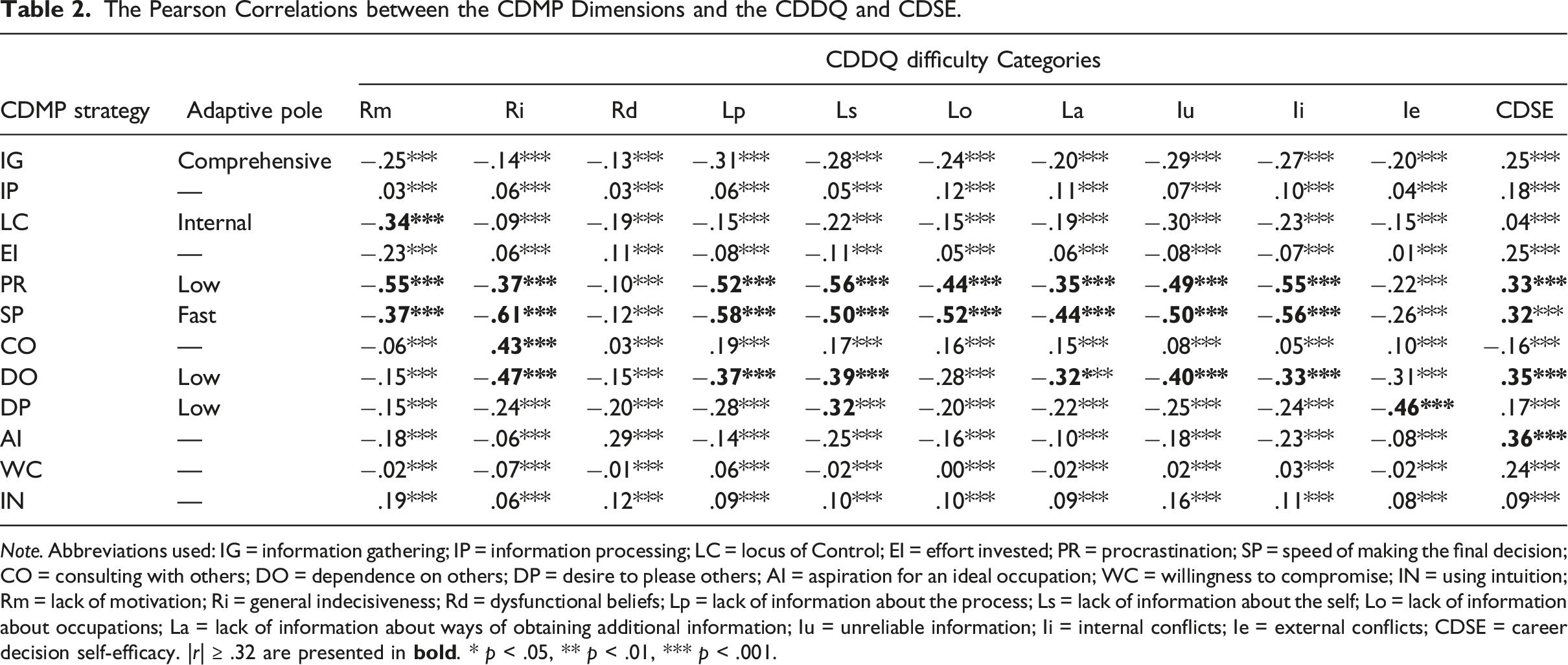
Note. Abbreviations used: IG = information gathering; IP = information processing; LC = locus of Control; EI = effort invested; PR = procrastination; SP = speed of making the final decision; CO = consulting with others; DO = dependence on others; DP = desire to please others; AI = aspiration for an ideal occupation; WC = willingness to compromise; IN = using intuition; Rm = lack of motivation; Ri = general indecisiveness; Rd = dysfunctional beliefs; Lp = lack of information about the process; Ls = lack of information about the self; Lo = lack of information about occupations; La = lack of information about ways of obtaining additional information; Iu = unreliable information; Ii = internal conflicts; Ie = external conflicts; CDSE = career decision self-efficacy. |r| ≥ .32 are presented in
Career Decision-Making Difficulties
As Table 2 shows, the adaptive poles of the six adaptive CDMP strategies were associated with lower scores on the 10 CDDQ scales. The largest correlations were with procrastination (|r| Mdn = .47, range – .10–.56) and speed of making the final decision (|r| Mdn = .50, range – .12–.61), reflecting that individuals who procrastinate or need more time before making the final decision are more likely to face career decision-making difficulties. The remaining four adaptive CDMP-F strategies were also significantly associated with the 10 CDDQ scales (|r| Mdn = .25, .19, .33, and .24 for information gathering, locus of control, dependence on others, and desire to please others).
Specifically, external locus of control was associated with a high lack of motivation (|r| = .34), indicating that individuals who believe their careers are determined by luck or fate (rather than their own actions) are less motivated to engage in career decision-making. Then, high dependence on others was associated with general indecisiveness (|r| = .47), lack of information about the self (|r| = .39), unreliable information (|r| = .40), and internal conflicts (|r| = .33), reflecting that high dependence on others is related to self-related difficulties. High dependence on others was also associated with a lack of information about the career decision-making process (|r| = .37), suggesting that dependence is also associated with information deficits on how to make career decisions. Finally, high desire to please others was predominantly related to external conflicts (|r| = .46), indicating that individuals trying to please others are likely to struggle with reconciling conflicts among the opinions of different people, including themselves. Finally, the six non-adaptive CDMP-F strategies had negligible to low associations with the 10 CDDQ scales (range of |r| Mdn – .02–.17).
Career Indecision Types
To examine mean differences in the 12 CDMP-F scores as a function of career indecision types, we estimated an LPA model with distal outcomes using the Bolck-Croon-Hagenaars method (BCH; Bakk & Vermunt, 2016) via the BCH function in Mplus. Figure 1 depicts the mean CDMP-F scores for each of the seven career indecision types. Supplemental Material E further details the results of these analyses. Given the number of comparisons, we applied the Bonferroni correction (α = .003) and considered differences representing at least a small effect size (i.e., Cohen’s d > 0.20) worth reporting. Mean level differences of the 12 career decision-making strategies by career indecision types. Note. CU = conflicted uninformed; IC = internally conflicted; GU = generally uninformed; UM = unmotivated; EC = externally conflicted; OU = occupations uninformed; UR = unrealistic.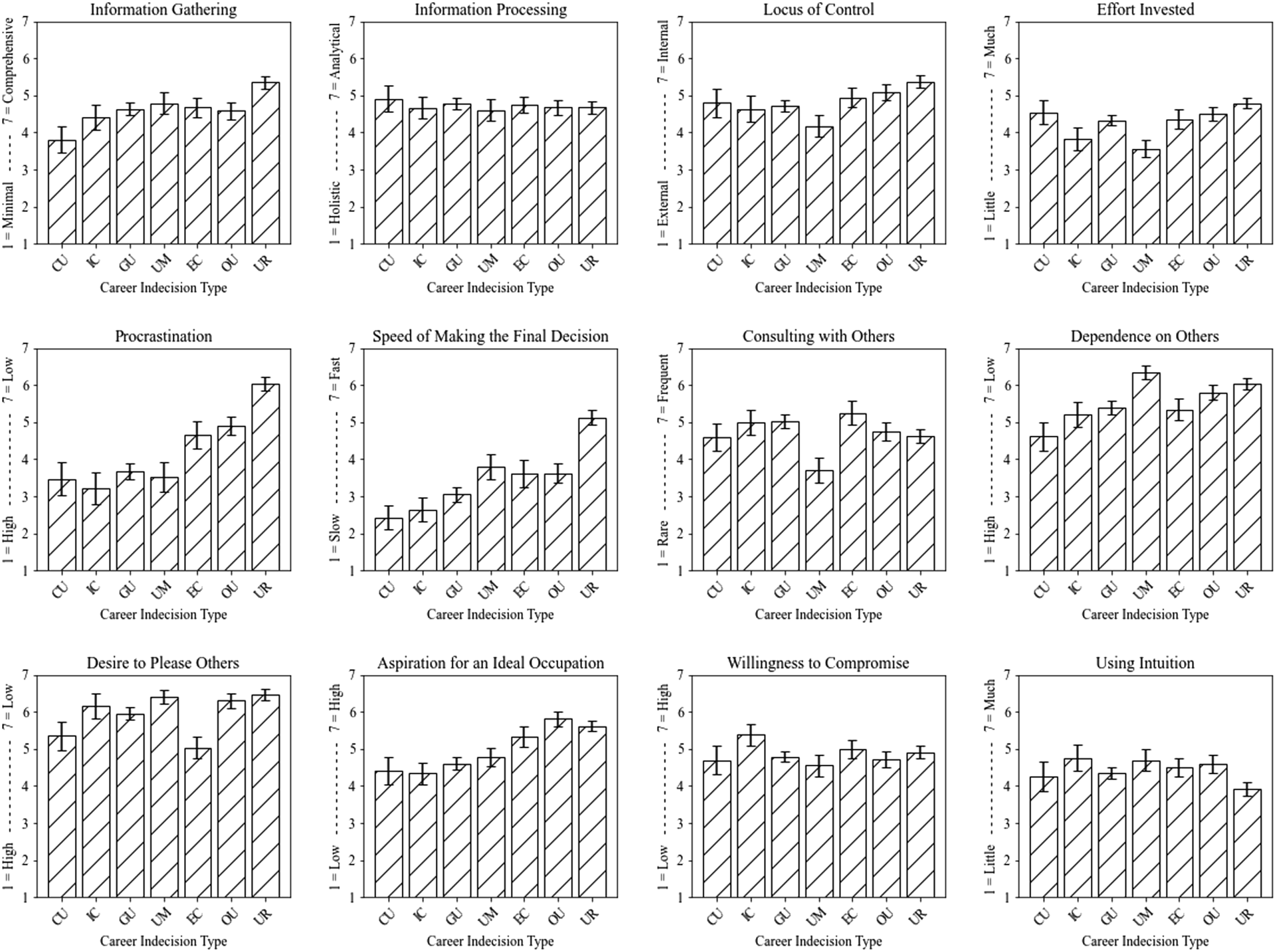
Procrastination and Speed of Making the Final Decision
The largest differences among the seven career indecision types were observed in procrastination, χ 2 (6) = 114.96, p < .001. The conflicted uninformed, internally conflicted, generally uninformed, and unmotivated types (Mrange = 3.47–3.67) reported procrastinating more than the remaining three types (i.e., externally conflicted, occupations uninformed, and unrealistic; Mrange = 4.66–6.04, Cohen’s ds > 0.46). On the other hand, the unrealistic type (M = 6.04) reported procrastinating significantly less than all other types (Cohen’s ds > 0.57). Thus, the maladaptive high procrastination pole was especially endorsed by two multiple-information-lacking types (the conflicted-uninformed and generally uninformed types), as well as the internally conflicted and unmotivated types.
A similar pattern of differences was observed in speed of making the final decision, χ 2 (6) = 94.54, p < .001. The conflicted uninformed, internally conflicted, and generally uninformed types (Mrange = 2.43–3.05), but not the unmotivated type (compare with procrastination), reported being slower in making their final decision than the remaining types (Mrange = 3.61–5.13. Cohen’s ds > 0.37). In turn, the unmotivated type reported similar levels of speed as the externally conflicted and occupations uninformed types. Finally, the unrealistic type (M = 5.13) reported being faster in making the final decision than all other types (Cohen’s ds > 0.65). Thus, the maladaptive slow speed of making the final decision pole characterized the two multiple-information-lacking types (the conflicted-uninformed and generally uninformed types), and the internally conflicted type.
Dependence on Others and Desire to Please Others
Significant differences among the seven career indecision types were also revealed in dependence on others, χ 2 (6) = 31.93, p < .001. The conflicted uninformed type reported depending on others significantly more than all other types (Cohen’s ds > 0.28). Then, the generally uninformed, internally conflicted, and externally conflicted types (Mrange = 4.62–5.39) reported depending on others more than the three remaining types (i.e., unmotivated, occupations uninformed, and unrealistic; Mrange = 5.80–6.34, Cohen’s ds > 0.26). Finally, the unmotivated type (M = 6.34) reported the lowest levels of dependence on others compared to all types (Cohen’s ds > 0.22). In comparison, for desire to please others, χ 2 (6) = 42.36, p < .001, both the conflicted uninformed and externally conflicted types (Mrange = 5.35–5.03) reported the highest desire to please others compared with all other five types (Mrange = 5.96–6.47; Cohen’s ds > 0.21). Thus, the maladaptive high dependence on others and high desire to please others poles characterized the conflicted uninformed type; the maladaptive high dependence on others pole also characterized the externally conflicted type.
Information Gathering and Locus of Control
Significant differences emerged in information gathering, χ 2 (6) = 23.64, p < .01. Specifically, the conflicted uninformed type (M = 3.81, Cohen’s ds > 0.29) endorsed the minimal information gathering pole and the unrealistic type (M = 5.35, Cohen’s ds > 0.33) the comprehensive information gathering pole compared with the remaining types (Mrange = 4.40–4.79). For locus of control, χ 2 (6) = 17.00, p < .01, the unmotivated type (M = 4.18) reported having a more external locus of control than all other types. In comparison, apart from the occupations uninformed type, the unrealistic type (M = 5.38) reported having a more internal locus of control than other types (Mrange = 4.18–4.94; Cohen’s ds > 0.27). Thus, the maladaptive minimal information gathering pole characterized the conflicted uninformed type; in contrast, the maladaptive external locus of control pole particularly characterized the unmotivated type.
In comparison to the significant differences that emerged in the six adaptive CDMP-F strategies, a significant difference across the seven career indecision types emerged only in one of the remaining six strategies. Specifically, in aspiration for an ideal occupation, χ 2 (6) = 47.20, p < .001, the occupations uninformed and unrealistic types (Mrange = 5.62–5.81)–and to a lesser degree, the externally conflicted type (M = 5.32)–reported a higher aspiration for an ideal occupation than the remaining types (Mrange = 4.34–4.78; Cohen’s ds > 0.57). In this respect, the four types characterized by the maladaptive high procrastination pole (i.e., conflicted uninformed, generally conflicted, internally conflicted, and unmotivated) also reported the lowest aspiration for an ideal occupation level.
Discussion
To inform research and practice of the career decision-making strategies that may explain which individuals are more likely to face which career-related difficulties, the present study investigated the differential links between an array of career decision-making strategies, on the one hand, and self-efficacy and difficulties, on the other (Goal 1). Understanding the antecedents associated with various career-related difficulties and problems can help in identifying pathways explaining who is likely to develop which type of difficulties in career decision-making, thereby illuminating the issues worth addressing when working with different types of career counseling clients. In addition, the present study reported the development and validation of a French version of the Career Decision-Making Profiles Questionnaire (i.e., CDMP-F; items are available in Supplemental Material B; Goal 2). We investigated the psychometric properties of the CDMP-F for measuring 12 career decision-making strategies in terms of its structural validity and associations with a global estimate of career decision self-efficacy and 10 career decision-making difficulties. Integrating variable-centered and person-centered analyses provided a complementary perspective that is especially suitable for guiding future case-study research (Howard & Hoffman, 2018).
The Structural Validity and Reliability of the CDMP-F
One of the two main goals of the present study was to develop and validate a French version of the Career Decision-Making Profiles questionnaire (i.e., CDMP-F). Confirmatory factor analyses provided incremental support for the model corresponding to the hypothesized 12-factor structure, thereby supporting the structural validity of the CDMP-F. In line with previous findings on the structure of the CDMP in other languages (Ebner et al., 2018; Gati & Levin, 2012; Ginevra et al., 2012; Tian et al., 2014), our findings corroborated that 12 strategies should be considered–rather than a single style or a total score–to describe individual differences in career decision-making strategies. In addition, our results demonstrated that the CDMP-F scores were characterized by satisfactory to high internal reliability consistencies, similar to those reported for other versions of the CDMP (Ebner et al., 2018; Gati & Levin, 2012; Ginevra et al., 2012; Tian et al., 2014). Furthermore, with respect to the psychometric properties of the CDMP-F, the observed associations of the CDMP-F strategies with career decision-making self-efficacy and difficulties, as elaborated in the following section, lent ample support for the construct validity of the CDMP-F.
Associations of Career Decision-Making Strategies With Self-Efficacy and Difficulties
Procrastination and Speed of Making the Final Decision
In line with our expectations and previous findings (see Supplemental Material A), variable-centered analyses revealed that high procrastination and slow speed of making the final decision were strongly associated with low career decision self-efficacy and multiple difficulties. Previous findings uncovered that procrastination and speed of making the final decision were the two most strongly associated strategies with multiple career decision-making difficulties (Shin & Kelly, 2015), low self-efficacy (Gadassi et al., 2013), and career undecidedness (Levin & Lipshits-Braziler, 2022). Interestingly though, previous studies did not consider the associations of career decision-making strategies with specific difficulties. The analyses conducted in the present study uncovered that procrastination and speed of making the final decision correlated less strongly with external conflicts and almost negligibly with dysfunctional beliefs. Moreover, these analyses revealed that procrastination was more related to lack of motivation than general indecisiveness, whereas slow speed of making the final decision was more related to general indecisiveness than to lack of motivation.
Complementary person-centered analyses yielded findings that were largely consistent with the results of the variable-centered analyses. Given that multiple difficulties were associated with procrastination, person-centered analyses revealed that the maladaptive high procrastination pole predominantly characterized the two multiple-information-lacking types (i.e., conflicted uninformed and generally uninformed) as well as the unmotivated and internally conflicted types. In referring to these four types, Levin et al., 2024a proposed that dealing with self-related issues is among the first steps individuals face in career decision-making (see also Gati et al., 2019; Xu & Flores, 2023), a proposition that is supported by the observed procrastination tendency of these four self-related types. In turn, conflicted uninformed, generally uninformed, and internally conflicted (but not the unmotivated) types were also associated with the maladaptive slow speed of making the final decision pole, suggesting that internal conflicts are likely to persist throughout the career decision-making process. These findings demonstrate the construct validity of procrastination and speed of making the final decision as measured by the CMDP-F. Moreover, these findings support the conceptual differentiation–that high procrastination would lead to avoiding or delaying the decision-making process, whereas slow speed of making the final decision is more detrimental in the final stage of the process and is often related to general indecisiveness, a general tendency to avoid decision-making (Gati et al., 1996; 2010; Saka et al., 2008).
Dependence on Others and Desire to Please Others
Dependence on others and desire to please others are similar strategies involving other people, but the results of the present study supported their construct validity by highlighting their distinctiveness. Specifically, dependence on others was associated with low self-efficacy and self-related difficulties belonging to different CDDQ clusters (including general indecisiveness, lack of information about the self, unreliable information, and internal conflicts, as well as lack of information about the process). These findings may explain why previous studies found relatively similar associations of dependence on others with the three CDDQ clusters (Perez & Gati, 2017; Shin & Kelly, 2015; Willner et al., 2015). In comparison, the maladaptive high desire to please others pole seems less detrimental to career decision-making given its weaker associations with self-efficacy and most career decision-making difficulties. Rather, a high desire to please others was primarily associated with external conflicts, reflecting that emphasizing others’ needs and wishes in career decision-making likely leads to difficulty in satisfying the opinions of different people.
Person-centered analyses revealed that whereas dependence on others was most clearly elevated among the conflicted uninformed type, a greater desire to please others most clearly characterized the externally conflicted type. These results are compatible with the patterns of associations of these two strategies observed in the variable-centered analysis, notably that dependence on others is associated with multiple career decision-making difficulties and that desire to please others was mostly associated with external conflicts. Furthermore, these findings suggest that whereas dependence on others involves relying on others (more than on independent activities such as exploration of the self and the world of work), desire to please others does not necessarily interfere with independent behaviors but rather involves giving substantial weight to the opinions of others.
Information Gathering and Locus of Control
Information gathering was the only strategy considered to have an adaptive pole for which variable-centered analyses did not reveal any meaningful associations with career decision self-efficacy or career decision-making difficulties. However, person-centered analyses showed that the maladaptive minimal information gathering pole was particularly endorsed by the conflicted uninformed type. In turn, variable-centered analyses revealed that the maladaptive external locus of control pole was associated with one career decision-making difficulty, namely with lack of motivation, corresponding to the person-centered finding that the maladaptive external locus of control pole was especially endorsed by the unmotivated type. Previous studies on the link between information gathering and locus of control and the three CDDQ clusters resulted in mixed findings, indicating negligible to small associations in some studies and moderate associations in others (Perez & Gati, 2017; Shin & Kelly, 2015; Willner et al., 2015; see Supplemental Material A). Willner et al. (2015) proposed that such discrepancies may be attributed to age differences across samples, such that minimal information gathering would be more detrimental at a younger age. The findings of the present study, conducted among adolescents and young adults, seem compatible with this explanation but further replicate the previously reported weaker associations of these strategies with career-related difficulties.
Adaptable and Non-adaptable Decision-Making Strategies
The associations of the CDMP-F strategies described in the preceding three subsections, compared with the negligible to small associations of the remaining six CDMP-F strategies with career decision-making self-efficacy and difficulties, align with previous findings (Ebner & Paul, 2023; Gadassi et al., 2013; Levin & Lipshits-Braziler, 2022; Tian et al., 2014), thereby validating the adaptability assumption for the six CDA strategies (Gadassi et al., 2012; Gati & Levin, 2012). Nonetheless, Ebner and her colleagues questioned whether aspiration with an ideal occupation should also be regarded as adaptive for career decision-making given its associations with career success, career adaptability, and life satisfaction (Ebner et al., 2018; Ebner & Paul, 2023). Indeed, the results of the present study indicated that this strategy is associated with high career decision self-efficacy. However, the relatively weaker associations of aspiration with an ideal occupation with career decision-making difficulties in the present study, as well as its relatively low incremental validity (Gadassi et al., 2012; 2013), continue to undermine its relevance for being considered an adaptable strategy.
Limitations and Directions for Future Research
A first limitation of the present study concerns the generalizability of our findings, which is constrained by the fact that our study drew on data from adolescents and young adults from only the French-speaking part of Switzerland. Indeed, Guan et al. (2015) reported partial support for the measurement invariance of the CDMP between Chinese and U.S. respondents. Thus, with respect to the psychometric properties of the French version of the Career Decision-Making Profiles questionnaire (i.e., CDMP-F), future investigations should ascertain the suitability of the CDMP-F in other francophone regions. In addition, although our results support the use of the CDMP-F among women and men (see Supplemental Material F), as well as among adolescents and young adults (Supplemental Material G), future studies should verify the psychometric properties of the CDMP-F among working adults or other specific populations of interests (e.g., individuals with immigration backgrounds, individuals with disabilities). Relatedly, although the results of the present study are compatible with the findings of previous studies regarding the associations of CDMP with higher-order factors of career decision-making difficulties conducted in other countries, future research should investigate whether the differential associations uncovered in the present study replicate in other cultural contexts.
Second, to investigate the associations among career decision-making strategies, self-efficacy, and difficulties, we relied on cross-sectional data. Although theoretical considerations conceptualize decision-making strategies as the causes of decision-making difficulties, the design of the present study does not allow testing such causal hypotheses. Indeed, reverse causal directionalities cannot be ruled out, suggesting, for example, that the experience of specific career decision-making difficulties (e.g., dysfunctional beliefs) will result in adopting specific career decision-making strategies (e.g., speed of making the final decision). Thus, although the results of the present study are informative for pinpointing decision-making strategies predictive of specific career decision-making difficulties, longitudinal and experimental studies are needed to clarify the causality underlying the observed associations. Finally, a third limitation concerns the scope of difficulties considered in the present study. Although based on one of the most comprehensive taxonomies, the CDDQ does not cover all career decision-making difficulties. Understanding the links between career decision-making strategies and career-related difficulties may benefit from utilizing additional models and measures of career decision-making difficulties (e.g., Hacker et al., 2013; Saka et al., 2008).
Implications for Theory, Research, and Practice
From a theoretical standpoint, previous approaches conceptualized career decision-making strategies as individual differences predictive of the overall quality of adjusting and adapting to the task of career choice (Harren, 1979). The CDMP model utilized this reasoning in its general adaptability assumption (Gati et al., 2010). Indeed, the results of the present study confirmed that individuals with multiple career decision-making difficulties (i.e., conflicted uninformed, generally uninformed) are likely to be characterized by the maladaptive poles of multiple strategies. At the same time, previous work did not identify differential links between specific career decision-making strategies and difficulties (see also Gadassi et al., 2012, 2013; Levin & Lipshits-Braziler, 2022; Willner et al., 2015). The results of the present study highlight three differential pathways pairing certain career decision-making strategies to specific career-related difficulties. These pathways include (a) procrastination and external locus of control to lack of motivation, (b) slow speed of making the final decision to general indecisiveness, and (c) desire to please others to external conflicts. These findings complement recent attempts to identify differential pathways in career decision-making related to confusion and ambiguity management (Xu, 2022; Xu & Flores, 2023).
For research and practice, the results of the present study support using the CDMP-F to measure 12 career decision-making strategies among French-speaking individuals. Indeed, both structural and construct validity analyses provide evidence for using the CDMP-F to characterize individuals’ multidimensional ways of engaging in the career decision-making process and pinpointing the six adaptive strategies. As such, these findings also strengthen the cross-cultural generalizability of the CDMP model, and its applicability to the cultural context of the French speaking part of Switzerland. Previous accounts exemplify how the CDMP model can be integrated into career counseling to inform intervention planning, and serve as guides for practitioners on how to use the CDMP in counseling (Gati & Levin, 2014; Levin & Gati, 2015). In addition to these general guidelines, the emerged differential associations among specific career decision-making strategies and difficulties suggest that helping clients with the issues of lack of motivation, indecisiveness, or external conflicts could be promoted by raising clients’ awareness of their high procrastination and external locus of control, slow speed of making the final decision, or high desire to please others, respectively. Moreover, results may also be informative for the provision of group interventions. Although many guidance courses and group interventions focus on exploration (for a recent systematic review, see Soares et al., 2022), the findings of this study emphasize, for example, addressing the impact of significant others on career decision-making to support clients in overcoming difficulties related to internal or external conflicts.
Conclusion
The present study investigated the relationship between career decision-making strategies, self-efficacy, and difficulties among adolescents and young adults in the French-speaking part of Switzerland. Its results support using the CDMP-F to measure 12 career decision-making strategies among French-speaking individuals. In addition, the present study sheds light on three specific pathways indicative of which individuals are likely to develop particular difficulties during career decision-making: high procrastination and external locus of control were linked to lack of motivation; slow speed of making the final decision was linked to general indecisiveness; and high desire to please others was linked to external conflicts. Future research should further investigate these pathways as potential factors worth addressing when working with clients to increase career decision-making self-efficacy or overcome specific career decision-making difficulties.
Supplemental Material
Supplemental Material - Associations of Career Decision-Making Strategies With Career Decision-Making Self-Efficacy and Difficulties Among French-Speaking Swiss Adolescents and Young Adults
Supplemental Material for Associations of Career Decision-Making Strategies With Career Decision-Making Self-Efficacy and Difficulties Among French-Speaking Swiss Adolescents and Young Adults by Nimrod Levin, Jonas Masdonati, Pauline Castella, and Elodie Grassi in Journal of Career Assessment
Footnotes
Acknowledgments

Declaration of Conflicting Interests
The author(s) declared no potential conflicts of interest with respect to the research, authorship, and/or publication of this article.
Funding
The author(s) received no financial support for the research, authorship, and/or publication of this article.
Supplemental Material
Supplemental material for this article is available online.
Note
References
Supplementary Material
Please find the following supplemental material available below.
For Open Access articles published under a Creative Commons License, all supplemental material carries the same license as the article it is associated with.
For non-Open Access articles published, all supplemental material carries a non-exclusive license, and permission requests for re-use of supplemental material or any part of supplemental material shall be sent directly to the copyright owner as specified in the copyright notice associated with the article.
