




Abstract
Tackling the United Nations’ Sustainable Development Goals (SDGs) has become a key strategic marketing activity for multinational enterprises (MNEs) to build their reputation and ensure their brand value. However, SDGs can cause goal conflicts for MNEs, resulting in firms not being equally responsive to all stakeholders. Therefore, this study explores how ethical leadership, underpinned by a corporate purpose, enables MNEs to pursue SDGs in foreign markets. The researchers argue that ethical leadership based on a corporate purpose can provide strategic direction for MNEs, thus enabling them to focus on selected SDGs that can be integrated into their values-based marketing agendas. Further, the findings reveal that a corporate purpose can offer consistency and perseverance in the exertion of ethical leadership at the local market level; however, ethical leadership may require organizational members to disassociate from structural inconsistencies and goal conflicts in pursuit of SDGs. Thus, the study makes a significant contribution to the literature on international marketing by adopting an ethical perspective to explain how MNEs can strategically position themselves in relation to SDGs in international markets. The findings suggest that ethical leadership can build a foundation for credible marketing communication while serving as a driver of values-based marketing programs.
Keywords
The United Nations (UN) Sustainable Development Goals (SDGs) are ushering in a new era of business in which companies are incentivized to conduct moral inventories of their core business activities to stay relevant (Bouguerra et al. 2023; Bu and Wagner 2016; Elg and Ghauri 2021; Gartenberg, Prat, and Serafeim 2019; Montiel et al. 2021).
Although multinational enterprises (MNEs) have been widely considered engines of global trade and economic progress, they are rarely associated with ethics, let alone ethical leadership. The widespread public conception of a planetary crisis has made ethics an integral part of customer value and brand equity for many products and services (Pittz, Steiner, and Pennington 2020). The discourse that has followed from the awakening to environmental and social values is arguably creating new marketing norms, prompting MNEs to not only focus on profit but also contribute to society (Berrone et al. 2023). In the international marketing literature, the concept of ethical leadership is still underexplored, and there are gaps in our understanding of how ethical leadership is exerted by MNEs to enable the realization of SDGs. While research has recognized that ethical leadership can function as a differentiated marketing asset which increases purchase intentions (Van Quaquebeke et al. 2019), there is a scarcity of studies that have explored how such advantages are created through firms’ international activities. This research gap limits our understanding of international marketing and calls for more studies that can demonstrate how MNEs can use this concept in their international operations and marketing activity. This study aims to address this research gap.
In this study, the ethical leadership perspective is applied to capture parts of the delivery of new forms of values-based marketing initiatives (Kotler, Kartajaya, and Setiawan 2019), in which MNEs are positioning themselves as important contributors to SDGs (Berrone et al. 2023). Thus, we propose that ethical leadership is becoming increasingly important for MNEs because of the extensive scrutiny they are subject to from customers, suppliers, and media (Lawton and Páez 2015). The study is thus guided by the following research question: How, and by which mechanisms, is ethical leadership exerted by MNEs to enable the realization of SDGs in their international operations?
Pursuing this inquiry, we explore how ethical leadership, based on a corporate purpose, enables MNEs to pursue SDGs in foreign markets by building on an in-depth study on a Swedish MNE in the fashion industry (Ghauri 2004). We study both the intraorganizational processes (headquarters–subsidiary) and the interorganizational processes (subsidiary–local market stakeholders) of exerting ethical leadership in the MNE. Ethical leadership has been defined as “the showcasing of normatively appropriate conduct with the help of interpersonal relationships and personal actions, and employing two-way communication, reinforcement and decision making to promote such conduct to followers” (Brown, Treviño, and Harrison 2005, p. 120). Although we found this definition to be sufficiently comprehensive and precise, this study applied ethical leadership at the organizational level, where interpersonal relationships are analytically transposed to interorganizational relationships.
George and Schillebeeckx (2022) assert that organizations that are firmly and genuinely guided by a purpose will, by design, be more committed to some ethical goals than others. The linkage with ethics and purpose aligns with Mayer's (2021) conceptualization of a corporate purpose as the activities aimed at enhancing the well-being and prosperity of shareholders, society, and the natural world. These aspects link congenially with the virtue ethics view, suggesting that the fulfillment of purpose provides the means to achieve human flourishing. Therefore, we postulated that firms that are committed to a corporate purpose will increase their potential to be viewed as ethical leaders in pursuit of SDGs. Specifically, we studied the firm's sustainability efforts concerning water management (SDG 6) and climate action (SDG 13), expecting to contribute to the literature on international marketing by conceptualizing how MNEs can contribute to the realization of SDGs. More precisely, we argue that ethical leadership requires considerations that go beyond a rigid focus on rules and standards by focusing instead on moral character and exertion of virtue based on practical wisdom, which is the ability to integrate ethical considerations with instrumental concerns (Bachmann, Habisch, and Dierksmeier 2018; Lawton and Páez 2015). Further, we subscribe to the view of MacIntyre (1981), according to whom ethical leadership is embedded in social practices and contributes to the flourishing of individuals and communities. Because the concept of ethical leadership is still underexplored in the context of MNEs and SDGs, we can add new insights into how such leadership is coordinated both within the MNE and across its relationships with foreign market stakeholders.
Furthermore, we expect to contribute to the literature on international marketing by providing explanations regarding how MNEs can infuse values into their marketing offerings. Arguably, the study reflects the early shaping of a new form of global capitalism in which the profitability objectives of MNEs remain intact but are paired with the adoption of firm-specific ethical credos revolving around favored SDGs (Elg and Melén Hånell 2023; Tarnovskaya, Melén Hånell, and Tolstoy 2022), which become integral to their marketing activities (Foroudi et al. 2023). This contribution to our understanding of international marketing is important since self–brand connections are influenced by firms’ global operations (Ahmad et al. 2023), meaning that firm conduct will affect the values consumers ascribe to the offerings. The benefits of taking a leading role in the pursuit of SDGs involve managing risks, regaining trust, and being part of serving future markets instead of present markets (Van Tulder et al. 2021). It also means being more adept at serving consumers whose brand perceptions are increasingly being affected by the ethical stances of the selling firms.
Theory
Theoretical Background: MNEs and the Pursuit of SDGs
The plan for the 17 SDGs is to achieve each goal and target (169 targets and 231 indicators in total) by 2030. The global arena lends itself well to addressing both problems and opportunities associated with SDGs since the achievement of these goals requires global coordination (Montiel et al. 2021; Van Tulder et al. 2021). MNEs from advanced economies are frequently criticized for transferring the problems of industrialization, such as greenhouse gas emissions, contamination, and hazardous work, to emerging markets (Vachani, Doh, and Teegen 2009). In emerging markets, the institutional mechanisms that monitor negative externalities may be lacking, inefficient, or largely ignored (Zhou and Wang 2020). Therefore, the SDGs provide a framework that levels out the discrepancies in sustainability standards between advanced markets and emerging markets. However, SDGs are often criticized for being too many and too vague (Nonet et al. 2022), causing companies to notoriously underdeliver in efforts to attain them (Van Tulder and Van Mil 2022).
Tarnovskaya, Melén Hånell, and Tolstoy (2022) have suggested that the debated aspiration–behavior gap related to global challenges can be reduced if MNEs become more progressive and make efforts to integrate environmental and social goals into their core marketing strategies. To do so, they need to align values-based product offerings with prioritized SDGs (Berrone et al. 2023). Marketing initiatives can gain different levels of support depending on which SDGs key customer segments identify themselves with (Strizhakova and Coulter 2019). In this respect, MNEs can be viewed as uniquely positioned to be bridge builders between new SDG-related customer requirements and global production (Nylund, Brem, and Agarwal 2021). A (nonexhaustive) overview of research on MNEs and their pursuits of SDGs is displayed in Table 1. As shown in this table, the explicit linkages between SDGs and marketing initiatives vary. While some studies explicitly explore the links between SDGs and marketing activities (Celone et al. 2022; Strizhakova and Coulter 2019; Van Zanten and Van Tulder 2018), other studies are more focused on the order and implementation of SDGs (e.g., Liou and Rao-Nicholson 2021; Montiel et al. 2021; Nylund, Brem, and Agarwal 2021). In this article we argue that the marketing and the implementation perspectives of SDGs are interrelated as the ethical leadership of MNEs, involving the selection and implementation of SDGs, eventually determines the values that their customers ascribe to the marketing offerings.
Literature Review of SDGs and MNEs in International Business and Marketing.
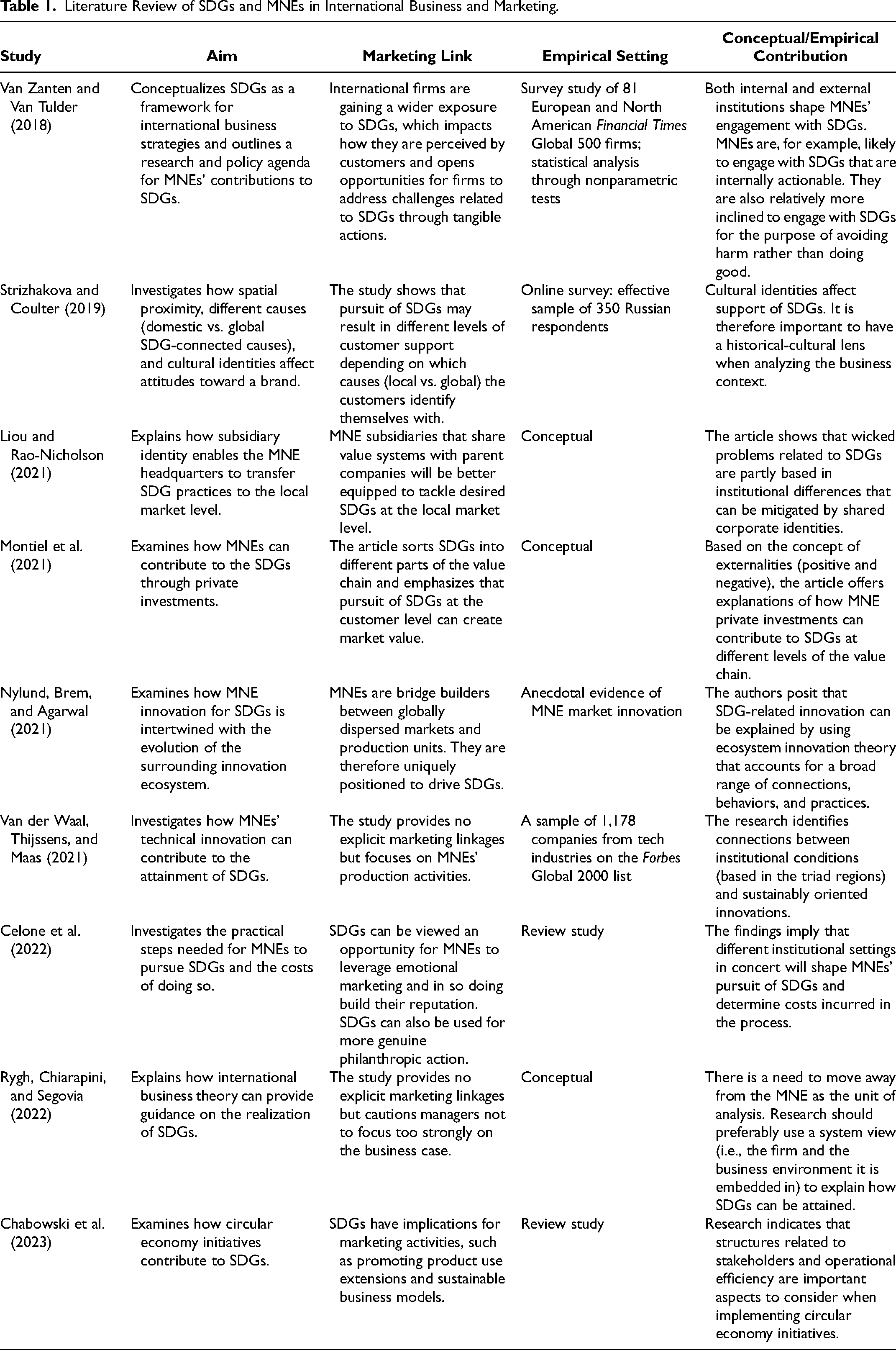
Research has indicated that the effective pursuit of SDGs requires MNEs to (1) design SDG-related initiatives so that they resonate not only with customers, but also with the ethical values of local and global stakeholders, (2) resolve congruence conflicts between SDGs and economic targets, and (3) decide which roles they should take in the pursuit of SDGs (e.g., pioneers or followers). An overview of the research addressing these three topics is presented subsequently.
Sustainable behavior is context dependent. Prior research shows that what is considered ethical and desirable behavior may vary when, for example, the content of marketing programs in one market may not correspond with the values held by actors in another market (Bain et al. 2019; Elg, Ghauri, and Schaumann 2015; Foroudi et al. 2023). Moreover, MNEs that operate in multiple markets across the world often experience how cultural and contextual dynamics pose specific operational challenges, which become pronounced in emerging market contexts, potentially affecting the MNEs’ abilities to align supply-chain operations with prioritized SDGs used for marketing communication (Montiel et al. 2021). Furthermore, local stakeholders such as suppliers, customers, the media, and governments make different interpretations of the ethical conduct of firms (Crilly, Hansen, and Zollo 2016). For example, MNEs could put a cap on working hours in factories in an emerging market to make work life, at minimum, endurable. Local workers and managers, however, could view this policy as intrusive on individual freedom by limiting the possibility of earning an additional income. While contemporary literature suggests that MNEs should be sensitive to the concerns of local stakeholders (Asgary and Li 2016; Beckman, Colwell, and Cunningham 2009; Bouguerra et al. 2023; Buckley, Doh, and Benischke 2017; Van Zanten and Van Tulder 2018), recent research has also demonstrated that MNEs may assume leadership and shape stakeholder behaviors rather than only conforming to them (Elg and Ghauri 2021; Elg and Melén Hånell 2023). To do so, practices need to be transferred between headquarters and subsidiaries, which is facilitated when the value systems of organizational units are aligned (Liou and Rao-Nicholson 2021).
Goal conflicts between different SDGs may, however, occur (Trisos et al. 2019), possibly causing confusion in the communication of market offerings. For example, Swiss food and beverage company Nestlé uses palm oil in its production. Palm oil content may deter customers because it leads to deforestation and the extinction of species (SDG 13 and SDG 15). Although Nestlé (2022) does not deny its use of palm oil, it has argued that the problem is complicated, stating, “If we all stopped using palm oil and moved to some of the alternative vegetable oil options out there such as sunflower oil, soybean oil or rapeseed oil, we could need up to nine times as much land to get the same volume of vegetable oil. This would simply shift the problem elsewhere and potentially lead to more deforestation, not less.” This statement is seemingly charged with the logic of consequence ethics, which means that an action that produces a lower net negative outcome than the alternative action can be considered beneficial.
Furthermore, the standards that MNEs are holding themselves to in pursuit of SDGs may differ vastly between firms. Some MNEs may make the pursuit of SDGs a central part of their marketing strategies and competitive positioning (Ghauri 2022), thus affecting their core operations (Detomasi 2015; Tarnovskaya, Melén Hånell, and Tolstoy 2022), while others may merely try to meet the minimum requirements to avoid extensive scrutiny (e.g., Tarnovskaya, Tolstoy, and Melén Hånell 2022). Progressive MNEs that articulate corporate purposes with a high ambition level in relation to SDG targets can arguably gain recognition and legitimacy (Park and Ghauri 2015). Such approaches are rarely solely underpinned by rules and protocols but are anchored in the shared beliefs of organizational members, genuine transparency, and active participation in local communities (Asgary and Li 2016; Elg and Melén Hånell 2023). Hence, for MNEs to realize SDGs, they need to lead on the basis of moral values that permeate their organizations.
Based on the observations of proactive predispositions toward SDGs among certain MNEs (Tarnovskaya, Melén Hånell, and Tolstoy 2022; Van Tulder et al. 2021), this study argues that the ethical leadership perspective is useful for analyzing challenges associated with the realization of these goals. In particular, ethical leadership may be instrumental in transferring SDG practices aligned with values-based marketing principles to new market situations. The section that follows outlines an integrated framework that accounts for the interplay between ethical leadership and corporate purpose in MNEs’ pursuit of SDGs.
Theoretical Perspective: Connecting Ethical Leadership with Corporate Purpose
This article builds on the premise that progressive and credible values-based marketing efforts require ethical leadership that covers relevant activities in the entire value chain. Ethical leadership has predominantly focused on individual leadership. From this perspective, individual leaders can act as role models within organizations by exercising moral standards and social influence on their coworkers (Mayer et al. 2009). Scholars have argued that organizations—not only individuals—can function as agents of virtue (Bright, Cameron, and Caza 2006; Cameron, Arran, and Barker 2004; Sison and Ferrero 2015) and ethical leaders (Chun 2005). When organizations shoulder the responsibilities of ethical leadership, they are evaluated based on “normatively appropriate conduct” (Brown, Treviño, and Harrison 2005, p. 120), which is constantly reevaluated through the development of practical wisdom (Bachmann, Habisch, and Dierksmeier 2018). Drawing on the principles of Aristotle, we argue that virtue cannot exist without purpose. Ethical leadership is dependent on the organizational climate, which can foster more (or less) ethical leaders. Shared understandings of what constitutes ethical behavior can be developed within organizations (Trevino 1986). These understandings will permeate the thinking and behaviors in these organizations and give rise to norms that penalize perceived unethical practices (Schaubroeck et al. 2012). Eisenbeiss (2012) argues that researchers need to further analyze how ethical leaders exert their power and influence. Such efforts could involve setting ethical goals and engaging in direct operations for the fulfillment of overarching objectives. Another characteristic of ethical leadership is the proactiveness in not only responding to upcoming situations, but developing new ethical norms, principles, and values (Kaptein 2019). Ethical leaders can be instrumental in moving beyond current standards and virtues embedded in surrounding communities (Takala 1998) and taking the leaps necessary to fulfill societal missions. Ethical leadership needs to be understood in light of moral relativity, whereby specific approaches fit better in certain settings (Lemoine, Hartnell, and Leroy 2019), sometimes leading to mismatches and contention. For example, some markets will place more emphasis on particular moral content because of cultural differences. The inability of ethical leadership to bridge gaps between different settings can be manifested by virtue signaling, which implies demonstrating positive—yet unobservable—progress of sustainable development and is primarily geared at enhancing the reputation of the company without contributing to a flourishing community (Brower, Kashmiri, and Mahajan 2017; Payne et al. 2013).
While ethical leadership stems from intrinsic motivations and convictions, it can also underpin values-based marketing programs, which can create new competitive positions for firms globally (Lin et al. 2020). The virtue ethics perspective on ethical leadership rests on the Aristotelian idea that an ethical stance is not a stable state but reflects the aspiration of actualizing one's potential: the purpose (telos). From the firm's perspective, virtue ethics contain aspirational values and seek to answer the question “What kind of organization should we be?” (Chun 2005).
Enacted virtue may, over time, become embedded in organizational routines, structures, mental schemata, and relationships (Chun 2005; Daft and Weick 1984; Schaubroeck et al. 2012) as companies develop practical wisdom of how to handle complex situations (Caniglia et al. 2023). Virtue at the organizational level is expressed by qualities such as integrity, conscientiousness, empathy, and courage (Chun 2005). Hence, virtuousness means that morals are internalized rather than externalized, which, in turn, cushions dysfunction and promotes ethical reflexivity (Bright, Cameron, and Caza 2006; Sison and Ferrero 2015). This condition may motivate and reinforce an organizational commitment to ethical leadership that compels firms to disseminate moral values in the industries in which they operate, eventually reinforcing practical wisdom (Caniglia et al. 2023).
A formalized purpose originates from strategic and moral inventory (George and Schillebeeckx 2022), which, arguably, reinforces ethical leadership in the pursuit of SDGs. Deciding on a purpose will motivate the allocation of resources to key areas of sustainability. A corporate purpose has discriminatory qualities, meaning that it inevitably favors some SDGs at the expense of others (George and Schillebeeckx 2022). For example, when producing electric vehicles, the manufacturer may claim to be contributing to climate action, although the extraction of lithium needed for batteries in these vehicles causes environmental harm by contaminating soil and reducing biodiversity in areas where it is extracted. The corporate purpose will function as a compass pointing at a larger mission, possibly engaging others in shaping market practices (Beninger and Francis 2021), thereby creating a new order of objectives, tasks, institutions, and network configurations between market actors (Nenonen, Storbacka, and Windahl 2019). Further, a guiding purpose may engage relevant stakeholders, which MNEs can orchestrate to set new business standards in a market (Bouguerra et al. 2023; Tarnovskaya, Melén Hånell, and Tolstoy 2022).
We recognized the Aristotelian teleological link between purpose and the practice of ethical values. Therefore, we drew from the literature on corporate purpose (George and Schillebeeckx 2022) and corporate ethics (Brown, Treviño, and Harrison 2005; Chun 2005; Schaubroeck et al. 2012) to conceptually investigate and explain how ethical leadership is exerted among MNEs in their pursuit of SDGs.
Method
Both conceptual and empirical developments are required to shed light on how MNEs pursue the UN SDGs. While ethical leadership is a growing phenomenon, it is underexplored in the context of MNEs. Therefore, we adopted a theory elaboration approach (Lee, Mitchell, and Sablynski 1999; Welch et al. 2013) by employing an abductive, qualitative case study (Sætre and Van de Ven 2021) to enrich the theory on how ethical leadership underpinned by a corporate purpose can enable the realization of SDGs by MNEs. This motivated our choice of an in-depth qualitative case study approach (Doz 2011; Ghauri and Grønhaug 2010), whereby we looked for new insights to provide a rich explanation of a complex and multifaceted research topic (Eisenhardt and Graebner 2007; Ghauri 2004). Considering that ethical aspects and behavior related to MNEs’ operations are sensitive areas to study, we chose to conduct a single case study because one of the advantages over conducting multiple case studies is that studying a single case enables researchers to provide rich descriptions of a phenomenon (Siggelkow 2007).
The case company, a fashion company, was theoretically sampled (see Eisenhardt 1989). The global fashion company is an example of an MNE that has documented experience working on sustainability matters for a relatively long period in emerging markets. One of its largest production markets is Bangladesh, as the fashion company group has more than 200 direct suppliers in Bangladesh, some of whom have collaborated with the fashion company for a long time. Moreover, in its production office in Bangladesh, the fashion company has a local sustainability team consisting of 28 persons. They are organized into an environmental team, focusing on issues related to water and energy use, and a social team, focusing mainly on issues related to living wages, industrial relations, and skills development. Two of the areas in which the local sustainability team believes that they encounter the greatest challenges are water management and climate action. The fashion company's work on water management and climate issues has frequently received attention and criticism in the business press, particularly in the context of the company's operations in an emerging market context. Water management and climate action are also highly critical in the company's operations, and these areas are given much focus in the company's strategic documents (e.g., company sustainability reports).
Data Collection
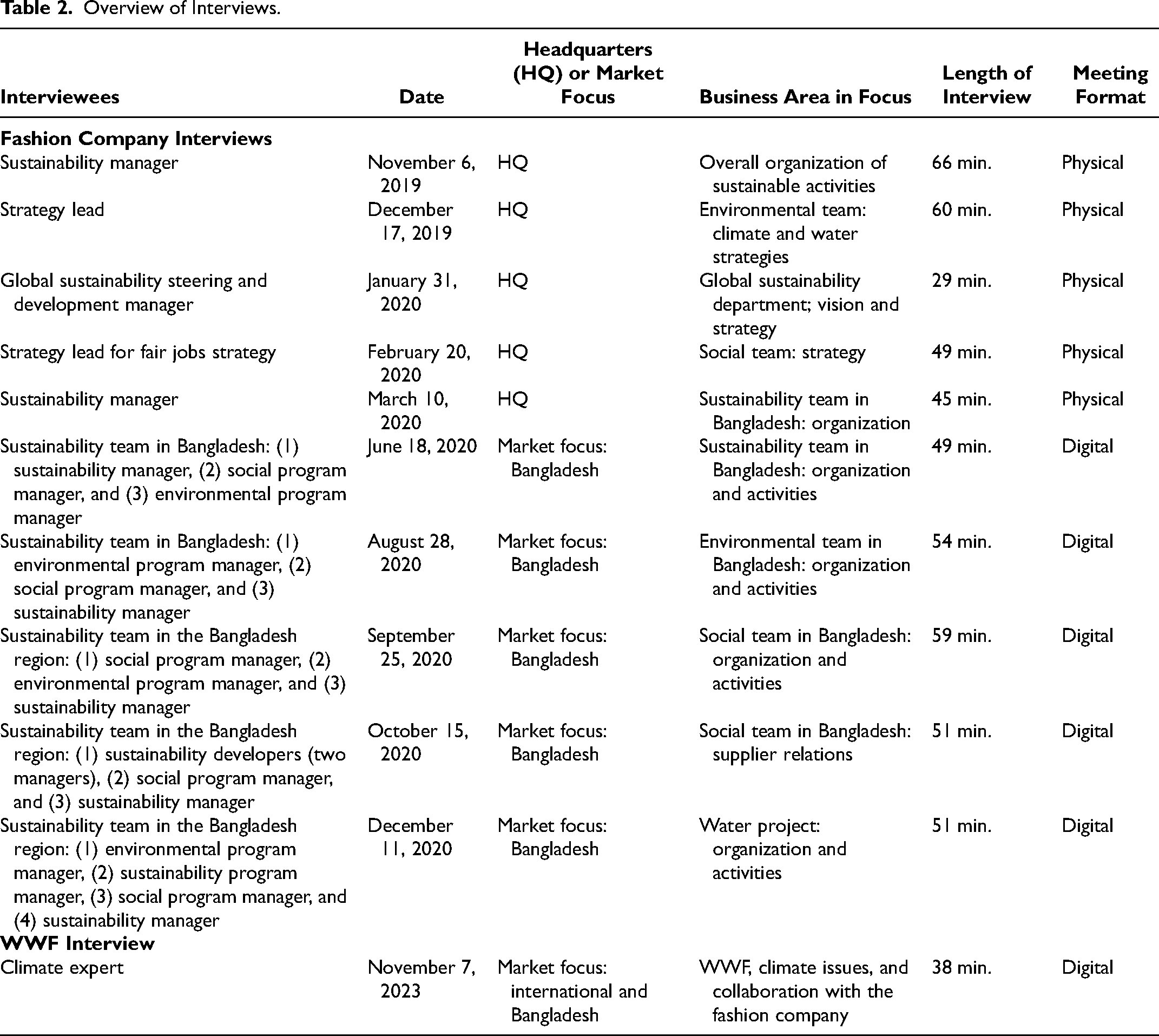
The overall design of the data collection involved two phases. In May 2019, we entered the first phase of our study, which was focused on conducting interviews with managers at the company headquarters. Our aim was to interview headquarters-level managers who are responsible for tasks and issues related to the company's sustainability work, including the work on climate and water. Five interviews were conducted in this first phase, and we met with four managers located at headquarters level. These five interview meetings were conducted in a physical setting. This first phase aimed to investigate the overall policies and codes of conduct concerning sustainability matters, which gave us insights into what the company identifies as its main risk areas in emerging-market operations as well as the rationale behind the company’s policies and roadmaps for change. In 2020, we began the second phase of the study, in which we focused on the actual processes of implementing sustainability targets, which were often related to SDGs. Here, we put a special emphasis on Bangladesh as a market region and interviewed managers from the local sustainability team in the Bangladesh region, to learn about their attitudes to corporate sustainability programs, possible mismatches between operations and strategy, and stories of how corporate sustainability projects have unfolded. The interviews with managers from the local team in Bangladesh were conducted via Zoom or Teams. We conducted five interview meetings, and in most of the interviews, we met with a team of two to four local managers. In the first interview meeting with managers from the local sustainability team (June 2020), questions focused on the local sustainability organization. In the second interview (August 2020), we met with managers from the environmental team to learn about their work on climate and water. The third and fourth interviews (September and October 2020) had a focus on the social team and the issues this team was addressing in the region. The fifth interview gave an in-depth understanding of the water project, which was one critical issue of focus within the environmental team.
In addition to the completed interviews with managers working for the fashion company and its partners in the foreign market, we conducted one interview with an expert on climate issues from World Wide Fund for Nature (WWF), who had experience in collaborating with the fashion company on climate issues.
Table 2 provides information on the number of respondents, length of the interview meetings, and setting of the interviews conducted at the headquarters level and the local market level (i.e., Bangladesh). In total, we completed 11 interview meetings. We met with four headquarters-level managers, six managers from the local sustainability team in Bangladesh, and one expert from the WWF organization. All the interviews were recorded and transcribed verbatim. Although the primary data constituted the main data source in this case study, we also used secondary data such as company sustainability reports (from 2012, 2013, 2018, and 2020), news articles (e.g., Economist 2019; Gould 2014), press releases, industry reports (Lehmann et al. 2019), and websites, which served as anchor points for preparing the interview questions. Additionally, the secondary data enabled us to triangulate, thereby improving the study's accuracy and deepening our understanding of the topic (Ghauri 2004; Miles and Huberman 1994). Thus, we were able to compare the interview data with information from the company's sustainability reports as a way to improve the study's accuracy focusing specifically on water management and climate action. The information from sustainability reports, news articles, and industry reports also enabled us to add further details and information to our case focusing on water management (SDG 6) and climate action (SDG 13).
Overview of Interviews.
Data Analysis
To make conceptual categorizations, we used an inductive open coding strategy (Corbin and Strauss 2008) anchored in our research question. Further, to explore the concept of ethical leadership, we adopted the Gioia methodology (Gioia, Corley, and Hamilton 2012; Hagen, Zucchella, and Ghauri 2018). This method requires a data structure consisting of informant-centric properties (i.e., the activities the case firm is engaged in), theory-centric concepts (i.e., purpose and virtue), and an overarching aggregate theme (i.e., ethical leadership).
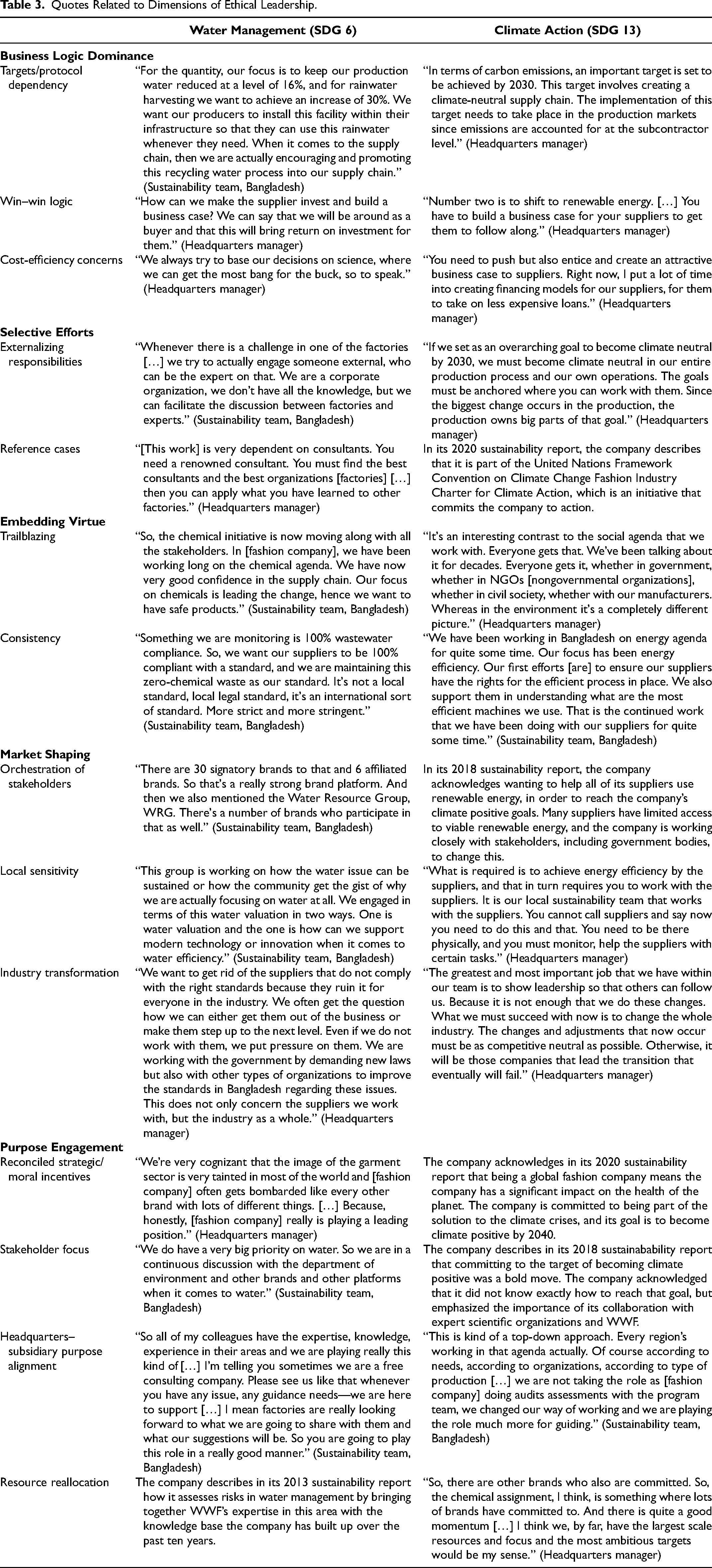
To categorize data, we used narrative analysis techniques, which included exploring recurring themes and patterns in the respondents’ stories and recollections. In line with O’Dwyer (2004), the data analysis was based on an iterative approach comprising parallel data collection and theoretical reasoning. We used theory and the NVivo 12 software to catalog and sort the interview transcripts and interview notes for the analysis. To avoid data becoming too fragmented, we merged and separated themes based on theoretical considerations. The initial list received from our open coding procedure generated first-order codes of ethical leadership and corporate purpose. Guided by the conceptualization, the process involved aggregation of the data into meaningful codes encompassing practices that were labeled as “success cases,” “win–win,” and “standardization.” For instance, the quotes coded as “success cases” involve a disproportionate emphasis on representative projects and initiatives where the goals have been achieved. Examples of representative quotes are found in the case descriptions, as well as in Table 3.
Quotes Related to Dimensions of Ethical Leadership.
Having generated these codes, we reimmersed ourselves in the theory related to virtue ethics and ethical leadership. We proceeded to aggregate our first-order codes into second-order codes and, in the process, found commonalities among the codes, enabling us to collapse them into two subcategories of virtuous behavior that relate in different ways to our conception of ethical leadership (Brown, Treviño, and Harrison 2005). This analysis led to the development of the concepts of signaling virtue and embedding virtue. Further, we found commonalities associated with corporate purpose engagement (see Figure 1). While these dimensions have been used or alluded to in previous literature, we have not seen them applied in the context of ethical leadership among MNEs before. Hence, new conceptual attributes were identified related to these concepts when viewed in this setting. To demonstrate how data were analyzed, we documented the codification of relevant concepts that we discovered in the study in a coding tree (Eisenhardt 1989; Miles and Huberman 1994), illustrated in Figure 1. In the subsequent analysis, we related the concept of virtue embedding to ethical leadership. This concept is based on the argument that virtue needs to be reflected in the actions and behaviors of the ethical agent and its followers (Piccolo et al. 2010). To ensure the quality of the case study findings, we followed recommended practices to enhance the methodological trustworthiness of the case evidence. The trustworthiness of the findings was further ensured through the development of a retrievable case study database, the use of case study protocol throughout the data collection process, and the revision by the respondents of case study reports (Sinkovics, Penz, and Ghauri 2008).
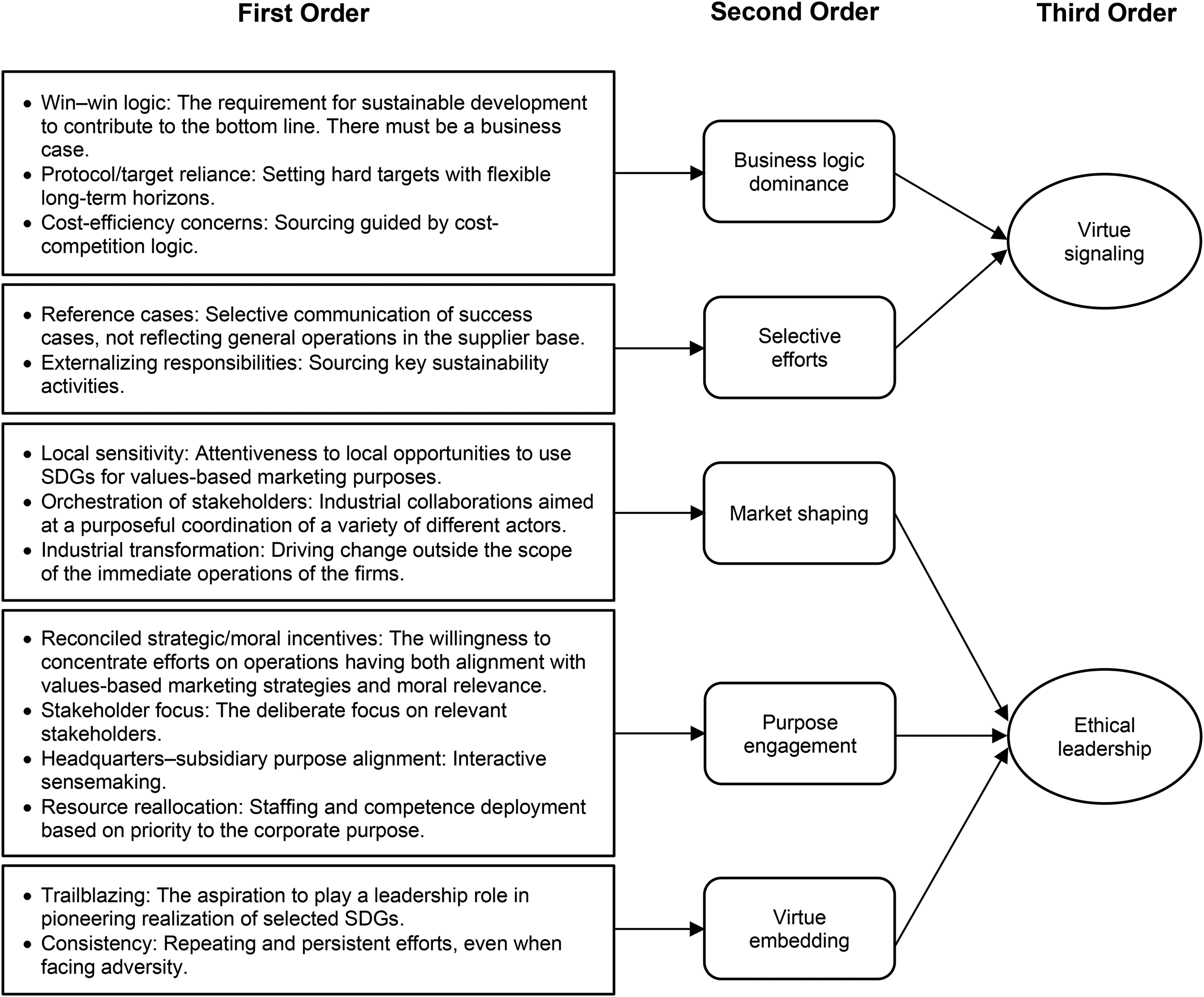
Coding Scheme.
Findings
The fashion company’s sustainability vision, as stated in its 2018 sustainability report, emphasizes that the company aims to take a leading role in the change toward a circular and renewable fashion industry. The value proposition to consumers is about offering fashion and quality at a good price, which implies consumer-facing services offered in an ethical and responsible way.
The fashion company is dealing with substantial challenges in its production markets to deliver on these promises to customers and other stakeholders in its marketing communication, as the production of garments requires extensive use of energy, chemicals, and water. This dependency has significant negative effects on the environment. The fashion industry's carbon emissions exceed those of flights and shipping combined (Lehmann et al. 2019), and the textile industry has a problematic effect on water reserves (Gould 2014). Water is required to grow cotton, dye fabrics, and create washed-out looks. Even though textile supply chains are heavily dependent on water, many production and processing sites are located in the world's most water-stressed and polluted river basins. In its 2013 sustainability report, the fashion company describes that two-thirds of the factories that make clothes for the company using wet processors are located in areas that are experiencing extreme water scarcity. Whether and how water resources can be managed responsibly in garment production has often been discussed and criticized in the media (Economist 2019; Gould 2014).
Linkages Created Between Corporate Purpose and Selected SDGs
The fashion company's local sustainability team acknowledges that water and climate issues are among the biggest challenges in their work on sustainability in Bangladesh. In dialogue between the local team and sustainability experts at the headquarters level, the firm has outlined strategies for how to tackle these issues. The fashion company has made both climate action and sustainable water use central to its purpose. In 2016, as a promise to customers and other stakeholders, the fashion company launched a new climate strategy in which it presented the ambitious goal to become climate-positive throughout the entire value chain by 2040. For the fashion company, this new goal was considered a bold target, and by the time it was launched, the company recognized that it would require a substantial shift in production operations. In its 2018 sustainability report, the company acknowledged that it did not have all the solutions ready for how to achieve the goal, but the company expressed the need to take this action due to the urgency of climate change.
In Bangladesh, the prime source of energy is natural gas; consequently, natural gas is the most used fuel in the factories contracted by the fashion company in the country. From a factory's perspective, natural gas is both the most accessible energy source and the most cost-effective choice because of government subsidies lowering the price. The subsidies have nearly eradicated incentives for manufacturers to make a shift to renewable energy sources. Further, there is low motivation among suppliers to participate in energy efficiency programs to use less energy because of the low cost of electricity.
Besides the struggle with clean energy, the water-related challenge was accentuated by the fashion company’s local sustainability team. One team member stated: “There is a lot of surface water in Bangladesh. It is in the delta region and near the sea where most rivers come and merge into the sea. However, this surface water is not good enough for drinking or for industrial purposes. The challenges that the team must solve relates to the source of water. The only source of water that they have is ground water, and the groundwater is decreasing rapidly.”
Local fashion company employees realize that water depletion will have detrimental consequences both for the local community and for business. For instance, if water sourcing is not handled carefully, the company will have fewer options for water sourcing in the future. As a member of the local sustainability team explained, “In Bangladesh, the more downward you go for water, the more contaminated the water. In some places there is arsenic contamination. So, these kinds of things will come into play.”
Despite not all the solutions being ready, two of the fashion company’s priorities for action that were stated at the outset were (1) leadership in energy efficiency to enable the fashion company to use as little energy as possible and (2) the 100% renewable energy goal whereby the company ensures that the energy sourced by the fashion company group and the supply chain is renewable.
To a large extent, the implementation of the targets related to energy efficiency and renewable energy is taking place in the production markets since emissions are accounted for at the subcontractor level. As one headquarters-level manager explained, “What is required is to achieve energy efficiency by the suppliers, and that in turn requires you to work with the suppliers. It is our local environmental team that works with the suppliers. You cannot call suppliers and say now you need to do this and that. You need to be there physically, and you must monitor and help the suppliers with certain tasks.”
The fashion company has taken a clear stand on the water problem in Bangladesh. The objectives of the local organization are largely shaped by the firm's self-proclaimed mission of becoming a water steward in the industry. To build momentum for achieving this goal, the fashion company entered a partnership with WWF in 2011. This collaboration with WWF was described in the company’s 2012 sustainability report as a critical partnership for the company’s implementation of the water stewardship strategy. The company aimed to work with WWF on both the corporate and the local level. In the three-year partnership they set out to work toward implementing a water stewardship strategy that aimed to be a game-changer for the industry. The guidelines in this report provide directionality for operations at the local market level and provide a platform for internal communication (i.e., between headquarters and local subsidiaries) and goal setting within the fashion company.
The Company's Pursuit to Realize Prioritized SDGs
In Sweden, headquarters-level managers explained that the company is assuming a leadership position in relation to the targeted SDGs. Comparing the firm to competing brands brings a reminder of what has already been done and where the company is situated on the development curve: “The greatest and most important job that we have within our team is to show leadership so that others can follow us. Because it is not enough that we do these changes. What we must succeed with now is to change the whole industry. The changes and adjustments that now occur must be as competitive neutral as possible. Otherwise, it will be those companies that lead the transition that eventually will fail.”
As a reflection of the aspiration for a leadership position, the local environmental team in Bangladesh described a situation in which substantial time and effort is devoted to building relationships at the local level, finding ways of influencing predominantly subcontractors to make better decisions concerning water management and climate action. The team, for example, finds it important to identify the partners with the greatest aptitude for change first and build momentum from there. Hence, corporate principles are translated to the market context to resonate with local stakeholders. The local environmental team emphasizes that the company is far ahead of its competitors and that this gap can make it difficult to bring them along. The fashion company has also publicly acknowledged that one of the big challenges of its water stewardship strategy has to do with its attempts to work across the industry and inspire others to follow its lead.
Water management: focus on SDG 6
Several local managers who are part of the fashion company's water team in Bangladesh agree that attitudes and commitments to sustainable development in the country are standing in the way of progress. The availability of water is largely taken for granted by business actors and actors in civil society. According to a local water team respondent, “People actually don’t value water, so this is a very big challenge here.” Another local water team respondent, based in Bangladesh, describes in the company’s 2020 sustainability report that water is a local issue, which means that the challenge and risk that the company faces in a specific river basin is unique and the solutions also need to be derived from there.
Because groundwater can still be extracted in Bangladesh, there are no (short-term) economic gains to be made from recycling or using water more frugally and efficiently. Therefore, by setting examples for how water should be valued and managed, the company intends to shape attitudes and behaviors in the market. As one headquarters sustainability manager asserted, “All organizations we work with conduct wastewater treatment where the water is purified and tests that are made are published on a website of a third party. The industry has thus joined forces and said: How can we make this better? Since 2011 there has been tremendous progress in these types of issues related to water and chemical discharge. All subcontractors we work with need to be on board with this.” Hence, several global brands have rallied around these objectives, and the fashion company is allegedly driving the change at the local market level in Bangladesh.
Some would say that there is a strong business case for the fashion industry to manage its water footprint (Gould 2014), as water-saving measures show a good return on investment. From another perspective, the real business case for responsible water stewardship might not be about profit, but about reputation and securing a social license to operate (Gould 2014). At the fashion company, managers at all levels of the organization believe that the company can onboard local actors in activities related to water management, which is substantiated by recurring statements from local managers. For instance, one said, “We are putting ourselves in a leading position … we have a very big leverage in our business.” This influence, however, appears to resonate mostly with industry peers that also have sourcing operations in Bangladesh. Local government and local laws are not considered strong enough to enforce and shape behavior among suppliers; moreover, local managers in the fashion company emphasize that they have realized that change needs to be instigated from within the industry and not through regulation or top-down decisions. For instance, one manager said, “Factory owners are not actually afraid of these regulatory bodies. Their concentration is more on their business that is connected with the brand. For Bangladesh, regulatory systems are not strong enough that they regulate everything or they monitor everything at the factory level. But rather, they are actually brands who take a big responsibility when it comes to any agenda on sustainability because if brands ask anything, factories positively take that and do that because this is directly connected with their business.”
Assuming the role as a notable influencer of norms and practices within the industry, the fashion company has realized the necessity of gaining wide-ranging support among industrial actors in Bangladesh. The pool of international brands with which the fashion company shares suppliers within Bangladesh is diverse, ranging from small firms to large players, with the latter group comprising competitors. The fashion company believes that it needs to unite international brands around improved water management practices regardless of competitive dynamics. This work takes place at both the local level (by the local organization) and the corporate level as many international brands lack a local organization. According to a local team respondent, “We do have regular communication with other brands about their initiatives, but it's not always the brands that come forward. We discuss mainly anything we want to initiate with the brand. And we also have regular contact with other brands who are like us. They want to follow the same agenda and they have the same ambition. So there we connect more. We do have some platforms locally.”
For the water stewardship initiatives to become credible, the fashion company needs to provide concrete targets to enable transparent assessment by internal and external stakeholders. For example, the fashion company is implementing water management standards and zero chemical discharge standards at over 500 suppliers in the supply chain. Further, to demonstrate progress in these areas, the fashion company is pointing at several success cases, even though they do not represent its entire supplier base. Not all suppliers are willing to conform to the fashion company's standards, and water management compliance still needs to be widely monitored in the production chain. Besides, new norms do not gain traction easily at local factories, as the fashion company usually has to demonstrate economic incentives for change. A member of the local sustainability team pointed out that “when there is no water violation, there won’t be any business case in terms of efficiency and in terms of recycling, because for [setting up] recycling, a factory has to invest a lot.” Additionally, the fashion company is encouraging factories to use renowned consultants at their own expense to cut costs and make progress in water management.
Climate action: focus on SDG 13
When the fashion company's new climate strategy was launched in 2016, it explicitly stated that the company needs to engage other stakeholders to pursue a climate-positive supply chain. Similar to the water situation, there are challenges at the policy level in Bangladesh concerning energy transition. Local laws do not regulate energy use at the factory level, and the local sustainability team in Bangladesh is part of a discussion at the national level, encompassing buyers (who represent different international brands) to outline effective regulatory frameworks for the promotion of renewable energy. An ongoing partnership that supports climate action development is the fashion company's collaboration with WWF. A WWF manager with experience working together with the fashion company on the climate strategy describes the fashion company as often having been one of the front-runner corporations, willing to push the boundaries, at least when it comes to target setting. The strategy to become climate positive by 2040 was one example of this, as the company did not have all the answers on how to actually get there when the new strategy was launched. The company was willing to make the commitment and then start to figure out how to achieve it, and WWF still is working on it together with the fashion company.
One of the activities that this partnership has focused on involves supplier engagement in reducing emissions (which is in line with the fashion company's targets), thus scaling the solutions of fossil-free energy sources and exploiting synergies with other partnership streams. Moreover, the local sustainability team focuses on enrolling factories in energy efficiency programs. The efficiency programs are geared toward teaching factory managers about opportunities related to more efficient energy consumption. For many factories, it is important to be clear on the calculus of why doing certain things can increase energy efficiency and profitability.
Furthermore, the sustainability team is collaborating with suppliers on initiatives aimed at increasing the attractiveness of renewable energy sources. The priority of these collaborations is to increase the proportion of renewable energy in the supply chain. Given that factories in Bangladesh are heavily dependent on fossil fuels such as natural gas, the team is working toward breaking this trend and paving the way for renewable energy options. The company has collaborated with WWF to determine how to scale renewable energy among textile suppliers in Bangladesh by focusing specifically on making rooftop solar panels available to suppliers. For example, by organizing workshops with key suppliers, the fashion company has been able to gauge the interest of suppliers to install such solutions at their factories. Such workshops have made it easier to find suppliers with an interest in engaging in pilot projects, as described in the company’s 2018 sustainability report and a WWF report on the partnership.
At the headquarters level in Stockholm, managers emphasized the need to develop business cases for suppliers and offered incentives for them to switch to renewable energy. The company is creating financing solutions for the suppliers so that they can take on relatively cheap loans for investing in solar options or new technologies. A WWF manager working on the climate initiative together with the fashion company confirms that for many suppliers, finances can be a major obstacle in enabling them to take on the necessary investments. Access to funding, whether in the form of loans or other financing, is a crucial point that the fashion company is working on as well. For example, a challenge for the fashion company and its suppliers is the high interest rate for loans in Bangladesh. Here, the company can exploit its strengths as a global MNE to create offers with lower interest rates for its suppliers, enabling them to make green investments. The local fashion company team understands the value of economic incentives but stresses the importance of making suppliers discover the long-term benefits of a sustainable transition themselves.
Discussion
The case demonstrates the attempts at ethical leadership in two areas: climate action (SDG 13) and water management (SDG 6). Making SDGs a part of the purpose and marketing programs can imply a significant shift in the value-chain operations of MNEs (George and Schillebeeckx 2022), which has serious ramifications for the industry.
The study shows, however, that SDG initiatives can be pursued at different levels of moral commitment. Here, we distinguish between variations of such commitments by using the terms “signaling of virtue” (drawing on Brower, Kashmiri, and Mahajan 2017; Payne et al. 2013) and “embedding of virtue” (drawing on Newstead et al. 2020). Table 3 provides examples of quotes related to the relevant fine-grained dimensions of the case. These dimensions can also be found in the coding structure displayed in the “Method” section. The purpose engagement is reflected by the ethical grounding of the company, steering its activities toward certain objectives that are linked to a selection of stakeholders. The purpose engagement involves the reconciliation between directives formulated at the headquarters level and enforcement of practices linked to those directives at the local market level, which seems to be reflected by an internal learning process within the MNE (Brown, Treviño, and Harrison 2005). Virtue embedding, in turn, involves challenging industry-held norms (e.g., trailblazing) and being consistent in taking a leadership role in implementing replacement practices and moral schemes (Kaptein 2019). These dimensions reflect organizational virtues that can be used to build a momentum to orchestrate and shape the activities of local market actors to align with SDGs. As observed, attitudinal–behavioral gaps do prevail. Gaps between aspirations and actual practices are reflected by virtue-signaling activities that will not credibly advance the company as an ethical leader (Brower, Kashmiri, and Mahajan 2017; Payne et al. 2013).
Ethical Leadership in the Realization of SDGs
In a shift toward a values-based international marketing approach, firms can assume leadership roles guided by a corporate purpose. The ethical leadership roles are enabled by the innate characteristics of multinational organizations, whereby they can function as brokers between consumer-facing needs and globally dispersed operations (Nylund, Brem, and Agarwal 2021). In line with, for example, Tarnovskaya, Tolstoy, and Melén Hånell (2022), the findings suggest that some MNEs attempt to leverage these roles by positioning themselves as pioneers in the pursuit of SDGs. In the water case, the fashion company is making headway toward improving practices in sustainable water management to compensate for inadequate local institutions and weak regulations (Zhou and Wang 2020) reflecting an international distance between home and host markets (Ghemawat 2007). While facing resistance, the company is attempting to engage local actors while also actively seeking to shape perceptions, moral norms, and practices. Careful use of water sources is becoming a key message in the customer-facing value offering of the company, and it is imperative for subcontractors to be aware of the business incentives of delivering on outstanding promises in this matter. Here, ethical leadership does not refer to adapting to stakeholders in the local market (George and Schillebeeckx 2022); rather, it involves influencing them and reshaping their perspectives to fit a new business reality (Tarnovskaya, Melén Hånell, and Tolstoy 2022).
Hence, local market sensitivity implies understanding the views of stakeholders (Resick et al. 2006) and based on that information being able to create incentives to develop new practices in relation to the use of water sources. Pursuing the corporate purpose, however, enables firms to move beyond stakeholder requirements and assume ethical leadership positions. In the case study, this position is to a large part exerted at the level of the local market organization, not least because the firm has created a sustainability team specially assigned to align operations with SDGs (Liou and Rao-Nicholson 2021). The local sustainability team members can disassociate themselves from the structurally unsustainable practices built into the business model and are, thereby, able to engage with prioritized SDGs without perceiving that they are making flagrant moral compromises. The diffusion of purpose and values from the headquarters to the subsidiary is thus enabled by the deployment of sustainability professionals in the local context, where they focus on specified tasks that insulate them from inherent goal conflicts.
Ethical leadership does not seem to be primarily spurred by stakeholder pressures at the local level; rather, it is anchored in the convictions and capabilities of organizational members, implying an inside-out framing to approach the SDGs, breaking with the bulk of research on MNEs that has suggested an outside-in approach whereby subsidiaries adapt to local market conditions (Andersson, Forsgren, and Holm 2002). While these convictions that are diffused in the local market originate from values-based international marketing approaches at the central organization to respond to the ethical concerns of customers (Strizhakova and Coulter 2019), local managers express sincere commitments and consistency in the pursuit of SDGs related to those marketing programs. The case company has also been reasonably successful in rallying support among other international fashion brands that are also transitioning to more sustainable brand profiles. The more followers the company recruits, the more leverage it creates when bargaining, for example, with local factories (Bu and Wagner 2016). The business incentives of buyers (fashion brands) to adopt values-based marketing practices thus trickles down to local factories. However, other local actors (i.e., the government, factories, and civil society) are still reluctant to adopt water and energy initiatives, possibly because of a lack of incentives. Apart from the pressures of buyers, there is no apparent business case for actions such as shifting to renewable energy. This makes stakeholders shortsighted and inert. Thus, the case sheds light on the challenges associated with ethical leadership in cross-cultural settings, where normative schemes (and incentives) differ significantly, causing some key actors to become entrenched in unsustainable practices (Elg and Ghauri 2021). Differences in incentives between foreign buyers and local market actors represent inherent goal conflicts that possibly can be bridged by embedding new values and spurring new ethical guidelines in the market. Hence, subsidiaries need to take on a more active role in exerting influence and acting on a values-based business logic at the local market level than previously has been accounted for in research that has leaned on more reactive perspectives (Bain et al. 2019; Elg, Ghauri, and Schaumann 2015; Foroudi et al. 2023).
While previous studies (Bu and Wagner 2016) have suggested company size and market power to be indicators of ethical leadership, these features also expose companies to scrutiny, as evidenced by the intensive media coverage and engagement of nongovernmental organizations. The fashion company is taking a reputation risk by raising the bar for sustainable practices in Bangladesh and incorporating those aspirations in its marketing messages. Any shortcomings in endeavors tied to the corporate purpose at the foreign market level can spill over negatively from the subsidiary to the brand (Zhou and Wang 2020). Arguably, genuine ethical leadership needs to be coupled with some level of risk, meaning that the firm is willing to make sacrifices to realize its purpose. The case shows that risks of noncompliance can be mitigated when ethical leadership is exerted through long-term trusting relationships rather than strict monitoring. The perseverance of fostering long-term relationships and developing shared visions reflects a quality of ethical leadership that attracts followers and can break new paths (Nylund, Brem, and Agarwal 2021).
When Ethical Leadership Fails: Signaling Virtue
Energy sourcing is dependent on government policy, and MNEs may have little leverage on government decisions in this regard. Because the fashion company was unable to use economic incentives to drive climate action in Bangladesh, it occasionally appeared disconnected to SDG 13, leading to cognitive dissonance among involved actors. Virtue-based ethical leadership is arguably contingent on the mobilization of local resources and the engagement of critical actors. Without this anchorage, MNEs’ objectives will be undermined, and their aspirations related to corporate purpose could be viewed as nonauthentic.
Success cases are used to persuade factories to improve sustainable development, thereby asserting that business performance and water efficiency are reconcilable. As profit objectives in certain business situations take precedence over virtue (Davis 2021), carefully curated reference cases are creating a distorted picture of actual achievements (Brower, Kashmiri, and Mahajan 2017; Payne et al. 2013). Such virtue-signaling activities may fail to have lasting effects on attitudes and practices among local factory managers since ideas are not integrated into moral schemes. For water efficiency to gain traction in the market, new norms (Bright, Cameron, and Caza 2006; Sison and Ferrero 2015) that reflect a willingness to do good rather than avoid harm (Van Zanten and Van Tulder 2018) need to be established.
A Model of Ethical Leadership
The case depicts an MNE that started its journey of sustainable development from a situation in which its most basic operations appeared gravely misaligned with several SDGs. By attempting to transform into a responsible actor in the fashion industry, the firm sends a message that is directed both to customers and to garment factories in production markets. The pursuit of prioritized SDGs can thus enable companies to deliver on marketing promises, substantiated by shifts in operations and supply-chain practices. As Figure 2 shows, the engagement with the corporate purpose serves as the point of the departure for values-based marketing programs, eventually enabling MNEs to commit to the SDGs where they possess the necessary clout to make a difference.
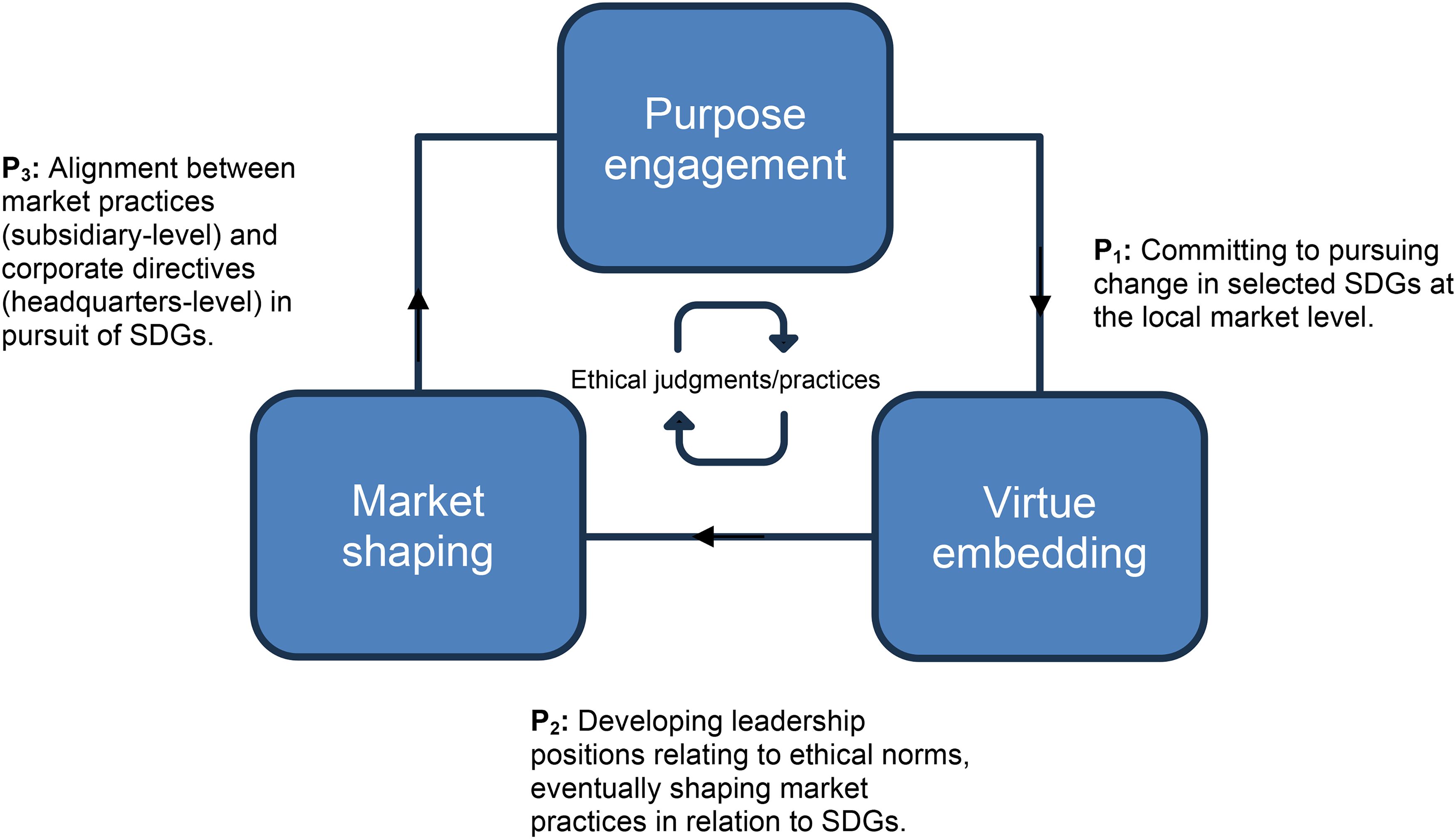
Ethical Leadership in the Pursuit of SDGs.
The corporate purpose has grown out of a strategic and moral inventory put in place by the firm (Mayer 2021), in which both profitability and the pursuit of a selection of SDGs are considered and balanced. The findings suggest that MNEs are incentivized to focus on SDGs where they have the greatest potential to become successful contributors, while not compromising their business objectives. Strategic focus areas related to SDGs are selected on the basis of their effects in regard to long-term business missions as well as the company's resources and capabilities to serve as a change-maker for society in those areas. While it is likely that the strategic/moral inventory shaping the purpose is to some degree instigated by a rational business calculus at the headquarters level, a consistent focus on targeted SDGs may move MNEs beyond a narrow business focus (Rygh, Chiarapini, and Segovia 2022) and generate virtue-based commitments to these goals among employees and, eventually, stakeholders at the local market level.
The local organization of MNEs may exert ethical leadership vis-à-vis local actors (e.g., factory managers) by pointing at both the softer benefits (contributing to society) and the harder benefits (compliance and preemptively developing the sustainability agenda) of adopting a new ethical framing of production practices. Both the water and climate initiatives reflect selective stakeholder responsiveness (Van Zanten and Van Tulder 2018), which deviates from established sustainability research belonging to, for instance, the stream of stakeholder capitalism (Freeman, Martin, and Parmar 2007). Commitment to virtues related to targeted SDGs seems to take place along the entire value chain (Montiel et al. 2021), but critical operations in the studied case are concentrated at the production market level where key activities of the firm take place. While ethical leadership could infer free-rider problems (Van Zanten and Van Tulder 2018), the findings rather seem to imply that progressive behavior is contagious, both between industry actors and across organizational units. The studied MNE is orchestrating stakeholders to reshape market practices, which is an expression of a proactive and market-driving approach to sustainable development (Beninger and Francis 2021; Bouguerra et al. 2023; Tarnovskaya, Melén Hånell, and Tolstoy 2022; Yin and Jamali 2016). Hence, new moral frameworks and practices are bound to spill over to the industrial context that the firm is a part of. This creates scope for competitors within the same industry to also adopt values-based international marketing approaches since they share suppliers that are transitioning toward more sustainable practices.
Actual progress in relation to SDGs is observed to take place at the local market level, where the corporate purpose, along with related directives, is transformed into actionable tasks. Individuals directly involved in these operations may need to disassociate themselves from structural inconsistencies between the (allegedly unsustainable) business model of the firm and targeted SDGs; therefore, local teams can avoid cognitive dissonance and remain convinced that they are being guided by virtues. The ethics that guide pursuits of SDGs thus appear to be anchored in the perceived identity of the local organization rather than in a set of normative rules (Moore 2012). The local subsidiary functions as a bridgehead, translating headquarters’ requirements to the local context in the endeavor to engage local stakeholders (Nylund, Brem, and Agarwal 2021). In turn, local practices seem to affect headquarters decisions and resource allocations, thus eventually influencing global coordination and SDG-related programs in other markets.
Both the water and the climate aspects of the case also offer examples of disengagement from the corporate purpose, particularly in situations where sustainable development is reduced to virtue signaling whereby the company points at isolated achievements and offsetting activities (Brower, Kashmiri, and Mahajan 2017; Payne et al. 2013). Activities such as these may spur values-based marketing programs in the short term, but do not bring about any noticeable change at the industrial level in the long-term perspective.
Conclusion
The growing stature of the SDGs has made it both a moral concern as well as a marketing imperative for MNEs to decide which sustainability challenges are most relevant for them as a way to competitively position themselves. This condition marks a shift from “stakeholder capitalism” perspectives to a reality that assigns stronger agency to individual MNEs to reposition themselves as both market leaders and thought leaders in shaping ethical standards. While investigating aspirations for ethical leadership can provide a theoretical explanation for how MNEs are navigating in an economy influenced by SDGs, the concept of ethical leadership needs further theorization to enable precise analytical application. In this study, we applied corporate purpose and virtue ethics frameworks to contribute to this theoretical development, arguing that there is substantial potential in recognizing the agency of MNEs in the pursuit of SDGs and not treating them as passive responders.
The first theoretical contribution of the article is establishing a conceptual link between the concept of corporate purpose and the concept of ethical leadership. While this relationship is alluded to in the Aristotelian school of virtue ethics, it has not been discussed in the context of international marketing. This study claims that ethical leadership can provide answers to why some MNEs are better equipped than others to enact corporate purposes by advancing the idea that ethical leadership cannot be based on rules and “duties” alone as this could lead to MNEs becoming detached from their perceived moral responsibilities and aspirations. In contrast, a virtuous form of ethical leadership that is anchored in local communities may break new paths and inspire others to follow suit. As the case study demonstrated, firms face complex situations during the implementation of SDGs (such as the mismatch between the purpose of the firm and local practices, attitudes, and laws), implying that a corporate purpose can provide an ethical grounding for MNEs that facilitates decision-making. Ethical leadership based on virtue, however, may be restricted to company representatives at the local market level and not permeate the organization. While the case study reflects the strength of moral commitments to SDGs, it also suggests that MNEs in some instances serve as agents of sustainable development because of their capacities, global outlooks, and economic influence. MNEs aspiring for ethical leadership are transitioning from abiding by externally imposed rules to being animated by intrinsic motivations of doing good. At the subsidiary level, managers are, at times, able to disassociate from negative effects that are structurally built into the business model and immerse themselves in the sustainable development issues that they are assigned to tackle. The compartmentalization of tasks creates conditions for authentic personal commitments to the corporate purpose. Therefore, further research is required to delve into management challenges of ethical leadership, such as how it can be disseminated in the organization.
The second contribution of the study involves a practical demonstration that adopting a corporate purpose and exerting ethical leadership can complement the stakeholder capitalism perspective (Davis 2021) by explaining how MNEs can be change-makers in the realms of the specific SDGs that they have chosen to prioritize. MNEs’ engagement in SDGs may foreshadow a development toward an economy in which the corporate purpose and corporate branding activities become intertwined. This calls for new international marketing programs in which marketing offerings are generated through the alignment of corporate purpose and customer values. Hence, we call for research that examines this new competitive landscape and its implications for international marketing.
Limitations
This study comes with two noteworthy limitations. First, the study is based on a single case, confined to the analysis of two specific SDGs. While it contributes novel empirical observations, the basis for generalization of this study, especially to other SDGs and other markets than the ones investigated, is limited. For more granular insights, researchers could use comparative study designs, juxtaposing particular SDG challenges at different levels of a global value chain (the categorization of Montiel et al. [2021] could be helpful here). Second, while the study draws on both subsidiary and headquarters data from the MNE, the understanding of stakeholder views is inferred from secondary accounts. In a study of ethical leadership, it would be beneficial to be able to tap directly into the narratives of relevant stakeholders (nongovernmental organizations, competitors, suppliers). Future research could draw from a broader industrial ecosystem dataset to better discern diverging and converging views related to SDGs among multiple actors.
Managerial Implications
The study has managerial implications. First, an organization preferably should formulate a corporate purpose with clear actionable linkages to specific SDGs. Such a purpose will point out a direction that reconciles business objectives with societal objectives, enabling organizations to funnel resources to areas in their value chains where they are able to build clout for impact. Because firm conduct will affect the values consumers ascribe to the offerings, the firm will be more adept at serving consumers, whose brand perceptions are increasingly affected by the ethical stances of the firms representing the brands. There is a trend that consumers’ increased awareness of sustainability is driving their purchasing decisions (e.g., Lehmann et al. 2019). This trend likely will continue to grow (Lehmann et al. 2019). Hence, organizations that are able to reposition themselves as not only market leaders but also thought leaders in shaping ethical standards can become more capable of marketing themselves in an economy that is influenced by SDGs. Second, to become credible advocates of SDGs, MNEs need to engage closely in the communities in which the SDG challenges are pronounced. This requires long-term goal setting, task consistency, and close, trusting relationships. Local market sensitivity is key here, as it enables an understanding of the views of local stakeholders (e.g., suppliers, consumers, competitors) and how to create incentives for these stakeholders to change or develop new, sustainable practices. An important point is that ethical leadership is not about adapting to stakeholders in the local market; its focus is rather on influencing and giving local stakeholders incentives to change and develop new sustainability practices. Finally, ethical leadership can only be achieved if internal units of the MNE are aligned. Such an alignment can be created through the enabling of mutual learning processes rather than the strict top-down enforcement of corporate protocols. The reason for this is that ethical leadership requires conviction and genuine engagement, which, arguably, is more effectively fostered through culture than through formalized enforcement. With this approach, the local subsidiaries must be able to take on a more active role in exerting and acting on an ethical leadership position. This implies engaging with prioritized SDGs and understanding the views of local market stakeholders, as well as bridging and managing differences in incentives among stakeholders. An MNE should create mutual learning processes that enable local practices and the subsidiary's local market understanding to influence the headquarters’ decision-making on initiatives such as SDG-related programs.
Footnotes
Editor
Kelly Hewett
Associate Editor
Michael C. Christofi
Declaration of Conflicting Interests
The author(s) declared no potential conflicts of interest with respect to the research, authorship, and/or publication of this article.
Funding
The author(s) disclosed receipt of the following financial support for the research, authorship, and/or publication of this article: The authors would like to thank Riksbankens Jubileumsfond for financial support of this research.
