




Abstract
Solidarity between people of color (PoC) is known to mute divisions between racially stigmatized groups. Yet solidarity’s political origins remain highly unclear. We consider whether PoC solidarity responds to partisan dynamics that unfold before, during, and after presidential elections. A racially diverse Democratic Party requires cross-racial alliances to effectively coordinate during presidential campaigns. This implies that relations between partisanship and PoC solidarity should be sensitive to shifts in campaign contexts, which (de)escalate partisanship. Thus, depending on campaign context, partisanship might shape PoC solidarity, and solidarity might also affect partisanship. We evaluate these prospects with longitudinal data from two extensive survey panels of Asian, Black, Latino, and Multiracial adults, which spanned the 2024 presidential contest between Democrat Kamala Harris and Republican Donald Trump. Across panels, we detect an influence of partisanship on PoC solidarity, with no clear evidence for a reverse relationship between these variables. Critically, partisanship’s linkage to PoC solidarity strengthens in waves that are more proximate to election day. These dynamics are substantively similar across racially stigmatized groups, suggesting that solidarity between people of color is partly rooted in the salience of presidential campaigns and the incentives they provide to build cross-racial alliances.
Keywords
“Voters of color have long been pivotal to Democratic election prospects.” -Armani Syed, journalist “We know that voters of color are critical to Democrats’ coalition and the…investments highlight our commitment to continuously engaging with communities of color on issues they care about.” -Rep. Suzan DelBene, Democrat
1
America’s racial sands are shifting, with nearly 40% of the U.S. population now comprised of people of color (PoC)—Black Americans, Asian Americans, Latinos, and other non-Whites (Pérez 2021). Research documents that solidarity with PoC can sometimes mute political divisions between them (Cortland et al. 2017; Rogbeer et al. 2025; Zou and Ngum 2025; see also see Benjamin 2017; Wilkinson 2015; Sirin et al. 2021). Indeed, studies show that a heightened sense of shared discrimination catalyzes PoC solidarity, which then steers them to support pro-Asian, pro-Black, and pro-Latino policies—even if they are not members of these outgroups (for meta-analytic evidence, see Pérez et al. 2024). But what aspects of politics does PoC solidarity emerge from?
Clearer answers to this question are blocked by theoretical and methodological blind spots. Although researchers have closely studied solidarity’s effects on PoC’s opinions, its connection to explicitly political processes remain murky, especially processes connected to national elections. Several large-scale experiments have manipulated exposure to shared forms of discrimination, which catalyzes solidarity between PoC (Pérez et al. 2024). For example, when Asian and Latino adults perceive they are similarly discriminated against as foreigners (Zou and Cheryan 2017), it boosts their solidarity with other PoC. This indicates shared discrimination can cause stronger solidarity, but without clarifying how it emerges organically from political sources, since these treatments are not framed by partisan elites or in partisan terms (e.g., Kim et al., 2025; Rogbeer et al., 2025).
Compounding this challenge, decades of research finds that relations between African Americans, Asian Americans, Latinos, and other PoC are generally conflictual as they vie for status, resources, and policy issues in civic settings (Kim, 2023; McClain et al., 2008; McClain and Karnig, 1990; Meier et al. 2004; Vaca 2004). One key, then, is to better illuminate how PoC solidarity emerges and is maintained in a tumultuous “real world” of inter-minority politics outside the confines of tightly controlled experiments, particularly in zero-sum settings like electoral contests. One prospect here is partisanship, given its dynamic effects on downstream orientations (Goren, 2005; Margolis, 2018)—including, we think, PoC solidarity. Indeed, while it is intuitive to think that inter-minority solidarity is “baked into” campaign dynamics, President Trump’s election in 2016 and re-election in 2024 reminds scholars that political unity among PoC varies, in part, according to whether and how party elites make race a salient issue and the manner in which their opponents react (or not) to this campaign tactic (e.g., Ramírez 2013; Stout 2020).
A second blind spot in this literature is whether PoC solidarity has durable downstream political effects. While the mega-category people of color has contents (e.g., norms and beliefs) that lend themselves to being politicized (Pérez 2021), the brief nature (i.e., minutes) of solidarity experiments prevents scholars from determining whether its effects on political outcomes persist after these controlled studies (i.e., weeks to months later). Newer research shows that PoC solidarity is stable over time, with a test-retest correlation of (0.63) across a 6-month window (Engelhardt et al. 2025). Missing, however, is evidence that solidarity shapes downstream political outcomes in the long-run—beyond brief experimental effects. This is critical to assess because mass politics is a distal realm that many people pay weak attention to (Krupnikov and Ryan 2022) and one whose salience varies by electoral context (Michelitch and Utych 2018).
A careful look at experimental evidence on PoC solidarity reveals two areas that can be improved with non-experimental methodologies. One area involves evaluating solidarity’s effects on deep-seated political orientations, such as partisan self-identification (PID). Such an effort would be especially revealing because PID is highly stable and known to profoundly affect political thinking and behavior among White adults (Campbell et al. 1960; Green et al. 2002) and people of color (McCann and Jones-Correa 2020; White and Laird 2020). A second area entails appraising solidarity’s dynamics among other hard-to-reach populations besides Asian, Black, and Latino adults—the “usual three”—such as Multiracial Americans, who are one of the fastest-growing populations in the U.S. (Davenport 2018; Masuoka 2017). Broadening the scope of analysis to new populations can boost confidence in the range of solidarity’s effects.
Our paper improves on these fronts by synthesizing growing research on PoC solidarity with established insights about partisanship—the “unmoved mover” of U.S. mass politics (Green and Palmquist 1994; Jennings and Niemi 1978). Our theoretical reasoning yields competing expectations about the longitudinal relations between these variables, which we test with two major panel surveys of African American, Asian American, Latino, and Multiracial adults spanning the 2024 presidential election: (a) the 2023–2024 American Multiracial Panel Study (AMPS) (N = 1,407) and (b) the 2024–2025 Survey Panel of People of Color (SPPoC) (N = 2,702). By leveraging the over-time structure of these panels, the extensive measures of PoC solidarity and PID they contain, and the multiple populations they cover, we evaluate the temporal dynamics between partisanship and PoC solidarity for the first time.
We report three new findings. First, consistent with a classic view of PID as an “immovable mover” (Green et al. 2002), we show that present levels of Republican partisanship precede lower levels of PoC solidarity. Since PID is an ordinal variable, this also means that present levels of Democratic partisanship increase future solidarity levels. We attribute these patterns to the asymmetric opportunities PoC have to mentally “rehearse” cross-racial alliances within each party. Whereas Republicans are a majority-White party with relatively few PoC, Democrats are a multi-ethnic party that often demands cross-racial alliances to succeed politically (Rosenfeld 2018; Schickler 2016). Also, whereas the GOP is mentally correlated with White Americans, Democrats are mentally correlated with PoC (Westwood and Peterson 2020; Zhirkov and Valentino 2022). These varied party configurations in people’s long-term memories allow campaigns to forge stronger, more durable mental associations between partisanship and PoC’s inclination to coordinate politically with one another (i.e., solidarity), which is neither automatic nor easy (Davies 2025; Kim 2023; Zou and Cheryan 2017).
Second, we find little evidence that current levels of camaraderie between PoC significantly weaken Republican partisanship among Black, Latino, Asian, and Multiracial adults (again, compared to Democratic partisanship). During the election, and in its aftermath, both panels reveal that PoC solidarity has a substantively negligible and unreliable influence on Republican partisanship. The limited relevance of PoC solidarity on PID aligns with the conventional view that partisanship is deep-seated and generally resistant to major shifts (Green and Platzman 2024), including among PoC (Hopkins et al. 2023; McCann and Jones-Correa 2020; White and Laird 2020).
Finally, we establish that these relations between PID and solidarity are substantively similar across all populations under study, including Multiracial adults (Davenport 2018; Masuoka 2017), who are generally overlooked by prior studies of PoC solidarity. This increases confidence in our observed dynamics’ generalizability. It also enhances the external validity of prior solidarity experiments by highlighting its downstream consequences in the “real world” of mass politics. We discuss our results’ implications for political scientists and practitioners in a racially diversifying polity.
Presidential Campaigns and the Partisan Roots of PoC Solidarity
We seek to explain why temporal dynamics may exist between PoC solidarity and PID. We accomplish this by first defining these variables and their nature, which clarifies why we might (not) expect meaningful relationships between them over time. Here, literature on PoC solidarity conceptualizes it as a byproduct of identifying as a person of color (e.g., Chin et al. 2023; Cortland et al. 2017; Pérez et al. 2024). Solidarity entails behavioral commitment to an ingroup, which manifests as coordination and collective action with fellow ingroup members. As Leach et al. (2008: 147) describe it, solidarity is “associated with approaching…group-based activity,” activity that is neither political by definition nor easy to produce between racially stigmatized groups (Cortland et al. 2017; Craig et al. 2022; Pérez 2021). This situational aspect of solidarity implies it is the outcome of antecedent influences (e.g., shared discrimination), as well as a possible driver of political behavior under some circumstances. This insight aligns with the documented stability of PoC solidarity. With test-retest correlations of (0.63), solidarity is durable, but not impervious to change over time (Engelhardt et al. 2025).
In turn, research on partisan self-identification (PID) finds an even more stable variable than solidarity and one characterized as a primary influence on individual-level political attitudes and behaviors (Campbell et al. 1960; Green et al. 2002). Seminal work using cross-sectional surveys once indicated that many people of color (i.e., Asian Americans and Latinos) held a weak sense of partisanship (Hajnal and Lee 2011). But more recent, longitudinal work focused on a polarized era (i.e., post-2012) finds that more PoC have now sorted themselves ideologically into their “correct” party, yielding a more stable sense of PID (Hopkins et al. 2023; McCann and Jones-Correa 2020). 2
Given these insights, what kind of relationship should we expect between PID and solidarity? Although these are real concepts that exist in PoC’s long-term memories (cf. Collins and Loftus 1975), there might be no link between them because they are stored in distinct domains in memory (Tourangeau et al. 2000). PID is an explicitly political orientation that regularly structures civic opinions and behavior. In contrast, PoC solidarity is sporadically experienced, as highlighted by chronic tensions between various racially stigmatized ingroups (e.g., Black-Latino conflicts) (Benjamin, 2017; Carey et al., 2016; Kim, 2023; McClain et al., 2008; McClain and Karnig, 1990; Wilkinson 2015). Solidarity also often manifests socially (e.g., inter-personal friendships), rather than in overtly civic ways (e.g., protesting, donating, and voting), which means that political elites must actively work on infusing PoC solidarity with explicitly political overtones. This stands to make solidarity a distal outcome beyond PID’s reach.
Indeed, while elections do prime PID’s salience (Michelitch and Utych 2018; Sears and Valentino 1997), this does not require activation of citizen’s experiences as people of color, especially since PID is a political force that aligns with, and consequently channels, other group attachments during elections (Hickel et al. 2021; Mason 2018; White and Laird 2020). Although our party system has a long and deepening connection to race that may have initially brought some PoC into a party (Pantoja et al. 2001; Schickler 2016; Wong 2005), the salience of race in elections waxes and wanes according to the issue dimension(s) that elites compete on during specific campaigns. Thus, our first null hypothesis (H10) is that PID is unrelated to PoC solidarity.
In contrast, another reading of these literatures suggests PID should positively influence PoC solidarity, which aligns with growing research on PID’s effects on race-related attitudes and identities (e.g., Agadjanian and Lacy, 2021; Egan, 2020; Saavedra, 2016). The ideological sorting of the mass public into Democrats and Republicans has produced parties that are more racially and ideologically homogenous than before (Levendusky 2009). This polarization and increased attention to identity-inflected issues (Hopkins et al. 2023) have produced clearer stereotypes about who comprises each party and what its primary stances are (Ahler and Sood 2018; Westwood and Peterson 2020). Consequently, citizens have acquired racialized images about Democrats and Republicans (Zhirkov and Valentino 2022), with the former perceived as intertwined with PoC and the latter with Whites, the “real” Americans (Danbold and Huo 2015).
This structural feature of parties facilitates stronger mental links between them and racial imagery—Democrats privilege the identities of PoC, while Republicans enshrine American identity (Dawkins and Hanson 2024). Thus, the Democratic party’s racial diversity provides people of color regular opportunities (e.g., presidential elections) to mentally rehearse inter-minority solidarity (Fazio 2014), with the possibility that this camaraderie accumulates and persists over time (as evidenced by its relative stability; see Engelhardt et al. 2025). Indeed, even if presidential campaigns do not explicitly foment solidarity, the ideological sorting and racialized images of both parties might be sufficient for citizens to simultaneously consider themselves PoC and partisans, thus strengthening interdependence between non-White Democrats (relative to non-White Republicans) (Huddy et al. 2016; Pérez et al. 2025b; Saavedra 2016). That is, even though a race-party link is well-established, it is the presently sorted and conflictual environment that makes politics today more relevant to PoC compared to several decades ago (e.g., Solís and Pérez 2026). Our first alternate hypothesis, then, is that present Republican partisanship will significantly decrease later solidarity between people of color (H11). 3
What about solidarity—can it also shape PoC’s partisanship? The prevailing view on PID suggests it is unlikely. Panel analyses show partisanship is stable, changes minimally over one’s lifespan, and is a major predictor of mass political behavior (e.g., Green and Palmquist 1994; Jennings and Niemi 1978). Thus, while partisanship occasionally changes, it largely persists throughout individuals’ adult lives. Partisanship’s resistance to lasting, dramatic changes also occurs among people of color, as recent panel evidence indicates (Hopkins et al. 2023; McCann and Jones-Correa 2020; White and Laird 2020). In fact, the affinity people of color have for their racial group or the category, PoC, are perhaps already fully integrated into their partisanship. Thus, our second null hypothesis is that PoC solidarity does not relate to PID over time (H20).
Still, a closer reading of solidarity’s functionality, plus more recent developments in mass polarization, indicate that PoC solidarity might, in fact, independently shape partisanship among Asians, Blacks, Latinos, and other PoC. Careful conceptualization and measurement work characterizes solidarity as the degree of self-involvement in an ingroup one identifies with (e.g., people of color). Solidarity drives ingroup members to engage in group-centric activities (Leach et al. 2008). Thus, solidarity is a commitment to preserving an ingroup’s well-being and coordinating with peers to accomplish this via available means—including partisan politics.
This claim is backed by long-run trends in the racial diversification of the Democratic party and racial homogenization of the GOP, which have accelerated due to polarization (Iyengar et al. 2019). In the 1930s, Democrats began to organize and convert African Americans in northern cities to their party as part of a gradual effort to rebrand itself as the party of “workers” during the Great Depression (Schickler 2016). Later, after the 1965 revision of immigration laws to facilitate the entry of newcomers and their families, Democrats worked to slowly incorporate Asian and Latino immigrants and their descendants into their ranks, as reflected in the 1990s upsurge of new Asian and Latino voters in California, now a solidly “blue” state (Pantoja et al. 2001; Wong 2005).
Hypotheses about temporal dynamics between PID and PoC solidarity

Research Design
We test our collection of hypotheses with two panel datasets. The first, the 2023–2024 American Multiracial Panel Study (AMPS), is a three-wave panel dataset we collected in partnership with YouGov in the nearly year and a half before the 2024 presidential election, with Wave 1 gathered in June 2023, Wave 2 in December 2023, and Wave 3 in August 2024. 4 We collected Wave 1 responses during June 10–21, 2023 and sampled large numbers of African American (n = 985), Asian American (n = 678), Latino American (n = 975), Multiracial American (n = 764), and White American adults (n = 1,000), for a total N = 4,402. We undertook Wave 2 in November 17–December 12, 2023, and Wave 3 in July 31–August 23, 2024, with YouGov at that point able to recontact at least 31% of the Wave 1 respondents in each group (Black Americans n = 301, Asian Americans n = 347, Latinos n = 378, Multiracials n = 381, and White Americans n = 500). 5 We focus on the samples of Asian, Black, Latino, and Multiracial adults (n = 1,407). 6
Our second dataset, the 2024–2025 Survey Panel of People of Color (SPPoC), is a three-wave panel data set that we gathered during the peak of the presidential campaign and 7 months into the newly elected Trump administration. We implemented this survey panel in partnership with the National Opinion Research Center (NORC). Specifically, we collected Wave 1 responses during June 5–20, 2024 from large numbers of Asian (n = 1,039), Black (n = 1,292), and Latino Americans (n = 1,296). We undertook Wave 2 during December 2–12, and Wave 3 from July 23–August 5, 2025. NORC was able to recontact at least 73% of wave 1 completes (Black Americans n = 979; Asian Americans n = 774; Latino Americans n = 949).
We operationalize PoC solidarity in each wave with a previously validated three-item battery (Pérez et al. 2025a). Here, respondents used 5-point agree-disagree scales to answer three items: (1) “I feel solidarity with people of color, which include Black, Asian, and Latino people”; (2) “The problems of Black, Latino, Asian, and other people of color are similar enough for them to be allies”; and (3) “What happens to people of color in this country has something to do with what happens in my life as a [Black, Asian, Latino, multiracial] person” (cf. Dawson 1994; Leach et al. 2008).
We operationalize partisanship with 3 items available in all waves in each panel survey, which allows us to tame measurement error and better capture the cognitive and affective components of partisan identity (Goren 2005), which are key aspects of self-identification with an ingroup (Tajfel 1981). 7 We use individuals’ responses to the 7-point branched American National Election Studies item as well as their ratings of Democrats and Republicans on separate favorability rating scales (Highton and Kam, 2011). 8 We score these items so that higher values denote greater affiliation with, and warmer affect toward, the Republican party relative to the Democratic party.
Modeling Strategy
We test our hypotheses by estimating cross-lagged panel models (CLPMs) (Engelhardt 2021; Finkel 1995; Goren 2005). Compared to other related approaches, CLPMs estimate connections between stable, slow-moving variables overtime. Specifically, we test whether average scores on a construct measured at one time point (C1) predict average scores on another variable at a second time point (Vt+1), net of initial average scores on that first construct (Ct - 1). We note that our estimation strategy does not let us distinguish between how much stable trait-like differences in solidarity and partisanship or state-like within-person fluctuations in the same variable account for any potential temporal connections (Hamaker et al. 2015). Yet this distinction only matters when trying to infer the specific source of observed dynamics. Our theory is agnostic about whether changes in (rather than levels of) partisanship precede differences in solidarity. It is also agnostic about whether partisanship, as a stable feature of individuals, promotes changes in solidarity (e.g., through repeated exposure to messages and ideas) (Miller 2000). Our more modest and specific goal here is to clarify the temporal order and possible relationship(s) between PoC solidarity and PID, which makes our approach highly suitable for this objective. A major advantage of our analytic approach is that it minimizes threats to confounding from time-invariant characteristics. We further assess the robustness of this approach by including key covariates that could, in theory, confound an observed relationship between PID and PoC solidarity (cf. Hamaker 2023; Zyphur et al. 2019).
We estimate our cross-lagged models within a structural equation modeling (SEM) framework (Finkel 1995; Goren 2005). This approach directly addresses measurement error while specifying longitudinal relationships between our explanatory variables. For our model’s measurement component, we specify PoC solidarity and partisanship as separate latent variables in each wave, allowing us to remove random error from the observed items. To ensure temporal consistency in the latent variable’s meaning (e.g., partisanship), we constrain item factor loadings and intercepts to equality across waves. Because we measure PoC solidarity on agree-disagree scales that are all phrased in the same direction, we also estimate a method factor to avoid confounding substantive variation with variation due to methodological artifacts, like acquiescence bias (Brown, 2007; Clifford and Engelhardt, 2026). We define this method factor as a third latent variable on which all PoC solidarity items load, as well as additional items that are unrelated to solidarity but also use agree-disagree response scales to define this acquiescent-responding dimension (Watson 1992). 9 To identify this method factor we fix all the agree-disagree items’ factor loadings to 1 under the assumption that response bias affects each item similarly (Savalei and Falk 2014). Finally, we constrain to 0 the method factor’s correlation with the other substantive factors.
Each model’s structural component consists of regressions that offer information on each construct’s temporal effects. To test H1, we predict future PoC solidarity with partisanship and PoC solidarity measured in an earlier wave. A statistically significant coefficient on partisanship supports H11—that is, knowing someone’s initial partisanship gives us information about people’s later solidarity levels, net of baseline solidarity. To test H2, we predict future partisanship with the same variables. Evidence for H21 comes from a significant coefficient on PoC solidarity, indicating someone’s initial solidarity level gives us information on later partisanship, net of baseline PID.
We strengthen our inferences about PoC solidarity in this parsimonious context by including self-identification as a person of color as a covariate. Unlike solidarity, PoC identity indexes “the salience and importance of ingroup membership” (Leach et al. 2008, 147). Published work establishes that PoC identity and solidarity are correlated but distinct concepts (rs = 0.47–0.64 in wave 1 across groups) (Engelhardt et al. 2025; Pérez et al. 2025a), with PoC identity temporally preceding PoC solidarity. Thus, our analysis ensures that any observed relationship(s) between PoC solidarity and PID is independent of PoC identity’s possible influence. Consequently, we define a latent PoC ID variable with three previously validated items from wave one (e.g., “The fact that I am a person of color is an important part of my identity”) (Pérez et al. 2025a). Because these items have agree-disagree scales, they also form part of our method factor. 10
We recognize our baseline expectations of null effects cannot be demonstrated via null hypothesis testing (Gill 1999). That is, we can never really “prove” a null. Therefore, we evaluate our findings by considering statistical and substantive significance (Rainey 2014). We define negligible effects as standardized coefficients at or below 0.03, which are estimates that fall in the bottom 20% of effect sizes in studies assessing psychological dispositions with CLPMs (Orth et al. 2022). If the 90% confidence interval for our estimated coefficient contains only values between ±0.03, then we have clearer evidence of no effect, which better aligns with our null predictions (Rainey 2014).
Result 1: Partisanship and PoC Solidarity Are Dynamically Related Over Time
We report estimates from two versions of each cross-lagged model. Our primary estimates include only partisanship, PoC solidarity, and PoC ID. These are what we label our baseline model in the figures below. The second set of estimates, which we label extensive controls in our figures below, incorporate several demographic and political characteristics, in addition to PoC identity, that could plausibly bias our main model estimates (Hamaker 2023; Zyphur et al. 2019). These include gender, age, education, and immigrant generation, and (for the AMPS analysis) political interest, all of which are common covariates in studies of public opinion among people of color (Pérez 2021). 11
Figure 1 reports the estimated stabilities and cross-lagged effects for the AMPS, the panel study whose third wave was gathered in August 2024, right before the presidential election intensified. Looking first at Panel A and the parameter estimates from our baseline model, we find clear evidence for H11. Republican partisanship measured in June 2023 significantly reduced solidarity measured in November and December of that year (−0.114, SE = 0.038, p < .001). This same pattern re-emerges in between November-December 2023 and August 2024 (−0.185, SE = 0.038, p < .001). In both intervals, PoC who were on average more Republican ended up scoring on average lower in PoC solidarity after accounting for solidarity’s baseline stability. Furthermore, notice that this path from partisanship to solidarity increases (−0.114 → −0.185) as we move into the 2024 election year. This pattern dovetails neatly with research on the impact of approaching electoral contexts on partisanship’s salience and influence (Engelhardt 2021; Michelitch and Utych 2018). Indeed, this is the kind of pattern one might expect if a heightened sense of partisanship facilitates coalition-building among people of color via solidarity. Notably, our key coefficients are sizeable, with our standardized coefficients coming in near the 70th and 90th percentiles of observed effects from such models (Orth et al. 2022). Panel B shows these same patterns persist after covariate adjustment, but the path from wave 1 to wave 2 attenuates, though its standard error remains the same (−0.08, SE = 0.04, p < .05). Cross-lagged panel model results from 6/2023–7/2024 AMPS. Baseline controls include only PoC identity. Extensive controls include racial identity and background demographics. Standardized parameter estimates with standard errors in parentheses. Fit statistics scaled.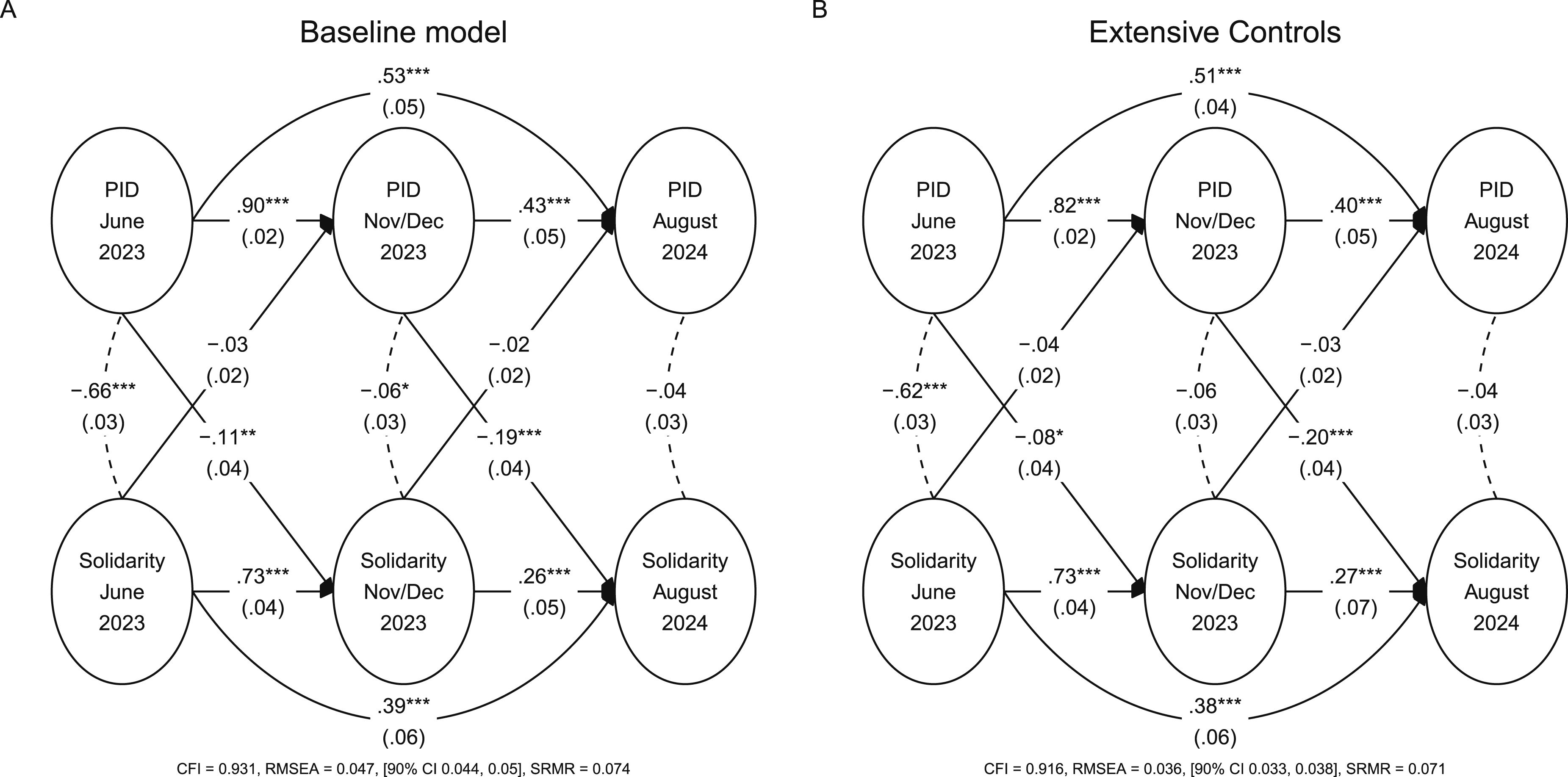
Turning to our test of H21, we find no clear influence of solidarity on PID. Consistent with expectations, higher average levels of PoC solidarity in June 2023 predict less Republican (more Democratic) partisanship measured in November–December of that year, with the same pattern arising in the interval between November 2023 and August 2024. Yet these patterns are imprecisely estimated (ps = 0.203 and 0.391) and quite modest, with the largest coefficients in the 20th percentile of effects for models like these (Orth et al. 2022). This appears to be partly explained by confounding, since Panel B shows that inclusion of extensive controls sharpens these estimates and trends them away from zero (ps = 0.051 and 0.145). Still, given the small size and imprecision of these coefficients, we interpret these patterns as providing very weak support for H21. Indeed, the 90% confidence intervals for these key estimates contain at least some substantively meaningful values, which provide evidence against H20 (baseline: [−0.067, 0.009; −0.045, 0.015]; controls: [−0.075, −0.005; −0.005, 0.004]).
Figure 2 offers complementary findings from our analysis of the 2024–2025 SPPoC, which began in the summer preceding 2024’s presidential election and ended 7 months into the new Trump administration in July 2025. This is a period where partisan dynamics are presumably in full swing. Panel A indicates that between June and December 2024 (−0.16, SE = 0.03, p < .001) and December 2024 and July 2025 (−0.14, SE = 0.03, p < .001), Republican partisanship and PoC solidarity are inversely related in the manner anticipated by H11. That is, people of color who on average scored more Republican in the initial wave expressed on average significantly less PoC solidarity in the subsequent wave. These cross-lagged effects are also substantial, between the 75th and 85th percentiles of observed effects. Panel B further establishes these paths’ robustness to confounding from additional factors, with the estimated effects remaining sizeable even after covariate inclusion. Cross-lagged panel model results from 6/2024–7/2025 SPPoC. Baseline controls include only PoC identity. Extensive controls include racial identity and background demographics. Standardized parameter estimates with standard errors in parentheses.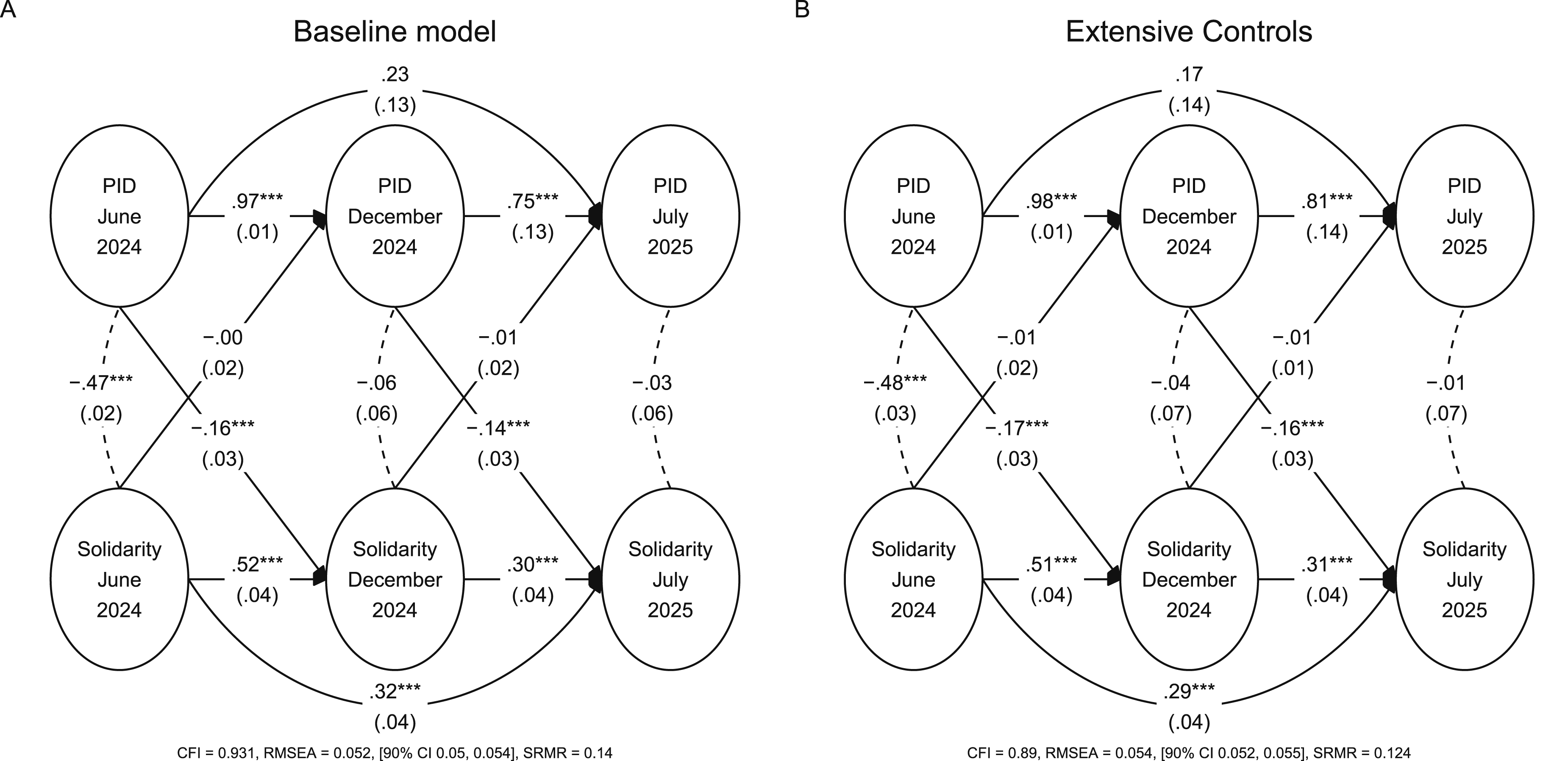
In turn, we again uncover very weak evidence for H21, which also expected an inverse relationship between present PoC solidarity and later Republican partisanship. As Figure 2 indicates, the estimated cross-lagged effects of initial solidarity on subsequent partisanship are both near 0 and statistically unreliable, a pattern that emerges with and without inclusion of covariates. And again, the 90% confidence intervals contain substantively meaningful values, which provide evidence against H20 (baseline: [−0.036, 0.030; −0.037, 0.019]; controls: [−0.040, 0.020; −0.027, 0.017]).
In sum, across two major panel datasets with respondents of color, our results consistently support partisanship as one major force behind the solidarity that PoC express toward each other. Indeed, our findings highlight the importance of campaign context in these relationships. Although we consistently find support for partisanship’s impact on PoC solidarity, this pattern’s magnitude appears to increase in the more heavily politicized election year and its immediate aftermath. In sharp contrast, the evidence for H21 is consistently weak in both precision and magnitude—and, ultimately, not replicated across our datasets.
Result 2: Dynamics Between PID and Solidarity Operate Equivalently Across PoC
Although we find clear support for H11, our analyses assume these dynamics work equivalently for all people of color. Yet orientations toward partisanship can vary between racial and ethnic groups in important ways (Carlos 2018; Hajnal and Lee 2011; Pérez et al. 2025b; Raychaudhuri 2018). For instance, Black Americans have uniquely strong connections to the Democratic party (Hajnal and Lee 2011; White and Laird 2020), and only recently have scholars identified more crystallized partisan orientations among Asian and Latino PoC (Hopkins et al. 2023; McCann and Jones-Correa 2020; Pérez et al. 2025b). Similarly, (non-) Whites consider Black adults the prototypical person of color, which means they define this mega-group’s norms and values. Thus, the category, people of color, may lead Black Americans to have unique beliefs about group solidarity and its connection to partisanship (Chin et al. 2023).
We therefore test whether our evidence so far varies between Black and non-Black PoC. Within an SEM framework, we estimate a model that fixes the measurement of the latent variables to equality across groups (i.e., Black and non-Black PoC) but allows the structural parameters to vary freely across groups. In other words, we hold constant the meaning of partisanship and PoC solidarity, but allow the estimated relationships between these variables, including the cross-lagged effects and covariances between the latent variables, to differ between PoC. We then test whether these relationships are statistically similar across PoC by estimating a second model that constrains these structural parameters to equality across groups. This second model reflects the hypothesis that our observed dynamics are statistically equivalent across PoC. Since the constrained model is nested within the unconstrained model, we test for heterogeneity by fixing to equality the structural parameters (regression slopes and latent variable covariances) and evaluating how much the simpler model’s fit deteriorates. If model fit weakens, then we conclude that the unconstrained model better reflects the observed relationships, providing clear evidence for differences between (non-) Black PoC in the observed dynamics between PoC solidarity and PID.
Model fit comparison of group heterogeneity vs. homogeneity in temporal relationships between PoC solidarity and partisanship
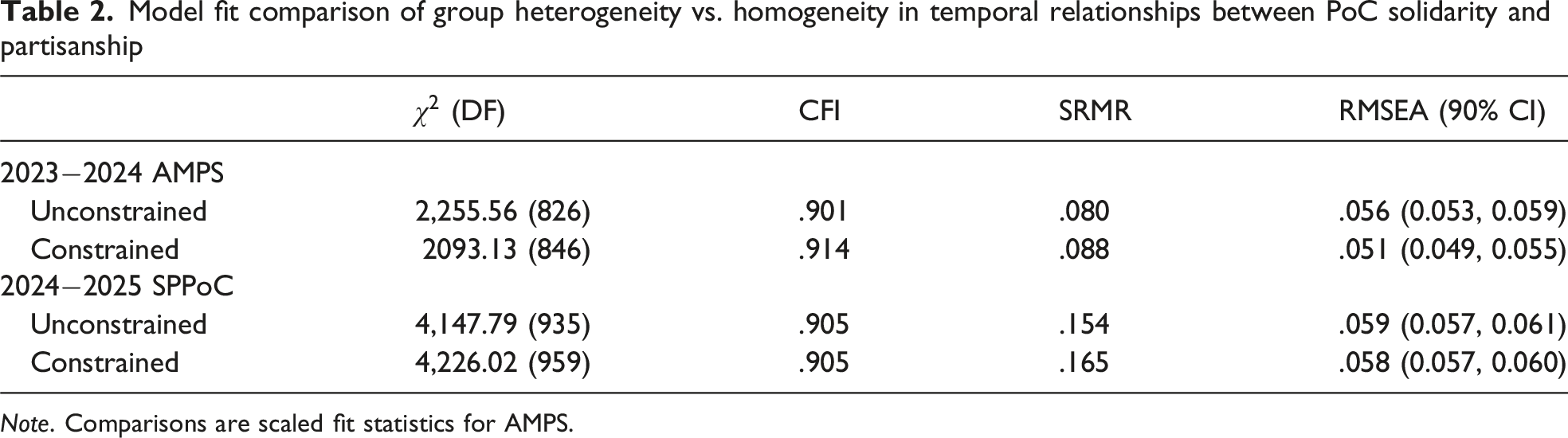
Note. Comparisons are scaled fit statistics for AMPS.
The bottom panel provides similar information for models using the SPPoC. Here, the CFI and SRMR for the unconstrained model are subpar. However, this pattern is driven by the method factor included in this model (and the AMPS model). We retain this method factor because it is highly consistent with best practices when estimating models like these (Brown 2007). Accordingly, we observe that our likelihood ratio test again suggests our constrained model fits worse than the unconstrained one (
Result 3: PID-Solidarity Dynamic Is Generally Robust to Political Awareness
Political scientists sometimes find that partisanship’s links with other orientations often depend on individual differences in political interest and awareness (e.g., Carsey and Layman 2006; Engelhardt 2021). Even orientations presumed to be more easily linked to politics, such as attachment to social and racial groups (Green et al. 2002), sometimes depend on one’s interest in and awareness of politics (Jones 2023; Lee 2008). Although our dynamic model (with demographic controls) adjusts for individual differences in political interest and education, our specifications still assume the cross-lagged influences of partisanship and PoC solidarity have similar effects across levels of political engagement.
We formally probe this assumption by operationalizing awareness with a political interest item included in the AMPS, which asks people how often they pay attention to social and political affairs (1 = Hardly at all, 4 = Most of the time), and with an indicator for having a college degree in the SPPoC. While research suggests political knowledge items better index chronic cognitive engagement and understanding (Zaller 1992), both data collections lack relevant measures and constructing truly comparable knowledge measures across racialized groups is known to be challenging and often unattainable (Abrajano 2015; Pérez 2015). 12
Model fit comparison of heterogeneity vs. homogeneity in temporal relationships between PoC solidarity and partisanship by awareness
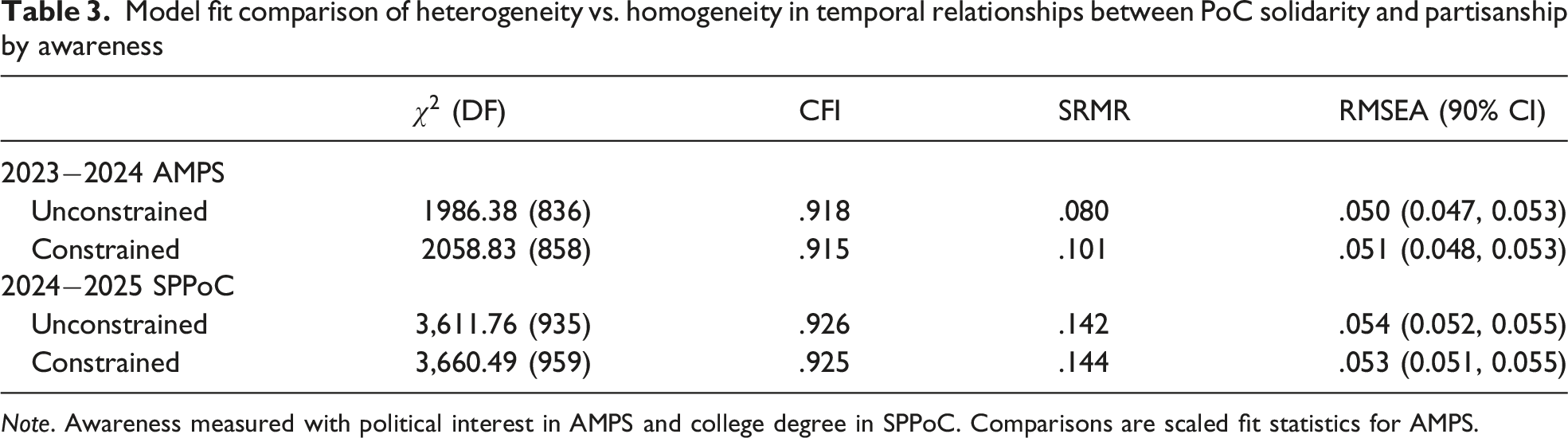
Note. Awareness measured with political interest in AMPS and college degree in SPPoC. Comparisons are scaled fit statistics for AMPS.
We find some evidence that the constraints slightly reduce the model’s global fit in the AMPS data, as indicated by changes in our CFI and chi-square test (
Implications
We began our paper by asking about the partisan origins of PoC solidarity—an important theoretical question with few empirical answers so far. We suggested that perhaps the high and persistent levels of PoC solidarity previously observed by scholars are partly connected to partisan self-identification: one of the most fundamental variables in the study of mass political behavior in the U.S. (Green et al. 2002; Hopkins et al. 2023; McCann and Jones-Correa 2020). By leveraging two unique panel surveys of African American, Asian American, Latino, and, for the AMPS, Multiracial adults, we found evidence that clarifies one of the expressly political roots of PoC solidarity. Specifically, we found consistent evidence that Republican PID (at time 1) significantly associates with reduced PoC solidarity (at time 2). We also discovered that net of this relationship, PoC solidarity (June 2023) may relate to decreased self-identification as a Republican among African American, Asian American, Latino, and Multiracial adults (November/December 2023), though we see future replication important for this potential path, with specific attention to non-election contexts. Together, these patterns support the view that partisan identity precedes solidarity between PoC, with the observed dynamics operating uniformly across all four populations under study and across levels of political interest.
While informative, we call attention to one potential limitation. Political interest increasingly influences who completes political studies, including on samples like ours (Bailey 2024). Samples more politically engaged than the true population would mean we might overestimate partisanship’s contribution to PoC solidarity given the former’s heightened crystallization among the politically involved. But simultaneously, a more engaged sample would mean that people’s attitudes in general, not just partisanship, are more likely crystallized, making them less likely to change and enabling alternative causal paths. So, while our samples are perhaps unique in these regards, sample biases of this kind are hard to predict.
With caveats like these in mind, where should scholars go next with these findings? There are many directions, but mindful of space, we highlight and discuss three specific possibilities. First, our findings’ most obvious implication, at least to us, is that solidarity between PoC has structural political roots, as manifested through PID. Why is this important? A close look at the published record in political science (Pérez et al. 2024) and social psychology (Cortland et al. 2017) shows that the triggers of PoC solidarity are mostly social in nature and largely devoid of explicitly partisan content. This is a remarkable insight on its own, given that something not expressly political (i.e., perceived shared discrimination) has significant downstream consequences for political attitudes. However, our results open a new door to better understanding the political conditions that give rise to (or reduce) PoC solidarity. One promising start inspired by partisanship’s increased influence with election proximity would be to simply develop and test new manipulations that focus on the political triggers of PoC solidarity, with such efforts helping to unpack which aspects of partisanship’s content (e.g., ideological programs, issue positions, candidate traits, and electoral appeals) facilitate the relationships we find. We find this attention key because changes in partisanship itself do not appear to underpin our results. Estimates from a panel model that relates changes in partisanship to changes in PoC solidarity yield null relationships (Appendix B). Consequently, our results likely follow from processes that intercede between more stable partisanship and more labile PoC solidarity.
Additional attention to potential mechanisms linked to partisan preferences would not only help to further enhance the external validity of published experimental findings so far but also help to synthesize the study of racial and ethnic politics (REP) and the study of partisan polarization: two fields which generally do not cross-fertilize each other (Pérez and Cobian 2024). We find the latter to be an especially important next step because the overwhelming majority of research on the polarization of the U.S. mass public centers on non-Hispanic Whites, with noticeably fewer studies centering on PoC (e.g., Huddy et al. 2016). Thus, an integrative effort like this would serve social scientists well by providing further evidence about polarization’s effects on PoC.
Second, we think our findings highlight a clear opportunity to better cement conceptual and theoretical links between how political scientists and social psychologists study PoC solidarity (e.g., Chin et al. 2023; Craig et al. 2022). Social psychologists have invested deeply in better understanding the types of social situations (e.g., perspective-taking) and cognitive outputs (e.g., perceived similarity) of solidarity between PoC, but usually at the expense of expressly political outcomes. In turn, political scientists are generally interested in the political triggers of PoC solidarity, but at the expense of truly grasping and fully detailing the psychological processes behind these relationships. A deeper synthesis between these two research areas stands to bring new questions and insights about PoC politics. We think this is especially the case when it comes to political behavior (e.g., voting). If, as we have observed, PoC solidarity has deep political roots, then it stands to reason that it might also have strong effects on political behavior. Interestingly, while political behavior scholars have faced conceptual and theoretical challenges in explaining when attitudes drive political behavior (Pérez and Mártir 2025), social psychologists have plenty of validated mechanisms worthy of exploration, including the role of attitude importance and behavioral intentions in producing actual political behavior (Ajzen and Kruglanski 2019; Ajzen and Fishbein 1980; see also Chin et al. 2023; van Zomeren et al. 2008). Integrating these insights, we think, will help scholars better anticipate when and how PoC solidarity yields downstream behavioral effects (Rogbeer and Perez 2026).
Finally, we think that our results raise interesting new questions about the coherence and political dynamics of people of color as a mega-group in American politics. The evidence we report here is consistent with the view that political solidarity mutes divisions between PoC—a pattern we can now trace, in part, to intraparty dynamics among Democrats. But it is important to note that this evidence, and other evidence like it (e.g., Engelhardt et al. 2025; Pérez et al. 2024), is gleaned from studies of national-level politics. This leaves open questions about whether the patterns we have observed here generalize to other settings, such as state-level and local-level politics. We urge scholars to push in these two directions, given that a big slice of inter-minority politics in the U.S. happens between communities of color at the state and local levels (e.g., Benjamin 2017; Kaufmann 2004; McClain and Karnig 1990; Meier et al. 2004). Therefore, to have a fuller grasp about the coherence and political promise of a mega-group, like people of color, scholars must theorize about why we should (not) observe comparable dynamics in other major political settings that are strongly suspected of conditioning politics between PoC.
Supplemental Material
Supplemental Material - Solidarity Between People of Color Has Dynamic, Partisan Roots: Panel Evidence During and After the 2024 Presidential Contest
Supplemental Material for Solidarity Between People of Color Has Dynamic, Partisan Roots: Panel Evidence During and After the 2024 Presidential Contest by Andrew M. Engelhardt, Efrén Pérez, Seth Goldman, Yuen Huo, Tatishe Nteta, and Linda R. Tropp in Political Research Quarterly
Footnotes

Funding
The authors disclosed receipt of the following financial support for the research, authorship, and/or publication of this article: This work was supported by the Russell Sage Foundation.
Declaration of Conflicting Interests
The authors declared no potential conflicts of interest with respect to the research, authorship, and/or publication of this article.
Supplemental Material
Supplemental material for this article is available online.
Notes
References
Supplementary Material
Please find the following supplemental material available below.
For Open Access articles published under a Creative Commons License, all supplemental material carries the same license as the article it is associated with.
For non-Open Access articles published, all supplemental material carries a non-exclusive license, and permission requests for re-use of supplemental material or any part of supplemental material shall be sent directly to the copyright owner as specified in the copyright notice associated with the article.
