




Abstract
Anecdotal and experimental evidence suggests that at least some consumers change their purchasing behavior in response to the values, reputations, and political activity of corporations. Using two nationally-representative surveys and a third survey of registered voters, we find Americans’ engagement in boycotts and/or buycotts for political or social reasons to be widespread. Social media activity, political knowledge, ideological intensity, and an interest in politics are significantly associated with political-consumer behavior. Among partisans, we find both instrumental and expressive partisanship to be significant predictors of political consumerism.
Public calls to boycott retail establishments, restaurants, and other companies, in response to corporate political activity, are seemingly on the rise in the United States. Boycotts often trigger calls to buycott the same commercial establishments by political opponents on the other side. In one recent example, Donald Trump encouraged his supporters to “buy L.L. Bean” after Democrats called for a boycott of the brand upon learning the company’s heiress, Linda Bean, donated large sums to a pro-Trump political action committee (PAC) (Victor, 2017). Other brands such as New Balance (Gilbert, 2016), Nordstrom (Allison and Rupp, 2017), Starbucks (Mazza, 2017), Uber (Said, 2017), and Under Armour (Kilgore, 2017) have all been targets of boycotts and/or buycotts in the last year related to political or social issues. Survey data show that sizeable percentages of Americans report having boycotted or buycotted a product or company (Baek, 2010; Newman and Bartels, 2011; Stolle and Micheletti, 2013; Copeland, 2014a) and that such political consumerism appears to have become more widespread in many western countries, including in the United States (Stolle and Micheletti, 2013). 1 Although political consumerism has received a fair amount of scholarly attention, we still have an incomplete picture of the sociopolitical and demographic underpinnings of this behavior.
The current study advances several objectives. First, we aim to update previous studies of political consumerism with an eye towards developing longitudinal perspectives of such behavior and examining the factors that currently explain it. Our approach engages potential limitations in the extant research and adopts refinements to address measurement and other methodological concerns. Next we seek to build upon existing scholarship in two substantive ways. A central goal is to examine how individuals’ partisan identities find expression in their consumer choices. We focus not only on the instrumental aspects of partisanship but also on “expressive partisanship,” which, as we discuss below, scholars view as a related but distinct concept (Huddy et al., 2015). We also investigate how contextual changes, most notably, the proliferation of social media and ensuing changes in interpersonal networks, may influence political consumerism.
We leverage a variety of empirical sources to pursue our objectives. We analyze two, nationally-representative surveys conducted by YouGov in 2016 and an original, third survey of registered voters that included a partisan identity battery adopted from Huddy et al. (2015). As a preview, we find that instrumental components of partisanship are strongly associated with political consumerism and that individuals with strong expressive partisan identities are more likely to report boycott participation. Our analyses also suggest social media activity is associated with political consumerism. We proceed by providing a brief overview of political consumerism, how it is measured, and our expectations about the relationship between boycotts/buycotts and partisanship. We then describe our data and methodological procedures and report our findings.
Background and expectations
Political consumerism is often considered an extension of “lifestyle politics” (Bennett, 1998) where politics infiltrates non-political aspects of our daily routines. The decision to patronize one business over another falls into this broad category. Over time, the study of political participation has expanded to include forms of non-electoral participation such as protest (Barnes and Kaase, 1979), volunteering (Verba, Schlozman and Brady, 1995) and eventually political consumerism (Newman and Bartels, 2011). In fact, a goal of the initial political science research on consumerism was to establish it as a form of political participation (Newman and Bartels, 2011; Baek, 2010). Empirical examinations of survey data documented substantial overlap between many of the characteristics that predict consumerism and those that predict other forms of participation (Newman and Bartels, 2011; Copeland, 2014a).
Early research about the topic used a variety of question wordings when inquiring about participation in boycotts and buycotts. Generally, researchers have taken a broad approach by asking about purchasing decisions for “political, ethical, or environmental reasons.” Referencing the environment in questions designed to measure political consumerism may inflate estimates of those, particularly on the left, who engage in politically-minded shopping or eating (Stolle and Micheletti, 2013: 73). In the current study, we narrow our attention to boycotts and buycotts arising from “social and political” (dis)agreements with corporate entities and ask identical questions in all three surveys to evaluate whether political consumerism fluctuates during the relatively short time period between our surveys. Large variations have been observed in prior studies. Both context and question wording may contribute to these discrepancies. For example, a 2002 survey found that almost half of Americans had previously participated in boycotts or buycotts (Baek, 2010). This estimate is on the high end and is likely an artifact of the question wording, which did not specify a time period. The frequency of boycott or buycott behavior is usually lower when questions reference a specific time frame, generally, the previous year (e.g., Newman and Bartels, 2011; Copeland, 2014a and 2014b). To maximize comparability, we follow this approach in our studies.
Much has changed since many of the initial studies about political consumerism were conducted, including how Americans acquire political information as well as growing partisan polarization. One prominent difference is the popularization of social media, which is a leading source of information about the implications of consumption choices (Stolle and Micheletti, 2013). Social media is particularly relevant for some segments of the population that are highly active online (see Becker and Copeland, 2016) and may accelerate how quickly information concerning corporate political activity reaches everyday Americans. Exposure to information about companies and industries that violate (or conform to) citizens’ political values is a necessary component for political consumerism (Becker and Copeland, 2016; Neilson and Paxton, 2010; De Zúñiga et al., 2014; Wicks et al., 2014; Stolle and Micheletti, 2013). Accordingly, we expect that social media use will be positively correlated with political consumerism, although we recognize that relevant information may reach the public through a variety of channels, including traditional ones.
When Americans encounter information about the political activities of corporations and brands, they may be motivated to reward or punish them by either purchasing or declining to purchase their goods or services. Partisans today are potentially more reactive to political information about corporate entities, given that Democrats and Republicans have become more polarized in recent years, and Americans affiliated with each party increasingly dislike the opposition (Webster and Abramowitz, 2017; Lelkes, 2016; Iyengar, Sood and Lelkes, 2012). Affective polarization, or hostility toward opposing partisans, seems to be growing, ingrained or automatic in voters’ minds and as potent as animus based on race (Iyengar and Westwood, 2015). Moreover, the “intrusion” or “gradual encroachment” of party preference into nonpolitical or personal domains is causing nonpolitical judgments and behaviors to reflect the influence of partisan cues (Iyengar and Westwood, 2015: 691). However, not all partisans will be moved to boycott or buycott. We suspect political consumer behavior to vary based on the expressive and instrumental components of individuals’ partisan identities. Expressive partisanship refers to one’s longstanding identity as either a Democrat or a Republican (see Huddy et al., 2015 and Green et al., 2002), whereas instrumental partisanship can be viewed as “a running tally of party performance, ideological beliefs, and proximities to the party in terms of one’s preferred policies” (Huddy et al., 2015: 1). Standard measures of strength of partisanship do not allow for a distinction between expressive and instrumental partisanship.
A strong expressive partisan identity has been linked to campaign activity and electoral participation (Huddy et al., 2015; Miller and Conover, 2015), but its connection to non-electoral forms of behavior such as consumerism has not been evaluated. While less direct than campaigning, we expect expressive partisanship to be associated with Americans’ decisions to reward or punish companies for political or social reasons. Calls to boycott or buycott companies for their political activities, including, as the L.L. Bean example showcases, the endorsements or contributions of its affiliates, might be particularly motivating for partisans with a strong expressive identity.
There are several reasons to believe that instrumental partisanship is also associated with political consumerism. In fact, much of the extant research has focused on a brand’s policy record. When partisans are called upon to boycott or buycott companies for actions related to the policy proposals of a party or candidate, instrumental partisanship could motivate the action. Recent examples that strike an instrumental tone include calls by Republicans to boycott Starbucks following its criticism of Trump’s refugee policy (Mazza, 2017) and boycotts by Democrats against New Balance after it signaled support for Trump’s policy on the Trans-Pacific Partnership (Gilbert, 2016). A priori, we are agnostic about the relative effects of instrumental versus expressive partisanship on political consumerism, but we explore this question empirically below.
Data and methods
We use data from three sources–the American National Election Study (ANES) 2016 Pilot, and two original sources, the 2016 Cooperative Congressional Election Study (CCES) and an original survey of registered voters. The ANES pilot is a cross-sectional survey fielded in January 2016 to a sample of 1200 adults. The CCES data was collected during the 2016 presidential election. Our political consumerism items were included on the pre-election instrument that was administered beginning in late September to 1000 participants. Both the ANES and the CCES were conducted online by YouGov. In our analyses, we apply the weights provided for each survey. Our survey of registered voters was fielded from late March to early April 2017 to a random sample of 10,000 voters nationally provided by L2, a commercial list vendor; 397 US voters participated in the survey, representing an overall response rate of about 4%. This survey probed respondents about political consumerism as well as about the 2016 elections and several policy issues. 2
We measure consumer behavior identically across all surveys using separate questions on participation in boycotts and buycotts. Specifically, respondents were asked, “In the last 12 months, have you bought a certain product or service because of the social or political values of the company that provides it, or have you not done that in the past 12 months?” and “In the last 12 months, have you declined to buy a certain product or service because of the social or political values of the company that provides it, or not?” 3 Asking identical questions before the start of the presidential nominations and again in the weeks before the general election allows us to detect potential fluctuations in politically-minded spending during the contentious 2016 campaign. Some earlier studies of political consumerism (Newman and Bartels, 2011; Copeland, 2014a) combined self-reports of boycotts and buycotts into a single measure. We will similarly collapse our survey responses to assess the proportions of Americans who actively purchase or decline to purchase products for political or social reasons, but we also evaluate them separately, as we view them as distinct actions based on punishment and reward, respectively (Copeland, 2014b; Baek, 2010).
We run logistic regression models for each outcome variable. Individuals who reported declining to buy a product or service in the previous 12 months are coded dichotomously as “1” and all other individuals are coded as “0.” An identical coding scheme is used for the buycott outcome variable (1 = buycotted, 0 = did not). For the first half of our analyses, our explanatory variables of interest are: party identification, partisan intensity, ideological intensity, political interest, political knowledge, and social media activity. 4 We also include a range of available control variables including: age (and age-squared), gender, race, education, income, marital status, and voter registration status. For the registered voter survey, we omit controls that were unavailable (income, marital status, and political knowledge) or not applicable (voter registration).
We designed our registered voter survey to enable us to empirically test our expectations regarding expressive and instrumental partisanship. In this survey, we included the four-question partisan identity battery adopted from Huddy et al. (2015) to create a scale ranging from “0” (low expressive identity) to “1” (high expressive identity). This survey also included questions about respondents’ positions on policies including abortion, gay marriage, immigration, Obamacare, and the minimum wage, and responses were used to construct a scale for instrumental partisanship on which “0” represents someone who is neutral on all issues or whose liberal and conservative issue positions cancel each other out, and “1” represents someone who reported the extreme liberal (conservative) position on each issue.
Patterns and determinants of contemporary political consumerism
We begin by reporting and contextualizing the overall patterns that emerge in our surveys and proceed to examine the determinants of contemporary political consumerism in America. Consistent with previous studies, we find that political consumerism is commonplace in the United States. Sizeable percentages across all three of our studies reported boycotting and buycotting products or services because of the social or political values of the company that provides them, as shown in Table 1. In our January 2016 survey, 35% of survey respondents reported that they participated in a boycott and/or buycott during the previous 12 months. Boycotting occurred more frequently than buycotting in this and in all three of our surveys, 32% of respondents reported boycotting compared to 22% who reported buycotting a product or service. Both boycotting and buycotting were more prevalent among registered voters, with 39% reporting participating in a boycott and 27% in a buycott. The percentages climbed as the culmination of the 2016 election approached, based on our October survey, when a combined 40% of respondents reported boycotting (36%) and/or buycotting (22%) a product. The rates increase slightly in this survey when the analysis is restricted to registered voters (39% boycotted; 24% buycotted). Frequencies rise further during our April 2017 survey in which a combined 53% of respondents indicated they had participated in a boycott (50%) or buycott (30%) in the previous 12 months. Overall, we detect hints that political consumerism may be on the rise, both over time and over the period of our studies, but we caution that additional, longitudinal research is necessary to determine whether these patterns are solid or ephemeral.
Percentage of Americans reporting boycotting or buycotting in the previous year.
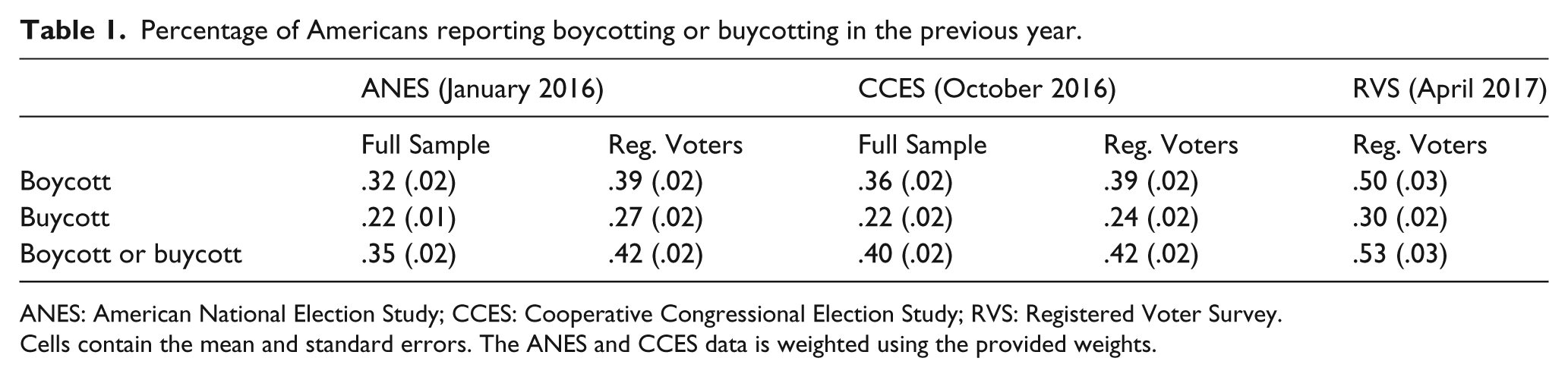
ANES: American National Election Study; CCES: Cooperative Congressional Election Study; RVS: Registered Voter Survey.
Cells contain the mean and standard errors. The ANES and CCES data is weighted using the provided weights.
Next, we proceed to assess the sociopolitical and demographic underpinnings of political-consumer behavior. We run a series of logistic regression models for each survey to better understand which individual-level characteristics are related to political consumerism. Reported participation in a boycott or a buycott in the previous year are separately regressed on a variety of political variables including: partisan identification, political knowledge, political interest, partisan intensity, ideological intensity, and social media activity as well as an array of demographic variables. We also collapse political consumerism into a single, dichotomous variable indicating participation in either a boycott or buycott in the previous year as a function of the same political and demographic variables.
Political knowledge, political interest, and ideological intensity were significant predictors of all three outcome variables (boycott, buycott, and the combined variable) in each of the surveys we analyze. Individuals who demonstrated greater knowledge about politics, who reported higher levels of interest, and who placed themselves near the extremes on the seven-point ideological scale were all more likely to have reported engaging in political consumerism during the previous year. This is consistent with previous findings in the US and in other Western democracies that placement on the political spectrum and an interest in politics are closely related to political-consumer behavior (Stolle and Micheletti, 2013). Although the social media use variable was not available for all three studies, our analyses of the CCES revealed, as expected, that social media use was significantly correlated with political consumerism across the board; higher levels of political activity on social media were, in fact, associated with higher rates of participation in boycotts and buycotts, all else being equal. This finding is generally consistent with social media effects reported by Copeland and Becker (2016), although social media activity in their study was denoted using indicators for social media membership, discussion of LGBT issues on social media, and using social media to meet other LGBT people. By contrast, the constitutive components of our measure of social media use are less restrictive overall and incorporate items that focus on political activity on social media. The results we report also speak to the broader generalizability of social media effects, given Copeland and Becker’s (2016) analyses were based on a specialized sample restricted to LGBT individuals. Finally, we note that our original results overall remain robust to the inclusion of the measure of social media use.
Our findings on political orientation are comparable to some prior studies that found left-leaning individuals participated in boycotts and buycotts at higher rates than conservatives (Stolle and Micheletti, 2013), but somewhat contrast with other studies that reported individuals who engaged in buycotts were more likely to identify as Republican and conservative whereas individuals who participated in boycotts more frequently identified as Democrats and liberal (Baek, 2010). Since we are exclusively investigating political consumerism in the United States, we folded ideological self-placement to represent ideological intensity and included indicator variables for party identification. In addition to significant findings for ideological intensity, Republicans were less likely to report participating in a boycott compared to Democrats; the differences are statistically significant (p < .05, two-tailed) in both the January 2016 and April 2017 surveys, as shown in Table 2. 5 Republicans also reported buycotting a product or service in the previous year at lower rates than Democrats, as shown in Table 3, a difference that was only significant in the January 2016 survey. It is conceivable these patterns reflect the influence of partisan reactions to Donald Trump and the idiosyncratic nature of the 2016 presidential election, but additional research is needed to determine whether these effects persist. Nevertheless, research by Copeland and Becker (2017) has also shown that Democrats were significantly more likely to have boycotted Trump family brands during the 2016 election. Strength of partisanship, on the other hand, was marginally statistically significant in our April 2017 survey, in which partisan intensity was significantly related (p < .10, two-tailed) to having participated in a boycott.
Boycotted a product or service in the last 12 months for political or social reasons.

ANES: American National Election Study; CCES: Cooperative Congressional Election Study; RVS: Registered Voter Survey.
Cells contain coefficients with standard errors in parentheses for logistic regression models. The ANES and CCES data is weighted using the provided weights. * = p < .05; + = p < .1, two-tailed.
Buycotted a product or service in the last 12 months for political or social reasons.

ANES: American National Election Study; CCES: Cooperative Congressional Election Study; RVS: Registered Voter Survey.
Cells contain coefficients with standard errors in parentheses for logistic regression models. The ANES and CCES data is weighted using the provided weights. * = p < .05; + = p < .1, two-tailed.
The relationships between demographic variables and political consumerism were generally insignificant and often inconsistent across surveys, particularly with regard to age and race. Individuals who were not registered were significantly less likely to have reported boycotting and buycotting in the ANES survey, but voter registration was not significant and was in the opposite direction for boycotting and the combined variable in the CCES. Neither income nor marital status were significantly related to either boycotts or buycotts. Consistent with prior research that finds women to be more frequent political consumers in almost all countries except the United States (Stolle and Micheletti, 2013), significant gender differences rarely emerged in our surveys. Gender was only significant for the combined boycott/buycott variable in the April 2017 survey (see Table 4), in which women were more likely to have reported participating in political-consumer behavior. Overall, race and age were generally insignificantly related to political-consumer behavior.
Boycotted or buycotted a product or service in the last 12 months for political or social reasons.

ANES: American National Election Study; CCES: Cooperative Congressional Election Study; RVS: Registered Voter Survey.
Cells contain coefficients with standard errors in parentheses for logistic regression models. The ANES and CCES data is weighted using the provided weights. * = p < .05; + = p < .1, two-tailed.
Political consumerism as political expression: Assessing the role of expressive and instrumental partisanship
Next we narrow our focus to Democrats and Republicans to examine the impact of expressive and instrumental partisanship on political consumerism. Overall, we find strong evidence that both expressive and instrumental aspects of partisanship are related to political consumerism. Across all three models, our measure of instrumental partisanship is statistically significant (p < .05, two-tailed). Expressive partisan identity, on the other hand, has a positive and statistically significant association with boycotting and the combined boycott/buycott outcome variable, suggesting that individuals with a strong expressive identity may be more inclined to punish brands that oppose their party than to reward brands that support their party. We note that expressive partisan identity appears to have a substantively similar (positive) impact on buycotting behavior, but the effect is not statistically significant at conventional levels. Additional evidence is necessary to ascertain definitively whether expressive partisanship is reliably associated with buycott choices. 6
To assess the relative impact of instrumental partisanship and expressive partisan identity on political consumerism, we used the estimates for the uncollapsed models above (Table 5, columns 1 and 2) to calculate the predicted probabilities of participating in boycotts and buycotts for each component of partisanship. On average, a one standard deviation increase on the instrumental partisanship scale, approximately 0.33, corresponds to an increase in the probability of participation in a boycott during the preceding year by 0.142 (p = .000) and raises the probability of participating in a buycott by 0.09 (p = .004), holding all other variables constant. Similarly, a one standard deviation increase on the expressive partisanship scale, approximately 0.21, corresponds to an increase in the predicted probability of having boycotted by 0.06 (p = .029) and buycotting by 0.04 (p = .146 ). We conclude from these analyses that instrumental partisanship likely has a modestly stronger, although, in our view, comparable, substantive impact on political consumerism, relative to expressive partisan identity. 7
Expressive and instrumental partisanship and political consumerism.
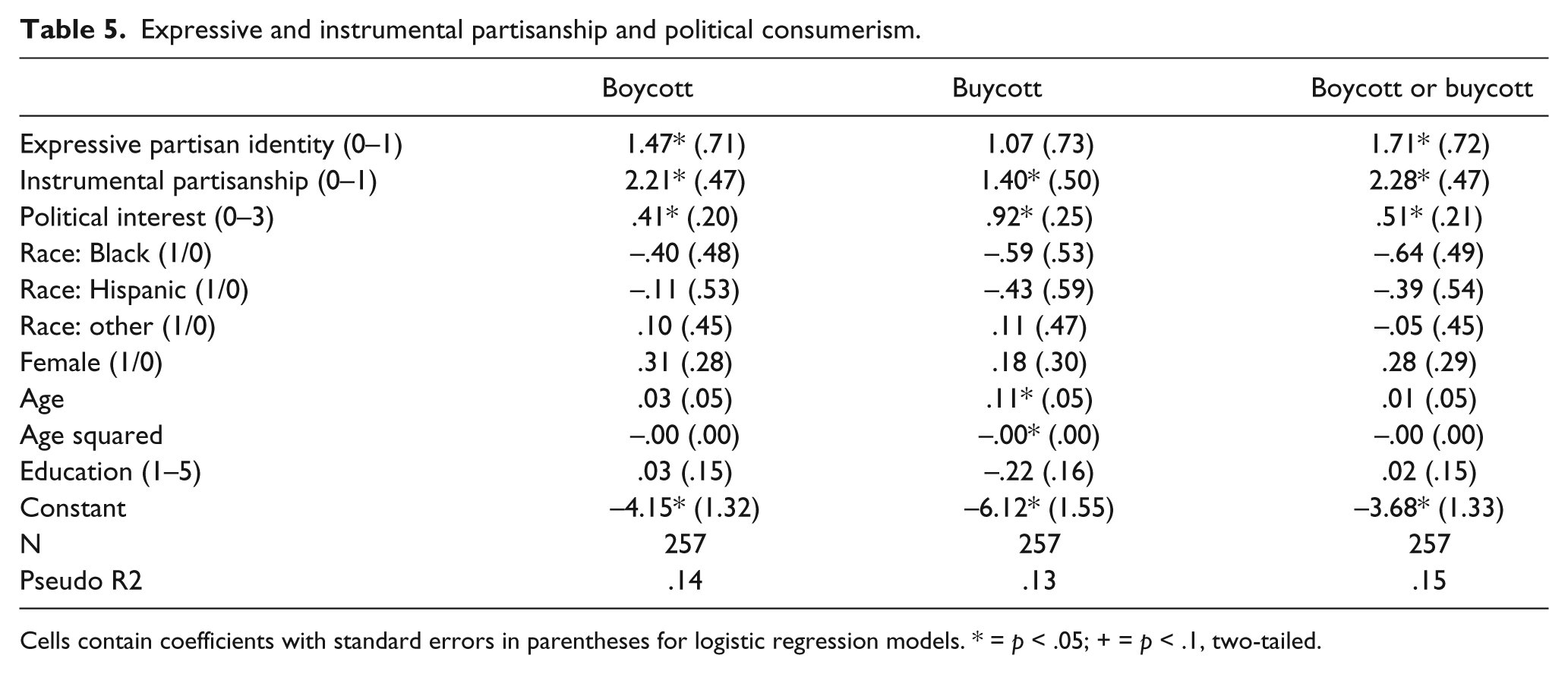
Cells contain coefficients with standard errors in parentheses for logistic regression models. * = p < .05; + = p < .1, two-tailed.
Conclusion
Large percentages of Americans participate in boycotts and buycotts for political reasons. These rates varied across our three surveys conducted over a sixteen-month period in the United States, with the portion who reported partaking in political-consumer behavior rising in each successive survey. Political knowledge, political interest, and ideological intensity are all closely related to participation in political-consumer behavior. In two of the three surveys we analyze, Republicans reported engaging in political-consumer behavior at lower rates than Democrats. Narrowing our focus to partisans, we show that both expressive and instrumental partisanship are associated with political-consumer behavior. Individuals with strong expressive partisan identities reported boycotting at higher rates than individuals with weaker identities. Instrumental partisanship was a significant predictor of both boycotts and buycotts, with partisans who held more consistent policy positions reporting higher rates of participation in recent boycotts and buycotts compared to those who held less consistent positions.
The fluctuations in participation in boycotts and/or buycotts for political reasons between our surveys as well as the relationship between political consumerism and instrumental and expressive partisanship suggests that context matters. Individuals who failed to engage in political consumerism during the past year could still be triggered to participate if exposed to the relevant information connecting the politics of brands with their own political predispositions. Instrumental partisanship should be most relevant when calls to boycott or buycott emphasize policy issues. Americans with strong expressive partisan identities are likely to respond to political information, such as campaign contributions and endorsements. Our findings suggest that expressive partisanship may be more closely associated with punishing companies for actions that support the opposition through boycotts rather than rewarding them for activities that support their own party, results that are consistent with studies that find anger or threat can motivate action based on partisan identity (see Miller and Conover, 2015).
The implications of the analyses we report are potentially significant. In an era characterized by heightened partisan polarization, political views and preferences may increasingly find expression in individuals’ consumer preferences and behavior. Additionally, the recent U.S. Supreme Court ruling in Citizens United v. FEC that enables corporations to engage directly in electioneering has already opened the floodgates for increased corporate political activity, a trend with no realistic end in sight barring further legal or legislative action. Our research suggests individuals will be responsive to these activities, a finding that may (or may not) affect corporate calculations about the risks or opportunities associated with overt political involvement.
Other contextual developments seem to be influential as well. Our results reinforce the notion that social media use affects and, as Copeland and Becker (2016) argue, likely facilitates political consumerism, a finding whose implications are potent given social media’s capacity to transform the sociopolitical landscape and to extend individuals’ interpersonal networks. These changes may influence citizens’ consumer reactions in meaningful ways. As access to information about the politics of corporations becomes more widespread, for instance, the relationship between expressive partisanship and consumer behavior may grow even stronger. The heightened scrutiny of corporate political activity facilitated by near-constant coverage of such activities, transparency in the form of immediate disclosure of at least some of these activities, and the capacity for instantaneous awareness building and mobilization afforded by social and other media suggest the distinctions between consumer and political expressions and behavior may be eroding. In light of these developments, we also believe it is useful to continually monitor the social and attitudinal underpinnings of political consumerism to track ways in which these may change over time and in different circumstances. The current study aims to take a step in this direction.
Footnotes
Acknowledgements
Support to include the political consumerism items in the 2016 CCES study was generously provided by the Open Society Foundation and the Democracy Fund as part of a larger project directed by Costas Panagopoulos, Donald Green and Jonathan Krasno (co-principal investigators). Support for the April 2017 national survey of registered voters was provided by the Center for Electoral Politics and Democracy at Fordham University. We thank Donald Green and Jonathan Krasno for support as well as Paul Westcott of L2 for his assistance.
Correction (June 2025):
Declaration of Conflicting Interest
The author(s) declared no potential conflicts of interest with respect to the research, authorship, and/or publication of this article.
Funding
The author(s) received no financial support for the research, authorship, and/or publication of this article.
Supplementary Material
The supplementary files are available at: http://journals.sagepub.com/doi/suppl/10.1177/2053168017738632. The replication files are available at: 
Notes
Carnegie Corporation of New York Grant
This publication was made possible (in part) by a grant from Carnegie Corporation of New York. The statements made and views expressed are solely the responsibility of the author.
References
Supplementary Material
Please find the following supplemental material available below.
For Open Access articles published under a Creative Commons License, all supplemental material carries the same license as the article it is associated with.
For non-Open Access articles published, all supplemental material carries a non-exclusive license, and permission requests for re-use of supplemental material or any part of supplemental material shall be sent directly to the copyright owner as specified in the copyright notice associated with the article.
