



Abstract
The Supreme Court’s Dobbs ruling created a patchwork of abortion regulations across the U.S. Proponents of federalism argue that the easy exit option federalism entails allows people to flee areas that restrict rights. We ask whether people flee or avoid moving to states with abortion bans. We argue that dislike of abortion bans is strongest among those directly affected (women, doctors), the affluent, and the highly educated, and that these groups are also most likely to factor abortion bans into their mobility calculations. We test these arguments using experimental and observational data. A conjoint experiment shows that strict abortion laws make people, especially women, less likely to “accept” jobs in states with them. Analysis of U.S. Census Bureau data shows that residents did not become more likely to exit states with abortion bans after Dobbs. However, college graduates and women of childbearing age in states with abortion bans became relatively more likely to relocate to non-ban states, while being affluent or a non-college graduate had the opposite effect. Finally, analysis of medical residency application data shows that, after Dobbs, there were significantly fewer residency applications to states with abortion bans.
Introduction
After the Supreme Court’s Dobbs ruling, which concluded that there is not a federal constitutional right to an abortion, women of childbearing age seeking access to such treatment have been left to navigate a patchwork of state laws with dramatic variation in abortion rights. Doctors have also had their ability to practice medicine as they see fit curtailed. This decision has had major effects on American life, affecting infant mortality rates (Singh and Gallo 2024), mental health (Thornburg et al., 2024), and physicians’ concerns about quality of medical care (Sabbath et al., 2024).
Women’s fundamental reproductive rights now vary depending on which state they live in. This variation in rights for different groups depending where they live, which has been common in U.S. history, is seen by many as a serious drawback of American federalism (Grumbach 2018; Riker 1964). Yet, proponents argue that one benefit of federalism is that it provides an easy exit option in the face of such rights restrictions: people can relatively easily leave or not move to subnational units that restrict rights (Buchanan 1995; Calabresi 1995). U.S. history certainly provides prominent examples of oppressed groups using this exit option, including Mormons fleeing religious persecution and Blacks escaping slavery and Jim Crow.
But whether people would exit from or avoid relocating to states with abortion bans is debatable. On the one hand, most Americans identify as pro-choice and say that abortion is an important issue to them (Brenan and Saad 2024). On the other, moving is costly, and most interstate migrants move for economic reasons (Partridge 2010). Certainly, a large majority of people do not care enough about abortion rights to leave states or avoid relocating to states that have bans. Yet, recent analysis of U.S. postal service change of address forms suggests that people may be fleeing states with abortion bans (Dench, Lifchez, Lindo and Liu 2025). Furthermore, even if people do not move solely because of abortion bans, many people move across state lines each year for economic opportunities or other amenities. Abortion bans could be one factor weighed alongside others, as we elaborate below. Indeed, high-achieving women from liberal areas in the U.S. appear less likely to apply to college in states with abortion bans (Kane 2025).
We argue that women of childbearing age and doctors (who are directly targeted by these laws) and individuals with college degrees and the affluent (who have more liberal social positions and greater resources with which to move) are both strongly opposed to abortion bans and more likely to relocate in response to them. We test these arguments with three studies. In Study 1, we analyze a conjoint experiment fielded on a nationally representative sample that provides competing hypothetical job opportunities. We find that people generally prefer jobs in states with more expansive abortion rights, and that women are particularly sensitive to abortion rights, though the highly educated or affluent are not.
Studies 2 and 3 examine actual interstate migration patterns, taking advantage of variation in state abortion bans after the 2022 Dobbs decision. Study 2 uses the Current Population Survey (CPS) Annual Social and Economic Supplement Data (ASES), and examines the residential patterns of the mass public, with a particular focus on women of childbearing age, and those with college degrees and higher incomes. We examine post-Dobbs changes in exit from states that have banned abortion and state abortion regime switching (i.e., from a ban state to a no-ban state, and vice versa). We find no evidence that people generally, or our subgroups of theoretical interest, became more likely to exit states with bans once they were legal. We do find, however, that after Dobbs college graduates and women of childbearing age in states banning abortion became modestly more likely to switch residence to a no-ban state, compared to their counterparts in no-ban states switching residence to a state with an abortion ban. Affluence and the lack of a college degree had the opposite effect.
Study 3 uses data from the Electronic Residency Application Survey (ERAS) to examine the geographic preferences of medical students, who must express preferences about where they prefer to live as they apply for medical residency. We find that, after Dobbs, there were reductions in residency applications in both ban and no-ban states (due to changes in the administration of the program), but the reduction in applications was significantly greater in states that banned abortion.
Overall, we find that many people prefer living in an area with more expansive abortion rights, especially women. Actual migration data show that abortion bans have a polarizing effect—some groups seem to avoid them, while other groups seem to prefer them. Doctors prefer practicing in states that do not ban abortion. Thus, the federalism exit option is used by some people, though these effects are generally modest. We conclude by noting the broader effects of abortion bans and state mobility for state prosperity: because highly educated professionals and some groups targeted by bans are desirable migrants, it is possible that this migration could place a check on additional government abortion restrictions over the long-term, but abortion ban states are unlikely to see substantial departures of many groups, including valuable migrants, such as the affluent.
Abortion Rights, Federalism, and Interstate Migration
There are competing views on whether federalism ultimately protects or undermines liberty. Political scientists have typically emphasized the latter (Kettl 2022), most obviously for racial and ethnic minorities (Epperly et al., 2020; Grumbach 2022; Riker 1964). Public choice scholars and conservative legal theorists, however, have argued that federalism provides citizens with an option: if states restrict liberties in a manner that residents dislike, they can move to a place with policies they prefer (Buchanan 1995). Furthermore, if people generally prefer jurisdictions with more liberty and they either move in response to rights restrictions, or policymakers anticipate that they may do so, then this could incentivize state governments to protect their citizens’ rights and liberties.
Though most Americans prefer some limitations on abortion access, a large majority express opposition to the types of strict abortion bans made legal by Dobbs (Edwards- Levy 2024). However, because people can use voice to change policy (Hirschman 1970), interstate migration is rare (Kaplan and Schulhofer-Wohl 2012), and economic considerations and amenities are so important to interstate moves (Khater and Yao 2022; Partridge 2010), it is not likely many people will move in response to abortion bans.
Nevertheless, there is some evidence that the quest for liberty can shape interstate migration. It appears that same-sex couples were more likely to move to states that allowed gay marriage prior to Obergefell, which legalized it across all states (Marcén and Morales 2022). Most relevant here, using postal change of address data, Dench et al. (2025) find that abortion ban states have experienced substantial net outflows of population since Dobbs, especially in single-person households. Abortion bans may not only lead to people departing ban states; they can keep people from moving to them. Kane (2025) finds that high-achieving women from liberal areas without abortion bans became considerably less likely to apply to college in a ban state after Dobbs. Whether people flee or refuse to relocate to states with abortion bans and who this may be is an important question: state policymakers view certain people—especially those with specialized skills, like doctors—as more desirable residents. If these types of residents are moving away or refusing to come this could attract attention from policymakers and drive policy change.
Considering the benefits and costs of abortion bans and moving can help us to theorize about who is most likely to move in response to abortion bans. In order for rights restrictions to affect relocation decisions people must believe that they derive some benefit from living in a state without a ban, and be willing to pay the costs to move to another state if they live in a ban state or forego potential benefits of living in a ban state if they live in a no-ban state.
The most obvious beneficiaries of expansive abortion rights are women of childbearing age, who experience more freedom, control over their lives and perhaps better health outcomes. While women can travel to another state for an abortion, this is not helpful in emergencies resulting from common pregnancy conditions (miscarriages, ectopic pregnancies, etc.). Traveling to a different state in these circumstances is often not medically possible, even for affluent women. One could argue that the odds of this happening are low, but people often overweight the odds of unlikely events (Steiner and Stewart 2016).
Abortion bans also target doctors with criminal penalties, they face increased malpractice insurance, and potential legal costs practicing in a state with an abortion ban. 1 Thus, doctors are likely to perceive benefits from practicing in a no-ban state.
Though less tangible, we also expect that the highly educated and affluent will view more expansive abortion rights as a benefit among many they consider when deciding where to live. The benefits that they receive are more ideological. Highly educated individuals have long been shown to be more supportive of civil liberties (Stouffer 1955) and high SES individuals tend to prefer broader rights for women, specifically (Gaines and Garand, 2010). Affluent people also find individual rights and self-expression more salient than economic issues (Inglehart, 1981).
For people to actually move, though, they must also be willing and able to pay the costs of moving. First, there are informational costs—people need to know variation in abortion policies. Most of the public is unaware of the details of policy (Thorson 2023), including rights policies (e.g., Jones 2016). Second, there are financial costs associated with moving, especially changing states. Third, different family and residential situations shape the costs of moving. Homeownership creates more friction in moving residences. People with children must be willing to pay the cost of uprooting them. If people have spouses, there are costs associated with uprooting them, such as finding a new job.
We think that women, doctors, those with college degrees and the affluent will be well-positioned to pay the informational and financial costs. Informational costs are likely lower for doctors and women due to the direct impact that these laws have on those in their community. The highly educated and affluent pay more attention to political news (Saad 2021) and learn about policy variation in their education (Hainmueller and Hiscox 2006), and thus have greater awareness of policy differences between jurisdictions (Teske et al. 1993).
Regarding financial costs, doctors are affluent, and at some points in their careers (i.e., applying to residency) they must express their preferences about where they want to live and be willing to move. So, moving is both necessary and less costly for physicians. While women tend to have lower incomes than men, there are many affluent women who can easily afford to move. Because affluent people tend to already have desirable jobs and economic circumstances, income is often negatively associated with interstate migration (e.g., Gius 2011), but it is almost tautological to say that the affluent are more able to incur the financial costs of moving. People with college degrees are also more desired in different state labor markets and are more accustomed to moving to a different state to pursue better economic opportunities (Malamud and Wozniak 2012; Rosenbloom and Sundstrom 2004).
Possible Evidence and Hypotheses
In order to conclude that abortion bans shape interstate migration, we would ideally gather evidence that people weigh abortion bans into their state location decisionmaking and that actual migration patterns reflect these preferences. Migration patterns may show aversion to abortion bans in two ways. First, more people might leave abortion ban states after a ban is in place. If this is the case, after Dobbs we should see an overall increase in people moving away from abortion ban states relative to the rate that people in other states are moving away from their state (i.e., the difference-in-differences of exit across treatment and control states).
It is necessary to look beyond simple exit decisions from abortion ban states, though. We also need to understand the state policy of that person’s new state. It could be the case, for example, that neither people in ban states nor people in no-ban states become any more likely to exit, but the latter are more likely to avoid ban states when relocating. If we looked only at exit, we would incorrectly conclude that bans did not affect interstate migration decisions.
We therefore examine the propensity of people in ban or eventual ban states and no-ban states to switch abortion regime types—that is, whether they relocate from a state that eventually implements a ban to one that does not, or vice versa. Each year, people move between states with and without abortion bans for a variety of reasons. Some residents of no-ban states may find ban states more appealing for unrelated reasons, and the reverse may also be true. However, if abortion bans influence the attractiveness of a move, we would expect that after Dobbs individuals (or key subgroups) in ban states become relatively more likely to switch regime types compared to individuals in no-ban states. In other words, there is a difference between pre- and post-Dobbs state switching in abortion ban and no-ban states (i.e., the difference-in-differences of switching abortion regimes between ban and no-ban states). An observed difference could result from several dynamics: individuals in ban states may become more likely to move overall; they may not move more frequently but may disproportionately relocate to no-ban states; individuals in no-ban states may become less likely to move; or, if they do move, may avoid relocating to ban states. Any of these patterns—or a combination of them—resulting in a significant difference-in-differences would suggest that abortion bans affect interstate migration decisions.
We arrive at the following hypotheses: • H1: Women of childbearing age will (a) demonstrate an aversion to abortion bans in interstate migration decisionmaking, (b) be relatively more likely to move away from states with abortion bans after Dobbs, and (c) be relatively more likely to relocate from a ban to a no-ban state after Dobbs. • H2: The affluent will (a) demonstrate an aversion to abortion bans in interstate migration decisionmaking, (b) be relatively more likely to move away from states with abortion bans after Dobbs, and (c) be relatively more likely to relocate from a ban to a no-ban state after Dobbs. • H3: College graduates will (a) demonstrate an aversion to abortion bans in interstate migration decisionmaking, (b) be relatively more likely to move away from states with abortion bans after Dobbs, and (c) be relatively more likely to relocate from a ban to a no-ban state after Dobbs.
Finally, our theoretical framework suggests that doctors should also demonstrate an aversion to abortion bans. However, we lack sufficient experimental data to directly examine their decision processes, and we cannot directly examine their actual migration decisions due to limitations on occupational classifications in large governmental surveys. Instead, we rely on their preferences for state residence when they are applying to medical residency. We can compare changes in applications to no-ban and ban states pre- and post-Dobbs. We therefore have the following final hypothesis: • H4: Medical doctors will be less likely to apply for medical residency in states with an abortion ban after Dobbs.
Analysis
We test our hypotheses with a trio of studies. First, to test sensitivity to abortion rights restrictions among the mass public in a realistic, multidimensional decision context, we use a conjoint experiment fielded on a nationally representative sample. The results of this study provide us with a baseline understanding of whether Americans actually do prefer expansive abortion rights and whether the affluent, highly educated, and women prefer more rights, unconstrained by the need for information about policy variation, finances, and motivation. Conjoint experiments have been shown to approximate real world decisions and behavior in a number of contexts, even some quite costly decisions (e.g., Soutar and Turner 2002). Yet, it is easy to click a button on a survey to say you would move; it is another thing to rent a truck and start packing. Thus, while the conjoint experiment is useful to understand citizens’ preferences about the effects of abortion rights restrictions on mobility, its external validity as an actual predictor of mobility decisions is suspect.
Therefore, we conduct two observational studies. Thirteen states had abortion bans in place prior to Dobbs, and it was a challenge to Texas’ law that led to the decision. While the abortion bans were determined by state political factors that might also affect interstate migration, the timing of those bans becoming legal was exogenously determined by the Supreme Court, providing us with causal leverage. Each of the observational analyses relies on coding state laws for whether they have a total abortion ban (i.e., with no exceptions), information obtained from the Kaiser Family Foundation abortion policy dashboard (Kaiser Family Foundation 2023).
One potential limitation of these studies is the issue of “information equivalence” associated with identifying abortion bans as the cause of moves. Put simply, people observing a state abortion ban are also simultaneously making assumptions about that state government that go beyond abortion bans. Namely, that it is a conservative, Republican government, with a penchant for conservative social policies.
This is potentially a problem because with growing polarization, people may be sorting into different areas based on their partisanship and ideology (Brown and Enos 2021; Kaplan, Spenkuch and Sullivan 2022) (but see Martin and Webster 2020; Mummolo and Nall 2017). In addition, younger women and college graduates are becoming much more Democratic in recent years (Grossmann and Hopkins 2024). Similarly, doctors are also becoming more Democratic, and are more likely to want to live in large cities (Bonica, Rosenthal, Blackwood and Rothman 2020). If groups trending Democratic (young women, college graduates, and physicians) move to states without abortion bans it could reflect broader political preferences and not be a direct response to abortion bans. Our analysis accounts for this in two ways.
First, we address this issue directly in our conjoint experiment by including other policies and the vote outcome for Trump or Biden in the prior election, which is a much better indicator of state partisanship. We can see explicitly how abortion attitudes matter after controlling for these other factors. Second, in our observational analyses we use temporal data to examine whether certain groups become more or less likely to leave states or switch state abortion regime types. During the period of treatment (2022) the partisanship of different groups of Americans is relatively stable, as are the state reputations for conservatism. All of the states that have abortion bans have been quite conservative for some time and in most states (except Indiana) the laws have been on the books for decades, but were simply unenforceable. Thus, the timing of the abortion bans was exogenously determined.
We doubt that many people who are sophisticated enough to be moving across state lines required the presence of an abortion ban to notice that Texas and Alabama are conservative states. However, it is possible that abortion bans make state conservatism more salient in interstate moves, and that this salience after Dobbs, rather than abortion bans per se, drives interstate migrations. But if abortion bans (unintentionally) affect interstate migration in this manner, this is interesting in itself. Women and doctors are likely to be acting in direct response to the ways abortion bans affect them, but the highly educated and affluent may be responding more to the growing salience of state ideological differences.
Study 1: Conjoint Experiment
Our conjoint experiment allows us to examine H1a, H2a, and H3a: whether women, the affluent and college graduates, respectively, demonstrate an aversion to abortion bans in interstate migration decisionmaking. One of the major reasons that people move to a different state is to pursue better economic opportunities (Partridge 2010). 2 We take advantage of this fact, presenting respondents with pairs of side-by-side job offers randomizing state abortion rights policies, and other state- and job-related and rights and economic policy attributes to enhance realism and to allow us to determine how abortion rights compare in importance to other factors affecting job choice (Becker, Connolly and Slaughter 2010; Cable and Judge 1994; Carless 2005). Our approach is similar to Nelson and Witko (2022).
The conjoint experiment was fielded with a survey conducted by YouGov on a nationally representative sample of 1200 respondents aged 18+ in November 2022, around 5 months after the Dobbs decision. 3 Respondents were presented with ten pairs of hypothetical job offers, each with nine randomly assigned traits. While this is many attributes, it is not so many that satisficing would affect the results much (Bansak, Hainmueller, Hopkins and Yamamoto 2018). To further limit respondent fatigue, we randomized the order of attributes across respondents, but kept that order constant for each respondent.
Conjoint attributes and realizations
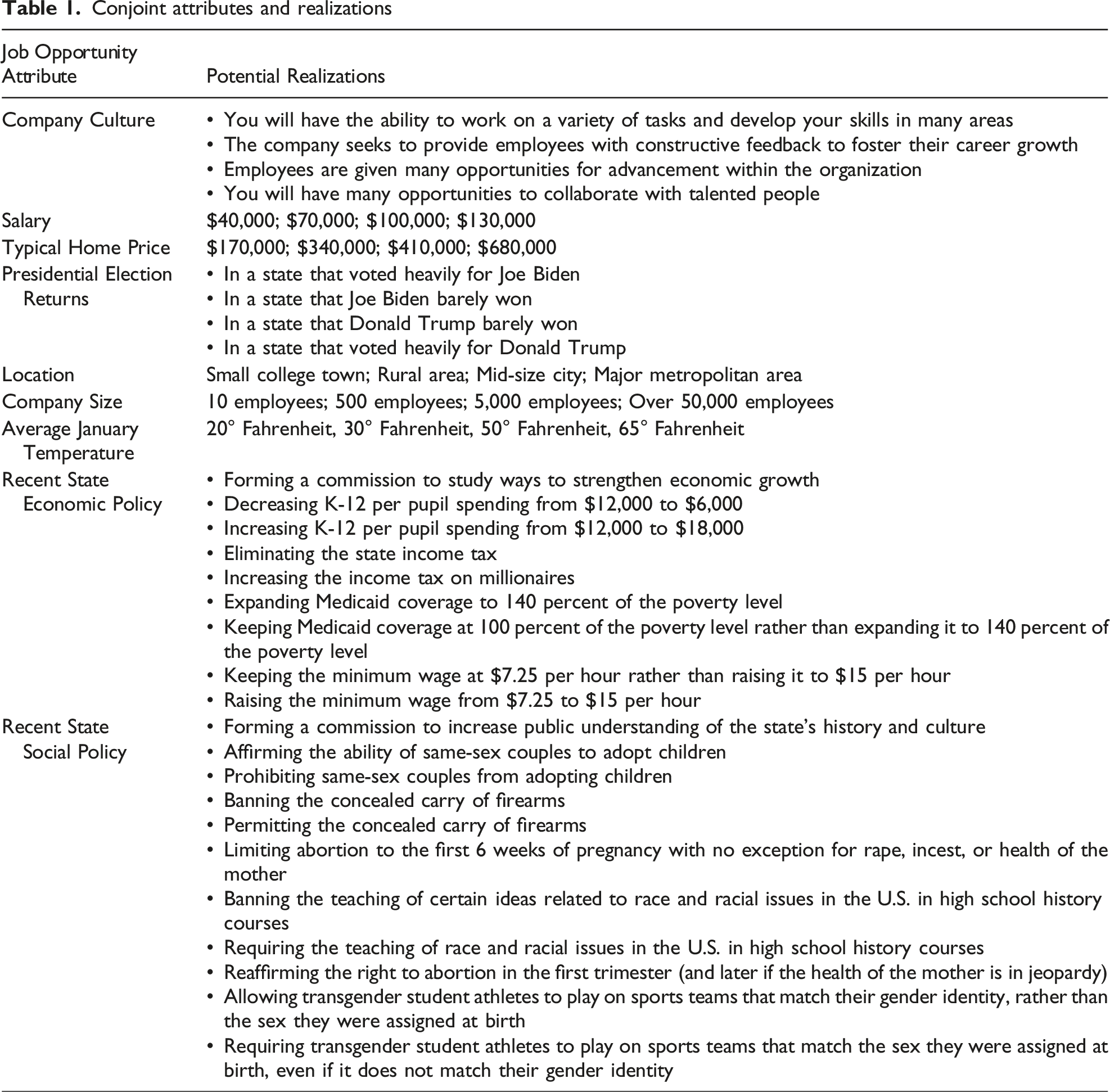
After reading each pair of job offers, respondents selected the job they were more likely to accept. We estimate the average marginal component effect of the treatments to understand the causal impact of these factors on micro-level preferences (Hainmueller, Hop-kins and Yamamoto 2014). The AMCE provides the marginal effect of each attribute over the joint distribution of the other included attributes. Estimated AMCEs are identical to the coefficients estimated from a multivariate linear regression (Hainmueller, Hangartner and Yamamoto 2015) and must be interpreted relative to an omitted baseline category. We cluster our standard errors at the respondent level because each respondent rated multiple pairs of profiles.
Study 1 Results
Figure 1 displays the change in the probability of selecting a job given the presence of a particular attribute relative to the baseline attribute. Our first expectation suggested that abortion rights restrictions would make respondents less likely to select a job and they do, by around 10 percent relative to the baseline of forming a commission to study the state’s history. The other attributes are not of direct theoretical interest, but allow us to benchmark how important rights are to people. Salary is the largest factor shaping job choice. Each $30,000 increase in salary is associated with about a 0.10 increase in the probability that a job is selected (with diminishing marginal utility evident). Yet, the effect of an abortion limitation is about equivalent to $30,000 in salary. AMCE Results, Job Selection Outcome, YouGov (November 2022). The dots plot the Average Marginal Component Effect, and the whiskers provide 95 percent confidence intervals. Positive values of the outcome variable indicate that the respondent was more likely to select a job with that feature, compared to the baseline.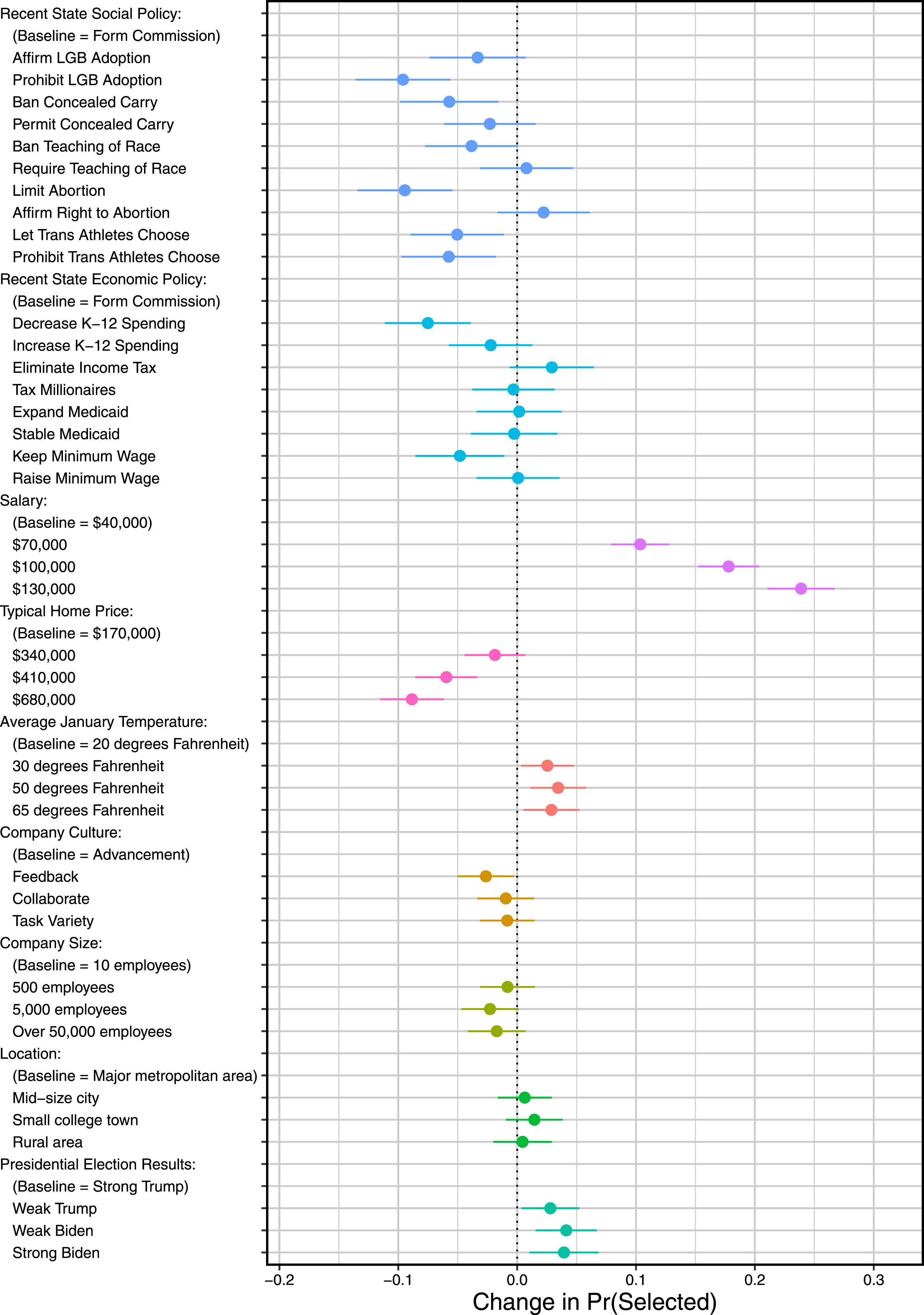
To further test our arguments, we calculated the difference in abortion right effect sizes and other rights effect sizes for comparison purposes for (a) men and women, (b) respondents with and without a college degree, and (c) respondents in the first and fourth income quartiles. The three panels of Figure 2 plot these differences. We see that women are about 9 percent less likely to want to live in a state with strict abortion limits than men but share men’s preferences for other rights. We find no evidence that educated and higher income respondents are more sensitive to abortion rights, however. Thus, we find support for H1a, but not H2a, or H3a. ACIE Results, Job Selection Outcome, YouGov (November 2022). The dots plot the Average Component Interaction Effect, and the whiskers provide 95 percent confidence intervals.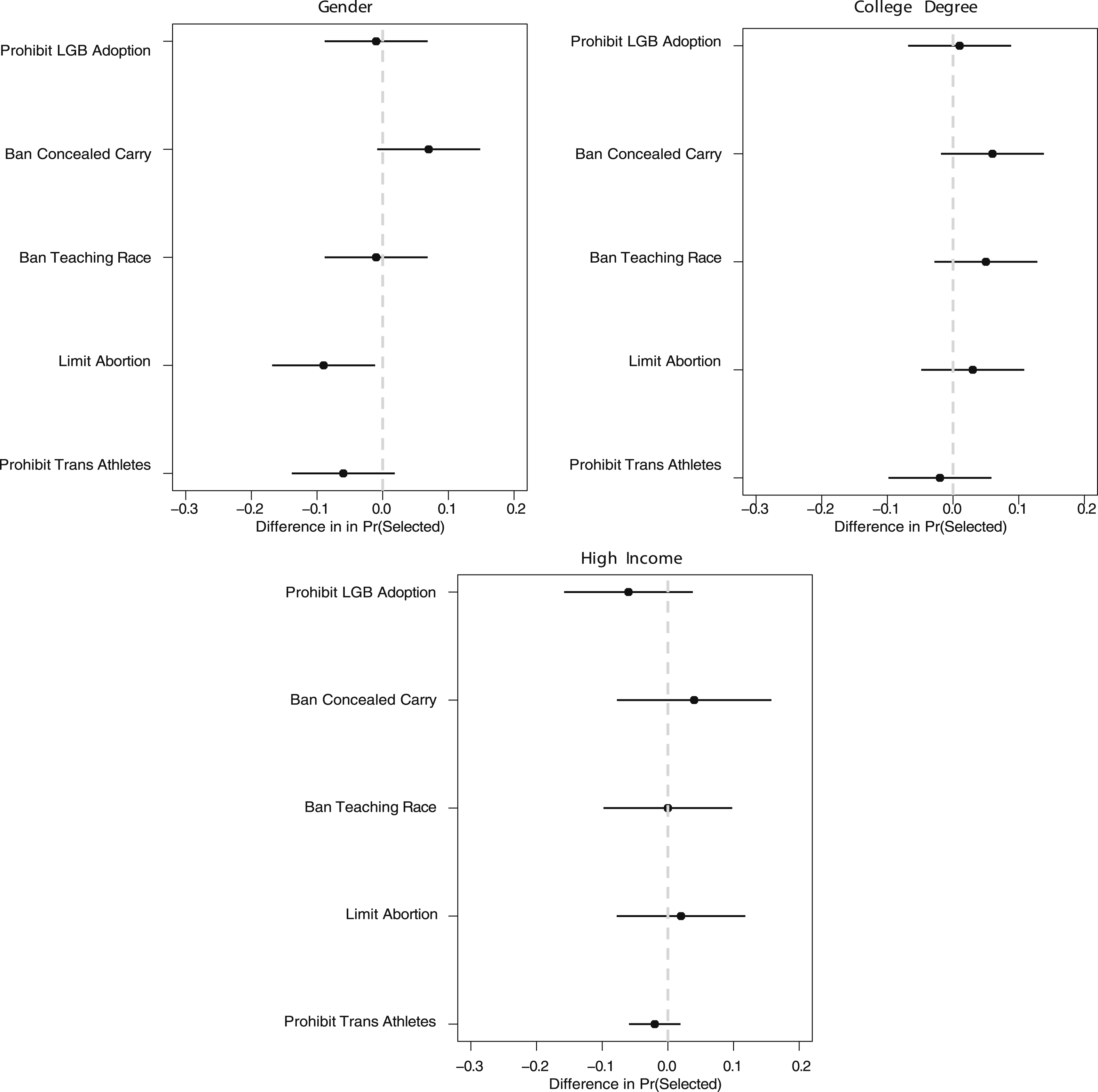
Study 2: The Migration of the Mass Public Using Current Population Survey Annual Social and Economic Supplement Data
Next, we examine the migration of the mass public in response to post-Dobbs abortion bans using the Current Population Survey Annual Social and Economic Supplement (ASES), fielded in March of each year, which includes a question about state of residence in the current and prior year.
The ASES has very large and, crucially, representative samples of households at the state level each year, with generally over 150,000 observations per year. The most recent year of ASES survey data available is from March 2023, which asks people where they lived in March 2022. This timing is ideal because March 2022 is two months prior to the Dobbs ruling. The ASES asks several demographic questions, which allow us to consider how Dobbs affected the migration of our groups of theoretical interest.
We ask two questions in our analysis. First, were people and relevant subgroups more likely to leave states with strict abortion bans after Dobbs? For this analysis we estimate difference-in-differences (DiD) models appropriate for repeated cross-sections. Though DiD was initially developed for use with only one pre-treatment period and one post-treatment period, we are able to use ASES data from multiple pre-treatment periods to analyze pre-trends and provide a more robust analysis (Callaway and Sant’Anna 2021). We collected ASES data from 2013 to 2023 and have a sample size of nearly 20 million Americans with over 34,000 interstate movers, including a sample of nearly 150,000 and over 2406 movers in 2023, following Dobbs. We also estimate models with only 1 year pre-treatment and 1 year post-treatment, as in the classic DiD model.
Second, we examine how likely it is for people and relevant subgroups to switch state abortion regime types. We track migration over time in no-ban and eventual ban or ban states and observe any changes in these patterns following Dobbs. The data prior to Dobbs establish baseline probabilities that people in the states that do not eventually ban abortion find the states that eventually do ban abortion attractive places to live, and that people in eventual ban states find the no-ban states attractive places to live. We expect to see that the implementation of bans made it more likely that people (and relevant subgroups) in ban states switch state regime types compared to counterparts in no-ban states. We analyze this question using similar DiD models. For both analyses, we present the results of linear probability models in the main text for ease of estimation and interpretation (with alternative logistic regression models in the Appendix).
We obtained the ASES data from the IPUMS interface (Ruggles et al. 2024). Because the survey was fielded in March, our key explanatory variable is whether there was a total abortion ban in place after Dobbs in the state that respondents lived in last March. 5 We rely on variables measuring sex and age to create an indicator of whether someone is a female of childbearing age, which we defined as ages 16–39, when nearly 90 percent of births occur in the U.S.6 We also created indicators for whether respondents have a four-year college degree, and family incomes above the 75th percentile (around $118,000). In addition, we control for marriage, home ownership, and the number of children respondents have, since these factors could affect their propensity to move to another state and likelihood of seeking an abortion.
Study 2 Results
We begin by presenting the results for the exit models. Models include both state and year fixed-effects as required by the DiD specification, but they are not shown in the interests of space. One assumption of DiD analysis is that the treated and untreated units had parallel trends prior to treatment, which is confirmed in Figure C1 in the Appendix.
State exit after abortion ban
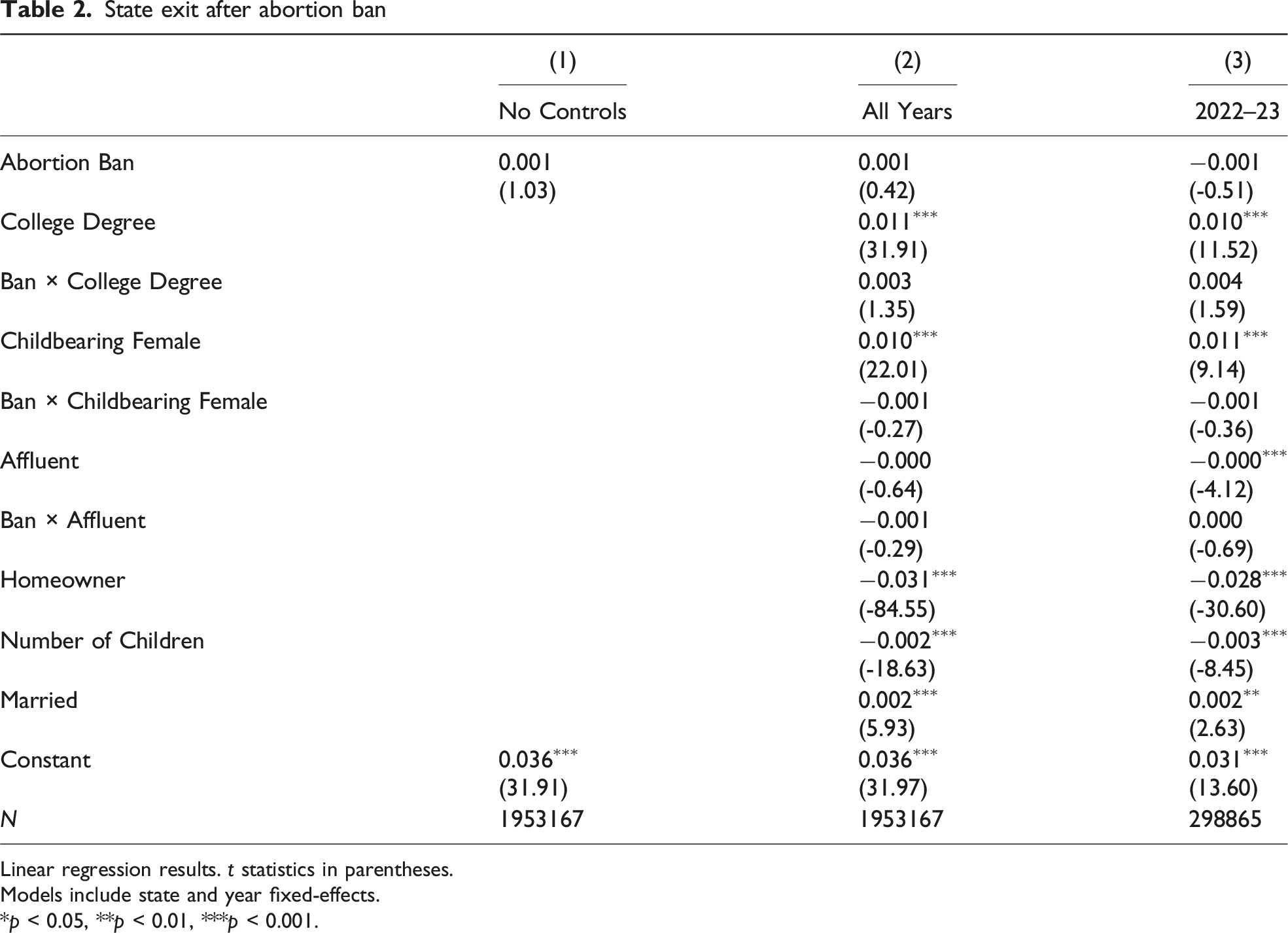
Linear regression results. t statistics in parentheses.
Models include state and year fixed-effects.
*p < 0.05, **p < 0.01, ***p < 0.001.
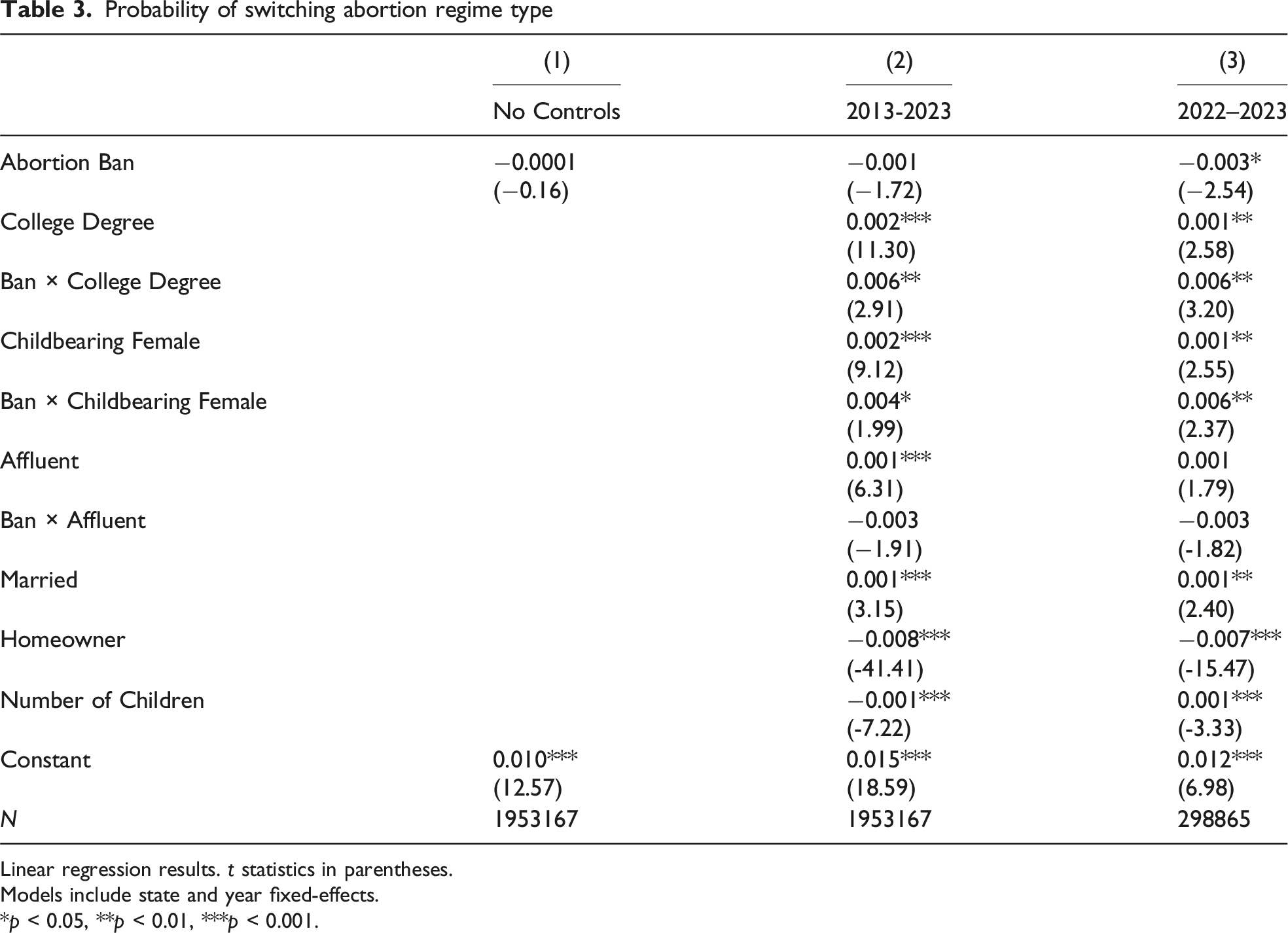
Next, we turn to the analysis of “regime switching.” For this analysis we again fail to reject the null hypothesis of parallel trends.7
Probability of switching abortion regime type
Linear regression results. t statistics in parentheses.
Models include state and year fixed-effects.
*p < 0.05, **p < 0.01, ***p < 0.001.
To make sense of the total effects for the groups that we expected to be sensitive to bans, we present a series of figures showing the marginal effects for the interactions in model 2 (the results for model 3 produce very similar figures). These figures show the effects of a state ban becoming legal, that is, treatment, on the probability of switching from a ban state to a no-ban state for different groups of people in ban states, relative to the probability that their counterparts in no-ban states would switch to a ban state.
In Figure 3, we see that, for women of childbearing age, the effect of a ban becoming legal in their state once the Dobbs decision was made is positive and nearly significant (confidence interval slightly overlaps zero). This effect means that childbearing age women in ban states become about 0.004 more likely to switch state type after the ban was legal compared to their counterparts not living in ban states. Thus, we can confirm hypothesis 1c. Marginal effect of ban on switching abortion regime types by childbearing female status, with 95 percent confidence interval.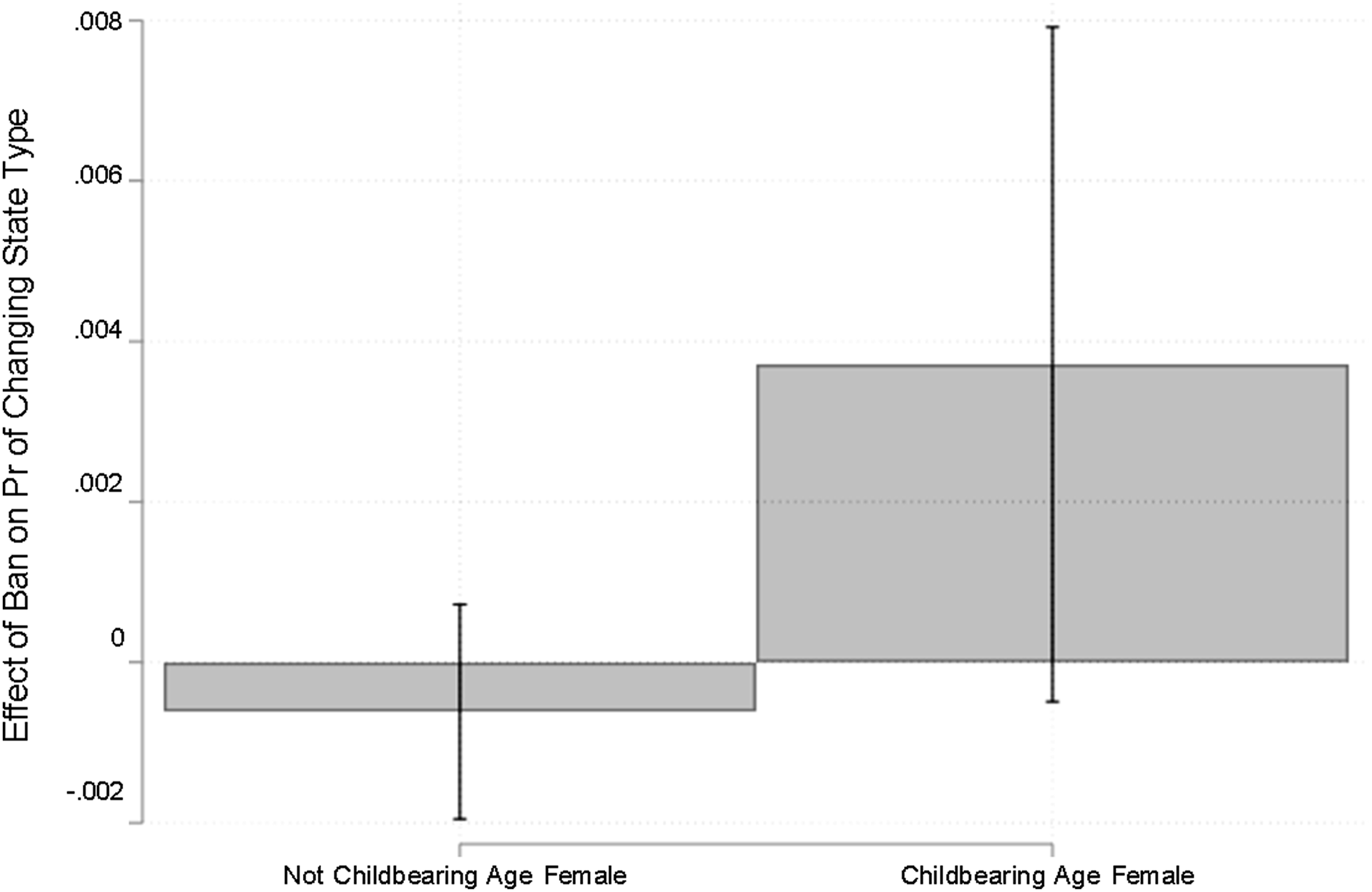
We can see in Figure 4 that for people with a college degree, living in a ban state made them about 0.004 more likely to switch state abortion regime types compared to BA holders in no-ban states. People without a BA degree actually became ever so slightly less likely to switch state types if they lived in a ban state, compared to those not living in a ban state after Dobbs. Thus, we see some education polarization in response to abortion bans. This was not expected, but is sensible given the broader trend toward education polarization in American politics (Grossmann and Hopkins 2024). Marginal effect of ban on switching abortion regime types by BA degree status, with 95 percent confidence interval.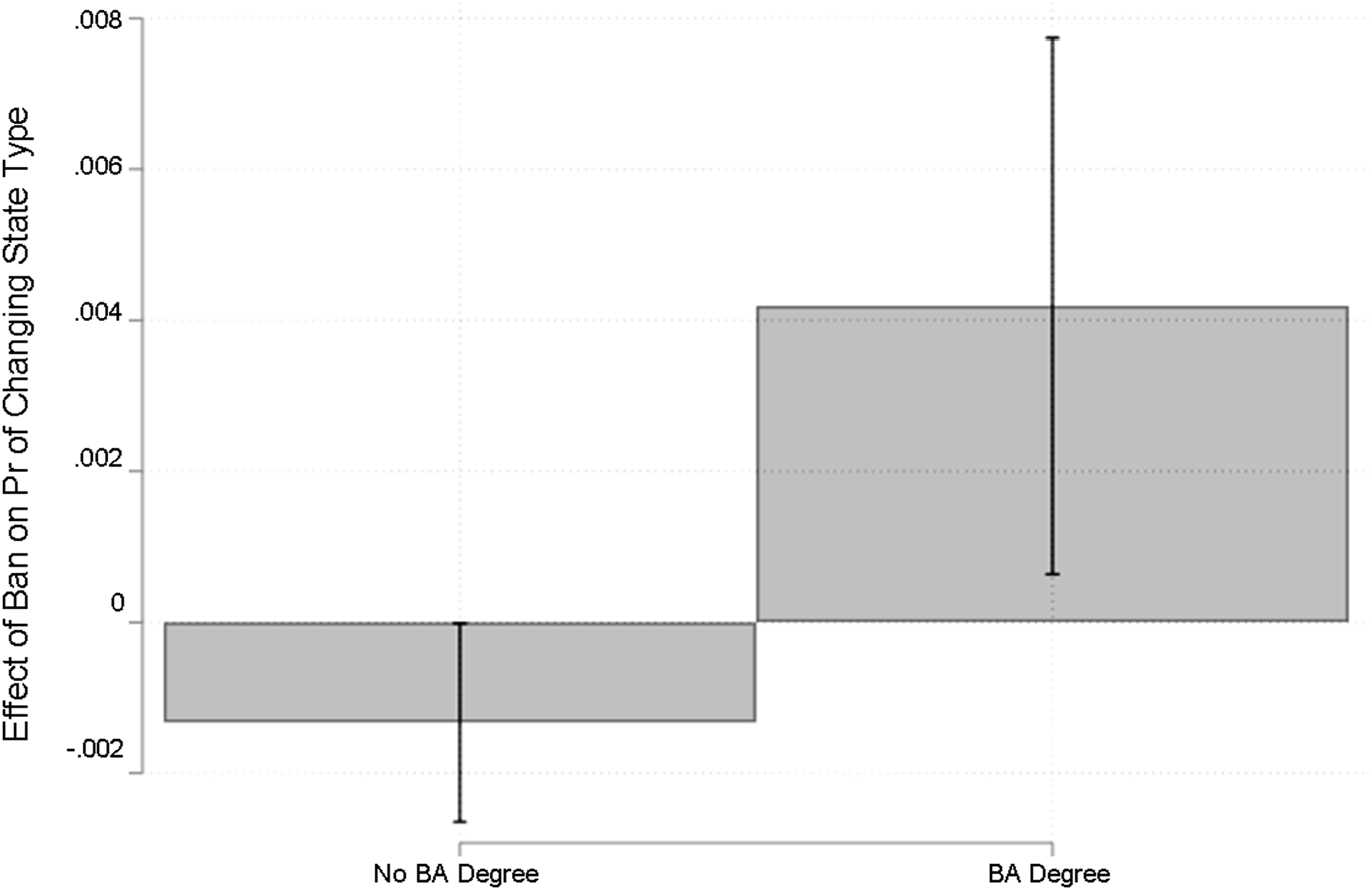
We see the effects for affluence in Figure 5. For those with family incomes above the 75th percentile who lived in a ban state they actually became less likely to switch state abortion regime types compared to similar individuals in no-ban states, though the confidence interval again slightly overlaps zero. Marginal effect of ban on switching abortion regime types by income status, with 95 percent confidence interval.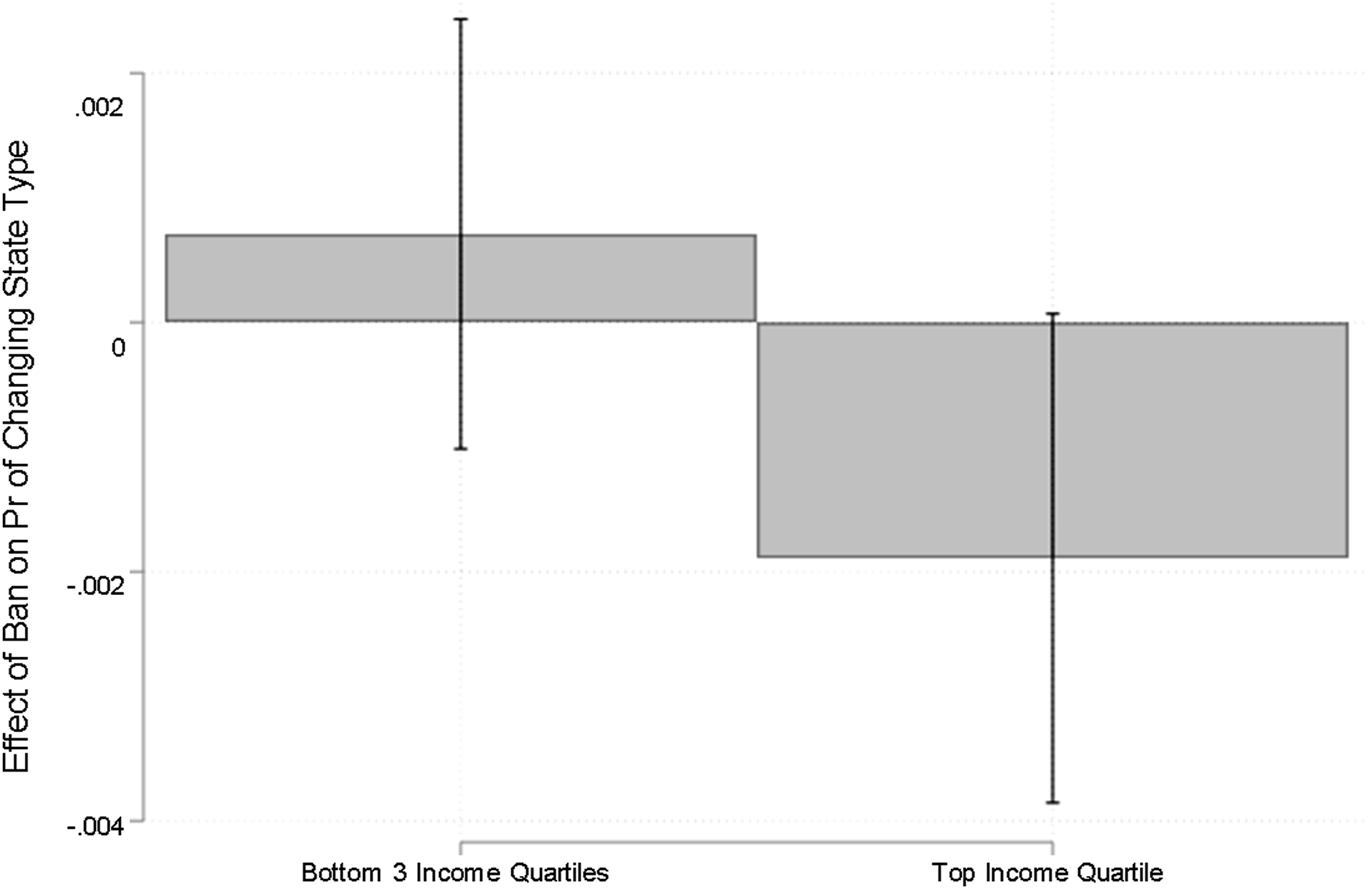
We thus find support for H1c and H3c, but not H2c. In fact, we observe the opposite of the hypothesized effect for H2c. All of these effects are very small, as would be expected given how rare interstate moves are. The probability of changing state abortion regime type is only 0.004 from 2013 to 2023. From this perspective, an abortion ban approximately doubled the probability that someone with a bachelor’s degree or a woman of childbearing age would leave an abortion ban for a no-ban state, relative to baseline, while bans decreased the probability for affluent people by around 50 percent. These effects are meaningful changes in probability, though they still do not make state switches very likely.
Study 3: Residency Applications of Medical Students
Study 3 makes use of data from the Electronic Residency Application Survey (ERAS) to examine whether medical students applying for residency are less likely to apply for residency in states with strict abortion bans after Dobbs (H4). These data are described as such: “The ERAS program is a centralized online application service created and maintained by the AAMC as a resource for applicants, program directors, designated institutional officials, and deans of medical schools” (Orgera, Mahmood and Grover 2023). This database thus contains the expressed residential preferences of highly educated and much-needed skilled professionals who must move, and it is therefore not simply cheap talk, since medical students are typically matched to one of the states they prefer. Furthermore, these residency decisions can affect where doctors practice in the future, and are more generally indicative of geographic preferences among this group.
Doctors are obviously very important to state healthcare systems and it is hard to imagine that a growing hesitance of doctors to work in certain states would not attract the attention of policymakers, since it is already attracting the attention of journalists (Epperly 2023; Musa and Bonifield 2023; Nirappil and Sellers 2023). According to the Association of American Medical Colleges, there was a large decrease in OB/GYN applicants in the 2023 cycle in states that had total abortion bans (Orgera, Mahmood and Grover 2023). But more thorough analysis is needed and we use publicly available ERAS data from 2019 to 2024 for this purpose. Data for 31 state-years is not available due to missing data from the data source.
The organization that coordinates residency applications encouraged doctors to apply to fewer residencies just around the time Dobbs was decided (Orgera and Grover 2024). Thus, there was a decline in applications in both sets of states, meaning we essentially examine whether the decline in applications has been significantly larger in ban states compared to no-ban states.
To examine this question we use both DiD and standard regression approaches. We cannot rule out the possibility that the data violate the parallel trends assumption (see Appendix Figure D1). The literature is not entirely clear on how to proceed in this circumstance (Rambachan and Roth 2023; Roth, Sant’Anna, Bilinski and Poe 2023; Roth and Sant’Anna 2023), so we also present separate regressions of the time period prior to the enactment of abortion bans and the time period after in the Appendix Table D1, which confirms the results of the simple DiD models presented below (i.e., a ban state dummy is negative and significant only after Dobbs). We lack demographic variables for applicants, so we cannot examine whether women, or various specialties, were more likely to not apply to ban states, for example. However, since all applicants come from a fairly uniform population (education, income, age) over time, and the potential states that they might apply to obviously does not change, then this does not threaten our inferences about the effect of abortion bans on applications.
Study 3 Results
Residency applications, 2019-2024
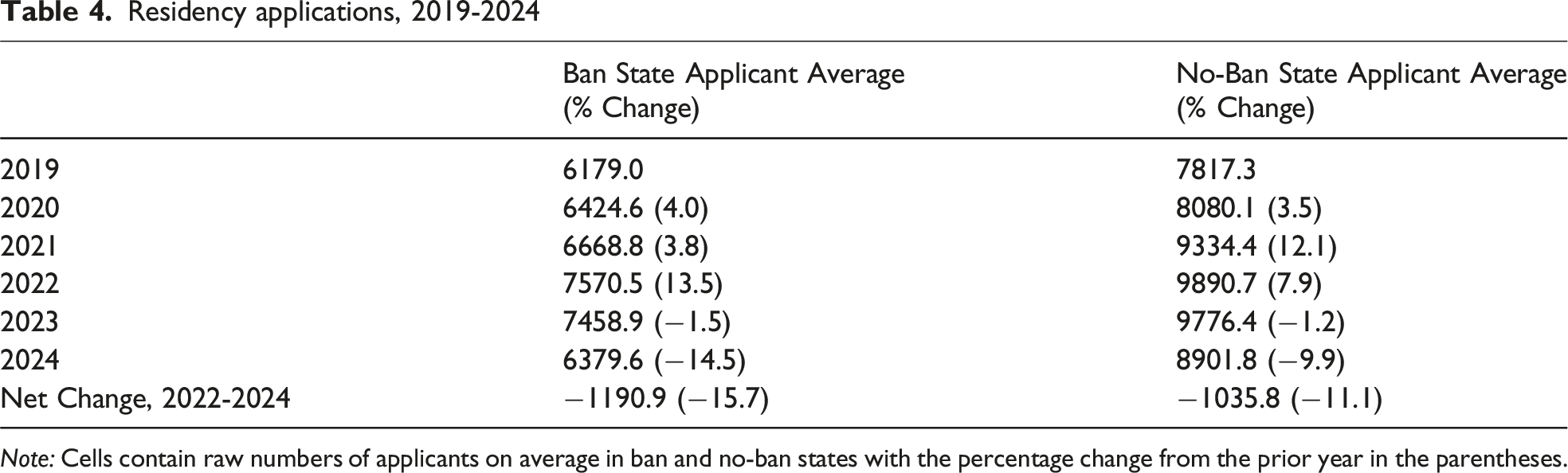
Note: Cells contain raw numbers of applicants on average in ban and no-ban states with the percentage change from the prior year in the parentheses.
Effect of ban on residency applications
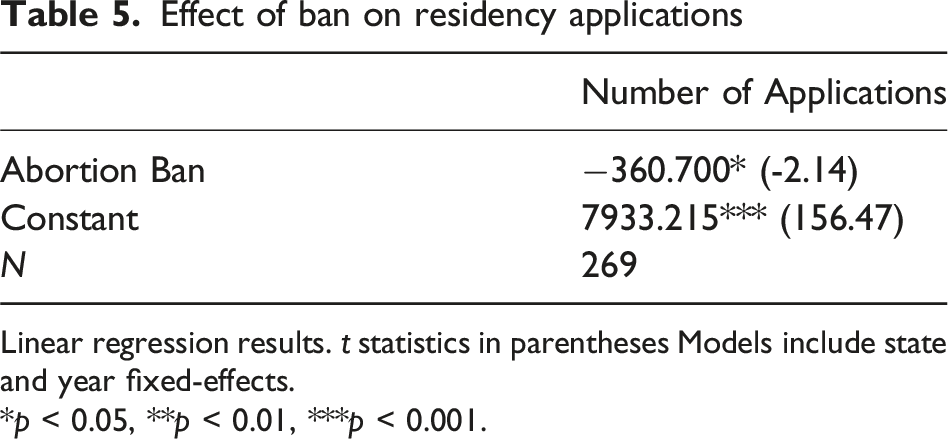
Linear regression results. t statistics in parentheses Models include state and year fixed-effects.
*p < 0.05, **p < 0.01, ***p < 0.001.
Conclusion
Observers have argued that the federalism exit option allows people to use interstate migration to protect their liberty or live in areas that have more freedom. We thought in the context of abortion, young women, doctors, the college-educated and affluent would be most likely to choose to migrate away from abortion bans. We used a series of analyses to test our arguments and found support for some, but not all of them. Our conjoint experiment showed that people are less willing to “accept” jobs in states with abortion bans and this was particularly true of women, but not the college-educated or affluent.
We then presented the results of two observational analyses that focused on interstate migration and intentions after Dobbs. We did not observe that the mass public was more likely to exit states with strict abortion laws after Dobbs. In an analysis of switching state abortion regime types we did find that women of childbearing age and people with college degrees became more likely to switch to a no-ban state once a ban was in place, while affluence and the lack of a college degree actually made people less likely to switch state types after a ban was in place in their state, compared to counterparts in no-ban states.
Taking these results together we conclude that people are not more likely to flee abortion ban states but that people who did move made different decisions about where to relocate. These results contrast with Dench et al. (2025) who find that people are more likely to flee states with abortion bans. But there is no reason to question either set of results. Dench et al. (2025) examine administrative data of all individuals who make change of address requests with the U.S. Postal Service, while we examine large representative samples, which would include people who may never file change of address forms with the postal service, and which do not oversample the subgroups most likely to move. Our results suggests that abortion bans are likely to have little impact on the migration of some groups, repel other groups, and maybe even attract some groups. This finding is consistent with Kane (2025). Results we present in the Appendix also lend some support to the Dench et al. (2025) finding that single people are probably more likely to move in response to abortion bans. In short, we see a polarized response to abortion bans, which we did not anticipate, but which is not so surprising in these polarized times.
Our analysis of medical residency applications also shows that doctors are less likely to apply for residency in the abortion ban states after Dobbs. Taken together, then, these studies show that abortion bans are probably shaping interstate migration decisions in the mass public, especially among young women, college graduates and doctors.
It should be kept in mind that because these abortion bans are relatively new, we must be cautious and not over-interpret the findings. The effect sizes are very small and our results should certainly be viewed as preliminary. As abortion bans age they could have bigger effects (if they lead to very bad outcomes) or smaller effects (if their effects are not so bad, doctors do not end up getting charged with crimes, etc.).
Our results also have implications for how we view federalism and its ability to protect liberty via the exit option. We see that federalism certainly allows for ample policy variation, which can affect people’s migration decisionmaking. However, because relatively few people do move across state lines the federalism exit option is not a way for very many people to protect their rights in the short term. Furthermore, the fact that the affluent are not repelled by abortion bans may limit any governmental response to interstate migration because these residents are desirable. On the other hand, if doctors or college graduates become less likely to move to abortion ban states this could certainly attract the attention of policymakers and make them reconsider abortion bans over the longer term, even if relatively few people actually move in response to abortion bans.
Supplemental Material
Supplemental Material - Abortion Bans and Interstate Migration
Supplemental Material for Abortion Bans and Interstate Migration by Michael J. Nelson, Christopher Witko in Political Research Quarterly.
Footnotes
Authors’ Note
Nathaniel Flemming and Morrgan Herlihy provided excellent research assistance.
Acknowledgments
We thank Jenny Wolak, David Miller, Boris Shor, David Fortunado, Josh Ryan, seminar participants at the University of Michigan and the University of British Columbia Centre for Constitutional Law and Legal Studies, and conference participants at the State Politics and Policy and Southern Political Science Association conferences for helpful comments.

Ethical Approval
The research was approved by Penn State’s IRB. Respondents indicated consent for participation at the beginning of the survey.
Funding
The authors disclosed receipt of the following financial support for the research, authorship, and/or publication of this article: The YouGov survey was supported by the Center for the Study of Federalism.
Declaration of Conflicting Interests
The authors declared no potential conflicts of interest with respect to the research, authorship, and/or publication of this article.
Supplemental Material
Supplemental material for this article is available online.
Notes
References
Supplementary Material
Please find the following supplemental material available below.
For Open Access articles published under a Creative Commons License, all supplemental material carries the same license as the article it is associated with.
For non-Open Access articles published, all supplemental material carries a non-exclusive license, and permission requests for re-use of supplemental material or any part of supplemental material shall be sent directly to the copyright owner as specified in the copyright notice associated with the article.
