




Abstract
A large literature documents the effects of gendered stereotyping on the outcomes of legislative and executive elections. Less attention has been paid to the effects of these stereotypes on judicial elections, a venue where candidates might encounter unique stereotypes. Further, existing research on judicial elections prioritizes one form of qualification—prior judicial experience—leaving unaddressed the effects of other professional experiences on voters’ choices in these contests. In this paper, we rely on a conjoint experiment to test the effects of candidate qualifications and gender stereotypes in U.S. state judicial elections. We find that, on average, women candidates are advantaged in judicial elections, though we find no evidence that citizens view women candidates as more qualified. Further, while voters do prefer candidates with prior judicial experience they also—contrary to the conventional wisdom—favor judges with prior political experience. Importantly, however, we observe minimal instances of gendered stereotyping in these elections. Our findings call for further research on the effects of gender in judicial elections.
While the presence of women in the legal field and in the U.S. judiciary has risen in recent decades, women are underrepresented on state supreme courts. As of 2024, 43 percent of state supreme court seats were held by women (Merriman, Isozaki and Bannon 2024). This underrepresentation has substantial consequences for state judicial systems. Women and men tend to vote differently in certain types of cases (Boyd, Epstein and Martin 2010), manage their caseloads differently (Boyd 2013), and bring different experiences to judicial deliberations (Haire and Moyer 2015). Further, increased gender diversity on state courts can have positive benefits for the public’s esteem for the judicial branch (e.g., Fix and Johnson 2017).
Why are women underrepresented on state courts? One possible cause of this underrepresentation is the presence and success of women in judicial elections, which occur in some capacity in 39 states. 1 On the one hand, judicial elections provide opportunities for women and other underrepresented populations to gain representation on the bench in ways that may be difficult to achieve through an appointive process where the “old boys’ network” still looms large. On the other hand, those who run for judge may have to contend with the barriers faced by women and people of color in other types of elections (Huddy and Terkildsen 1993; Schneider and Bos 2014). When voters have little information about candidates, the effects of stereotyping might be particularly influential (Bauer 2013; Bos and Schneider 2017; Ditonto, Hamilton and Redlawsk 2014). Because judicial elections are often low information contests, the effects of voter stereotyping may be particularly consequential in these contests (Bonneau and Cann 2015; Klein and Baum 2001).
These stereotypes may collide with voters’ conceptions of “quality” in judicial elections. Though scholars of legislative politics have devoted careful attention to the gendered ways in which voters judge candidate qualifications (e.g., Gonzalez and Bauer 2020), scholars of judicial elections have largely limited their understanding of whether or not a candidate for judicial office is qualified to a simple, single indicator: whether a candidate for a higher court has previous judicial experience and has paid little attention to the effects of gender (Bonneau and Hall 2009; Hall and Bonneau 2006). This limited understanding of gender and judicial quality in contests for state judge has the potential to obscure important electoral dynamics that might, in turn, inhibit women’s representation in these important policymaking bodies.
In this paper, we examine the effects of candidate qualifications and gendered stereotypes in judicial elections. We hypothesize that, like those to select executives and legislators, gendered stereotypes about competence and qualifications affect voters’ judgments in these races. Drawing on a conjoint experiment mirroring a nonpartisan judicial election, we find that, on average, women candidates are advantaged in judicial elections. However, we find no evidence that citizens view women candidates as more qualified. While respondents do prefer candidates with prior judicial experience over other types of prior legal experience, they also prefer candidates that have prior political experiences such as service in a state legislature or on a city council. These results stand in stark contrast to theories of judicial politics suggesting that the public prefers a nonpoliticized judiciary (e.g., Gibson and Nelson 2017). Further, and contrary to our hypotheses, we observe minimal instances of gendered stereotyping in these elections. Our results have important implications for our understanding of qualifications, stereotyping, and judicial diversity, especially in a post-Dobbs era as issues related to reproductive rights increasingly reach their final resolution in state, rather than federal, courts.
Judicial Elections and Judicial Diversity
Diversity in the judiciary is important to both descriptive and substantive representation. Descriptively, as voters see themselves represented in the judiciary, they may be less likely to be disillusioned with their judicial institutions and increase their support for them (Fix and Johnson 2017). Or, taking a page from procedural justice theory, increased representation on the courts might lead women and other underrepresented groups to see these courts’ decisions as having gone through a fairer process, also increasing their support for the judiciary (Olson 2001).
Because women are often underrepresented in legislative and executive arenas, courts and other alternative political spaces (including interest groups) can offer a unique opportunity for women to express and advance their policy interests (Beckwith 2011; Mansbridge 1999; Phillips 1995; Strolovich 2007). Substantively, then, the inclusion of more women on state courts might lead to better substantive representation through judicial decisions on so-called “women’s issues”—such as education, child and family policy, health, and reproductive issues (Fix and Johnson 2017). Studies suggest there are important differences between male and female judges on issues that explicitly implicating gender or sex (Boyd, Epstein and Martin 2010). As issues related to reproductive rights become increasingly prominent on state high court dockets post-Dobbs, understanding the conditions under which state supreme courts facilitate women’s substantive representation has become a very prominent concern.
One potential contribution to the underrepresentation of women in state judiciaries is the method by which candidates are chosen for state supreme courts. Most states hold some type of election for their state supreme court justices. Judicial elections tend to come in three types. 2 First, six states use partisan elections to retain the judges of their state high courts. These elections resemble legislative elections and may feature multiple candidates with party labels next to their names. Second, 13 states use nonpartisan state supreme court elections for this purpose; here, multiple candidates may compete for a single judgeship on the ballot but candidates’ names appear without a party label. Third, 19 states use uncontestable retention elections. In these elections (which generally happen after a judge is appointed to the bench by a governor or nonpartisan commission), an incumbent judge appears on the ballot without party affiliation or an opponent, and voters make a binary decision about whether the judge should remain on the bench (Gibson and Nelson 2021). 3 The remaining states appoint their judges (typically through either the legislature or governor). Most of these states make judges face reappointment after a set term.
The literature is mixed about whether elective or appointment systems enhance judicial diversity. Some research suggests that appointment-based processes are more likely than electoral ones to enhance women’s presence on the bench (Bratton and Spill 2002; Goelzhauser 2011; Reddick, Nelson and Caufield 2009). A contrasting set of studies suggests that elections might promote diversity because, when women run for judicial office, they tend to be successful (Frederick and Streb 2008; Nguyen 2019). And yet a third set of studies suggest there is no relationship between the use of elections and the composition of the bench (Gibson and Nelson 2021; Hurwitz and Lanier 2003). Thus, we have much to learn about the consequences of judicial elections for judicial diversity and, in particular, the ways in which candidates from particular groups may be (dis)advantaged by particular types of selection or retention systems as they try to attain or keep a seat on the bench.
Further, in states with judicial elections, voters sometimes must select their justices with little to no information other than candidate name, especially in nonpartisan elections where voters are denied even a party cue on the ballot (Klein and Baum 2001). In such low information elections, voters may be particularly susceptible to heuristics because a rich information environment cannot counter out these cues. Thus, voters may potentially activate gender stereotypes as they evaluate candidates on their ballot, when given a name that indicates candidate gender, and especially when partisan affiliation is not provided.
Candidate Qualifications in Judicial Elections
Concerns about judicial diversity aside, the extent to which these systems differ in their ability to put qualified judges on the bench is another frontline debate in the ongoing discussion about the best way to select judges. Critics of judicial elections have charged that voters are unable to judge the qualifications of judicial candidates; proponents have argued that voters have no more or less difficulty incorporating judicial qualifications in their voting calculi than they do for any other state-level office (e.g., Hall and Bonneau 2006). Regardless, the empirical question is the extent to which candidate qualifications affect vote choice in these contests.
This debate exists, in part, because scholars of state judicial elections have been simplistic in their evaluations of the effect of judicial qualifications on the outcomes of judicial elections. Hall and Bonneau (2006) find that incumbent judges perform worse in their reelection campaigns when they face a challenger with prior judicial experience; they interpret this evidence to suggest that voters factor judicial candidates’ qualifications into their voting calculi in state supreme court elections. 4 While this measure of quality—prior judicial experience—benefits from its simplicity, it raises concerns about validity. Especially for state high courts, individuals may have varied career paths. While service on a trial court or an appellate court may provide judges with experience in the role of a judge, such experience is not the only way to become qualified for the bench. Extensive experience as an advocate or in the teaching or study of law might provide another path toward a high level of judicial quality. Inasmuch as career paths—and therefore professional experiences—are gendered (Carroll and Sanbonmatsu 2013; Lawless and Fox 2010; Sanbonmatsu 2014), a simple reliance on prior judicial experience as a measure of judicial quality risks obscuring ways in which judicial selection is gendered and may contribute to the underrepresentation of women on the bench.
Many other conceptualizations of judicial “quality” exist. At the federal level, the predominant indicator of judicial quality comes from the American Bar Association, which evaluates Article III judicial nominees by considering judicial integrity, competence, and temperament and publicizes its determination about whether a nominee is “Well Qualified,” “Qualified,” or “Not Qualified” to serve on the federal bench. The ABA’s evaluation prioritizes professional qualifications. 5 They do, however, consider alternatives to courtroom experience, such as involvement in administrative agencies or arbitration boards, tribal courts, or teaching trial advocacy may serve as a sign of a well-qualified judge in place of courtroom service (American Bar Association 2020). Though the ABA’s assessments are thorough, they are limited in their ability to predict judicial success in terms of reversal rates and in how equitable the ratings are for minority and women nominees relative to white and male nominees (Sen 2014).
Similarly, at the state level, bar associations and state officials sometimes offer voters Judicial Performance Evaluation (JPE) guides that purport to provide voters with easy-to-understand information on an incumbent judge’s performance; in many cases, these guides provide voters with an explicit recommendation as to whether or not the judge should be retained in office. Unfortunately, like the ABA ratings, these ratings suffer from systematic gender bias (Gill 2014; Gill, Lazos and Waters 2011).
Aside from overt bias in the rating systems used by bar associations, it is important to consider gendered pathways to office and how they might affect our understanding of judicial qualifications. Barnes and Holman (2020) note that diversity among candidate characteristics—including personal and professional experiences and backgrounds—is important for representation, both descriptive and substantive. Candidate backgrounds are gendered, and the experiences and backgrounds that candidates have are not necessarily equivalent across candidate identity. For example, women are less frequently found in the traditional professional pools for candidate recruitment, such as business and law, but may have substantial experience in another relevant field, such as education (Carroll and Sanbonmatsu 2013; Lawless and Fox 2010; Sanbonmatsu 2014). In elections where candidates are required to hold some formal qualification, such as a legal degree, these paths are necessarily narrower. Still, a broader conception of qualifications—and understanding the different professional and civic experiences men and women bring to the bench—is important to understand the barriers that women face to holding judicial office.
Gender Stereotypes
Earlier, we suggested that the low information environment in which voters make decisions in judicial elections may provide a fertile ground for the use of gender heuristics. These, in turn, may affect how we understand “quality” in judicial elections. Voters often rely on cues like gender in order to make assumptions about candidates, particularly in low information environments. Gender heuristics may make voting easier: based on gender stereotypes, a gender heuristic provides an information shortcut for voters (Lawless 2004; Mo 2015). Gender shortcuts may be particularly relevant for voters who don’t share a common partisan identity with a candidate (Barnes and Beaulieu 2014). Gender stereotypes in elections are typically analyzed through the lens of a candidate’s competency on issues, and, in the United States, are studied in legislative and (occasionally) executive contexts.
There are two main theories that account for much of the work on this question: first, that women politicians are associated with stereotypically feminine traits, and so voters have diverging beliefs of what issues women are competent on relative to men. The second approach is based in how voters evaluate politicians’ ideology and partisanship: voters may view women politicians as having more liberal beliefs than male politicians (regardless of party affiliation) and are more likely to think that women are more likely to be Democrats (Bauer 2018; Devroe and Wauters 2018). In general, there are three models of gender and party stereotyping in politics: the gender stereotyping model, the party stereotyping model, and the interactive gender and partisan model (Gonzalez and Bauer 2020).
The first of these models suggests that feminine stereotypes associated with women can undermine their electoral success and support in the electorate because of gender role mismatches between women—perceived to have feminine qualities—and the masculine expectations that voters hold for those in political positions (Butler and Preece 2016). Even if women officeholders are viewed positively when associated with traditional feminine stereotypes (such as communal- and compromise-centered leadership styles) the same women may be evaluated less favorably when running for office and are potentially viewed as violating gender stereotypes with their electoral ambitions (Bernhard 2021; Sweet-Cushman 2022). The party stereotyping model asserts that gender stereotypes are negligible in terms of understanding electoral outcomes because of the dominance of partisanship as a cue in many elections (Bauer 2013; Brians 2005; Hayes 2011). The final model argues that voters rely on both gender and party-based stereotypes, where voters associate Democratic women candidates with feminine traits and issues relative to male Democratic candidates, such that Democratic women are affected by both gender and party stereotypes (Badas and Stauffer 2019; Gonzalez and Bauer 2020; Koch 2000). Women are typically perceived as being more liberal than men (Devroe and Wauters 2018; Dolan 2014; McDermott 1997). Thus, even without a partisan cue, if voters rely on such assumptions about women candidates, they may evaluate them differently based on their own partisanship (Koch 2000). Moreover, even in nonpartisan electoral contexts, conservative voters are less likely to support women running for office, especially for executive offices (Anzia and Bernhard 2022).
When and how do stereotypes affect electoral outcomes? Contrasting the idea that women politicians are perceived as having stereotypically feminine traits and are similar to women as a whole, Schneider and Bos (2014) argue that women politicians experience stereotyping as a subtype of women, meaning that they do not benefit from feminine stereotypes like women who are not politicians. In fact, women politicians do not see the benefits of either stereotypically feminine or masculine stereotypes: women politicians are seen as lacking the positive characteristics assigned to women generally, such as empathy and compassion—meaning women candidates lose any advantage over men through the expression of feminine qualities. Additionally, women candidates are not assigned masculine stereotypes which might benefit them in the political sphere. Male candidates, in contrast, benefit from masculine stereotypes in the realm of politics. Other research finds that while some women candidates and officeholders may benefit from gendered stereotypes—particularly Democratic and liberal women who demonstrate a communally-oriented leadership style that emphasizes consensus—such benefits are limited to legislative offices that are congruent with women’s traditional gender roles (Anzia and Bernhard 2022; Bernhard 2021; Schneider, Bos and DiFilippo 2022; Sweet-Cushman 2022).
Stereotyping is highly context-dependent and can differ widely across different electoral environments (Bauer 2013; Bos and Schneider 2017; Ditonto, Hamilton and Redlawsk 2014). Gonzalez and Bauer (2020) rely on role-congruity theory and the categorization of individuals into multiple stereotype categories in order to develop a general understanding of how voters relate traits to their perceptions of candidates. Their study describes how stereotypes can be reinforced by each other, in that cues can have overlapping content that make them congruent to each other in the eyes of the electorate. Gonzalez and Bauer describe this effect in terms of gender and party stereotypes, but other work shows that there are particular stereotypes about different political offices as well. Huddy and Terkildsen (1993) examine the effects of gender stereotyping across different types and levels of office, and conclude that masculine-associated traits are preferred by candidates at “higher” levels of office, especially in executive elections, where candidates may be expected to serve as leaders or be more aggressive than in other offices (see also Sweet-Cushman (2022)). However, they also note that feminine traits may be preferred in some cases, such as in the judiciary. Using an experimental design to study candidate preference in state supreme court candidates, Sigelman, Sigelman and Fowler (1987) find that women candidates with traditionally feminine traits and viewed as being “nice” were better supported than women candidates viewed as being “dynamic,” according to their possession of traditionally masculine traits. Conversely, Oliver and Conroy (2018) demonstrate that, regardless of candidate gender, city council candidates who self-identify as masculine are more likely to be recruited for office: women are not necessarily punished for not conforming to gender roles, but there is a persistent connection between politics and masculine norms. However, gender stereotype research—even when accounting for other heuristics like party—have yielded mixed results. Dolan (2014) examines how gender-based stereotypes may influence the manner in which voters evaluate legislative candidates, and considers how this evaluation further affects a voter’s final decision. She finds that stereotypes are not central to voter evaluations of candidates, and thus are essentially immaterial when considering the impact of gender on vote choice. However, voters in particularly low-information elections may respond to the choice presented to them using gender stereotyping. Further studies by Bauer (2013, 2017), among others, stress the importance of considering context—including in how candidates campaign—in considering when and how gender stereotypes can affect electoral outcomes. Gender stereotypes alone do not always account for electoral variation.
Women candidates can possibly mediate the effects of traditionally feminine gender stereotypes by presenting themselves with more typical leadership qualities (Bos and Schneider 2017). In judicial elections, this may mean that women who express their traits through traditional aspects of judicial quality can combat some of the negative stereotyping, though the possible decreased association between masculine traits and judicial offices relative to other offices may lead voters to perceive a better gender role match among women than they would experience in executive elections.
Theory and Hypotheses
We have expectations related to the effects of candidate qualifications and gender stereotyping in judicial elections. Our first expectation relates to candidates’ prior legal experience. As discussed above, previous attempts to understand the effects of judicial elections privilege prior judicial experience as the most important qualification for a judicial nominee and suggest that voters prefer candidates with higher levels of qualifications. Thus:
Candidates with prior judicial experience will be judged as more qualified for state supreme court and will be electorally advantaged, compared to judicial candidates with other types of legal backgrounds. The legal profession is broad; therefore, we examine descriptively the effects of other types of prominent legal experiences, including service as a prosecutor, a public defender, or in private practice. Prior prosecutors are well-represented on state supreme court benches, while public defenders are few and far between (Gibson and Nelson 2021). One explanation for the underrepresentation of public defenders on the bench is that voters view them as less qualified and are less likely to vote for individuals with that experience on election day. We believe no existing study has benchmarked the relative importance of these different career experiences on voters’ evaluations of judicial candidates or their willingness to support candidates who have particular prior career experiences. Therefore, though we do not make strong hypotheses about the relative ranking of these different experiences, we compare them to the effect of prior judicial experience. Second, the American public generally dislikes the politicization (or attempted politicization) of the judiciary. Hibbing and Theiss-Morse (1995) demonstrate that, because citizens perceive courts as separate from the explicit politicking that characterizes the “Washington system,” the public tends to approve of the judicial branch at a higher level than the legislative or executive branch. Studies at the state level have led to similar conclusions (e.g., Benesh 2006; Kelleher and Wolak 2007). We expect that voters consider the politicization of the judiciary when casting votes in judicial elections, punishing candidates who have previous political experience over those whose prior experiences are entirely in the legal realm:
Compared to a candidate with no prior political experience, judicial candidates with previous executive or legislative branch experience should be rated by respondents as less qualified and be less likely to be selected. Third, the American legal profession is notoriously elitist, with lawyers who attended elite law schools dominating the U.S. Supreme Court and elite law firms. While such qualifications might make a prospective judge more attractive in beltway legal circles, that elitism might backfire in state-level judicial elections to select judges with the final say on state law (e.g., Gibson and Nelson 2021). For this reason, we expect:
Candidates who completed their legal education in the state in which they are running for judge will be electorally advantaged compared to judicial candidates who attended out-of-state or elite law schools. Our second set of expectations, regarding gender and stereotyping, are rooted in the literature on candidate’s varying paths to office and on conceptions of candidate quality across elections (Burns, Schlozman and Verba 2001). Often, women politicians are associated with traditionally feminine characteristics, competencies, and interests, or the women politician sub-type, where women do not benefit from being perceived as masculine or feminine (Schneider and Bos 2014). In the United States, role congruity theory suggests that women who defy gender roles will be punished, though Oliver and Conroy (2018) suggest that this is not the case for women seeking some offices. Women candidates do not receive the potential benefits from the positive stereotypes assigned to women, but they also “lose” to men on masculine traits, because there is an inherent gender role mismatch between women politicians and masculinity (Schneider and Bos 2014). Further, because women politicians are viewed as holding more masculine traits compared to other women, they are not associated with femininity, but they are also not positively associated with masculine traits. Consequently, we anticipate that women will be at a disadvantage compared to men seeking judicial office in the states. Thus:
Women will (a) be less likely to be selected and (b) receive lower evaluations on quality than male candidates, holding all other candidate qualities constant. Aside from a direct effect of gender, studies of gender stereotyping suggest heterogeneity in when women candidates will receive electoral (dis)advantages. Voters are more likely to punish a woman candidate who is seen as agentic and dominant traits, such as being seen as intimidating or arrogant (Schneider, Bos and DiFilippo 2022). And, for women running for executive and legislative office, more positive stereotypes are attributed to women compared to men or ungendered candidates. However, when women face an electoral environment, these positive stereotypes disappear, and in some cases, disadvantage the woman running for office. In particular, women are punished for exhibiting “incongruent” characteristics when running for office (e.g., agentic women are punished when running for a communal legislative office) (Sweet-Cushman 2022). Thus:
Women candidates will (a) be less likely to be selected and (b) be receive lower evaluations of quality when they have professional experiences or traits that are less traditionally feminine, compared to women candidates who do not have those experiences or traits.
Research Design
We test these theoretical expectations using a conjoint experiment fielded in June 2022 on Prolific, a vendor that connects survey respondents to researchers. 6 The sample was limited to U.S. adults who speak English; given the gender imbalance in many online samples and our substantive interest in gender, we recruited roughly equal number of male and female participants. After answering a battery of questions about their political and demographic backgrounds, respondents participated in a conjoint experiment. Each of our 1,000 respondents rated 10 pairs of candidates.
An experimental approach is particularly apt for our research question. Because women candidates are likely to be selective about where they seek office, observational studies that seek to unravel gender in judicial elections will encounter inferential difficulties. Further, the experimental setting allows us to independently manipulate each type of candidate qualifications, ensuring that (a) all of the potential qualifications we seek to study are present for both male and female candidates and (b) there is no correlation in candidate qualifications brought about by the path dependence of a particular legal career (e.g., attending a top-tier law school and working in corporate law).
At the same time, we are cognizant of two major drawbacks to this research design: while many judicial elections are low information contests, a survey experiment provides every respondent with full information about each candidate, potentially providing voters with more information than they would have in a typical electoral context. As Barabas and Jerit (2010) demonstrate, this feature of survey experiments suggests that any results we uncover be treated as maximal-sized effects. Also, as we discuss later, any candidate choice experiment, like ours, sidesteps processes of candidate recruitment and ambition which are both gendered (Lawless and Fox 2010; Sanbonmatsu 2014). Thus, our study enables us to make conclusions about voter behavior once a candidate is on the ballot; future research should pay close attention to the gendered pathways toward judicial candidacy.
Conjoint Attributes.
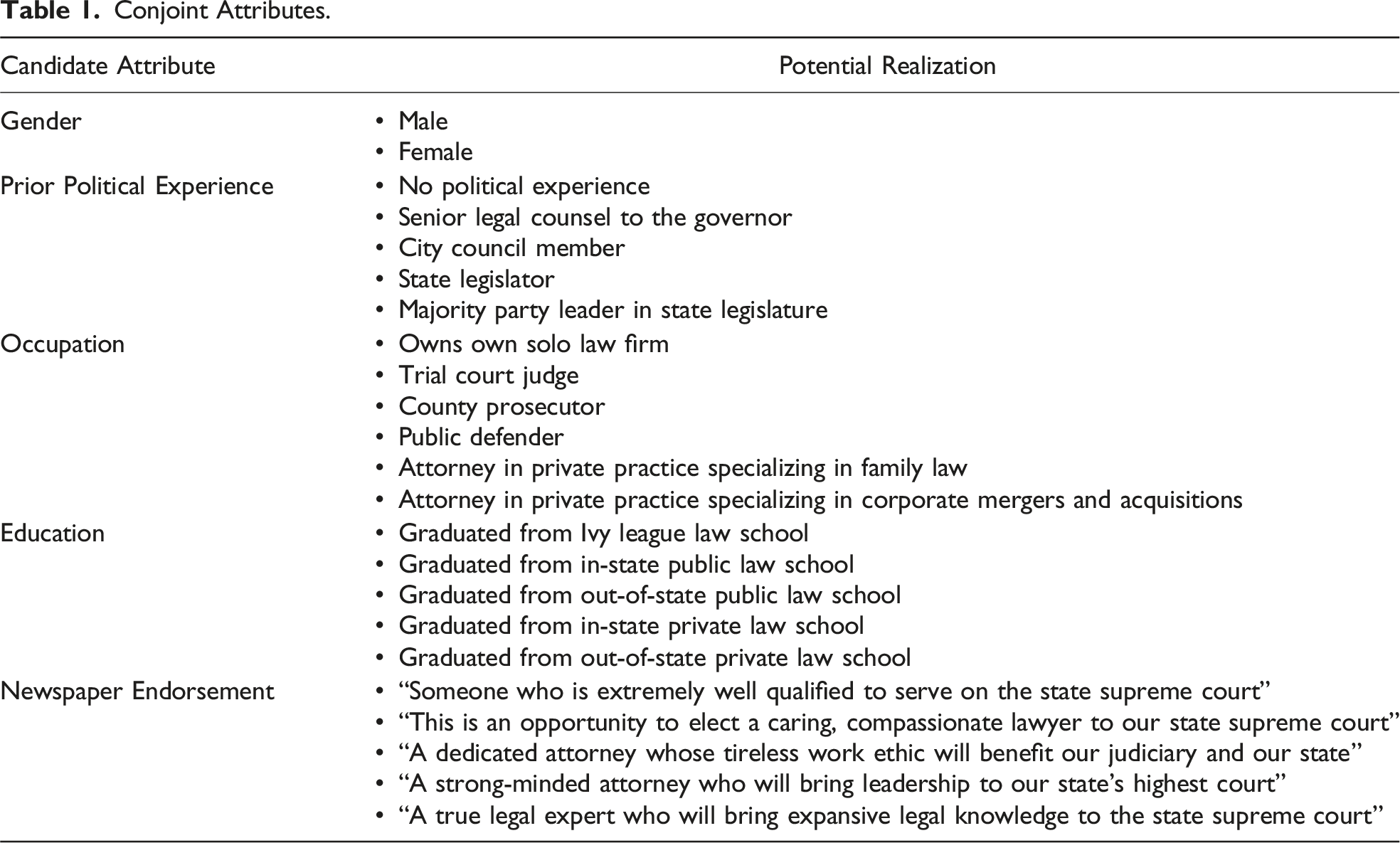
These treatments enable us to test the hypotheses outlined above. Our first hypothesis relates to prior judicial experience, suggesting that candidates will be viewed as more qualified and will be more likely to be selected if they have previous service on the bench. The Occupation suite of treatments enables us to test this hypothesis, comparing prior service as a trial court judge to other types of public and private-sector legal experience.
Our second hypothesis related to candidates’ prior political experience, suggesting that candidates who have previous political experience would be judged as less qualified and be less likely to be selected than candidates whose careers have not involved the political arena. We therefore contrast candidates with no prior legal experience to a set of elected and unelected political experiences in both the legislative and executive branches of government.
Our third hypothesis related to a candidate’s prior educational experience. We make three distinctions: whether the law school is an elite law school, whether the candidate attended an in-state law school or an out-of-state law school, and whether the law school was public or private. Recall that we hypothesized that candidates who attended in-state law schools should be advantaged electorally.
Our fourth and fifth hypotheses involve the gender and professional background of the candidates. While the fourth hypothesis straightforwardly predicts an electoral bias against women candidates, our fifth hypothesis suggests that the effects of professional experience and personal traits will vary by gender. In designing the experiment, we included two sets of treatments to test this hypothesis. First, in designing our occupational treatments, we included two—expertise in family law and expertise in mergers and acquisitions—that were found to be among the most female and male-dominated (respectively) legal practice specialties (Isaacson 2017). 8
Second, we drew from previous research on gender stereotypes to design a series of five newspaper endorsement treatments aimed at providing respondents with information about the candidates’ personal traits. In designing the treatments meant to prime feminine stereotypes, we looked to Huddy and Terkildsen (1993) who note that characteristics such as “compassion,” “warmth,” and “kindness” are exemplars of feminine traits. Therefore, we included two treatments that highlighted candidates described as “caring, compassionate lawyer” or a “dedicated attorney” with a “tireless work ethic.” Because Lawless (2004) mentions “self-confidence” and “assertiveness” as masculine traits, we also included a “strong-minded attorney” with noted “leadership” skills and a “true legal expert” with “expansive legal knowledge” as two endorsements meant to prime masculine associations. Finally, we included a candidate endorsed as “extremely well qualified” with no additional information as a sort of baseline condition, acknowledging that Lawless and Pearson (2008) and Schneider and Bos (2014) have suggested that the very notion of qualifications may have a masculine veneer.
We have two outcome variables: (a) the probability a respondent would vote for a candidate and (b) their rating of the candidate’s qualifications. To measure the former, we asked candidates which of the two candidates they would vote for in an upcoming election. To measure the latter, we asked respondents to rate each profile on a four-point scale ranging from “Not at all qualified” to “Extremely qualified” to assess perceptions of qualifications. The strength of the candidate selection outcome is its ability to mirror the binary choice many voters face in these elections; the advantage of the latter outcome is its granularity. Together, the two variables give us a complimentary picture of respondents’ evaluations of the candidate pairs. Overall, the correlation between the two outcome variables is only r = .27, though this correlation is suppressed by the binary selection variable. The average qualification score for a selected candidate is 3.62; for an unselected candidate, the mean is 3.27 (p < .01).
Results
Figure 1 displays the average marginal component effect for the candidate selection outcome; Figure 2 plots the results for the candidate rating outcome (Hainmueller, Hopkins and Yamamoto 2014).
9
Positive estimates indicate that candidates having that particular attribute were more likely to be selected (or were rated more highly) than candidates with the baseline attribute; negative values denote that the attribute was associated with a lower probability of selection (or lower rating), relative to the baseline. Average component interaction effects, candidate selection outcome. Positive estimates indicate that female candidates having that experience are were more likely to be selected; negative values indicate that characteristic was associated with a lower probability of selection for female candidates. The lines provide 95% confidence intervals. Average component interaction effects, candidate qualifications outcome. Positive estimates indicate that female candidates having that experience are viewed as more qualified; negative values indicate that female candidates with that characteristic were viewed as less qualified. The lines provide 95% confidence intervals.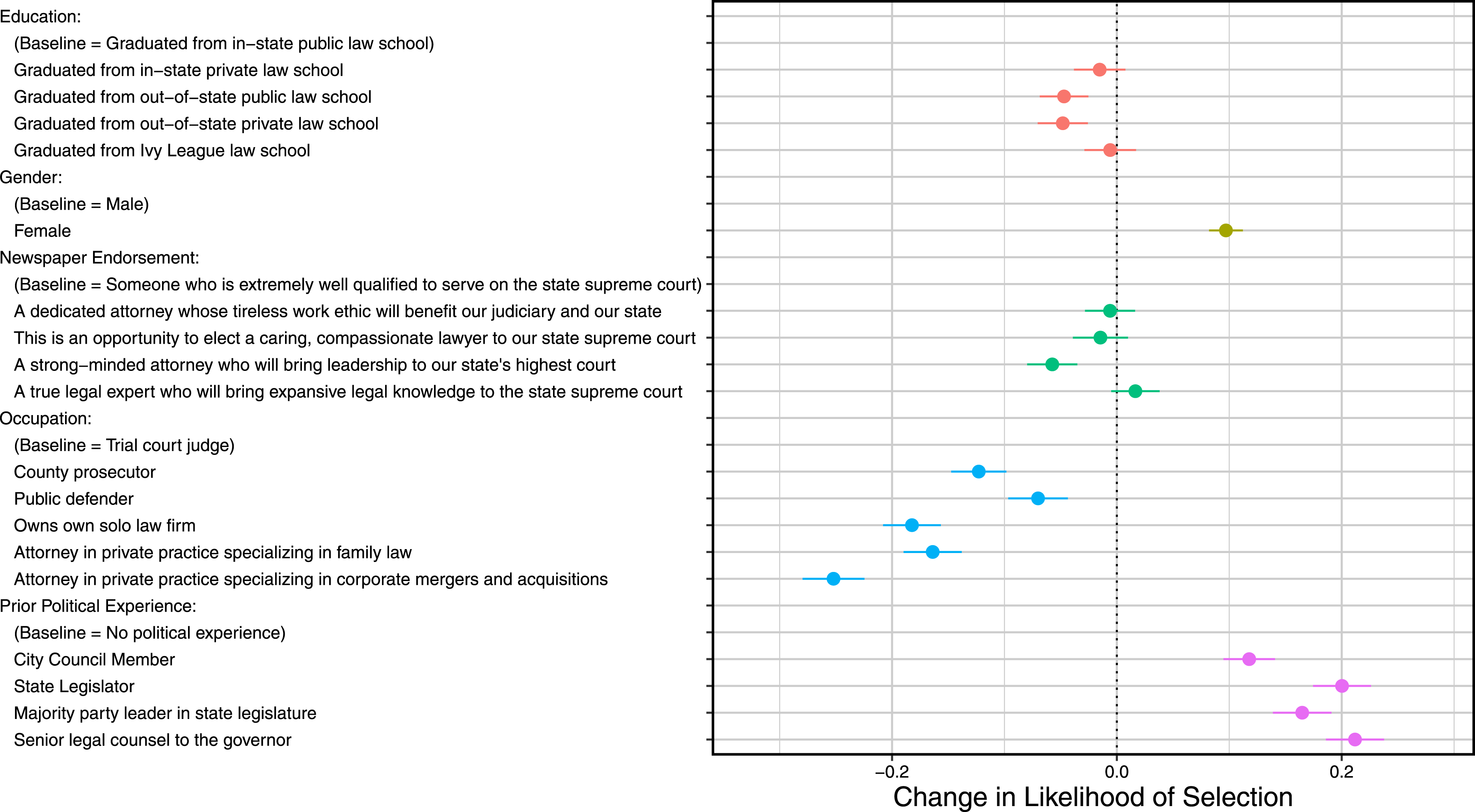
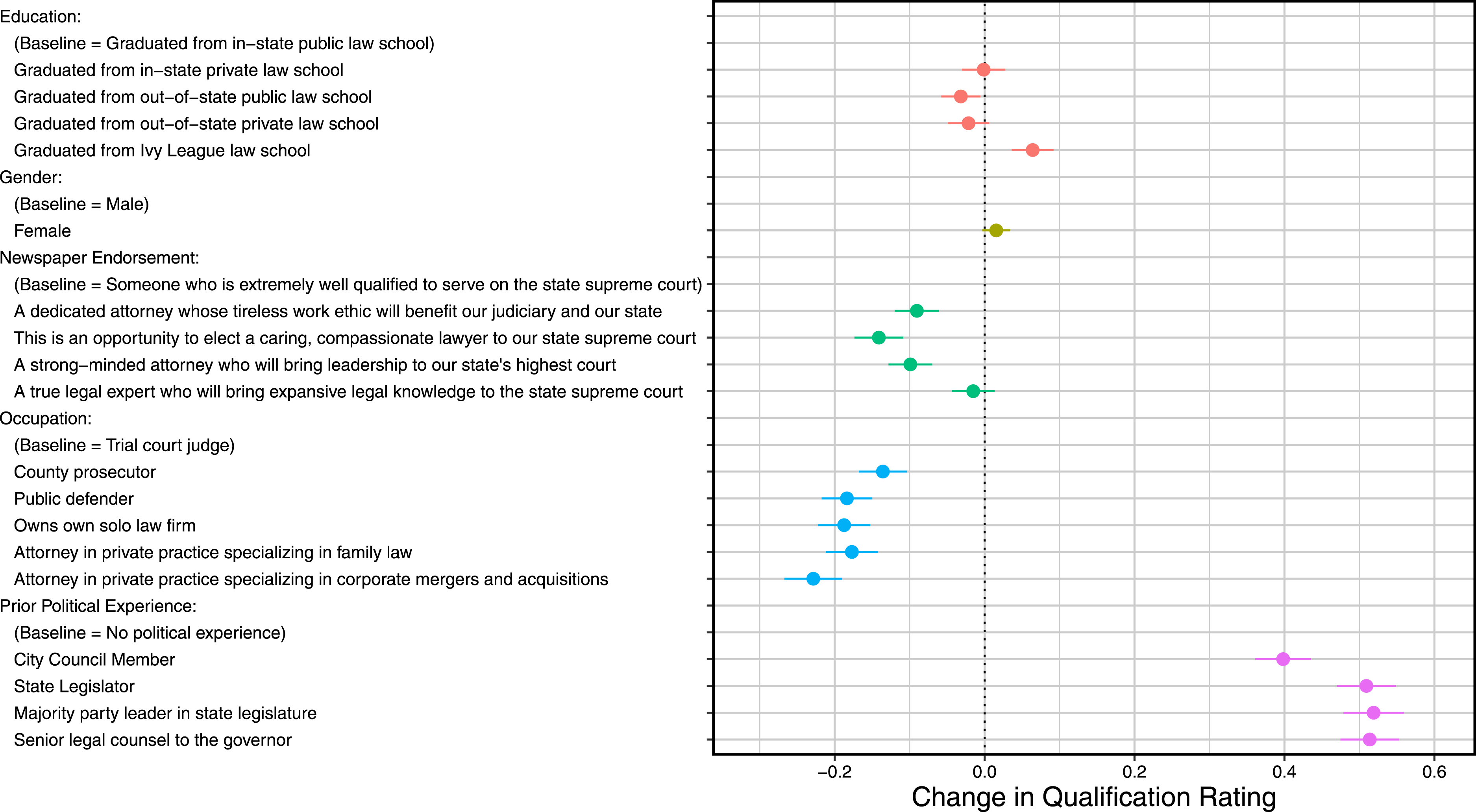
We begin with our hypotheses related to the effect of prior judicial and political experience. For both outcome variables, we observe robust evidence in support of our hypothesis: all of the other types of legal experience are negative and statistically different from prior judicial experience, which is the baseline category in Figures 1 and 2. Though we did not make explicit hypotheses about the other types of experience, we see that public service work tends to be favored compared to private practice, especially for the candidate selection outcome. Candidates with only private sector legal experience were the least likely to be selected, with candidates whose experience was in corporate law about 23 percent less likely to be selected than former trial court judges.
Our second hypothesis related to candidates’ prior political experience. Here, we had expected to see negative estimates for each experience: respondents would be repelled by candidates who had previously served in an elected or high-profile appointed government office. We were wrong. Candidates who served as state legislators or legal advisors to the governor were 20 percent more likely to be selected than candidates without any prior political experience. Likewise, candidates who had served in a state legislature or as the governor’s legal counsel were rated a half-point more qualified than those without prior political experience, a sizable effect given the four-point scale.
Further, though we observe a slight decrease in the probability that a party leader in a state legislator is selected relative to a rank-and-file state legislator, that difference is not statistically significant. Instead, the main distinction respondents seemed to draw was between local and state-level experience: candidates with city council experience were viewed as more qualified (and were more likely to be selected) than candidates with no political experience but as less qualified (and less likely to be selected) than candidates with some sort of state-level political experience, be it in the legislative or executive branch. In short, we find no evidence across either outcome variable that prior political experiences disadvantage candidates in judicial elections.
Our third hypothesis suggested an advantage for respondents with an in-state legal education. We observed mixed support for this hypothesis. Beginning with the candidate selection outcome, we find that respondents were biased against respondents who went to out-of-state law schools, regardless of whether those schools were public or private. Candidates who attended an out-of-state (though not Ivy League) law school were about 5 percent less likely to be selected. We observe no differences in the probability of selection between a candidate who attended an in-state public law school (the baseline category), an in-state private law school, or an Ivy League law school.
Turning to Figure 2 and the candidate rating outcome, we see that, while respondents are no more likely to vote for Ivy League candidates than candidates who went to an in-state law school, they do rate such candidates as more qualified than those who attended an in-state law school. The out-of-state law school effects are more muted for this outcome, with possibly a slight disadvantage for respondents who went to an out-of-state private law school compared to an in-state public law school, though the size of this effect is small and not distinguishable from the other non-Ivy categories.
Thus, perhaps the most important conclusion we draw regarding the effect of a candidate’s education is that, relative to attending an in-state law school, judicial candidates who attended a top-tier law school are no more likely to be selected in judicial elections (though citizens may view them as more qualified). Instead, we find modest evidence of home state parochialism: the size of these educational effects is much smaller than most of the political or legal experience effects we estimate.
Our fourth hypothesis concerned candidate gender. Beginning with candidate selection, we see a relatively large and statistically significant estimate for female candidates. On average, female profiles were about 10 percent more likely to be selected than male profiles, all else equal. In a sense, our results are similar to those of Frederick and Streb (2008) and Nguyen (2019) who find that, when female judicial candidates run, they tend to be advantaged.
However, we find no evidence that female candidates have a qualification advantage. While respondents were more likely to indicate a vote intention for a female candidate, they were no more likely to rate a female profile highly than a male profile. 10
To test our final expectations, Figures 3 and 4 allow the effects of candidate occupation and newspaper endorsement to vary according to the profile’s gender. We had expected to see that the gendered traits—family law vs. corporate law experience and the gendered newspaper endorsements especially—had different effects according to candidate gender. Regarding the candidate selection outcome, “dedicated” male candidates with a “tireless work ethic” receive an electoral boost relative to a female candidate with that endorsement. And, as hypothesized, female candidates with experience in family law were selected more often by respondents than male candidates with experience in that practice area. Average marginal interaction effects, candidate selection outcome. Positive estimates indicate that, relative to the baseline, candidates having that experience are were more likely to be selected; negative values indicate that characteristic was associated with a lower probability of selection. The lines provide 95% confidence intervals. Average marginal interaction effects, candidate qualifications outcome. Positive estimates indicate that, relative to the baseline, candidates having that experience are viewed as more qualified; negative values indicate that candidates with that characteristic were, on average, viewed as less qualified. The lines provide 95% confidence intervals.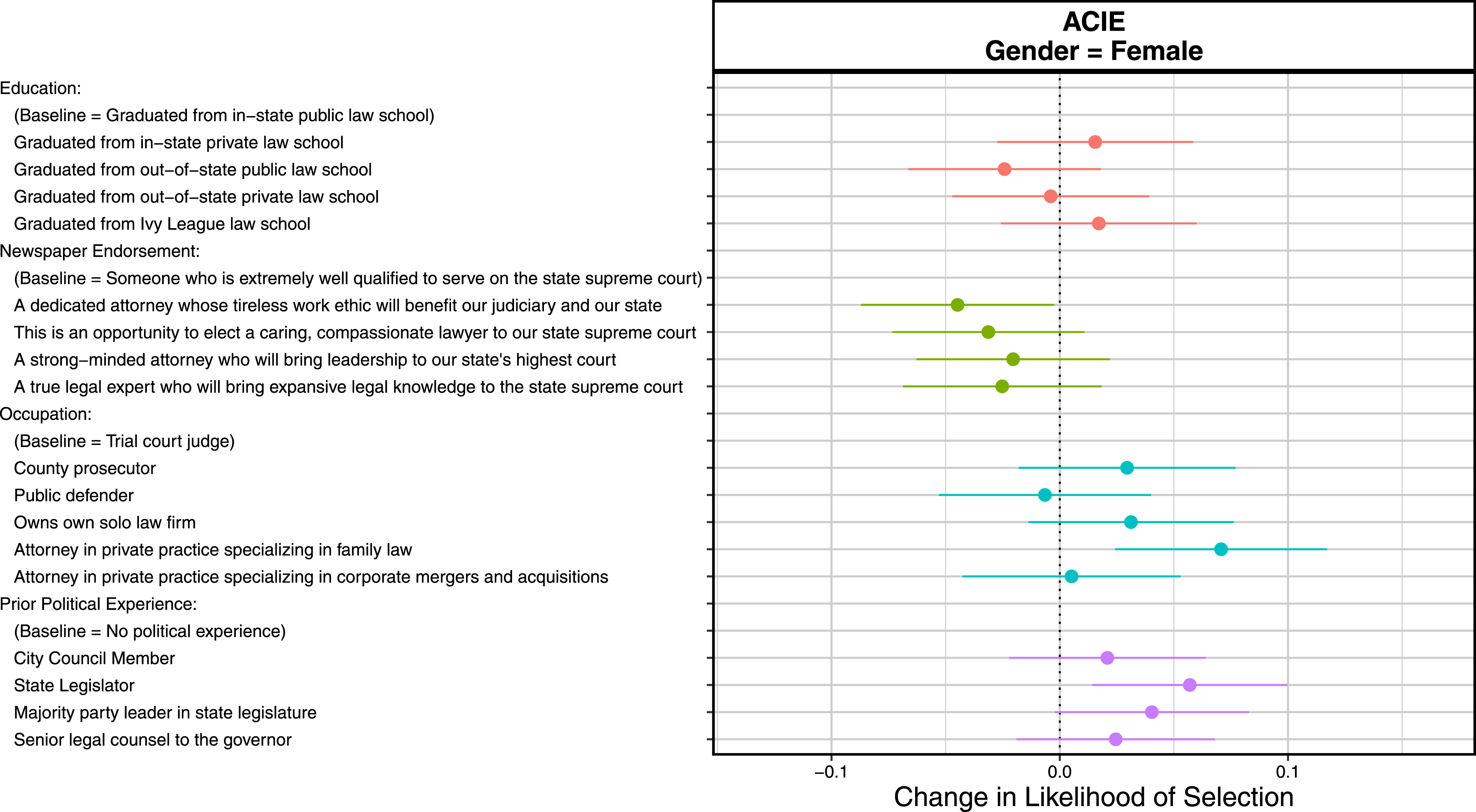
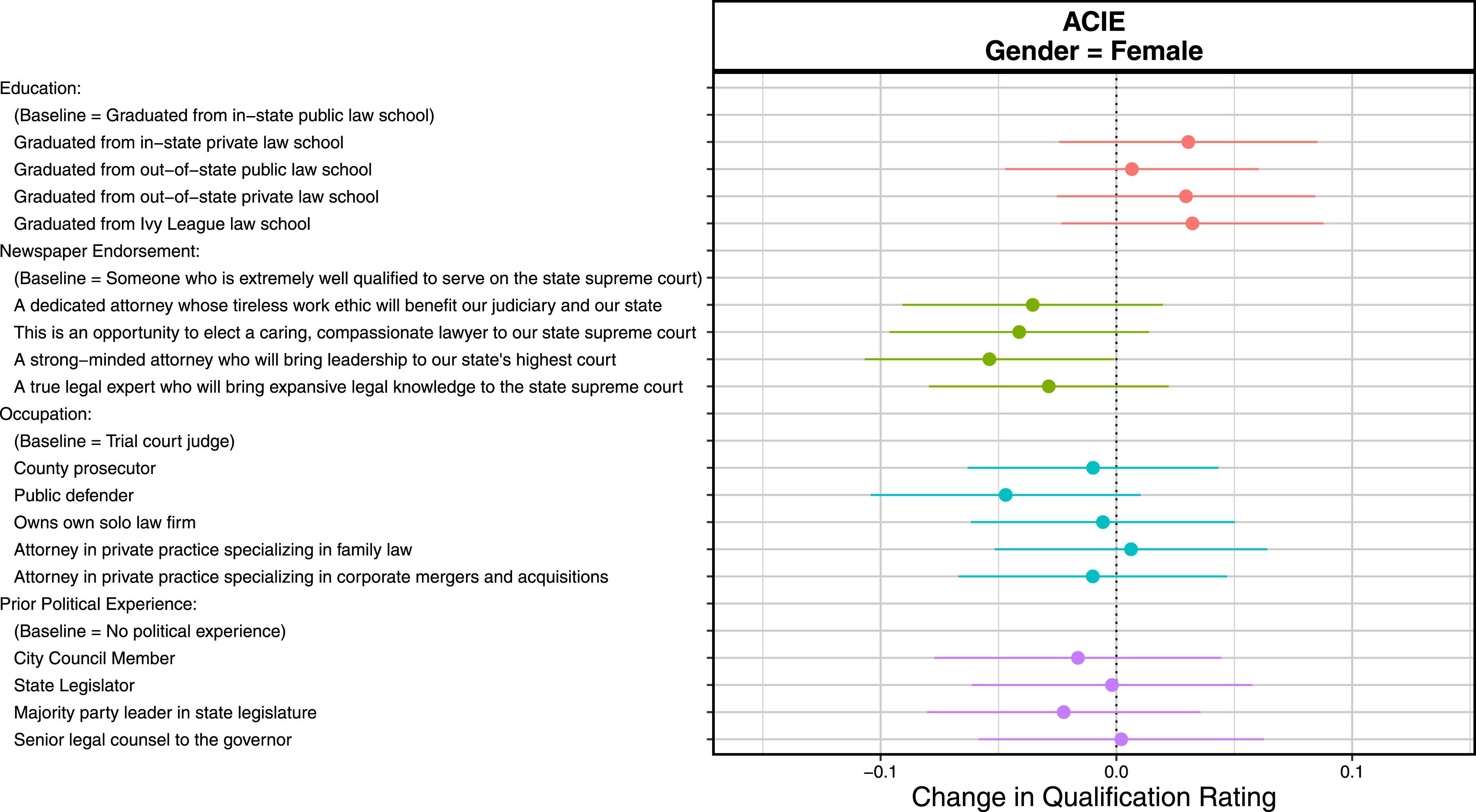
With regard to the qualifications rating outcome, we observe even fewer differences. In fact, the only statistically significant difference is that “strong-minded” female candidates endorsed for their leadership are less likely to be selected than male candidates with that characteristic.
These results point to the presence of minimal gendered stereotyping in these contexts while also underscoring that these effects are not ubiquitous: male candidates with experience in a male-dominated aspect of law receive no electoral or qualifications advantage, for example.
Conclusion
In this paper, we have tried to assess how candidate gender—and stereotypes related to gender—might affect voters’ evaluations of candidates in judicial elections. We find that female candidates are more likely to be selected than male candidates, though voters, on average, view female candidates as no more qualified than male ones. Further, we find that voters prefer judicial candidates with prior judicial and public service legal experience and, surprisingly, those that have prior political experience, especially at the state level. Importantly, however, we observe minimal instances of gendered stereotyping.
Although we can offer no conclusive evidence as to why women are broadly advantaged in these elections over their male counterparts, research on gender stereotypes and judicial politics more generally may provide some explanations. One possibility is that, just as citizens oftentimes view courts as “different” types of political institutions, so too might voters evaluate judicial candidates on different metrics than their legislative or executive ones. Huddy and Terkildsen (1993) note that masculine traits are preferred across the board when looking at politics broadly. But, looking just at the judiciary, it may be the case that feminine traits are preferred, and the persistent connection between politics and masculinity may disadvantage women in politics overall might be less present in judicial races (Dittmar 2015). As they think about concepts like justice and fairness, rather than the distributive concerns that are more present in other types of elections, perhaps voters in judicial elections want candidates who are compassionate, trustworthy, and considerate. While voters might want a candidate that can cut a deal on taxes or foreign policy, it may be the case that they are seeking a different type of person for judicial office. Unfortunately, our understanding of voters’ wants in judicial elections is less developed; there is a lot of ground in this field left to be covered. Our research suggests that judicial races may provide unique opportunities to understand the limits of stereotyping in electoral contests; studies that prioritize legislative and executive races are missing an important opportunity to test scope conditions of their theories.
The disjuncture between the qualifications and candidate choice results with respect to gender also caution against a simplistic understanding of judicial selection in which qualifications matter above all else. Just as voters may value candidates’ whose judicial philosophies or likely interpretations of the law may match their own, so too do voters seem value judicial candidates with a variety of life experiences, not just those “elite” experiences that traditional studies of judicial selection often prioritize. Of particular note here is our finding that candidates with explicitly political backgrounds are viewed as more qualified than those who seek judicial office without prior political experience. Clearly, our respondents were interested in more than just elite legal education and prior judicial office. Scholars should be, too.
Our survey experiment has several important drawbacks that future work may want to remedy. First, we have focused on nonpartisan judicial elections. This design decision allowed us to focus on gender and qualifications generally but had the drawback of prohibiting us from studying how partisan stereotypes might further complicate the effects of gender and qualifications in these elections. While some studies suggest that quality is an important factor in elections, including judicial elections, others assert that partisanship is the most essential factor in public evaluations of judicial nominees (Sen 2017). Yet, there are also stereotypes among partisans—both in terms of voters and candidates—that interact party identification with candidate gender, complicating our understanding of how partisanship affects voter perceptions of candidates with differing genders (Hayes 2011; Koch 2000). Typically, more feminine attributes and qualities are assigned to Democratic candidates than to Republican candidates, in a way that can benefit male Democratic candidates: they receive the positive effects of being associated with traditionally masculine characteristics because of their gender, and this can affirm the gender role match wherein men have corresponding masculine traits. Democratic men also benefit from the feminine qualities associated with Democratic candidates, which can lead them to be perceived as having traits like compassion or increased focus on collaboration (Hayes 2011). Studying these relationships in the context of judicial elections is an important pathway forward.
Second, the underrepresentation of people of color on state benches is even more pronounced than the underrepresentation of women. Racial or ethnic stereotypes, which may interact with gendered stereotypes, might provide one pathway toward understanding why state high courts lack these voices, just as the qualification standards for women of color differ for the federal bench (Moyer, Harris and Solberg 2022). Our experimental approach is particularly apt for this context since these candidates are likely to be particularly selective about when and where they seek judicial office, skewing observational studies even in those relatively rare cases in which these candidates seek office. Future work should try to unravel the extent to which voters judge these candidates differently than white candidates.
Third, conjoint experiments like the one we employ naturally set aside the important issue of political ambition: we randomize the presence of a female candidate. In the real world, gendered differences in ambition and willingness to endure the electoral process create disparities in the presence of female candidates, even given a welcoming electorate. Our results are therefore complicated in their external validity by the lack of female candidates running for these important offices in the real world.
Future work needs to understand the contextual and institutional features of state judiciaries that encourage female candidates to run for judicial office. It is one thing for studies like ours to show that female candidates perform well in judicial elections. It is another for voters to show up at the polls to see a ballot with female candidates listed for judicial office. Differences in political recruitment and ambition—which also loom large for potential judges (e.g., Badas and Stauffer 2023)—may also affect representation on state courts by affecting the opportunities for voters to see a woman candidate on the ballot. Studies of political ambition have long documented substantially different expectations and goals dependent on a potential candidate’s gender identity. Women, on average, are less likely to seek office, even when equivalently (and highly) qualified, relative to men (Fox and Lawless 2004). Moreover, differential candidate recruitment patterns by gender also affect women’s perceptions of their suitability for office: they are less likely to see themselves as qualified to run for office, and parties frequently entrench gendered socialization patterns through their support for candidates (Sanbonmatsu 2006).
Moreover, even if they are interested in running for office, many women face a distinct calculus when they determine whether or not to run for office. The “cost” for running for office is both distinct relative to men, and generally higher for women, in a number of ways, including perceptions of qualifications (as just discussed), managing traditional divisions of household labor with seeking political office, and motivation in seeking office. Many of these hurdles are defined by gender stereotypes, either directly or indirectly (Teele, Kalla and Rosenbluth 2018). Understanding differential candidate recruitment patterns in judicial elections is a topic ripe for additional research.
We close by underscoring that our results have important implications for reproductive rights as the U.S. Supreme Court has pushed the issue of abortion to the states with its Dobbs decision. Almost certainly, any abortion legislation passed at the state level will soon find its way to state supreme courts, and existing research suggests that men and women decide differently on issues that implicate sex or gender (e.g., Boyd, Epstein and Martin 2010). Therefore, understanding the barriers women face to judicial office is key to understanding the dynamics of reproductive rights in the United States. Our research suggests that, should women—especially those with backgrounds in politics or who have served as judges, prosecutors, or public defenders—run for office, they will find a welcoming electorate. And, especially in the coming years, they will face dockets that present important opportunities for substantive representation.
Supplemental Material
Supplemental Material - Gender Stereotypes and Candidate Qualifications in Judicial Elections
Supplemental Material for Gender Stereotypes and Candidate Qualifications in Judicial Elections by Megan Kennedy, Michael J. Nelson, and Erin Heidt-Forsythe in Political Research Quarterly
Supplemental Material
Supplemental Material - Gender Stereotypes and Candidate Qualifications in Judicial Elections
Supplemental Material for Gender Stereotypes and Candidate Qualifications in Judicial Elections by Megan Kennedy, Michael J. Nelson, and Erin Heidt-Forsythe in Political Research Quarterly
Footnotes
Acknowledgements
We thank the Department of Political Science and the College of the Liberal Arts at Penn State for supporting this research and Mirya Holman for feedback on an earlier draft.
Declaration of Conflicting Interests
The author(s) declared no potential conflicts of interest with respect to the research, authorship, and/or publication of this article.
Funding
The author(s) received no financial support for the research, authorship, and/or publication of this article.

Data Availability Statement
Data and code for replication purposes are available at https://doi.org/10.7910/DVN/JVIARV.
Supplemental Material
Supplemental material for this article is available online.