




Abstract
Despite high-profile arguments about the negative consequences of judicial elections for judicial legitimacy, empirical evidence is ambiguous, at best. Drawing on more than 28,000 survey responses, representative at the state level, we find no evidence that elected courts are less legitimate than appointed courts. To further explore this finding, we draw upon a survey of Wisconsin, a state that has experienced a large amount of politicized judicial campaigning. We demonstrate that citizens expect this type of activity in their elections, even though they say they dislike it. Then, we present new evidence on the causal effects of campaign activity on attitudes toward courts in this state. We demonstrate that, though citizens may believe that courts selected through expensive and negative elections are less fair, there is no evidence that they find elected courts to be less legitimate or worthy of compliance.
Institutions without legitimacy tend to be fragile, vulnerable, and often ineffective. Consequently, institutional structures matter. To the extent that institutions can be constructed in way that enhances, rather than undermines, their legitimacy, institutional vitality is assured. Therefore, how institutions are designed can have important political consequences. 1
Judicial scholars have long investigated this theory, contending that the public’s willingness to grant legitimacy to courts lies at the heart of judicial power and efficacy. Usually, the public’s allegiance to its judiciary is not expressly given: while presidents, prime ministers, and legislators can rely on electoral mandates as evidence of their approval and acceptance, most judges throughout the world are appointed to their position, never face voters, and are therefore denied the legitimacy that flows naturally from the ballot box. 2
This is not true, however, for most state-level judges in the United States. Judges in 39 states must face some sort of election in order to keep their seat on the bench, providing them with a direct linkage to their constituents. These are meaningful elections: studies have shown that this public accountability is associated with judicial behavior (e.g., Ash and MacLeod, 2021; Canes-Wrone et al., 2014; Gibson and Nelson, 2021; Hall, 2014; Kritzer, 2016; Nelson, 2014). Moreover, voters behave in judicial elections in ways that mimic their choices in other types of elections (e.g., Bonneau and Hall, 2009; Hall, 2001, 2015; Kritzer, 2015, 2020).
A major controversy in the debate over judicial selection mechanisms focuses on the legitimacy of courts. The American Bar Association, the Brennan Center for Justice, and various interest groups have all claimed that the use of elections undermines judicial legitimacy (e.g., American Bar Association, 2003). As the argument goes, elections—especially hard-fought ones featuring attack advertising and large amounts of campaign spending—diminish the “unique” position of the judiciary in the eyes of the public and thereby lessen the public’s esteem for the judicial branch (for summaries of these arguments, see Bonneau and Hall, 2009; Bonneau, 2018). These critiques align at least partially with academic research indicating that perceptions of judicial politicization are associated with decreased levels of institutional support (e.g., Gibson and Caldeira, 2009; Gibson and Nelson, 2017).
Unfortunately, however, there have been only limited comparisons of public attitudes toward elected and appointed state courts, and most of those studies are now dated, drawing from a time at which expensive campaigning was relatively new (and therefore dubbed “new-style”). Further, many of the studies that do exist tend to focus on types of public support, like confidence (Benesh, 2006; Kelleher and Wolak, 2007), that are different from institutional legitimacy, the “gold standard” form of support.
Our investigation draws upon Gibson and Nelson's (2025) massive survey of more than 28,000 respondents, selected to provide representative samples of the residents of each of the 50 states. These data, which include reliable and valid measures of state high court legitimacy, provide the best opportunity to date to assess differences in state court diffuse support according to the types of selection or retention systems. If decades of salient and politicized electioneering have taken the toll opponents of judicial elections have suggested, then there should be noticeable differences in the legitimacy of elected and appointed courts.
The results of our analyses of these surveys indicate that diffuse support judgments are not meaningfully related to methods of judicial selection or retention. Owing to the large sample size, we can be confident that any differences across systems are negligible; they are precisely estimated null effects.
To provide more in-depth evidence of the limited negative effects of elections on legitimacy, we fielded a representative 2024 survey of Wisconsin residents. By focusing on Wisconsin, we can assess how judgments of campaign activities affect diffuse support in a milieu in which years of salient electioneering have had the chance to take their toll: Wisconsin is perhaps the best-case context for testing whether elections have deleterious effects on legitimacy judgments. Analysis of a novel survey experiment shows that legitimacy judgments are unaffected by electioneering, even actions people say they dislike. Still, we do find some negative short-term effects of judicial campaigning: citizens lower their judgments of state supreme court performance in response to electoral activities they find distasteful, even if they do not withdraw legitimacy from the high court.
Our findings have profound implications for our understanding of the consequences of judicial selection and retention systems. If methods of selecting and retaining judges had the large and deleterious consequences for public support that their opponents have claimed, we should have found that decades of salient, politicized judicial elections have eroded the public’s support for these institutions. Yet, we unearth no evidence that elections have undermined diffuse support. Every method of judicial selection has merits and drawbacks. But, at least in the United States today, the creation of a legitimacy deficit for the state judiciaries does not seem to flow from electing judges.
Judicial Legitimacy and State Courts
Legitimacy (“diffuse support”) is a normative concept, having something to do with the right (moral and legal) to make decisions; institutions without legitimacy often find their authority contested. Grounded in democratic values and relatively stable (Nelson and Tucker, 2021), legitimacy differs from a second type of institutional attitudes (“specific support”) which indicates performance satisfaction and which changes more fluidly (Ansolabehere and White, 2020; Boston and Krewson, 2024; Haglin et al., 2021). Legitimate institutions are those recognized as appropriate decision-making bodies even when one disagrees with the outputs of the institution (Gibson, 2015). To be effective, courts need legitimacy—the leeway to go against public opinion when necessary.
Precisely because judicial legitimacy is so important, scholars, judges, and activists have debated for decades the consequences of judicial selection methods for the public’s support for their state courts (e.g., American Bar Association, 2003; Gibson, 2012). Unfortunately, not a great deal of research has been reported on public attitudes toward any state-level judicial institutions (but see, e.g., Wenzel et al., 2003; Kelleher and Wolak, 2007). Further, where scholars have been able to analyze public support for these institutions, they have tended to focus on the public’s institutional trust or confidence (e.g., Benesh, 2006; Benesh and Howell, 2001; Dupree et al., 2022; Kelleher and Wolak, 2007; Nownes and Glennon, 2015; Stone and Olson, 2025; Wenzel et al., 2003), a concept connected to but different from institutional legitimacy (Gibson, Caldeira, and Spence, 2003). 3
Perhaps the most directly relevant earlier attempt to measure state high court legitimacy in all 50 states is that of Cann and Yates (2016). Applying MRP to three diffuse support items asked in a 2012 national survey, the authors created a measure of the sociological legitimacy of each of the 50 high courts. However, as far as we know, their measure has not been used by scholars in other published work.
Drawing conclusions about the effects of selection systems on legitimacy is difficult because much of this literature is now quite dated. For example, the data from Benesh’s (2006) and Kelleher and Wolak’s (2007) well-cited studies of confidence in state courts comes from 1999, and the survey underlying Cann and Yates’s estimates was fielded in 2012. Consequently, these studies straddle the so-called “decade of change” in judicial elections from 2000 to 2010 in which campaign spending, negative advertising, and other modes of politicized campaigning increased (Sample et al., 2010). 4 In the more than a decade since Cann and Yates’s survey, expensive campaigning has become the norm in many states, with many of these contentious judicial elections receiving national news coverage. Fresh data are needed to understand whether decades of high-profile, politicized electioneering have affected public support for state courts.
How Selection Systems Might Affect Legitimacy
The lack of dispositive, recent data has not impeded claims about the effects of judicial elections for judicial legitimacy. For decades, scholars, judges, and activists have debated the consequences of judicial selection methods for the public’s support for their state courts. The most prominent arguments have suggested that the use of elections is associated with a reduction in judicial legitimacy (e.g., American Bar Association, 2003). Elections, after all, make courts seem less “special” and more part of “normal” politics; elections are the quintessential “political” way to select politicians in democratic polities. Moreover, the uniqueness of judges as apolitical policymakers in the eyes of the public could be expected to have eroded as elections have become more expensive, campaigning more negative, and judges have come to be seen as little more than “politicians in robes” (e.g., Gibson, 2011; Hall, 2015; Levendusky et al., 2024).
This argument has some basis in studies of public support for courts. For example, Gibson and Nelson (2017) and Gibson and Caldeira (2009) have shown that, as citizens perceive courts as more politicized, they extend less legitimacy to the judiciary (see also Nelson and Gibson, 2019). Moreover, in his studies of judicial elections specifically, Gibson (2008, 2009, 2012) has shown that negative advertisements, campaign contributions, and other trappings of modern campaigning are associated with hits to judicial legitimacy.
Still, many of these studies examine support for the U.S. Supreme Court, not state supreme courts, and Gibson’s studies of state judicial elections are based mainly on single survey experiments fielded at a time when salient and negative judicial electioneering was novel to most people. Unfortunately, we know little about how these effects translate into political environments in which voters regularly see and judge expensive and politicized judicial campaigns. Still, those findings would lead us to expect that decades of overt politicized campaigning in states that use judicial elections have gradually but significantly eroded these institutions’ levels of diffuse support.
However, other strands of research paint a more sanguine portrait of the effects of judicial elections on judicial legitimacy. For one, a widespread finding in studies of diffuse support is that “to know a court is to love it”: as citizens become more aware of courts, they tend to like them more (e.g., Gibson and Nelson, 2014). This is a core empirical finding undergirding positivity theory (Gibson and Caldeira, 2009). Regular elections for state judges both remind citizens that their courts are accountable and expose people to legitimizing symbols of legal authority (e.g., judges in their robes). Or, take Gibson’s (2012) arguments about the “net effects” of particular judicial campaigns. Some (but not all) people are offput by electioneering for judicial offices, and some types of campaigning may indeed reduce citizens’ legitimacy judgments. But, on the other hand, Americans like the idea of elections and accountability. Election activities by judicial candidates remind people that judges are elected by the people and that they are accountable to the people for their decisions. Gibson argues that the boost to judicial legitimacy from electing judges may help to buffer the negative effects of churlish campaigning activities.
Thus, there is at least some reason to expect that judicial elections might be associated with decreased levels of judicial legitimacy, but other arguments suggest that the consequences of elections on legitimacy might be overstated. And, the existing empirical evidence on this point is dated:Legitimacy Theory suggests that these early studies may have painted a time-bound view of the effects of electioneering on legitimacy. Institutional support generally declines through gradual processes of erosion; so too are gains in legitimacy the product of slow accumulation (e.g., Mondak and Smithey, 1997).
Therefore, a revealing way to understand the consequences of selection methods on legitimacy is to examine their effects on diffuse support after decades of politicized campaigning have had their chance to shape citizens’ institutional commitments. By looking at the condition of U.S. state court legitimacy in the 2020s, after more than two decades of commonplace politicized judicial selection and retention in the states, we have the opportunity to assess the consequences of this cumulated process. Specifically, if judicial elections do harm judicial legitimacy, then almost 25 years of negative television advertisements, policy talk, and high dollar electioneering should have taken their toll on state court legitimacy. We therefore turn to an analysis of whether variability in citizens’ support for their state high courts is associated with the method the state uses to select its judges.
Analytical Strategy
Research investigating the relationships between state-level institutional structures and public opinion toward those institutions traditionally focuses on the individual survey respondent as the unit of analysis. Most research does so because using the state as the unit of analysis would involve using tiny numbers of respondents in many if not most states.
Our investigation of the relationship between the use of judicial elections and judicial legitimacy benefits from a unique dataset. With a grant from CHIP50, Gibson and Nelson (2025) were able to field a handful of questions in a 50-state survey conducted in November/December 2023 (see Online Appendix A for details). In total, 28,177 interviews were completed (excluding District of Columbia residents). The average number of respondents per state is 564 (standard deviation = 224; median = 513).
Our research design therefore allows us the luxury of conducting analyses at both the state level and the level of the individual survey respondent. The advantage of using the state as the unit of analysis is that each state’s selection system contributes equally to our overall conclusions. After all, our main hypothesis could easily be stated as: For states in which the justices of the high court are elected, the residents of each of these states ascribe [little/equal/more] legitimacy to their court of last resort. Testing this hypothesis requires that we treat Wyoming and New York as equal units of analysis. 5
Conducting analysis at the state level is expensive (and hence quite rare) and also makes it difficult to control for various cross-state differences in attributes that might be related to willingness to extend legitimacy to the high court (e.g., respondent’s race). Analysis at the individual respondent level easily allows for multiple controls and is especially warranted when each state contributes significantly to the overall number of respondents in the survey. And when state-level and individual-level findings converge, as they do in this study, one can ascribe even greater confidence to the veracity of the conclusions.
Measurement
We focus on two types of public support for courts. First, following Nelson and Gibson (2020), we measured specific support using a standard performance satisfaction question. Generally, people approve of the job being done by their state supreme court, with more than two-thirds rating their court as either doing a great job or a pretty good job. Only 5.9% say their court is doing a poor job.
Second, the measure of institutional support we use throughout this analysis is the state’s average response to the six diffuse support items. Following earlier state-level research, we adapted the standard measures of U.S. Supreme Court legitimacy developed by Gibson and his colleagues to the state context (See Online Appendix A for question wordings.). The item-set has strong psychometric properties. The average Cronbach’s alpha across the fifty states is 0.84 (standard deviation = 0.02), with a state-level range from 0.76 to 0.88.
6
Regarding validity, results from a Common Factor Analysis indicate a unidimensional scale; the maximum observed second-dimension eigenvalue is 0.91. Moreover, each of the items loads strongly on the first extracted factor. In fact, in only three states are there any item loadings less than 0.50. Thus, our analysis provides impressive evidence of the reliability and validity of the measures in each state. The measure of institutional support we use throughout this analysis is the state’s average response to the six diffuse support items, shown in Figure 1. Diffuse support for the state supreme courts. Notes. Shown are the average levels of diffuse support, by state. The bars are shaded according to the selection system a majority of that state’s residents believe is used. For the text of the six items, see Online Appendix A. Data for the 50 state high courts comes from the CHIP50 survey; data for the U.S. Supreme Court comes from the July 2024 YouGov survey.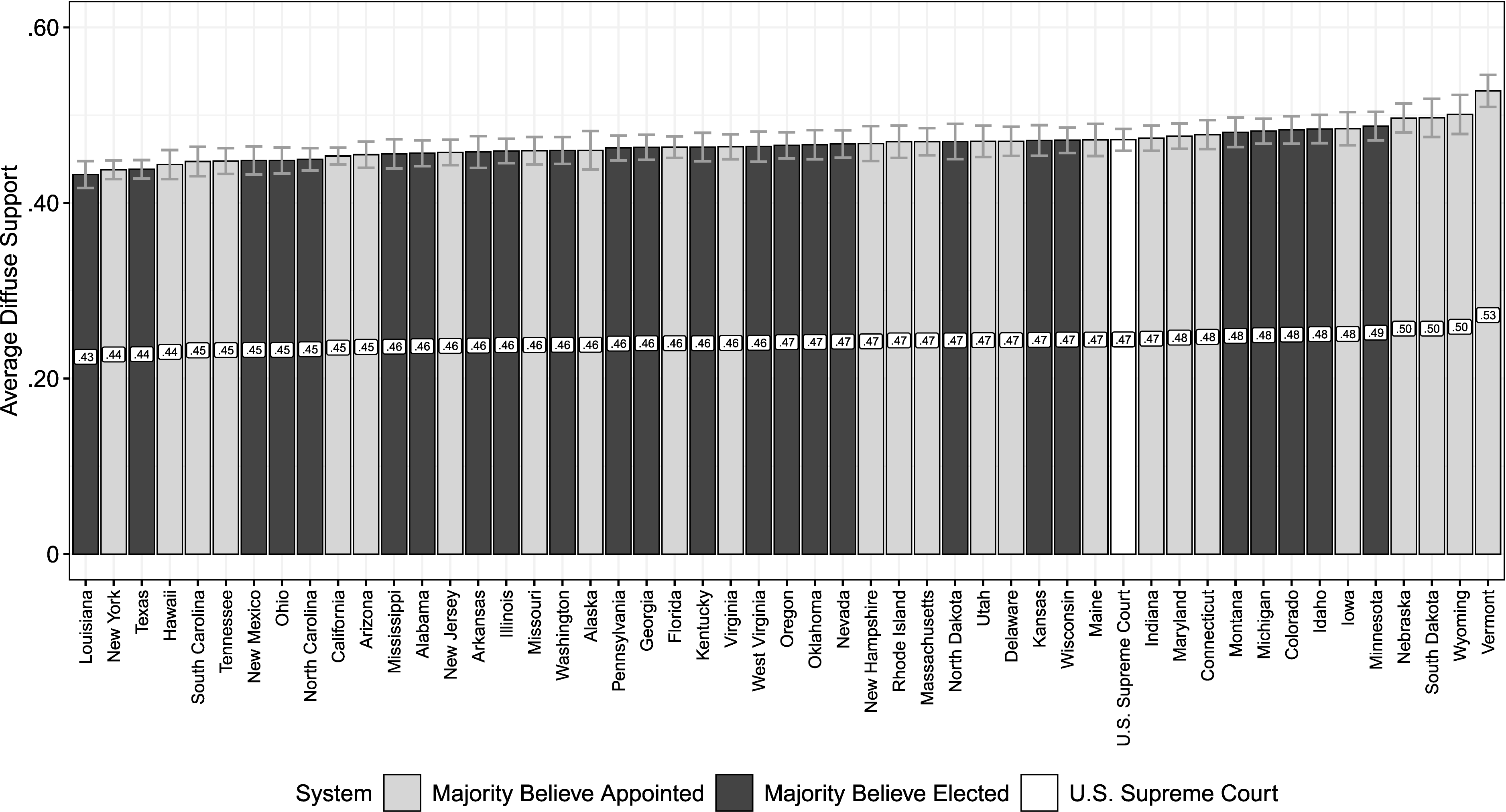
Figure 1 also reports the method of selecting high court judges (as perceived by the residents of the state—see below). Were it the case that elections were associated with a decrease in diffuse support, the expected pattern in this figure would be a cluster of dark gray bars on the left-hand side of the figure with lower averages than a corresponding group of lighter gray bars on the right-hand side. Even a cursory examination of the state high court legitimacy scores suggests that legitimacy is not at all closely associated with the method of selecting judges, although more rigorous analysis is of course necessary.
To provide some context for the scores reported in Figure 1, we can compare the state high courts to the U.S. Supreme Court using the same measures from a nationally representative survey conducted by YouGov in July 2024, about 6 months after our CHIP50 survey (also reported in Figure 1). Though we acknowledge that the Supreme Court’s legitimacy has suffered since Dobbs (e.g., Gibson, 2024b, 2024a), it is not the case that the U.S. Supreme Court’s level of support is a great deal higher than the level of loyalty enjoyed by the state supreme courts. Only 13 of the 50 state supreme courts have a level of diffuse support that is statistically distinguishable from the U.S. Supreme Court at p < .05. And, the 50-state average value of high court legitimacy is not significantly distinguishable from the average value of U.S. Supreme Court legitimacy.
Model Specification and Results
Armed with a very large representative sample, valid measures of support for state high courts to use as outcome variables, and information about the perceived method of selection for the respondents’ state supreme courts, we can test the effects of selection method on institutional attitudes.
We assess the effect of selection method on support for state high courts using a multilevel linear model that includes a random effect for the respondent's state. These random effects can account for state-level heterogeneity given characteristics (like region, political climate, and culture) that do not vary within state. We estimate separate models for the two outcomes: (a) citizens’ level of performance satisfaction and (b) their level of diffuse support for their state supreme court.
Our independent variable of interest is a state’s method of selecting and retaining justices. Here, we draw a distinction between actual and perceived measures of this attribute. To determine a state’s actual (formal) method of judicial selection and retention, we turned to the Book of the States (Council of State Governments, 2023). 7 Regarding perceptions of selection method, we rely on a question asking respondents whether the justices of their state’s high court are elected or appointed to the bench. Of our respondents, 50.8% indicated that their state supreme court justices were elected; 49.2% said they were appointed. About three-fifths of respondents correctly know whether their state appoints or elects its judges (see Online Appendix B for more details).
Given the myriad reasonable ways one might classify states’ selection systems, we use five different specifications of selection method to assess the robustness of our results: • Specification 1 uses the respondent’s perception of the court's selection method, with a binary variable that indicates whether or not they believe their state supreme court is elected. • Specification 2 uses a binary variable indicating whether judges on the state supreme court are formally selected by elite appointment. The baseline is (all) elected courts. • Specification 3 uses a categorical variable which indicates whether judges on the state supreme court are formally (a) retained by reappointment or (b) serve until mandatory retirement. The baseline is (all) elected courts. • Specification 4 uses a more granular coding scheme than Model 2, focusing on selection. Judges formally selected by nonpartisan election, gubernatorial appointment, and legislative appointment are compared against partisan elections as a baseline. • Specification 5 uses a more granular coding scheme than Model 3, focusing on retention. Judges formally retained by nonpartisan election, retention elections, gubernatorial appointment, legislative appointment, commission reappointment, and no reappointment (mandatory retirement age) are compared against partisan elections as a baseline.
Thus, we estimate ten models: five specifications for two outcome variables. We control for respondents’ demographic attributes (education, gender, race, income, urban/rural, age) and political views (the respondent's party identification and partisan alignment with the governor) 8 as well as respondents’ level of awareness of their state high court. In the diffuse support models, we also control for specific support. All variables range from 0 to 1 (for summary statistics, see Online Appendix A).
Multilevel Linear Regression Results
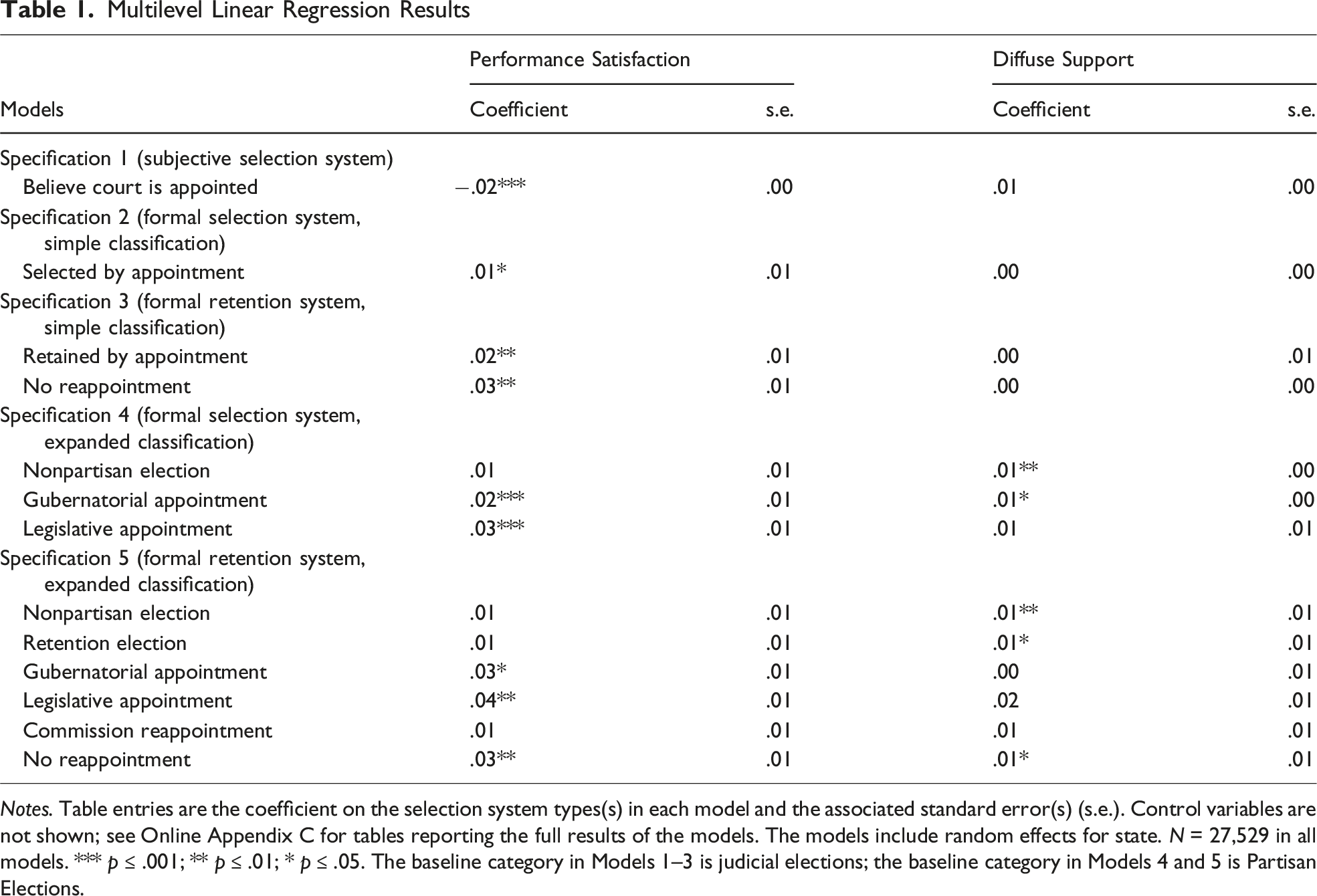
Notes. Table entries are the coefficient on the selection system types(s) in each model and the associated standard error(s) (s.e.). Control variables are not shown; see Online Appendix C for tables reporting the full results of the models. The models include random effects for state. N = 27,529 in all models. *** p ≤ .001; ** p ≤ .01; * p ≤ .05. The baseline category in Models 1–3 is judicial elections; the baseline category in Models 4 and 5 is Partisan Elections.
Second, turning to diffuse support, we generally observe statistically and substantively null results. With regard to the subjective measure of selection system, in Model 1, there is no evidence that respondents who think their court is elected see it as less legitimate, perhaps the clearest test of our hypothesis. Looking at the other models, which use the actual method of selection or retention system in the state, we observe some statistically significant coefficients of .01. But with diffuse support measured on a 0–1 scale, this coefficient corresponds with a 1% change in the outcome variable. Given that the diffuse support index is composed of six items, each measured on a five-point scale, the largest of these coefficients is associated with far less than a change of a single scale level on a single indicator: a decidedly null effect.
Although not reported in Table 1 (see Online Appendix C), the size of these effects is also smaller than many other important predictors of legitimacy. The effect of selection method is smaller than educational attainment’s effect or a respondent’s copartisanship with the governor and is similar in size to the effect of the respondent’s income, hardly a longstanding important predictor of support for courts. In short, no matter how one codes selection or retention system, there is no evidence that performance satisfaction or diffuse support is associated in any substantively meaningful way with perceived or actual methods of selection.
Judicial Electioneering Today
It is one thing to find evidence that citizens who believe their state high court judges are elected, on average, rate those courts as legitimate as their peers who believe their state high court judges are appointed. It is another thing to suggest that elections themselves do not blunt judicial legitimacy. This latter point is perhaps surprising given the findings of Gibson (e.g., 2008 and 2012) that particular features of “new-style” campaign activity take away from support for courts. Why, then, have those deficits not accumulated over election cycles into negative consequences for judicial legitimacy?
It seems clear that the “new-style” of judicial campaigning is no longer new. It is easy to imagine that when hardcore electioneering first began—the period of time about which we know the most about the effects of judicial campaigns on judicial legitimacy and during which the arguments about the positive and negative effects of elections on legitimacy were formulated and initially tested—many constituents were surprised (if not shocked) by seeing the “new-style” of campaign activity (e.g., Gibson, 2008, 2012). “Old-style” campaigning might have included advertisements announcing endorsements from various groups, but “new-style” activities often bear a striking resemblance to the electioneering of candidates for ordinary political offices and politicized Supreme Court confirmation hearings (e.g., Gibson and Caldeira, 2009). Today, judicial campaigns carry little of that “shock-value” for citizens.
Repeated exposure to politicized electioneering represents a form of habituation. As Koch (2017, 231, citations omitted) summarizes the theory: When habituation occurs, the stimulus is processed peripherally . . . Recipients no longer involve themselves as intensely with the stimulus, dedicating less attention and processing time to repeatedly presented stimuli . . . This does not mean that recipients no longer perceive the stimulus, but rather that, since the stimulus no longer offers any novelty value, they require less time to encode it and also have less motivation to process it . . . As a result, arguments such as advertising slogans fade into the background, while peripheral cues gain importance.
As applied to judicial elections, the conclusions of many of the early studies of the effects of campaigns came from a time when Americans could not have been habituated to politicized judicial campaigning. Now, we suggest, they may be.
People no doubt may not like particular features of judicial campaigns. But Americans understand that activities such as negative advertisements and campaign contributions are the cost they must pay for the ability to select their own high court judges. And, because these activities are common, they do not provide negative “unjudicial” associations that would harm loyalty to state courts. Put differently, because citizens widely accept campaign activities as a normal and typical aspect of judicial campaigning, the ability of campaign activities—and therefore of judicial elections generally—to undermine diffuse support may have become quite limited.
Campaign Activity and Judicial Legitimacy in a Politicized Context
To understand the effects of vigorous campaign activity today, we turn to a 2024 representative survey of Wisconsin residents to marshal two types of evidence. First, we present descriptive data to demonstrate that citizens now expect and accept many elements of politicized judicial campaigns. Second, we draw upon an experiment embedded in the Wisconsin survey (fielded in partnership with Verasight) to estimate the causal effect of disliked campaign activities on support for the high court. 9 If our argument is correct, we should expect to see that, while disliked campaign activities decrease short-term evaluations of state courts, these activities are unable to affect legitimacy judgments.
The Wisconsin Electioneering Survey
Wisconsin is an ideal case to understand the effects of modern judicial electioneering. Indeed, the Wisconsin Supreme Court is arguably the most interesting state supreme court in the United States, nearly overturning the results of the 2020 presidential election in Wisconsin and flipping—in the most expensive judicial election in U.S. history (Ewall-Wice, 2023)—from 15 years of a conservative majority to a liberal majority in 2023. Abortion was perhaps the single most important issue in that 2023 campaign, with news outlets suggesting that “[t]he fate of abortion access in battleground Wisconsin likely rests with [the] outcome of the heated race for state Supreme Court” (Le, 2023). In few states has the process of selecting state high court judges become more politicized than Wisconsin.
Importantly, the Wisconsin Supreme Court is salient to citizens in this state: 64.5% of our respondents said they were “very aware” of the court, and less than 1% of the respondents said they had “never heard of” it. We put to the respondents a standard 3-item judicial knowledge battery (e.g., Gibson and Nelson, 2015) that included (a) whether Wisconsin justices serve for life or set terms, (b) whether justices are elected or appointed, and (c) which institution has the “last say” on the meaning of the Wisconsin constitution. Only 2.5% of the respondents answered all three questions incorrectly, and a majority of the respondents (53.6%) answered all three questions correctly.
As further evidence of the salience of the Court, we asked a series of questions about the 2023 Wisconsin Supreme Court election which attracted widespread national and local media attention and took place 15 months before our survey went into the field. Overall, 55.8% of the respondents said they remembered either “a little” or “quite a bit” about the election. Two-thirds (67.7%) of the respondents said that the candidates’ activities in that campaign were at least “somewhat acceptable.” Only 4.9% of the respondents said that the actions of the candidates in that election were “not acceptable at all”—a small number given widespread condemnation by pundits of statements made by Janet Protasiewicz pre-committing to providing a pro-choice vote if elected. Nearly two-thirds of the respondents (62.4%) correctly identified Protasiewicz as the candidate who advertised herself as more liberal, and 63.8% of the respondents correctly recalled that Protasiewicz was the winning candidate in that contest. Further, the respondents varied significantly in their involvement with the campaign; while only 3.3% said that they donated to a campaign, 60.4% recalled watching television advertisements during the campaign, and 69.8% reported voting in the election (although, of course, self-reports of previous voter turnout are always inflated). Of the voting respondents, 33.0% said that they cast their ballot for Daniel Kelly (the conservative candidate), and 46.6% said they voted for Janet Protasiewicz. The remaining respondents either said they voted for a different candidate or could not remember their vote. In short, we have a variety of evidence that these respondents were both highly aware of the Wisconsin Supreme Court and campaign activities in Wisconsin Supreme Court elections.
While the 2023 election makes the Wisconsin Supreme Court a particularly salient judicial institution, the court is not noteworthy in its level of institutional support. In terms of our index of state high court legitimacy (Figure 1), the Wisconsin Supreme Court enjoys roughly average legitimacy. Thus, our selection of this state fulfills something of a “Goldilocks” criterion: the court is prominent enough for respondents to give meaningful survey responses but not at all an outlier in the level of support it enjoys from its constituents. This makes it possible for us to test in a realistic context our hypotheses about the effects of politicized campaigning on public support for state courts, thereby boosting the external validity of our experiment.
Attitudes Toward Campaign Activity
Our argument suggests that people accept as an empirical fact that judicial elections will have many of the trappings of modern political campaigns, so electioneering activities do not bring to mind “nonjudicial” associations that damage legitimacy judgments. We know from studies of presidential and legislative elections that people often dislike many aspects of modern electoral politics: they dislike negative ads or think money plays too big of a role in electioneering (see, for example, Nai and Maier, 2021). While some previous studies have examined citizens’ expectations of good judging (e.g., Gibson, 2012; Gibson and Caldeira, 2009; Kritzer, 2021), we know little about what citizens today think is typical—or what ought to be—in judicial campaigns.
We predict that citizens expect that many features of modern legislative and executive campaigns will also be commonplace in judicial elections, and therefore they have little shock-value. To this end, we asked, “Suppose that, in the future, there is an election for judges on the Wisconsin Supreme Court. Which of the following would you expect to happen in that election?” Respondents were presented with the following list and asked to select all that apply: • Television ads criticizing the candidates. • Spending by interest groups from outside Wisconsin. • Candidates participating in televised debates. • Candidates saying how they would vote on important legal issues, like abortion or gay rights. • Candidates seeking donations to their campaigns. • Candidates seeking endorsements from various organized groups. • Candidates endorsing people running for other elected offices.
Figure 2 summarizes the responses to these items. Note the high percentages expecting the campaign activities nearly across the board. There are only two activities—endorsing others and televised debates—that a majority of respondents do not expect to see in an upcoming election (and one of them—debates—has long been a feature of many, if not most, Wisconsin Supreme Court campaigns).
10
Perhaps most tellingly, more than two-thirds of the respondents expected judicial candidates would pre-commit their positions on policies that come before the court. In short, there is broad evidence that these campaign activities are seen as routine—at least among citizens in a state with highly salient judicial elections. Wisconsin residents’ expectations of various types of judicial electioneering. The data come from a Verasight survey of Wisconsin residents, Summer 2024. N = 1002.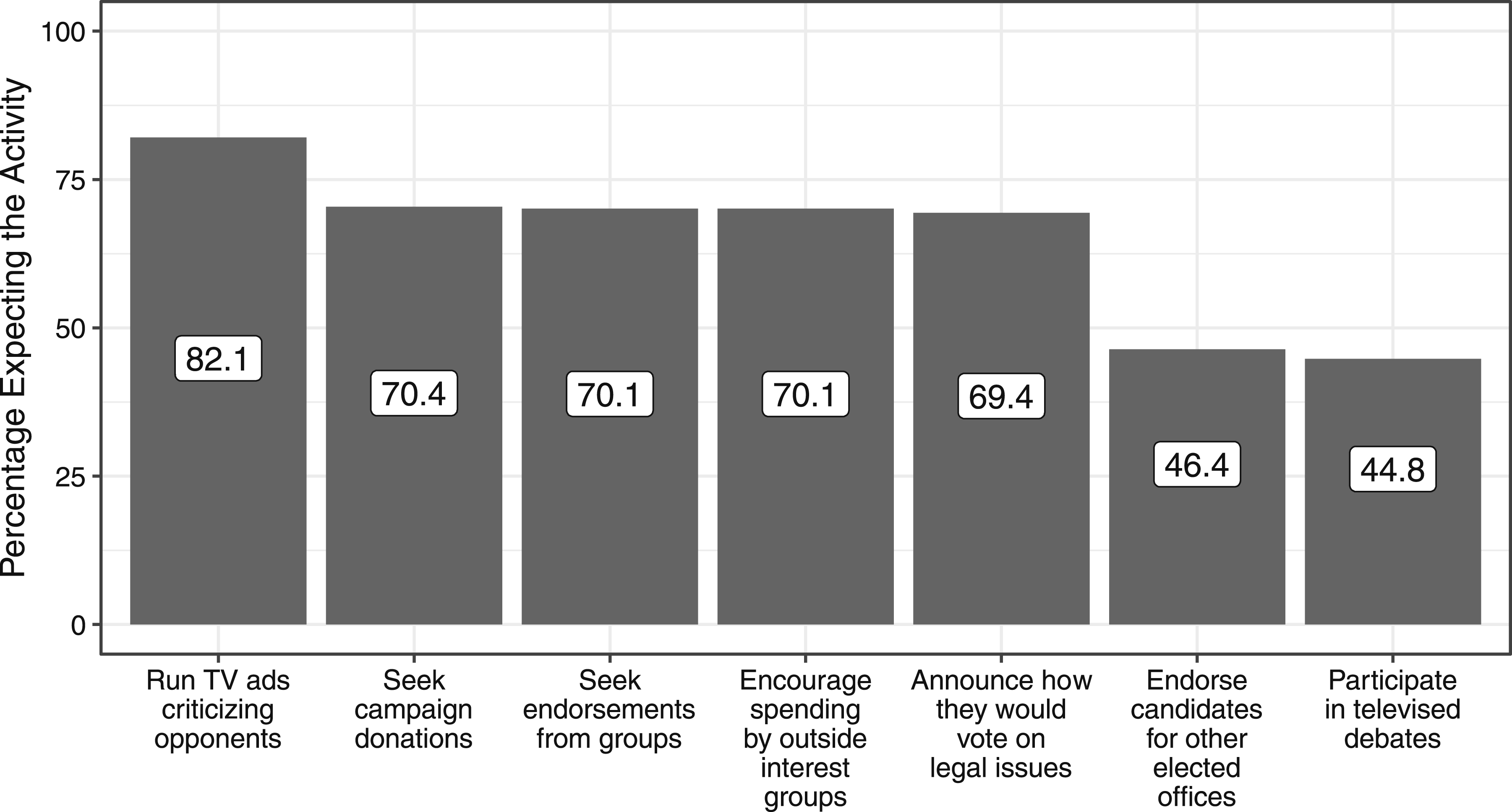
People likely differ in how they rate various campaign activities, with some expecting campaign activities to take place but still disliking them. Consequently, we asked the respondents their evaluations of the seven campaign activities we addressed above, with Figure 3 reporting the percentages of respondents approving of these activities. There is great variation, ranging from the widely condoned debates to the widely disapproved of encouraging campaign spending by outside interest groups—but with many activities in-between in the evaluations they attract. Nearly all respondents (96.1%) approved of at least one of the activities, just as nearly all respondents (95.2%) disapproved of at least one of the activities. While decades of judicial reform efforts have sought to limit the ability of candidates to communicate their policy positions to the public—through the use of nonpartisan elections or restrictive speech codes that censor judicial candidates (at least until White)—our survey data indicate that citizens both expect their candidates to tell them how they would vote on important issues and want them to do so.
11
Wisconsin residents’ approval of various types of judicial electioneering. The data come from a Verasight survey of Wisconsin residents, Summer 2024. The percentage of respondents “disapproving” or “strongly disapproving” of the activity is simply 100% minus the percentage shown in each of the bars of the graph. N = 1002.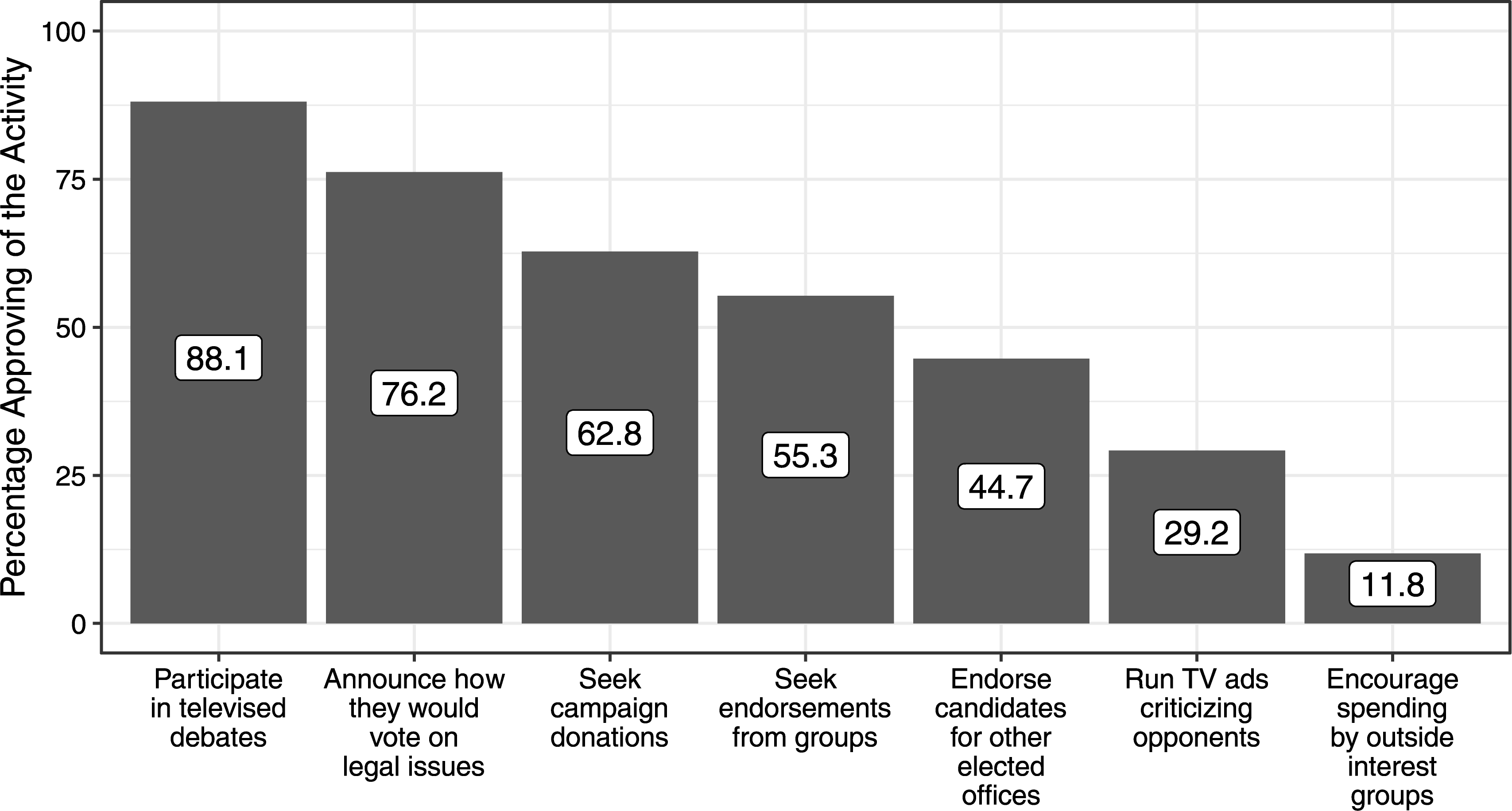
The Electioneering Experiment
As we have just noted, we asked the respondents whether they approved or disapproved of seven different types of electioneering activities. We then incorporated the evaluations of these activities in an electioneering experiment. The key comparison we make is of the difference in support for the Wisconsin Supreme Court among those who read of a court comprised of justices who reached the bench through respondent-approved electioneering activities compared to those who got their seats through activities the respondent found distasteful. Thus, we compare activities that the respondents themselves said they dislike against activities that the respondents themselves said they liked. Comparing liked and disliked activities creates a sizeable but realistic hypothesized gap between the two experimental conditions.
If there is no difference in legitimacy judgments among citizens who read about a court staffed through disliked means and those who read of a court whose justices came to the bench through approved campaign activities, then we would have strong evidence that electioneering does little to undermine legitimacy judgments. Our desensitization hypothesis is that court attitudes, particularly more durable ones such as diffuse support, do not vary according to whether the respondents are primed to think about approved or disapproved campaign activities.
Some types of legal attitudes are more malleable than others. As a consequence, the effects of selection mechanisms may influence some institutional attitudes but not others. Citizens may strongly dislike some aspects of judicial campaigns, like attack advertising or accepting campaign contributions, and these activities might detract from people’s short-term support for courts—their performance satisfaction or fairness judgments. But, on average, we hypothesize that they have no longer-term effects on the more obdurate attitudes: legitimacy-related views. Because this latter type of attitude is more firmly grounded in longer-term, more stable values (e.g., Mondak and Smithey, 1997), diffuse support should be more resistant to change. Thus,
For performance satisfaction/fairness—more malleable, short-term attitudes—campaign activities might have deleterious effects, with citizens disliking judicial electioneering lowering this type of support.
For legitimacy/acceptance—more global and obdurate attitudes—these sorts of activities are unlikely to have as much effect on these institutional attitudes.
Experimental Design
From the replies to the seven activities shown in Figure 3, we identified each respondent’s two most approved and disapproved activities. For the vast majority, we were able to identify two approved activities (90.0%) and two disapproved activities (88.4%). For those with fewer than two approved activities, we supplemented their responses with one or two activities we assumed everyone would find acceptable: (1) “candidates speaking to community groups about their legal philosophies,” and (2) “candidates supporting a ‘get-out-the-vote’ drive.” For those with fewer than two disapproved activities, the supplemental items we assumed everyone would reject are: (1) “candidates promising to decide cases the way the Wisconsin governor wants,” and (2) “candidates who accepted campaign contributions from everyone, including from lawyers who had cases pending before the Wisconsin Supreme Court.” With the responses to the seven items and, where necessary (for a very small percentage of respondents), the supplemental activities, all respondents were scored as having two approved and two disapproved activities. 12
We then randomly assigned the respondents to be asked about one of two types of electioneering activities: either approved activities (36.3%) or disapproved activities (63.7%). We “unbalanced” the distribution because we expect to be able to learn more from objectionable activities than from acceptable activities. The treatment is formatted as follows:
13
Imagine that, after the future election we have been talking about is completed, the Wisconsin Supreme Court is made up of judges who got their seats on the bench via campaigns in which they [ACTIVITY 1] and they [ACTIVITY 2].
We use four indicators of court attitudes as outcomes: performance satisfaction (Nelson and Gibson, 2020), perceived fairness, Gibson, 2024a measure of diffuse support, and a standard measure of acquiescence (full question wordings in Appendix A). The inter-item correlations range from .01 to a maximum of .39; these four measures are clearly measuring separate aspect of attitudes toward the institution. 14 Our specific expectation is that we might observe statistically significant differences for the first pair of outcomes but not the second: elections affect short-term evaluations of the institution but not more obdurate ones (Boston and Krewson, 2024; Gibson and Nelson, 2025). 15
Results
The Effects of Judicial Electioneering on Court Attitudes
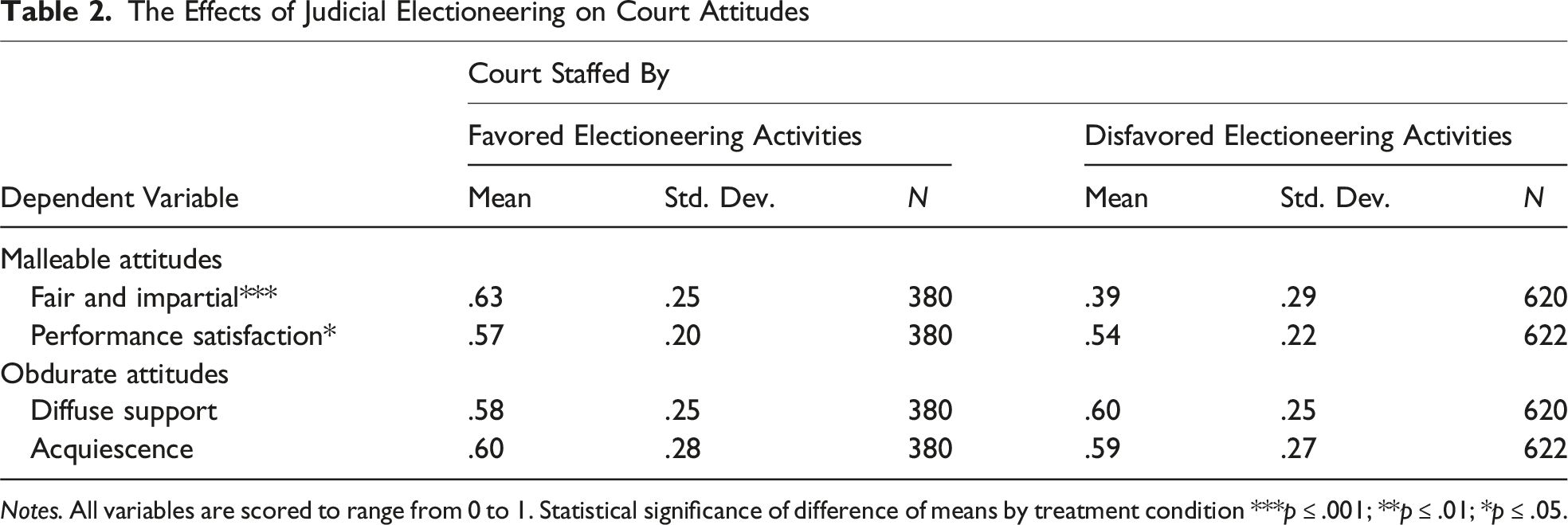
Notes. All variables are scored to range from 0 to 1. Statistical significance of difference of means by treatment condition ***p ≤ .001; **p ≤ .01; *p ≤ .05.
Second, regarding performance satisfaction, the difference between activities is smaller (only 0.03) but is still statistically significant (p = .01). Approval of the court is lower when it is staffed through more disfavored types of campaigns; however, the difference in performance satisfaction is so small as to border on the trivial, with the difference being far less than a single scale point in the measure of that outcome variable.
Finally, for both diffuse support (a .02 difference) and acquiescence (a .01 difference), we find no statistically significant difference according to treatment assignment. Thus, as we expected, we observe no indication that judicial elections—even those with electioneering activities the respondents disapprove of—are associated with a reduction in legitimacy. This finding supplements our observational analysis. Further, respondents are no more likely to report they would refuse to accept decisions by a court staffed through disliked electoral activities. 16
The major inference we draw from our analysis of the Wisconsinites is that they widely view campaign activities as a routine part of the electoral process, even as they dislike many of those activities. Moreover, while we find some evidence that people may say that a court staffed through disfavored campaign activities is less likely to be fair, none of the results for the other three court attitudes are substantively significant (and, for legitimacy and acquiescence, the difference is also not statistically significant). At the same time, we do not doubt that, over the long haul, detrimental effects on specific support and senses of unfairness might wind up undermining institutional support. In short, however, it does not seem that campaign activities do much to affect people’s judgments of their state supreme courts, just as our theory predicts.
Discussion and Concluding Comments
Our analysis is based on a measure of diffuse support at the state level drawn from representative state-level samples. In our observational analysis, we found no evidence across a variety of different classifications—actual and perceived—of judicial selection/retention systems that the use of judicial elections is associated with a substantively meaningful difference in people’s approval of their state high court or their willingness to ascribe legitimacy to it. Then, drawing on a survey of Wisconsin residents, we presented evidence that those who live in a state with a recent history of salient judicial campaigns see the trappings of modern judicial campaigns as routine. Finally, we compared respondents who read of a court staffed through approved electioneering means to those who read of a court staffed through activities the respondent disfavored. While we found some evidence that respondents see courts staffed through disfavored activities as less fair or impartial, we observed no evidence that they see such courts as less legitimate or as less deserving of compliance.
Our results stand in contrast to some other studies of the effects of judicial elections (e.g., Cann and Yates, 2016; Gibson, 2009, 2012; Woodson, 2017; Gibson et al., 2011) conducted in previous decades, when television advertising and large amounts of campaign fundraising were more novel (e.g., Bonneau and Hall, 2009; Hall, 2015). One interpretation of our results is that some of these existing studies are time bound: whereas activities like negative campaigning might have been seen as “unjudicial” in the 2000s, therefore undermining judicial legitimacy, these same activities have been common for many election cycles, dulling their ability to affect judgments of state high courts.
Put differently, if methods of judicial selection or retention had the large and important consequences for public support so often claimed, decades of rough-and-tumble judicial elections should have eroded the public’s support for these institutions in those states using elections to staff their courts. Yet, we find no substantively important differences across types of selection/retention regimes. These selection/retention systems do matter: they affect the public’s relationship to the judiciary and the behavior of judges on the bench, and we think it likely that particular events (especially contentious appointments or elections) might have important shorter-term consequences for public support (as our experiment suggests). But, in terms of institutional legitimacy—the ultimate basis of judicial power—these selection mechanisms appear to have had little long-lasting effect. At least as of 2024.
Our study suffers from some obvious shortcomings that future research should address. Most serious is the lack of temporal data to understand when and how citizens’ attitudes about judicial campaigning might have changed over the past three decades. Our analysis looks at a process in extremis: Wisconsin. Like most research on the evolution of cultural norms, we posit that a process of desensitization has taken place over time even though we have no direct evidence of changing expectations and assessments. In essence, our assumption is that when politicized electioneering was new, people saw it as “new-style” and reacted to it; over time, they became desensitized to this sort of activity. Unfortunately, however, there is no direct evidence we could collect that would allow us to chart citizens’ changing attitudes. After all, a major empirical advance in this paper is that we rely on the first-ever measure of high court legitimacy for each of the fifty states drawn state-representative samples. That means, by definition, there are no comparable measures or surveys from earlier days that we could mine to gather temporal data to test how these norms have changed over time.
We generally conclude from this analysis that institutional structures and attributes matter. In our specific case, it seems that those who seek greater popular accountability from state courts can advocate for judicial elections with the knowledge that institutional legitimacy is unlikely to be compromised. Conversely, of course, those who advocate for judicial appointments should acknowledge that appointed mechanisms for state high court judges do no better than elected mechanisms in terms of generating and sustaining institutional legitimacy. Institutions matter, but how they matter cannot be discerned without rigorous empirical inquiry of the sort presented here.
Supplemental Material
Supplemental Material - Institutional Structures and Judicial Legitimacy
Supplemental Material for Institutional Structures and Judicial Legitimacy by Michael J. Nelson and James L. Gibson in Political Research Quarterly.
Footnotes
Acknowledgments
We thank Andy Stone, Ali Yanus, Ellen Key, Mike Salamone, Kirsten Widner, Amanda Driscoll, Morgan Hazelton, and Jay Krehbiel for helpful comments on an earlier version of this paper and Morrgan Herlihy for helpful research assistance.

Ethical Considerations
The Wisconsin survey was reviewed and approved by the Washington University in St. Louis Institutional Review Board. The IRB judged this project to be in the “exempt” category. Respondents indicated consent for participation at the beginning of the survey.
Funding
The author disclosed receipt of the following financial support for the research, authorship, and/or publication of this article: The national survey was supported by the CHIP50 Research Program: James L. Gibson and Michael J. Nelson. Co-Principal Investigators. “State Supreme Court Legitimacy: Measurement and Connections to Abortion Rulings.” The Civic Health and Institutions Project, a 50 States Survey (CHIP50) 2023–2024. The Wisconsin survey was conducted in partnership with Verasight with support from a grant from the Center for the Study of Federalism. The YouGov survey was conducted with support from the McCourtney Institute for Democracy and the College of the Liberal Arts at Penn State.
Declaration of Conflicting Interests
The author declared no potential conflicts of interest with respect to the research, authorship, and/or publication of this article.
Data Availability Statement
Data and code for replication purposes are available on Dataverse: https://doi.org/10.7910/DVN/Q0J796 (Nelson and Gibson, 2025).
Supplemental Material
Supplemental material for this article is available online.
Notes
References
Supplementary Material
Please find the following supplemental material available below.
For Open Access articles published under a Creative Commons License, all supplemental material carries the same license as the article it is associated with.
For non-Open Access articles published, all supplemental material carries a non-exclusive license, and permission requests for re-use of supplemental material or any part of supplemental material shall be sent directly to the copyright owner as specified in the copyright notice associated with the article.
