




Abstract
Political participation is socially distorted: Socio-economic resources affecting the probability of individuals becoming politically active question the principle of political equality. Such inequality in participation based on social stratification is well documented for elections, while research on inequality in referendum participation is still scarce. Based on the observation that such inequality varies between referendums, this paper explores referendum-specific contextual factors that may affect socially distorted referendum participation. We leverage information from an original dataset covering 1788 districts in 35 German municipalities for 68 local referendums held between 2000 and 2019. The results of our multilevel models indicate that concurrent first-order elections boost referendum turnout and decrease social stratification, while the closeness of the decision increases turnout but does not affect stratification bias. Moreover, we find a curvilinear relationship between turnout and stratification, with stratification only diminishing from participation levels above 40–50%.
Introduction
Political participation is socially distorted. A large body of literature documents social inequality in political participation since individual socio-economic resources like education or income strongly affect the probability of an individual becoming politically active (e.g., Dalton 2017; Gallego 2010, 2015; Schäfer and Schwander 2019; Verba et al. 1978, 1995). Moreover, this inequality gap seems to rise (Armingeon and Schädel 2015; Dalton 2017). Unequal participation between social groups weakens the normative principle of political equality, as it is also associated with unequal interest representation in the political decision-making process, thereby challenging the responsiveness and legitimacy of democracies (e.g., Elsässer, Hense, and Schäfer 2021; Gilens 2012; Stadelmann Portmann, and Eichenberger 2015).
While elections and other forms of conventional or unconventional political participation have already been widely studied with regard to the socio-economically induced bias in participation, similar research regarding turnout in referendums (direct democracy) is still limited (Kriesi 2005; Leininger 2015; Vatter Rousselot, and Milic 2018). This is remarkable as many democracies around the world nowadays provide legal provisions for direct democracy at the national or subnational levels (Morel 2018), and international surveys indicate that citizens' support for direct democracy is strong and on the rise (e.g., Donovan and Karp 2006; Rose and Weßels 2021; Schuck and de Vreese 2015). Theoretically, however, a socio-economically induced bias in referendum participation might be even more pronounced than in representative elections. This assumption (see Krämling et al. 2022; Merkel and Ritzi 2017; Vatter Rousselot, and Milic 2018) is generally based on lower turnout rates in referendums compared to elections and low turnout levels being associated with stronger social bias in participation (Lijphart 1997; Schäfer 2013) due to more limited campaign activities by media and political parties that fail to mobilize less politically interested citizens, and from higher cognitive demands in referendums due to sometimes complex issues to decide about (Merkel and Ritzi 2017: 27). Given such a bias, the positive effect expected from the implementation and use of direct democracy regarding an increase in political legitimacy has to be put into question: As long as resource-induced biases in referendum participation replicate inequality in political participation, strengthening direct democracy might not serve as a remedy for democracy—unless we know how such inequality can be diminished.
So far, research on direct democracy has shown that first, referendum participation is socio-economically distorted as well (e.g., Bechtel, Hangartner, and Lukas, 2016; Bechtel and Schmid 2021; Dermont and Stadelmann-Steffen 2018; Fatke 2015; Krämling et al. 2022; Stadelmann Portmann, and Eichenberger 2015). And second, turnout varies across referendums and countries (Leininger 2015). However, research investigating the socio-economically induced participation bias and attempting to explain these variances is still missing. Yet, such research is crucial to reduce social stratification bias in future referendum participation. Therefore, this paper focuses on factors that might affect this social stratification bias in referendum turnout.
Additionally, research on participation in referendums has mainly focused on Switzerland and the United States due to the number of cases and data available. We extend this scope of research by focusing on referendums in Germany.
Germany represents a highly illuminative case regarding research on direct democracy due to the high number of referendums at the subnational level—especially the local level. While nation-wide referendums are not allowed by the German basic law, 85 local referendums were held in 2022, and more than 4.500 in the years between 1956 and 2022 (Mehr Demokratie e.V. et al. 2023). Moreover, participation rates in Germany's local referendums vary considerably and are generally lower than turnout at the state' or the federal level (Vetter and Velimsky 2019), which might leave more room for social stratification bias in referendum participation.
To test our hypotheses regarding factors explaining variance in social stratification bias, we leverage information from an original dataset covering 68 local referendums in 35 German cities (> 100 000 inhabitants) that were held between 2000 and 2019.
We concentrate on referendum-specific factors that may account for differences in participation bias across referendums. Building on rational-choice considerations, we try to explain socio-economically induced bias by focusing on factors that might not only affect the general cost-benefit calculations of individuals when deciding to go to the polls. What seem more relevant to us are factors that increase the propensity to vote, especially among low-resource groups, by either reducing their perceptions of participation cost or by increasing their benefit perceptions (Gallego 2010). Besides investigating the impact of turnout levels on the participation bias, we will explore effects from concurrently held first-order elections, the “races’” closeness, and the initiating actors (bottom-up or top-down).
The results of our multilevel analyses indicate that concurrent first-order elections (FOEs) boost referendum turnout and decrease social stratification, while the closeness of the decision increases turnout but does not affect the social stratification bias. Moreover, we find a curvilinear relationship between turnout and stratification, indicating that for social stratification in referendum turnout, it matters more who participates than how many.
Reducing Social Stratification Bias in Referendum Participation
Inequalities in political participation arise due to differences in socio-economic resources between different social groups. Many studies repeatedly demonstrate this relationship between socio-economic resources and the use of different forms of conventional and unconventional political participation at the individual level (see Blais 2006; Dalton 2017; Gallego 2015; Gallego Rico, and Anduiza 2012; Lijphart 1997; Marien Hooghe, and Quintelier 2010; Nyhuis et al. 2022; Schäfer et al. 2013; Smets and van Ham 2013; Verba et al. 1978, 1995; Verba and Nie 1972). However, studies related to referendum participation are seldom and primarily refer to Switzerland (e.g., Goldberg Lanz, and Pascal 2019; Kirchgässner and Schulz 2005; Leininger and Heyne 2017; Vatter, Milic, and Rousselot 2020) or the USA (e.g., Childers and Binder 2012; Gamble 1997; Hajnal and Lewis 2003; Matsusaka 1993; Smith and Tolbert 2004).
The few studies covering social stratification in direct democratic voting in the USA and in Switzerland show that—similar to participation in representative elections or other forms of political activities—voters from socio-economically better-off strata are also over-represented when it comes to referendum participation (e.g., Bechtel et al., 2016; Bechtel and Schmid 2021; Dermont and Stadelmann-Steffen 2018; Fatke 2015; Krämling et al. 2022; Stadelmann Portmann, and Eichenberger 2015). 1 Although the institutional setting of referendums in Germany differs from the US and from Switzerland, similar results have already been found in the German case: Based on individual-level data, Gabriel, Schoen, and Faden-Kuhne (2014) showed such an educational bias for the statewide referendum on “Stuttgart 21” in Baden-Wuerttemberg. Similarly, Vetter and Velimsky (2019) reported such a bias in German local referendum participation by analyzing unemployment rates and referendum turnout in different city districts. According to Leininger (2015) and Vatter, Rousselot, and Milic (2018), we additionally know that there is significant variance in referendum turnout across referendums and countries.
Based on previous findings from electoral behavior (Dalton 2017; Gallego 2010, 2015; Schäfer and Schwander 2019; Verba et al. 1978, 1995), we assume that such variance in referendum turnout is associated with different levels of social stratification in referendum participation. However, studies that take a closer look into these variances to explain the drivers of this social stratification bias are still missing. Therefore, this paper focuses on explaining such variances in socio-economically induced participation bias in referendums by looking at different referendum-specific context factors.
To explain stratification bias in referendum turnout, we start with variances in referendum participation, referring to Tingsten’s influential study and his “law of dispersion” (1937, 230). Analyzing electoral voting behavior in Germany, Denmark, Austria, Sweden, Switzerland, and the US, Tingsten (1937) found a positive relationship between levels of voter turnout and social bias in participation. He concluded that the higher the turnout is, the less room there is for inequality in participation, especially when turnout approaches 100%. Since then, several studies have found empirical evidence for this relationship concerning electoral turnout (Bhatti et al. 2019; Lijphart 1997). Hence, we expect a similar pattern for direct democratic voting. Our first expectation is:
The higher the general turnout in a referendum, the lower the social stratification bias in referendum participation should be.
We then extend Tingsten’s argument, as boosting turnout across all social strata similarly should not per se result in changes in the inequality gap. In terms of socially distorted referendum participation, the important question is not just the level of participation itself but also who turns out to vote (Leininger 2015). Therefore, we focus on context factors that might disproportionately mobilize high- and low-resource groups, thereby affecting inequality, independent of effects regarding turnout levels in general.
Starting from a rational-choice perspective, Gallego (2010, 246) showed that contexts lowering the costs of participation by increasing the “easiness of voting” help to narrow the participation gap: “[…] education is less related to the probability to vote where the ballots are simple, where registration is state-initiated, and where the number of electoral parties is small.” Such institutional and political context factors described by Gallego not only boost turnout in general. They disproportionally reduce the cognitive costs of voting for low-resource groups, thereby reducing the participation gap by having stronger mobilizing effects for individuals with a lower propensity to vote due to resources, motives, or networks.
Referring to referendums, such factors of “easiness” reducing the perceived costs of participation might be, for example, highly informative and far-reaching campaigns in the wake of a referendum or proposals with only limited complexity (Kirchgässner and Schulz 2005). However, inequality may also be affected by contexts that disproportionally affect the benefit perceptions of individuals. For example, the more costly or difficult it gets to perceive an expected benefit or that one’s voice might be decisive for the election, the more disproportionate the mobilization of high- and low-resource groups should be, thereby increasing the inequality gap.
There is ample literature on institutional, political, and individual factors affecting turnout (see Cancela and Geys 2016; Stockemer 2017; for Germany: Caballero 2014; Kaeding, Haußner, and Pieper 2016; Steinbrecher 2020). However, we are mainly interested in factors that affect electoral participation disproportionally in different socio-economic groups of potential voters.
We, therefore, focus on a limited number of referendum-specific contextual factors that are available for all our cases, that vary either between the referendums or the municipalities, and for which we expect a disproportional mobilization among different socio-economic voter groups in local referendums: the concurrence with first-order elections (FOEs), the closeness of the race and the initiating actors (bottom-up vs top-down).
Other factors, like different campaign activities, might as well have disproportional mobilizing effects (Enos, Fowler, and Lynn 2014) but are unfortunately not available for our cases. Moreover, institutional factors that may affect turnout hardly vary as referendums operate under similar rules and laws. 2 Therefore, we abstained from including them in our analyses.
Concurrent First-Order Elections
Simultaneously held subnational and first-order elections (FOE) have been found to be one of the most important characteristics of boosting turnout, especially in subnational elections (Cancela and Geys 2016; Leininger, Rudolph, and Zittlau 2018; Vetter 2015). Yet, analyzing concurrent referendums and first-order elections, the focus is mainly on the influence of direct democratic voting on turnout in elections and less on the referendum participation itself (Altman 2013; Childers and Binder 2012; Dvořák, Jan, and Novák 2017; Freitag and Stadelmann-Steffen 2010; Hajnal and Lewis 2003; Peters 2016). 3 Whether high voter turnout in FOEs bolsters or hinders participation in referendums is still a matter of debate (Eder, Vatter, and Freitag 2009). FOEs are generally characterized by high turnout due to broad campaigning from political parties and high media reporting about politics, which are expected to reduce information costs for making up one’s mind in an upcoming election (Kriesi 2005). While this reduction in information costs is generally not related to the referendum, costs for referendum participation might nevertheless be lower when an FOE and a referendum are held the same day and going to the polling station allows for two votes at one point in time. This “lower-cost” argument should apply especially to groups with less interest in politics, mainly from low-resource strata. Therefore, high mobilization from a FOE should disproportionally increase their propensity to cast referendum ballots. We therefore expect:
Concurrent FOEs should reduce social stratification in referendum participation.
The Closeness of the Race
Similarly to concurrent elections, the race’s closeness in elections and also in referendums can foster turnout (see Cancela and Geys 2016; Stockemer 2017; Søberg and Tangerås 2007). The rationale behind is that the perceived closeness of race strengthens campaigning efforts from stakeholders involved and media reporting (Kriesi 2005), thereby increasing the perceived stakes in general and lowering the costs of participation by making it easier to obtain information on the issues. These arguments should also hold for referendums, boosting turnout and leaving less room for social stratification. Additionally, the perception of one’s voice impacting the outcome should be higher when the race is close (Kirchgässner and Schulz 2005). Nevertheless, we expect this effect to have different consequences for high- and low-resource groups in the electorate. The impact of additional information about issue positions and the higher probability of one’s voice being decisive should be more pronounced for individuals with high resources and more political interests than for individuals lacking these resources, as higher resource groups should better be able to predict the closeness of the race (Enos, Fowler, and Lynn 2014). Moreover, research by Darmofal (2010) indicates that perceiving an election as close boosts turnout, especially among respondents with high levels of self-efficacy, who mainly belong to higher socio-economic strata. In contrast, perceiving the election as close does not affect the turnout among respondents with low levels of self-efficacy.
Such effects should be more pronounced in FOEs, where opinion polls and nationwide media or party campaigns are more intense, which might help voters to make up their minds about closeness. However, we expect perceived closeness to disproportionately mobilize different social strata also in local referendums, albeit to a lesser extent.
Research by Gherghina and Tap (2023) on referendums in Eastern Europe indicates that especially those citizens who are already politically engaged and satisfied with democracy consider themselves to be more informed about the referendum topics. These citizens often belong to high-resource groups (for Germany see Best et al. 2023; Campbell 2019; Landwehr and Steiner 2017). Therefore, we expect closeness in a local referendum to mobilize mainly voters with high resources who better perceive the closeness in advance (Darmofal 2010), thereby increasing social stratification bias.
Closeness of the race in a referendum should increase the social stratification in referendum participation.
The Initiating Actors (Bottom-Up vs Top-Down)
Finally, we focus on the actors initiating a referendum: Referendums can be initiated either top-down (plebiscites; constitutional referendums) or bottom-up (initiatives and facultative referendums). Collecting signatures to initiate a “bottom-up” referendum is a demanding process that requires resources like time, verbal skills, and the ability to mobilize social networks. Consequently, in most cases, such referendums should be initiated by citizens with higher socio-economic resources, who in turn should primarily mobilize voters with similar interests and resources to participate in the referendum. Even when these initiating groups try to mobilize voters beyond their boundaries, these attempts may fail to reach out to potential voters from lower resource strata. Therefore, we expect disproportional mobilization effects from bottom-up initiated referendums between high and low-resource groups, enhancing social stratification bias in referendum participation.
Furthermore, such bottom-up-initiated referendums generally challenge the parties in power, who might then downplay the importance of a referendum, leading to lower turnout. Top-down-initiated referendums in Germany (Rehmet et al. 2018) indeed show higher turnout rates on average than bottom-up-initiated referendums, which might indicate higher mobilization efforts from parties for referendums initiated by the local councils. We, therefore, assume:
Mobilization in bottom-up initiated referendums targets higher resource groups stronger than low resource groups, thereby increasing social stratification bias in referendum participation.
Figure 1 provides a summary of our final model to be tested. The starting assumption is a negative relationship between a district’s level of resources (unemployment rate) and referendum turnout in the respective district. Our hypotheses are tested by calculating interaction effects between the main variable of interest (effect of unemployment on turnout) and our independent variables. While we expect lower levels of social stratification bias for concurrent FOEs, we expect the opposite regarding close races and bottom-up initiated referendums. Explaining social stratification bias in referendum participation.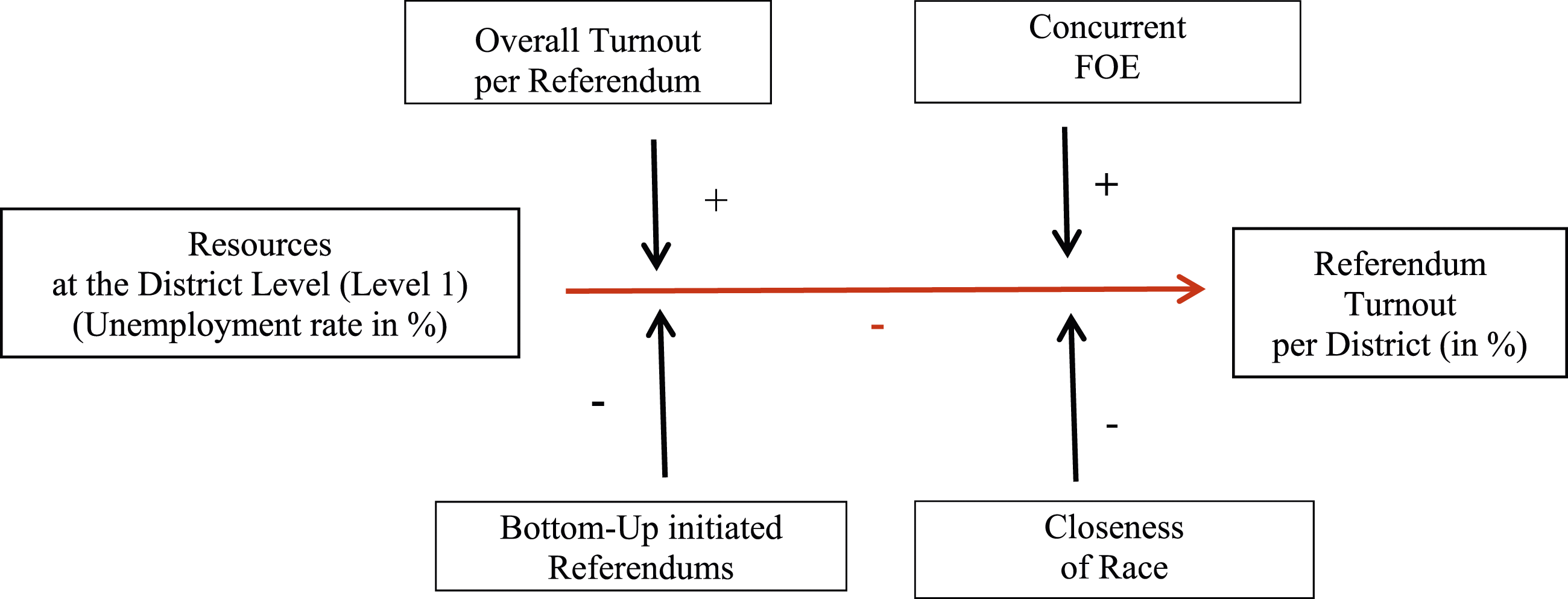
Research Design, Data, and Operationalization
Direct democracy refers to all procedures made possible by the constitution and other legal provisions through which citizens can directly decide on political issues or place them on the political agenda. Legal provisions for direct democracy can take the form of initiatives, facultative or obligatory referendums, or plebiscites. They can be binding or non-binding. Since the beginning of the 1990s, all German states have provided for local referendums in their respective local government constitutions.
These referendums may be initiated either top-down when a simple or a two-thirds majority of the local council decides to hold a referendum (Ratsreferendum), or bottom-up when citizens call into question a decision already taken by the council (Bürgerentscheid), or when an issue up to then not tackled by the council is to be placed on the local councils’ agenda (Initiative). The respective regulations in the local government constitutions of the states differ only slightly regarding these regulations. In all states, citizens initiating a referendum must collect supporting signatures in a given period, and the number of voters in the referendum must surpass an approval quorum. The formal requirements for the admissibility of a referendum are that the question posed for a vote must be answered with “yes” or “no,” and that it falls within the competence of the municipality (within its sphere of influence). Voting usually takes place on a Sunday or a public holiday. Postal voting is allowed in all states, and referendums are binding.
In Germany, there are 79 major cities with more than 100 000 inhabitants. 4 Our analyses are based on 68 referendums that took place in 35 of these cities between 2000 and 2019. 5 Our primary units of analysis are the 889 city districts in these cities. As in some cities, several referendums have taken place in the period covered, the total number of city districts for which we have collected data amounts to 1788 units of observation. This provides a strong comparative research design since it allows for analyzing social stratification in referendums in a large number of cities in varying referendum-specific contexts. Data on referendum turnout and the socio-economic structure per district were collected from the statistical offices of each municipality.
We rely on aggregate district-level data, which poses the risk of ecological fallacy. Therefore, we conducted some robustness tests using individual representative survey data for Germany and survey data from a specific statewide referendum. We then compare these results with the findings from our macro level approach to strengthen the results of our analyses (see part 4, subsection “Addressing Ecological Fallacy”).
The data structure is hierarchical as we include information from three levels: from city districts (L1) nested in a referendum (L2) nested in a city (L3). Since lower-level observations are nested within higher levels, each observation is not truly independent, violating the assumption of independent error terms. To address this problem, we use multi-level linear regressions. Specifically, we employ three-level random intercept models. The base model (random intercept only) is given by





For the comparability of the results, all predictor variables except the dummy variables are grand-mean centered. 6 For a robustness check, we calculated generalized linear mixed models (GLMM) to test our hypotheses following a beta-distribution according to the parameterization of Ferrari and Cribari-Neto (2004). The results remain similar (see Appendix A3). 7
Measuring Social Stratification Bias in Referendum Participation: Dependent Variables
Referendum turnout per district is measured as the number of voters in a district over the district’s total number of eligible voters per referendum in all 35 municipalities (N = 1788). District referendum turnout ranges between 7.2% in Kassel-Wesertor (2013) and 87.0% in the district of Bremen-Borgfeld (2017). Turnout is slightly skewed, with an average turnout of 40.1% per district.
The degree of social stratification in referendum participation is measured by the unstandardized regression coefficient between two level 1 variables: the city districts’ rates of unemployment (social resources per district) and referendum turnout per district. The level of social resources at the district level can be measured using different social indicators like education, income, or unemployment. We use the unemployment rate per city district for two reasons: First, previous studies suggest that unemployment is the most relevant indicator explaining unequal voter turnout in Germany (Schäfer et al. 2013; Vetter and Velimsky 2019). Second, data availability at the district level and the comparability across municipalities are best regarding this indicator. Unemployment rates between city districts vary from 0,3% in Erlangen to 30,9% in Bremen–Ohlendorf. The degree of social stratification per referendum is then measured by the unstandardized regression coefficient between the districts’ unemployment rate and referendum turnout per district.
The overall municipal turnout per referendum (level 2) is measured as the number of all voters per referendum (N = 68) over the total number of eligible voters. The variable concurrent first-order elections (FOE) (level 2) is coded 1 when a referendum takes place the same day as an election to the federal parliament (Bundestag). In line with the literature, we consider only German federal elections as FOEs (Marsh 1998; Müller 2018; Reif and Schmitt 1980) since turnout and the mobilization potential are highest in these elections (Steinbrecher 2020). 8 Our data contains five referendums held simultaneously with FOEs. 9
The closeness of race (level 2) is measured by the gap between winners and losers in the respective ballot (see Kirchgässner and Schulz 2005; Matsusaka 1993). The smaller the gap, the higher we suppose the race’s closeness to have been. We subtract the gap (percentage points) from 100 to obtain a measure where higher values indicate a closer race. 10
The variable bottom-up initiated referendums (level 2) is coded 1 when citizens initiated the referendum (bottom-up). We also include initiatives or referendums that call into question a decision already taken by the council (Korrekturbegehren). The reference category covers ballots initiated by a simple or a two-thirds majority by the local council (Ratsreferendum).
We include two control variables in our regression models: The first is the degree of segregation per city (level 3) (Stockemer and Scruggs 2012; van Holm 2019). According to (Bartle, Birch, and Skirmuntt 2017), social segregation, defined as social inequality between municipal districts, is expected to reduce contacts and interlinks between more and less socially privileged groups, to strengthen in-group identities, attitudes, and behavior, which in turn reduces perceptions of conflict, thereby leading to less participation, especially in low-resource areas. The variable is measured by the coefficient of variation (CV), defined as the ratio of the standard deviation of the unemployment rate at the district level for each city divided by the average unemployment rate per city. The CV always relates to the year of the respective referendum. Large values indicate a high degree of segregation. Second, size of the municipality (level 3) is measured by the natural log of population size at the time of the respective referendum. Municipal size is a prominent factor in the literature that negatively affects local voter turnout (Cancela and Geys 2016; McDonnell 2019). The assumption is that due to a limited number of voters in smaller municipalities, each vote has a stronger weight, rendering participation in smaller municipalities more efficacious. The same should hold for participating in a local referendum (see Søberg and Tangerås 2007).
Results
Explaining Referendum Turnout and Unequal Participation.
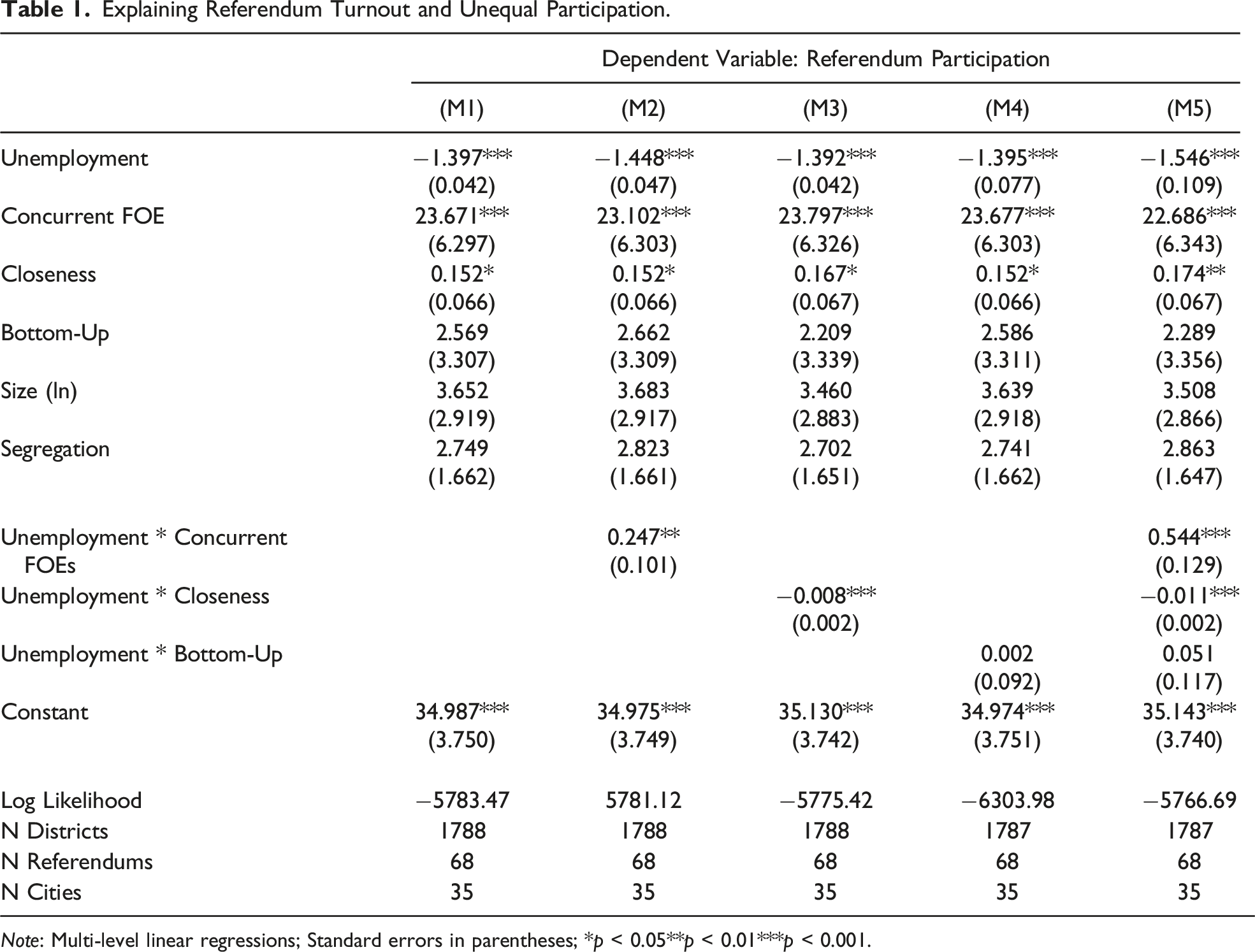
Note: Multi-level linear regressions; Standard errors in parentheses; *p < 0.05**p < 0.01***p < 0.001.
We now test our hypotheses by estimating further regression models, including cross-level interaction effects indicating decreasing or increasing effects on social stratification bias in referendum participation. According to hypothesis 1, we expect a decline in social stratification bias the higher the overall turnout in a referendum. The significant interaction effect regarding overall referendum turnout indicates that stratification bias is reduced when more voters cast their ballot in the referendum throughout the municipality (see Appendix A3).
However, when we look more closely at the marginal effects behind this interaction effect (Figure 2), a curvilinear pattern emerges: When turnout is lower than 40% on the left-hand side of the graph, the negative unemployment effect increases with rising referendum turnout, thereby fostering social stratification. Marginal effects of unemployment for increasing levels of the referendum turnout (overall).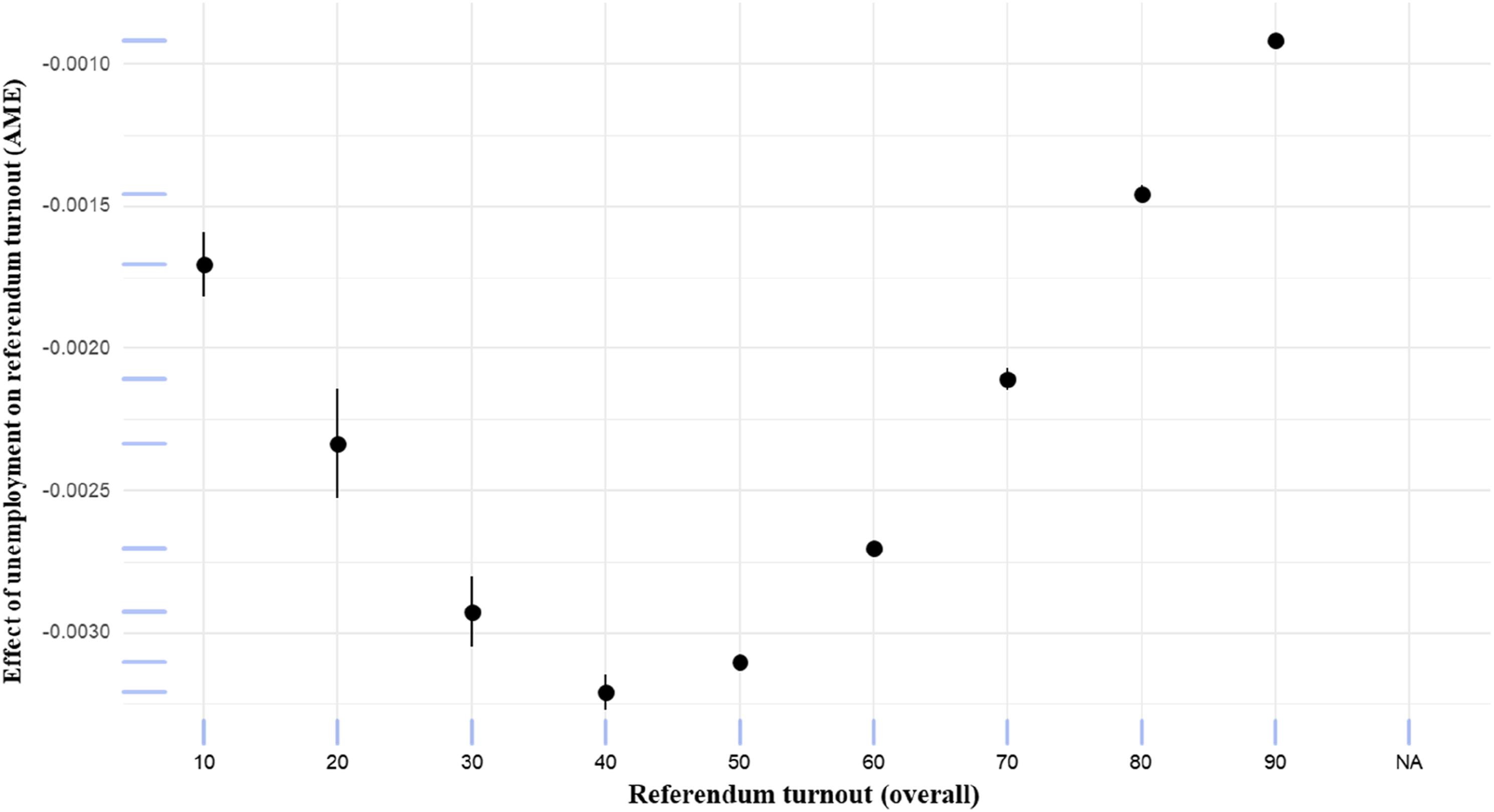
Tingsten’s law only seems to hold when overall referendum turnout surpasses 40%. Then, rising turnout diminishes the effect of a district’s unemployment rate on referendum turnout, thereby indicating a reduction in social stratification bias. This curvilinear effect might result from three different scenarios: At a very low level of turnout, only those directly affected participate more or less independent of social resources. Thereby, only a small negative effect from unemployment emerges.
At a low to medium level of overall referendum turnout (20–40%), those directly affected and those highly interested in politics and having a high sense of civic duty (in general, voters with high resources) participate, thereby increasing inequality. Finally, surpassing the tipping point of 40–50% of overall referendum turnout, Tingsten’s law holds that social stratification bias decreases when there is less room for inequality. This curvilinear effect only partially supports our hypothesis and should be investigated more closely in further research.
Having demonstrated that a socio-economic participation bias exists in German local referendums but that the relationship between turnout and social stratification is not linear, only diminishing from participation levels above 40–50%, we now turn to the contextual factors influencing social stratification in referendum turnout (see Table 1).
We proceed stepwise: the first model (M1) contains our main effects and the two control variables. As expected, concurrent FOEs and closeness of race boost referendum turnout. Turning to our hypotheses: The interaction effects with the three referendum-specific contextual factors are added in models M2–M4 to assess how these indicators modify the effect of our social stratification measure. All interaction effects are included in Model 5 (full model). The results show a significant positive interaction effect from concurrent FOEs (H2) and a significant negative interaction effect for closeness (H3).
However, since interaction coefficients, on their own, are insufficient in terms of testing our hypotheses, as the significance levels of the coefficients are only weakly related to the substantive effects of interest and may not be informative, we present marginal effects plots for these interaction effects as suggested by (Berry, Golder, and Milton 2012; Brambor, Clark, and Golder 2006). We base these estimates on the full model (M5), which includes all interactions (see Braumoeller 2004).
The marginal effect plots in Figure 3 confirm hypothesis 2. The left side of the figure reveals that unemployment has a strong reductive effect on referendum turnout. However, this reductive effect is less pronounced for referendums held with concurrent FOEs. Moreover, referendums with concurrent FOEs also have higher turnout levels than other referendums. It appears that the higher participation in federal elections spills over to referendum turnout to the extent that social stratification in referendum participation is reduced. Marginal Effects of Interaction Terms from Model 5 in Table 1 (predicted Values).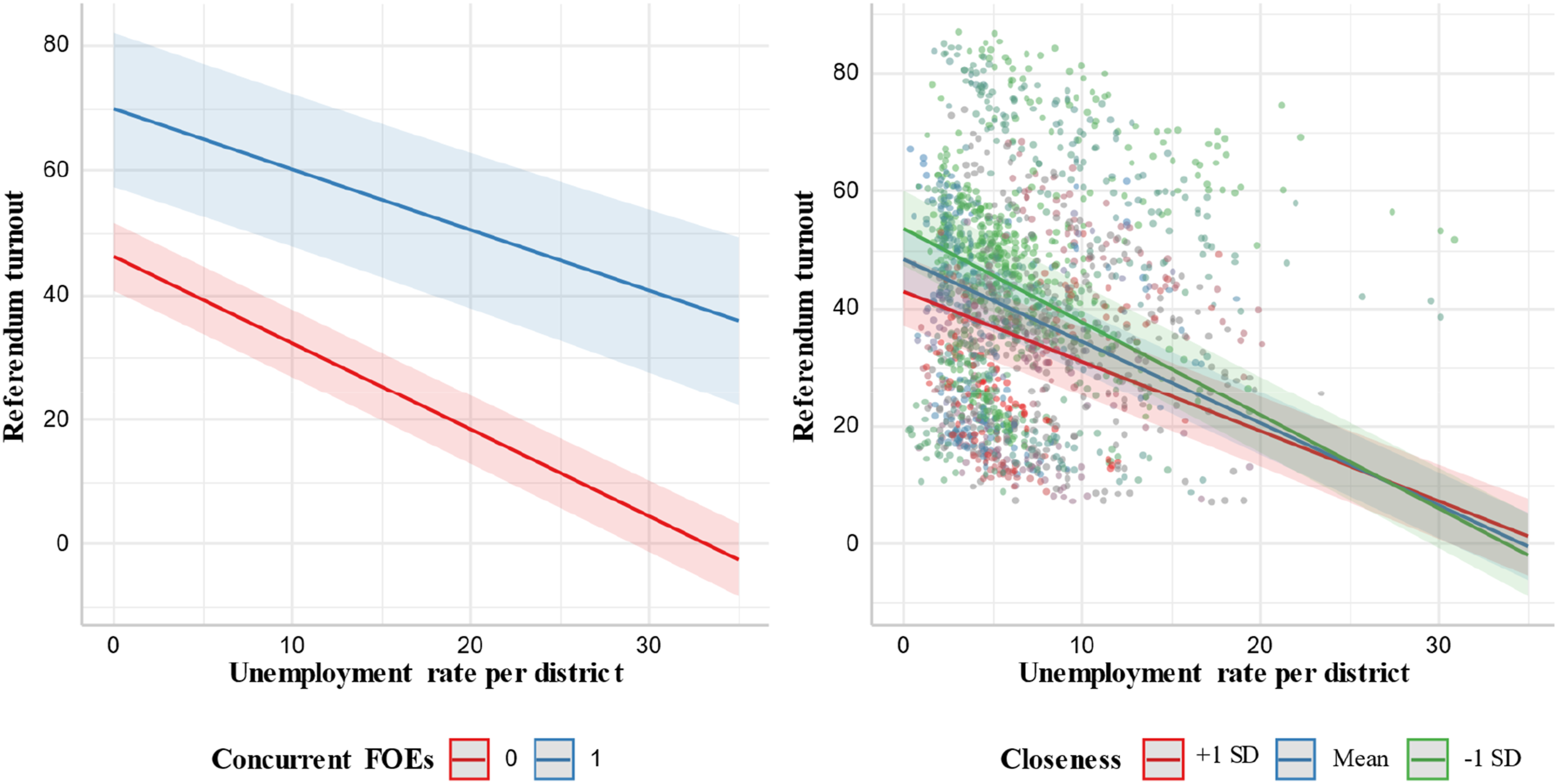
As a robustness check, we ran additional analyses, including simultaneously held elections to the European Parliament and state (Land) elections (see Appendix A4). The results reveal that state elections boost referendum turnout, but do not reduce stratification bias in referendum turnout.
11
Similarly, there is no reduction in participation bias when European elections are held on the same day. Coming back to our hypotheses, we expected in hypothesis 3 that the closeness of the race in a referendum should increase social stratification in referendum participation. However, the right side of the marginal effects plot in Figure 3 does not show differences in participation bias whether the race is close or not. There is also no difference in stratification bias, whether a referendum is initiated bottom-up or top-down (see Figure 4). With regard to our control variables, municipal size
12
and segregation, no significant effect can be found. Marginal Effects of Interaction Terms from Model 5 in Table 1 (predicted Values).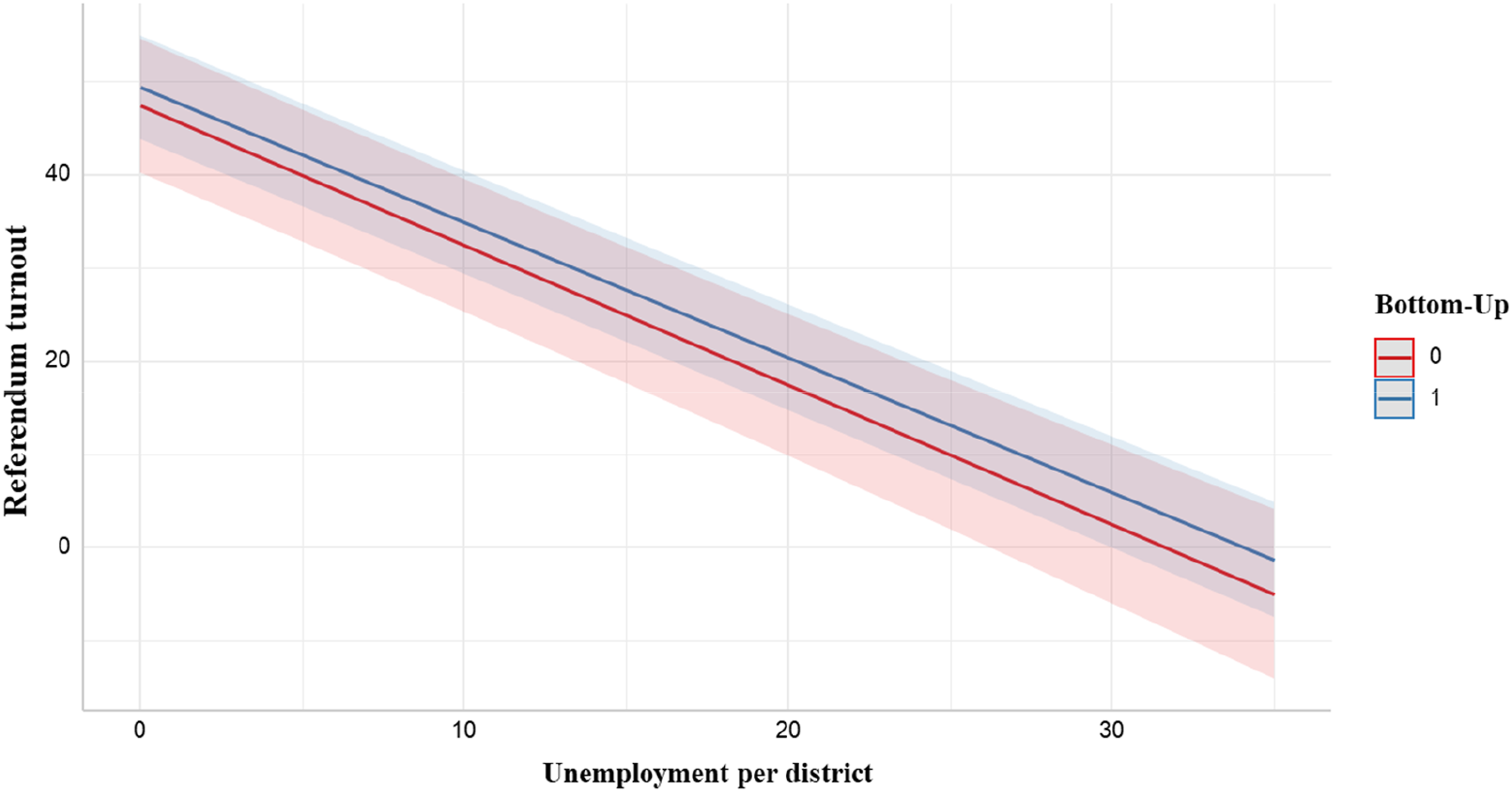
To sum up: Social stratification in referendum participation is lower for referendums when they are held simultaneously with first-order elections. The predictor is also associated with higher referendum turnout. Besides that, the closeness of a race boosts turnout but does not affect participation bias. 13 Factors affecting turnout, therefore, are not necessarily related to social stratification in participation. Furthermore, we can show that social stratification varies among referendums according to the overall participation level. There is a curvilinear relationship between social stratification and turnout, whereby stratification first rises and only declines for turnout above 50%.
Addressing Ecological Fallacy
Given that our analyses are based on district-level data due to a lack of survey data, there is a risk of ecological fallacy in interpreting the results. In our case, it would not be clear whether the district’s unemployment rate mirrors this group’s participation rate in the respective referendum or, in general, whether socially lower strata participate less in referendums than higher resource strata. Several methods of ecological inference have been proposed to deal with this issue (e.g., King, Rosen, and Tanner 1999, 2004; Liu 2007). 14 However, these methods also appear to be heavily biased (Gnaldi, Tomaselli, and Forcina 2018). We, therefore, use a different approach to address ecological fallacy. First, based on two questions from the German General Social Survey 2018 (ALLBUS) (GESIS-Leibniz-Institut für Sozialwissenschaften, 2019), we demonstrate that a significant negative relationship between unemployment and referendum participation exists also using individual level data—thereby strengthening the results from our macro level analyses (see Appendix A8). Second, we analyze the Stuttgart 21 statewide referendum 15 in Baden-Württemberg and show solely for the city of Stuttgart that here, as well, analyses using individual level data support the results from our macro level research design based on district-level data (see Appendix A9). Although ecological fallacy cannot completely be ruled out, we can show that the relationship we found for local referendum participation at the district level is mirrored by representative survey data for Germany and by individual-level and district level data from Stuttgart 21 statewide referendum.
Conclusion and Discussion
Extensive empirical evidence confirms social stratification bias in turnout for elections (Gallego 2015; Schäfer and Schwander 2019; Verba et al. 1978, 1995). Our analyses add to existing studies on unequal participation by focusing on direct democratic voting (Eder, Vatter, and Freitag 2009; Kirchgässner and Schulz 2005; Leininger and Heyne 2017; Smith and Tolbert 2004; Vatter Rousselot, and Milic 2018). As most quantitative studies dealing with direct democracy refer to the U.S. or Switzerland, we enlarged the focus by looking at the German case. Compared to studies investigating national referendums across different institutional settings (e.g., Geißel, Anna, and Paulus 2023; Krämling et al. 2022), we base our analyses on a large sample of subnational referendums, aiming to extend our understanding with regard to social stratification bias in direct democratic voting.
Starting with Tingsten’s law of dispersion (1937), we assumed first that rising turnout reduces the socio-economically induced bias in referendum participation by leaving less room for inequalities. Second, we concentrated on three referendum-specific contextual factors that may affect this bias: concurrent FOEs, the race’s closeness, and the initiating actors (bottom-up vs top-down).
Building on rational choice considerations and on the notion that reducing social stratification in referendum turnout requires a disproportionately strong mobilization of low resource strata, we argued that social stratification might be reduced by lowering the perceived costs of participation, especially among those less well-off, by fostering their propensity to vote.
Using multilevel methods on an original dataset covering 1788 districts in 35 large German municipalities for 68 local referendums held between 2000 and 2019, we find that referendum participation is indeed socially biased and that boosting turnout does not inevitably lead to a reduction in inequality: We can show that “Tingsten’s law” applies to turnout rates above approximately 50%. However, rising turnout increases the selection bias below 40 to 50%.
So far, our explanation is that with very low turnout, only those directly affected participate in a local referendum, irrespectively of their resources but mainly driven by affectedness. With higher turnout levels, it should be those with more political interest and stronger feelings of civic duty going to the polls, who generally come from more resourceful groups, thereby increasing social stratification. Only when about 50% or more of those eligible to vote cast their ballot, raising turnout ends up lowering the inequality gap.
We also find that simultaneously held FOEs not only increase turnout in general but also lead to a reduction in socially biased referendum turnout. The broad mobilization by parties and the media prior to a FOE seems to reduce the costs of obtaining information and to make up one’s mind for the upcoming election (Kriesi 2005). This mobilizes especially voters from low-resource strata to go to the polls, where at the same time, they can cast their ballot for the referendum without having any additional opportunity costs. We do not find such effect for concurrent elections to European Parliament or state (Land) elections, although the latter boost referendum turnout.
Our analyses reveal a similar pattern with regard to the closeness of the race, which increases referendum turnout (Søberg and Tangerås 2007), but this boosting effect does not reduce social stratification bias. Whether referendums are initiated bottom-up or top-down does not show any effects, neither on referendum turnout nor on participation bias.
While future research needs to determine whether these findings generalize beyond the German local level, we nonetheless argue that our analyses offer a good starting point for future studies. While focusing on a limited number of referendums in large cities, we see, for instance, no apparent arguments for why our results should not hold for smaller municipalities. While we know that electoral and referendum turnout is higher in smaller than in larger cities (for elections: Cancela and Geys 2016; McDonnell 2019; for referendums: Mehr Demokratie e.V. et al. 2023), it is on the one hand reasonable to assume that social stratification bias is less pronounced in smaller municipalities. On the other hand, information costs could be higher in smaller municipalities due to less media reporting and party campaign activities that might lead to an even lower mobilization among citizens from lower socio-economic strata. It might be interesting to extend our analyses to municipalities of smaller size, although we do not see why our findings regarding closeness and concurrent FOEs should differ according to municipal size.
We did not include institutional factors, as they vary only slightly in our German sample. Extending our results to other country contexts (Geißel, Anna, and Paulus 2023), these factors might be more relevant and should be studied in future research. There are some further limitations to our analyses: First, as we rely on district level data, it would be beneficial to use individual-level data to deepen our conclusions on social stratification bias in referendum participation, although data availability is often scarce. Research should also extend our findings for a greater number of referendums, especially with regard to concurrent held elections. In addition, it would be worthwhile retesting our hypothesis on closeness using ex-ante measures, that is, by assessing pre-election online campaigns across a large number of cases, which, however, might prove challenging.
Furthermore, other referendum-related context factors should be considered that may disproportionally mobilize different social strata, for example, learning effects from prior experiences with referendums (see Smith and Tolbert 2004), media coverage, mobilization by parties, NGOs or local initiatives, and different degrees of conflict. We would have liked to include these indicators but have to leave this open for further research.
Dalton (2017, 166) concluded from his comparative analyses that there is no “obvious factor that increases participation overall while narrowing the participation gap. Thus, the potential for reform in such large-scale institutional structures to broadly improve the level and equality of citizen participation is limited.” Our results reveal that, at least for subnational direct democracy, referendum-related factors like concurrent first-order elections significantly reduce inequality, while closeness—although increasing turnout in general—does not impact the socially induced participation gap.
Our results have broader implications for further research on inequalities in direct democratic voting (see Bechtel et al. 2016; Bechtel and Schmid 2021; Dermont and Stadelmann-Steffen 2018; Fatke 2015; Krämling et al. 2022; Stadelmann Portmann, and Eichenberger 2015) and political participation in general (see Gallego 2015; Gallego et al. 2012; Lehoucq and Kolev 2015; Marien Hooghe, and Quintelier 2010; Oser, Feitosa, and Ruth 2023; Rigby and Springer 2011; Verba et al. 1978, 1995).
Supplemental Material
Supplemental Material - Reducing Social Stratification Bias in Referendum Participation: Evidence From the German Local Level
Supplemental Material for Reducing Social Stratification Bias in Referendum Participation: Evidence From the German Local Level by Jan A. Velimsky, Angelika Vetter, and Andre Bächtiger in Political Research Quarterly
Footnotes
Acknowledgments
We thank the panel participants, Isabelle Guinaudeau, Uwe Remer, Dominic Nyhuis, Patrick Bernhagen and Kristina Faden-Kuhne, for their valuable suggestions and helpful feedback.
Authors’ Note
Previous versions of this article have been presented at the Annual General Conference of the European Political Science Association 2020.
Declaration of Conflicting Interests
The author(s) declared no potential conflicts of interest with respect to the research, authorship, and/or publication of this article.
Funding
The author(s) received no financial support for the research, authorship, and/or publication of this article.

Supplemental Material
Supplemental material for this article is available online.
Notes
References
Supplementary Material
Please find the following supplemental material available below.
For Open Access articles published under a Creative Commons License, all supplemental material carries the same license as the article it is associated with.
For non-Open Access articles published, all supplemental material carries a non-exclusive license, and permission requests for re-use of supplemental material or any part of supplemental material shall be sent directly to the copyright owner as specified in the copyright notice associated with the article.
