




Abstract
Conventional wisdom suggests that women can face a punishment from voters for engaging in self-promotion. Self-promotion, highlighting your accomplishments, can be detrimental to women because such behavior violates feminine stereotypic expectations that women be modest and humble. I argue and show that voters do not punish women for engaging in self-promotion but there are different styles of self-promotion that are more beneficial to women than others. I argue that women will be most successful when they use a communal style of self-promotion that emphasizes feminine stereotypic qualities, such as compromise. Conversely, I argue that agentic forms of self-promotion, which draw on masculine qualities, will be less successful for women because agency violates feminine expectations for women. I test the effects of communal and agentic self-promotion using two experiments. The result shows two key findings. First, voters do not punish women incumbents for using agentic styles of self-promotion, but women receive more positive evaluations with communal self-promotion. Second, voters are slightly more likely to reward men for communal self-promotion relative to women legislators.
Keywords
The 2018 “Pink Wave” election saw record numbers of women run for and win elected office at the local, state, and federal levels. When these incumbent women stood for re-election in 2020 and 2022 many of them lost. The incumbent women losing re-election include Abby Finkenauer in Iowa’s first congressional district lost in 2020, and Elaine Luria of Virginia’s second congressional district lost in 2022. When women incumbents run for re-election they often face high-quality challengers who can make it more difficult for incumbent women to win re-election (Branton et al. 2018; Milyo and Schlosberg 2000). Securing re-election often requires incumbents, regardless of their gender, to engage in self-promotion, or more simply put, to talk about all the work they did for their districts and states. A burgeoning body of scholarship indicates that women are highly effective legislators (Anzia and Berry 2011; Volden, Wiseman, and Wittmer 2013) which means they have much to brag about to voters. Scant research examines how legislator gender affects voter responses to self-promotion. This manuscript fills this gap.
Self-promotion can be fraught for women 1 because highlighting accomplishments is a stereotypically masculine activity, meaning it goes against the feminine stereotypic expectations that women should be humble and modest (Vinkenburg et al. 2011; Prentice and Carranza 2002). Women are thought to face penalties for breaking with masculine norms (Smith and Huntoon 2014; Rudman 1998) but research offers mixed evidence on this point (Brooks 2013; Bauer, Harman, and Russell 2022). A gendered self-promotion backlash means that women incumbents might not be able to effectively engage in the conventional behaviors thought to secure re-election (Fenno 1978; Mayhew 1974). Indeed, recent studies find that feminine and masculine stereotypes shape the campaign communication environment for incumbents and challengers (Bauer and Santia 2023; Schneider 2014) and these gender stereotypes affect evaluations of female candidates (Anzia and Bernhard 2022; Bauer 2017; Ditonto, Hamilton, and Redlawsk 2014; Ditonto 2017).
This manuscript examines how legislator gender affects the way voters respond to self-promotion messages. I identify two ways that legislators can engage in self-promotion. First, legislators can engage in agentic-based self-promotion where legislators position themselves as the main actor responsible for a legislative benefit, this style resembles classic models of credit-claiming (Mayhew 1974). Second, legislators can engage in a communal style of self-promotion where legislators highlight the collaboration needed to secure benefits for a district. Studies show that women legislators frequently engage in more collaboration than men (Volden, Wiseman, and Wittmer 2013; Holman, Mahoney, and Hurler 2022; Holman and Mahoney 2019; Mahoney 2018), and this can offer women a strategic opportunity to use gender to frame how they promote their successes. Using two survey experiments, I find that, first, voters do not punish women incumbents for using agentic styles of self-promotion, but women receive more positive evaluations using communal forms of self-promotion. Second, voters are slightly more likely to reward men legislators for communality relative to women legislators.
This manuscript makes three key contributions to the existing literature on evaluations of women in politics, democratic accountability, and representation. First, the present research clarifies when women will face a punishment for violating feminine norms, an area with conflicting results in the literature to date. Second, this manuscript draws on social psychology research to develop a cohesive theory accounting for how gender affects the way voters respond to self-promotion messages in a political context. Third, I integrate these theories from social psychology with scholarship on voter decision-making to develop and test of a theory delineating how gender affects voter responses to self-promotion, and how the gendered style of a self-promotion message affects evaluations of both women and men. The risk of losing re-election for an incumbent woman can hinder her ability to move up the political pipeline to higher levels of office which frequently under-represent women at higher rates than lower offices (Lazarus, Steigerwalt and Clark 2022).
Legislator Gender, Productivity, and Strategic Messages
Women legislators are highly productive. Women in legislative chambers bring home more federal dollars to their districts and sponsor and cosponsor more bills that eventually become law relative to men (Anzia and Berry 2011; Volden, Wiseman, and Wittmer 2013). It is thought that women’s higher rates of productivity are motivated, in part, by the need to overcome gender-based biases believed to exist in the electorate (Anzia and Berry 2011), prevent re-election challengers (Branton et al. 2018), and stave off a sense of “gendered vulnerability” (Lazarus and Steigerwalt 2018). Women’s high levels of legislative productivity get an electoral boost from voters as long as there is a high level of policy congruence between the legislator’s votes and the preferences of the voters in their district (Kaslovsky and Rogoswki 2022). Research suggests that women frequently disseminate messages about their accomplishments (Fridkin and Kenney 2015; Dolan and Kropf 2004; Lazarus and Steigerwalt 2018), but this research does not test voter responses to such messages. This manuscript, through the use of an experimental approach, bridges the gap between the research on the messages legislators develop and how voters evaluate such messages (McGraw 2003).
Extant scholarship on responses to legislative productivity overlooks how gender stereotypes condition voter responses to self-promotion behavior (see e.g., Grimmer, Westwood, and Messing (2014); Esterling, Lazer, and Neblo (2013)). Masculine stereotypes characterize men as tough, assertive, more likely to engage in power-seeking behaviors, and more likely to serve in authoritative social roles (Koenig et al. 2011). Feminine stereotypes characterize women as caring, sensitive, and more likely to engage in nurturing behaviors and serve in supportive social roles (Eagly and Karau 2002). Masculine stereotypes define political leadership roles while feminine stereotypes are not congruent with leadership roles (Bos, Schneider, and Utz 2017; Bauer 2020a; Sweet-Cushman 2022). Self-promotion is considered a masculine behavior (Heilman and Okimoto 2007; Moss-Rascusin and Rudman 2010; Rudman 1998), and this opens up the potential that women will face a gendered punishment for engaging in this activity as people often punish those who violate stereotypic norms (Sinclair and Kunda 1999; Kunda et al. 2002).
The extent to which women face a punishment for engaging in masculine behaviors in a political context is not clear. Some scholarship finds that women do not face a gendered penalty for masculine behaviors (Brooks 2011). Other research finds that any penalty women face is conditional on characteristics of voters such as relative partisanship between the voter and the candidate or ideology (Bauer, Kalmoe, and Russell 2022; Bernhard 2021; Krupnikov and Bauer 2014; Saha and Weeks 2020), the type of masculine behavior such as failing to engage in legislative compromise or bipartisanship (Bauer, Yong Harbridge, and Krupnikov 2017; Vraga 2017), or the level of exposure people have to a woman engaging in masculine activities (Bauer, Harman, and Russell 2022). A growing body of scholarship finds that women often manage a gendered backlash by adopting dual-stereotype strategies that relies on both feminine and masculine stereotypes in the content and the tone of the message (Bauer and Santia 2021; Carpinella and Bauer 2021) and such approaches can be successful for women. I apply this work on women’s management of stereotypic expectations to test how voters respond to messages about self-promotion that combine elements of feminine and masculine stereotypes.
The classic literature on how members of Congress secure re-election through self-promotion focuses on credit-claiming. Credit-claiming is a particular form of self-promotion that often allows a legislator to establish themselves as a central actor responsible for the security and well-being of their district (Mayhew 1974). Mayhew’s conception of credit-claiming does not necessarily delineate how legislators can most effectively credit-claim. The conventional literature on credit-claiming generally examines whether a legislator discussed their accomplishments in messages disseminated to their district through press releases or campaign websites (Grimmer, Westwood, and Messing 2014; Lazarus and Steigerwalt 2018) or the types of issues legislators discussed in credit-claiming messages (Fridkin and Kenney 2015; Dolan and Kropf 2004). This literature has yet to incorporate gender as a theoretical construct that can shape how legislators discuss their accomplishments along with how voters respond to such messages. I develop a theory of gendered self-promotion that considers these dynamics.
In sum, there are three major limitations to the past scholarship. First, much of the literature on whether voters reward women for their productivity does not identify or test whether voters know about women’s productivity. Second, the act of self-promotion is, in and of itself, a masculine behavior but past work does not examine self-promotion as a masculine behavior. Third, past scholarship lacks a strong and clear theory about how voters respond to self-promotion messages that considers how gender shapes the expectations voters have and often use to evaluate political leaders and for women in politics. My research fills these critical gaps in the literature.
Gendered Self-Promotion Strategies for Women Legislators
Voters do not see women political leaders as having the masculine stereotypic traits that align most closely with the traits valued in political leaders, such as strength, knowledge, and experience (Schneider and Bos 2014). And, voters see women as less qualified than men for leadership roles (Bauer 2020b; Fulton 2012)—though these masculine trait and qualification barriers are less of an obstacle for women incumbents relative to women challengers (Bauer 2020a; Fridkin and Kenney 2009). Self-promotion can mitigate these perceptual biases, but self-promotion can be risky for women because of the potential for a gendered backlash. I argue that whether women face a backlash for self-promotion will depend on the gendered style of self-promotion that women use.
Women incumbents express concern about facing a gendered backlash for engaging in masculinity and violating feminine norms when on the campaign trail (Dittmar 2015; Kanthak and Woon 2015; Stoddard and Preece 2015; Bernhard, Shames, and Teele 2021; Crowder-Meyer 2020). Avoiding self-promotion altogether is not a viable option for women incumbents. The political environment is such that women in politics often must develop messages that align with masculinity to win over voters but still incorporate feminine stereotypes into these messages (Bauer and Santia 2021; Jungblut and Haim 2023). I draw on social psychology research on how women in masculine contexts, for example, business management, balance competing stereotypic expectations around self-promotion to fulfill the masculine expectations of their role and to avoid facing a counter-stereotypic backlash (Moss-Rascusin and Rudman 2010; Parks-Stamm, Heilman, and Hearns 2008; Heilman and Okimoto 2007).
Social psychology research argues that women are most successful with self-promotion when they are seen as upholding communal expectations even if they are engaging in a behavior that fits into masculine stereotypes (Moss-Rascusin and Rudman 2010). Smith and Huntoon (2014) tested responses to how women ask for raises, a task that requires self-promotion but where women can face a gendered punishment while men are often rewarded for taking the initiative to ask for more money. The authors found that when women asked for raises for other people on their team, namely, other women, they were less likely to face a self-promotion backlash, and more likely to secure the raise because others saw these women as upholding feminine stereotypes even while engaging in a masculine task. I argue that gendered self-promotion can take on a feminine or a masculine style, and feminine self-promotion can protect women from a backlash effect.
A feminine self-promotion style is one that reinforces women’s communal roles in taking care of others and engaging in collaboration and consensus-building (Eagly and Carli 2003). I term this strategy communal self-promotion. Communal self-promotion positions the legislator as an actor responsible for a tangible good that benefits the district (Mayhew 1974), but communal self-promotion also emphasizes aspects of the legislative process, such as building consensus, that fit into the perceived stereotypic strengths of women (Barnes 2016; Holman and Mahoney 2019). Because communal self-promotion reinforces feminine stereotypes, this style should mitigate any backlash that women might face for engaging in counter-stereotypic behaviors.
Women legislators who embody feminine stereotypes often face negative evaluations due to the incongruity between feminine stereotypes and masculine leadership roles (Bauer 2015) though these negative effects do not always occur (see e.g., Bernhard (2021); Anzia and Bernhard (2021)). I argue that women will not receive negative evaluations when they use communal self-promotion styles for two reasons. First, communal self-promotion is a messaging strategy that uses feminine stereotypes in style but masculine stereotypes in substance. This strategy of being both feminine and masculine at the same time often used by women in politics to mitigate conflicting stereotype expectations (Carpinella and Bauer 2021; Fridkin and Kenney 2015) and voters rate women using this dual-stereotype approach positively. Second, women legislators who use communal self-promotion will not face a punishment because emphasizing their role in compromise, bipartisanship, and consensus-building delivers on behaviors that voters express a desire to see more of in Congress (Wolak 2020).
Agentic self-promotion emphasizes the singular role of a legislator in securing benefits for their district, and positions the legislator as someone who holds power over others rather than someone who shares power with others. Agentic self-promotion fits into the masculine expectations of power leaders and of men more generally (Vinkenburg et al. 2011). This masculine form of self-promotion resembles the typical way that scholars investigate credit-claiming. Agentic self-promotion demonstrates a legislator’s skill and competency at fulfilling the masculine role of being a legislator. An example of an agentic self-promotion strategy is one from Democratic Representative Katie Porter of California’s 47th district when she tweeted: A GOP bill @OversightDems considered last week would censor public servants and weaken content disclaimers, ironically under the guise of free speech. I wrote an amendment to protect scientists and health officials communicating with the public. Committee Republicans rejected it. (emphasis added)
Agentic self-promotion can be risky for women candidates because voters may see them as violating feminine stereotypes that women be modest. But women cannot avoid self-promotion because voters may assume that a woman accomplished nothing during the legislation session, and this undermines her opportunity for re-election. I argue that women can successfully engage in communal self-promotion. An example of communal self-promotion is a message from Republican Congresswoman Julia Letlow from Louisiana’s 5th district who tweeted: “Proud to work with @MayorEllis, the @CityofMonroe, and our delegation in the Legislature to secure this substantial federal investment in #LA05” (emphasis added). This message demonstrates communal self-promotion in that Letlow highlights her collaborative work with multiple political actors to secure funding for projects in her district, and collaboration fits into feminine stereotypes (Prentice and Carranza 2002).
The first prediction identifies voter responses to communal and agentic self-promotion messages from women.
Communal Self-Promotion Prediction: Women officeholders will benefit more from communal self-promotion relative to agentic self-promotion.
Gender Differences Prediction: Voters will evaluate men officeholders who deploy communal self-promotion messages more positively compared to women officeholders who use communal self-promotion.
How Voters Respond to Gendered Self-Promotion
I use two experiments to test responses to gendered self-promotion. I use experiments as opposed to observational data for several reasons.2 First, the high level of control afforded by the experimental design is the only way I can know that the manipulation and not some other confound affected participant responses (McDermott 2002). This gives my research strong internal validity. Second, the appropriate observational data needed to test constituent responses to communal and agentic forms of self-promotion are not available, and this makes experiments particularly appropriate in this context (Morton and Williams 2010).3 Using observational data requires that I have information on how frequently and when legislators engage in self-promotion, the gendered style of self-promotion, and have data on whether voters heard these messages, and I must be able to immediately measure how voters responded. Certainly, observational data on women’s self-promotion likely exist, but there is no data on whether voters ever heard or saw such messages. Considering these limitations of observational data, experiments are an appropriate design choice to test my predictions.
The two experiments start with the same basic design with Study 2 building slightly on Study 1. The first experiment manipulates legislator gender, controls for shared partisanship among participants, and includes both communal and agentic self-promotion messages. The first study’s sample size is N = 413, with roughly 100 participants in each condition. The second experiment uses these same conditions but adds a control group with no gendered form of self-promotion strategy. Study 2’s sample size is 740 with 117–135 participants per condition. The inclusion of a control group in Study 2 allows for a more robust test of whether agentic women face a uniquely gendered punishment for violating feminine norms. I manipulated legislator gender in all the experiments with the names, Carol or Chris Hartley. Study 1 used photos of two white legislators thereby cueing the white racial identity of these legislators. Study 2 does not explicitly cue race with photos, and did not ask respondents about the perceived race or ethnicity of the legislators, as such, I simply cannot know what people thought of the legislator race or ethnicity in Study 2. The names come from Bauer (2020b) who pre-tested them and found the names to be perceived equivalently in terms of age, race, and education backgrounds.
I embedded the manipulation in a news article reporting on a speech the legislator delivered at a rally. The article includes a pull-out quotation where the legislator either self-promotes using an agentic or a communal style. Both conditions listed the legislator’s accomplishments which included passing legislation to build a community center, repairing roads, and supporting veterans as well as creating jobs in the district. I use these specific legislative accomplishments because empirical research measures legislative productivity through bills passed and federal dollars brought to the district (Anzia and Berry 2011; Volden, Wiseman, and Wittmer 2013). Both studies use issues that are relatively gender and partisan neutral. This is an intentional choice as women and men might be evaluated differently if they engage in communal or agentic self-promotion on issues that fit or counter gender or partisan stereotypic strengths (Schneider 2014; Bauer 2019).
The communal condition framed the legislator’s accomplishments as part of collaborative efforts using language about being “part of a team” and “cosponsoring” legislation. The pull-out quotation with the communal message is below: I worked with others to pass legislation to build a new community center, repair the roads in the state, and provide support for our veterans. I was part of a team responsible for attracting new businesses and jobs in our state. Some of the bills I cosponsored with other legislators became law. My colleagues in Congress and I improved the lives of people in our state.
The agentic conditions used language to highlight the legislator’s singular role in securing the same benefits. The pull-out quotation with the agentic self-promotion message is below: I, alone, passed legislation to build a new community center, repair the roads in the state, and provide support for our veterans. I am single-handedly responsible for attracting new businesses and thousands of jobs in our state. Many of the bills I introduced became law because I secured the support of my colleagues. Through my determination, I single-handedly improved the lives of people in our state.
I based both stimuli on social psychology research on agency and communality and the relationship of these concepts to gender stereotypes (Eagly and Karau 2002; Eagly and Carli 2003). I took two additional steps to ensure that the stimuli reflect the types of messages people might get from their elected representative. First, I conducted a small content analysis of a sample of newsletters from incumbents in the 115th Congress. Student researchers, blind to the purpose of this research, analyzed a sample of 300 newsletters evenly split between women and men incumbents. The researchers used a codebook that defined how communality and agency could occur in congressional communication. Appendix 2, Table A1 presents the full codebook and procedures. Communal credit-claiming occurred fairly frequently with 52 percent of messages from women using communality and 39 percent of messages from men using this strategy, p = 0.0312. Women legislators used agentic credit-claiming in 56 percent of their newsletter messages and men used agentic credit-claiming in 46 percent of their messages, and this is a marginally significant difference, p = 0.0736. I used the information from this analysis to shape the content of the experimental stimuli. As a second step, I conducted a pre-test of the agentic message conditions in a small experiment that varied legislator gender. The pre-test asked participants about the believability of the agentic message, namely, whether they thought the legislator was exaggerating in describing their accomplishments. The results for this pre-test show that 72 percent of experimental participants indicated that they did not think the legislator was exaggerating their legislative accomplishments, see Appendix 2 for more information.
The first study used an MTurk sample, and the second study used a national sample recruited through the 2018 Cooperative Congressional Election Study, (CCES). MTurk is an online recruitment platform where participants complete small tasks for a nominal fee. The results produced by MTurk samples frequently mirror those conducted with nationally representative samples (Berinsky, Huber, and Lenz 2012). MTurk samples are particularly useful for research on perceptions of women in politics because these samples are less likely to misreport preferences for women legislators due to social desirability pressures (Krupnikov, Piston, and Bauer 2016). I embedded the second experiment in the CCES, which recruits a sample of adults weighted to resemble the composition of the U.S.4 Data quality issues are often a concern about online sample research. To ensure a strong level of data quality I took several measures in the design and execution of the study (Clifford, Jewell, and Waggoner 2015). First, with the MTurk sample, I selected options in MTurk and the Qualtrics platform through which I fielded the study to identify potential bots. Second, I used manipulation checks to ensure that respondents paid attention to the appropriate information but not in a way that increases cognitive processing (Berinsky, Margolis, and Sances 2014). I largely made these adjustments to Study 1 on MTurk as I have less control over the execution of CCES surveys that are administered through YouGov. However, the use of two samples helps to understand and compare data quality, if the two studies find similar patterns this suggests that the two samples are largely equivalent in terms of the substantive findings (Krupnikov and Levine 2014).
I measured how participants respond to the self-promotion messages of legislators using three sets of questions. The first set of questions track how well legislators maintain an electoral connection with voters on being a “good representative of constituent opinion” and the extent to which the legislator “cares about people like me.” The question asked: “Please rate how well each phrase or adjective describes the candidate you read about. Give the first impression that comes to mind.” The response options included: Very Well, Somewhat well, Somewhat unwell, Not Well at All. These questions gauge the ability of legislators to build positive interpersonal relationships with constituents, and these measures can offer a test for how communal self-promotion styles can boost legislator ratings on feminine qualities. It is expected that the communal man will benefit the most here based on the gender differences prediction.
The second set of questions asked participants to rate the leadership qualities of the legislator on strong leadership and legislative effectiveness. The strong leadership question asked participants: “Please rate how well each phrase or adjective describes the candidate you read about. Give the first impression that comes to mind.” With the following response options: Very Well, Somewhat well, Somewhat unwell, Not Well at All. The legislative effectiveness question asked: “Using the scale below, how would you rate Hartley's level of effectiveness as a legislator where 1 means Hartley is not very effective at all, and 7 means Hartley is highly effective?” I include these questions to test whether agentic self-promotion affects how well women legislators fit into the masculine political leadership role.
The final question asked participants to rate legislator favorability (Elis, Hillygus, and Nie 2010; Bauer, Yong Harbridge, and Krupnikov 2017) used as a proxy for vote support. The question wording was: “Using the scale below, how would you rate Hartley's favorability as a legislator where 1 means Hartley is not very favorable at all, and 7 means Hartley is very favorable?” I rescaled all the outcome variables range from 0 to 1 with values closer to 1 indicating more positive evaluations.
Experiment 1: Communal vs. Agentic Styles of Self-Promotion
The communal self-promotion prediction argues that women legislators will receive more positive evaluations when they use a communal style of self-promotion relative to an agentic style of self-promotion. To test this prediction, I conduct comparisons within legislator gender (i.e., agentic woman vs. communal woman) to draw inferences about which types of messages are most effective for women legislators. I test the gender differences prediction by comparing the woman’s evaluations to the man’s evaluations across the treatment conditions (i.e., the communal woman vs. the communal man). For all the comparisons, I rely on a series of two-tailed t-tests.5
Figure 1 displays the comparisons within legislator gender but across the treatment conditions (full means in Appendix 3, Table A6). Positive values show that a communal style of self-promotion is more effective and negative values show an agentic style of self-promotion is more effective. The results for women are shown in the lighter gray bars, and suggest that, except for two outcomes, women break even across communal and agentic self-promotion. The two exceptions are strong leadership and favorability. On strong leadership, the woman does much better with agentic self-promotion getting a 0.075 or 7.5 percent boost over communal self-promotion, p = 0.0159. The woman legislator, however, does better with communal self-promotion on overall favorability, with about a 0.10 or 10 percent increase compared to the agentic self-promotion condition, p = 0.0034. The effects of communal relative to agentic self-promotion, MTurk study.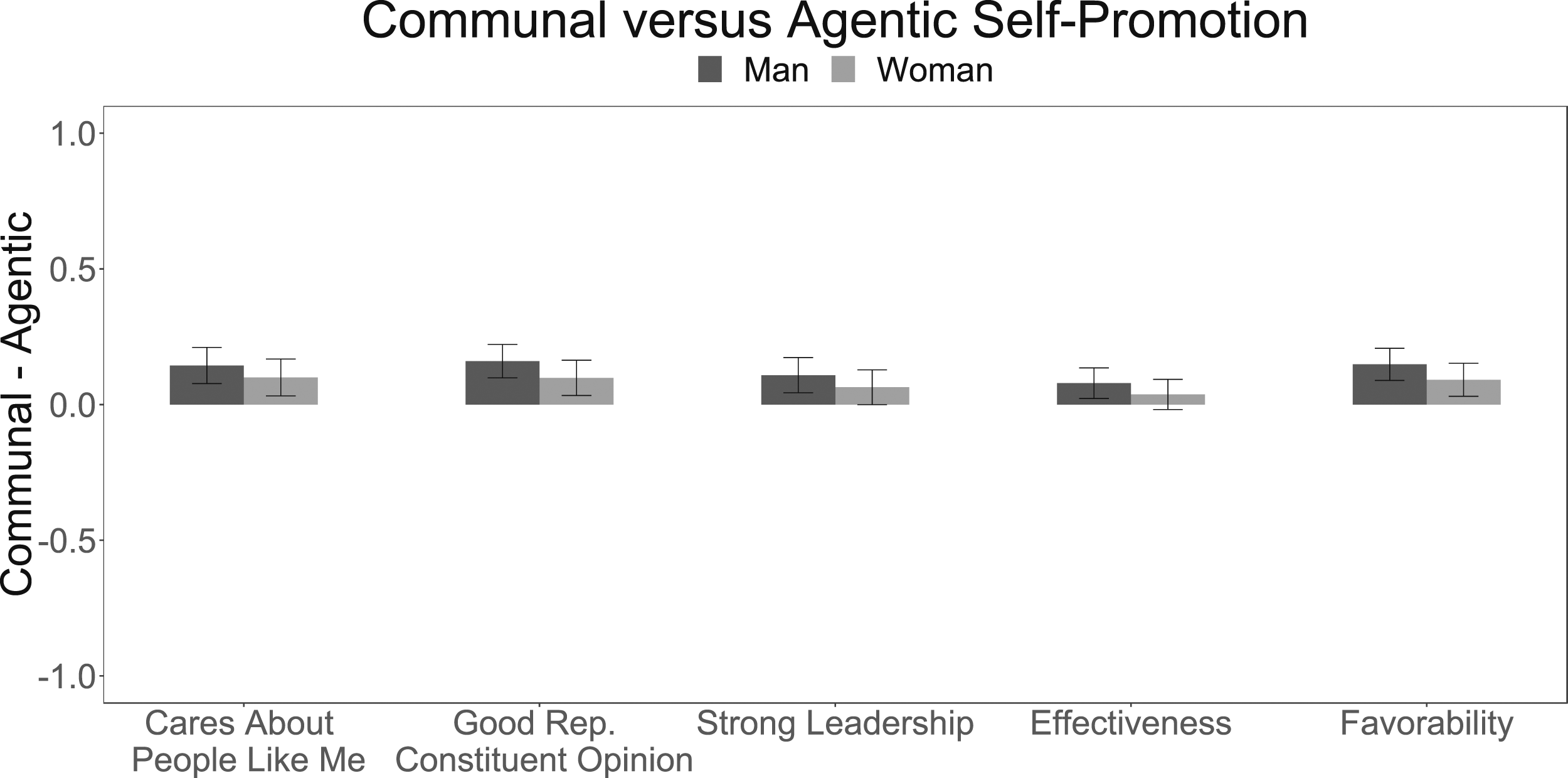
Figure 1 includes the results for men as a point of comparison. For the man (shown in the darker gray bars), he does better with communal over agentic self-promotion on four of the five outcomes. The lone null result for the man is on legislative effectiveness. This finding fits with the expectations in the gender differences prediction which argued that men would be over-rewarded for embracing feminine stereotypes. The woman incumbent appears to gain no unique benefits relative to the man when communicating in a stereotypically feminine style. These findings suggest mixed support for the communal self-promotion prediction.
Figure 2 presents the differences in the effects of communal and agentic self-promotion across legislator gender (see Appendix 3, Table A6 for full comparisons). These comparisons test the gender differences prediction. Each bar shows the difference in the effect of agentic and communal self-promotion for the woman relative to the man. Positive bars indicate that the woman legislator benefits more from a particular self-promotion strategy while negative bars indicate that the man benefits more from that same strategy. The gender differences prediction argued that men would gain more with communal self-promotion. Starting with the electoral connection questions, the communal man receives significantly more positive evaluations relative to the communal woman. Participants rated him 0.094 points, or 9.4 percent, more positively than the women legislator as a legislator who cares about people like them, p = 0.0138; and 0.079 points, or 7.9 percent more positively than the woman legislator as a good representative of constituent opinion, p = 0.0468. The boost the man receives indicates that the man’s reward comes from the communal style of communication. These positive effects fit with the prediction laid out in the gender differences hypothesis. Participants reward the man more than the women when he displays a more feminine style of leadership. Self-promotion across legislator gender, MTurk study.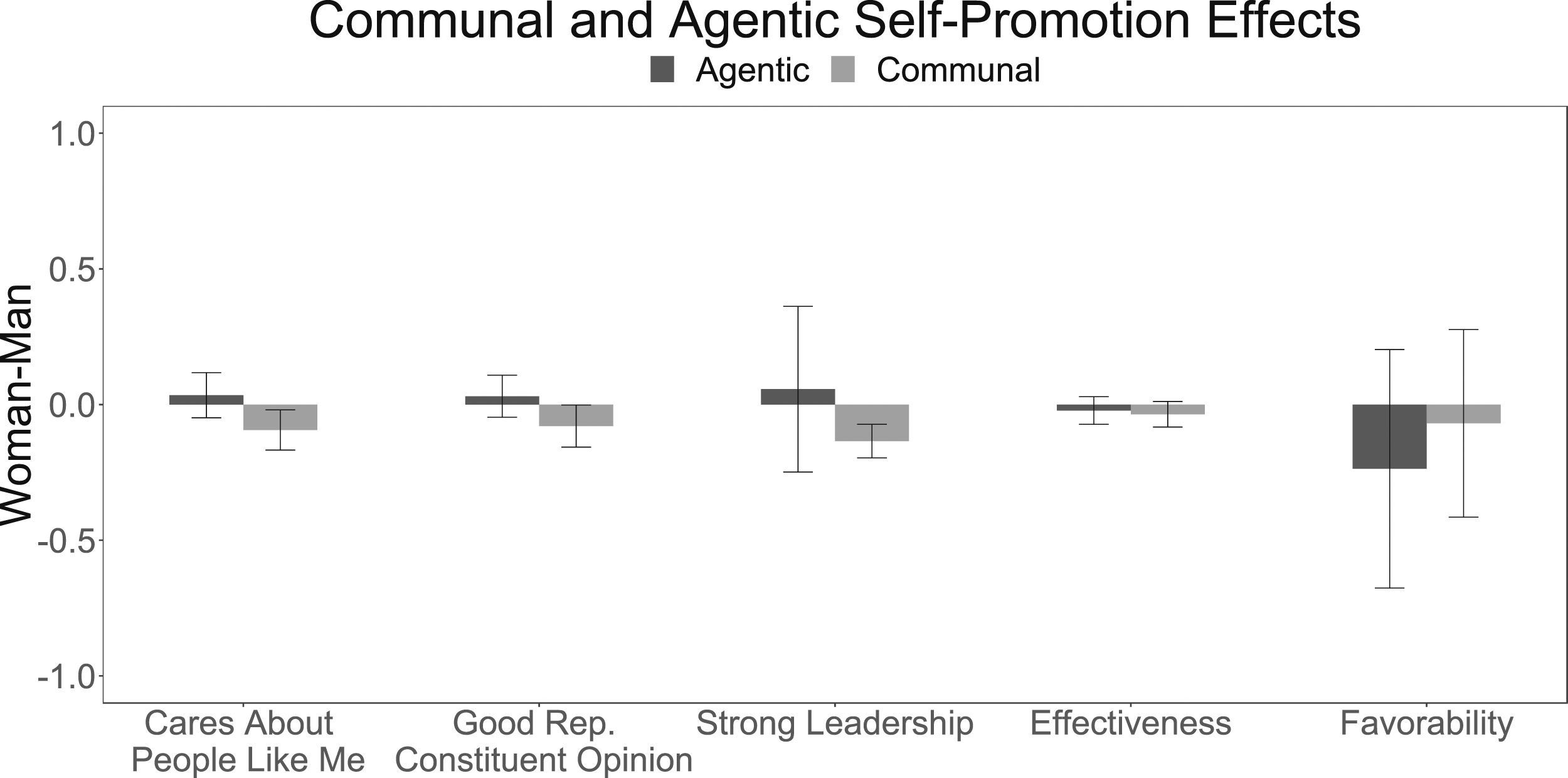
The positive effects of communality for the man extend to some, but not all, of the institutional performance outcomes. The man who uses a communal self-promotion strategy receives a rating that is 0.135 points or 13.5 percent more positive than the woman’s rating on strong leadership, p < 0.001. The incumbent man has little to lose and can gain when embracing a communal self-promotion style. The communal woman and the communal man, however, receive equitable rating on being effective legislators, p = 0.1391. On the favorability outcome, there is no statistically significant difference across legislator gender, p = 0.6946. Thus far, I find partial support for the gender differences prediction.
I compared differences across respondent gender and respondent party and these results are in Appendix 3, Table A7 and Table A8. The partisan comparisons show no differences in how Democratic participants evaluated Democratic woman and man, and vice versa for Republican participants evaluating Republican woman and man. I also compared within legislator gender and across party (i.e., differences in how co-partisans rated women and men legislators who self-promoted) and found no significant differences. Women participants were more likely to rate the agentic man, relative to the agentic woman, more positively on cares about people like me, good representative, and strong leadership. This is the only pattern that stood out in the results and suggests that women reward men for conforming to masculine expectations. Study 2 turns to replicating and building on these first set of results.
Experiment 2: Does Gendered Self-Promotion shift Baseline Legislator Evaluations
The second study differs from the first experiment in that I include a control condition for the woman and men. Here, rather than directly comparing across legislator gender in the treatment conditions I compare within legislator gender from the treatment to the control group. This approach lets me test how gendered self-promotion styles shift the baseline impressions voters have of women and men legislators. The inclusion of a control group also allows me to test whether women face a gendered punishment for agentic self-promotion relative to their baseline evaluations. If women receive more negative evaluations when they use agentic self-promotion relative to no self-promotion this suggests the presence of a gendered punishment, especially if men do not experience the same negative effect. I include the same five key outcomes measuring how voters rate legislators on electoral connection measures, leadership perceptions, and overall favorability.6f
Figure 3 reports the difference in the legislator ratings from the treatment to the control group for the communal and agentic conditions for the woman and the man (see Appendix 3, Table A9). The top panel reports the effects of communal self-promotion. All the legislators, regardless of gender, benefit from communal self-promotion relative to their baseline evaluations. There are no differences in the benefits of communality across legislator gender on all the outcome variables. The boosts that both the woman and man incumbents receive over their control condition ratings are quite substantial. For example, for the results on legislative effectiveness, the women legislator receives a 0.11 or 11 percent boost, p < 0.001, and the man receives a near identical 0.12 or 12 percent boost, p < 0.001, relative to their respective control conditions. Differences in the effects of communal and agentic self-promotion relative to a control condition, CCES sample.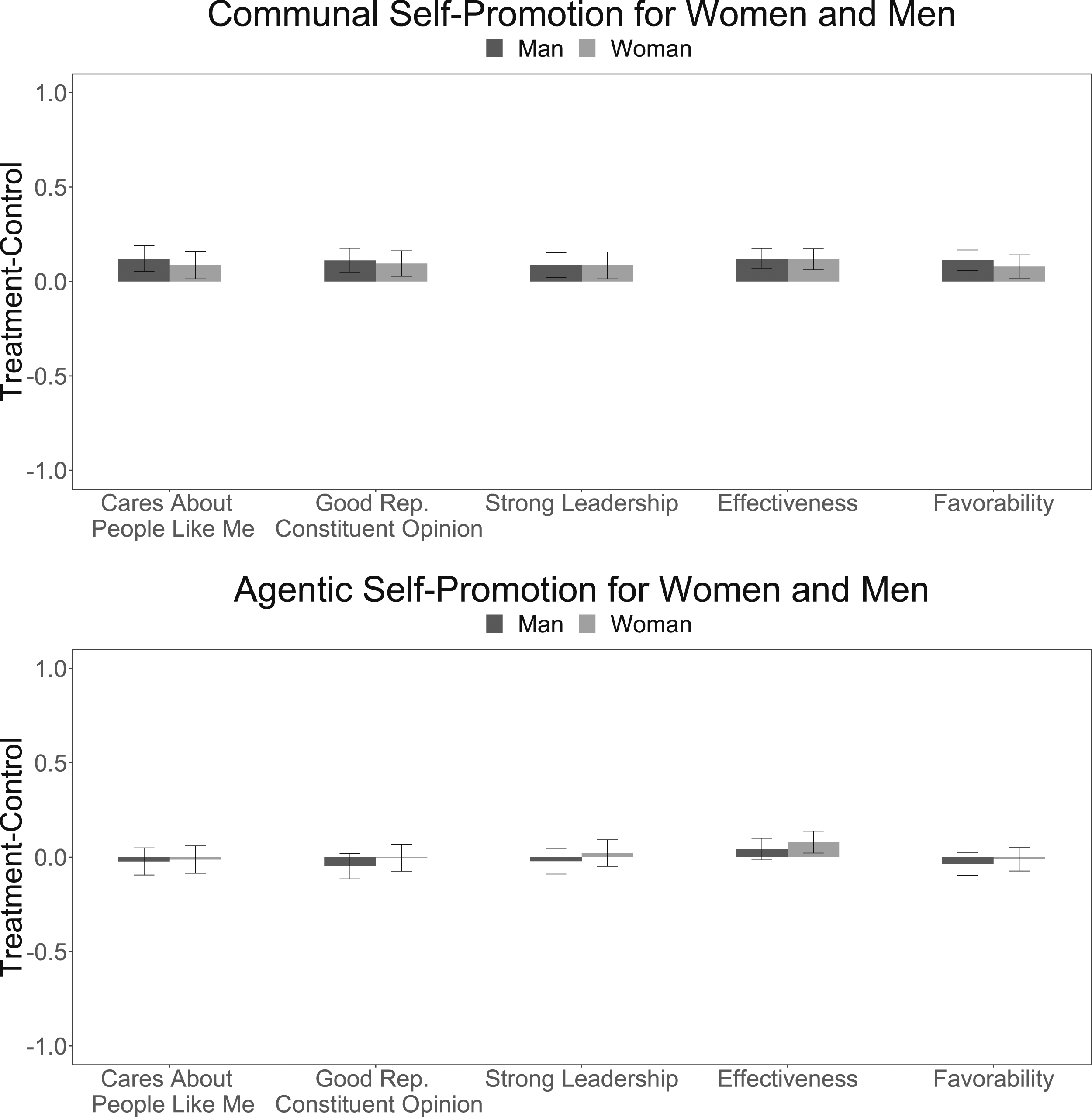
Next, I examine the effects of agentic self-promotion, displayed in the bottom panel of Figure 3. The differences from the treatment to the control group are insignificant on four of the five outcome variables measured for the woman and the man. The one variable with a significant effect is legislative effectiveness. The woman legislator receives a 0.08 or an 8 percent boost relative to the control condition, p = 0.0074, and the man receives a 0.04 or 4 percent boost, p = 0.1441, on legislative effectiveness. The size of the 8 percent boost received by the woman is statistically different compared to the 4 percent boost received by the man, p = 0.0779; but this is the only outcome with an effect across legislator gender. The overall lack of significant differences from the treatment to the control group suggests that agentic self-promotion behaviors fit the baseline expectations that voters have for legislators, but also that women do not face a uniquely gendered punishment for using this more masculine style of self-promotion.
Study 1 showed that people tended to prefer legislators who described their accomplishments through a communal style of self-promotion rather than agentic self-promotion. I replicated those analyses comparing how each legislator fared in the communal relative to the agentic condition. Figure 4 presents these results. Across the board, respondents, again, rated the legislator who used communal self-promotion more positively than the legislator who used agentic self-promotion. The lone exception is a null result on legislative effectiveness for the woman across the communal and agentic conditions. I also replicated the analyses from Study 1 that compared across legislator gender within the treatment conditions (e.g., comparing the communal woman to the communal man). These findings are in Table A9 of Appendix 2, but show no gender differences in either treatment condition. Communal versus agentic self-promotion for women and men, CCES sample.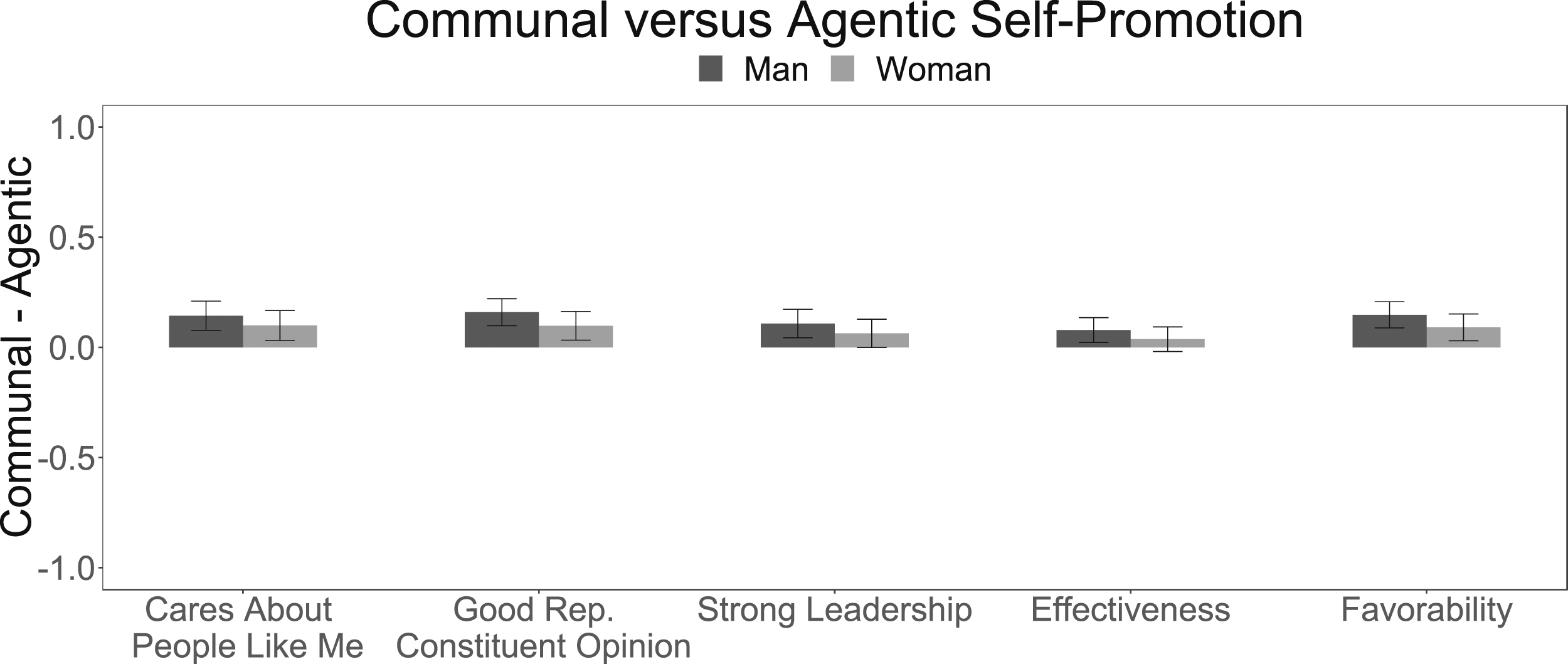
As a final check, I compared differences across respondent gender and respondent party and these results are in Appendix 3, Table A10 and A11. Across party, the main difference is that Democrats tend to reward all candidates for communality more than Republicans. Across gender, the results show that women participants are more responsive to communal self-promotion messages than men, and women participants are more responsive when the message comes from women legislators. The effect suggests the combination of the feminine style of leadership coupled with the distinctive policy benefits appeal to women voters specifically, and this fits with research showing that women favor this type of approach in government (Conover 1988).
Discussion and Conclusion
The success of representative democracy depends, in part, on the ability of legislators to act upon the interests of voters, and re-election depends on voters rewarding legislators for acting on their behalf through election. Maintaining this electoral connection requires that legislators communicate clearly and effectively with voters about their accomplishments. In this section, I outline how future research can build on these findings to pinpoint how voters respond to self-promotion messages as well as the broad implications for this research in shedding light on how women can successfully navigate masculine institutions.
Women legislators face tough re-election challenges from high-quality opponents (Branton et al. 2018). These challenges make it essential that women legislators tell voters about their legislative accomplishments. The results presented in this manuscript indicate that communal self-promotion messages can benefit women legislators, but women legislators will not face any unique advantages over men who also benefit from communal messages. This research focused on self-promotion for incumbent women because of the barriers women face in securing re-election, especially the first time they run for re-election when they are most vulnerable to challengers. Self-promotion can also affect women who are challengers. Women, as potential candidates, are especially hesitant to enter the political pipeline as challengers (Crowder-Meyer 2020; Sweet-Cushman 2016; 2020). Examining how women challengers fare with self-promotion is a next step for future scholarship.
The treatment used a general election. The utility of gendered self-promotion strategies is likely to differ in primary elections. The gender and partisanship stereotype literature finds that people see the Democratic Party as more feminine and the Republican Party as more masculine (Winter 2010). Communal self-promotion may be more beneficial for Democratic women while agentic self-promotion may be more beneficial for Republican women. The congruity between feminine stereotypes and partisan stereotypes could lead voters to respond more positively to a Democratic woman using communality in a shared party electoral context. Likewise, the congruity between masculine stereotypes and partisan stereotypes could lead voters to respond positively to an agentic self-promoting Republican woman, though these dynamics might shift if the agentic self-promoting Republican woman were running against an agentic Republican man (see e.g., Bauer (2020a)). Updated studies on the gendered content of self-promotion messages can better explore how legislator party shapes differences in the content of messages as Republican and Democratic women are thought to draw on their gender in different ways when legislating (Wineinger 2022).
A limitation of the two studies presented here is that they do not vary the gender stereotypic nature of the issues in the self-promotion messages. There are lots of gendered issues that legislators might self-promote about such as sponsoring legislation to support, or not, abortion rights, or education, both of which are stereotypically feminine issues (Osborn 2012). Dolan and Kropf (2004) found that women emphasize their work on stereotypically feminine issues more than men. Two reasonable hypotheses emerge from this research. First, women who self-promote on stereotypically feminine issues may receive a boost for meeting voter expectations (Iyengar, Valentino, and Ansolabehere 1996). Second, self-promotion on stereotypically masculine issues could benefit women so that they can fill in gaps on their issue qualifications (Holman et al. 2019; Schneider 2014), and self-promotion on masculine issues that emphasizes communality could help women fulfill feminine expectations through a dual-stereotype use approach that mitigates the potential for a voter backlash (Bast, Oschatz, and Renner 2022; Fridkin and Kenney 2015; Bauer and Santia 2021). Additionally, this manuscript does not address how challengers might attack women incumbents for their levels of legislative productivity, which could increase the need for women to self-promote, this is, again, an area for future research.
The study’s design used a U.S. House contest to test responses to communal and agentic self-promotion. The U.S. House, while seen through a masculine lens, is, arguably, a less masculine office compared to the U.S. Senate or the U.S. presidency (Sweet-Cushman 2022). The masculinity of the office may affect how much voters value communal self-promotion strategies, especially when the office is one where collaboration amongst colleagues is not seen as valuable. The electoral context can also shape the extent to which voters value communality in candidates (Bauer and Santia 2023). A context that calls for communality, such as the pandemic, may see voters valuing communality more than they might during an electoral context dominated by national security concerns where agentic self-promotion may carry more sway with voters.
The intersection of race and gender may lead voters to respond differently to women of color who engage in self-promotion (Brown 2014; Cargile 2023; Santia and Bauer 2023). Women of color, especially Black women, are often seen as lacking the professional qualifications needed for political office, and this is due to the racist-sexist stereotypes that exist about Black women (i.e., the angry black woman stereotype) (Harris-Perry 2013; Bateson 2020; Carey and Lizotte 2019). Latinas often face these qualification challenges though the stereotypic perceptions of Latinas differ markedly from those of Black women (Cargile 2016; Cargile, Merolla, and Schroedel 2016; Gonzalez and Bauer 2022). Past work suggests that women of color in political leadership contexts are often seen as having agentic qualities due to the influence of masculine stereotypes that overlap with racist stereotypes (e.g., the angry stereotype about Black women) but also seen as having communal qualities due to the stereotypes associated with women (Brown 2014). In this way, women of color might be able to leverage communal and agentic self-promotion in ways that enhance their qualifications for re-election and without being seen as breaking stereotypic norms.
My research only investigated the gendered dynamics of self-promotion for hypothetical candidates who present as cis-gender women and cis-gender men. The study of the biases and challenges that transwomen and transmen face in politics is an emerging area of research as more transgender individuals run for and when political office. Indeed, it was in 2017 that the first openly transwoman won election to a state legislature in Virginia with Danica Roem’s victory, and in 2022 that the first transman won election to Delaware’s state legislature with James Roesner’s victory. Emerging scholarship on the evaluations of trans-identities suggests that the public processes gender cues for trans individuals and cis-gender individuals differently (Jones and Brewer 2019; Jones et al. 2018; Haider-Markel et al. 2017). Future work should not only examine self-promotion dynamics facing transwomen and transmen but should do more to theory-build how individuals process cues about gender identity for individuals who are not only transgender but also non-gender binary or hold another gender identity.
A key take-away from this research is that women legislators are not punished for self-promotion. Expanding this research to measuring the rate of return, so to speak, on self-promotion for women incumbents by connecting women’s communication style to vote outcomes or the probability of drawing a high-quality challenger can lend further insight into how women can successfully secure re-election. The results from these studies seem to suggest that men might be missing an opportunity to gain over their women opponents if they use communal self-promotion. The extent to which communal self-promotion is a solid strategy for men to defeat women is not entirely clear from these results.
Self-promotion is pivotal to political leadership. Women must self-promote at every stage of the political process starting with entering the political pipeline, running a campaign, winning a campaign, being a successful legislator, and winning re-election. These findings provide insights into how women can sell their accomplishments. Getting more women into high-profile leadership roles requires self-promotion on the part of the woman. Emphasizing feminine leadership qualities may insulate women from a self-promotion penalty. My research suggests that women do not face a gendered penalty for engaging in self-promotion, and voters respond most positively to communal self-promotion messages.
Supplemental Material
Supplemental Material - Gendered Self-Promotion: Differences in How Voters Evaluate Women and Men Who Highlight Their Legislative Accomplishments
Supplemental Material for Gendered Self-Promotion: Differences in How Voters Evaluate Women and Men Who Highlight Their Legislative Accomplishments by Nichole M. Bauer in Political Research Quarterly
Footnotes
Acknowledgements
The author is grateful to the student workers in the Gender & Politics Research Lab who assisted with the coding of legislator emails that informed the experimental design of this reserach. The author would also like to thank Lindsey Cormack who generously shared her data on legislator email newsletters.
Declaration of Conflicting Interests
The author(s) declared no potential conflicts of interest with respect to the research, authorship, and/or publication of this article.
Funding
The author(s) disclosed receipt of the following financial support for the research, authorship, and/or publication of this article: This research was supported, in part, from the Remal Das and Lachmi Devi Bhatia Memorial Professorship at Louisiana State University.

Supplemental Material
Supplemental material for this article is available online.
Notes
References
Supplementary Material
Please find the following supplemental material available below.
For Open Access articles published under a Creative Commons License, all supplemental material carries the same license as the article it is associated with.
For non-Open Access articles published, all supplemental material carries a non-exclusive license, and permission requests for re-use of supplemental material or any part of supplemental material shall be sent directly to the copyright owner as specified in the copyright notice associated with the article.
