Abstract
This paper examines the conditional effects of legislator gender, party, and key district-level characteristics on patterns of roll-call votes. I propose and test a theory of legislative freedom conceptualized as a member of Congress’s ability to defect from their party in roll-call votes. I argue that women members of Congress (MCs) will be more able to exercise legislative freedom in women-friendly districts. I expect both Democratic and Republican women MCs representing women-friendly districts will be more likely than those representing districts that are less women-friendly to defect from party and that the women-friendly district effect will be stronger for Republican women MCs. To test these hypotheses, I use roll-call voting data, women-friendly district data (Palmer and Simon 2006), and original data collected on members of the U.S. House beginning with the 103rd Congress. In this paper, I further explore the proposed theory of legislative freedom to examine recent high-profile cases of women MCs defecting from the Republican party and the conditions in which they exercise this freedom.
Introduction
On January 13, 2021, when the U.S. House of Representatives voted to impeach then-President Donald Trump for the second time, Wyoming Representative Liz Cheney was one of 10 Republicans to vote in favor of impeachment (Chappell 2021). Congresswoman Cheney made the choice to vote this way, against the wishes of Republican Party leadership, despite being the third-ranking House Republican at the time. We know now that this vote and her continued condemnation of the former president eventually cost Rep. Cheney her leadership position and her seat in Congress (Beavers and Montellaro 2022), but at that time her defection from the Republican Party sent an important signal. When Representative Cheney made the choice to defect from her Party by voting to impeach the President, she was exercising what I call legislative freedom. Similarly, when the Trump administration-backed plan to repeal the Affordable Care Act went to the Senate floor on July 28, 2017, Senators Susan Collins (R-Maine), John McCain (R-Arizona), and Lisa Murkowski (R-Alaska) were the only three Republicans who voted against the bill (Caldwell 2017). In doing so, these three Republican Senators exercised legislative freedom by defecting from their Party in the now historic vote.
When members of Congress (MCs) make choices about their legislative behavior, there are many factors constraining their choices, and perhaps the most powerful of these factors is their political party. MCs exercise legislative freedom when they defect from their party in some form of legislative behavior (i.e., one-minute speeches, bill sponsorship, committee markup and voting, legislative debate, roll-call voting, etc.). How MCs vote on a piece of legislation is, for many reasons, one of the more high-profile forms of legislative behavior. Members of the public can easily look up how MCs voted on a bill. Even when voters do not take the time to look up MC votes on bills, it is typical voters will hear about MC votes through the media. Then, MC’s votes are often subject to public scrutiny when they run for re-election or for higher office. As stated by Swers, “members of Congress recognize that a single vote potentially has the power to make or break their careers,” (2002, 113). We are witnessing this in real-time as evidenced by the Republican Party’s purging of Representative Cheney. In this paper, I focus more specifically on examining when women MCs exercise legislative freedom through roll-call votes. While all MCs operate under many constraints when seeking re-election, gender and politics scholars have noted how women face even more obstacles (Dolan, Deckman, and Swers 2018; Huddy and Terkildsen 1993; Kahn 1994; Sanbonmatsu and Dolan 2009), are disadvantaged by outside group ad campaigns (English et al. 2022), and must be more qualified than their counterparts who are men when running for office and for re-election (Barnes et al. 2017; Fulton 2012, 2014; Pearson and McGhee 2013). Starting from this observation that women in Congress face more challenges, one could expect that it may be even harder for women MCs to exercise legislative freedom than it is for their colleagues who are men. This leads to my investigation of whether women MCs who represent “women-friendly districts” (Palmer and Simon 2006) are more able—and so, more likely—to exercise legislative freedom by defecting from their Party in roll-call votes than women MCs representing districts that are less women-friendly or men MCs who represent similar districts. 1
This project contributes to gender politics and representation literature by better linking the legislative behavior of MCs to the characteristics of their district. Beyond simply asking whether and how women in Congress represent women’s interests, I argue that the demographic characteristics of districts in which women are more likely to run and win public office also put women representing those districts in Congress in better positions to substantively represent women’s interests through public policy. This paper tests whether and how the district-level factors involved in the women-friendly district index might allow women MCs to vote on legislation that matches their preferences even if those preferences on certain issues do not align with their party’s agenda. The research questions to be tested in this paper are the following. Do women-friendly districts give women MCs, once in office, more legislative freedom than other, less women-friendly districts? Are women MCs, particularly Republicans, more able and more likely to defect from the Republican party in roll-call votes on women’s issues?
Gender and Representation
Women MCs claim they feel an obligation to represent the interests of women as a particular constituency group (Carroll 1994; Carroll 2002; Dittmar, Sanbonmatsu, and Carroll 2018; Dovi 2002; 2007). This obligation that women MCs feel to their women constituents can be viewed as a gender-conscious homestyle. Existing literature also demonstrates there are greater differences in public policy preferences within the Republican party than there are within the Democratic party (Poggione 2004). Seminal research shows moderate Republican women MCs are more likely to defect from party line than Republican men when given the opportunity (Swers 2002). This paper provides an additional test of these findings by incorporating the district-level demographic factors specifically captured by the women-friendly district index.
Women make up over half of the world’s population, and that of the United States, and now hold a record high number of seats in the U.S. Congress at only 28-percent (Center for American Women and Politics [CAWP] 2023). Therefore, women around the country are not descriptively represented by our legislators. Mansbridge defines descriptive representatives as “individuals who in their own backgrounds mirror some of the more frequent experiences and outward manifestations of belonging to the group” (1999, 628). Pitkin summarizes the argument made by advocates of descriptive representation stating, “true representation…requires that the legislature be so selected that its composition corresponds accurately to that of the whole of the nation; only then is it really a representative body” (1967, 60). Additionally, Swain notes “descriptive representation has its own value” (1995, 217). So, for women around the country to be descriptively represented by the legislative branch, advocates for descriptive representation argue there should be more women in Congress, and therefore, more MCs with the shared identity and lived experiences as women.
However, “the primary function of representative democracy is to represent the substantive interests of the represented” (Mansbridge 1999, 630). The Constitution was designed with the intention that the members of our legislative branch would substantively represent the interests of their constituents through public policy. I argue there is an important link between descriptive, identity-based, representation and substantive, action- or policy-based, representation of constituents. Increasing women’s presence in Congress should increase both descriptive and substantive representation for women (Thomas 1994; Carroll 1994; Carroll 2002; Swers 1998; Dovi 2007). When MCs prioritize women’s issues, they devote limited time and resources to policy areas related to women and/or women’s interests. Swers (2002) defined women’s issues broadly as those aimed to achieve equality for women, those related to women’s special needs (women’s health, childcare, etc.), and those addressing women’s traditional roles as caregivers. In Swers’ (2002) seminal work on the legislative behavior of women in Congress, she categorized feminist, anti-feminist, and social welfare bills all as different types within the larger category of “women’s issue” bills. For example, bills limiting access to abortion and bills increasing access to abortion are both characterized as women’s issue bills because they are classified as healthcare proposals and are related to women. For the purposes of this paper, MCs pursuing these contradictory goals in votes on bills that mention “women” are similarly understood to be acting on women’s issues.
In conceptualizing a broad category of issues as “women’s issues,” researchers run the risk of essentialism. Essentializing women as a group can pose problems for researchers and activist groups alike provoking the assumption that all women have the same, shared essence and interests. However, Crenshaw (1991) cautions against the temptation to avoid the categories of gender due to fears of essentialism. She writes, “a large and continuing project for subordinated people… [is] a project that presumes that categories have meaning and consequences. And this project’s most pressing problem… is not the existence of the categories, but rather the particular values attached to them and the way those values foster and create social hierarchies” (Crenshaw 1991, 1296-1297). Here, Crenshaw (1991) reminds researchers that gender can still be a useful category to help us understand how women, and people of color, have been marginalized and how representation of women, and people of color, can be powerful and change-making.
Women-Friendly Districts
In Palmer and Simon’s (2006) seminal project on women candidates in American politics, they identify a set of district-level demographic factors common to congressional districts that are likely to elect women. There are key demographic factors similar across districts that are most likely to have women running for Congress and most likely to have (white) women win when they compete in electoral contests. Palmer and Simon (2006) create these indexes of women-friendliness for both Democratic women candidates and Republican women candidates for every congressional district. Therefore, there exists both a Democratic and Republican women-friendly district index for each district.
Many of the characteristics common to Democratic women-friendly districts and Republican women-friendly districts can be conceptualized as demographic factors that might lead to districts being relatively more liberal (i.e., percentage of residents of color, vote share for the Republican presidential candidate, etc.). Because of this, I expect constituents in women-friendly districts to be more liberal, less sexist, and more favorable toward “women’s issues,” on average, than constituents in other districts. Districts with high levels of Democratic women-friendliness are generally safe districts for the Democratic party. However, they note important differences between a women-friendly and a party-friendly district. They observe that core Democratic and Republican districts that are similarly likely to elect (white) women also have very similar socioeconomic, progressive, women-friendly characteristics. They state, “women are elected in districts that are distinct from the districts men represent… Thus, ‘party-friendly’ and ‘women-friendly’ are not the same concept” (Palmer and Simon 2006, 199). They also note, perhaps unsurprisingly, that districts with high Republican women-friendly index scores are strikingly similar to districts that are friendly to Democratic candidates who are men (Palmer and Simon 2006, 213). Another way to describe the similarity between districts that are friendly to Republican women candidates and to Democratic candidates who are men would be to note that these districts are also likely to be competitive, swing districts.
Gender and Legislative Behavior
A growing body of research on legislative behavior shows women MCs are more likely than men MCs to vote in support of women’s issue bills in roll-call votes (Swers 1998; Hogan 2008; Frederick 2009; Frederick 2010; Frederick 2011; Jenkins 2012). Existing research also shows women MCs are more likely to vote in the liberal direction than men MCs (Vega and Firestone 1995; Welch 1985; see also Schwindt-Bayer and Corbetta 2004 who find the opposite).
Gender and Roll-Call Votes at the State-Level
Both Hogan (2008) and Jenkins (2012) look at the effects of gender on roll-call voting in state legislatures. Hogan (2008) finds Democratic women state representatives vote more liberally, and Republican women representatives vote more conservatively, than Democratic men, but this piece only looks at roll-call voting patterns for economic and regulatory policy rather than women’s issue policy. The only issue area related to women’s issues in which Jenkins (2012) finds a direct effect of gender on roll-call voting is abortion. Jenkins writes that, for the issue of abortion, “female legislators vote more liberally than their male counterparts even when controlling for ideology and party identification” (2012, 427). These findings on the effect of gender on roll-call voting patterns in the issue area of abortion are evidence that, though there are many policy areas in which women legislators are polarized by partisan lines, women representatives are more likely to vote together on issues that directly affect women as a group despite their partisan affiliations.
Gender and Roll-Call Votes in the U.S. Senate
Frederick (2010; 2011) explores the relationship between gender, partisanship, and roll-call voting within the U.S. Senate. Republican women Senators vote more liberally than Republican Senators who are men in general, and have even higher AAUW support scores on women’s issues, but there are no significant gender differences between the votes of Democratic women and men in the U.S. Senate (Frederick 2010). Across the left-right policy dimension, men and women Senators representing the same state vote similarly, but when votes are on issues of concern to women, Senators who are women are more supportive (Frederick 2011; see also Frederick 2015 for a look across both the House and Senate). This work (Frederick 2010; 2011) largely corroborates the implications of the findings that women MCs, regardless of partisan affiliations, are more likely to vote in support of women’s issues than their counterparts who are men (Jenkins 2012).
Gender and Roll-Call Votes in the U.S. House of Representatives
Research on the effects of gender on roll-call voting within the U.S. House has yielded somewhat conflicting results. Swers (1998) finds women MCs in the U.S. House are more likely to vote for women’s issue bills than men MCs and the strongest effect is on Republican women MCs due to their likelihood to defect from party and vote for the women’s issue. However, this analysis is based on only fourteen “women’s issue” bills voted on during the 103rd Congress. When Frederick (2009) explores a similar research question including all roll-call votes for the U.S. House 97th-109th Congresses and finds Democratic women MCs are more liberal than Democratic men, but Republican women MCs are more conservative than Democratic men MCs. More recently, scholars have revisited some of these questions and found that the votes of Republican women MCs are systematically more in favor of women’s autonomy when compared to Republican men MCs in votes related to abortion (Rolfes-Hasse and Swers 2022).
Re-election Incentives
While much of the extant women and politics literature identifies gender differences in legislative behavior, I argue that researchers have previously overestimated the effects of descriptive representation on substantive representation by not seriously taking district-level characteristics into account. I argue that women in Congress who represent districts with certain characteristics are more incentivized, and better able, to substantively representing women’s interests. Defections from party in roll-call votes are a good place to look for substantive representation because if women MCs representing women-friendly districts are more incentivized to represent women’s interests than men MCs, this should be evident in the choices they make when legislation comes to the floor for a vote.
This paper largely builds on research by Michele Swers (2002) in which she explores roll-call voting behavior of women in Congress on select women’s issue bills. Swers (2002) finds that Republican women MCs are more likely to defect from party and vote with the liberal position on these women’s issue bills, and this effect is most significant when Republicans are the minority party. While Swers (2002) explores MC votes on a sample of women’s issue bills, examines partisan differences, and controls for some district-level factors, I expand on her work by investigating the influence district characteristics have on previously observed gender differences in legislative behavior. I incorporate the women-friendly district index, a more holistic measure of district characteristics that should affect legislative behavior, not just as a control variable, but as an explanatory variable of interest. Because our House representatives are supposed to be closest to and most responsive to the people, I think women representing women-friendly districts ought to be even more likely to act in the legislative interests of women, even if they risk electoral rebuke. Additionally, I argue examining legislative behavior and the link between descriptive and substantive representation without including a holistic measure capturing district-level characteristics gives us an incomplete picture of why our representatives make the legislative choices they do. Further, in Swers’ (2002) seminal book on congresswomen’s legislative behavior, she explores defection from party in roll-call votes on a small sample of women’s issue bills from the 103rd and 104th Congresses. In this paper, I expand on her work by examining under what circumstances women MCs are likely to defect from party in roll-call votes on women’s issues from the 103rd through the 112th Congresses.
I argue women-friendly districts are important because district women-friendliness likely helps to insulate women candidates, and women MCs once in office, from some of the “double binds” (Dolan, Deckman, Swers 2018, 124-125) that women in politics face. If a district has these characteristics that make it more likely to have a woman running for (and winning) office, this district is women-friendly. Voters within this district should be more likely to be generally supportive of women in public office and feel strongly about women’s constituent interests. A district’s characteristics have clear connections to MC legislative behavior because MCs are motivated primarily by re-election (Mayhew 2004). Because MC homestyle is heavily informed by the perceptions of their geographic and re-election constituencies (Fenno 1978), I expect women MCs who represent women-friendly districts to be both insulated from some effects of harmful gender stereotypes against women candidates and more empowered to take legislative actions that benefit women, informed by their own experiences as women.
If women MCs are more likely to participate in bipartisan and collaborative legislation (Holman and Mahoney 2018), it is likely that women MCs—both Republican and Democratic—will sponsor legislation and amendments, speak and debate, and vote in ways that do not always fit with their respective party lines. If there is a larger range in policy preferences within the Republican party (Poggione 2004), and if moderate Republican women MCs are more likely to defect from party when given the opportunity (Swers 2002), it is likely that Republican women MCs especially will make legislative choices that do not always fit with the party line. And, if women-friendly districts favor women candidates, it is likely the women-friendliness of a district can help facilitate greater levels of legislative freedom for both Democratic and Republican women MCs, enabling them to remain popular among constituents even when they make choices that diverge from their party.
Because the focus in this iteration of this project is to investigate MCs voting behavior specifically in women’s issue roll-call votes, I have different expectations for the voting behavior of Democratic and Republican women MCs in terms of their likelihood to defect from party. If one were to examine a larger sample of roll-call votes on more issues (beyond women’s issues bills), I would expect to find Democratic women MCs representing districts with high levels of women-friendliness to be more able, and so more likely, to exercise legislative freedom by defecting from the Democratic party line than Democratic women MCs representing less women-friendly districts, on a variety of issues. I would expect Democratic women MCs to be empowered by their women-friendly districts to exercise legislative freedom and reveal some of their personal preferences (Burden 2007) and follow through on their campaign promises (Sulkin 2011), even on issues for which they would appear to be defecting from the Democratic party platform. For example, I would expect to find Democratic women MCs representing women-friendly districts able to buck their party on roll-call votes defecting from party leadership if they hold a different stance on issues such as worker’s rights, trade, or electing the House Speaker.
However, focusing on women’s issue roll-call votes in this project leads me to expect that Democratic women MCs would be most likely to cast votes that benefit liberal women’s interests, as has been found in prior research (Vega and Firestone 1995; Welch 1985). Because it is likely that the Democratic party’s, and especially the Democratic party leadership’s, stance on these women’s issue roll-call votes is also to benefit liberal women’s interests, I expect Democratic women MCs representing women-friendly districts to be less likely to defect from party in women’s issue roll-call votes than Democratic men MCs representing districts that are similarly women-friendly and less than women MCs representing districts that are less women-friendly. Thus, my first hypothesis states:
Democratic women MCs representing women-friendly districts will be less likely to defect from their Party in women’s issue roll-call votes than Democratic women MCs representing districts that are less women-friendly and Democratic men MCs representing similarly women-friendly districts.
My expectations for defections among the Republican party are different. I argue that women MCs who represent women-friendly districts should be more willing to legislate as they see fit (even bucking the Party line) and could expect to be more supported by their constituents than if they were representing districts with low levels of women-friendliness. Women MCs, motivated primarily by re-election concerns like all MCs, could expect to be insulated to a degree from electoral rebuke for defecting from the party line if they represent a constituency that is favorable to women candidates.
When the confirmation of Supreme Court Justice Brett Kavanaugh, a Trump Administration nominee who was credibly accused of sexual assault by Dr. Christina Blasey Ford, went to the Senate floor, Senator Lisa Murkowski (R-Alaska), was the lone Republican Senator to defect from her party and vote against his confirmation (Cheney 2018). 2 She released a statement explaining her position and cited her concerns with his confirmation reflecting perspectives she heard from many of her women constituents. The confirmation of Justice Kavanaugh, and the public Senate Judiciary committee hearings preceding it, were met with protests, demonstrations, and outcries of women around the country. It is likely not a coincidence that Senator Murkowski cited the concerns of her women constituents back home in Alaska when she decided not to vote to confirm a Supreme Court Justice so many women around the country opposed. Rather, it is likely that Senator Murkowski had empathy for women survivors of sexual assault in her home state and around the country because Murkowski is a woman herself—thus connecting the link between descriptive and substantive representation for women. In her floor vote against the confirmation of Justice Kavanaugh, Senator Murkowski exercised legislative freedom. This is a high-profile example of a Republican woman Senator, Lisa Murkowski, defecting from party. Now, because Senators represent whole states and not congressional districts, one cannot compare the relative women-friendliness of the districts they represent to investigate how and whether this may translate to their legislative behavior. So, I take this observed behavior from the Senate and look to examples from the House.
When the Republican-majority U.S. House voted on a healthcare bill with the goal of repealing the Affordable Care Act, Representative Jaime Herrera Beutler (R-Washington) was one of the few Republicans to defect from party and vote against the repeal (Dugyala and Zanona 2019). Representative Herrera Beutler is a Republican woman MC representing Washington’s 3rd district since 2011. When she defected from the Republican party in that healthcare repeal vote, when she has sponsored legislation to extend Medicaid coverage for moms longer after delivery, and when she was one of the few Republicans to critique President Trump declaring a national emergency to build a wall along the southern border between the U.S. and Mexico (Dugyala and Zanona 2019), Rep. Herrera Beutler exercised legislative freedom and risked rebuke from Republican party leadership and Republican voters in her district back home in the state of Washington. Rep. Herrera Beutler was also 1 of the 10 House Republicans (and 1 of 2 women with Rep. Liz Cheney) who voted to impeach President Trump in January 2021 (Montanaro 2021).
Thus, I look to the U.S. House to test whether Republican women MCs, like Representative Herrera Beutler, are more able to exercise legislative freedom if they are insulated from electoral rebuke by representing relatively women-friendly House congressional districts. Notably, Canes-Wrone, Brady, and Cogan (2002) find that MCs actually become more electorally vulnerable the more they vote with their party’s extreme, as opposed to the more they defect. I focus on examining this phenomenon of legislative freedom specifically for Republican women MCs here because I expect party defection to be more likely to occur among Republican women MCs representing women-friendly districts than among Democratic women MCs representing women-friendly districts, particularly on women’s issue roll-call votes. Women in Congress are more heavily concentrated within the Democratic party (Dittmar 2018; Pettey 2018; Thomsen 2015), and voters often assume women in Congress are more liberal than the men representing both parties based on gender stereotypes (Huddy and Terkilden 1993; Sanbonmatsu and Dolan 2009). So, if women are more likely to defect from party due to women-friendly district characteristics, as I expect, this women-friendly district effect should be especially pronounced among Republican women MCs in an analysis that focuses on women’s issue votes. Thus, my second hypothesis states:
Republican women MCs representing women-friendly districts will be more likely to defect from their Party in women’s issue roll-call votes than Republican women MCs representing districts that are less women-friendly and Republican men MCs representing similarly women-friendly districts.
Data and Methods
In this paper, I use three main sources of data. First, I use data from the Congressional Roll-Call Votes Database (Lewis et al. 2019). This source contains information on all the bills voted on by Congress on the House floor, information about the individual members of the House of Representatives (i.e., ideology, age, etc.), and information about individual members’ roll-call votes. Second, I use data sourced from the U.S. Census to create a Democratic women-friendly district index and Republican women-friendly district index score for each House congressional district. In this paper, I replicate Palmer and Simon’s (2006) method for creating both a Democratic and Republican women-friendly district index score for each district. 3 Districts with higher women-friendly district index scores are congressional districts in which women are more likely to run for Congress and more likely to win their election contests. Third, I use an original data set including data collected on U.S. House candidate gender (Barnes et al. 2017), committee chairpersonship, and membership in the majority party.
Research Design
The time period examined in this paper is from the 103rd through the 112th Congress (1993-2013). This follows the framework of many prior studies of women and American politics because of the larger sample of women in Congress after the first “Year of the Woman” elections in 1992. The unit of analysis for the hypotheses tested in this paper is the legislator-Congress (MC-Congress). There are 4,350 observations in the data set.
I employ logistic regression analysis to test the effects of MC gender-party and the women-friendly district index on the legislative freedom exercised by the MC. The dependent variable in my hypotheses is legislative freedom. I operationalize legislative freedom as a MC casting a roll-call vote that does not align with their party leadership position. The independent variables of interest are legislator gender and women-friendly district index score. I utilize the control variables necessary for finding the isolated effects of gender and district women-friendliness on legislative freedom. In this legislator-centric analysis, such control variables include party identification, tenure in Congress, membership of majority party, committee chairpersonship, and DW-nominate scores as a measure of legislator ideology. I include dummy variables for the different Congresses so that I can isolate the effects of MC gender-party and district women-friendliness on legislative freedom over time.
Dependent Variable
In this paper, the dependent variable is legislative freedom conceptualized as whether a MC defects from Party in a roll-call vote on a women’s issue bill in a given Congress. Using data from the Congressional Roll-Call Votes Database (Lewis et al. 2019), all roll-call votes from the 103rd through the 112th Congress are coded as a women’s issue vote on a bill by roll number if the detailed description of the bill contained any of the words, “women,” “woman,” and/or “girl.” A variable called womenbill is coded 1 if the detailed description per roll number-vote contained the word “women,” “woman,” and/or “girl” and all other roll number-votes were coded as 0. Pearson and Dancey (2011) operationalize substantive representation of women’s interests through MCs mentioning the word “women” in one-minute speeches on the U.S. House floor. Following their method, I operationalize women’s issue votes as all roll number-votes for which the detailed description contains any of these women-focused words mentioned above. 4
To capture when a MC defects from their party, dummy variables for party leaders were created. Dem_leader represents the Democratic Leader in the House of Representatives for each Congress (103rd-112th Congress). Because the Speaker of the House participated in less votes for each Congressional session than other members, and for the sake of uniformity, Dem_leader is coded as 1 for whoever was either the House Majority or Minority Leader for each Congress (depending on whether Democrats were the majority or minority party in the House) and 0 for all other MCs. For Republicans, the same Rep_leader variable for each Congress was coded following the same method.
To create variables capturing when MCs defected from party, Dem_defect_womenbill and Rep_defect_womenbill were created. Dem_defect_womenbill is coded as 1 for each roll number-vote in which a Democratic MC’s cast code did not equal the Dem_leader cast code for all roll number-votes coded as women’s bill votes, and otherwise coded as 0. For Republicans, Rep_defect_womenbill variable was coded as either 1 for defecting from the Rep_leader or 0 otherwise, following the same method mentioned above.
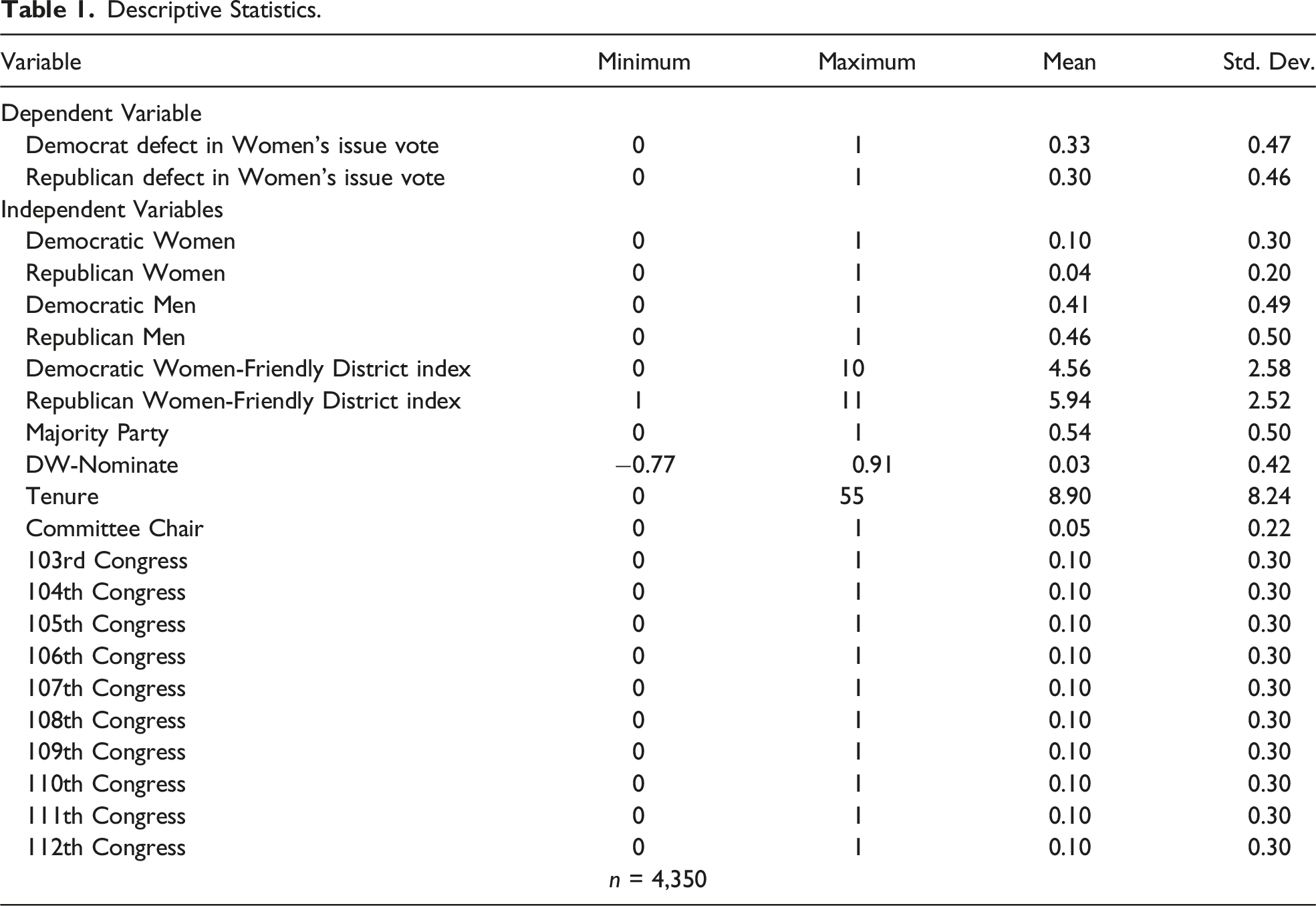
To run a logistic regression analysis with the dummy variable for whether a MC defects from party as the dependent variable, the data were collapsed by the state and district code per Congress. This data contained observations for every MC’s vote on every roll number from the 103rd through the 112th Congress. Next, the data were collapsed by a unique identifier created for each MC-Congress, creating a condensed data set containing observations for 435 MCs per Congress from the 103rd through the 112th Congress with a binary dummy variable for whether a MC defected from their party in a women’s issue roll-call vote in a given Congress. The variable Dem_defect_womenbill (representing whether a Democratic MC defected from their party leader in the House on a women’s bill vote in a Congress) ranges from 0-1 (mean = 0.33). The variable Rep_defect_womenbill (representing whether a Republican MC defected from their party leader in the House on a women’s bill vote in a Congress) ranges from 0-1 (mean = 0.30).
Independent Variables
The explanatory variables of interest are MC gender-party and the women-friendly district index score. The following four dummy variables were created for MC gender-party: FemDem coded as 1 for Democrat women MCs and otherwise as 0 (mean = 0.10), FemRep coded as 1 for Republican women MCs and otherwise as 0 (mean = 0.04), MaleDem coded as 1 for Democratic men MCs and otherwise as 0 (mean = 0.41), and lastly, MaleRep coded as 1 for Republican men MCs and otherwise as 0 (mean = 0.46). As mentioned above, Palmer and Simon’s (2006) women-friendly district index is utilized as an explanatory variable in these analyses. The women-friendly district index score is created for each U.S. House congressional district using district-level demographic data from the U.S. Census Bureau. Accordingly, a Democratic women-friendly district index (which measures the friendliness of a district to Democratic women and ranges from 0-10; mean = 4.56) and a Republican women-friendly district index (which measures the friendliness of a district to Republican women and ranges from 0-11; mean = 5.94) is produced for each U.S. House congressional district. Districts with higher women-friendly district index scores are districts in which women candidates are more likely to run and more likely to win elective office.
Control Variables
Descriptive Statistics.
Results
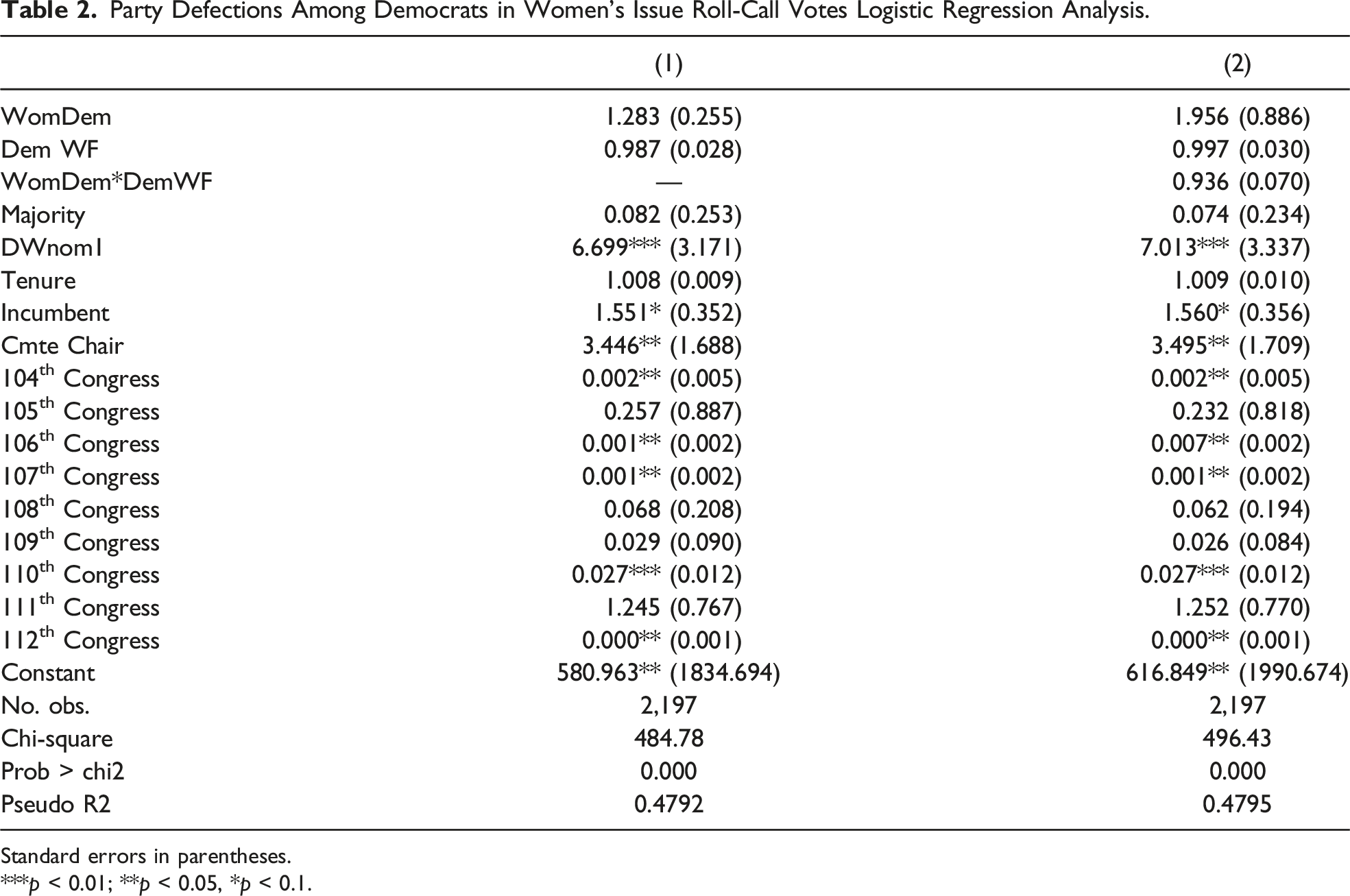
The results show some modest support for my theory about women-friendly districts creating environments of legislative freedom for women MCs, but they do not show support for my expectations about the direction of gender differences among Republicans. The results indicate that Democratic women MCs representing moderately women-friendly districts are actually more likely to defect from party on women’s issue roll-call votes than their partisan counterparts who are men. Meanwhile, there are no apparent gender differences in party defection among Republican MCs on women’s issue roll-call votes, but the Republican women-friendly district effect increases the likelihood of Republicans defecting from party on women’s issues.
Party Defections Among Democrats in Women's Issue Roll-Call Votes Logistic Regression Analysis.
Standard errors in parentheses.
***p < 0.01; **p < 0.05, *p < 0.1.
The coefficients displayed for the interaction terms cannot be directly interpreted (Buis 2010), as the effect of women-friendly district index conditions the effect of MC gender differently at different values on the independent variables. Thus, the predicted probabilities of Democratic women MCs and Democratic men MCs defecting from party on women’s issue votes, conditioned by the Democratic women-friendly district index, are displayed in Figure 1. While Figure 1 shows that there are no statistically significant gender differences in the predicted probability of MCs defecting from party on a women’s issue roll-call vote within the Democratic party at the 95-percent confidence level, there are some statistically significant gender differences at the p < 0.10 level. In districts that are moderately women-friendly, with Democratic women-friendly index scores of 5, the predicted probability of a Democratic woman MC defecting from party on a women’s issue roll-call vote is 0.69 compared to that of a Democratic man MC at 0.65 (Δ Pr. Probability = 0.04*). Figure 1 also shows that Democratic women MCs representing districts with high levels of Democratic women-friendliness are less likely to defect from party leadership on women’s issue votes than their fellow Democratic women MCs representing districts that are less women-friendly. This provides some modest support for my first hypothesis, though these differences are not statistically significant with 95-percent confidence. Marginal effects among Democrats.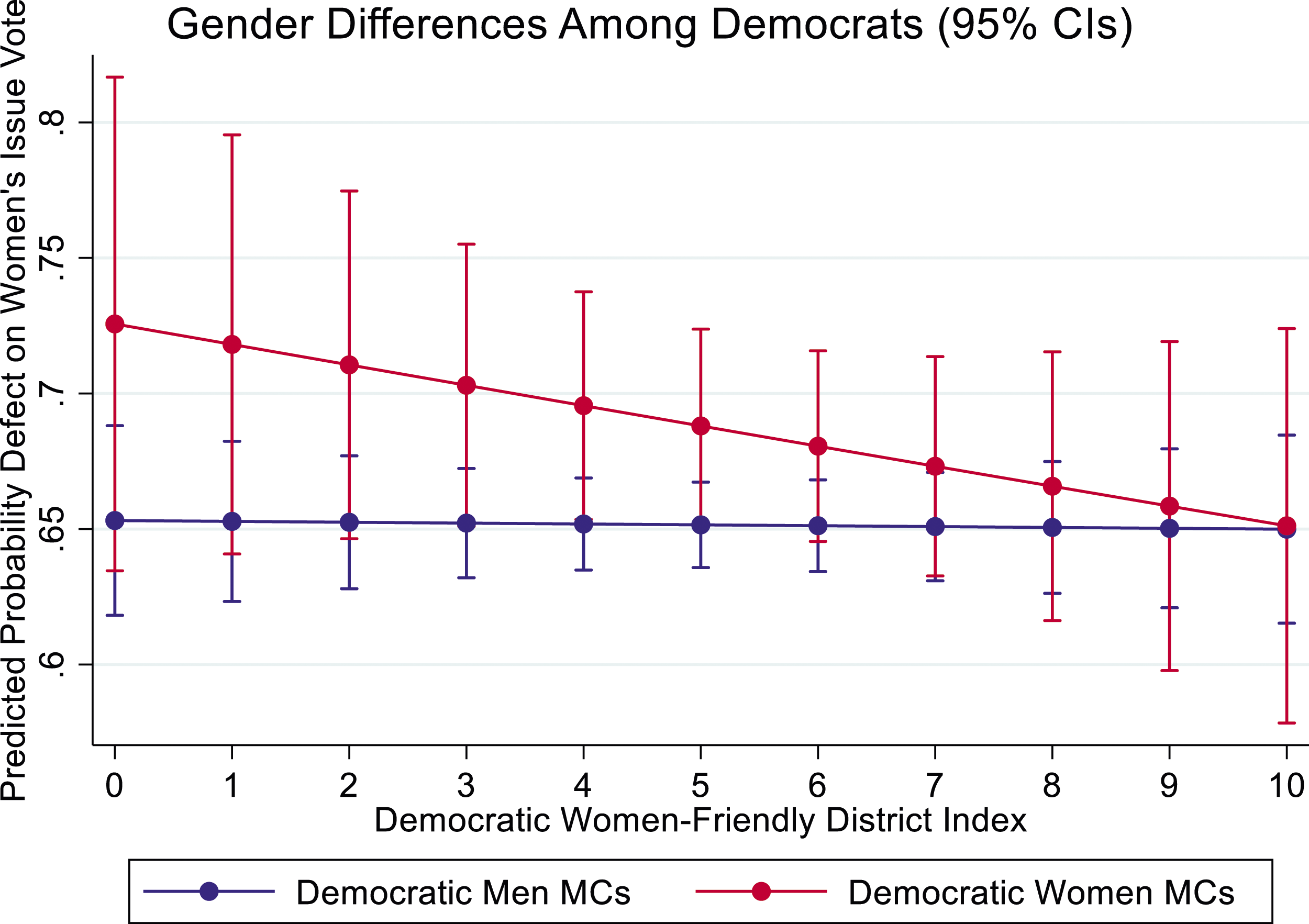
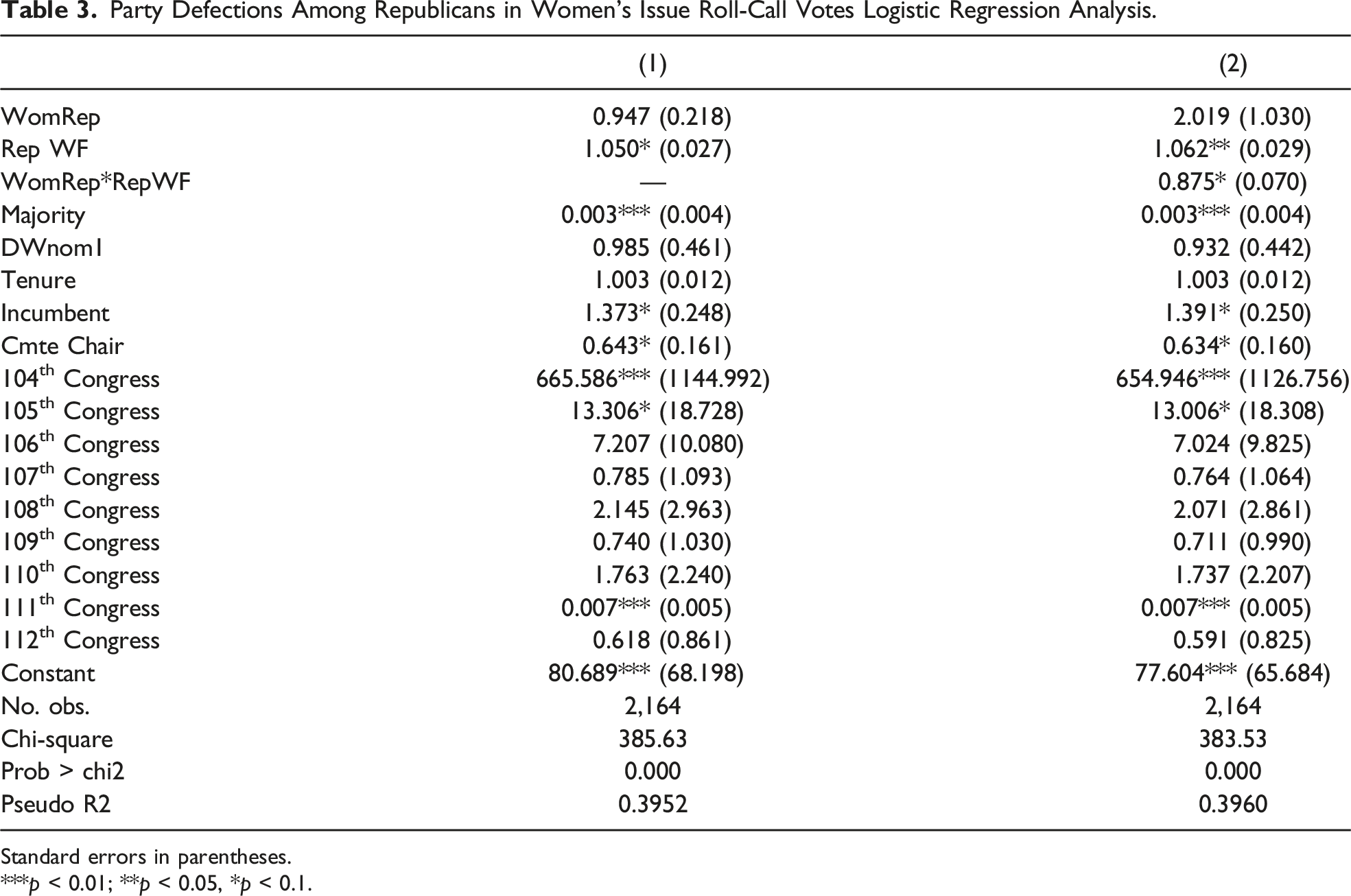
Party Defections Among Republicans in Women's Issue Roll-Call Votes Logistic Regression Analysis.
Standard errors in parentheses.
***p < 0.01; **p < 0.05, *p < 0.1.
Because coefficients displayed for interaction terms cannot be directly interpreted due to conditional effects at different levels of explanatory variables on the dependent variable, the predicted probabilities of Republican women MCs and Republican men MCs defecting from party on women’s issue roll-call votes, conditioned by the Republican women-friendly district index, are displayed in Figure 2. The results indicate that there are no statistically significant gender differences among Republicans in terms of defecting from party on women’s issue roll-call votes. These results do not offer support for my second hypothesis, that Republican women MCs representing women-friendly districts will be more likely to defect from party on women’s issue votes than their men partisan counterparts or their fellow Republican women representing districts that are less women-friendly. I attribute these results in part to the fact that there are very few districts in the sample at the highest levels of the Republican women-friendly district index, and there are even fewer Republican women MCs represented in the sample in this analysis (4.34-percent) Figure A1 and A2. Marginal effects among Republicans.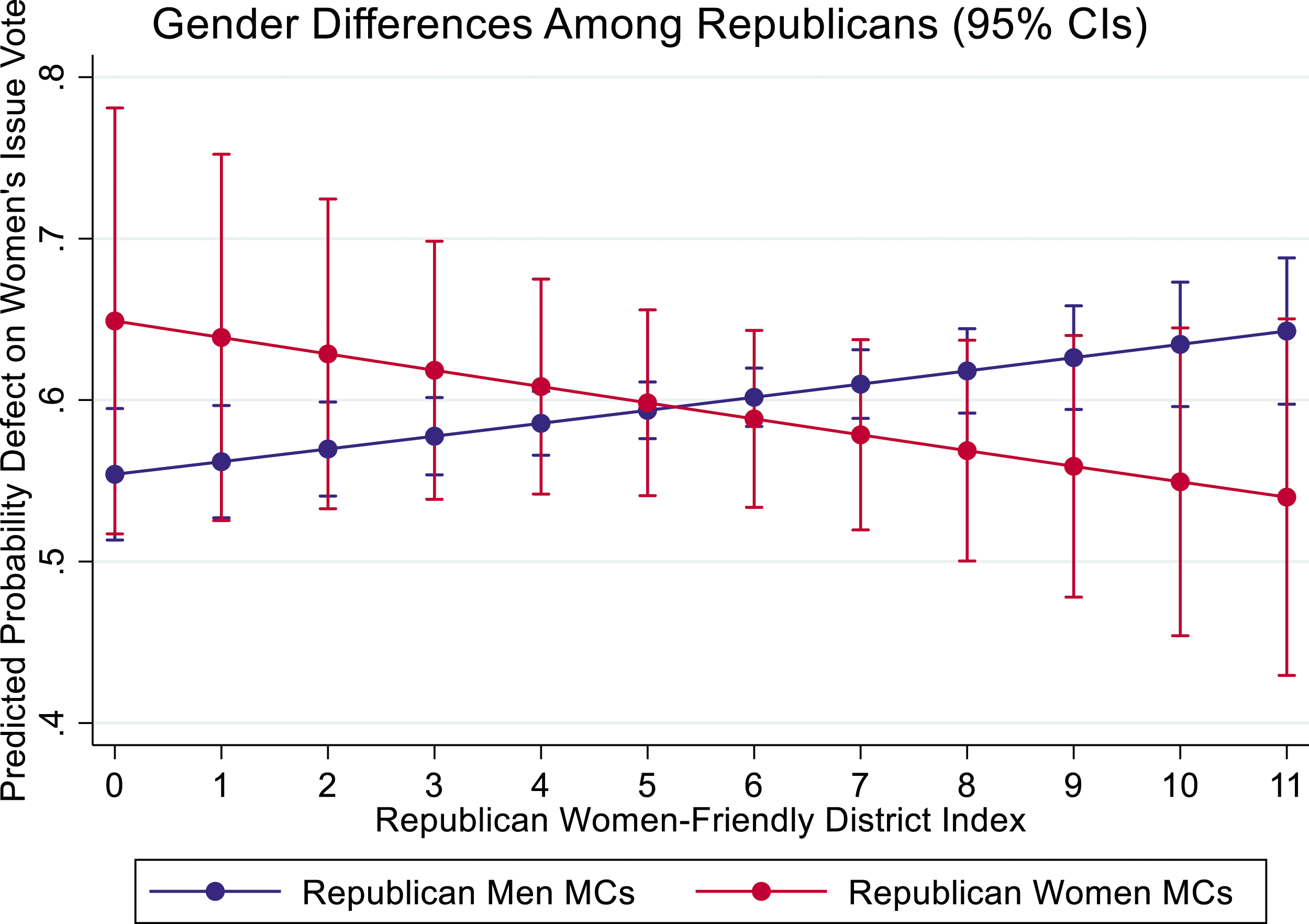
Discussion and Conclusion
In this paper, I find some conservative evidence to support my theory that MCs representing women-friendly districts are more able to exercise legislative freedom by defecting from party in women’s issue roll-call votes. While I do not find gender differences in likelihood to defect from party on women’s issue roll-call votes among Democratic men and women MCs representing districts that are highly women-friendly, this finding bolsters existing research that shows that the Democratic party is generally friendlier to the interests of women around the country—particularly liberal women’s interests—and has become more so over time as evidenced by the gender gap (Dolan, Deckman, and Swers 2018; Kaufmann and Petrocik 1999).
While there are not significant gender differences among Democrats representing women-friendly districts, I do find that Democratic women MCs representing moderately women-friendly districts are more likely to exercise legislative freedom by defecting from party. Though I did not expect this finding and rather predicted the opposite, this was based on the idea that Democratic party leadership would be voting in favor of women’s issues and interests in roll-call votes. My finding here contributes to the literature by showing some weakly statistically significant evidence (at the p < 0.10 level) that Democratic women MCs representing these moderately women-friendly districts are able to defect from party in women’s issue votes and are more likely to do so than Democratic men MCs representing similarly women-friendly districts. It is not surprising that the likelihood of a Democratic woman MC defecting from their party on women’s issue roll-call votes decreases as the women-friendliness of the district that MC represents increases. However, the finding that Democratic women MCs who represent moderately women-friendly districts are more likely to defect from their party on women’s issue roll-call votes than are Democratic men MCs representing similar districts points to the potential for the women-friendliness of a district insulating a Democratic woman MC from both party and electoral rebuke. Perhaps it is in these districts that are moderately women-friendly that we might also be most likely to find a moderate Democratic woman MC, and that those MCs would be less liberal, feminist than the Democratic MCs (men or women) who represent districts with the highest levels of women-friendliness Figure A3 and A4.
My finding that Republican women MCs are no more likely to defect from the Republican party than men MCs in women’s issue roll-call votes stands in contrast to existing research on a narrower sample of women’s issue bills from the 103rd and 104th Congress (Swers 2002). Instead, I find that the Republican MCs representing districts that are more women-friendly are more likely to defect from party on women’s issue votes. Based on the results displayed in the Figure 2, though there are not statistically significant gender differences, it appears that it is actually Republican men MCs representing women-friendly districts who are likely to defect from party on women’s issue votes. This offers an important contribution to this area of research by highlighting the importance of district-level demographic characteristics as a conditional, explanatory factor for Republican MCs exercising legislative freedom on women’s issues. These findings together also support existing research that shows women in Congress operate on partisan teams focused on differing gender-based policy objectives (Swers 2016). This finding about Republican MCs, representing women-friendly districts and defecting from party on women’s issue votes, has interesting real-world implications for the future of substantive representation of women’s interests by Republican MCs. The finding here leads one to expect that as districts become more women-friendly, Republican MCs representing these women-friendly districts, even Republican men, are likely to serve as substantive representatives for women’s interests, too.
One limitation of the findings presented here are that the Democratic and Republican women-friendly district indexes created by Palmer and Simon (2006), and replicated for this project, are limited in that they are measures that do not capture the likely success of women candidates of color. For example, the districts that tend to elect Black women are the most liberal, the most party-friendly to Democrats, the smallest and most urban, and are similar to districts that elect black men (Palmer and Simon 2006, 202-204). Because women of color in Congress are concentrated within the Democratic party and most likely to be elected in the most liberal and Democratic of districts, I risk underestimating the effects of race and party when predicting legislative behavior in this project. However, because of the Democratic party-friendly socioeconomic characteristics of districts most likely to elect Black women (and men), MCs of color are still likely to represent districts with relatively high Democratic women-friendly district scores. Still, this shortcoming should be expanded upon in future research that delves deeper into Palmer and Simon’s (2006) observation that districts that are favorable to women candidates of color are the most liberal, Democratic districts, with characteristics distinct from those that only elect white women.
There are opportunities for future research to expand on these findings by examining intersectionality and the effects of descriptive representation in terms of the race and gender of our representatives combined with district characteristics on women’s issue roll-call voting behavior. Future research can also expand on the findings here by examining roll-call voting in the U.S. Senate chamber in addition to the U.S. House of Representatives. The record high number of women in both chambers of Congress currently provides even more room for advancing research on the impact of women’s representation in this way. There is also opportunity to expand on this research by testing whether women MCs representing women-friendly districts are able to get away with exercising legislative freedom and defecting from party by continuing to get reelected. Additionally, in future iterations of this project, I plan to explore Congresswomen exercising legislative freedom in other policy areas of roll-call voting beyond just women’s issues. Once we begin investigating women’s roll-call legislative behavior beyond women’s issue voting, we can develop a fuller picture of women and their legislative behavior in Congress, and we are likely to find interesting patterns in this less developed research avenue.
Footnotes
Declaration of Conflicting Interests
The author(s) declared no potential conflicts of interest with respect to the research, authorship, and/or publication of this article.
Funding
The author(s) received no financial support for the research, authorship, and/or publication of this article.

Notes
Appendix
Distribution of Republican Women MCs in Republican Women-Friendly Districts.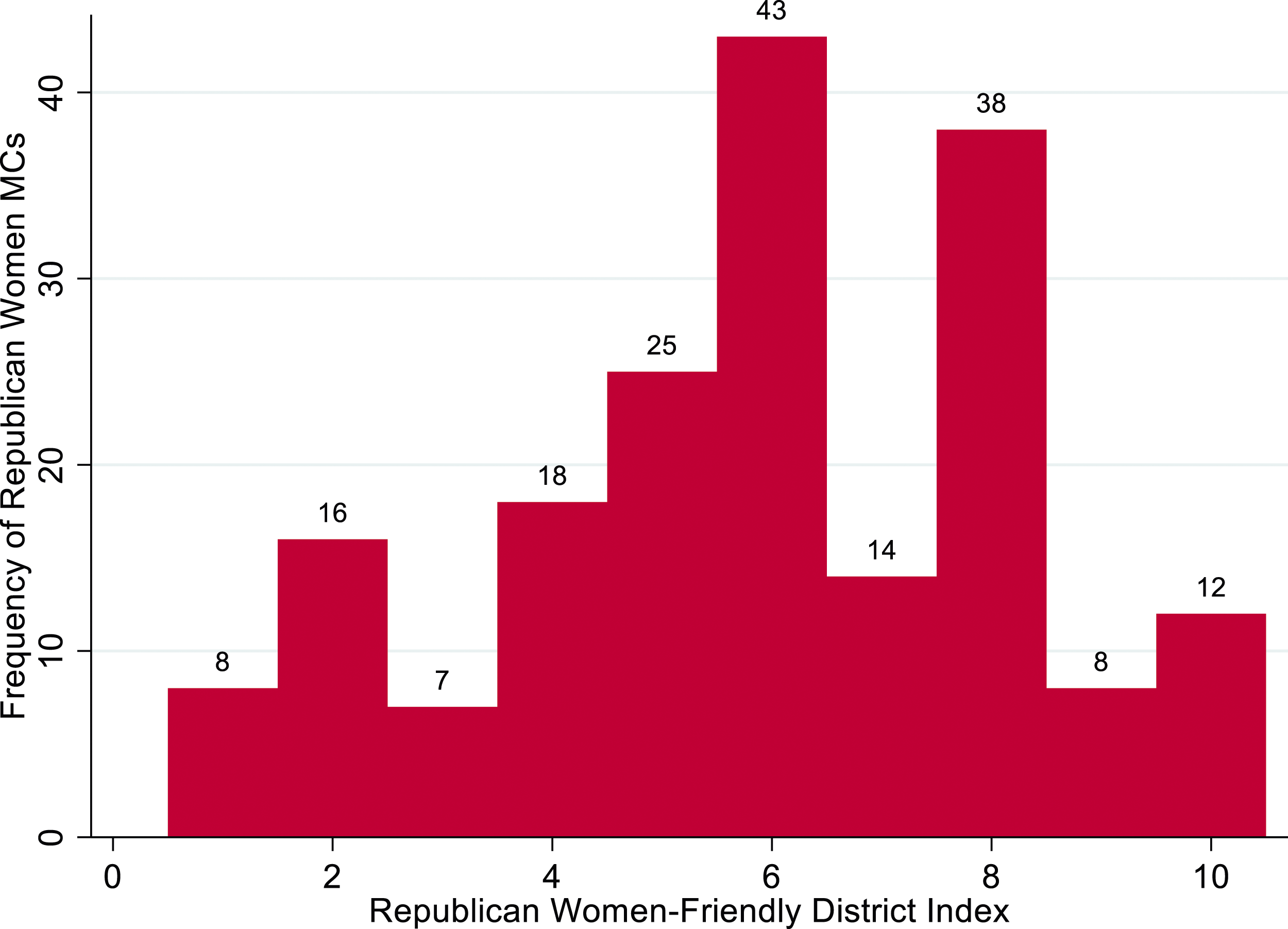
Distribution of Republican Men MCs in Republican Women-Friendly Districts.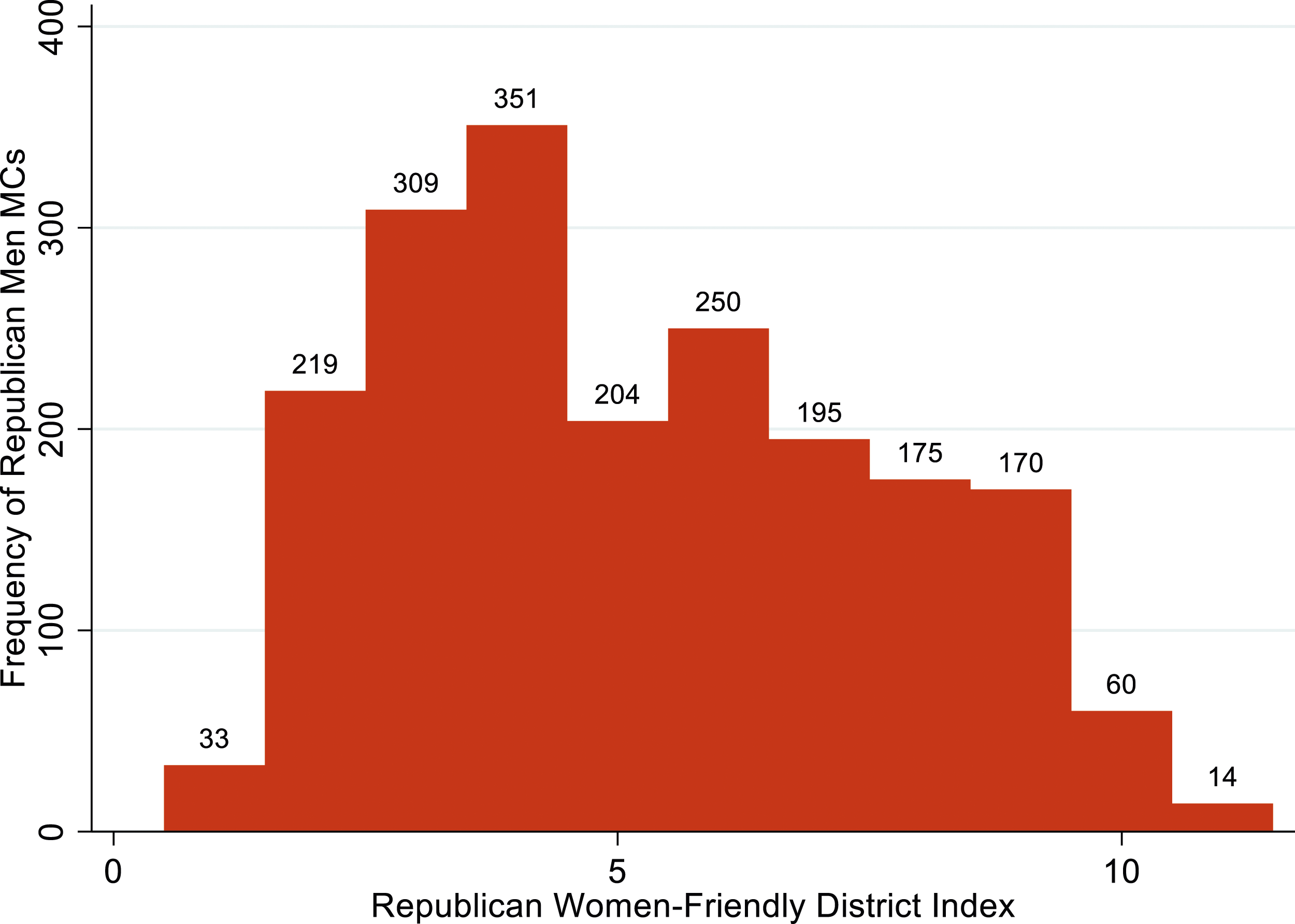
Distribution of Democratic Women MCs in Democratic Women-Friendly Districts.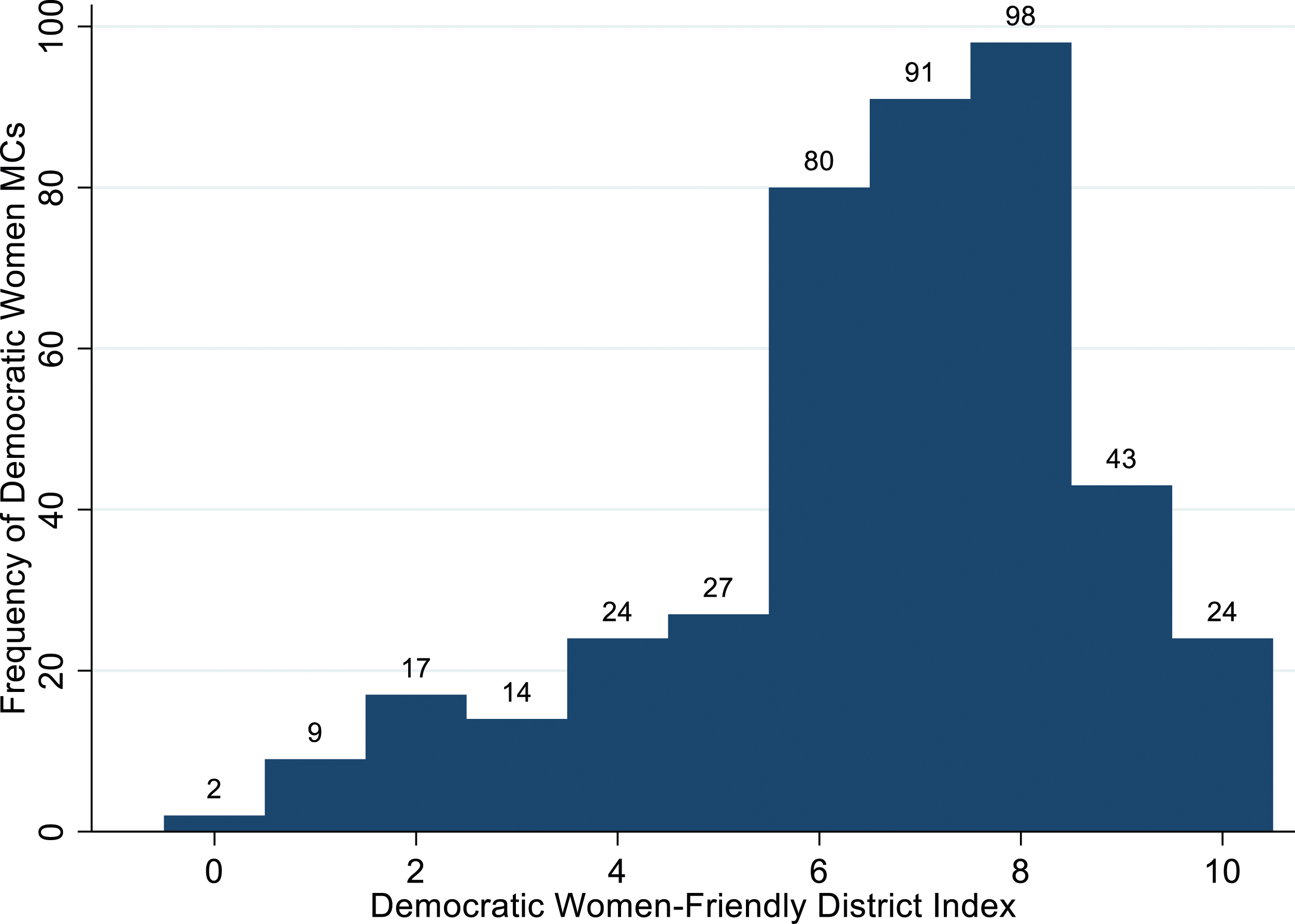
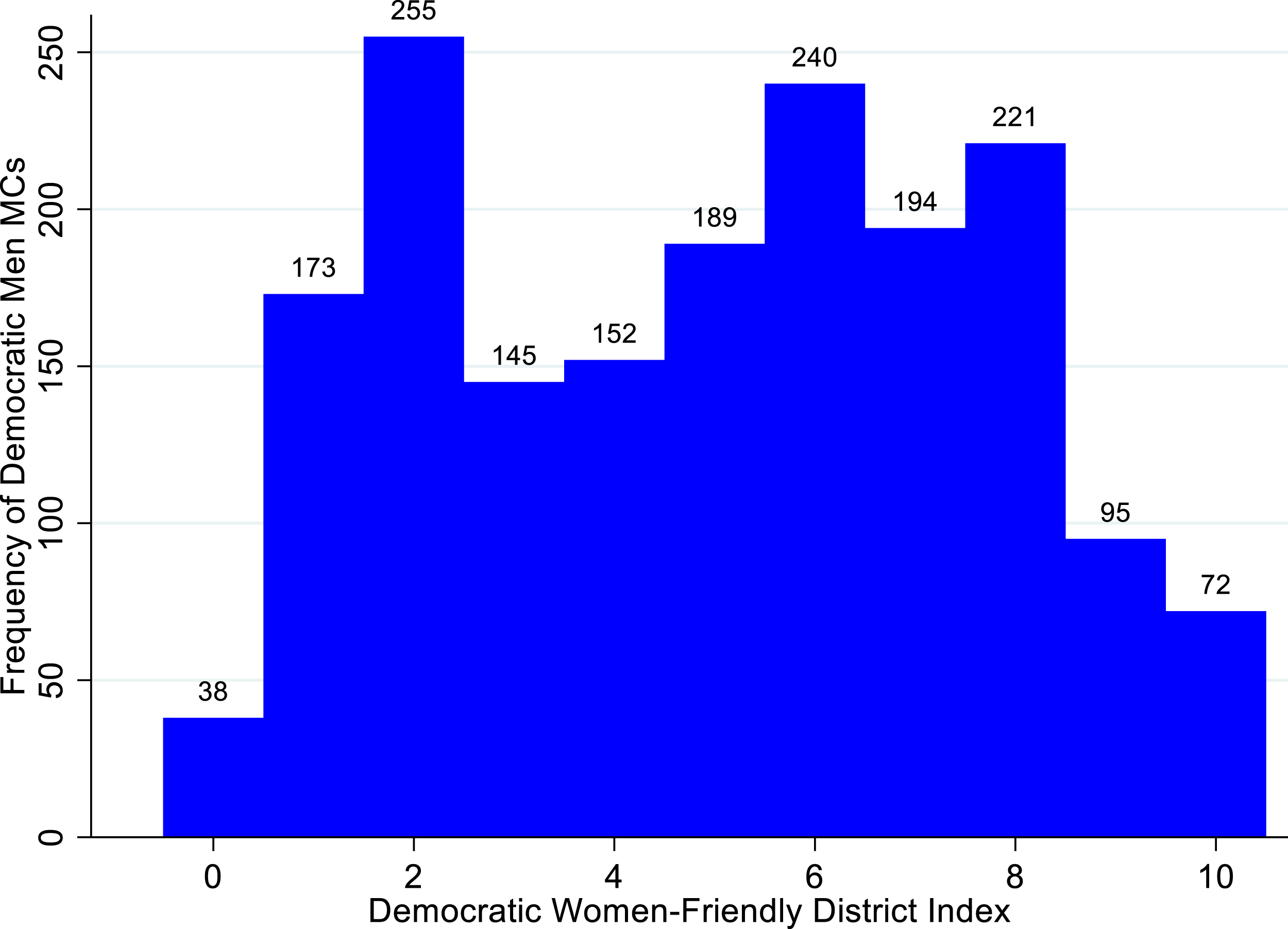
Distribution of Democratic Men MCs in Democratic Women-Friendly Districts.