




Abstract
This article sheds light on the obstacles that women face as members of the government by answering the questions: How does the sex of ministers shape the way MPs’ assess the quality of their work? And, how does this relationship differ depending on the political ideology of MPs? We argue that legislators assess the competencies of women ministers differently after the activation of gender stereotypes, but that the way they react depends on the ideological orientation of their party. We investigate this topic in a real-word context using a unique survey experiment with German and Austrian MPs. The evidence reveals that, while MPs belonging to right-wing parties perceive women in the executive as less competent than men ministers, their colleagues from left-wing parties actually assess them more favorably. These findings highlight the persistence of old myths about women’s lacking political skills and the emergence of new ones about women’s superior ability to govern.
Introduction
Prejudice against women in government persists and is visible in women’s lower chances for nomination to ministerial positions. Despite numerical gains, only 35% of all cabinet members in advanced industrialized democracies were women at the end of 2020 (Jahn et al. 2022). The extensive set of research that engages with women’s growing presence in executive office emphasizes the continuing role of gender stereotypes. These are generalized expectations about what men and women are and should (not) be like (see e.g., Broverman et al. 1972; Hentschel et al. 2019) and affect party gatekeepers’ assessment of women aspirants for ministerial positions (Davis 1997; Goddard 2019; Krook and O'Brien 2012). Once women enter the executive, it is likely that the beliefs of political actors about women continue to shape their work as ministers. Remarks of politicians support this conjecture: For instance, a local branch of the Finnish National Coalition Party labeled the women-majority cabinet from 2019 a “lipstick government” in a public statement (Yleisradio 2019). A Canadian member of parliament (MP) called environmental minister Catherine McKenna a “climate barbie” during a parliamentary debate (BBC News 2017). And, a British representative described the cabinet reshuffle by the former Prime Minister David Cameron in 2014 as “the night of the petticoats” (BBC News 2014) implying that the newly appointed women had been selected merely for being women rather than qualified. Despite such anecdotal evidence suggesting that fellow politicians take gender into account when evaluating members of the executive, the disadvantages faced by women ministers has received little scholarly attention so far. To address this gap, the present article answers the following research questions: How does the sex of ministers shape the way MPs’ assess the quality of their work in office? And, how does this relationship differ depending on the political ideology of MPs?
We put the argument under empirical scrutiny that legislators’ assessment of the competencies of women as ministers is shaped by prejudice about women’s ability to govern. Role congruity theory (Eagly and Karau 2002) contends that the traits women are expected to possess (e.g., empathy) do not align with those of a successful leader (e.g., assertiveness). Whether these presumptions are applied and shape how other people evaluate women in leadership positions depends on their implicit or explicit activation through role-confirming information (Bauer 2015; Kunda and Spencer 2003). Translating this rationale to the context of legislative-executive relations, this study shows that MPs build their assessment on gender stereotypes when judging the quality of the work of women ministers, but that the direction of the effect depends on the ideological orientation of their party. MPs from right-wing and centrist parties are more likely to apply gender stereotypes during their assessment, leading to a lower evaluation of women ministers’ ability to govern. We argue that this follows from, first, low exposure to women politicians due to low numbers of women in the respective party parliamentary groups (Mansbridge 1999) and, second, from conservative perceptions about women’s role in society typical for politicians of these parties. By contrast, MPs from leftist parties, who experience frequent contact with politicians of both sexes and hold more progressive gender views, tend to evaluate the competency of women ministers overly positive after assessing a man.
We draw these conclusions based on data from a unique survey experiment with MPs in Germany and Austria conducted in March and April 2020 (response rate of 14.9%). We asked MPs to rate the competency of women ministers who were in office at the time. MPs belonging to the control group only had to evaluate a single woman minister, while those in the treatment group had to evaluate a man minister before assessing a woman minister. By first having to rate a man’s competency, we expose the treatment group to a stimulus that activates gender stereotypes by reminding them that men tend to govern—a process continuously taking place in daily life through role conforming information in the news or observation of men and women in traditional roles (see e.g., Campus 2013). 1 Comparing the evaluation of women executives across the two samples of MPs allows us to study how salient gender stereotypes impact the evaluation of women ministers.
Our research design overcomes major barriers to investigating the role of gender stereotypes for women ministers and creates results with high internal validity. To begin with, we analyze the evaluation of actual women in government, while previous contributions focused on differences in the perception of hypothetical men and women running for political offices (Courtemanche and Connor Green 2020; Mo 2015; Smith et al. 2007). The limited set of information about these imagined people can lead to an overestimation of the impact of sex as a cue for competency (Mo 2015). The present study offers a more realistic assessment. Additionally, our research design provides a least likely setting for the confirmation of theoretical expectations about the role of gender stereotypes for the perception of women politicians. We study MPs who are in charge of overseeing the quality of the executive work (Miller 2005; Strøm 2000) and who should be equipped with the necessary information to evaluate the work of a minister objectively. Moreover, the women assessed by MPs serve in portfolios that are perceived as traditionally “masculine” or “neutral” (Escobar-Lemmon and Taylor-Robinson 2005; Goddard 2019), namely, environment, agriculture, and defense, and hence, do not reaffirm gender stereotypes about women’s role in the society. Studies that take into account ministers holding traditionally “feminine” portfolios such as family, education, or social affairs, or analyses engaging with the population more broadly are likely to reveal more severe stereotyping.
The findings presented in this study have important implications for the pathway to gender equality in the 21st century: To begin with, we show that women ministers will continue to face discrimination. Instead of concentrating on policy design and implementation, women will have to invest time in convincing legislators of their capabilities and to secure the support for their policy proposals in parliament. Hence, “myths about women’s inabilities to participate” (Banaszak and Plutzer 1993, 149) will continue to reduce the quality of democratic legislative processes. Yet, our results reveal that MPs from leftist parties are neither free of prejudice and assess women ministers overly positive. Whether this behavior is a sign of increasing equality remains unclear. A set of positive stereotypes about women in politics might just as well create an entirely different type of disadvantage for women in politics: If myths about women’s better ability to participate emerge more broadly and lead to unrealistically high expectations, women’s increasing involvement into politics is likely to create major disappointments.
How Gender Stereotypes Shape the Evaluation of Ministers by Political Elites
When women reach leadership positions, gender stereotypes should create prejudice against women according to role congruity theory (Eagly and Karau 2002). 2 This theory proposes that sex-typical social roles are decisive for the characteristics and abilities others ascribe to a person. 3 Gender stereotypes follow from the persistent observation of people in their traditional roles in the society. However, they are not only descriptive, but also have a prescriptive component (i.e., formulate beliefs about what men and women should do) and a proscriptive component (i.e., formulate beliefs about what men and women should not do) (Eagly and Karau 2002; Rudman et al. 2012). Agentic attributes such as assertiveness or strength are prescriptive for men, while communal attributes such as warmth and kindness are for women. This distinction most likely derives from the idea that agency is an important feature for leadership and career success, whereas communality is required for caring for the welfare of others (e.g., Eagly and Karau 2002; Prentice and Carranza 2002). Gender stereotypes also include proscribed characteristics which are negative qualities “prohibited” for only one gender. For example, dominant masculine traits (i.e., being controlling and arrogant) are proscribed for women but accepted for men, and weak feminine traits (i.e., being weak and naive) are proscribed for men but approved of for women (e.g., Prentice and Carranza 2002; Rudman et al. 2012). These kinds of cues derived from gender stereotypes allow observers to categorize and simplify and to make predictions about a person’s personality, which consequently shapes how others evaluate men and women. If the beliefs about a group do not correspond to someone’s unique qualities, stereotypes can lead to faulty assessments. These faulty assessments can then affect the expectation about performance and attributes of women (and less frequently men) negatively or positively (e.g., Hentschel et al. 2019). Experimental research on political candidate evaluations demonstrates that voters tend to apply more stringent qualification standards for women than men (Bauer 2015) and to view men as more suitable for political leadership roles than women (Smith et al. 2007). Additionally, women candidates’ experience tends to be questioned (Annesley et al. 2019) and they need to be exceptionally highly qualified to succeed (see e.g., Schneider and Bos 2019). Thus, we expect that in the context of political leadership positions, MPs’ expectations about gender-specific behavior should become more pronounced and create negative prejudices about women’s ability to lead. The incongruence between the feminine stereotype and leader role expectations (e.g., strength, assertiveness) results in the judgment that women leaders who behave in a way congruent with these expectations, are not ideal leaders. At the same time women, who behave as expected from leaders, lack the communal qualities deemed appropriate for their gender (Eagly and Karau 2002; Heilman and Okimoto 2007).
Since ministerial positions remain men-dominated and require attributes that are stereotypically associated with men but not with women, gender stereotypes should lead MPs to assess women as less competent ministers than men. Overall, research indicates that elites generally consider men as more competent and knowledgeable than women when it comes to conducting leadership tasks. Studies mostly drawing on experiments imply that men are stereotyped as possessing agentic traits and, thus, fit the political leader role perfectly (Huddy and Terkildsen 1993; Rosenwasser and Dean 1989). By contrast, unlike men, women politicians described as power seeking elicit backlash against women as they do not live up to prescribed stereotypes such as level of communality or niceness (see Schneider and Bos 2019 for an overview). Previous scholarly work engaging with women’s careers in industrial organizations also shows that doubts about women’s leadership competences persist even once they have reached a high-level position, for example, as managers (Heilman and Okimoto 2007; Koenig et al. 2011; Rudman et al. 2012). To our best knowledge, there is to date no study that engages with gender bias in the evaluation of ministers.
Factors such as the tasks a minister ought to fulfill in office or the context under which a person leads may strengthen or weaken the degree to which women’s leadership is perceived as incongruent. For one, if the position involves dealing with topics close to the private sphere, such as gender equity or education, incompatibility with the expectation about women’s leadership competence is lower compared to positions where executives have to engage with military crises, crime, or the economy (Huddy and Terkildsen 1993; Koenig et al. 2011; Rosenwasser and Dean 1989). While there is no study analyzing performance evaluation of ministers, this pattern is, for example, visible in portfolio assignment by gatekeepers: If women are appointed as ministers, they are most likely to be in charge of “feminine” policy fields and least likely to govern in “masculine” areas (Annesley et al. 2019; Goddard 2019; Krook and O'Brien 2012). Contextual factors such as women prime ministers, large numbers of women politicians and gender-progressive values can transform expectations about women’s role in the society, and, for instance, make the appointment of women to traditionally “masculine” and prestigious portfolios more likely (Barnes and O'Brien 2018; Goddard 2021).
If judgment of women ministers is a consequence of the application of gender stereotypes (i.e., the extent to which one uses stereotypes to evaluate a person), the observation of role-confirming behavior should activate stereotypes (i.e., make them accessible in the MPs’ minds). Explicit and implicit activation of stereotypes occur constantly through role conforming information in the media (e.g., Aaldering and Van Der Pas 2020; Campus 2013) or viewing men and women in roles perceived as traditionally congruent to the respective gender (de Lemus et al. 2014; Rudman and Kilianski 2000). Previous empirical work uncovered that the application of gender stereotypes for evaluation of individuals does not occur automatically because expectations about men’s and women’s role in the society might be more or less present to the respondent (Kunda and Spencer 2003). They are influential only in certain contexts or in subtle, indirect ways, for instance, after hearing stereotypical campaign messages (Bauer 2015), during terrorist or national security threats (Fox and Lawless 2004), or after the involvement in a scandal (Courtemanche and Connor Green 2020). As a result, some authors have argued that gender stereotypes need to be activated by stereotype-consistent information (Bauer 2015; Ditonto 2017; Eagly and Karau 2002), that is, by gender congruent primes, to cause a biased evaluation of men and women (Blair and Banaji 1996). Scholarship employing survey experiments use different strategies to activate gender stereotypes in order to measure how and when they are applied. Some manipulate the sex of the political candidates to be evaluated by voters (Barnes and Beaulieu 2014; Courtemanche and Connor Green 2020; King and Matland 2003), while others use visuals (Bauer and Carpinella 2018; Coronel et al. 2021). These studies provide ample evidence that stereotypes can be activated spontaneously on exposure to a stereotyped individual, that the activation can be automatic and upon subconscious exposure that is too brief to permit controlled processing (Kunda and Spencer 2003). In line with this research, MPs’ reliance on stereotypes in their assessment of women ministers should thus be more pronounced after the activation of subconscious role expectations related to gender and leadership. When explicitly compared to a man, women should tend to reach lower competency ratings.
MPs who receive role-confirming information will evaluate women ministers less favorable than MPs who do not receive such information. Furthermore, we expect that MPs’ predisposition to react to role-confirming behavior should be moderated by the ideological position of the party they belong to. Two causal mechanisms can explain how a parties’ left-right orientation affects the application of gender stereotypes in the evaluation of ministers. First of all, parties choose candidates aligning with their core values and aspirants for political offices join parties that represent their ideals. While rightist parties emphasize traditional family values in their manifestos, left parties tend to promote positive attitudes towards gender equality and emphasize feminist issues (Jost et al. 2008). Consequently, MPs from more left-leaning parties should be more aware of bias and less prone to negatively assess the competency of women ministers after the activation of gender stereotypes compared to politicians from more rightist parties. Second, ideological differences between parties are a main predictor for the level of exposure to women politicians with a lower share of women amongst activists, members, professional politicians, and leaders in right-wing parties than in those to the left of the center (e.g., Sanbonmatsu 2002). Most professional politicians are first and foremost socialized within their party, internalizing its costumes and rules and norms. Women in politics expose their party colleagues to the idea of women as political actors and provide a realistic picture concerning the impact of women’s involvement (e.g., Beaman et al. 2009) as well as the competence of women in office (Alexander and Jalalzai 2020). The verification of women’s ability should diminish the unsubstantiated stereotypical expectations that often undermine women’s credibility (Dahlerup 1988). If women’s progress fosters acceptance of gender-equal capabilities to lead, we should observe that the application of gender stereotypes is less pronounced in parties with many women politicians. Based on these considerations, we contemplate that the application of gender stereotypes during the assessment is shaped by the ideological orientation of the MP’s party.
The effect of receiving role-confirming information on the way MPs evaluate women ministers will be less pronounced in left-wing parties than centrist and right-wing parties. Lastly, the literature implies that role-confirming information influences legislators’ assessment of women ministers differently, depending on the specific ability MPs’ ought to assess. According to previous research, leaders should possess a number of different abilities in order to be favorably evaluated (Zaccaro et al. 2018). As gender stereotypes assign different strengths to men (e.g., agentic, assertive, independent, self-confident) and women (e.g., community-oriented, affectionate, empathic, cooperative), the reliance on gender cues might vary with the specific ability asked to be evaluated. At the same time, gendered expectations about the traits of men and women are not static but adapt to changes in societal structures and roles according to the concept of dynamic stereotypes. As women’s socio-economic status has changed during the last decades, so have consensual beliefs about their attributes. A recent study from the United States demonstrates that contemporary gender stereotypes put emphasis on women’s communion and competence but not on their agency (Eagly et al. 2020). These developments can be explained with the gender segregation of the labor force and women’s disproportionately high employment in sectors like education and health care. People’s observation of women in these jobs emphasizing social skills and social contribution (Cortes and Pan 2018) has reinforced the strength of the corresponding stereotypes such as being empathetic. While these studies mainly consider ordinary citizens, similar mechanisms might impact the evaluation of women in politics since they are most visible in fields related to traditionally “feminine” policy areas with regard to work focus in parliament, but also concerning the ministerial portfolios they lead. Additionally, in line with the glass cliff theory, experimental research from industrial organizations demonstrates that people tend to assign traits which are important for handling crisis situation to women leaders rather than men (see Bruckmüller et al. 2014 for an overview). Attributes to successfully maneuver difficult situations tend to be perceived stereotypically feminine (e.g., understanding, intuitive, tactful). As a result, characteristics that are seen to be desirable for a leader in times of crisis are hence more strongly associated with feminine gender stereotypes. A number of studies argue that women politicians constitute a group distinct not only from men in politics but also from women in general and are subject to different stereotypes (Schneider and Bos 2014). It is likely that women ministers are perceived as less empathetic and more assertive than women in the general population. However, we expect that the activation of gender stereotypes, and with it the direct sex comparison, reinforces the evaluation of ministers along the lines of traditional feminine (e.g., empathy, crisis-management) and masculine traits (e.g., assertiveness) as they become particularly pronounced in a direct comparison. In sum, we anticipate that, after the activation of gender stereotypes, MPs tend to perceive women cabinet members as less assertive and more empathetic.
MPs who receive role-confirming information will evaluate the assertiveness of women ministers less favorable than MPs who do not receive such information.
MPs who receive role-confirming information will evaluate the empathy and crisis-management ability of women ministers more favorable than MPs who do not receive such information.
Research Design
To test these hypotheses, we conducted a survey experiment with German and Austrian MPs. MPs had to rate the competency of a single woman belonging to the government at that time. We asked respondents to assess the minister’s competency in general as well as with regard to a list of specific abilities. Through an experimental treatment, we artificially activated gender stereotypes for a random part of the sample beforehand. 4 By comparing the evaluation of the woman minister between the treatment and control group, this research design allows uncovering under which conditions MPs rely on active stereotypes for the assessment of women in the executive.
Germany and Austria were selected for this purpose because they constitute typical cases for gender equality in politics in advanced industrial democracies. In both countries, the shares of women in parliament and government are slightly above the European standard. While on average, 29.6% of all single or lower house MPs in Europe (including Scandinavia) are women, the German Bundestag includes 30.9% women and the Austrian Nationalrat 37.2% (Inter-Parliamentary Union 2018). Of the fifteen ministers in each country’s cabinet in office in 2020, six in Germany and eight in Austria were women (the latter figure includes two women ministers to the chancellor’s office). The governments of both countries are led by conservative parties, but the coalition partners differ. A major difference between the two cases is that Germany has been governed by Angela Merkel since 2005, while Austria was only briefly led by a woman interim chancellor in 2019.
We distributed our online questionnaire to all MPs in office via email (709 in Germany and 183 in Austria) on the 27th of March 2020. 5 Two weeks later, we sent a reminder and closed the survey on the 16th of April 2020. Within that time frame, 80 German MPs and 53 Austrian MPs responded, leading to response rates of 11.4% in Germany and 29.0% in Austria. 6 Appendix 1 provides details on the organization of the survey. 7
Measuring the Competency of Ministers
The ratings that respondents assign to the competency of a minister constitute the dependent variables for the analyses. To avoid question order effects, all respondents only had to assess the competency of a single woman minister. To ensure that the results can be generalized beyond a single specific minister, we took three women ministers with different characteristics into account, one from the Austrian and two from the German cabinet. All Austrian MPs were asked to judge the qualification of the minister of defense, Klaudia Tanner (Austrian People’s Party), half of the German sample had to rate minister of nutrition and agriculture, Julia Klöckner (Christian Democrats), and the second half of the German sample evaluated minister of environment, Svenja Schulze (Social Democrats). Key characteristics of the ministers are outlined in Appendix 2. We selected these ministers because they are in charge of portfolios which are perceived as traditionally “masculine” or “neutral,” and hence, do not reaffirm gender stereotypes about women’s role in the society (Escobar-Lemmon and Taylor-Robinson 2005; Goddard 2019). They are least likely cases for observing strong stereotyping effects. Moreover, from the limited set of women serving in such portfolios, we chose these three, because we were able to identify reasonably similar men ministers with regard to factors such as expertise, political experience, and popularity. Assessing these men constitutes the treatment for the treatment group and comparability is important to ensure that the treatment effect can be attributed to the sex of the minister rather than other differences between ministers (see description of independent variable for details).
At first, respondents had to rate the overall competency of the woman minister. Afterwards, they were asked to assess her with regard to seven more nuanced abilities. To develop this list of abilities, we draw on findings from studies on industrial organizations that use employees’ evaluations of leaders or of leadership skills (Koenig et al. 2011; Zaccaro et al. 2018), since research on political leadership skills mostly relies on evaluation of political candidates running for office rather than office holders (e.g., Bellucci et al. 2013; Berz and Jankowski 2022; Bittner 2011; Costa and Ferreira da Silva 2015; Ferreira Da Silva and Costa 2019; Ohr and Oscarsson 2011; Rehmert 2022). This scholarly work indicates that performance-oriented criteria play an important role in the overall judgment of leaders and that they contribute significantly to leadership effectiveness (Zaccaro et al. 2018). The set of desirable attributes of leaders includes the level of expertise, the capacity to shape interpersonal relations, and cognitive and strategic skills. In a similar manner, ministers might benefit from substantial expertise related to the portfolio they are heading. Furthermore, the set of interpersonal skills necessary to lead a ministry successfully includes capabilities that relate to coordination within cabinet or between governing parties, such as the ability to compromise and assertiveness, but also traits that help gathering support in the electorate such as empathy (since the ability to place oneself in another’s position that enables politicians to remain connected to the people) and integrity. Problem-solving and crisis-management ability, moreover, reveal the capacity to trace information in a way that effectively influences politics and policy. Overall, we define seven abilities that respondents had to assess for the woman minister.
8
We provided short clarifications of each item, to ensure an unambiguous understanding of the wordings. The final list as presented in the survey reads as follows: (1) Expertise (knows recent developments and problems in the area of responsibility) (2) Problem-solving ability (develops reasonable solution proposals for current problems) (3) Crisis-management ability (reacts in a systematic manner to external shocks such as natural disasters) (4) Assertiveness (enforces his or her interests against opposition) (5) Integrity (is credible and honest) (6) Ability to compromise (finds joint solutions acceptable for all involved) (7) Empathy (has close ties to the population)
We asked respondents to assess the ministers’ competencies and abilities in comparison to the average performance of members of cabinet in office at that time. Using the cabinet as a reference point reduces the likelihood that MPs make use of implicit reference points such as previous cabinets or ministers from their own party. For the overall competency measure, we allowed respondents to choose from an eleven-point scale ranging from −5 “strongly below average” to +5 “strongly above average.” For the list of specified abilities, we limited the scale from −2 “strongly below average” to +2 “strongly above average.” The response scale furthermore included the option to reply “I cannot assess this specific competence.” 9
Independent Variables
Our main independent variable is the level of application of gender stereotypes about men’s and women’s ability to govern. To bring such subconscious expectations to the forefront, a randomly assigned half of our respondents received role-congruent information: They had to assess the competency of a comparable man minister before rating the woman minister. We expect that reflecting on the qualification of a man raises the likelihood to apply gender stereotypes in the evaluation of women ministers. Even though we explicitly asked all respondents to judge the minister’s competency in comparison to the average of the cabinet, just having rated the competency of a man in cabinet should enhance awareness for the importance of personality traits typically ascribed to men. The control group, by contrast, evaluated only a single woman minister, meaning that we did not activate gender stereotypes. The treatment variable hence takes the value “1” for the random part of the sample that had to rate a man minister, and “0” for those who only rated the woman minister. Even though respondents in the treatment group had to assess different men ministers depending on the woman they were asked to assess, we do not differentiate between these sub-groups of the treatment group. By contrast, we investigate whether a uniform effect occurs if MPs assess a man before a woman.
Survey set-up by group and respondents assigned to the group.
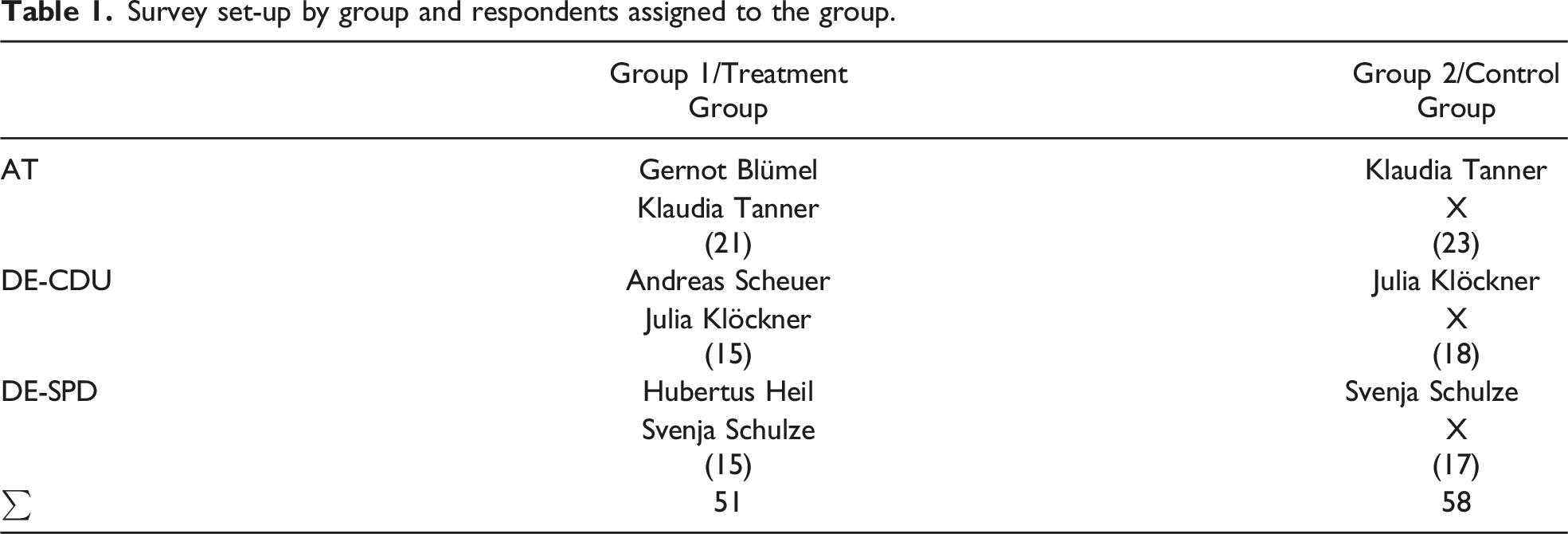
Beyond the effect of the treatment, we are interested in the interaction of the treatment with the ideological position of MPs’ parliamentary group. During the survey, we asked respondents to provide their party identification. Based on this information and experts’ assessment of party ideology in the CHES expert survey (Bakker et al. 2020), we created a continuous variable that takes values between “0” (for extreme-left parties) and “10” (for extreme-right parties).
Control Variables
We capture heterogeneity of the treatment effect by controlling for three individual-level confounders that are likely to shape to what degree MPs react to the activation of gender stereotypes in our experiment. 10
First of all, parliamentarians’ sex is a moderating variable that needs to be taken into account. Men are generally less sensitive to the existence and severity of subtle discrimination against women (Blodorn et al. 2012), tend to believe that their gender’s higher social status is earned (Lee et al. 2011), and overlook structural factors that contribute to positional inequalities. As a result, men MPs should be more likely to apply gender stereotypes when evaluating the competency of a woman in government than their women colleagues.
A second potential confounding variable for the treatment effect is the substantial expertise of MPs. We expect that MPs with little expertise in a specific policy area have only limited knowledge of the qualifications of the minister in charge of this portfolio and, thus, tend to rely on easily obtained cues such as sex in their evaluation (Koch 2000; McDermott 1997). In other words, MPs’ assessment of cabinet members’ qualification should be more reliant on gender stereotypes if they do not mention the minister’s resort as one of their main areas of expertise.
Finally, major differences between the assessments of government and opposition party members are likely to occur. In charge of overseeing the government through mechanisms of legislative oversight (Saalfeld 2000), the opposition should critically monitor governmental activities and the extent to which ministers fulfill their duties in a satisfactory manner. By contrast, members of governing parties should assess the work of their government less meticulously and evaluate cabinet members more favorably than opposition members.
Active Gender Stereotypes and the Evaluation of Women Ministers: Empirical Evidence
Before studying how the treatment affects the evaluation of women in government by MPs, we briefly summarize the respondents’ perception of each of the three women executives. Legislators rate the German minister of environment Svenja Schulze (Social Democrats) as “average.” Her overall competency evaluation as well as all but one of her seven more nuanced skills is close to zero, that is, neither more nor less qualified than most other cabinet members. A noteworthy exemption is MPs’ evaluation of her assertiveness, which is −0.28 points below average (with Pr (T < t) = 0.099). The two other ministers are not rated as favorably by the MPs: German minister of agriculture, Julia Klöckner, received an overall competency value of −1 (with Pr (T < t) = 0.016), while Austrian minister of defense Claudia Tanner reached on average −0.72 points (with Pr (T < t) = 0.093). Despite this similarity in their general assessment, MPs’ rating of these two women’s specific abilities differs considerably: Klöckner’s competency evaluation is rather mixed. MPs perceive her as having an above-average level of knowledge about recent developments and issues in her area of responsibility (0.45 with Pr (T > t) = 0.008), but view her ability to solve problems (−0.25 with Pr (T < t) = 0.0934), manage crisis (−0.33 with Pr (T < t) = 0.0576), or find compromise (−0.34 with Pr (T < t) = 0.0195) as rather poor. Tanner’s competency level, by contrast, is evaluated as below the average of the Austrian government, even though she is rated as “average” on six abilities and as more assertive than her colleagues (mean = 0.70 with Pr (T > t) = 0.003). Her case echoes previous research arguing that assertiveness and a self-directed leadership style constitute a key asset for men while women do not profit from showing this type of behavior (Carli 1990; Eagly et al. 1995). In sum, there appears to be no general pattern that would describe the evaluation of all three women accurately; instead, there are clear differences in the way parliamentarians assess each of them.
To test our theoretical propositions, we study the effect of having just rated a man on MPs’ evaluation of women’s competency through linear regression. We calculated two linear regression models for each dependent variable, that is, overall competency and the seven abilities. The first model includes only the treatment, the second one adds the interaction between the treatment and party ideology as well as the control variables. All models include fixed effects for the minister under scrutiny in order to capture systematic variation in their assessment and actual performance. With these fixed effects, we also account for country-specific differences between Austria and Germany. The Austrian case serves as reference category. Although legislators’ evaluation of the three women in general displays some differences, we expect no systematic variation in the treatment effect across the ministers (and we provide supportive evidence for this proposition later in this section).
Linear regression of MPs’ evaluation of women minister’s competency (without and with control variables).
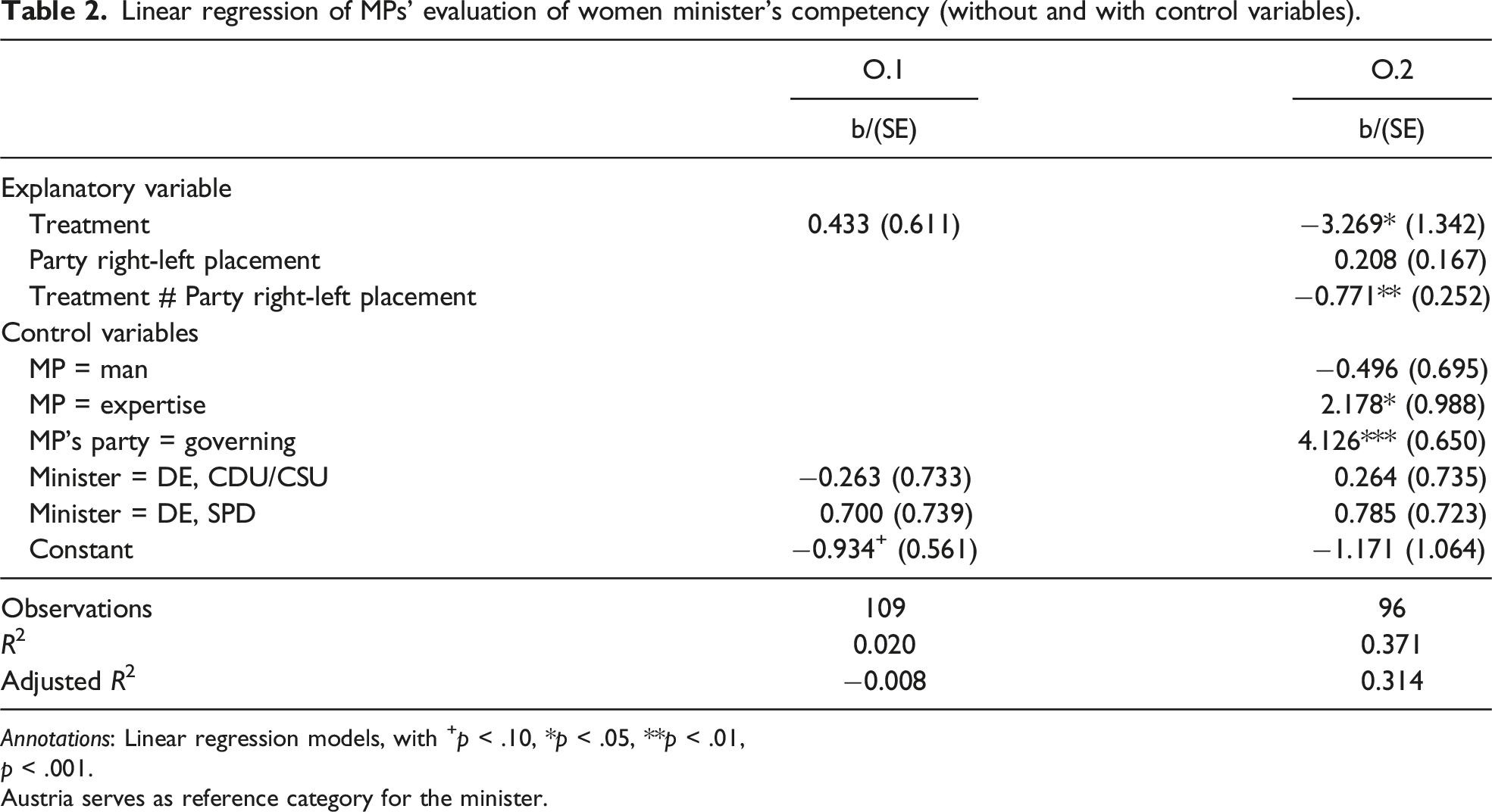
Annotations: Linear regression models, with +p < .10, *p < .05, **p < .01,p < .001.
Austria serves as reference category for the minister.
Once the models include party ideology as a conditional factor for the treatment, the expected effect emerges: MPs who received role-confirming information, tend to rate the same woman about 3.27 points lower than their colleagues who did not experience such a treatment. However, the more leftist the party a respondent belongs to, the more positively will they assess women ministers after receiving the treatment (see Table A1, Model O.2). Figure 1 indicates how these effects play out together: MPs belonging to parties on the far-right of the ideological scale (i.e., AfD in Germany and FPÖ in Austria), evaluate women ministers slightly more negatively if they first assessed a man. MPs belonging to parties on the left-side of the ideological scale (i.e., SPD, Green and Left in Germany, SPÖ and Green in Austria), react extremely positively to the stimulus and assess women ministers more favorably after evaluating a man minister. The effect is substantial, with MPs on the left-side rating women about 2.5 points higher as a consequence of receiving role-confirming information on an eleven-point scale. However, this evidence lends only partial support for Hypothesis 2, which proposes that MPs in left-wing parties are less likely to assess women ministers negatively than their colleagues in centrist and right-wing parties. Apparently, the activation of gender stereotypes leads to more favorable assessments of women by MPs belonging to leftist parties. This unanticipated finding speaks to a few other studies that find a pro-woman bias albeit in different contexts: Dhima (2022) shows that in particular, Canadian MPs from left-leaning parties are more responsive to women political aspirants than men.
11
Also, Sanbonmatsu and Dolan (2008) demonstrate in their research analyzing citizens’ evaluation of candidates running for office that Democrats are more likely than Republicans to hold favorable stereotypes about woman politicians and that Republicans were less likely to see women as suited emotionally for politics compared to men. Marginal effect of the treatment conditional on party ideology for overall competency evaluation with 95% confidence intervals.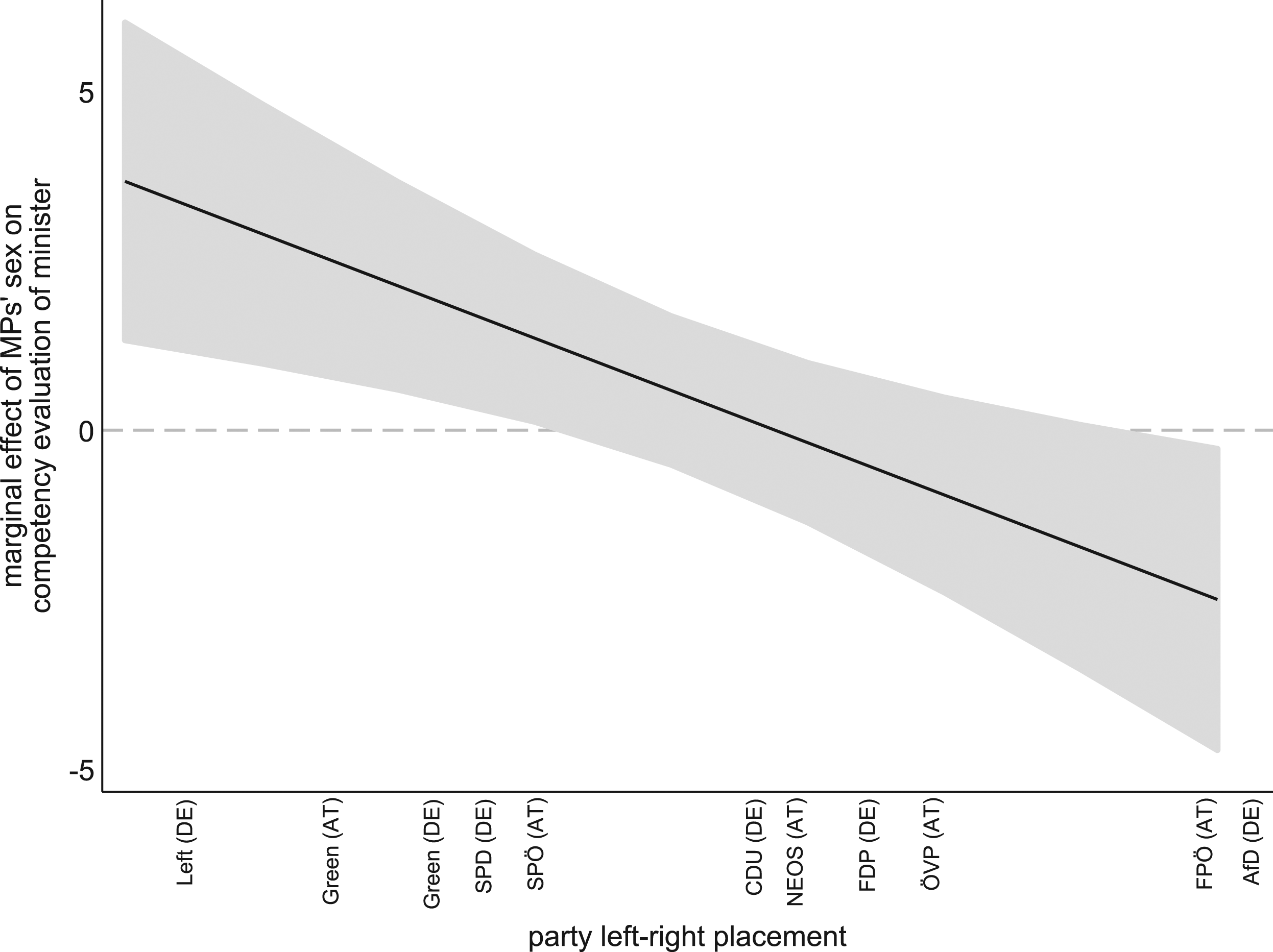
Turning to MPs’ rating of the more nuanced abilities, these patterns persist. The results of simple models without the conditional effect of ideology show no indication of an unconditional treatment effect, that is, that all MPs who received role-confirming information react equally to this stimulus (see Appendix 6, Table A6.1). However, for all seven skills, the combination of receiving a treatment (i.e., rating a man first) and party ideology determines the reaction to the treatment. Figure 2 displays the key coefficients visually, while full models are presented in Table A6.2 in Appendix 6. MPs who received role-confirming information rate women ministers between 0.93 and 1.79 points lower (on a 5-point scale), but the more leftist the party a MP belongs to, the more does this effect shrink and eventually turns positive. Overall, this analysis provides additional support for Hypothesis 2, but not Hypothesis 1. Effect of treatment, party right-left placement, and their interaction on MPs’ evaluation of ministers’ abilities with 95% confidence intervals.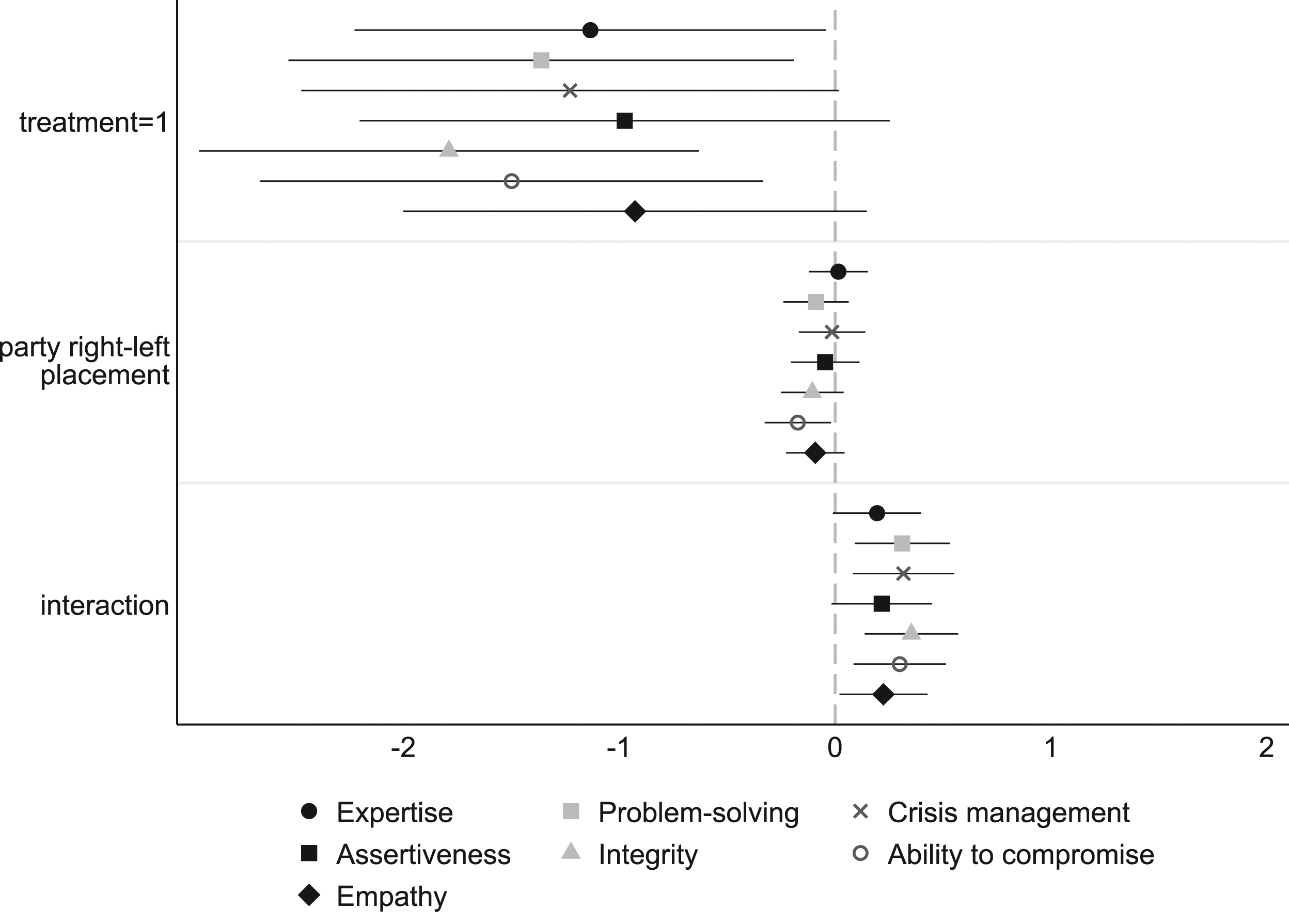
We do not find any systematic differences of the treatment effects across different abilities as suggested by Hypotheses 3a and 3b. The strength and statistical significance of the treatment effects do not vary systematically between assertiveness on the one hand, and crisis-management or empathy on the other hand. Comparable strengths of the coefficients and the overlapping confidence intervals displayed in Figure 2 illustrate this finding. Instead, the patterns described above hold for all abilities. Notably, one might still observe such gendered patterns of ability assignment when comparing ministers from the two sexes directly rather than studying the effect of role-confirming information on the assessment of women ministers. 12
We run a series of robustness tests. To begin with, we test whether, beyond party ideology, any of the control variables interact with the treatment and changes the relationship between party ideology and the treatment. For that purpose, we recalculated all models three times including interactions with the sex of the respondent, MPs’ expertise, and their status as member of a government or opposition party. Despite adding a second interaction with the treatment to the models, the coefficient of the variable itself and the conditional effect with party ideology stay substantial in size (even though some p-values increase, see Appendixes 5 and 6). Furthermore, we test for an alternative modeling strategy and estimate ordinal logistic regression models (see Appendix 7). They lead to the same conclusions as the linear models presented in the text.
Moreover, we ran separate models for each woman minister, to uncover whether the findings are driven by the particularities of one of the cases (Appendix 8). Despite the low number of respondents per minister, the findings are consistent and comparable to the models including all ministers: If the models only account for the treatment as explanatory variable for MPs’ assessment of a minister’s overall competency and their nuanced abilities, the effects of this variable are small in size. A notable exemption is the assessment of Klöckner’s ability to solve problems and manage crisis: All MPs who first saw Scheuer actually tend to rate her more favorably—independent of their party ideology. This finding might be driven by the particularities of the case, with Scheuer being involved into a major scandal surrounding the European car toll, which probably largely harmed his perception as being able to solve crisis and address problems in his role as minister of transportation. Even in this least likely case, in which the man minister’s reputation suffers from a scandal, we find that MPs from far-right parties assess Klöckner’s work less favorably for all other abilities implying that the combination of gender stereotypes and party ideology is decisive for the perception of women in government. Turning to the models including the interaction between the treatment and party ideology, the coefficients of the treatment effect are negative, while the effects of the interaction term are positive. Both coefficients are substantial in size in most models. Again, there is one notable exemption: We do not find any effects of the treatment and party ideology on Schulze’s assertiveness. Nevertheless, at large, the findings show that the ratings of Klöckner, Schulze, and Tanner are consistently lower if MPs had to assess a man and belong to a far-right party and consistently higher if MPs had to assess a man first and belong to a leftist party. While the low number of respondents per minister leads to varying levels of statistical significance, the effect strengths are substantial for nearly all abilities and ministers (see Appendixes 8 and 9). These robustness tests hence lend additional support for Hypothesis 2 when investigating the assessment of each of the three ministers individually, whereas Hypothesis 1 and 3 continue to lack any supportive evidence.
Conclusion
In this study, we used a unique survey experiment with German and Austrian MPs to show that gender stereotypes shape MPs’ perception of the competencies of women in government. MPs’ characterizations of women ministers as “climate barbies” or “lipstick government” are symptomatic of the way some legislators perceive the competency of women in the executive. Women not only struggle to be selected to the government in the first place (Barnes and O'Brien 2018; Davis 1997; Goddard 2019; Krook and O'Brien 2012), but some politicians continue to create additional barriers for women’s executive careers, even when they occupy the most prestigious posts. The negative impact of “myths about women’s inabilities to participate” (Banaszak and Plutzer 1993, 149) on the evaluation of women ministers within the group of MPs from right-wing parties is substantial.
However, we also observe that the activation of gender stereotypes leads to a more favorable assessment of women ministers by legislators belonging to leftist parties. Contrary to our theoretical expectation, the effect of gender stereotypes on MPs’ evaluation of women in the executive did not diminish as party ideology moves to the left. Whether this finding implies that women in the executive will eventually have the opportunity to exercise their office under similar conditions as their men colleagues remains unclear. The overly positive evaluation of women in government by leftist MPs after the activation of gender stereotypes might just as well lead to the emergence of a new set of stereotypes about women in politics and create an entirely different type of disadvantage for them. Such a phenomenon was first observed in the context of the glass cliff theory, which argues that women are set up to fail in leadership positions because gatekeepers perceive them as more successful crisis managers (Bruckmüller et al. 2014). Moreover, a number of studies in the legislative arena imply that, due to gender biases in selection processes, only overly talented and qualified women emerge as candidates (e.g., Anzia and Berry 2011; Fox and Lawless 2004) and those who win office perform better than men (Jenkins 2007; Milyo and Schosberg 2000). Exceptionalism is hence frequent, and might transform into the general expectation that women in politics perform better than men. If myths about women’s superior ability to participate in politics emerge more broadly and create unrealistically high expectations, women’s increasing involvement into politics is likely to cause major disappointments. A promising avenue for research is to investigate the consequence of such overly positive evaluations of women ministers.
Moreover, future research could analyze whether stereotyping occurs in a similar manner across different contexts. For instance, in less established democracies women ministers and their work might be subject to stronger stereotyping than their colleagues in industrialized countries for two reasons. First of all, as long as institutional relations are less routinized, MPs might rely on shortcuts such as gender traits to evaluate the competence of ministers. Second, the representation of women is often poor during phases of democratization (Hughes 1937; Hughes and Paxton 2019). Since the application of stereotypes is more common in environments with few women political actors, MPs should apply them to a larger extent if interaction with women is minimal. Understanding how the application of stereotypes works across contexts would provide a clearer picture about the obstacles women continue to face in governments around the world.
Supplemental Material
Supplemental Material - Myths About Women in the Political Executive – How Gender Stereotypes Shape the Way MPs Assess the Competences of Ministers
Supplemental Material for Myths About Women in the Political Executive—How Gender Stereotypes Shape the Way MPs Assess the Competences of Ministers by Sarah C. Dingler and Corinna Kroeber in Political Research Quarterly
Footnotes
Acknowledgments
We are grateful for the valuable, constructive feedback of the three reviewers. Moreover, we are very thankful for the research assistance of Joanna Hüffelmann and Dzaneta Kaunaite.
Declaration of Conflicting Interests
The author(s) declared no potential conflicts of interest with respect to the research, authorship, and/or publication of this article.
Funding
The author(s) disclosed receipt of the following financial support for the research, authorship, and/or publication of this article: This article includes results of the research project “Can a Woman Do the Job? Introducing a Gender Perspective on Legislative Oversight,” funded by the Fritz Thyssen Foundation.

Supplemental Material
Supplemental material for this article is available online.
Notes
References
Supplementary Material
Please find the following supplemental material available below.
For Open Access articles published under a Creative Commons License, all supplemental material carries the same license as the article it is associated with.
For non-Open Access articles published, all supplemental material carries a non-exclusive license, and permission requests for re-use of supplemental material or any part of supplemental material shall be sent directly to the copyright owner as specified in the copyright notice associated with the article.
