




Abstract
The article proposes a new way to combine the “proportional” and “majoritarian” visions of democracy. The proposal blends elements of mixed electoral systems, parliamentarism, presidentialism and bicameralism. Voters are given a single vote to make two simultaneous choices: one about the proportional composition of the legislature and one about the two top parties forming a majoritarian “confidence chamber” embedded within the legislature. Only the majority in this chamber has the power to dismiss the cabinet in a vote of no-confidence. The proposed system virtually guarantees the feasibility of identifiable and stable one-party cabinets governing with shifting, issue-specific majorities in a highly proportional legislature. It is illustrated with respect to the 2013 federal election in Germany.
Keywords
[D]uring the past two hundred years we have thought little about the institutional design of democracy. Since the great explosion of institutional thinking, when the present democratic institutions were invented – and they were invented – there has been almost no institutional creativity.
Introduction
Political scientists often distinguish between two visions of democracy: “proportional” and “majoritarian” (Powell, 2000). Many authors also believe that it would be good to find a compromise between these two ideals. As institutional designs for achieving this compromise, some point towards electoral systems (Carey and Hix, 2011; Shugart, 2001), others towards presidentialism (Cheibub, 2009: 1383–1384; Colomer and Negretto, 2005) and still others towards specific versions of bicameralism (Ganghof, 2014; Stone, 2008). This article presents a proposal which seeks to combine elements of all three options.
In brief, I propose a form of mixed-member electoral system in which voters elect two types of legislators, only one of which possesses the right to dismiss the cabinet in a no-confidence vote. Voters have a single vote to make two simultaneous choices: one about the proportional composition of the parliament and one about the two top parties forming a majoritarian “confidence chamber” within parliament. Only the majority in the confidence chamber has the power to dismiss the cabinet in a vote of no-confidence. The system virtually guarantees the feasibility of stable one-party cabinets governing like minority cabinets in the proportional legislature.
The paper proceeds in four parts. I first clarify the meaning of the two visions, majoritarian and proportional, then review existing compromise designs, sketch my own original proposal and finally illustrate the proposed design with data from Germany.
The two visions of democracy
The conceptual distinction between the “majoritarian” and “proportional” visions of democracy is well-established but needs clarification. In the so-called “majoritarian” ideal, voters can make a clear choice between two parties, one of which forms a stable majority cabinet that can be held responsible for its performance in office (Powell, 2000). In terms of voter support, however, this model is only majoritarian in a perfect “Duvergerian” equilibrium; that is, when voters are deterred from voting for third candidates, potential third candidates are deterred from entering the competition and the same two-party system exists in every district. Real-world versions of this vision, often based on plurality rule (first-past-the-post), typically allow a minority of voters to rule over a majority. In UK parliamentary elections, for example, which follow first-past-the-post rule, a party can win only 36.8 percent of the vote, as the Conservative Party did in 2015, and yet win 50.9 percent of the seats.
The proportional vision has a commonsensical version that focuses on the ideal of proportional representation (PR) combined with legislative majority rule. This combination is much more likely to empower an actual majority of voters (McGann, 2006). Powell’s (2000) proportional vision goes further, though, and also requires that parliamentary parties have proportional influence on legislation. He sketches two different specifications of this idea (Ganghof, 2015). One is super-majoritarian in that parties form oversized portfolio or legislative coalitions. The other is majoritarian in that different minimal-winning coalitions are built on different issues (Powell, 2000: 256, n.9). Proportional influence then means that all parties get some influence on at least some issues. It is this latter version of the proportional vision on which I focus here (see also Ward and Weale, 2010). 1
Existing compromise designs
In purely parliamentary systems the obvious starting point for a compromise between the majoritarian and proportional ideals is the electoral system. For instance, if parties in a proportional system are induced to form two competing pre-electoral coalitions, voters can then elect a party that represents their views and more or less directly select one of two cabinets. Mixed-member proportional (MMP) systems and systems with a majority bonus can be interpreted in terms of this type of balancing (Shugart, 2001). However, the degree of (mechanical) proportionality is typically limited in this approach, because a very high number of parties and a multi-dimensional structure of party positions make the formation of two comprehensive pre-election blocs less likely (Ganghof et al., 2015). Moreover, recent elections in MMP countries like Germany show that limited departures from pure proportionality such as a five percent legal threshold of representation might not be sufficient to achieve the goals of the “majoritarian” vision (see below).
Presidential systems might also achieve a compromise. The popular election of a fixed-term president is inherently disproportional and virtually guarantees that voters will be able to identify cabinet alternatives as well as ensures cabinet stability (Cheibub, 2009). The legislature, on the other hand, can be elected proportionally to fairly represent the position of the (issue-specific) median voter (Colomer and Negretto, 2005). The downside of presidentialism, however, is its negative effect on the programmatic capacities of political parties (Samuels and Shugart, 2010). Due to the institutional separation between the legislature and the popularly elected executive, a party loses control over its presidential candidate and – if the candidate is successful – over the elected president. Hence, while the legislature may be proportionally elected, the parties therein might not have the capacity to deliver programmatic representation.
This problem of presidentialism can be avoided by shifting the locus of power separation into the legislature. In Australia, in particular, we find bicameral systems in which the upper house has the same democratic legitimacy as the lower house, as well as an absolute veto over legislation, but no right to dismiss the cabinet. This renders it possible to make the lower house a “majoritarian” confidence chamber and the institutionally separated upper house a proportional legislature (Ganghof, 2014). However, this model does also have some downsides. Since lower house members in Australia are elected in single-member districts (based on alternative vote (AV) systems), single-party majorities at the national or state levels are far from guaranteed. Moreover, bicameralism implies that overall proportionality may be limited by a small size of the upper house. Third, if the upper house is used for PR, its capacity to deliver territorial representation tends to be reduced.
The proposal
My proposal modifies the Australian solution by combining it with a mixed-member electoral system. 2 The idea is to make the confidence-conferring, majoritarian part of the legislature not a separate chamber but a differentiated chamber within a highly proportional legislature (see Figure 1). What the proposed system shares with Australian bicameralism is that the cabinet survives independently from one of two equally legitimate parts of the legislature. I therefore refer to it as “semi-parliamentary” (Ganghof, 2016).

A proportional, semi-parliamentary system.
Voting rules
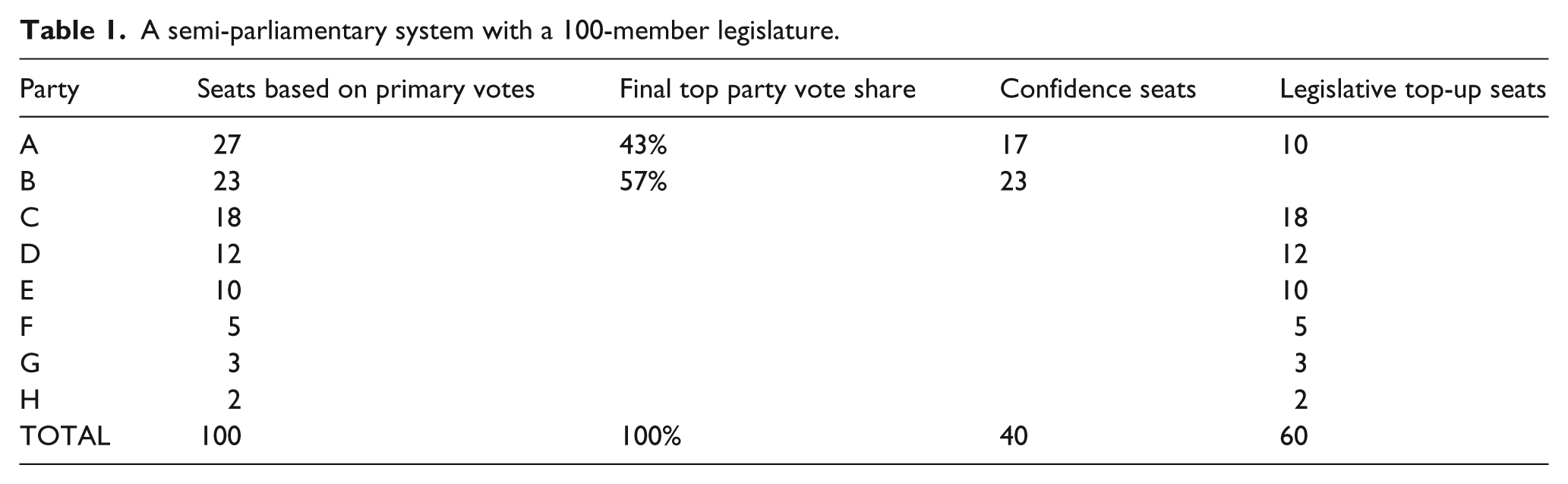
There is one district for the entire parliament and voters have one vote to choose between party lists. They can rank as many lists as they like in order of preference. Their votes are counted twice. First, voters’ first preferences determine the proportional composition of parliament – with no or only a low legal threshold. Second, voters’ rankings are used to determine the two parties with the greatest support, based on a modified AV system. The parties with the least first-place votes are iteratively eliminated, and their votes are transferred to each voter’s second-most preferred party, third-most preferred party, and so on. In contrast to a normal AV system, the process does not stop when one party has received more than 50 percent of the votes, but continues until all but two parties are eliminated. Only these two top parties receive “confidence seats” in proportion to their final vote shares in the AV contest. One of these two parties gets all of the seats it receives based on the proportional count as confidence seats and thereby determines the size of the “confidence chamber”.
Table 1 illustrates the procedure with a fictitious example of a 100-member legislature. The first column shows eight parties
A semi-parliamentary system with a 100-member legislature.
The system allows voters to confer two mandates. With their first preferences they confer a mandate on the fairly determined legislative majority, which might change from issue to issue. Analytically, we may think of this as a mandate for the issue-specific median party. However, not all voters engage in pure proximity voting, so that the median party in parliament does not necessarily represent the median voter. In any case, the moral legitimacy of the legislative mandate does not depend on spatial preference locations, but on the fairness (proportionality) of the procedure and ultimately on the value of political equality (e.g. McGann, 2006).
Based on voters’ fuller preference rankings, a mandate to form the cabinet is conferred to the winner of the AV contest. Given the fairness argument for PR, the moral legitimacy of this additional contest must largely be based on instrumental considerations, such as facilitating issue-specific decision-making (Ward and Weale, 2010) or achieving accountability (Powell, 2000). The voting method for the confidence chamber should, nevertheless, be as fair as practically feasible. AV is preferable to plurality rule in that no votes are wasted and the winner commands an absolute majority of the votes in the final count. I do not have the space to systematically compare AV to alternatives such as approval voting, the Coombs rule or the Borda count, but want to highlight three attractive properties of AV: first, a party with an absolute majority of first-preferences votes will always be selected as the winner; second, voters can submit incomplete preference rankings without being discriminated against (cf. Emerson, 2013); and third, a manipulation of the outcome via strategic voting would require a rather high level of sophistication (Grofman and Feld, 2004: 652).
The proposed system also aims at combining different ideals of accountability. First, the prime minister and the cabinet are accountable to the majority in the confidence chambers. If the AV contest selected the government without giving the strongest opposition party seats in the confidence chamber, the governing party’s control over the cabinet would be reduced (as it is in a presidential system). With the presence of the opposition party, the cabinet’s position cannot move too far away from its party without risking defections and a successful no-confidence vote. Second, the legislature as a whole is also charged with the task of controlling the cabinet. Since this cabinet is likely to have minority status in the legislature, this task can be more meaningfully pursued than in the pure majoritarian vision (Stone, 2008). Third, relatively pure PR allows for the easy entry of new parties, which provides a way to keep all existing parliamentary parties accountable (McGann, 2013).
One concern about the proposed system should be mentioned. The proliferation of small parties may be greater than under a pure PR parliamentary system, everything else being equal, because voters can use their second preference to choose the cabinet. It would, therefore, be possible that a rather small (centrist) party can form the government. In the example in Table 1, the winning party
Inter-institutional rules
From the perspective of legislative decision-making, one might hope that the outcome of the AV contest is centrist, so that cabinet’s policy position is identical or close to that of the median legislative party on the most important issue dimension(s). This would likely make it easier for the cabinet to win the majority support of the proportional parliament at large to pass legislation. A centrist outcome is far from guaranteed, however. For one thing, even in a one-dimensional space and with pure proximity voting, the outcome of the AV contest may systematically diverge from the median voter (McGann et al., 2002). For another, complications like multidimensionality, party identification, valence advantages, candidate characteristics or directional voting might all contribute to (moderately) non-centrist cabinets (McDonald et al., 2012). This outcome might be desirable, if the majoritarian vision is meant to give voters a clear choice between alternatives. Yet it also implies that the two mandates can conflict. I will briefly sketch institutional rules that might contribute to achieving a reasonable balance between them, but other solutions also exist (Stone, 2008).
The legislature as a whole and the confidence chamber should both have the right to initiate and amend legislation. The legislature must certainly possess a veto over all (non-budgetary) legislation. It might be denied a veto over the annual budget, as this veto could be turned into a de facto no-confidence vote. This problem should not be overstated, however, because the opposition party in the confidence chamber is unlikely to have a majority in the proportional legislature. Most upper houses in Australia do possess a budget veto: the Australian Senate as well as the Legislative Councils in South Australia, Western Australia and Tasmania. 6
The confidence chamber, and hence the cabinet, might also be given a veto over legislation to protect its core program – as is, of course, the case for the lower houses in Australian bicameralism. However, it is not entirely clear that this is necessary. Given the PR-based legitimacy of an issue-specific legislative majority, we might want the government to take its preferences into account. A partial substitute for the cabinet’s veto power could be its (unavoidable) dissolution power. If the cabinet loses confidence in the confidence chamber and no new cabinet can be formed (which is likely), the entire parliament has to be dissolved and new elections held. This implies that the cabinet can virtually always threaten to dissolve the entire parliament if legislation is passed – or vetoed – in ways that undermine its core program. This dissolution threat allows the cabinet to defend its policies against the median parliamentary party, if public opinion is favorable to these policies (Becher and Christiansen, 2015).
Of course, veto and dissolution powers are blunt instruments to solve a conflict of mandates. A complementary rule would be to allow the cabinet (or its majority in the confidence chamber) to refer only the conflicted issue back to the voters. An analogous solution has been adopted in New South Wales, where a popular referendum, initiated by the lower house, is the only way to resolve bicameral deadlock on a particular bill. If the cabinet is given a veto over legislation, the legislative majority should probably also be able to initiate a referendum on a deadlocked proposal. Giving both agents this power would give greater bargaining strength to whichever agent’s position is deemed closer to the issue-specific median voter. Given the inherent uncertainty of a referendum, both agents would generally have strong incentives to compromise and avoid the referendum.
An illustration
Germany has a parliamentary system with a MMP electoral system and a five percent legal threshold of representation. In the past, this system balanced elements of the two visions reasonably well (Shugart, 2001). It limited the number of parties and helped to organize them into two competing blocs, while also achieving a high degree of empirical proportionality. Moreover, it allowed party elites to generally avoid Grand Coalitions of the major parties. Recently, though, elections have failed to approximate either of the two visions.
Consider the latest federal election of 2013 (Poguntke and von Dem Berge, 2014). Figure 2 shows parties’ preferences in two dimensions based on the 2014 Chapel Hill survey. The boldfaced labels indicate parties that gained parliamentary representation; parties with less than two percent of the vote are excluded. Almost 17 percent of the German voters wasted their votes by selecting parties that did not pass the threshold. The most important of these parties were the Liberals (FDP), the Euro-skeptic Alternative for Germany (AfD) and the Pirate Party. 7 Despite this substantial disproportionality, though, crucial goals of the majoritarian vision were not achieved. Voters could not identify competing cabinet options before the election, as there were no broad pre-electoral alliances. The election resulted in a Grand Coalition of Christian and Social Democrats, controlling 80 percent of the seats in Bundestag; this was the second Grand Coalition in the last three federal elections. The opposition currently exists only on the left and does not represent a feasible alternative government.

German party positions in 2013/2014.
With the system proposed here, the five percent threshold could have been abolished or significantly reduced. This would have led to a fairer and more multidimensional representation of voter preferences in the legislative process. The AfD would have represented the Euro-skeptic position on the right (on the EU dimension not shown in the Figure), the Liberals would have stood for the combination of economic and social liberalism. At the same time, voters could have directly chosen a stable one-party cabinet. The Christian Democrats (CDU/CSU) would probably have won the AV contest. They could thus have governed with flexible, issue-specific majorities. Where the CDU was not the issue-specific median party, the party that was could have initiated policy change against the government or vetoed legislation.
In the particular example, the proposed system would probably have reduced the bargaining strength of the Social Democrats, who would likely have lost their veto player status as a cabinet party. But this is not due to any systematic bias. To the contrary, Germany’s Social Democrats seem disadvantaged under the current system, because a center-left portfolio coalition that includes the Left Party is opposed by important parts of both parties. Social Democrats have thus been torn between the incentive to capture the median voter and the effort to maintain a leftist profile in order to limit electoral losses and facilitate a center-left portfolio coalition. This sort of asymmetric coordination failure would be less consequential in the proposed system. Since the Social Democrats would not need a coalition partner to get into office, they would be free to pursue an office-oriented strategy of median capture; and if they did win office, the Left Party would be free to support a Social Democratic cabinet on a selective, issue-specific basis.
Prima facie, it might seem that the proposed system would be unstable, as the opposition parties could coordinate to change it (if constitutional amendment rules and their combined seat share allow this). However, a party like the Social Democrats might well prefer the chance of forming a one-party government some of the time to being a junior cabinet party most of the time; and the smaller opposition parties might benefit from greater issue-specific legislative influence without having to assume responsibility for the entire government program. Stability would also increase if voters came to value the system and threatened to sanction reforms.
Conclusion
It might seem unlikely that established democracies would consider the kind of system proposed here, but this should not keep us from further analyzing its positive and normative advantages and disadvantages. Moreover, elements of such a system might be worth considering in efforts to democratize complex systems like the European Union. Given the partisan fragmentation of the European Parliament, a purely parliamentary system of government would be unlikely to give European voters a clear choice between alternative mandates. It is more likely to lead to a permanent Grand Coalition. This is partly why the direct election of a European president often appears to be the only viable path to meaningful democratization (cf. Hix, 2014: 195). Yet a switch to presidentialism would likely have a strongly negative long-term effect on the emergence of programmatic European parties – and thus on the EU’s overall democratic capacity. If we want to give European voters a clear choice without undermining programmatic parties and PR, adequately Europeanized elements of the semi-parliamentary system proposed here might be worth considering. But this is the topic for another paper.
Footnotes
Acknowledgements
For comments and suggestions, I would like to thank the involved editors and reviewers of Research & Politics, especially Anthony McGann, as well as Joachim Behnke, Sebastian Eppner, Florian Grotz, André Kaiser, Alexander Pörschke, Fritz W. Scharpf, Stefan Schukraft, Christian Stecker, Daniel Viehoff and Albert Weale. All remaining shortcomings are my responsibility.
Declaration of conflicting interest
None declared.
Funding
This work was supported by the German Research Foundation (DFG) (grant number GA 1696/2-1).
Notes
Carnegie Corporation of New York Grant
The open access article processing charge (APC) for this article was waived due to a grant awarded to Research & Politics from Carnegie Corporation of New York under its ‘Bridging the Gap’ initiative. The statements made and views expressed are solely the responsibility of the author.