



Abstract
While the success of the president's legislative agenda is measured by examining the rate of passage of presidential bills (the batting average), the dominance of the president over the legislative process can be better understood by considering the share of presidential bills among bills introduced and laws enacted. Studies on the success of the president's agenda outnumber those on the dominance of the president, but the latter more directly address the debate on the proactive legislative powers of the executive. Reviewing the 13,358 bills introduced and the 2603 laws enacted in the eight legislative terms in Chile between 1990 and 2022, we associate the constitutional changes in 2005 and the electoral reform of 2015 with a decline in the legislative dominance of the president. There was a progressive decline in presidential dominance in legislative inputs and outputs long before the 2019 social upheaval weakened the Piñera government.
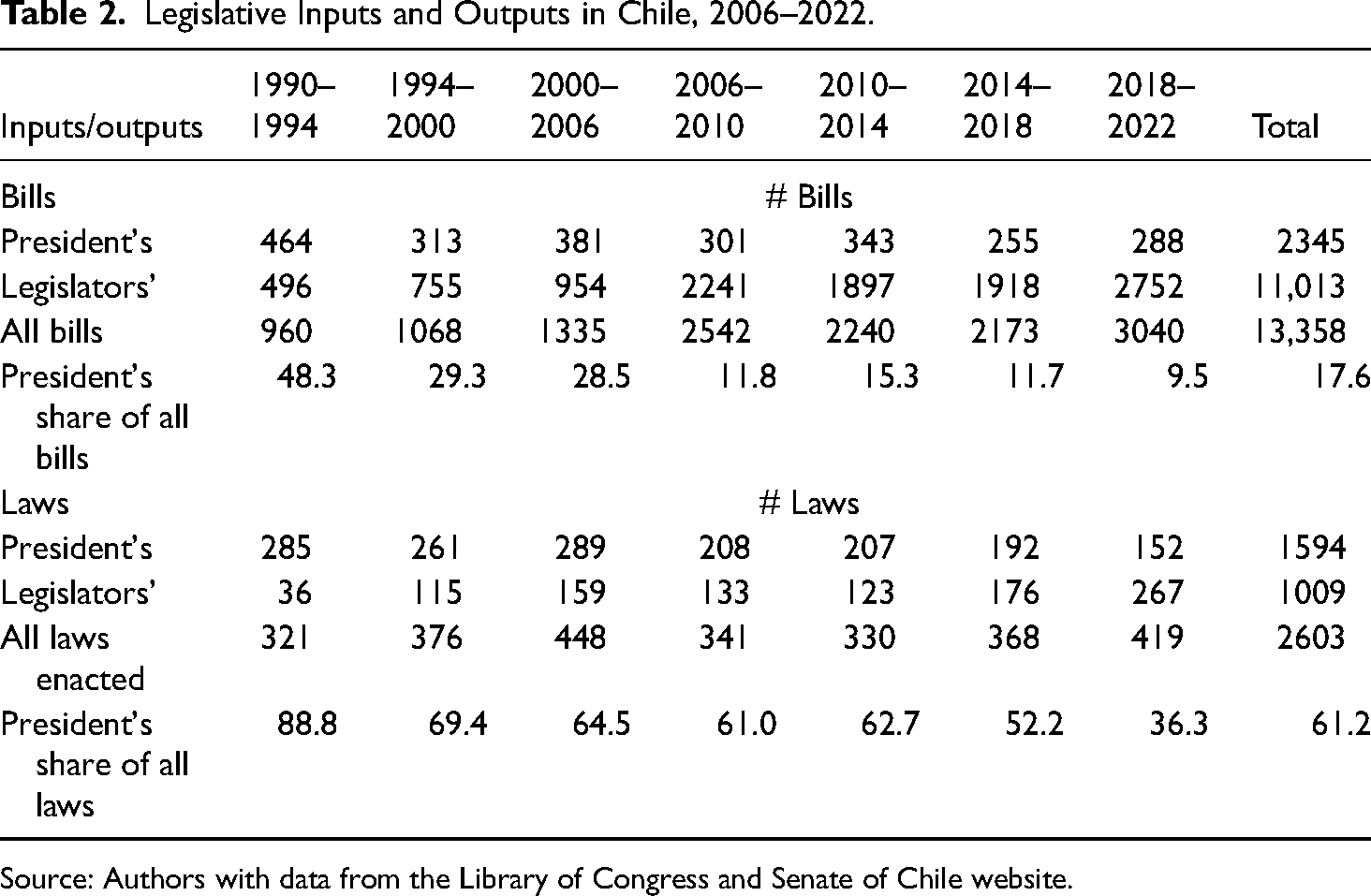
Previous works on executive-legislative relations in Latin America have extensively studied the proactive legislative powers of the executive by focusing on the success of the president's legislative agenda—the batting average. An alternative indicator of presidential dominance is the share of presidential bills among all bills introduced and among laws enacted. In Chile, while in 1990–1994, the president accounted for 48.3% of the bills introduced, in 2018–2022, presidential bills accounted for an all-time low of 9.5% of bills introduced. Similarly, presidential bills among laws enacted declined from 88.8% to 36.3% in the same periods.
The literature shows that institutional reforms, like changes in rules of the lawmaking process and changes in electoral rules, impact the balance of powers between the executive and the legislature. Contextual variables can also have an impact. We associate the 2005 constitutional reforms and the 2015 electoral reforms to a rebalancing of executive-legislative relations in favor of the latter. We also discuss the impact of the October 2019 upheaval on the number and share of presidential and legislator-initiated bills and laws enacted. The evidence is consistent with the claim that unlike the claims made about hyper-presidentialism in the early 1990s, we can no longer speak of presidential dominance over the legislative process in Chile. The evidence convincingly shows that the relative balance of powers between the executive and legislature in the lawmaking process in Chile has shifted over time away from the former, and that variance is associated to institutional design changes and to changes in electoral rules.
In what follows, we discuss the determinants of the president's dominance over the legislative process and postulate two hypotheses that associate constitutional changes and changes in electoral rules with the president's legislative dominance, and a third hypothesis that links political shocks with the balance of powers between the executive and legislature in the lawmaking process. We then review the works that have discusses the executive-legislative relations in Chile. After discussing our methodology, we present the data. Our results point to an association between changes in lawmaking rules, changes to electoral rules, and political shocks with variance in the president's dominance in the legislative process. In the last section, we discuss the implications of our findings.
Determinants of the Presidential Dominance in the Legislative Process in Latin America
Latin American political systems are characterized by a strong presidency with proactive legislative powers and a legislature with mostly reactive attributions (Cox and Morgenstern, 2001; Llanos and Nolte, 2006). The strength of the Latin American president has been a subject of study for decades (Shugart and Carey, 1992; Mainwaring, 1993; Mainwaring and Shugart, 1997; Linz, 1990). Several texts have shown that Latin American presidential systems have limits and constraints, and that the legislature exercises important powers (Morgenstern and Nacif, 2002; Figueiredo and Limongi, 2000; Cheibub, 2007). A recent text that compares the powers of the president in Chile with that of other Latin American countries defines hyper-presidentialism as “a political system in which the president concentrates excessive power” and questions the appropriateness of characterizing the Chilean political system as such (Martínez and Dockendorff, 2023: 54).
Latin American presidents normally control the legislative agenda through bill initiation and agenda setting powers (Morgenstern and Nacif, 2002; Alemán and Tsebelis, 2016). But legislative majorities do not guarantee the legislative success of the executive (Alemán and Calvo, 2010). The key to success lies in the executive's ability to form majority coalitions (Mainwaring and Shugart, 1997). Because presidents can use their constitutional powers to advance their agendas in a fragmented congress (Figueiredo and Limongi, 2000; Raile et al., 2011) and can benefit from party system fragmentation (Chasquetti 2001: 319–359), the legislative success of ruling majority and minority multiparty coalitions is similar (Cheibub et al., 2004). The president's legislative success also depends on support in the legislature, the electoral calendar, and political conditions (Cheibub et al., 2004; Figueiredo et al., 2009; Saiegh, 2009; Mimica et al., 2023; Alemán and Navia, 2009). A unified government increases the chances of success of the president's agenda (Barrett and Eshbaugh-Soha, 2007), while a divided congress fosters gridlock (Binder 2003; Edwards et al., 1997). However, even if the president and the majority in congress are from different parties, they can agree to pass certain relevant legislation (Barrett and Eshbaugh-Soha, 2007).
Changes in the lawmaking process can alter the balance of power between the executive and legislature (Sin, 2015). When new lawmaking rules give more powers to the legislature, the president's ability to advance their agenda—their bills—declines (Cheibub et al., 2004; Saiegh, 2011; Shugart and Carey, 1992; Morgenstern and Nacif, 2002; Alemán and Tsebelis, 2016; Benoit and Hayden, 2004).
In turn, permissive electoral rules—including proportional representation and larger district magnitude—induce the proliferation of parties (Amorin Neto and Cox, 1997; Colomer, 2004). Changes in electoral rules induce changes in the behavior of legislators (Cox, 1997; Lijphart and Waisman, 1996; Lijphart, 1994). Electoral institutions affect legislative behavior, incentives, and accountability (André et al., 2014). Influenced by a larger district magnitude, legislators favor their personal reputation over the party's reputation (Carey and Shugart, 1995).
Prior studies have used the success of presidents in passing their bills as an indicator of legislative success (Alemán and Navia, 2009; Alemán and Calvo, 2010; Figueiredo and Limongi, 2000). This indicator can be misleading, as it only captures the batting average of the president. Since the executive usually introduces fewer bills than legislators, but wants all the bills approved, while sometimes legislators introduce bills to please their voters or some interest group. A complementary indicator of success looks at the share of presidential bills among all bills introduced and laws enacted allows to capture more fully the dominance of the president in executive-legislative relations (Santos et al., 2014; Chasquetti, 2011; Alcántara Sáez et al., 2005). This indicator more adequately measures the respective weight of the government and the congress in the legislative process. By using this indicator, we avoid focusing on the president's batting average and instead focus on the result of the game.
Presidentialism and Legislative System in Chile
Chile is ranked among the strongest presidential democracies in Latin America. In the Comparative Constitutions Project rankings, Chile is given a 6, on a 1–7 scale, below Ecuador, the only country with a score of 7. The Chilean legislature is given a score of 0.33, on 0–1 scale, next to Mexico, Peru, Colombia, and Bolivia, and weaker than Uruguay, Argentina, Brazil, and Venezuela. 1
The Chilean constitution grants the president broader proactive legislative powers than elsewhere in Latin American presidential democracies (Llanos and Nolte, 2006; Cox and Morgenstern, 2001).
Comparative studies on Latin American systems rank Chile as having a dominant president (Mainwaring and Shugart, 1997) and label the executive's legislative powers as very high (Shugart and Haggard, 2001). Chilean presidents have broad veto and agenda setting powers (Samuels and Shugart, 2003; Tsebelis and Alemán, 2005). Recent studies reinforce the notion that the legislative powers of Chilean presidents are among the strongest in Latin America (Santos et al., 2014). Studies from the 1990s describe the country's political system as exaggerated presidentialism (Siavelis 2000) or super-presidential (Shugart and Carey, 1992: 129). More recent texts describe the system as hyper-presidentialist (Eyzaguirre Guzmán et al., 2022).
Nonetheless, the Chilean congress has cultivated a strong horizontal relationship with the executive (Huneeus and Berríos, 2005). The legislature has a high level of institutionalization (Nolte, 2003). The stability of the system depends on the existence of a multiparty coalition supporting the president (Siavelis, 2000), and there is plenty of cooperation between the executive and the legislature (Siavelis, 2000; Berríos and Gamboa, 2006; Jaime-Godoy and Navia, 2023). In fact, Chilean presidents cannot unilaterally modify the status quo (Alemán and Navia, 2016). Recent studies find that the legislature has found additional ways to influence the lawmaking process (Arana Araya, 2015; Faúndez Caicedo et al., 2022). Using different methodologies and approaches, a few studies openly call into question the alleged existence of hyper-presidentialism in Chile (Martínez and Dockendorff, 2023; Mimica et al., 2023; Jaime-Godoy and Navia, 2023). Martínez and Dockendorff (2023) discuss the constitutional powers, the balance of powers between the executive and other democratic institutions, and the strength of political parties in congress to question the claim that there is hyper-presidentialism in Chile.
Since the return of democracy in 1990, two multiparty coalitions have dominated the political arena. On the center-left, the Concertación, comprised by the Christian Democratic (PDC), Socialist (PS), For Democracy (PPD) and Radical (PR) parties, formed in the late-1980s by centrists and leftwing parties. On the right, National Renewal (RN) and the Independent Democratic Union (UDI), two parties that supported the dictatorship, formed the Alianza. In four consecutive presidential terms between 1990 and 2010, the Concertación rules with PDC Patricio Aylwin (1990–1994), PDC Eduardo Frei (1990–2000), PPD Ricardo Lagos (2000–2006), and PS Michelle Bachelet (2006–2010). There has been alternation in power since 2009, when Sebastián Piñera, the Alianza candidate, won the presidential election. In 2014, Bachelet returned to power, bringing the Communist Party into the Concertación, and renaming it New Majority. In her campaign, Bachelet's promised to replace the 1980 Constitution—enacted under military rule but modified several times under democratic rule. Bachelet launched a non-binding process of constitutional dialogues and presented her own draft of a new constitution 6 days before leaving office. On March 11, 2018, Piñera, leading the rightwing coalition, returned to power and swiftly withdrew the new constitution bill, promising to introduce reforms to the 1980 constitution.
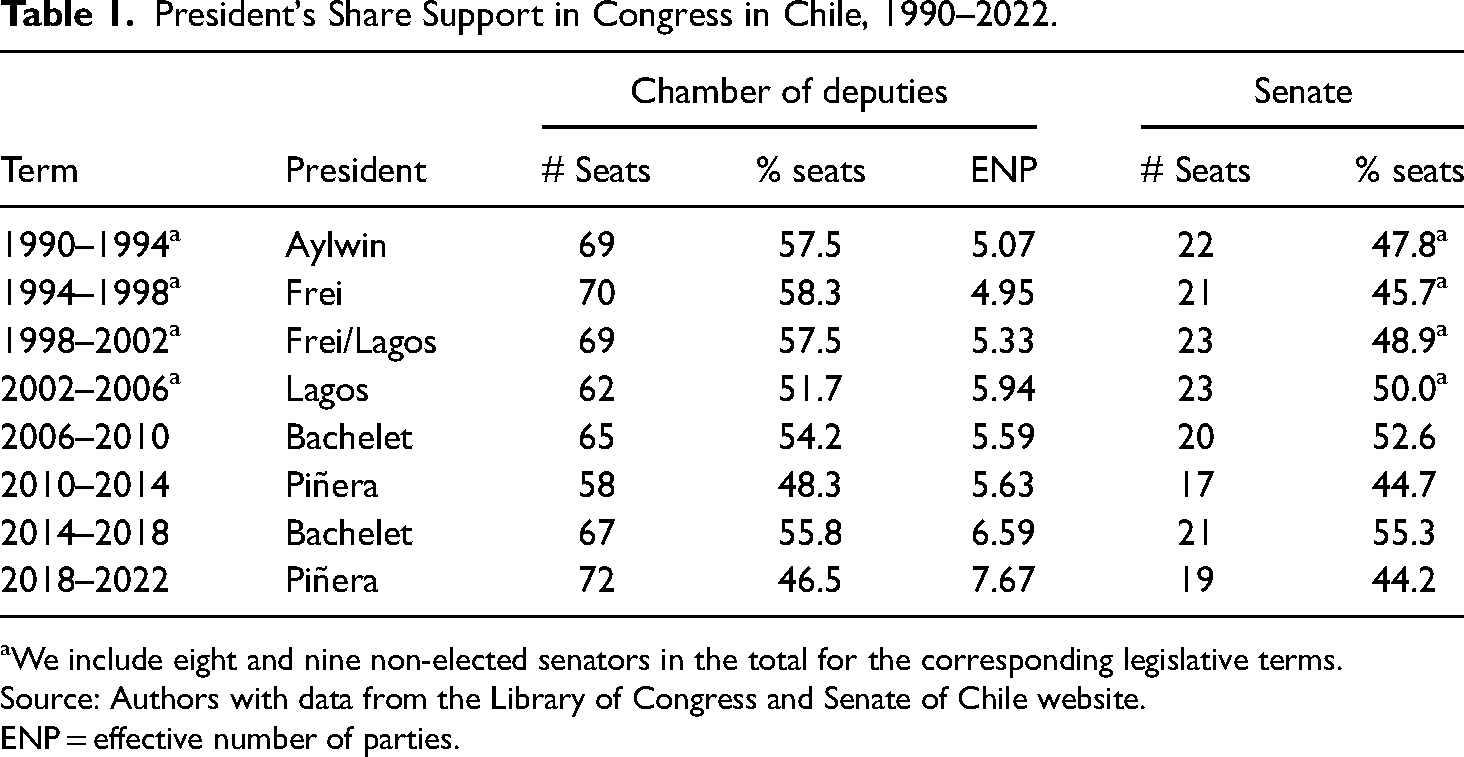
Table 1 shows the president's seat share support in the Chamber of Deputies and Senate, and the effective number of parties (ENP) in the Chamber of Deputies since democratization. All presidents enjoyed a legislative delegation greater than 44%, but Bachelet in her second government was the only president to have a majority in both chambers. The ENP remained relatively constant until 2014, when it rose above 6 for the first time. Therefore, the increase in fragmentation in the lower chamber began before the 2015 electoral reform discussed below.
President's Share Support in Congress in Chile, 1990–2022.
We include eight and nine non-elected senators in the total for the corresponding legislative terms.
Source: Authors with data from the Library of Congress and Senate of Chile website.
ENP = effective number of parties.
About a third of the laws passed between 1990 and 2018 came from legislator-initiated bills (Jaime-Godoy and Navia, 2023). Legislators are partisan and coalitions cohesive in their roll call votes (Toro Maureira, 2007; Figueroa and Navia, 2021). Legislators normally team up with colleagues from other parties to author bills (Faúndez Caicedo et al., 2022) and advance their political careers (Escobedo Aránguiz and Navia, 2020). Bills are more likely to succeed when they are coauthored by legislators from different coalitions (Le Foulon Moran, 2020; Dockendorff, 2021) and when they receive a presidential urgency motion (Jaime-Godoy and Navia, 2023), and less likely to succeed when they are introduced by first-termers (Dockendorff, 2021). The share of legislator-initiated bills introduced increased substantially after the 2005 comprehensive set of constitutional reforms (Jaime-Godoy and Navia, 2023). In the 1990–2018 period, about a third of the laws enacted were initiated as a legislator bill, but after the 2005 reforms, their rate of passage declined (Faúndez Caicedo et al., 2022).
The 2005 Constitutional Reforms
The 2005 constitutional reforms eliminated most pending authoritarian enclaves, reduced the proactive legislative powers of the president, and expanded those of the legislature (Mimica, Navia, and Osorio 2023; Fuentes, 2015: 100). The reforms eliminated non-elected senators that had served since 1990. The presidential term went from 6 to 4 years, ending non-concurrent legislative elections (held in 1997 and 2001) and stand-alone presidential elections (held in 1999). Shorter presidential terms limit the time horizon of presidents and concurrent elections link the electoral fortunes of presidential and legislative candidates and give ruling coalition legislators more incentives to cooperate with the executive. Since 2005, the Chamber of Deputies has the power to form investigative committees to inquire into actions of the executive and cabinet members (Fuentes, 2015: 105). Legislators can resign from their posts to take cabinet positions. The power to fill the vacancy belongs to the respective political party. That allows for presidents to appoint legislators from ruling coalition parties to the cabinet without losing seats in the legislature. Until 2005, the legislative year was comprised of an ordinary and extraordinary session. In the latter, from September to May, the legislature could only discuss those bills prioritized by the executive. Since 2005, that distinction was eliminated and legislator-initiated bills can be discussed all year round—as a result, the number of legislator-initiated bills increased drastically.
Studies that relied on data from before the 2005 reforms report a high influence and legislative success for the president in the lawmaking process (Alemán and Navia, 2009; Alcántara Sáez et al., 2005), although some studies that rely on pre-2005 constitutional reform data already report a more proactive legislature (Berríos and Gamboa, 2006; Visconti, 2011). Studies that include data from the post-2005 period find an increasingly influential legislature (Jaime-Godoy and Navia 2023; Dockendorff, 2021; Mimica et al., 2023). Presidential bills are more likely to succeed when they are introduced in the first year of the administration, when bills receive amendments, and when the bills cover economic issues (Alemán and Navia 2016; Mimica, Navia, and Osorio 2023). Although legislators introduce more bills than the president (Faúndez Caicedo et al., 2022; Dockendorff, 2021), presidential bills advance more quickly through the legislative process (Alemán and Navia, 2009; Mimica et al., 2023).
The Electoral Reform of 2015
The open-list proportional representation system with small district magnitude in place until 2013 and the runoff presidential election rules induced the formation of two large coalitions that functioned as a two-party system before the 2005 reforms (Londregan, 2000; Carey, 2002) and at least until the 2014–2018 terms (Campos-Parra and Navia, 2017). Multiparty coalitions in Chile have been highly cohesive, both before (Carey, 2002; Aleman and Saiegh, 2007) and after the 2005 reforms (Campos-Parra and Navia, 2022).
In 2015, under the second presidency of Bachelet, an electoral reform introduced a more permissive proportional representation system. The electoral reform introduced a higher district magnitude, while keeping the open-list proportional representation arrangement and the D’Hondt seat allocation formula (Gamboa and Morales, 2016). The electoral map is now comprised of 28 districts, ranging from three to eight seats each, in the Chamber of Deputies and 16 senatorial districts that elect between 2 and 5 seats each. While in the so-called binominal systems, parties had incentives to form large coalitions, under the more permissive current system, parties can still win seats by running outside of the two traditional coalitions.
Also, in 2015, another reform lowered entry barriers for new parties and introduced public funding for parties. A record number of emerging parties registered candidates for the 2017 legislative elections. While only seven parties won seats in the 120-member Chamber of Deputies for the 2014–2018 term, 16 parties won seats in the 155-member Chamber of Deputies for the 2018–2022 term. In fact, as shown in Table 1 above, the effective number of legislative parties remained almost constant between 1990 and 2010, but began to increase since, reaching after the 2017 election. As the cost of forming a party declined and the higher average district magnitude made it easier for new parties to win seats, fringe parties were able to win seats in Congress.
In the 2013 presidential election, there was a record number of nine presidential candidates, most of them leftists. In 2017, Beatriz Sánchez, the presidential candidate of the Broad Front, a new emerging leftwing coalition, came a couple of percentage points short to make it to runoff. After 2017, the two-coalition system began to crumble. In 2021, both traditional coalitions failed to make it to the presidential election runoff. Although the two coalitions obtained the largest blocs of legislators, the new party system is now comprised of several loose and ad-hoc coalitions. The end of the two-coalition equilibrium was accelerated, if not triggered, by changes in electoral rules and the new rules for the formation of political parties adopted in 2015.
The 2005 constitutional reforms and the 2015 electoral reforms drastically modified the political environment. While the 2005 reforms rebalanced executive-legislative relations in favor of the latter, the 2015 electoral reform made the legislative branch more fragmented. The reforms made the political system less strongly presidential, granted the legislature more powers and attributions, and made it more difficult for the president to achieve majorities in Congress. Based on that, our first two hypothesis are
The Social Uprising of 2019
Although democracy consolidated and the economy developed significantly since 1990, the persistent levels of inequality and the shortcomings of the economic model fed a certain discontent with the democratic system (Joignant et al., 2016; PNUD, 2010). Student revolts in 2006 and 2011 and other social movements highlighted some of the shortcomings of Chile's economic model (Donoso and Von Bülow, 2017).
The 16-year run of alternation in power between Bachelet and Piñera, and their respective left and rightwing coalitions points to political stability. However, that stability abruptly ended in October 2019 with a social uprising that triggered a radical change that impacted all democratic institutions (Peña and Silva, 2022; Somma, 2021). The social upheaval was widely associated with a certain malaise in democratic representation previously identified (Joignant et al., 2016; Somma et al., 2021).
Discussing the reasons for the upheaval, some argued that the rapid process of modernization created new demands, changed cultural values, and deepened generational differences, weakening the structures that facilitated socialization processes. The economic model helped expand the middle class and consumption power, but income and other forms of inequality remained. The political system failed to respond to the demands that triggered the discontent (Somma et al., 2021; Peña et al., 2021). The expansion in access to education fed a gap between high expectations among younger Chileans and the employment and overall well-being opportunities afforded to that generation (Brunner, 2021). The social uprising was a revolt against the failed promise of meritocracy and personal success based on individual effort (Brunner, 2021).
The 2019 social uprising accelerated the ongoing decline in presidential approval. President Sebastián Piñera's approval fell to rock bottom (Melendez et al., 2021: 268). To respond to the ongoing discontent, political parties in the legislature broker an agreement to start a constitution writing process. Rightwing parties that historically opposed replacing the Pinochet-era constitution acquiesced to writing a new constitution. The agreement, signed on November 15, 2019, included a plebiscite to start the process, the democratic election of a constitutional convention, a 1-year term to draft a new text and an exit plebiscite with mandatory voting to ratify the text. As the Piñera administration was formally excluded from the negotiations, the press began to speak of a “de-facto parliamentarism” that presumably emerged after the upheaval.
The legislature appointed an advisory committee to write the rules of the constitution writing process and several legislators initiated constitutional reform bills that passed in early 2020 to move the process forward. Because of the COVID-19 pandemic, the entry plebiscite was rescheduled for October 2020. The legislature also sought to hold Piñera accountable for the alleged human rights violations committed during the uprising. Congress debated two constitutional impeachment accusations against Piñera between November 2019 and October 2021. One was associated to the exposé of the Panama Papers, an international press investigation that uncovered secret bank accounts and shady business deals. The Panama Papers accusations passed in the Chamber of Deputies, but not in the Senate. The Chamber of Deputies also debated four constitutional accusations against Piñera cabinet ministers after the uprising, two of which passed the Chamber of Deputies. One passed in the Senate and forced the ousting of the chief of the cabinet, Interior Minister Andrés Chadwick in November of 2019. The active use of constitutional accusations after the uprising (two against Piñera and four against cabinet ministers) contrasted with the scant use of that constitutional prerogative in previous administrations. In the previous Piñera term (2010–2014), there were three constitutional accusations against ministers (only one passed). In the two Bachelet terms (2006–2010, 2014–2018), there were two constitutional accusations, respectively (only one succeeded in Bachelet's first term).
The social uprising of 2019 impacted the de facto balance of powers between the executive and legislature, increasing the proactivity of Congress given the extreme weakness of the Piñera government. So, our third hypothesis states:
Methodology
To study the legislative inputs and outputs in Chile, we obtained information on the 2345 presidential bills and 11,013 legislator-initiated bills introduced in the seven presidential terms between 1990 and 2022. We also collected information on the 1594 laws enacted from presidential bills and 1009 laws enacted from legislator-initiated bills. We obtained the information from the websites of the Library of Congress, the Senate, and the Chamber of Deputies. Although we also look at the legislative inputs and outputs in the first year of the Gabriel Boric administration (March of 2022 to March of 2023), we exclude that data from most of our analysis, as the Boric term is still underway. This allows us to assess the variation over time of the president's participation in the legislative process and not just the president's batting average.
For hypotheses 1 and 2, we assess the effect of constitutional reforms and reforms to electoral rules on the relative share of presidential and legislator-initiated bills and laws in the legislative inputs and outputs. To assess the effect of the social upheaval on legislative inputs and outputs, our third hypothesis, we use the monthly data on bills introduced and laws enacted by each presidential term between 2006 and 2022.
Our dependent variable is the share of presidential bills among the bills introduced and the share of presidential bills among the laws enacted in each term. Our independent variable for hypothesis 1 is the adoption of constitutional reforms that affect the balance of powers between the executive and legislature. Although there were dozens of reforms implemented during the term—like the extension of mandatory education from 8 to 12 years—we only focus on that impacted the institutional design, namely the 2005 constitutional reform and the 2015 electoral reform. For hypothesis 2, the independent variable is the adoption of an electoral reform in any given term.
For hypothesis 3, the independent variable of interest is the impact of the 2019 social upheaval. We distinguish between the first 19 months and those introduced in the subsequent 29 months of each 4-year term. We artificially set a dichotomy on the nineteenth month to reflect the potential impact of the events associated to the October 2019 upheaval on the legislative inputs and outputs patterns in Chile and to compare with previous terms where no such event was present.
Table 2 shows the legislative inputs (bills) and outputs (laws) in the seven presidential terms. The upward trend in the number of bills introduced and the number of laws enacted is more pronounced in the number of bills introduced and mostly associated to an increase in legislator-initiated bills, especially since 2006—when the 2005 reforms came into effect. While presidential bills accounted for 58.3% of all bills introduced in the first term (1990–1994), that number reached an all-time low of 9.5% in the 2018–2022 term. The number of presidential bills introduced declined considerably since the 2014–2018 term (Bachelet's second term), while the number of legislator-initiated bills reached a record in 2018–2022. In turn, the number of laws enacted not surprisingly was higher during the two 6-year presidential terms. But after the 2005 constitutional reforms, when presidential terms were reduced to 4 years, the number of laws enacted remained stable for three terms, and then increased drastically in 2018–2022.
Legislative Inputs and Outputs in Chile, 2006–2022.
Source: Authors with data from the Library of Congress and Senate of Chile website.
Out of the 419 laws enacted in the 2018–2022 term, only 36.3% originated in presidential bills. Under Bachelet's second term, and despite the legislative majority she had, the share of presidential bills among laws enacted fell to 52.2%, compared to the 61.0% and 62.7% in the 2006–2010 and 2010–2014 terms, respectively.
Hypotheses 1 and 2: The Effect of Constitutional and Electoral Reforms on Legislative Inputs and Outputs
Figure 1 shows the evolution in the number of presidential and legislator-initiated bills introduced by presidential terms since 1990. There was an upward slope in the number of bills introduced starting in 2006 when 4-year presidential terms were reintroduced. But under the second Piñera presidency (2018–2022), the 3040 (760 per year) bills introduced reached an all-time high. Legislative bills expanded at a faster pace (2241, 1897, 1918, and 2752 per term, respectively) than presidential bills (301, 343, 255 and 288, respectively). The record-breaking number of bills in the 2018–2022 term can be associated to the electoral reform of 2015 that increased the number of legislators from 120 to 155 in the Chamber of Deputies and from 38 to 50 in the Senate. In fact, when we look at the per capita number of bills, the average number of bills introduced by each legislator only marginally increased in 2018–2022 compared to previous terms (14.2 compared to 12.0, 12.1, and 13.9, respectively).
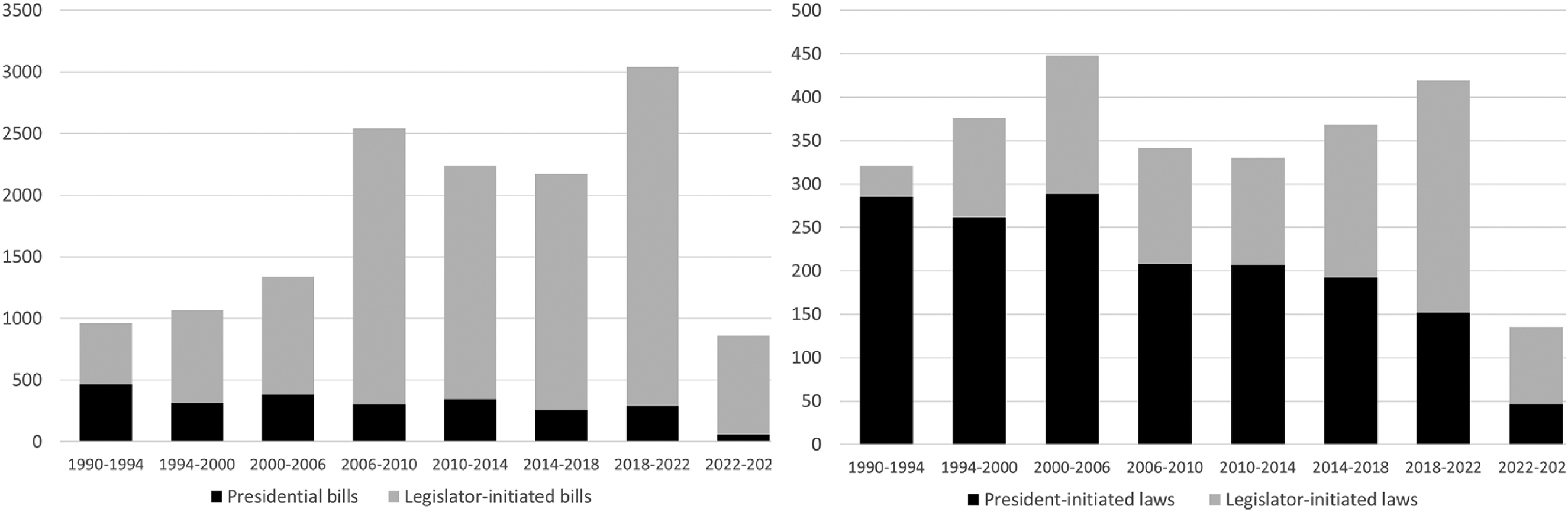
Presidential and Legislator-initiated Bills and Laws, 1990–2023.
The variance over time in the number of presidential bills is partially associated with the length of presidential terms (6 years between 1994 and 2006 and 4 years for all the other terms). In the first presidential term, 1990–1994, there was no backlog of bills for congress to debate, and thus, the president was hard-pressed to introduce more bills. When the 2005 reforms cut the presidential term to 4 years and eliminated the extraordinary legislative session, there was less time and weaker control of the agenda by the president, which limited the incentives to introduce presidential bills after 2006.
Figure 1 also shows that most laws enacted originated in presidential bills in the first six terms (1990–2018), but in 2018–2022, the number of laws enacted that originated in legislator-initiated bills outnumbered (63.4%) the laws that originated in presidential bills. Still, there was an upward slope in the share of laws enacted from legislator-initiated bills that preceded Piñera's second term (39%, 37.3%, and 47.8). As we discuss below, the upward trend continued during the first year of Gabriel Boric's government. As the changes in electoral rules can be associated to the increase in the number of legislator-initiated bills introduced, the electoral reforms of 2015 can also be indirectly associated to a higher number of laws enacted that were initially introduced as legislator-initiated bills.
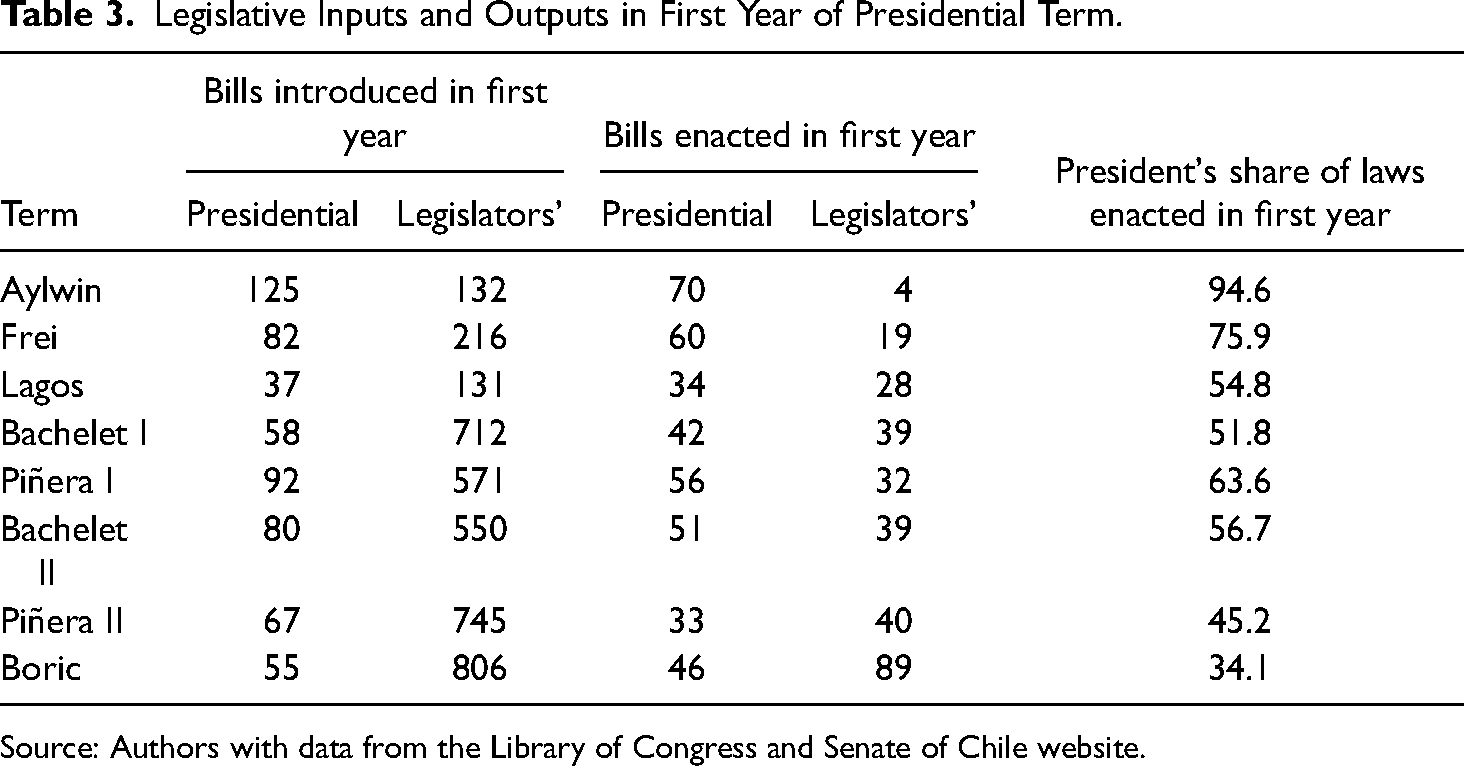
Table 3 shows the legislative inputs and outputs for the first year of every presidential term. While there was an increasing weight of legislator-initiated bills since Bachelet's first term (2006–2010), the number of bills initiated by presidents in their first year has remained more stable. Presidential bills as a share of the laws enacted in the first year have been on the decline as well. In the most recent two terms, the share of legislator-initiated bills among the laws enacted has grown, pointing to progressive loss of influence of the president in the lawmaking process. That upward trend has continued in the first year of the Boric presidency. The evidence challenges the claim made in the early years of post-1990 democracy that Chile has an exaggerated presidentialism.
Legislative Inputs and Outputs in First Year of Presidential Term.
Source: Authors with data from the Library of Congress and Senate of Chile website.
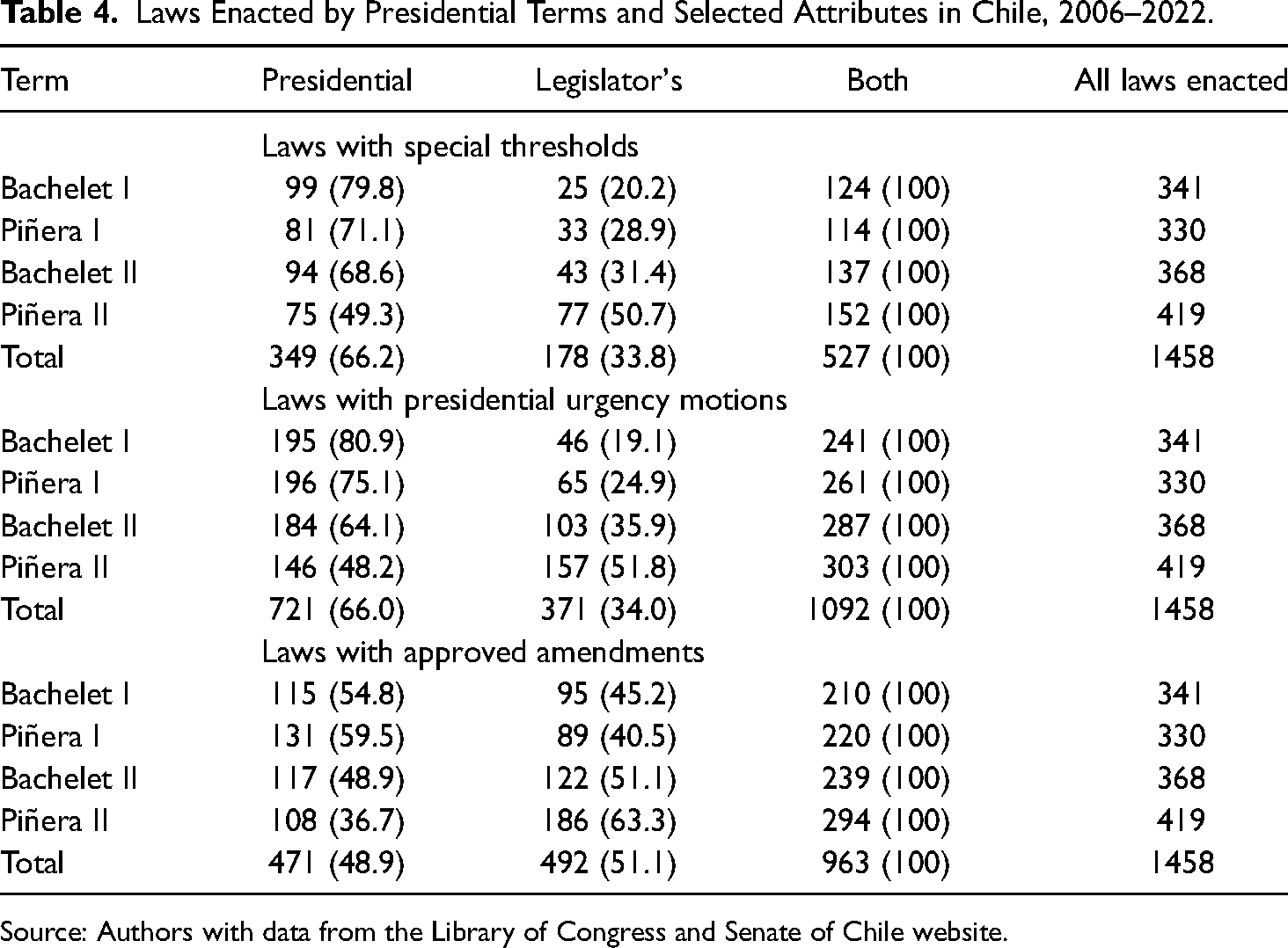
We also look at three attributes of laws enacted, the voting thresholds required, the presidential urgency motions issued, and the amendments introduced. Between 1990 and 2022, the most important laws had to be approved by a qualified majority of 2/3, 3/5 (for constitutional reforms), 4/7 (in the case of constitutional organic laws), or 50% + 1 of the legislators in office. Special voting thresholds are a good indicator of the importance or relevance of a bill. Table 4 shows the bills introduced and laws enacted by their qualified majority requirements. In Bachelet's first term, most special threshold laws were initiated by the president (79.8%). Since then, the number of legislator bills enacted with special thresholds has been on the rise. In Piñera's second term, legislator-initiated bills comprised 50.7% of laws with special thresholds enacted. These results underscore the growing importance of Congress in initiating relevant bills, even though the institutional framework that grants the president exclusive initiative on many issues, especially spending bills, has not been modified. As the share of legislator-initiated bills experienced its biggest increase in 2018–2022, we can associate such increase with the adoption of the electoral reforms that came into effect in that term.
Laws Enacted by Presidential Terms and Selected Attributes in Chile, 2006–2022.
Source: Authors with data from the Library of Congress and Senate of Chile website.
The dynamics around presidential urgencies motions have also changed in recent terms. Presidents consistently introduce more urgency motions to their own bills than to bills initiated by legislators. 80.9% of the bills that received an urgency motion during Bachelet's first term were initiated by the president. But that share has declined since. In Piñera's second term, only 48.2% of the enacted bills that received an urgency motion were initiated by the president. This data suggests that the president, understanding his or her relative weakness, prefers to give priority to projects initiated by legislators rather than to his own bills. Again, although the downward decline was noticeable before the 2018–2022 term, the slope of the curve became steeper that term, when the new electoral rules came into effect.
Finally, in Bachelet's and Piñera's first administrations, the number of presidential bills that received amendments exceeded the number of legislator-initiated bills. This trend was reversed in Bachelet's and Piñera's second terms, where the laws enacted from legislators’ bills outnumbered laws enacted from presidential bills. The data presented in Tables 4 on bills introduced and laws enacted point to the growing importance of legislator-initiated bills and the corresponding declining relevance of presidential bills in the lawmaking process. After the 2005 constitutional reforms, and the 2015 electoral reforms, the president has lost influence over the legislative process and the legislature has gained influenced. The strong presidentialism—where the executive controlled the legislative process and most laws enacted originated in presidential bills—reported for years immediately after the restoration of democracy in 1990 was replaced by an equilibrium where the legislature exercises more influence. Thus, the evidence is consistent with hypotheses 1 and 2.
Hypothesis 3: The Consequences of Social Upheaval in the Lawmaking Process
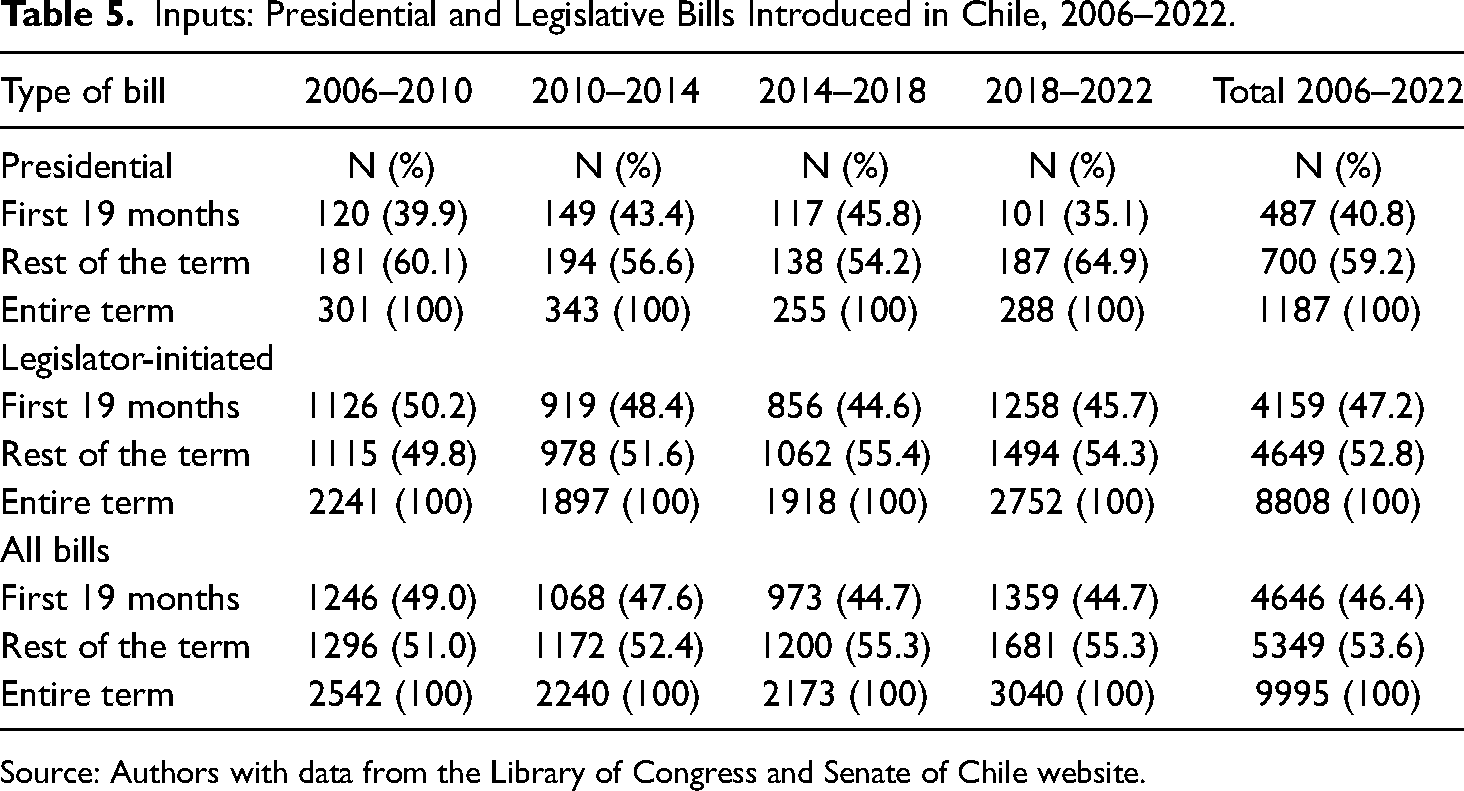
The third hypothesis associates the social upheaval in 2019 with the variation in legislative inputs and outputs. As Table 5 shows, there were more legislator-initiated bills in 2018–2022 than in previous terms, but there was also an increase in the number of legislators from 158 in previous terms (120 in the Chamber and 38 in the Senate), to 198 in 2018–2022 (155 in the Chamber and 43 in the Senate). The per capita number of bills introduced was 13.9 in 2018–2022, up from 12.1 and 12.0 in 2014–2018 and 2010–2014, respectively. Moreover, the upward trend was already noticeable before the 2019 social upheaval. In the first 19 months of the 2018–2022 term, legislators introduced 6.3 bills per capita, up from the 5.4 introduced in the first 19 months of the 2014–2018 term. In the months after the upheaval, legislators introduced 7.5 bills each, up from the 6.7 per capita bills introduced in the comparable period in 2014–2018. This suggests that the surge in the number of bills introduced is associated with the increase in the number of legislators more than with the social upheaval or with the lockdown measures of the Covid-19 pandemic that impacted the ability of legislators to interact with their constituencies.
Inputs: Presidential and Legislative Bills Introduced in Chile, 2006–2022.
Source: Authors with data from the Library of Congress and Senate of Chile website.
The data in Table 5 also imply that the 2019 uprising might have impacted the introduction of presidential bills. Compared to the three previous terms, the second Piñera administration was more active in sending bills in the rest of the term than in the 19 months before the upheaval. In turn, relative to prior terms, legislators in 2018–2022 were not less active in introducing bills in the first 19 months than in the rest of the term. But the decline in the influence of the president in the legislative process preceded the upheaval. In his first 19 months, Piñera only introduced 101 bills, less than the 120, 148, and 116 introduced by the executive in the three preceding terms, respectively (including Piñera's first term).
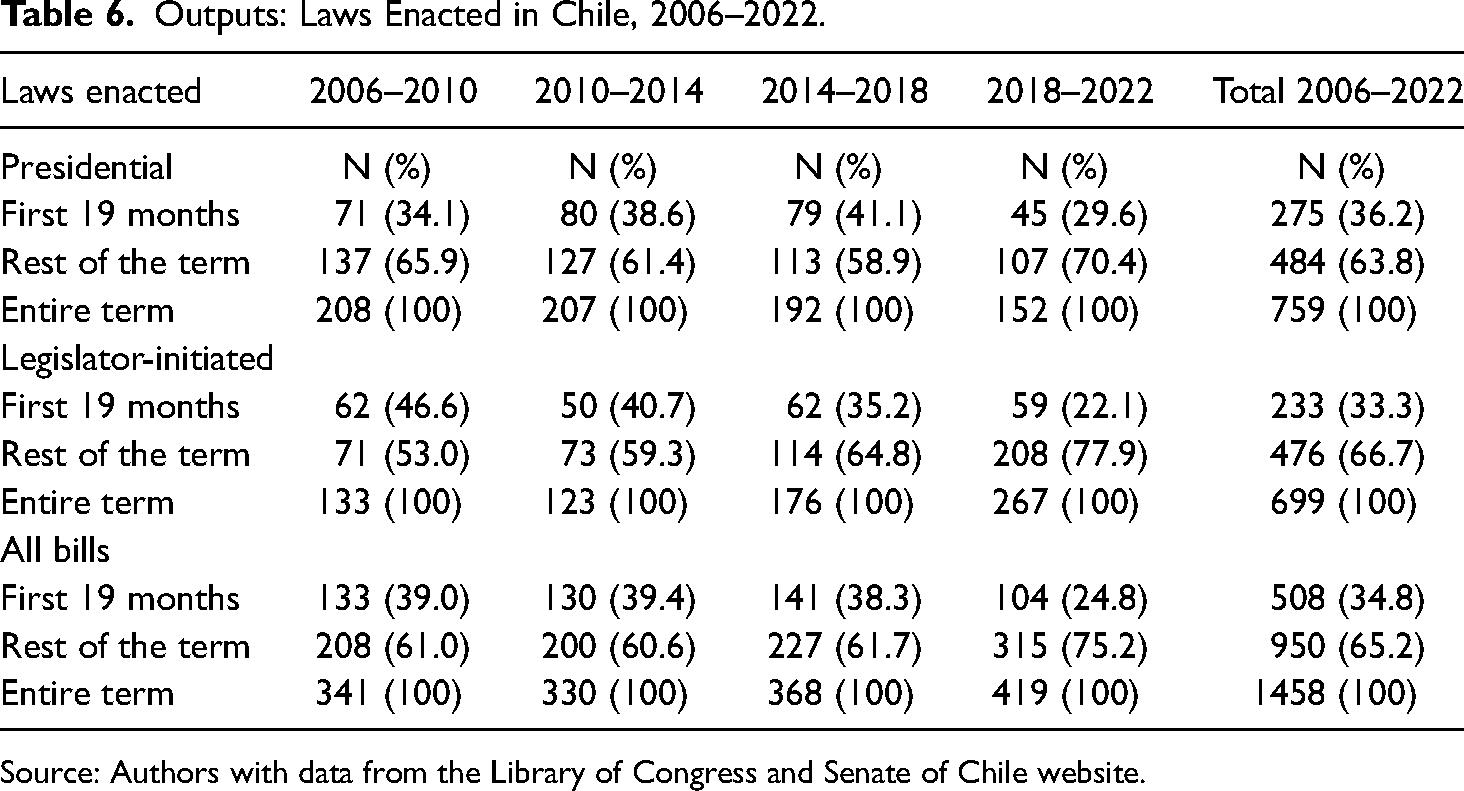
Notice that, above, we associate that decline with the impact of the changes in the electoral rules and with the increase in the number of legislators. In fact, since the decline in the number of presidential bills preceded the upheaval, the upheaval cannot be blamed for the declining weight of presidential bills among all bills introduced in the first 19 months of the term. After the upheaval, compared to the number of bills in the first 19 months, Piñera was more active in sending bills than his immediate predecessor. Moreover, as Table 6 below shows, when the upheaval began in October 2019, only 45 laws had been enacted from presidential bills, less than the 70, 81, and 79 laws in the three previous terms. The relative weight of presidential bills introduced in the first 19 months was lower, both as a percentage of all presidential bills and as the number of presidential bills introduced, in 2018–2022 than in the preceding three terms. We associate this with the changes in the electoral rules that came into effect in the 2017 election.
Outputs: Laws Enacted in Chile, 2006–2022.
Source: Authors with data from the Library of Congress and Senate of Chile website.
In the rest of his second term, Piñera introduced more bills than in the first 19 months. But so did presidents in the previous three terms. Still, the share of presidential bills introduced in the second part of the term (29 months) was higher for Piñera than for previous presidents. Thus, compared to the three previous presidencies, the 2019 upheaval might have had a marginal impact on the introduction of presidential bills. Whereas in the first 19 months, Piñera (2018–2022) trailed the three previous administrations in introducing bills, his administration moved faster than previous administrations in introducing bills in the subsequent 29 months. In that dimension, the upheaval might have triggered a sense of urgency in the president to introduce bills (although many of those bills were also associated to the Covid-19 pandemic health emergency).
Thus, the increase in legislator-initiated bills and the decrease in presidential bills introduced in the first 19 months of the 2018–2022 term are more likely associated to the changes in the electoral rules and to an increase in the number of legislators than to the October 2019 riots. Still, the social upheaval (or perhaps the Covid-19 pandemic) might be associated with the increase in the number of presidential bills introduced in the rest of Piñera's second term, but not with the number of legislator-initiated bills.
Table 6 shows the laws enacted in each term. Since bills might take a long time to pass, we include all the presidential and legislator-initiated bills enacted per term, regardless of when they were introduced. We do so because presidents can prioritize bills introduced by their predecessors, they can introduce amendments to those bills or, when they disagree with the content of the bill, they can withdraw a bill introduced by a predecessor. Thus, when a president decides against blocking the progress of a bill introduced by a predecessor, it can be assumed that the president agrees with its content and thus, we attribute the success of that bill to the president in the term when the bill passed. For legislator-initiated bills, which take an even longer time to pass, we also consider all the bills enacted in each term, regardless of when they were introduced.
The number of laws enacted that originated in presidential bills reached the lowest mark in 2018–2022. The 152 laws enacted from presidential bills in that term were far fewer than the 208, 207, and 192 laws enacted in previous terms. Yet, Piñera had enacted only 45 bills in the months before the upheaval, less than the 71, 80, and 79 laws enacted from presidential bills in the previous terms. So, the decline in the number of presidential bills enacted was evident even before the upheaval, an observation that is consistent with the expectations of our second hypothesis that points to the effect of an increase in the number of legislators. In fact, after October 2019, there were 107 presidential bills enacted, just slightly fewer than the 113 laws enacted in the preceding term. Thus, the downward trend in the number of presidential bills is probably associated to the changes in the electoral rules more than to the 2019 upheaval. That downward decline was present in previous terms.
In turn, the 267 legislator-initiated bills enacted in 2018–2022 outnumbered the 134, 123, and 176 legislator-initiated bills enacted in the previous terms. After the 2019 upheaval, the number of legislator-initiated bills enacted increased considerably with respect to previous terms. While 53.0%, 59.3%, and 64.8% of the legislator-initiated bills in previous terms were enacted in the last 29 months of the term, an impressive 77.9% of the legislator-initiated bills enacted in 2018–2022 passed after the 2019 upheaval. The rapid acceleration in the number of laws enacted from legislator-initiated bills and in the rate of those bills enacted after the nineteenth month suggests that the sway of the legislature in the lawmaking process increased drastically after the 2019 upheaval. Compared to the first 19 months, legislator-initiated bills increased more dramatically in the second part of the 2018–2022 term than in previous legislative terms. That suggests that the changes in the electoral rules implemented before the 2017 election had less to do with the increase in the weight of legislator-initiated bills among laws enacted than the social upheaval of October 2019. Thus, the evidence is partially consistent with our third hypothesis. The social upheaval impacted the executive-legislature balance of powers in laws enacted. Even though the number of presidential bills enacted just marginally declined, the number of legislator-initiated bills enacted rapidly increased after the upheaval. The increase in the number of laws enacted in that term compared to previous terms is primarily explained by an increase in the number of legislator-initiated bills that passed.
Since our third hypothesis associates the changes in legislative inputs and outputs to the 2019 social upheaval, Figure 2 shows the cumulative monthly evolution in legislative inputs and outputs for all presidential terms between 2006 and 2022. We included a break point at the end of the nineteenth month in every 4-year administration to compare what happened before and after the 2019 upheaval with the equivalent moments in previous terms. Two things immediately stand out. First, there is an upward trend in the number of bills introduced in every presidential term. Second, the number of laws enacted has also been on the rise. The trends in Figure 2 lend support to our hypotheses. First, changes to the electoral rules led to an increase in the number of bills introduced by legislators and, presumably, that might have also impacted the number of legislator-initiated bills enacted. Second, the declining sway of presidential bills among legislative outputs was noticeable before the 2019 upheaval, but the rapid increase in the number of laws enacted and the decline in the share of presidential bills among laws enacted in the second Piñera administration suggests that the social upheaval further shifted the balance in executive-legislative relations by weakening the former and strengthening the latter. The trend of a weakening executive was noticeable before the 2018–2022 term, but it accelerated in the months after the 2019 upheaval.
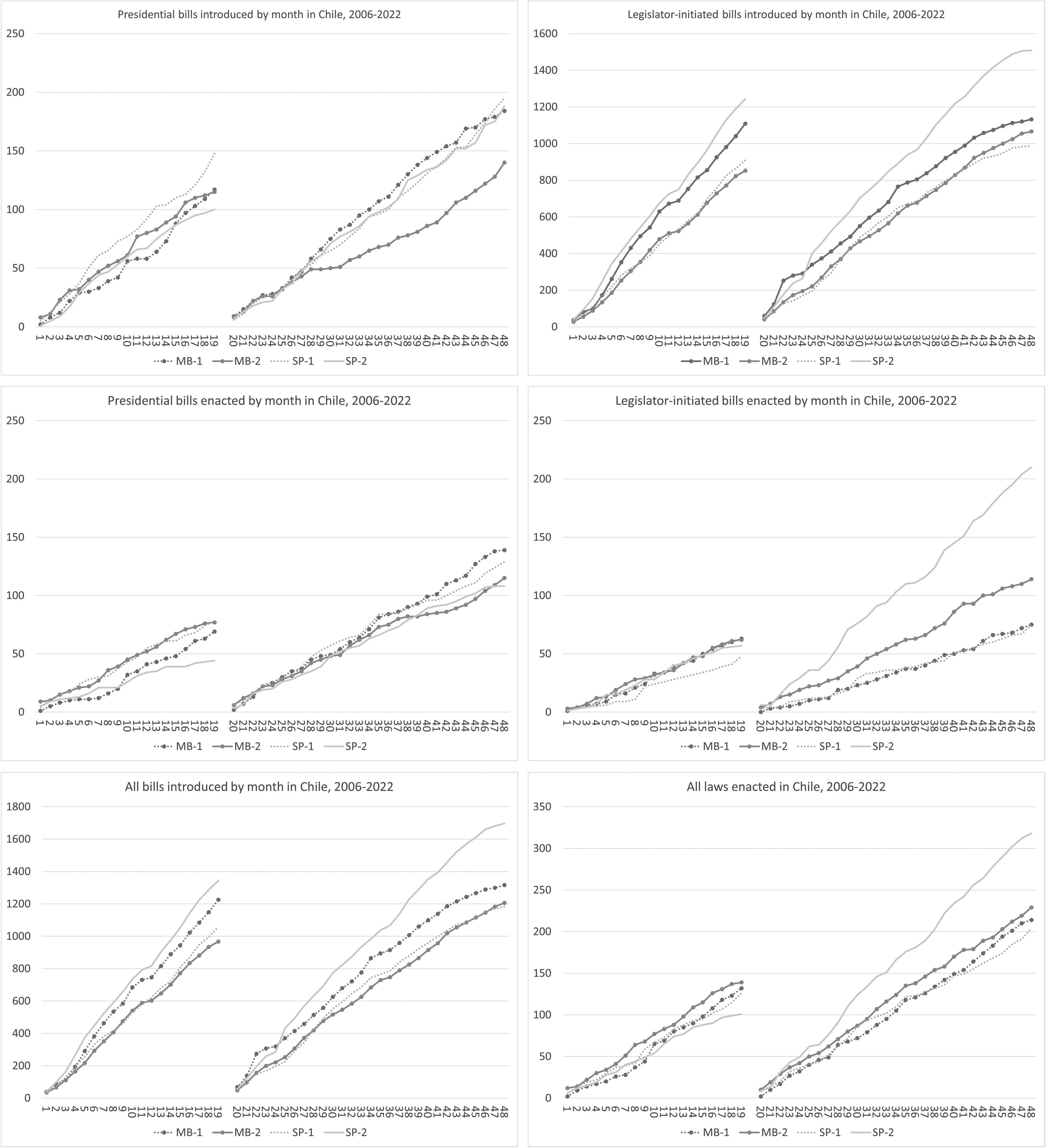
Legislative Inputs and Outputs in the Chilean Congress in Chile by Presidential Term, 2006–2022.
After the 2019 social upheaval, the influence of the legislature over laws enacted increased. This is consistent with our third hypothesis. However, even before the upheaval, Piñera already had less sway in the legislative process than his predecessors, a claim that is consistent with the second hypothesis. In her second administration, Bachelet also had less sway over the legislative process than previous presidents—a fact that lends support to our first hypothesis. Thus, the declining influence of the president in the legislative process cannot be primarily associated to the 2019 upheaval. The social upheaval accentuated the declining lawmaking influence of the president. But as the constitutional reforms of 2005 and the electoral reform of 2014–2015 strengthened the legislature, the political system adjusted. The declining influence of the president accelerated, especially in terms of the share of presidential bills among laws enacted. But that process was well underway before the upheaval. The social upheaval did not result in legislative gridlock. Rather than blocking presidential bills, the stronger legislature took on a more proactive role in passing its own bills than in the previous three terms.
Institutional reforms that reduced the power of the executive and altered electoral rules had a negative impact on the influence of the executive in the legislative process in Chile. Contextual variables, like the 2019 social upheaval, further accentuated the already declining legislative sway of the president. The evidence is, thus, consistent with our first hypothesis (on the effect of constitutional reforms), our second hypothesis (on the impact of changes in electoral rules), and only partially consistent with our third hypothesis (on the impact of the social upheaval on legislator-initiated bills).
Conclusions
Studies in the early 1990s defined the political system of Chile as strongly presidential. Yet, the 2005 constitutional reforms that gave congress a more proactive role in the legislative process weakened the president. The electoral reform of 2015 further strengthened the legislature. The 2019 social upheaval, which resulted in a constitution writing process, marginally altered the executive-legislature lawmaking balance in favor of the latter. The upheaval triggered a power vacuum, which was filled by a bicameral congress that acquired more power in the legislative process. In the Bachelet (2014–2018) and Piñera (2018–2022) administrations, the legislature accounted for a bigger share in the number of bills introduced and, also, in the number of laws enacted than in any previous presidential term since 1990. That trend continued in the first year of President Gabriel Boric. This evidence conclusively calls into question the alleged presence of hyper-presidentialism in Chile. The political system has evolved over time as the legislature has strengthened.
The evidence shows that relatively minor changes to the lawmaking rules and changes in electoral rules have impacted the balance of powers between the executive and legislature. As it well known, Chile went through a frustratingly long and unproductive constitution making process between 2019 and 2023. Our findings suggest that there is no need to rewrite a constitution to change the balance of powers between the executive and the legislature. Tweaking with the lawmaking rules can help improve executive-legislative relations and correct unbalances that might have emerged over the years.
Studies on the proactive legislative powers of the president have mostly focused on the success of the president's legislative agenda. Here, we propose to go beyond looking at the batting average and look at data on the dominance of the president over the legislative inputs and, especially, outputs—the final score of the game. Future studies on executive-legislative relations in Latin American presidential democracies should include additional indicators for the dependent variable. The success of the president's agenda is not the only indicator that matters. The share of presidential bills among bills introduced and laws enacted is also relevant to understand the lawmaking balance of powers between the executive and the legislature.
Footnotes
Declaration of Conflicting Interests
The author(s) declared no potential conflicts of interest with respect to the research, authorship, and/or publication of this article.
Funding
The author(s) disclosed receipt of the following financial support for the research, authorship, and/or publication of this article: This work was supported by FONDECYT: [Grant Number 1231627]; ANID-Millennium Science Initiative Program: [Grant Number NCS2021_063]. The data used for the paper was collected by the authors from publicly available sources.
