




Abstract
In recent elections, ‘progressives’ in centre-left parties have advocated for more democratised processes of candidate selection. We test whether more inclusive and decentralised selectorates align with higher numbers of progressive candidates nominated in national legislative elections by centre-left parties across three advanced western democracies between 2017 and 2021. In the Labour Party, more centralised selectorates aligned with higher numbers of progressives selected. For the SPD, we report null findings, likely due to additional incentives for factional co-operation in a multi-party system. In our most decentralised case, the Democratic Party, selection of progressives was congruent with district partisanship rather than selectorate inclusivity, with progressives more commonly selected in safe rather than competitive or unfavoured districts. This relationship was not present in our other cases. These findings highlight the importance of the decentralisation dimension for the factional allegiance of legislative candidates nominated.
Introduction
Nomination of legislative candidates has long been considered among the most important functions of political parties, with consequences for party ownership (Schattschneider 1942, 101), control (Ranney 1981, 103), and as a defining feature ‘that universally distinguishes parties from other political organizations’ (Sartori 1976, 64). Indeed, recent theorizing about parties places nominations at the heart of what parties are (Bawn et al. 2012). Candidate selections reveal intra-party dynamics, as ‘an acid test of how democratically they conduct their internal affairs’ (Gallagher 1988, 1). Despite widespread acknowledgement of the importance of nominations, the empirical consequences of variance in the rules of selection remain poorly understood, particularly in terms of the factional allegiances of legislative candidates selected.
We test these consequences for the Labour Party in England, the German Sozialdemokratische Partei Deutschlands (SPD) and the Democratic Party in the United States, using the spatial and temporal variation present within each case. These parties are three of the oldest of their kind, whose trends and intra-party dynamics resonate to other advanced western democracies. We contend that each party has a bi-factional structure—with comparative moderate and progressive 1 factions—which structures intra-party conflict. We consider factional affiliations of candidates for national legislative office based on variation in selection processes. In these parties, the factions have competing views on the role of intra-party democracy, meaning the candidate selection process is itself a site of factional conflict.
In recent decades, candidate selection has targeted by reformers in centre-left parties, often aligned with the progressive faction, to foster connection with voters (Bille 2001; Totz 2011) in response to electoral decline and falling membership numbers (Benedetto, Hix, and Mastrorocco 2020). These parties have been marred by claims that they are out-of-touch elites who have abandoned core party values, traditionally understood as a struggle of solidarity (Müller 1999). Contemporarily, a vigorous debate has emerged about electoral revitalisation (Abou-Chadi and Wagner 2019, 2020); should parties pursue left-leaning movement-based politics—as advocated by politicians such as Jeremy Corbyn and Bernie Sanders—or attempt to reignite their Third Way successes by adopting comparatively moderate policy positions? A key component of these debates has been the extent to which parties should ‘bring the members back in’ (Hopkin 2001) as part of the candidate selectorate; those responsible for selecting candidates. Given recent calls for greater intra-party democratisation across these parties, how do selection processes relate to the ideological identity of legislative candidates nominated? More specifically, given that these demands largely originate from progressives in these parties, to what extent do more ‘open’ selectorates correspond to greater numbers of progressive-aligned candidates being selected for national legislative office? Given the differences between our cases we focus on within-case variation.
Existing literature conceives two main dimensions of selectorate openness: inclusivity and decentralisation (Gallagher 1988; Hazan and Rahat 2010; Hopkin 2001; Katz and Mair 1995; Lundell 2004; Rahat and Hazan 2001; Ranney 1981). In the Labour Party, groups such as Momentum have advocated for greater selectorate inclusivity as a mechanism to recruit more diverse MPs (Parker 2018). In the SPD, recent democratisation has also resulted in greater involvement in candidate selection by ordinary members (Detterbeck 2016) with reforms at the national level, introduction of primaries in Land (state) elections, and efforts to include even non-party members in the process (Detterbeck 2013). In the U.S., the highly inclusive and decentralised primary system has been blamed for producing extreme candidates and contributing to polarization in Congress (Brady, Han, and Pope 2007; Kamarck, Podkul, and Zeppos 2016; Schumer 2014). Despite this criticism, states have continued to enact reforms making selectorates more inclusive, such as shifting from closed to open primaries. In each case, the inclusivity dimension is the focus of reform efforts, with comparatively little attention given to decentralisation. We consider the relative importance of inclusivity and decentralisation in nominating progressive candidates within our cases. To do so, we use the framework established by Reuven Hazan and Gideon Rahat (Hazan and Rahat 2010; Rahat and Hazan 2001) and applied elsewhere in the literature (e.g. Shomer 2014; Spies and Kaiser 2014).
Given the contemporary prominence of progressives demanding more internal party democracy, we restrict our analysis to recent variation in candidate selection processes. We analyse the period from 2017 to 2021, including the last two national legislative elections in each case. We select these parties due to their prominence in the literature on social democratic parties, their influence on centre-left parties globally, the countries’ different electoral and party systems, and their common position as the leading exponants of Third Way politics. We also note a paucity of comparative intra-party literature including the U.S. alongside European cases.
Our research question focuses on the alignment between inclusivity and decentralisation of legislative candidate selectorates, and the rate of progressive candidates selected in three centre-left parties. Theoretically, our expectations are derived from John May’s ‘special law of curvilinear disparity’ (1973). Greater inclusivity and, especially, centralisation of Labour selectorates aligned with the nomination of greater numbers of progressive candidates under Corbyn, in line with theoretical literature suggesting that inclusivity without decentralisation can strengthen the control of party leadership over candidate outcomes (Cross and Katz 2013; Hazan and Rahat 2010; Scarrow 1999). We report null findings for the SPD, with minimal differences in the factional identity of candidates with spatial variation in selection processes, likely due to closer inter-faction co-operation and need to balance selections in multi-party electoral systems. In the Democratic Party, we find that the nomination of progressives was better explained by district partisanship rather than spatial variation in the inclusivity of primary election participation, potentially due to the decentralised selection process. More inclusive selection processes did not align with higher numbers of progressive candidates being selected in the SPD or Democratic Party, suggesting that progressive demands for intra-party democratisation are made, at least in part, out of conviction rather than for electoral benefit. Methodologically, we offer a qualitative approach linking candidate selection processes with factional allegiance of candidates selected, replicable for other parties with identifiable factions. Our findings highlight the importance of the decentralisation dimension of candidate selection, frequently overlooked by political scientists and reform advocates alike.
We proceed as follows: first, we present the theoretical background which shapes our assumptions about candidate selection, as well as details of the framework that we follow. We then present our cases and expand our theorizing about factions in these parties. Next, we explain selection processes in each party, and position selectorates along both dimensions. Following this, we introduce our data and research design. Finally, we present and discuss the results of our empirical models.
Candidate selection and factions in centre-left parties
May’s ‘laws’ (1973) contend that the diversity of views within parties align with different strata of the organisational hierarchy. May argues that middle-elites—such as local party organisations, engaged party members and activists—are more ideologically extreme than both the leaders and members of central organisations above them, and the ordinary party voters below them. His ‘special law of curvilinear disparity’ has received several challenges, most prominently that political competition has moved ‘beyond’ it (Van Holsteyn, Ridder, and Koole 2017; Wager et al. 2021; Weldon 2007) or that intra-party opinion is more randomly distributed in practice (Kitschelt 1989; Norris 1995). Despite these critiques, May’s work remains influential in understanding political parties, empirically supported by studies across disparate democracies (Bäckersten 2021; Belchior and Freire 2011).
May’s law has clear implications for the outcomes of candidate selection processes. If selection is decentralised but still relatively exclusive—or, in other words, the power of selection includes middle-elites but not ordinary party voters—then spatial models of voting (e.g. Downs 1957) would expect greater number of non-centrist candidates to be nominated. Similarly, as selection processes become more inclusive, with a shift in power away from elected officials towards active and engaged supporters and members, May’s law theorises that the candidate selectorates would become more ideologically extreme. 2
Political consequences of candidate selection
Legislative candidate selection is a vital tool at the disposal of the party, with the ability to reduce or exacerbate factional conflict (Gallagher and Marsh 1988; Hazan and Rahat 2010; Rahat and Hazan 2001; Ranney 1981; Sartori 1976). We follow the literature in understanding candidate selection as the ‘predominantly extralegal process by which a political party decides which of the persons legally eligible to hold an elective public office will be designated on the ballot’ (Ranney 1981). Given the recent focus of reform efforts on the selectorate, we limit our analysis to variation in the group(s) choosing the candidate.
Several studies consider whether selectorates influence the type of candidates selected, though few include variation along both the inclusivity and decentralisation dimensions. Two notable articles consider whether candidate selection impacts the ‘representativeness’ of parties, with Mikulska and Scarrow’s (2010) study of British parties indicating that more inclusive procedures result in greater alignment between candidates and party voters. Spies and Kaiser’s (2014) cross-national analysis of Western European countries—which does include both dimensions—finds that inclusivity is positively associated with representativeness, and that it is important for spatial variation only. Further literature examines the relationship between selectorates and candidates’ behaviour once elected, indicating that open candidate selection negatively impacts party cohesion by influencing legislator incentives (Hazan 2014). The mechanism here is rather straightforward, if—as Fenno (1973) and Mayhew (1974) argue—legislators are primarily motivated by re-election, then, under competitive selection systems, their initial concern becomes the intra-, rather than inter-, party stage of the process, fostering alignment with their selectorates. Other studies consider the impact of selectorates on the demographic characteristics of candidates (Fortin-Rittberger and Rittberger 2015; Pruysers et al. 2017), where, in an analysis of the German case, Deiss-Helbig (2021) finds no association between selectorate inclusivity and the nomination of female or immigrant-origin candidates.
From a theoretical perspective, questions of whether institutions of candidate selection matter remain contested. Behaviouralists consider variation in candidate selection processes as nothing more than a product of other political factors (Czudnowski 1975). Conversely, neo-institutionalists position candidate selection processes as directly affecting the systems within which they exist (Gallagher and Marsh 1988). In summarising this debate, Hazan and Rahat conclude, ‘we do not presuppose that institutions can explain everything, but rather that institutions matter’ (2010, 7). We follow their framework, taking an institutionalist approach using selectorate inclusivity and decentralisation as our independent variables. As the targets of democratic reforms, we analyse the effect of the rules rather than the practice of selection, though we acknowledge their considerable potential to diverge (Detterbeck 2016; Hassell 2018), and our work here would be complimented by further qualitative analyses of the practice of candidate selection in each of our three parties. We limit our analysis to the formal rules given the raft of evidence that they can matter (Bille 2001; Gallagher and Marsh 1988; Hopkin 2001). Accordingly, we test the following hypotheses both across and within our selected cases: H1: Selectorate inclusivity will align with higher numbers of progressive candidates. H2: Selectorate decentralisation will align with higher numbers of progressive candidates, unless the progressive faction controls the central party (e.g. Labour under Corbyn), where centralisation will align with higher numbers of progressive candidates.
We also expect that inclusive and decentralised selection processes will align with greater congruence between districts and candidates, specifically: H3: Where selection processes are more inclusive and decentralised, numbers of progressive candidates will more closely align with district safety, with more progressives selected in safe seats and fewer selected in competitive or hard-to-win districts.
In all hypotheses’, inclusivity refers to the breadth of decision makers involved in selection, where variation in inclusivity relates to the size of the group selecting. In their framework, Hazan and Rahat operationalise inclusivity using twenty-five-point scale. On this ‘party selectorates continuum’ (2010, 49), a score of zero represents the most exclusive end, where a single leader comprises the selectorate, six represents when elites are the selectorate, twelve when delegates select, eighteen when party members select, and twenty-four being the most inclusive selectorate possible where non-party affiliated voters form the selectorate. We use this scale in our analyses, placing candidate selectorates along this continuum.
Decentralisation refers to the number of distinct selectorates across the party, usually territorially. In a completely centralised selectorate, a single group—usually the central party—selects all candidates. In contrast, completely decentralised selectorates have a distinct group of selectors for each candidate, often the district or constituency party. Decentralisation is measured as the number of selectorates for all candidates. Hazan and Rahat do not offer a numeric scale to operationalise decentralisation, in part because the dimension may contain both territorial and social components. Given that our cases have no social component, 3 we scale decentralisation on a zero to one continuum territorially; where zero represents centralisation with a single selectorate for all candidates, and one represents a completely decentralised process with a discrete selectorate per candidate. As the framework’s authors note, applying this scale through variation in the numbers of selectorates provides a straightforward way to operationalise decentralisation (Hazan and Rahat 2010, 67).
Though inclusivity likely aligns with decentralisation, these concepts are distinct. 4 Candidate selection may be inclusive and centralised, with mass participation and centrally-controlled processes serving to remove power from middle-level party elites (Kenig, Rahat, and Hazan 2013; Webb 1994). Alternatively, selection may be decentralised but exclusive, with power in the hands of small local groups. Some studies conflate these dimensions under the heading of ‘democratisation’ (Bille 2001) or ‘openness’ (Krouwel 1999). 1 Separating these dimensions enables comparison of trends of decentralisation, where power has moved from central to local levels; and inclusivity, involving greater participation in the selection process. Rahat and Hazan (2001, 309) suggest that decentralising selectorates without making them more inclusive can reduce intra-party democracy, meaning we consider each dimension separately.
We use Hazan and Rahat’s (2010) operationalisation of these dimensions, noting their centrality across the candidate selection literature (Gallagher 1988; Hopkin 2001; Katz and Mair 1995; Lundell 2004; Ranney 1981). For mixed and multi-stage selections, as in the Labour and SPD cases, we follow the framework by conducting separate analyses of each selectorate or stage. Though the framework also includes candidate eligibility (Hazan and Rahat 2010, chap. 2) and voting mechanisms (Hazan and Rahat 2010, chap. 5), we restrict our analysis to the selectorate as the target of democratisation efforts (see also Shomer 2014).
Case selection
The Labour Party, SPD and Democratic Party were three of the leading proponents of Third Way politics under the respective leaderships of Blair, Schröder and Clinton. In the early twenty-first century, these parties have struggled to move on ideationally, with the legacies of these Third Way administrations contested (Manwaring and Kennedy 2018). Retention of attachment to, or desire to abandon, Third Way politics is at the heart of factional divisions between elites in all three parties. Common socio-political trends in England, Germany and the U.S. have posed similar challenges to these parties, with intra-party disagreement over how best to respond to cultural and economic changes and the decline of working class identity, debates over electoral strategy including trade-offs between median voters and energising the base, and over the integration of New Left issues (Gauja 2017; Inglehart 1990; Keman 2017; Przeworski and Sprague 1986). Studies indicate that these parties are also similarly unresponsive to shifts in public opinion or global economic conditions (Adams, Haupt, and Stoll 2009). We argue that these common responses to societal trends and intra-party debates make these cases particularly appropriate for comparison.
These parties also influence other members of the social democratic ‘party family’. Comparative accounts (see e.g. Keman 2017) identify these parties as foundational in shaping policy preferences, organisational approaches, and electoral strategies of centre-left parties globally. In analysing three of the most established and well-known parties of their type, we believe our findings and approach will likely travel to other centre-left parties influenced by our cases. We are particularly interested in centre-left parties given their perceived electoral struggles, with the party family frequently positioned as being in decline (Lavelle 2008).
We analyse candidate selection in the two most recent national legislative elections for each party, covering the period between 2017 and 2021. We focus on recent elections given the growing demands for internal democratisation by progressives in our cases. In doing so, we attempt to understand the relationship between selectorates and candidates in an era where change is being demanded from within these parties. The period is of additional interest given the parties’ divergent electoral fortunes. In the Labour Party, the selection of Jeremy Corbyn as leader in 2015 coincided with the party’s vote share increasing almost 10 percent in 2017 (Agerholm and Dore 2017), but was followed by the party’s worst election performance for nearly a century in 2019. In Germany, the SPD received their lowest post-war share of the vote in 2017, then narrowly won the 2021 election, albeit with a relatively low proportion of the vote. In the U.S., the Democratic Party experienced a resurgent period with a ‘blue wave’ in the House of Representatives in 2018 followed by unified control of government after 2020. Though we make no claims about selectorates and electoral outcomes, that these parties had contrasting fortunes over these two election cycles sparks further comparative interest. All systems have single-member districts, with a further variation that the U.S. has a separately elected executive, reducing the stakes for legislative candidate selection somewhat as the potential leader is not being selected. The presence of SPD list candidates provides further variation, with lists understood as a tool for party organisations to control selection.
We include Labour candidates from the 2017 and 2019 elections, restricting our analysis to selection of candidates in England for two reasons. First, candidate selection processes are more varied outside of England, and second, the additional cross-cutting cleavages connected to issues of nationalism, independence, and the multi-national makeup of the British Isles in Scotland and Wales makes categorising candidates as proximate to moderate or progressive factions less comparative. 5 For the SPD, we included all candidates who stood in a constituency (direct mandate) or on a Land list in 2017 and 2021. For the Democratic Party, we included all candidates for the U.S. House of Representatives in 2018 and 2020. 6
Intra-party factions
We contend that a bi-factional structure exists within the Labour Party, SPD and Democratic Party. Though the policy positions of factions vary over time and between cases, we argue that the origin and manifestation of the intra-party divide is similar, with delineation between left-leaning progressives and comparatively moderate or establishment factions. Social democratic parties have long been conceived as being built on factions (Rose 1964), which serve as parties’ animating components, ‘seeking to pour new wine into old bottles’ (Ceaser 1990, 90–91). Scholarship advocates a persistent bi-factional structure of major parties, envisaged as having regular and realigner (Reiter 2004), regular and ideologue (Noel 2016), or careerist and believer factions (Panebianco 1988), with an ideologically motivated faction and a faction more concerned with pragmatism and electoral longevity. Though other scholarship highlights non-ideological factions—including leadership factions (Janda 1983) and factions of interest (Boucek 2009)—we conceive that these factions align with ideological orientations when present in our cases. 7
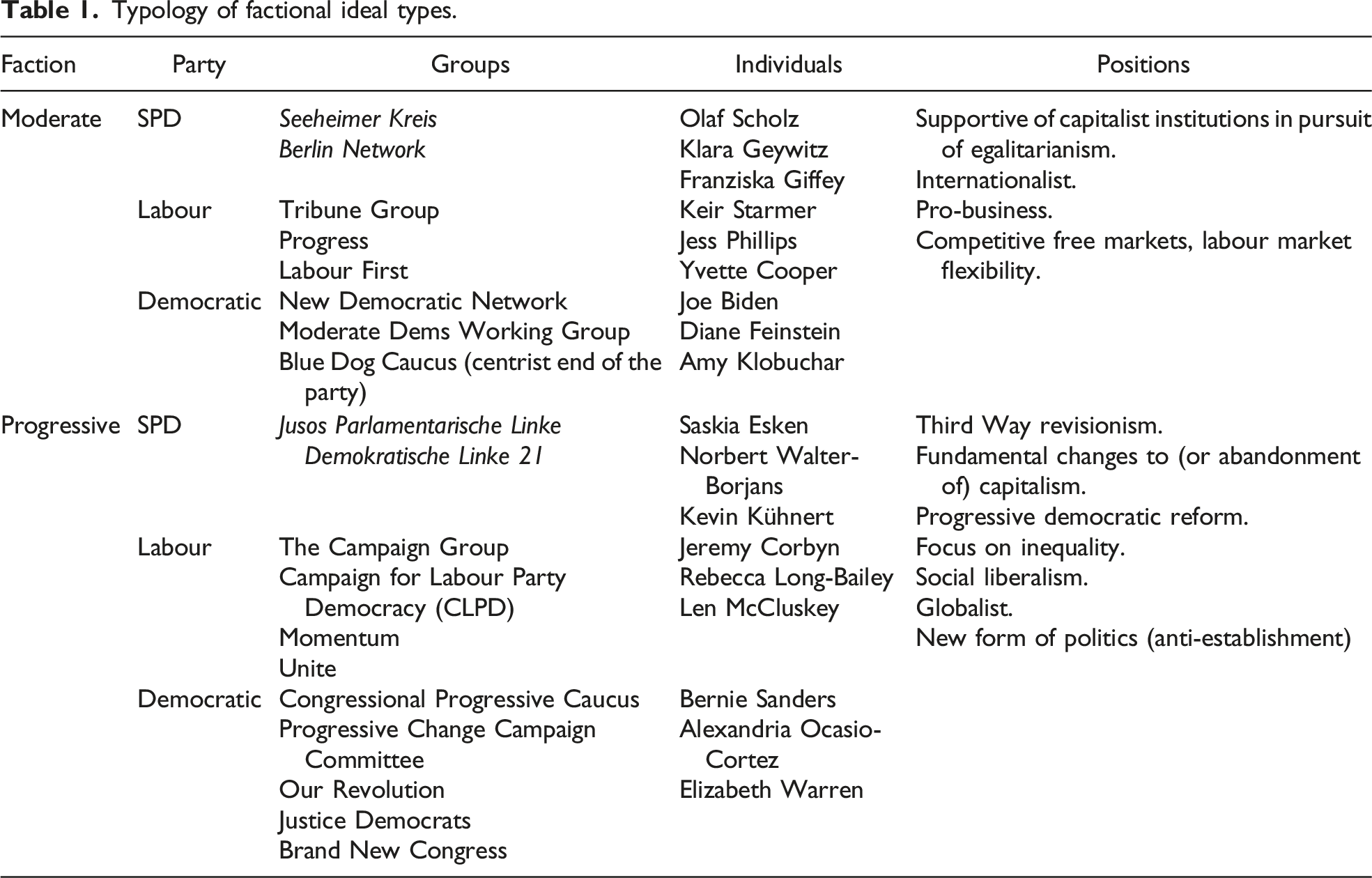
We present our typology of factional ideal types in Table 1. Though these factions have country-level differences, we argue that they are sufficiently similar for analysis. In each case, the moderate faction is the heir of Third Way politics, framed as a way of providing equality of opportunity and aligning these parties in a modernising approach to late twentieth-century centrism. Harmonisation of the social democratic vision fostered transatlantic relations and influenced the direction of centre-left parties worldwide. In response, progressive factions altered their strategic objectives and policy platforms. On economic policy, progressives advocated for greater levels of redistribution and in some instances openly attacked the institutions and practices of capitalism, leading to accusations of being less ‘business-friendly’. ‘New Leftism’—a moniker derived from New Left issues—was adopted by progressive factions, who often considered themselves as an alternative to the establishment status quo, and of acting as an internal opposition to their parties’ moderate factions. The increased salience of cultural cleavages (Inglehart 1977, 1990; Kitschelt 1994; Wager et al. 2021) has further divided centre-left parties, with progressives eager to prioritise issues around identity and many moderates urging caution on electoral grounds out of fear of alienating median voters. Selectorate inclusivity and decentralisation placement. Typology of factional ideal types.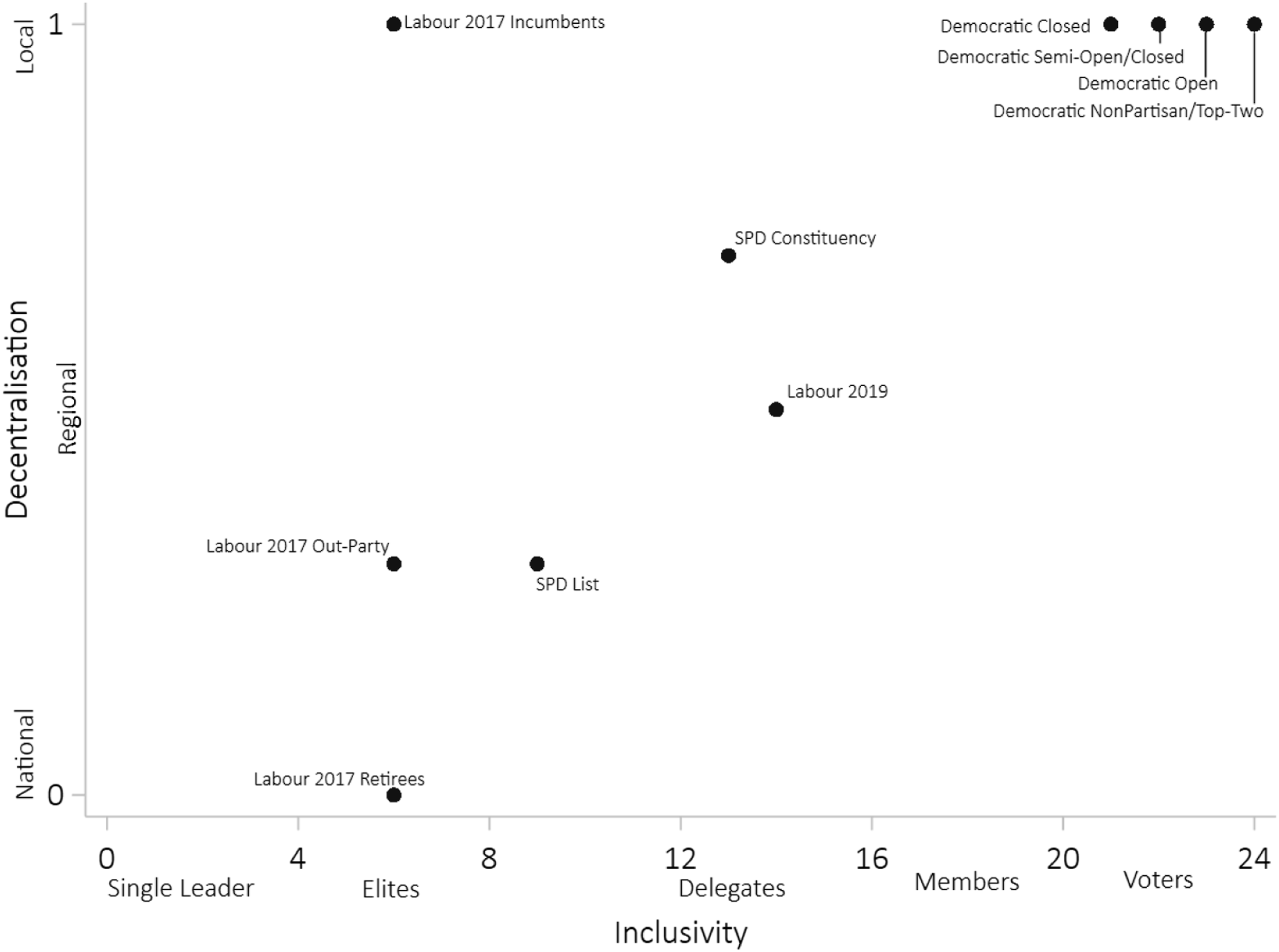
Beyond their distinct policy platforms, these factions also differ over their views on intra-party democracy, with progressives calling for more open selection processes. In the Labour Party, Momentum has called for primary elections to nominate parliamentary candidates (Parker 2018) and introduced open primaries internally (Bell 2020). 1 In the SPD, the youth organisation Jusos – to the party’s left – leads demands for greater internal democracy (Wolkenstein 2016), though these have also been adopted by moderates such as Sigmar Gabriel (Totz 2011). In the Democratic Party, particularly since the 2016 convention, progressives have pushed for more inclusive nomination rules, designed to promote citizen engagement in intra-party processes (Cohen 2020). 1 Progressive factions in these parties have been conceived of as ‘party-driven movements’ (Muldoon and Rye 2020), with internal democratisation a key goal.
Candidate selection processes
We position our cases within Hazan and Rahat’s (2010) framework along the dimensions of inclusivity and centralisation in Figure 1. We note that in our cases, where more independent variation would be preferrable, these dimensions do largely align. In some instances, such as the U.S. primaries along the inclusivity dimension, Hazan and Rahat specify a position. Elsewhere we follow the established literature, supplemented with our case knowledge, to place these parties within the framework. This literature highlights the decentralised or ‘weak’ nature of American parties (Azari 2016), a dichotomy of ‘centralised parties with decentralised selection’ in the Labour Party (Denver 1988) where selection processes provide an illusion of inclusivity (Rodgers 2019b), and a centralised SPD party organisation operating within a federal system designed for decentralised structures (Braunthal 2019; Sturm 2018). Our placements align with other comparative analyses of intra-party democracy where available (Bolin et al. 2017). Data referred to in Figure 1 and Tables 3, 4 and 5 can be found as supplemental materials.
Labour Party
In the Labour Party, candidate selection has been a site of factional conflict since the 1973 campaign for mandatory candidate reselections by the leftist Campaign for Labour Party Democracy (CLPD), of which Corbyn was a founding member. His 2015 leadership victory reinvigorated intra-party debates on the subject, with mandatory reselection viewed as a tool to align the comparatively moderate Parliamentary Labour Party (PLP) with his left-wing leadership team (Payne et al. 2019). The snap election in 2017 resulted in three different selection processes. Incumbent MPs were automatically reselected, bypassing local trigger ballots. In effect, the candidates were the selectorates in these seats, scoring a one on the decentralisation scale, with each candidate independently deciding whether to run, and a six for inclusivity given that the process was entirely in the hands of legislative elites. In vacant seats, candidates were screened by the National Executive Committee (NEC) and regional boards and assigned to constituencies. We score this selectorate as a six for inclusivity, with decisions made entirely by elites. On the decentralisation dimension, the combined influence of national (0) and regional (0.5) groups produced a score of 0.3. In the thirteen seats where sitting Labour MPs retired, the NEC completely controlled the candidate selection process. We score these entirely nationalised selectorates at zero on the decentralisation dimension, and six on the inclusivity dimension.
In response to another snap general election in 2019, a new fast-tracked process harmonised selection of all candidates. In a multi-stage process, the NEC gave longlists to panels comprised of NEC, regional board and local party representatives, who then established shortlists from which CLPs selected (Rodgers 2019a). This change constituted a formal decentralisation of the process, which we score at 0.5 given the joint involvement of local, regional and national bodies. The process was also more inclusive, with final decisions split between party delegates and members, giving a score of fourteen. In practice, the NEC retained an ability to impose candidates on some CLPs, such as in Bassetlaw where moderate Sally Gimson was replaced with a progressive alternative (BBC 2019), fuelling concerns that the NEC had ‘bypassed local democracy’ (Reid 2019) and highlighting the division between the rules and practice of selection.
SPD
Two types of candidates are selected for German federal elections: constituency and Land list candidates. Candidates are selected using a mixed system, where ‘candidates face two different sets of selectors and two different logics of nomination’ (Detterbeck 2016). These distinct selectorates provide our within-party spatial variation for the SPD. Constituency candidates are selected first, via local conventions of delegates in a largely decentralised process, with separate delegate conventions forming selectorates for each candidate, often taking direction from state party elites (Berz and Jankowski 2022). The influence of state elites means we score the constituency selectorate at 0.7 on the decentralisation dimension, between the local and regional level. In terms of inclusivity, delegates dominate the selection process in these conventions, though membership conventions have some input, and a few candidates are directly selected by members (Reiser 2011). Given the centrality of delegates (twelve) and slight influence of membership (eighteen) we place constituency candidates at thirteen on the inclusivity dimension. 8
Land lists are formally chosen by state-wide delegate conferences, with regional and national elites ranking candidates prior to the conference and delegates voting on each position (Detterbeck 2016). For decentralisation, we score this process at 0.4, with power largely concentrated at the regional level but with some influence of national elites (Berz and Jankowski 2022). We code these list selectorates as a nine for inclusivity, halfway between the elite (six) and delegate (twelve) models.
Democratic Party
Of our cases, the Democratic Party has the most inclusive selectorates. To participate in the selection of Democratic candidates, voters need not be a formal member of the party. Spatial variation exists between states in the form of primary election voter eligibility, with potential consequences for their informational and signalling functions (Meirowitz 2005). In closed primaries, voters must declare their affiliation as a Democrat when they register to vote; in semi-closed primaries, voters may be registered as a Democrat or Independent; and in open, top-two and non-partisan primaries, all registered voters may participate. These rules result in Democratic selectorates being scored—by us and Hazan and Rahat—between twenty-one and twenty-four on the inclusivity dimension.
The Democratic Party is also the most decentralised. Each candidate has a distinct selectorate contained entirely within their district, meaning that the decentralisation score is one in all primaries. Though our concern is with formal rules governing selectorates, research indicates that more centralised groups such as state and national parties do informally influence nominations (Hassell 2018).
Data and research design
Identifying candidates’ factional proximity.
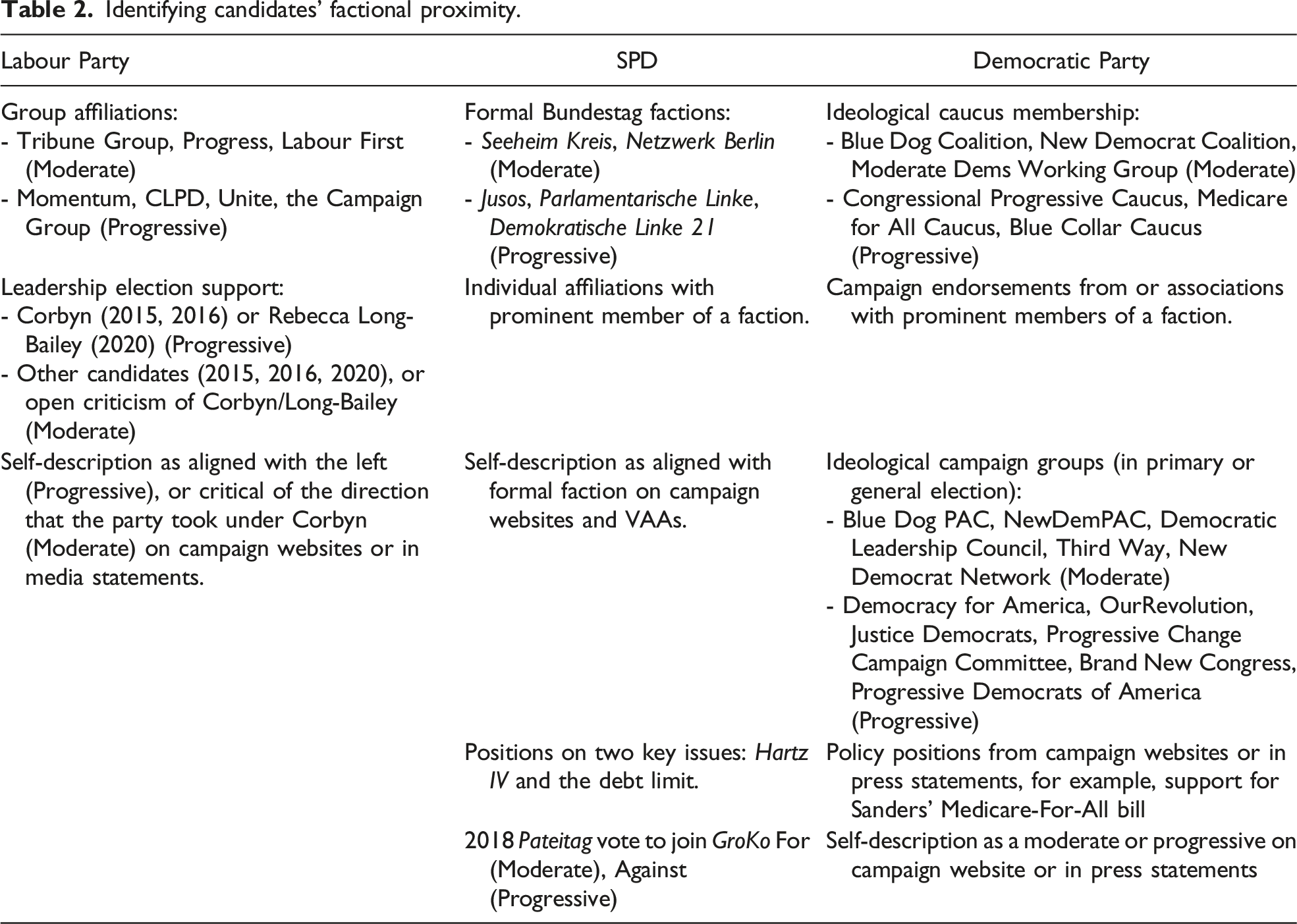
For Labour, alignment with Corbyn and Momentum was the key indicator of proximity to the progressive faction. Other groups aligned to this faction included the CLPD and Len McCluskey’s Unite trade union. Affiliation with Progress or Tribune, or leading figures within these groups, were indicators of proximity to the moderate faction. Candidate support in the 2015, 2016, and 2020 leadership elections was a further indicator, with support for Corbyn or Rebecca Long-Bailey—understood as Corbyn’s ideological heir—coded as progressive. Support for alternative candidates in those elections, or open criticism of Corbyn or Long-Bailey, was coded as moderate. We also considered candidates who expressed public doubt about the party’s direction under Corbyn’s leadership in ideological terms as proximate to the moderate faction.
For SPD candidates, we also used a combination of sources, with membership of formal factions in the Bundestag—themselves a by-product of 1970s intra-party factional conflict (Müller-Rommel 1982)— serving as indicators for candidates who had held national office. We also consulted voting advice applications (VAAs) which provide information about candidate’s views, and candidate websites. In addition, we considered candidates’ positions on two key issues: the Hartz IV reforms and attitude to the debt limit. Finally, we included candidates’ positions on whether to join another Große Koalition (grand coalition) with the CDU. Jusos and other left-leaning groups led the NoGroko (no grand coalition) campaign (Faas and Klingelhöfer 2019), meaning we considered a no vote as a further indicator of progressive proximity.
For Democrats who served in Congress, we deemed ideological caucus membership to be a signal of intra-party orientation and therefore an indicator of factional proximity. We also used campaign endorsements from, or public associations with, prominent members of a faction during primary or general election campaigns. Affiliations with groups supporting candidates in elections based on ideological position were included, following literature that uses group alignment to determine factional allegiance (Bendix and Mackay 2017). Policy positions on campaign websites or in press statements were considered further indicators of factional proximity, as were ideological self-placements such as claims of being a moderate or progressive Democrat.
For Labour and the Democratic Party, our inclusion criteria are straightforward; we code all candidates running. For the SPD we include candidates once, meaning candidates who are double listed—those selected for a constituency and on a party list—are coded as constituency candidates only. Given that constituency candidates are selected first, and Land lists drawn up afterwards, we think this is the most sensible approach available. We recognise that in some constituencies, candidates may put themselves forward to earn a better place on the state list, but our research indicates that the vast majority of—though not all—SPD candidates actively attempt to win their district election.
For each hypothesis, the dichotomous variable of whether the candidate selected is proximate to the progressive faction is our dependent variable. For H1 and H2, our independent variables are inclusivity and decentralisation, respectively. For H3, our independent variable is district partisanship, operationalised for consistency as the percentage points by which the party won or lost the territory in the previous election (lagged margin). We acknowledge here that our cases do not make for a perfect comparison, in one case—the Labour Party—we have both temporal and spatial variation. In our other two cases, we have spatial variation only, along both dimensions in the SPD and along the inclusivity dimension for the Democratic Party. In addition, we note that between our cases the two variables track one another. Potential differences in temporal and spatial variance, and alignment between our variables mean caution should be exercised in generalizing our findings, but, given the subject of analysis, we are restricted to the variation present in the real world.
We initially run our models across all districts, then, following best practice advocated by Hazan and Rahat (2010) given variation in the value of becoming the party candidate, we run a second version restricted to ‘winnable’ districts only. We consider districts where the party finished within twenty points of the winning candidate in the previous election as winnable. In the appendix, we also test a fourth hypothesis of temporal change when time is exogenous to variation in candidate selection rules and report null findings. In all models we control for incumbency, in recognition that incumbents are highly likely to be reselected. Because our dependent variable is dichotomous, we use logistic regression to produce our models. 11
Results and discussion
Descriptive results.
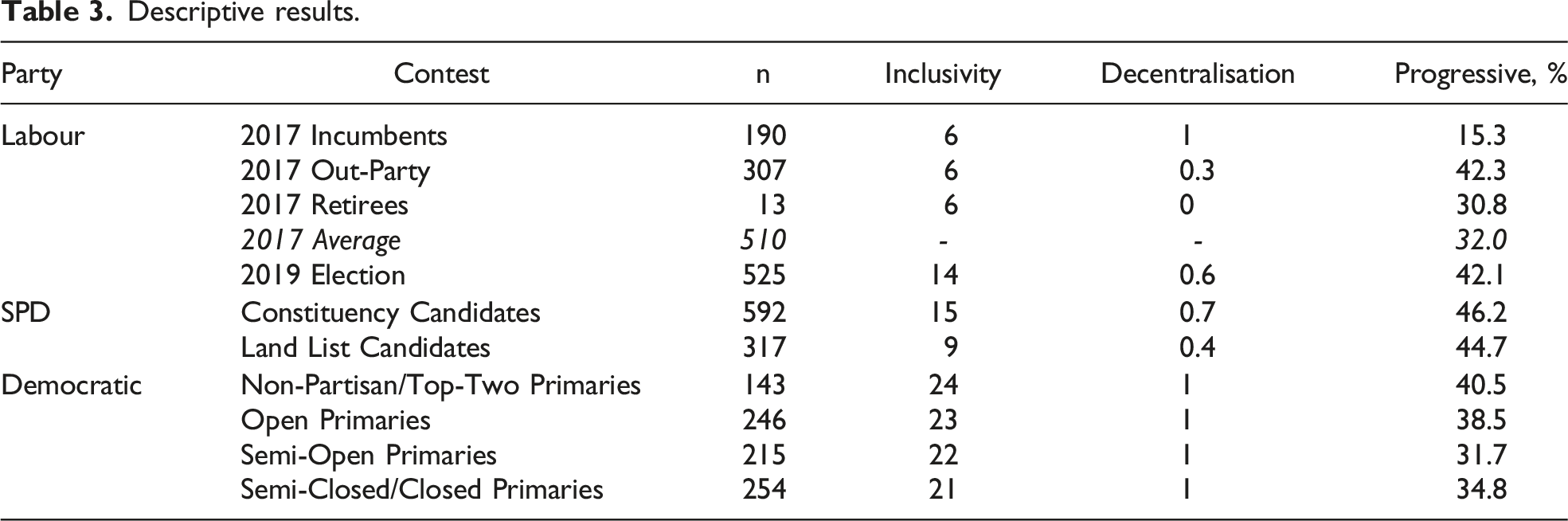
In 2017, despite Corbyn having been leader for two years, only 32 percent of candidates were aligned with the progressive faction, largely due to the relative paucity of progressives in the PLP, with only 15 percent of the 190 incumbents that stood in 2017 coded as progressive. In vacant seats, where selection was more centralised, a far higher rate (42 percent) of progressive candidates were selected. By 2019, the harmonised selection mechanism aligned with a ten-point increase in progressives selected overall. Given that this change is temporal we are unable to isolate candidate selection as the causal mechanism versus other changes over time, though media coverage and the consternation of moderates suggests that changes to the candidate selection process were a vital tool in nominating progressives (Grew 2018; Ley 2015).
Regression results.
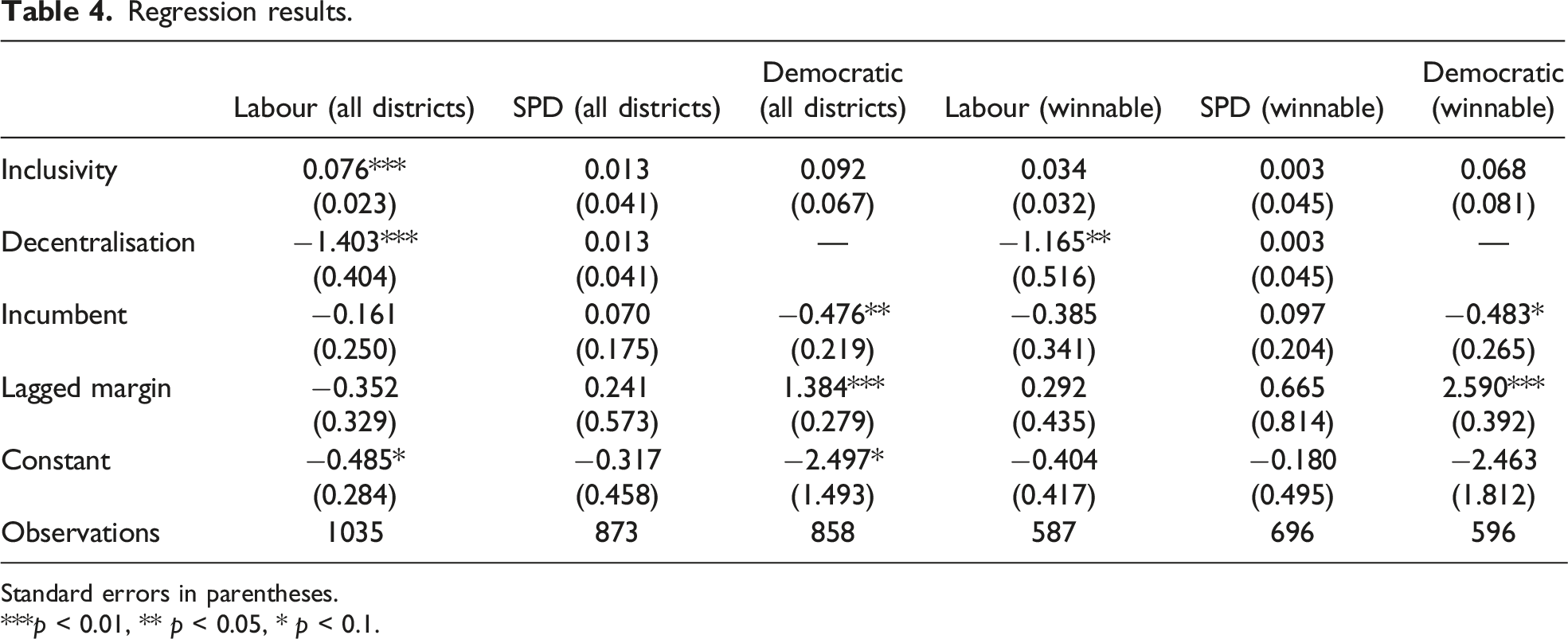
Standard errors in parentheses.
***p < 0.01, ** p < 0.05, * p < 0.1.
In the case of Labour under Corbyn, it appears that selectorate centralisation enabled party leadership to exert greater control over outcomes. Labour under Corbyn appears to offer a counterexample to May’s law, with a comparatively leftist central party attempting to select progressives by centralising the selectorate. In the wake of the 2019 electoral defeat, debates over Labour’s commitment to formal power arrangements, intra-party democracy, and candidate selections have not subsided and remain a source of factional division (Stewart 2020).
Our results for the SPD are inconclusive, largely because of the lack of variation in our dependent variable, with similar rates of progressive candidates selected for constituencies and Land lists. We suggest two main reasons for this. First, the mixed electoral system and resultant multi-party landscape in Germany provides the SPD with electoral threats on both sides ideologically, with die Linke and die Grünen offering alternatives to the party’s left. Contesting elections on two ideological fronts changes candidate selection incentives for centre-left parties, and likely changes the ideological makeup of the party. In a multi-party electoral system, progressives in centre-left parties are likely more moderate than in systems with no credible alternative to their left, 12 making co-operation with party moderates more amenable to both factions and reducing incentives for one faction to dominate selection outcomes. Second, these data suggest that the SPD is more evenly balanced between its factions historically, where—unlike the other parties analysed here—incumbents are no less likely to be proximate to the progressive faction. Though the party apparatus and formal structures remain largely controlled by moderates (Braunthal 2019), the continued selection of progressive candidates and leaders such as Saskia Esken and Norbert Walter-Borjans indicates that internal divisions are actively managed by the party in a way which extends to the candidate selection process. Indeed, this management may only be possible because selectorates are somewhat exclusive and centralised. Despite divisions over policy and election strategy, the SPD appears comparatively willing to ensure candidates from both factions are selected. Though some reforms to the candidate selection process have taken place, including the increased use of primaries, the formal rules of selection have remained relatively static over time. The modern SPD appears to offer a different counterexample to May’s law, with moderates and progressives active at both the elite and mid-level strata of the party organisation and demonstrating a willingness to cooperate on candidate selection.
In the Democratic Party, we find no evidence that variation in inclusivity aligns with numbers of progressives selected. This non-finding aligns with McGhee et al. (2014), who show that more open primaries do not result in the nomination of more moderate candidates. Specifically, moderates were not selected in greater numbers under non-partisan or top-two primaries (see also Ahler, Citrin, and Lenz 2016), as argued by reform advocates (Alvarez and Sinclair 2015; Kamarck 2014). As in the Labour Party, incumbency and membership of the moderate faction align, with incumbents less likely to be progressives, even when compared with other candidates in winnable districts. More importantly, the significant alignment between district partisanship and the selection of progressive candidates provides support for H3. With completely decentralised and highly inclusive selectorates, primary voters select progressive candidates in safe districts and moderates in competitive and hard-to-win districts. Under the logic of spatial voting theories, it appears that Democratic primary voters are nominating ‘electable’ candidates. In application to May’s law, it may be that the record numbers of Democratic primary voters in 2018 and 2020 (Cowburn 2020; DeSilver 2018) shifted the locus of power from middle-elites toward ordinary voters causing greater district-level congruence.
In application to our hypotheses, we find that inclusivity aligned with higher numbers of progressives selected in the Labour Party only (H1). Even in this case, inclusivity was less important than the decentralisation dimension, with greater numbers of candidates proximate to the central party’s faction under centralised selectorates in both models (H2). We reject the null hypothesis for H3, where the Democratic Party—with the most inclusive and decentralised candidate selection—demonstrates evidence of alignment between district identity and progressives selected, this relationship is not present in parties with more centralised and exclusive selectorates.
Conclusion
Our findings highlight the importance of within-party variation in candidate selectorate rules in one of our cases, the Labour Party in England, where more inclusive and, especially, more centralised selectorates aligned with the selection of progressive candidates. We find no relationship between selectorates and factional identity of candidates selected in our other two cases, indicating that the connection between selectorate rules and candidates is highly context dependent. In terms of candidate representativeness, we find congruence between district partisanship and candidate position in our most inclusive and decentralised case only, the Democratic Party, where primaries appear to have selected candidates more aligned with their districts that the Labour Party or SPD selection processes. Though our results would be more robust with greater temporal and spatial variation in our independent variables and with further cases where inclusivity and decentralisation were less aligned, 13 we contend that our findings warrant greater scholarly attention on the—frequently overlooked— dimension of selectorate decentralisation.
Practically, we suggest that progressives in these parties do not appear to be leading demands for internal democratisation out of self-interest. Or at least, if self-interest is the motivating factor for progressive desires to make selectorates more inclusive, it appears somewhat misplaced. Progressives were no more likely to become candidates under inclusive selectorates in the SPD or the Democratic Party, suggesting that democratising demands are at least somewhat motivated by convictions about internal practices.
We offer the first study that we know of that empirically analyses the relationship between intra-party variation in candidate selectorates and the factional allegiance of candidates selected. This relationship has become more important in recent years, with identifiable progressive factions in centre-left parties leading calls for internal democracy. Our method travels to other countries where parties have clearly identifiable factions and could also be applied to parties on the right of the political spectrum. This approach may be of particular interest where reforms of candidate selection processes have been implemented.
This study is also rare in comparing U.S. and European legislative candidate selectorates. Literature on U.S. nominations frequently conceives the legislative primary system as exceptional rather than being located at the most inclusive and decentralised end of a spectrum. Scholars working on comparative and American intra-party politics have much to learn from one another and the sub-field would benefit from further comparative work that includes the U.S. case.
Footnotes
Acknowledgements
We thank participants who provided feedback on an earlier draft of this article presented at the 2021 PSA conference and the three anonymous reviewers whose feedback vastly improved the quality of this work.
Declaration of conflicting interests
The author(s) declared no potential conflicts of interest with respect to the research, authorship, and/or publication of this article.
Funding
The author(s) received no financial support for the research, authorship, and/or publication of this article.

Notes
Appendix
Changes in the number of progressive candidates may simply be a function of change over time and therefore unrelated to candidate selection. We test the following alternative hypothesis for parties where change over time can be isolated from temporal variation in selection procedure (the SPD and Democratic Party):
Robust standard errors in parentheses. ***p < 0.01, ** p < 0.05, * p < 0.1.
SPD
Democratic Party
Inclusivity
0.009
0.092
(0.042)
(0.067)
Decentralisation
0.009
—
(0.042)
Incumbent
0.085
−0.465**
(0.176)
(0.220)
Margin Last Election
0.138
1.396***
(0.582)
(0.278)
Time
0.159
−0.168
(0.138)
(0.146)
Constant
−0.515
−2.254
(0.488)
(1.506)
Observations
873
858
In both cases, we return null results for the change over time variable and our other findings do not change. Where time is exogenous to candidate selection rules, we find no evidence of variation in the numbers of progressive candidates selected.