



Abstract
The supposed popularity of socialism among young Americans has been a trending topic in American political media and campaigns. While evidence from public opinion polls disagrees as to whether socialism is truly gaining in popularity, the use of the term “socialism” has had a profound impact on policy discussions in the media and has featured as a prominent Republican Party strategy in the 2020 election cycle. This gives rise to important questions: How do individuals react to the socialist label? Does the socialist label serve as an ideological or affective signal? Are attacks that frame policies as socialist effective in decreasing policy support? Using original observational and experimental survey data, we find that individuals have strong polarized affective reactions to the socialist label. However, framing popular social welfare policies as socialist is ineffective in undermining popular support. Implications suggest that while framing political policies as socialist may trigger affective polarization, it is likely an ineffective means of political persuasion. As a result, oversaturation of the term in the media may lead to misleading conclusions about both political ideology and individual political behavior.
We want to talk about funding social services, and ensuring good engagement in community policing, let’s talk about what we are for. And we need to not ever use the words “socialist” or “socialism” ever again. Because while people think it doesn’t matter, it does matter. And we lost good [congress]members because of it.
In the 2020 election cycle, much had been made about the rise in the popularity of socialism among young voters, typified by eye-catching headlines like “The Resurgent Left—Millennial Socialism” (The Economist 2019). This narrative has been bolstered by the success and popularity of several Democratic Party politicians that have defended socialism and socialist policies, including Congress member Alexandria Ocasio-Cortez and Senator Bernie Sanders. Yet, evidence from public opinion polls regarding the veracity of claims touting or decrying the rising tide of socialism in America is rather mixed. A 2018 poll found that 43 percent of Americans have a positive view of socialism; an 18 percent increase from 1942 (Younis 2019). A 2019 poll found 55 percent of women prefer socialism to capitalism (Harris 2019). However, other polls reveal a decrease in the popularity of socialism among U.S. citizens, with few changes among Democrats and Republicans since 2010 (Newport 2018). Americans also disagree over the degree of socialism in America. A 2016 poll indicates that 54 percent of Republicans see America as becoming more socialist, while only 16 percent of Democrats agree (Investor’s Business Daily/TIPP 2016). Moreover, only 28 percent of Americans report even giving much thought to socialism at all, casting further doubt over the new found role of socialism in America’s political thinking (Yokley 2019). Irrespective of whether America has truly become more socialist, the term “socialism” itself has made a significant impact on American politics, with Donald Trump’s reelection campaign building its strategy on portraying Democrats as radical socialists (Blake 2019). President Trump demonstrated this in his 2019 State of the Union Address, where he asserted “Here, in the United States, we are alarmed by new calls to adopt socialism in our country . . . Tonight, we renew our resolve that America will never be a socialist country.” Ultimately, this is not dissimilar to campaign tactics that the GOP has used in the past, taking advantage of Democratic squeamishness surrounding the term “liberal” in an attempt to turn the phrase into a broad damaging label to be applied to Democratic candidates (Neiheisel 2016). In response, many Democratic candidates have rebuked the socialist label, decrying socialism as the cause of underwhelming 2020 electoral performances in the House of Representatives (see quote from Rep. Spanberger above). In one particularly famous example, West Virginia Democratic Senator Joe Manchin even went as far as to compare the “crazy socialist agenda” to his rear end. 1
We leverage original observational and experimental survey data to answer these questions. We posit that individuals use the term socialism as an affective rather than ideological label. Rather than holding a consensus ideological meaning, individuals with positive predispositions toward socialism describe policies and entities they support as “socialist” and describe those they oppose or dislike as “capitalist.” Individuals with negative dispositions toward socialism exhibit the inverse pattern. Thus, citizens with opposing views on socialism may share (un)favorable opinions of a given policy. Yet, they will not agree whether its (failures) successes are “socialist” or “capitalist” in nature. As a result, we find that framing policies as socialist or capitalist has little effect on popular support for those policies. While we remain agnostic as to the true objective ideological definition of socialism, we conclude that failure to distinguish between ideological and affective considerations when discussing socialism can lead to highly misleading conclusions about its (un)popularity and effectiveness as a negative campaign strategy.
Processing through an Affective Lens
The use of motivated reasoning in the interpretation of political information is ubiquitous, as individuals are driven by two competing motives: the need to acquire accurate, detailed information and the need to leverage motivated reasoning to defend one’s own predispositions and identities from cognitive dissonance (Kunda 1990). Incoming information is interpreted through a dual-processing cognitive system that satisfies both motives. While factual information is processed consciously through deliberate systemic processing, that information is also subjected to a much quicker peripheral affective lens (Chaiken et al. 1996). This leads to what is known as hot cognition, in which information is put through an emotional or affective filter which in turn impacts how it is systemically processed prior to use in updating one’s opinion. Evidence shows that individuals are much quicker to accept and process information that confirms their predispositions and previously held beliefs, incorporating new information into their beliefs (more) less critically when it (dis)confirms their predispositions (Lodge and Taber 2005; Redlawsk 2002). Thus, upon hearing a term such as “socialism,” individuals will view that information through an affective lens that is colored by their prior experiences and predispositions. This process is wholly unconscious, as external stimuli trigger affective considerations that activate associations linking feelings, thoughts, perceptions, and subsequent behavior in a manner consistent with motivated biases (Taber and Lodge 2016).
These motivated biases lead individuals toward selective exposure to information that is congruent with their own political beliefs. This can lead to higher levels of affective partisan polarization, as individuals avoid sources of information that may provide dissonant information while becoming more uncritical of sources that provide information congruent with ones own beliefs and identities (Iyengar and Hahn 2009; Knobloch-Westerwick 2012; Stroud 2011; Taber and Lodge 2006). This process is further exacerbated by elite discourse. As media entities and politicians exhibit higher levels of partisan polarization, individuals follow clear partisan signals that influence their information-seeking behavior, their interpretation of political facts, and their ultimate policy opinions (Druckman et al. 2013). 2 Given socialism’s aforementioned high level of salience in both the media and elite discourse, one may expect that previously held beliefs would color their perceptions of the term. This would serve to entrench their already deeply held stereotypes of socialism.
In this research, we narrow our focus specifically to how individuals respond to identical terms and information based on their affective biases in cognitive processing. While citizens tend to forget detailed information rather quickly, they are often able to remember the positive or negative affect triggered by that information (Lodge et al. 1995; Lodge and Taber 2013). The affective impression often colors the interpretation in a manner that is favorable to their previously held beliefs, leading individuals to disagree on the nature of the facts at hand. Due to this, there does not need to be widespread agreement on the facts of what constitutes socialist policy in order for individuals to hold strong, affect-based opinions. Indeed, Edelman (1964) discusses how vague or affect-laden information can be, and often times is, interpreted to however the perceiver feels best suits their personal and in-group interests. Although dated, recent research in political science has confirmed this as happening in two stages: (1) political elites, who do understand these political events through direct involvement, simplify complicated political information into consumable packages for the public to digest and (2) input affective cues and symbols into their summaries, which leads to further interpretation from the public digesting this information. While a term like socialism may not be well defined in policy, the less explicit and detailed information is, the more opportunity the perceiver has to “read their own meanings into situations that are unclear or provocative of emotion” with their own limited, affective, and polarized understanding of a given topic (Edelman 1964, 30).
Expanding upon this, evidence shows that the real-world circumstances of a polarized political environment often exacerbate these polarized affective interpretations of facts and information. Partisan citizens take cues from party elites, spinning facts to arrive at highly different perceptions of the same information (Bisgaard and Slothuus 2018). For example, while individuals may be given information about a specific number of war casualties, whether that number constitutes a large or small and important or unimportant amount of deaths is highly dependent on whether the information reflects poorly on one’s own political party leader (Gaines et al. 2007). Similarly, while opposing partisan individuals may both agree about the poor or healthy state of the economy, they often arrive at polarized assessments of who deserves the credit or blame based on partisan considerations (Bisgaard 2015). This is highly applicable in regard to how individuals perceive socialism in America. Two individuals with opposing affective views on socialism can support the same policy (e.g., social security, which is broadly popular among Democrats and Republicans). However, one can expect both individuals to fall back upon their predispositions when discussing why they support the policy. While one such individual may point to the policy’s success as proof of socialism’s virtue, the other may deny that the policy is socialist at all. While it is possible to overcome individuals’ initial instinct to double down on their previous beliefs, it requires a large amount of negative information to cause enough cognitive dissonance to reach the limit of motivated reasoning (Redlawsk et al. 2010). In this context, we assert assessments of socialism work in much the same manner.
Ultimately, we suggest that reactions to the socialist label work much in this manner. Individuals have strong predispositions toward salient political labels like socialism and capitalism. However, while individuals may receive the same information or cues, how they react to that information is highly dependent on their predispositions. Take, for example, the self-described socialist nation of North Korea, with whom the United States has a contentious relationship. 3 Individuals with strong negative dispositions toward socialism may view North Korea’s lack of personal freedoms, economic hardships, and strained relationship with the United States as evidence of the failings of socialism. However, an individual who is positively predisposed toward socialism may feel that North Korea is a poor example of socialism, finding friendly social democracies such as Sweden to be a much more apt example. Thus, even though individuals are given the same set of facts, they are processing this information through the lens of their previously held affective beliefs rather than a shared objective ideological definition of socialism.
Socialism in America
Like symbolic ideology and partisanship, which fluctuate over time and policy context (Ellis and Stimson 2009; Wlezien 1995), symbolic opinion of socialism has shifted despite somewhat consistent operational (i.e. policy-based) policy beliefs. 4 Unlike many of its Western European allies, America failed to see socialism materialize as either a popular ideology or as a political party that poses a legitimate electoral challenge. 5 Decades of Cold War hostilities have resulted in a general negative perception of socialism. America’s longstanding rivalry with the former Soviet Union provides Americans with a highly salient example which cognitive processes may link socialism to negative affect. More recently, the Republican party has leveraged negative predispositions like these as an electoral strategy. Republicans since Ronald Reagan have gone to great lengths to turn the term “liberal” into a dirty word, successfully portraying broad swaths of the Democratic Party as too liberal while leading Democratic candidates to avoid defending their liberal identities (Schiffer 2000). Further evidence suggests that such attacks are not highly successful, failing to shift self-reported identities and affecting voter behavior in most instances (Neiheisel 2016). Nonetheless, the Trump campaign’s use of the term socialism as a derogatory attack reflects this same sentiment, attempting to create a negative label to attach to their electoral opposition and policies supported by the Democratic Party.
Yet, symbolic labels in politics are malleable over time and liable to change. For example, the term liberal itself became synonymous with the Democratic Party when Franklin Delano Roosevelt adopted the identity during the 1932 presidential race—a development which greatly frustrated the self-described liberal Herbert Hoover and the Republican Party (Rotunda 1986). In addition, while the majority of Americans refer to themselves as conservatives as a symbolic identity, the majority of Americans remain liberal in their instrumental ideology, maintaining liberal policy preferences (Ellis and Stimson 2012). Despite the historic symbolic unpopularity of socialism in America, certain “socialist” or “social-democratic” policies remain popular in an operational sense (e.g. Medicare and Social Security), a pattern which remains consistent today (Blake 2019).
Recently, left-leaning interest groups and politicians have leveraged popular policies to increase the symbolic popularity of socialism. In fact, these efforts themselves harken back to the previously noted efforts of President Roosevelt. For example, Roosevelt-era social welfare policies and Keynesian economics once framed as means to save the capitalist economy have been reinterpreted as socialist goals by Senator Bernie Sanders: . . . Roosevelt helped create a government that made transformative progress in protecting the needs of working families. Today, in the second decade of the 21st century, we must take up the unfinished business of the New Deal and carry it to completion.
6
The Congressional Progressive Caucus, the more liberal wing of the Democratic party in Congress, has framed its sweeping reform legislation as “The Green New Deal,” reframing popular liberal policies to be more symbolically socialist-adjacent. Similarly, labor unions have enjoyed increased favorability by aligning with popular policy movements and policies, like a $15 an hour minimum wage, protests for women’s rights, more stringent gun control laws, and protests against police brutality (Younis 2019).
These contrasting historical conceptions of socialism provide individuals with differing examples from which individuals will recall the most accessible, heavily used thoughts. Individuals default to an exemplar which they believe best represents that concept and will contrast related incoming information with their stereotyped exemplar (Smith and Zarate 1992). For instance, individuals typically filter their perceptions of candidates through their exemplar prototypes and stereotypes, often finding candidates that are more congruent with their previously held prototypes to be more favorable (Hains et al. 1997). Historical context provides multiple radically different exemplars of socialism, which we assert result in radically different responses to the term.
On one hand, we see the Cold War framework and Republican campaign strategy which associates socialism with hostility. This may drive some citizens to view the Soviet Union and other adversarial foreign powers as exemplars of socialism, leading to a highly negative disposition. On the other, we see socialism portrayed as a push for economic equality and social justice programs, including social democratic ally nations with such policies and newly salient domestic politicians such as Senator Bernie Sanders and Congressmember Alexandria Ocasio-Cortez. These may serve as more positive exemplars for other individuals, offering opportunities for positive associations for the term socialism.
We put forward the Different Angles Hypothesis, 7 in which citizens perceive and react to socialism through diametrically opposed frameworks based on their predispositions toward socialism. In other words, those with positive views and those with negative ones will see socialism from different angles. For example, citizens with negative predispositions may claim that North Korea is indicative of socialism’s failings; those with positive socialist predispositions would argue North Korea is not truly socialist and does not apply to the discussion. Thus, while individuals can agree on the facts (e.g. North Korea’s government is corrupt), they will strongly disagree over whether socialism is to blame.
Study 1
In Study 1, we seek to assess how individuals react to the terms “socialism” and “capitalism.” We seek to analyze what exemplars are most accessible when individuals are presented with the term socialism. In doing so, we test whether individuals with differing dispositions toward socialism hold (dis)similar examples and definitions of what makes something socialist. We then seek to assess whether framing popular policies using those exemplars is effective in shifting levels of policy support.
Study Design
This study uses a census-matched sample of 800 respondents from Lucid, an online survey service, in the summer of 2019 (53% female, median age = 46, 72% white, 46% Democrat/lean Democrat, 37% Republican/lean Republican). Studies conducted on traditional nationally representative samples have been shown to replicate on Lucid in the vast majority of instances (Coppock and McClellan 2019). 8 We split the study into two sections: observational results and experimental results.
Measurement
The key independent variable is a differenced measure of attitudes toward socialism and capitalism, referred to hereafter as socialism disposition. We measured positive attitudes toward socialism using two questions asking respondents how favorably they viewed socialism (1 = extremely unfavorably, 7 = extremely favorably) and whether they thought socialism was good or bad for America (1 = extremely bad, 7 = extremely good). We averaged these two questions to create an index of positive attitudes toward socialism, with higher scores representing more positive views (α = .94). We measured positive views toward capitalism in an identical fashion (α = .93). 9 We then subtracted attitudes toward capitalism from attitudes toward socialism, creating a differenced measure. Positive scores indicate that the respondent had more favorable views of socialism than capitalism; vice versa for negative scores. This measure is advantageous, as it allows one to both assess individuals’ relative positions on both socialism and capitalism while accounting for individuals who have similar opinions of both. Individual levels of socialism disposition appear to vary greatly. Yet, overall most hold a middle-of-the-road view of socialism, with a slight skew toward negative predispositions. Histograms featuring the overall distribution of socialism disposition can be found in Supplemental Appendix D. We also included the standard battery of demographic measures (measured prior to the dependent variables), featuring partisan identification (measured on the traditional seven-point branching scale; 1 = strong Democrat, 7 = strong Republican), political ideology (1 = extremely liberal, 7 = extremely conservative), sex (1 = female, 0 = male), race (1 = white, 0 = non-white), age (median = 46), income (1 = less than $14,000, 24 = greater than $250,00), and education (1 = some high school, 8 = doctoral degree).
Observational Results
To assess what exemplars individuals found accessible when encountering the term socialism, we asked respondents “When you think about socialist countries, what countries come to mind?” Respondents could list as many countries as they liked. Two independent coders then counted the number of “adversarial” and “friendly” countries named. Adversarial countries are defined as countries with a history of self-identified socialist or communist-led governments with whom America has or has had a contentious relationship: Russia, China, Venezuela, Cuba, and North Korea (intercoder reliability = .84). We define friendly countries as those self-labeled social democratic with whom America has stable relationships: Sweden, Norway, Denmark, Finland, and the Netherlands (intercoder reliability = .94). Once again, we remain agnostic as to whether either set of exemplars represent true objective socialist or communist regimes. We leverage these examples due to their positive/negative associations in U.S. media.
We expect individuals with positive predispositions toward socialism to name fewer adversarial examples and more friendly examples; vice versa for those with negative predispositions. This would indicate that individuals subconsciously view socialism through the framework of their own dispositions, associating the term with friendly (adversarial) exemplar countries based on whether they (dis)liked socialism beforehand.
Second, to test whether those with positive and negative dispositions lead individuals to react to information differently, respondents were presented with three adversarial countries (Russia, Venezuela, and North Korea) and three friendly countries (Sweden, Norway, and Denmark). We asked respondents to rate how socialists/capitalist various countries are on a seven-point scale (rescaled to run from −1 to 1; −1 = very socialist, 1 = very capitalist). We averaged scores for adversarial countries (α = .77) and friendly countries (α = .87) to get reliable measures of perceived socialism.
We expect those with positive socialism dispositions will view friendly nations as more socialist and adversarial nations as less socialist; vice versa for those with negative predispositions. This would indicate that individuals are selective in their interpretations, accepting or rejecting interpretations of socialism based on their previously held beliefs and associated exemplars.
Figure 1 presents a word cloud of the countries that individuals named as socialist. A plurality of the responses are adversarial countries such as Russia, China, and North Korea. Friendly countries are named often as well, although less often than adversarial countries. Respondents also named several notable Western democracies not classified here, such as the United States and Canada, that are not classified as “friendly” or “adversarial” for this analysis. Further analysis regarding these Western democracies can be found in Supplemental Appendix C, though results from these analyses are highly similar to the classified “friendly” countries. If one excludes Western democracies, the modal number of both adversarial and friendly countries is zero. 10 It is perhaps unsurprising that individuals generally be lack knowledge regarding foreign governments, socialism, and capitalism around the world. While we remain agnostic as to the true definition of socialism, it is somewhat normatively concerning that many respondents do not name what may classically be a “correct” response. This does not preclude individuals from having affective responses to socialism or socialist framing (as coming analysis shows). However, this nonetheless underscores a somewhat common detachment between affective toward socialism and ideological or historical context.
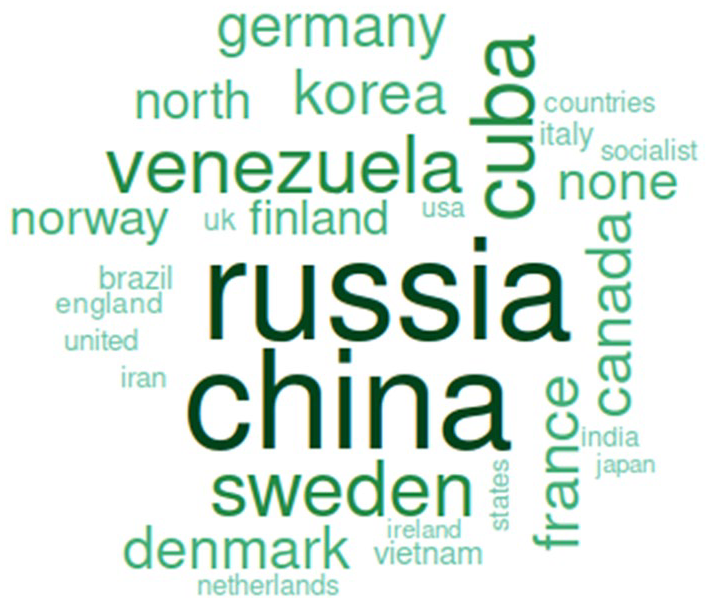
Word cloud of countries named as socialist.
Table 1 presents a negative binomial regression assessing the overall number of countries an individual names. Figures 2 and 3 depict the predicted number of adversarial (mean = .73) and friendly countries (mean = .29) named, respectively. Respondents with more (less) positive dispositions toward socialism named substantially fewer (more) adversarial countries when asked to think about socialism (Model A1 & A2). Moving from the most negative socialism disposition to the most positive decreases the predicted number of countries named by 1.33 on average (p < .01). This implies that those with positive and negative dispositions have drastically different exemplars of the term socialism. If the individual dislikes socialism, they are more likely to associate socialism with adversarial nations, while the same cannot be said for those with positive dispositions. Respondents exhibit a more modest inverse relationship based on socialism disposition and friendly countries (Model F1 & F2). Moving from the lowest to highest possible value, more socialism disposition increase the number of friendly countries named by .309 (p < .01).
Socialism Disposition and Number of Adversarial or Friendly Countries Named as Examples of Socialism.
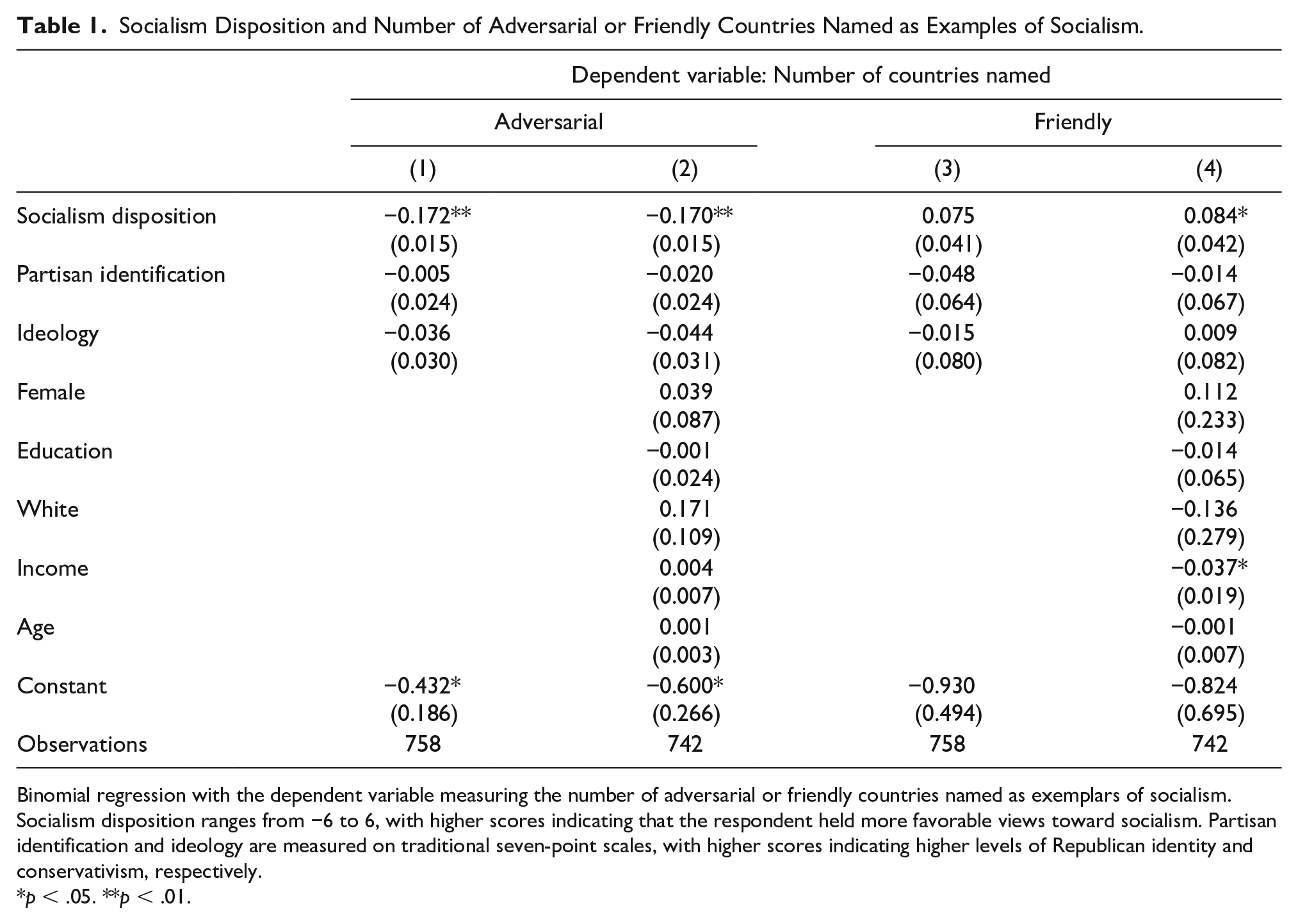
Binomial regression with the dependent variable measuring the number of adversarial or friendly countries named as exemplars of socialism. Socialism disposition ranges from −6 to 6, with higher scores indicating that the respondent held more favorable views toward socialism. Partisan identification and ideology are measured on traditional seven-point scales, with higher scores indicating higher levels of Republican identity and conservativism, respectively.
p < .05. **p < .01.
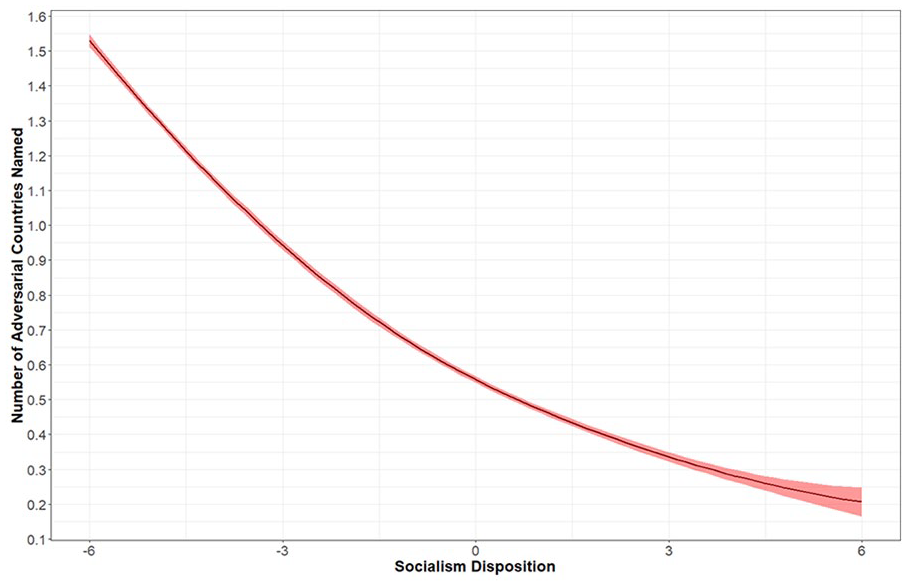
Predicted number of adversarial countries named (A1).
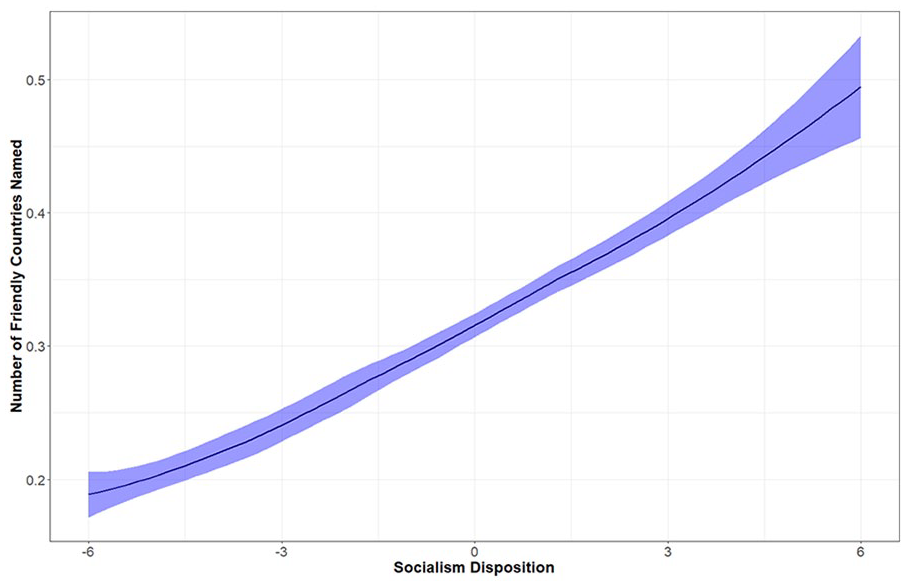
Predicted number of friendly countries named (F1).
Results show that socialism dispositions are heavily associated with one’s pre-existing stereotypes and exemplars. While those with positive dispositions think of relatively wealthy Western social democracies, those with a distaste for socialism perceive it as the domain of adversarial nations. The implications suggest that those with positive and negative dispositions are talking right past each other, thinking of completely different subjects that are dependent upon their personal frames of references. Thus, two individuals may have entirely polarized reactions to the simple mention of the label “socialist.”
Table 2 presents a linear regression analysis assessing perceptions of socialism. Figures 4 and 5 present the predicted probabilities (Model A1). Higher scores indicate that the country is seen as more capitalist, while lower scores indicate the country is seen as more socialist.
Socialism Disposition and Perceptions Socialism in a Given Country.
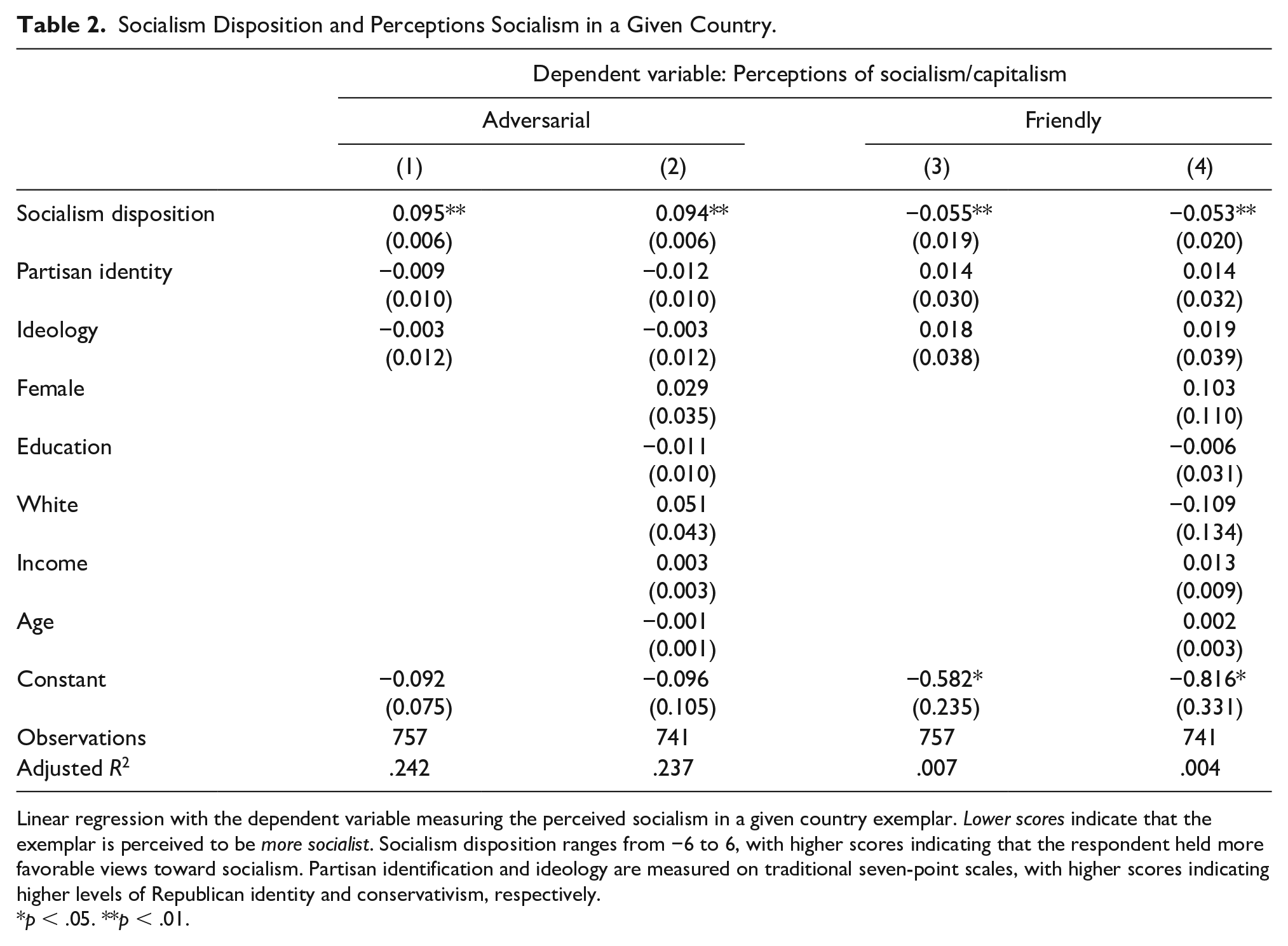
Linear regression with the dependent variable measuring the perceived socialism in a given country exemplar. Lower scores indicate that the exemplar is perceived to be more socialist. Socialism disposition ranges from −6 to 6, with higher scores indicating that the respondent held more favorable views toward socialism. Partisan identification and ideology are measured on traditional seven-point scales, with higher scores indicating higher levels of Republican identity and conservativism, respectively.
p < .05. **p < .01.
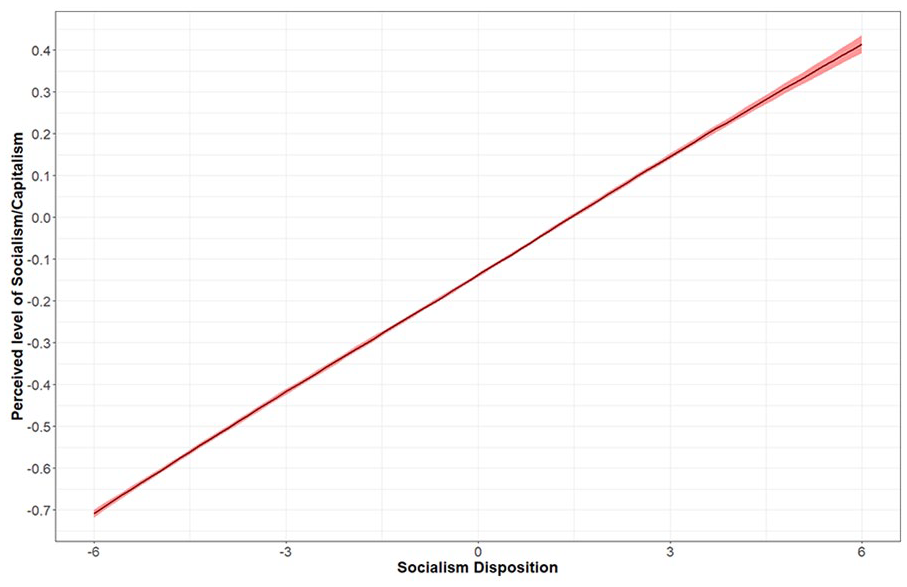
Predicted capitalism score for adversarial countries (A1).
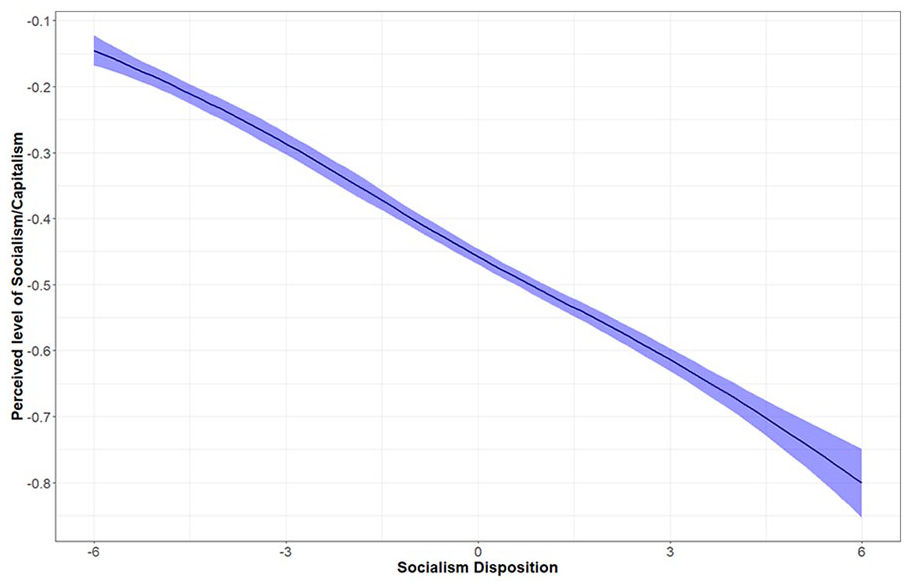
Predicted capitalism score for friendly countries (F1).
Results provide strong support for the Different Angles Hypothesis. Individuals with positive socialism dispositions rate adversarial countries as more capitalist. Moving from the most negative to the most positive socialism disposition increases the rating of adversarial countries from −.71 to .16 (37.8% of the scale; p < .01). Thus, those with negative dispositions view adversarial nations as highly socialist, while individuals with positive dispositions view those same nations as capitalist. While the evidence is observational, the association between socialism disposition and perceptions of adversarial countries is quite strong, suggesting that individuals have highly polarized reactions to the term socialism and find polar opposite exemplars to be more accessible based on their predispositions.
This trend is reversed when respondents assess friendly countries. On average, most respondents view the friendly countries as more socialist than capitalist. Yet, moving from the least to most positive socialism disposition results in a .69 decrease in capitalism score (23% of the scale; p < .01). In summary, positive socialism dispositions lead respondents to view friendly countries as more socialist, those with negative dispositions view those same countries as capitalist, underscoring strong polarized reactions to the term socialism.
Experimental Results
Our observational results show that the term socialism brings to mind drastically different exemplars based on polarized predispositions. Yet, does using the socialist label as a polarizing frame bolster or undermine support for liberal welfare policies? To test this, we conducted a brief framing experiment that compares levels of policy support based on use of the socialist label and individual socialism disposition. We asked respondents to rate how much they support or oppose three social welfare policies: social security, welfare, and free college. We measured support for these policies on seven-point Likert scales (1 = strongly oppose, 7 = strongly support). We then averaged policy support for all three measures to create one indexed measure of social welfare policy support (α = .68). However, we randomly assigned respondents into one of two framing treatments. In the socialist treatment, respondents were told that the aforementioned policies are popular in many socialist countries. In the capitalist treatment, respondents were told that the same policies are popular in many capitalist countries. 11 If the socialist frame is effective in altering levels of policy support, one should expect a strong interaction effect between the socialism treatment and socialism disposition. Specifically, when these policies are tied to socialist countries, one would expect that those with a strong distaste for socialism would become less supportive relative to the capitalist frame. This would indicate that socialist label-based attacks are effective in shifting the opinions of the target demographic.
Table 3 presents linear regression analyses assessing policy opinion. The socialism treatment variable is a binary indicator representing the treatment (1 = socialist treatment, 0 = capitalist treatment). Socialism disposition is measured in the same manner as previous observational analyses. Overall, individuals express high levels of support for social welfare policies irrespective of their socialism disposition, much in line with theories regarding the liberal operational ideology of most Americans. Results display the anticipated main effect, as individuals with more positive socialism dispositions are more of supportive social welfare policies. A one scale point increase in socialism disposition correlates with a .243 (p < .01) increase in support after accounting for a potential interaction. Overall, individuals with the most positive socialism disposition are 1.24 scale points (17.7%) more supportive relative to individuals with neutral opinions. Those with the most negative social dispositions are 1.33 scale points (19%) less supportive.
The Effect of Socialism Framing on Support for Social Welfare Policies.
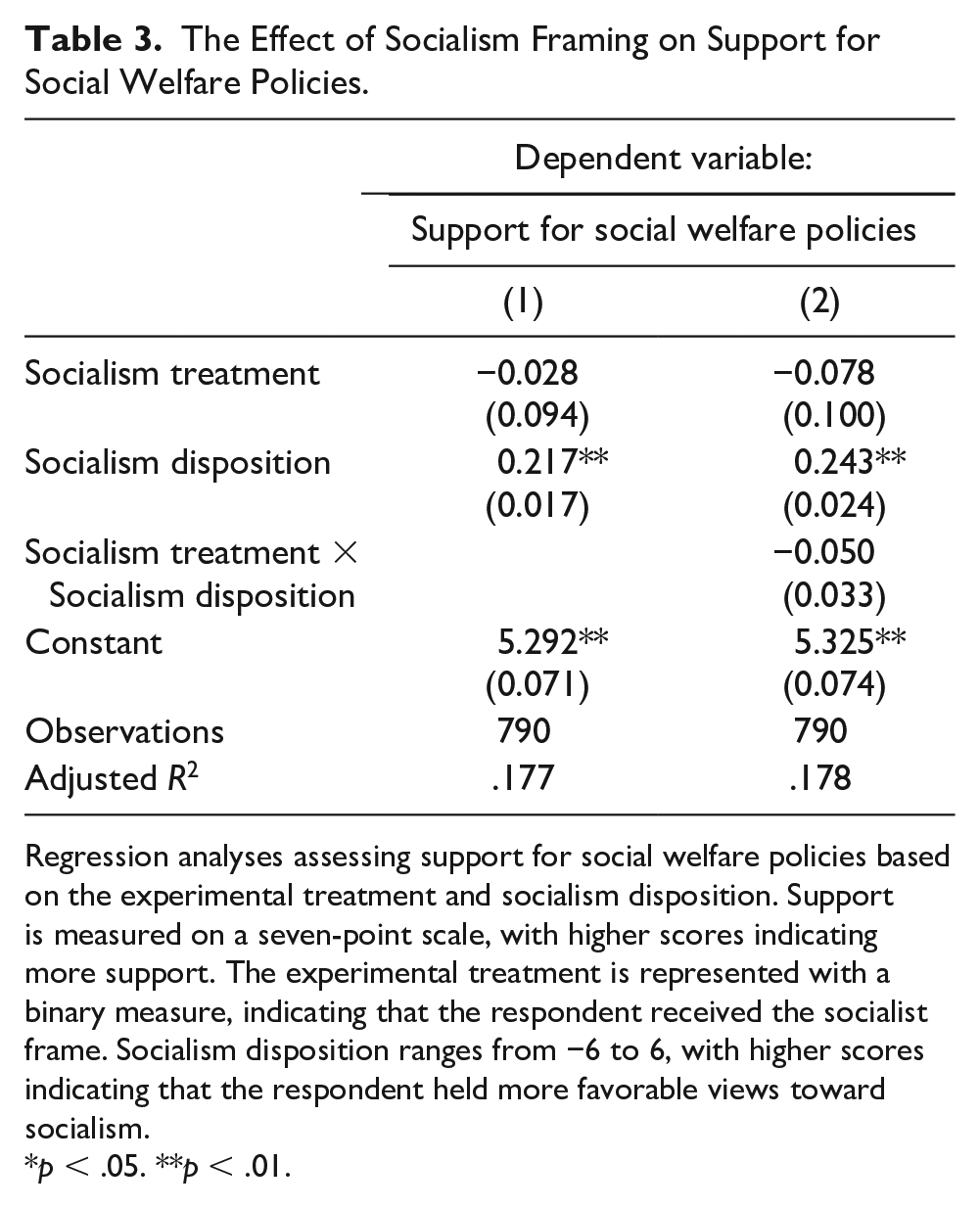
Regression analyses assessing support for social welfare policies based on the experimental treatment and socialism disposition. Support is measured on a seven-point scale, with higher scores indicating more support. The experimental treatment is represented with a binary measure, indicating that the respondent received the socialist frame. Socialism disposition ranges from −6 to 6, with higher scores indicating that the respondent held more favorable views toward socialism.
p < .05. **p < .01.
The socialism treatment fails to shift policy support in a substantively meaningful way. Similarly, the interaction between socialism disposition and the socialism treatment does not appear to substantively impact levels of policy support. In fact, the coefficient for the interaction is negative, indicating that individuals with positive socialism dispositions are slightly less supportive when assigned into the socialism treatment. However, this effect was substantively negligible in effect size (and statistically null). Ultimately, these results indicate that the socialism frame is not highly effective in moving public opinion. While individuals exhibit large differences in support based on socialism disposition, even those with the negative socialism dispositions support these policies to a modest degree. While this set of individuals should, in theory, be the most sensitive to socialism framing due to their strong affective distaste, the frame nonetheless has little impact on their overall policy opinions.
Discussion
Evidence from Study 1 provides consistent support for the Different Angles Hypothesis. When asked to provide an example of socialist countries, respondents with positive predispositions toward socialism are more likely to name friendly Western-European countries while those with negative socialism dispositions are more likely to name adversarial foreign powers. Just as socialism prompts respondents to access opposing examples, respondents respond to identical cues or examples in a polarized manner. While individuals with negative socialism dispositions see adversarial nations as highly socialist, those with positive socialism dispositions attribute the failings of those nations to capitalism. The inverse is true of friendly nations. Those with negative dispositions toward socialism attribute the success of these nations to capitalism, while those with positive predispositions attribute those successes to socialism. Yet, while individuals are highly polarized in regard to the term, attempts to use socialism as a frame appear to be ineffective. Individuals already hold favorable opinions of social welfare policies, and attempts to link those policies to socialist exemplars seem to do little to alter this. This ultimately implies that attempts to frame policies as socialist in an effort to undermine popular support are somewhat ineffective.
While this study provides consistent evidence in support of our hypothesis, the exemplars that we use in Study 1 are somewhat abstract and less salient to the average American than more domestic-based and current-events driven policies. Observational results show that while individuals may hold strong dispositions on socialism itself, many individuals have a poor concept of what countries’ governments exemplify socialism. Moreover, the socialist frame we leverage in the experimental portion of Study 1 is somewhat subtle, linking social welfare policies to socialism without using the frame as an outright attack. Nonetheless, we believe results from Study 1 provide a justifiable starting point for an experimental approach in Study 2. In addition, Study 2 seeks to add to the robustness of the prior findings by using a more immediately salient context regarding relevant domestic policy while using the socialist frame in a manner that is more blatant and actively derogatory toward socialism.
Study 2
In Study 2, we seek to expand upon Study 1 to better assess reactions to the socialist label and the effectiveness of socialist framing when used in a political attack. We test the Different Angles Hypothesis in a more salient context in Study 2, analyzing opinions of timely and relevant domestic policy. This better allows one to test whether framing a policy as “socialist” allows one to alter support for the policy to a substantive degree.
Study Design
In Study 2, we leverage an experimental design to test the robustness of our results from the previous study. We distributed a survey experiment to 530 respondents on Amazon Mechanical Turk (MTurk). MTurk samples are not demographically representative of the U.S. population. Yet, MTurk respondents exhibit similar patterns of political behavior and identity, ideology, and general psychological characteristics to respondents from traditional nationally representative samples, mitigating concerns of heterogeneous treatment effects based on demographics (Berinsky et al. 2012; Clifford et al. 2015; Coppock and Green 2015; Druckman and Kam 2011). In addition, extensive research shows that studies conducted on MTurk and other online survey sights replicate those conducted on traditional samples in the vast majority of instances (Coppock et al. 2018; Coppock and Green 2015).
Respondents viewed a fabricated news article criticizing the stimulus bill put forward by the U.S. government as a response to the spread of Covid-19. The content of the article was heavily based on real-world news articles published at the time. 12 Despite the fact that the stimulus bill passed with overwhelming bipartisan support, Republicans expressed initial concerns and have balked at the idea of passing a second stimulus bill in the final days of the Trump administration. 13 While the bill was passed under a Republican presidency, Republicans and conservative media have nonetheless criticized Democrats for the perceived socialism of the stimulus bill. 14 Once again, the manipulation was designed to closely mimic an online news article published by a mainstream political news sources (see Figures 6 and 7). 15
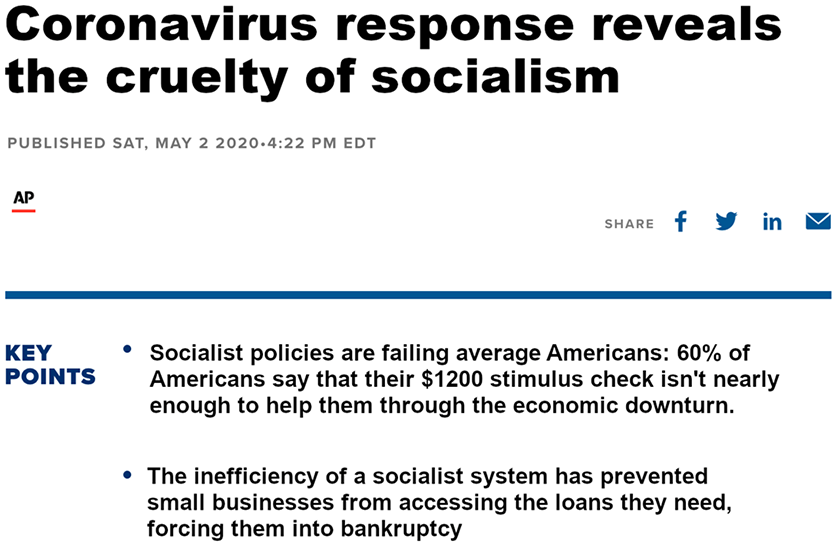
Socialism manipulation.
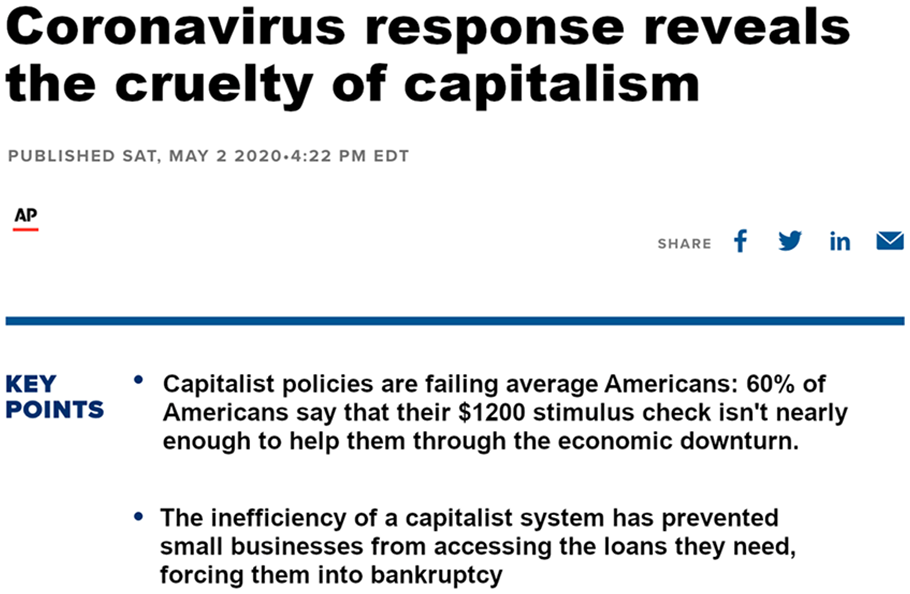
Capitalism manipulation.
Respondents randomly received one of two treatments. In the socialism treatment, the inadequacies of the policies are blamed on the failures of socialism. In the capitalist treatment, the terms “socialism” and “socialist” are simply replaced with “capitalism” and “capitalist.” In doing so, we seek to assess whether simple socialist framing in the news media individuals receive can impact the perceived validity and subsequent effectiveness of those criticisms. In using capitalism as a competing frame rather than using no cue at all, we seek to create the most favorable circumstances under which one would see the socialist frame shift individual opinions, particularly among those with negative socialist dispositions.
Measurement
We use similar independent variables to the previous study. The framing treatment is captured by a binary variable (1 = socialist treatment, 0 = capitalist treatment). Socialism dispositions are measured on the same differenced scale as the previous study, running from −6 to 6, with higher scores representing more positive dispositions toward socialism. For further analyses, we also include partisan identification, which is measured on a branching Likert scale (1 = strong Democrat, 7 = strong Republican).
We feature two key dependent variables. First, we ask respondents to assess whether the criticisms are “a fair portrayal of socialism/capitalism,” represented with a binary measure (1 = fair portrayal, 0 = unfair portrayal). This allows for one to test whether respondents feel the criticisms were fair based on the socialist/capitalist framing of the article. To measure support for the stimulus policy, we asked respondents two questions, with answers measured on five-point Likert scales: (1) “Do you approve or disapprove of the U.S. government’s response to the coronavirus?” (1 = strongly disapprove, 5 = strongly approve), and (2) “Are you satisfied or dissatisfied with the U.S. government’s response to the coronavirus epidemic?” (1 = very dissatisfied, 5 = very satisfied). We averaged answers into one index of support (Cronbach’s α = .89).
Should the evidence support the Different Angles Hypothesis, one should expect a strong conditional effect for the fairness variable, with the relationship between the frame and perceived fairness moderated by socialism dispositions. Respondents with positive socialism dispositions will find the criticisms of the governments’ response to be a poor example of socialism, but an accurate depiction of capitalism’s failings. Individuals with negative socialism dispositions will evince the inverse pattern, finding the criticism of the government’s response to be an unfair portrayal of capitalism, but an accurate depiction of socialism’s failings.
If socialist framing is successful in shifting individual opinions, one should expect a similar conditional effect for the support variable, with the relationship between the frame and support moderated by socialism disposition. This would indicate that framing the policy as socialist in a derogatory fashion leads individuals with negative socialism disposition to express less support for the policy.
Results
Figure 8 presents the predicted probability that respondents expressed that the criticisms are a fair depiction of socialism/capitalism based on their socialism dispositions and experimental treatment. These probabilities are generated from logistic regression analyses found in Supplemental Appendix B, Table B1). Results reveal strong conditional effects based on the framing of the article. Respondents with positive socialism dispositions are only 18.2 percent likely to feel that the article’s criticisms are a fair critique of socialism as a whole. However, when those same criticisms are framed as a failing of capitalism, respondents with positive socialism dispositions are 81.6 percent likely to feel that criticisms are fair; a difference of 63.4 percent (p < .01) between frames. Individuals with negative socialism dispositions display the inverse pattern. Such respondents are 50.4 percent likely to believe the criticisms to be a fair portrayal of socialism and only 32.7 percent likely to believe the same of capitalism. This is a smaller, but still sizable difference of 17.3 percent (p < .01). Ultimately, these results reveal the same pattern: Individuals react to the socialist label by clearly attributing negative outcomes to their least-preferred system, while rejecting the premise that negative outcomes are due to their most-preferred system. This implies that the meaning of socialism is highly malleable based on individual predispositions.
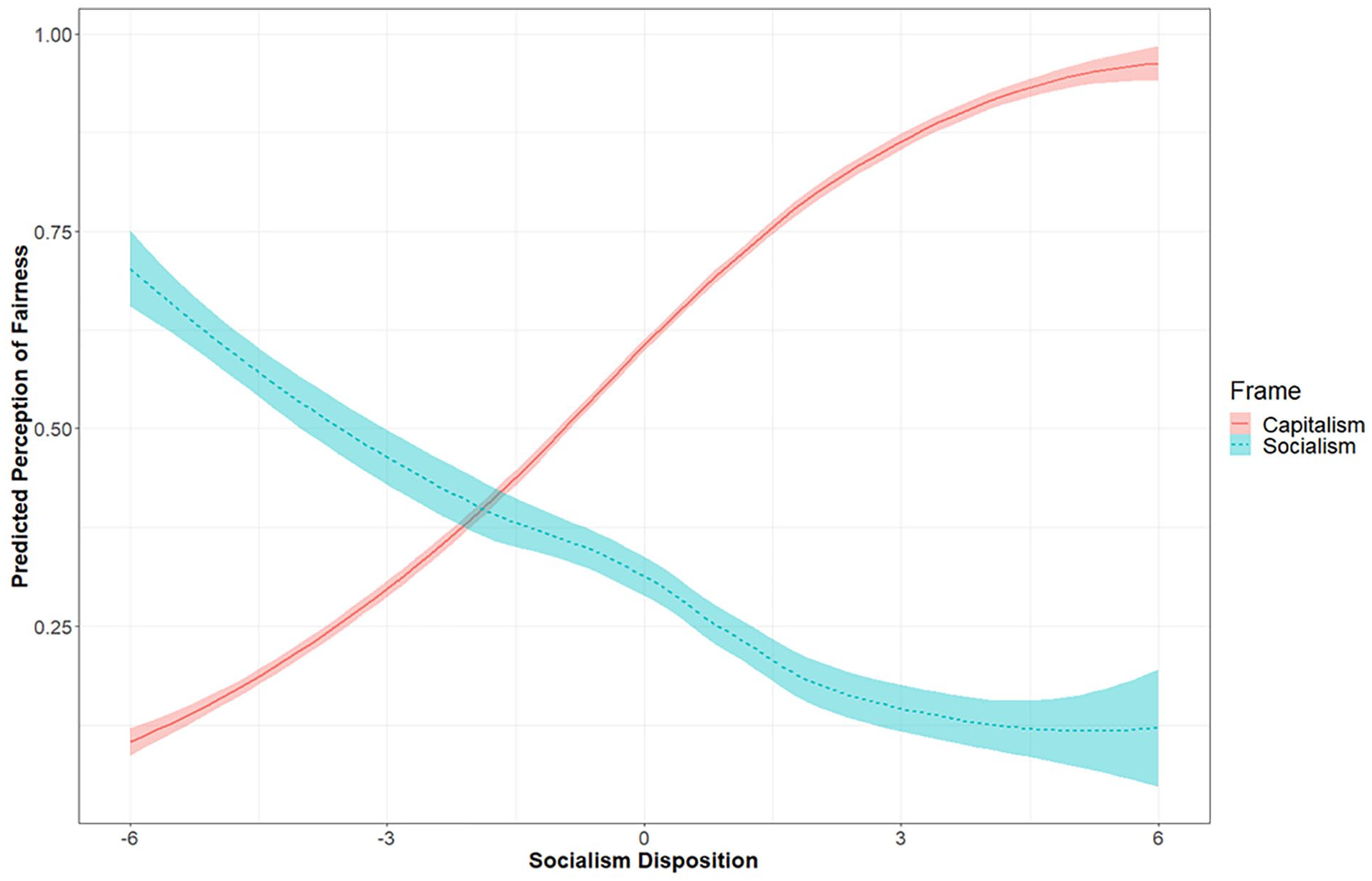
Perceived article fairness based on socialism disposition.
Policy approval based on socialism disposition.
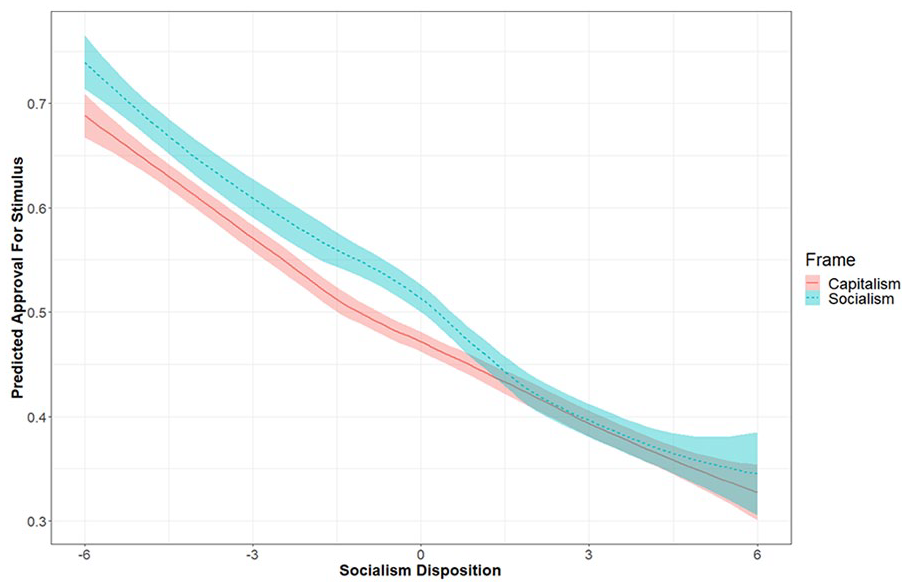
While the socialist label produces strong polarizing affective reactions, the question remains as to how effective attacks on socialism are in undermining popular policy support. Figure 9 presents the predicted approval of the stimulus bill based on socialism dispositions and the experimental treatment. These predicted scores are generated via linear regression analyses found in Supplemental Appendix B, Table 2.
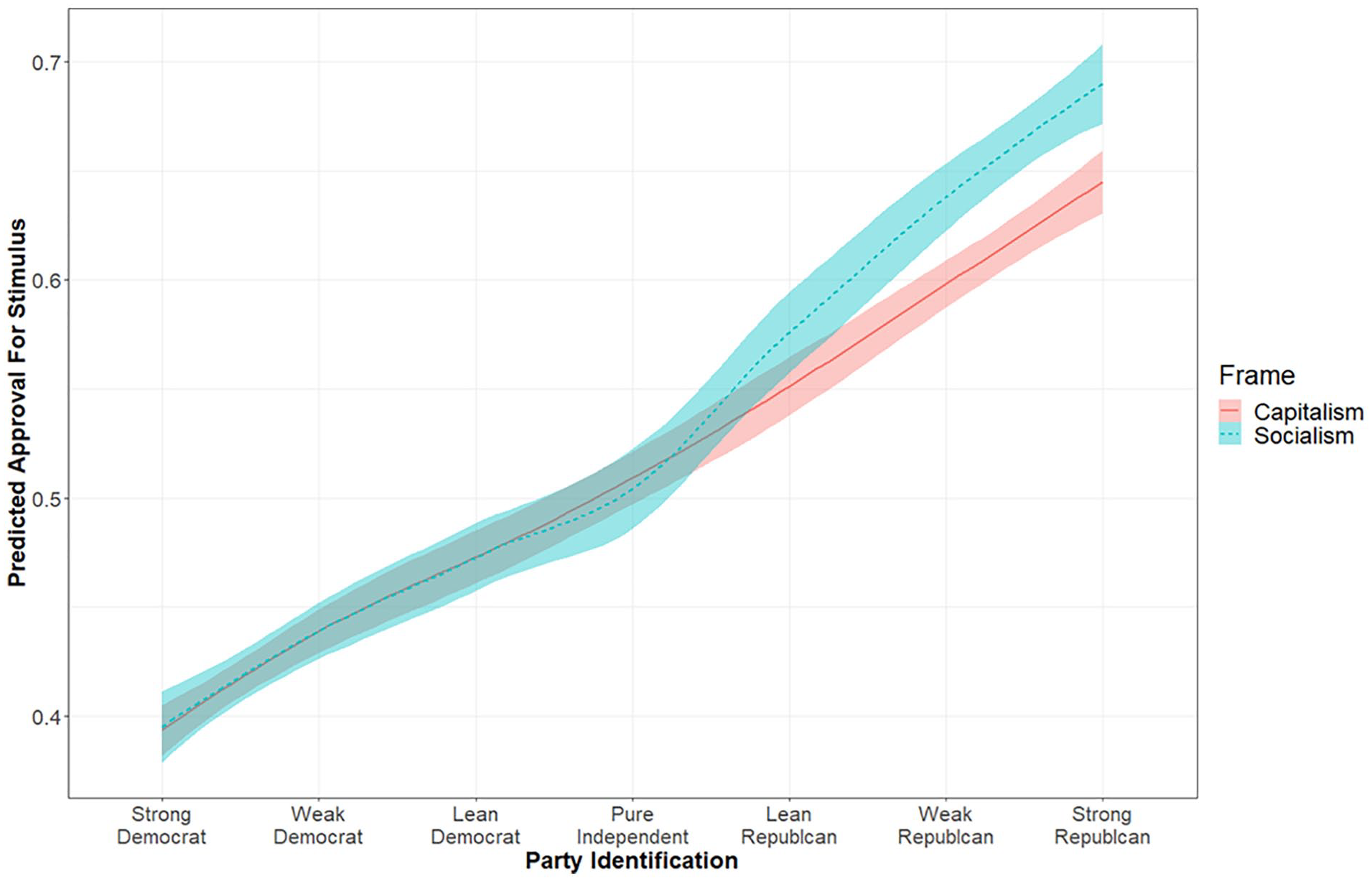
Policy approval based on party identification.
Analyses show a strong negative main effect for socialism disposition. Individuals with more positive socialism dispositions are less supportive of the government response overall, while those with more negative socialism dispositions are more supportive of the stimulus bill. The article framing exhibits little effect on support for the stimulus bill. Thus, it would appear that while individuals have strong polarized assessments of both capitalism and socialism, these assessments have little influence on ultimate policy support.
These results are likely driven by partisan considerations, as socialism disposition is moderately correlated with partisan identification (r = −.5, p < .01). Figure 10 plots policy approval based on respondents’ party identification. Results provide a pattern that is with consistent partisan-based reasoning. Republicans are 21.1 percent (p < .01) more supportive of the stimulus bill than Democrats. The framing of the bill has little affect on individual support. Republicans tend to be highly supportive of the bill while Democrats are more skeptical, and the bill’s shortcomings as socialist framing fails to shift respondents from their stances to a notable degree. These results confirm similar results from the social welfare policies in Study 1. In addition, this implies that attacks which frame the stimulus bill as socialism, such as the real world examples noted earlier, are not highly effective due to a potential ceiling effect brought about via partisanship. Individuals may arrive at policy conclusions for different affective reasons all together. While respondents may have strong polarized affective reactions to socialism, simply labeling a policy as socialist is ineffective in changing minds.
Discussion
Results from Study 2 concur with findings from Study 1, providing support for the Different Angles Hypothesis. When presented with identical policy information, individuals attribute policy failures to their least-preferred system. Those with positive socialist dispositions interpret policy failings as failings of capitalism, while those with negative socialism dispositions interpret those same failings as socialist. However, differences in framing and interpretations fail to subsequently shift policy opinion to a substantial degree. Although individuals exhibit strong predispositions toward socialism, framing a policy as socialist may not be an effective means of undermining or increasing support for salient policy issues. Harking back to the Trump campaign’s use of socialist framing, these results suggest that this tactic may be ineffective. Republican voters likely prefer Trump to his Democratic opponent, former Vice President Joe Biden, prior to framing. Democratic voters are likely to interpret the frame differently or reject it all together based on context. Thus, while the term socialism may serve as a media buzzword that draws attention to pundit debates by triggering strong polarized reactions, it is unlikely that it provides a consistent signal to all members of the audience or drastically alters individual opinions.
This study is not without limitations. While the Covid-19 stimulus bill is somewhat similar to a social welfare policy like universal basic income, the two are not entirely synonymous. Moreover, the fact that this policy was implemented under a Republican president makes the context somewhat unique. However, this experiment closely mimics real-life criticism and negative attacks from conservative news outlets. Moreover, the results closely mirror those garnered through the use of more traditional social welfare policies, triggering strong polarized affective reactions despite the somewhat unique context.
Conclusion
Analyses evince a pattern in which those with positive and negative socialism dispositions have difficulty coming to a shared understanding. Those with positive dispositions will react to the use of the term by rejecting examples that cast socialism in a negative light; vice versa for those with negative disposition. In addition, individuals tend to determine whether or not a policy is socialist based primarily on whether the incoming information is congruent with their predispositions. The influence of policy content itself appears to be negligible. The positive or negative nature of the information determines whether the policy is considered socialist. In fact, we find that individuals that claim to detest socialism support the coronavirus stimulus bill likely based on partisan considerations. While there are differences between the stimulus bill and stereotyped socialist policies like universal basic income, individuals are nonetheless taking policy positions that are somewhat antithetical to the ideology they supposedly oppose or support.
Our findings cast doubt on the media narrative regarding the alleged rising popularity of American socialism. While many media pundits lament (or celebrate) socialism’s increased popularity based on mixed evidence from opinion polls, we remain skeptical as to the validity of such claims. Rather than seeing a homogeneous shift of opinion toward more socialist world views, our findings suggest that individuals have predictable and strong polarized affective reactions to the term. In addition, the use of the socialist label fails to drastically shift policy opinions to a notable degree. The term may simply be used by large numbers of recent “socialist” converts to describe policies that were already popular among the public or a catch-all derogatory phrase for policies that conservative Republicans dislike. This gives rise to the question as to whether aforementioned Democratic Party members can soften the reputation of socialism by tying it to successful and popular policies. Our findings here suggest that this would be quite difficult, particularly among Republicans. While Republicans may support the popular policies espoused by socialist candidates, our results suggest that they are liable to deny that the policy is socialist despite the framing while maintaining an affective distaste for the term.
Our findings also speak to the broader scholarly debate regarding operational ideology, expressive ideology, and individual perceptions. Many prior studies suggest that operational, expressive ideology, and affective bias are inherently linked (Rogowski and Sutherland 2016; Webster and Abramowitz 2017). This evidence, however, is juxtaposed by a competing school of thought, showing that affective polarization has increased irrespective of individual ideological sorting, raising doubts as to the strength of the causal link between policy views and expressive partisan identity (Lelkes 2018). Our findings tend to match well with this later school of thought. We find that socialist framing does little to undermine policy support overall, as well might be the goal of many attacks using socialist framing. Instead, the term socialism is perhaps confined to triggering and exacerbating affective polarization rather than drawing influence from a consistent link to operational ideology. We believe that the present findings thus offer a good starting point for future exploration into the matter.
In both journalistic and scholarly work, one must consider that range of potential meanings that terms like socialism have—be they symbolic and affective or ideological and policy-driven. In failing to adequately consider the multiple ways in which individuals define the terms we wish to discuss, scholars and pundits risk arriving at misleading conclusions about the political world. These findings suggest media entities may want to use caution in regard to how they use such terms. Overuse and over-saturation could relegate such terms to the status of buzzwords offering little useful information to the listener. In addition, the use of buzzwords like socialism may prompt affective motivated reasoning, further decreasing the effectiveness of political discussions and persuasive communications. However, we understand that this is not how terms like socialism are necessarily treated intentionally. Terms like socialism gain a foothold in American dialogue because of how different groups and individuals use them (Edelman 1964). We therefore think further research should explore how and why the diverse meanings of these terms have been constructed in the minds of American citizens. Our findings suggest media entities and political elites have forfeited using specific meanings when using important terms. The use of buzzwords like socialism may have prompted affective motivated reasoning, fostering the utility of these terms for personal and group gains.
Future Avenues and Considerations
We note that this research focuses narrowly on policy opinions rather than politicians or political candidates. We believe that offers ample opportunity for expansion into other contexts, such as political candidates and campaigns. In addition, while this research focuses on socialism, we believe this research raises questions about the need to properly conceptualize and define terms in the American political lexicon. Terms such as “fascism,” “conspiracy theory,” “constitutional crisis,” and “collusion” are just a few examples of terms used with similar ubiquity to socialism since the 2016 election that may warrant further exploration.
While this study focuses narrowly on the influence of socialism disposition and the effectiveness of socialism framing, further research is necessary to full determine the origins of socialism disposition. We argue that media agenda-setting plays a highly important role in determining individual-level socialism disposition. Future works that use observational methods, including analysis of news stories and statements made by elites over time, offer promising explanations that could expand upon this work. Moreover, while socialism dispositions are well-connected to partisan identity, there are a number of potentially informative psychological and demographic factors that are regrettably not addressed in the present study that may influence socialism disposition. These include political interest, news consumption habits, right wing authoritarianism, and political sophistication. 16 In particular, it may be insightful to assess the effect of immigration status, particularly among communities with historical ties to socialist regimes, such as the sizeable Cuban community in Florida. Many of these factors may be helpful in answer questions regarding whether the reputation of socialism can be softened over time, which may effect both the policy and electoral success of the Republican and Democratic parties in the future.
One final avenue for future work may find potential insights in how the meanings of words in the political lexicon change over time. Our results show that socialist framing fails to drastically undermine policy support and casts doubt as to whether the reputation of socialism can be softened among the public. However, our study is limited to one point in time. It is not unreasonable to believe that while individuals may be highly resistant to socialist framing, positive or negative, a constant stream of information tying to socialism to specific policies or politicians over long periods may wear away at the proverbial stone. We believe that careful attention to shifting political contexts, and the use of socialist framing in those contexts, may offer insightful answers to important questions.
Supplemental Material
sj-pdf-1-prq-10.1177_10659129211037402 – Supplemental material for Viewed from Different Engels?: Differences in Reactions to “Socialism” as a Policy Label
Supplemental material, sj-pdf-1-prq-10.1177_10659129211037402 for Viewed from Different Engels?: Differences in Reactions to “Socialism” as a Policy Label by Adam L. Ozer, Brian W. Sullivan and Douglas S. Van in Political Research Quarterly
Footnotes
Acknowledgements
A special thank you to Beth Simas for her helpful feedback and advice throughout the research process.
Declaration of Conflicting Interests
The author(s) declared no potential conflicts of interest with respect to the research, authorship, and/or publication of this article.
Funding
The author(s) received no financial support for the research, authorship, and/or publication of this article.

Data Accessibility Statement
Notes
Supplemental Material
Supplemental materials for this article are available with the manuscript on the Political Research Quarterly (PRQ) website.
References
Supplementary Material
Please find the following supplemental material available below.
For Open Access articles published under a Creative Commons License, all supplemental material carries the same license as the article it is associated with.
For non-Open Access articles published, all supplemental material carries a non-exclusive license, and permission requests for re-use of supplemental material or any part of supplemental material shall be sent directly to the copyright owner as specified in the copyright notice associated with the article.
