




Abstract
Human rights organizations (HROs) frame advocacy campaigns in order to shape individuals’ values and mobilize them to act. While previous work has examined some commonly used HRO frames, we know little about how they work as most often utilized—in combination. In this experiment, participants were randomly assigned either to a control group or to treatment groups shown campaigns against sleep deprivation during interrogation featuring frames used alone or in combination. We find that effects of personal frames on action mobilization are not mitigated by the inclusion of other frames, and that human rights campaigns with multiple frames yield outcomes that are neither better nor worse than a single personal narrative of human suffering. HROs should be able to use multiple frames in combination as needed without concern.
Introduction
Human rights organizations (HROs) use issue framing in their campaigns to mobilize consensus about the nature of human rights abuses and mobilize action in order to change perpetrators’ behavior (Keck and Sikkink, 1998). Framing is the process through which socio-political actors use rhetorical lenses to present information in an effort to construct meaning or influence perceptions and opinions (Goffman, 1974). Which framing techniques are employed can affect an individual’s attitudes and behavior (Chong and Druckman, 2007).
Issue framing is crucial to human rights micromobilization because the way in which people process information affects their willingness to help others in need (Small et al., 2007; Slovic, 2007). Yet advocates report a lack of systematic evidence as to whether and under what circumstances their messaging strategies are effective (McEntire et al., 2015a, 2015b). Pressure to direct limited funds toward action rather than research or administration means that HROs must rely on anecdotal experience with untested combinations of frames when crafting messages. This is problematic, as untested messaging campaigns aimed at pro-social mobilization may backfire (Nyhan et al., 2014).
Experimental research by McEntire et al. (2015b) examined the independent effects of the three frames used most frequently by large, Western, global HROs—personal, informational, and motivational frames—on consensus and action mobilization. Yet that study acknowledges that more often than not HROs use multiple frames in concert in campaign materials. Advocates and journalists have in some cases explicitly based their approach to messaging on assumptions and findings about how frames interact which may not translate to a human rights context (Small, et al., 2007; Kristof, 2007), and in other cases have chosen a mixed-frame strategy without any real understanding about whether and how it would work (Talbott, 2014). Therefore, we replicate and extend that experiment, this time also testing the efficacy of combinations of these framing strategies in affecting how much respondents change their opinions about a human rights issue to match the HRO’s position (consensus mobilization), and how willing they are to sign a petition to ban the practice (action mobilization).
Framing human rights
Personal frames evoke emotional reactions by identifying and humanizing a (single) victim and establishing a personal connection between the reader and the individual in the story. The audience is more likely to feel anger, sadness, or empathy when thinking about the issue, will prioritize the issue, and will come to want to affect change (Small et al., 2007). In human rights campaigns, personal frames used on their own are highly effective at generating strong emotional reactions, leading people to reject a practice as a rights violation and participate in a campaign to demand its cessation (McEntire et al., 2015b).
Informational frames situate issues within a broader context, typically including facts or statistics, in order to increase an individual’s knowledge about the nature and scope of an issue. Information about government rights abuses can directly affect public opinion about human rights, and play a role in affecting campaign outcomes (Becker, 2012; Davis et al., 2012). In human rights campaigns, informational frames on their own increase individuals’ knowledge about the campaign issue, mobilize consensus, and generate donations, but do not mobilize other pro-social action (McEntire et al., 2015b).
Motivational frames are attempts to get individuals to act by creating feelings of agency and efficacy (Gamson, 1995). These effects have been most prominently noted in get-out-the-vote efforts (Duffy and Tavits, 2008). In human rights campaigns, however, motivational frames on their own do not enhance individuals’ sense of agency, and, as a result, have no effect on consensus or action mobilization (McEntire et al., 2015a, 2015b).
Simultaneous framing
Previous findings suggest that both informational and personal frames work as expected to lead to consensus mobilization. Informational frames enlighten people as to the scope or extent of a human rights abuse, and personal frames heighten emotional reaction to a victim’s plight (McEntire et al., 2015b). Therefore, we expect HRO framing campaigns that include personal or informational campaigns (separately or together) to help convince individuals of the problematic nature of the abuse. Since motivational frames on their own do not lead to changes in a person’s sense of agency or efficacy, they should have no such effect when employed alone, but should not detract from the effects of the personal or informational frames.
H1: Exposure to an HRO campaign that includes at least a personal or informational frame will result in greater alignment between individuals’ and the HRO’s opinions regarding the campaign issue.
Extant literature on the social psychology of prosocial mobilization suggests that, when presented together, information meant to provide context for a vivid story of human suffering may actually inhibit actions that would aid the victim by making the audience calculate rather than feel (Kahneman, 2003; Slovic, 2007; Small et al., 2007). These findings have affected how advocates and journalists communicate about human rights (Kristof, 2007). Yet those experiments identify victims of acknowledged humanitarian crises, such as natural disasters (Slovic, 2007; Small et al., 2007). People may first need to be convinced of the nature and scope of a human rights problem—particularly a contentious one—before being moved by an emotional appeal to act (McEntire et al., 2015a). Contrary to the social psychology literature, we expect that narratives that combine personal and informational frames will generate an emotional reaction, increase knowledge about the issue, and lead to greater action mobilization.
H2: Exposure to personal and informational frames combined in an HRO campaign will increase individuals’ willingness to mobilize around the campaign issue.
Since neither informational frames nor motivational frames on their own have been found to have a significant effect on action mobilization such as signing a petition, and since motivational frames on their own do not increase agency, there is little reason to believe that a combination of informational and motivational frames would have any effect on the willingness to act. But motivational frames should not detract from the emotional power of a personal narrative, which has been found to yield action mobilization even when used on its own (McEntire et al., 2015b).
H3: Exposure to personal and motivational frames combined in an HRO campaign will increase individuals’ willingness to mobilize around the campaign issue.
H4: Exposure to informational and motivational frames combined during an HRO campaign will have no effect on individuals’ willingness to mobilize around the campaign issue.
Exposure to a combination of all three frames should increase action mobilization. Once subjects have understood the problem and connected to the victim, they should be more empowered to affect change. Anecdotal reports from HROs that operate on the local level suggest that this three-pronged strategy is effective (Talbott, 2014), and research suggests that it increases a person’s willingness to donate money to a human rights campaign (McEntire et al., 2015a).
H5: Exposure to a combination of all three frames (personal frame, informational frame, and motivational frame) will increase individuals’ willingness to mobilize around the campaign issue.
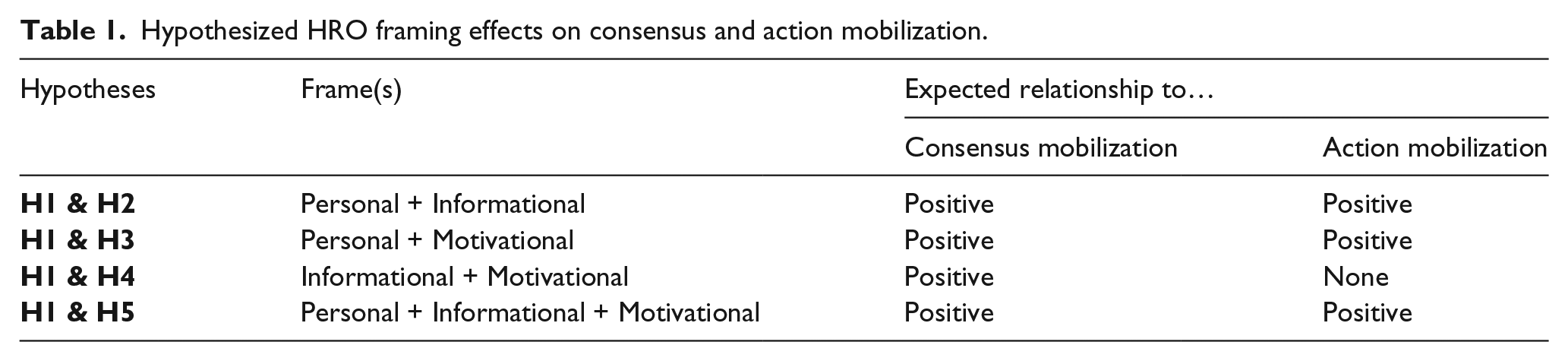
In sum, we argue that while frames that affect either knowledge or emotion are sufficient to yield consensus mobilization, frames that target emotion are necessary to stimulate action mobilization. Table 1 summarizes our expectations.
Hypothesized HRO framing effects on consensus and action mobilization.
Survey Experiment
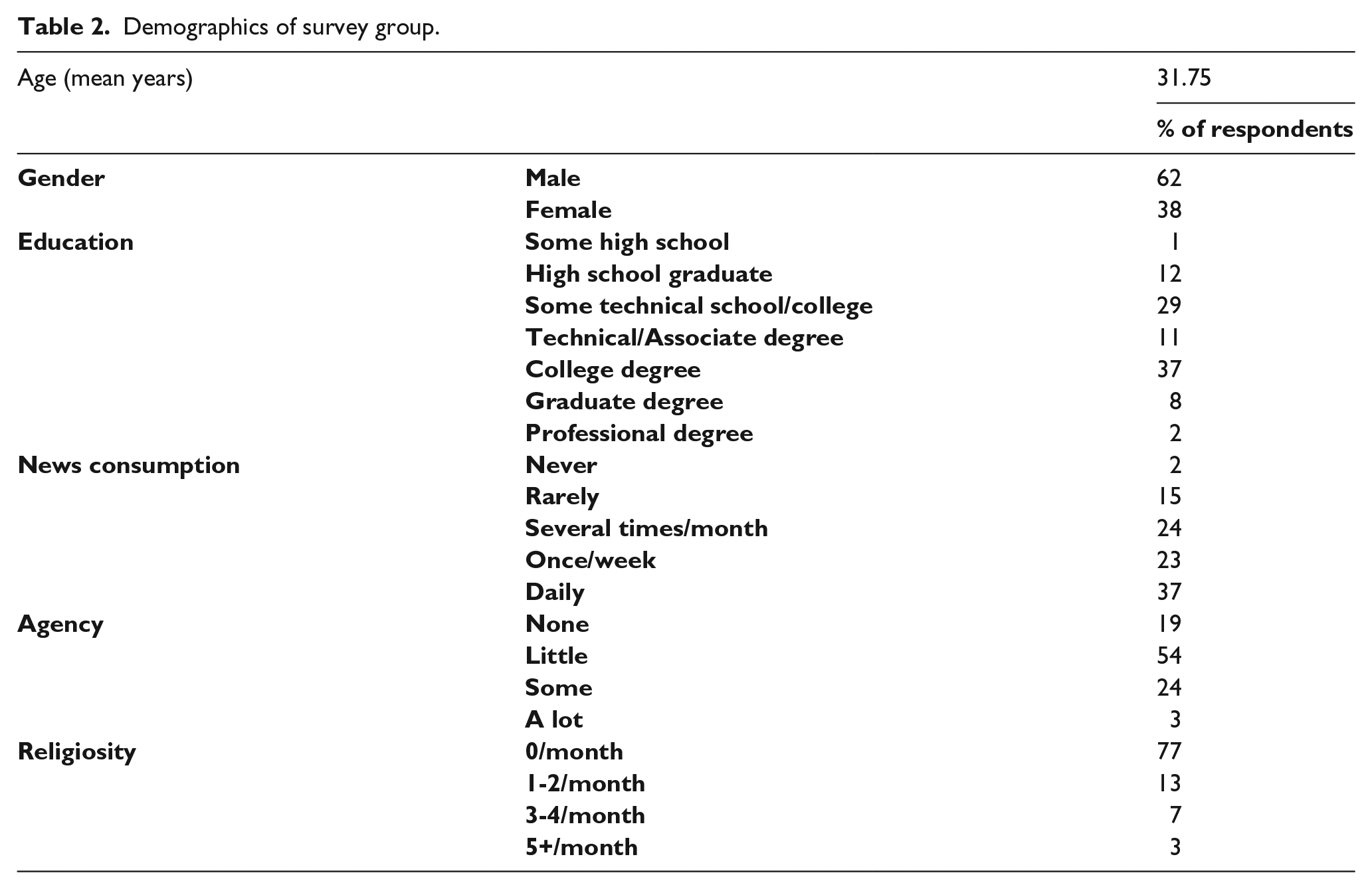
To test our hypotheses, we replicated the experimental design and protocols of McEntire et al. (2015b), but expanded it to include experimental groups that also saw combinations of frames. Participants in our survey experiment were recruited through Amazon’s Mechanical Turk (MTurk). 1 To avoid any selection effects, our job ad made no reference to human rights, sleep deprivation, police interrogation, or politics. Participants were required to be 18 or older, live in the United States, and have a previous task satisfaction rate of 85% or higher. These parameters yielded a sample of 1834 participants. As with other studies employing MTurk as a recruitment tool (Buhrmester et al., 2011; Berinsky et al., 2012), our sample is slightly younger, more liberal, and slightly more educated than the US population. However, this closely resembles the target demographic for HRO campaigns (McEntire et al., 2015b). 2 Table 2 presents the demographic profile of participants.
Demographics of survey group.
Participants were randomly assigned to the control group or one of 11 treatment groups, asked to read an HRO campaign against sleep deprivation featuring some combination of informational, personal, and motivational frames. 3 Treatment 10, a combination of informational, personal-male and motivational frames, is reproduced below (see Figure 1), but all treatments are available in the online appendix. We consulted the most recent campaigns of a number of large, Western, global HROs to guide language and style of the treatments. All treatments included the same basic content—sleep deprivation as a police interrogation tactic is ineffective and inhumane—allowing us to isolate how differently framing the message affected respondents’ attitudes and action. Treatments with multiple frames were only edited for redundancy.

Informational + Personal-Male + Motivational Frame.
The focus of our campaign was the issue of sleep deprivation, a hard test for building consensus and action mobilization. According to recent studies, only 35-44% of Americans oppose the use of sleep deprivation as an interrogation technique, compared to “more severe” forms of torture, which a majority of respondents oppose (Richards et al., 2012). As such, there is a high bar for any HRO to convince the public that sleep deprivation is wrong, and so much so that it warrants their participation in a campaign to ban the practice.
Participants assigned to a treatment group were asked to read the corresponding campaign message before being surveyed regarding their attitudes and likely future actions on the campaign issue. Those in the control group were taken directly to the survey. All respondents saw the same questions in the same order, as reproduced in the online appendix. Random assignment of participants and administration of the survey was carried out with Qualtrics.
Variables
The first dependent variable, consensus mobilization—fostering agreement about the nature and severity of an issue—is measured on an ordinal scale of 1–5 indicating a respondent’s agreement/disagreement with the statement, “Sleep deprivation is an appropriate police interrogation technique.” The second dependent variable, action mobilization—the ability to get individuals to mobilize for social change—is measured by a participant’s willingness to add their name to (fictitious) petitions to be sent to the UN Special Rapporteur for Human Rights, demanding the immediate end to the use of sleep deprivation during police interrogations. Their willingness to take this direct action is recorded dichotomously, 1 if they “click” to add their name, 0 if they do not.
We also employed the same control variables used by McEntire et al. (2015b)—the age, gender, level of education, frequency of news consumption, and feelings of agency of the respondents—all of which could impact how frames affect consensus and action mobilization. Table 3 provides a full description of each variable, how it was captured in the survey and how it was measured. Descriptive statistics for all variables are presented in the online appendix in Table OA1.
Variables and measures.

Results
Because the dependent variables are not continuous, we use (ordered) logit to estimate the effect of independent and simultaneous framing techniques on individuals’ attitudes and actions regarding sleep deprivation. Table 4 reports the coefficients and robust standard errors for each variable. Generally, HRO campaigns are more effective at building consensus on the issues than at motivating individuals to act. However, personal narratives, alone or in combination with another framing strategy, appear to be the most consistently successful. Personal frames increase individuals’ knowledge of the human consequences of the abuse and stimulate an emotional reaction to the issue, and as a result, lead them to reject the use of sleep deprivation during police interrogations and to participate in a campaign to end its use. These results are robust to various specifications of the models. 4
Ordered logit results, Models 1–3.

Notes: Robust standard errors in parentheses; * p < 0.05, ** p < 0.01, *** p < 0.001.
Model 1 examines the effect that exposure to one of the HRO campaigns has on a participant’s approval of sleep deprivation as a police interrogation tool. Results show that compared to the control group, exposure to almost any of the treatments significantly decreases respondents’ approval. For example, reading a personal narrative of a male survivor of sleep deprivation results in a 1.06 unit decrease in the log odds of reporting a higher level of agreement with the use of sleep deprivation. 5 Only the motivational frame when used alone has no impact on an individual’s attitudes regarding sleep deprivation. Given that on its own there is no observable relationship, it is likely that when present in a combination frame the informational and/or personal components are driving the resultant disapproval of sleep deprivation. Yet as Figure 2 (and Table OA2 in the online appendix) shows, the only campaign that had effects that were substantively distinguishable from the control group contained a single personal frame. 6 Moreover, none of the combination frames outperform their individual frame components on their own, suggesting that there is little added value to more complex human rights campaigns.

Predicted probability with 95% CI of disagreeing or strongly disagreeing with the statement: “Sleep deprivation is an appropriate police interrogation technique” (measuring consensus mobilization), by treatment group.
Model 2 examines the effect that exposure to one of the treatments has on a participant’s willingness to mobilize around the campaign issue. Again, all framing strategies, with the exception of the motivational frame, were successful at mobilizing individuals to sign the petition. However, in examining predicted probabilities for Model 3, we found that only campaigns that included a personal frame (though not all of those campaigns) had effects that were substantively distinguishable from the control group (see Figure 3 and Table OA2 in the online appendix).
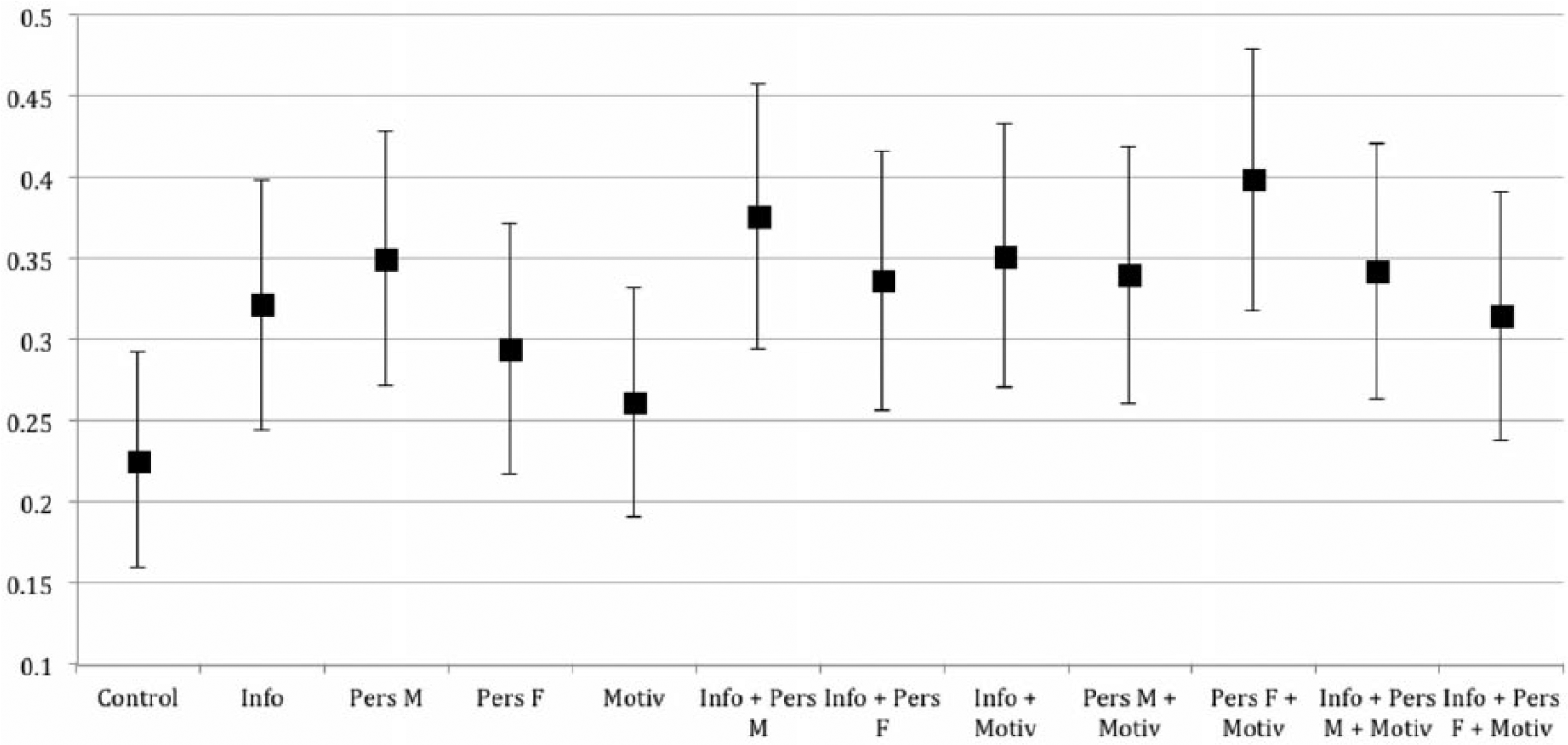
Predicted probabilities with 95% CI of signing a petition to be sent to the UN Special Rapporteur (measuring action mobilization), by treatment group.
In comparison, Models 3 to 12 in Tables 5 and 6 show that the driving mechanisms behind the informational and personal frames—knowledge and emotions—work as hypothesized. Any time an informational component is included in the HRO campaign, respondents report feeling more knowledgeable on the campaign issue. However, the informational frame only makes people feel more knowledgeable about the (in)efficacy of sleep deprivation as a reliable method of interrogation: respondents did not report feeling more knowledgeable about the mental and physical impacts of sleep deprivation on victims. In this regard, we are cautious about the appropriateness of informational frames on their own for human rights campaigns insofar as even when respondents reject the use of sleep deprivation, they do not appear to be doing it because of its detrimental effects on the person, but rather because it does not yield reliable intelligence. Further analysis is required to determine if similar results are found for other forms of abuse in various contexts.
Ordered Logit Results, Models 3-7.

Notes: Two-tailed tests; robust standard errors in parentheses; * = p < 0.05; ** = p < 0.01; *** = p < 0.001.
Ordered logit results, Models 8–12.

Notes: Two-tailed tests; robust standard errors in parentheses; * = p < 0.05; ** = p < 0.01; *** = p < 0.001.
Personal frames, on the other hand, elicit emotional responses from viewers. Individuals exposed to personal narratives of suffering are more likely to feel “bad” or “very bad” when thinking about sleep deprivation, feelings driven mostly by their understanding of the suffering it caused to victims. In this way, we are most optimistic about the ability of personal narratives, whether used alone or in combination with an informational and/or motivational frame, to do what HROs want to do—build public consensus around a human rights issue, and galvanize grassroots action on the issue, and for the appropriate reasons. In addition, situating a personal frame within an informational context does not appear to dull the emotional impact and its mobilization potential. This is contrary to the findings of the social psychology literature upon which some prominent human rights narrative strategies are based (Kristof, 2007).
Discussion
In this study we examined the effects of frames—alone and in combination—on mobilization of opinion and action on human rights issues. In our experiment, participants were randomly assigned either to a control group or to treatment groups shown campaigns against sleep deprivation during interrogation featuring frames used alone or in combination. Our findings generally reinforce the importance of personal frames for human rights campaign micromobilization and suggest that they are neither hindered nor aided by combining them with informational frames.
First, our study was able to replicate McEntire et al.’s (2015b) findings using a different sample of participants. In particular, our results confirm their findings that: (1) HRO campaigns are more effective at building consensus on the issues than motivating individuals to act; (2) personal frames work by increasing individuals’ knowledge of the human consequences of the abuse and stimulating an emotional reaction to the issue, while informational frames increase respondents’ knowledge about the issue; and (3) personal narratives are the most consistently successful at mobilizing both consensus and action.
Our study also yields novel results regarding how frames, when combined, affect micromobilization. We find that combining informational or motivational frames with a personal frame does not mitigate the latter’s effects on action mobilization. However, the inclusion of other frames does not improve the power of personal frames. And more complex human rights campaigns with multiple frames are neither more nor less effective than a single personal narrative of human suffering.
These results are particularly important to HROs, which have little systematic evidence driving their use of these frames, alone or in combination, few resources available to find out, and much riding on how they frame issues (McEntire et al., 2015b). HROs may have reasons to use multiple frames, even when some components may not be useful to mobilize individuals’ consensus or action. For instance, informational frames have been shown to help mobilize people to donate more to prosocial causes (McEntire et al., 2015a) and could potentially be important tools for informing or mobilizing the media, decision makers, or other audiences. Regardless of the reason, our results suggest that HROs can continue the frequently used strategy of combining frames without concern.
Additional studies are needed to determine the generalizability of our findings for HRO campaigns to other human rights issues, contexts, cultures, countries, and types of perpetrators and victims. Are other framing strategies more effective for different kinds of rights abuses, such as restrictions on voting rights or forced migration? Are personal frames, alone or in combination, only effective when the victim/survivor is perceived as innocent or vulnerable, and therefore deserving of our mobilization and protection efforts? In what ways does the local cultural context affect an HRO’s choice of framing strategy, and its efficacy? Given the range of advocacy in which HROs engage, these are important questions that require further empirical research, and which will ultimately encourage more evidence-based human rights advocacy.
Footnotes
Acknowledgements
This research was performed under College of Wooster Human Subjects Research Committee Approval HSRC 2014/04/002. The authors thank the editors and two anonymous reviewers for comments and suggestions on the manuscript.
Correction (March 2025):
Declaration of conflicting interest
The authors declare that there is no conflict of interest.
Funding
This research received no specific grant from any funding agency in the public, commercial, or not-for-profit sectors.
Supplementary material
The online appendix and replication files are available at: http://journals.sagepub.com/doi/suppl/10.1177/2053168017702988 and  respectively.
Notes
Carnegie Corporation of New York Grant
This publication was made possible (in part) by a grant from Carnegie Corporation of New York. The statements made and views expressed are solely the responsibility of the author.
References
Supplementary Material
Please find the following supplemental material available below.
For Open Access articles published under a Creative Commons License, all supplemental material carries the same license as the article it is associated with.
For non-Open Access articles published, all supplemental material carries a non-exclusive license, and permission requests for re-use of supplemental material or any part of supplemental material shall be sent directly to the copyright owner as specified in the copyright notice associated with the article.
