




Abstract
Public organizations are subject to many kinds of control mechanisms and analysts worry that they often suffer from an “accountability overload.” This article argues that such diagnoses are typically set without an adequate demarcation criterion for identifying accountability practices and separating them from other kinds of interaction, such as strategic pursuit of power or reputational standing. In response, the suggestion is that accountability practices should be restricted to procedures that track the mandate of the organization. This requires clarification of how mandates can be seen as more than a mere heap of conflicting considerations. The concept of a “multidimensional mandate” is introduced as a heuristic for thinking about how different perspectives on organizational action can be integrated. The interpretive test for deciding if a procedure qualifies as an accountability practice is whether it is sufficiently sensitive to the intertwinement of the goals and commitments of the organization. Neither account-givers nor account-holders can legitimately refrain from orienting themselves in this broader normative framework.
Introduction
What does it mean for public organizations to be accountable in modern systems of governance? This article aims to rehabilitate a view on public accountability that is commonsensical yet currently in academic disrepute. The suggestion here is that accountability is essentially about answerability to mandate. That is, for a practice to count as an accountability practice, it must be reasonable to describe it as a competent, good faith attempt to check fidelity to the mission of the institution (broadly understood). Making practical sense of this idea requires serious reconsideration of the concept of mandates.
The idea of answerability to mandate is not very promising if mandates are composed of a mere heap of conflicting types of considerations. But arguing otherwise means challenging a key premise in standard approaches to public accountability. A common theme is that public organizations are subject to incompatible standards or values. The claim is not simply the platitude that organizations are faced with conflicting expectations because conflicting expectations do not by themselves establish that there is an incoherent mandate. We have no reason to assume that all expectations are equally warranted. Rather, the serious challenge is raised by the claim that accountability is fragmented by a set of conflicting yet equally legitimate standards: There are instances where accountability to one authority under one standard violates the expectations of legitimate sources of authority under another standard. Following rules often requires one to be unresponsive to a constituent’s request for special treatment. At other times exercising one’s professional judgment can conflict with rules. (Romzek 2000, 30. For similar claims couched in terms of incompatible values, see De Graaf, Huberts, and Smulders 2016; Stewart 2006; Thacher and Rein 2004)
In the same vein, the idea of fundamentally conflicting standards is essential to what Julia Black calls “legitimacy dilemmas”: “Actions that organizations need to take to render them legitimate for one legitimacy community can be in direct opposition to those they need to adopt to satisfy another” (Black 2008, 157–58).
This raises difficulties for anyone who thinks accountability is about answerability to mandate. Indeed, the claim of fundamental conflict seems to suggest what we can call a myth of the mandate charge against the common-sense view of accountability. According to this charge, organizations are tasked with a heap of incompatible standards that make the notion of answerability to mandate meaningless. Seeing as there is no coherent mandate, all we can expect organizations to do is manage expectations in a way that secures survival. How can accountability as answerability to mandate be defended in light of this charge?
What we need is an account of public mandates that is sufficiently sensitive to the variety of standards organizations are bound by and yet able to distinguish between warranted and unwarranted expectations. The article offers the idea of the “multidimensional mandate” according to which different kinds of standards can cohere in an overarching structure—as opposed to relating to a set of isolated and conflicting normative domains. This provides an interpretive test that enables us to distinguish between mechanisms that check fidelity to mandate and mechanisms that blatantly distort incentives to comply with the mandate.
Background
The impetus to rethink public accountability arises from two major trends over the last thirty years: delegation and auditing.
First, a general feature of modern governance is delegation of tasks to specialized bodies. This has been described in terms of “agencification” and the rise of “regulocracy” (Christensen and Lægreid 2006; Levi-Faur 2012; Verhoest et al. 2012). In areas of critical societal concern, such as financial stability or food safety, public authority has been handed to agencies formally designed to operate at arm’s length from elected representatives. In this way, political power is shifted from actors that represent a party manifestoes to “nonmajoritarian” or “depoliticized” institutions. The latter are supposedly legitimate in virtue of their expertise and independence (Majone 1996; Pettit 2004; Vibert 2007).
In response, there has been a rise in expectations regarding the accountability of the institutions that have been delegated new powers (Curtin 2005, 88; Scholten 2014, 4–5). Merely ensuring fidelity to legal or formal mandates may be a red herring in this regard. The mandates on paper do not always track the mandates that are necessary for effective pursuit of the entrusted tasks. For example, nondelegation doctrines, such as Meroni in the European Union (EU), legally prohibit the handing of political discretion to independent agencies. Hence, official rhetoric typically frames the agencies as strictly technical. This rhetoric contrasts with the ways independent agencies actually color political agendas and policy approaches (Brown 2008, 553; Moloney 2019, 103–107). Even ardent defenders of the “cost-benefit revolution” who celebrate the “triumph of the technocrats” note that qualitative considerations concerning justice and dignity must form part of the policy reasoning of expert bodies (Sunstein 2018, 3, 170). This political dimension of independent bodies calls for a reconceptualization of accountability-grounding mandates.
The second reason to rethink public accountability comes from a parallel trend. The general problem of public accountability has gradually transformed into the more specific problem of auditing according to standardized metrics (O’Neill 2014; Power 2005). Auditing practices gravitate toward the hard and fast, and they shun the complex and multiinterpretable. Hence, the indicators deployed to monitor compliance are typically measurable proxies for the real objectives because the latter are only assessable with intelligent judgment. In particular, procedural accuracy is easier to measure than performance. We know what constitutes a rule violation, but we will often disagree about what a good outcome looks like. This gives both account-givers and account-holders an incentive to focus on formal routines and financial standards rather than the inevitably contested sphere of results. The phenomena related to this are commonly referred to as the “accountability bias” (Behn 2001, 12–15), the “accountability dilemma” (March and Olsen 1995, 151), and the “accountability paradox” (Dubnick 2005, 395–97).
In light of this, many are worried that public organizations can become “too accountable” (Kovacic and Hyman 2012, 6); there is a critical focus on pathologies of “multiple accountability disorder” (MAD) (Koppell 2005) and “accountability overkill” (see Bovens, Schillemans, & Hart 2008, 228–29 for a concise review). However, as some analysts have noted, the claim of an “accountability overload” is not really about an overload of accountability. It is a warning that institutional practices are “taking place in the name of accountability yet in fact running the risk of detracting from it” (Busuioc 2013, 254). That is, some mechanisms—such as unreasonably laborious financial discharge procedures or obligatory reports without interested audiences—are commonly spoken of as accountability practices but may in fact disguise real deficits in terms of public transparency and answerability. But how can we differentiate between genuine accountability practices and practices that are about accountability in name only?
The question of how to define what counts as an accountability practice is not simply a matter of terminology; it is a matter of taking a stand on the meaning and value of nonarbitrary rule by delegation. An overly expansive concept of accountability risks undermining its critical force regarding concerns about, for example, abuse of power or biased decision making. Richard Mulgan gestured toward this point in his argument that accountability is about external scrutiny and should not be expanded to include the internal sanctions of conscience or “inward accountability” (Mulgan 2000, 560). However, the range of accountability pathologies diagnosed today indicates that it is not sufficient to demarcate accountability as the practice of “holding the powerful to account through political and legal channels of external scrutiny and sanctions” (Mulgan 2000, 571). Not every form of external scrutiny counts as a check on whether an organization is pursuing its mission in the right way. As I will argue, it depends on whether the oversight practice tracks the multidimensional mandate.
Mandates as Interpretive Objects
How can mandates play a foundational role in accountability analysis? According to an influential definition, “[a]ccountability is a relationship between an actor and a forum, in which the actor has an obligation to explain and to justify his or her conduct, the forum can pose questions and pass judgement, and the actor may face consequences” (Bovens 2007, 450, emphasis in original). As I am using the concept of a mandate here, it plays a double function in this relationship.
First, in justifying the conduct, the account-giver appeals to reasons that are grounded in the mandate. This refers to the authorizing aspect of mandates, which is established through acts of entrustment or licensing that define a sphere of legitimate action for the organization. An action is authorized when the mandate provides sufficient justification for it. Second, the rewards or sanctions imposed by the account-holder must track the execution of the mandate. This refers to the commanding aspect of mandates, which subjects organizations and their representatives to special liabilities. Mandates confer moral or institutional authority to those with a legitimate interest in the organization, an authority to uphold compliance with entrusted goals.
The duality of public mandates is different from the legitimate function of law in other domains, such as the market and social relations. In the latter domains, law figures in a more facilitative way, enabling fairness without “authorizing” substantive goals except in the indirect sense of permitting everything that is not prohibited. By contrast, in the case of public organizations, it may be argued that the converse holds: “everything not authorized is prohibited” (Mashaw 2006, 119). In this regard, it is worth noting that violations of this principle—mission creep and ultra vires decisions—may be an issue with account-holders as well as the account-givers that have been the target of traditional concerns. For example, the European Ombudsman has gradually expanded its remit to become a self-proclaimed “political” actor, evolving from its original mission of adjudicating of administrative justice toward a broader self-conception as an “embedder of democracy” and “driver of change” (Hofmann 2017, 4). But being held accountable entails answerability to someone with “a legitimate claim to demand an account” (Bovens, Schillemans, and Goodin 2014, 6). When it comes to public organizations intervening in the work of other public organizations, “legitimate” should be read as implying authorization by a mandate. Whatever the merits of the specific Ombudsman expansion, fidelity to mandate is what distinguishes public authority from private or arbitrary power.
Naturally, explaining the role of mandates in accountability practices requires that we move beyond this rudimentary conceptual structure and say something more substantive about the standards involved. However, there is little in the existing literature to suggest that systematic work will be rewarding in this regard. Instead, the idea of accountability as answerability to mandate has been the victim of two contradictory attitudes: some see it as too obvious to be worthy of theoretical attention while others see it as too murky to be analytically useful. 1
Classical principal-agent approaches illustrate the first attitude, as they have been content to describe mandates as composed of various “detritti of the legislative process” (McCubbins, Noll, and Weingast 1987, 245). Here, hardly any attempt is made at clarifying how the “detritti” is to be structured or at acknowledging the way public mandates may reach beyond formal delegation. By contrast, organizational theories have criticized this simplistic approach and instead highlighted the inherent ambiguity and contested nature of organizational goals. As a result, they have expressed skepticism regarding the usefulness of thinking of accountability in terms of fidelity to mandates (Olsen 2017, 56).
There is no reason to contest the claim of pervasive ambiguity or multiinterpretability of organizational goals. However, should we therefore accept that this bolsters the myth of the mandate charge? The opposite seems to be the case; recognition of the interpretive nature of organizational mandates can be transformed into a weapon to confront contemporary assumptions regarding the impossibility of coherent mandates. If, as Johan P. Olsen claims, “the legitimacy of public administration depends on their ability to reconcile contradictory premises and competing accountabilities to multiple principals on specific issues in specific situations” (Olsen 2017, 47), then we should reconceptualize mandates as the interpretive structure that gives the process of reconciliation direction and justificatory force.
Value Commitments and Institutional Priorities
Accountability as answerability to mandate builds on the idea that justifications and consequences can track a coherent normative framework for public action. To avoid any impression that the familiar tensions and oppositions are simply being wished away to achieve harmony, it is necessary to highlight a distinction between the value commitments and the institutional priorities of public organizations.
Value commitments are foundational sources of justification and criticism. As with our personal or moral commitments, organizational value commitments have a constitutive quality. That is, they set constraints that can only be breached at the cost of betraying one’s integrity (Korsgaard 1996, 101–102). For example, an agency committed to technically accurate and unbiased decision making betrays part of its own normative foundation when it knowingly relies on misleading industry data. Naturally, expert bodies will often have to rely on evidence insufficient for certainty, but they can stay above the threshold of their value commitment by acting in good faith on the best available data in a transparent manner.
Institutional priorities, by contrast, are a matter of emphasis within a range of permissible options warranted by the value commitments. When they flow from a legitimate interpretation of the mandate, institutional priorities give greater weight to one kind of value commitment while simultaneously respecting the basic demands of the other commitments. For example, an organization committed to technical accuracy in its decision making is typically also committed to performative efficiency. In some cases, efficiency may be gained by lowering evidentiary standards. Here, there is conflict between priorities, but this can be resolved by an “integrity-preserving compromise” (Benjamin 1990). The decision will be integrity preserving if the reduction of accuracy does not violate the lower threshold of this value commitment. In short, a value commitment can be preserved without maximization.
Naturally, this raises the question of interpretive license. How broad is the range of permissible options within a value commitment? For example, some have found it unclear whether the U.S. Environmental Protection Agency’s (EPA) commitment to legality allows it to interpret the Clean Air Act to include regulation of greenhouse gases that have global effects. Are greenhouse gases “air pollutants” in the intended statutory sense? On one hand, the broad language of the statute is meant to confer the necessary flexibility to respond to changing circumstances and scientific developments (as argued by the U.S. Supreme Court 2 ). On the other hand, given the potentially major economic consequences and the uncertainties regarding efficiency, it may seem to require explicit congressional authorization (as the EPA argued when challenged by petitioners).
This case indicates how the question of interpretive license concerning one value commitment soon involves an interpretive judgment concerning other value commitments. The question of legality points directly to considerations of efficiency, competence, and moral purpose. If accountability is about providing reasons, we need to consider more systematically how value commitments can form a coherent source of justification.
Integrating the Commitments
To establish a more systematic view of how value commitments constitute a multidimensional mandate, it is useful to build on Daniel Carpenter’s concept of an “organizational image” (Carpenter 2010, 46–47). As Carpenter explains it, this image is constituted by the performative, moral, technical, and legal-procedural dimensions of an organization’s public identity. My aim in this section is to explain how the organizational image can be translated into a mandate where the same dimensions are present but not necessarily in the kind of fundamental conflict that Carpenter and many others assume. 3
The Performative Dimension
The assumption that the different dimensions of the public image cannot be jointly preserved appears problematic once we see them as value commitments in the sense described above. Consider first the claim that public organizations are judged by their performance: “Whatever the aim of the organization, its performative reputation expresses its audiences’ varying judgments of the quality of the entity’s decision making and its capacity for effectively achieving its ends and announced objectives” (Carpenter 2010, 46, emphasis in original).
In this regard, a traditional theme is how efficiency should be weighed against procedural constraints. For example, James Q. Wilson claims that “adding constraints reduces the efficiency with which the main goal of an agency can be pursued but increases the chance that it will be pursued in a nonarbitrary manner” (Wilson 1989, 326). If we read this as a matter of institutional priorities, there is no reason to think this claim implies incompatible value commitments. To the contrary, the appeal to “nonarbitrary” decision-making points toward integrated commitments. Imagine that no relevant constraints are adopted. Would that imply that the organization can proceed more efficiently toward its goal? It seems strange to hold that arbitrary pursuit of the goal of an organization is efficient in a valuable sense. In the context of an organizational mandate, efficiency turns from virtue to vice if it is not tempered by procedural constraints.
The Moral Dimension
The second dimension of the organizational image concerns moral expectations: “Audiences may ask: does this organization have morally defensible means and ends?” (Carpenter 2010, 46). Carpenter explains this dimension in terms of transparency, fidelity to public interests, compassion for those adversely affected, and responsiveness to human needs.
Such moral expectations seem no more suitable for isolated interpretation than the dimension of efficient performance. Rather, the fact that public organizations are required to be efficient and technically accurate rightly moderates expectations of transparency and responsiveness to the diversity of human needs. Public organizations are part of a larger system of division of political labor, and a form of partiality toward particular public concerns is part of their mandate (Richardson 2002, 226). In other words, an organization’s approach to moral concerns and the common good is distinctly shaped by the allocated jurisdiction.
The Technical Dimension
Similar considerations apply to the third dimension, which is the expectation of technical competence. Carpenter (2010, 46) says this “encompasses variables such as scientific accuracy, methodological prowess, and analytic capacity.” Applying rigorous scientific standards in a way that systematically prevents effective decisions or responsiveness to urgent needs amounts to undermining the organization’s legitimacy. Hence, the warrants of expertise in the agency context are distinct from the warrants of ordinary scientific research. Claims made in the name of expertise are governed by considerations of policy-relevance, applicability, and manageability in a way that scientific claims in the context of ordinary research are not (Gundersen 2018, 7).
For example, expert communication of the risk assessment of some chemical may be governed by standards of lay accessibility and political feasibility. 4 These standards are presumably appropriate given the regulatory question at hand, but they may be inappropriate for answering a purely scientific question about the hazards of the chemical. The distinction between claims made in the name of scientific research and in the name of expertise is normatively significant given that they answer different kinds of questions.
The Legal-Procedural Dimension
The fourth and last dimension is about the legal-procedural pedigree of decisions: “Whatever the decision, audiences (particularly courts and some scientific audiences) may ask, did the organization follow accepted procedures to come to its decision?” (Carpenter 2010, 47). As with the other dimensions, the legal-procedural aspect of organizational practice needs intelligent application and cannot be construed as simply a matter of sticking to formal rules without concern for political and economic costs. Aside from cases of egregious misconduct, the task of assessing whether procedures were adequately complied with is seldom a matter of plain fact. Procedural instructions are typically riddled with terms like “proportionate,” “reasonable,” and “fair.” As discussed above in relation to the EPA and the Clean Air Act, the issue of procedural legality is often inherently bound up with basic questions of performance, moral purpose, and accuracy.
By contrast, consider an analysis that construes the U.S. Supreme Court decision in Mathews v. Eldridge 5 as a paradigmatic illustration of a decision that favors political considerations instead of legal-procedural principles. In the case, the Court decided that social security benefits could be terminated without prior evidentiary hearing. The Court emphasized that procedural requirements of prior evidentiary hearings would be detrimental to “the Government’s interests, including the function involved and the fiscal and administrative burdens that the additional or substitute procedural requirement would entail” (Mathews quoted from Tennert 2006, 1352).
John R. Tennert celebrates this as the legitimate triumph of political reasons as opposed to legal-procedural principles: “If this decision were to be decided on the principles of equity or fairness or justice, Mathews clearly prevails in his appeal of benefits termination” (Tennert 2006, 1353). The supposed problem with respecting “fairness” is the likelihood “that agencies would have become far more selective and cautious with respect to who receives benefits, thus depriving a greater number of people of benefits over time” (Tennert 2006, 1353). This self-styled “pragmatic” account sees agencies as bound by two competing dimensions of administrative reasoning, where legal-procedural principles of “fairness and accountability” conflict with political-economic concerns of “efficiency and effectiveness” (Tennert 2006, 1353). Here, due process apparently means rigid rule-adherence that is disengaged from the broader mission. But such a concept of due process makes little sense if we treat it as a value commitment. Insofar as public organizations are bound by due process, they are bound in a way that requires sensitivity to the point of this value in an entrusted normative order.
The Reality of the Mandate
The same kinds of considerations apply to the examples used by the authors cited above to motivate the myth of the mandate charge: the quote from Barbara Romzek highlights a conflict between rules and special treatment. And Black (2008, 153), at the same level of generality, speaks of a conflict between the claims of those who demand “procedural justice (constitutionality) and those demanding maximum speed and efficiency in decision-making (functionality)” (emphasis added). In both cases, there may indeed be a conflict between institutional priorities. Nevertheless, in terms of accountability, what matters is that the organization can give reasons to assure that all value commitments have been preserved despite not being prioritized. In other words, the question of what kinds of actions are authorized and what liabilities are incurred must be separated from the question of what it would take to maximize any specific value commitment.
It is a basic duty for public organizations to consider which external demands are warranted and to find integrity-preserving compromises within the remaining conflicts regarding institutional priorities. Hence, the mandate is no myth, but it must be recognized as an interpretive object. An organization that fails this—and instead panders to one audience’s mandate-insensitive demands for maximum efficiency by ignoring its commitment to moral concern or procedural justice—is no longer acting in its publicly entrusted capacity.
Horizontal and Vertical Orientation
Having indicated how the dimensions of the organizational image can be understood as a set of interlocking value commitments as opposed to mere heap of conflicting considerations, the next step is to clarify how this relates to concrete accountability practices. That is, how can institutional mechanisms establish relationships that track the mandate?
The picture that is materialized above suggests that public organizations have mandates that are constituted by four main dimensions. But understanding the meaning and significance of any particular dimension requires some awareness of its function in the overall structure. In this regard, it may be useful to think of mandate interpretation as a form of orientation. This section describes two modes of orientation that enable accountability practices to track the mandate. The horizontal mode is about sufficient responsiveness to the intertwinement of the distinct value commitments (performative, moral, legal-procedural, and technical). Procedures that treat the value commitments as isolated normative domains will fail to ground accountability relationships. The vertical mode is about attentiveness to how concrete institutional priorities relate to the more abstract value commitments. Procedures that ignore how specific activities are governed by complex higher order goals fail to track the mandate.
The diagram (Figure 1) illustrates the two axes that govern orientation in the mandate. On the vertical axis, institutional priorities are specifications made in the application of the different of value commitments to particular cases. On the horizontal axis, concrete applications preserve all commitments, but the process of specification inevitably prioritizes some kinds of concerns over others. 6
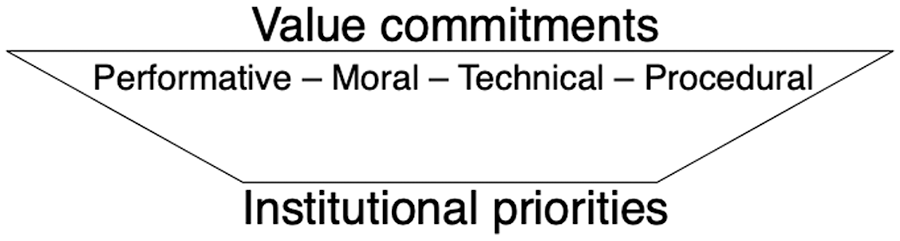
Applying Value Commitments.
Horizontal Orientation and Stakeholder Consultations
As an example of the horizontal mode of orientation, let us consider how stakeholder consultations can go from improving to impairing the accountability of a decision-making process. When appropriately institutionalized as inclusive and responsive reason-giving mechanisms, stakeholder consultations may constitute a genuine accountability practice. Ideally, they engage a broad variety of perspectives that expand the public organization’s understanding of the different aspects of an issue and the range of potentially affected interests. Some implementations of the “notice-and-comment” requirement of the U.S. Administrative Procedure Act have been favorably discussed in this regard (Mashaw 2018, 80–81).
However, consultation procedures can also be designed in ways that mask accountability deficits. This may happen when consultation procedures fail to give stakeholders an opportunity to orient themselves horizontally. For example, some organizations may perceive a tension between their duty to technical accuracy and their duty to inclusiveness. In such cases, choosing technical accuracy instead of genuine inclusiveness may appear both easiest and safest.
A study of the conditions of stakeholder input to the European Food and Safety Authority’s (EFSA) risk assessment of genetically modified organisms illustrates such a case (Kritikos 2018, chapter 5). The issue of genetically modified organisms is bound up with complex social, economic, and environmental questions that cannot be answered by microbiological standards alone (Paskalev 2017, 210). In this regard, it is significant that inclusive consultation is a basic aspect of EFSA’s commitment to legality. Its founding regulation states that there “shall be open and transparent public consultation, directly or through representative bodies, during the preparation, evaluation and revision of food law, except where the urgency of the matter does not allow it.” 7 In practice, however, the panel on genetically modified organisms operated with a framework of consultation that was too technical for the genuine participation of interest groups and stakeholders that represent a broad set of legitimate concerns (Kritikos 2018, 174–75). In other words, the decision of the panel has a political dimension that is not tracked by the consultation framework.
By not adjusting the terms of assessment to the capacities of the stakeholders, the consultation effectively disconnects the technical commitment from legal-procedural and moral commitments in a way that distorts the grounds of accountability. The consultations are conducted on predefined and narrow technical grounds that cannot genuinely expand the understanding of the issue. This shows how lack of horizontal integration of the technical commitment with the other commitments leaves the policy-making process partly unaccountable. Confining the process to an unduly narrow space of expert inquiry means that the political nature of the decision is given, at best, an implicit and nonpublic treatment. By contrast, the call for horizontal orientation is about approaching the value commitments as interlocking sources of justificatory reasons.
A New MAD Treatment
Approaching the stakeholder procedures in the horizontal mode of orientation is the opposite of the traditionally suggested treatment for organizations diagnosed with “MAD”. This is Jonathan Koppell’s (2005) influential term for a dysfunction that results from trying to meet all kinds of conflicting expectations. The suggested cure has been to narrow the scope of accountability, based on the claim that “organizations that remain focused on one dimension of accountability . . . are likely to be MAD resistant” (Koppell 2005, 99, emphasis added). For example, it is argued that an organization cannot both be accountable for efficient performance and also for inclusive procedures (Koppell 2005, 103, 105). Instead of tracking a coherent multidimensional mandate, the suggested model is a zero-sum game. Account-holders and account-givers must allegedly choose whether to pursue a performative, moral, procedural, or technical mandate.
To delineate a positive account of the horizontal approach, let us reinterpret Koppell’s own example. The context is a situation where a public-private partnership—the Internet Corporation for Assigned Names and Numbers (ICANN)—is having a board meeting and is confronted by critics from nonprofit groups. The critics wanted more representation of noncommercial interests. The chairwoman responded bluntly: “With all due respect, we are less interested in complaints about the process [and more interested in] doing real work and moving forward” (Koppell 2005, 103). On Koppell’s interpretation, ICANN is ignoring the procedural dimension of accountability to be accountable along the performance dimension.
But once we see accountability as grounded in practices that track the multidimensional mandate, this interpretation appears misguided. It relies on the false premise that the organization can “do real work and move forward” in an accountability-relevant sense without procedures of adequate representation. The nonprofit groups in Koppell’s case wanted to know what reasons supported ICANN’s business-backed policy for cracking down on “cybersquatting.” 8 This request appears to track ICANN’s mandate. At the time, the effective bylaw stated that ICANN “shall operate to the maximum extent feasible in an open and transparent manner and consistent with procedures designed to ensure fairness.” 9 This places a substantive constraint on what it means for the organization to move forward; “getting things done” is not sufficient. Things must be done for publicly accessible and democratically acceptable reasons.
As part of the interpretive test, the criterion of horizontal orientation robs account-givers and account-holders of certain justificatory strategies. In particular, given that public organizations typically work with complex and contested issues, there is no “real work” to be done independently of adequate process. Such appeals to performance fail to express a competent good faith attempt to respect the mandate as an integrated normative framework.
Vertical Orientation and Performance Management
The vertical mode of orientation is about seeing how concrete practices align with high-level goals (ultimately value commitments). This makes public organizations answerable to a goal structure that has analogies in ordinary intentional action. Goals, as they typically figure in practical reasoning, are not adopted in isolation but are rather “nested” in complex hierarchical structures (Raz 1986, 292). For example, my goal of jogging today is nested in a goal of getting regular exercise, which is in turn part of a general plan of a moderately healthy lifestyle, which is a broader idea that includes a variety of considerations. Similarly, for organizations, the goal of having a plurality of stakeholders represented at a meeting may be nested in the broader goal of realizing a stakeholder engagement strategy, which may in turn be a response to the goal of unbiased decision making or, even more abstractly, the goal of “good governance.”
To some extent, the need for vertical orientation has already been expressed in assessments of accountability practices. A particularly explicit example is Thomas Schillemans and Madalina Busuioc’s (2014) critical observation that “principals may delegate tasks without accompanying goals, essentially leaving it to the agents to come up with goals for their actions” (Schillemans and Busuioc 2014, 199, emphasis in original). This essentially amounts to negligence in preparing the ground for a genuine accountability relationship. High-level goals endow actions with a public meaning and provide standards for reason giving. Without nesting concrete tasks in high-level goals, there is not much for an accountability practice to track. There is no public evaluative framework for assessing the normative judgments of officials.
A more implicit call for vertical orientation pervades criticism of the “performance management” movement. The past three decades have witnessed an international trend of imposing varieties of more or less standardized performance indicators on public organizations (Pollitt 2018). Ideally, performance management enhances accountability by making organizations subject to publicly accessible goals (Heinrich 2002, 722). In practice, however, a problem with some versions is that they lead to “gaming,” understood as the practice of “hitting the target but missing the point” because “what is measured is what matters” (Bevan and Hood 2006; see also Molander, Grimen, and Eriksen 2012, 224). This provides an example of a mode of control where instruments that monitor aspects of day-to-day activities have a tendency to become detached from higher level goals.
In this regard, Beryl Radin (2006) has criticized the performance movement for its failure to respect the need for professional judgment when complex goals are pursued. As she notes, “Much of what has been devised in the name of accountability actually interferes with the responsibilities that individuals in organizations have to carry out work and to accomplish what they have been asked to do” (Radin 2006, 7). One of her useful examples concerns the way U.S. government bodies end up spending their time satisfying outcome measures as specified by Office of Management and Budget (OMB) in ways that conflict with the broader and more complex goals expressed by Congress. In particular, she describes how the Office of Research and Development of the EPA is pressured to comply with standardized criteria that are not experienced as appropriate for the research programs in question (Radin 2006, 116–17). In effect, the budget of the research programs depends on factors that are seemingly external to their politically delegated mission. This means that the OMB has powerful influence over this ostensibly science-based branch of government, but it hardly means that the research programs have become more answerable to their mandate.
The notion of vertical orientation helps illuminate the conditions that would make performance management into an accountability practice that tracks the mandate. The basic criterion is that specific indicators are sufficiently aligned to the overarching goals of the organization. Performance management does not enhance accountability unless it proceeds from a competent, good faith attempt to understand how the organization’s tasks are nested in broader commitments. In light of this criterion, it would distort the matter to claim that the EPA must choose whether it will be accountable to the performance audit designed by the OMB or the goal-setting politicians. Although it may be strategically prudent, there is no accountability in pandering to mandate-insensitive expectations.
Note that this does not imply that the EPA interpretation of the mandate is immune or self-validating. That is, the allegation that the OMB has not calibrated its expectations to the real mission of the research programs is not true simply in virtue of conflict between the organizations. In general, the mere fact that performance management is experienced as annoying and dispiriting red tape does not disqualify it as an accountability tool. While control instruments that crowd out or reduce “public service motivation” may sometimes indicate mandate insensitivity on the part of account-holders, the reverse can also be the case; public service motivation on the part of account-givers may have evolved to a political commitment that is not compliant with the delegated mandate (Gailmard 2010, 41–43). In other words, clashes may be a healthy sign of an accountability system that enforces responsiveness to legitimate input and protects the value commitments of the mandate.
This relates to a general point about both horizontal and vertical orientation; mandate interpretation is an institutionally distributed process that unfolds across disputed jurisdictional boundaries. In this regard, the current approach is not averse to seeing the mandate as a dynamic object, where processes of interinstitutional reasoning set precedent or provide authoritative guidance for future mandate interpretation. When the parties participate in good faith and with the required interpretive competence, accountability becomes means to embed the reasoning of a particular organization in the broader practice of democratic reasoning. 10
Three Objections
This section anticipates three objections that are valuable because of their potential to clarify the meaning and significance of the approach developed above.
The Demandingness Objection
Some might worry that an overly demanding picture has emerged. Can we expect participants in accountability practices to comprehend both how abstract value commitments are intertwined and how these commitments ground complex goal structures? In terms of individual interpretive capacities, accountability may appear to require someone like Ronald Dworkin’s (1986, 239) Hercules, the judge with “superhuman intellectual power and patience.” That would of course be an unfortunate result. Clearly, the call for both horizontal and vertical orientation must be constrained by considerations of feasibility and efficiency.
However, no Herculean effort is required by the suggestion here. First, requiring mandate-sensitivity is not the same as demanding full comprehension of the mandate. The demarcation criterion is that practices express a reasonable (i.e., competent and good faith) interpretation of the mandate. What constitutes reasonable interpretation depends on what it is appropriate to expect of the actors given the gravity and complexity of the issue. Second, accountability is ultimately achieved by a coherent accountability system. The current approach does not reject—it rather presupposes—a division of labor between different accountability forums. Hence, tracking the mandate does not require that all account-holders maintain an equally scrutinizing focus in all directions.
For example, close parliamentary scrutiny of all agency instruments and decisions would be drain resources in an inefficient manner. In terms of strategies for economizing attention, there is nothing inherently wrong with so-called “fire alarm” supervision triggered by important events, as opposed to “police patrol” oversight of ongoing process (McCubbins and Schwartz 1984). However, the aspects that are eventually assessed must be approached in a mandate-sensitive manner. Criticism of agencies in light of fire alarms, sounded by nongovernmental organizations (NGOs) or the media, lacks credibility if it comes across as in the service of some end that is external to the overarching mandate. Consider, for example, the idea that parliaments should invite private interests to comment on agency proposals, thereby passing cost of information collection on to the private sector (Hix 2000, 76). This may indeed be a useful tool for economizing attention, but it does not serve accountability unless the parliament translates the worries of the private sector to a more generalized perspective on the common good and sensitivity to the multidimensional mandate of the agency.
The Separation of Powers Objection
Despite resting on a principled division of labor between account-holders, some might worry what the current approach implicitly licenses in terms of second-guessing the work of public organizations. The claim that account-holders, as well as account-givers, must orient themselves horizontally and vertically in the mandate may appear as an invitation to blur organizational boundaries. Is the suggestion that every account-holder is free to impose consequences if it disagrees with substantive policy issues that have been entrusted to the account-giver? This would not only amount to a fundamentally unpredictable way of demanding reasons and imposing consequences, but in some cases a constitutionally troubling breakdown of the division of labor between political, legal, and executive institutions.
However, accountability as answerability to mandate is actually designed to uphold legitimate divisions of labor. The approach highlights that insofar as the account-holder only possesses isolated or noncontextual measures of organizational behavior, accountability is not served by linking these measures to consequences. In this regard, mandate orientation enables account-holders to recognize their own boundaries, and, in particular, the ways in which uncalibrated control instruments can distort conditions of mandate compliance. Hence, taking the mandate seriously entails high threshold for second-guessing or overriding the work specifically entrusted to specialized public organizations.
The issue of deference has long been an issue in administrative law, with cases such as Chevron 11 in the United States, and more recently Gauweiler 12 in the EU, having spawned a large legal literature on the interpretive authority of courts and the scope of judicial review of administrative decisions (e.g., Mendes 2019; Merrill and Hickman 2001). The current approach suggests that we should extrapolate the issue of deference to other modes of review and auditing. For example, consider the increasingly popular notion that “competition” is a form of accountability (Peters 2010, 214). One version makes the allocation of funds contingent on the competitive results between comparable agency programs (Organisation for Economic Co-operation and Development 2018, 7). Presumably, such quasi-market arrangements make organizations more responsive to the kinds of results that are measured. But the approach developed in this paper calls for hesitancy in seeing this as an accountability practice. Are the measures appropriately aligned the broader mandate in terms of both horizontal intertwinement of dimensions and hierarchical nesting of goals? If not, then making the budget contingent on competition is either a distortion of the conditions for mandate compliance or, if the procedure is backed by relevant principals, a de facto redesign of the mandate.
The Neutrality Objection
In terms of an analytical framework, the proposal of an interpretive test for identifying accountability practices may trigger a different objection among those who see themselves as engaged in descriptive rather than normative studies. Some analysts would perhaps rather stick with an all-inclusive concept of accountability instead of adopting the proposed demarcation criterion because they would like to keep the concept free of controversial evaluative judgment. Is that a good reason to reject the current proposal?
It would be a good reason if the proposed demarcation criterion involved usurping political or first-order administrative questions of institutional design. The analytical concept of accountability should certainly be kept distinct from substantive conceptions of how accountability should be institutionalized in particular cases. People will reasonably disagree on whether specific practices are ideally suited to gain relevant oversight.
Nevertheless, subjecting practices to the interpretive test is not about aligning accountability with any detailed or comprehensive conception of what organizations should be doing. The standard of a reasonable check on fidelity to mandate allows for suboptimal outcomes of many kinds. For example, a review can rely on a faulty understanding of regulatory principles such as proportionality or precaution, but it may still be recognizable as a practice guided by answerability to the mandate. By contrast, we are not simply speaking of reasonable errors of judgment when practices are best captured in terms such as “cherry picking,” “blame avoidance,” “deck stacking,” or “publicity stunts.” These terms allude to ways in which institutional mechanisms are used strategically and at best contingently related to the mandate.
In any case, analysts hardly tend shy away from making normative judgments. Rather, they sometimes set deeply evaluative diagnoses of the problem in ways that obscure the solution. As noted in the introduction, terms such as “accountability overload” or “accountability overkill” are appealed to in order to argue that organizations are “too accountable.” Apparently, the message to decision makers is that public organizations should have more autonomy and be held less accountable. But the presence of an overload of mission-insensitive management tools may reveal little or nothing about whether trust in organizations is warranted. Arbitrariness—that is, nonpublic reasoning—may thrive in a system where organizations compete through control mechanisms to secure their own power. But the very point of accountability is to prevent arbitrariness. The idea of tracking the multidimensional mandate is an attempt to articulate how accountability can serve this function.
Recapturing the Value of Accountability
To connect this more clearly to current academic trends, it is worth highlighting how the response to the neutrality objection speaks directly to the foundation of an alternative and increasingly popular accountability perspective, namely the “reputational approach.” In constructing this approach, Busuioc and Martin Lodge (2016) draw on findings that show how certain control practices negatively affect professional values, redirect attention and resources toward keeping up appearances, and skew the self-selection to professions. Against this background, accountability practices appear to be driven—on both sides of the relation—by purely reputational concerns that have nothing to do with answerability to mandate.
This leads Busuioc and Lodge to ask how accountability can be considered a “Good Thing, of which one cannot have enough” when it often results in “gaming, cheating and slacking, and a decline in moral responsibility and/or intrinsic motivation?” (Busuioc and Lodge 2016, 248). Their solution to the “Good Thing puzzle” is to deny that accountability is an inherently normative concept. They argue that it is ethically justified for account-givers to “evade (some) accountability obligations” to pursue their real mission (Busuioc and Lodge 2016, 255). But should we not rather abandon the idea that all forms of control mechanisms are accountability practices?
It is significant that the “Good Thing puzzle” is construed by including all kinds of external demands in the category of accountability practices. The broad palette of management tools—from perfunctory paperwork procedures to mission-insensitive performance indicators—is subsumed under the accountability label in an indiscriminate fashion. But this stands in tension with Busuioc’s (2013, 254) valid point, quoted in the Background section, that certain practices are introduced in the name of accountability but are in reality detracting from it.
A couple of examples from Busuioc’s own work on EU agencies provide clear illustrations of how the procedures they have in mind can fail the interpretive test in virtue of lacking horizontal and vertical integration. First, the oversight practices of parliamentary committees are said to be driven at times by an exclusive focus on mediatized and politicized issues, taking little account of their place in a larger goal structure: “By remaining confined only to certain aspects, accountability tends to be a bit patchy and not geared towards the ‘broad picture’” (Busuioc 2013, 133).
13
Second, the agencies spend on average 30 percent of their staff resources on administrative tasks—and some more than 50 percent—due to extensive audit requirements: Most agencies are subject to the same financial oversight and cumbersome procedures as the European Commission: internal audit by the IAS [Internal Audit Service of the European Commission] (often in parallel to an additional layer of internal audit, IAC [Internal Audit Capability]), external audit by the Court of Auditors and a complex discharge procedure before the European Parliament. (Busuioc 2013, 189)
In the absence of a demarcation criterion, such practices may indeed cast doubt on the value of accountability: Why do we need to make technical agencies responsive to politically slanted forums? What is the point of having an abundance of auditing practices that perform overlapping functions and apply standardized procedures regardless of agency size or work? The barrage of overlapping and overly cumbersome financial oversight mechanisms that Busuioc identifies appear out of proportion with any reasonable concern to check fidelity to mandate. However, the gravity of such disregard for agency performance is obscured by describing it as an accountability practice.
As demonstrated in the discussion of different ways to hold stakeholder consultations and set performance indicators, the goal here is not to reject any specific kind of procedure. In many cases, one and the same procedure can serve accountability as well as contrary purposes. In principle, what appears to be empty and impractical box-ticking routines for the oversight of one organization may be highly relevant for preventing arbitrariness or dereliction of duty in another. However, the use of mechanisms has to be subjected to an interpretive test to know whether they are about accountability. As suggested above, the test is whether they can be read as a reasonable check on fidelity to the mandate.
Conclusion
It has become a commonplace that accountability is essentially about managing expectations and securing reputational standing. This article has argued that such approaches fail to demarcate accountability practices from strategies that pursue nonpublic aims. Procedures such as formalistic audit exercises and politicized hearings will often fail to track the mandate and therefore have little relation to the core sense of accountability as an obligation to explain and justify how goals have been pursued. A battery of misguided practices cannot amount to an “accountability overload” or make public organizations “too accountable.” It may be true that practices with plainly detrimental effects on organizational missions are continued for their reputational benefits, but that should not generate a puzzle as to why accountability is considered a good thing.
However, the idea of accountability of answerability to mandate may sound naïve to those who emphasize the conflicting considerations to which agencies are subjected. In light of a “myth of the mandate” charge that is implicit in the literature, this article has sought to defend the demarcation criterion by providing a new model of organizational mandates. The multidimensional model emphasizes the interrelatedness of commitments and the nested structure of goals that ground legitimate decision-making processes. Accountability practices are about competent, good faith attempts to track an intelligent application of different kind kinds of considerations. This demarcation criterion requires us to rethink the conceptual and normative conclusions drawn from analyses that highlight the more problematic features of control regimes.
Footnotes
Acknowledgements
Three reviewers for the journal raised a series of important issues that contributed to a host of improvements. The paper has also benefited from comments by Erik Oddvar Eriksen, Torbjørn Gundersen Alexander Katsaitis, Johan P. Olsen, and Vesco Paskalev. Various drafts were presented at a TARN workshop in Brussels, a REFLEX workshop in Oslo, and the Gothenburg-Oslo-Århus Workshop in Political Theory in Oslo. I am grateful for all the feedback, especially the prepared comments by Kim Angell, Christopher Lord, Michelle Everson, Martin Weinrich, and the anonymous review for the TARN working paper series.
Declaration of Conflicting Interests
The author(s) declared no potential conflicts of interest with respect to the research, authorship, and/or publication of this article.
Funding
The author(s) disclosed receipt of the following financial support for the research, authorship, and/or publication of this article: This research is part of the project Democracy and Expert Rule: The Quest for Reflexive Legitimacy (REFLEX) funded by the Norwegian Research Council’s Top research program (grant number 250436).
