



Abstract
The purpose of this study was to examine where students with or at risk for emotional and behavioral disorders (EBDs) were placed in K–3 grade classroom seating assignments over time and the relation between classroom seating placement and peer-reported reputations of these students. Specifically, we investigated how proximity to the classroom teacher’s desk and isolation from peers influenced peer perceptions. Results revealed variability in seat distance from the teacher’s desk and that approximately half of the students were assigned a seat in isolation from their peers. Seat isolation was significantly associated with more negative peer-reported reputations, including increased nominations for fighting and giving the teacher a hard time, while reducing nominations for being nice and cooperative. Conversely, distance from the teacher’s desk showed no statistically significant associations with peer reputation. These preliminary findings highlight the potential importance of classroom seating placement in shaping the social experiences of students with or at risk for EBD. Implications for classroom management practices and future research are discussed.
Elementary students who exhibit externalizing behavior challenges, characterized by persistent noncompliance, impulsivity, aggression, and disruption, often face significant social challenges within their peer relationships (e.g., Chow et al., 2023; Granger, Chow et al., 2025a; Parker et al., 2015; Sturaro et al., 2011; Useche et al., 2014). The majority of these students, described in the research literature as with or at risk for emotional and behavioral disorders (EBDs), exhibit challenging behaviors but may not always be formally identified with emotional disturbance or receive Individuals with Disabilities Education Act (IDEA)-based support (Forness et al., 2012). As a result, these students are primarily educated in general education classrooms. Within these settings, students with or at risk for EBD are at a heightened risk for experiencing peer victimization, rejection, isolation, and negative peer influence (Chow et al., 2023; LoParo et al., 2023; Prinstein & La Greca, 2004; Sturaro et al., 2011; Useche et al., 2014). These social challenges may also include peer exclusion and bullying (e.g., Hawker & Boulton, 2000; Reijntjes et al., 2011). Students who experience negative social interactions may miss out on opportunities to engage in critical developmental processes that positive social interactions bring (e.g., perspective-taking, developing social competence, and enhancing moral reasoning), with long-term implications for both academic and social outcomes (Rubin et al., 2015). Given that up to 12% of students exhibit moderate EBD-related challenges and up to 20% have at least mild EBD-related challenges (e.g., Forness et al., 2012), examining classroom-based supports that may influence the social experiences of these students is an important goal.
Classroom seating arrangements may be an impactful yet overlooked tool for shaping the social outcomes of students with or at risk for EBD. Elementary classrooms provide a structured environment where students often spend time in teacher-assigned seating placements near a subset of their peers. Peer proximity in classroom seating arrangements influences student interaction patterns, the development and maintenance of friendships, and individual student behavior through mechanisms like social learning and peer influence (e.g., Braun et al., 2020; Faur & Laursen, 2022; Van den Berg et al., 2012). In intervention studies, a student’s intentional placement near prosocial peers has shown promise in mitigating externalizing behaviors and improving peer acceptance (Van den Berg & Stoltz, 2018).
However, little is known about where teachers typically place students with or at risk for EBD in classroom seating arrangements and how these naturally occurring placements influence the social experiences of these students. This is important to consider because teachers often arrange classroom seating to address behavioral or academic needs and may unintentionally contribute to the peer experiences of this group of students. The current study begins to address this knowledge gap by providing a descriptive analysis of the classroom seating placements of elementary students with or at risk for EBD over the course of a school year. This pilot work examines how these students are assigned seats in relation to their peers and the teacher’s desk. In addition, this study explores the potential connections between these seating placements and peer-reported behavioral reputations of students with or at risk for EBD. Findings from this initial step in this ongoing line of research are intended to provide insights into how classroom seating arrangements may be leveraged to support positive peer interactions and reduce social isolation for this population of students.
Theoretical Framework
To frame this investigation, we draw on Social Reference Theory which emphasizes the implicit messages that can be conveyed through social cues by authority figures, such as teachers, within a group setting (Bandura, 1992). In the classroom, teachers act as central figures whose decisions and actions establish social norms and expectations for behavior (Farmer et al., 2011). One of the highly visible ways these messages may be communicated is through the physical placement of students within the classroom. Seating assignments may serve as a social signal that influences how students are perceived by their peers. For example, assigning a student to a seat near the teacher’s desk may signal that the student requires closer monitoring or support. While this decision may be intended as a behavior management strategy, it may unintentionally reinforce negative peer perceptions, such as stigmatization or exclusion. Similarly, placing a student in a physically isolated seat (away from peers) may signal a lack of inclusion or a need to separate the student from the group, potentially magnifying negative reputations and reducing opportunities for positive peer interactions. This notion aligns with research demonstrating that students adjust their evaluations of classmates based on perceived teacher attitudes. Hendrickx et al. (2017) found that when students believed a teacher liked a peer, they were more likely to like that peer themselves. These findings highlight the powerful role that teachers’ implicit signals, through seating arrangements or interpersonal interactions, may play in shaping classroom social structures. This theory also provides a framework for understanding broader patterns in seating arrangements. Teachers make deliberate choices about seating assignments based on multiple considerations, such as behavior management, academic needs, and classroom dynamics. Thus, seating decisions reflect a teacher’s priorities and also convey implicit messages to students about behavioral and social expectations. For instance, inclusive seating arrangements that integrate students among their peers may encourage positive peer interactions, while seating placements that isolate students may inadvertently reinforce social barriers. We use this theory to frame the investigation of naturally occurring classroom seating arrangements, focusing on the placement of students with or at risk for EBD in relation to their peers and the teacher’s desk, as well as the potential impact of these placements on peer perceptions.
Classroom Seating Placement
In elementary school, students typically remain in the same classroom for most of the day, spending the majority of that time in designated seats. Teachers face many decisions and possibilities for arranging classroom seating. For example, they can use an arrangement in straight rows, in small groups, in U-shapes, or in flexible arrangements (McCorskey & McVetta, 1978; Wannarka & Ruhl, 2008). Prior work shows variability exists in the overall seating arrangement shapes that teachers use. For example, Gremmen and colleagues (2016) reported that many teachers (48%) divided their students into small groups in the classroom, 40% used rows, and 12% used alternative configurations. Interestingly, in a similar study of fourth-grade teachers, teachers reported making minor seating changes (e.g., switching the places of two or three children without rearranging everyone else) more frequently than major ones (e.g., rearranging the locations of half or more of the students or completely rearranging the seating format from rows to clusters) throughout the year (Steggerda et al., 2023). Teachers must also make choices about the exact position of each student within a seating arrangement. The rationale for these placements is complex, as teachers must consider a range of factors, including the class roster, physical space, academic concerns, and behavior management, among others (Gremmen et al., 2016; Van den Berg & Stoltz, 2018; Wannarka & Ruhl, 2008). Gremmen and colleagues (2016) interviewed teachers to gain in-depth information about what they considered important when creating classroom seating arrangements. Teachers reported that creating a seating arrangement was very challenging and mentioned between 2 and 19 considerations, indicating variation between teachers. Indeed, prior work shows that some teachers prioritize academic needs by grouping students with similar or diverse skills (30.9%), while others focus on physical needs such as auditory/visual concerns (16.3%), social relationships (12.9%), or classroom management (16.8%; Gremmen et al., 2016; Hoekstra et al., 2023; McKeown et al., 2016; Van den Berg & Stoltz, 2018; Wannarka & Ruhl, 2008). Other studies have found that behavioral needs were the highest priority for teachers when considering how to assign classroom seating. Gest and Rodkin (2011) asked teachers to rate several student seating grouping strategies based on their importance. They found that separating students with behavior problems was an important consideration for most teachers in addition to promoting new friendships and academic diversity. In some cases, teachers reported separating students with externalizing behaviors from their peers to reduce disruptions, and others strategically placed these students near the teacher to increase supervision and support (Hoekstra et al., 2023). Kim and colleagues (2020) also found that behavioral problems were the most important consideration, whereas promoting both existing and new friendships was considered the least important. Together, these findings suggest that teachers have various considerations when creating a seating arrangement and that they use them to manage and address the needs and relationships of individual children as well as the group.
There is empirical research on the effects of classroom seating on students’ social development (e.g., McKeown et al., 2016; Schwebel & Cherlin, 1972). First, seating chart placement is associated with friendship formation (e.g., Kim et al., 2020). To illustrate, Gest and Rodkin (2011) explored whether elementary teachers’ beliefs about seating changes were associated with classroom peer dynamics. Their findings showed that teachers who prioritized fostering new friendships through seating changes tended to have more egalitarian classroom structures (i.e., classrooms where friendships are more evenly distributed among students rather than concentrated within specific cliques or status hierarchies). However, this approach was also associated with lower friendship reciprocity. Researchers hypothesized this may be because newly formed friendship networks may not have had sufficient time to stabilize. Seating chart placement is also shown to influence social status and peer acceptance. Students who sit closer to the center of the room tend to be perceived as more likable and popular, and proximity between classmates is associated with stronger social ties (Van den Berg & Cillessen, 2015). Furthermore, separating seats of aggressors and victims has been associated with reduced aggression and victimization (Troop-Gordon & Ladd, 2015).
Researchers have also begun to explore whether intentional changes in classroom seating arrangements can enhance students’ social adjustment and peer relationships. Several studies have examined the impact of seating proximity on peer dynamics, often by strategically placing students who initially disliked each other or exhibited externalizing behaviors near well-liked or prosocial peers (Braun et al., 2020; Van den Berg et al., 2012; Van den Berg & Stoltz, 2018). Findings suggest that seating students closer to those they initially disliked can increase mutual likability and reduce peer victimization and social withdrawal over time (Van den Berg et al., 2012). Similarly, assigning students with externalizing behaviors to sit next to prosocial classmates led to improved behavior and increased likability for the target students, although it sometimes negatively affected the status of their peers (Van den Berg & Stoltz, 2018). However, a broader implementation of such interventions revealed mixed results, although some students benefited, others exhibited increased overt aggression and lower cooperation (Braun et al., 2020).
It is clear that growing evidence suggests seating arrangements are a powerful yet underexplored tool for classroom management and for shaping students’ social experiences. To our knowledge, studies have yet to examine these effects in samples of students identified through systematic screening as having or being at risk for EBD, a student group particularly vulnerable to negative developmental outcomes linked to their behavioral patterns. Specifically, we do not currently know where teachers naturally choose to place students with or at risk for EBD; if they are placed closer to the teacher’s desk, isolated from peers, or integrated into the classroom in ways that could support or hinder their social development. This gap is significant, as teachers’ seating decisions may unintentionally reinforce social marginalization or, conversely, provide opportunities for positive peer interactions. It is possible that these decisions exacerbate marginalization or are a uniquely strong catalyst for positive peer experiences for students with EBD. Understanding these patterns could inform interventions that leverage seating arrangements as a tool for improving peer relationships and reducing the social disadvantages faced by students with or at risk for EBD. By focusing on the impact of student placement, this study extends prior research and explores the extent to which classroom seating may be a tool for fostering inclusion and behavioral improvement.
Peer Behavioral Reputation and Seating Placement
Peer reputation refers to the group’s shared perception of an individual in a social context and is typically assessed through sociometric measures. In these assessments, all consenting students in a class are asked to nominate classmates who match a given description (e.g., “Kids who give the teacher a hard time”). A student’s reputation is determined by the frequency with which classmates nominate them for a specific description, relative to the total possible nominations (e.g., Hughes et al., 2009). Previous research indicates that students can differentiate between their classmates’ behavioral characteristics (e.g., Gest et al., 2006). It is important to distinguish peer reputation from social standing (e.g., popularity) or peer preference, which reflects liking and disliking (e.g., peer acceptance or rejection). A behavioral peer reputation specifically refers to a student’s relative position within a peer group based on how their behavior is perceived by classmates (e.g., “Kids who start fights” or “Kids who are nice to others”; Coie et al., 1982).
Educators and researchers should be aware of peer reputations for several reasons. First, peer reputations can influence how students perceive themselves and behave, as well as affect how their peers engage with them (Gest et al., 2005). Second, students who have difficulty forming positive peer relationships are at greater risk of disengagement, lower academic achievement, and school dropout (Buhs et al., 2006; Risi et al., 2003; Wentzel et al., 2021). Moreover, challenges in peer interactions can negatively impact the overall classroom environment, influencing learning outcomes for all students (Flook et al., 2005; Stormont, 2001). Third, peer reputations are strongly linked to long-term trajectories. For instance, a study of 612 students in Grades 3 through 6 found that children with a reputation for aggression or disruptive behavior were more likely to face academic and career challenges later in life (Gest et al., 2006; Realmuto et al., 1997).
A limited number of studies have explored peer-reported behavioral reputations of students identified with or at risk for EBD. A widely recognized study by Farmer and Hollowell (1994) analyzed how peers assessed the social and behavioral traits of 20 students in Grades 3 through 6 who were receiving special education services for emotional and behavioral challenges. Peers nominated classmates who fit the following characteristics: Cooperative, Starts Fights, Popular, Athletic, Disruptive, Leaders, Good at schoolwork, and Shy/Withdrawn. Results revealed boys with an EBD classification, who were receiving special education services, were rated significantly higher on Starts Fights, Disruptive, and Aggressive behavior compared to boys in all other classifications (i.e., learning disabilities, academically gifted, and general education) and were rated significantly lower on Cooperative behavior compared to academically gifted boys. More recently, the peer reputations of 26 K–3 grade students with or at risk for EBD were compared with their classmates at two time points during the school year (Granger, Ross et al., 2025b). Results revealed that focal students had poorer behavioral reputations among the domains of Starts Fights, Says Mean Things, Nice, Cooperating, and Giving the Teacher a Hard Time and that these reputations were stable over time. Interestingly, there were no differences between focal students and their classmates for the reputation of being Picked On.
Previous research has also used teacher reports to develop student behavioral profiles and examine differences in peer reputations across these profiles (Farmer & Hollowell, 1994; Realmuto et al., 2000; Rodkin et al., 2000). For instance, Farmer and colleagues (1999) identified teacher-reported behavioral profiles of elementary students with and without mild disabilities. Of particular relevance to the present study are profiles of boys and girls who exhibited above-average levels of aggressive behavior. These profiles included “Bright Antisocial Boys,” “Troubled Boys,” “Tough Boys,” “Extremely Troubled Boys,” “Troubled Girls,” “Bright Antisocial Girls,” and “Unruly Girls.” Findings showed significant differences in peer-reported behavioral reputations across these profiles. For example, boys with disabilities in the “Bright Antisocial,” “Troubled,” and “Extremely Troubled” profiles received significantly more antisocial nominations than did “Model” boys with disabilities. Overall, this research suggests that students with or at risk for EBD often develop negative behavioral reputations, which, if unaddressed, may remain stable throughout the school year.
Peer behavioral reputations of students with or at risk for EBD may be partially informed by where these students are assigned to sit in their classroom. Because seating placements determine students’ proximity to both peers and authority figures, placement may influence the frequency and nature of students’ social interactions, as well as the implicit messages peers receive about a student’s behavioral role in the classroom. Placement near the teacher’s desk, for example, may signal that a student requires additional supervision, which could reinforce perceptions of the student as needing control rather than as a valued classmate. Likewise, physical isolation from peers, whether intentional or incidental, may limit opportunities for positive peer interactions and increase the likelihood of being perceived as socially disconnected or disruptive. Importantly, seating arrangements may also provide opportunities for positive socialization when students with EBD are placed near prosocial classmates who can model appropriate behaviors. However, without intentional efforts to structure interactions in a way that fosters inclusion, seating arrangements may inadvertently reinforce preexisting peer perceptions.
Present Study
This pilot study aimed to examine the naturally occurring seating placements of students with or at risk for EBD in early elementary classrooms and the extent to which these placements are associated with peer-reported behavioral reputations. Given that students with or at risk for EBD are at an increased risk for peer rejection and social isolation, understanding how seating arrangements contribute to their social experiences is a critical area of inquiry. Despite existing research highlighting the influence of peer proximity in seating charts on social development, little is known about how teachers position students with or at risk for EBD in relation to their peers and the teacher’s desk over time, or how these placements may shape peer perceptions. The present study is designed to address three key research questions:
What are the patterns of seating placement for students with or at risk for EBD in relation to the teacher’s desk, and to what extent do these placements vary throughout the school year?
What are the patterns of seating placement for students with or at risk for EBD in relation to their classroom peers, and to what extent do these placements vary throughout the school year?
As an exploratory analysis, we examine the extent to which (a) the distance between a student’s assigned seat and the teacher’s desk and (b) being seated separately from peers are associated with the peer-reported behavioral reputations of students with or at risk for EBD.
Method
Setting and Participants
Teacher and student participants were recruited from six urban elementary schools in a Mid-Atlantic state. The mean number of students per school was 471 (SD = 115.84) and consisted of predominantly African American students (65%) from a low-income community (66% qualified for free and reduced-price lunch). The present study includes teacher and student participants from a comparison condition who were part of a study aimed at testing an intervention designed to address the needs of young students who demonstrate persistent and intensive challenging behaviors in classroom settings. This intervention provided teacher training and coaching on evidence-based practices shown to reduce student problem behaviors and increase high-quality teacher–student relationships. Teachers were randomly assigned within grade and school to the intervention or a business-as-usual comparison condition. Teacher reports on seating charts and student behavior were collected in the fall and peer nominations occurred in the winter. All study activities were approved by the district and university human participants’ protection boards.
Teachers
Teachers were eligible for inclusion if they met the following criteria: (a) taught in Grades kindergarten to Grade 3, (b) had at least one student in their classroom who met the study’s criteria for being at risk for EBD based on systematic screening procedures (described in the student screening section below), and (c) consented to participate. The present study includes nine teachers who participated in the comparison condition. All participating teachers were female. Four teachers taught in first grade, three teachers taught in second grade, and two teachers taught in kindergarten. Most were White (55.6%) or Black (33.3%), and 11.1% were Native American/American Indian. The majority of teachers were non-Hispanic/Latino (89%). All had a bachelor’s degree (44%) or master’s degree (56%). Teachers ranged in age, with nearly 67% of teachers between the ages of 26 and 35 years, 11% between 18 and 25 years, 11% of teachers between 45 and 55 years, and 11% of teachers over 55 years. Years of teaching experience ranged from 2 to 22 years; on average, teachers had 6.56 years of teaching experience (SD = 6.09). As a part of the larger study, teachers were given US$500 for their participation.
Focal Students
Teachers selected one to three focal students in their classrooms. Teachers were limited to three participating focal students per classroom due to study resources and funding. Students who met the following criteria were eligible for participation: (a) the student was enrolled in a participating teacher’s classroom, (b) the student exhibited externalizing behaviors that interfered with participation in the classroom as indicated by the Systematic Screening for Behavior Disorders (SSBD; Walker et al., 2014), and (c) the student had parental/guardian consent to participate. In addition to caregiver consent, student assent was obtained for all students capable of providing it, following age-appropriate procedures approved by the institutional review board (IRB). Assent was sought after explaining the study’s purpose and activities in a developmentally appropriate manner, and students who declined participation were not included. This pilot study included 17 students with or at risk for EBD (focal students) who participated in the comparison condition. Focal student sample demographics included 77% African American/Black, 6% White, 16% Multiracial, and 18% Hispanic/Latino. The majority of participating focal students were male (82.4%).
Classmates
After teachers selected one to three focal students in their classrooms, teachers sent home consent forms to all classmates to participate in peer nomination interviews with study staff (detailed below). The present study sample included 72 classmates across nine classrooms. Classmate sample demographics included 43.1% African American/Black, 16.70% White, 1% Asian/Pacific Islander, 9.7% multiracial students, and 26.4% of students were Hispanic/Latino; the remaining percentage was unreported. Approximately half of the participating classmates were female (50%; gender was missing for 2.8% of the student sample).
Measures
Child Screening
Obtaining caregiver consent and screening of student participants began approximately 1 month after the beginning of school. To determine eligibility for participation, teachers nominated up to five students who engaged in chronic externalizing problem behavior. Caregiver consent was then obtained, and systematic screening for the risk of EBD took place using the SSBD (Walker et al., 2014). The SSBD is a three-stage multigate screening system designed to proactively identify students who are at risk of negative developmental outcomes associated with their behavior patterns. The first two gates of this tool combine teacher ratings of the frequency and intensity of student adjustment problems in school. The third gate includes trained observer ratings of students’ behaviors and is used to refer students for possible disability support according to federal and state special education guidelines (Walker et al., 1990). Given the scope of the intervention, only the first two stages of the tool were used to identify focal students. Both stages exhibit strong psychometric properties (see Walker et al., 2014). Students were screened in under a modified assessment of risk that included scoring raw data across four scales and applying risk criteria to the scores to identify students at risk of externalizing behavior problems (see Walker et al., 2014 for scoring criteria). After screening, one to three students per classroom were selected to participate in the study, depending upon returned caregiver consent forms and the most elevated externalizing scores on the SSBD. In the present study, three teachers had three participating students, two teachers had two participating students, and four teachers had one participating student.
Focal Student Externalizing Behavior
Focal student externalizing behavior was measured with teacher reports on the Social Skills Improvement Rating System (SSIS-RS; Elliott & Gresham, 2008). Teachers completed this measure in the fall. Each item on the SSIS-RS is rated on a 4-point frequency scale, with responses ranging from 0 (Never) to 3 (Almost Always). These items are grouped into subscales. The subscale of interest in this study was externalizing behaviors (M =20.03; SD = 4.62; range = 6–29). Example items include “Talks back to adults” and “Acts without thinking.” For the current sample, internal consistency was acceptable for externalizing behavior with a Cronbach’s alpha of .70.
Behavioral Reputation
Behavioral reputation was collected via individual peer nomination interviews with students in the winter (Coie et al., 1982). Interviews were conducted with each student in the hallway outside their classroom, after obtaining student assent (for students ages 7 and older). Each student was asked to name students in their class who fit several behavioral characteristics. Of interest to the present study were the following characteristics:
Starts Fights: “These are the kids in my class who start fights. These kids push other kids around, or hit them or kick them.”
Says Mean Things: “These kids say mean things to other kids, and they spread nasty rumors about other kids.”
Cooperates: “These kids cooperate. Here are kids who really cooperate—they pitch in, share, and give everyone a turn.”
Picked On: “These kids are always getting picked on, being made fun of, called bad names, even hit or pushed.”
Nice: “These kids are always willing to do something nice for somebody else and are really nice people.”
Gives the Teacher a Hard Time: “These are kids that give my teacher a hard time. They don’t follow the classroom rules.”
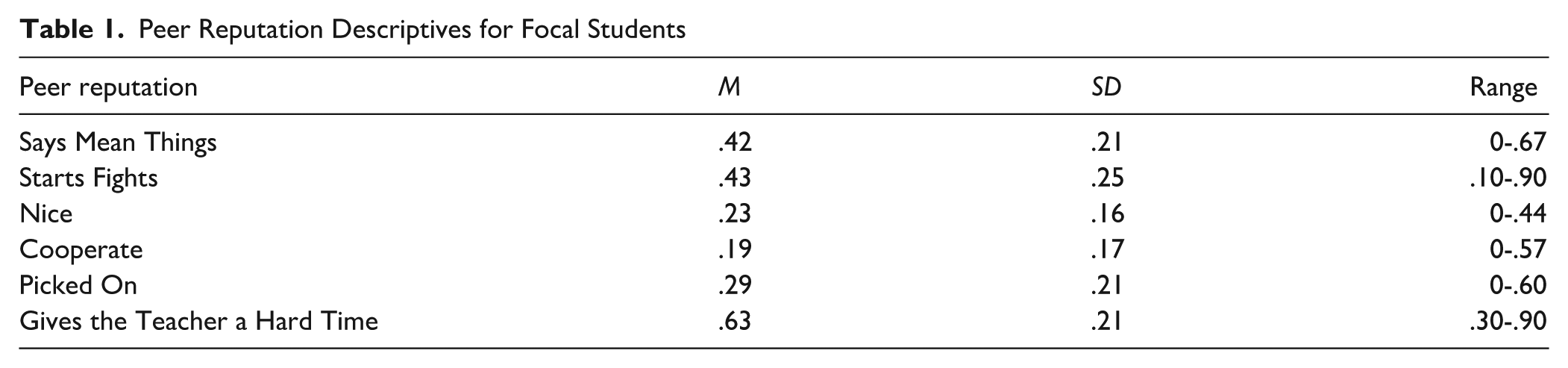
Unlimited nominations were allowed for each question. All interviewers had a classroom roster and referenced the roster with each student, and researchers provided redirection if a student named individuals outside the classroom. Per the IRB protocol in place, interviewers did not have pictures of each student but reviewed the list of names to ensure students knew the classmates referenced on the list. A few students needed to be redirected to the task, but the majority of students did not have difficulty understanding the nomination technique. These data were used to calculate behavioral reputation. Behavioral reputation is expressed as a proportion of the total received nominations on an item divided by the maximum possible number of nominations. Table 1 shows the means and standard deviations of focal students’ behavioral reputations.
Peer Reputation Descriptives for Focal Students
Classroom Measures
Seating Charts
In the fall, winter, and spring, teachers reported on their classroom seating charts by drawing their desk arrangements on a provided grid and writing the names of all consented students on their respective desks (see Figure 1 for examples). Teachers were asked to draw their default seating arrangement, defined as the arrangement (a) where students sit for most of the school day and (b) that is seen by the teacher as the default arrangement regardless of temporary rearrangements for certain activities (e.g., reading groups; Van den Berg et al., 2012). Teachers were not formally interviewed or asked to elaborate on their strategies or rationale for arranging seating. However, we did ask if the classroom seating arrangements were determined by the teachers or if students were allowed to choose their seats. All teachers stated that they made the seating arrangements and that students did not have the option to select their seats. This approach to measuring seating charts aligns with standard methodological practices (e.g., Van den Berg et al., 2012).
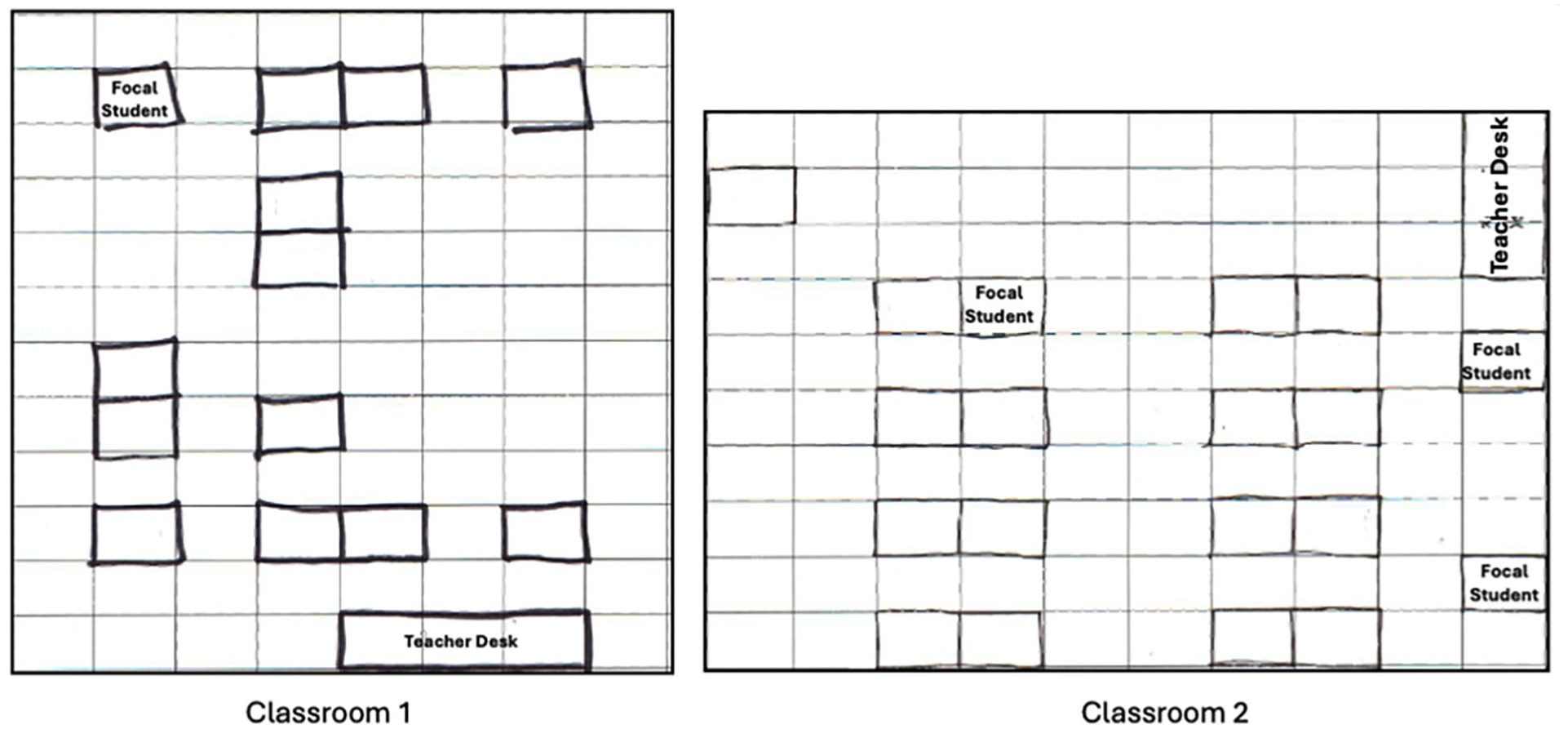
Examples of Fall Seating Assignments of Students With or at Risk for EBD
Coding Classroom Seating Distance
We calculated the physical distance between each student’s desk and the teacher’s desk following the procedure described by Van den Berg and colleagues (2012). The Euclidean distance formula was applied to calculate the distance between each student’s desk and the teacher’s desk, using coordinates from the grid system (e.g., d = √[(x2 − x1)2 + (y2 − y1)2]). Each grid square was treated as one unit, regardless of whether it represented a walkway or desk, ensuring consistency in distance measurement. Distance was measured by taking the number of grid squares between each desk both horizontally and vertically. A passageway is treated as the equivalence of the number of gridlines the teacher included in the distance calculation. This procedure can be applied to all types of seating arrangements (e.g., U Shape, Desk Clusters, Rows/Columns; see Van den Berg et al., 2012). All coding was conducted independently by two researchers to ensure reliability. Any discrepancies in coding were discussed and resolved collaboratively with the coding team and the principal investigator (PI).
To ensure comparability across classrooms of varying sizes, distances from each student’s assigned seat to the teacher’s desk were standardized. This was necessary because larger classrooms inherently have greater absolute distances, which could skew comparisons between classrooms. To calculate the standardized distance, the absolute distance from each student to the teacher’s desk was divided by the maximum possible distance in that specific classroom (e.g., the distance to the furthest seat). This resulted in a relative distance score ranging from 0 (indicating proximity to the teacher’s desk) to 1 (indicating placement at the furthest point from the teacher). This approach ensured that any observed differences were not confounded by classroom size.
Isolation
Isolation in classroom seating placement was coded based on the physical proximity of desks to one another. Specifically, a student was coded as “isolated” if their desk was not directly adjacent to any other desk in the seating arrangement. Adjacent desks were defined as those located immediately to the left, right, front, or back of the focal student’s desk. Desks positioned diagonally were not considered adjacent. This coding method captured instances where students were seated apart from their peers in a way that could limit opportunities for peer interaction. For example, as shown in Figure 1, desks labeled as “Focal Student” in Classroom 1 and Classroom 2 represent cases where students were positioned in isolation relative to their classmates. This approach ensured consistent identification of isolation across classrooms of varying sizes and configurations. To ensure reliability, all seating charts were double coded by two independent researchers. Any discrepancies in coding were discussed and reconciled to reach a consensus.
Missing Data
It is important to note that participating students were only allowed to nominate other participating students (per IRB protocol). Given these procedures, previous work has suggested that peer reputation reports may not be reliable in classrooms where less than 40% of the students participated (Marks et al., 2013). Of the nine classrooms, the peer nomination data in five classrooms (consisting of six focal students and 24 classmates) were considered missing due to less than 50% of the classmates participating in the peer nomination procedures (largely due to lower than anticipated recruitment rates related to COVID-19 protocols during the 2021 school year). Statistical tests indicated no significant differences in student grade, gender, or race/ethnicity between those classrooms with and without missing peer nomination data. To account for missing data, we fit all statistical models using the robust Full Information Maximum Likelihood (FIML) estimator, which uses each case’s available data to compute estimated values for missing data for each of the six focal students, thus retaining the analytic sample’s (N = 17) full power (Hox & Bechger, 1998).
Data Analysis
To answer our research questions, we fit a series of regression models, using Mplus 8.7, including a student’s standardized distance from the teacher’s desk and isolation from peers (measured in the fall) as predictors of peer-reported reputation (measured in the winter). We also included teacher-reported externalizing behavior (measured in the fall) as a covariate to account for individual differences in student behavior that could be related to both seating placement and peer reputations. Students with higher levels of externalizing behavior may be more likely to be seated closer to the teacher or apart from peers as part of classroom management strategies (e.g., reducing disruptions). By accounting for externalizing behavior, we aimed to better understand the potential role of seating placement in shaping peer-reported reputations while recognizing that behavioral characteristics may also contribute to these associations. We used linear regression with cluster (teacher)-robust standard errors to account for dependency of students nested within classrooms (McNeish, 2023).
Results
Preliminary Analyses
First, we conducted preliminary analyses to examine the descriptive statistics, skewness, and kurtosis pertaining to all study variables. All variables were within acceptable ranges (−3 to 3 for skewness and −10 to 10 for kurtosis) and did not require transformations (Kline, 2023).
Seating Placement Relative to the Teacher’s Desk
We examined the distance of focal students’ assigned seats from the teacher’s desk at three time points. Descriptive analyses indicated that the average standardized distance from the teacher’s desk in the fall was M = 0.66 (SD = 0.26), in the winter was M = 0.65 (SD = 0.29), and in the spring was M = 0.64 (SD = 0.32). A repeated measures analysis of variance (ANOVA) tested for differences in seating distance over time. Results indicated no significant changes in the average seating distance across the three time points, F(2, 32) = 0.067, p = .92. This suggests that, although there was some variability in seating placements over time across classrooms, the overall pattern of seating distance from the teacher’s desk remained stable throughout the school year for focal students.
Seating Placement Relative to Peers
We also examined whether focal students were seated adjacent to at least one peer or isolated from others at three time points during the school year. Results indicated that in the fall, 47.1% of focal students (8 out of 17) were seated in isolation, meaning they had no other students directly next to them. This proportion decreased to 29.4% in the winter and remained at 29.4% in the spring. These findings suggest a decline in the number of focal students who were seated in isolation after the fall, potentially indicating behavior change and increased opportunities for peer interaction as the school year progressed. However, a notable proportion of students with or at risk for EBD continued to be isolated from their classmates.
An exploratory independent samples t-test was also conducted to compare the distance from the teacher’s desk between students seated in isolation and those not seated in isolation. Results revealed no statistically significant difference in mean distance from the teacher’s desk between isolated students (M = 0.73, SD = 0.33) and non-isolated students (M = 0.61, SD = 0.25), t(15) = −0.87, p = .39. The mean difference in distance was 0.12, or approximately 12%, suggesting that although isolated students were seated about 12% farther from the teacher on average, this difference was not statistically significant.
Distance to the Teacher’s Desk and Peer Reputation
Results did not reveal significant associations between seat distance from the teacher’s desk and peer reputations (see Table 2). We also conducted a sensitivity analysis without imputation to assess the robustness of our findings. The results were consistent with the primary analyses, suggesting that missing data did not meaningfully affect the observed associations.
Regression Results Predicting Focal Student Peer Reputation from Externalizing Behavior, Distance from Teacher’s Desk, and Seat Isolation
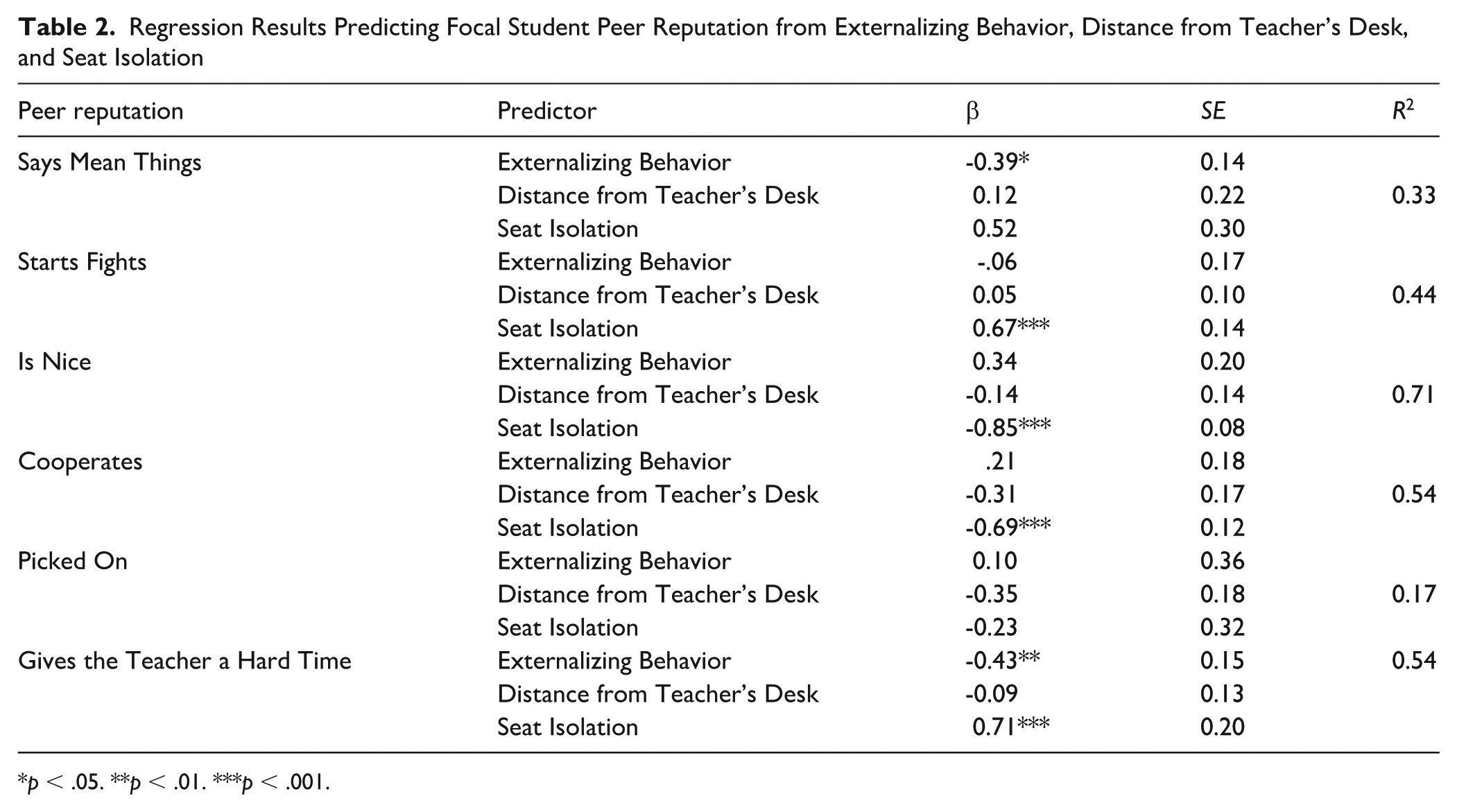
p < .05. **p < .01. ***p < .001.
Peer Isolation and Peer Reputation
Results revealed significant associations between seating chart isolation and multiple peer-reported reputations (see Table 2). Students seated apart from peers were more likely to be nominated as students who “Start Fights” (B = .33, p < .05) and for “Giving the Teacher a Hard Time” (B = .31, p < .01). In contrast, being seated apart from peers was associated with fewer nominations for “Being Nice” (B = −.28, p < .001) and for “Cooperating” (B = −.23, p < .001). Again, we conducted a sensitivity analysis without imputation, and the results remained consistent with the primary analyses.
Discussion
In this pilot study, we examined where students with or at risk for EBD were placed in K–3 grade classroom seating assignments over time and the relation between classroom seating placement and peer-reported reputations of these students. Findings suggested that although the distance of these students from the teacher remains largely stable throughout the school year, a substantial proportion of students are seated in physical isolation. Findings also provide initial evidence that physical isolation from peers may play a role in shaping the social experiences of students with or at risk for EBD in classroom settings. Although research on classroom seating arrangements is still a growing field, it is increasingly recognized as an important factor in shaping student experiences and outcomes (e.g., Gest & Rodkin, 2011; Van den Berg & Stoltz, 2018; Wannarka & Ruhl, 2008). To date, students who have been systematically screened for behavioral risk, including those with or at risk for EBD, have largely been overlooked in this work. This study represents a starting point for bringing these students into the conversation and underscores the need for further investigation into how their placement within seating arrangements influences their social trajectories. By highlighting this gap, we hope to encourage further research that examines the role of classroom seating in shaping the experiences of students with or at risk for EBD.
Classroom Seating Placement
The descriptive patterns in this pilot study indicate that students with or at risk for EBD were typically seated approximately two-thirds of the way from the teacher’s desk (standardized mean distances ranging from 0.64 to 0.66 across the school year), suggesting students were neither consistently placed immediately next to nor particularly distant from the teacher’s desk. This moderate distance remained stable throughout the school year. This pattern is surprising and raises questions about whether these placements reflect teachers’ attempts to balance behavioral monitoring with student autonomy or if placements are influenced by other factors, such as classroom dynamics or instructional needs (Gremmen et al., 2016). The stability of this pattern suggests that teachers may adopt somewhat fixed seating strategies based on early perceptions of student behavior, possibly to maintain classroom management. Although prior work suggests teachers more frequently make minor seating changes rather than major reconfigurations during the year (Steggerda et al., 2023), little research has documented longitudinal stability in individual student placements, particularly for students with or at risk for EBD. As such, our finding that focal students’ proximity to the teacher remained largely stable represents a novel contribution to the literature. Future work should examine teachers’ rationale for placing students with or at risk for EBD at particular distances from their own desks. Qualitative methods, such as interviews or focus groups, in which teachers are shown visuals of their seating chart placements across the school year, could facilitate discussions and insights into how and why teachers choose seating placements for these students. Although Hoekstra et al. (2023) did not focus specifically on students with EBD, their interviews with upper elementary school teachers revealed that teachers seated students whose behavior was disruptive or distracting to other students in the front of the classroom and close to the teacher. Future research could build on this work by exploring whether teachers adopt similar or different strategies when making seating decisions for students who have been screened and identified as with or at risk for EBD.
Findings also revealed that students with or at risk for EBD experienced persistent isolation from peers in their seating placement. It is relevant to note that the proportion of students seated in isolation declined from nearly half in the fall to about one-third in the winter and spring. This trend could suggest that teachers initially isolate students for behavioral management purposes early in the year but gradually integrate some students, as they adjust socially or behaviorally. Yet, the sustained isolation of nearly a third of students with or at risk for EBD is concerning. Furthermore, despite isolated students being seated slightly farther from the teacher on average, the absence of a significant difference in proximity between isolated and non-isolated students implies that seating isolation might be driven by factors beyond teacher proximity alone, such as managing classroom disruptions or social dynamics (e.g., Hoekstra et al., 2023). Future research should examine teachers’ reasoning for isolating particular students, examine how isolation impacts students’ long-term social outcomes, and identify seating strategies that may facilitate positive peer engagement without compromising effective individual behavioral supports or classroom management. It may also be helpful to examine the characteristics of students who were integrated into the classroom seating arrangement and those who remained isolated throughout the school year. For example, future research might investigate whether differences in student behavioral improvements, teacher–student relationship quality, or classroom peer dynamics contribute to differences in seating changes (e.g., Gest & Rodkin, 2011).
Peer Behavioral Reputations and Seating Placement
This pilot study also revealed that isolation from peers, over and above proximity to the teacher’s desk and student externalizing behavior, may be particularly consequential for shaping peer-reported reputations of students with or at risk for EBD. Students who were seated apart from their peers received higher nominations for negative behavioral traits (e.g., “Starts Fights,” “Giving the Teacher a Hard Time”) and fewer nominations for positive traits (e.g., “Being Nice,” “Cooperating”). This finding aligns with social reference theory and previous research on peer socialization, which suggests that physical proximity influences the development of friendships, peer influence, and social standing (Van den Berg & Stoltz, 2018). Seating isolation may serve as a visible social cue that signals to peers that a student is different or problematic, reinforcing preexisting negative perceptions. The role of social reference theory is particularly relevant here (Farmer et al., 2011). If teachers consistently place certain students in isolation, it may unintentionally communicate to the broader peer group that these students are to be avoided or are less integrated into the social ecology. This highlights a critical tension: while teachers may isolate students as a behavior management strategy, doing so could exacerbate social difficulties.
Unlike seating isolation, proximity to the teacher’s desk had minimal impact on peer reputations. We initially hypothesized that being seated near the teacher might signal a need for closer supervision, potentially reinforcing peer perceptions of the student as requiring adult oversight. However, our preliminary findings suggest that proximity to the teacher’s desk may not be the primary factor shaping peer perceptions of students with or at risk for EBD. Future research should explore two key factors that may shape this association. First, developmental context may matter. For younger students, proximity to the teacher may be a highly desirable position, reflecting their orientation toward adult authority and desire for positive reinforcement. This notion is reflected in interviews with middle school students, in which students associated front-row seating with greater visibility and connection to the teacher, suggesting that proximity may be interpreted as a marker of approval or importance (McKenna, 2010). Future work should examine whether this interpretation of proximity holds across developmental stages and whether it is moderated by the quality of the teacher–student relationship or students’ liking of the teacher. Second, the timing of seating changes may shape how proximity to the teacher’s desk is interpreted. For instance, if a student with or at risk for EBD begins the year seated near the teacher, and if such proximity is viewed positively by classmates, it may enhance peer perceptions. In contrast, if the student is moved closer to the teacher midyear (potentially as a response to behavioral challenges), the change may be more likely to elicit negative interpretations from peers. Future work should consider not just proximity itself but also the trajectory of seating arrangements over time, and how these spatial shifts interact with classroom social dynamics and behavioral cues.
Implications
These findings underscore the importance of building teachers’ awareness about the influence seating placement may have on student outcomes. Teachers’ awareness may be one indicator that helps to identify the intensity of training, professional development, or intervention needed to help teachers make intentional seating decisions, particularly for students with or at risk for EBD. To illustrate, if teachers initially lack awareness but can readily implement inclusive seating strategies with minimal guidance, then brief, targeted training may be sufficient. If simple, light-touch training is not enough, then more comprehensive training might be needed.
Current teacher training in classroom management tends to provide little guidance on how seating arrangements may impact student socialization and peer reputations (e.g., Sprick et al., 2021). Future professional development initiatives could include training to use seating arrangements that foster social integration while still supporting classroom management needs, providing teachers with evidence-based approaches for gradually reintegrating isolated students into peer groups, and teaching educators how to assess classroom social dynamics and adjust seating placements to promote positive peer interactions. Given that seating assignments are one of the first decisions teachers make each school year, equipping educators with strategies to optimize these placements could be a low-cost and scalable intervention for improving the social experiences of students with or at risk for EBD.
Our findings suggest that a student’s proximity to the teacher’s desk may be less influential on peer perceptions than their proximity to or isolation from classmates. This insight may make it easier for teachers to adopt recommended seating arrangements, as it shifts the focus away from their own desk placement and toward the broader instructional environment. Pre-service training and professional development can help teachers design seating arrangements that prioritize student interactions rather than centering on their own position in the classroom. This shift could reduce the influence of subjective factors, such as teachers’ perceptions of their own personality or instructional style, on seating decisions.
Limitations and Future Directions
This study represents an initial and descriptive exploration of naturally occurring classroom seating placements and how these placements might influence peer-reported reputations among students with or at risk for EBD. Given the preliminary and descriptive nature of this pilot study, results should be interpreted cautiously and serve primarily as a guide for future work. Several limitations must be considered. First, due to the small sample size and limited number of classrooms, findings may not be generalizable beyond this specific sample. Future studies would benefit from larger samples and a broader range of dimensions of diversity to enhance generalizability. Although our sample was racially diverse, ensuring that the samples of larger studies make efforts to recruit ethnic, cultural, linguistic, disability, and additional racial diversity will provide more avenues for analyses of individual differences as well as the variation needed to represent a broader range of contexts. In addition, due to the small sample size, we did not include covariates such as gender or race in our statistical models. Future studies with larger and more diverse samples should investigate how these individual characteristics may moderate the association between seating placement and peer reputation. Furthermore, the small sample size raises concerns about overfitting, potentially inflating R2 values. Future research should replicate these findings with larger samples and explore alternative modeling approaches to assess robustness. Second, we did not collect peer reputations at the beginning of the school year and as a result could not control for existing peer perception in study models. Future research should include baseline peer reputation measures to move toward establishing causal inferences.
Third, we lacked information on the amount of time students actually spent in their assigned seats each day, and we did not measure how frequently teachers changed seating placements beyond the three measurement points. Future studies should examine whether micro-adjustments in seating placements (e.g., rotating students periodically) impact social outcomes. Fourth, the rationale behind teachers’ seating placement decisions remains unknown, and our data were purely observational. Future qualitative research methods, such as interviews or focus groups where teachers discuss their seating arrangements, could provide valuable insights. It may also be useful to incorporate student perspectives on seating arrangements. For example, exploring student perspectives could provide insight into the extent to which isolated students view their seating placement as punitive, supportive, or neutral, and how these perceptions relate to their sense of belonging, classroom engagement, and peer relationships. Finally, the presence and influence of additional adults in the classroom, such as paraprofessionals or co-teachers, was not captured and may have implications for how seating arrangements are determined. Future research should account for these additional adults and their potential role in student placements.
Conclusion
This study provides preliminary evidence that students with or at risk for EBD are often seated in isolation from their peers and that classroom seating placement may play a meaningful role in shaping peer reputations for these students. These findings highlight the need for teachers to carefully consider the social implications of seating decisions and suggest that reducing isolation through intentional seating strategies may be a promising avenue for improving peer experiences among students with behavioral challenges. Moving forward, further exploring the role of social cues in seating placements, integrating seating strategies into broader interventions for students with or at risk for EBD, and refining teacher training on classroom arrangements will be critical steps toward fostering more inclusive and supportive classroom environments.
Footnotes

Funding
The authors disclosed receipt of the following financial support for the research, authorship, and/or publication of this article: Preparation of this article was supported, in part, by the Institute of Education Science, National Center for Special Education Research (Grant No. R324B220003).
Declaration of Conflicting Interests
The authors declared no potential conflicts of interest with respect to the research, authorship, and/or publication of this article.