




Abstract
Elementary school students with or at risk for emotional and behavioral disorders (EBD) are likely to experience social difficulties and challenges with peer relationships (e.g., victimization, rejection, isolation, and negative peer influence). A particularly salient influence on students’ classroom-based social experiences is how they are perceived by their classmates. The current study examined the extent to which the behavioral reputations of a group of U.S. K to third-grade students identified as with or at risk for EBD (focal students; n = 26) differed from their classmates (n = 120). Results revealed that focal students had poorer behavioral reputations among the domains of Starts Fights, Says Mean Things, Nice, Cooperates, and Gives the Teacher a Hard Time; and that these reputations were stable over time. Interestingly, there were no differences between focal students and their classmates for the reputation of being Picked On. Implications and limitations are discussed.
Keywords
Positive peer experiences are connected to long-term positive outcomes for students including academic achievement, school enjoyment, motivation, engagement, and social-emotional development (e.g., Rose et al., 2022). Unfortunately, elementary school students with or at risk for emotional and behavioral disorders (EBD), who exhibit challenging behaviors such as noncompliance, aggression, and disruption, are likely to experience social difficulties and challenges with peer relationships (e.g., victimization, rejection, isolation, and negative peer influence; Malti & Rubin, 2018; Parker et al., 2015; Sturaro et al., 2011). These challenges often continue into adolescence, remaining a significant source of impairment (Henricsson & Rydell, 2006). Given that approximately 12% to 20% of students are at risk or have been identified as having an EBD, understanding the peer experiences of this population of students is an important goal (Mitchell et al., 2019; Ringeisen et al., 2020). Furthermore, less than 1% of students are formally identified with emotional disturbance (ED) and receive support for this disability under IDEA (NRC & IOM, 2009). As a result, most students with or at risk for EBD, a broader category used in the research literature to describe students with challenging behavior who may not have an ED label, are educated primarily in general education classrooms (Mitchell et al., 2019). This makes examinations of the classroom-based peer experiences of this population of students within general education settings particularly relevant.
In classrooms, students tend to have clear roles and reputations within the peer ecology and a strong influence on students’ peer experiences and subsequent outcomes is how they are perceived by their classmates (Adler & Adler, 1998; Hymel et al., 1990; Morison & Masten, 1991). Peer reputation reflects the collective group view of an individual’s social, behavioral, or academic characteristics within a social setting as well as their interactions with other students (Prinstein, 2007). Prior work categorizes peer reputations by academic reputations or behavioral reputations, although a larger body of literature is devoted to academic reputations (Gest et al., 2005). This work shows that students can make distinctions between the characteristics of their classmates and that these assessments are connected to peer interactions and subsequent student outcomes (e.g., Gest et al., 2006; Realmuto et al., 2000). For example, peers’ perceptions of others’ academic ability are predictive of their liking of classmates (Hughes & Zhang, 2007). In addition, in a study of 612 third- through sixth-grade students, Gest and colleagues (2006) found that having a childhood reputation as aggressive-disruptive was predictive of later negative academic and job outcomes.
Understanding the peer reputations of students with or at risk for EBD is relevant to researchers and educators because students who do not get along with their peers are at elevated risk for disengagement, academic failure, and school dropout (Buhs et al., 2006; Mikami et al., 2012; Risi et al., 2003; Wentzel et al., 2021). Furthermore, social problems between peers can be a disruption to the overall classroom learning environment (Stormont, 2001). The current study aims to contribute to the literature on the social development of students with or at risk for EBD by examining the extent to which their behavioral reputation differs from their typical classmates. Furthermore, we examine the extent to which these reputations are stable across two time points in the school year. We examine these questions in a sample of K to third-grade classrooms, a time that has been marked as a critical period in behavioral and social development (Bierman, 2004; Legkauskas & Magelinskaite-Legkauskiene, 2019).
Peer Reputation
Students develop peer reputations based on their behaviors and interactions with other students (e.g., Gest et al., 2005; Hughes et al., 2009). A behavioral reputation refers to a student’s relative standing in a peer group in terms of peer evaluation of behavior (i.e., “Kids who start fights”; “Kids who give the teacher a hard time”; “Kids who are nice to others”; Coie et al., 1982). Behavioral reputations are typically collected via sociometric assessments. In these assessments, all consenting students in a class are asked to nominate peers who fit a presented description. A student’s reputation is an index of the number of times classmates nominate them for a particular description out of the total possible nominations (e.g., Coie et al., 1990; Hughes et al., 2009). It is important to note that peer reputation is distinct from social standing or preference, which typically measures peer liking and disliking (e.g., peer rejection or acceptance). Prior work supports that student perspectives on classmate behavior are valid and privileged information, particularly because peers are privy to behaviors and social interactions that may be beyond the view of adults and teachers (Terry & Coie, 1991). For example, bullying is more likely to occur on the school playground than in the classroom (Craig et al., 2000). Therefore, in peer relations literature, classmate reports are a useful tool and are often considered the most appropriate choice in elementary school settings to assess peer reputation and youth social experiences (Cillessen & Bukowski, 2018).
Students’ peer reputations across social, behavioral, and academic dimensions are related to student outcomes (e.g., Risi et al., 2003). For example, Hughes and colleagues (2014) asked 713 elementary school students about their perceptions of classmates’ reputations for peer-teacher support (i.e., “These kids get along well with their teachers. They like to talk to their teachers, and their teachers enjoy spending time with them.”). Findings revealed that reputation for peer–teacher support was associated with peer academic reputation, peer acceptance, and teacher-rated behavioral engagement. In addition, in a sample of adolescent students, Grazia Lo Cricchio and colleagues (2023) report four configurations of peer reputations: Shy/Excluded/ Victimized, Normative, Aggressive/Arrogant, and Prosocial/Popular. The authors examined the extent to which these profiles were associated with a mutual friendship connection in the classroom. The proportions of mutual friends for the Shy/Excluded/Victimized, Normative, and Aggressive/Arrogant profiles were lower relative than those in the Prosocial/Popular profile.
Peer reputations may influence student outcomes by guiding the types of social interactions that peers engage in, their access to social contacts, and positive or negative visibility in the peer group (e.g., Farmer & Rodkin, 1996); as a result, reputation may constrain or widen the social experiences available to a student (see Rogosch & Newcomb, 1989). Peers may also respond differently to classmates depending on their peer reputation (e.g., Hymel et al., 1990; Morison & Masten, 1991). For example, students may have attributional biases for a peer’s behaviors who they perceive to have a reputation for “saying mean things.” Peer reputations may also influence student outcomes via a bi-directional process; reputations may influence a student to become more like their reputation over time which in turn may strengthen their pre-existing reputation. Prior work lends support to this cycle, suggesting that a student’s behavior is more likely to become consistent with their reputation rather than the reputation changing to become consistent with the behavior (Yarrow & Campbell, 1963). Furthermore, in the context of these bidirectional interactions, student behaviors and relationships evolve and adapt to align with both the broader social context and peer norms (Hamm et al., 2020). Therefore, it is important to consider how a student’s social and behavioral characteristics may limit the social interactions and experiences available to them and the extent to which the broader social context promotes or hinders their social engagement and formation or maintenance of prosocial behaviors (Farmer & Rodkin, 1996).
Behavioral Reputations of Students With or at Risk for EBD
To date, a limited range of work has focused on describing peer-reported behavioral reputations of students with or at risk for EBD. This work documents that boys with an EBD classification are rated significantly higher on Starts Fights, Disruptive, and Aggressive compared with boys in other classifications (i.e., learning disabilities, academically gifted, and general education; Farmer & Hollowell, 1994). Furthermore, academically gifted boys are rated significantly higher in Cooperative behaviors compared with boys in the EBD classification and the learning disability classification. It is important to note these patterns come from a sample of 20 students in third- to sixth-grade classrooms. Other studies have examined similar constructs to peer-reported behavioral reputation; creating student behavioral profiles based on teacher reports and subsequently testing for differences in peer assessment across these profiles (Farmer & Hollowell, 1994; Realmuto et al., 2000; Rodkin et al., 2000). To illustrate, Farmer & Hollowell (1994), derived teacher-reported behavioral profiles of elementary students with and without mild disabilities. Relative to the present study are profiles of boys and girls who rated above average on aggressive behavior. These profiles included “Bright Antisocial Boys,” “Troubled Boys,” “Tough Boys,” “Extremely Troubled Boys,” “Troubled Girls,” “Bright Antisocial Girls,” “Unruly Girls.” Results revealed differences in behavioral reputation across profiles. For example, boys with disabilities in the “Bright Antisocial,” “Troubled,” and “Extremely Troubled” profiles received significantly more antisocial nominations than did “Model” boys with disabilities. Interestingly, this study and those like it, tend to use teacher rated aggression as one of several components that make up student behavioral profiles. To our knowledge, these studies have not used risk status for EBD or EBD classification as a component of these teacher-rated profiles. This limits our ability to generalize findings from these studies to the peer-reported reputations of students who may be identified, via systematic screening, as with or at risk for EBD. Furthermore, this work tends to examine students in upper elementary and middle school. The current study furthers this research by including a more robust classification of students with or at risk for EBD in early elementary school settings.
Stability of Behavioral Reputations of Students With or at Risk for EBD
A larger body of research describes the social preference and status of students with elevated rates of aggressive and challenging behaviors; with some of the most commonly studied aspects including peer acceptance, rejection, and popularity (e.g., Leflot et al., 2011). Although this work is distinct from peer behavioral reputations, this research provides valuable insights that aid us in forming hypotheses about the stability of these reputations over time. This work illustrates that students who enter elementary school demonstrating challenging behaviors (e.g., aggressive and disruptive) are often disliked, rejected, and victimized by their peers, which in turn contributes to increased peer hostility and aggressive behavior (e.g., Salmivalli, 2018). There is also continuity in the social preferences and status of these students. Initial peer impressions of students with behavior problems form quickly (Coie et al., 1982). For example, Mikami and Hinshaw (2003) demonstrate that students’ peer liking is correlated at .51 and peer disliking is correlated at over .85 across 5 weeks. Cillessen and colleagues (2000) also document that about half of peer-rejected children remain categorized as so 1 year later. Test–retest reliability estimates of peer reputation also provide evidence that peer assessments remain stable. For example, Farmer and colleagues (1999) examined the 3-week test–retest reliability for peer reports on aspects such as who is Disruptive, Starts Fights, and Gets in Trouble in fourth- through sixth-grade classrooms and test-retest rs ranged from .82 to .93. However, research on the behavioral reputations and stability of these reputations for early elementary students with or at risk for EBD is lacking. This is surprising given that interpersonal and social challenges are key features of this population of students.
Student Characteristics and Peer Reputation
Gender differences are apparent in students’ peer reputations. Girls are consistently found to have a more positive social reputation and are often described as more sociable and mature compared with boys; boys tend to be described as more aggressive, likely to start fights, disruptive, and immature (Crapanzano et al., 2011; Farmer & Hollowell, 1994; Rose & Rudolph, 2006). Prior work examining students’ aggressive behavior also demonstrates that peers appraise these behaviors differently by gender; aggressive boys are often rated as popular or cool compared with aggressive girls (e.g., Xie et al., 2006). Reputation may also be influenced by student age; as students get older, their conceptualization of peer categories and other behavioral characteristics becomes more complex (e.g., students become increasingly sensitive to rejection and social acceptance); thus, peer reputations may become more distinct amongst older students (Killen et al., 2001). Given current findings regarding gender and age differences in peer reputation, we consider student gender and grade in all study models.
Present Study
An important gap in the literature on the social development and peer relations of students with or at risk for EBD is identifying the extent to which the behavioral reputations of this population differ compared with their classmates. Furthermore, we do not yet know the extent to which these reputations demonstrate stability or change across the school year. This is important to investigate given that peer reputations shape the peer interactions and social experiences of students (e.g., Grazia Lo Cricchio et al., 2023). The present study descriptively examines the extent to which the behavioral reputations of early elementary students with or at risk for EBD (focal students) differ from their classmates and the extent to which these reputations change over two time points in the school year. We extend on prior work that investigates upper elementary students’ peer reputations amongst students who receive special education services for Behavioral Disorders (Farmer & Hollowell, 1994). Aligned with the peer reputation literature, we assess the following prosocial and antisocial behavioral characteristics: Starts Fights, Says Mean Things, Cooperates, Picked On, Gives Teacher a Hard Time, and Nice (e.g., Cantrell & Prinz, 1985; Coie et al., 1982; Masten et al., 1985). We expected that students with or at risk for EBD would receive a higher proportion of peer nominations for Starts Fights, Says Mean Things, Picked On, and Gives Teacher a Hard Time compared with their classmates; and that they would receive a lower proportion of nominations for Cooperates and Nice compared with their classmates. We also anticipated that these reputations remain stable over two time points during the school year. We hope to provide the field with more nuanced information on the peer experiences of early elementary students who have been screened as with or at risk for EBD.
Method
Setting and Participants
Teacher and student participants were recruited from six urban elementary schools in a Mid-Atlantic state. The mean number of students per school was 471 (SD = 115.84) and consisted of predominantly African American students (65%) from a low-income community (66% qualified for free and reduced-price lunch). The present study includes teacher and student participants from a comparison condition who were part of a study aimed at testing an intervention designed to address the needs of young students who demonstrate persistent and intensive challenging behaviors in classroom settings. This intervention provided teacher training and coaching on evidence-based practices shown to reduce student problem behaviors and increase high-quality teacher–student relationships. Teachers were randomly assigned within grade and school to the intervention or a business-as-usual comparison condition. Peer nominations occurred in the Winter and Spring. All study activities were approved by the district and university human participants’ protection boards.
Kindergarten to Third-Grade Teachers
Teachers were eligible for inclusion if they met the following criteria: (a) taught in grades kindergarten to third grade, (b) served at least one student identified as being with or at risk of EBD, and (c) consented to participate. The present study includes 13 teachers who participated in the comparison condition. Participating teachers were female. The majority were Caucasian/White (54%) or African American/Black (23%). Two teachers were Native American/ American Indian (15.4%), and one teacher was Multiracial. The majority of teachers were non-Hispanic/Latino (84.6%). All were licensed and had a bachelor’s degree (31%) or master’s degree (69%). Teachers ranged in age, with nearly 40% of teachers between the ages of 26 to 35, 15% between 18 and 25, 15% of teachers between 36 and 45, and 15% of teachers between 46 and 55. Years of teaching experience ranged from 1 to 38 years; on average, teachers had 11.4 years of teaching experience (SD = 10.7). Teachers were given US$500 for their participation. It is worth noting that on average classrooms in the present study scored in the mid-range on an observational tier 1 classroom management measure (CARS-B; Gilmour et al., 2024; Scale 1 = very high to 5 = very low). Subscales on this measure included: level of student compliance during structured time (M = 2.50, SD = .67); students follow rules appropriate to setting (M = 2.33, SD .78); student level of cooperation (M = 2.00, SD = .00); student interest (M = 2.50, SD = .67); classroom is focused and on-task (M = 2.33, SD = .79); classroom is responsive to individual student’s needs (M = 2.75, SD = .45); and classroom is supportive of student efforts (M = 2.42, SD = 70).
Focal Students
Teachers selected one to three focal students in their classrooms. Teachers were limited to three participating focal students per classroom due to study resources and funding. Students who met the following criteria were eligible for participation: (a) the student was enrolled in a participating teacher’s classroom, (b) the student exhibited externalizing behaviors that interfered with participation in the classroom as indicated by the Systematic Screening for Behavior Disorders (SSBD; Walker et al., 2014), and (c) the student had parental/guardian consent to participate. This study included 26 students who participated in the comparison condition. Focal student sample demographics included 80.8% African American/Black, 11.5% White, and 7.7% Multiracial. One student (3.8%) was Hispanic/Latino. The majority of participating focal students were male (73.1%), and the average age was 7.22 years (SD = 1.27).
Classmates
After teachers selected one to three focal students in their classrooms, teachers sent home consent forms to all classmates to participate in peer nomination interviews with study staff (detailed below). The present study sample included 120 classmates across 13 classrooms. The average classroom size was 18 students (SD = 2.4). Classmate sample demographics included 48.3% African American/Black, 40.8% White, 1.7% Asian/Pacific Islander, 0.8% Multiracial, and 8.3% other ethnicities. In all, 88% of students were non-Hispanic/Latino. The majority of participating classmates were female (54.2%), and the average age was 7.26 years (SD = 1.08).
Measures
Student Screening
Obtaining caregiver consent and screening of student participants began approximately 1 month after the beginning of school. To determine eligibility for participation, teachers nominated up to five students who engaged in chronic externalizing problem behavior. Caregiver consent was then obtained, and systematic screening for the risk of EBD took place using the SSBD (Walker et al., 2014). The SSBD is a three-stage multigate screening system designed to proactively identify students who are at risk of negative developmental outcomes associated with their behavior patterns. The first two gates of this tool combine teacher ratings of the frequency and intensity of student adjustment problems in school. The third gate includes trained observer ratings of students’ behaviors and is used to refer students for possible disability support according to federal and state special education guidelines (Walker et al., 1990). Given the scope of the intervention, only the first two stages of the tool were used to identify focal students. Both stages exhibit strong psychometric properties (see Walker et al., 2014). Students were screened under a modified assessment of risk that included scoring raw data across four scales and applying risk criteria to the scores to identify students at risk of externalizing behavior problems (see Walker et al., 2014 for scoring criteria).
After screening, one to three students per classroom were selected to participate in the study, depending upon returned caregiver consent forms and the most elevated externalizing scores on the SSBD. In the present study, four teachers had three participating students, five teachers had two participating students, and four teachers had one participating student.
Behavioral Reputation
Behavioral reputation was collected via individual peer nomination interviews with students in the Winter and Spring with approximately 9 weeks between each time point (Coie et al., 1982). Interviews were conducted with each student in the hallway outside their classroom, after obtaining student assent (for students ages 7 and older). Each student was asked to name students in their class who fit several behavioral characteristics. Of interest to the present study were the following characteristics: Starts Fights: “These are the kids in my class who start fights. These kids push other kids around, or hit them or kick them” Says Mean Things: “These kids say mean things to other kids, and they spread nasty rumors about other kids” Cooperates: “These kids cooperate. Here are kids who really cooperate—they pitch in, share, and give everyone a turn” Picked On: “These kids are always getting picked on, being made fun of, called bad names, even hit or pushed” Nice: “These kids are always willing to do something nice for somebody else and are really nice people” Gives the Teacher a Hard Time: “These are kids that give my teacher a hard time. They don’t follow the classroom rules”
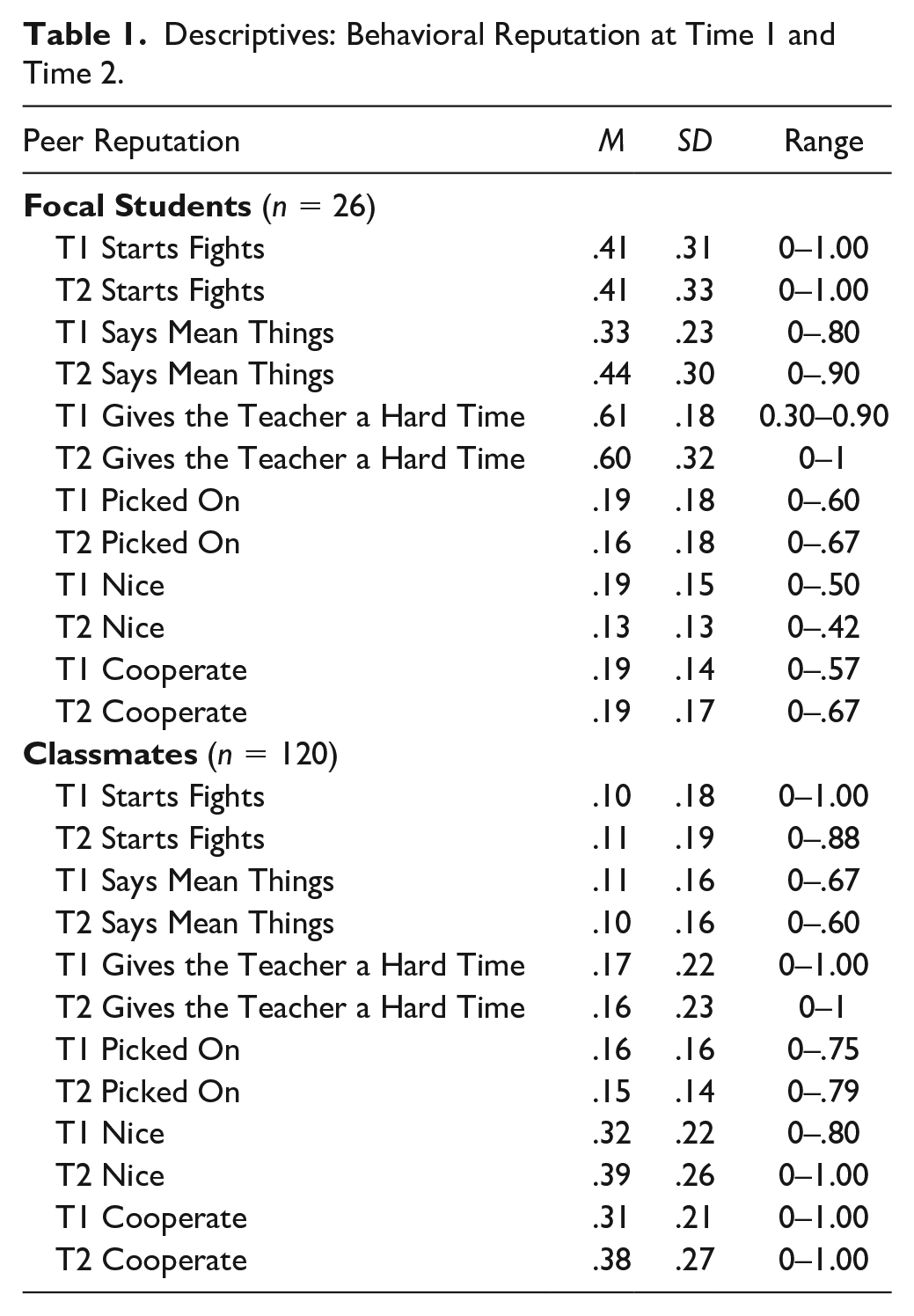
Unlimited, same, and cross-sex nominations were allowed for each question; and one should note that students were permitted to self-nominate, although these nominations were excluded from the data. All interviewers had a classroom roster and referenced the roster with each student and researchers provided redirection if a student named individuals outside the classroom. Per the institutional review board (IRB) protocol in place, interviewers did not have pictures of each student but reviewed the list of names to ensure students knew the classmates referenced on the list. A few students needed to be redirected to the task, but the majority of students did not have difficulty understanding the nomination technique. These data were used to calculate behavioral reputation. Behavioral reputation is expressed as a proportion of the total received nominations on an item divided by the maximum possible number of nominations. See Table 1 for the means and standard deviations of behavioral reputation by focal students and classmates.
Descriptives: Behavioral Reputation at Time 1 and Time 2.
Analysis
The present study included an analytic sample of 26 students with or at risk for EBD, 13 teachers/classrooms and 120 classmates. To arrive at the present study sample, seven classrooms and 11 students with or at risk for EBD were excluded due to less than 50% of the classmates participating in the peer nomination procedures (largely due to lower than anticipated recruitment rates related to COVID-19 protocols during the 2021 school year). It is important to note that participating students were only allowed to nominate other participating students (per IRB protocol). Given these procedures, previous work has suggested that peer reputation reports may not be reliable in classrooms where less than 50% of the students participated (Marks et al., 2013). Of the classrooms with 50% or higher participation rates, missing data patterns revealed that nine students were missing data for peer reputations at Time 2. To account for missing data, we fit all statistical models using the robust full information maximum likelihood (FIML) estimator, which uses each case’s available data to compute estimated values for missing data, thus retaining the analytic sample’s full power (Hox & Bechger, 1998).
Do the Behavioral Reputations of Focal Students Differ From Their Classmates?
To answer our first research question, we fit regression models including student gender and grade as covariates. Students were nested within classrooms; therefore, we used linear regression with cluster (teacher)-robust standard errors (McNeish, 2023). Student gender, grade, and focal student status (scored as 0 = classmate and 1 = focal student) were regressed on each of the Time 1 behavioral reputations. Results are interpreted as the extent to which being categorized as a focal student is associated with higher or lower values on Time 1 reputations compared with being a classmate.
To What Extent Do Behavioral Reputations Change Over the School Year?
To test our second research question, we first conducted a set of repeated measures analyses of variance (ANOVAs) with a within (time)-between (focal student status) interaction. Next, we conducted a set of paired samples t-tests to determine whether behavioral reputations changed between Time 1 and Time 2 for focal students and classmates. For behavioral reputations that differed from Time 1 to Time 2, student gender, grade, focal student status, and Time 1 proportion scores on each of the behavioral reputations were regressed on each of the Time 2 behavioral reputations. Direct effects in these models are interpreted as the extent to which being categorized as a focal student is associated with an increase or decrease in the change in reputation from Time 1 to Time 2 compared with being categorized as a classmate. Analyses were conducted using Mplus Version 8.0 (Muthén & Muthén, 1998–2017).
Results
Our first research question aimed to test the extent to which the behavioral reputations of focal students differed from their classmates at Time 1. Results revealed that being categorized as a focal student was associated with higher proportion scores in behavioral reputation for Starts Fights (B = .29, p < .001); Says Mean Things (B =.22, p <.001); and Gives the Teacher a Hard Time (B = .41, p < .001) compared with classmates. Being categorized as a focal student was associated with lower proportion scores in behavioral reputation for Cooperates (B = −.10, p < .001) and Nice (B = −.11, p < .001) compared with classmates. Interestingly, there was not a significant difference between focal students and classmates for the behavioral reputation of being Picked On (B = .03, p = .40). See Table 2 for model results.
Focal Student Status as a Predictor of Behavioral Reputations at Time 1.
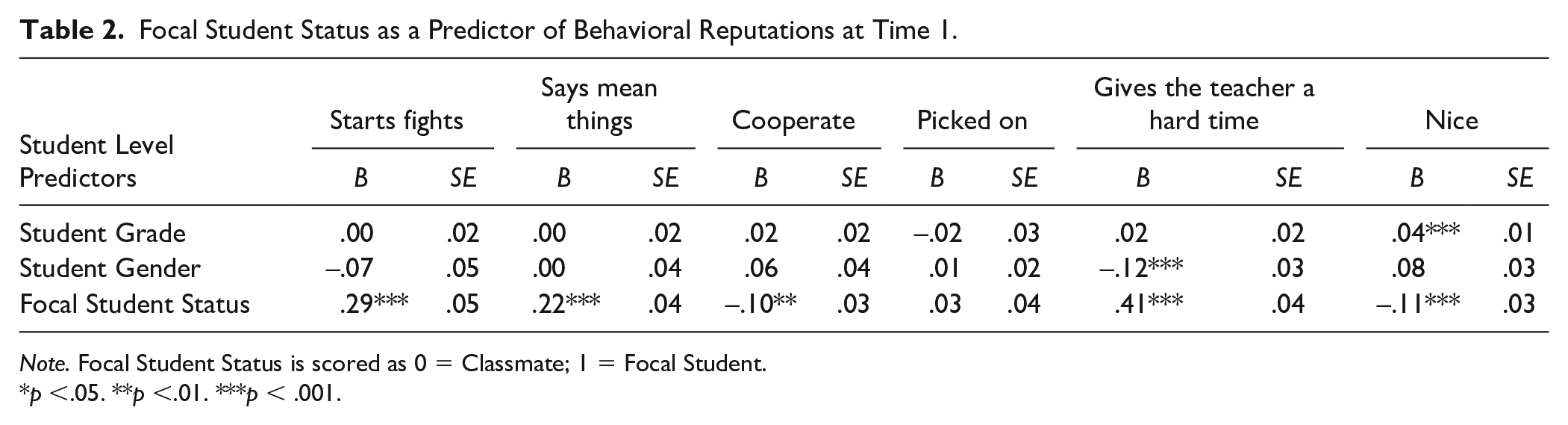
Note. Focal Student Status is scored as 0 = Classmate; 1 = Focal Student.
p <.05. **p <.01. ***p < .001.
Our second research question aimed to test the extent to which there was a difference in Time 1 to Time 2 behavioral reputation for focal students and classmates. Repeated measures ANOVAs did not reveal significant time by focal student status interactions for Starts Fights, Cooperates, Picked On, or Gives the Teacher a Hard Time; this suggests that the effect of time on behavioral reputation did not differ by focal student status. However, repeated measures ANOVAs did reveal significant time by focal student status interactions for Says Mean Things, F (1, 145) = 9.81, p =.003 and Nice, F (1, 145)= 6.84, p =.010; revealing that the effect of time on these behavioral reputations did differ by focal student status. For focal students, paired samples t tests revealed no differences for Starts Fights, t(23) = −.03, p = .98; Gives the Teacher a Hard Time, t(23) =.22, p = .83; Cooperates, t(23) = −.19, p = .86; or Picked On, t(23) = .85, p = .41 from Time 1 to Time 2. Results did reveal a difference for Says Mean Things, t(23) = −2.17, p < .05 and Nice, t(23) = 2.30, p < .05 from Time 1 to Time 2. For classmates, paired samples t-tests revealed no differences for Starts Fights, t(112) = −1.16, p = .25; Gives the Teacher a Hard Time, t(112) = −.11, p = .91; Says Mean Things, t(112) = .16, p = .88; and Picked On, t(112) = −.03, p = .98 from Time 1 to Time 2. Results did reveal a difference for Cooperates, t(112) = −2.63, p <.05 and Nice, t(112) = −3.15, p < .05.
Discussion
In this study, we descriptively examined the behavioral reputations of students identified via screening as with or at risk for EBD. Importantly, we examined the differences in the behavioral reputation of this population from their classmates and the extent to which these reputations varied across approximately a 9-week time frame. We anticipated that focal students would receive a higher proportion of peer nominations for antisocial behavioral characteristics (e.g., Starts Fights, Gives the Teacher a Hard Time, Picked On) and that focal students would receive a lower proportion of peer nominations for prosocial behavioral characteristics (e.g., Cooperates, Nice) compared with their classmates. Findings mostly aligned with our expectations. First, focal students and classmates differed on all behavioral reputations in the expected direction, with the exception of Picked On. These findings parallel prior work that suggests boys who receive special education services for behavioral disorders are rated more often on Starts Fights, Disruptive, and Aggressive and lower on Cooperative Behaviors compared with boys in other classifications (e.g., learning disabilities, academically gifted, and general education; Farmer & Hollowell, 1994). The present study extends this prior work by including a large sample of students screened as with or at risk for EBD (who may or may not yet be receiving special education services) and controlling for the influence of gender and grade on behavioral reputation.
It was surprising to see that focal students and classmates did not differ on the behavioral reputation for being Picked On. Prior work suggests that students with elevated rates of challenging behavior are likely to be involved in difficult peer social experiences such as victimization, negative peer interactions, and rejection (Malti & Rubin, 2018; Parker et al., 2015; Sturaro et al., 2011), which can align with dimensions inherent in being “picked on.” However, heterogeneity does exist in the social experiences of students with elevated rates of aggressive behavior, with some youth being categorized as aggressive-popular students; these students pick on others and gain social acceptance and status through these actions (e.g., Rodkin & Roisman, 2010). Given that students in our sample were not involved in interactions in which peers perceived they were picked on but were perceived to Say Mean Things and Start Fights, it may be that some students in our sample were in this aggressive-popular category. Future work should look to unpack these nuances by examining who is being picked on, by whom, what the social norms for aggressive behavior, bullying, and victimization are in the classroom, features of the classroom social ecology (e.g., hierarchy), and Tier 1 behavior management practices; these factors may influence the extent to which students with or at risk for EBD are rejected or accepted into their peer group (e.g. Saarento & Salmivalli, 2015). Future work should also examine the extent to which students with or at risk for EBD are identified as popular-aggressive by their peers and the student, teacher, and classroom factors that play a role in situating these students into positions of social power. It is important to note that a large body of research has examined the intersections of behavior, peer liking and disliking, popularity, and social position in elementary and middle school for students with elevated rates of aggressive behavior (often as reported by teachers or peers; Farmer et al., 2003; Rodkin & Rosiman, 2010). However, to our knowledge, much less work has examined these patterns in early elementary school students specifically screened and identified as with or at risk for EBD who often (but not always) exhibit aggression and may also show behaviors such as noncompliance, disruptions, rule violations, impulsivity, and risk-taking behaviors. This is an important area for future work, considering the association between positive peer experiences and long-term outcomes (Rose et al., 2022; Wentzel, 2009). Furthermore, an understanding of early elementary social patterns and dynamics can pave the way for early intervention intended to improve long term outcomes for students with or at risk for EBD.
We also anticipated that behavioral reputations would be stable from Time 1 to Time 2. Interestingly, for focal students, behavioral reputations were relatively stable: Starts Fights, Gives the Teacher a Hard Time, Picked On, and Cooperates did not change from Time 1 to Time 2. However, behavioral reputations for Say Mean Things intensified (a higher proportion of peers nominated focal students at Time 2), as did the reputation for being Nice (a lower proportion of peer-nominated focal students at Time 2). Interestingly, the change in reputation for being Nice was greater for focal students than for their classmates. For classmates, most behavioral reputations also demonstrated stability (i.e., Starts Fights, Give the Teacher a Hard Time, Say Mean Things, and Picked On) but Cooperates and Nice intensified (a higher proportion of peer-nominated classmates from Time 1 to Time 2). These patterns shed light on the dynamics of behavioral reputations and suggest that peer perceptions of certain behavioral patterns are ingrained within peer groups (at least across a 9-week window). Findings also highlight that some negative behavioral reputations of focal students may become more severe as the school year progresses. In contrast, classmates’ positive behavioral reputations may strengthen across the year.
It is important to highlight that this study did not test the mechanisms by which behavioral reputation intensified between the two time points. It may be that as peers spend more time around their classmates and get to know one another better, students grow in their agreement on the behavioral characteristics of their peers. Furthermore, students may discuss the relative abilities of their classmates (e.g., behaviors and academic skills) with one another and these conversations may solidify student reputations that are largely shared and reinforced at a class-wide level. It may also be the case that individuals are likely to change their behavior in the direction of their peer reputation (e.g., self-fulfilling prophecy; Yarrow & Campbell, 1963). It is also possible that student’s interactions and experiences within the larger classroom social ecology (e.g., with teachers and other school adults) influence the development and stability of peer reputations. To illustrate, when both teachers and peers report a student engages in high rates of challenging behavior, there may be features of the classroom ecology that prompt this collective perspective on student behavior. The student may be repeatedly excluded from class and/or social opportunities by adults due to their behaviors and these practices may be visible to peers; over time these interactions may solidify the student’s peer reputation, further limiting opportunities for positive social interactions and peer influence. This cycle highlights the value of early intervention to prevent negative reputations from forming. This could be accomplished via positive behavioral interventions and supports such as giving children/students important classroom social roles, good behavior games, spending warm caring time with students, and giving students positive greetings at the door; amongst many others; Farmer et al., 2019; Hanish et al., 2021; Mikami et al., 2022). Future work would benefit from longitudinal assessments that examine observations of individual behavior, interactions within the classroom social ecology, and peer reputation over time to disentangle the direction of these effects and highlight promising areas for intervention and support.
As a whole, the findings from the present study begin to paint a picture of peers’ perceptions of students with or at risk for EBD. This is important to understand because peer perceptions can guide social interactions and experiences. For example, students may use classmates’ reputations as a way to choose with whom they interact and form social relations. Research on academic reputations supports this notion; studies in samples of older elementary and middle school students show that students prefer to work with others whom they perceive as more academically capable on school-related tasks (e.g., Droege & Stipek, 1993; Hughes & Zhang, 2007). As a result, having a negative behavioral reputation may serve as a barrier and limit future opportunities to develop positive interactions, peer relationships, and prosocial behaviors. It may also present as a risk factor for future peer rejection, isolation, or bullying.
Although the present study did not test for links between reputation and the frequency and quality of peer interactions, this work does begin to signal that interventions focused on the social development and experiences of students with or at risk for EBD may need to also consider their behavioral reputations. Interventions designed to target individual skills without considering the student’s behavioral reputation in the social context may be less effective if shifts in behavioral reputations have not changed amongst peers as well (Farmer et al., 2007; Hymel et al., 1990). As a practical example, peer-mediated interventions (PMI) are designed to teach students skills (e.g., academic, social) via interactions with a peer (e.g., during free play, peer counseling, group play, and peer pair work). Peer-mediated intervention can include the use of strategies such as modeling, tutoring, assessment, counseling, and mentoring to improve the social and academic skill of students. Peer-mediated interventions are frequently implemented in elementary school settings and are often structured so that developmentally typical children are designated as peer mediators and encouraged to play, talk, and engage in classroom activities with focal students. Peer-mediated interventions are an evidence-based approach shown to improve the academic performance for students with or at risk for EBD (McCullough et al., 2020). When creating peer pairs, teachers are encouraged to consider student characteristics and needs. These characteristics commonly include gender, special education classification, reading skills, writing skills, social skills, and classroom engagement. Findings from the present study may prompt research that examines how a student’s behavioral reputation (class wide or as reported by their PMI partner) influences the effectiveness of this type of intervention and when this effect is the strongest (e.g., later in the year when reputations are more solidified).
The stability and intensification of behavioral reputations across two time points in the school year (for both focal students and classmates) also highlight the need for understanding patterns of peer interactions and peer perceptions, particularly early in the school year. At the beginning of the school year, peers are appraising their classmates’ behaviors, forming social groups, and expectations for what it is like to interact with each classmate (Dishison et al., 1994; Dodge et al., 1982). Teachers’ social and behavioral support in these first weeks of school may be critically important as behavioral reputations begin to form; given that they may be unlikely to change without intervention as the year progresses. Furthermore, for intervention efforts designed to support students with or at risk for EBD, efforts that are introduced later in the year may be less likely to produce change, given that students may have established interaction patterns and behavioral reputations that may be difficult to shift, although this theory remains to be tested. Implementing intervention efforts early in the school year may be particularly important to consider given that positive peer relationships play a role in the development of social skills and overall well-being for students (Rose et al., 2022).
In this study, we used a short-term longitudinal data set and were bound to the limitations that our dataset imposes. Future studies building from this work should design longitudinal studies across the year to allow for analysis to move in the direction of disentangling the reciprocal influences of individual behavior and behavioral reputations. Longitudinal studies would also allow researchers to examine how quickly behavioral reputations form and the extent to which they shift across the year (e.g., by assessing reputation within the first 2 weeks of school and then each month after). It is also important to note that the present study included a small sample of classrooms and students with or at risk for EBD. Interpreting and generalizing these findings should be done with caution. Future work should look to replicate patterns of peer reputation for students with or at risk for EBD among a larger sample of classrooms and students from a heterogeneous sample. Importantly, this work represents a descriptive and preliminary view of the behavioral reputations of K to third-grade students with or at risk for EBD. The current study does not speak to the heterogeneity that likely exists in the behavioral and social characteristics of this group of students (e.g., Farmer & Hollowell, 1994). Future work should use person-centered analyses to identify different profiles of students and examine the extent to which students display variability in their configurations of behavioral reputations.
Regarding our sample, girls were underrepresented. Given that prior work shows peer reputations present differently for girls and boys (although in the present study, a gender difference was only present for the reputation of “Giving the Teacher a Hard Time”), future studies should strive to oversample girls to obtain equal representation across both groups and examine similarities and differences in behavioral reputations by gender. This will be important to test for interactions between gender and focal student status on behavioral reputations. Another limitation to consider is the potential influence of implicit bias in teacher ratings and peer nominations, particularly regarding race and ethnicity. Given that a majority of the focal students in this study are Black/African American, there is a possibility that teacher perceptions and peer responses could reflect broader patterns of bias that have been documented in research. While teacher bias and peer bias were not controlled for in our analyses, these are important factors to consider in interpreting the results. Future research might explore these dynamics in more depth, including how race and ethnicity intersect with teacher and peer perceptions, to better understand their role in shaping student reputations and behavior. Finally, this study also includes a sample of teachers who volunteered to participate in a trial of a program to support their delivery of evidence-based instructional practices with students with or at risk for EBD. Although teachers in the present study were randomized to the business-as-usual condition, we acknowledge that our study is limited by this selection effect.
Finally, this study elucidates patterns of behavioral reputation in the classroom, yet there remains much to learn about how teacher and classroom-level factors might influence the behavioral reputations of students with or at risk for EBD. To illustrate, teachers serve as social referent in the classroom (Hendrickx et al., 2017; Mariage et al., 2000), and students appraise the social cues of teachers to guide their own perceptions of and interactions with their classmates. Indeed, teachers’ student preference is found to mediate the statistical effect of child aggression on peer acceptance in first- to fifth-grade students (Chang et al., 2007). Mercer and DeRosier (2008) also found reciprocal links between teacher preference and peer rejection over 3rd and 4th grade, after controlling for children’s aggression. Finally, Hendrickx and colleagues (2017) found that negative teacher-student interactions in fifth grade were linked to peers perceiving that the teacher disliked a particular student, which, in turn, significantly influenced peer disliking of that student 6 months later. Future work should examine how teachers’ interaction with students with or at risk for EBD may magnify or buffer negative peer reputations. This work could include observations of teacher-student interactions that may reduce problem behavior, promote positive peer culture, and potentially reduce student’s negative peer reputations (e.g., teachers' use of behavior-specific praise, positive greetings at the door, modeling warm caring time with focal students; e.g., Farmer et al., 2019; Hanish et al., 2021; Mikami et al., 2022). It may also be interesting to examine the extent to which having a negative peer behavioral reputation influences teacher’s view of the focal student, their interactions with the focal student, and attributions for the focal student’s behaviors.
Classroom contexts may also influence behavioral reputations. A consistent finding is that aggressive, off-task, and hyperactive children have higher social preferences in classrooms in which such behaviors are common among peers compared with classrooms where such behaviors are unusual (Chang, 2004; Stormshak et al., 1999). This pattern of results may occur due to a high base rate of externalizing behavior in a classroom making peers view such actions as normative and socially acceptable. This work hints that the behavioral reputations of students may be context-dependent. For students with or at risk of EBD, the influence of these external factors remains untested and studies that incorporate a student-in-context approach may help clarify how behavioral reputations are established (Farmer, 2000).
Conclusion
In this study, we found that students with or at risk of EBD had overall poorer behavioral reputations than their classmates and that these reputations remained stable or intensified across two time points over the year. This descriptive study highlights the importance of considering the social experiences of students with or at risk for EBD and that behavioral reputations may be one barrier that shapes their capacity to engage in positive and prosocial peer interactions. This is an important area to address given that positive and high-quality social experiences influence student’s academic performance and emotional and behavioral development. To support the social development of students with or at risk for EBD, teachers, and other educators/stakeholders may consider ways in which they can support these students in developing positive behavioral reputations early in the year.
Footnotes
Declaration of Conflicting Interests
The author(s) declared no potential conflicts of interest with respect to the research, authorship, and/or publication of this article.
Funding
The preparation of this article was supported by the Institute of Education Science, National Center for Special Education Research (Grant No. R324B220003). The opinions expressed are those of the authors and do not represent the views of the Institute or the U.S. Department of Education.
