



Abstract
The purpose of this study was to examine the relation between externalizing behavior and peer reputations of kindergarten through third-grade students (N = 35, from 18 U.S. classrooms) with or at risk for Emotional and Behavioral Disorders (EBDs). We also examined the extent to which this relation varied as a function of teacher delivery of praise. A series of multiple regression models, adjusted for the nesting of students within classrooms, were conducted. Models revealed a significant effect of the interaction between externalizing behavior and teacher praise on peer reputations for prosocial behavior (i.e., “Being Nice”). This effect indicated a negative relation between externalizing behavior and a prosocial peer reputation for students who received low rates of teacher praise. However, a positive relation was present between externalizing behavior and a prosocial peer reputation for students who received average and high rates of teacher praise. Findings reinforce that teacher praise is an important positive behavioral support and send a preliminary signal that praise may mitigate negative peer reputations for students with or at risk for EBD. Implications for research and practice are discussed.
Students with or at risk for Emotional and Behavioral Disorders (EBDs) are particularly susceptible to elevated rates of social difficulties and challenges with interpersonal relationships (Parker et al., 2015; Sturaro et al., 2011). This can include, but is not limited to, peer rejection, bullying, isolation and peer exclusion, and victimization (e.g., Hawker & Boulton, 2000; Reijntjes et al., 2011; Sturaro et al., 2011). Positive peer experiences provide students with the opportunity to practice perspective-taking, social competence, and moral reasoning skills that are linked to academic achievement, school liking, motivation, engagement, and social-emotional development (Raver, 2002). Therefore, students with negative social experiences may miss out on a crucial developmental process with implications for their social and academic trajectories (Rubin et al., 2013). Furthermore, peer relationship difficulties that develop in elementary school often continue into adolescence and, without intervention, can remain a significant source of impairment (Henricsson & Rydell, 2006). Consideration of classroom-based supports that promote or hinder the social experiences of students with or at risk for EBD is an important goal, given that EBDs are prevalent in a high proportion of young students (approximately 12%–20%; e.g., Ringeisen et al., 2020). Furthermore, most students with or at risk for EBD, a broader category used in the research literature to describe students with challenging behavior who may not have an Emotional Disturbance (ED) label, are educated primarily in general education classrooms (Mitchell et al., 2019; Ringeisen et al., 2020).
Students with or at risk for EBD may be at a heightened risk for experiencing negative peer reputations (e.g., Granger et al., 2025; Farmer & Hollowell, 1994). Peer reputation represents the collective group view of an individual within a social context and is typically collected via sociometric assessments. In these assessments, all consenting students in a class are asked to nominate peers who fit a presented description. A student’s reputation is then an index of the number of times classmates nominate the student for a particular description out of the total possible nominations (e.g., Hughes et al., 2009). Prior work shows that students can make distinctions between the behavioral characteristics of their classmates; Gest et al. (2006) suggest this may be because peers are participant-observers and are particularly sensitive to individual differences and skills among their peers. It is important to note that the construct of peer reputation is distinct from social standing (e.g., popularity) or preference, which typically measures peer liking and disliking (e.g., peer rejection or acceptance).
Peer reputations are relevant for researchers and educators for several reasons. First, peer reputations may shape students’ self-evaluations and behavior and may also be associated with differences in treatment by peers (Gest et al., 2005). For example, a student’s peer reputation for academic abilities is predictive of how well liked the student is by peers (Hughes & Zhang, 2007). Second, students who do not get along with their peers are at elevated risk for disengagement, academic failure, and school dropout (Buhs et al., 2006; Risi et al., 2003; Wentzel et al., 2021); and social problems between peers can be a disruption to the overall classroom learning environment (Flook et al., 2005; Stormont, 2001). Third, peer reputations are connected to student outcomes (e.g., Gest et al., 2006; Realmuto et al., 1997). To illustrate, in a study of 612 third- through sixth-grade students, Gest et al. (2006) found that having a childhood reputation as aggressive-disruptive was predictive of later negative academic and job outcomes.
Given the influence of peer reputations on classroom experiences and student outcomes, in the present study, we focus on the extent to which a student’s externalizing behavior is associated with their peer reputation for prosocial (e.g., students who “are always willing to do something nice for somebody else and are really nice people”) and antisocial behaviors (e.g., students who “say mean things to other kids”) in a sample of kindergarten through third-grade students screened and identified as with or at risk for EBD (focal students). Importantly, we move beyond a main effects approach by also considering the extent to which the relation between externalizing behavior and peer reputation varies by the frequency and thoroughness of teachers’ delivery of praise to each focal student. As the institutional leader of the classroom, teachers can play a critical role in managing student’s classroom-based social experiences (Farmer et al., 2011). Moreover, prior work demonstrates that students form social opinions (e.g., who is friends with whom; who is liked) in part based on teachers’ interactions with students in the classroom (Chang et al., 2007). However, we do not yet know the extent to which teacher praise may play a role in shaping peer reputations for this student population. This information will help to identify malleable supports that may influence the classroom-based social experiences of students with or at risk for EBD.
Theoretical Framework
To frame this investigation, we draw from two established theories. The first focuses on teachers’ involvement and guidance for the opportunities that students have for classroom interactions, and how they view and treat one another. They do this by monitoring, facilitating, modeling, and setting the tone for social interactions (Braun et al., 2019). A teacher’s role in the classroom social context has been characterized as the “invisible hand” (Farmer et al., 2011). This framework posits that because teachers are an influential leader of the classroom but not a member of the classroom peer network, they can guide students’ social experiences by establishing and enforcing rules for peer interactions and facilitating opportunities for students to build skills. These social dynamics management practices can be both intentional and overt practices that influence students’ relationships and the peer culture. To illustrate, teachers who promote friendships between students increase levels of peer acceptance, decrease victimization, and minimize social hierarchies in classrooms (Gest & Rodkin, 2011a; Mikami et al., 2012; Serdiouk et al., 2015). More broadly, teacher–student relationship quality is shown to influence associations between student behavior and peer relationships (Endedijk et al., 2022). The current study uses this lens to examine the associations among teacher’s interactions with students with or at risk for EBD and their behavioral reputations.
Second, we look to Sociocultural Theory to frame this investigation. This theory posits that young children often use a “more knowledgeable other” in their environment for information (both explicit and implicit). Subsequently, this information is used to guide students’ appraisals of their environment, others, and their own feelings (e.g., “Am I safe in this classroom?”; “Is it alright that I am nervous about this activity”; “Do my classmates and teacher like me?”). In turn, these appraisals shape behaviors (McLean et al., 2023; Mendoza & King, 2020). As the institutional leader of the classroom, who also provides instructions and expectations for classroom behavior, researchers posit that the teacher serves as the more knowledgeable other within a classroom setting (e.g., McLean et al., 2023). Applied to the present study, this theory suggests that students may use teachers as a social referent in the classroom and base their evaluations of classmates’ behavioral reputations, in part, on teachers’ interactions with students in the classroom. Prior work lends support to this notion. For instance, Hendrickx and colleagues (2017) report that negative teacher–student interactions were linked to peers perceiving teacher dislike toward a particular student, which, in turn, predicted increased peer disliking of that student 6 months later. This important finding suggests that teachers serve as a social referent for peer disliking. The present study examines the role of teachers as social referents in shaping the peer reputations of students with or at risk for EBD, a group particularly vulnerable to developing negative peer perceptions.
Behavioral Reputations of Students With or at Risk for EBD
A behavioral reputation refers to a student’s relative standing in a peer group in terms of peer evaluation of behavior (i.e., “Kids who start fights”; “Kids who give the teacher a hard time”; “Kids who are nice to others”; Coie et al., 1982). In the peer relations and social network literatures, classmate reports are often considered the standard approach for measuring youths’ social experiences, such as their peer reputations, particularly because peers are privy to behaviors and social interactions that may be beyond the view of adults and teachers (Cillessen & Bukowski, 2018; Terry & Coie, 1991). For example, in elementary school, bullying often occurs on the playground and during outside recess/break time (Craig et al., 2000; Vaillancourt et al., 2010).
To date, a small body of work has focused on describing peer-reported behavioral reputations of students with or at risk for EBD. Most notably, Farmer and Hollowell (1994) examined the peer assessments of the social and behavioral characteristics of 20 students in third- through sixth-grade classrooms who were receiving special education services for emotional and behavioral problems. Peers nominated classmates who fit the following characteristics: Cooperative (i.e., friendly, share, easy to get along with); Starts Fights (i.e., common for children to have disagreements when working or playing together and some may get angry very easily, hit others, and start fights); Popular (i.e., many classmates like to play with them or do things with them); Athletic (i.e., very good at many different kinds of outdoor games and sports); Disruptive (i.e., they may talk out, not pay attention to the teacher, and not follow the rules); Leaders (i.e., often in charge during games or activities and other students look up to them and will often do what they say or ask); Good at school work (i.e., finish their assignments quickly, get most of the answers correct, and do extra work or read during free time); and Shy/Withdrawn (i.e., they prefer to do things by themselves and they don’t usually hang around with other kids). Results revealed boys with an EBD classification, who were receiving special education services, were rated significantly higher on Starts Fights, Disruptive, and Aggressive behavior compared to boys in all other classifications (i.e., learning disabilities, academically gifted, and general education) and were rated significantly lower on Cooperative behavior compared to academically gifted boys. More recently, the peer reputations of 26 kindergarten-third-grade students with or at risk for EBD were compared with their classmates at two time points during the school year (Granger et al., 2025, under review). Results revealed that focal students had poorer behavioral reputations among the domains of Starts Fights, Says Mean Things, Nice, Cooperating, and Giving the Teacher a Hard Time; and that these reputations were stable over time. Interestingly, there were no differences between focal students and their classmates for the reputation of being Picked On.
Other studies have created student behavioral profiles based on teacher reports and subsequently tested for differences in peer reputations across these profiles (Farmer & Hollowell, 1994; Realmuto et al., 2000; Rodkin et al., 2000). To illustrate, Farmer et al. (1999) derived teacher-reported behavioral profiles of elementary students with and without mild disabilities. Relative to the present study are profiles of boys and girls who rated above average on aggressive behavior. These profiles included “Bright Antisocial Boys,” “Troubled Boys,” “Tough Boys,” “Extremely Troubled Boys,” “Troubled Girls,” “Bright Antisocial Girls,” and “Unruly Girls.” Results revealed differences in peer-reported behavioral reputation across profiles. For example, boys with disabilities in the “Bright Antisocial,” “Troubled,” and “Extremely Troubled” profiles received significantly more antisocial nominations than did “Model” boys with disabilities. This work informs our impressions about the behavioral reputations of students with or at risk for EBD, suggesting they may have negative peer reputations.
A larger body of research describes the social preference and status of students with elevated rates of aggressive and challenging behaviors, with some of the most studied aspects including peer acceptance, rejection, and popularity (e.g., Leflot et al., 2011). Although this work is distinct from peer behavioral reputations, this research provides valuable insights that aid us in forming hypotheses about the behavioral reputations of students with or at risk for EBD. This work illustrates that students who enter elementary school demonstrating challenging behaviors (e.g., aggressive, disruptive) are often disliked, rejected, and victimized by their peers, which in turn contributes to increased peer hostility and aggressive behavior (e.g., Salmivalli, 2018). There is also continuity in the social preferences and status of these students. Initial peer impressions of students with behavior problems form quickly and tend to be stable across the year (e.g., Cillessen et al., 2000; Coie et al., 1982; Mikami & Hinshaw, 2003). Taken together, this work suggests that students with or at risk for EBD may develop poor behavioral reputations and that without intervention, these reputations may be stable across the year.
Teacher Delivery of Praise and Peer Reputation
Adults can play an influential role in shaping students’ relationships and impressions of their peers. Indeed, teachers’ interactions, relationships, behaviors, and reactions toward individual students, as well as their general teaching practices, play a meaningful role in shaping students’ classroom-based peer relationships and experiences (Chang, 2004; De Laet et al., 2014; Gest & Rodkin, 2011b; Hughes & Chen, 2011; Mercer & DeRosier, 2008). To illustrate, in classrooms where teaching practices are characterized by warmth and caring, students are less rejective of aggressive peers (Chang, 2004). Furthermore, studies show that students adopt their teachers’ expressed disliking of individual students (Chang, 2004) and teachers’ student preference plays a mediating role in the relation between student aggressive behavior and peer acceptance in first- through fifth-grade classrooms (Chang et al., 2007). These associations hold for students who are perceived by peers to show aggressive behavior; students exhibiting aggression were disliked less and liked more when they were perceived by peers to be less disliked and more liked by their classroom teacher (Hendrickx et al., 2017). Teacher–student relationships are also shown to shape peer disliking in elementary school and are associated with rates of peer victimization (Elledge et al., 2016; Hughes & Im, 2016). This body of work supports that students are sensitive to teacher cues such as content and affective tone, suggesting that negative attention may increase the salience of students’ challenging behavior and positive attention may increase the salience of students’ appropriate behavior. We posit that teacher praise may be one mechanism of positive attention through which peers may evaluate their teacher’s approval or disapproval of individual students and form opinions about students’ behavioral reputations.
Praise is defined as teacher’s approval for a student’s behavior that can be delivered verbally or with a non-verbal gesture (Floress & Beschta, 2018; Jenkins et al., 2015). Praise is divided into two types: General praise and behavior-specific praise (BSP). General praise is a broad and somewhat generic statement of approval (e.g., “Way to go”; “Nice work”). BSP indicates approval of a student’s specific behavior and how it met an expectation or affected academic or social achievement (e.g., “I saw how you helped your friend with their math problem, great job being kind today”; “I noticed how you raised your hand and waited to speak. That shows respect for our friends, nice job waiting your turn”; Kennedy & Jolivette, 2008). Although BSP is a feasible and efficient way to reinforce student behavior and it is consistently linked to reductions in disruptive behavior, studies reveal that teachers use BSP at low rates (Floress et al., 2017; Granger et al., 2024; Stormont et al., 2007). However, teachers use general praise at higher rates than BSP (e.g., approximately four to five times as often; Floress & Beschta, 2018); therefore, we focus this study on teachers’ delivery of general praise to focal students, given that peers may be more likely to witness this type of teacher–student interaction.
Several studies specifically support that teacher feedback, such as praise, may shape peer experiences. First, Hendrickx and colleagues (2016) found that observations of negative teacher behavior (i.e., any verbalization that came across as angry, derogatory, sarcastic, or condescending, based on words, intonation, facial expressions, or gestures) were associated with fifth graders’ reported perceptions of teacher disliking and their own peer disliking 6 months later. Hendrickx and colleagues (2020) also reported that although teachers had less frequent interactions with students who were isolated or unpopular, when teachers interacted with these students less negatively, students became more socially integrated into their peer group over time. In an experimental design, White and Kistner (1992) examined the association between teacher feedback and students’ impressions of a child actor (on video) exhibiting peer-rejected behaviors. Findings revealed that teachers’ positive feedback was associated with higher preference scores and more positive descriptions from students, while negative feedback was associated with lower social preference and negative descriptions. Finally, a teacher’s criticism toward second graders in front of peers was found to mediate the negative relation between student externalizing behaviors and social preference (McAuliffe et al., 2009). Taken together, these studies suggest that peers may watch the tone of teachers’ feedback and the way teachers respond to students with or at risk for EBD, using the teacher as a reference point when forming judgments about others.
Present Study
Despite a host of knowledge about the social experiences of students with or at risk for EBD and the influence of teacher praise on student behavior, important knowledge gaps remain. First, we know less about the extent to which the intensity of a student’s externalizing behavior is related to peer perceptions of students who have been categorized as with or at risk for EBD. Although much of the existing literature examines externalizing behavior as a continuous construct in general classroom populations or compares students with elevated externalizing behavior to their peers, there is limited research specifically focused on students with or at risk for EBD. These students face unique challenges and are particularly vulnerable to negative peer reputations and social challenges. Thus, examining their specific social experiences provides valuable insights into interventions that might be used to address their specific needs. Second, we do not yet know the extent to which the quality of teachers’ interactions with students with or at risk for EBD plays a role in the relation between students’ externalizing behavior and their behavioral reputations. We examine the association between externalizing behavior and the peer reputations of students with or at risk for EBD. Aligned with prior work that examines prosocial and antisocial student reputations, we examine the extent to which students are nominated for being “Nice,” “Cooperating, “Giving the teacher a hard time” and for “Saying Mean Things.” We anticipate that a student’s externalizing behavior will be negatively related to the proportion of classmates that nominate the student for being Nice and Cooperates and positively related to the proportion of classmates that nominate the student for Saying Mean Things and Giving the Teacher a Hard Time. Our second aim is to examine the extent to which these relations are modified by teachers’ use of praise. We anticipate that the strength of the relations between student externalizing behavior and peer reputations will decrease for students who receive high rates of praise from their teacher. By investigating the influence of teacher–student interactions on the relation between externalizing behavior and peer reputation, we hope to provide the field with an initial understanding of the classroom factors that may shape the social experiences of students with or at risk for EBD, ultimately contributing to the development of more effective interventions and support strategies tailored to their unique needs.
Method
Setting and Participants
We recruited teacher and student participants from six elementary schools in a U.S. Mid-Atlantic state. The mean number of students per school was 471 (SD = 115.84) and consisted of predominantly African American students (65%, SD = .23) from a low-income community (66% qualified for free and reduced-price lunch). The present study includes teacher (n = 18) and student participants (N = 35 focal students and 141 of their peers) from a comparison condition who were part of a study aimed at testing an intervention designed to address the needs of young students who demonstrate persistent and intensive challenging behaviors in classroom settings. This intervention provided teacher training and coaching on evidence-based practices shown to reduce student problem behaviors and increase high-quality teacher–child relationships. Teachers were randomly assigned within grade and school to the intervention or to a business-as-usual comparison condition. Teacher reports on student externalizing behavior were collected via survey, and teacher–child interactions were collected via observations. Both the teacher survey and observations occurred in the Fall (across three cohorts in 2019, 2021, and 2022). Peer nominations occurred in the Winter. All study activities were approved by the district and university human participants’ protection boards.
Kindergarten to Third-Grade Teachers
Teachers were eligible for inclusion if they met the following criteria: (a) taught in grades kindergarten to third grade, (b) served at least one child identified as being with or at risk of EBD, and (c) consented to participate. The present study includes 18 teachers who participated in the comparison condition. Participating teachers were female. The majority were Caucasian/White (56%) or African American/Black (28%); two teachers were Native American/American Indian (11%), and one teacher was multiracial. The majority of teachers were non-Hispanic/Latino (89%). All but one teacher was licensed and had a bachelor’s degree (33%) or master’s degree (67%). Teachers ranged in age, with nearly 40% of teachers between the ages 26 and 35 years, 17% of teachers between 36 and 45 years, and 17% of teachers between 46 and 55 years. Years of teaching experience ranged from 1 to 38 years; on average, teachers had 9.3 years of teaching experience (SD = 9.6). Teachers were given US$500 for their participation.
Focal Students
Students who met the following criteria were eligible for participation: (a) the student was enrolled in a participating teacher’s classroom, (b) the student exhibited externalizing behaviors that interfered with participation in the classroom as indicated by the Systematic Screening for Behavior Disorders (SSBD; Walker et al., 1990), and (c) the student had parental/guardian consent to participate. Due to study resources and funding, teachers selected one to three focal students in their classrooms. This study included 35 students who participated in the comparison condition. Student sample demographics included 71.4% African American/Black, 14.3% White, 5.7% multiracial, 2.9% Asian/Pacific Islander, and 5.7% other ethnicities. In total, 13.9% of students were Hispanic/Latino. The majority of participating students were male (77.1%), and the average age was 7.28 years (SD = 1.19).
Classmates
After teachers selected one to three focal students in their classrooms, teachers sent home consent forms to all focal students’ classmates to participate in peer nomination interviews (detailed below). The present study sample included 141 classmates across 18 classrooms. The average classroom size was 18 students. On average, there were 7.8 classmate participants per class. Classmate sample demographics included 44.7% African American/Black, 36.9% White, 2.1% Asian/Pacific Islander, 2.1% multirical, and 13.9% other ethnicities, and 0.71% were unknown. In total, 80.9% of students were non-Hispanic/Latino, 18.4% were Hispanic, and 0.71% were unknown. The majority of participating classmates were female (53.19%), and the average age was 7.32 years (SD = 1.09).
Measures
Student Screening
Obtaining caregiver consent and screening of student participants began approximately 1 month after the beginning of school. To determine eligibility for participation, teachers nominated up to five students who engaged in chronic externalizing problem behavior. Caregiver consent was then obtained, and systematic screening for risk of EBDs took place using the SSBD (Walker et al., 1990). The SSBD is a three-stage multigate screening system designed to proactively identify students who are at risk of negative developmental outcomes associated with their behavior patterns. The first two gates of this tool combine teacher ratings of the frequency and intensity of student adjustment problems in school. The third gate includes trained observer ratings of students’ behaviors and is used to refer students for possible disability support according to federal and state special education guidelines (Walker et al., 1990). Given the scope of the intervention, only the first two stages of the tool were used to identify focal students. Both stages exhibit strong psychometric properties (see Walker et al., 1990). Students were screened in under a modified assessment of risk that included scoring raw data across four scales and applying risk criteria to the scores to identify students at risk of externalizing behavior problems (see Walker et al., 1990 for scoring criteria). After screening, one to three students per classroom were selected to participate in the study, depending upon returned caregiver consents and the most elevated externalizing scores on the SSBD. In the present study, six teachers had one participating student in their classroom, seven had two participating students, and five had three participating students.
Focal Student Externalizing Behavior
Focal student externalizing behavior was measured with teacher reports on the Social Skills Improvement Rating System (SSIS-RS; Gresham & Elliott, 2008). Teachers completed this measure in the Fall. Each item on the SSIS-RS is rated on a 4-point frequency scale, with responses ranging from 0 (Never) to 3 (Almost Always). These items are grouped into subscales. The subscale of interest in this study was externalizing behaviors (M = 20.03; SD = 4.62; range = 6–29). Example items include “Talks back to adults” and “Acts without thinking.” For the current sample, internal consistency was acceptable for externalizing behavior with Cronbach’s alpha of .70.
Behavioral Reputation
Behavioral reputation was collected via individual peer nomination interviews with students in the Winter (Coie et al., 1982). This provided time for students to acclimate to the classroom environment and new peers. Interviews were conducted with each student in the hallway outside their classroom. Each student was asked to name students in their class who fit peer descriptions. Of interest to the present study were the following characteristics:
: “These kids are always willing to do something nice for somebody else and are really nice people”
: “These kids cooperate. Here are kids who really cooperate—they pitch in, share, and give everyone a turn”
: “These kids say mean things to other kids, and they spread nasty rumors about other kids”
: “These are kids that give my teacher a hard time. They don’t follow the classroom rules”
Unlimited, nominations were allowed for each question. All interviewers had a classroom roster and referenced the roster with each student, and researchers provided redirection if a student named individuals outside the classroom. Per the IRB protocol, interviewers did not have pictures of each student but reviewed the list of names to ensure students knew the classmates referenced on the list. A few students needed to be redirected to the task, but the majority of students did not have difficulty understanding the nomination technique. These data were used to calculate reputation for behaviors. Behavioral reputation is expressed as a proportion of the total nominations received on an item divided by the maximum possible number of nominations (note that self-nominations were not included). To ease the interpretation of findings, we transformed the proportion scores by multiplying by 100.
Teacher Praise
The Treatment Integrity Instrument for Elementary School Classrooms (TIES; Sutherland & McLeod, 2022) was used to measure teacher adherence in their use of praise with each individual focal student. The TIES is an observational measure in which raters assess teachers’ adherence (i.e., extensiveness) and competence (i.e., quality) of delivery of evidence-based practices using a seven-point Likert-type scale. The present study focuses on teachers’ adherence. Adherence ratings are comprised of two key components: thoroughness and frequency. Anchors for adherence included: (1) Not at all: the teacher does not use praise; (2–3) Somewhat: the teachers use praise, but not in a frequent or thorough manner; (4–5) Considerably: the teacher uses praise frequently during the observations or thoroughly during a brief portion of observation or moderate frequency and thoroughness during the observation; Extensively (6–7) the teacher uses praise frequently and thoroughly. Praise was operationalized as interactions in which the “teacher provides positive verbal statements of approval in response to an appropriate social, emotional, behavioral, or academic response from the focal student.” Each teacher was observed to interact with each focal student for a 15-minute observation period. The observations occurred during teacher-chosen instructional time and could include one-on-one time with the focal student, group-based (e.g., small group table time), or whole-class interactions (e.g., morning meeting).
The observers were research assistants hired to assist with study data collection and observations. The training was conducted using vignettes and practice observations and led by the lead researcher, with assistance from graduate research assistants and research project staff. At the end of the training, observers were determined to be reliable if interobserver agreement for all codes on master-coded videos indicated moderate agreement/reliability (Cicchetti, 1994). As part of the larger study, trained observers conducted 137 observations in classrooms at pretest and post-test; a secondary observer conducted reliability checks during 40 observations (30% of the total observations). The ICC for Praise was .81, reflecting “good” to “excellent” agreement (Cicchetti, 1994).
Analysis
The present study included an analytic sample of 35 students with or at risk for EBD and 18 teachers/classrooms. To arrive at the present study sample, two students were excluded; the first student was in a classroom where only one classmate returned a consent form to participate, and the second student was in a classroom where peer nomination data was delayed until Spring due to the teacher’s extended leave. For the 35 students in the present study, missing data existed for peer reputation scores; 10 students between 6 classrooms were considered to have missing data on peer reputation scores. In these 6 classrooms, less than 50% of the student’s classmates participated in the peer nomination procedures (largely due to lower than anticipated recruitment rates related to COVID-19 in the 2021 school year). It is important to note that consented/participating students were only allowed to nominate other consented/participating students (per IRB). Given these procedures, previous work has suggested that peer reputation reports may not be reliable in classrooms where less than 40% of the students participated (Marks et al., 2013). Thus, peer reputation data in these classrooms were considered missing. To account for missing data, we fit all statistical models using the robust Full Information Maximum Likelihood (FIML) estimator, which uses each case’s available data to compute estimated values for missing data, thus retaining the analytic sample’s full power (Hox, 1998).
To answer our research questions, we fit a series of regression models (i.e., two for each peer reputation dependent variable) including child gender as a covariate. Student gender was included given that gender differences are apparent in students’ peer reputations; girls are consistently found to have a more positive social reputation and are often described as more sociable and mature compared to boys (Crapanzano et al., 2011; Rose & Rudolph, 2006; Xie et al., 2006). Students were nested within teachers; therefore, we used linear regression with cluster (teacher)-robust standard errors (McNeish, 2023). We built models sequentially using Mplus 8.7 (Muthén & Muthén, 2017/2018), beginning with a main effects model and then an interaction model that included a praise by challenging behavior interaction term. We grand mean-centered the independent variables to ease interpretation.
Results
Preliminary Analyses
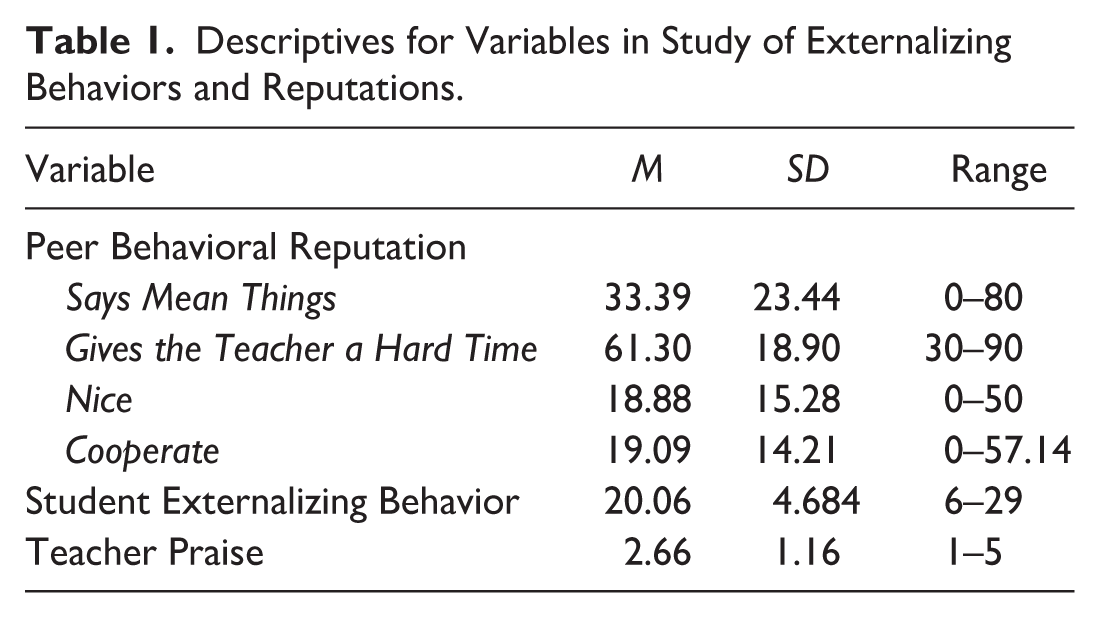
First, we conducted preliminary analyses to examine the descriptive statistics, skewness, and kurtosis pertaining to all study variables (see Table 1). All variables were within acceptable ranges (−3 to 3 for skewness and −10 to 10 for kurtosis) and therefore did not require transformations (Kline, 2023).
Descriptives for Variables in Study of Externalizing Behaviors and Reputations.
Student Externalizing Behavior and Behavioral Reputation
Next, we tested if there was a direct relation between student externalizing behavior and the four facets of peer reputation (see Table 2). The main effects models revealed that praise was not significantly related to the proportion of peer nominations that focal students received for any of the behavioral reputations. However, student externalizing behavior was a significant and negative predictor of focal students’ peer reputation for “Cooperates” (B = −.71; p < .05)
Peer Reputation Predicted by Student Gender, Externalizing Behavior, and Teacher Praise.
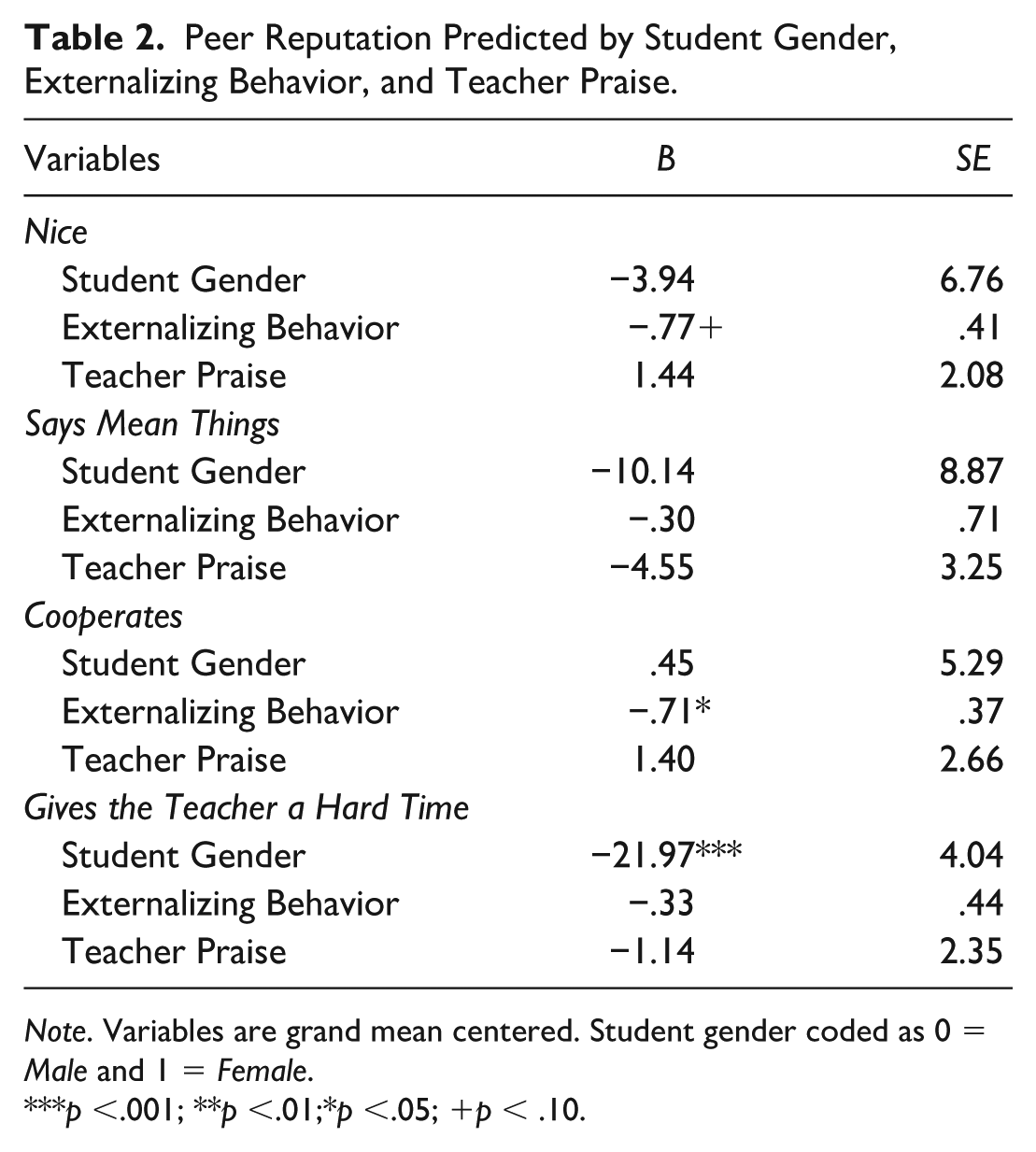
Note. Variables are grand mean centered. Student gender coded as 0 = Male and 1 = Female.
p <.001; **p <.01;*p <.05; +p < .10.
Moderation by Teacher Delivery of Praise
We next tested the extent to which teachers’ delivery of praise modified the relation between externalizing behavior and behavioral reputation (see Table 3). The interaction between externalizing behavior and praise was not a significant predictor of peer nominations for Says Mean Things, Cooperates, or Gives the Teacher a Hard Time. However, the interaction between externalizing behavior and praise was a significant predictor of peer nominations for being Nice (B = 1.11; p < .001). To interpret this interaction, we examined the regression slopes depicting associations between externalizing behavior and praise at the average level of praise and one SD above and below the average for praise (see Figure 1). Simple slopes tests revealed the slopes were not significantly different than zero at low levels of teacher praise (B = −.45; p = .65), at high levels of teacher praise (B = .11; p = .92) or at average levels of teacher praise (B = −.17; p = .87). Although the simple slopes were not significantly different from zero, the interaction effect between externalizing behavior and teacher praise remains noteworthy. An examination of the graph revealed a disordinal interaction (i.e., a cross-over effect was present for the range of the measured independent variable; Lee et al., 2015); indicating student behavior had differential associations with peer perceptions for being “Nice” depending on teacher praise.
Peer Reputation Predicted by Student Gender, Externalizing Behavior, Teacher Praise, and the Interaction of Behavior and Praise.
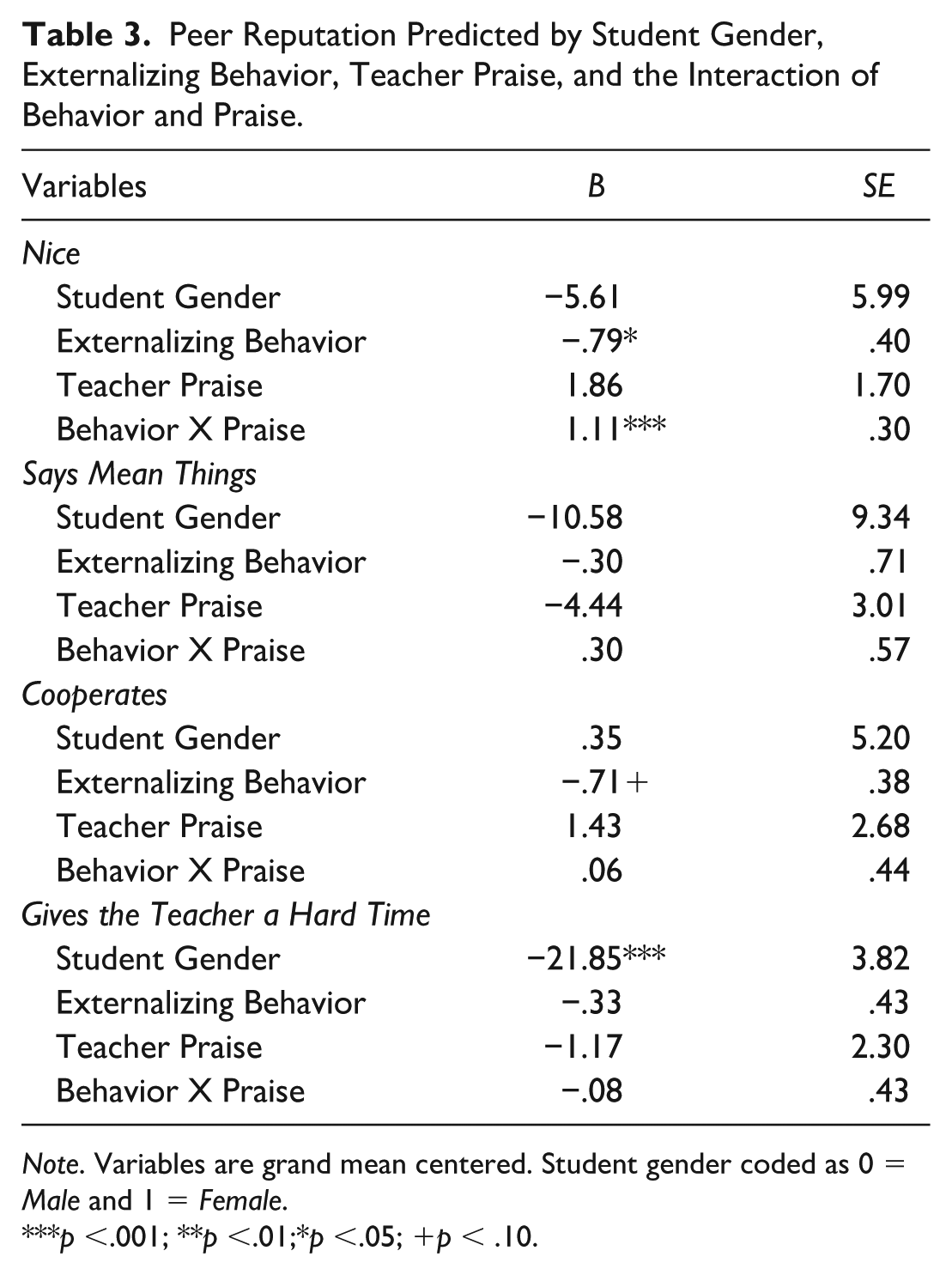
Note. Variables are grand mean centered. Student gender coded as 0 = Male and 1 = Female.
p <.001; **p <.01;*p <.05; +p < .10.
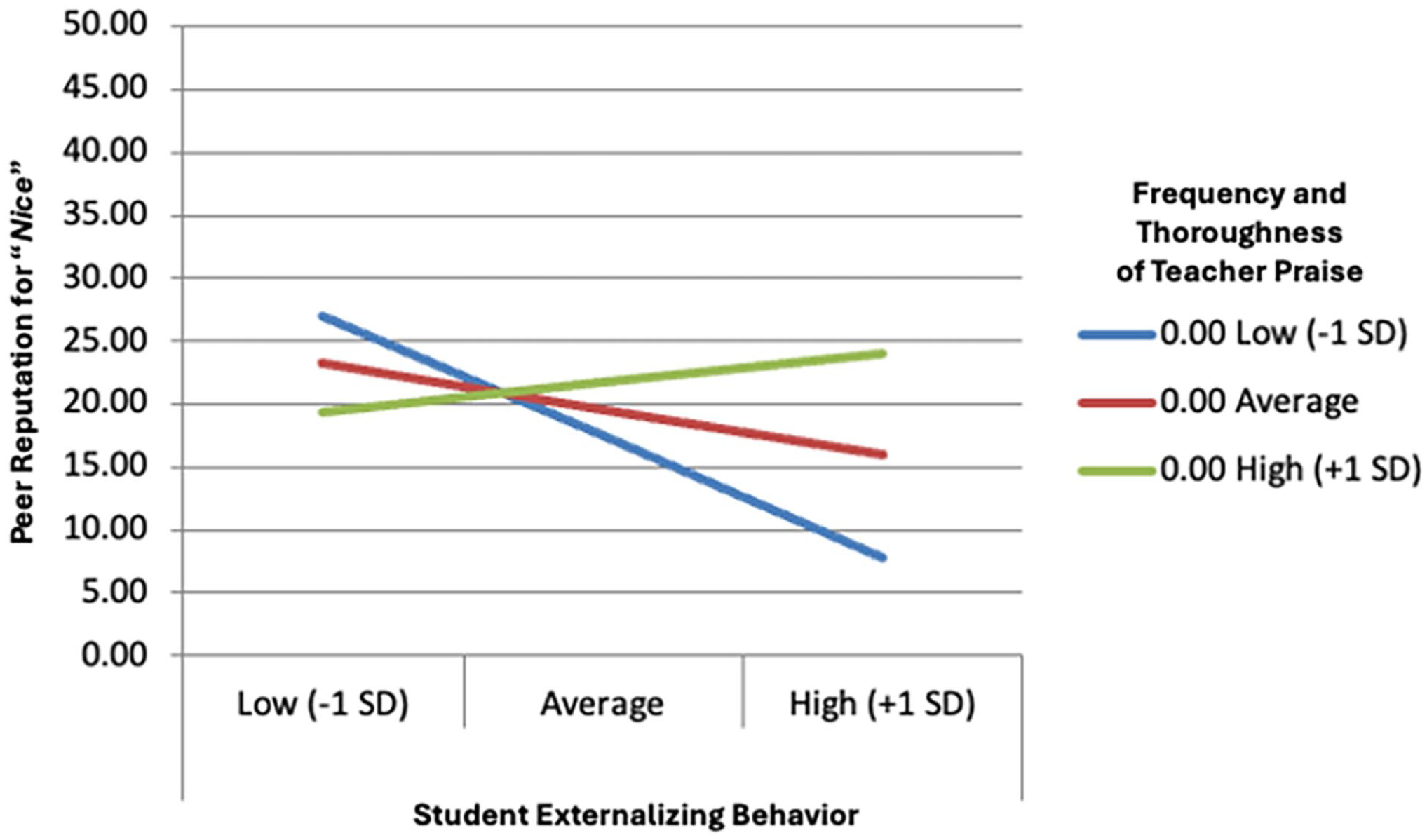
Peer Reputation for Being “Nice” Predicted by Student Externalizing Behavior and Teacher Praise.
Discussion
In this study, we investigated the associations among externalizing behavior and peer behavioral reputations of students identified as with or at risk for EBD, as well as the potential moderating effect of teacher praise. We anticipated that externalizing behavior would be positively related to a reputation for Says Mean Things and Gives the Teacher a Hard Time and negatively related to a reputation for being Nice and Cooperates. We also expected that high levels of teacher praise would diminish the association between externalizing behavior and poor behavioral reparations. Findings partially aligned with our expectations. Student externalizing behavior was related to the behavioral reputation for Cooperates. This finding aligns with prior work that suggests boys who received special education supports for EBD were nominated by peers less for displaying cooperative behaviors compared to academically gifted boys (Farmer & Hollowell, 1994) and recent work that found students with or at risk for EBD received fewer peer nominations for cooperative behaviors compared to their classmates (Granger et al., 2025). Surprisingly, externalizing behavior ratings for students with or at risk for EBD were not directly related to their peer behavioral reputations for Says Mean Things, Gives the Teacher a Hard Time, or Nice. However, prior work documents that students with or at risk for EBD do have poorer behavioral reputations among the domains of Starts Fights, Says Mean Things, Nice, Cooperating, and Giving the Teacher a Hard Time compared to their classmates (Granger et al., 2025). Taken together, this work suggests that conditional on being screened and identified as with or at risk for EBD (i.e., displaying abnormal/high levels of externalizing behavior), a student’s continuous rating of challenging behavior may not be related to their peer behavioral reputations. However, students do appear to make distinctions between peers with low/typical rates of externalizing behavior and peers with the highest rates of externalizing behavior (e.g., Granger et al., 2025).
Regarding the peer reputation for being Nice, the main effects of student behavior and teacher praise were subsumed by a significant interaction effect, whereby teacher-reported externalizing behavior had differential associations on peer-reported behavioral reputation for being Nice depending on the observed level of teacher praise. These findings hint that there is variability in the relation between student behavior and reputation as a function of teacher–student interactions. When evaluating prosocial behavior such as who is willing to do something nice for somebody else and is a nice person, students may look to the teacher as a social referent; teachers may shape peer impressions of individual student’s prosocial behaviors through their frequency and thoroughness of delivery of praise. More broadly, this implies that teachers who communicate that a student exhibiting challenging behavior has value may break or lessen the typical link between externalizing problems and poor social experiences. This aligns with prior work that shows students tend to adopt their teachers expressed liking and disliking of other students and that positive teacher feedback to individual students is associated with more positive descriptions from students (Chang, 2004; White & Kistner, 1992). This preliminary finding also underscores the importance of positive behavioral interventions and supports. Specifically, these findings are aligned with prior work that supports the value of positive teacher–student interactions, warm and nurturing teacher–student relationships, positive reinforcement strategies, and modeling positive encounters when interacting with students with or at risk for EBD (e.g., Myers et al., 2020). Typically, these supports are evaluated in reference to changes in individual student outcomes such as behavior or engagement. Findings from this study suggest that this framework of supports may also help to build students’ positive behavioral reputations, although this remains an empirical question to be explored.
It is important to note that the interaction of student behavior and teacher praise was not a significant predictor of the remaining peer behavioral reputations: Cooperates, Says Mean Things, and Gives the Teacher a Hard Time. Future work should look to unpack the extent to which additional contextual, teacher, or individual student factors may moderate links between student behavior and these peer reputations. We propose three specific constructs to be considered in future investigations. First, peer reputations may be influenced by the praise-to-reprimand ratio that teachers deliver to students with or at risk for EBD. Although the field does not state recommendations on acceptable or empirically derived praise-to-reprimand ratios, educators are encouraged to use BSP frequently and in a higher ratio to reprimands/corrections (e.g., 3:1, 4:1, 5:1; e.g., Caldarella et al., 2019, 2020). However, it is common for rates of reprimands to be higher than rates of praise in natural classroom settings (e.g., Floress & Beschta, 2018; Reinke et al., 2013). This ratio may be relevant as students look to their teacher as a social referent when evaluating their peers’ behaviors. Second, future work should consider to what extent the type of praise contributes to shaping peer behavioral reputations. To illustrate, praise for academic skills and praise for prosocial behaviors may exert a different influence on peer reputations for antisocial and prosocial characteristics (e.g., being nice, says mean things). In addition, behavior specific praise may have a stronger or weaker influence than general praise on peer’s judgments about student behaviors, although this remains to be tested. Third, it may be important to consider the influence of the overall teacher–student relationship in conjunction with the frequency at which teacher’s praise an individual student. Prior work demonstrates that teachers tend to have negative relationships with students with or at risk for EBD (Nurmi, 2012) and that student’s relationships with their teacher may also influence their peer likability and reputations (De Laet et al., 2014; Hughes & Chen, 2011; Mercer & DeRosier, 2008; Roorda et al., 2011). For teachers and students with negative relationships, the frequency and thoroughness of praise may or may not be meaningful enough to alter student’s overall perception of the interactions between the teacher and focal student.
In this study, we collected teacher reports of student behavior and observed teacher praise in the Fall, followed by student interviews about peer reputations in the Winter. The temporal sequence between the independent and dependent variables allows us to draw initial conclusions about the direction of these associations. However, we did not control for (and did not collect) students’ peer reputations at the beginning of the year, which limits our ability to assess changes in peer reputation over time. Future studies stemming from this research should be designed prospectively across the school year to enable analyses that move toward establishing causal relationships. For instance, exploring potential reciprocal associations between student behavior, teacher–student interactions, and peer perceptions could provide insights for intervention and professional development initiatives aimed at determining when and with whom (e.g., teacher–student interactions, peer perceptions) support may be most effective. Future work may also consider the contexts under which students are being praised. Although our observations included teacher-chosen instructional contexts (e.g., one-on-one interactions with the focal student, small group activities, and whole-class teaching), we did not account for variations in these contexts across the 18 classrooms in our analyses. This variability could influence how frequently teacher praise was delivered in each observational sampling. Future research should consider including instructional context as a covariate in study models to better understand its potential impact on teacher praise and student outcomes. Finally, the lack of significant simple slopes in our findings may partially reflect the limited statistical power inherent in our small sample size. With only 35 focal students, our ability to detect subtle effects is constrained. Nonetheless, the observed interaction provides preliminary evidence that teacher praise may play a role in buffering the social consequences of externalizing behavior. Future studies with larger, more diverse samples are needed to determine whether these patterns are robust and generalizable.
When interpreting study results, it is also important to consider the complex interplay between teacher praise, student behavior, and peer perceptions. It is possible that teacher praise is directed more frequently toward students who already display prosocial behaviors, regardless of their externalizing behaviors, which could influence their peer reputations. Alternatively, teacher praise may promote prosocial behaviors in focal students, which peers observe and use to inform reputations. These explanations suggest that changes in peer reputation may reflect peers’ observations of actual behavior changes rather than being solely influenced by teacher behavior. Future research should explore these pathways over time to better understand how teacher praise interacts with student behavior and peer perceptions in shaping reputations. Regardless of whether peer reputations reflect objective behavior or social perception, they remain a meaningful construct with implications for students’ social experiences, treatment by peers, and self-concept. For students with or at risk for EBD, understanding these dynamics is important, as peer reputations represent the social perceptions they navigate in classrooms. However, understanding this alignment is valuable. Future research could explore how peer reputation reports from peers, teachers, and observers align, providing deeper insights into the interplay between perception and behavior in shaping classroom social dynamics.
It is also important to acknowledge that the models used in this study were based on a limited number of teachers and students from a homogeneous community sample. Therefore, caution should be exercised when interpreting and generalizing these findings. Future research should aim to replicate this work with a larger and more diverse sample of teachers and students.
Specifically, our sample was comprised of students with or at risk for EBD, which provides insights into a population that is often underrepresented in studies of classroom dynamics and social experiences. However, this sample selection also introduces constraints, such as a restricted range of externalizing behavior compared to general classroom populations. Future research could expand on these findings by examining the role of teacher praise in more diverse classroom samples, which may allow for broader generalizations and the identification of additional moderating factors. In addition, the mismatch in racial demographics between our teacher and student samples is noteworthy. Our teacher sample was 42% Black, whereas our student sample was predominantly Black (over 90%). This discrepancy is significant, given existing knowledge about the impact of teacher–student racial match/mismatch on teacher–student relationships, perceptions of student behavior, and student outcomes. Finally, it is important to recognize that our study included teachers who volunteered to participate in a program trial aimed at enhancing their delivery of evidence-based instructional practices with students with or at risk for EBD. Although teachers in our study were randomized to the business-as-usual condition, our findings are subject to limitations associated with this selection effect.
Conclusion
This study extends previous work on the associations between student’s challenging behavior and their peer reputations and examines the extent to which teacher praise influences this relation in a sample of students with or at risk for EBD. This study hints that students may use their teacher as a social referent, forming judgments about their classmate’s prosocial reputations, based in part on how the teacher interacts with that classmate. Furthermore, teacher praise is likely an important teacher–student interaction characteristic to consider when examining student’s prosocial peer reputations and social experiences. Identifying classroom factors, such as teacher praise, that are amenable to change and contribute to the connections between student characteristics and peer relationships in the classroom can enhance the precision of intervention strategies. This insight can guide educators in implementing practices that influence or manage classroom social dynamics more effectively. In summary, this study underscores the importance of considering teacher–student interactions and classroom dynamics in shaping social experiences and peer relationships for students with or at risk for EBD.
Footnotes
Declaration of Conflicting Interests
The author(s) declared no potential conflicts of interest with respect to the research, authorship, and/or publication of this article.
Funding
Preparation of this article was supported by the Institute of Education Science, National Center for Special Education Research (grant no. R324B220003). The opinions expressed are those of the authors and do not represent views of the Institute or the U.S. Department of Education.
