



Abstract
This article aims to sketch a new integrative perspective on what I call change-ability. I define change-ability as skilled ways of coordinating with a rapidly changing world. Many urgent societal challenges – from climate change to obesity, from the mass extinction of species to fraying social cohesion – require people to collectively change everyday patterns of behaviour they take for granted. The key insight I start from is that to durably change undesirable patterns of behaviour, we could start by changing the affordances the environment offers – the possibilities for action offered to us by the living environment. The aim of this article is to sketch an integrative conceptual framework for understanding change-ability in terms in terms of a dynamical ‘brain ↔ body ↔ community ↔ landscape of affordances’ system. This Change-Ability Conceptual Framework starts from the idea that individuals and communities are situated in the same rich landscape of affordances and suggests that making communities more change-able entails transforming the material ‘grooves’ that have formed in this landscape of affordances.
Keywords
Introduction
When you read this text, you will likely be sitting in a chair. Why? The answer, in part, is that the environments in which we work and live are generally structured around sitting. Even though we know sitting for long stretches of time is unhealthy, we find it difficult to change what we do in such a living environment.
This article aims to sketch a new integrative perspective on what I call change-ability. I define change-ability as skilled ways of coordinating with a rapidly changing world. Many urgent societal challenges – from climate change to obesity, from the mass extinction of species to fraying social cohesion – require people to collectively change everyday patterns of behaviour they take for granted. The key insight I would like to start from here is that to durably change undesirable patterns of behaviour such as excessive sitting, for example, we could start by changing the affordances the environment offers. Affordances are the manifold possibilities for action provided to us by the human social, cultural, material and natural environment, or what I will call our living environment (Gibson 1979; Heft 1989; Chemero 2009; Rietveld and Kiverstein 2014). 1 A chair, for example, enables us to sit comfortably for long periods of time. But although affordances enable action, they also constrain what we can do. Affordances of available chairs can become obstacles to change as we are then not inclined to seek alternatives to sitting. The communal custom of sitting and the omnipresence of chairs have jointly made sitting our second nature.
Created by RAAAF, the experimental architecture and visual art studio that I co-founded in 2006, the art installation below (Figure 1) transforms the landscape of affordances. The End of Sitting illustrates the key insight of this article: it shows us how a material intervention that changes the spectrum of available affordances has the potential to generate behavioural change. By means of affordances for ‘supported standing’, this artwork makes material an imaginary office of the future where people work while standing and changing positions thanks to a new ‘non-sitting technology’. I call installations like this ‘material thinking models’ because they scaffold philosophical thinking about the relation between people’s behaviour and the living environment. Still from The End of Sitting 1:1, short film by Barbara Visser | RAAAF (2015).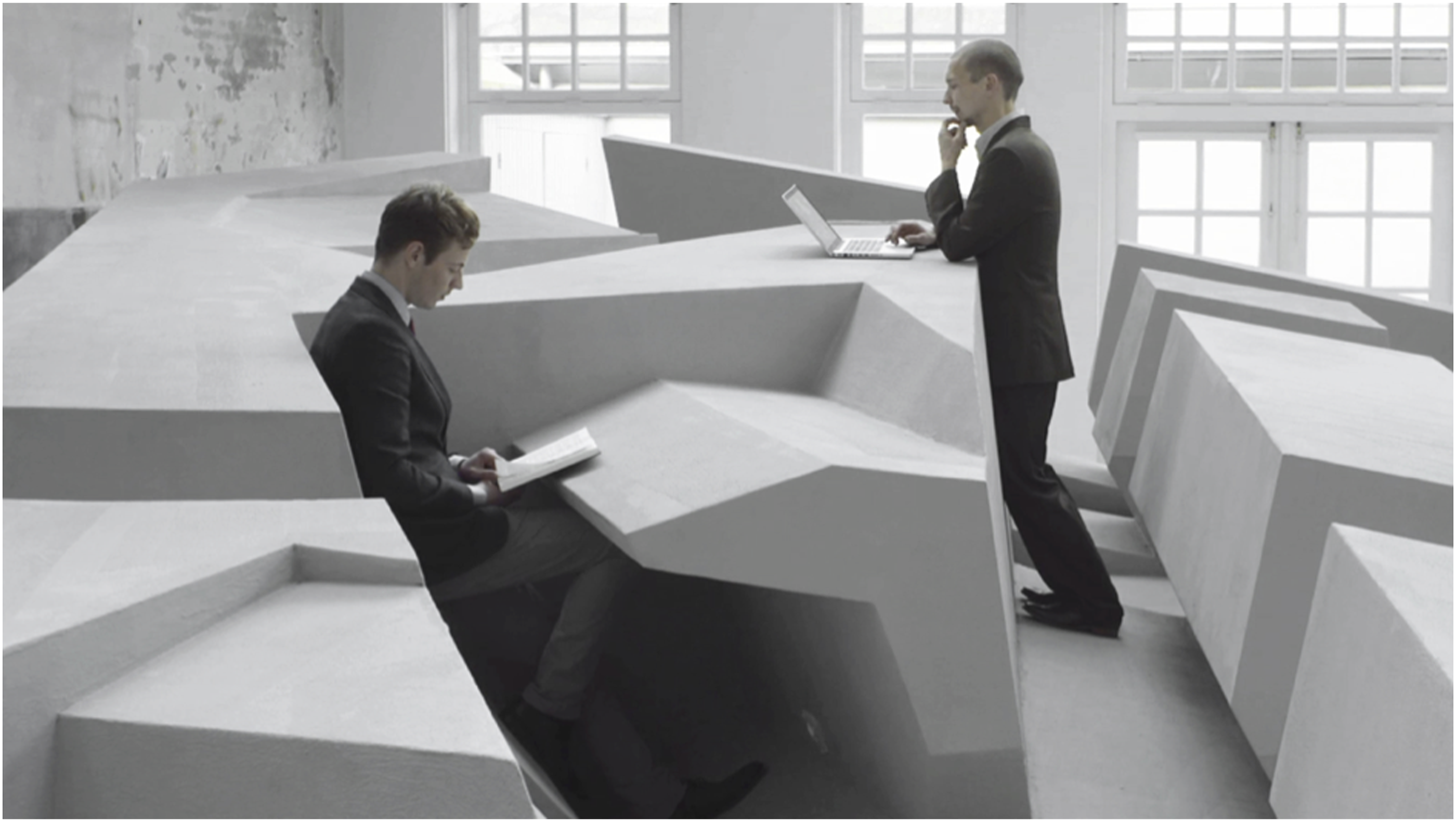
In this short article, I will seek to shed light on people’s resources for coordinating in real-life situations with a rapidly changing environment. People and the communal practices they take part in are often resistant to change. This is particularly true of patterns of behaviour such as sitting, mobile phone use or eating, which become entrenched through constant repetition and now feel ‘natural’. Yet generating individual and coordinated collective behavioural change is among the most pressing challenges societies face today. What can we learn about generating change in real-life communal patterns of behaviour from the philosophy of embodied cognition and material thinking models like The End of Sitting (Figure 2)? Still from The End of Sitting 1:1, short film by Barbara Visser | RAAAF (2015).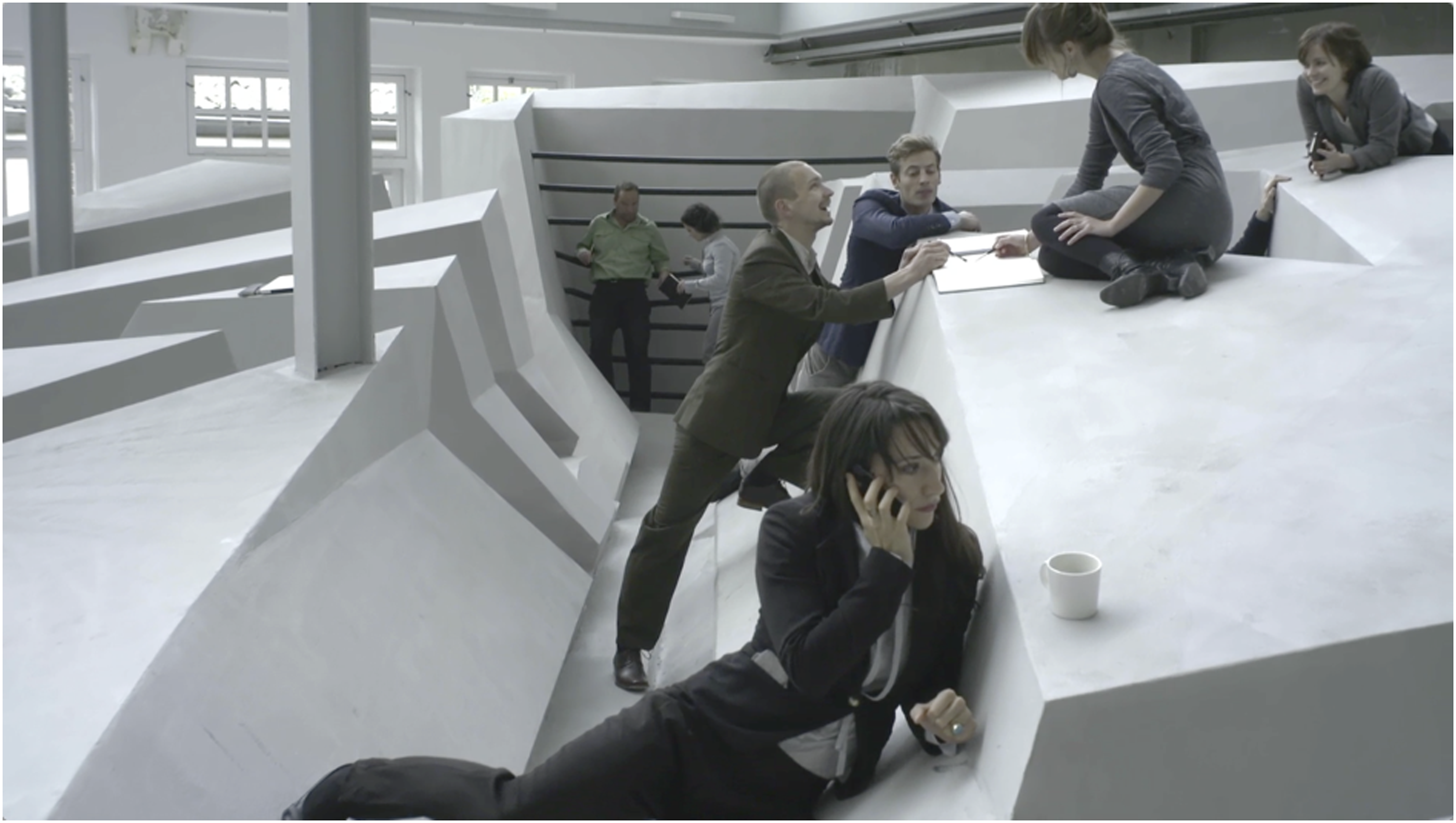
My earlier work in the field of embodied cognition was concerned with understanding the skilled actions of individuals in terms of individual brain–body–environment dynamics. The new change-ability perspective ‘decentres’ the individual by focusing on collective and communal dynamics, more specifically the change-ability of entire communities situated in their living environment. A key premise of my change-ability approach is that some important insights into the dynamics of change-ability of skilled individuals in their living environments also apply to the change-ability of entire communities. I will sketch how the change-ability, of both individuals and the communities they make up, depends crucially on their various abilities, skills and habits on the one hand and the affordances of their environment on the other, that is, on the rich landscape of affordances in which people are situated. The change-ability approach goes beyond the state-of-the-art of in embodied cognition by thinking in terms of a dynamical ‘brain ↔ body ↔ community ↔ landscape of affordances’ system.
The aim of this article is to sketch an integrative conceptual framework for understanding change-ability in terms of brain–body–environment dynamics over multiple scales: the relations between the landscape of affordances, the community (sociomaterial dynamics) and the active individual with their abilities and related brain and body dynamics. Working out this first sketch will be an important line of research for me and my team in the years to come. Before I sketch the Change-Ability Conceptual Framework (CAF), I will first give a concise overview of its main theoretical foundations.
Theoretical foundations of the Change-Ability Conceptual Framework (CAF)
My work is situated in the rapidly evolving field of philosophy of embodied cognition, which understands individuals and their environments as making up an integrated brain–body–environment system (Varela et al. 1991; Clark 1997; Thompson 2007; Rietveld 2008b; Chemero 2009; Noë 2009; 2015; Hutchins 2010; Barrett 2011; Hutto & Myin 2017; Myin 2012; 2020; Anderson, 2014; Bruineberg & Rietveld 2014; Froese & Di Paolo 2011; Colombetti 2014; Kirchhoff 2015; Gallagher 2017; Di Paolo, Buhrmann & Barandiaran 2017). It follows that to understand human cognitive behaviour in all its complexity, we need to study the behaviour of people in real-world situations (Barker 1968; Gibson 1979; Costall 1997; Heft 2001; Hutchins 1995; 2013; Sutton 2010; Harris et al. 2011; Suchman 2007; Rietveld & Kiverstein 2014, 2022). Over many years, I have, together with my team, employed the philosophical method of conceptual analysis to engineer several of the theoretical building blocks of the philosophy of change-ability: affordances, skilled agency and metastable attunement. I introduce these concepts below. I also introduce two new concepts from our recent work that are relevant because they will help to understand the reciprocal relations between individuals and communities: desire paths and multi-scale dynamics.
The CAF suggests the beginning of an answer: it is the shared living environment (the rich landscape of affordances) in which both individuals and collectives are situated that generates (often unreflective) affordance-related states of action readiness based on habits that entrain individuals and the communities they form. The End of Sitting, for example, freed the people in the art installation from the constraints generated by chairs because such possibilities for sitting were minimised, and at the same time, an entire landscape of affordances for supported standing was offered. It is the offering of a large variety of possibilities for supported standing that allows people with different body sizes and abilities to find non-sitting positions that work for them.
Here, it might be instructive to consider how the RAAAF team were able to break with past ways of doing things over the course of developing The End of Sitting. The first explorations of affordances for supported standing were done with wood, which allows for easy ‘tailoring’ around the body. However, after making the large wooden installation (Figures 1 and 2), we (both as individuals and as a team) became ‘stuck’ and found it difficult to develop the project in new directions and beyond wooden structures. What gave a new impulse to our imagination for future End of Sitting places were collective explorative site visits to all kinds of places that use a variety of materials to support bodies and invite movement: from pilates studios and trx-gyms to funfairs and children’s playgrounds. We also visited factories and wholesalers of materials that are sturdy, light and flexible. These collective explorative tours generated a lot of enthusiasm about the possibilities of different materials encountered and an eagerness to seriously experiment with their potentials. The metal frame of the material playground (Figure 3) I discussed in my inaugural lecture (Rietveld 2022 this volume) was then built to be able to explore at the scale of the body the various affordances these materials could offer for non-sitting positions, moving around and ‘living diagonally’ as we called it. Exploring the world of affordances in a material playground (photo: RAAAF).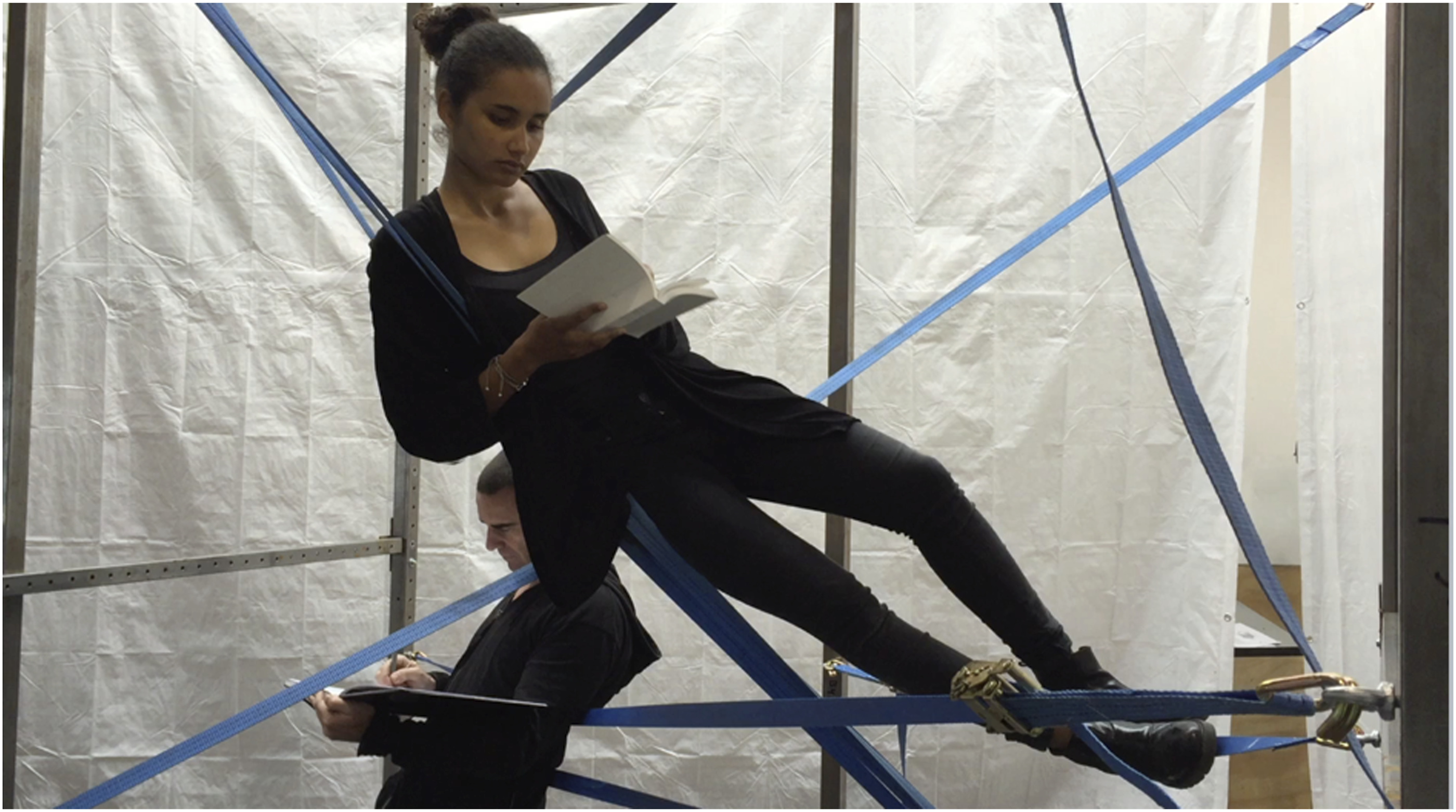
It was only in this process of material experimentation and trial-and-error – in collaboration with a master craftsman – that we got a clear idea of the possibilities that the materials offer and of their relevance for further developing The End of Sitting project. This has generated many interesting ideas and the installation Breaking Habits (van Dijk & Rietveld 2018; 2020; 2021) which we exhibited at the Mondriaan Fund for the Visual Arts in Amsterdam and presented on the Dutch TV and internationally in Zeit Magazine. This latter installation was made out of felt-reinforced suspended carpet, a material hybrid we had develop ourselves during the process of material experimentation. So at least at the scale of our End of Sitting team and art collective, the combination of stability (the concept of non-sitting positions for living more actively was still the same as earlier on in The End of Sitting project) and exploration allowed us collectively to break out of the ‘wooden’ grooves we had become stuck in and move into new territories with more flexible materials that can follow the forms of bodies.
One way of approaching this could be by seeing individuals as self-organised collectives of abilities. It is their multiple abilities that allow them to be responsive to multiple relevant affordances simultaneously. Multiple states of action readiness self-organise in response to the various relevant affordances for them (see Bruineberg & Rietveld 2019, p. 211 on the individual agent as a system of anticipations such as readiness for jab, hook and uppercut in the boxing example above). Similarly, we can see dyads (Kiverstein & Rietveld 2021) and larger collectives as pooling multiple abilities, skills and habits and generating multiple states of action readiness that coordinate in relation to affordances of shared relevance. Sometimes these affordances of shared relevance are large-scale affordances, like the action possibility of creating an interesting new End of Sitting installation was for the RAAAF art collective (Van Dijk & Rietveld 2018).
My example above was being stuck in the grooves of working with wood to make non-sitting positions. This experience led the individuals that make up the RAAAF collective as a whole to engage in exploration of different materials, outside of the trodden wood paths, a new but related activity that enabled the collective to become more change-able. The wooden material grooves formed in the landscape of affordances were obstacles to change-ability, and transforming the landscape of affordances by means of the material experiments afforded by the material playground helped to reduce these obstacles and led to the new Breaking Habits art installation (see Rietveld & Kiverstein 2022 for more examples).
Our work suggests that it is in part engagement with large-scale affordances of shared relevance (cf. Kiverstein & Rietveld 2021; Van Dijk & Rietveld 2018; 2021) that allow different people to coordinate their behaviour at different points in time (i.e. diachronically). It is because the medical team at the hospital and the boxer who is training all share an interest in the health of the parent treated at the hospital, that in this particular situation the boxer is not only poised for possibilities of punching the heavy bag but also for the affordance of answering a phone call.
The Change-Ability Conceptual Framework (CAF)
The complexity of change-ability in brain–body–environment systems is enormous, particularly in real-life environments, outside of traditional cognitive science laboratories. As Randall Beer notes, studying any one component of a brain–body–environment system is difficult enough; studying all three components and their interactions stretches cognitive science beyond its current experimental limits (Beer 2008: 101). It is here that a philosophy that embraces real-life complexity can do fundamental work by engineering ‘bridging concepts’ that allow for complementary scientific perspectives to be connected. The Sketch of the Change-Ability Conceptual Framework (CAF). Note that communities are made central, while acknowledging that individual agents participate in them and can over larger time-scales be seen as continuing communal patterns of behaviour. Crucially, what individuals and communities have in common is that they are situated in the same living environment or ecological niche (the world in flux, in blue). In other words, individuals and communities (both in green) share the rich landscape of affordances that enables and constrains what they can do.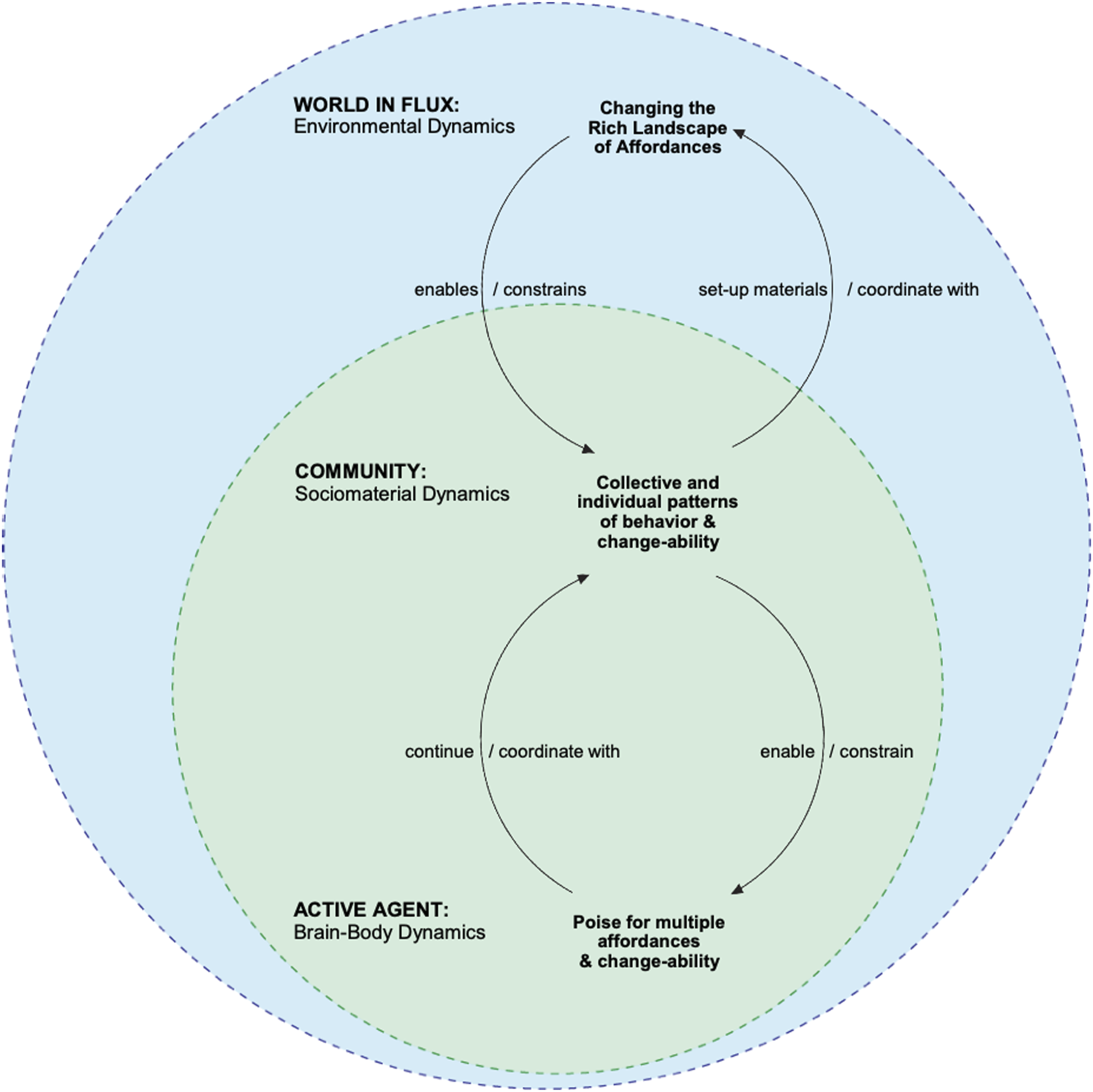
To date, the philosophy of embodied cognitive science, including my own work, has primarily focused on how affordances enable action. The CAF breaks new ground in the field embodied cognition by paying attention to how affordances also constrain what people do, thereby limiting their ability to change. Moreover, within (embodied) cognitive science, individuals and dyads are typically at the centre of theorising. The Change-Ability Conceptual Framework (CAF) decentres the individual by placing entire communities centre stage, studying how the wider social and material environment enables and constrains individual and collective patterns of behaviour.
While affordances can make a person’s activities stable, regular and rigid, they can also be used to open up new, hitherto unrecognised possibilities for organising social life. The End of Sitting freed the people in the art installation from the constraints generated by chairs and allowed them to work in a tilted landscape that affords changing positions. In this tangible way, The End of Sitting installation invited people to reflect on their habitual sitting behaviours, the sitting society in which they live, and role that the material environment plays in the generation of behavioural patterns. In the same spirit, the other affordance-based interventions by RAAAF that I presented in my inaugural lecture (Rietveld 2022, this volume) could open people up to explore unconventional possibilities. For example, creating buildings by joining forces with bacteria to generate bio-cement or by developing a practice of cultural heritage that is based more on imagination than pure preservation (Rietveld & Rietveld, 2020).
The Change-Ability Conceptual Framework (CAF) is depicted in Figure 4. It illustrates my central idea that affordances both enable change-ability but also serve as constraints or obstacles to realising change in real life. The dotted green line indicates the situatedness of both active agents and the communities they form within the larger dynamics of the environment. Communal patterns of behaviour (such as sitting on chairs for example) reciprocally shape and are shaped by the activities of individuals over time. This dynamic is illustrated in the lower half of the figure by the arrows forming relationships of reciprocity. People today tend to eat, work, travel and play while remaining seated. These communal patterns of behaviour in turn set up and shape materials that give form to the shared and changing landscape of affordances. In other words, these communal dynamics shape the shared meshwork of material ‘grooves’ that can constrain collective and individual patterns of behaviour. This is illustrated by the arrows forming a relationship of reciprocity in the upper half of the figure.
Crucially, the arrows in the upper and lower half of the figure feed into each other, enabling, constraining and thus jointly shaping the sociomaterial dynamics of a community over time. These arrows show how the shared landscape of affordances and individuals (as they act in agreement with what others do in their communities) shape and are being shaped by each other over time. The result of this dynamic is that historical and material ‘grooves’ form in the environment that constrain the ability of individuals and communities to change. Affordance-based material interventions that change the shared living environment can reduce such impediments.
Conclusion
Embodied cognitive science foregrounds the situatedness of cognition in real life and thus is well positioned to engage with societal challenges. However, so far it has largely been a theoretical affair (but see e.g. Carel et al. (2020); Maiese & Hanna (2019); Ratcliffe (2019); Zahavi & Martiny (2019); Heft & Chawla (2006); Protevi (2009b/b); Slaby & Von Scheve (2019); Lebahn-Hadidi (2021); Kaaronen (2017)). The Change-Ability Conceptual Framework (CAF) starts from the idea that individuals and communities are situated in the same rich landscape of affordances and suggests that making communities more change-able entails transforming the material ‘grooves’ in this landscape of affordances.
By embedding my philosophy in RAAAF’s art-science practice, we have been able to make affordance-based interventions in real life, learn from their effects and inspire others with this. The exploration of overlooked affordances can break down the inertia that forms over time in the dynamical ‘brain ↔ body ↔ community ↔ landscape of affordances’ system and enhance people’s ability to coordinate with a world in flux. The CAF thus promises to open up a new perspective on how to increase people’s change-ability at a time when it is urgently needed.
Footnotes
Acknowledgements
The roots of this Change-Ability project lay at the expertise on change-ability that my brother Ronald Rietveld and our team at RAAAF have developed over the last 15 years, which is why would like to thank them here. Other people without whom this Change-Ability project would not have been possible are Julian Kiverstein, the Skilled Intentionality team members at the University of Amsterdam/AMC and our collaborators, as well as the many colleagues and friends who gave feedback on my draft descriptions of the Chang-Ability project. Many, many thanks to all of you! I am grateful for all the support by Peter-Paul Verbeek and Ciano Aydin as Socrates Professor at the University of Twente and for the VICI-funding by NWO, Netherlands Organisation for Scientific Research.
Declaration of conflicting interests
The author(s) declared no potential conflicts of interest with respect to the research, authorship, and/or publication of this article.
Funding
The author(s) disclosed receipt of the following financial support for the research, authorship, and/or publication of this article: This work was supported by the Netherlands Organisation for Scientific Research (NWO VICI).
