



Abstract
Ecological-enactive cognitive science is an increasingly influential paradigm that has proved its heuristic value in various fields of the human sciences. This text, in the form of a conversation, explores possibilities for an ecological-enactive account of how people experientially engage with works of art on the basis of their embodied skills.
Keywords
Introduction
Ecological-enactive cognitive science is an increasingly influential paradigm that has proved its heuristic value in various fields of the human sciences. This text, in the form of a conversation, explores possibilities for an ecological-enactive account of how people experientially engage with works of art. Drawing on the theoretical vocabulary of ecological enactivism, Anja Novak (below AN) suggests to approach the experiential engagement with a work of art as the enactment of certain skills that allow a person to respond to the work in a meaningful way. In an exchange of thoughts with Geerteke van Lierop (GvL) and Erik Rietveld (ER), this approach will be explored. Drawing on the Skilled Intentionality Framework developed by Erik Rietveld’s research group at the University of Amsterdam, skills are understood in relation to the selective engagement with multiple affordances. Affordances are possibilities for action provided to people by the socio-material environment. Artworks are part of and encountered within this socio-material environment. Several abilities for engaging with art will be singled out: imaginative linguistic skills and bodily affective capacities for relating to artworks. In both cases, the person responding to the work of art is enacting embodied knowing-how and this enactment is in turn afforded by the artwork’s socio-material nature.
Conversation
ER: If I understand correctly, the core of your approach is that skills are crucial for dealing with a work of art, and more specifically for experiencing a work of art.
AN: Yes, I think the Skilled Intentionality Framework and in particular the notion of skills could be an interesting new approach to art and how people experience works of art. The Skilled Intentionality Framework (SIF) is co-developed on the basis of ethnographic and philosophical research embedded in RAAAF, an art studio that creates works of art at the interface of visual arts, architecture, and philosophy. SIF could provide new terminology that helps to say more about aspects of the experience of a work of art that are often overlooked or are difficult to name and describe in more traditional approaches. In particular, I think it is appropriate to better understand and analyze the embodied aspects of the experience of art.
ER: Okay, the embodied components will be covered in a moment. Perhaps you could first say something about the aspects of the experience of works of art that are actually not so well understood at the moment. Instances where the Skilled Intentionality Framework can be complementary to existing theories.
AN: Initially, there is a fairly strong tradition within art history to approach the interaction between artwork and receiver in a cognitivist way, as something that mainly has to do with the kind of meaning-making that takes place between your ears. What does a work of art mean? That’s what people often wonder at first. This stress on meaning can cause frustration, especially for someone who has little art-historical knowledge. If you assume that meaning-making has to take place at the level of thinking, you get frustrated if you don’t understand what you see. But an important part of what is going on is that you can’t articulate what you see, how the artwork appeals to you, what it does to you. And then you soon have the idea that you don’t understand anything at all. But if you manage to put aside the urge to understand the artwork on an intellectual level and dare relate to it in a different way, then all kinds of things happen. You may become more aware of what is actually going on between you and the work of art, what the work does to you. I find that layer of experiencing a work of art very interesting and I would like to be able to articulate and analyze it better.
ER: So are you saying then, that if you come across a work of art and you don’t start reflecting immediately, that is, refrain from trying to understand it by thinking very hard about it, then you avoid disturbing those ways in which the work of art does something to you? Or you avoid being no longer in contact with it? Is that why those skills are so important? Does thinking too hard interfere with feeling or experiencing how the work of art affects you?
AN: Reflection can certainly interfere with it. But besides that, all that thinking is also based on something. It takes place not only in the brain, but in the whole body. So actually, even if you think you don’t understand what you see before you, you are already thinking. Your body is already thinking. Your body is already in the process of deploying all kinds of skills that you bring along, skills that you embody. I would like to understand better how the artwork triggers those skills. And also how you can allow such an immediate response to happen and pay attention to it, without adding another layer of meanings that may be more sophisticated or far-fetched. That extra layer of meaning has to do with all kinds of things you have in mind, but much less with what really goes on between you and the artwork. I want to understand how you as a viewer can develop a different attitude that allows you to be more alert to what is happening pre-reflectively in embodied experience.
ER: So if I understand correctly, you actually want to preclude thinking from being seen solely as linguistic reflection, in order to leave room for this embodied, pre-reflective form of thinking that is specific to experiencing a work of art.
AN: Exactly. In art history, attempts to look at how people actually experience works of art are prone to the accusation of being too subjective. Experience reports are quickly dismissed as being nothing more than the receiver’s personal preoccupations, their vague feelings or memories that are being projected onto the artwork. These “projections” are taken to be improper meanings. But I wonder, how can meaning be improper? Especially meaning that springs from a lived, felt interaction with a work of art. Another difficulty within art-historical methodology is the question of how the receiver’s experiences exactly relate to the material aspects of the artwork. That dualism—a material thing on one side, a subjective receiver on the other—is still quite strong in art history and difficult to overcome. How to bring both sides together? How does my experience relate to the artwork’s materiality?
ER: Such materiality and its affordances is also why it is not purely subjective because this materiality partly determines how you experience the artwork.
AN: Exactly. In this sense, I think that an experience that focuses mainly on, or that arises from, an intense engagement with the materiality of a work of art, can never be subjectivistic.
ER: I understood that art history students are often taught that naming the material aspects of a work of art is one way you might look at the work.
AN: That’s right. That is indeed the first step within iconological analysis: first you try to name what you see, what is given in a material sense. But with the next steps of iconological analysis, other matters are introduced. And the final interpretation is often based on all kinds of contextual data, that is, various kinds of texts that are found in the vicinity of the work of art. And from there the work is ultimately interpreted. The materiality is indeed the beginning, but in the process of interpretation it gradually fades into the background.
ER: How do you see the relationship between that materiality, affordances, and those skills that you want to emphasize? Affordances are possibilities for action offered by the living environment. Based on the skills a person has developed, multiple affordances stand out as relevant in a particular situation. Could this affordance-related understanding of skill help to make sense of the relation between materials and skills in the experience of artworks?
AN: Materiality is something that also characterizes our environment as such. The artwork is a material thing. You have developed the skills that you bring along as a viewer because you always already relate to a material environment. You have developed those skills in relation to the material aspects of your environment and its affordances. In that sense, skills always have to do with materiality. I think that is why the material aspects of a work of art can trigger certain skills that have been developed in relation to the material aspects of your environment and their affordances.
ER: So because skills are always developed in socio-material practices, for us humans they always have roots in materiality. This sounds right but it begs the question of how the viewer knows where the materiality of the work begins and where it ends? This often already seems more difficult with an installation than with a painting. And with art in public space, think of Bunker 599: where does this work begin and where does it end? Does that matter? Figure 1 Bunker 599 by RAAAF | Atelier de Lyon (photo: Allard Bovenberg).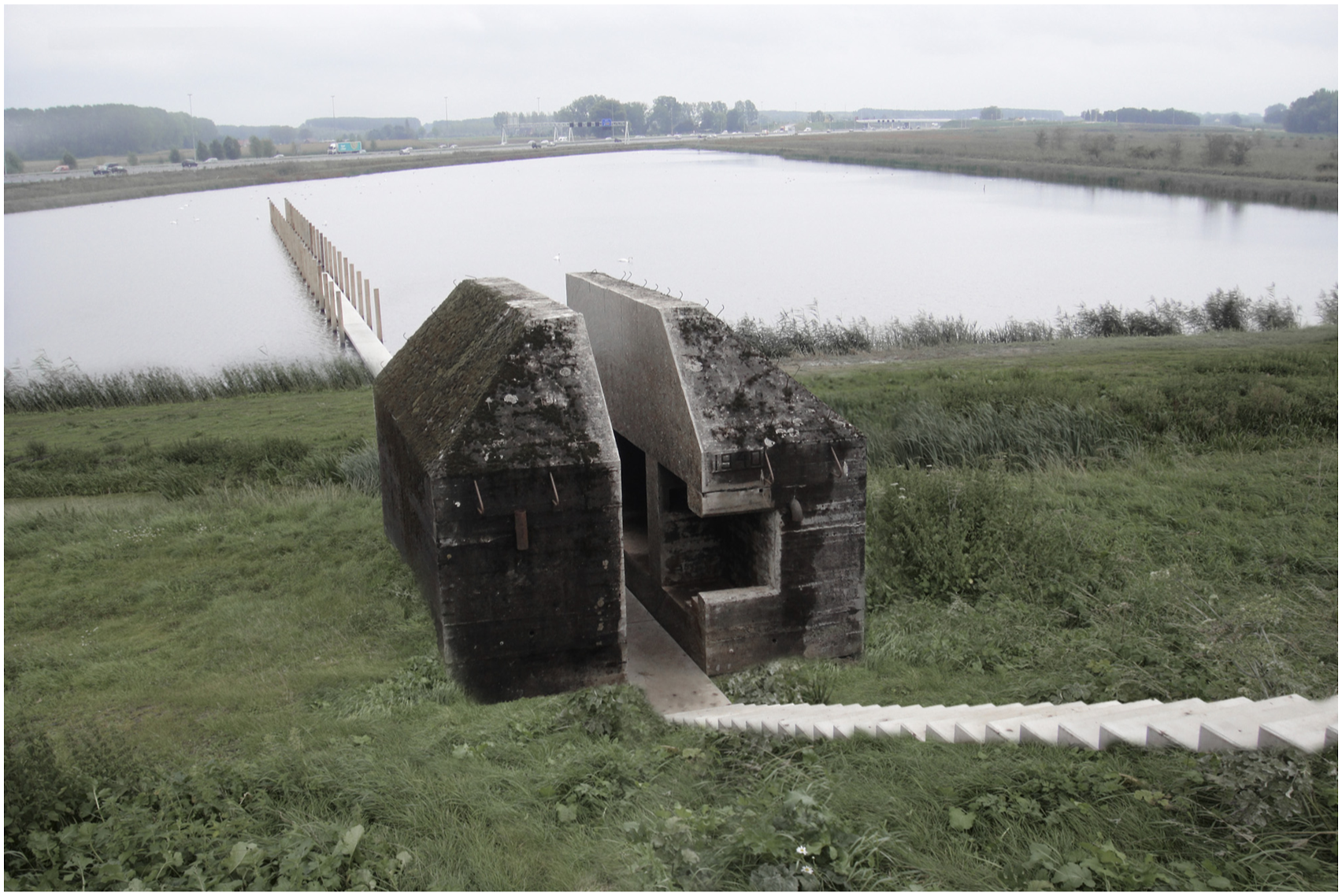
AN: That’s a really good question and it’s a very complicated question. That question is indeed more pressing for a certain type of artwork. A painting has a frame and thus appears to be more clearly delineated from its surroundings. At the same time, the effect of a painting does not stop at that frame. Paintings also have a strong spatial effect, they radiate. The measurements of the space in which you experience a painting, the light in the space, affect your experience of the painting. So there are all kinds of, perhaps less obvious, ways in which the materiality of a painting is also less delineated than one might think. But with a 3D work of art, and certainly with a work of art that explicitly relates to its surrounds, the relationship to the environment is much more prominent. As a viewer you easily realize that you are not looking at an isolated image, but at a larger environment. In a sense, the artwork also functions as a prism or as a lens that makes the environment appear in a certain way. And vice versa. The environment also has an impact on how you experience the work. This is very clear when working in the outdoor area. If you visit Bunker 599 in spring, on a sunny day, you will get a very different experience than in fall, on a stormy day with gray skies. Neither experience is better or more true to the work, I think. Experiences are always situated, always contingent on the circumstances in which they occur.
AN: So materiality doesn’t really stop anywhere, it fans out in all directions, and yet in the experience of a work of art there is a certain focus that arises, through which you have an idea of what that work of art is, that it has a kind of boundedness, that it is a definite entity which, although related to its environment, is in a certain sense also delimited from it. That is why we talk about a work that relates to its environment instead of coinciding with it. There are artists who have stretched the notion of a relationship between artwork and environment to an extreme by making works that are not objects, but transformations of a place or environment. Such a work is more an intervention in the environment than an object relating to it.
ER: And then of course there are aspects of the experience of a work of art that are not materially present. Whether it’s a real Picasso or a fake Picasso. Whether it is looted art or not looted art. Well, you name it, there are plenty of examples of course. Or take Bunker 599 as an example again, because we all know it well. The fact that it was a municipal monument when it was cut open, for example. That makes a difference in how you experience it, but it’s status as heritage relates to socio-material practices of, for instance, monument preservation. So far we have focused on material aspects of the experience of artworks but how should we account for their social and cultural aspects? Is this also to be understood in terms of skills and materials?
AN: You mention examples here that are quite different from each other. In order to distinguish a real Picasso from a copy, you need very specific skills. An expert who knows exactly how Picasso handled the brush or what materials he used can distinguish the original from the copy quite easily. Someone who is not an expert on Picasso’s work will probably not see the difference. In the case of Bunker 599… I wonder whether it makes such a big difference to the experience of someone who happens to come there whether you know that it was a municipal monument and later became a national monument. I think that matters more to someone who is involved with heritage and who knows the difference between those two categories, and understands that this has consequences for the value assigned to an object. The Picasso expert above relies on particular viewing skills that enable him to detect subtle characteristics of Picasso’s manner of painting. These viewing skills are obtained by prolonged and intense perceptual engagement with Picasso’s work through taking part in art-historical social practices. They are an example of embodied knowledge.
ER: I’d like to hear more about how the cognitive skills involved in the case of Bunker 599 also find a place in this theory because in some situations they are very relevant of course. For example, as mentioned above, in experiencing the artwork, knowing that it is a cut monument might make a difference for a visitor working in the field of cultural heritage. But before you get into that, maybe you should say what skills you wanted to focus on in particular.
AN: I want to use the Skilled Intentionality Framework to develop an embodied skill-based approach to the experience of artworks. That approach is emphatically developed from a case, not from an abstract angle. Two individual viewers, novelist Sarah Meuleman and myself, have written reports of their respective experiences of the aforementioned artwork Bunker 599. Based on a detailed analysis of these two experience reports, I try to work towards such a skill-based approach.
For me, two sets of skills emerged from those two experience reports. For Meuleman these were skills that I call imaginative linguistic skills. And for me they were skills that I call bodily affective skills. By the first I mean something very simple, something that almost everyone has when you encounter a work of art: it evokes a variety of thoughts, feelings and images. I saw that strongly reflected in Meuleman’s experience report. She gives articulation to her experience with the use of various vivid metaphors and images that tell something about how she experienced this work. She probably has developed these imaginative linguistic skills to a great extent because she is a writer. Imaginative linguistic skills are ones that writers work with a lot, which is probably why she falls back on them when trying to relate to that artwork. But they are also skills that people in general use when they try to give linguistic articulation to what they observe, to things they encounter.
The other set of skills, that I call bodily affective skills are prominent in my own experience report. These bodily affective skills have more to do with an alertness to certain bodily sensations you have when viewing a work of art, and to the emotional response that these sensations evoke. I have probably developed these skills in the course of my previous training as a dancer. Through intense physical training, dancers become hyperaware of their bodies and of physical sensations. But these bodily affective skills are also generally enacted by people relating to artworks. The artwork gives you a certain feeling. That’s actually the first thing people often say, and it’s also something that people usually appreciate about encountering a work of art: that it evokes certain sensations and feelings. So, both types of skills are quite general but they came out extra clearly from those two reports.
GvL: Can you say something about the relationship to existing theories in art history. Is there, for example, a field that focuses primarily on the affective and a field that primarily focuses on the imaginary, but not one that brings both together? Or is one of the two not yet discussed at all?
AN: I would find it very valuable to have a theoretical framework at my disposal in which you can name those different aspects of the experience of a work of art in their mutual connection. Indeed, many approaches focus on one particular aspect of the experience of a work of art. While it is precisely the interconnection of all those different ways of relating to something that is very important. In my opinion, that is also one of the great qualities of art. In the experience of a work of art, sensation or feeling and imagination are interrelated. You can also express in language how this happens in yourself. That’s a very important aspect of art anyway. Art allows us to become more aware of what we actually do when we relate to our environment, and how we do it.
ER: Note that understanding “all those different ways of relating to something” requires that in a conceptual framework for engagement with works of art, we also make space for skills like talking to oneself, reflecting, speculating explicitly etc, that is, to linguistic skills. It is a strength of the Skilled Intentionality Framework that we can integrate these different kinds of skills and understand how they are interrelated. SIF is about all skills people have, also skills for so-called “higher” cognition, and affordances for doing things (like creating, imagining, talking, reflecting) that would traditionally be thought of as calling for “higher” cognition.
Would you call the interrelatedness of the skills that you mentioned—imagination, metaphor, embodied sensation, and feeling—the experience of a work of art? Or is the experience of the artwork something different from these skills, a separate phenomenon?
AN: I think the experience of the artwork certainly has to do with how different aspects of an experience interrelate. I am inclined to think of this interrelation as an accumulation of layers, sensory, affective, imagistic, linguistic, but what I would find very interesting is to show how those layers do not actually exist separately from each other. They are not separate layers that are stacked on top of each other, they are closely connected. They form a field of relevant affordances, with each layer of meaning being experienced as a relevant inviting affordance.
ER: So that would mean that the layers of meaning of the artwork are typically integrated in the experience of the person who visits that artwork; i.e. in the field of relevant or inviting affordances that makes up their lived situation.
AN: Yes. Well, actually I think every experience is layered in such a way. Experience itself is layered. We are just not always reflectively aware of that. Based on skills that we have developed more strongly or less strongly, we tend to focus on certain aspects or layers of the experience. Those other layers may be there, but we give less attention to them. (A person may also lack a particular skill completely, say due to a congenital disability, and consequently have an experience that is structured differently.) Every experience is layered. This has to do with the way in which human beings are structured as feeling, thinking, perceiving animals.
ER: Yes, yes.
AN: So I think that layering is always there, but the degree to which we attend to those different layers can vary a lot.
GvL: And is that attention to those layers itself one of those skills?
AN: Yes. I think so, yes. And I think that art can also be an important instrument to further develop that attention to those different layers and their interconnectedness. In my view, this aspect of the experience of art has remained somewhat unexposed in art history, and that the Skilled Intentionality Framework could potentially help art historians to bring this aspect into view.
ER: What about the more idiosyncratic experiences someone has had? It might be more difficult to call these experiences skills, because a skill is normally seen as something that has its roots in socio-cultural practice. Yet, if you happen to be someone who—well let’s take a crazy example—once fell from a mountain for hundreds of meters. Yes, that is admittedly not a practice, but an experience that may have shaped you. How do these kinds of idiosyncratic, personal experiences contribute to the experience of artworks?
AN: I wonder how… secretly I wonder how idiosyncratic experience really is. When I now look at those two experiential reports by Sarah Meuleman and myself, there are idiosyncratic aspects in both. For example, my own engagement with the materiality of that work became quite intense and personal at a certain point. I saw scars in the reinforced concrete of the bunker, traces of its being cut. I felt empathy with the woundedness and vulnerability of the bunker. It often happens with art that people respond to artworks as if they were living things, or victims of violence. Certain aspects of my experience turned out to be based on my personal history as the daughter of a severely traumatized father. There was a paradox to my experience of the bunker as both protector in times of war but also as wounded and therefore unable to protect. The bunker is an environment that puts you in contact with an experience of trauma but in a somewhat distanced aesthetic way. These are experiences that have to do with a certain familiarity with trauma. But I am not unique in that.
ER: No, definitely not.
AN: On the one hand, my embodied experience of this artwork seems to be something very personal. On the other hand, there are so many people who deal with trauma in a certain way and at certain points in their lives. So my experience is at once something very personal and on the other hand something quite general that many people will be able to relate to.
ER: Okay, I get that. I also think this is correct and that this is an underexposed aspect of what is apparently idiosyncratic. But can this kind of highly personal experience be thought of as a skill?
AN: As an art historian I have developed skills for attending to layers of meaning in the artwork. But it was precisely by relating to Bunker 599 that it began to dawn on me that my past family history could have an impact on the layers of meaning I attend to. Well, now it becomes very personal, but when you grow up as a child—if you have a very intense affective relationship from birth with a severely traumatized person—this has an impact on all kinds of communication skills that you develop. Ultimately, this affects your entire experience of your environment. Because your parents are your original environment. In your relationship with your parents you learn the most basic skills to relate to a world. Or even to perceive a world as a world at all, as something separate from yourself. Initially, you learn this in relation to your parents. So in that sense I think you might call that a skill for noticing how the artwork affects you. Thanks to that you are able to give expression to a layer of meaning in the artwork, and to make an entrance for others to relate to the artwork in a way that is meaningful for them also. Others can, for instance, now experience Bunker 599 as place to relate to trauma, a “traumascape.”
ER: So, on the one hand, as an art historian with a background as a dancer you have this skill for noticing how the artwork makes you feel, and, on the other, because of your family history you may have developed all kinds of skills differently, or developed them more than what would have been usual or typical. Yes, in embodied cognition one typically would say that it is the history of interactions, so your history of interactions with the world, that forms your skills, abilities and habits.
AN: Yes.
GvL: You see that in collective trauma too. Recently, someone who works a lot with trauma was remarking that she sometimes thinks: how can I experience this so intensely? She has started to delve into what arises from collective trauma. It goes beyond your parents, your direct ancestors, and maybe even beyond. A common history that still influences your experience today.
AN: I also did a little research into traumatology and understood that it’s a field of research that’s actually still developing, but there’s growing evidence that trauma is indeed passed on over several generations. And in such a violent way that even later generations, in effect, reenact the traumas of relatives from earlier generations. So, you’re basically repeating your grandmother’s or great-grandmother’s trauma, without even realizing it. That shows that we are part of a much larger field of experience. And this reminds me again of your question, Erik, about the frame of that painting. That the materiality and therefore also the environment with which you interact, is much broader than what immediately surrounds you. In spatial terms, but also in time. It goes back much further than you actually realize.
ER: What about the scope of the Skilled Intentionality Framework for understanding engagement with art. We’ve talked about paintings and artworks in public space, for instance the bunker. Is this theoretical framework for art based on SIF also relevant for understanding modern dance, for example? I only mention modern dance because you know it well.
AN: Yes, absolutely. Being able to become aware of bodily sensations and make sense of them is in a way even more important for understanding dance than visual art. That is how you understand dance, by bodily and affectively engaging with the dancer’s movements. In the case of dance, it is even more difficult to put this understanding into words.
ER: Poetry?
AN: Sure. I am not a literary scholar, but the experience of a poem, it seems to me, is very visceral. The Skilled Intentionality Framework thus also offers opportunities to get out of those monodisciplinary boxes of visual art, dance, or literature into which the entire artistic field is still classified. I never felt at home in there because I was trained in two disciplines of dance and the visual arts. I find those boxes very limiting. And I think those boxes just… obscure the connection between the different layers of the experience.
ER: Yes.
GvL: I really like modern dance, precisely because it gives me a bodily experience, yet it also evokes the first skill type, those linguistic and visual associations. It is presumably an interaction between the two. So I’m also curious about the layering between those two skill types.
AN: But what associations does it evoke?
GvL: Sometimes loss, images, memories from the past, but it can also evoke something new. A new insight. For me it is primarily affective with dance, but it also evokes those other layers of meaning relating to imaginative linguistic skills.
AN: Yes, what I call imaginative linguistic skills… I think they partly entail giving the embodied experiences that you have linguistic meaning. Whether that be images, or memories, or words, or certain thoughts. I think that in this way we give meaning to the more bodily sensations for ourselves.
GvL: In that order too? First the affective experience, and when you still want to get a grip on that or give it meaning, that often happens later?
AN: I don’t know if there really is a sequence. I’m also sometimes inclined to think there’s that bodily sensation first, and then you express it. But often it is the case that you can only have the bodily experiences by expressing them. In dance, for instance, to understand a movement it is necessary to reenact the movement, and feel what it means; it is a performative understanding. So I hesitate to say one is primary and the other is secondary. That may not be the case. The bodily affective experience is not like a distinct layer onto which language needs to be added. Iconologists in art history start from the bodily experience but then they step away and look for linguistic meaning elsewhere in, for instance, written texts that allow for them to interpret the artwork. This I find a strange way to proceed because this introduces a gap between where you start—the bodily experience—and the linguistic dimension of meaning.
GvL: When I visited Bunker 599, it was really an interaction between the two and not in any order.
AN: Yes, exactly.
GvL: And maybe that’s the same with dance, but because I feel it so strongly in my body, this then gains the upper hand.
AN: It’s actually a continuous interplay between this more embodied feeling and this activity of your imagination.
GvL: So that’s two aspects: imaginative linguistic skills and the embodied feeling. And how do those skills relate to trauma, the environment from the past in your youth, and how you were raised? What does that relate to then, compared to those two aspects?
AN: Well, I… very specifically about those trauma-related experiences. I think those are experiences that are difficult to express in language or imagination. For me that was something I first felt when I was in the cut bunker. But it actually escapes largely what you can properly describe with words. That’s why I find it difficult to say exactly what it entails. But it has something to do with empathy, with connecting on an embodied and affective level with the wound of another, with the damage that another being has suffered. The artwork allows me to connect with being wounded in a general way: not just limited to wounds of humans but also of other living beings and entities. You are confronted with the question of how to respond to woundedness that is not your own.
GvL: With those other skills you said: it’s not a hierarchy, it’s not first the one and then the other, but it’s an interaction. With this trauma-related experience you could perhaps say that it arises from the body, comes up before you become aware of it. So that affectivity does have the upper hand, in the first instance.
AN: Yes, I think so. I also discovered that when I was analyzing my own experience of Bunker 599. I had the idea that I did not understand the artwork very well at first. I do understand the concept behind it, the idea to render a piece of heritage that no longer ‘speaks’ experienceable again. But in terms of experience, I didn’t get the work very well. Yet, I did have a certain sensation when I went inside, and sat down in the remnants of the inner space. It was then that something happened to me, something visceral, which I couldn’t quite name at first. It was only when I reflected on that sensation later that I understood what had actually happened: I felt an intense sadness for the irreparable ‘injury' the bunker had suffered and ‘mourned’ the loss of its wholeness. In the terminology of SIF you could say that for me the artwork afforded mourning.
GvL: That is quite interesting, because it is also rather distinctive of having a strong experience with a work of art, that you can really feel a transformation afterward.
ER: Do you have any other things you would like to say that have not yet been discussed? Next to that, we may also have some other questions. We’ll make these short and then you can just choose what you want to talk about in the remaining time.
AN: There’s one thing I’d like to tell you about. And that has to do with the notion of enaction, which I find very interesting in relation to art and art-historical methodology. That art is a domain within which a certain kind of action or activity is possible that may not be possible elsewhere. I personally find it very exciting to view the experience of art as an action. Thus, not as something passive, where you simply take in something from the environment and process it, but as an activity where the environment, or the work of art in this case, and the person who experiences it, are mutually constituting each other.
This is also relevant in regard to trauma. I wonder if art could sometimes make it possible to actively relate to a situation that in some ways touches on a previous traumatic experience. Enactive approaches within traumatology define trauma as a situation in which you lose the skills to relate to what is happening (Ataria, 2015). You stiffen, become overwhelmed, gaps appear in your perception and memory. Art may offer the opportunity to fill these gaps by being perceptually empowering in a situation that touches on the trauma but is not traumatic itself. However, this idea of visual art as providing a safe space in which people can relate to their traumatic experiences requires further scientific investigation so far as I know.
ER: In the enactive approach, perceiving has always been a form of doing. So that separation between observing the artwork and doing is actually no longer there because you put action first. So in that sense the experience of the artwork is something you do.
AN: Sure. Traditionally, a viewer’s experience has been seen as something idiosyncratic. It means a lot to you but not to anyone else, because it’s just your thing. But if you view the experience within the enactive framework, then the experience really becomes your creation. And then, in a sense, you also become a co-creator of the artwork. 1 Then that work of art is no longer a static thing that the artist has put down and “that is it then.” But it’s really an invitation to do it over and over again. I find that performative aspect of the experience of art very interesting. And I think enaction can help to further develop and better name and understand that performative aspect. We are just now becoming aware of this performative dimension of experiencing visual art. When you enter the bunker, for instance, its materiality and spatial structure offers multiple invitations to enact embodied experiences. The layers of meaning of the bunker are in part the embodied experiences it invites. What is enacted is the affective responses of your body to the artwork, your movement through the artwork etc. Interestingly you are both the performer of these responses and the audience. You are also invited to observe your own enactment. This observation is perhaps what I talked about earlier in terms of the art historian’s skills for attending to layers of meaning.
ER: And in part your role of active performer in experiencing artworks actually becomes clearer thanks to the Skilled Intentionality Framework. For instance, when you talk about the experience of inviting affordances that comes from engaging one’s skills. Because, yes, you can have those skills, but if you don’t use them say because you are too tired or distracted by your phone, you don’t have the experience.
AN: Yes.
ER: What is also very much present in the Skilled Intentionality Framework is thinking from the concrete situation. So no situation is the same, because you are constantly changing as a person because of everything you do. After all, it is the history of interactions that shapes you. So you’re always transforming; all the time, as it were. And thus what you said makes sense; that the experience of a work of art is your creation based on the skills you have and the experiences you have gained before, which you embody and take with you to that encounter with the work of art.
AN: Yes, that’s right.
ER: And that you don’t meet the artwork in the same way every time either. The light is different every time, sometimes you are alone, sometimes with others. You name it. The affordances offered by the artwork in its context are not static but unfold over time.
AN: In that sense you could also see every experience as a performance indeed. And the artwork is like a script that is offered to you as an invitation to certain actions. And then you as a performer have to accept that invitation and you have to do something with it.
GvL: There’s also that transformative character of it, that it really does something to you, that it brings about a change.
AN: Sure.
ER: I worry about the word script though. That’s a bit of a risky word, because then it may sound like it’s already pre-programmed with code for a computer program. But I don’t think that’s what you mean. More that enticing or generative possibilities are offered by the work, for that experience.
AN: Yes, I meant script more like you see it in conceptual art, for example. You have conceptual artworks where the artist actually gives you certain instructions for actions, and then the viewer has to carry out the instructions. You can do that in a thousand different ways. So every performance is also different and places that conceptual work in a different situation every time. Each time, other aspects that are included as possibilities in that work become manifest.
ER: Okay, that’s a good example indeed. Without using the word script, I would say it comes close to seeing the created artwork as an orchestrated nest of affordances that could invite in many ways, depending in part on how the people who relate to the artwork are selectively open to these invitations on the basis of their skills in the particular situation. And this realm of action, why do you think this is so important? Is it theoretically important, or societally important?
AN: Both, I think. Art is often seen as a form of reflection on a world that already exists. Or on life that is already playing out in a certain way. But if you see it as a realm of action, you emphasize, again, the transformative power of art. Then it is not only reflecting the world, but has the ability to actually bring about change.
ER: Yes, to set new developments in motion.
AN: And that’s how I’d like to see art. I would rather see it this way than that it is purely a reflection of a certain view of a reality, which is already playing out in a certain way, which you then think about again. But as a realm of action, art has the ability to transform the world.
ER: That’s nice and important indeed.
GvL: Nice closing sentence, Anja.
*everyone laughs”
Footnotes
Acknowledgements
The authors would like to thanks Twan Kieboom for transcribing their discussion and Julian Kiverstein for excellent editorial suggestions.
Declaration of conflicting interests
The author(s) declared no potential conflicts of interest with respect to the research, authorship, and/or publication of this article.
Funding
The author(s) disclosed receipt of the following financial support for the research, authorship, and/or publication of this article: This research is supported by the Netherlands Organisation for Scientific Research (NWO) in the form of a VICI grant awarded to Erik Rietveld and by his European Research Council (ERC) Starting Grant (679190).

Note
About the Authors