



Abstract
This mixed-method study examines how human resource management (HRM) practices relate to organizational work injury rates and when their safety benefits are constrained by features of the work system. Using quantitative data from 106 ethnographies spanning 1940–1999 in Hodson’s (2004) Workplace Ethnography Project, we simultaneously modeled five general HRM practices: systematic selection, training, information sharing, compensation, and autonomy-based structural empowerment. Autonomy-based structural empowerment emerged as the only practice associated with lower injury rates when modeled alongside the others. To examine theoretically informative deviations from this dominant pattern, we conducted qualitative re-immersion into four counterfactual cases in which very high empowerment co-occurred with frequent injuries. This analysis suggests four recurring boundary conditions—uncertainty, physical hazard exposure, interpersonal strain, and task complexity—that appear to weaken empowerment’s protective association by likely increasing volatility, cognitive load, and coordination demands. Together, these findings advance a contingency-based account of HRM effectiveness by specifying when empowerment functions as safety-enhancing and when clustered boundary conditions limit its effectiveness.
Keywords
Introduction
Every year, an estimated 340 million work-related injuries occur worldwide (International Labour Organization, n.d). In the United States alone, more than two million work injuries were reported in 2022 (U.S. Bureau of Labor Statistics, 2023). These incidents have severe consequences for employees, including time away from work, family disruption, and long-term health problems (Dembe, 2001). Organizations also face substantial costs through lost productivity, diminished human capital, and reduced performance (Ogbonnaya et al., 2013). It is therefore in their economic, legal, and moral interest to adopt evidence-based management practices that minimize injuries. Human resource management (HRM) is widely regarded as central to this effort, insofar as it shapes how work is designed, coordinated, and carried out on a daily basis (Granger et al., 2021; Turner & Dueck, 2015; Turner et al., 2021; Zacharatos & Barling, 2004).
HRM practices are generally aimed at enhancing employee competencies, commitment, and productivity (Posthuma et al., 2013). Systems of HRM practices encompass a spectrum of strategies related to employee selection, information sharing, training, compensation, and job design, which collectively structure employees’ skills, motivation, discretion, and opportunities for coordination. A growing body of research has examined how such systems and their practices relate to safety outcomes, primarily at the individual (e.g., Zacharatos et al., 2005) and group levels (e.g., Wallace et al., 2006). However, several unresolved issues remain in understanding how HRM systems shape workplace safety at the organizational level of analysis, where injury rates reflect not only individual behaviors but also emergent properties of work systems.
First, relatively few studies have examined how organizational-level HRM practices relate directly to organizational-level injury rates (e.g., Turner et al., 2021; Zacharatos et al., 2005). Relationships observed at the individual or group level do not necessarily generalize upward, as the form and strength of HRM–outcome relationships can vary across levels of analysis (Klein & Kozlowski, 2000). Organizational injury rates are shaped by system-level features such as task interdependence, coordination demands, and exposure to hazards, which may amplify, attenuate, or fundamentally alter the effects of HRM practices. Although existing evidence supports the relevance of HRM practices for safety outcomes (e.g., Tregaskis et al., 2013; Turner et al., 2021; Zacharatos et al., 2005), further work is needed to understand how HRM systems operate at the organizational level across diverse work contexts.
Second, much of the literature relies on reports from single informants (often HR managers or senior executives) to assess the presence of HRM practices (Gerhart et al., 2000). Such approaches risk conflating espoused practices with enacted practices, introducing measurement error and obscuring how HRM systems are actually experienced in day-to-day work (Wright et al., 2001). This limitation is particularly consequential for safety research, as the effectiveness of HRM practices may depend less on formal policies than on how discretion, information, and responsibility are enacted under real work conditions.
Third, although HRM practices are widely understood to function as interdependent systems (Posthuma et al., 2013), empirical research frequently aggregates them into composite indices (e.g., Shaffer & Darnold, 2020). While this approach is useful for estimating overall system effects, it can mask the distinct roles of specific practices and limit insight into how particular elements of HRM systems contribute to or undermine important organizational outcomes (Chadwick, 2010; Hauff, 2021). As a result, such models may obscure which practices matter most for safety and under what conditions their effects diverge.
Fourth, and critically, recent HRM scholarship has increasingly emphasized the double-edged nature of HRM practices (Guest, 2025). Practices designed to enhance autonomy, involvement, and performance may also intensify work, increase cognitive and temporal demands, and shift responsibility for managing risk onto employees (Han et al., 2020; Ogbonnaya & Messersmith, 2019). From this perspective, HRM practices cannot be assumed to function as uniformly beneficial to safety. Instead, their effects are likely to depend on the conditions under which discretion is exercised, coordination is required, and hazards are encountered. Yet relatively little research has theorized when and why otherwise effective HRM systems may fail to promote safety or may even exacerbate injury risk. Importantly, the preceding limitations—level-of-analysis mismatches, reliance on intended rather than enacted practices, and aggregation of HRM systems—may bias the literature toward documenting average benefits while obscuring these potential boundary conditions.
The present study addresses these issues by examining the relationship between core HRM practices and organizational-level injury rates, with particular attention to the conditions under which HRM systems may cease to function as safety-enhancing. We adopt a two-stage mixed-methods design. In the first stage, we conduct a quantitative meta-ethnographic analysis using data from Hodson’s (2004) Workplace Ethnography Project, a catalog of published workplace ethnographies that enables comparison across a wide range of time periods, organizations, industries, and institutional contexts. This analysis establishes the dominant, average associations between HRM practices and injury rates while accounting for other core HRM practices. In the second stage, we conduct qualitative re-immersion (Roscigno et al., 2009) on a small subset of ethnographies that contradict this dominant pattern: cases in which extensive HRM systems coexist with elevated injury rates. Re-immersion allows us to theorize the contextual constraints under which the safety benefits of HRM systems may break down.
This study makes three interrelated contributions to the HRM and workplace safety literatures. First, rather than asking which HRM practices matter most for safety on average, we advance a constraint-based account of HRM effectiveness by theorizing when HRM practices fail to function as safety-enhancing. Building on, but moving beyond, prior work demonstrating associations between HRM practices and lower injury rates (e.g., Tregaskis et al., 2013; Turner et al., 2021), we show that the safety benefits of HRM systems depend on whether discretion, skill, and involvement can be enacted without overwhelming employees’ cognitive and coordination capacities. Second, we reconceptualize boundary conditions of the HRM–safety relationship not as isolated moderators, but as bundles of co-occurring constraints that jointly shape how HRM practices are enacted. Third, methodologically, we demonstrate how meta-ethnographic analysis (Noblit & Hare, 1988) combined with qualitative re-immersion can surface theoretically meaningful boundary conditions of HRM systems that are difficult to observe using survey- or audit-based data alone. In doing so, we shift theorizing about HRM and safety away from a focus on additive benefits and toward an examination of the conditions under which ostensibly “good” HRM practices become less effective or even stop working.
Theoretical Background and Hypotheses
Human Resource Management Practices
HRM practices encompass methods and procedures designed to operationalize an organization’s values, thereby enhancing performance, capability, commitment, and productivity (Applebaum et al., 2000; Jiang et al., 2012; Posthuma et al., 2013). Ideally, these practices are coordinated within a system to boost organizational efficiency and effectiveness (Boon et al., 2019; Posthuma et al., 2013). At the same time, the very features that make HRM systems performance-enhancing may also introduce vulnerabilities for safety, particularly under conditions of high uncertainty, hazard exposure, or task interdependence. Building on previous research that connects HRM systems to safety outcomes (e.g., Turner et al., 2021; Zacharatos et al., 2005), this study integrates these fields by examining the underexplored intersection between HRM practices and workplace safety. Specifically, we examine how HRM practices, when analyzed as part of a system, may both contribute to and constrain workplace safety depending on the conditions under which they are enacted.
Posthuma et al.’s (2013) review of HRM literature from 1992 to 2011 identified key HRM practices that were both commonly studied and stable over time, including systematic selection, extensive training, information sharing, high relative compensation, and autonomy-based structural empowerment. Boon et al.’s (2019) review from 1991 to 2017 supported the frequency of these categories. These practices are widely understood to constitute the core components through which organizations build workforce capability, allocate discretion, and coordinate work. Accordingly, our focus is on these five HRM practices and their relationships with workplace injury rates.
Meta-analytic evidence has established positive associations between many organizational-level HRM practices and both perceptual and objective performance outcomes (e.g., Combs et al., 2006; Jiang et al., 2012; Saridakis et al., 2017; Subramony, 2009). Organizations aim to improve these outcomes by enhancing the quality of selection methods (e.g., Kim & Ployhart, 2014), offering comprehensive training opportunities (e.g., Kim & Ployhart, 2014), facilitating information sharing (e.g., Vlachos, 2008), compensating superior performance (e.g., Werner et al., 2016), and promoting employee involvement (e.g., Gong et al., 2009). Implicit in this literature is the assumption that these practices can be effectively deployed in day-to-day work—a premise that may not hold uniformly across work systems characterized by high risk, uncertainty, or coordination demands.
The HRM practices we investigate are general, rather than safety-specific, practices (e.g., Ohanu et al., 2025; Vredenburgh, 2002). General HRM practices focus on enhancing organizational processes broadly rather than targeting safety directly. For example, high-quality selection procedures, such as structured interviews, aim to identify suitable candidates for any position, rather than emphasizing safety competencies per se. Below, we develop rationales explaining why systematic selection, training, information sharing, compensation, and autonomy-based structural empowerment are expected, on average, to promote workplace safety.
Our focus on general HRM practices is deliberate. We conceptualize these practices as the foundational infrastructure through which safety-specific practices and climates are enacted. Selection, training, information sharing, compensation, and empowerment structure employees’ skills, discretion, and motivation, shaping how safety rules are interpreted, prioritized, and applied in everyday work. In this sense, general HRM practices do not compete with safety-specific practices; rather, they condition whether formal safety systems gain traction and whether discretion enhances or overwhelms employees’ capacity to manage risk. This perspective aligns with research showing that safety outcomes are influenced not only by explicit safety policies but also by broader organizational routines, communication patterns, and capability-building systems (Griffin et al., 2016). Focusing on general HRM practices therefore allows us to examine safety as an emergent outcome of how work is designed, developed, and enacted, rather than solely as compliance with formal safety procedures.
This study investigates how five general HRM practices comprising HRM systems are associated with workplace injury rates. HRM systems are assumed to comprise practices that complement, compensate, or reinforce each other (Delery, 1998). At the same time, complementarities may also generate tensions, particularly when multiple practices simultaneously increase discretion, expectations, or cognitive load. We therefore argue that it is critical to examine the operationalization of these practices rather than aggregating them into a single index, which can obscure distinct effects and limit theoretical insight (Chadwick, 2010). Analyzing HRM practices together allows us to assess their simultaneous and relative associations with safety outcomes.
At the same time, HRM theory suggests that these practices may not function as uniformly beneficial resources across all work systems. Practices that enhance discretion and involvement may also intensify work, elevate cognitive and coordination demands, and shift responsibility for managing hazards onto employees (Han et al., 2020; Ogbonnaya & Messersmith, 2019). Importantly, such constraints are not exogenous moderators but may be endogenous to how HRM systems redistribute authority, responsibility, and accountability within organizations. Accordingly, while we hypothesize negative associations between HRM practices and injury rates on average, we anticipate meaningful heterogeneity in these relationships depending on the constraints imposed by characteristics of the work system.
HRM Practices and Safety
Beus et al. (2016) highlighted determinants of safety outcomes across multiple levels, including safety climate, leadership, and organizational policies. Extensive research has linked safety climate (Zohar, 2002) and transformational leadership (Barling et al., 2002) to safety outcomes, but the role of organizational policies and practices remains less well understood. Drawing on the resource-based perspective and human capital theory (Jiang & Messersmith, 2018; Ployhart & Moliterno, 2011), we posit that HRM practices generally contribute to safer workplaces by enhancing employee capability, motivation, and coordination (Griffin et al., 2016).
The resource-based perspective suggests that organizations achieve advantage by harnessing valuable, rare, and inimitable resources (Jiang & Messersmith, 2018). Human capital theory emphasizes that employees’ collective knowledge and skills constitute a critical organizational asset (Ployhart & Moliterno, 2011). Both perspectives suggest that HRM investments can enhance safety by developing the human capital required to recognize hazards, coordinate action, and respond effectively to risk (Wright et al., 2013). However, both perspectives also implicitly assume that enhanced human capital can be effectively mobilized in situ—an assumption that may break down under conditions of acute hazard, time pressure, or coordination overload.
Prior research supports the relevance of HRM practices for safety outcomes. Zacharatos et al. (2005) found that perceptions of high-performance work practices were associated with lower injury rates, while Wallace et al. (2006) linked supportive management practices to fewer injuries at the group level. However, findings at lower levels of analysis may not generalize to organizational injury rates (Fulmer & Ostroff, 2016), and many studies rely on single-informant reports that obscure how HRM practices are enacted in practice (Beijer et al., 2021; Purcell & Hutchinson, 2007).
Accordingly, we first develop hypotheses about the average associations between core HRM practices and injury rates, before turning to qualitative analyses that interrogate where and why these expectations might break down. The hypotheses below are therefore intended to establish dominant patterns, rather than to exhaustively specify the conditions under which HRM practices succeed or fail.
Systematic Selection
Selection is fundamental in shaping the knowledge, skills, and abilities (KSAs) available within an organization (Lepak et al., 2006). Through careful selection, organizations directly influence the quality and type of KSAs that comprise their workforce, which ultimately affects various organizational outcomes, including workplace safety. A systematic selection process involves clearly identifying the KSAs necessary for job success, implementing formal and standardized screening methods, and prioritizing attributes that are relatively stable and less likely to change through training (Guion, 2011). Such an approach ensures that successful candidates are not only equipped with the right skills for the specific job but are also aligned with the broader values and requirements of the organization. This strategic fit is essential for reducing role ambiguity and equipping employees to handle their responsibilities safely (Werbel & Gilliland, 1999). Research suggests that when selection procedures are structured and advanced, they enhance workforce competence, leading to safer work environments. For example, Smith et al. (1978) found that facilities with more sophisticated selection processes reported fewer injuries than those relying on rudimentary methods, underscoring the role of systematic selection in injury prevention. Thus, we hypothesize.
Systematic selection procedures will be associated with lower work injury rates.
Extensive Training
Extensive training is characterized by its depth, breadth, and intensity, aiming to provide employees with the knowledge and competencies needed to perform their jobs effectively (Youndt & Snell, 2004). Such training is a strategic tool for enhancing human capital—employees’ KSAs—thereby elevating organizational performance and safety (Garavan et al., 2021; Jiang et al., 2012). Comprehensive training goes beyond equipping employees with core technical skills; it also focuses on building strategic understanding, such as when and how to apply KSAs in diverse scenarios, and developing interpersonal skills that foster better communication and collaboration (Aguinis & Kraiger, 2009; Ford & Schmidt, 2000). These competencies enable employees to adapt to various work situations, including those involving hazards, thereby reducing the likelihood of injuries. When organizations invest in training, they are effectively investing in their employees’ capacity to act safely and confidently. Empirical research supports the connection between extensive training and lower injury rates. For example, Kaminski (2001) found that organizations offering more training hours, whether health and safety-related or more general, experienced fewer injuries. Similarly, Camuffo et al. (2017) observed that frontline managers who coached and developed their subordinates’ KSAs contributed to a decrease in lost-time injuries. Therefore, we propose.
Extensive training will be associated with lower work injury rates.
Information Sharing
Effective information sharing is crucial for empowering employees, ensuring that they are informed, motivated, and prepared to make safe decisions in the workplace (Cerasoli et al., 2018). Formal training alone cannot cover all the potential scenarios employees may encounter. Therefore, organizations must foster environments where informal, ongoing communication and information-sharing are encouraged. Such communication takes various forms, including regular team meetings, knowledge-sharing sessions, and shift handovers, where employees can exchange job-specific information and continuously update their KSAs (Posthuma et al., 2013; Randell et al., 2010). These opportunities for interaction also promote a culture of collective responsibility, enabling teams to adapt and respond to emerging challenges (Gittel et al., 2010). As employees become more informed, they are better positioned to navigate workplace risks effectively and make decisions that prioritize safety. We hypothesize.
Greater information sharing will be associated with lower work injury rates.
High Relative Compensation
Compensation, encompassing both monetary and non-monetary rewards, plays a pivotal role in retaining skilled employees and sustaining human capital within an organization (Pfeffer, 1998). Skilled employees with longer tenure are generally safer, as they have developed valuable tacit knowledge and experience in handling job tasks and potential hazards (Breslin & Smith, 2006). High relative compensation not only incentivizes skilled employees to remain with the organization but also signals the organization’s commitment to valuing and retaining its workforce. This investment in retention is particularly important for workplace safety because newly hired employees are typically at a higher risk of work-related injuries compared to their more experienced counterparts (Breslin & Smith, 2006). Research linking compensation practices to safety is still emerging; however, Werner et al. (2016) found that supplemental retirement plans, as a form of additional compensation, were associated with reduced insurance costs for truck drivers due to fewer accidents and violations. The stability provided by fair and competitive compensation can contribute to lower injury rates, as retained employees are better equipped to work safely. Thus, we hypothesize.
High relative compensation will be associated with lower work injury rates.
Autonomy-Based Structural Empowerment
Structural empowerment refers to the practices designed to transfer authority from upper management to lower-level employees, enabling them to take greater responsibility for workplace outcomes (Seibert et al., 2011). The current study focuses on autonomy-based structural empowerment, focusing on structural empowerment practices that increase employee discretion at work. Such empowerment allows employees to make decisions autonomously, encouraging them to address workplace issues more efficiently and with greater innovation, without undue constraints from managerial dictates (Ogbonnaya et al., 2013). This form of empowerment is often operationalized through practices such as enhancing job autonomy (Posthuma et al., 2013).
From the resource-based and human capital perspectives, autonomy-based structural empowerment harnesses the abilities of the workforce, enabling employees to contribute proactively to positive safety outcomes. Empowered employees are more likely to identify and mitigate hazards independently, foster a culture of accountability, and exhibit heightened awareness of safety issues (Turner et al., 2005). Empirical research consistently links broader structural empowerment to positive safety outcomes. For instance, Shannon et al. (1996) found that workplaces with higher levels of empowerment—employee involvement and discretion—reported fewer injuries. Similarly, Turner et al. (2021) found that employee involvement and discretion uniquely predicted lower injury rates after accounting for industry risk and other HRM practices.
At the same time, empowerment reallocates decision authority to the point of production, potentially increasing employees’ exposure to risk when discretion must be exercised under conditions of time pressure, uncertainty, or fragmented coordination. In such contexts, empowerment may amplify responsibility without a commensurate increase in collective control or shared situational awareness. The effectiveness of empowerment for safety therefore depends on whether employees possess not only the authority to act, but also the time, information, and coordination capacity required to exercise discretion effectively (Grote, 2020).
Greater autonomy-based structural empowerment will be associated with lower work injury rates.
Study Summary
In summary, this study examines the simultaneous effects of five core HRM practices on workplace injury rates. The hypotheses above establish average relationships between HRM practices and safety outcomes, consistent with prior HRM–safety research. At the same time, prior research suggests that these relationships are likely to be contingent. While no meta-analysis has yet focused specifically on HRM–safety, meta-analyses of HRM–performance relationships (e.g., Combs et al., 2006; Jiang et al., 2012; Saridakis et al., 2017) have consistently documented substantial heterogeneity in effect sizes across contexts.
In line with calls for greater attention to boundary conditions and failure modes in HRM research (e.g., Guest, 2025; Han et al., 2020), these insights motivate our subsequent qualitative re-immersion into counterfactual ethnographic cases. Rather than testing moderators statistically, this phase is designed to theorize the contextual constraints under which the safety benefits of HRM may break down.
Method
Samples
This study analyzed the link between HRM practices and workplace safety through a two-phase approach, using both quantitative and qualitative methods. In the first phase, we used quantitative data from Hodson’s (2004) Workplace Ethnography Project 1 (WEP), a “meta-ethnographic” database created through systematic identification and coding of the population of published, book-length organizational ethnographies. The WEP case selection proceeded in two waves (early 1990s; early 2000s), and relied on an exhaustive search process that combined archival database searches, bibliography tracing, interlibrary loans and local library searches, and review by an advisory board of 20 organizational ethnography experts (Hodson, 2004, 2005; Hodson & Roscigno, 2004). To be included, ethnographies had to be based on direct observation lasting at least six months, focus on a single organizational setting, and examine at least one clearly identifiable work group (e.g., assembly line, typing pool, task group). This strategy yields broad coverage of organizations while preserving the depth typical of ethnographic observation and interpretation.
Of the 204 ethnographies in the full WEP, only 106 included coder-rated data on workplace injuries. These 106 ethnographies therefore formed the usable sample for our analyses. Consistent with WEP conventions and contemporary research using the WEP (e.g., Shaffer & Darnold, 2020), we treat each ethnography as a single, distinct case that can be compared to other cases once coded using a common protocol. The 204 WEP cases were drawn from 156 books, because some books contained multiple independently codeable organizational settings.
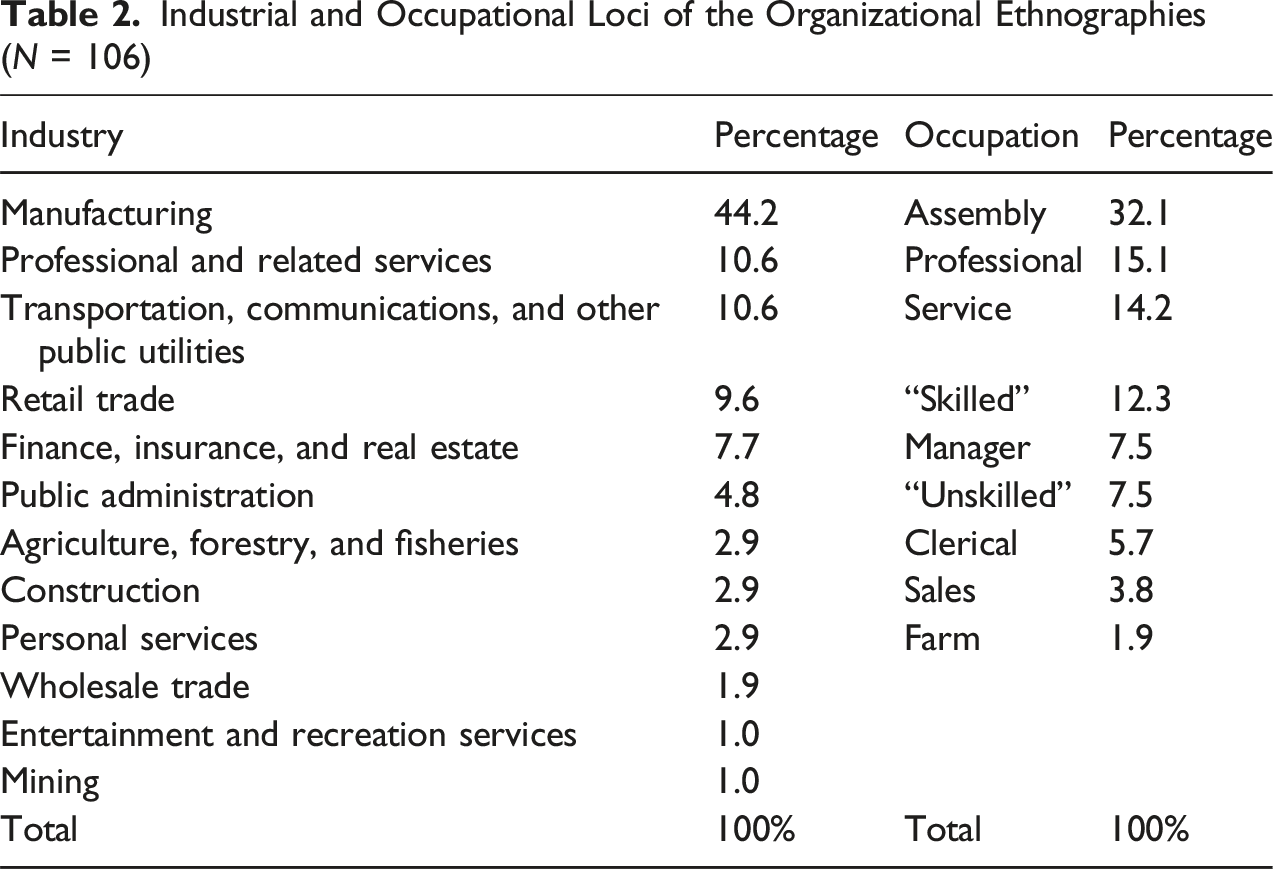
These ethnographies span 1940 to 1999 and cover a diverse range of job types—including manual, service, clerical, managerial, and professional roles—across a variety of industries. More broadly, organizational ethnographies in this tradition typically reflect extended immersion (often averaging over a year in the field), and the WEP draws on a cumulative record amounting to hundreds of person-years of PhD-level observation and interpretation (Hodson, 2005; Hodson & Roscigno, 2004).
The data were coded over several years by the late Randy Hodson and trained graduate student coders using a standardized codebook (Hodson, 2004). The coding protocol was developed over an initial six-month period by Hodson and three advanced graduate students through repeated joint coding and discussion of eight ethnographies, followed by iterative revision and finalization of response categories and decision rules (Hodson, 2004, 2005; Hodson & Roscigno, 2004; Shaffer & Darnold, 2020). After protocol finalization, additional coders (including members of a year-long graduate practicum and additional research assistants) were trained on a common ethnography and met twice weekly as a group to resolve questions and maintain interpretive consistency (Shaffer & Darnold, 2020). Coders recorded up to three page numbers supporting each coding decision; when multiple relevant passages existed, coders were instructed to reconcile inconsistencies across cited passages and record the best overall rating. Completed cases were debriefed and reviewed in detail by the research staff, and a 10% sample of cases was recoded to estimate reliability, yielding an average intercorrelation of .79 across coding decisions (Hodson, 2004; Hodson & Roscigno, 2004).
In the second phase, we identified specific cases that contradicted the quantitative findings to better understand how contextual factors might moderate the relationship between HRM practices and injury rates. We identified four ethnographies with counterfactual results for an in-depth, post hoc qualitative analysis, representing paradoxical instances in the dataset. This process of “re-immersion,” as described in prior studies using the WEP (e.g., Hodson, 2010; Roscigno et al., 2009), allowed us to investigate these inconsistencies and uncover contextual conditions that might explain the unexpected outcomes. That is, the process of re-immersion into these counterfactual cases was designed to generate rather than test for moderators. Thus, our goal was to explain anomalies in the quantitative results rather than reanalyze all case types.
Measures
We derived measures for HRM practices and injury rates using data from Hodson’s (2004) WEP, relying on detailed guidelines provided for the coders. We specifically focused on five HRM practices, with coding instructions intended to capture the degree of each practice’s implementation. All HRM practices were coded as single-item ordinal ratings using Hodson’s (2004) standardized codebook; differences across measures reflect variation in the number of response categories (three-vs. five-point scales), not differences in item count. Consistent with WEP guidance, coders were instructed to prioritize behavioral indicators and specific descriptions, rather than relying on ethnographers’ global evaluative statements (Hodson, 2004).
Below are the measures we used, alongside summaries of instructions provided to coders. For further clarification, specific quotations from the ethnographies representing each measure are included in the Supplemental Materials that accompany this manuscript. The supplemental materials reproduce Hodson’s original coding instructions verbatim, including wording and examples, to preserve the integrity of the source material.
Systematic Selection
Systematic selection was measured with a single item evaluating organizational recruitment efforts on a three-point ordinal scale (1 = little effort, 2 = average effort, 3 = great effort). Coders were instructed to assess “how much effort the company puts into seeking and keeping qualified personnel” (Hodson, 2004, p. 6). This measure captures the organization’s commitment to systematically selecting employees with the necessary KSAs.
Extensive Training
The level of on-the-job training was assessed with a single item using a five-point ordinal scale ranging from “none” (1) to “extensive” (5). Coders were instructed to follow the guidelines: “1 – None” meant no specific instructions provided to new workers. “2 – Very Little” meant only minimal training, typically involving a brief demonstration. “3 – Average” meant training lasting up to one week, possibly including introductory materials or supervision by senior workers. “4 – More than Average” meant training lasting longer than a week and potentially involving job rotation. “5 – Extensive” meant ongoing job rotation and/or formal classes (Hodson, 2004, p. 8). This measure reflects an organization’s investment in developing employee capabilities beyond basic training.
Information Sharing
Information sharing was assessed with a single item on a five-point ordinal scale (1 = not at all to 5 = extensive), focusing on the extent of employee interaction and communication. Coders rated as follows: “2 – Very Little” implied either work was largely done alone, or there was minimal sharing of information. “3 – Average” implied information was shared to address occasional work-related problems. “4 – More than Average” implied regular interactions to share insights and discuss work. “5 – Extensive” implied frequent, highly important information sharing (Hodson, 2004, p. 8). This measure captures the organization’s approach to fostering a culture of open communication and collective problem-solving.
High Relative Compensation
Coders rated compensation levels with a single item on a five-point ordinal scale from 1 (very low) to 5 (very high) relative to industry or area standards. They were instructed to evaluate “how compensation compares to area or industry standards, considering both monetary and non-monetary rewards” (Hodson, 2004, p. 7). This measure provides an assessment of how competitive an organization’s compensation packages are in retaining skilled workers.
Autonomy-Based Structural Empowerment
Autonomy-based structural empowerment was measured with a single item assessing job autonomy on a five-point ordinal scale (1 = none to 5 = very high). Coders followed the guidelines: “1 – None” indicated no worker control over tasks, with all aspects dictated. “2 – Little” indicated occasional ability to select procedures or priorities. “3 – Average” indicated regular opportunities to choose procedures, with clear limits. “4 – High” indicated significant latitude in determining work methods and priorities. “5 – Very High” indicated broad goals requiring substantial interpretation (Hodson, 2004, p. 12). This measure captures the extent to which employees have the authority to make decisions autonomously, reflecting empowerment levels within the organization.
Work Injury Rate
Work injury rate was assessed based on the frequency of workplace injuries, rated on a three-point ordinal scale: “1 – None or Rare” indicated that injuries were rare or explicitly stated to be uncommon. “2 – Average” indicated injuries occurred sometimes, generally minor. “3 – Common” indicated severe injuries occurred regularly. Coders were instructed to include “deaths, accidents involving lost work time, and minor injuries” (Hodson, 2004, p. 13). This variable reflects the incidence of work-related injuries, encompassing a range from minor incidents to more severe, life-altering injuries.
Analytical Approach
Our analysis used a mixed-method approach, combining quantitative and qualitative techniques to gain a comprehensive understanding of how HRM practices influence workplace safety. The analysis consisted of two main steps.
First, we conducted a quantitative analysis by regressing the five HRM practices against the work injury rate using SPSS 29. This step provided an overview of the statistical relationships between HRM practices and injury rates, offering insights into which practices analyzed in the same model are more consistently associated with lower injury frequencies. Because autonomy-based structural empowerment emerged as the only HRM practice associated with lower injury rates in the full model, we used it as the focal ‘dominant pattern’ for selecting counterfactual cases in the qualitative phase.
In the second step, we adopted Hodson’s (2010) re-immersion technique to conduct a qualitative, post hoc analysis. Re-immersion is a method that leverages “the inductive strengths of qualitative traditions for theoretical elaboration and process-centered insights” (Hodson, 2010, p. 904). This qualitative phase allowed us to revisit specific cases to better interpret the quantitative patterns identified. We filtered for ethnographies that demonstrated a paradoxical combination of very high autonomy-based structural empowerment (rated as 5) and frequent work injuries (rated as 3). This left us with four ethnographies which contradicted our quantitative findings presented below that linked higher autonomy-based structural empowerment with lower injury rates. These were the only cases in the corpus meeting our counterfactual selection criteria, which necessarily limits the qualitative synthesis to the sectors represented by those cases. By examining these counterfactual cases, we aimed to explore boundary conditions that might explain the observed discrepancy. The first and fifth authors summarized the narratives, identifying themes that could serve as moderators of the relationship between HRM practices and injury rates, and organized these findings into structured charts for each ethnography.
Methodological Scope and Historical Context
Because this study draws on a historically bounded ethnographic corpus, it is important to clarify the scope conditions under which the findings should be interpreted. Hodson’s (2004) Workplace Ethnography Project includes ethnographies spanning over fifty years from 1940 to 1999, which raises concerns about the relevance of these older datasets to contemporary workplaces. While these ethnographies provide rich, in-depth insights into HRM practices over time, their historical nature may limit their applicability to current organizational contexts. Additionally, the variability in ethnographic methods and theoretical orientations of the authors (e.g., functionalist, Weberian, critical/feminist) introduces subjectivity that may affect how HRM practices and injury outcomes are represented.
At the same time, the WEP’s design explicitly attempts to reduce idiosyncratic interpretive bias through standardized coding rules, frequent coder meetings, source-page documentation for each decision, post-coding debrief and review, and routine recoding for reliability (Hodson, 2004; Hodson & Roscigno, 2004). Moreover, Hodson reports validity checks indicating no distinct patterns of findings attributable to ethnographers’ theoretical orientation (and related characteristics) or coder effects across a range of workplace phenomena (Hodson, 2004; Hodson & Roscigno, 2004).
Results
Quantitative Analyses
Descriptive Statistics and Spearman’s Correlations (N = 106)
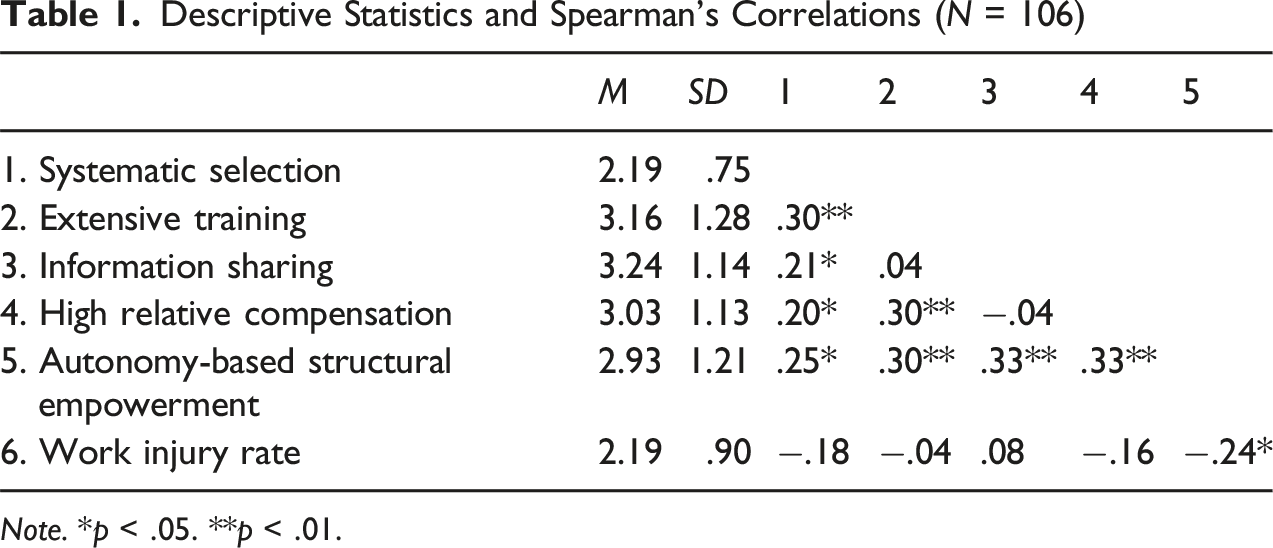
Note. *p < .05. **p < .01.
Industrial and Occupational Loci of the Organizational Ethnographies (N = 106)
Ordinal Regression Predicting Organizational Work Injury Rates From HRM Practices (N = 106)
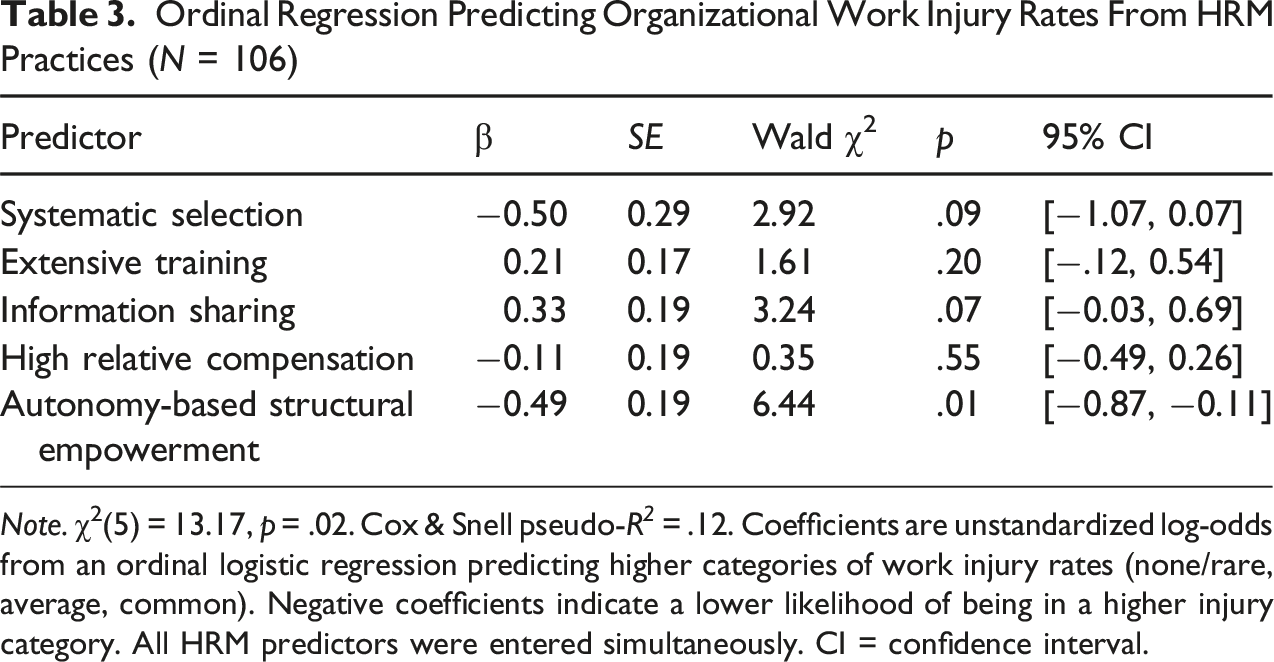
Note. χ2(5) = 13.17, p = .02. Cox & Snell pseudo-R 2 = .12. Coefficients are unstandardized log-odds from an ordinal logistic regression predicting higher categories of work injury rates (none/rare, average, common). Negative coefficients indicate a lower likelihood of being in a higher injury category. All HRM predictors were entered simultaneously. CI = confidence interval.
Among the predictors, only autonomy-based structural empowerment (β = −0.49, SE = 0.19, Wald = 6.44, p = .01) was a significant contributor, indicating that empowerment uniquely explains variation in injury rates when considered alongside the other HRM practices. The remaining practices were not statistically significant in this combined analysis: systematic selection (β = −0.50, p = .09), extensive training (β = 0.21, p = .20), information sharing (β = 0.33, p = .07), and high relative compensation (β = −0.11, p = .55). Notably, a one-unit increase in autonomy-based structural empowerment reduced the cumulative odds of being in a higher injury category by approximately 39% (odds ratio = 0.61), holding the other practices constant. As a robustness check, we rescaled all predictors to a common 0–1 metric and re-estimated the model to allow for cross-variable comparisons; the pattern of results remained unchanged, with autonomy-based structural empowerment remaining the only HRM practice significantly associated with injury rates.
Taken together, these findings highlight the distinct role of autonomy-based structural empowerment as the only HRM practice associated with lower injury rates at the organizational level, supporting Hypothesis 5 while providing no support for Hypotheses 1–4.
Qualitative Re-Immersion
The quantitative analyses indicate that, when examined simultaneously, autonomy-based structural empowerment emerges as the sole HRM practice associated with lower organizational injury rates. At the same time, the presence of substantial variability around this average effect suggests that empowerment does not function as a uniformly protective resource across all work systems. In particular, the dataset includes cases in which high levels of autonomy-based structural empowerment coexist with elevated injury rates—patterns that run counter to the dominant quantitative association. From a constraint-based perspective, such counterfactual cases are theoretically generative rather than anomalous, as they point to conditions under which discretion and local decision authority may amplify rather than mitigate risk. These cases allow us to examine how empowerment is enacted under clustered constraints, rather than assuming that discretion operates as a context-free resource. Accordingly, we undertook a qualitative re-immersion (Roscigno et al., 2009) into a purposively selected subset of ethnographies to theorize the work-system constraints under which the safety benefits of autonomy-based structural empowerment may break down. Consistent with this aim, the re-immersion is used to generate propositions about boundary conditions, not to estimate their prevalence or to conduct confirmatory moderation tests within this dataset.
To explore this question, we conducted a post hoc qualitative analysis, focusing only on cases that completely contradicted our quantitative findings. Specifically, we examined ethnographies that exhibited counterfactual findings—instances where high autonomy-based structural empowerment (rated as “very high”) co-occurred with high injury rates (rated as “common”). We limited our re-immersion to these cases because they represented the only paradoxical instances in the dataset, and our goal was to explain anomalies in the quantitative results rather than reanalyze all case types. By focusing on these extreme contrasts, we maximize analytic leverage for identifying the conditions under which empowerment’s protective association is attenuated.
In our dataset, we identified four ethnographies that met our counterfactual criteria: (1) firefighters (McCarl, 1985), (2) construction workers (Applebaum, 1981), (3) locomotive engineers (Gamst, 1980), and (4) laborers, chemical process workers, and tradespeople working in chemical, liquids, and gas plants (Wedderburn & Crompton, 1972). These book-length ethnographies offered detailed insights into the “behavioral and attitudinal patterns of workers, symbols important to workers, paths of communication within work organizations, places of work and their physical arrangements, and social interaction of workers with co-workers and others both on and off the job” (Gamst, 1980, p. 13). Re-immersing ourselves into these four cases allowed us to identify recurring clusters of conditions that shape how empowerment is exercised under risk.
High Autonomy-Based Structural Empowerment–High Injuries Conditions
The four counterfactual ethnographies depict occupational groups that experienced high autonomy-based structural empowerment alongside elevated injury rates. For instance, Gamst’s (1980) study of locomotive engineers highlights an environment structured to enable swift responses to changing circumstances. In this setting, workers operate with significant autonomy, allowing them to make real-time decisions in complex rail situations, often without direct supervision or immediate reference to systemic rules. This autonomy, while prestigious among engineers, also carried the risk of potentially dangerous outcomes when exacting rules were not consulted in critical situations.
A similar level of autonomy-based structural empowerment is evident in McCarl’s (1985) study of firefighters and Wedderburn and Crompton’s (1972) study of chemical plant workers. In both cases, while a supervisory structure existed, the dynamic nature of the work necessitated frequent independent action. Firefighters, for example, had to respond rapidly and autonomously during fire suppression efforts, with officers unable to micromanage evolving situations (McCarl, 1985). In the chemical plant setting, autonomy-based structural empowerment varied with the complexity of the process, often providing workers with considerable responsibility, especially when foremen were absent or their roles were minimized (Wedderburn & Crompton, 1972).
Applebaum’s (1981) study of construction workers similarly illustrates significant autonomy-based structural empowerment through work organized on a “craft basis.” Craftspeople exercised substantial control over their processes, facing little direct supervision and enjoying autonomy over work methods and tool selection. This autonomy recognized the expertise of craftspeople and allowed them to make decisions independently. Nevertheless, the construction industry, despite the high autonomy-based structural empowerment it offers, remains one of the most dangerous sectors, characterized by high rates of fatal injuries (U.S. Bureau of Labor Statistics, 2023). Applebaum (1981) notes that high steel work, for example, is both highly prestigious and exceptionally dangerous. Even non-fatal injuries from falls are often regarded as fortunate given the high inherent risks.
These examples illustrate that high discretion and local authority are not sufficient, on their own, to ensure safety. Our analysis of these counterfactual cases identified four key boundary conditions—uncertainty, physical hazards, interpersonal dynamics, and task complexity—that may undermine the protective effects of autonomy-based structural empowerment and contribute to heightened risks of workplace injury.
Uncertainty
The occupations highlighted in the counterfactual ethnographies were marked by significant levels of uncertainty, defined as the perceived unpredictability of work tasks (Leach et al., 2013). Uncertainty often arose not from workers’ lack of preparedness, but rather from external factors outside their control, such as fluctuating environments or rapidly changing weather conditions. For instance, construction workers regularly moved between various building stages or construction sites, each requiring different tools and techniques, necessitating continual adaptation to changing environments (Applebaum, 1981). Similarly, firefighters had to rapidly adapt to different building layouts, often during the chaos of an ongoing emergency (McCarl, 1985). Chemical plant operators also faced uncertainty from fluctuating production demands, which led to frequent changes in materials and erratic stoppages in production processes (Wedderburn & Crompton, 1972).
For locomotive engineers, uncertainty was primarily tied to the unpredictability of the terrain. Changes in the landscape, such as sudden inclines, declines, or hazardous track conditions, presented serious safety risks, including engine burnout or runaway trains. Gamst (1980) describes one incident in which a potential collision was narrowly avoided, noting that stopping a train required over two miles on a slight descent.
The ethnographies collectively demonstrate that under conditions of persistent uncertainty, empowerment shifts responsibility for risk management onto workers precisely when reliable anticipation is least possible. In such contexts, discretion may increase exposure rather than protection, as workers must act without stable reference points or sufficient time for deliberation.
Physical Hazards
The physical hazards inherent to specific occupations, such as firefighting, construction, and chemical processing, serve as another boundary condition. Applebaum (1981) notes that construction workers often derive satisfaction from undertaking “manly work,” which involves “winning over the elements and showing persistence in the face of adversity” (p. 109). This cultural orientation reflects the nature of physical risks they encounter—hazards amplified by malfunctioning equipment and adverse weather. For instance, Applebaum (1981) describes the dangers of a wet and muddy worksite: “Men [sic] lose their footing, equipment slides out of control, visibility is poor” (p. 77).
Similarly, chemical plant operators were often exposed to hazardous materials, with any oversight potentially leading to severe injury or chemical spills (Wedderburn & Crompton, 1972). Firefighters confronted high-risk situations daily, such as entering burning buildings with compromised infrastructure, where collapse or explosion could occur without warning (McCarl, 1985).
Across these cases, the presence of extreme physical hazards constrains the protective value of empowerment by narrowing the margin for safe choice. When the environment itself is unforgiving, discretion does not eliminate danger but instead determines how risk is distributed and borne.
Interpersonal Dynamics
Interpersonal dynamics, including coworker interdependence, trust, and hierarchical relationships, also shape safety outcomes under high empowerment. Construction workers frequently moved between sites and teams, requiring rapid trust formation. Applebaum (1981) describes how high steel workers selectively avoided collaboration with coworkers perceived as unsafe, highlighting the role of trust in injury prevention.
Firefighters similarly relied on collective action to advance hoses, throw ladders, and assess evolving situations (McCarl, 1985). Novices learned through mentorship and “tricks of the trade,” yet such learning-by-doing inherently involved risk (Goodbrand et al., 2021). For locomotive engineers, hierarchical dynamics complicated safety decisions; although novices could engage emergency brakes, they were often reluctant to contradict senior engineers (Gamst, 1980).
These cases suggest that empowerment is relationally contingent. When authority is formally decentralized but socially constrained by hierarchy, trust deficits, or deference norms, empowered actors may hesitate or mis-coordinate, limiting empowerment’s capacity to enhance safety.
Task Complexity
Task complexity further constrains the safety benefits of empowerment. In rail operations, safe performance depends on interpreting overlapping hand, lantern, and flag signals; misinterpretation poses immediate danger (Gamst, 1980). Firefighters similarly must integrate multiple cues (e.g., smoke color, structural integrity, standpipe conditions) under time pressure (McCarl, 1985). Chemical plant operators monitored interdependent systems, where small errors could cascade into major incidents (Wedderburn & Crompton, 1972).
These cases illustrate that high cognitive load can overwhelm the benefits of discretion. When empowered workers must simultaneously process complex, fast-moving information streams, autonomy may increase the likelihood of error rather than prevent it.
Discussion
This study examined how five core, general HRM practices—systematic selection, extensive training, information sharing, high relative compensation, and autonomy-based structural empowerment—relate to organizational work injury rates. Using 106 workplace ethnographies spanning 1940–1999 from Hodson’s (2004) Workplace Ethnography Project, we found a clear dominant quantitative pattern: autonomy-based structural empowerment was the only practice significantly associated with lower injury rates, both in a bivariate correlation analysis and in an ordinal regression model that simultaneously included all five practices. In other words, the results do not suggest that “more HRM” is uniformly safer at the organizational level; rather, they suggest that empowerment is the practice of the HRM system most consistently aligned with lower injury rates in these data, whereas the other four practices show no reliable average association with injuries in the same models.
At the same time, the re-immersion phase clarifies why even empowerment cannot be treated as a context-free safety enhancer. By returning to the four counterfactual cases in which very high autonomy-based structural empowerment co-occurred with common injuries, we identified recurring clusters of constraints—uncertainty, physical hazard exposure, interpersonal strain, and task complexity—that appear to attenuate empowerment’s protective association. Taken together, these cases point to a set of boundary conditions consistent with a contingency model: empowerment reallocates discretion and responsibility to the point of production, but its safety value depends on whether discretion can be exercised with sufficient time, information, and coordination capacity. When conditions simultaneously increase volatility, narrow margins for error, and heighten coordination demands, empowerment may still confer autonomy and local authority while leaving workers to manage risk under conditions that exceed feasible local adaptation (Grote, 2020). Accordingly, the qualitative synthesis complements the quantitative result by specifying when empowerment is likely to operate as a safety-enhancing resource and when it may be “overrun” by features of the work system.
The paper’s historical scope (1940–1999) matters for interpretation, but it does not undermine the theoretical leverage of the pattern. We do not claim that the injury prevalence, reporting conventions, or regulatory regimes represented in the ethnographies map directly onto contemporary workplaces, nor that the absolute injury frequencies implied by the three-point injury coding reflect modern definitions of harm. Rather, the contribution lies in identifying durable features of work—discretion, coordination, hazard exposure, uncertainty, and complexity—and showing how their configuration shapes whether empowerment is likely to translate into safer outcomes. In this sense, the historical corpus is most useful not as a mirror of present-day injury rates, but as a comparative archive that helps surface a generalizable contingency logic about HRM effectiveness as it relates to safety.
A key implication of the re-immersion is that the four boundary conditions are best understood as bundled constraints rather than isolated moderators. Across the counterfactual ethnographies, uncertainty, hazard exposure, interpersonal dynamics, and complexity co-occurred to varying degrees, but their joint presence would consistently increase cognitive load, time pressure, and coordination demands. This bundling matters theoretically because it suggests that “context” does not simply add or subtract from the empowerment–safety relationship; it can alter the meaning of empowerment by changing what discretion entails in practice. In relatively stable settings, discretion may allow workers to anticipate hazards, coordinate locally, and adjust safely. Under clustered constraints, however, discretion may become compressed and reactive, with fewer reliable cues, less slack, and more interdependent consequences. Empowerment then functions less as a resource for safe adaptation where the conditions for safe choice are fragile.
Consistent with this positioning, we emphasize that these boundary conditions are theory-generating propositions derived from counterfactual re-immersion rather than quantitatively corroborated moderators. The qualitative phase is therefore not offered as confirmatory evidence of interaction effects; instead, it specifies a plausible constraint-based approach that future research can operationalize and test in contemporary samples. That work will be especially valuable if it measures constraints at the work-system level (e.g., volatility, hazard intensity, coordination complexity) and models how they combine to shape empowerment’s association with injury outcomes.
Importantly, the present findings do not imply that safety-specific systems are unimportant. Instead, they suggest a complementarity logic: general HRM practices (especially empowerment) shape whether safety-related information, rules, and responsibilities can be enacted effectively under real work conditions. In high-constraint settings, more formalized safety infrastructure may help compensate for limits in discretionary control, whereas in lower-constraint settings, empowerment may enable more effective local anticipation and adaptation. This framing supports HRM’s longstanding caution against assuming universal “best practices” (Boselie et al., 2009) and more generally reinforces a contingency view of HRM system effectiveness (e.g., Boxall & Purcell, 2011; Lepak & Shaw, 2008).
Practical Implications
The findings offer several practical implications for organizations seeking to improve safety through HRM systems. First, autonomy-based structural empowerment appears to be a promising lever for lowering injury rates on average, including when modeled alongside selection, training, information sharing, and compensation. However, the qualitative evidence illustrates that empowerment is most defensible as a safety strategy when paired with an explicit audit of work-system constraints. In settings characterized by high uncertainty, intense hazard exposure, substantial task complexity, and strained coordination, organizations should be cautious about treating autonomy as a substitute for safety infrastructure. In such environments, the practical challenge is not simply “empower or not,” but how to ensure that discretion is exercised with adequate information, time, and coordination supports.
Second, empowerment is not self-executing: increasing discretion without strengthening capability and coordination capacity can widen the gap between responsibility and control. This is one reason the absence of average effects for other general practices in the quantitative model should not be misread as evidence that they are unimportant in practice. Training and information sharing, in particular, may still be necessary complements that help workers use discretion safely, even if they do not show independent average associations with injury rates in this dataset. From an implementation standpoint, this implies that organizations should treat empowerment as a system design choice that requires commensurate investments in capability-building, reliable communication channels, and role clarity, especially where work is volatile or interdependent.
Third, the re-immersion suggests that the most consequential constraints for empowerment often reflect shared underlying demands—volatility, cognitive load, and coordination fragility. Accordingly, organizations may gain more by reducing these underlying demands than by adding autonomy alone. Parker and Knight’s (2024) SMART model emphasis on high-quality work design is useful here in highlighting how work can be designed to be optimally stimulating rather than overwhelming, while also clarifying expectations and feedback and supporting effective relationships and instrumental support. Finally, employee involvement can be valuable precisely because it helps surface how constraints are experienced at the point of work. Encouraging constructive, change-oriented safety communication (i.e., safety voice; Tucker et al., 2008) may help organizations identify where discretion is being asked to carry more risk-management responsibility than the system can reliably support.
Limitations and Future Research
This study has several limitations that also motivate future research. First, the analyses draw on Hodson’s (2004) Workplace Ethnography Project (WEP), which spans over five decades (1940–1999). Although many HRM practice categories appear relatively stable across time (Boon et al., 2019; Posthuma et al., 2013), technological change, evolving regulatory regimes, and shifting definitions of occupational harm may limit direct generalization to contemporary settings (Granger & Turner, 2022; Walters & Nichols, 2009). Future research should therefore replicate and extend these findings using contemporary organizational data, while explicitly modeling how regulatory context and industry risk shape the empowerment–safety relationship.
Second, the WEP measures are single-item ordinal ratings. While this is an intentional design feature of the WEP’s coding system, it also means that each HRM practice is captured at a relatively coarse level, and important distinctions (e.g., the form and contingencies of compensation; Kuvaas et al., 2020) are not directly represented. Similarly, the study does not explicitly differentiate general HRM practices from safety-specific practices (e.g., Ohanu et al., 2025; Vredenburgh, 2002). Future research would benefit from richer measurement approaches, such as multi-source audits, site visits, and insider consultations (cf. Turner et al., 2021), that can more precisely distinguish intended versus enacted HRM and general versus safety-specific practices (Turner & Deng).
Third, statistical power is a reasonable concern given the sample size (N = 106) and the ordinal nature of the outcome. It is possible that smaller average associations for selection, training, information sharing, or compensation could exist but remain undetected in this dataset, increasing the risk of Type II error. Relatedly, HRM theory often emphasizes complementarities and interactions among practices (Becker et al., 1997), yet the present quantitative model focused on simultaneous main effects. Larger samples and contemporary datasets will be better suited to testing whether combinations of practices, or interactions between practices and work system constraints, predict injuries more robustly than any single element.
Fourth, the injury outcome is coded on a three-point scale that necessarily compresses differences across industries, regions, and periods (Takala, 2019). Although the measure is suitable for broad comparative analysis within the WEP, it cannot fully account for baseline risk differences across contexts, and it does not capture psychosocial or chronic dimensions of harm that are increasingly central to occupational health discussions (National Institute for Occupational Safety and Health, 2022). Future work should examine whether empowerment’s safety value extends to contemporary forms of risk (e.g., remote-work hazards, digital overload, human-autonomy interaction) and whether the same constraint bundles similarly attenuate effects across different harm domains.
Finally, the boundary conditions identified here derive from qualitative re-immersion into four counterfactual cases. Their strength lies in specifying a coherent, grounded contingency logic; their limitation is that they do not estimate prevalence or provide confirmatory tests of interaction effects. Future research should therefore operationalize uncertainty, hazard intensity, interpersonal dynamics, and complexity at the work system level and test their combined effects with empowerment, ideally using multi-level designs that connect organizational practices to group processes and individual mechanisms (Wood, 2021). Leadership may also be a key cross-level pathway shaping how empowerment is enacted for safety (Lyubykh et al., 2022), and future studies should examine how leaders’ choices about discretion, coordination, and accountability influence safety outcomes in high-constraint systems.
Conclusion
This study shows that autonomy-based structural empowerment is the only one of five core, general HRM practices that is consistently associated with lower organizational injury rates in a multi-industry corpus of 106 workplace ethnographies, while also demonstrating that empowerment’s safety value is contingent rather than universal. Through counterfactual qualitative re-immersion, we identify four bundled work-system constraints (uncertainty, physical hazard exposure, interpersonal strain, and task complexity) that appear to attenuate empowerment’s protective association by increasing volatility, narrowing margins for error, and intensifying coordination and cognitive demands. These constraints should be treated as theory-generating propositions surfaced through re-immersion rather than confirmed moderators, but they nonetheless offer a clear agenda for future research and practice: empowerment is most likely to promote safety when discretion is supported by adequate information, time, and coordination capacity, and least likely to do so when clustered constraints overwhelm reliable local adaptation.
Footnotes
Author Note
We presented much earlier versions of this paper at the 29th Annual Society for Industrial and Organizational Psychology Conference (Honolulu, HI), the 77th Annual Convention of the Canadian Psychological Association (Victoria, BC), and the third Human Resources Division International Conference (Dublin, Ireland). We thank Natalya Alonso, Jim Arrowsmith, Charles Calderwood, Wendy Casper, Joseph Cheng, Sharon Clarke, Fang Lee Cooke, Luke Fletcher, Carlo Isola, Johannes Kraak, Bård Kuvaas, Zhanna Lyubykh, Anna Merrifield, Peter Nolan, Catie Phares, Kaylee Somerville, Natalie Valle, Julie Weatherhead, Geoff Wood, and Stephen Wood for their helpful comments.

Funding
The authors disclosed receipt of the following financial support for the research, authorship, and/or publication of this article: The Haskayne School of Business’s Canadian Centre for Advanced Leadership in Business, Centre for Corporate Sustainability, and HROD/Strategy Fund all provided financial support for this research.
Declaration of Conflicting Interests
The authors declared no potential conflicts of interest with respect to the research, authorship, and/or publication of this article.