



Abstract
We develop and test a model of how older workers’ perceived age discrimination obstructs their job performance, focusing on employee job level (managerial versus line employee) as a critical contingency. Drawing upon resource theories, we propose that the effects of age discrimination on performance are more detrimental for older workers at lower levels (frontline) than at higher levels (managerial). We tested our model using three-wave data—controlling for lagged variables at every stage—and found evidence for a moderating role of job level. Older workers in lower job levels (frontline) experienced more negative consequences from perceived age discrimination compared to those in higher job levels (managerial), resulting in lower work engagement and ultimately in lower subsequent task performance relative to baseline. However, we did not observe conclusive effects extending to proactive performance. Our model and results show that the impact of perceived age discrimination is mitigated at higher managerial job levels, highlighting the need to protect frontline older workers who are impacted more strongly by age discrimination.
Age discrimination (i.e., unfavorable and biased treatment based on age) is a longstanding barrier to addressing the global challenge of the ageing workforce (e.g., Caines et al., 2024; North, 2019). The literature has shown the broad (negative) influence of age discrimination on individuals, organizations, and societies (Pak et al., 2023; Peng, 2022; Yeung et al., 2021). For instance, several surveys (e.g., Carlsson & Eriksson, 2019; Neumark, 2021; Neumark & Song, 2013) indicate that age discrimination can undermine policy efforts aimed at sustaining older worker employment and promoting postponed retirement (Børing & Grøgaard, 2023). These societal effects are underpinned by individual-level processes, as perceived age discrimination negatively influences older workers’ work-related intentions, deterring them from considering bridge employment (e.g., Peng, 2022) and accelerating their intentions to retire early (e.g., Bayl-Smith & Griffin, 2014). Overall, age discrimination erodes older workers’ attitudes toward work.
In contrast, the behavioral implications of age discrimination are less well-understood. While research shows that organizations exhibiting higher levels of age discrimination tend to have poorer firm performance (Kunze et al., 2011), effects on individual-level work behaviors are less clear. Studies on perceived age discrimination and older workers’ performance behaviors have reported mixed findings (e.g., Brady et al., 2025; B. Griffin et al., 2016; Spoelma & Marchiondo, 2024), suggesting that the impacts of age discrimination on work behavior depends on critical contextual factors. This paper examines the relationship of age discrimination with work performance behaviors among older workers, adopting a job-contextual perspective that emphasizes a key occupational contingency: the employee’s job level.
Research is surprisingly scarce on the impacts of age discrimination across the organizational hierarchy. Do managers and line employees experience similar effects of age discrimination? It is vital to understand the role played by hierarchical level because if managers have a different—and as we find, weaker—reaction to age discrimination, they may underestimate its harmful effects for other employees and overlook the resulting ramifications for the organization.
In the research reported here, we examined the relationship between age discrimination and two discrete facets of work performance behaviors (task and proactive performance) among older workers. We proposed that these relationships are mediated by work engagement and—importantly—moderated by job level. Specifically, we expected that older workers in managerial roles would experience reduced decrements from age discrimination compared to their counterparts in frontline roles. The predicted relationships are shown in Figure 1. We tested our proposed model in a study of 1,442 Australian older workers using a rigorous longitudinal design with autoregressive controls—a first in the literature on age discrimination and work performance—which helps rule out a broad range of alternative explanations including reverse causality. To ensure an apples-to-apples comparison across job levels, we additionally probed for measurement equivalence across job level to verify that our results were not solely due to differences in the manifestation of age discrimination across job levels and in the nature of job performance across job levels. These design strengths allow us to present the strongest evidence to date for age discrimination effects across job level. Empirical model. Note. The hypothesized model is shown in the rounded box with broken lines. We explored the moderating role of job level using a multigroup structural equation model that tested for group differences in the paths from age discrimination through work engagement to both types of performance. Since we specifically hypothesized first-stage moderated mediation, we only expected to observe job level differences in the path from age discrimination to work engagement. The model controls for lagged measurements of work engagement, task performance and proactive performance to ensure that the mediation process is capturing change from a baseline. For clarity, we omit indicators, factor loadings, invariance constraints, and longitudinal indicator error covariances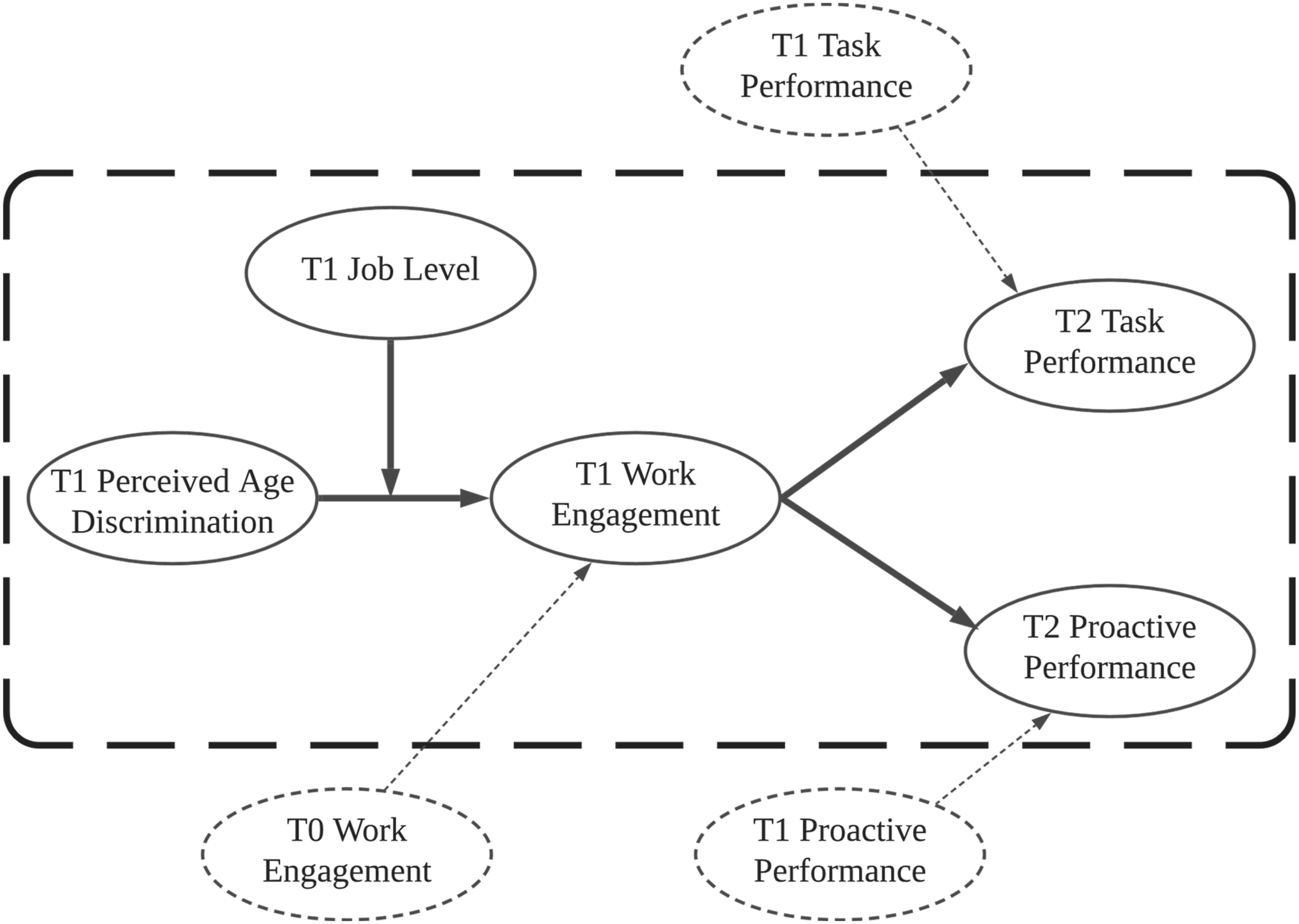
We intended to make four contributions to the literature on older workers and age discrimination. First, we aimed to answer calls in the age discrimination literature to explore contextual moderators as opposed to psychological moderators (Brady et al., 2025; Spoelma & Marchiondo, 2024), with Brady et al. pointing to occupational context as a particularly promising contingency to explore in this literature. We did so by bringing the organizational hierarchy into the picture and exploring differential responses to age discrimination among managers versus line employees. Broadly speaking, organizations are hierarchically structured entities and involve—at a minimum—line employees who carry out the core tasks of the business and managers who undertake planning and monitoring roles. These two broad job roles are associated with marked differences in access to and control of organizational and work-related resources. Organizational resources, such as budget and finances, as well as the granting of monetary and non-monetary rewards, are controlled by managers. This access to and control of important resources gives a great deal of power and status to formal managerial roles (Magee & Galinsky, 2008). Managers also have considerably more task autonomy and decision latitude than line employees. This mix of tangible (e.g., finances) and intangible (e.g., power, status, autonomy) resources in managerial roles (compared to line employee roles) allows for an enhanced capacity to sustain engagement in the work role and enact role-prescribed behaviors despite experiencing age discrimination. Although research on age discrimination has traditionally taken a resource-based approach (Brady et al., 2025; Rabl & Triana, 2013; Sarwar & Muhammad, 2020; Volpone & Avery, 2013; Yeung et al., 2021), it has thus far paid little attention to job-contextual factors (like job level) that fundamentally inform older workers’ access to resources on the job. A job-contextual perspective reveals that the detrimental effects of age discrimination are not universal but are shaped by employees’ access to resources within the organizational hierarchy. These differences across job level have important implications not just for theory but also for practice. If managers experience age discrimination as less harmful, they may presume that age discrimination has similarly muted effects on line employees, and may consequently overlook the potential of age discrimination to hurt these vulnerable employees’ engagement and performance.
Second, we aimed to take two incremental steps to advance the literature on age discrimination and work performance—a literature that is still burgeoning and marked by equivocal findings. One step we took was to broaden the criterion space of performance outcomes in this literature. Research has focused predominantly on the implications of age discrimination for task performance (Brady et al., 2025; Spoelma & Marchiondo, 2024; cf. Triana et al., 2017 for an exception looking at withdrawal behaviors). Research on work performance has been criticized for its overly narrow criterion focus on task performance at the neglect of other important employee behaviors that constitute work role performance more broadly (Carpini et al., 2017). In this study, one of our aims was to broaden the criterion space of performance outcomes of age discrimination by assessing not only task performance behaviors but also proactive performance behaviors as outcomes of interest. Task performance refers to the completion of the required formal tasks, duties, and responsibilities recognized by one’s job description (Williams & Anderson, 1991), while proactive performance involves initiating change and improvement or challenging the status quo at work (Crant, 2000; M. A. Griffin et al., 2007). The link between age discrimination and performance can be better understood by broadening and differentiating what counts as work performance. The second step we took was to explore contextual contingencies that could inform when and for whom age discrimination leads to performance decrements. The differences we observed across job level provide suggestive evidence that the relationship between age discrimination and work performance is highly variable and fundamentally contingent on job context (in line with speculations by Brady et al., 2025). We believe these steps make much-needed incremental advancements to our understanding of the discrimination-performance relationship.
Third, we aimed to direct attention to work engagement as an underexplored mechanism by which age discrimination relates to performance. While work engagement is a valued criterion in its own right, it also serves as the motivational engine for role performance (Kahn, 1990), which helps us explain why age discrimination might undermine performance. Work engagement has been referred to as “the harnessing of organization members’ selves to their work roles; in engagement, people employ and express themselves physically, cognitively, and emotionally during role performances” (Kahn, 1990, p. 694). Engaged employees bring their “heart, mind, and hands” to the job (Rich et al., 2010). We proposed that the experience of age discrimination prevents older workers from fully engaging with the work role, which reduces their ability and motivation to engage in role-prescribed performance behaviors. This view offers fresh insight into the theoretical mechanism underlying the age discrimination-job performance relationship.
Finally, most empirical work on the consequences of perceived age discrimination has used cross-sectional or time-lagged designs; there is a need for more sophisticated designs with stronger causal identification (Amarnani et al., 2023; Beier et al., 2022). We adopted a longitudinal design in which all mediators and outcomes are repeated measures (following recommendations by Vancouver reported in M. Wang et al., 2017). This design enabled us to impose autoregressive control on mediator and outcome variables, which helps partial out the contribution of stable omitted endogenous causes and helps rule out reverse causal explanations for findings. This issue is particularly important for our study context given that discrimination (like other forms of mistreatment) is often causally confounded with its outcomes (Aquino & Thau, 2009; see also D. Cheng et al., 2019). This design is a much-needed empirical advancement in the age discrimination literature, offering a conservative and rigorous test of discrimination effects. We comment further on our design strategy in the Methods section.
Theoretical Framework and Hypotheses
Workplace age discrimination is characterized by negative attitudes and behaviors at workplace or differential workplace treatment toward workers based on their age group (Marchiondo et al., 2016; Peng et al., 2023), which is increasingly being recognized as a systemic threat and obstacle to carrying out proficient and high-quality performance behaviors at work (e.g., Brady et al., 2025; Spoelma & Marchiondo, 2024). There has been longstanding scholarly and managerial interest in sustaining older workers’ job performance (Waldman & Avolio, 1986; see also Ng & Feldman, 2008). Work performance is generally understood to entail the enactment of role-situated behaviors (M. A. Griffin et al., 2007; Kahn, 1990). Some role-prescribed behaviors relate to expectations and requirements that are central to the work role (such as task performance), while other role-prescribed behaviors are relatively peripheral to the employees’ job description and specification yet also nevertheless essential to navigating uncertainty and initiating change or innovation (such as proactive performance; M. A. Griffin et al., 2007). These role-prescribed behaviors are enacted through a process of work engagement, defined as the extent to which employees inhabit the work role physically, cognitively, and emotionally (Kahn, 1990). Older workers who receive age discrimination may exhibit poorer work performance to the extent that discrimination impairs their ability to engage in the work role. We develop these hypotheses and unpack job level as a contingency below.
Our hypotheses are primarily informed by conservation of resources theory (COR; Hobfoll, 1989), which can explain why older workers’ experience of age discrimination can diminish their work engagement and performance. COR theory suggests that individuals strive to retain, protect, and acquire resources and that stress occurs when people experience threats of resource loss, actual resource loss, or a lack of resource gain following resource investment (Hobfoll, 1989). Age discrimination poses a powerful threat to resources loss, particularly because it likely conditions older workers to anticipate lower-quality future treatment from the organization. Age discrimination can also cause actual resource loss, for example, by actively reducing older workers’ opportunities for training and advancement, recognition for skills and contributions, and retention. People also perceive resource loss when their resource investments do not offer satisfactory returns (Hobfoll, 1989), which occurs in age discrimination when older workers feel that their contributions are undervalued. Overall, age discrimination is an undesirable collection of work conditions that altogether serve as threats of net resource loss, actual resource losses, thereby impeding work engagement.
There is a rich tradition of discrimination research underpinned by COR theory (e.g., Bayl-Smith & Griffin, 2014; De Clercq & Brieger, 2022; Dhanani et al., 2023; King et al., 2023; Mazzetti et al., 2022; Rabl & Triana, 2013). Indeed, age discrimination deprives older workers of a great deal of resources that they would otherwise have under occupationally fair working conditions (e.g., access to training and advancement opportunities, recognition for skills and contributions, retention practices; Truxillo et al., 2017). In doing so, age discrimination also portends further resource loss by conditioning older workers to anticipate lower-quality future treatment from the organization (Rabl, 2010). Age discriminatory conditions also make older workers feel that their various contributions to the organization—which would otherwise have facilitated resource recovery—are undervalued (Snape & Redman, 2003). Overall, age discrimination is an undesirable collection of work conditions that threaten and drain resources as well as impede resource recovery.
Importantly, work engagement itself requires resource investment: to be engaged is to expend physical, cognitive, and emotional energies in the work role (Kahn, 1990). When discrimination depletes resources, older workers are less able and less willing to make this investment. COR theory prescribes that conditions like age discrimination prompt employees to either (a) invest resources to counteract the resource loss or (b) adopt a self-protective stance that minimizes further resource loss. In the former case, employees are able to remain resilient and sustain themselves despite resource loss because they are able to orchestrate buffers, protections, and replenishments that counteract threatening conditions. In the latter case, employees withdraw their resources from the work role and disengage, protecting themselves from further and more devastating resource loss but also preventing themselves from fully engaging in their job role and performing the role as well as they could. COR theory further suggests that when resources are exhausted, individuals may become defensive, aggressive, and even irrational to preserve their remaining resources (Hobfoll, 2001). To illustrate, Tu and Chi (2024) found that daily abusive supervision depletes employees’ resources and makes them defensive: these employees reduce physical and social recovery activities but engage more in low-effort activities (relaxing, nonwork-related behaviors that require relatively minimal effort, energy, and internal resources). However, these effects tended to occur particularly among employees lacking in resources. This reasoning implies that the consequences of age discrimination are likely to depend fundamentally on employees’ pre-existing access to resources.
We note that not all resources are necessarily pertinent. Halbesleben et al. (2014) helpfully clarify that which attributes operate as resources depend on (a) what enables employees to pursue a given goal; and (b) what counteracts obstacles to goal pursuit due to a given demand. Since this study probes how age discrimination impacts employees’ engagement in the work role and enactment of role behaviors (i.e., performance), the relevant resources ought to offer affordances that enable employees to engage with their roles and fluidly enact their roles, and to help dispel (or counteract) likely obstacles due to age discrimination. Furthermore, these resources are likely not to manifest as isolated, discrete resources but rather as a group of linked resources. In the parlance of COR theory, this notion of a group of linked resources is referred to as a “resource caravan” (Hobfoll, 2012), which is far more consequential than one-off discrete resources. Taking all these theoretical considerations into account, we focused on a role-situated attribute that offers insight into the broader job context and embeds a caravan of interconnected essential work resources that altogether support engagement in the work role and protect against the threats and losses portended by age discrimination—namely, the employee’s job level.
Job level reflects an employee’s status or seniority within the organizational hierarchy and implies distinct role expectations as well as access to supports and affordances (Miles et al., 1996). Importantly, job level is generally characterized as a higher-level collection of resources. It is a quintessential example of so-called “omnibus” context that reflects higher-level differences between occupational conditions and encompasses a broad range of lower-level “discrete” contextual resources (Johns, 2006, 2017). In line with COR theory, job level serves as a resource caravan (Hobfoll, 2012) that offers multiple role-situated affordances that enables older workers to engage in and enact the work role despite experiencing age discrimination. Generally speaking, employees in a managerial (versus line) job level have access to a broad range of discrete resources that accrue to formal leadership roles and to their hierarchical position within the organization, including power, status, autonomy, budget, and finances (Magee & Galinsky, 2008). Employees higher in the organizational hierarchy typically also possess a more comprehensive understanding of their organization’s functioning due to their greater scope of function (Martela, 2023), enabling them to apply their competencies and skills better to overcome obstacles posed by discrimination. Managers are also better positioned to use their autonomy and discretion (Young & Steelman, 2017) to insulate aspects of their work role from discriminatory environments. Managers are also embedded in broader and richer social exchange networks (including senior leadership and cross-functional alliances) that confer resiliency and create opportunities for resource gain (Carroll & Teo, 1996). For these reasons, we believed that job level fundamentally informs whether employees who experience age discrimination are able to remain engaged in their work role.
Overall, we propose that older workers with higher job levels (managerial) can access a broad range of role-situated affordances that altogether buffer the negative impacts of age discrimination on how fully workers engage with their work role. On the contrary, those who are at lower job levels, like frontline older workers, are reduced access to resources that most effectively enable them to cope with age discrimination, rendering them less able and willing to engage fully in their roles. Therefore, we hypothesize that:
The negative relationship between perceived age discrimination and work engagement is moderated by job level. Specifically, the relationship between perceived age discrimination and work engagement is more strongly negative for frontline employees than for managerial employees.
The previous section dealt with the left-hand side of the model shown in Figure 1. In this section, we extend these arguments from work engagement to job performance behaviors (operationalized as task performance and proactive performance in our study). Task performance is the facet of job performance directly related to achieving core tasks or organizational goals (Borman & Motowidlo, 1993). In addition to core task behaviors, we also consider another essential facet of job performance: proactive behavior. These two forms of performance cover the reactive and proactive behaviors needed to carry out a work role.
In order to carry out the work role effectively, employees need to be engaged in their work role (Kahn, 1990). Work engagement reflects the harnessing of an employee’s full self in physical, cognitive, and emotional energy toward the work role (Kahn, 1990; Rich et al., 2010), resulting in high-level role performance of both reactive and proactive role-prescribed behaviors. We adopted Kahn’s conceptualization of engagement which is fundamentally rooted in the work role (Macey & Schneider, 2008; Wittenberg et al., 2024). Our model aligns with this perspective, given that the behavioral outcomes we focus on—task performance and proactive performance—are role-situated behaviors. Engaged employees have higher performance because they allocate their physical, cognitive, and emotional energies into core tasks (Rich et al., 2010). Specifically, by allocating their physical energy, older workers can exert effort over an extended period which in turn improves performance. By allocating their cognitive energy, older workers can maintain vigilance, attention, and focus, which in turn improves job performance. Finally, by allocating their emotional energy, older workers can foster stronger connections among coworkers in pursuit of organizational goals. This thinking not only applies to task performance but also to proactive performance, as engaging in proactive behaviors requires sufficient resources to allocate beyond their core task responsibilities (Sonnentag, 2003). Indeed, studies show that work engagement positively relates to task performance (i.e., Christian et al., 2011; Li et al., 2020; Neuber et al., 2022; Yuan et al., 2021) and proactive performance (i.e., Maden-Eyiusta, 2021; Salanova & Schaufeli, 2008; Sonnentag, 2003). Hence, engagement is essential to enacting role behaviors in service of core tasks and proactive activities.
As argued earlier, age discrimination impairs employees’ ability and motivation to engage in the work role, which undermines role behaviors comprising task performance and proactive performance. Older workers at a higher, managerial job level are better positioned to orchestrate protections, workarounds, and arrangements that shield them from resource loss and insulate their work roles from the obstacles and challenges created by age discrimination. These protections sustain older workers’ engagement in the work role despite age discrimination and—as we argued above—therefore enable them to enact role-prescribed work behaviors. However, frontline older workers who lack these protections experience the full brunt of age discrimination, leaving them in a resource-exhausted state that cannot sustain the physical, cognitive, and emotional inhabiting of the work role, leaving these older workers unable and unwilling to engage in the role and therefore to perform role-enacted behaviors.
We therefore propose a moderated mediation hypothesis. That is, the negative impact of age discrimination on both facets of job performance via work engagement will be stronger for frontline employees as opposed to managerial employees. Drawing on COR theory, we expect the differences in job level to primarily inform the relationship between age discrimination and engagement, which constitutes first-stage moderated mediation hypotheses:
The indirect effect of age discrimination through work engagement on (a) task performance and (b) proactive performance is conditional on job level. Specifically, the indirect effect is more strongly negative for frontline employees than for managerial employees.
To rigorously test these hypotheses, we addressed two key considerations. First, the impact of discrimination is often challenging to isolate because the outcomes of discrimination can also serve as antecedents. For example, employees who perform poorly may become targets of age discrimination, creating a potential reverse causality issue. This challenge is frequently echoed in the rhetoric surrounding workplace discrimination and its purported justifications (e.g., Coffman et al., 2021). Getting causally robust estimates is not only a theoretical necessity but also a practical imperative. To address this issue, we applied a longitudinal design, controlling lagged assessments of outcome variables at an earlier time point to mitigate the risk of reverse causal interpretations.
Another important consideration is whether the nature of discrimination and performance behaviors altogether differ systematically across job levels, potentially leading to an apples-to-oranges comparison. It is critical to ensure that any observed results are not merely artifacts of differences in discrimination perception by managers versus line employees, or differences in the definition of task and proactive performance by these groups. This concern can be addressed psychometrically by examining measurement equivalence (also referred to as measurement invariance). Hence, we probed the measurement equivalence of these variables between job levels prior to conducting our hypothesis tests. Further explanation and results can be found in the preliminary analysis section. By addressing these two considerations head-on, we aimed to provide the strongest evidence to date for differences in the effects of age discrimination between managers and line employees.
Method
Participants and Procedure
This study includes longitudinal field data as part of a large-scale online longitudinal survey of older Australian workers. Following guidelines for the recruitment and sampling of older workers (Amarnani et al., 2023), we specifically recruited employees aged 50 and above. Data were collected over three waves, with 6-month intervals between each wave. We used an ISO-accredited research panel provider to help us recruit a nationally representative sample of Australian older workers. We recruited 893 managerial older workers and 625 frontline older workers, a total of 1,518 participants at Time 0 (baseline) and Time 1. We applied checks for insufficient effort responding (Huang et al., 2015), which resulted in the exclusion of 76 participants (40 managerial older workers, 36 frontline older workers), leaving a final Time 1 sample size of 1,442 participants (853 managerial older workers, 589 frontline older workers). Among these participants, 992 completed the Time 2 survey. Removing insufficient effort responders resulted in a fully matched sample of 937 workers (547 managerial older workers, 390 frontline older workers) in Time 2. At Time 1, the average age of participants was 59.6 years (SD = 5.9), with 33.5 % of the sample being female. The median level of organizational tenure at the current organization was 11-15 years. The three modal industries in the sample were healthcare and social service (11.6%), professional, scientific and technical services (9.9%), and administrative and support services (9.7%).
We probed the missingness in the data (including missingness due to attrition) to determine whether we could characterize the missingness as completely at random (MCAR). The result of an MCAR test, χ2(24) = 32.45, p = .12, was inconclusive. Hence, we opted to use full information maximum likelihood estimation to account for missingness (Newman, 2014). As such, all 1,442 participants were included in the analyses. To further probe for non-random sampling bias due to participant attrition, we also conducted logistic regression checks to predict attrition (J. S. Goodman & Blum, 1996) using age (B = 0.02, SE = 0.01, p = .11), tenure (B = −0.01, SE = 0.03, p = .68), gender (B = 0.20, SE = 0.12, p = .11), work engagement (B = 0.06, SE = 0.06, p = .36), perceived age discrimination (B = 0.05, SE = 0.04, p = .20), task performance (B = 0.03, SE = 0.07, p = .67), proactive performance (B = −0.07, SE = 0.05, p = .12), and job level (managerial versus frontline; B = 0.03, SE = 0.12, p = .78). None of the above factors statistically significantly predicted attrition from Time 1 to Time 2. To assess potential attrition bias, we conducted a sensitivity analysis using inverse probability weighting (Lang & Kell, 2020), using T1 age, gender, and tenure to predict T2 retention. Applying the resulting weights to the CFA and multigroup SEM analyses yielded parameter estimates and significance levels that were highly consistent with the results using FIML.
Measures
Means, Standard Deviations, and Intercorrelations of Study Variables
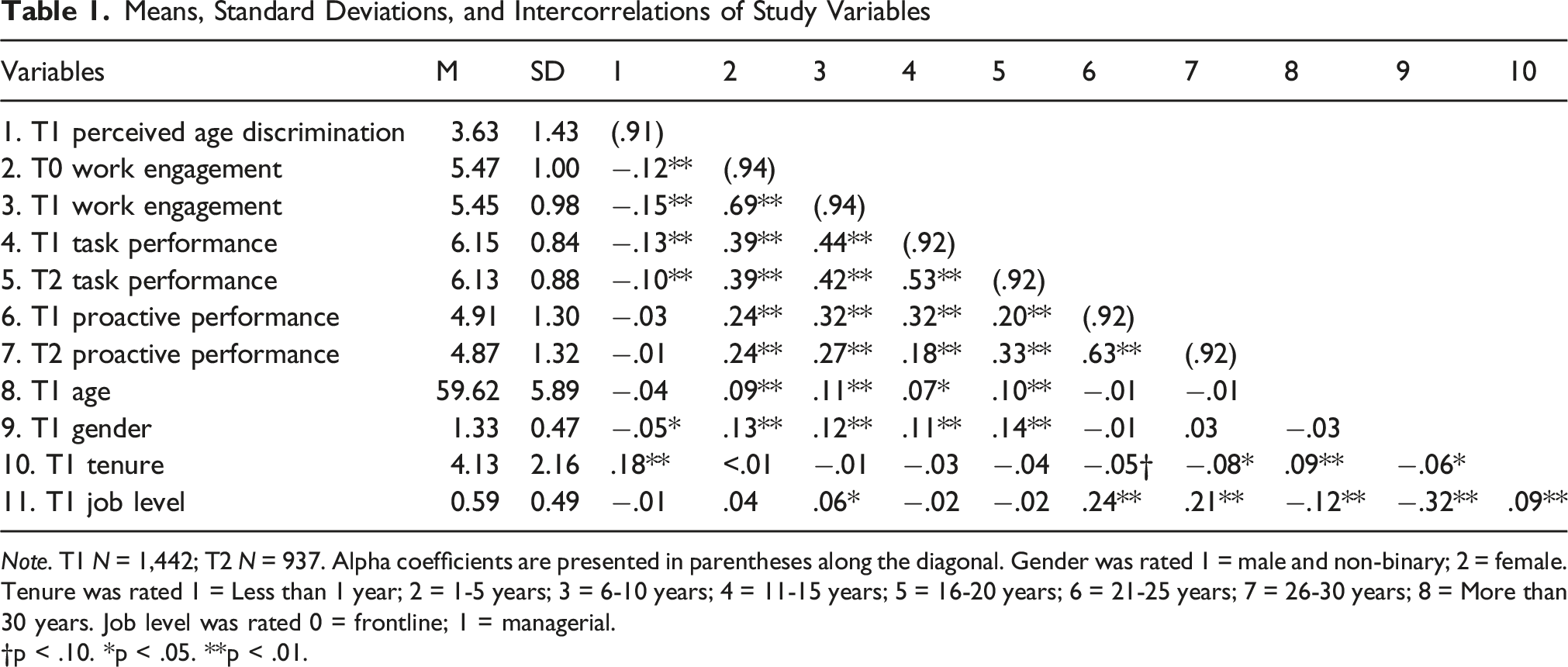
Note. T1 N = 1,442; T2 N = 937. Alpha coefficients are presented in parentheses along the diagonal. Gender was rated 1 = male and non-binary; 2 = female. Tenure was rated 1 = Less than 1 year; 2 = 1-5 years; 3 = 6-10 years; 4 = 11-15 years; 5 = 16-20 years; 6 = 21-25 years; 7 = 26-30 years; 8 = More than 30 years. Job level was rated 0 = frontline; 1 = managerial.
†p < .10. *p < .05. **p < .01.
Analytic Strategy
Longitudinal Approach
We estimated the model using longitudinal structural equation modeling with autoregressive control at every stage, controlling for all outcomes at earlier time points (e.g., controlling for baseline T0 engagement in predicting T1 engagement). Autoregressive control is an important feature of longitudinal models made possible by the use of repeated measures over time. These controls provide evidence against reverse causal explanations by changing the interpretation of path coefficients to predict not the level of Y at a later time point, but rather the residualized change in Y from the baseline (Cronbach & Furby, 1970; see also Castro-Schilo & Grimm, 2018). Since age discrimination involves established organizational practices, we positioned age discrimination and work engagement at the same time point—a “contemporaneous effect” (e.g., Muthén & Asparouhov, 2024)—while controlling for baseline work engagement ratings 6 months prior. Treating the discrimination-engagement relationship as contemporaneous (rather than time-lagged) effectively models the active deleterious effects of established discrimination practices on engagement, doing so over-and-above baseline levels of work engagement. Time was coded to place the predictor variable (age discrimination) at T1, while baseline-rated work engagement was at T0. We then linked T1 engagement to subsequent T2 performance (a “lagged effect”), controlling for T1 performance.
Statistical Control Strategy
One benefit of longitudinal designs with repeated measures is holding the person constant by controlling for lagged assessments of all substantive variables. In principle, this approach accounts for stable endogenous confounds whose effects are subsumed by autoregressive paths, which partly captures the effects of stable covariates at the earlier time point (Usami et al., 2019; Zyphur et al., 2020). Hence, following standard practice in autoregressive models, we control only for lagged variables rather than additionally adjusting for other covariates. 1
Results
Preliminary Analyses
Results of AVE and the Fornell-Larcker Criterion
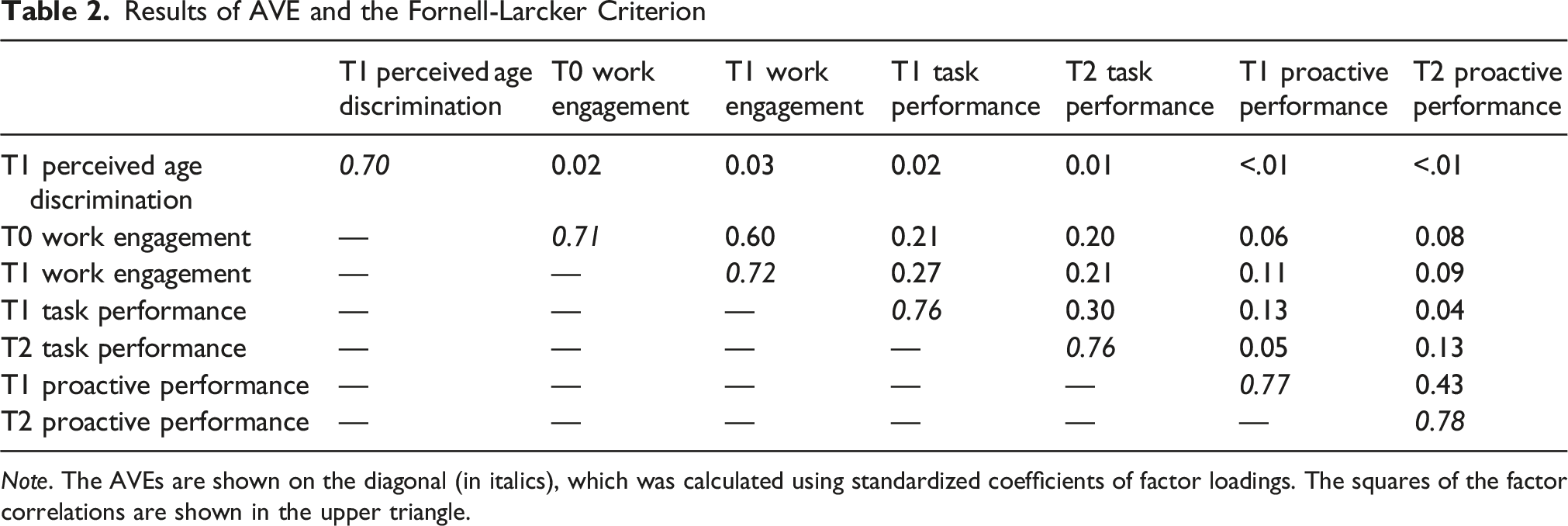
Note. The AVEs are shown on the diagonal (in italics), which was calculated using standardized coefficients of factor loadings. The squares of the factor correlations are shown in the upper triangle.
In subsequent hypotheses testing, we parceled the engagement measure following norms for modeling lengthy measures in longitudinal studies (H.-L. Cheng et al., 2020; Eby et al., 2015). 2 Since the engagement measure was multidimensional, we applied a heterogenous parceling strategy as suggested by Cole et al. (2016) to parcel the nine-item work engagement into three parcels. Heterogenous parceling generates tighter estimates of structural path coefficients and is thus well suited to conducting hypothesis tests.
We also probed for measurement equivalence between the frontline older workers and the managerial older workers. We observed evidence of measurement equivalence. Specifically, a model imposing metric invariance (constraining factor loadings to equality) between the two groups fits just as well as a model imposing only configural invariance: χ 2 diff = 23.99, df = 15, ns, which indicates adequate measurement equivalence for regression hypotheses to be tested. 3 These metric invariance constraints were retained in multigroup hypothesis testing.
Hypothesis Testing
We conducted multigroup longitudinal structural equation modeling using Mplus 8.11 to estimate parallel models for the frontline and managerial groups of older workers. Mplus was also used to compute indirect effects as well as bias-corrected bootstrapped estimates of the standard errors and confidence intervals of the indirect effects (k = 5,000). We first tested the model with a full sample of older workers. The omnibus model showed adequate fit: χ2 (186) = 648.22, CFI = .98, TLI = .98, RMSEA = .04, SRMR = .07. Next, we conducted multigroup structural equation models with between-group metric invariance constraints. The multigroup model likewise showed a good fit to the data: χ2 (396; managerial = 853, frontline = 589) = 854.18, CFI = .98, TLI = .98, RMSEA = .04, SRMR = .06.
Path Coefficients of Multigroup Longitudinal Structural Equation Modeling
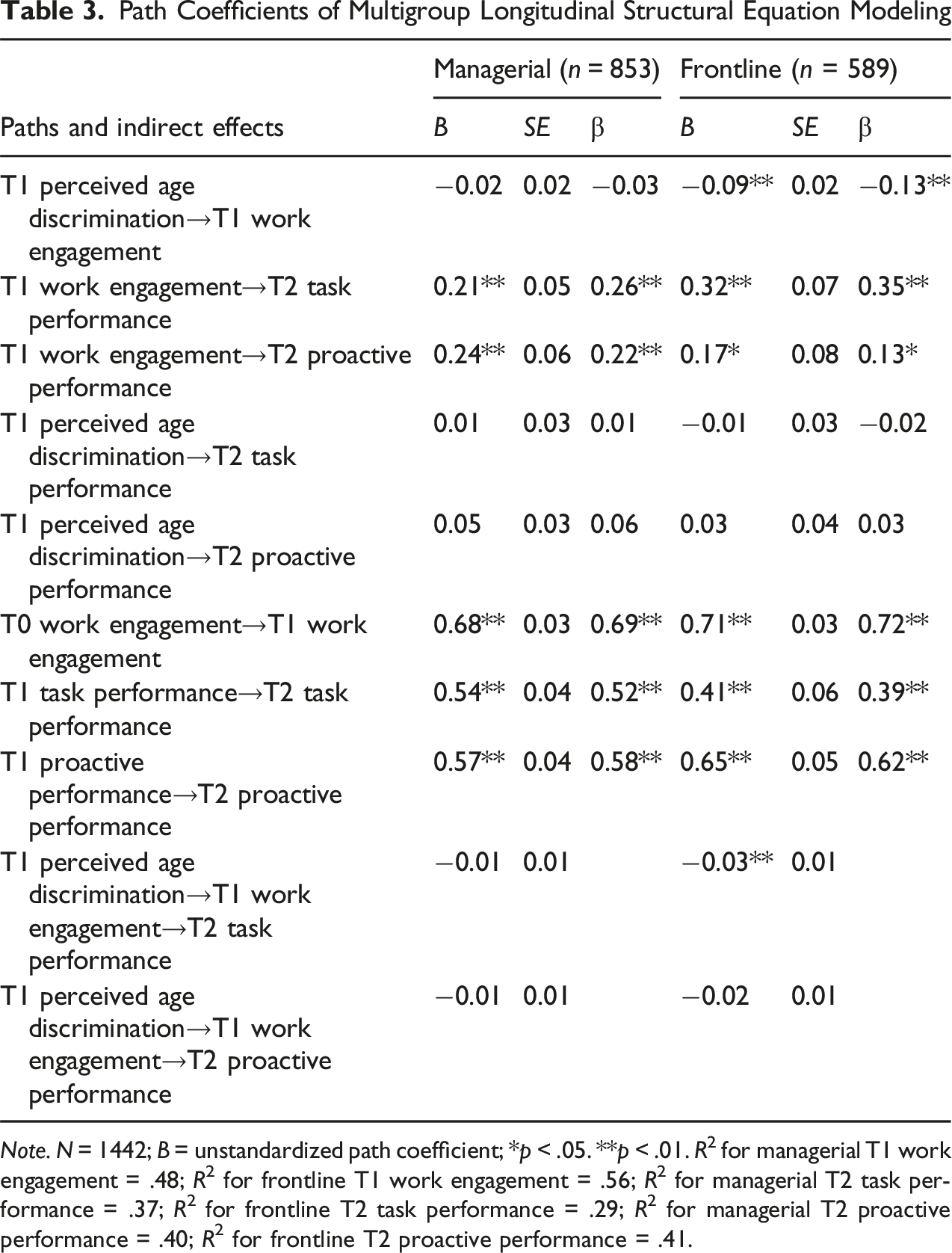
Note. N = 1442; B = unstandardized path coefficient; *p < .05. **p < .01. R2 for managerial T1 work engagement = .48; R2 for frontline T1 work engagement = .56; R2 for managerial T2 task performance = .37; R2 for frontline T2 task performance = .29; R2 for managerial T2 proactive performance = .40; R2 for frontline T2 proactive performance = .41.
Wald Test for Multigroup Analysis
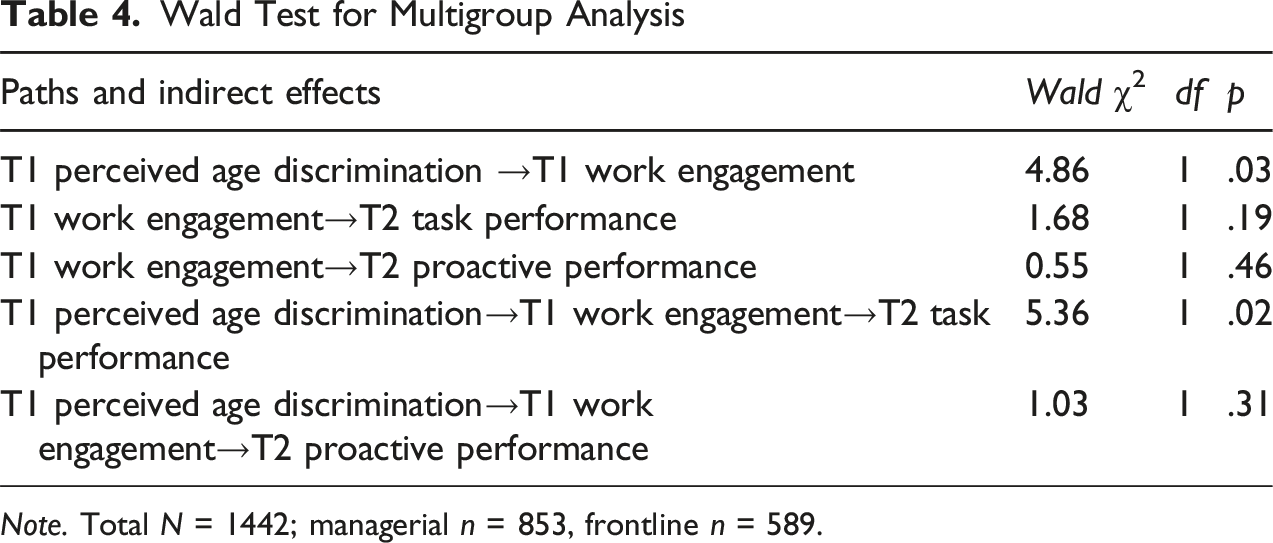
Note. Total N = 1442; managerial n = 853, frontline n = 589.
Supplementary Analyses
T-Test Results and Effect Sizes
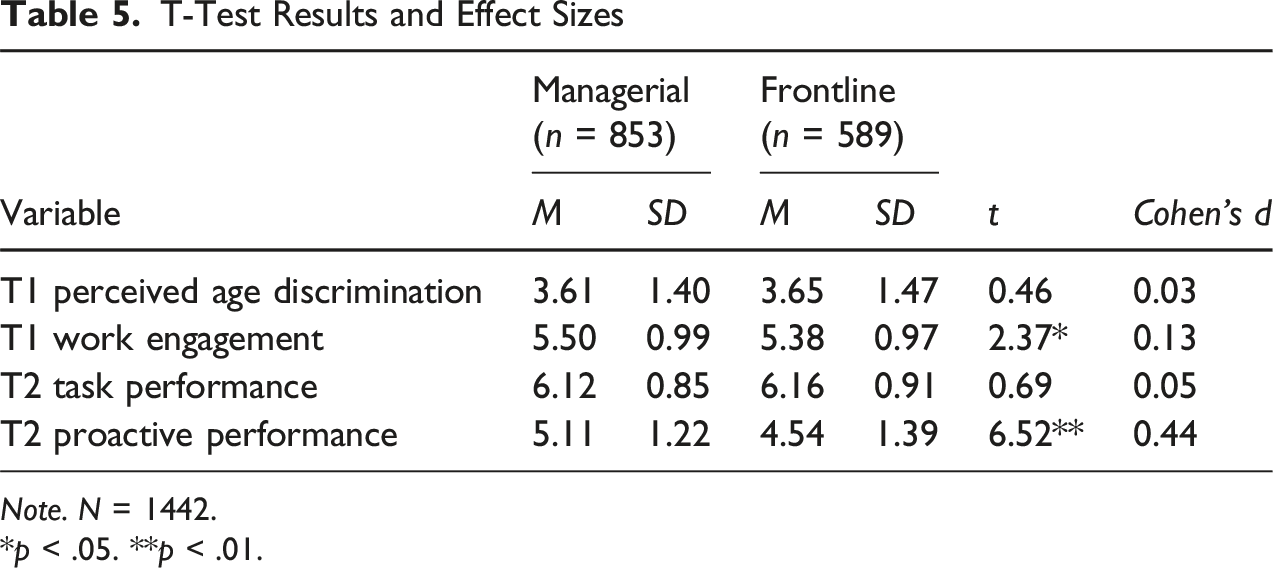
Note. N = 1442.
*p < .05. **p < .01.
Discussion
Age discrimination remains a significant workplace scourge. Over one-third of those aged 65 or older in 28 European nations reported age discrimination (WHO, 2021). Sixty-three per cent of Australians reported age discrimination in the past five years (AHRC, 2023). Age discrimination gets in the way of productive longer-term workforce participation by older workers. Many workers frustrated by discriminatory experiences feel forced to change employers or even occupations; some dejected by being repeatedly overlooked choose to retire. These trends mean significant lost opportunities for individuals and organizations and nullify efforts by governments to prolong workplace participation of older workers.
This study aimed to better understand the relationship between age discrimination and work performance. Previous research has found a mix of effects including null and negative effects (Brady et al., 2025; B. Griffin et al., 2016; Spoelma & Marchiondo, 2024). We explored the possible role of job level as a moderator, proposing that the effects of age discrimination are more marked for older workers at lower frontline levels than at higher managerial levels. We found support for this hypothesis in our longitudinal study of older workers. That is, older workers who reported age discrimination were more likely to have lower levels of work engagement (relative to baseline) and subsequently performed more poorly (relative to baseline). Importantly, we only observed this pattern among older workers in frontline roles; older managers did not show any decrements to engagement and performance despite experiencing on average similar levels of age discrimination. We also observed effects most clearly on role task performance—effects on proactive performance were inconclusive. We comment further on these findings and their implications for theory and practice in the following section.
Theoretical Implications
Our study contributes to the literature of age discrimination by providing a more comprehensive resource-based perspective on when and how older workers are less vulnerable to age discrimination. There is a rich tradition of discrimination research underpinned by COR theory that has largely focused on lower-level, discrete individual resources at a given time (e.g., inclusive workplace practices, Bland et al., 2025; coworker compassion, Dhanani et al., 2023; professional development, Mazzetti et al., 2022; coping behaviors, Volpone & Avery, 2013; core self-evaluations, Wagstaff et al., 2015; trait resiliency and organizational support, King et al., 2023). Despite COR theory suggesting that resources typically function and travel together as a resource caravan that encompasses multiple discrete resources, few studies have directed attention to these higher-level omnibus factors that more broadly characterize the employee’s access to resources. Our study addresses this gap by demonstrating that job level can serve as a resource caravan—a higher-level bundle of resources to mitigate the negative effects of age discrimination on performance. It is also conceivable that job level could operate as a meta-resource: a higher-order resource that enables employees to more effectively harness and activate their lower-order resources (Amarnani et al., 2020; Bordia et al., 2017). By moving beyond lower-level, discrete resources, we advance the resource-based understanding of how organizational context protects against workplace age discrimination for older workers. We see this research as an early foray into understanding the complex contributions of job level to discrimination experiences and impacts. Unpacking the manifold processes by which job level enables “resourcing” (Feldman & Worline, 2011) will be an important next step in this line of research.
Our resource-based perspective is also centered on work role enactment, advancing the literature on the discrimination-performance relationship. Previous studies have approached this relationship from multiple perspectives. Some studies adopted a resource-based framework, focusing on work ability (Brady et al., 2025) or emotional exhaustion (Mazzetti et al., 2022). Others emphasized internal psychological regulation, drawing on self-regulation theory with a focus on cognitive resource depletion (Walker et al., 2022), or adopting self-affirmation theory with a focus on stress appraisals (Spoelma & Marchiondo, 2024). While these perspectives provide important insights, they largely overlook the fact that work performance is inherently situated within the enactment of the work role. Drawing on COR theory, we introduce a role-grounded lens to better understand how age discrimination affects job performance, as job performance is inextricably bound up in the work role (M. A. Griffin et al., 2007). In our study, job level serves as a contextual factor that defines one’s work role within an organizational hierarchy, integrated with Kahn’s conceptualization of work engagement and M. A. Griffin et al.’s (2007) dimensions of task and proactive performance, both of which are work-role centered. By grounding the analysis in work roles, we take the next step in the discrimination-performance relationship, demonstrating how age discrimination differentially impacts performance across the positions of older workers within organizational hierarchies.
We also took an important next step in this literature by broadening the criterion base of performance beyond task performance. This step has proven to be generative, as we found meaningful differences in results between task performance and proactive performance. Specifically, our proposed model held only for task performance but was inconclusive for proactive performance. We believe the explanation for this result is that work behaviors that are more central to the role (i.e., core task behaviors) are more sensitive to these effects than role-peripheral work behaviors (e.g., proactive behaviors). Some of our incidental findings substantiate this possibility. Specifically, we observed that the effect of work engagement on task performance was markedly stronger than it was for proactive performance, but only among frontline older workers. Our speculative interpretation is that proactive performance is more peripheral to the work role in frontline workers than it is among managerial workers. This notion aligns with the original conceptualization of proactive performance behaviors as geared toward managing uncertainty (M. A. Griffin et al., 2007) which tends to be embedded in managerial role prescriptions more so than in frontline roles. Managers are not only more likely to be expected to be proactive, but also have the latitude and resources (by virtue of their role) that are needed to engage in judicious proactive behavior (Y. Wang et al., 2025). Future research may be able to speak more definitively to this issue (and generate new insights) by specifically asking participants to report the relative role centrality of these performance behaviors to allow a deeper understanding of how discrimination intersects with role enactment.
Work engagement served as our focal mechanism. Our frame-of-reference for engagement came from Kahn’s (1990) role-based perspective. However, there are other important perspectives on work engagement that may also be brought to bear, most notably Schaufeli and Bakker’s (2004) job demands-resources view of work engagement. Kahn’s framework conceptualizes engagement as the enactment of the self-in-work role and emphasizes its contextual nature (Fletcher et al., 2018; Kahn, 1990; Rich et al., 2010). On the other hand, Schaufeli & Bakker’s stream positions engagement as “a positive, fulfilling, work-related state of mind that is characterized by vigor, dedication, and absorption” (2004, p. 295) that is fostered by favorable job characteristics (i.e., “job resources”). These two metatheories of engagement both capture the strong motivational force that is central to the phenomenology of work engagement. One important difference between these metatheories is in what they regard as process that engagement is meant to capture. Kahn’s view seems to treat engagement as the process of inhabiting the work role and aligning the self with the role. Schaufeli and Bakker’s view seems to treat engagement as the accumulation of “motivational potential” (p. 298) through positive and supportive job characteristics that altogether sustain vigor, dedication, and absorption. We see both perspectives as essential to understanding the problem of engaging older workers (Kulik et al., 2016). Kahn’s view highlights how engagement is bound up in the social role, which offers direct insight into the innumerable work experiences and behaviors that are role-linked, role-situated, and/or role-prescribed, which intersects with much of the older worker experience. Notably, interpersonal perceptions of work roles can intersect with stereotypes of older workers, which offers another important avenue for further investigation. On the other hand, the stream of research flowing from Schaufeli and Bakker (2004) has helped us make headway toward answering important practical questions about how to design jobs that engage older workers and that maximize the motivational potential of job resources. Future research can draw productively from both “ways of thinking” about engagement.
Overall, our research makes three key contributions. First, we apply the resource caravan perspective to explain why some older workers are more vulnerable to the negative effects of age discrimination than others. Rather than focusing on discrete, isolated resources at a given point in time, we extend prior research by emphasizing a broader role of resources in buffering the negative discrimination-performance relationship. Second, we adopt Kahn’s (1990) view of engagement—role engagement as a primary mechanism linking discrimination to performance, which is role-grounded and distinct from prior studies that focus on other streams of engagement conceptualization. Third, we contribute to age discrimination literature by bringing job level as a key boundary condition into the discrimination-performance relationship, highlighting the context-sensitive nature of perceived age discrimination and the heterogeneity of older workers, and the potential buffering role of job level in shaping older workers’ access to coping resources.
Practical Implications
This research offers some insight into managerial practices. First, consistent with a key corollary of the COR theory that those with more existing resources suffer less from resource loss than those with fewer resources, we showed that possessing a deeper resource cache allows managers to better withstand depleting experiences. For example, age discrimination can threaten one’s social identity as an older person, thereby hurting the sense of self. But the status and esteem that managers derive from their role (Magee & Galinsky, 2008) may buffer them from the demeaning experience of age discrimination. Line employees are less likely to have the workplace status that would protect them from the identity threat posed by age discrimination. Second, existing resources allow managers to accrue additional resources to combat the depleting effect of age discrimination. For example, greater autonomy in scheduling their own work can allow a manager the time to pursue alternate opportunities to the ones denied due to age discrimination. A line employee with less flexibility or autonomy than a manager may not be able to similarly pivot and pursue other opportunities. Third, greater power and status afford a psychological advantage to incumbents—research shows that those with more power are more confident in their ability to deal with challenges compared to those with less power (Anderson & Galinsky, 2006). This sense of confidence may aid managers in coping with age discrimination, while line employees devoid of this confidence would succumb to the depleting effects of discrimination. Thus, the various position-based resource advantages mitigate the resource-depleting effects of age discrimination for managers compared to line employees.
These findings further add to the growing knowledge base against one-size-fits-all solutions to support older workers (M. Wang & Shultz, 2010; see also Sykes-Bridge et al., 2023). Earlier research has shown that older workers feel the effects of mistreatment more strongly but are nevertheless able to preserve performance despite being mistreated (Amarnani et al., 2019). However, as our findings show, it is important to consider how older workers vary (cf. Amarnani et al., 2023). We find that it is important to consider older workers’ differences in job level in understanding how to manage and support them. Our results demonstrate that workplace age discrimination can hurt older workers’ positive working state (work engagement) physically, emotionally, and cognitively, further lowering their task performance and proactive performance. The detrimental influence of perceived age discrimination on work engagement is especially strong in frontline older workers compared to older managerial workers. This may be because higher job levels can provide older workers with more resources and help them utilize other resources to cope with workplace age discrimination. Thus, organizations need to create an age-friendly workplace environment that might especially address the work-related well-being of frontline older workers. Organizations might consider helping replenish resources for frontline older workers, given that lower job levels provide limited resources for them to cope with workplace stressors. Specifically, we encourage future research to examine effective age-inclusive HRM practices or interventions that target frontline older workers. A possible intervention would be age-inclusive leadership training, as it has been shown to influence employees’ intrinsic work motivation (De Boom & De Meulenaere, 2024), promote an age-diversity climate (Boehm et al., 2014), and facilitate successful aging at work (Cui et al., 2025). Future research may also investigate how debiasing interventions can mitigate age biases, as the literature has demonstrated that such interventions reduce age discrimination in workplace performance evaluations and hiring decisions for older workers (Sinclair et al., 2024).
Given that frontline older workers naturally have less job autonomy than managerial older workers, organizations may consider designing interventions to bolster frontline older workers’ job autonomy. Research has shown that job autonomy can confer multiple benefits for frontline workers, including increased self-efficacy (Sousa et al., 2012), job performance (Cai et al., 2019), and creativity (Coelho & Augusto, 2010). Strategies to increase job autonomy may include providing leadership training for supervisors to encourage initiative-taking opportunities, informational feedback and acknowledging employee needs and feelings, embedding autonomy-supportive intervention into work design by offering flexible options and personalized choices, and implementing employee training that emphasize autonomous identification (Slemp et al., 2021). Additionally, establishing formal cross-functional ties for frontline employees may help support them in effectively enacting their frontline roles. Frontline employees who perceive formative cross-functional performance monitoring are more likely to deliver better employee outcomes, in terms of higher motivation, stronger organizational identification, greater output, enhanced innovation, and increased willingness to exert extra effort (McDermott et al., 2019).
Our findings also highlight implications for policy. Most policy prescriptions on age discrimination (e.g., in the U.S. and UK) do not distinguish between frontline and managerial workers. Notably, both national-level reporting and legal scholarship on age discrimination claims lump together claims made by lower-level frontline staff with claims made by higher-level managerial staff (e.g., Blackham, 2021; COTA, 2023). One straightforward, baseline step on the path to improving and tailoring age discrimination policy prescription is to disaggregate across job level when reporting and documenting age discrimination claims. Adjustments to reporting practice will allow governments and non-governmental organizations to make headway on the age discrimination problem beyond one-size-fits-all prescriptions, taking into account evidence for differential impacts across job levels.
Our findings also suggest the troubling possibility that managerial older workers might underestimate the impacts of age discrimination on their frontline counterparts if they are better able on average to preserve their own performance. If managerial older workers considered their relative resilience to age discrimination and were to attribute that resilience to their own capabilities (or to the innocuousness of age discrimination) rather than to the benefits and protections of their managerial status, it is possible that these managerial older workers might form implicit beliefs that age discrimination is not so bad and that frontline older workers should just try to be resilient like them. While managers are typically encouraged to “learn from experience,” they might wind up learning the wrong thing from this experience and thereby underestimate the harms of age discrimination to frontline older workers. Our findings raise this possibility as a concern for future investigation. We note here that older employees in managerial roles may experience identity conflict due to the incompatibility between their identity as older workers and their role as managers. Role identity literature has highlighted that identity conflict may lead to job attitudes (e.g., lower job satisfaction, increased disengagement) and negative behaviors (e.g., undermining performance, unethical behaviors, reduced prosocial behaviors) (Vough et al., 2025). Future research could investigate how identity conflict impacts older managerial workers’ perceived age discrimination, and how this conflict influences their attitude towards age discrimination against older workers.
Limitations and Future Research
We comment here on limitations and future directions. First, we consider the possibility of common method bias. Our questionnaire design includes elements that could contribute to this bias, such as the use of self-reported data. We applied procedural remedies to minimize contamination of our path estimates by common method variance as suggested by Podsakoff et al. (2003). For instance, we used time lags with autoregressive control to separate the measurement of predictors and outcome variables. The temporal separation of measurement is a powerful procedural remedy for many typical sources of method variance (Podsakoff et al., 2024). Autoregressive control further reduces contamination of substantive effects by method variance by sequestering the contributions of stable response tendencies and methodological artifacts (e.g., acquiescence bias) into the autoregressive path (Orth et al., 2021). Overall, it is unlikely that our results are due solely to common method variance.
Second, we solicited self-report assessments of job performance rather than using informant reports. Recent research on age discrimination and job performance has also used self-report ratings of performance (Brady et al., 2025; Spoelma & Marchiondo, 2024). The issue of who ought to be the right informant for ratings of job performance continues to be controversial. Commenting on self-report ratings of performance, Spector (2006, p. 228) notes that “coworker or supervisor ratings might be helpful in controlling for self-serving biases, such as with self-appraisals of performance. However, these methods might control for some forms of bias but not others, and they might introduce other biases or problems.” Indeed, informant reports of performance ratings tend to contain more rater variance and idiosyncratic variance than actual variance in performance dimensions; in contrast, self-ratings contain the most actual variance in performance dimensions (Hoffman et al., 2010). The consensus view in the literature (Foster et al., 2024) is that informant ratings of performance are not inherently superior to self-ratings; both contain important variance in performance (as well as bias). Nevertheless, we believe that future research with informant-ratings will help deepen our understanding of how age discrimination relates to work behaviors.
We encourage future research to address the limitations of self-reported performance by incorporating multi-source data, such as supervisor ratings of performance, to validate and extend our findings. To do so, future research may consider control variables such as subordinates’ prosocial values, affect, organizational identification, secure-base support, and supervisor-subordinate congruence in proactive personality, as these factors may significantly influence supervisors’ ratings of subordinates’ proactive behavior (Grant et al., 2009; Wu & Parker, 2017; M. Xu et al., 2019; Q. Xu et al., 2019). When applying multi-source ratings of performance, future studies should examine interrater reliability and assess external validity, using a nomological network approach to analyze covariance patterns among source effects and external performance measures to determine whether source effects represent meaningful performance-relevant variance or bias (Hoffman & Woehr, 2009). Future research should also consider job level when adopting multi-source ratings, as meta-analytic evidence indicates that interrater reliability varies significantly across managerial and nonmanagerial positions—nonmanagerial raters exhibit higher interrater reliability than managerial raters (Zhou et al., 2024). Future research may also select appropriate rating combinations, as meta-analytic findings suggest that self-ratings and supervisor-ratings exhibit greater convergence than self-ratings and coworker-ratings (Carpenter et al., 2014).
More research is needed to deepen our understanding of job level as a resource caravan. Drawing upon COR theory, we argued that job level encompasses a bundle of resources that altogether sustain older workers’ engagement in their work role despite age discrimination. These resources enable employees in managerial roles to sidestep and work around obstacles due to age discrimination, as well as to orchestrate resource recovery. Consistent with this reasoning, we only observed buffering effects of job level on the discrimination-engagement relationship, and did not find any differences across job level in the engagement-performance relationship. The benefits of a managerial job level do not seem to extend to enactive capacity in translating engagement to performance. Turning to the resource caravan itself, it will be important for future research to unpack the bundle of resources that likely make up this caravan. Several candidate resources could play distinct but complementary roles. Job autonomy might be an immediate, proximal buffer by allowing employees to alter task sequencing, pacing, and interaction patterns in ways that preserve cognitive and affective engagement in the work despite biased treatment. Network breadth provides valuable access to information, informal influence, and alternative pathways for accomplishing work when formal channels are constrained by discrimination. Status, in turn, may operate more indirectly by legitimizing these adaptations and reducing the risk that workarounds are questioned or penalized. Future research can allow deeper insight into job tenure as a resource caravan while also unpacking its bundle of resources through the use of latent profile techniques. These techniques can identify configurations of resources that contribute to managerial job level and provide outsized protection from the impacts of discrimination. This approach stays true to the nature of job level as a resource caravan, providing insight into the contributions of lower-level resources without reverting back to piecemeal approaches that only examine one resource at a time.
Further, the measure we used for age discrimination against older workers (Chiu et al., 2001) only captures older workers’ perception of employers’ generalized attitudes and practices rather than age-discriminatory interpersonal behavior (Fasbender & Gerpott, 2021). Employers’ generalized attitudes reflect the broader organizational atmosphere and values that permeate the workplace and are therefore likely to be pertinent to the experience and enactment of work roles (S. A. Goodman & Svyantek, 1999; Leung, 2008). Nevertheless, the interpersonal side of age discrimination is an important topic for future investigation. Future research may consider adopting other established measures of perceived age discrimination to address its multiple forms, such as Marchiondo et al.’s (2016) nine-item scale, Bayl-Smith and Griffin’s (2014) six-item scale, and others (as summarized in Peng et al., 2023). Additionally, one item in the Chiu et al. (2001) measure asks about whether their organizations would give younger workers priority to stay in the case of downsizing. Involuntary turnover and retrenchment are not uncommon in the Australian business environment, but this issue might not have been relevant to all participants. It is possible that this item might be particularly context-sensitive; nevertheless, this item did display consistent factor loadings across job level and over time (i.e., metric invariance) which demonstrates at least that the item is behaving consistently. We encourage researchers to use a broader range of measures of age discrimination, as well as to include a “not applicable” option. This option would allow researchers to more fully capture the content space of age discrimination (for fuller content validity) while accounting for diversity in how discrimination manifests.
We adopted a contemporaneous modelling approach that positions age discrimination and work engagement both at T1 while controlling for lagged work engagement. Although the use of autoregressive control does help rule out a broad range of alternative causal explanations, it does not provide complete causal identification. The use of alternative designs and approaches (including field experimentation) can help provide converging evidence of the causal impact of age discrimination. Relatedly, our modelling approach uses some elements of the cross-lagged panel model, but did not incorporate specific elements that focus primarily on within-person processes (e.g., random intercept parameterization; Hamaker et al., 2015). It is possible to probe these within-person processes using random intercept cross-lagged panel models with a larger number of waves. Doing this will allow researchers to answer research questions about temporary increases in age discrimination (i.e., do older workers perform worse than usual when they experience more age discrimination than usual; see Orth et al., 2021 for a primer). Although these questions are substantively different from the questions we explore in this paper, they are nevertheless important for developing a fuller picture of the impacts of age discrimination.
Finally, we wish to comment on generalizability given our sample of Australian older workers. The experience and impact of perceived age discrimination may vary based on culture. For example, older workers in collectivistic-tight societies may experience more negative prejudice and unfair discrimination from supervisors and coworkers, such that they experience lower job satisfaction and have higher turnover intentions compared to older workers from individualistic-loose societies (de Paula Couto et al., 2023; Marcus & Fritzsche, 2016). Additionally, since our study showed that job level moderates older workers’ perceived age discrimination on work engagement, will this differ across cultures? For instance, could job level play a stronger moderating role in higher power-distance cultures? Will job level moderate the mediation paths perceived age discrimination→work engagement→proactive performance in a high-power distance culture, which is not supported in our model? Future research might seek to answer these remaining questions. Moreover, we do recognize that age discrimination may also be experienced by younger workers (Snape & Redman, 2003), albeit not as often (e.g., Blackham, 2020). Future research might consider the experiences of younger workers’ age discrimination to provide a fuller picture of its impacts on the workforce.
Conclusion
This research proposed and tested a theoretical model to explain why and when older workers’ perceived age discrimination obstructs their job performance. Our results suggest that the pathway to reduced job performance in response to perceived age discrimination appears to be via reduced work engagement. Moreover, when employees are in a—relatively—resource-poor line role (versus a manager), perceived age discrimination leads to lower work engagement. A conservation of resource perspective, widely used to explain employee reactions to overly demanding circumstances, was fruitful in explaining the effects of perceived age discrimination. We hope the work presented here will spark further interest in examining the resource loss implications of age discrimination.
Footnotes

Ethical Considerations
The research reported here was approved by the Human Research Ethics Committee at the Australian National University.
Funding
The authors disclosed receipt of the following financial support for the research, authorship, and/or publication of this article: This research was supported by a grant from the Australian Research Council (DP200103440) to the second, third, and fourth authors.
Declaration of Conflicting Interests
The authors declared no potential conflicts of interest with respect to the research, authorship, and/or publication of this article.
Data Availability Statement
Data are not available due to their proprietary nature but are available from the corresponding author on reasonable request.