




Abstract
Social support provided by organizational actors responsible for designing the change is promoted to achieve technology implementation success (TIS). However, how these support interventions exert their effects remains unclear. We examine interdisciplinary literature on social support provided to employees and identify interventions we frame as organizational support strategies (OSS). Drawing on theories of social support and technology acceptance, we develop and test our social support model of technology implementation. Using meta-analysis, we examine the relationship between OSS—emotional support (e.g., participation, management support), instrumental support (e.g., training, technical support), and informational support (e.g., information provision, change vision)—and TIS outcomes (e.g., technology acceptance, user satisfaction, performance, positive change attitude, computer self-efficacy, reduced strain). Meta-analytic structural equation modeling based on k = 108 unique samples (N = 23,005) showed a moderate relationship between OSS and TIS (r = .30). A closer examination revealed that informational support (r = .38) was the strongest predictor of overall TIS. Further analyses showed that each kind of support was most strongly related to a specific indicator of TIS. These findings help explain how OSS function and offer guidance for aligning support interventions with targeted implementation outcomes.
Keywords
Introduction
Technologies—such as enterprise resource planning, health record, e-learning, or artificial intelligence—play an integral role in today’s economic landscape (Cascio & Montealegre, 2016). Employees increasingly interact with these technologies in their daily work (Parker & Grote, 2020). However, the successful implementation of such technologies remains a significant challenge for organizations (Cândido & Santos, 2015). Many implementation efforts fail to achieve their intended goals, often due to a variety of factors—including technical shortcomings, as well as psychological, social, and organizational dynamics that contribute to project escalation (Keil, 1995). Despite the diversity of these factors, they converge on a common risk: employees frequently perceive technological change as stressful, which can impair performance (Nixon & Spector, 2013) or provoke resistance against the new technology (Oreg, 2006).
One prominent way to address this common risk factor is through the adoption of organizational support strategies (OSS). These strategies involve intentional efforts by organizational members—particularly those involved in designing change management for technology implementation—to support employees during the implementation process. OSS can take the form of emotional (e.g., management support or participation opportunities), instrumental (e.g., training or technical support), and informational support (e.g., provision of information or vision for change). OSS have been discussed across disciplines, such as information sciences, economics, and psychology. Depending on the field, they have been conceptualized under various terms, such as critical success factors (e.g., Iden & Eikebrokk, 2013; Reitsma & Hilletofth, 2018), organizational support factors (Bhattacherjee & Hikmet, 2008), or process of change variables (Oreg et al., 2011).
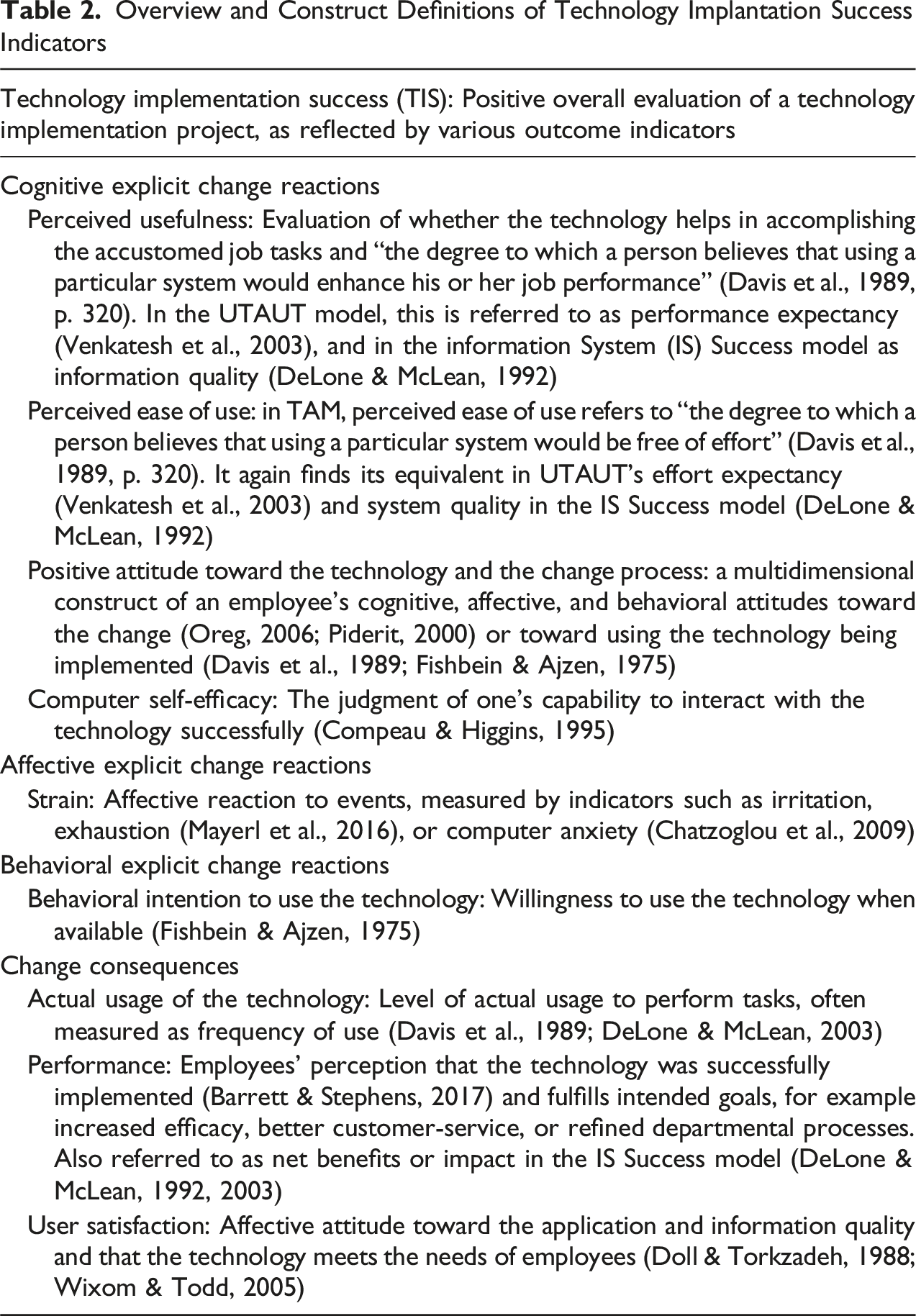
OSS have been examined in relation to various employee-level outcomes that we subsume under the overall construct technology implementation success (TIS). TIS comprises several indicators of successful technology implementation, each rooted in distinct theoretical frameworks: positive evaluation of the technology (usefulness and perceived ease of use), behavioral use intention and actual usage (Davis et al., 1989; DeLone & McLean, 1992, 2003; Venkatesh & Bala, 2008; Venkatesh et al., 2003), attitudes toward technological change (Davis et al., 1989; Piderit, 2000), computer self-efficacy (Compeau & Higgins, 1995), reduced strain (Mayerl et al., 2016), user satisfaction (Wixom & Todd, 2005), and individual performance (DeLone & McLean, 2003).
The nature of OSS and its relationship with TIS remains insufficiently understood. Although the application of OSS lowers implementation failure rates (Cândido & Santos, 2015), empirical studies report considerable variation in effect sizes (e.g., Kwak et al., 2012; Sanders & Courtney, 1985). Moreover, current empirical research often lacks a clear theoretical rational explaining why OSS should enhance technology implementation success. Such theoretical grounding is crucial for understanding these relationships and for designing more effective implementation processes (Nielsen & Miraglia, 2017). We argue that social support theory (House, 1981) offers a valuable theoretical framework for conceptualizing OSS and linking it to existing theories explaining TIS. Accordingly, the present study aims to identify the kinds of OSS currently applied in organizations, and to meta-analytically assess their effects on TIS.
The present meta-analysis makes four key contributions. First, we review interdisciplinary literature to identify theoretical frameworks and variables associated with organizational support for the successful implementation of technologies in the workplace. Second, we examine social support interventions in primary studies, categorize them according to established OSS categories and describe the kind of social support they represent and evaluate their effects. For this purpose, we draw on social support theory (House, 1981), explore its relationship with TIS, and develop a conceptual model of social support in the context of technology implementation. Third, we apply meta-analytic structural equation modeling (Cheung, 2015) to account effect sizes dependencies and to determine the overall relationship between OSS and TIS. Fourth, we derive implications for future research on OSS and TIS and recommendations on how practitioners can more effectively design support for technology implementation.
Social Support Theory to Explain Relationships of OSS on TIS
OSS are frequently employed in technology adoption projects to mitigate the adverse effects of organizational change on employees. Social support theory (House, 1981) provides a framework for understanding the nature, forms and functions of support provided by social actors to help individuals cope with challenges and enhance well-being. Social support explains how social relationships in general—and OSS in particular—need to be structured in order to be experienced as supportive, and under which conditions they exert beneficial effects, such as on TIS. In the following sections, we derive key principles of social support theory to conceptualize the nature and form of support provided by organizational social actors, outline the theoretical foundations of TIS, and illustrate the relationship between OSS to TIS.
Social Support provided by Organizational Actors: Organizational Support Strategies
Social support refers to the provision of psychological or material resources within a social relationship, from one party—such as organizational representatives—to another, such as employees (Jolly et al., 2021). Support can take various forms, including actual supportive behaviors or perceived availability of support; it may originate from different sources (e.g., colleagues, supervisors, or friends), and can be provided formally or informally (Jolly et al., 2021; Sykes, 2020).
Overview and Construct Definitions of Organizational Support Strategies
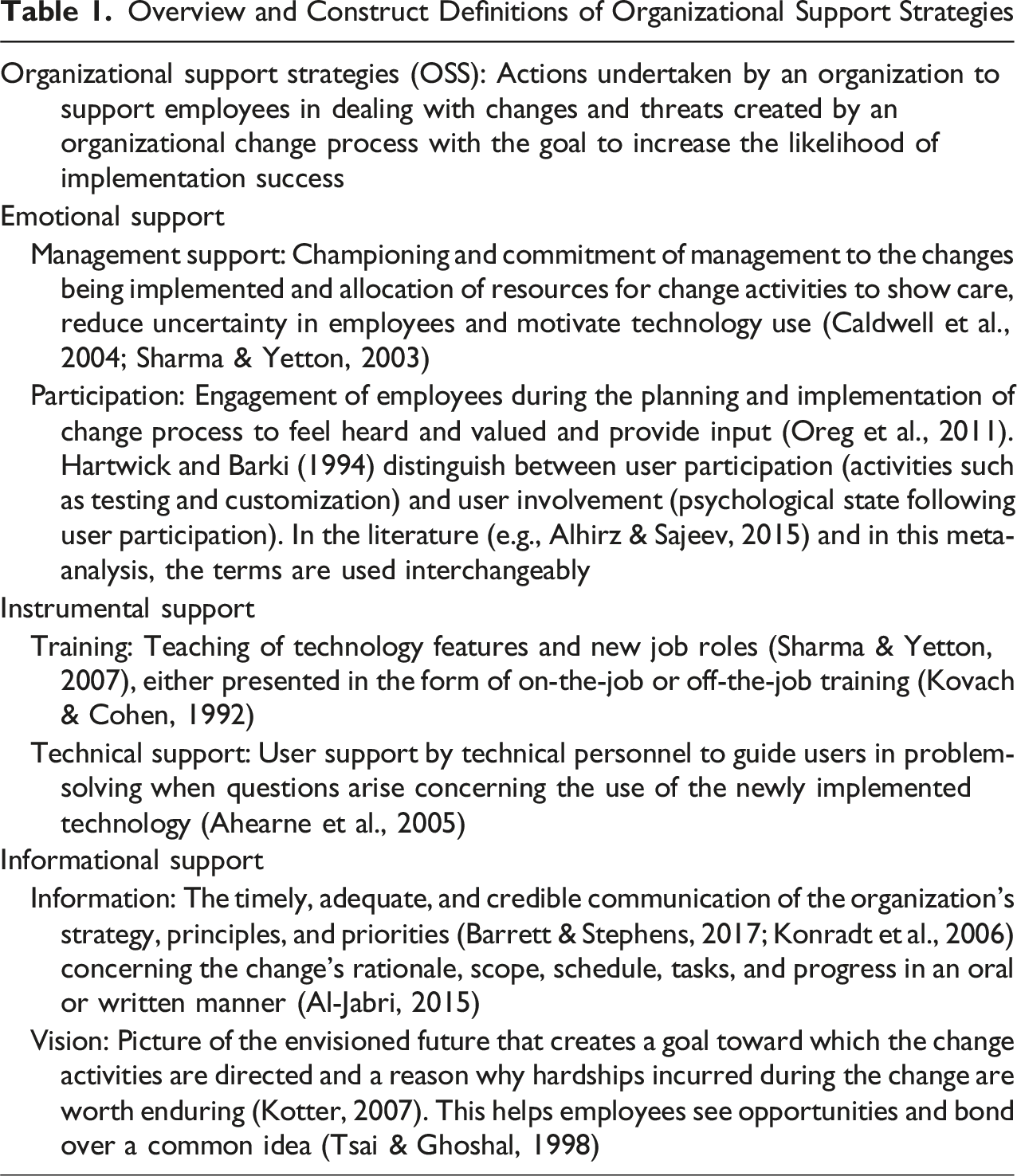
Social support theory posits that the provision of support is effective because it equipes individuals with resources to better cope with strain, adapt to demands, and ultimately enhance their well-being. Such support becomes especially important during technology implementation, when employees may need to acquire new skills to use the technology effectively (Oberländer et al., 2020; Paruzel et al., 2020), or when adjustments to business processes and work design require employees to understand and adapt to changed conditions (Momoh et al., 2010; Parker & Grote, 2020). To provide more specific predictions, social support theory is complemented by other theoretical frameworks. Within the job demands-resources (JD-R) model (Bakker & Demerouti, 2017), social support is conceptualized as a job resource that buffers the negative effects of job demands—such as increased complexity or uncertainty—by offering matching resources (e.g., training for new competency requirements, Schlicher et al., 2022). In addition, such resources enhance the motivation to positively interact with the environment, thereby fostering well-being and performance. From the perspective of Conservation of Resources (COR) Theory (Hobfoll et al., 2018), support during organizational change signals to employees that they possess sufficient resources to cope with the demands of change (e.g., achieving the necessary competences through training), promoting a positive mindset and readiness for change. Conversely, employees who lack such resources are more likely to experience strain and, in a downward spiral of negative outlook, respond defensively, for instance by resisting technological change (e.g., Oreg et al., 2018). In the following section, we introduce the construct of technology implementation success (TIS), which we link theoretically to the role of support.
Employee-Side Indicators of Technology Implementation Success
Research has identified multiple facets of TIS, each grounded in distinct theoretical models that explain successful technology implementation in terms of employee acceptance and usage. The key theoretical frameworks that inform this meta-analysis are introduced in the following section. Indicators of TIS derived from theories are presented in italics.
The Technology Acceptance Model (TAM; Davis et al., 1989) conceptualizes successful implementation of a technology as the acceptance of the technology by the employee, operationalized through usage. According to TAM, acceptance results from the beliefs a person has about the technology’s functionality (perceived usefulness) and operability (perceived ease of use). When these beliefs are favorable, they foster a positive attitude toward the system, which in turn leads to the behavioral intention to use the system. TAM is rooted in the Theory of Reasoned Action (Fishbein & Ajzen, 1975), which posits that behavior is driven by attitudes and subjective norms via behavioral intention and actual usage behavior. Several extensions have sought to enhance TAM’s explanatory power. TAM 2 and TAM 3 (Venkatesh & Bala, 2008; Venkatesh & Davis, 2000) introduce additional antecedents while preserving the model’s core structure. Unified models such as UTAUT (Venkatesh et al., 2003, 2012) consolidate variables at a meta-level, though the underlying concepts remain theoretically consistent with the original TAM.
The information system success model (DeLone & McLean, 1992, 2003)—developed from an economics perspective—defines TIS in term of performance outcomes resulting from the use of the new technology. The model operationalizes performance as the net benefit or impact on the individual or organization. These outcomes are predicted by employees’ perception of system quality (comparable to perceived ease of use), information quality (comparable to perceived usefulness), and service quality (which aligns conceptually with the OSS technical support, see DeLone & McLean, 2003). The relationship is mediated by system use and user satisfaction.
In their integrated research model of user satisfaction and technology acceptance literature, Wixom and Todd (2005) conceptualize TIS in terms of employee usage and use satisfaction. They propose that the intention to use the newly implemented technology is driven by employees’ evaluations of the technology’s information and system quality. User satisfaction, in this framework, reflects a combination of object-based beliefs—centered on technology attributes as highlighted in the user satisfaction literature (e.g., Doll & Torkzadeh, 1988)—and behavioral beliefs, as defined in TAM and its extensions (Davis et al., 1989; Venkatesh et al., 2003).
Two additional variables, computer self-efficacy and strain, have frequently been examined in relation to OSS and TIS. Unlike the constructs originating in information systems research, these variables are rooted in broader psychological theories. Computer self-efficacy (CSE) is derived from Social Cognitive Theory (Bandura, 1986) and refers to an individual’s belief in their ability to effectively interact with the technology being implemented. It was later incorporated into TAM3 as an antecedent variable to enhance the model’s predictive power (Venkatesh & Bala, 2008). Strain, by contrast, reflects affective responses to demands such as uncertainty and resource loss, and has been widely used in psychological frameworks addressing uncertainty and demands (e.g., Bordia et al., 2004; Mayerl et al., 2016). Empirical research have treated both CSE and strain either as mediators of the OSS-TIS relationship (e.g., Anandarajan et al., 2000; Chatzoglou et al., 2009) or as characteristic of the individual predicting technology implementation outcomes (e.g., Rajan & Baral, 2015).
Overview and Construct Definitions of Technology Implantation Success Indicators
Elements of the relation of OSS on TIS have previously been examined in meta-analytic research, yielding heterogenous results. For example, Mahmood et al. (2000) reported strong relationships between user involvement in system development and organizational support with user satisfaction, and Mahmood et al. (2001) found similarly strong relationships of training and organizational support on usage. Furthermore, Mahmood et al. (2000) found a moderate relationship between management support and user satisfaction. Sabherwal et al. (2006) observed medium-sized relationships of management support, training, and participation with attitude toward the system, perceived usefulness, satisfaction with the system, and usage. Sharma and Yetton (2007) confirmed medium-sized relationship for training and implementation success. Additionally, He and King (2008) and Hwang and Thorn (1999) identified medium-sized effects of user participation in system development on user satisfaction, use intention, and usage, and small effects on productivity with the system. In contrast, Hameed et al. (2012) found only a weak relationship between management support and technology adoption. Likely, Hwang and Schmidt (2011) and Sharma and Yetton (2011) reported small to medium-sized relationship for the relationship of management support with technology implementation success. These inconsistent findings underscore the need for an integrative meta-analysis to resolve heterogeneity and establish a clear understanding of OSS-TIS relationships.
Building on the previously outlined theoretical frameworks, we derive our first hypothesis by integrating insights from social support theory, the Job Demands–Resources (JD-R) model, and research on technology implementation. Social support theory proposes three potential mechanisms for how support affects outcomes: first, a main direct effect on the outcome; second, a reduction of perceived stressors; and third, a buffering effect that moderates the stressor-outcome relationship (House, 1981; Viswesvaran et al., 1999). Among these, we focus on the main effects model, which posits that support exerts a direct positive influence on key outcomes. This focus aligns with the JD-R model (Bakker & Demerouti), in which social support theory functions as a job resource that directly fosters motivation—such as the motivation to adopt and engage with new technologies. In line with technology acceptance theories (e.g., DeLone & McLean, 2003; Venkatesh et al., 2012), OSS can be conceptualized as a contextual factor that directly facilitates favorable perceptions and behaviors during implementation processes. Furthermore, meta-analytic evidence supports the presence of robust linear main effects of support on workplace outcomes (Ng & Sorensen, 2008; Viswesvaran et al., 1999), and empirical studies on technology-related change have similarly relied on direct effects models (e.g., Ainin, 2011; Lee et al., 2011). Accordingly, we test the direct relationship between OSS and TIS. This approach allows us to assess the overall impact of OSS on TIS across studies and contexts. We expect that higher availability of support will be associated with higher levels of TIS.
OSS is positively related to TIS.
Analyzing the Differentiating Relationships Among Three Kinds of Support
Social support theory (House, 1981) posits that support can take four different forms, depending on its nature and function. OSS can thus be categorized based on the specific kind of support provided. Prior research on job resources, including social support, suggests that such resources are most effective when they target specific functions, demands or outcomes (van Veldhoven et al., 2020). This matching mechanism helps explain why different kinds of OSS exert differential effects on TIS indicators.
Social support theory distinguishes between four kinds of support in its model assumptions (House, 1981; Smollan, 2017). Instrumental support refers to behaviors aimed at helping employees solve problems, such as providing financial assistance or practical help at work. Informational support involves offering guidance or knowledge that helps employees cope with challenging work situations. Emotional support “involves providing empathy, caring, love, and trust” (House, 1981, p. 24). Appraisal support encompasses feedback intended to aid in self-evaluation and social comparison. In practice, however, these kinds of support often overlap. For instance, informational support may simultaneously convey emotional support by signaling care for the recipient (Semmer et al., 2008). Moreover, different supportive behaviors by the same individual are frequently highly correlated, likely because the provider responds flexibly to the situation and offers the kind of support they perceive most appropriate (Semmer et al., 2008). Thus, the four kinds of support function more as theoretical lenses for understanding supportive acts than as empirically distinct dimensions (e.g., Mathieu et al., 2019; Viswesvaran et al., 1999). When supportive acts fit more than one categories, researchers have either coded them under multiple types (e.g., Smollan, 2017) or grouped them into broader categories (e.g., Mathieu et al., 2019; ten Brummelhuis et al., 2012)—such as differentiating between tangible (instrumental) and intangible (emotional, appraisal, informational) support (House, 1981).
OSS can be aligned with the kinds of support identified in social support theory by examining both construct definitions—i.e., the supportive meaning conveyed by the OSS (House, 1981)—and measurement characteristics, such as whether OSS items reflect the features of specific support categories (Lawrence et al., 2007). In the context of technology implementation projects, instrumental support typically involves the provision of technical support options for emerging problems or training to help employees acquire the skills needed to use new technologies effectively (Sykes, 2020). Informational support is reflected in behaviors that communicate relevant information about the technology and the change process, or a goal vision that the technology implementation seeks to achieve. Emotional support may be expressed through opportunities for employees to participate in the project or through management support behaviors that address employees’ socio-emotional needs—for instance, by valuing their input or offering care and reassurance during periods of difficulty associated with the technological change (Baran et al., 2012). The review did not identify OSS specifically targeting appraisal support.
The specificity hypothesis of social support theory posits that different kinds of social support are most effective when they align with the contextual demands of a situation (Cohen & Wills, 1985). For instance, emotional support is more likely to mitigate emotional strain, because both operate within the same affective domain, whereas instrumental support may be less effective in such contexts due to mismatch in focus. Building on this, the optimal support matching model (Cutrona, 1990) further suggests that support is most beneficial when it corresponds dimensionally to the kind of demand or outcome—for example, emotional support with affective demands, and instrumental support with task-related challenges. Applied to technology implementation, emotional support by management (e.g., empathy and encouragement) may not be sufficient for facilitating adaptations to the new technology if the primary challenge lies in technical difficulties. In such cases, instrumental support in the form of technological assistance from IT staff may be more effective. This assumption is supported by empirical and meta-analytic findings demonstrating differentiated effects of kinds of support in organizational contexts (e.g., Mathieu et al., 2019; van de Ven et al., 2014). Accordingly, we assume that higher levels of instrumental, informational, or emotional support each exert their strongest effects on distinct TIS categories. The specific relationships will be outlined in the following sections for each kind of support.
Instrumental support refers to the provision of tangible resources that enable employees to address task-related challenges independently (House, 1981). In the context of technology implementation, this includes training that builds users’ skills to self-confidently use and technical support that helps resolve application issues. According to the specificity hypothesis (Cohen & Wills, 1985), support is most effective when its content matches the demand of the outcome it is intended to influence. Instrumental support aligns with technology-related demands by directly targeting employees’ need to acquire and apply technical knowledge, thus facilitating successful technology interaction. The optimal support matching model (Cutrona, 1990) extends this logic, positing that instrumental support should be particularly effective when the targeted outcomes are task- or behavior-oriented. Building on this, the information systems success model (DeLone & McLean, 2003) identifies service quality, which represents instrumental support, as a key determinant of intention to use, usage and performance. Empirical research confirms these theoretical expectations: for instance, users receiving instrumental support report fewer difficulties in system use (Sharma & Yetton, 2007), Higher self-efficacy (Huang et al., 2017) and more positive evaluations of the system (Chatzoglou et al., 2009). These findings suggest that instrumental support is especially well suited to influencing behavioral outcomes such as intention to use, usage, and performance, as well as content-oriented outcomes such as perceived ease of use and computer self-efficacy. In contrast, cognitive and affective outcomes, which relate to beliefs or emotions about the change, may be less directly influenced by task-specific support. Accordingly, we hypothesize that the instrumental support OSS training and technical support are more strongly related to behavioral and content-oriented outcomes.
Instrumental support is more strongly related to behavioral outcomes (behavioral intention to use, usage, and performance) and content-oriented outcomes (PEOU, computer self-efficacy) than to cognitive or affective outcomes. Informational support refers to the provision of knowledge that helps employees understand and interpret their environment (House, 1981). In organizational settings, this includes communication about the technology being implemented and the process of implementation, and the overarching goal or vision for the implementation effort. Within the framework of the specificity hypothesis (Cohen & Wills, 1985), support is most effective when it aligns with the kind of demand being addressed. Informational support is particularly suited to cognitive demands, as it directly aids in understanding and interpretation rather than emotional coping and behavioral execution. The optimal matching model (Cutrona, 1990) similarly posits that the most effective support matches the type of stressor or demand along a functional dimension—in this case informational support addressing informational uncertainty. Technology acceptance theories reinforce this perspective: perceptions such as perceived usefulness, perceived ease of use, and attitude toward using the technology are shaped by information about technology features (e.g., accuracy, reliability, job relevance; Venkatesh & Bala, 2008; Wixom & Todd, 2005) and its vision for implementation. Thus, when employees receive timely, clear, and credible information, they are more likely to form favorable cognitive evaluations of the technology. Empirical research supports this assumption. Providing high-quality information has been shown to enhance positive evaluations of technology (Al-Jabri, 2015), reduce uncertainty, and promote openness to change (Allen et al., 2007). Van de Ven et al. (2014) found that informational support has a stronger effect on cognitive outcomes such as self-efficacy than affective (e.g., anxiety) or behavioral outcomes (e.g., usage). Based on this reasoning, we expect that informational support will most strongly influence cognitive outcomes—specifically, evaluations of the technology (PU, PEOU), attitude towards the technology, and self-efficacy in using it.
Informational support is more strongly related to cognitive outcomes (PU, PEOU, attitude, and computer self-efficacy) than to affective or behavioral outcomes. Emotional support refers to expressions of emotional care, empathy, and appreciation, often conveyed through supportive leadership behaviors, or participation opportunities (House, 1981). This kind of support helps employees emotionally process the challenges associated with change, for example by being listened to or feeling valued. According to optimal matching (Curtona, 1990), support is most effective when it aligns the kind of stressor it addresses. Emotional support is therefore expected to be particularly effective in managing affective demands, such as uncertainty, frustration, or anxiety, which are common in the context of major technology-driven changes. Although technology acceptance theories primarily emphasize cognitive evaluations of systems (e.g. usefulness, ease of use), the organizational change literature highlights the importance of emotional reactions during change processes (Oreg et al., 2011, 2018). Empirical studies support this: Mathieu et al. (2019) found that emotional support had a stronger impact on affective outcomes (e.g., strain) than on cognitive outcomes. Similarly, Bordia et al. (2004) showed that participation was linked to increased perceived control and reduced emotional strain (Bordia et al., 2004), while management support fostered more positive emotional appraisals of change (Fugate & Soenen, 2018). Based on this evidence, we propose that emotional support plays a critical role in helping employees emotionally cope with the stressors of technology implementation. It is therefore expected to most strongly influence affective outcomes, such as reduced strain and user satisfaction, rather than cognitive or behavioral responses.
Emotional support is more strongly related to affective outcomes (reduced strain, user satisfaction) than to cognitive or behavioral outcomes. Beyond their direct effects, OSS may also exert indirect effects on outcomes of technology implementation through employees’ psychological reactions to the technology and change process. Empirical research in this field has produced a variety of models linking OSS to TIS (e.g., Costa et al., 2016; Lee et al., 2005; Lee et al., 2011), often in inconsistent or fragmented ways. To clarify these relationships, we draw on two complementary theoretical frameworks that support the presence of mediation effects. First, technology acceptance models (TAM; Davis et al., 1989; Venkatesh & Bala, 2008) and meta-analytic findings (Blut et al., 2016; Legris et al., 2003) demonstrate that the impact of external variables, such as social support, on technology usage is indirect, mediated by cognitive evaluations of the technology: perceived usefulness, ease of use, and attitude. Second, Oreg et al.’s (2011) model of change recipients’ reactions to change suggests that employee’s responses to organizational change can be classified as (a) explicit affective, cognitive, and behavioral reactions to change, and (b) consequences of change, such as job satisfaction, and performance. Integrating these perspectives, we propose that OSS affect the outcomes of technology implementation—namely performance with the system, user satisfaction and usage—primarily through employee’s explicit psychological reactions to the change. Specifically, we conceptualize cognitive reactions as perceived ease of use, usefulness, attitude to the system and computer self-efficacy; affective reactions as reduced strain; and behavioral reactions as behavioral use intention. These reactions act as mediators between the kinds of support and the final implementation outcomes. For example, informational support may increase understanding of the system, enhance perceived usefulness and thereby promoting system usage; emotional support may reduce strain and thereby increase satisfaction; and instrumental support may strengthen self-efficacy, thereby facilitating better performance. We thus expect serial as well as parallel mediation pathways, as proposed in our framework.
The effect of instrumental, informational, and emotional support on (a) usage, (b) performance, and (c) user satisfaction is mediated by cognitive (perceived ease of use, perceived usefulness, attitude, computer self-efficacy), affective (reduced strain), and behavioral (intention to use) explicit reactions to technological change.
Method
Literature Search
A systematic four-step literature search was conducted to identify primary studies on the application of OSS in technology implementation processes within organizational settings.
In the first step, a comprehensive keyword search was performed in the databases PsychINFO, EconLIT, IEEE Xplore, and ACM digital library. An interdisciplinary approach was adopted, as relevant primary studies were expected across the fields of information sciences, social sciences and management. Keywords were developed by combining search terms from prior meta-analyses, relevant primary studies, and synonyms. The final search term, executed in May 2024, included combination of the following terms: Information system, technology, software and chang*, adapt*, adopt*, implement*, integrate and success factor, organizational support, management support, leadership, participation, training, user information, communication, vision, technical support, helpdesk support, user support. Since compound terms like “technology implementation” often excluded relevant primary studies, broader single terms such as “technology” and “implementation” were used. The first step of literature search yielded 5415 hits.
In the second step, additional primary studies were identified through published meta-analyses on technology implementation. Meta-analyses were included if they addressed general aspects of social support or technology implementation process design (Mahmood et al., 2000, 2001; Oreg et al., 2011; Sabherwal et al., 2006) or examined the effects of specific OSS (Hwang & Schmidt, 2011; Sharma & Yetton, 2003, 2007, 2011). Third, major organizational psychology and management conference databases (e.g., EAWOP, SIOP, and AOM) were searched to identify relevant working papers, or unpublished studies. Finally, in a fourth step, a backward search was conducted by screening the reference lists of all included primary studies to identify additional eligible studies.
Titles and abstracts of all identified studies were screened by the first author to determine eligibility. Primary studies were included in the meta-analysis if they met three criteria. First, the study had to report on the implementation of a technology in an organizational context. Consistent with Orlikowski and Scott (2008), we defined “technology” as any machine or device (hardware) that is used as a tool for the analysis and manipulation of information or control of machines (software) that facilitates task efficiency and new modes of work for the user. Studies focused on continued technology usage following implementation were excluded. Second, studies were required to focus on employees in subordinate roles, as OSS are designed to target these individuals. Research involving senior leaders (e.g., CEOs, project managers), was excluded, as these individuals typically design or administer OSS. Studies involving non-employed populations were excluded as well (e.g., students, citizen samples for the effects of e-government systems on the public). Third, studies needed to report statistically usable effect sizes linking OSS (predictor) to TIS (outcome) from unique samples. In total, 99 primary studies yielding 108 unique samples met these criteria. Six primary studies contributed multiple samples. Additional details on the search strategy and included studies are provided in the Appendix A in the Supplemental Material.
Coding Procedure
All primary studies included were coded by the first author according to a standardized coding manual. Effect sizes were recoded as correlation coefficients, r. Effect sizes were suitable for inclusion when primary studies reported on correlation coefficient or measures (e.g., chi2, mean differences of experimental groups) that could be transformed into such, following formulas presented by Borenstein (2009). Beta-coefficients of structural equation analysis were excluded due to concerns of producing inaccurate estimates (Roth et al., 2018). When effect sizes were not reported, study authors were contacted for additional data.
Each study was coded for the kind of OSS or TIS indicator used. Most constructs were measured using subjective self-report scales from correlational field studies during the implementation of a new technology. Computer self-efficacy was typically measured with the scale by Compeau and Higgins (1995). Other indicators were measured with combinations of context-adapted (e.g., Bueno & Salmeron, 2008; Lewis et al., 2003) and factor-analytically verified items for the means of the study context (e.g., Wang & Lai, 2014). Only performance and system usage were partly assessed using objective indicators, for example supervisor-ratings, customer satisfaction, or frequency and intensity of system use. Inclusion of measures was based on their conceptual alignment with construct definitions (see Table 1 and Table 2). For the analysis of moderators, we coded the kind of technology (11 categories, clustered from the list of implemented technologies in the primary studies), and phase of implementation as a linguistic contrast from the text (pre, during, post). To assess study characteristics, we coded for population (e.g., target group, sample size), measurement characteristics (e.g., reliability, source), and kind of publication (Protogerou & Hagger, 2020), year, country and culture, sector and company size.
To ensure the coding objectivity, a second coding expert independently coded a random subset of 26% of primary studies according to the standardized coding procedure. Interrater reliability (ICC2,1 for continuous, Kappa for categorical variables) was excellent across variables: sample characteristics (ICC2,1 = .957–1.0; Kappa = .794–1.0), construct measures (.920–.951), and effect sizes (.979), based on established benchmarks (Landis & Koch, 1977; Shrout & Fleiss, 1979).
Data Analysis
Data analysis was performed by following meta-analytic processes for random effects models described by Cheung (2015) and Jak (2015). This procedure was selected because it allows for the inclusion of effect sizes for which the assumption of independence does not hold true. Traditional approaches (e.g., Schmidt & Hunter, 2015) require effect sizes to be averaged or selected to include only one effect size per study, thereby reducing statistical power. Three-level meta-analysis and meta-analytic structural equation modeling allow for the estimation of dependency and degree of heterogeneity between effect sizes, therefore allowing the inclusion of multiple effect sizes for different OSS per study (Cheung, 2014b).
According to the hypotheses, a two-step approach was selected, for which a total of nES = 1178 effect sizes were coded. First, a three-level random-effects meta-analysis (Cheung, 2015) was conducted to test hypotheses 1–4. This approach tested the main effects of OSS on TIS and allowed moderator analysis to account for heterogeneity. The three-level meta-analysis extends the traditional two-level approaches by accounting for the sampling variance of effect sizes at level 1, additional within-study variance at level 2, and between-study variance at level 3 (level 2 in traditional meta-analyses, level 1 being study participants; Cheung, 2014b), thereby not only providing information on the differences of effect sizes between studies, but also of the different OSS and TIS measures within a single study. Three-level meta-analysis has been successfully applied in research before (e.g., Cheng et al., 2016; Ötting et al., 2020). The three-level analysis is based on a subset of nES = 615 effect sizes which assess the relation of OSS with TIS.
Meta-analyses provide estimators of homo- and heterogeneity of effect sizes to evaluate how much variability was observed in primary studies (Cheung, 2015). Cochran’s Q is a test of homogeneity with a chi-square distribution and (k − 1) degrees of freedom. Q is sensible to sample and study sizes. Therefore, the heterogeneity of effect sizes is also measured by Tau2, which is an estimator of true heterogeneity variability between effect sizes, and I2, which quantifies the proportion of total variability that is due to heterogeneity instead of sampling error. In three-level meta-analysis, Tau2 and I2 will be calculated for level 2 (within-study) and level 3 (between study), respectively (Cheung, 2015).
In the second step, a two-stage structural equation model (TSSEM) was fitted to the data to test hypothesis 5. In TSSEM, a structural model derived from theory (stage 2) is fitted to a pooled correlation matrix (stage 1) of the data from primary studies (Cheung, 2015; Jak, 2015). The advantage of TSSEM is that it can be fitted to the data when at least one primary study reports on a full correlation matrix of constructs (Landis, 2013). Missing values in the correlation matrices are accounted for by ML (maximum-likelihood) approaches, which proved unbiased and efficient under MCAR and MAR for TSSEM (Cheung & Cheung, 2016). Missing values occurred when primary studies only surveyed a selection of OSS or TIS for their respective research questions. Authors evaluated missing values in primary studies. However, missing values in these studies were assumed missing completely at random (MCAR) (Pigott, 2009), for which ML provides efficient and unbiased estimates for analysis (Cheung & Cheung, 2016). One study was omitted from TSSEM analysis, because data was not missing at random (NMAR). Because TSSEM requires more data than the three-level approach (additional intercorrelations of predictor and outcome variables had to be coded) but requires primary studies that report on more than one OSS per kind of support category to calculate composites (Schmidt & Hunter, 2015), the TSSEM analysis was based on nES = 714 effect sizes from k = 105 unique samples (one study being omitted, because it only reported on overall OSS). Because of high multicollinearity in the structural model between emotional and informational support in TSSEM analysis that would have led to misinterpretation of results (Kalnins, 2018), we integrated emotional and informational support into a common variable. This approach is often observed (e.g., Mathieu et al., 2019), as the theoretical factors of social support theory occasionally happen to fail to be distinguishable mathematically (Viswesvaran et al., 1999). Theoretically, the new factors represent tangible (instrumental support, provided specific resources) and nontangible acts of support (emotional/informational support, providing non-measurable resources), which have also been described as such in research before (House, 1981; Viswesvaran et al., 1999). However, because theory suggests otherwise and our hypotheses assume direct effects of each kind of OSS with TIS, we also report results for each support category in three-level analysis. Analyses were conducted in R 4.4.1. Applying the metaSEM package (Cheung, 2015). We interpreted the magnitude of effect sizes based on the benchmarks of Bosco et al. (2015) and Cohen (1962). To simplify the interpretation of practical relevance of results, we will compare the effect sizes against those found for comparable Human Resources practices (Paterson et al., 2016) and test the difference for significance (Gaussian single-sample test, Eid et al., 2011).
Results
Descriptive Analysis of Primary Studies
Of the 99 included primary studies, the majority (87) were published as journal articles, followed by conference papers (9), and book chapters (1) or dissertations (2), respectively. Of the 108 unique samples, most (106) were correlative field studies, with 1–3 measurement points during the technology implementation process. The range of publication years was 1985 to 2023, with peaks in 2005–2016. A total of N = 23,005 study participants took part in the primary studies, which reported sample sizes of 18 to 1,120 participants. Of the study participants, 55.76% were male, with a mean age of 36.0 years (range: 21–48), leading to the conclusion of a lightly screwed population favoring male and younger participants. Most studies were conducted in North America (46), followed by Asian (24) and European (20) samples. Among the studies reviewed, 32 based their theory on TAM (Davis et al., 1989) or its extensions (Venkatesh & Bala, 2008), making it the most researched model in relation to OSS. Another 13 studies found their theoretical foundation in the UTAUT model (2; Venkatesh et al., 2003) or the information system success model (11; DeLone & McLean, 1992). Of the 11 categories for kinds of technology being implemented, the most often cited technologies were enterprise resource planning systems (23), knowledge management systems (14), electronic health record systems (10), and others (22). Four implementation projects were in initialization, 73 in implementation, and 31 in the evaluation phase.
Three-Level Meta-Analysis of Overall OSS
Results of Three-Level Moderated Meta-Analysis With Relationships of Overall OSS on TIS and TIS Indicators
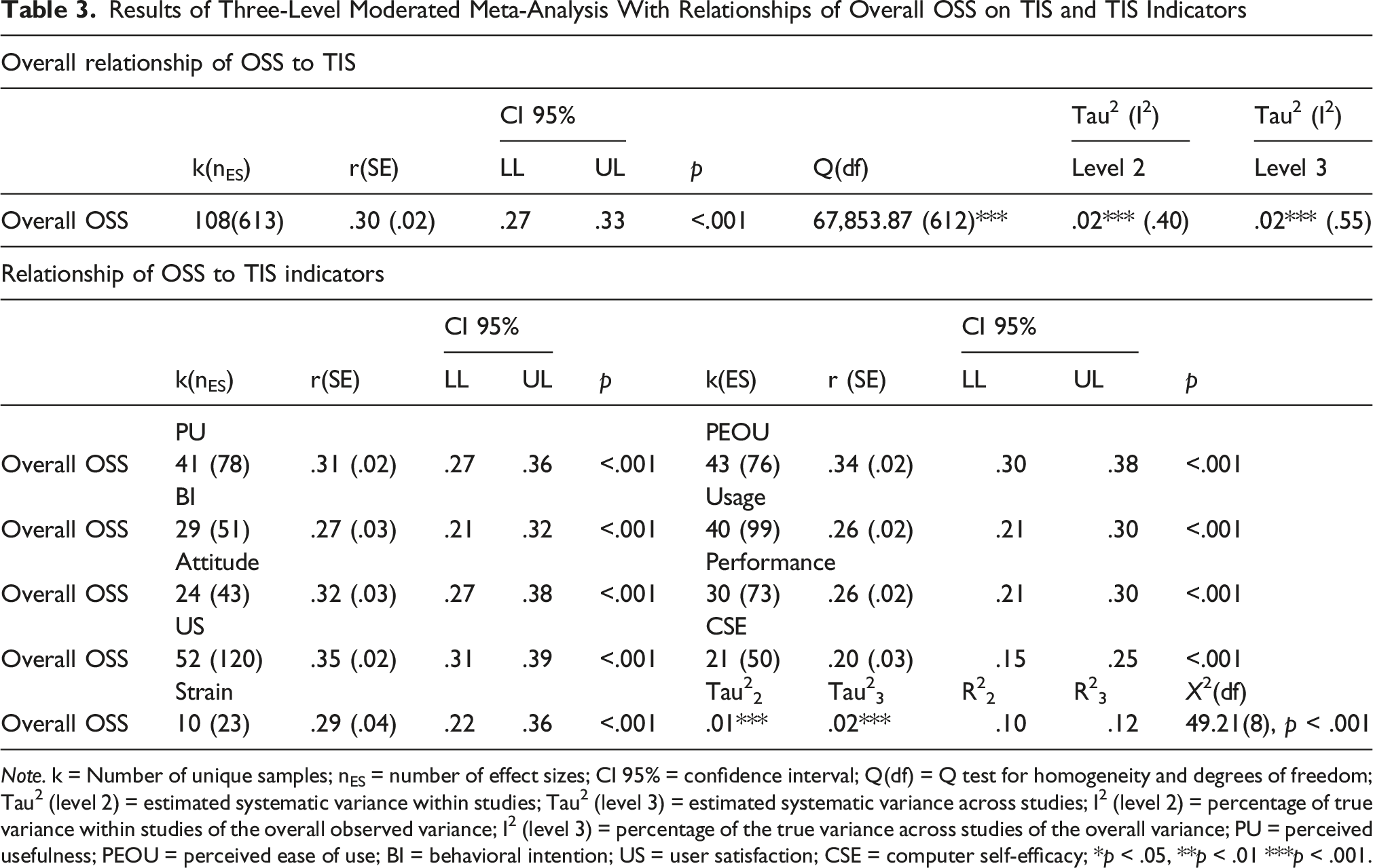
Note. k = Number of unique samples; nES = number of effect sizes; CI 95% = confidence interval; Q(df) = Q test for homogeneity and degrees of freedom; Tau2 (level 2) = estimated systematic variance within studies; Tau2 (level 3) = estimated systematic variance across studies; I2 (level 2) = percentage of true variance within studies of the overall observed variance; I2 (level 3) = percentage of the true variance across studies of the overall variance; PU = perceived usefulness; PEOU = perceived ease of use; BI = behavioral intention; US = user satisfaction; CSE = computer self-efficacy; *p < .05, **p < .01 ***p < .001.
Results showed significant heterogeneity, as indicated by the Q statistic of homogeneity Q(df = 612) = 67,853.87, p < .001. Within-study variance at level 2 accounted for 40% and between-study variance accounts for 55% of the total variance, as indicated by I2, leaving 5% variance not explained by factors at the study or effect size level. Refined analysis of outcome categories is advisable to solve heterogeneity.
We therefore further tested the differential effects of OSS on single TIS measures by testing the outcomes as moderators of the main effect (Cheung, 2015). OSS have almost consecutively medium-sized effects on outcome categories following the interpretation of Bosco et al. (2015). We found the strongest effects of OSS on perceived usefulness (r = .31, p < .001), perceived ease of use (r = .34, p < .001), attitude (r = .32, p < .001), and user satisfaction (r = .35, p < .001). The effect on behavioral intention to use (r = .27, p < .001) could also be interpreted as medium sized. The lowest relationship, yet the only effect deemed large in the benchmark of Bosco et al. (2015), could be found between OSS and performance (r = .26, p < .001) and actual usage (r = .26, p < .001). Computer self-efficacy (r = .20, p < .001) could be interpreted as a medium-sized effect and reduced strain (r = .29, p < .001) as large, following Bosco et al. (2015), and small and medium, respectively, following Cohen (1962). Hypothesis 1 was therefore confirmed: OSS has a significant relationship with TIS. The additionally explained variance through the differentiation of outcomes was small, R2 = .10 on level 2 and R2 = .12 on level 3. Consequently, a further refined analysis of the relationships of different kinds of OSS as assumed in hypothesis 2–4 is advisable.
Three-Level Meta-Analysis of Kinds of Support
Results of Three-Level Moderated Meta-Analysis With Relationships of Kinds of Support to TIS and TIS Indicators
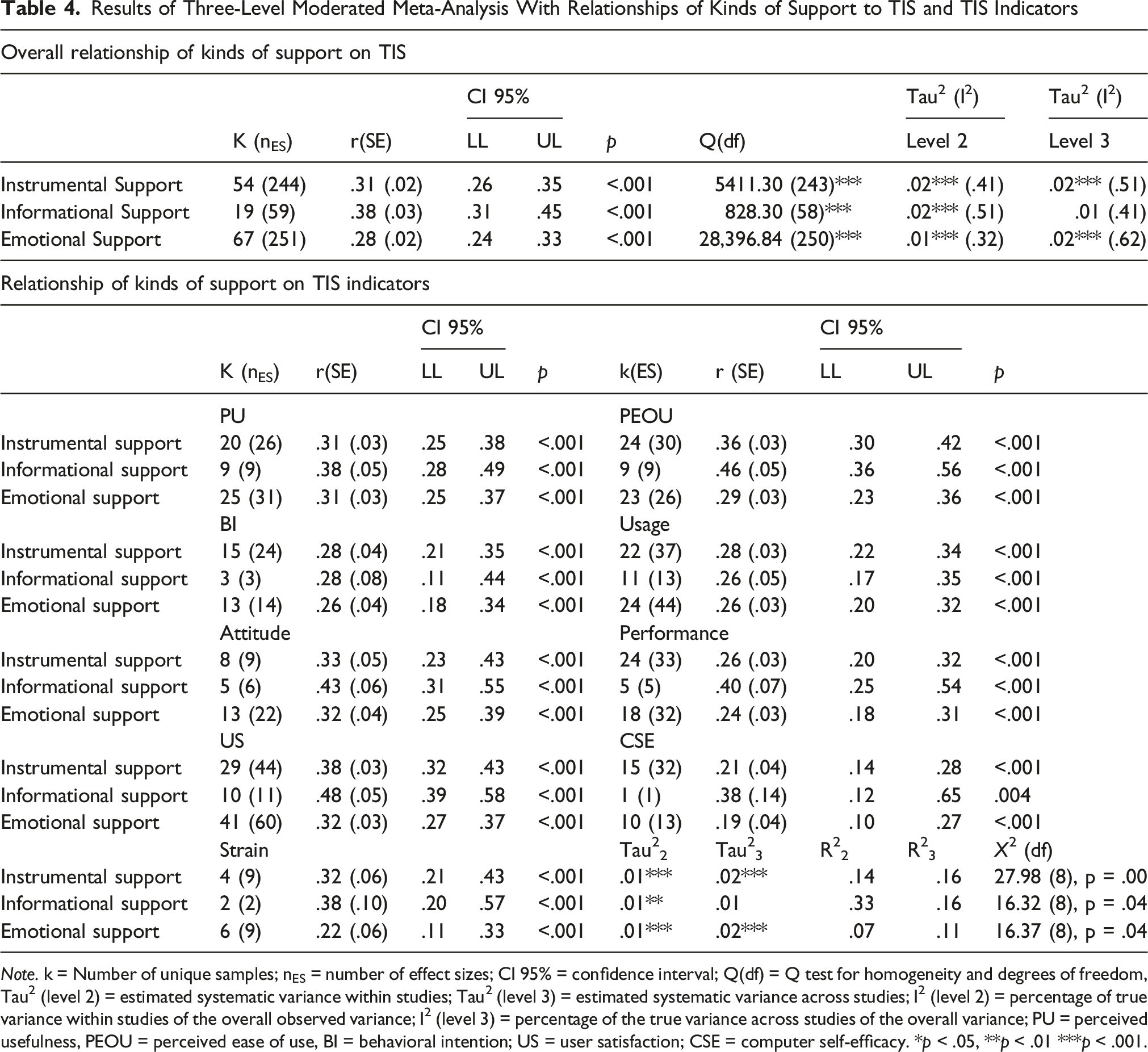
Note. k = Number of unique samples; nES = number of effect sizes; CI 95% = confidence interval; Q(df) = Q test for homogeneity and degrees of freedom, Tau2 (level 2) = estimated systematic variance within studies; Tau2 (level 3) = estimated systematic variance across studies; I2 (level 2) = percentage of true variance within studies of the overall observed variance; I2 (level 3) = percentage of the true variance across studies of the overall variance; PU = perceived usefulness, PEOU = perceived ease of use, BI = behavioral intention; US = user satisfaction; CSE = computer self-efficacy. *p < .05, **p < .01 ***p < .001.
Again, measures of heterogeneity indicated high levels of variation between estimates, as the Q statistics of homogeneity are significant for all three kinds of support. It is worth noting that the Tau2 level 3 values indicating variation between studies are not significant for informational support (τ23 = .01, .07), indicating homogeneity of effect size.
Furthermore, in accordance with hypotheses 2–4, the results suggest that TIS indicators are best predicted by specific OSS. In line with hypothesis 3, informational support strongly relates to the cognitive outcomes perceived ease of use (r = .46, p < .001), attitude (r = .43, p < .001), and computer self-efficacy (r = .38, p < .001). Informational support also has a large relationship with affective outcomes (user satisfaction: r = .48, p < .001). Just as in hypothesis 2, instrumental support showed the largest relationship with behavioral outcomes, for example usage of the new technology (r = .28, p < .001) and content-related outcomes (PEOU: r = .36, p < .001). Again, instrumental support also showed a large effect on affective outcomes (reduced strain: r = .32, p < .001). In accordance with hypothesis 4, emotional support was a strong predictor for affective outcomes (user satisfaction: r = .32, p < .001), but not conclusively, as it was a comparable weak predictor for the other affective outcome reduced strain (r = .22, p < .001). Emotional support was also strongly related to cognitive outcomes, such as attitudes (r = .32, p < .001). Second, the relationship between predictor and outcome varied more for some outcomes than for others. While the analysis of behavioral intention to use and usage showed comparable medium or large effect sizes for all three kinds of support categories, the other seven categories showed large differences between categories. Whereas informational support had a large effect on perceived ease of use (r = .46, p < .001), instrumental and emotional support showed medium-sized effects (r = .29-.36, p < .001). Similar results could be found for perceived usefulness, attitude, user satisfaction, and computer self-efficacy, where informational support proved a large effect, and instrumental and emotional support both medium-sized effects. In conclusion, the relationships of the three support categories with TIS indicators were medium or large in size, but the magnitude of the relationship in accordance to the hypothesis could only be supported in some respects. Informational support proved the strongest predictor of TIS indicators.
For variance explained by outcome categories, χ2 values indicate that there was still significant heterogeneity left—informational support: χ2(df = 8) = 16.32, p = .04; emotional support: χ2(df = 8) = 16.37, p = .04. The explained variance at level 2 varied per support categories between R2 = .33 for informational, R2 = .14 for instrumental, and R2 = .07 for emotional support. At level 3, explained variance ranged less widely (instrumental: R2 = .16, informational: R2 = .16, and emotional: R2 = .11), indicating that outcome categories explained heterogeneity between studies.
TSSEM Analysis of Mediated Relationships
Pooled Correlation Matrix of Primary Studies
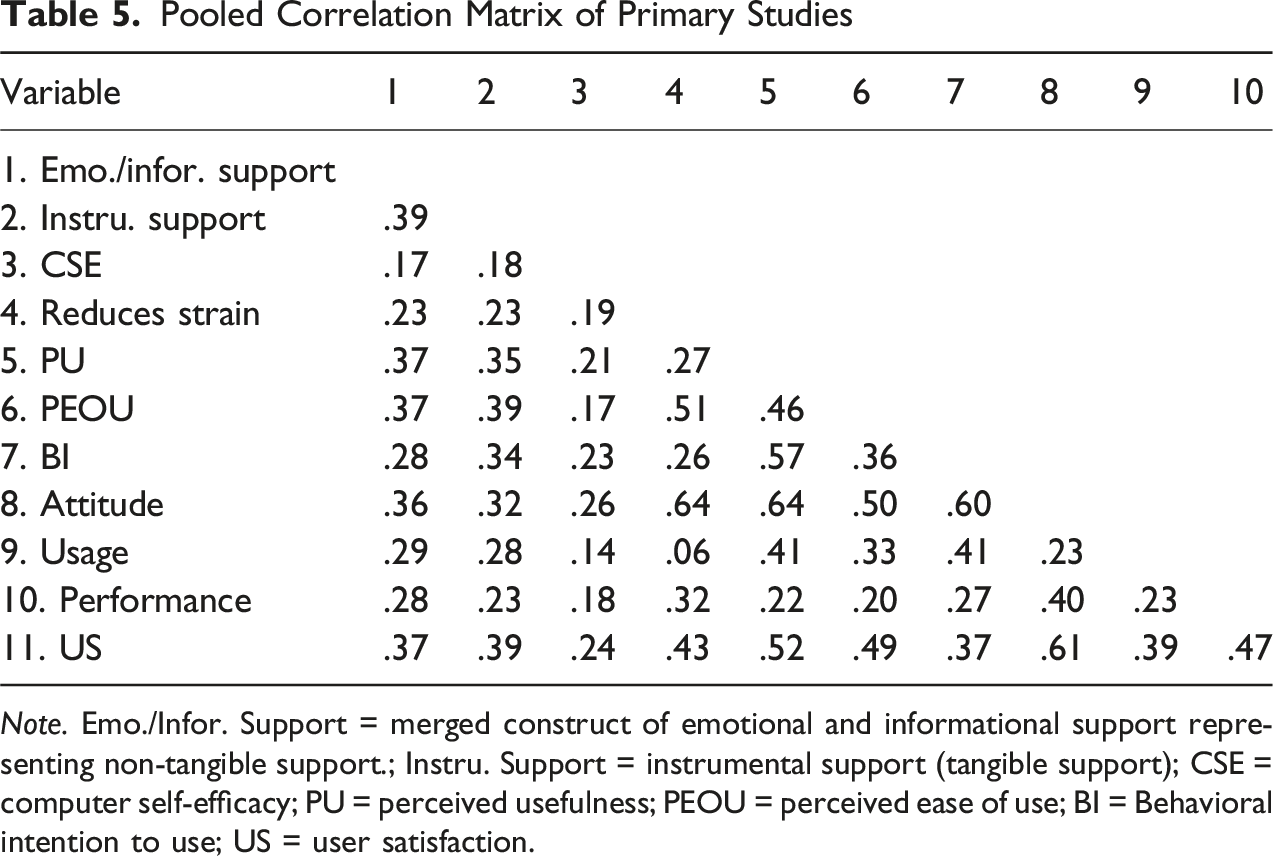
Note. Emo./Infor. Support = merged construct of emotional and informational support representing non-tangible support.; Instru. Support = instrumental support (tangible support); CSE = computer self-efficacy; PU = perceived usefulness; PEOU = perceived ease of use; BI = Behavioral intention to use; US = user satisfaction.
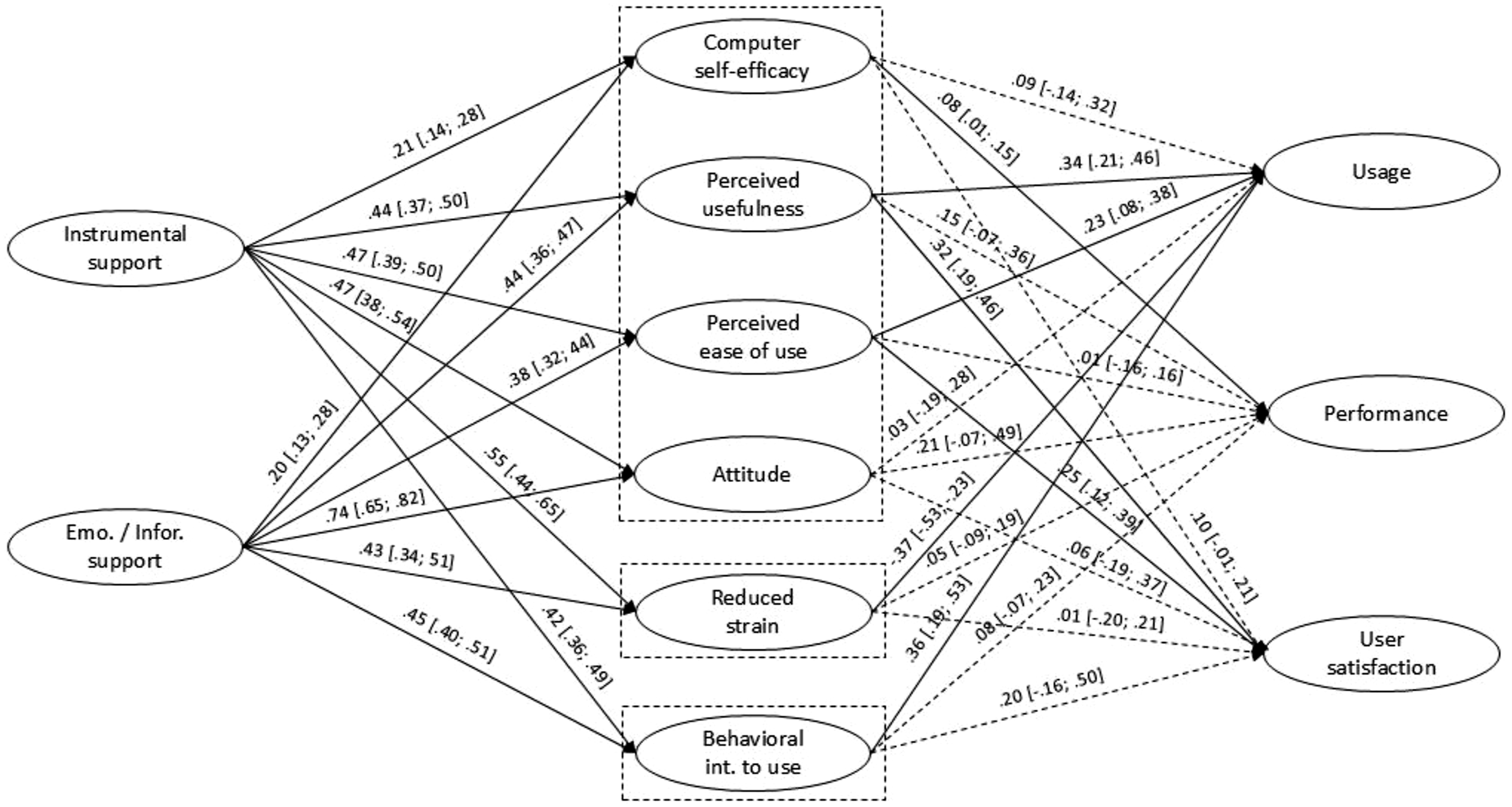
Social Support Model of Technology Implementation Paths Model. Note. Bold Lines Represent Significant Relations. Emo/Infor. Support = Merged Construct of Emotional and Informational Support Representing Non-Tangible Support
Indirect Effects of the TSSEM Analysis
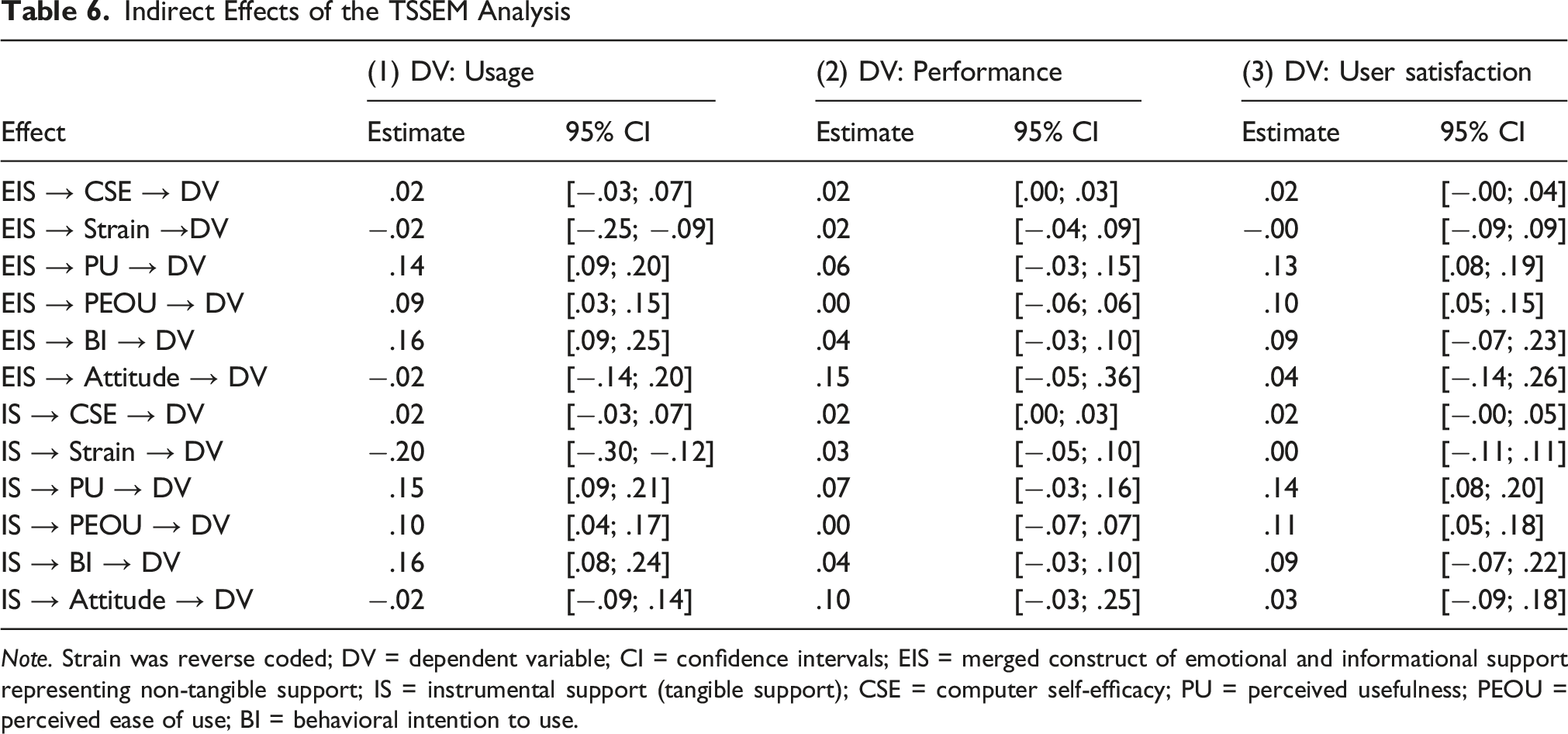
Note. Strain was reverse coded; DV = dependent variable; CI = confidence intervals; EIS = merged construct of emotional and informational support representing non-tangible support; IS = instrumental support (tangible support); CSE = computer self-efficacy; PU = perceived usefulness; PEOU = perceived ease of use; BI = behavioral intention to use.
Testing of Moderation Effects
During the review of primary studies we have coded study information that could serve for exploratory moderator analysis. The moderator kind of technology was significant for the overall relationship of OSS on TIS, indicating that depending on the technology being implemented and its impact on the employee, the relationship varies. The explained variance between studies was R23 = .13. Furthermore, we tested the method moderator type of publication and year, to test for publication bias and methodological and theoretical developments, respectively. We did not find a moderation effect on the overall OSS-TIS relationship. The publication moderator was significant for emotionsl support (R23 = .12) and the year-moderator for informational support (R23 = .39). The comprehensive report on moderator analysis can be found in Appendix E in the Supplemental Materials.
Discussion
The present meta-analysis examined theoretical approaches and synthetized empirical research on social support provided by organizational members during the implementation of new technologies in the workplace. Our goal was to advance a theoretical understanding of OSS, which has so far received limited attention in implementation research. In addition, we reviewed theories related to TIS and empirically tested our holistic social support model of technology implementation success to evaluate relationships. We meta-analytically integrated research by applying three-level meta-analysis and meta-analytic structural equation modeling approaches, thereby testing direct, mediated, and moderator effects of OSS on TIS.
The results indicate that OSS are effective in influencing indicators of technology implementation success, demonstrating a moderate overall relationship. While OSS cannot fully compensate for the shortcomings of poorly designed technologies—system quality remains a major determinant of implementation outcomes (Blut et al., 2016; Legris et al., 2003)—it plays a critical role in fostering a climate of openness and willingness to interact with the new technology. OSS are helping to ensure that a well-designed technology is experienced positively. Furthermore, the differentiated analysis of specific TIS indicators revealed that OSS are successful in influencing usage and performance with a large effect size, and user satisfaction, attitude and perception of the system (perceived ease of use and usefulness) with a moderate effect. Thus, OSS are a key process of change variable (Oreg et al., 2011).
Different kinds of support serve to achieve different goals during the implementation process. Informational support emerged as particularly strong predictor of TIS, demonstrating large effect sizes. Although the importance of information during organizational change is well established (e.g., Allen et al., 2007), the present study is the first to synthesize the meta-analytic effect of informational support specifically in the context of technology implementation. Instrumental and emotional support also showed large relationships with TIS. The magnitude of these effect sizes are comparable to those reported in related meta-analyses on single kinds of OSS (Sabherwal et al., 2006; Sharma & Yetton, 2003, 2007), but smaller than the effect sizes of earlier meta-analyses (Mahmood et al., 2000, 2001), and smaller (except informational support which was larger) than those reported for general human resources practices (Paterson et al., 2016). Notably, the different kinds of support were differently associated with specific implementation outcomes; for example, emotional support was most strongly related to user satisfaction and attitude; instrumental support to usage and ease of use; and informational support to ease of use, attitude, and user satisfaction. These findings suggest that different kinds of OSS address different needs and interests of employees throughout the implementation process.
The structural model successfully explains the mechanisms of the relationships of kinds of support to TIS indicators, underscoring that using, liking, and performing well with a technology involve distinct psychological processes. The relationship between OSS and usage was mediated by perceived ease of use, perceived usefulness, reduced strain, and behavioral intention to use. OSS influenced user satisfaction through perceived ease of use, perceived usefulness, and behavioral intention to use. In contrast, the relationship between OSS and performance was mediated solely by computer self-efficacy. Notably, the effect of computer self-efficacy was rather small compared to other mediators. One potential explanation is that, in most study contexts, use of the new technology was mandatory, reducing the relevance of self-efficacy for actual use and performance.
Due to substantial multicollinearity between emotional and informative support, these two kinds of support were integrated into one common factor. The two social support factors that resulted for TSSEM represent a distinction between tangible (instrumental support) and nontangible (emotional and informational support) kinds of support, consistent with earlier conceptualizations (Viswesvaran et al., 1999) that the high intercorrelation between emotional and informative support may reflect their shared underlying meaning—both can be interpreted as expressions of care, appraisal, and guidance often provided by the same source (e.g., Semmer et al., 2008).
Theoretical Implications and Future Research Directions
This meta-analysis contributes to the research of OSS and TIS by drawing on theoretical perspectives from information sciences, economics and psychology to map the current state of knowledge in the field. By identifying theoretical linkages and positioning these frameworks in relation to each other, we offer a pathway toward closing the theoretical gap concerning how OSS relate to TIS. Social support proved valuable in explaining the nature and mechanisms of OSS, and our finding contribute to this theory by operationalizing support categories as concrete support interventions—thereby enhancing construct clarity. With respect to technology acceptance theories, findings demonstrate that social support variables are worthwhile evaluating to increase technology acceptance. Finally, the results point to a range of promising directions for future research.
The observed heterogeneity in effect sizes suggests that not all mediating or moderating mechanisms linking OSS to TIS have yet been identified (e.g., Eisenberger et al., 2020). A promising direction for future research lies in examining the psychological states of employees that are activated in response to receiving OSS. The application of motivational frameworks such as self-determination theory (Deci et al., 2017; Jolly et al., 2021; Mitchell et al., 2012) may help empirically determine the underlying mechanisms though which OSS exert their effects. Moreover, existing research on OSS has largely assumed that support is uniformly beneficial across recipients, overlooking the possibility that employees differ in how they perceive and respond to support. Individual differences—such as openness to change (Devos et al., 2007), prior experience with organizational change (Cullen-Lester et al., 2019; Rafferty & Restubog, 2017), or familiarity with technical systems (Aiman-Smith & Green, 2002)—may moderate the effectiveness of OSS and should be systematically examined in future studies.
The conceptualization of OSS as a resource remains theoretically underdeveloped. In most primary studies, OSS is implicitly treated as uniformly beneficial for TIS, aligning with resource-based frameworks (Bakker & Demerouti, 2017; Hobfoll et al., 2018) that posit any gain in resources helps to buffer strain. However, two critical questions remain unresolved. First, are OSS always perceived as beneficial across contexts? A growing body of research points to a dark side to social support, particularly when it is unsolicited or perceived as intrusive (e.g., Gray et al., 2019). Such findings challenge the assumption of OSS as an unconditionally positive resource and underscore the importance of the receiver’s subjective experience. Second, do OSS need to be continuously available, or can it be mobilized reactively in response to emerging stressors such as technology implementation? Prior research suggests that the timing of support may matter. Viswesvaran et al. (1999) found that pre-existing support networks were more effective in mitigating strain than support activated only after the stressor emerged. This distinction raises important questions about whether organizations can rely on spontaneously initiated OSS during change episodes, or whether ongoing, proactive support structures are necessary to ensure effectiveness. Future research should explore the temporal dynamics of OSS availability and its implications for employee adjustment and technology-related outcomes.
Social support theory (House, 1981) has proven to be resourceful for conceptualizing OSS beyond a generic notion of “overall support”. The current findings underscore that different kinds of support exhibit distinct relationships with TIS, with each kind most strongly affecting a different TIS indicator. However, our statistical analysis also revealed theoretical limitations that future research needs to address. As this meta-analysis confirms, and previous research and reviews have noted (Jolly et al., 2021; Semmer et al., 2008), acts of support often overlap in meaning and may simultaneously reflect multiple kinds of support. As a result, theoretically distinct categories do not always emerge as empirically separable constructs. This points to a lack of conceptual and operational clarity in how kinds of support are defined and measured. Future research should examine the boundaries and overlaps between kinds of support to either sharpen exiting definitions, or develop revised classification systems based on more discriminative criteria—such as quality of exchange relationships (Matusik et al., 2022), or supportive behaviors. A more precise conceptualization would then allow for the development of measurement instruments that can distinguish kinds of support as factor-analytically, thus enabling a more rigorous empirical test of their unique effects.
Technological change should be understood in the broader context of work design. While some organizations treat technology implementation primarily as the introduction of new technology features, others embed it within more comprehensive restructuring of job design, work units, or organizational processes (Grüner, 2009; Wang et al., 2020). In the latter case, the primary stressor may not be the technology per se, but rather the disruption of established work routines (Caldwell et al., 2004). Research has increasingly sought to specify the characteristics of change in order to better predict change outcomes. For instance, Rafferty and Griffin (2006) conceptualized change along the dimensions of frequency, impact, and level of planning, and Day et al. (2012) identified technology- and job-related dimensions that constitute demands or support to employees. Future research could investigate how changes in work design (Parker & Grote, 2020) function as demands and how these demands shape the amount and kind of support required by change recipients to ensure TIS.
Practical Implications
The social support model of technology implementation offers organizations evidence-based recommendations for designing effective change processes. First, the model highlights the importance of a balanced combination of instrumental, informational, and emotional OSS during technology implementation. It also identifies which specific indicators of TIS should be considered throughout the change process. Second, the model elucidates how the factors within the model are interrelated, for example, by identifying particularly strong relationships between specific kinds of support and TIS outcomes. Third, the model provides effect size estimates that allow organizations to gauge the relative impact of the different OSS on various TIS. This knowledge enables decision-makers to allocate support resources more strategically and tailor interventions to the needs of their specific implementation context.
To implement OSS effectively, organizations should begin with a thorough organizational diagnosis to identify which specific indicators of TIS require the most attention (McFillen et al., 2013). In some contexts, prospective users may perceive the new technology as difficult to use; in others, resistance to change or elevated strain levels may dominate employee responses. Based on our findings, each of these scenarios calls for a distinct support strategy. Tailoring OSS interventions to the specific needs of employees not only increases the likelihood of successful implementation but also promotes more efficient use of organizational resources.
Limitations
The current meta-analysis was not without limitations. First, methodological inconsistencies across primary studies raise concerns about construct measurement. Many studies used different instruments based on varying definitions of key constructs, or adapted (and factor-analytically tested) existing instruments to their specific context. This raises the risk of comparing conceptually divergent measures under a common label—what Sharpe (1997) referred to as “apple and pears” problem—which may have contributed to the observed heterogeneity in effect sizes.
Second, the theoretical foundation of social support theory presents definitory ambiguities that remain unresolved. As House (1981) already noted, the boundaries between different kinds of support (e.g., emotional vs. informational) are often vague, and many supportive ACTS simultaneously fulfill multiple functions. This conceptual overlap complicates the categorization of OSS, which are not theory-driven constructs but rather practice-oriented interventions developed to address specific challenges in implementation contexts. While social support theory provides a valuable lens for interpreting OSS effects, the interventions themselves rarely represent pure instantiations of a single support category. For example, a training intervention may primarily offer instrumental support but also convey informational content and emotional reassurance. Moreover, some OSS measurement instruments capture multiple support dimensions within a single scale. For instance, a minority of management support scales have included an item of appraisal support (e.g., feedback, coaching), next to items on emotional support, leading to conceptual and statistical overlap. This lack of differentiation may explain the multicollinearity observed in the TSSEM model, particularly between emotional and informational support. To enhance construct clarity and reduce theoretical and empirical ambiguity, future research should develop new, theory-informed questionnaires or objective measures that more precisely capture the distinct dimensions of OSS and social support (see also: Jolly et al., 2021).
Third, some relationships within the proposed model have received disproportionately greater empirical attention than others. Constructs from Technology Acceptance Model (Davis et al., 1989) have been among the most frequently investigated outcomes, and among OSS, instrumental support has been studied more often than informational support. This imbalance affects the robustness of the meta-analytic estimates: the greater the number of available effect sizes, the more precise and reliable the resulting estimates. Consequently, underexplored relationships represent valuable avenues for future research.
Finally, future research should address methodological limitations common to the primary studies included in this meta-analysis. Most of these studies employes cross-sectional, correlational designs with data collected from the same source, raising concerns about common method bias and limiting causal inference (Podsakoff et al., 2003). To strengthen the evidence based on OSS and their impact on TIS, future research should adopt more rigorous designs, such as longitudinal and experimental studies with control groups, and incorporate objective outcome measures where feasible.
Conclusion
When implementing new technologies, organizations have a wide range of options to support employees through OSS. The present meta-analysis demonstrates that they are effective in promoting key indicators of TIS. As such, technological change need not be associated with high failure rates—provided organizations integrate targeted OSS in their change process. This meta-analysis offers practitioners evidence-based guidance to align their implementation strategies with clearly defined support mechanisms and intended outcomes. At the same time, it establishes the social support model of technology implementation as a theoretically grounded, interdisciplinary framework for future research. By synthesizing insights from psychology, information sciences, and management studies, the model provides conceptual structure and highlights promising avenues for advancing the understanding of technological change yet to be explored.
Supplemental Material
Supplemental Material - Social Support for the Successful Implementation of Technologies in the Workplace: An Examination of Theories and Meta-Analysis of Research
Supplemental Material for Social Support for the Successful Implementation of Technologies in the Workplace: An Examination of Theories and Meta-Analysis of Research by Katharina D. Schlicher, Günter W. Maier in Group & Organization Management
Footnotes
Author’s Note
Preliminary results of this meta-analysis were presented at the EAWOP Small Group Meeting “Organizational frame conditions and their meaning for change recipients: Discussing specific challenges for affected employees and the various roles leaders have to cover in organizational change.” in Dortmund, Germany, Sept. 11–18, 2018, and the AOW (Arbeits-, Organisations- und Wirtschaftspsychologie) congress of the DGPs (German Society of Psychology) in Braunschweig, Germany, Sept. 25-27, 2019. This manuscript has been proofread by Proof-Reading-Service.com Ltd.

Funding
The authors received no financial support for the research, authorship, and/or publication of this article.
Declaration of Conflicting Interests
The authors declared no potential conflicts of interest with respect to the research, authorship, and/or publication of this article.
Data Availability Statement
Supplemental Material
Supplemental material for this article is available online.
Author Biographies
References
Supplementary Material
Please find the following supplemental material available below.
For Open Access articles published under a Creative Commons License, all supplemental material carries the same license as the article it is associated with.
For non-Open Access articles published, all supplemental material carries a non-exclusive license, and permission requests for re-use of supplemental material or any part of supplemental material shall be sent directly to the copyright owner as specified in the copyright notice associated with the article.
