



Abstract
In response to the global COVID-19 pandemic, many businesses closed their offices and asked their employees to work from home. The transition to remote work has yielded performance gains for many companies; so much so that many firms are planning to continue to use remote work after the pandemic subsides. Nevertheless, such benefits may not be distributed equally throughout the workforce. Drawing on the sociocognitive theory of socioeconomic status (SES), we predict that one’s home working environment features salient signals of their social status that affect their performance. Based on a sample of 304 remote workers from within the United States collected during the COVID-19 shutdown, we find that individuals whose home offices connote higher levels of SES report a greater sense of control over their environment, which ultimately is associated with higher levels of perceived job performance. Furthermore, we find that the more time an individual spends in their home office, the stronger the relationship between their environment-based SES and their personal sense of control. Taken as a whole, our findings suggest that because home working environments are arrayed along an SES gradient, they present another mechanism by which pre-existing inequalities may be made salient as a result of the COVID-19 pandemic.
The global COVID-19 pandemic has caused organizations and employees around the world to rethink how they work. In particular, at the height of the pandemic, nearly 70% of full-time office workers left their desks and cubicles behind and performed their jobs from home (Owl Labs & Global Workplace Analytics, 2021; Thompson, 2020). Although this change may have been a temporary response to ensure workers’ safety and comply with government mandates, many businesses are realizing substantial performance gains, with some reporting an average increase of 47% in productivity (Westfall, 2020). Such findings are consistent with past research documenting the benefits of telework (Gajendran & Harrison, 2007; Wörtler, Van Yperen, & Barelds, 2021). Because of these benefits, many organizations are planning on making this arrangement the new norm, as 30% of all workplaces are reportedly moving to permanent remote work (Akala, 2020; Bond, 2020). Importantly, organizations may not have fully considered—nor might they entirely be aware of—the implications of this workforce change.
While organizations are witnessing productivity increases due to teleworking, not all of their workers may experience the potential performance benefits of remote work. Instead, a significant portion of employees may be left behind. In particular, when viewed through the lens of the sociocognitive theory of socioeconomic status (SES) (Kraus, Piff, Mendoza-Denton, Rheinschmidt, & Keltner, 2012), a person’s home working environment may have consequential effects on how he or she thinks, feels, and acts, and these effects likely vary depending upon his or her SES. That is, not everyone has the means to outfit a designated and fully resourced home office, and this disparity becomes even more pertinent when employees are increasingly required to work from home. Although employees’ physical working spaces hold key information about their SES and can profoundly affect their cognitions, emotions, and behavior, this area of research is largely underexamined.
In view of the COVID-19 pandemic and the related surge in teleworking, the consequences of employees’ SES and their home work environments require further understanding. In this study, we seek to extend the existing literature on employees’ SES by exploring the idea that physical spaces are proximal markers of SES that can influence work outcomes beyond other, more well-studied SES factors. Socioeconomic status is typically defined as one’s objective material resources (e.g., income and education) as well as his or her subjective interpretation of these resources (Côté, 2011; Loignon & Woehr, 2018). We posit that people’s homes feature an omnipresent array of markers of one’s SES (e.g., furnishings, decorations, and physical space) (Bourdieu, 1984; Dittmar, 1992) and that working in these home environments may serve as an additional factor by which differences in an individual’s attitudes and work behaviors are affected (cf., Elsbach & Pratt, 2007). We expect that, compared to low SES workers, high SES employees perceive more positive attitudes and work-related behaviors as a result of working in their resourceful home work environments. More specifically, we test the idea that rather than perceiving high levels of constraints due to working from home for an extended period of time, individuals who have the privilege to work in home environments that connote high SES come to feel a greater sense of personal control. At the same time, we expect the opposite to be true for those working in more impoverished home environments, which will ultimately impact their self-reported job performance (Ng, Sorensen, & Eby, 2006; Spector, 1982).
By examining the SES-based effects of one’s home environment (see Figure 1 for our conceptual model), we make three contributions to the existing literature as well expose important, yet potentially unintended, consequences of the rapid shift to remote work in response to the COVID-19 pandemic. First, when viewed through the lens of recent SES-focused theories and prior work examining the environment’s effect on workers' identities (Elsbach & Pratt, 2007), an organization’s office can be seen as a great equalizer. Specifically, businesses and companies often subsume the cost of furnishing and decorating their workplaces. Thus, when employees enter these environments, the range of SES-based environmental signals is constrained and more equally distributed throughout the workforce. However, as employees increasingly work from home, the sociocognitive effects of their SES are driven more by their personal possessions and surroundings, which are likely far more stratified (e.g., Darley & Gross, 1983; Dittmar, 1992, 1994). This points to hidden costs that may arise when remote work is adopted for large segments of the workforce. Conceptual model.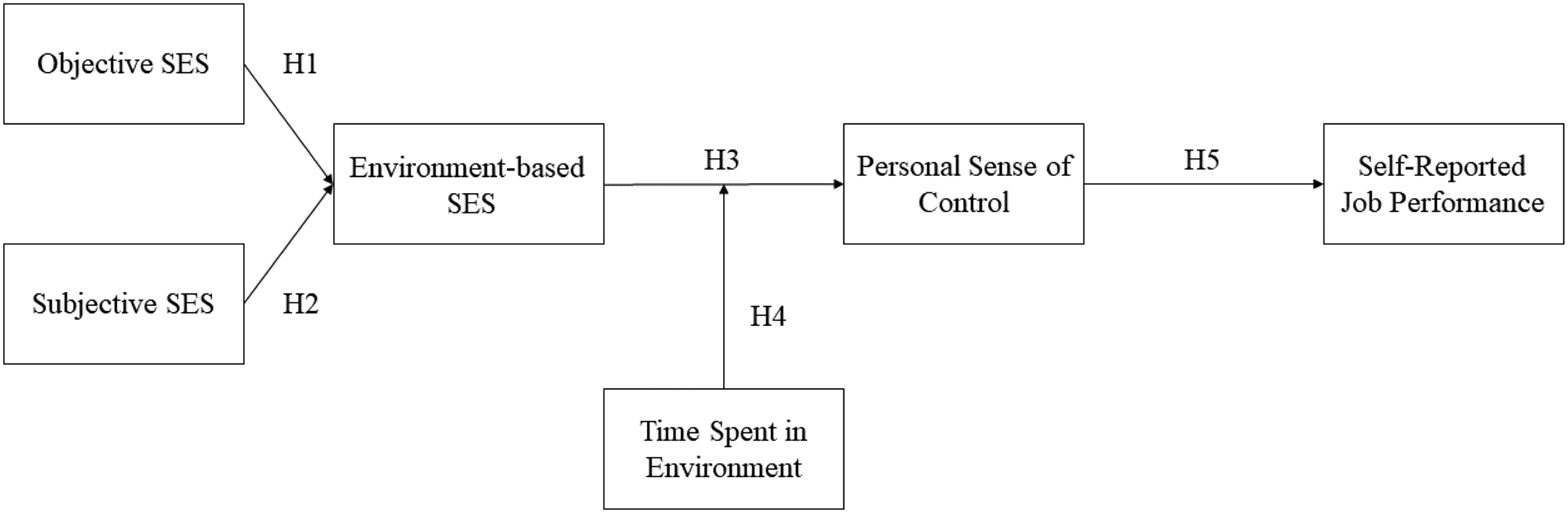
Second, because SES affects key psychological variables that influence workers’ job performance (i.e., individuals’ personal sense of control), the performance and productivity gains that are being touted as a benefit of the rapid and widespread shift to telework may predominantly emerge among higher SES workers whose resourceful home environments are most conducive to performing better. Thus, by further benefitting those workers who already occupy a position of socioeconomic privilege, the move to remote work may represent a subtle mechanism that further perpetuates pre-existing inequalities.
Third, our study extends the burgeoning literature that examines social class and SES in the workplace (Côté, 2011; Leana & Meuris, 2015; Loignon & Woehr, 2018), by examining environment-based SES. Prior research has demonstrated that SES, when viewed as a characteristic of an individual, has important consequences for a range of organizational phenomena (e.g., Kish-Gephart & Campbell, 2015; Martin, Côté, & Woodruff, 2016; and Pitesa, Thau, & Pillutla, 2017). We suggest that people’s home working environments are proximal markers of where they lie along the SES gradient. As such, these environments connote greater or lesser resources. We argue and show that employees’ home working environments can have significant, non-ignorable consequences for their psychology and work behaviors. Consequently, we help raise awareness of the potentially inadvertent consequences of organizations’ sudden, dramatic, and persistent shift to home working environments.
Theory and Hypothesis Development
Environment-Based SES as a Proximal Marker of Subjective and Objective SES
Socioeconomic status is largely thought to consist of two dimensions. Objective SES represents the resources that a person possesses (which are often captured with measures of income, wealth, and education), while subjective SES corresponds to their interpretation of those resources (Côté, 2011; Loignon & Woehr, 2018). Relatedly, people’s environment-based SES reflects the cumulative status-based effects of the material possessions present in their personal, physical environment (Darley & Gross, 1983; Dittmar, 1992, 1994). Based on prior work examining the psychological effects of physical environments (Elsbach & Pratt, 2007; Gosling, Ko, Mannarelli, & Morris, 2002), we conceptualize one’s environment-based SES as a proximal marker of their SES. That is, we contend that individuals craft their home working environments in ways that reflect and reinforce their objective and subjective SES. As part of this process, individuals will express their level of SES by adorning the physical spaces with symbols, artifacts, and items that not only reflect their own status but also serve to reinforce how they view their SES (Elsbach, 2004; Gosling et al., 2002). Such cues may be as simple as the amount or quality of furniture and decorations one can devote to a dedicated workspace within their home. We also expect that home working environments are places where individuals spend a great deal of time and repeatedly perform various behaviors. These behaviors likely leave discernible residues that reflect their level of SES. In fact, these personal working environments may even capture behaviors that are performed outside of the immediate surroundings (Gosling et al., 2002). For instance, the hobbies or leisure activities that one pursues are readily stratified along an SES gradient (e.g., boxing vs. sailing and listening to country music vs. jazz) (Bourdieu, 1984; Rivera, 2012; Stephens, Markus, & Townsend, 2007). To the extent that these activities are then represented in one’s home working environment, they also serve as proximal markers of their subjective and objective SES. Given these considerations, we hypothesize that:
Hypothesis 1: Subjective SES is positively related to environment-based SES.
Hypothesis 2: Objective SES is positively related to environment-based SES.
Environment-Based SES and Personal Sense of Control
In the response to the Great Recession and in response to rising levels of economic inequality, scholars have increasingly recognized the organizational relevance of individuals’ SES (Banks et al., 2016; Bapuji, Patel, Ertug, & Allen, 2020). Rather than simply treating SES as a control variable, there is a growing body of evidence to suggest that this construct systematically alters how people think, feel, and act within organizations (Côté, 2011; Leana & Meuris, 2015; Loignon & Woehr, 2018). One of the most well-supported frameworks for organizing this rapidly evolving literature is the sociocognitive theory of SES. Within this theory, individuals with higher SES experience self-sufficiency on a daily basis (Kraus et al., 2012). For instance, individuals with higher SES can afford more reliable transportation (e.g., a personal vehicle), which provides more freedom in determining their daily schedule (Dargay, 2001). Likewise, greater SES affords more flexibility in meeting basic needs, like healthcare and securing nutritious foods (Link & Phelan, 1995). Even the immediate safety of one’s environment (e.g., exposure to crime and violence) is arrayed along an SES gradient such that higher SES individuals can more safely move about their neighborhoods (Wen, Hawkley, & Cacioppo, 2006). These experiences exist in stark contrast to someone in a position of lower SES. Lower SES individuals, for example, are more likely to rely on public transportation, have less access to healthcare, and be at greater risk for experiencing violence. Thus, their daily decisions are often more limited compared to people who occupy positions of higher SES (Kraus et al., 2012).
Ultimately, these experiences of self-sufficiency versus perceived constraint are thought to culminate in differences in an individual’s personal sense of control, or the extent to which individuals feel elevated freedom and influence over their lives (Kraus et al., 2012). In fact, multiple studies using convenience samples, laboratory manipulations, and nationally representative samples of adults have found positive relationships between SES and people’s personal sense of control (Barling & Weatherhead, 2016; Gadalla, 2009; W. Johnson & Krueger, 2006; Kraus, Piff, & Keltner, 2009; Lachman & Weaver, 1998; Schieman, Nguyen, & Elliott, 2003). These effects emerge whether SES is captured based on an individual’s objective resources or their subjective interpretation of these resources (Kraus et al., 2009).
As a proximal marker of one’s SES, we expect that people’s environment-based SES relates to the degree to which they believe they can influence their lives, above and beyond their objective and subjective SES. For example, if individuals have a well-equipped, dedicated work space at home, it provides freedom in determining when they can work. In contrast, if employees’ workspaces are a shared space, they are likely limited on when and how they can work, reinforcing perceived constraints. Indeed, other aspects of one’s environment, like lighting, furniture, and decorations, may also reinforce perceived freedom in how to organize their work and non-work time as well. That is, offices with good lighting, high-quality furniture, and tasteful decorations allow an individual to feel more comfortable working longer and harder, permitting them more perceived control over their work and non-work lives. Unlike specific forms of objective SES (e.g., income and education), we presume that the effects of environment-based SES cues are holistic in nature and are derived from the entire array of the characteristics (e.g., space and lighting) and possessions in people’s personal space that they occupy while working from home (Dittmar, 1994). Thus, environment-based SES, although a reflection of the individual, is thought to function independently of that individual and is thus a property of their physical environment (i.e., in this case, home office) (Elsbach, 2004).
Interestingly, as workplaces and remote offices were shuttered in response to the COVID-19 pandemic (Thompson, 2020) and workers increasingly perform their duties from home (Kniffin et al., 2020; Westfall, 2020), the effect of the SES of an employee’s home office or working environment takes on greater precedence. That is, rather than being influenced by the artifacts in their workplace, employees are increasingly exposed to whatever objects they have adorned their home workspace with. For many workers, the quality and prestige of the personal furnishings and artifacts may not correspond to what their company can afford. Instead, it is their personal income, wealth, and education, as well as how they view their own SES, that are likely to be more influential in determining what objects they are surrounded by in their homes (Côté, 2011; Loignon & Woehr, 2018). Because the United States, like many Western societies, is experiencing growing levels of socioeconomic inequality (Piketty, 2014), the shift from organizationally funded working environments (i.e., offices) to personal workspaces (i.e., home offices) will likely exhibit greater levels of stratification.
Although we are unaware of any studies that have directly examined the psychological effects of one’s personal SES-based environment, prior work is suggestive of such effects. First, public health researchers regularly aggregate objective indicators of SES to the neighborhood or zip code level (Krieger, Williams, & Moss, 1997). For instance, recent work highlights the distinct effect that these aggregate indicators (e.g., median home values in a neighborhood) can have on individual-level health outcomes (Krieger et al., 2002). Likewise, people regularly benchmark their own subjective SES to that of their communities (Goodman et al., 2001). Thus, at a macro level (i.e., neighborhoods), the environmental effects of SES appear to be relevant for individual outcomes and are distinct from traditional measures of subjective and objective SES. Second, public spaces at elite academic institutions are often seen as primarily the domain of higher-SES students and lower-SES students may be less likely to use such areas (Trawalter, Hoffman, & Palmer, 2020). Thus, these spaces appear to exhibit SES-based signals that are more welcoming to some individuals, in accordance with their personal socioeconomic background, and less inviting for others. Third, at a level more proximal to that of home offices or working environments, a recent study found that the odds of “air rage” on airplanes, defined as extreme antisocial behavior reported during commercial airline flights, increase with environment-based SES (i.e., the presence vs. absence of a first-class cabin or boarding the plane at the front of the aircraft where the first-class cabin is located) (DeCelles & Norton, 2016). Thus, being confined to spaces with clear, SES-based signals seems to shift people’s attitudes and behavior in meaningful ways. Taken as a whole, these findings lead us to hypothesize:
Hypothesis 3: Environment-based SES is positively related to one’s personal sense of control.
A key feature of environmental artifacts is that they are often considered to be relatively permanent (Elsbach, 2004). As an individual spends more time in their home office or working environment, the artifacts that they choose to—or are able to—display are likely repeatedly viewed and experienced, which reinforces their effects on an individual’s identity over time (Elsbach & Pratt, 2007). Prior research has referred to this phenomenon as behavioral residues, or the physical traces of activities conducted in a given environment (Gosling et al., 2002). As these residues accumulate from greater and greater interaction with a specific environment, their psychological effects should become increasingly pronounced. This suggests that being repeatedly exposed to the SES-based element of home offices or working environments may make their psychological effects even more pronounced. Stated differently, the SES of a home office is only relevant if a person works in that office. Thus, we hypothesize that:
Hypothesis 4: The positive relationship between environment-based SES and personal sense of control is stronger for individuals who spend more time in their personal working environment.
Personal Sense of Control and Self-Reported Job Performance
The effects of environment-based SES on people’s sense of control are not without consequences. We expect that an individual’s personal sense of control will serve as a key mediating factor between their environment-based SES and self-reported job performance. Prior meta-analytic reviews have found that individuals with higher levels of a personal sense of control expressed greater instrumentality beliefs (i.e., saw stronger connections between their efforts and work outcomes; r = .23), were more involved in their job (r = .22), and were more focused on problem-oriented coping mechanisms (r = .16) (Ng et al., 2006). All else being equal, each of these factors should facilitate greater self-reported job performance. In fact, a greater sense of personal control has been found to be associated with higher levels of job performance (r = .15 to .24) (Judge & Bono, 2001; Ng et al., 2006). Based on these findings, we hypothesize that:
Hypothesis 5: Personal sense of control is positively related to self-reported job performance.
Moderated Mediation: The Effect of Time
Taken as a whole, our preceding arguments can be summarized via a moderated mediation model. Specifically, we expect that the SES of individuals’ home offices or working environments will affect their self-reported job performance by altering an essential psychological factor: their personal sense of control (Kraus et al., 2012). Furthermore, we anticipate that this relationship is affected by the amount of time people spend in their home working environment, such that the more interactions they have within this space and with the various artifacts they have acquired and selected, then the stronger the effects of their environment-based SES on their personal sense of control (Elsbach & Pratt, 2007; Gosling et al., 2002). Thus, we hypothesize:
Hypothesis 6: The indirect effect of environment-based SES on self-reported job performance via one’s personal sense of control is moderated by the time spent in their office, such that moderated mediation will occur among those who spend more time in their home offices or working environments.
Methods
Participants and Procedure
Because we were interested in the effects of working from home due to the COVID-19 pandemic, survey data was collected from a national sample of U.S. working adults (n = 304) after the start of the COVID-19 crisis and during the height of the workplace shutdowns in April, 2020 in the United States. 1 We recruited participants from a general population panel maintained by the market research firm ROI Rocket, Inc. This panel is cultivated and managed with the goal of representing the U.S. population. Given our interest in the effects of home office or working environments, individuals were invited to participate if they were currently working at least part-time (20 hr per week) and were working remotely in some type of home work environment, which we defined as “a designated space where you complete your work and that you are using on a regular basis.”
Eligible participants completed two surveys. The first survey described the task of taking and uploading photos of their current home office space. Specifically, participants were asked to (1) submit four photos: one of each wall of their home office or working environment, (2) provide photos that capture any furniture in their home office, (3) provide photos in color, (4) provide photos of at least a 1024 × 683 pixel resolution, (5) take their photos in a landscape format, (6) take photos during the day, open the blinds, and turn on any lights, (7) provide photos that captured personal keepsakes, features, or furniture, (8) not to include themselves in the photos, (9) not to modify their working space before taking the photos, and (10) to include a handwritten note with the date written numerically (MM/DD/YY) to ensure the photos were authentic. The survey also presented a sample photo that met these specifications. To proceed with the study, respondents had to acknowledge that they understood and were able to comply with these directions. This first survey also included items assessing the respondents' objective and subjective social class, their demographic information, and a baseline measure of self-reported job performance. The second survey, which was completed, on average, 5.5 days later (SD = 4.7 days), provided a brief reminder about the specifications for the photos and asked respondents to upload their four photos. 2 This survey also asked respondents to answer questions which measured other focal variables in our model as well as control variables.
Measures
Environment-based SES
Two coders reviewed the sets of photos submitted by the respondents to ascertain the SES of their home office or working environment. Specifically, after reviewing each participant’s set of photos, the coders indicated whether the participant is “high class or rich” (1 = high class/rich and 0 = not high class/rich). This item has been used in prior studies examining how social class and SES can be signaled via speech patterns and facial expressions (Bjornsdottir & Rule, 2017; Kraus, Torrez, Park, & Ghayebi, 2019). Across the 304 sets of photos, the percentage of inter-rater agreement was .72, which far exceeds chance agreement. This level of inter-rater agreement is also comparable to the coders’ ratings of the participants’ ethnicity (.80), gender (.72), and age (.64). Given these levels of inter-rater agreement, we proceeded by averaging the two coders’ SES ratings for each participant’s set of photos.
Personal sense of control
We measured the respondents’ personal sense of control using a scale from the Midlife in the United States (MIDUS) study (Ryff, Love, & Radler, 2020). This measure consists of eight items (e.g., “There is little I can do to change the important things in my life.”; “I often feel helpless in dealing with the problems of life.”) and responses are provided using a seven-point response scale ranging from (1) strongly disagree to (7) strongly agree. The perceived constraints scale is comparable to other measures of personal sense of control (e.g., locus of control and personal mastery) (Pearlin & Schooler, 1978; Rotter, 1966) as well as measures that have been used in prior SES-focused research (Kraus et al., 2009). We reverse scored the average value across these items so that higher scores indicate a greater personal sense of control. The coefficient alpha for this scale was .87.
Self-reported job performance
Because job performance is considered a socially desirable outcome that can be biased when self-reported, we employed a modified indirect questioning method to account for this challenge (Dalal & Hakel, 2016). 3 Thus, as part of the second survey, we instructed employees to think about how their superiors would see and rate their self-reported job performance using a three-item measure (J. L. Johnson & O'Leary-Kelly, 2003). Specifically, respondents were asked, “Thinking back to the past week, how would your supervisor describe your performance?” They then rated the following items: “Meets performance expectations”; “Fulfills the responsibilities included in the job description”; and “Performs the tasks that are expected as part of the job” on a seven-point scale ranging from (1) strongly disagree to (7) strongly agree. The coefficient alpha for this scale was .92.
Time spent in environment
Respondents indicated how much time they typically spent in their SES-based home environment by responding to the following question: “During a typical work week last year, how many hours did you spend in your home office or home working environment?” We utilized this measure because a wide array of literature has suggested the acceptability of measuring self-reported facts with single-item measures (Wanous, Reichers, & Hudy, 1997).
Objective SES
Following recent studies examining SES, we created a composite measure of objective social class by standardizing and then averaging across the participant’s self-reported income, wealth (i.e., stocks and bonds), and education, which were all positively correlated with one another (r = .14–.47, p ≤ .02) (Loignon & Woehr, 2018).
Subjective SES
We measured respondents' subjective SES by using their ratings on the MacArthur Ladder scale, which is a widely used index of perceived SES (Adler, Epel, Castellazzo, & Ickovics, 2000). This measure consists of a ladder with 10 rungs representing people with varying levels of SES. Each rung of the ladder is given a number between 1 and 10, with higher numbers indicating higher placement on the ladder. Participants were instructed to provide a value corresponding to the rung based on where they felt they stood relative to others in the United States.
Results
Descriptive Statistics and Correlations
Descriptive Statistics and Correlations.
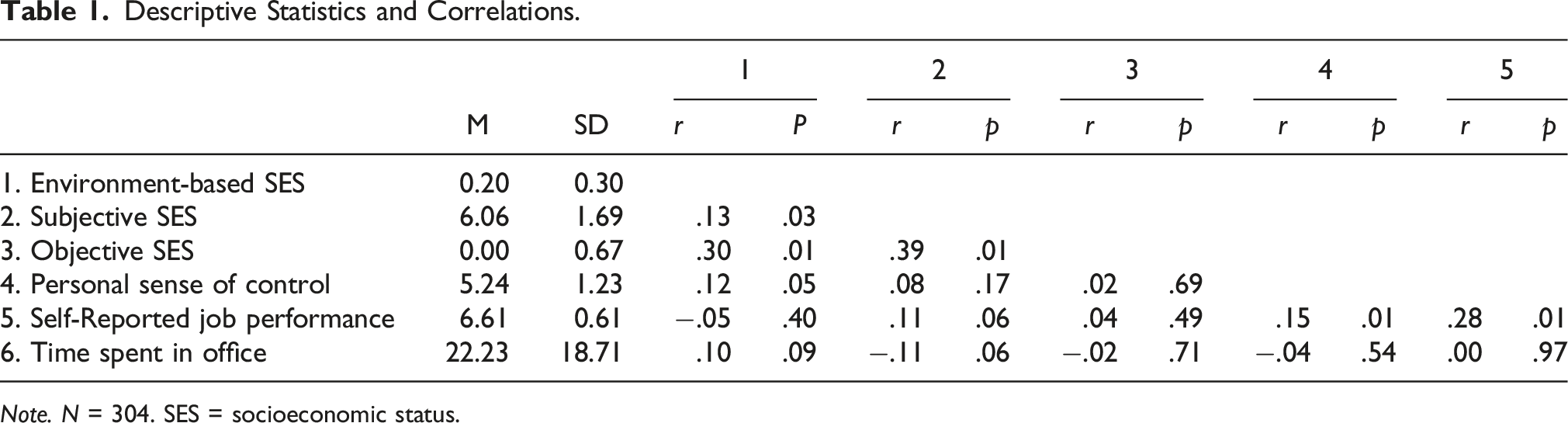
Note. N = 304. SES = socioeconomic status.
Tests of Hypotheses
Structural Equation Models for Testing Hypotheses.
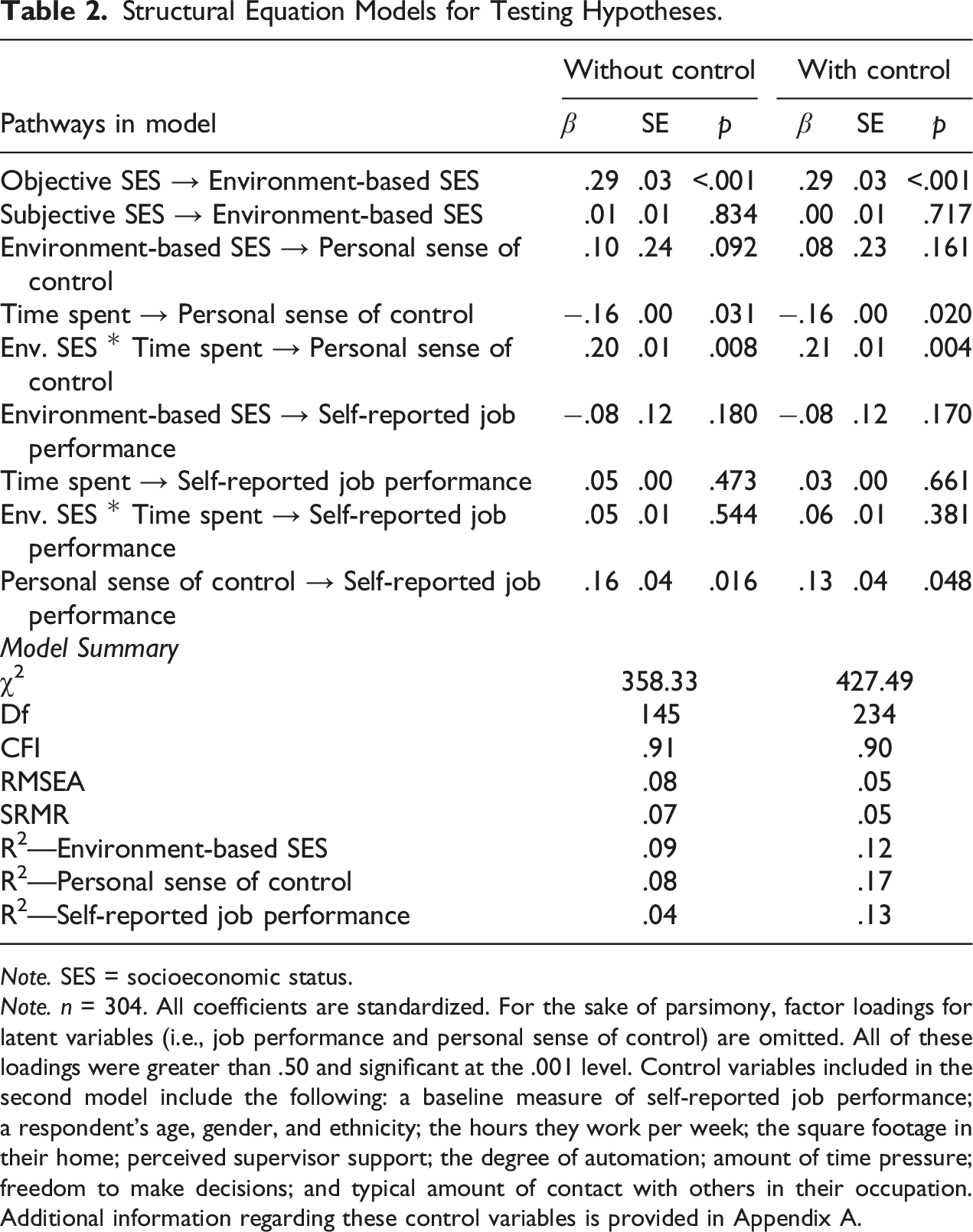
Note. SES = socioeconomic status.
Note. n = 304. All coefficients are standardized. For the sake of parsimony, factor loadings for latent variables (i.e., job performance and personal sense of control) are omitted. All of these loadings were greater than .50 and significant at the .001 level. Control variables included in the second model include the following: a baseline measure of self-reported job performance; a respondent’s age, gender, and ethnicity; the hours they work per week; the square footage in their home; perceived supervisor support; the degree of automation; amount of time pressure; freedom to make decisions; and typical amount of contact with others in their occupation. Additional information regarding these control variables is provided in Appendix A.
To examine the degree to which environment-based SES serves as a proximal marker of one’s SES, we included respondent’s subjective and objective SES as predictors of the environment-based SES, as rated by the coders, in the model (see Table 2). Objective SES was a positive and significant predictor of environment-based SES (β = .29, p < .001), while subjective SES was non-significant (β = .01, p = .834). These findings support our first hypothesis (H1) but failed to support our second hypothesis (H2). We return to this intriguing pattern of results further in the Discussion section below.
We next considered the relationship between environment-based SES and one’s personal sense of control. This pathway was positive (β =.10, p = .092), but non-significant, which fails to support our third hypothesis (H3). However, we did observe that the relationship between environment-based SES and personal sense of control was contingent upon how much time one spent in their office (β =.20, p = .031), which supports our fourth hypothesis (H4). This result qualifies the lack of support found for Hypothesis 3, as statisticians often acknowledge a first-order effect is qualified by and often not meaningful in the presence of a significant interaction (Aguinis, Edwards, & Bradly, 2017).
To better understand the nature of this interaction, we used the coefficients obtained in our structural equation model to plot the predicted values of one’s personal sense of control under varying levels of environment-based SES (i.e., low = 0 and high = 1) and time spent in one’s office (10 hr vs. 40 hr) (see Figure 2). As we hypothesized, the association between environment-based SES and personal sense of control was stronger for individuals who spent more time in their office. Interaction effect of environmental-SES and time spent in office on personal sense of control. Note. Low environment-based SES = 0 and high environment-based SES = 1. SES = socioeconomic status.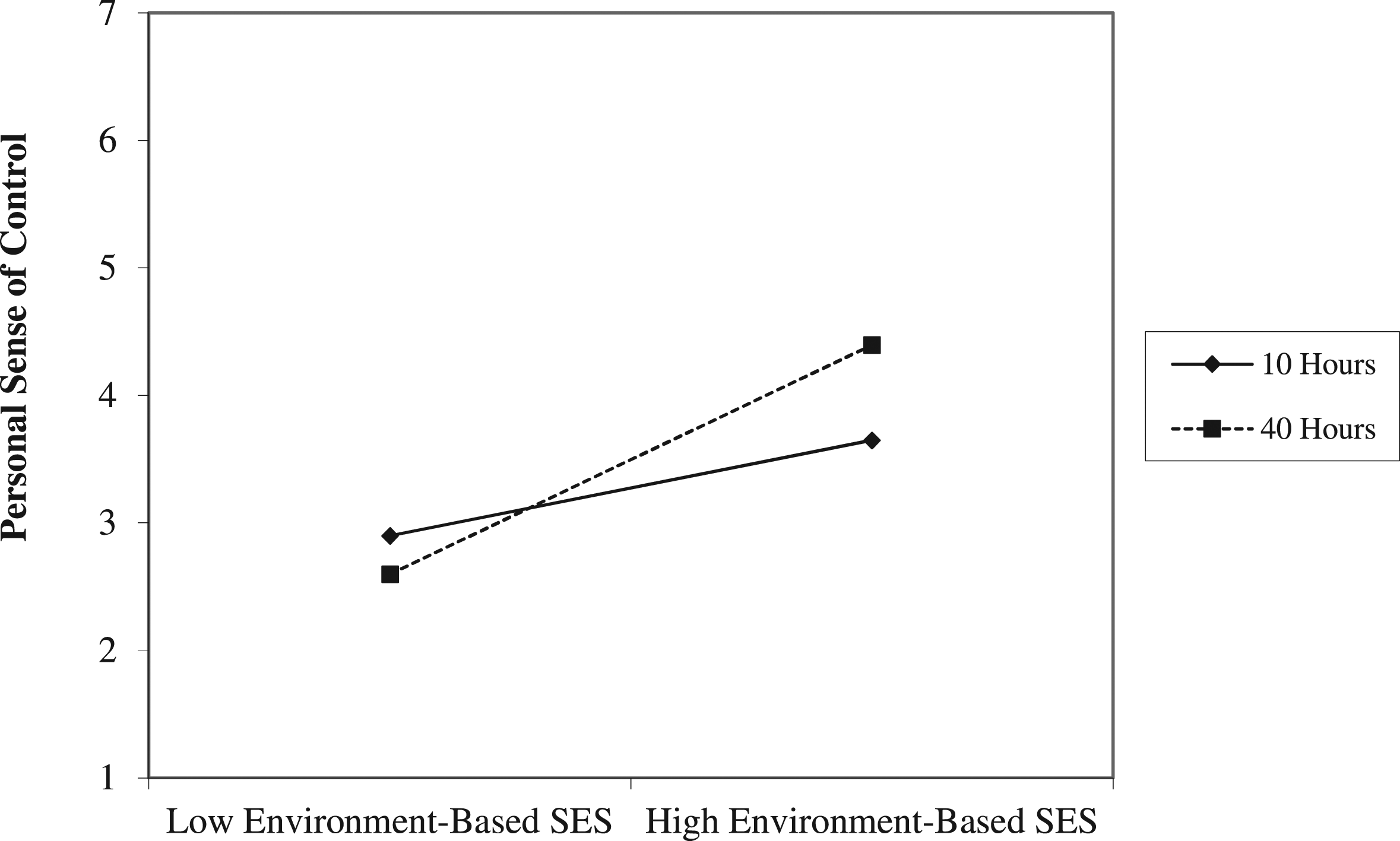
Next, we considered the relationship between one’s personal sense of control and their self-reported job performance. Consistent with past research (Ng et al., 2006; Spector, 1982), we found a positive and significant relationship between one’s personal sense of control and self-reported job performance (β =.16, p = .016), which supports our fifth hypothesis (H5).
Conditional (Time Spent in Office) and Simple Indirect Effects of Environmental SES on Self-Reported Job Performance via Personal Sense of Control.
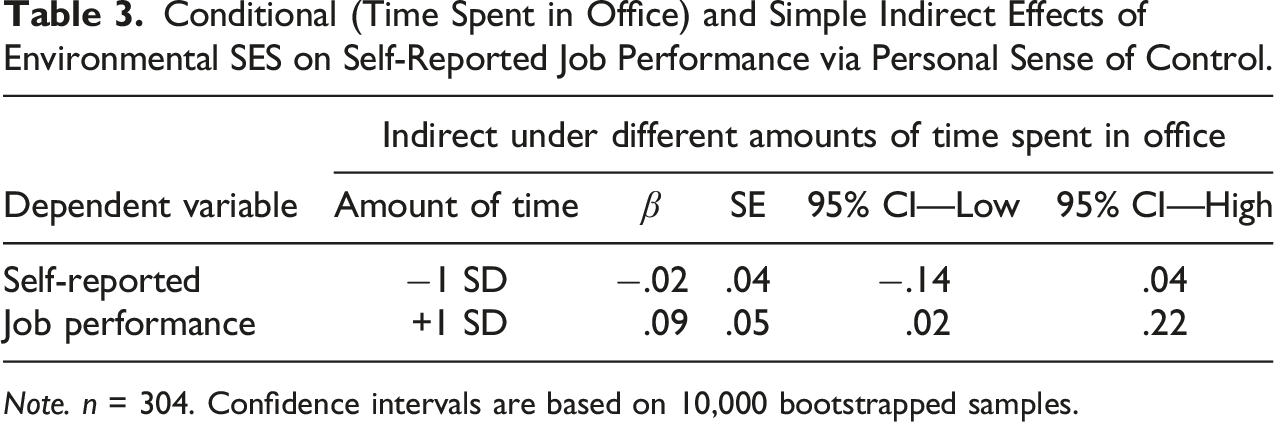
Note. n = 304. Confidence intervals are based on 10,000 bootstrapped samples.
Robustness Checks
Along with testing our hypotheses, we also conducted several robustness checks, which are described below.
Control variables
First, we re-estimated our structural equation model and incorporated several control variables that, based on existing theory and prior research, may be relevant to our study (Becker, 2005; Bernerth & Aguinis, 2016). These measures included a range of demographic variables (e.g., age and gender), work-related variables (e.g., perceived supervisor support), and occupational characteristics (e.g., decision-making authority), which may be relevant to one’s experience while working from home (see Appendix A for additional information regarding these measures). As seen in Table 2, the results of the model including the control variables are quite comparable to what we reported previously. Thus, although these variables allowed us to capture more variability in the criteria (i.e., increase in R2), the magnitude, direction, and significance of the hypothesized pathways remained consistent.
Omitted variable bias
Although the hypothesized effects are still supported while incorporating these control variables, we acknowledge that they still may suffer from omitted variable bias (OVB). That is, despite incorporating additional information about the respondents, there may still be other alternative explanations that are unaccounted for. To minimize the threat of OVB, we estimated a series of models using a copula correction method to account for potential alternative explanations (Falkenstrom, Park, & McIntosh, in press). This approach uses a Gaussian copula function to specify the dependence structure between the endogenous regressors (e.g., environment-based SES) and the structural errors (e.g., covariance between the residual error term when predicting personal sense of control and this variable). Specifically, the copula method links a predictor and the error term using the inverse of the cumulative normal distribution of the predictor (Falkenstrom et al., in press). By directly estimating the covariance between the residual and the endogenous predictor, this approach can absorb the effects of omitted variables and reduce the threat OVB.
Prior simulation studies have found that a copula method accurately recovers the true relationships among two variables as the endogenous regressor exhibits an increasingly non-normal distribution (Falkenstrom et al., in press). That is, greater levels of non-normality afford more power to distinguish the effects copula term from the endogenous regressors. In the current study, we identified two variables that exhibited sufficient non-normality that would justify using this approach: respondent’s objective SES (skewness = 4.10; Anderson-Darling test = 14.21, p < .001) and environment-based SES (skewness = 1.18; Anderson-Darling test = 48.78, p < .001). Thus, we estimated copula terms for these variables and included them in our structural equation model as control variables. The results of this updated model are consistent with what we reported previously. Specifically, objective SES remained a significant predictor of environment-based SES (β = .30, p = .014), and the interaction between environment-based SES and time spent in one’s office was still positive and statistically significant (β = .20, p = .008). These results indicate that even after accounting for potential omitted variables, several of the key pathways in our model remain consistent.
Excluding prior self-reported job performance
We also considered whether our use of a retrospective measure of prior job performance may have affected our results. In particular, one of the control variables in our model asked respondents to consider their performance in the prior year, which may be absorbing relevant variance in our focal criterion (i.e., self-reported job performance in the more recent time period). As such, we re-estimated the structural equation model excluding this control variable. The results of this model were wholly consistent with what we have reported previously. In particular, personal sense of control remained a significant predictor of self-reported job performance at T2 (β = .16, p = .019), and the indirect effect for environment-based SES, conditioned on time spent in one’s office, was also significant (β = .08, p = .049).
Reverse causality
As an additional robustness check, we conducted a test of reverse causality to examine the potential effects of self-reported job performance as an antecedent. That is, individuals who perform better at their job may be afforded more personal control at work and receive additional resources that they can then invest in their working environments. Thus, we examined an alternative model where we repositioned job performance as an antecedent of environment-based SES and personal sense of control. This model also features the same control variables that we included in our original model to help facilitate model comparisons.
This model indicated that the direct effects of job performance on personal sense of control were non-significant (β = .11, p = .077) as were its effects on environment-based SES (β = .07, p = .19). Likewise, the fit for this model when using the Bayesian Information Criterion (BIC) was slightly worse than the original model (BICreversed = 26825.06 vs. BICoriginal = 15816.12). These results show some evidence that these alternative pathways are less likely to be operating in the current sample.
Common method variance
Although we purposefully introduced a time lag between the measures of personal sense of control and self-reported job performance, it is possible that the effects may be attributed to a common method factor (Podsakoff, MacKenzie, Lee, & Podsakoff, 2003). To formally test the potential effects of common methods, we estimated confirmatory factor analyses where personal sense of control and job performance loaded onto a single factor. These analyses indicate that a model that fails to distinguish between job performance and personal sense of control exhibits poorer fit than a model that allows these measures to diverge (Δχ2 = 706.69, p < .001; ΔCFI = .42; ΔTLI = .42; ΔSRMR = .12; and ΔRMSEA = .18). These results indicate that a single-method factor, which accounts for the relationships among the latent variables, does not correspond well to the current data.
Disagreements regarding environment-based SES
Although we found that the raters agreed on the level of environment-based SES more than 70% of the time, there is still a question of whether our decision to average their two evaluations may have affected our results. As such, we re-ran the path model using a dichotomous measure of environment-based SES (i.e., only 0 = poor or 1 = rich). The results of this model, which showed comparable levels of fit (CFI = .90, TLI = .88, SRMR = .07, and RMSEA = .08), are consistent with the findings presented previously in that environment-based SES still predicted one’s personal sense of control (β = .14, p = .027) and this main effect depended upon the amount of time one spent in their home working environment (β = .18, p = .021).
Discussion
In response to the COVID-19 pandemic, many companies have quickly shifted to remote work. By having their employees working from home rather than on-site, organizations are reporting increased productivity and performance (Westfall, 2020), which corresponds with past research on the benefits of telework (Gajendran & Harrison, 2007; Wörtler et al., 2021). Because of these beneficial side effects of teleworking, companies are moving toward having their employees working from home more often or even permanently without fully considering the issues involved (Akala, 2020; Bond, 2020; Kelly, 2020). In this study, we viewed the widespread and rapid transitions to remote work due to the COVID-19 crisis through a sociocognitive SES lens (Kraus et al., 2012). Our aim was to explore the extent to which the reported productivity and performance gains are equally realized by all workers.
In a sample of over 300 employees working from home during the COVID-19 pandemic, our results suggest that the SES of a person’s home office (as rated by independent coders) is positively related to both one’s objective and subjective SES. We also show that people’s work environment serves as a proximal marker of one’s position along the SES gradient. Furthermore, one’s environment-based SES is meaningfully associated with their psychology. Specifically, our findings show that higher environmental SES of people’s home office space is positively related to their personal sense of control. In turn, this personal sense of control is positively related to self-reported job performance (even when controlling for people’s typical level of job performance). Thus, it appears that as employees are increasingly confined to their home office spaces during the COVID-19 pandemic, and during the transition to the “new normal,” the SES signals within this environment have meaningful relationships with their perceived sense of control as well as their performance. Ultimately, those who are fortunate enough to work in higher SES environments at home also appear to be best positioned to benefit from this sudden and widespread shift to remote work.
Our results also help clarify when the impact of SES-based environments is likely to be most pronounced. Specifically, we tested the amount of time typically spent in the home office as a moderator of the impact of environmental SES. Our findings suggest that for those who spend more time working from their home office, there is a stronger relationship between the SES-based effects of this environment and one’s personal sense of control. Additionally, the moderated mediation model indicates that the indirect effect of the SES of employees’ home office on their self-reported job performance through perceived personal control is stronger for those who work more hours from their home office.
Theoretical and Practical Implications
Our results have several implications that are worth noting. First, with regards to the ongoing global COVID-19 pandemic, and the trends emerging within the “new normal” (Kniffin et al., 2020), it appears employees levels of self-reported performance can diverge when working from home. This stands in stark contrast to many popular media representations of the benefits from working from home (Akala, 2020; Bond, 2020; Kelly, 2020) as well as past research highlighting its benefits (e.g., increased job satisfaction) (e.g., Gajendran & Harrison, 2007). Relatedly, the rapid shift to remote work may represent a dilemma as companies seeking to continue their operations may inadvertently exacerbate pre-existing inequalities that are made increasingly salient by this crisis (cf., Bapuji et al., 2020). That is, not only are higher SES individuals able to reap many of the basic benefits of remote work (e.g., greater social distancing), but these individuals also report improvements in their performance that their lower SES counterparts do not.
Second, businesses have been increasingly interested in implementing remote work even before offices and workplaces were shuttered as a result of the pandemic. Our results show that some caution may be warranted when implementing such changes because, in some ways, the shared physical environment of a corporate office can function as a great equalizer in terms of socioeconomic effects (Kraus et al., 2012). Because companies have a larger pool of resources to devote to furnishing, decorations, office materials, and interior design, the types of SES-based signals that a corporate office environment sends may exceed what a person could recreate at home based on his/her personal resources (Elsbach & Pratt, 2007). Furthermore, office resources are often distributed in an egalitarian fashion such that there are no major discrepancies in larger items (e.g., corporations rely on bulk purchases of office furniture). The unique, positive relationship between one’s objective SES and environment-based SES is consistent with this conclusion as it suggests that the resources one has available, rather than their interpretation of these resources (Côté, 2011; Loignon & Woehr, 2018), may exert more influence over the nature of their home working environments. Thus, our results suggest that as companies shift to remote work, either in response to the pandemic or as a new normative business practice, they may see larger performance disparities based upon the environment-based SES of their employees’ home offices.
Third, our work extends the discussion of SES within and across the human resource management literature. Recently, this literature has adopted socioeconomic lenses to explore the role of institutions in perpetuating socio-economic inequalities (Bapuji et al., 2020). In contrast, our results show a context where the typical business may, in some sense, equalize socioeconomic effect’s impact on worker performance. That is, when an employee comes into an office building and works in a space that is furnished by the organization, the socioeconomic disparities between employees are restricted and may even be “taken off the table”. This situation differs from what our data suggests is occurring in home working environments. In fact, at its extreme, one could envision that people with extensive resources (i.e., high objective SES) are more apt to have several types of locations and various locales to work in (e.g., primary residences along with vacation homes). By being able to not only reflect their identity in such environments but also switch among several environments, their experiences would likely further buttress their personal sense of control over their environment (e.g., Kraus et al., 2009). Certainly, not every organization distributes office resources equally or equitably. However, the degree of stratification is dramatically reduced compared to when employees work from home.
Strengths, Limitations, and Future Research
As one of the first studies, at least to our knowledge, to consider the organizational implications of environment-based SES, we believe our study design features several strengths (Spector, 2019). First, the cross-sectional design that we employed is well-suited for establishing covariation among variables during early stages of research. Thus, it lent itself well to examining some of the basic properties of environment-based SES (e.g., inter-rater reliability and covariation with other forms of SES) and its relationship with organizationally relevant constructs (i.e., personal sense of control and self-reported job performance). Second, cross-sectional designs can be strengthened by using retrospective measures which afford more a precise understanding of potential temporal precedence (Spector, 2019). Our use of a baseline measure of self-reported job performance (see Appendix A) is wholly consistent with such a strategy. Third, our design and analytical approach feature several strategies to mitigate the risk of alternative explanations. These include using multiple sources of data (i.e., raters evaluating environment-based SES), including several theoretically relevant control variables, and several robustness checks to try and determine the risk of reverse causality, OVB, and common method bias. Fourth, environment-based SES, which is a primary area of focus within this study, is a naturally occurring phenomenon. That is, although one could envision designs where the environment-based SES is manipulated (e.g., participants assigned to specific homes, providing resources to invest in one’s home working environments), these approaches also feature their own limitations (e.g., demand characteristics and insufficient mundane realism). Taken as a whole, we believe the current design affords several useful insights.
Despite these strengths, our study features several limitations that should be acknowledged. First, for the sake of expediency, we were unable to track the hypothesized phenomena over time. That is, we proxied a person’s temporal exposure using a reflective, self-report measure. We certainly acknowledge that it would be preferable to more precisely capture and measure individuals’ exposure to their home office environment over time. Having now identified approximate thresholds for when the effects of being exposed to a particular home working environment may shift (i.e., the conditional indirect effects) (Spector, 2019), we would encourage future research that considers the underlying processes that may be unfolding around these different time periods. For example, it may be that there is an accumulative effect of being exposed to certain environment-based stimuli that ultimately engenders the relationship between environment-based SES and personal sense of control. Time-intensive study designs, like an experience sampling method, would allow one to capture momentary changes around this potential threshold to further examine these potential mechanisms (e.g., Gabriel et al., 2019).
Second, given the rapid shift toward remote work, we were primarily concerned with how environmental SES unfolds within home offices. However, we suspect that there would be value in exploring the environment-based SES effects of other organizationally relevant settings. For instance, personal office spaces at work (Gosling et al., 2002) or communal spaces in a corporate building (e.g., breakrooms and lobbies) could be relevant contexts to further extend the current work. If our presumptions are accurate, and such work environments can be arrayed along socioeconomic hierarchies, then there is a good chance that they send clear and discernable SES signals that may have relevant effects for organizational stakeholders (e.g., who does and does not perceive a sense of belongingness in a certain work environment?) (Brewer, 1991; Trawalter et al., 2020).
Third, we believe there is value in further considering how the three forms of SES examined in the current study (i.e., objective SES, subjective SES, and environment-based SES) may coalesce in a consistent fashion or fragment in interesting ways. In the current study, individuals whose home working environments were classified as higher SES did not necessarily see themselves as occupying a position of higher SES. Past research has found that objective SES and subjective SES are also only moderately correlated (Adler et al., 2000; Kraus et al., 2012; Loignon & Woehr, 2018). Thus, within the United States, for example, it is not uncommon for extremely wealthy individuals to identify as “middle class” (Kraus & Tan, 2015). Given these findings, it would be interesting to consider whether people whose subjective SES does not correspond with either their objective SES or environment-based SES may be exhibiting some type of social class-based blind spot and whether such a lack of class consciousness may reflect a unique phenomenon (Martin, 2015). Such blind spots, like those discussed in other literature studies (e.g., Fleenor, Smither, Atwater, Braddy, & Sturm, 2010), may have unique relationships with other organizationally relevant constructs.
Finally, we would encourage further research that tries to identify what specific features of an environment correspond with high or low levels of environment-based SES. That is, how do people display their position along the SES gradient within their home working environments? As some initial evidence that certain features may be more prominent than others we asked raters what their judgments were based on and, unsurprisingly, learned that they were keenly aware of the furnishings, decorations, and structural features presented in the photo (e.g., size of the room and amount of natural light). Future research that builds on these initial findings to consider whether these features combine in an additive fashion, or some type of multiplicative form, would be useful in understanding the gestalt of how one’s SES is manifested in their home working environment (e.g., Elsbach & Pratt, 2007).
Conclusion
As a means of protecting themselves and others during the COVID-19 pandemic and as a component of our new normal (Kniffin et al., 2020), many workers increasingly find themselves working in their homes. Despite the benefits associated with these developments, these arrangements also produce a range of unintended consequences. In particular, our study suggests that one of the consequences that should not be ignored is that a person’s home office environment falls along a socioeconomic gradient and that this is associated with distinct differences in one’s psychological and work behavior.
Footnotes
Summary of Control Measures Used in Robustness Check
Along with our focal measures, we also included several, theoretically relevant control variables from several additional sources (Becker, 2005). These measures are described below. Measures from o*Net were included by determining respondents’ occupation from how they described their job (e.g., “In general terms, what job do you currently have (e.g., job title)?”). Additional information regarding the work context scales can be accessed here: https://www.onetonline.org/find/descriptor/browse/Work_Context/.
Measure(s) used
Description/sample item
Rating scale
Source/reference
Job performance at T1
Consider “the feedback you received from your supervisor on your last formal performance review. How did he/she describe your performance at that point?"
(1) Strongly disagree to (7) strongly agree
Self-report (J. L. Johnson & O'Leary-Kelly, 2003)
Age
Respondent’s age in years
Years
Self-report
Gender
Respondent’s self-identified gender
0 = Male, 1 = Female
Self-report
Ethnicity
Respondent’s self-identified ethnicity
0 = Non-White, 1 = White
Self-report
Hours worked
“I currently work __ hours per week.”
Hours
Self-report
Perceived supervisor support
“My supervisor talks me through work-related problems, helping me come up with solutions.”
(1) Strongly disagree to (7) strongly agree
Self-report (Jokisaari & Nurmi, 2009)
Home square footage
“How large would you estimate your apartment or home is?”
Square feet
Self-report
Degree of automation
“How automated is the job?”
0—not at all automated to 100—completely automated
O*Net: Work context
Time pressure
“How often does this job require the worker to meet strict deadlines?”
0—never to 100—every day
O*Net: Work context
Freedom to make decisions
“How much decision making freedom, without supervision, does the job offer?”
0—no freedom to 100—a lot of freedom
O*Net: Work context
Contact with others
“How much does this job require the worker to be in contact with others (face-to-face, by telephone, or otherwise) in order to perform it?”
0—no contact with others to 100—constant contact with others
O*Net: Work context
Quality of equipment
Coders were asked to evaluate the quality of the equipment and furnishings within each image (i.e., “Looking at the desk, computer, chair, and office appliances (shredder, television, monitors, office phones, etc.), this office is set up well as a working space in terms of quantity and quality of objects”)
(1) Strongly disagree to (7) strongly agree
Three PhD students provided supplemental ratings of photos
Declaration of Conflicting Interests
The author(s) declared no potential conflicts of interest with respect to the research, authorship, and/or publication of this article.
Funding
The author(s) disclosed receipt of the following financial support for the research, authorship, and/or publication of this article: This study was funded by a Seed Money Grant from NEOMA Business School.

Notes
Associate Editor: Mindy Shoss