




Abstract
The present study examined the configurations, or profiles, taken by distinct global and specific facets of job engagement and burnout (by relying on a bifactor operationalization of these constructs) among a nationally representative sample of Canadian Defence employees (n = 13,088; nested within 65 work units). The present study also adopted a multilevel perspective to investigate the role of job demands (work overload and role ambiguity), as well as individual (psychological empowerment), workgroup (interpersonal justice), supervisor (transformational leadership), and organizational (organizational support) resources in the prediction of profile membership. Latent profile analyses revealed five profiles of employees: Burned-Out/Disengaged (7.13%), Burned-Out/Involved (12.13%), Engaged (18.14%), Engaged/Exhausted (15.50%), and Normative (47.10%). The highest turnover intentions were observed in the Burned-Out/Disengaged profile, and the lowest in the Engaged profile. Employees’ perceptions of job demands and resources were also associated with profile membership across both levels, although the effects of psychological empowerment were more pronounced than the effects of job demands and resources related to the workgroup, supervisor, and organization. Individual-level effects were also more pronounced than effects occurring at the work unit level, where shared perceptions of work overload and organizational support proved to be the key shared drivers of profile membership.
Keywords
According to Kahn (1990), job engagement occurs when employees’ personal resources are actively channeled toward the realization of their work. High levels of job engagement facilitate the accomplishment of organizationally valued behaviors, support behaviors that are more focused and vigilant, and help workers meet the emotional demands of their roles (Kahn, 1990). Job engagement is a precursor of desirable outcomes for the organization (e.g., lower turnover intentions, better performance; Rich, LePine, & Crawford, 2010) and the employee (e.g., higher job satisfaction; Haynie, Mossholder, & Harris, 2016). Conversely, burnout is characterized by high levels of emotional exhaustion and negative attitudes toward work (Maslach, Schaufeli, & Leiter, 2001). Employees suffering from burnout feel disillusioned, helpless, irritated, and worn out. They have lost connection with their work and distance themselves mentally and emotionally from their work activities (Leiter & Maslach, 2016). Burnout is associated with high levels of turnover intentions (Cheng, Bartram, Karimi, & Leggat, 2016) and depressive symptoms (Hatch, Potter, Martus, Rose, & Freude, 2019).
Despite abundant research (Bakker & Demerouti, 2017; Laughman et al., 2016) supporting the benefits associated with job engagement components (physical, cognitive, and emotional; Rich et al., 2010) and the undesirable outcomes of burnout components (emotional exhaustion and disengagement; Demerouti, Mostert, & Bakker, 2010), little is known about their combined impact (Mäkikangas, Hyvönen, & Feldt, 2017). Two very distinct, yet complementary, types of analyses can help to better comprehend this combined impact. On the one hand, variable-centered analyses can help to understand the nature of associations between a subset of variables and other subsets of variables. Unfortunately, these analyses are unable to reveal a clear picture of the combined effect of more than two or three variables. On the other hand, person-centered analyses consider the configurations taken by a set of variables among discrete subpopulations, or profiles, of employees.
In the present study, we rely on person-centered analyses (i.e., latent profile analyses—LPA) to identify the configurations of burnout and job engagement among different profiles of employees in a way that would be impossible to achieve using variable-centered analyses. More precisely, the resulting profiles would represent discrete subpopulations of employees characterized by qualitatively distinct configurations of burnout and job engagement (e.g., such as a profile of employees experiencing high levels of burnout coupled with low levels of job engagement, a profile characterized by high levels of engagement coupled with high levels of emotional exhaustion, or even a profile dominated by specific dimensions of burnout and/or job engagement). This approach helps to achieve a more integrative, or holistic, understanding of the reality of job engagement and burnout profiles as it is truly experienced among employees, and in a way that shares clear connections with our (i.e., researchers, managers, and practitioners) tendency to think of employees as members of discrete categories (Zyphur, 2009). More precisely, whereas a nomothetic variable-centered approach considers job engagement and burnout components as separate interrelated constructs, a more idiographic person-centered approach rather focuses on how all of these components are experienced together by different types of employees (Marsh, Lüdtke, Trautwein, & Morin, 2009; Meyer & Morin, 2016).
Emerging person-centered research has started to look at how job engagement and burnout components combine within specific individuals (Abós, Sevil-Serrano, Haerens, Aelterman, & García-González, 2019; Mäkikangas, Feldt, Kinnunen, & Tolvanen, 2012, 2014, 2017; Moeller, Ivcevic, White, Menges, & Brackett, 2018; Salmela-Aro, Hietajärvi, & Lonka, 2019; see Table S1 in the online supplements for an overview of the profiles identified in these studies, as well as their associations with a variety of predictors and outcomes). However, no research has done so while considering the specificity of all theoretical facets of job engagement, or by simultaneously considering employees’ global and specific levels of job engagement (physical, cognitive, and emotional; e.g., Gillet, Morin, Jeoffrion, & Fouquereau, 2020c) and burnout (emotional exhaustion and disengagement; Isoard-Gautheur et al., 2018). Information is thus lacking regarding the nature of employees’ job engagement and burnout configurations based on a complete theoretical coverage of the inherent multidimensionality of both constructs.
To inform this issue, this study documents the job engagement and burnout configurations that best characterize members of a large-scale representative sample of Canadian Defence personnel, while accounting for the multidimensionality of job engagement and burnout. In doing so, we emphasize the importance of adopting a finer-grained representation of job engagement and burnout by simultaneously considering their global and specific components. This more refined perspective helps us to better understand the unique, and complementary, role played by each specific facet of burnout and job engagement beyond the role played by employees’ global levels of burnout and job engagement. This approach should help us to uncover whether profiles defined by more, or less, balanced configurations of burnout and job engagement across components may carry greater, or lower, risks for exposed employees. For instance, despite the generally assumed positive effects of job engagement, is it possible for some highly engaged employees to also experience higher than expected levels of emotional exhaustion? Alternatively, is job engagement enough to limit employees’ risk of turnover intentions, or would its benefits be maximized only for employees presenting some specific combinations of burnout and job engagement components?
This study also documents the construct validity (Muthén, 2003) of these profiles by considering their associations with job demands and resources (work overload, role ambiguity, interpersonal justice, transformational leadership, organizational support, and psychological empowerment), and turnover intentions. From a practical perspective, this study should help provide improved guidance for managers seeking to nurture, preserve, and improve psychological health among different types of employees (Zyphur, 2009). For instance, by documenting the implications of these profiles for employees’ turnover intentions, this study should help organizations determine which profiles should be prioritized from an intervention perspective. Likewise, understanding how different types of job demands and resources contribute to the emergence of different profiles should also provide guidance in relation to the identification of actionable levers of intervention. Importantly, a unique contribution of this study would be to examine these associations from a multilevel perspective. This multilevel perspective will allow us to verify whether, and how, the effects of employees’ perceptions of job demands and resources on their likelihood of profile membership would differ across the individual versus group levels of analyses, leading to a clearer understanding of the role played by employees’ shared perceptions of the job demands and resources present in their work unit, once properly disaggregated from their individual perceptions of these same job demands and resources.
A Multidimensional Representation of Burnout and Job Engagement
It is recognized that an assessment of job engagement should tap into the physical, cognitive, and emotional facets of this construct (Rich et al., 2010), just like an assessment of burnout should at least tap into its emotional exhaustion and disengagement components (Demerouti, Bakker, Vardakou, & Kantas, 2003). It has also been proposed that employees might experience job engagement and burnout in a more holistic manner as a function of two overarching dimensions (Alfes, Shantz, Truss, & Soane, 2013; Cheng et al., 2016). This global approach is supported by high correlations among ratings of physical, cognitive, and emotional job engagement (Shuck & Reio, 2014), and among ratings of emotional exhaustion and disengagement (Demerouti et al., 2010). Research has also shown that a higher-order representation of job engagement relates more strongly to antecedents and outcomes than its first-order components (Shuck, Nimon, & Zigarmi, 2017). However, research has also revealed well-differentiated associations between distinct components of job engagement and burnout, and a variety of outcomes, thus supporting the existence of conceptually distinct components of job engagement (Shuck et al., 2017) and burnout (Collie, Granziera, & Martin, 2018).
These options are not mutually exclusive as burnout might also exist as a global entity (i.e., burnout) reflecting commonalities among ratings of emotional exhaustion and disengagement, themselves including specificity unexplained by this global burnout entity (Barcza-Renner, Eklund, Morin, & Habeeb, 2016; Isoard-Gautheur et al., 2018). Likewise, job engagement can occur both as a global construct anchored in the variance shared across its dimensions (emotional, physical, and cognitive), themselves retaining some specificity (Gillet et al., 2020). Higher-order results support the idea that both constructs can be represented as global entities (Rich et al., 2010; Sinval, Queirós, Pasian, & Marôco, 2019). However, a remaining question is whether enough specificity exists in the physical, cognitive, and emotional components once global job engagement is considered, and in the emotional exhaustion and disengagement components once global burnout is considered (Gillet et al., 2020c; Sinval et al., 2019).
Although hierarchical models have often been used to address this question (e.g., Rich et al., 2010; Sinval et al., 2019), these models involve a stringent proportionality constraint in defining how the items relate to the higher-order factor and to the specific part of the first-order factors that is not explained by the higher-order factor (i.e., its disturbance; e.g., Chen et al., 2006). Indeed, in hierarchical models, items define first-order factors, which are used to define a higher-order factor reflecting the variance shared among the first-order factors. Yet, the relation between an item and the higher-order factor is indirect (i.e., mediated by the first-order factor). This indirect effect is reflected as the product of (x) the item’s first-order factor loading by (y) the loading of this first-order factor on the higher-order factor. This second term (y) is thus a constant for all items associated with a specific first-order factor. Similarly, the relation between an item and the disturbance of the first-order factor to which it is associated is also reflected as the product of this item’s loading on the first-order factor (x) by another constant representing the link between the first-order factor and its disturbance (z). As a result, the ratio of item variance explained by the global (the higher-order factor; e.g., global burnout) and specific (the first-order factors; e.g., emotional exhaustion and disengagement) factors (xy/xz) is assumed to be identical for each first-order factor (y/z), and unlikely to hold in real life (Morin, Arens, & Marsh, 2016a).
Bifactor models provide an alternative to hierarchical models (Chen et al., 2006) and are not submitted to this unrealistic restriction. Bifactor models thus provide a more flexible way to address the same questions. According to a bifactor operationalization, each item is used to define both a Global (G) factor and one Specific (S) factor. This approach thus provides a way to obtain a direct estimate of the commonalities shared across all items (the G-factor, e.g., global engagement or global burnout), and an equally explicit estimate of the specificity associated with each component (specified as independent from one another) beyond the variance already explained by the G-factor (S-factors, e.g., emotional, physical, and cognitive, or emotional exhaustion and disengagement). Apart from this global/specific variance decomposition, it is important to note that the meaning of engagement and burnout dimensions remains the same in bifactor models as in traditional approaches. In the present context, a bifactor representation would result in the estimation of participants’ specific levels on each of the job engagement or burnout components expressed as deviations from their global levels of job engagement or burnout. As such, the S-factors provide a direct representation of the extent to which the levels of each specific component can be considered to be in a state of imbalance relative to participants’ global levels of job engagement or burnout. The S-factors representing participants’ levels of emotional exhaustion and disengagement would thus reflect the extent to which employees’ levels of exhaustion or disengagement are higher, lower, or similar (when = 0) than their levels of burnout across dimensions. More precisely, the emotional exhaustion S-factor would reflect employees’ levels of emotional exhaustion occurring in a manner that is unrelated to their global levels of burnout (so, possibly, “healthier” levels of exertion or fatigue), while the disengagement S-factor would reflect their levels of disengagement occurring in a manner that is unrelated to their global levels of burnout (so, possibly, reflecting a drop in motivation and the need for a break). Similarly, emotional, physical, and cognitive job engagement S-factors indicate that employees’ levels of emotional, physical, or cognitive job engagement are higher, lower, or similar than their levels of job engagement across dimensions. More precisely, these S-factor would reflect employees’ feelings of having to invest a level of emotional, physical, or cognitive resources into their work role in a way that goes beyond their global level of engagement into this role. Numerous studies have demonstrated that a bifactor approach was more suitable than first- and higher-order representations of both burnout (e.g., Barcza-Renner et al., 2016; Isoard-Gautheur et al., 2018; Sinval et al., 2019) and job engagement (e.g., Gillet, Caesens, Morin, & Stinglhamber, 2019a; 2020c; Huyghebaert-Zouaghi, Caesens, Sandrin, & Gillet, 2021a).
A Person-Centered Perspective on the Complementary Role of Job Engagement and Burnout
Researchers relying on variable-centered analyses assume, often explicitly but sometimes implicitly, that their results would equally apply to all members of the population under study. Although it is possible to verify how the effects of one variable differ as a function of another one, such tests of interactions are virtually impossible to decode when more than three predictors interact together, especially in the presence of nonlinearity. Importantly, adopting a bifactor representation of job engagement and burnout would result in seven interacting predictors, making it impossible to rely on variable-centered analyses to achieve an integrated representation of the combined role played by these two G-factors (burnout and engagement) and five S-factors (emotional exhaustion, disengagement, cognitive engagement, emotional engagement, and physical engagement). Person-centered analyses do not rely on similar assumptions and are specifically designed to identify profiles of employees differing from one another on more or less extensive a set of variables (Meyer & Morin, 2016). Thus, rather than focusing on the additive or interactive effects of these variables, the person-centered approach rather focuses on the categorization of employees into discrete profiles differing in their unique experiences of job engagement and burnout dimensions, the outcome implications of these profiles, and the impact of various predictors on employees’ likelihood of corresponding to each of these profiles (Meyer & Morin, 2016).
Person-Centered Studies: A Summary
In Appendix 1 of the online supplements, Table S1 provides a summary of the results from previous person-centered research seeking to identify profiles of burnout and or engagement. Despite some variations possibly related to methodological differences (e.g., type of employees, measures), a high level of similarity is apparent across studies (Mäkikangas & Kinnunen, 2016). However, very few of these previous studies have adopted a comprehensive approach simultaneously incorporating multiple facets of engagement and burnout, while relying on a proper disaggregation of global levels of job engagement and burnout from the specificities associated with each job engagement and burnout facet. The estimation of latent profiles based on indicators capturing the bifactor structure of job engagement and burnout ratings (i.e., resulting in a proper disaggregation of global and specific levels of job engagement and burnout across facets) would make it possible to identify clearer, and more easily interpretable, profiles differing from one another in relation to both the global (i.e., global job engagement and burnout) and specific (i.e., the different dimensions of job engagement and burnout dimensions) components of these constructs (Morin et al., 2016b, 2017). This approach would thus help us to isolate the unique contribution of each specific dimension associated with both constructs (e.g., Gillet, Morin, Choisay, & Fouquereau, 2019b). Ignoring this dual global/specific structure carries the risk of inaccurately identifying profiles characterized by job engagement and burnout levels solely capturing the global components of these constructs (Morin & Marsh, 2015; Morin et al., 2016b, 2017). When we consider the results from previous person-centered studies, we can indeed note that a number of of these studies revealed a number of profiles mainly characterized by global types of differences. The present investigation, relying on representative sample of Defence employees, adopts an approach developed by Morin et al. (2016b, 2017) to identify profiles of burnout and job engagement while accounting for the global and specific components of these constructs.
Despite our difference in approach, it remains possible for us to expect the identification of profiles dominated by job engagement (i.e., an Engaged profile), burnout (i.e., a Burned-Out/Disengaged profile), or by low to average levels on both constructs (i.e., a Normative profile) (e.g., Gillet et al., 2019a). These expectations are consistent with the conservation of resources theory (Hobfoll, 1989), which sees available material and psychological resources as limited, and stress as emerging from the true or perceived loss of resources. From this perspective, the energizing nature of job engagement stands in stark contrast with the resource depletion nature of burnout. A similar perspective comes from self-determination theory (Ryan & Deci, 2017), which describes job engagement as primarily motivated by autonomous forms of motivation (i.e., driven by pleasure and choice) and burnout as primarily motivated by controlled forms of motivation (i.e., driven by internal or external pressures). Interestingly, recent research has generally supported these assertions in relation to job engagement and burnout (Gillet et al., 2018b; 2020d). From these two theoretical perspectives, it seems realistic to anticipate the identification of profiles dominated by either one, or none, of these two constructs.
However, in accordance with the subset of shape-differentiated profiles obtained in prior research (e.g., Abós et al., 2019; see Table S1) and with results from previous studies relying on a methodology similar to ours for the study of engagement profiles (Gillet et al., 2019a; 2020c), some employees may also be characterized by profiles presenting differentiated configurations of job engagement and burnout across indicators. For instance, we might identify a Burned-Out/Involved profile presenting high global levels of burnout, and moderate to high levels of global, physical, and cognitive job engagement, in accordance with the highly engaged and highly frenetic (Abós et al., 2019) and highly engaged-exhausted (Moeller et al., 2018) profiles identified previously. This expectation makes sense theoretically. As noted earlier, burned-out workers tend to be driven by controlled motivation, whereas engaged workers tend to be driven by autonomous motivation. However, motivation is rarely uniquely autonomous or controlled (Ryan & Deci, 2017), and often involves a combination of both for at least a subset of employees (Gillet et al., 2018a; Howard, Gagné, Morin, & Van den Broeck, 2016). These employees would likely form the Burned-Out/Involved profile. Moreover, it might be possible for globally high levels of job engagement to be accompanied by specific manifestations of burnout (e.g., exhaustion, thus reflecting the exerting nature of high levels of job engagement) independently of employees’ global levels of burnout. Likewise, it might also be possible for globally high levels of burnout to be accompanied by specific manifestations of engagement (e.g., physical engagement, thus reflecting attempts made by burned-out employees to maintain an adequate level of performance despite a global lack of psychological energy) independently of employees’ global levels of job engagement.
Given the novelty of our approach, it would be possible to speculate regarding the possible identification of a rather large number of qualitatively distinct configurations of job engagement and burnout. However, despite their interest, these possibilities would remain largely speculative. Thus, and in a way that is aligned with the methodologically inductive nature of person-centered analyses, we leave as an open research question the nature of the profiles to be identified.
Research Question 1: Which profiles of job engagement and burnout will be identified among the current sample of Defence employees?
Research Question 2: Will these profiles differ quantitatively (based on employees’ global levels of job engagement and burnout), qualitatively (based on their specific configuration of burnout and job engagement components), or both?
Profiles of Burnout and Engagement: Implications for Turnover Intentions
Turnover intentions are the main predictor of voluntary turnover (Heavy, Holwerda, & Hausknecht, 2013), a relation that is particularly marked among military personnel (Lytell & Drasgow, 2009). Turnover itself has always been a ubiquitous outcome for organizations given its costs in terms of performance reduction, recruitment, and training (Heavey et al., 2013). Turnover intentions are also negatively related to job engagement and positively related to burnout (Alfes et al., 2013; Cheng et al., 2016), indicating that highly involved employees are more likely to want to stay in their job, whereas worn-out ones are more likely to seek alternative employment.
Results from previous person-centered research (see Table S1; e.g., Abós et al., 2019) suggest that profiles characterized by high levels of job engagement and low levels of burnout (e.g., Engaged) tend to be associated with lower turnover intentions than profiles characterized by low levels of job engagement and high levels of burnout (e.g., Burned-Out/Disengaged). From the perspective of the conservation of resources theory (Hobfoll, 1989), burned-out employees can be seen as lacking the resources required to adequately accomplish their work-related tasks, thus leading to higher levels of dissatisfaction and perceptions of ineffectiveness, which may ultimately result in turnover intentions and voluntary turnover (Cheng et al., 2016). In contrast, engaged employees are seen as more positively disposed toward their work, and as experiencing more positive work-related emotions (Rich et al., 2010), thus increasing their identification with the organization and their willingness to allocate extra time and resources to their organization, which may ultimately reduce their turnover intentions (Gillet et al., 2019a). Moeller et al.’s (2018) observation of low turnover intentions among Apathetic employees (i.e., low burnout and engagement) also suggests that low turnover intentions should be observed in the Normative profile. Finally, some additional results (see Table S1; e.g., Moeller et al., 2018) indicate that job engagement may protect employees against the negative effects of burnout, implying that lower turnover intentions should be observed in the Burned-Out/Involved profile relative to the Burned-Out/Disengaged one. This perspective is also consistent with self-determination theory, which suggests that high levels of controlled motivation can become beneficial when combined with similarly high levels of autonomous motivation (Gillet et al., 2018a; Howard et al., 2016; Ryan & Deci, 2017). In line with these considerations, we ask:
Research Question 3: How do employees’ levels of turnover intentions differ as a function of their job engagement and burnout profiles?
A Multilevel Person-Centered Perspective on the Role of Job Demands and Resources
Job Demands
The job demands-resources (JD-R) model (Demerouti, Bakker, Nachreiner, & Schaufeli, 2001) highlights the role of two categories of work conditions, job demands, and resources, in the prediction of employees’ engagement and burnout. Job characteristics requiring employees to expand psychological and/or physical efforts in an ongoing manner are referred to as job demands and tend to carry a toll for employees feeling exposed to such a work environment (Schaufeli & Bakker, 2004). Moreover, employees tend to perceive job demands as challenging or hindering (Crawford, LePine, & Rich, 2010). Challenging job demands have the potential to support mastery, personal growth, or future gains (i.e., demands to be overcome to learn and achieve), whereas hindering job demands have the potential to thwart growth, learning, and goal attainment. We focus on the effects of two types of hindering job demands with a known influence on job engagement and burnout (e.g., Ghorpade, Lackritz, & Singh, 2011; Reinke & Chamorro-Premuzic, 2014): Role ambiguity and work overload. Hindering demands are expected to interfere with employees’ functioning by impeding their self-actualization and the satisfaction of their psychological needs for autonomy, competence, and relatedness (Ryan & Deci, 2017). Hindering demands are thus likely to lead to a persistent psychophysiological and cognitive activation (Sonnentag & Fritz, 2015) as a result of being unable to attain personal goals (e.g., Kinnunen et al., 2017). This persistent activation is likely to interfere with the work recovery process (Sonnentag & Bayer, 2005). Not surprisingly, the effects of hindering job demands are well documented in the prediction of a range of outcomes likely to emerge from the quality of the work recovery process, such as higher levels of burnout and lower levels of job engagement (Gillet et al., 2020a, 2021). More specifically, when coping with role ambiguity, employees lack clear and consistent information about work expectations (Kahn, Wolfe, Quinn, Snoek, & Rosenthal, 1964). They are thus more likely to report higher levels of job anxiety and strain, subsequently leading to lower job engagement and higher burnout (Bakker & Demerouti, 2017). Similarly, attempts to cope with work overload may lead employees to exhaust their energetic resources, in turn increasing their likelihood of experiencing lower levels of job engagement and higher levels of burnout (Schaufeli & Bakker, 2004).
Job Resources
Contrasting with job demands, job resources refer to those aspects of a job that contribute to supporting employees in achieving their goals, to reducing the costs associated with job demands, and to stimulating personal development (Demerouti et al., 2001; Xanthopoulou, Bakker, Demerouti, & Schaufeli, 2009). Job resources are expected to help enhance employees’ psychological functioning, both by increasing job engagement and by decreasing burnout (Schaufeli & Bakker, 2004). Nielsen et al. (2017) proposed a multilevel framework focusing on whether job resources originate from the employees, their workgroup, their supervisors, or the organization. They also reported meta-analytic evidence supporting the complementary role of each type of resources for employees’ psychological health and behaviors.
Individual Resources
Individual resources are personal characteristics that help employees cope with job demands and achieve satisfactory levels of performance while remaining psychologically healthy (Xanthopoulou et al., 2009). In this study, we focus on psychological empowerment, which encompasses employees’ feelings of competence, autonomy, impact, and meaning in relation to their work (Spreitzer, 1995, 2008). Competence refers to feelings of having the abilities required for a successful execution of their work, a cognition close to the concept of self-efficacy. Autonomy refers to feelings of being in control when initiating and regulating work behaviors. Impact refers to feelings of being able to influence operational, strategic, or administrative outcomes at work. Finally, meaning refers to feelings that there is a good fit between work requirements and employees’ personal beliefs, standards, and values. Despite their distinct nature, these four cognitions have been systematically shown to converge on a global psychological empowerment construct (Morin et al., 2016c; Seibert, Wang, & Courtright, 2011). Psychological empowerment is positioned as a core psychological resource allowing employees to play a volitional role at work while feeling in control of their actions, and thus as an important mechanism allowing them to handle the stressfulness of their work (e.g., Spreitzer, 1995, 2008). Meta-analyses support the role of psychological empowerment as a driver of a variety of organizationally relevant outcomes and psychological health indicators (e.g., Seibert et al., 2011), including lower levels of burnout and higher levels of job engagement (e.g., Calvo & García, 2018; Livne & Rashkovits, 2018). Importantly, psychological empowerment is conceptually distinct from self-determined work motivation (Gagné, Senécal, & Koestner, 1997).
Workgroup Resources
Workgroup resources relate to the social and interpersonal context of the workplace; that is, to relationships among group members that foster efficient communications, positive interactions, and trust (Nielsen et al., 2017). In this study, we focus on interpersonal justice, which refers to workgroups in which employees interact respectfully with one another (Colquitt, 2001). Evolving in a workgroup in which employees feel respected across a range of situations is likely to improve the pleasantness of the work, to help employees feel supported when facing adversity, and to protect them against feelings of exhaustion, isolation, and disconnection (Colquitt et al., 2013). The role of interpersonal justice as a driver of positive functioning at work, including higher levels of job engagement and reduced levels of burnout, have been well established in research (Colquitt et al., 2013; Gillet, Fouquereau, Bonnaud-Antignac, Mokounkolo, & Colombat, 2013).
Leader Resources
Leader resources refer to vertical interactions between employees and supervisors who may, by virtue of their position and leadership style, provide them with support, guidance, and security (Nielsen et al., 2017). We focus on transformational leadership, which refers to the ability of the supervisor to inspire and motivate employees’ loyalty and involvement (Bass & Avolio, 1994). Transformational leaders focus on employees’ individual needs, and provide them with a sense of mission and purpose which helps to protect them from adversity while maintaining their positive drive (Hildenbrand, Sacramento, & Binnewies, 2018). Similar to interpersonal justice, the role of transformational leadership as a mechanism able to support employees’ psychological health, including increases in job engagement and protection against burnout, has been supported by extensive research evidence (e.g., Hildenbrand et al., 2018; Montano, Reeske, Franke, & Hüffmeier, 2017).
Organizational Resources
Organizational resources refer to the broader work environment context, and the way it is organized and managed to support, motivate, and encourage positive functioning and growth (Nielsen et al. 2017). In this study, we focus on organizational support, which refers to the extent to which the organization values and supports employees’ contributions and well-being (Eisenberger, Huntington, Hutchinson, & Sowa, 1986). Organizational support contributes to fulfilling employees’ basic socioemotional needs at work and is expected to convey the idea that support (material or emotional) will be available to help them maintain adequate levels of performance under stressful conditions (Eisenberger & Stinglhamber, 2011). Not surprisingly, the beneficent role of employees’ perceptions of organizational support in relation to a wide range of outcome variables, including job engagement and burnout, has also been well established in research (e.g., Eisenberger & Stinglhamber, 2011; Gillet et al., 2018a).
A Person-Centered Perspective
Despite their importance, no research has examined the effects of these job demands and resources on job engagement and burnout profiles. Indeed, whereas variable-centered predictions simply highlight the role of job demands and resources in the prediction of each burnout or job engagement component considered in isolation, the person-centered perspective makes it possible to consider this role more broadly in the prediction of distinctive multidimensional configurations of job engagement and burnout. In other words, it makes it possible to directly account for the role of these job demands and resources in the prediction of the complete reality of employees’ engagement and burnout.
Despite the novelty of our approach, the variable-centered evidence presented thus far suggests that transformational leadership, interpersonal justice, organizational support, and psychological empowerment, as well as lower levels of role ambiguity and work overload, should predict a higher likelihood of membership into the Engaged profile followed by the Normative profile, and a lower likelihood of membership into the Burned-Out/Disengaged profile. However, given that JD-R research considers individual resources as a more proximal driver of employee functioning than work characteristics (Xanthopoulou et al., 2009), we can also assume that psychological empowerment should play a greater role in the prediction of employees’ likelihood of membership into these various profiles relative to the other job demands and resources considered in this study, at least at the individual level. Finally, research suggests that work overload tends to be perceived by some employees as a challenging job demand (Crawford et al., 2010). More specifically, when employees feel that their work overload partly falls under their personal control, their work motivation emerging from this work overload is more likely to be driven, at least partially, by autonomous forms of motivation (Ryan & Deci, 2017). In contrast, work overload is also likely to be externally imposed for many employees (e.g., by their supervisor or their colleagues), for whom it would represent a hindering type of job demand (Crawford et al., 2010) and a source of controlled forms of motivation (Ryan & Deci, 2017). As a result, and accounting for the well-established variable-centered positive associations between work overload and burnout (Schaufeli & Bakker, 2004), the potentially challenging nature of work overload may also increase the likelihood of belonging to a Burned-Out/Involved profile for some employees, in addition to increasing the likelihood of belonging to a Burned-Out/Disengaged profile for other employees.
Building on the JD-R model, we tested these possibilities by considering an individual resource (psychological empowerment) in addition to a series of job demands (work overload and role ambiguity) and workgroup (interpersonal justice), supervisor (transformational leadership), and organizational (organizational support) resources in the prediction of profile membership.
Research Question 4: How will job demands (work overload and role ambiguity) as well as individual (psychological empowerment), workgroup (interpersonal justice), supervisor (transformational leadership), and organizational (organizational support) resources relate to employees’ likelihood of belonging to the profiles of job engagement and burnout identified in this study?
A Multilevel Perspective
JD-R research has, for the most part, focused on job demands and resources assessed at the individual level via employees’ report, without often considering how the effects of these work-related characteristics may differ at the work unit level. Yet, Bakker and Demerouti (2017) remarked that it would be critical to adopt a more systematic multilevel approach to the study of these multilevel phenomena. Indeed, employees evolve in complex multilayered workplaces in which at least a part of their work experiences are likely to be shared by all members of their workgroups (i.e., reflecting their exposure to more objective work characteristics), thus conflating two sources of influence in a single estimate when relying on single-level analyses (Gonzàlez-Romà & Hernàndez, 2017; Morin et al., 2021). We adopt a multilevel perspective to achieve a clearer understanding of the role played by employees’ shared perceptions of the job demands and resources present in their work unit (i.e., a more objective, or at least consensual, picture of their work unit environment) properly disaggregated from their individual exposure to job demands and resources (i.e., inter-individual differences in their perceptions of their work unit).
More precisely, as part of the instructions provided to them in the questionnaires, employees were explicitly asked to report on their individual perceptions of the job demands, as well as the workgroup, supervisor, and organization resources present in their work unit. Using these ratings, our multilevel perspective allowed us to disaggregate their shared perceptions (from the group level aggregation of their individual perceptions) from their unique individual experiences. In organizational research, this type of rating makes it possible to assess “climate” or “consensus” constructs at the work unit level (Bliese, Chan, & Ployhart, 2007; Quigley, Tekleab, & Tesluk, 2007; Morin et al., 2021). In fact, many have argued that when the referent of the ratings is the work unit, then it is unreasonable to assume that the unique reality of the individual employee who provided the rating is the only cause of that rating (thus committing the fundamental attribution error of ignoring the work unit reality as an equally important source of influence on the rating; e.g., Ross, 1977). In this case, the proper level at which these predictors should be considered is the work unit (the object of the rating), allowing researchers to separately consider the role played by inter-individual deviations in these ratings. These deviations, however, are more likely to reflect social comparison processes or inter-individual differences in exposure to specific work characteristics than the whole reality of individual levels of exposure to these work characteristics (Marsh et al., 2012; Morin et al., 2014, 2021). This perspective highlights the risk of failing to separate these two layers of influences, especially when focusing on job demands and resources explicitly conceptualized, and measured, as characteristics of the work unit.
In contrast, being explicitly defined as an individual resource, psychological empowerment needs to be studied as such. Although meaningful individual variables can sometimes create a specific work context (such as sex, which is an meaningful individual variable and yet can create a male- or female-dominated work context), previous research has shown that did not happen when psychological empowerment was considered (Morin, Blais, & Chénard-Poirier, 2021); that is, that the construct of psychological empowerment (located at the individual level) was qualitatively distinct from the construct of team empowerment (located at the work unit level; Maynard et al., 2013), which is not considered in the present study.
Fortunately, some emerging variable-centered attempts have been made to study the effects of job demands and resources across the individual and group levels. For instance, Demerouti et al. (2001) found similar associations between job demands and resources and employees’ burnout and disengagement at the group and individual levels, showing job demands to be associated with higher levels of burnout, and job resources to be associated with lower levels of disengagement. Likewise, Bakker, Van Emmerik, & Van Riet (2008) found supervisor and workgroup resources to be associated with lower levels of cynicism, whereas job demands were positively related to emotional exhaustion at the individual level. Rather than focusing on global constructs reflecting job demands and resources, other studies established the multilevel role of specific work environment characteristics, such as leadership, organizational support, or justice perceptions (e.g., El Akremi, Colaianni, Portoghese, Galletta, & Battistelli, 2014; Gagné et al., 2020; Kiersch & Byrne, 2015) in the prediction of various indicators of psychological functioning, including job engagement and burnout. Despite similarities, these studies are inconsistent regarding the relative role of individual perceptions and group aggregates, making it hard to establish clear expectations and to transpose these expectations to the person-centered context.
Research Question 5: How will the associations between job demands and resources and employees’ likelihood of profile membership differ across levels of analyses (i.e., inter-individual differences in perceptions of work-related demands and resources and shared perceptions at the work unit level)?
Method
Participants
This study relies on a stratified random sample of Canadian Armed Forces/Department of National Defence (CAF/DND) non-deployed personnel, selected from a sampling frame of 100,018 military and civilian personnel covering a wide range of occupations. Random samples were drawn from 67 organizational strata with proportional allocation for the sector (i.e., Regular Force, Primary Reserve, and civilian personnel), sex, rank (i.e., non-commissioned members and officers) for military personnel, and years of service for civilian personnel. This random sampling scheme yielded a total sample of 41,387 personnel with a small expected margin of error (<1%). Of those, 13,088 respondents (31.6%), nested within 65 work units (including 46 to 576 employees, M = 201.35; SD = 127.91), took part in the Defence Workplace Well-Being Survey (DWWS) between May and August 2018. This sample size is aligned with the suggestion that analyses such as ours should rely on a sample including at least 50 units including at least 10 to 15 participants each (e.g., Lüdtke et al., 2008, 2011). The DWWS received approval from the CAF/DND Social Science Research Review Board. Participants provided informed consent and were ensured that their responses would remain confidential and that only aggregate data would be reported.
Sampling weights were calculated to ensure that the sample was representative of the target population (i.e., to ensure that the results can be generalized to the whole CAF/DND population from which the sample has been recruited). Taking into account these weights, 55% of the population were members of the Regular Force, 20% were members of the Primary Reserve, and 25% were civilian employees. Nineteen percent of the military members were officers, whereas 26% of the civilian employees occupied a managerial or supervisory position. Seventy-five percent of the population was male, 37% was younger than 35, 50% was between 35 and 54 years of age, and 13% was older than 54. Thirty-eight percent of the population had served within the CAF/DND for fewer than 11 years, 33% between 11 and 20 years, and 29% served for 20 years or more.
Most respondents (81.7%) completed the English version of the DWWS, whereas the remaining completed the French version. For the few measures (role ambiguity and work overload) not already validated in both official languages of Canada, translators from the Government of Canada’s Translation Bureau translated the original English items into French. Bilingual experts from CAF/DND then back-translated these items into English. Discrepancies were resolved by consensus.
Measures
Burnout
Disengagement (four items; α = .81; e.g., Over time, one can become disconnected from this type of work) and emotional exhaustion (four items; α = .85; e.g., During my work, I often feel emotionally drained) were measured with an eight-item short form of the Oldenburg Burnout Inventory (Demerouti et al., 2003; French version by Chevrier, 2009). All items were rated on a four-point scale ranging from 1–Strongly Disagree to 4–Strongly Agree.
Job engagement
Cognitive (six items; α = .93; e.g., At work, I am absorbed by my job), physical (six items; α = .93; e.g., I work with intensity on my job), and emotional (six items; α = .95; e.g., I am proud of my job) engagement were assessed with Rich et al.’s (2010) measure (French version by Gillet et al., 2020c). Items were rated on a five-point scale (1–Strongly Disagree; 5–Strongly Agree).
Psychological empowerment (individual resource)
Feelings of meaning (three items; α = .96; e.g., The work I do is meaningful to me) and impact (three items; α = .92; e.g., I have significant influence over what happens in my department) were assessed with subscales from Spreitzer’s (1995; French version by Boudrias, Rousseau, Migneault, Morin, & Courcy, 2010) questionnaire. Feelings of autonomy (six items; α = .81; e.g., I feel free to do my job the way I think it could best be done) and competence (four items; α = .90; e.g., I am good at the things I do in my job) were assessed with subscales from Van den Broeck, Vansteenkiste, De Witte, Soenens, and Lens’s (2010; French version by Gillet et al., 2020b) questionnaire. Responses were provided using a five-point scale (1–Totally Disagree; 5–Totally Agree).
Role ambiguity (job demand)
Employees’ perceptions of role ambiguity were assessed using the relevant six-item scale (α = .92; e.g., The requirements of my job are not always clear) from Bowling et al.’s (2017) questionnaire. All items were rated in relation to work conducted within their unit on a seven-point scale (1–Strongly Disagree; 7–Strongly Agree).
Work overload (job demand)
Employees’ perceptions of work overload were assessed with the six-item (α = .93) short version (Thiagarajan, Chakrabarty, & Taylor, 2006) of Reilly’ (1982) questionnaire. All items (e.g., I need more hours in the day to do all the things that are expected of me) were rated in a seven-point frequency scale (1–Never; 7–Always) in relation to work conducted within their unit.
Transformational leadership (supervisor resource)
Perceptions of the supervisors’ transformational leadership practices were assessed using the seven-item (α = .96; e.g., Communicates a clear and positive vision of the future) Global Transformational Leadership Scale (Carless, Wearing, & Mann, 2000; French version by Gillet et al., 2016a). Items followed the stem “Please indicate how often your supervisor …” on a five-point frequency scale (1–Rarely or Never; 5–Very Frequently, if not Always) in relation to the behaviors of their work unit’s supervisor.
Interpersonal justice (work group resource)
Interpersonal justice perceptions were measured with the four-item subscale (α = .93; e.g., Treat you with respect) from Colquitt’s (2001) questionnaire (French version by Gillet et al., 2015b). Items followed the stem “Please indicate the extent to which individuals (coworkers, supervisors, etc.)” and were rated on a five-point scale ranging from 1–To a Very Small Extent to 5–To a Very Large Extent in relation to their work unit more generally.
Organizational support (organizational resource)
Respondents described the level of support received from their organization with the French adaptation (Gillet et al., 2015a) of a questionnaire originally developed by Eisenberger, Huntington, Hutchinson, and Sowa (1986). This questionnaire includes eight items (e.g., The organization really cares about my well-being; α = .92) and were scored using a seven-point response scale (1–Strongly Disagree; 7–Strongly Agree) in relation to the reality of their work unit.
Turnover intentions (outcome)
Turnover intentions were assessed with a measure developed by Colarelli (1984). The four items from this scale (α = .86; e.g., I frequently think of quitting my job) were rated on a five-point scale (1–Strongly Disagree; 5–Strongly Agree).
Analyses
Mplus 8.3 (Muthén & Muthén, 2019) was used to conduct analyses via the Maximum Likelihood-Robust (MLR) estimator, which is robust to multilevel nesting and non-normality. Missing data was handled with Full Information Maximum Likelihood (Enders, 2010). Preliminary measurement models estimated for the individual-level measures of job engagement, burnout, empowerment, and turnover intentions, as well as unconditional LPA based on the indicators of job engagement and burnout were estimated at the individual level. For these models, we relied on Mplus design-based correction procedures (Asparouhov, 2005) to obtain standard errors and tests of model fit that accounted for participants’ nesting within work units. Preliminary measurement models for the multilevel constructs of job demands and workgroup, supervisor, and organization resources were specified as multilevel with employees (L1) nested under work units (L2). These latent variable models make it possible to assess constructs corrected for measurement errors at both levels of analyses (via the estimation of latent factors), together with L2 ratings reflecting aggregated individual perceptions corrected for inter-rater reliability, and L1 ratings reflecting inter-individual differences in perceptions of the L2 reality (Marsh et al., 2012; Morin et al., 2014, 2021). Conditional multilevel LPA were then used to allow L1 predictors to influence the likelihood of profile membership at the individual level (L1) and L2 predictors allowed to influence the frequency of occurrence of each profile at the work unit level (L2) (Finch & French, 2014; Mäkikangas, Tolvanen, Aunola, Feldt, Mauno, & Kinnunen, 2018). All models were estimated while incorporating stratified sampling weights using Mplus complex survey design functionalities (Asparouhov, 2005).
Preliminary Analyses
Preliminary analyses were conducted to verify the psychometric properties of all measures. These analyses were also used to obtain factor scores (estimated in standardized units with M = 0 and SD = 1), which were included as profile indicators, predictors, and outcomes in the main analyses. The decision to rely on factor scores made it possible to achieve a partial control for measurement errors (Skrondal & Laake, 2001) and to maintain the psychometric properties of the measurement models while maximizing the simplicity of the estimated models (e.g., Morin et al., 2016b, 2017).
A first measurement model was estimated for the profile indicators. In this model, participants’ ratings of burnout and job engagement were represented together by bifactor confirmatory factor analytic (bifactor-CFA) models including one global factor per construct (G-factor: Global burnout and Global engagement) and a series of orthogonal specific factors (S-factors; for burnout: Disengagement and emotional exhaustion; for job engagement: Cognitive, physical, and emotional engagement; Morin et al., 2016b, 2017). Bifactor models make it possible to explicitly isolate one global component underlying participants’ responses to all burnout or engagement items from specific components associated with responses to items forming each subscale left unexplained by the global components and reflecting imbalanced levels of burnout or engagement across dimensions. This approach is consistent with the high correlations typically observed among burnout (e.g., Demerouti et al., 2003) and job engagement (Rich et al., 2010) components, and with research supporting a similar operationalization of burnout (Barcza-Renner et al., 2016; Isoard-Gautheur et al., 2018; Sinval et al., 2019) and engagement (Gillet et al., 2019a; 2020c). Importantly, this approach has been recommended to identify clearer profiles in situations where a global construct is assumed to co-exist with specificities assessed from the same indicators (Morin et al., 2016b, 2017). Bifactor factor scores result in cleaner differentiations between the profiles as the indicators are uncorrelated (their “overlap” is rather explicitly represented by the global factor). Then, the indicators are free to vary independently of one another to provide a clearer representation of the distinct configurations (or profiles) observed in the sample. This has been extensively discussed in statistical (Morin et al., 2016b) and statistically oriented (Morin et al., 2017) publications.
A second model was estimated for the individual covariates. In this model, one higher-order factor was used to define participants’ global levels of psychological empowerment from four first-order factors reflecting autonomy, meaning, impact, and competence matching the well-established higher-order structure of this construct (Morin et al., 2016c; Seibert et al., 2011). One additional factor was included to reflect turnover intentions. Three a priori correlated uniquenesses were incorporated to this model to reflect the negative wording of three items from the autonomy subscale (Marsh, Scalas, & Nagengast, 2010).
A third model was estimated for the multilevel constructs. In this model, participants’ ratings of role ambiguity, work overload, transformational leadership, interpersonal justice, and organizational support were used to estimate five a priori CFA factors at the individual (L1) and work unit (L2) levels. These multilevel CFA models were estimated using doubly latent procedures to estimate latent constructs corrected for measurement errors at both levels, while also relying on a latent aggregation procedure to correct for agreement among work unit members in the assessment of the L2 constructs (Marsh et al., 2012; Morin et al., 2014, 2021). These models included six a priori correlated uniquenesses at the individual level (L1) to control for the negative wording of three items from the role ambiguity subscale and three items from the organizational support subscale (Marsh et al., 2010). Doubly latent models rely on an automatic group-mean centering procedure, so that L1 ratings can be directly interpreted as inter-individual deviations from the average rating of the L2 group reality, which has been shown to be the appropriate centering procedure for the type of constructs considered in the present study (Morin et al., 2014, 2021). This multilevel model was also used to assess the measurement isomorphism (or equivalence) of the constructs across levels (Bliese et al., 2007). Isomorphism makes it possible to compare constructs across levels (Metha & Neale, 2005) and helps stabilize the model estimation process (Lüdtke, Marsh, Robitzsch, & Trautwein, 2011).
Once the optimal models were identified, we combined all three solutions into a global single-level (L1) measurement model to assess the measurement invariance (Millsap, 2011) of participants’ responses as a function of their language (English vs. French), sex (males vs. females), and status (military vs. civilian). Goodness-of-fit was estimated using the Root Mean Square Error of Approximation (RMSEA), the Tucker-Lewis Index (TLI), the Comparative Fit Index (CFI), and a visual examination of parameter estimates. The robust χ2 will also be reported. According to common guidelines, RMSEA values under .06 and .08, and TLI/CFI values above .95 and .90, respectively, support excellent and acceptable fit (Hu & Bentler, 1999; Marsh, Hau, & Grayson, 2005). The results from these analyses are reported in Appendix B (Tables S2 to S6) of the online supplements and support the adequacy of all measurement models, their isomorphism, and their measurement invariance.
Weighted Correlations and Reliability for All Variables Used in the Present Study.
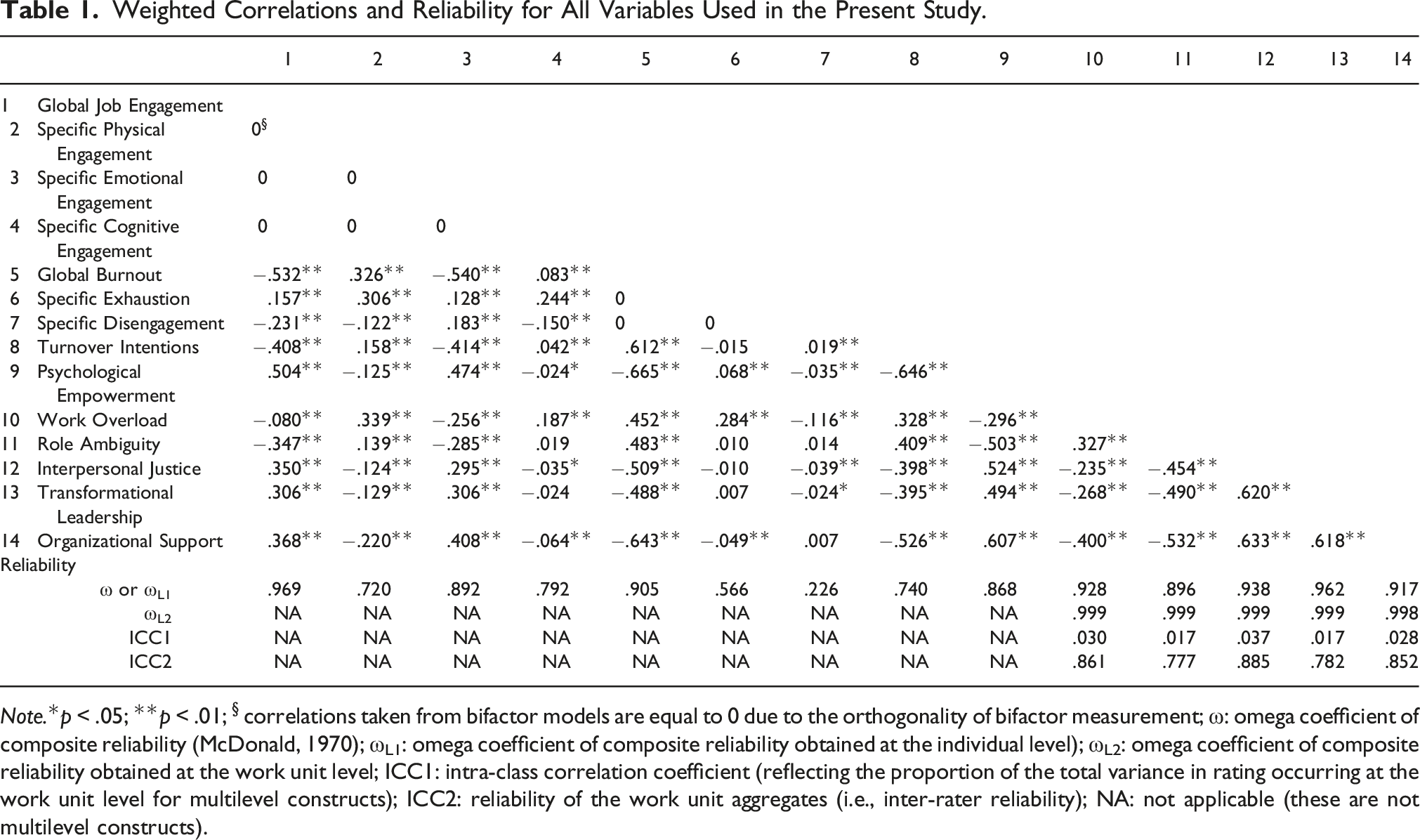
Note.*p < .05; **p < .01; § correlations taken from bifactor models are equal to 0 due to the orthogonality of bifactor measurement; ω: omega coefficient of composite reliability (McDonald, 1970); ωL1: omega coefficient of composite reliability obtained at the individual level); ωL2: omega coefficient of composite reliability obtained at the work unit level; ICC1: intra-class correlation coefficient (reflecting the proportion of the total variance in rating occurring at the work unit level for multilevel constructs); ICC2: reliability of the work unit aggregates (i.e., inter-rater reliability); NA: not applicable (these are not multilevel constructs).
More precisely, although the first-order model was able to achieve an acceptable level of fit to the data, the bifactor model with two G-factors (burnout and engagement) and five S-factors (emotional exhaustion, disengagement, cognitive engagement, emotional engagement, and physical engagement) was able to achieve a better level of fit across all indicators. This bifactor solution revealed two G-factors that were both well-defined by strong positive loadings from all items (λ = .538 to .797 for burnout and λ = .587 to .791 or job engagement). Over and above this G-factor, four S-factors retained a satisfactory level of specificity: Physical engagement (λ = .279 to .519), emotional engagement (λ = .481 to .695), cognitive engagement (λ = .209 to .505), and exhaustion (λ = .265 to .482). In contrast, the S-disengagement factor (|λ| = .041 to .455) appeared to be weakly defined, suggesting that disengagement ratings mainly served to define G-levels of burnout, and only retained a limited amount of specificity when these G-levels were taken into account. The fact that this S-factor retained less specificity does not mean that it has no meaning, especially when modeled using an approach that explicitly controls for both measurement errors and associations with the G-burnout construct, such as the approach taken in the present study. It should also be noted that, despite this low level of specificity, the factor scores used as input to our main analyses remain corrected for measurement errors (e.g., Skrondal & Laake, 2001; Morin et al., 2020).
Latent Profile Analyses (LPA)
The procedures used to select the optimal number of latent profiles present in our data is fully disclosed in Appendix C of the online supplements and led to the selection of a five-profile solution in which the means of the profile indicators were allowed to differ across profiles. Multilevel relations (Finch & French, 2014; Mäkikangas et al., 2018) between the L1 predictors and participants’ likelihood of membership in the various profiles, as well as between L2 predictors and the relative frequency of each profile occurring at the work unit level were assessed with a multilevel multinomial logistic regression link function based on the direct inclusion of the predictors into the final LPA solution (Diallo, Morin, & Lu, 2017). The profiles were also contrasted in relation to participants’ turnover intentions, which were directly included to the final solution, using the multivariate delta method (Raykov & Marcoulides, 2004). Annotated Mplus inputs, used to estimate our main analytic models, and are reported in Appendix D of the online supplements.
Results
Latent Profiles
The results from the five-profile solution are illustrated in Figure 1 (see Appendix C of the online supplements for details). The first profile was characterized by high global levels of burnout (1.25 SD above the sample mean) and low global levels of job engagement (2 SD under the average), coupled with close to average to moderately low specific levels of job engagement across dimensions (between .2 and .6 SD under the average), moderately low specific levels emotional exhaustion (.5 SD under the average), and high specific levels of disengagement (.6 SD above the average). This means that employees’ levels of emotional, physical, and cognitive job engagement are moderately lower than their global levels of job engagement across dimensions, suggesting that these employees do not feel the need to invest any specific resource beyond their already low levels of job engagement. Similarly, employees’ levels of emotional exhaustion are moderately lower than their global levels of burnout across dimensions, indicating that these employees do not feel exertion going beyond their levels of burnout. In contrast, employees’ levels of disengagement were higher than their levels of global burnout across dimensions, suggesting feelings of disengagement or demoralization going beyond their global levels of burnout. This Burned-Out/Disengaged profile was the smallest, corresponding to 7.13% of the employees, and shared similarities with the disengaged-underchallenged and worn-out profile identified in previous research (e.g., Abós et al., 2019; Mäkikangas & Kinnunen, 2016). Final Five-Profile Solution. Note. Profile indicators are factor scores with a mean of 0 and a standard deviation of 1.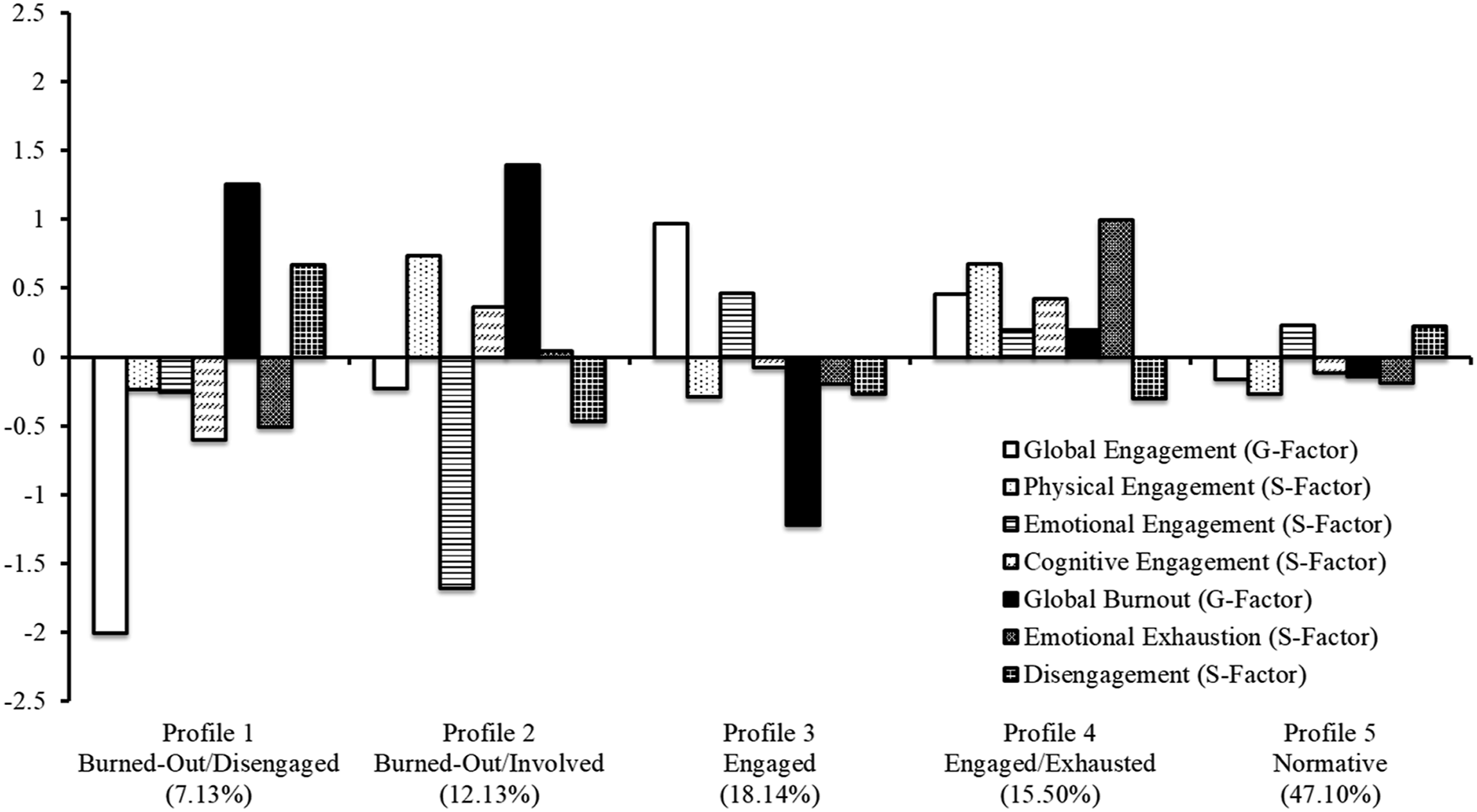
The second profile was also characterized by high global levels of burnout (+1.4 SD), but only by close to average levels (−.2 SD) of job engagement. In addition, employees’ corresponding to this profile presented moderately high to high specific levels of physical (+.7 SD) and cognitive (+.4 SD) engagement, coupled with specific levels of emotional exhaustion corresponding to the sample average, moderately low specific levels of disengagement (−.5 SD), and low specific levels of emotional engagement (−1.5 SD). This Burned-Out/Involved profile was slightly larger, corresponding to 12.13% of the employees, and was similar to the highly engaged and highly frenetic (Abós et al., 2019) and highly engaged and exhausted (Moeller et al., 2018) profile identified in previous research. The third profile presented a diametrically opposite configuration, with high global levels of job engagement (+1 SD) and low global levels of burnout (−1.2 SD), moderately high specific levels of emotional engagement (+.5 SD) and slightly below average specific levels on the remaining dimensions (0 to −.3 SD). This Engaged profile corresponded to 18.14% of the sample, and matched similar profiles identified in previous research (Moeller et al., 2018; Salmela-Aro et al., 2019).
The fourth profile was characterized by slightly above average global levels of burnout (+.2 SD) and job engagement (+.5 SD), coupled with low specific levels of disengagement (−.3 SD), and moderately high (+.2 SD) to high (+1 SD) specific levels of physical engagement, emotional engagement, cognitive engagement, and emotional exhaustion. This Engaged/Exhausted profile corresponded to 15.50% of the employees, and shared similarities with the highly engaged and moderately frenetic profile previously identified by Abós et al. (2019). The fifth profile was the largest (47.10%) and was characterized by close to average levels (−.3 SD to +.2 SD) across all dimensions, being neither engaged nor disengaged, and neither burned-out nor energized. This Normative profile thus characterized close to half of the employees for whom work is neither an occasion for high levels of involvement, nor a context that drags them down. A similar Normative profile was previously identified in work engagement research (Gillet et al., 2019a), as well as in research focusing on related constructs (need satisfaction: Gillet et al., 2019b; health and well-being: Morin et al., 2016b, 2017).
Turnover Intentions
Turnover intentions differed in a statistically significant (p ≤ .05) manner across all profiles. These levels were highest in the Burned-Out/Disengaged profile (1.192; 95% confidence interval [CI] = 1.141–1.243), closely followed by the Burned-Out/Involved profile (1.082; CI = 1.030–1.134), then by the Engaged/Exhausted profile (.083; CI = .033 to .133), followed by the Normative profile (−.104; CI = −.143 to −.065), with the lowest levels observed in the Engaged profile (−1.031; CI = −1.082 to −.980).
Job Demands and Resources
Results from the Predictive Analyses.
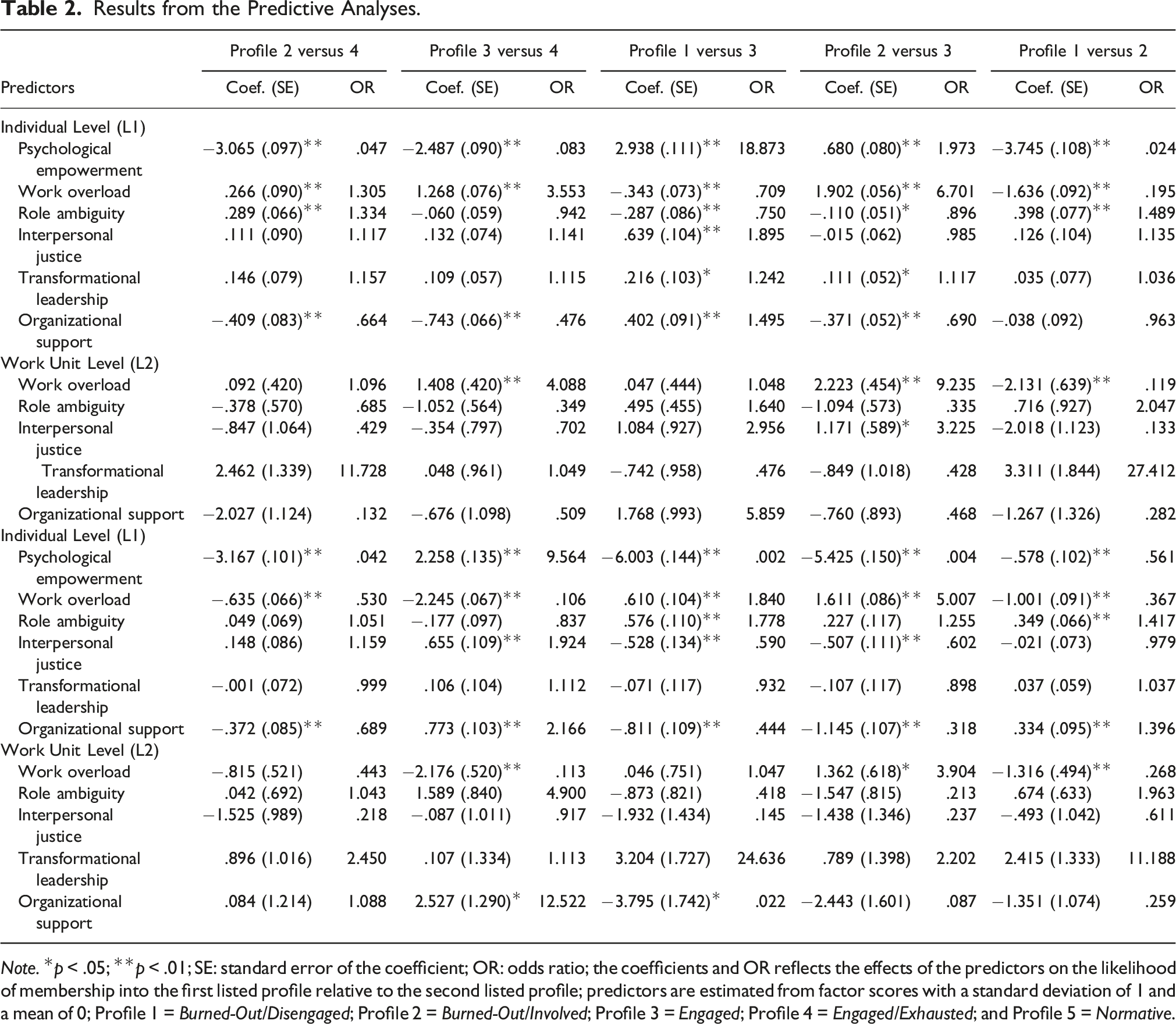
Note. *p < .05; **p < .01; SE: standard error of the coefficient; OR: odds ratio; the coefficients and OR reflects the effects of the predictors on the likelihood of membership into the first listed profile relative to the second listed profile; predictors are estimated from factor scores with a standard deviation of 1 and a mean of 0; Profile 1 = Burned-Out/Disengaged; Profile 2 = Burned-Out/Involved; Profile 3 = Engaged; Profile 4 = Engaged/Exhausted; and Profile 5 = Normative.
In terms of job demands, inter-individual deviations in perceptions of work overload at the individual level were systematically associated with the likelihood of membership into all of the profiles in a manner that was the direct opposite of psychological empowerment. More precisely, higher work overload perceptions were linked to an increased likelihood of membership into the Burned-Out/Disengaged (1) profile relative to all other profiles, followed by the Burned-Out/Involved (2) profile, then by the Normative (5) profile, followed by the Engaged/Exhausted (4) profile, and finally by the Engaged (3) profile. Inter-individual deviations in perceptions of the role ambiguity displayed a similar, yet not as widespread, pattern of associations with the likelihood of profile membership. More precisely, higher role ambiguity perceptions were associated an increased likelihood of membership into the Burned-Out/Disengaged (1) profile relative to all other profiles, as well as into the Normative (5) profile relative to the Engaged (3) and Engaged/Exhausted (4) profiles.
For job resources, inter-individual deviations in perceptions of interpersonal justice at the individual level were linked to an increased likelihood of membership into the Engaged (3) profile relative to all other profiles, whereas deviations in perceptions of transformational leadership were associated with an increased likelihood of membership into the Engaged (3) and Engaged/Exhausted (4) profiles relative to the Normative (5) profile. The effects of inter-individual deviations in perceptions of the organizational support were, however, more widespread. More precisely, these perceptions were related to an increased likelihood of membership into the Engaged (3) profile relative to all other profiles, followed by the Normative (5) profile, and then equally by the Engaged/Exhausted (4) and Burned-Out/Disengaged (1) profiles, and finally by the Burned-Out/Involved (2) profile.
Results were not as numerous at the work unit level. In terms of job demands, work unit levels of work overload were associated a higher frequency of occurrence of the Burned-Out/Involved (2) profile relative to the Engaged (3), Normative (5), and Burned-Out/Disengaged (1) profiles, as well as into Engaged/Exhausted (4) profile relative to the Normative (5) and Burned-Out/Disengaged (1) profiles. Work overload was also related to a higher frequency of occurrence of the Engaged (3) profile relative to the Engaged/Exhausted (4) profile. In contrast, work unit levels of role ambiguity did not predict the relative frequency of occurrence of any profile. In terms of job resources, work unit levels of interpersonal justice were linked to a higher frequency of occurrence of the Engaged/Exhausted (4) profile relative to the Normative (5) profile, whereas work unit levels of transformational leadership did not predict the relative frequency of occurrence of any profile. Finally, work unit levels of organizational support were related to a higher frequency of occurrence of the Engaged (3) profile relative to the Burned-Out/Disengaged (1) and Engaged/Exhausted (4) profiles.
Discussion
The dual global and specific multidimensional nature of job engagement and burnout is well established in research. Job engagement can be seen as a global construct, which also encompasses physical, cognitive, and emotional facets (Rich et al., 2010), just like burnout can be viewed as a global construct minimally encompassing emotional exhaustion and disengagement (Demerouti et al., 2010). However, despite the widely acknowledged recognition of the complementary role played by these two multidimensional constructs in shaping employees’ psychological functioning (Salmela-Aro et al., 2019), the most typical configurations taken by the combination of the global and specific facets of job engagement and burnout among distinct profiles of employees remain essentially unknown. The present study sought to address this limitation while building on recent person-centered research conducted on burnout (Berjot, Altintas, Grebot, & Lesage, 2017; Guidetti, Viotti, Gil-Monte, & Converso, 2018; Laverdière, Kealy, Ogrodniczuk, & Morin, 2018; Leiter & Maslach, 2016; Portoghese et al., 2018), job engagement (Gillet et al., 2019a, 2020c; Simbula, Guglielmi, Schaufeli, & Depolo, 2013), and both constructs (see Table S1 in the online supplements) without relying on a comprehensive operationalization of their multidimensionality (Abós et al., 2019; Mäkikangas et al., 2012; 2014; 2017; Moeller et al., 2018; Salmela-Aro et al., 2019). To document the practical relevance and construct validity of these profiles, we also considered their implications for turnover intentions and adopted a multilevel perspective to investigate the role of job demands and resources in the prediction of profile membership.
Employees’ Profiles of Job Engagement and Burnout (Research Questions 1 and 2)
Our results revealed that five distinct profiles best represented the job engagement and burnout configurations observed among a nationally representative sample of Canadian Defence employees: (1) Burned-Out/Disengaged; (2) Burned-Out/Involved; (3) Engaged; (4) Engaged/Exhausted; and (5) Normative. These profiles generally matched our expectations, anchored in the results obtained as part of prior person-centered studies summarized in Table S1. Despite this similarity, the nature of these profiles also emphasizes the importance of adopting a finer-grained representation of job engagement and burnout by simultaneously considering both their global levels and the specific nature of their different components. When considering our results, it is important to keep in mind that the specific facets of both constructs no longer reflect the whole variance shared among the items from these subscales. Rather, while they retain a similar meaning, these specific facets now represent the degree of discrepancy (or imbalance) between employees’ raw scores on each subscale and their global levels of engagement and burnout. In this regard, our results showed that four out of five of the profiles identified in this study were characterized by a configuration in which employees’ specific levels on various job engagement and burnout components deviated from their global levels of job engagement and burnout, and from the sample average. This result suggests that job engagement and burnout levels tend to deviate across dimensions beyond their ability to depict a common core. These deviations may explain why no profile was identified in which employees experienced high (or low) and matching levels of job engagement and burnout across dimensions.
More specifically, our results also showed that a more imbalanced configuration of specific facet scores seemed to be associated with profiles displaying high global levels of burnout (Burned-Out/Disengaged and Burned-Out/Involved), whereas a more balanced configuration seemed to accompany the Normative profile in which global levels of burnout and job engagement were closer to the sample average. Between these two extremes, the two profiles characterized by higher global levels of job engagement (Engaged and Engaged/Exhausted), while showing some variation across specific facets, still displayed a far more aligned configuration than the Burned-Out/Disengaged and Burned-Out/Involved profiles. Taken together, these results suggest that global levels of burnout played a greater role in creating imbalanced levels of psychological health across dimensions relative to global levels of job engagement. Yet, a comparison between the Engaged and Engaged/Exhausted profiles shows that engaged employees who go beyond the call of duty in terms of physical engagement without backing up this physical engagement with matching levels of emotional and cognitive engagement appear to be at higher risk of experiencing emotional exhaustion than employees experiencing more balanced levels of engagement.
A key take-home message from the present study is that the similarity between the current results and those obtained in the context of previous studies (see Table S1) relying on different measures and methodological approaches reinforces the robustness of our findings, and the idea that the current profiles might be generalizable enough to support interventions seeking to maximize employees’ likelihood of experiencing more desirable profiles. Beyond similarity, however, the differences and specificities between our results and previous ones supports the need to rely on a precise operationalization of the multidimensional nature of job engagement and burnout. By providing the first direct source of evidence of job engagement and burnout profiles defined according to their recently recommended bifactor operationalization (e.g., Gillet et al., 2020c; Isoard-Gautheur et al., 2018), the present study represents an important step forward in job engagement and burnout research. Indeed, the reliance on a more traditional approach (ignoring the dual global and specific nature of job engagement and burnout) would have simply resulted in the estimation of profiles suggesting that there was little value in considering the unique nature of each dimension over and above these global levels. In contrast, our results show that both components play a key role in the definition of job engagement and burnout profiles, and thus bring valuable information to our understanding of job engagement and burnout.
The Implications of the Profiles for Turnover Intentions (Research Question 3)
Supporting the meaningfulness of these profiles, our results revealed that they shared well-differentiated associations with turnover intentions in a way that matched our expectations and previous results see Table S1). Indeed, employees presenting the lowest levels of global job engagement coupled with high levels of global burnout (Burned-Out/Disengaged) displayed the highest turnover intentions, whereas Engaged employees presented the lowest turnover intentions. More generally, employees characterized by high global levels of burnout (Burned-Out/Disengaged and Burned-Out/Involved) were subjected to higher turnover intentions than those characterized by low to moderate global levels of burnout (Engaged, Engaged/Exhausted, and Normative). It is noteworthy that the turnover intentions observed in the Normative profile were lower than in the Engaged/Exhausted profile, suggesting that globally high levels of engagement are not enough to limit the risks of turnover intentions, at least when accompanied by above average levels of burnout. Indeed, experiencing a globally average job engagement and burnout configuration seems to limit turnover intentions to a greater extent than presenting a highly engaged, but exhausted, configuration. This result suggests that a highly engaged configuration might sometimes contribute to increase employees’ risks of emotional exhaustion (e.g., Bakker & Demerouti, 2017).
On the one hand, these results reinforce the idea that more aligned levels of job engagement and burnout yield higher benefits in terms of turnover intentions. The idea that alignment among these components could be, in some situations, more important than overall levels of psychological functioning has been previously documented in self-determination theory (e.g., Gillet et al., 2019b) and job engagement (e.g., Gillet et al., 2019a, 2020c) research. Our results demonstrate that these observations extend to a more comprehensive consideration of psychological functioning, encompassing burnout and job engagement. This observation suggests that this form of balance could stem from a more adequate allocation of one’s psychological resources at work, which is known to help reduce stress and recovery. On the other hand, the Normative profile also presented more pronounced turnover intentions than the Engaged profile. This second observation suggests that, despite the aforementioned benefits of alignment in terms of psychological functioning, some degree of imbalance reflecting a more engaged work orientation might still be beneficial for some outcomes, such as reducing turnover intentions. These observations clearly reinforce the need for future research to consider a much broader range of desirable (e.g., in-role and extra-role behaviors) and undesirable (e.g., absenteeism, sabotage, or work–family conflicts) outcomes.
A Multilevel Perspective on the Impact of Job Demands and Resources (Research Questions 4 and 5)
Individual-level predictions
Our results supported the role of interpersonal justice, transformational leadership, organizational support, and psychological empowerment as key drivers of psychological functioning at work (e.g., Colquitt et al., 2013; Eisenberger & Stinglhamber, 2011; Montano et al., 2017; Seibert et al., 2011). More specifically, individual levels of psychological empowerment, perceptions of interpersonal justice, and perceptions of organizational support were associated with membership into the Engaged profile, consistent with variable-centered evidence supporting the role of these resources in the prediction of job engagement and burnout (Calvo & García, 2018; Gillet et al., 2013, 2018a). Likewise, employees’ perceptions of transformational leadership were associated with the Engaged/Exhausted and Engaged profiles, relative to the Normative one, supporting the benefits of transformational leadership on job engagement (Montano et al., 2017). More generally, and as expected (e.g., Xanthopoulou et al., 2009), psychological empowerment, as an individual resource, had stronger, and more widespread, effects on job engagement and burnout than the remaining job demands and resources considered in the present study.
In contrast, and unexpectedly, perceptions of organizational support were associated with an increased likelihood of membership into the Burned-Out/Disengaged profile relative to the Burned-Out/Involved profile. Our results thus show that inter-individual differences in the perception of organizational support may be detrimental to their global engagement, especially among burned-out employees. This result is interesting given that prior variable-centered research has unanimously positioned perceived organizational support as a positive driver of psychological health in a “the more, the better” perspective (e.g., Caesens, Stinglhamber, & Luypaert, 2014). In fact, this assumption is so strong that possible ceiling effects to the benefits of organizational support in terms of psychological health have yet to be empirically verified (Morin et al., 2013).
Nevertheless, Caesens et al.’s (2020) recent findings suggest that high levels of social support perceptions might be detrimental in some situations. This “too much of a good thing” interpretation is aligned with prior variable-centered results revealing curvilinear relations between employees’ perceptions of organizational support and their levels of affective organizational commitment, trust, in-role performance, taking charge behaviors, extra-role performance, and deviance (Burnett, Chiaburu, Shapiro, & Li, 2015; Harris & Kacmar, 2018). Just like here, these studies reveal that higher levels of perceived organizational support are not always associated with more desirable outcomes. In line with this, Gillet et al. (2019b) also found that perceived organizational support was negatively related to specific levels of imbalance in the satisfaction of employees’ need for competence. They interpreted this result by suggesting that higher levels of perceived organizational support could lead employees to believe that their organization has doubts regarding their competence, ultimately leading to negative consequences (e.g., lower global levels of job engagement). What the present results suggest is that these undesirable effects of organizational support perceptions might be particularly marked among burned-out employees. Clearly, additional studies are needed to replicate the present results and to identify the mechanisms underlying these unexpected relations.
In terms of job demands, inter-individual differences in perceptions of work overload and role ambiguity were related to membership into the arguably least desirable Burned-Out/Disengaged profile, in accordance with variable-centered evidence showing that job demands are positively related to burnout and negatively related to job engagement (Bakker & Demerouti, 2017; Schaufeli & Bakker, 2004). Work overload and role ambiguity were also associated with membership into the Normative profile relative to the Engaged and Engaged/Exhausted profiles, thus supporting the detrimental effects of job demands on job engagement demonstrated in past studies (e.g., Reinke & Chamorro-Premuzic, 2014).
Work unit-level predictions
To answer repeated calls for increases in multilevel research focusing on the effects of job demands and resources (e.g., Bakker & Demerouti, 2007), we examined the role of work overload, role ambiguity, interpersonal justice, transformational leadership, and organizational support at the work unit level in the prediction of the relative frequency of occurrence of the profiles at the work unit level. Supporting the documented role of work overload in the emergence of burnout (e.g., Reinke & Chamorro-Premuzic, 2014), our results showed that work overload was associated with membership into the Burned-Out/Involved and Engaged/Exhausted profiles. This observation is consistent with the idea that the efforts required to cope with job demands can deplete employees’ psychological resources, thus increasing their risk of psychological difficulties (Crawford et al., 2010). In addition, Engaged/Exhausted employees displayed above average scores on the specific cognitive and physical (but not emotional) job engagement factors. As both specific factors might reflect exertion and fatigue resulting from the expenditure of extra efforts going beyond employees’ global levels of job engagement, it is not surprising that work overload predicted a higher likelihood of membership in this profile.
Surprisingly, work overload was also related to an increased likelihood of membership into the Burned-Out/Involved profile relative to the Burned-Out/Disengaged profile, into the Engaged/Exhausted profile relative to the Burned-Out/Disengaged profile, and into the Engaged profile relative to the Engaged/Exhausted one. Contrary to the unilaterally undesirable effects of individual perceptions of work overload, these results suggest that work unit levels of work overload might also have positive effects on global levels of job engagement among specific subtypes of employees. Although job demands have long been considered to have only negative effects on employees’ engagement, there is growing evidence that they can sometimes trigger motivational gains (LePine, LePine, & Jackson, 2004). Work overload, for instance, has been found to be positively related to job engagement, showing its motivating (i.e., challenging) potential (Crawford et al., 2010). Indeed, challenge demands have the potential to support growth and to foster the achievement of personal goals (LePine, Podsakoff, & LePine, 2005), thus nurturing job engagement. Because challenge demands enhance opportunities for future gains, investing resources (e.g., energy) may be beneficial (Crawford et al., 2010). Beyond these considerations, what the present result suggests is that the motivational effects of work overload might be limited to shared perceptions of work overload occurring at the work unit level, suggesting that equity could be critical to these benefits (Colquitt et al., 2013). In contrast, feelings of having a larger workload than one’s colleagues seem to lead to more unilaterally undesirable effects. Indeed, equity in workload might provide a more fertile ground for employees’ perception of this job demand in challenging terms, whereas inequity might lead them to perceive their unique work overload as hindering their performance in relation to that of other team members. As mentioned above, it would also be interesting for upcoming studies to consider how employees’ levels of autonomous and controlled work motivation may contribute to explain the differential effects of work overload at the individual and work unit level (e.g., Gillet et al., 2016b). More generally, future research is needed to examine the multilevel role of other challenge (e.g., information processing, problem solving) and hindrance (e.g., interruptions, harassment) demands in predicting job engagement and burnout profiles.
In contrast, role ambiguity and transformational leadership were unrelated to the frequency of profile occurrence at the work unit level. This result differs from that of previous variable-centered research (e.g., De Clercq, 2019; Montano et al., 2017), which could be explained by our adoption of a multivariate perspective in which various job demands and resources are simultaneously considered. Adopting a multivariate perspective means that all of the variance that is shared among the various predictors is controlled for (once the moderate correlations among them, as shown in Table 2, are accounted for), allowing for a more precise identification of the unique contribution of the most potent predictors. More precisely, what the present results suggest is that these specific job demands and resources do not seem to further contribute to the prediction of the relative frequency of occurrence of the profiles at the work unit level once the effects of other, arguably more potent, types of job demands and resources are considered. These findings encourage researchers to look at how various job demands and resources uniquely contribute to employees’ job engagement and burnout profiles.
Finally, work unit levels of interpersonal justice were related to an increased likelihood of membership into the Engaged/Exhausted profile relative to the Normative profile, while organizational support was associated with an increased likelihood of membership into the Engaged profile relative to the Burned-Out/Disengaged and Engaged/Exhausted ones. As in prior studies (Gillet et al., 2013, 2018a), these findings confirm that interpersonal justice and organizational support have positive effects on global levels of job engagement. These results also suggest that the previously identified limits to the benefits of organizational support perceptions might be limited to the individual level and fail to generalize to perceptions of organizational support shared among work unit members. More unexpected was the observation that shared interactional justice perceptions, at the work unit level, increased the likelihood of membership into an engagement profile that was also exhausted (rather than simply engaged). This observation suggests that work units characterized by a more positive interpersonal justice climate might contribute to push engaged employees to invest more of their personal resource than they should. Thus, beyond the benefits of interpersonal justice in terms of job engagement, organizations should be aware that in this context some of their most engaged employees might need support to avoid exhaustion. However, future research is needed to better understand the mechanisms underpinning this unexpected effect and to empirically verify whether and how these conclusions generalize to other job resources (e.g., psychological safety, contingent reward, and interpersonal respect culture). More generally, conclusions generally converge in showing that both levels of analyses (i.e., inter-individual differences in perceptions and shared perceptions at the work unit level) played a complementary and non-redundant role in the prediction of job engagement and burnout profiles, but also that the role of individual perceptions seemed to be slightly greater than that of work unit aggregates.
Limitations and Directions for Future Research
Even though this study represents the first systematic attempt to investigate the nature, predictors, and outcomes of employees’ job engagement and burnout profiles while relying on a methodological approach allowing us to properly disaggregate the global and specific components of these multidimensional constructs, limitations remain. First, the present study relied entirely on self-reports, raising possible concerns regarding the possible impact of various forms of self-report biases and social desirability. It would thus seem desirable for researchers to incorporate more objective, or multi-informant, measures to future investigations of similar issues. Second, although we have no reason to expect that our results would differ among other samples of employee (which is supported by the similarity between the nature of the profiles observed in this study relative to previous studies relying on different measures and methods), this study was conducted within a Canadian military organization which still serves to limit the generalizability of our findings. As a result, it would be important for future research to systematically verify the replicability of our results among more diversified samples of workers from different types of organizations (e.g., less hierarchical or authoritarian, or without the same level of job security and benefits) and cultures. The ability to demonstrate generalizability is important to support the value of interventions inspired by person-centered solutions. Third, we relied on a cross-sectional research design which made it impossible to verify the directionality of the observed associations, or even the possibility of changes. Although predictors or outcomes were selected based on their theoretical relevance (Bakker & Demerouti, 2017), it remains important for future research to extend our results longitudinally. Fourth, the novelty of our inductive approach made it impossible to rely on an a priori selection of predictors or outcomes that would allow us to precisely tease apart the qualitative differences observed between our profiles. Based on our results, we suggest that future research might benefit from a consideration of a wider set of outcomes (e.g., job performance, work–family conflicts) and from predictors likely to explain the specificity of the identified profiles (e.g., factors likely to explain involvement among otherwise burned-out employees or exertion among otherwise engaged employees). Finally, we considered the role of work characteristics at the individual and work unit levels in the prediction of employees’ likelihood of membership into the various profiles identified here. Alternative, and complementary, approaches would include the investigation of work unit profiles characterized by different frequencies of occurrence of individual profiles, as well as investigating work unit profiles characterized by distinctive sets of job demands and resources (e.g., Collie, Malmberg, Martin, Sammons, & Morin, 2020; Mäkikangas et al., 2018).
Practical Implications for Assessment, Research, and Intervention
In terms of research, the present investigation highlights the importance of accounting for the dual global and specific nature of employees’ multidimensional ratings of burnout and job engagement. Ignoring this dual nature might lead to the erroneous conclusion that each specific component of these two constructs are relatively independent from one another and result in similar effects caused in fact by employees’ global levels of burnout and job engagement. More concerning is the fact that these apparently comparable effects could mask the unique role played by each specific component beyond this global level. For applied researchers, this observation is particularly worrisome, given that biased results may serve as guides for the development of incomplete, or improper, interventions tailored at distinct profiles of employees defined by their global levels of burnout and job engagement while completely ignoring the specificities related to their unique manifestations of burnout and engagement.
In terms of measurement, our results pinpoint the value of adopting a bifactor operationalization of burnout and job engagement. Indeed, the failure to do so is likely to increase the risk of multicollinearity by the estimation of construct scores reflecting a confusing combination of global and specific components. Importantly, although bifactor models can separate the variance of both constructs shared across dimensions from the unique role of each specific dimension, the meaning of these global and specific dimensions remains the same as in more traditional approaches. Although it is reasonably simple to adopt this recommendation in research, practical applications of a bifactor operationalization for scoring purposes are not as straightforward. Indeed, the ability to score employees’ ratings of burnout and job engagement will require the development of online calculators, developed based on results from more representative normative samples. Although Perreira et al. (2018) rightly note that the Mplus statistical package can be used to generate factor scores (using the results from this, or any other, bifactor investigation of burnout or job engagement), this approach still requires samples of participants and will not work using ratings obtained from individual employees. In the meantime, this means that the practical implications will have to remain focused on a more “holistic” assessment of employees’ profiles and on practitioners’ ability to grasp the general principles identified in this study.
In terms of intervention and practice, this study reinforces the value of managerial practices seeking to reduce burnout and nurture engagement. Managers need to pay attention to employees feeling exposed to particularly high workloads, or who lack the ability or opportunity to adopt a volitional approach at work (i.e., low psychological empowerment). These individuals seem to be at risk of experiencing low global levels of job engagement coupled with high global levels of burnout, leading them to develop higher turnover intentions. Care should be taken to ensure that any unforeseen increase in workload be shared, in a reasonably equitable manner, among colleagues. Changes in the work organization designed to increase psychological empowerment might sustainably increase job engagement and decrease burnout levels in the long run. For instance, moving towards or enhancing high-involvement managerial systems (e.g., performance-related remuneration schemes) may help to improve employees’ psychological empowerment (Rehman, Ahmad, Allen, Raziq, & Riaz, 2019). Organizations should also allocate resources to enactive mastery experiences, promote self-directed decision-making, and create opportunities for personal growth. Efforts to promote justice perceptions in terms of workload allocations also seem promising (Emery, Booth, Michaelides, & Swaab, 2019).
Moreover, our findings suggest that initiatives seeking to increase employees’ perceptions of organizational support at work are likely to have widespread benefits when care is taken to ensure that this increase is perceived equivalently by all work unit members. Among possible ways to achieve this objective, top management might promote a supportive culture within their organization, for instance, by providing employees with the resources or materials they need to perform their job effectively, by providing useful training and developmental programs, by providing assurance of security during stressful times, and by promoting justice and fairness in the way policies are implemented and rewards distributed (Eisenberger & Stinglhamber, 2011). Importantly, care should be taken to maximally limit perceptions of inequity in the availability of these improved support mechanisms. Finally, programs designed to sensitize managers to the benefits of adopting a more transformational approach, and to provide them with tools on how to implement such an approach, might prove beneficial.
Supplemental Material
Supplemental Material - A Multilevel Person-Centered Perspective on the Role of Job Demands and Resources for Employees’ Job Engagement and Burnout Profiles
Supplemental Material for A Multilevel Person-Centered Perspective on the Role of Job Demands and Resources for Employees’ Job Engagement and Burnout Profiles by Nicolas Gillet, Alexandre J. S. Morin, and Ann-Renée Blais in Group & Organization Management
Footnotes
Declaration of Conflicting Interests
The author(s) declared no potential conflicts of interest with respect to the research, authorship, and/or publication of this article.
Funding
The author(s) disclosed receipt of the following financial support for the research, authorship, and/or publication of this article: Preparation of this paper was supported by grants from the Canadian Institute for Military and Veteran Health Research (CIMVHR) and from the Social Science and Humanities Research Council of Canada (435-2018-0368).

Supplemental Material
Supplemental material for this article is available online.
Associate Editor: Simon Restubog
Author Biographies
References
Supplementary Material
Please find the following supplemental material available below.
For Open Access articles published under a Creative Commons License, all supplemental material carries the same license as the article it is associated with.
For non-Open Access articles published, all supplemental material carries a non-exclusive license, and permission requests for re-use of supplemental material or any part of supplemental material shall be sent directly to the copyright owner as specified in the copyright notice associated with the article.
