



Abstract
Managers use idiosyncratic deals (i-deals) to motivate and retain employees. Yet we know little about the subsequent effects i-deals have on decisions about pay raises and promotions. Two studies investigate how managers make pay raise and promotion decisions for workers with i-deals. Using a policy-capturing design, managers (N = 116) made pay raise and promotion allocations for workers presented as good performers, based on information provided regarding whether and what type of i-deal workers had and the extent to which they helped peers. Developmental i-deal recipients tend to be recommended for both pay raises and promotions, while such recommendations are less likely for employees with flextime i-deals (for promotions) or reduced workload i-deals (for promotions and pay raises). In addition, workers with i-deals who help their peers are viewed more favorably in both decisions. The second study surveyed managers (N = 174) regarding their actual subordinates (N = 806), both controlled for the manager’s rating of subordinate performance. It supports the positive effect of developmental i-deals on pay and promotion decisions, but not the negative effects of flextime and reduced workload i-deals. Helping effects depend on the i-deal: Managers report that unhelpful recipients of developmental i-deals are less likely to be promoted than those with such i-deals who help their peers; unhelpful recipients of reduced workload i-deals are less likely to get pay raises than those with such deals who help. We discuss the implications of our findings for future research and career management.
Idiosyncratic deals (i-deals for short) are often used to attract and retain employees and motivate high performance (People Scout, 2016). I-deals refer to customized employment conditions negotiated between an employee and the employer (Rousseau, Ho, & Greenberg, 2006), ranging from small adjustments to completely individualized arrangements (Rousseau, 2005). I-deals promote flexibility at work (Lee, Bachrach, & Rousseau, 2015) and are increasingly common (Kalleberg, Reskin, & Hudson, 2000). Nonetheless, ethnographic studies note the potential perils of customized arrangements for a worker’s future career opportunities (Hochschild, 1997; Perlow, 1997). The crux of their findings is the adverse judgments managers make in evaluating recipients of customized arrangements relative to coworkers with more standard employment arrangements. To date, however, little research examines how i-deals affect the decisions managers make regarding the rewards employees receive after being granted an i-deal, an omission we remedy.
Managers frequently find themselves needing to balance paradoxical demands for both consistency across subordinates and responsiveness to individual needs (Fu et al., 2020; Rousseau, Tomprou, & Simosi, 2016). Consistency is central to perceptions of fairness in reward allocations (Colquitt et al., 2013), reflecting the extent to which treatment is equitable and applies the same standards across persons. In granting an i-deal, managers have been theorized to consider how fair coworkers might judge the i-deal to be as well as the burdens it may create for them (Laulié et al., 2019; Rousseau et al., 2006). Indeed, anticipated effects on third parties can lead managers to view i-deals as problematic as they try to be consistent across their subordinates but also responsive to their needs (Rousseau, 2005). Responsiveness reflects concern for the needs and preferences of individuals, allocating certain conditions of employment to those who value them more (Rousseau, 2005). Thus, by negotiating for customized employment conditions, i-deal recipients may alter their relative standing with respect to coworkers in terms of contributions made to the organization, making it more difficult for managers to treat subordinates equally in allocating future rewards like raises and promotions. I-deals, while responsive to individuals, may undermine consistency, particularly when the customization granted to one worker makes them less compliant with organizational norms regarding employee behavior or creates burdens on coworkers who must pick up the slack. Nonetheless, research on managers finds that those who balance consistency with responsiveness have higher subordinate performance than do line managers emphasizing consistency or responsiveness alone (Fu et al., 2020).
In light of the issues past research raises regarding the risks flexibility can pose for future careers (Dreher & Cox, 2000; Hochschild, 1997; Perlow, 1997), the potential normative noncompliance by those with i-deals, and the burdens such deals can create on coworkers, we consider that i-deals may affect subsequent managerial decisions about pay raise and promotion. In investigating these potential effects, we make three contributions. First, we seek to provide evidence of how managers make pay raise and promotion decisions in the context of i-deals. As managers are tasked with making decisions that benefit the organization, these decisions can be swayed by the manager’s frame of reference and available information. Granting i-deals is likely to affect the comparisons managers make in allocating rewards among their subordinates. Yet, at present, we know little of how i-deals contribute to managerial reward allocations.
Second, we contribute to research on managerial decisions (e.g., Hitt & Barr, 1989) regarding promotability and pay raise by examining an overlooked effect of types of i-deal. Scholars report difficulty in accounting for raises given to individual workers due to their differences in skills, contributions, and job duties (Kaufman & Hotchkiss, 2003; Krueger & Summers, 1988). Such differences complicate the equitable allocation of rewards based on the inputs individual employees provide. By examining decisions made in the context of i-deals, we call attention to how specific customized arrangements can complicate pay decisions where such deals can lead managers to attribute different contributions to i-deal recipients than to their peers. For example, while a deal to provide one worker with advanced training can be viewed as increasing the value of their contributions, another deal to reduce the duties another worker performs may lower billable hours or require more effort by coworkers. Similarly in the context of promotions, aside from differences in seniority and organization-specific skills (Baker et al., 1994; Kaufman & Hotchkiss, 2003; Lazear, 1981), theory and research on promotions are largely silent on how differences among workers factor into promotion decisions. In the present study, we investigate the effect of i-deals on pay and promotion decisions while controlling for employee in-role job performance. Doing so sheds light on the implicit policies managers apply to workers having different i-deals.
Third, we investigate the role of help given to peers by the i-deal recipient as a contributing factor in the effect i-deals have on pay raise and promotion decisions. I-deal recipients have been encouraged to help their coworkers as a means of mitigating potential adverse effects on future reward allocations (Rousseau, 2005; Rousseau, Tomprou, & Simosi, 2016). However, its role in doing so has not been previously tested. In the present study, we examine the effect of help given to peers by the i-deal recipient, positioning it in the context of the larger literature on performance and employee contributions. Help given to peers represents a form of contribution distinct from actual features of an i-deal. I-deals can alter the in-role job performance workers demonstrate, particularly where managerial performance judgments coincide with features of the i-deal (e.g., effort made, hours worked, and skills demonstrated). Helping peers is an established factor in managerial reward decisions, operationalized as organizational citizenship behavior (Allen & Rush, 1998). It is related to but distinct from in-role performance (Fu et al., 2020; Zhou & Martocchio, 2001). Helping peers also can serve as a form of burden-sharing in the context of i-deals, increasing perceptions of fairness on the part of managers (Rousseau, Ho, & Greenberg, 2006) and mitigating adverse effects on coworkers (Rousseau, 2005).
We investigate the effects of i-deals using two distinct methods: (1) a policy-capturing study, a within-person experimental design examining hypothetical pay and promotion recommendations made by managers without recall bias, and (2) a survey of managers regarding pay raises and promotions given to their actual current subordinates. Utilizing both a within-person experimental design and a managerial survey about actual subordinates allows us to delve into the factors influencing pay and promotion decisions where i-deals are involved.
Theoretical Background
Managers provide rewards and sanctions to their subordinates to create consequences for their past and present behavior and to incentivize future behavior (Zhu, 2007). How pay raises and promotions are allocated are key reward decisions most managers make (Harris, 2001; Kulik & Perry, 2008). In laying a foundation for our hypotheses, we first examine what is known in the research literature regarding how managers make reward decisions generally and then turn to the specific literature regarding pay and promotion decisions.
Managerial Decisions Regarding Reward Allocations
Research demonstrates that managers make a variety of judgments in allocating rewards to individual workers. First, to the extent the organization’s reward system is merit-based, managers tend to make judgments regarding the employee’s performance and contributions (Leslie et al., 2012; Yun, Takeuchi, & Liu, 2007). Employee performance ratings influence reward allocations generally (Ittner, Larcker & Meyer, 2003; Yun et al., 2007). This judgment reflects a common objective of reward allocation: to incentivize contributions to the organization (Gerhart & Rynes, 2003). Because workers differ in their skills, performance, and job duties (Kaufman & Hotchkiss, 2003; Krueger & Summers, 1988), determining how to reward their contributions is seldom a unidimensional judgment. Worker contributions can take the form of consistency in the work produced, the diversity of duties performed, or the application of a rare and valued skill. I-deals complicate such judgments in that differences in hours, skills, or duties can alter managerial perceptions of the worker’s contributions, commitment to the organization, or difficulty to replace, factors related to reward decisions (Bartol & Martin, 1990; Hornung et al., 2008). Second, managers make judgments regarding the individual’s potential to contribute to the organization in the future (Cadigan et al., 2020; Yun et al., 2007). Such judgments can serve to incentivize retention, by virtue of their effect on developing organizationally valued skills and enhancing future contributions (Lazear, 1981). Judgments regarding future contributions are often competitive, with individuals compared to peers in the context of promotion decisions (Lazear & Rosen, 1981).
Third, managers judge what constitutes a fair allocation of rewards both to support the two goals (i.e., incentivize past and future contributions) above as well as to promote employee trust and cooperation (Colquitt et al., 2013; Milkovich, Newman & Milkovich, 1996). Creating a sense of fairness is the third goal of reward allocation, attained by adherence to norms and standards (Folger & Greenberg, 1985; Gerhart & Rynes, 2003). It is critical to maintain loyalty and attachment to the organization on the part of both the focal employee and peers (Fisher, 2004; Tyler & Blader, 2003). Organizations differ in the reward standards their policies reflect (e.g., merit pay systems vs. seniority). However, because pay raises and promotions involve limited resources where allocations to some can reduce availability to others, fairness is likely to be gauged in terms of distributive justice, particularly in terms of individual contributions relative to peers (Folger & Greenberg, 1985). These three goals managers tend to pursue in making such decisions influence how they interpret information regarding the employee (Conlon, Porter & Parks, 2004; Hu et al., 2004; Sherer et al., 1987; Zhou & Martocchio, 2001).
Managerial Decisions Regarding Pay Raises
Pay raise decisions differ from other reward allocation decisions like promotions in that pay raises potentially can be given to all since they can be allocated equally. Moreover, even if modest, pay raises are commonly offered. In the U.S., a workers’ majority report receiving a pay raise annually (66%, Miller, 2020). Workers with average performance received in 2019 a raise slightly over 2%, while above-average performers received more (Emerman, 2019). Research on managerial decisions regarding pay raises points to an array of predictors. In policy-capturing studies, managers differentiate between workers using an array of factors: performance level, tenure, current salary, external job offer, and replacement difficulty (Schoderbek & Deshpande, 1992; Sherer et al., 1987). Through an employee survey, Day et al. (2014) showed a positive relationship between employee needs and pay raises beyond the effect of performance ratings, a finding suggesting that employee communications with managers affect pay raise decisions. Differences in compensation decisions have also been found between managers in the U.S. and Asia: Americans put more emphasis on work performance and Asian managers more emphasis on relationships (for Taiwan, Hu et al., 2004; for China, Zhou & Martocchio, 2001). We note, however, that despite the array of empirically observed variables that managers use in making pay decisions, a large portion of variance remains unexplained in pay decisions (Harris, 2001). This can mean that the judgments managers make are inherently inconsistent or alternatively that the critical factors shaping pay raise decisions are as yet not recognized.
Managerial Decisions Regarding Promotions
Promotions refer to an employee’s advancement in rank or status in a hierarchical structure, with fewer positions up the hierarchy. Since promotions are not divisible in the same fashion as other reward allocations like pay raises, promotion decisions inevitably advance some individuals over others. For this reason, promotions are often treated as tournaments (DeVaro, 2006; Lazear & Rosen, 1981) where relative differences between employees affect outcomes. Few studies investigate how managers make promotion decisions. Research that does exist largely focuses on managerial promotion. Service and Lockamy (2008) acknowledging the scant literature on promotion (largely before 1990) suggest that employee attitudes and people skills are typically considered in the context of managerial promotion. In a follow-up decision-making study, Lockamy and Service (2011) found that two factors predicted promotions to managers: organizational fit and ability to represent the organization. A study comparing managers and HR professionals found that while both had a preference for performance as opposed to potential in making promotion recommendations, HR managers gave more weight to potential than managers did (Cardigan et al., 2020). DeVaro (2006) examined promotion schemes for professional workers, finding that companies organize competitive promotion tournaments to motivate higher worker performance, giving the current performance an important role in promotion decisions. In all, findings suggest that where promotion is concerned, cues about both present performance and future potential are important. In sum, managers appear to pursue multiple goals and use diverse kinds of information in pay raises and promotion decisions. In the case of promotion, comparisons appear to be particularly important since promotions are given to some but not all. We now develop hypotheses regarding i-deals in managerial pay and promotion decisions.
Hypotheses
Effects of I-deal types
I-deals typically arise informally as employees and their managers attempt to modify work arrangements to meet each other’s needs. As exceptions to standard practice, i-deals can put their recipients in a position of noncompliance with existing norms and standards (Perlow, 1997; Rousseau, 2005), challenging efforts to treat workers consistently. Nonetheless, i-deals are granted to attain benefits for both the employer and employee (Rousseau, 2005; Rousseau et al., 2016). Moreover, despite the potential friction that may come from coworkers who do not possess such customized arrangements, managers can grant i-deals according to principles of justice as opposed to favoritism (Greenberg et al., 2004), reducing adverse effects of i-deals on peers.
I-deals can entail an array of individualized arrangements from customized job content and compensation to flexible hours and special training (Rousseau, 2005). Forms of i-deals scholars identify include financial i-deals (customized salary and/or benefits), task i-deals (responsibilities beyond job description), developmental i-deals (training and growth opportunities), and several forms of flexible arrangements (location, scheduling, and so on) (Hornung, Rousseau, & Glaser, 2008; Marescaux, De Winne & Sels, 2019; Rosen et al., 2013). Past research has provided evidence of the conditions under which managers are likely to grant i-deals (Ho & Tekleab, 2016; Hornung, Rousseau, & Glaser, 2009; Laulie, Tekleab, & Lee, 2019). In this study, we focus on how the three common forms of i-deals (Liao, Wayne, & Rousseau, 2016) affect pay and promotion decisions: developmental opportunities, flexible work schedules or flextime, and reduced workloads.
By virtue of the kind(s) of i-deal an individual receives, managers can use it as information regarding individual contributions, future potential, and standing relative to peers in making reward allocation decisions. I-deals provide cues managers can use to infer the recipient’s motivations, expectations for fair treatment, intentions toward the organization, and future behavior (Hornung et al., 2009; Ho & Kong, 2016). Although i-deals generally convey positive signals to their recipients regarding the value an employer places on them at the time the deal is made (Ho & Kong, 2016; Rousseau et al., 2006), the judgments managers subsequently make regarding i-deal recipients may not remain the same. Managers may come to view an employee as valuable due to the opportunities an i-deal provides or substandard due to performing fewer hours or tasks.
Managers have been found to report varying levels of employee contributions based on the type of i-deal workers have (Hornung et al., 2009. They tend to rate developmental i-deal recipients as having increased motivation and job performance, effects not observed for those with reduced workload i-deals (Hornung et al., 2009). Reduced workload i-deals are typically created to accommodate employees’ personal needs and are more readily available to highly valued employees than their less esteemed counterparts (Hochschild, 1997). Nonetheless, reduced workload i-deals can signal a decline in contributions by a once-valued employee and thus result in lower performance ratings (Perlow, 1997). Managers over time appear to reduce their assessment of the performance of those valued employees granted reduced workload i-deals: These erstwhile valued employees can come to be seen as contributing less than peers’ working standard or longer hours (Hochschild, 1997; Perlow, 1997). Indeed, the negative signals attributed to having reduced work schedules can make some employees reluctant to pursue such arrangements in the first place (Landers, Rebitzer, & Taylor, 1996; Kochan et al., 2019). Flextime also accommodates personal needs. In contrast, recipients granted special opportunities for development or challenging work can enhance their standing relative to peers with respect to valued skills or indicators of motivation, leading them to compete more successfully for promotions or pay raises (Rousseau, 2005). Studies of flexibility i-deals show mixed outcomes over time with both negative (Perlow, 1997) and positive effects (Gajendran, Harrison, & Delaney-Klinger, 2015), the latter when these i-deals remove obstacles to performance. The upshot is that managers making merit-based decisions can come to view i-deal recipients as having different standing relative to peers on indicators of merit.
Based on these arguments, we expect managers to derive different information from various forms of i-deal. The differential cues i-deals provide to managers are expected to influence their decisions regarding pay raises and promotions granted to those with i-deals. We posit that developmental i-deals tend to raise an employee’s standing relative to peers, particularly in terms of their perceived skills and value to the employer. In performance-oriented settings, equity criteria reflecting relative standing tend to be particularly salient to managers making reward decisions (Conlon et al., 2004; Konopaske & Werner, 2002; Milkovichet al., 1996).
The potentially greater value, skills, and motivational signals that workers with developmental i-deals display relative to peers (Hornung et al., 2008; Wang, Liu, & Shalley, 2018) are expected to motivate managers to allocate greater rewards to these recipients. In the context of pay raises, we posit that the greater relative standing attributed to workers with developmental i-deals will increase the likelihood of managers granting them pay raises, in line with the goal of allocating rewards in an equitable manner. In the context of promotion, we posit that managers are more likely to promote workers with developmental i-deals, consistent with the factors influencing pay raise decisions, along with the signals these i-deals offer regarding the employee’s motivation to grow in future contributions to the organization (Guerrero et al., 2016; Hornung et al., 2008). Indeed, evidence suggests that managers are more likely to recommend promotions for employees who undertake developmental assignments than those who do not (De Pater et al., 2009). Thus, we hypothesize that when current performance is controlled for:
Developmental i-deals will have a positive effect on managers' decisions to raise pay (a) and to promote (b). Reduced workload i-deals are expected to convey a consistent message to managers that the i-deal recipient is motivated primarily to meet nonwork needs (e.g., care for family or pursue personal interests, Kossek et al., 2015). Differences in workload relative to peers can take the form of fewer hours, clients served, or tasks performed placing the i-deal recipient in a position of lower standing relative to peers (Perlow, 1997). In the context of pay, due to equity considerations, we expect that managers will be less likely to grant pay raises to workers with reduced workload i-deals in contrast to peers with more conventional workloads. Moreover, the pursuit of workload reductions tends to be motivated by nonwork-related reasons leading managers to perceive these workers as less committed (Gascoigne & Kelliher, 2018; Hornung et al., 2009). Following the logic above with regard to standing relative to peers, a reduced workload is expected also to signal lower future contributions, resulting in managers being less likely to grant a promotion to workers with reduced workload i-deals even when they are good performers.
Reduced workload i-deals will have a negative effect on manager’s decisions to raise pay (a) and to promote (b). Flextime i-deals constitute an ambiguous middle ground between developmental and reduced workload i-deals. Although the former is expected to be viewed positively and the latter negatively with respect to reward allocations, evidence suggests that the judgments managers make regarding workers with flextime i-deals depend on context. On the one hand, flextime i-deals can place workers in a position of noncompliance where peers work on more conventional schedules (Perlow, 1997). On the other hand, flexible schedules are increasingly common due to the entry of women into the workforce and the rise of dual-income families (Glauber, 2011). We note that managerial attributions regarding flexitime workers are likely to be more variable: Managers may attribute flexibility i-deals to the employee’s nonwork priorities (Hornung et al., 2009) or as a well-motivated employee’s effort to overcome obstacles to reliable attendance (Rousseau, 2005). The diverse conditions motivating flexible i-deals and the circumstances in which they occur complicate managerial judgments regarding workers with these i-deals. Flexible work arrangements have been found to negatively affect career success when managers attribute the flexible arrangement to employee self-oriented motives, while effects are positive when managers judge the flexible arrangement to allow increased contributions (Leslie et al., 2012). At the same time, flextime i-deals can make it difficult to assess the kinds of contributions individuals make (Kossek et al., 2015), particularly if work hours put the worker on a different schedule than his or her supervisor. Thus, where reward decisions are made for workers with flextime i-deals, the information a manager possesses matters. Pertinent information can include performance measured in an objective fashion (e.g., results) or other contributions the worker makes (teamwork and self-management). Indeed, flextime i-deals are positively related to employee performance under certain conditions, for example, when it removes obstacles to doing the job (Gajendran et al., 2015). On the other hand, flextime i-deals can fail to create performance benefits in the workplace if they do not enhance nonwork life quality (Las Heras et al., 2017). Given the differences in conditions surrounding workers with flextime i-deals and their increasing incidence, we expect that these i-deals will have less clear-cut effects than other i-deals on managerial reward allocation decisions. Because evidence indicates that managers can hold diverse views regarding the motivations of employees with flextime i-deals, we expect that these i-deals may not be an important factor in the decision to give pay raises. Other things being equal, we expect workers with flextime i-deals to pay little to no penalty for this arrangement. However, where promotion decisions are concerned, we expect that workers with flexibility i-deals will be less likely to receive promotions. Their lower promotability is expected for two reasons. First, we expect more negative managerial judgments regarding their ability to act as an agent of the organization, to represent its interests, and uphold its norms (Lockamy & Service, 2011). Second, we expect mixed managerial attributions regarding the commitment of workers with flextime i-deals. Thus, we posit the flexibility i-deals lead managers to make lower ratings of worker promotability even when they are good performers. Thus, we hypothesize:
Flextime i-deals will have a negative effect on decisions to promote.
Effects of Helping Peers
Worker contributions are important to reward allocation decisions (Johnson, Erez, Kiker, & Motowidlo, 2002; Zhou & Martocchio, 2001). Contributions can take several forms including in-role job performance (assigned tasks and duties) and extra-role contextual performance (helping peers or the organization generally). One form of contribution is particularly valuable in the context of i-deals, that is, how the i-deal recipient addresses the burdens such arrangements may create for peers (Rousseau, 2005). In particular, helping coworkers is theorized to be important to how managers assess burden-sharing (Greenberg et al., 2004). Reward allocation studies show that managers place importance on the employee’s relationship with coworkers in decisions about bonuses and recognition (Johnson et al., 2002; Zhou & Martocchio, 2001), suggesting the value managers attribute to employees who are good team players and help others. Managers make greater allocations to employees they view as good organizational citizens, and offer fewer rewards to those viewed as poor citizens or who appear to ingratiate themselves through citizenship acts (Eastman, 1994; see also Allen & Rush, 1998). As such, we expect that managers will credit i-deal recipients who help their peers.
We expect that information on helping peers will interact with each type of i-deal differently as a function of the interpretations each deal sparks. As above, managers are expected to believe that those with developmental i-deals seek to improve themselves and contribute to the organization, thus meriting reward nomination. Since these i-deals are associated with skill-building and enhanced career potential (Hornung et al., 2009), the recipient’s efforts to help coworkers signal both burden-sharing and positive future contributions (Rousseau, 2005). Thus, managers are expected to allocate rewards to those with developmental i-deals who help peers.
When helping peers is high, developmental i-deals will have a more positive effect on decisions to raise pay and to promote than when helping is low. When reduced workload i-deals exist, we expect that managers will be less likely to consider helping peers as sufficient to justify nomination for a promotion, but more likely to do so for pay raises, thus weakening its hypothesized negative effect. Research on workers with reduced workload i-deals supports the low standing managers attribute to them relative to peers with conventional workloads (Hochschild, 1997; Perlow, 1997). Helping peers can thus be interpreted as an effort undertaken to maintain a deal that satisfies personal needs rather than promoting a career or becoming more valuable to the organization. Relatedly, Rousseau et al. (2009) find that employees with reduced workload i-deals tend to view their employment arrangement as more transactional rather than relational, in contrast to employees with other kinds of i-deals, suggesting lower organizational attachment on the part of workers with reduced workload i-deals. Taking these factors together, we expect that helping behavior by workers with reduced workload i-deals will not overcome the negative assumptions managers tend to make regarding these workers as far as promotion is concerned. However, when these recipients are helpful, managers may view this as a reciprocal effort to sustain the deal and avoid burdening others, weakening the negative effect on pay raise. As pay raises are more likely to be granted as a way to motivate the employee to remain in the organization, we expect that managers are more likely to grant pay raises to workers with reduced workload i-deals when they help coworkers.
When helping peers is high, reduced workload i-deals will have a less negative effect on decisions to raise pay than when it is low. For flextime i-deals, we hypothesized above that managers are less likely to consider i-deal recipients as promotable due to their noncompliance with scheduling norms. This negative effect on promotability is expected to weaken or be buffered when the manager has information that the recipient helps coworkers. Helping peers is expected to act as a buffer for the negative effects of flextime i-deals on promotion through helping’s contribution to burden-sharing and its signal of future contributions if promoted (note, no interaction is hypothesized for helping and flextime i-deals due to the absence of a direct effect of this type of deal on pay raise).
When helping peers is high, flextime i-deals will have a less negative effect on decisions to promote than when it is low.
Study 1
Policy Capturing
We use policy capturing to investigate how managers use information about the different types of i-deals in making decisions about pay raises and promotions across different scenarios (subordinates). We used this method to determine the relative effects of cues for employees all of whom were described as good performers. This design (a) presents participants with a series of vignettes in which independent variables are nested in order to assess their effects independently of each other, (b) obtains rater judgments as dependent variables, and (c) computes the relative weight of each independent variable using multiple regression analyses. The end product is a statistical equation or “individual policy rating” that represents how the participant combines and weighs the information in each scenario to arrive at a decision or judgment (Rotundo & Sackett, 2002). To reduce fatigue and boredom, while retaining a full-factorial design, the number of hypothetical scenarios with the profile-to-cue ratio remained at 4:1 resulting in 16 different subordinate scenarios (similar to Zhou & Martocchio policy-capturing study, 2001). We aggregate the results of these individual regression equations to provide a test of our hypotheses.
Sample and Procedure. We recruited 177 U.S.-based managers through survey software with online panel data from Qualtrics. We pre-screened for managers and stipulated exclusion requirements (Porter et al., 2019) such as nonsense responses to open-ended questions and shorter response times than the estimated time of completion (10 minutes). Two participants failed the qualification criteria, and 59, the attention checks or had incomplete responses (see Appendix for a detailed description). Our final sample was 116 managers with 1856 scenarios removing duplicated ones. Forty-eight percent were women, employed in diverse industries (27% services, 23% manufacturing, 12% non-profit, 16% retail, 16% IT, and 6% finance). The average age category was 3.32 (SD = 1.20) with “3” representing 35–44 years old. The average managerial experience category was 4.02 years (SD = 1.37) and the mean number of supervisees was 3.31 (SD = 1.30). Ethnicity was 73% Caucasian, 12% Hispanic, 8% African-American, 5% Asian, and 2% other. The median time of survey completion was 14 minutes (M = 18 minutes).
Scenario Development
Three cues were developed to tap three different types of i-deals (i.e., developmental i-deal, flextime i-deal, reduced workload i-deal) that are visible to others and are likely to affect evaluations for promotion and pay raises. We described an i-deal as an arrangement that peers did not have, consistent with past i-deals research (e.g., Hornung et al., 2009). We also included a cue on helping peers to examine how this may affect managers’ decision making for i-dealers. In addition, we kept employee performance constant to determine if i-deals are influential in the presence of clear objective performance information. We included a sentence that all employees were good performers to reduce alternative explanations: “All these employees are good performers and they often perform above and beyond your expectations” (bold in original).
We had extensive discussions with subject matter experts in i-deals and iterated versions until consensus was reached regarding the differences in the levels of each cue. Three managers also completed the scenarios and gave feedback (e.g., fatigue, timing, face validity, and differences in cue levels). We used gender-neutral names (e.g., Joey) from the Wikipedia English list of unisex names different for each scenario (see Appendix A).
We used an experimental design with both within- and between-person components consistent with previous policy capturing research (Hurt, Maver, & Hofmann, 1999; Rotundo & Sackett, 2002). The four within-person factors were completely crossed allowing examination of the independent effects of each factor on each outcome. This resulted in 16 scenarios, with each cue measured at two levels, present and absent (2 ×2 ×2 × 2), resulting in a full-factorial design. One-way ANOVAs of scenario order showed no differences in both dependent variables.
Each participant received 17 scenarios in a randomized order to limit sequencing effects. We randomly repeated one scenario to assess response reliability (yielding 16 unique plus one duplicated scenario). In addition, we randomized the cue order within scenarios. ANOVAs reveal no differences in random cue order.
Dependent Variables
After each scenario, participants made two recommendations: a pay increase decision (a seven-point scale from 0% and 6%, similar to Sherer et al., 1987), and a promotability rating (a seven-point scale from extremely unlikely = 1 to extremely likely = 7). We randomly ordered these recommendations.
Demographics and Participant Information
Following the scenarios, participants provided between-person demographic information including age, gender, race, industry sector, and the number of subordinates. We also assessed factors expected to influence reward decisions including their managerial experience (in years) and their organization’s policies regarding customized arrangements and merit pay policies. For managerial experience, we used five categories (0–2 years = 1 to above 8 years = 5). Participants indicated the extent their organization offered employees customized work arrangements upon request (from extremely unlikely = 1 to extremely likely = 7; M = 4.82, SD = 1.58). For pay merit, 66% indicated that their organization used such systems (no = 1, yes = 2). we controlled for several between-person factors likely to affect their decisions. The first is the effect of the manager’s organizational context, particularly the employer norms and policies. Because the allocation of rewards is predicated on norms, managers are likely to reward workers based on their organizational policies about such arrangements (Marinova, Moon, & Dyne, 2010). Experience in a managerial role can influence a manager’s frame of reference. Less experienced managers appear to be more concerned with distributive justice than more experienced ones (Hitt & Barr, 1989; Fredrickson, 1985). In contrast, experienced managers tend to adopt an organizational frame of reference focusing on motivating and retaining valued employees. Experienced managers are expected to be more willing to view i-deals as legitimate, that is, practices that can be used without violating justice principles (Greenberg et al., 2004). Last, merit pay systems are expected to influence decisions, particularly pay raises. These systems reflect formal practices allocating raises as a function of individual contributions (Heneman & Werner, 2005).
Analysis of Study 1
Hierarchical linear modeling (HLM; Bryk & Raudenbush, 1992) examined within- and between-person effects (Karren & Barringer, 2002; Kristof-Brown, Jansen, & Colbert, 2002). This technique is applied in policy capturing to parsimoniously examine within- and between-person variance (Karren & Barringer, 2002; Kristof-Brown, Jansen, & Colbert, 2002), and is preferred over traditional ANOVA (Aguinis & Bradley, 2014; Wijters & Baumgartner, 2019). In the Level-1 analyses, we regressed each decision outcome on each i-deals type and helping peers cues, controlling for Level-2 nesting. Since cue levels are the same across subjects (i.e., 0 = absent and 1 = present), we did not center Level-1 values (Hofmann & Gavin, 1998; Kristof-Brown et al., 2002). Next, a random coefficient regression model tested for interaction effects. Finally, at the between-person level of analysis, we included managerial experience and organizational policies regarding customized arrangements, regressing the intercept onto the Level-2 variables, grand-mean–centered except for the dummy variable of merit pay systems.
Study 1 Results
Descriptive Statistics and Bivariate Correlations (Study 1).
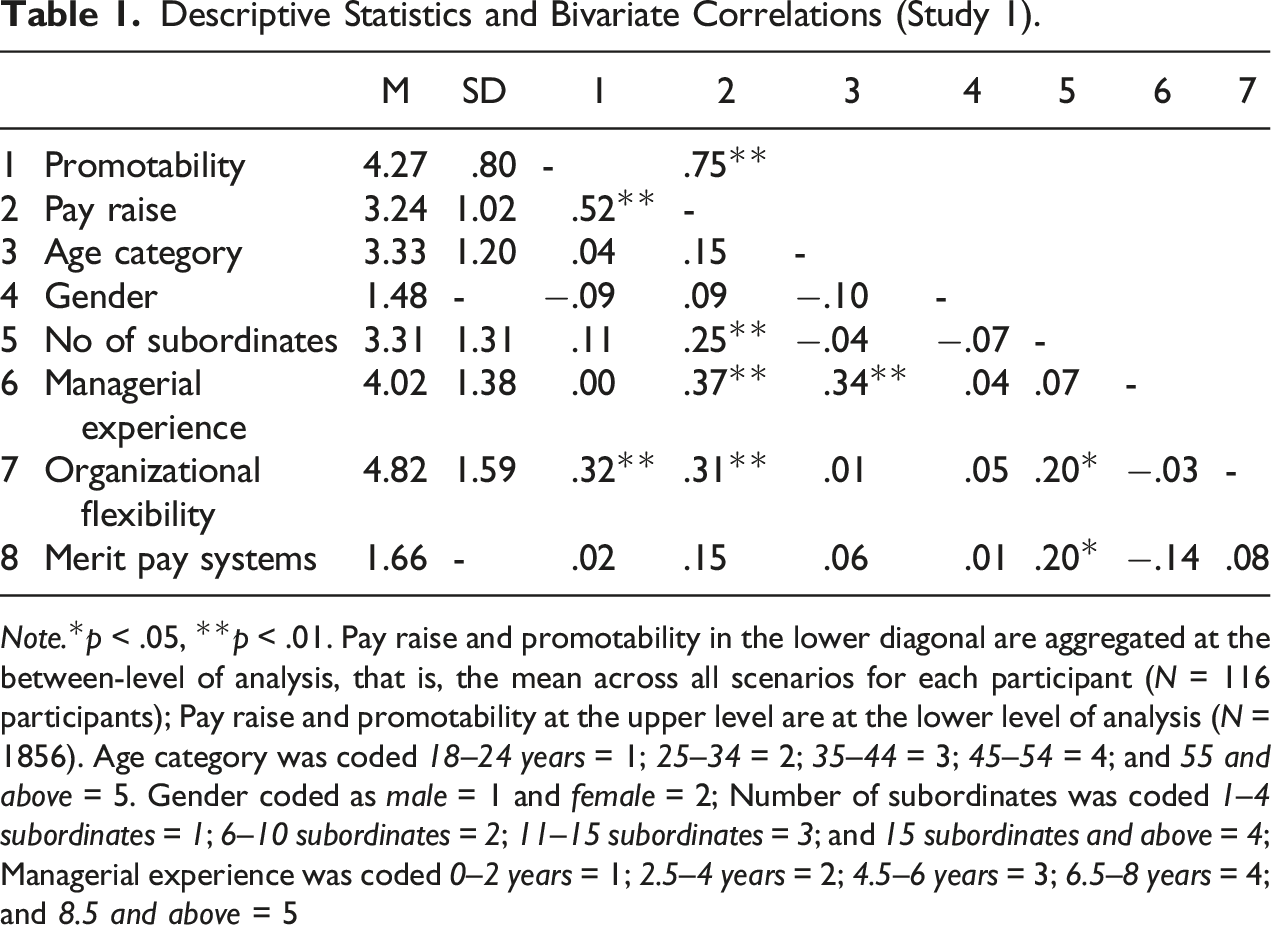
Note.*p < .05, **p < .01. Pay raise and promotability in the lower diagonal are aggregated at the between-level of analysis, that is, the mean across all scenarios for each participant (N = 116 participants); Pay raise and promotability at the upper level are at the lower level of analysis (N = 1856). Age category was coded 18–24 years = 1; 25–34 = 2; 35–44 = 3; 45–54 = 4; and 55 and above = 5. Gender coded as male = 1 and female = 2; Number of subordinates was coded 1–4 subordinates = 1; 6–10 subordinates = 2; 11–15 subordinates = 3; and 15 subordinates and above = 4; Managerial experience was coded 0–2 years = 1; 2.5–4 years = 2; 4.5–6 years = 3; 6.5–8 years = 4; and 8.5 and above = 5
Level-1 Models of Policy Capturing Cues on Promotability and Pay Raise (Study 1).
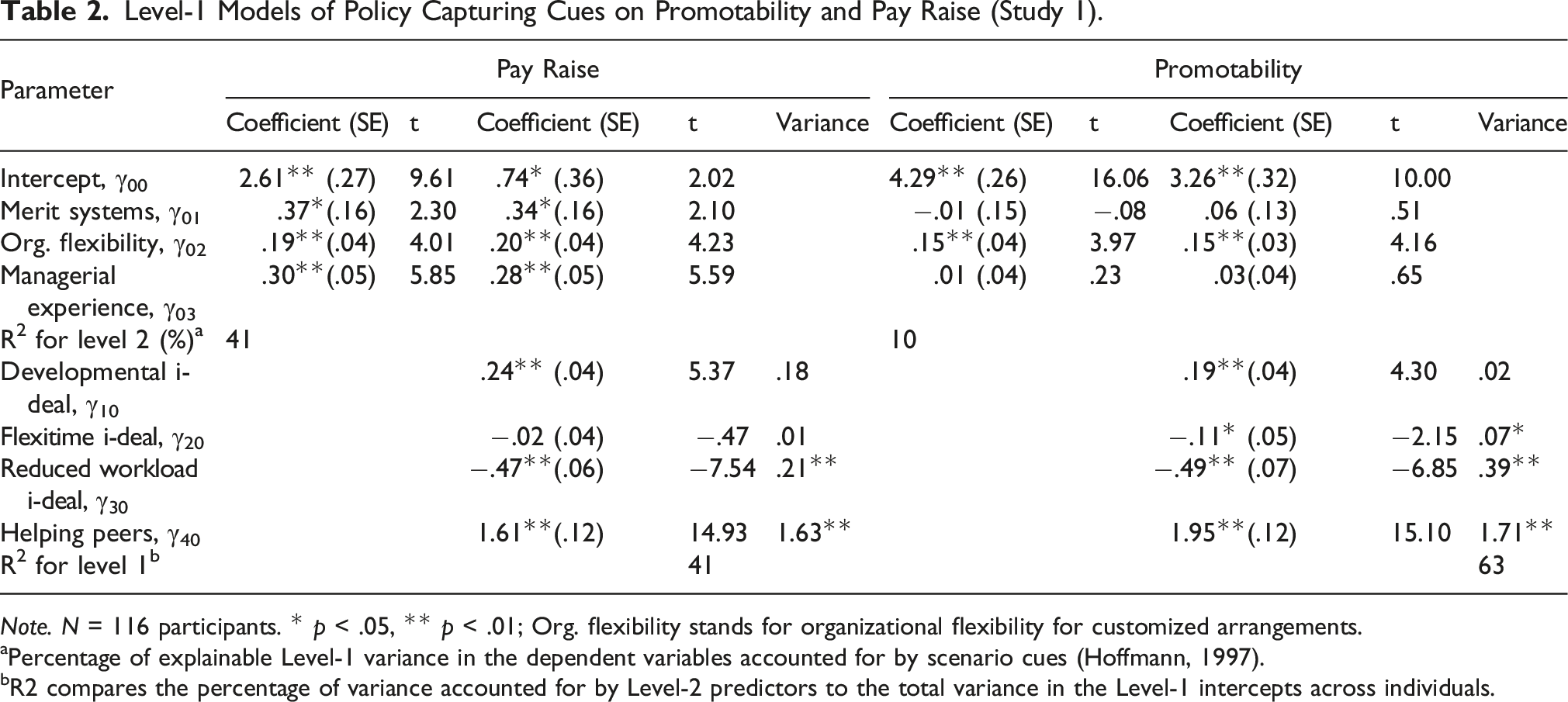
Note. N = 116 participants. * p < .05, ** p < .01; Org. flexibility stands for organizational flexibility for customized arrangements.
aPercentage of explainable Level-1 variance in the dependent variables accounted for by scenario cues (Hoffmann, 1997).
bR2 compares the percentage of variance accounted for by Level-2 predictors to the total variance in the Level-1 intercepts across individuals.
Hypotheses Testing
To test Hypotheses 1–3, we regressed each decision outcome on all cues. For pay raise, all slope coefficients (relative weights) for each cue differed from zero except for flextime, as hypothesized. For promotability, these coefficients also differed as hypothesized (see Table 2). For Hypothesis 1a and 2a regarding pay raises, the positive weight of developmental i-deal indicated that when this cue was present, managers tended to give a higher raise (β = .24, p < .001, effect size = .44); they were less likely to do so when the reduced workload i-deal cue was present (β = −.47, p < .001, effect size = −.72). As expected, flextime i-deals were unrelated to raises (β =−.02, p = .64). Note as expected, helping had a positive weight (β = 1.61, p < .001, effect size = .80). The variance accounted for by Level-1 cues was 41% for pay raise.
For Hypothesis 1b, 2b, and 3 regarding promotability, the positive weight for developmental i-deals indicates that when this cue was present, managers were more likely to promote (β = .19, p < .001, effect size = .37). The negative weight for flextime i-deal indicates that when this cue was present, managers were less likely to promote (β = −.11, p = .05, effect size = −.18) as was the case for reduced workload i-deal (β = −.49, p < .001, effect size = −.73), both as hypothesized. In all, Hypotheses 1–3 were supported for policy capturing. The effect of helping peers was positive (β = 1.95, p < .001, effect size = .80) as expected. The variance accounted for by Level-1 cues was 63% for pay raise.
Interaction Effects for Hypotheses 4–6 (Study 1).
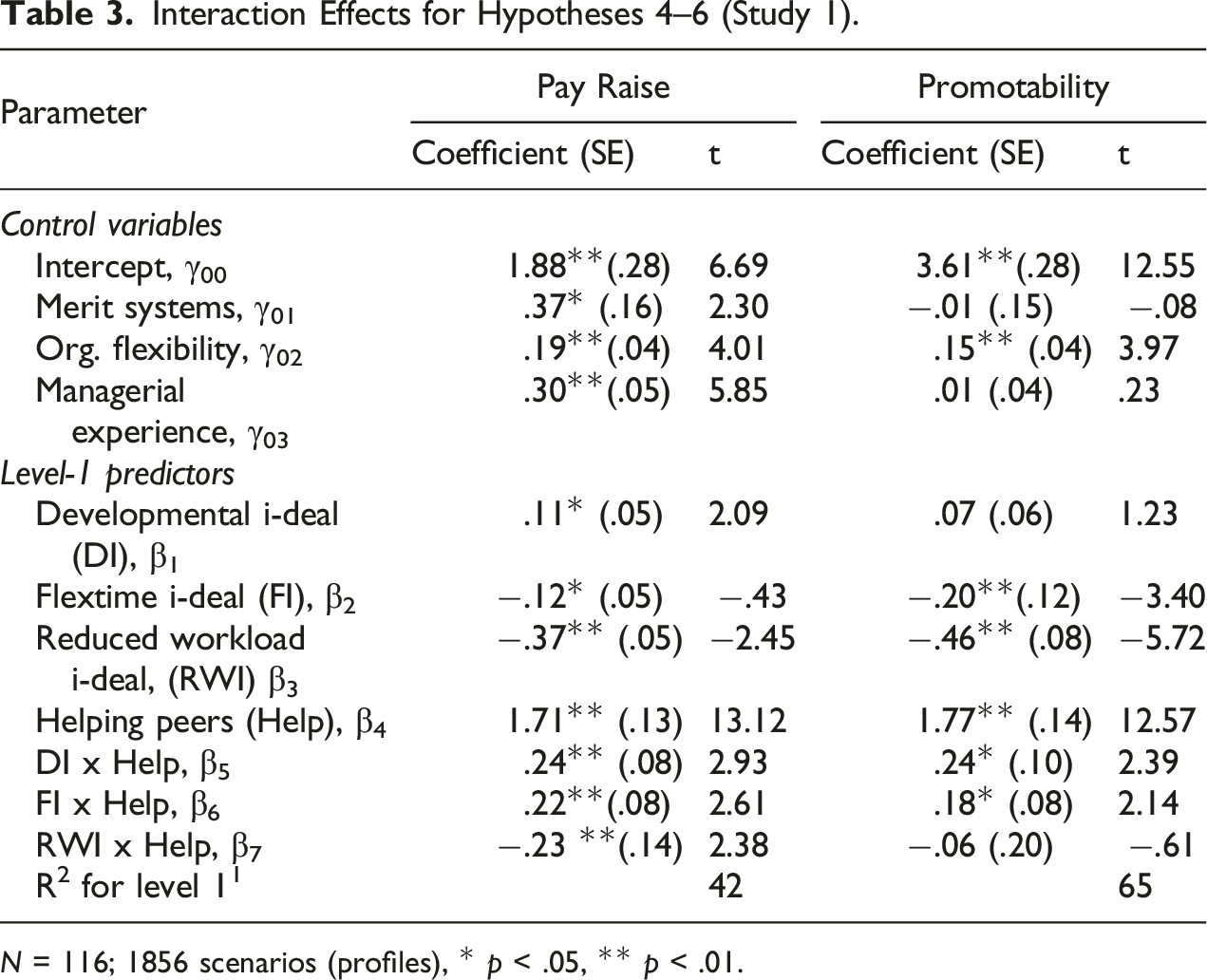
N = 116; 1856 scenarios (profiles), * p < .05, ** p < .01.
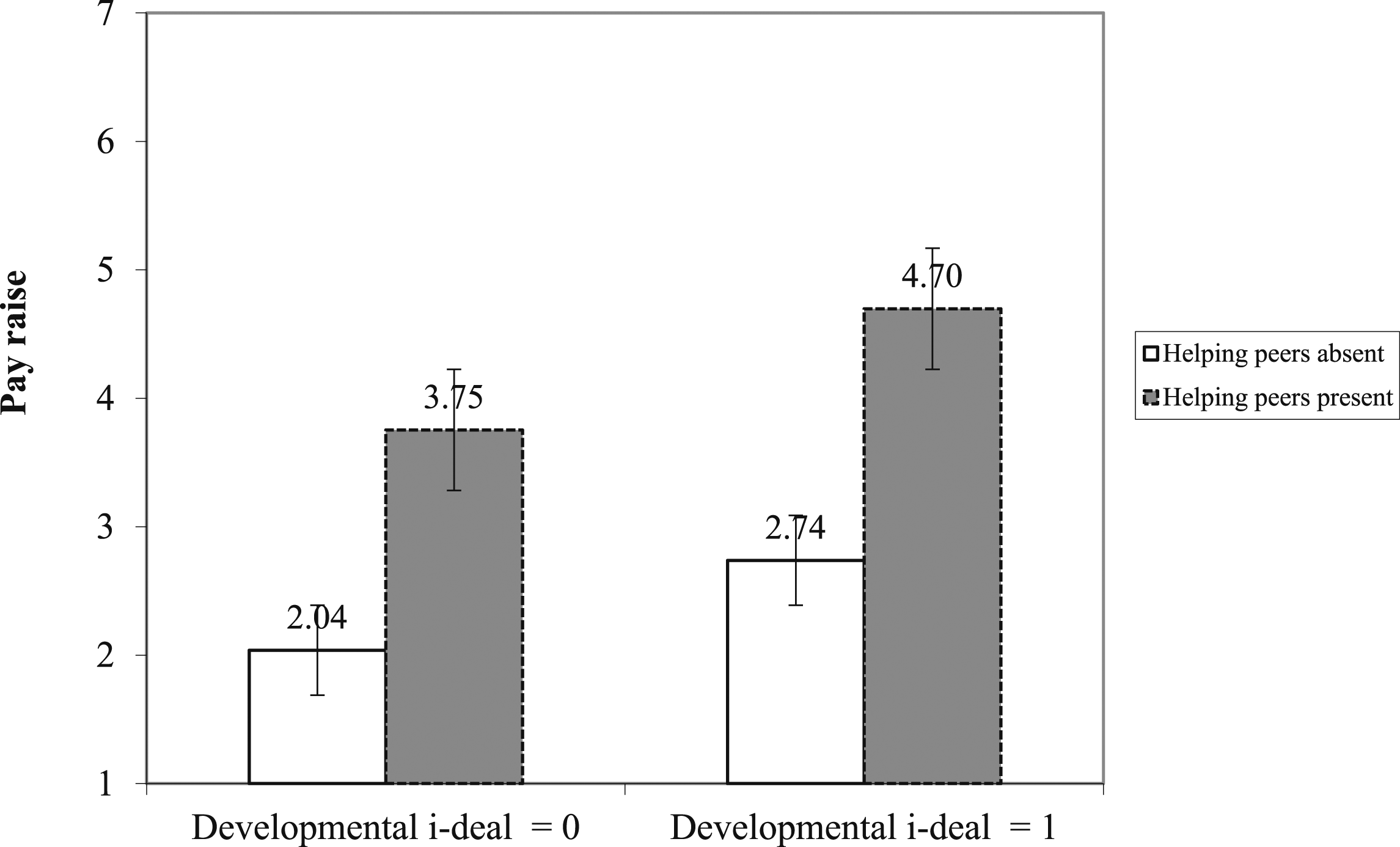
Two-way Interaction Effects between Developmental i-deals and Helping Peers for Pay Raise (Study 1).
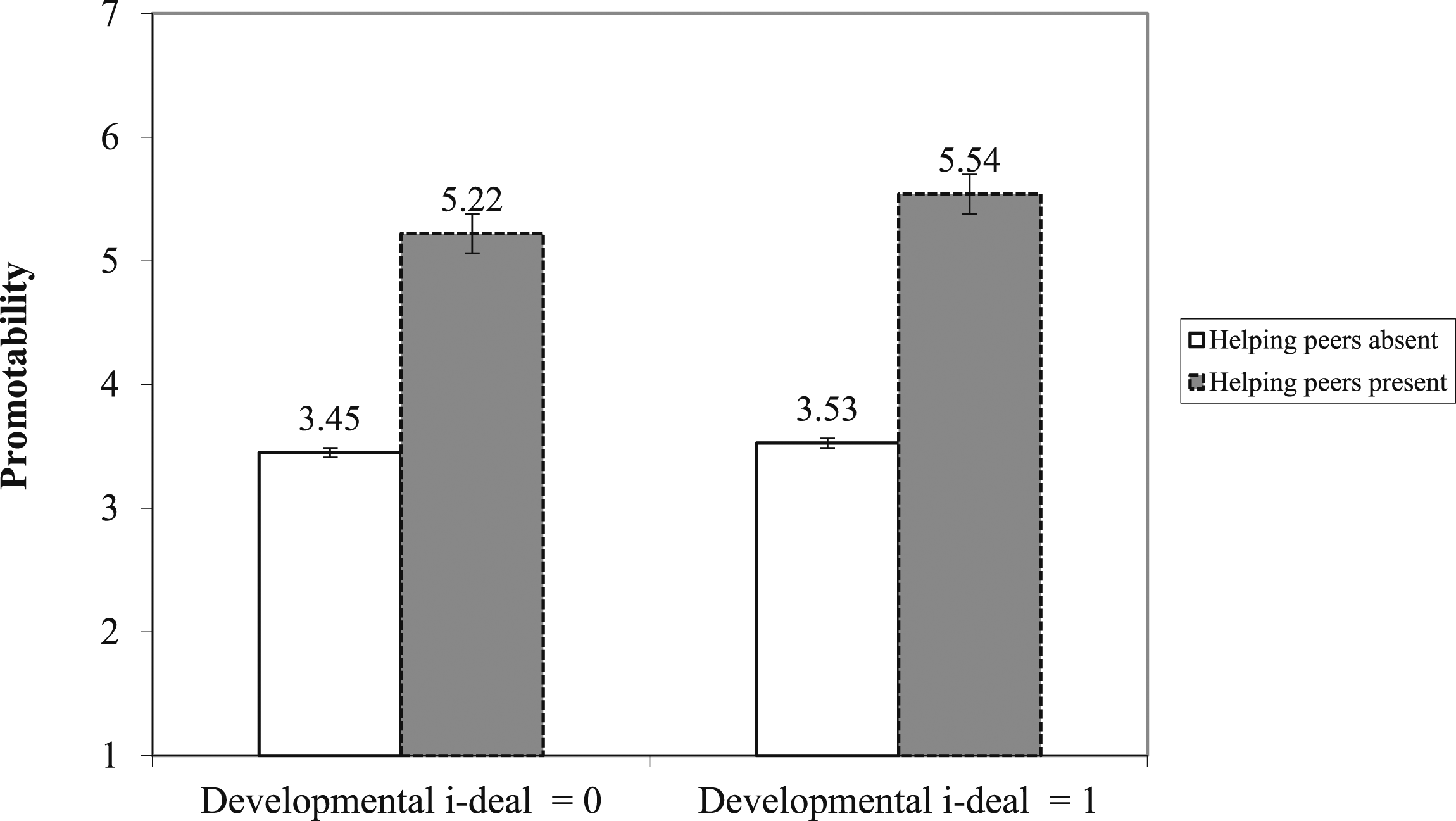
Two-way Interaction Effects between Developmental i-deals and Helping Peers for Promotability (Study 1).
We also found a two-way negative interaction between reduced workload i-deal and helping (β = −.23, p = .017) for pay raise. Managers were more likely to give a higher pay raise to employees without a reduced workload i-deal who helped peers in contrast to those with such an i-deal (estimate = −.61, t = −6.30, p < .001). When helping and reduced workload i-deal co-occur (estimate = −.38 t = −6.81, p < .001), managers are more likely to offer a pay raise (Figure 3). Managers thus appear to frown upon reduced workload i-deals, though they are more willing to grant raises when their recipients help peers, supporting Hypothesis 5. Two-way Interaction Effects between Reduced workload i-deals and Helping Peers for Pay Raise (Study 1).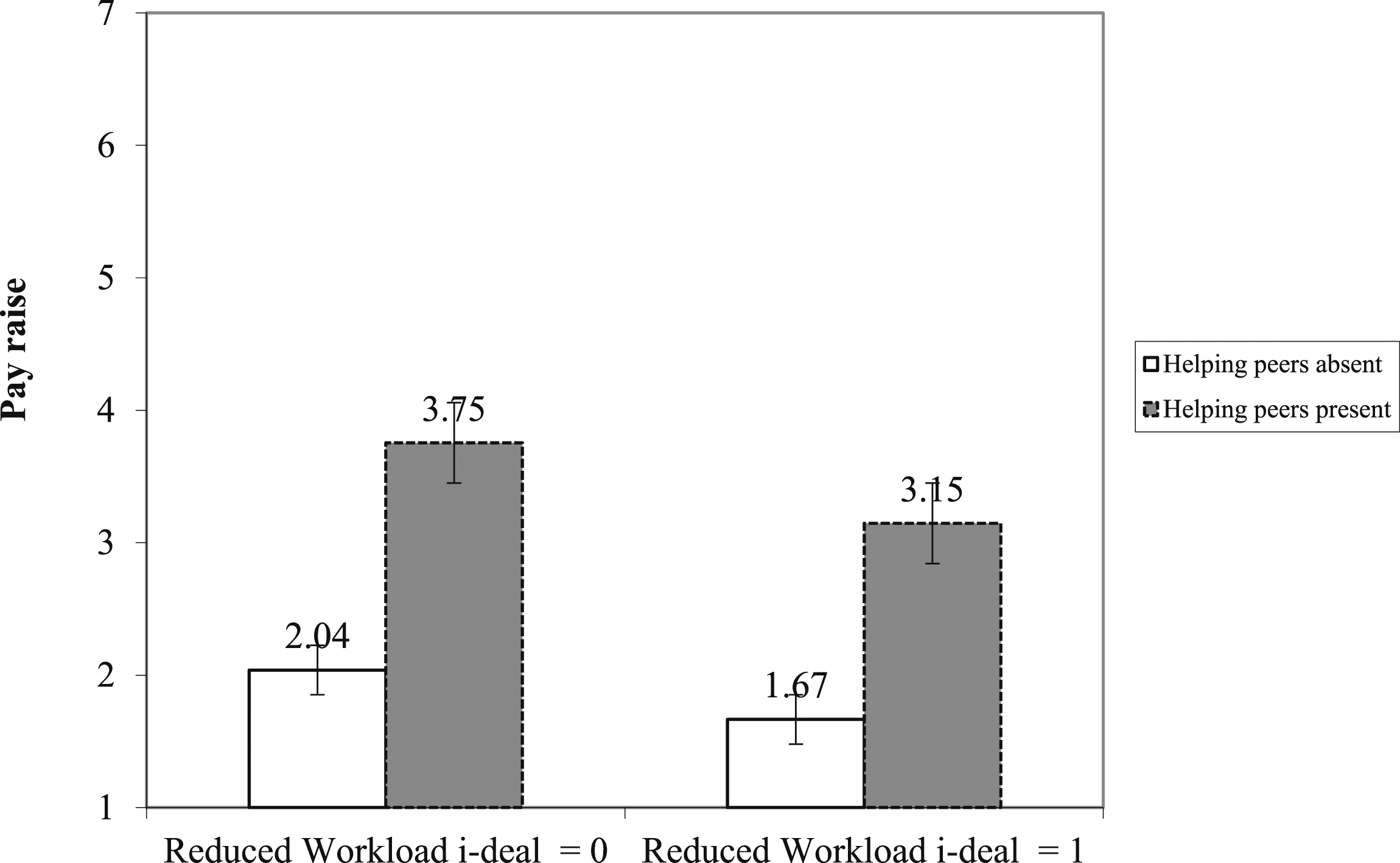
In line with expectation, an interaction exists between flextime i-deals and helping for promotability (β = .18, p = .037). Specifically, when helping peers was absent, managers were less likely to promote the employee with a flextime i-deal (estimate = −.20, t = −3.40, p < .01) (Figure 4), supporting Hypothesis 6. The variance accounted for by Level-1 cues and interactions including Level-2 predictors was 42% for pay raise and 65% for promotability. Two-way Interaction Effects between Flextime i-deals and Helping Peers for Promotability (Study 1).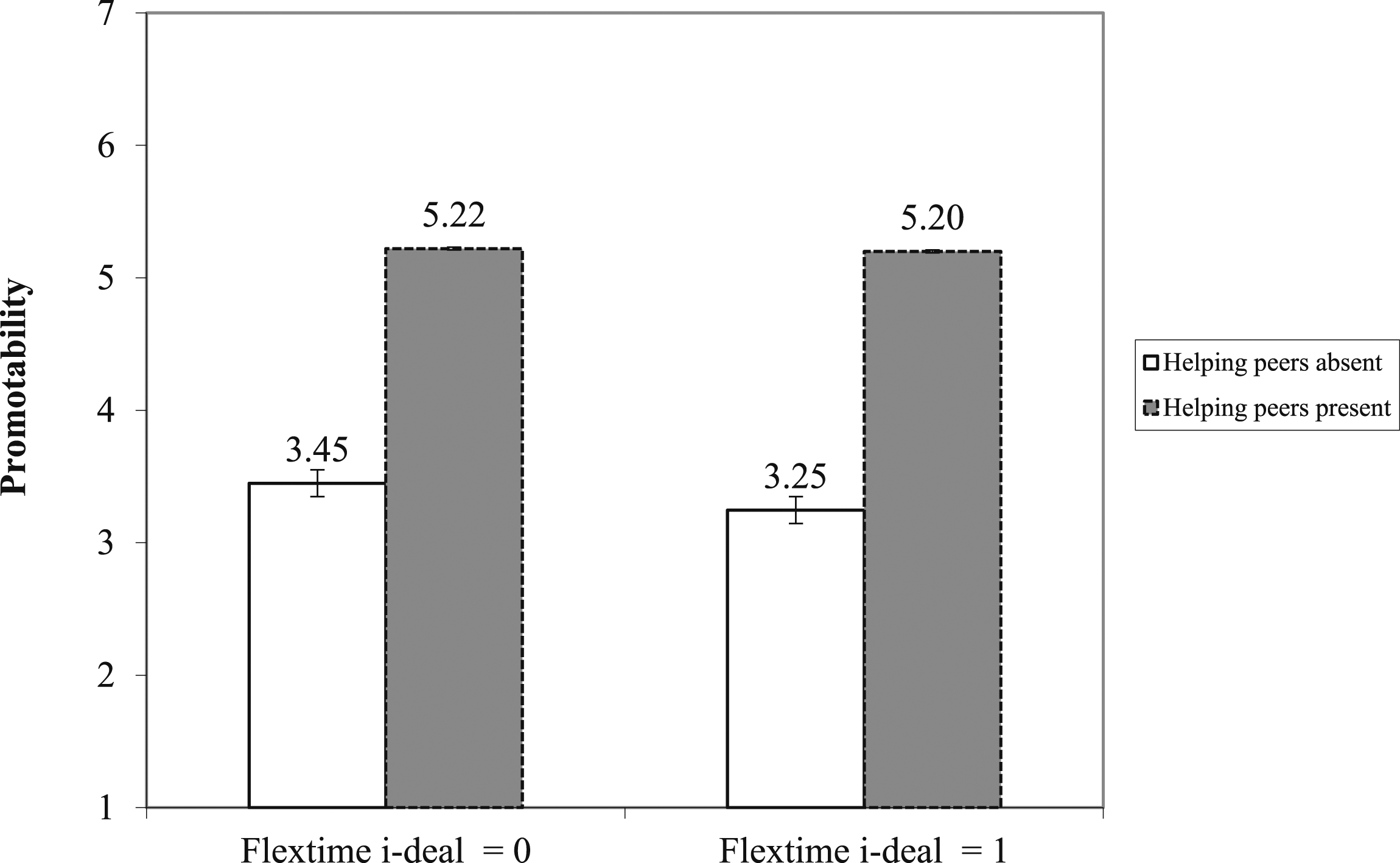
Study 1: Brief Discussion
Findings suggest that managers use all three types of i-deals as well as helping peers in deciding whether to allocate pay raises and promotions. In policy capturing, it is common that some manipulated factors have no effect, consistent with the general finding that individuals tend to use less information in making decisions than they often believe they do (Rousseau & Anton, 1988). However, in Study 1, all cues had some direct effect indicating that our respondents used all available information in their decisions. On average, respondents gave more weight to reduced workload (negative) and developmental (positive) i-deals in making both decisions. Managers were less likely to allocate these rewards to those with reduced workload i-deals but more likely to do so to those with developmental i-deals. Flextime contributes less to managerial reward decisions than the other two i-deals, consistent with expectation: It has a slightly negative effect on promotion and no impact on pay raise decisions. This finding can be understood in the context of existing research, indicating that flextime i-deals do not alter managers’ perceptions regarding i-dealer’s contributions (Hornung et al., 2009; Las Heras et al., 2017) since flextime deals are thought to address nonwork issues and need not alter performance expectations. We also infer that flexible scheduling is becoming more the norm rather than an exception in many workplaces, reducing the likelihood that workers with such arrangements are seen as non-compliant with organizational standards for performance and contribution.
Our findings also point to the role played by helping peers, which itself increases the likelihood of both pay raises and promotions. This finding is in line with compensation research indicating the benefits of contributions to peers in the pay raises workers receive (e.g., Zhou & Martocchio, 2001). Our findings go beyond this general positive effect of helping to show its interactions with all three i-deal types. Managers weigh helping others differently depending on the kind of i-deal. They tend to offer a pay raise and promotion to those who help when the i-deal is developmental. In line with social exchange theory, such behaviors strengthen reciprocity, making the manager more willing to reward employee contributions (Hui, Lam, & Law, 2000; Van Scotter, Motowidlo, & Cross, 2000). However, helping fails to compensate for a reduced workload i-deal where promotions are concerned, though it does for pay raises. When workers with flextime i-deals help peers, managers also are more likely to support them for promotion (and pay raises).
Finally, despite the general consistency in managerial judgments this study observes, managerial experience and workplace norms account for a small degree of between-manager differences in reward decisions. Experienced managers display greater willingness to grant pay raises, though not promotions. Merit pay systems affect how managers provide pay raises but not promotions. Interestingly, only the organization’s practice of flexibility predicted promotability. Between-person variance explained 40% of pay raise decisions and 10% of promotion.
A strength of policy capturing is avoidance of recall bias by simultaneously presenting information to decision-makers (Aguinis & Bradley, 2014). However, it may omit contextual information managers might otherwise use. Although policy capturing can address how managers may think in the abstract regarding pay and promotion decisions, we need to investigate how managers think about these decisions where their actual subordinates are concerned. For this reason, we now turn to examine managerial assessments of their actual subordinates.
Study 2
Our second study tested the same hypotheses in a sample of managers assessing their actual subordinates. In Study 2, managers rated subordinate job performance, a consistent predictor of reward allocation (Leslie et al., 2012; Yun et al., 2007), which we used as a control. Further, we measured helping peers as an employee’s general tendency to help others when they have issues at work, indicating whether helping remains a factor in managerial decision making as in Study 1.
Sample and Procedure
We recruited 253 managers through Qualtrics, an online platform, using the same exclusion criteria as Study 1. The final sample was 174 managers, reporting on decisions for 806 subordinates. Each participant provided the total number of supervisees. Then, choosing up to eight employees they supervise, each manager was asked to complete the survey starting with the longest tenure. Managers reported on an average 3.46 subordinates (SD = 2.13, Min = 1 and Max = 8). Managers worked in non-profits (33%), services and retail (32%), IT/consultancy (11%), manufacturing (14%), and finance (10%). They provided demographic information including their age (M = 43.41 years old, SD = 11.98), managerial experience (M = 12.58 years, SD = 8.74, Min = 1, Max = 39). Seventy-three percent were female, and the mean number of subordinates was 8.41 (SD = 6.24, Min = 2 and Max = 16). Participants rated their organizational policies for flexible arrangements as in Study 1. Fifty-five percent indicated their organization had merit pay systems. The mean organizational policy regarding customized arrangements was 3.70 (SD = 1.23). The median time for survey completion was 11 minutes (M = 13.78).
Measures
Participants completed an assessment for each of their current supervisees up to a total of 8. Compared to the policy-capturing study where participants read scenarios with presence/absence cues and then provided ratings on a pay raise and promotability scale, Study 2 participants rated all variables on Likert-type scales. We randomized scales to avoid ordering effects. All measures use a 5-point Likert-type scale from strongly disagree = 1 to strongly agree = 5 unless stated otherwise.
Types of i-deals. We assessed whether each subordinate had any of the three types of i-deal, using two-item scales developed by Rousseau and Kim (2006): developmental i-deal (α = .82), flextime i-deal (α = .83), and reduced workload i-deals (α = .91). A sample item is “I have authorized customized work schedules for this employee.”
Helping peers. We used four items of Podsakoff et al.’s (1990) altruism dimension to assess manager perceptions of each subordinate’s help for colleagues on the job (α = .91). A sample item is “This employee willingly helps others who have work-related problems.”
Employee performance ratings. Four items assessed manager perceptions of each subordinate’s job performance (adapted from Aiman-Smith, Scullen, & Barr, 2002): results (quantity and quality of work produced), basic work requirements, self-management (working independently, taking initiative, etc.), and working with others (communication, cooperation, and teamwork) (α = .89).
Reward allocations. Managers rated their likelihood of recommending each subordinate for promotion or pay raise, 1 using a 7-point scale (extremely unlikely = 1 to extremely likely = 7).
Employee demographics. Managers reported each subordinate’s gender (54% female) and years supervised (M = 4.34 years, SD = 4.23, Min = 1 year, Max = 36 years).
Analysis of Study 2
Descriptive Statistics and Bivariate Correlations (Study 2).
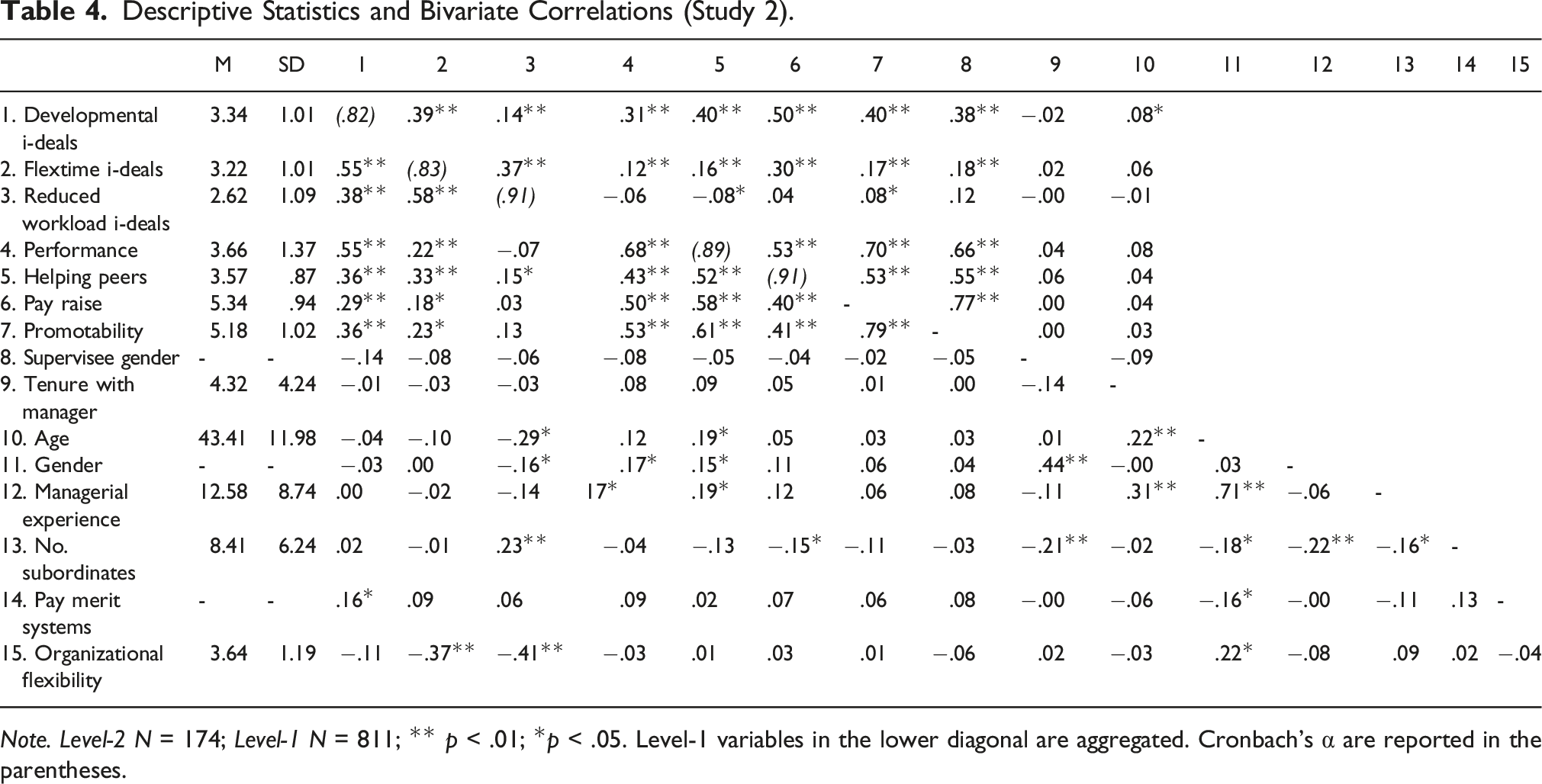
Note. Level-2 N = 174; Level-1 N = 811; ** p < .01; *p < .05. Level-1 variables in the lower diagonal are aggregated. Cronbach’s α are reported in the parentheses.
Results of Study 2
Level-1 Models of Types of I-deals on Pay Raise and Promotability (Study 2).
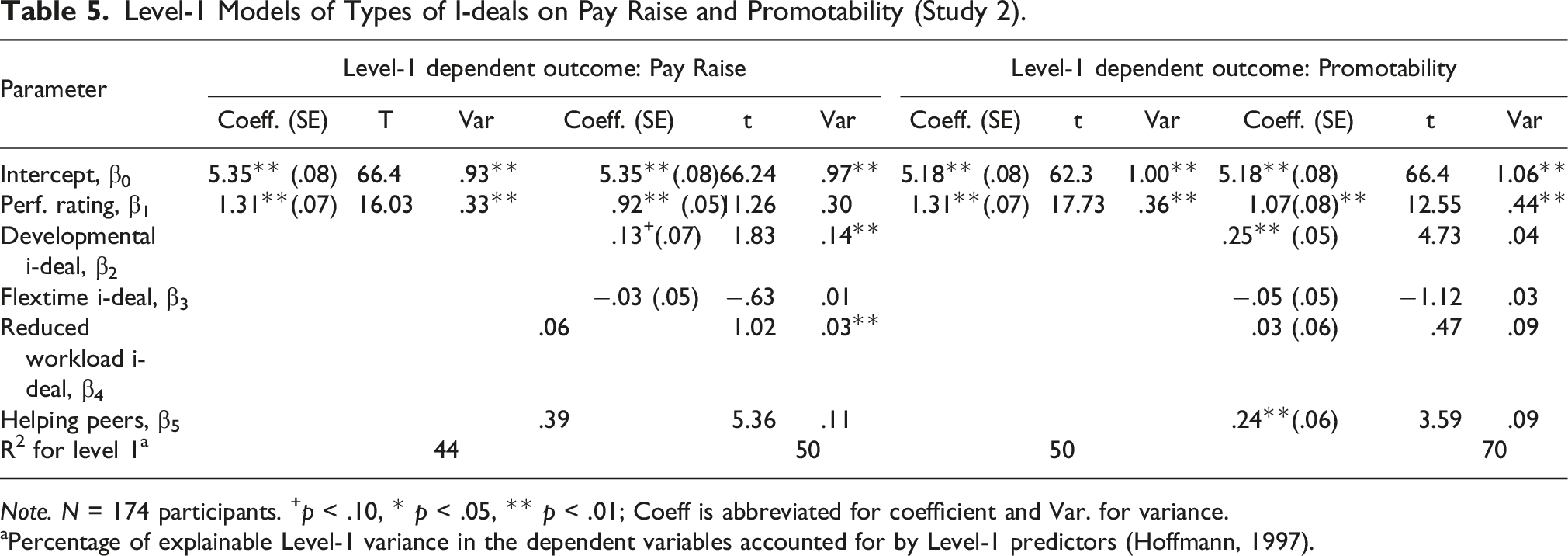
Note. N = 174 participants. +p < .10, * p < .05, ** p < .01; Coeff is abbreviated for coefficient and Var. for variance.
aPercentage of explainable Level-1 variance in the dependent variables accounted for by Level-1 predictors (Hoffmann, 1997).
Overview of Interaction Effects on Pay Raise and Promotability (Study 2).
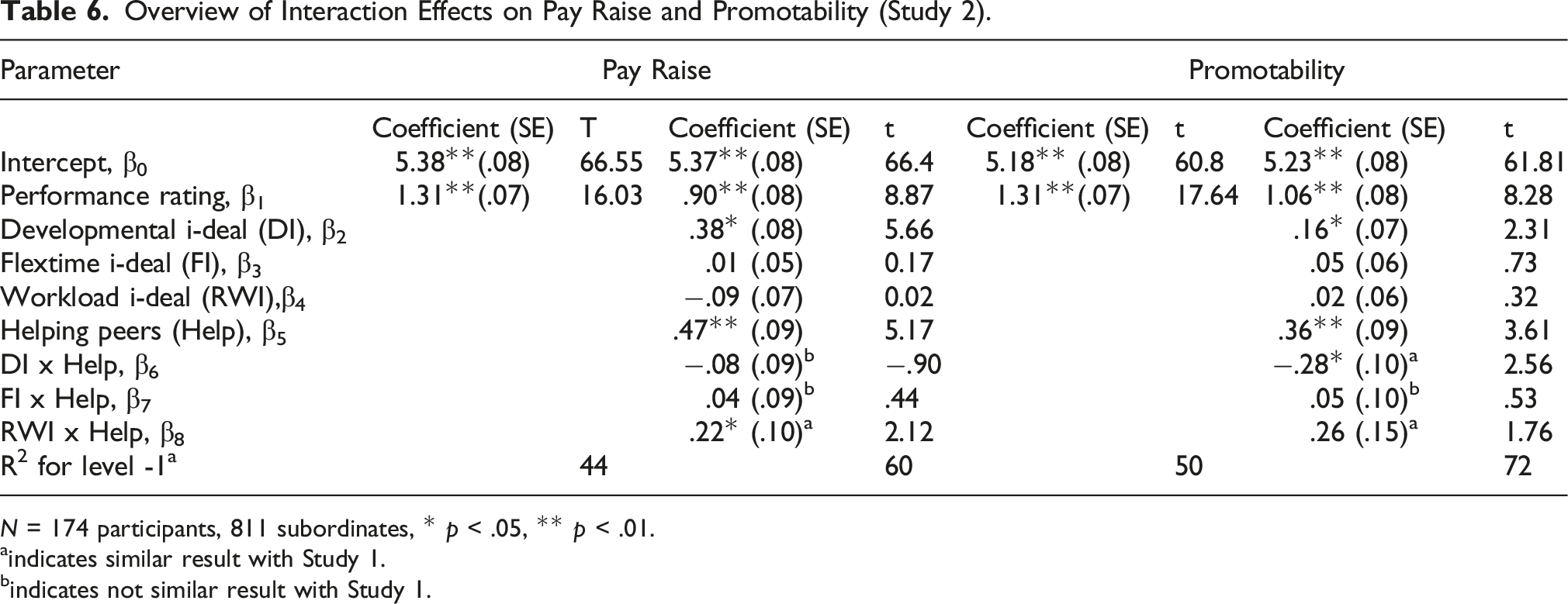
N = 174 participants, 811 subordinates, * p < .05, ** p < .01.
aindicates similar result with Study 1.
bindicates not similar result with Study 1.
Next, we tested Hypotheses 4–6. Hypotheses 4 predicted a developmental i-deal and helping peers' interaction on both outcomes. There was no interaction between developmental i-deals and helping (β = −.08, t = −.9, p = ns) on pay raise, but there was for promotability (β = −.28, t = −2.56, p = .04). Managers were likely to promote helpful employees regardless of their developmental i-deal, but less likely to do so when employees had received a developmental i-deal than those they did not (estimate = .60, t = 5.57, p < .001). Hypothesis 4 thus was partially supported.
Hypothesis 5 examined the interaction of reduced workload i-deals and helping on pay raise. Reduced workload i-deals interact with helping peers (β = .22, t = 2.12, p = .05) (Table 6). Managers were less likely to give a pay raise to reduced workload recipients who did not help (estimate = −.32, t = −2.53, p = .01), but the negative effect was eliminated when employees were helpful (estimate = .06, t = .53, p = .59), supporting Hypothesis 5. Hypothesis 6 predicted a flextime i-deal and helping interaction for promotability, but none was found (β = .05, t = .53, p = ns). As expected, we found no interaction for pay raise. Explained variance by Level-1 cues and interactions including the performance rating was 60% for pay raise and 72% for promotability. Overall, we find that helping peers and developmental i-deals tend to have positive effects on how managers make pay and promotion decisions.
Study 2: Brief Discussion
Study 2 tested our hypotheses by investigating managerial judgments regarding actual subordinates. In Study 2, between-person work norms and managerial experience were unrelated to our outcomes. Developmental i-deals remained an important predictor of promotability and pay raise decisions as hypothesized. As managers appear to view employees with developmental i-deals as meriting rewards, we suggest that such deals signal future potential and benefit for the organization in the long-run, consistent with past research (Hornung et al., 2009). However, unlike Study 1, neither reduced workload nor flextime i-deals directly affected Study 2 decisions. We infer that in evaluating their own subordinates, managers are less swayed by the potential negative implications of flextime and reduced workload i-deals for reward decisions. Regarding Hypothesis 4, we found no interaction for pay raise. We found an interaction for promotability with developmental i-deals: managers were more likely to consider a promotion for unhelpful developmental i-dealers than for unhelpful workers without a developmental i-deal. This finding suggests that managers perceive benefits from employees with developmental i-deals, and this offsets the absence of helping behavior on their part. Hypothesis 5 was supported with managers offering pay raises for helpful subordinates with reduced workload i-deals but not their unhelpful counterparts. This finding further illustrates the importance of helping coworkers in mitigating the adverse effects of reduced workload i-deals on pay raises and promotions. Finally, Hypothesis 6 was not confirmed, suggesting that flextime i-deals do not have the anticipated disadvantages when managers assess their actual subordinates. In all, results of Study 2 suggest that when managers evaluate actual subordinates with flextime or reduced workload i-deals, they largely ignore these i-deals and instead rely on helping behavior and other information in making pay raise and promotion decisions. At the same time, Study 2 affirms that developmental i-deals have the expected positive effects on both decisions.
General Discussion
Our studies sought to make several contributions: To identify whether i-deals affect subsequent reward allocations by managers, to assess how i-deals contribute to the differences between workers that managers confront in making pay and promotion decisions, and to advance understanding of how helping peers might offset or buffer adverse effects of noncompliance with standard firm practices. In doing so, we offer both theoretical and practical implications.
Effects of I-deals on Subsequent Reward Allocations
We observe a nuanced picture of how managers respond to i-deals in making pay and promotion decisions. A strong case exists for the pay and promotion advantages developmental i-deals offer their recipients, consistent with the value that growth opportunities signal to the employer (De Pater et al., 2009). Managers appear to interpret developmental i-deals as a positive signal regarding the recipient’s performance and future value. In contrast, managers appear to interpret reduced workload i-deals as a signal of low contribution and limited future potential reducing the likelihood of raises and promotions, an adverse effect mitigated in relation to meriting a raise by helping peers. In effect, both developmental and reduced workload i-deals appear to provide cues managers use to infer the level of i-deal recipient motivation.
Flextime i-deals display a more complicated yet net positive picture. Although the policy-capturing study found negative effects only for promotability offset by helping peers, our survey regarding actual subordinates showed no effect of flexibility on either decision. In all, we infer that managers tend to discount the nonconformity associated with flexible schedules.
Employee Differences and Reward Allocations
All employee information provided played some role in the reward decisions we studied. As we noted above, worker differences are a recognized challenge to systematically making pay and promotion decisions (cf. Baker et al., 1994). Our findings suggest that participants made considerable effort in arriving at their pay and promotion decisions. Policy-capturing participants used the full array of cues provided, in contrast with typical findings in policy capturing where individuals tend to only a subset of available cues (e.g., Rousseau & Anton, 1988). We suggest that salient worker differences in pay raise and promotion decisions can motivate the effortful use of employee information.
Differences among workers are likely to play a larger role in promotion decisions than in pay raises. We find greater willingness on the part of managers to grant raises to employees regardless of i-deals while recommending promotions more selectively (Lazear & Rosen, 1981). At the same time, we note that previous work on compensation has attributed the lower levels of pay women tend to receive relative to men to the likelihood of women having more idiosyncratic employment arrangements (Dreher & Cox, 2000), a conclusion challenged by our findings of a limited effect of flextime and reduced workload i-deals on pay raises. However, decades have passed between that study and ours, raising the possibility of changes in organizational practices and norms. Indeed, our results are in line with Gerber’s (2011) more recent findings that women do not accept lower wages in order to realize flexible schedules, particularly as flexibility becomes more common.
Our findings also call attention to differences in the implicit criteria managers are likely to use in allocating pay raises compared to promotions. The fact that managers tend to grant raises to good citizens with workload-reduction i-deals whom they otherwise refuse to promote suggests not only a greater willingness to grant raises than promotions but also a focus on present rather than future contributions in doing so. In contrast, future contributions are more heavily weighted for promotion, and it is developmental i-deals that signal future potential (Cadigan et al., 2020). Finally, we note that i-deals and helping peers appear to be important sources of worker differences in both pay and promotion decisions. Managers demonstrate relatively systematic ways of evaluating those differences, as evidenced by the low between-manager variance remaining after differences due to scenarios (policy capturing) or individual employees (survey) were accounted for.
The findings summarized above provide insights to advance theory development regarding pay and promotion decisions. Theories of compensation are largely predicated on employee differences in tastes and abilities with respect to occupational demands, leading to variation in wages and duties both between occupational types and within a given job (Gerhart & Rynes, 2003). Compensation theory focuses on the present and future contributions. Pay and promotion decisions that involve several current employees at the same time are likely to entail somewhat different standards than decisions made regarding a single employee. In the former case, managers can be expected to apply equity criteria, evaluating outcomes relative to inputs, where inputs are made salient by comparison with peers to maintain consistency. We encourage theory building with respect to pay and promotion decisions that take into account not only the attributes of a single individual but the comparative information available regarding peers and the compensatory ways in which this information can be evaluated.
Our findings suggest that managers use i-deals as proxies for contribution. Despite the fact that both our studies controlled for the effects of employee job performance, i-deals influenced the pay and promotion decisions managers made. We call attention to the need in pay and promotion research to further specify the attributions managers make in these decisions, including past, present, and future contributions (Gerhart & Rynes, 2003). Evidence that i-deals serve as proxies for contribution suggests that alternative forms of contribution can apply, including, for example, job-related investments employees are making, such as pursuing training and development.
By calling attention to interpretations of relative contribution in these reward decisions, we note that relative contribution can trend downward where adjusted or reduced workloads are concerned. At the same time, in our two studies, the negative effects of reduced workload i-deals for workers in policy capturing were somewhat mitigated in decisions regarding actual current employees. This observation suggests that other factors may be at work beyond current relative contribution in allocating pay to current employees, consistent with the phenomenon of “sticky wages” where pay is largely expected to go up rather than down. Nonetheless, by expanding the construct of contributions related to pay decisions to include information provided by i-deals and the comparative judgments it contributes to, we open up an investigation into the managerial judgments that underlie pay allocation in organizations.
In the context of promotion decisions, the goals of this reward allocation differ from those associated with pay: For promotion relative to pay, anticipated future contributions are likely to loom larger. Promotions have been theorized to promote an organization’s internal labor market since promotion from within is a means of rewarding retention and accumulation of firm-specific skills. Our findings with respect to promotion are consistent with reliance on relative skill and commitment to the organization as promotion criteria, consistent with internal labor market functioning as specified in existing theory. At the same time, previous research has stressed the disadvantage of appearing non-compliant with organizational norms in competitive promotion systems (Landers, et al., 1996). We find that flextime i-deal is not necessarily viewed as non-compliant with organizational norms and may no longer be weighed against the employee with respect to his or her commitment to the organization. Thus, our findings have implications for updating theory related to promotions.
Implications for Future Research
The differential consequences i-deals have on subsequent reward allocations are due in part to inferences managers make regarding the i-deal recipient’s present and future organizational contributions and the signals the type of i-deal conveys regarding those contributions. Future research should assess the actual inferences managers make in considering workers with specific i-deals for promotion or pay raise. We suggest that three inferences are particularly important: (1) managerial perceptions of current employee contributions relative to peers, (2) anticipated future contributions and ability to engage in promotable work, and (3) the distributive fairness or equity managers attribute to offering pay raises or promotion to workers with specific i-deals.
Communication and conduct by both the i-deal recipient and his or her coworkers can influence these managerial inferences (Chiaburu & Harrison, 2008). For example, conversations with i-deal recipients can make managers more aware of in-role and extra-role contributions, future intentions, and interest in advancement. Follow-up conversations with i-deal recipients and coworkers provide insight into consequences for third parties and the i-dealer’s role in mitigating any negative consequences. The context surrounding the creation of an i-deal, particularly reduced workloads, is an understudied feature. Contextual information can impact managerial inferences and attributions regarding the i-deal. For example, why an employee might request a reduced workload and its expected duration can influence attributions managers to make regarding the deal.
Future research should also give attention to the issues of i-deal timing and scope, conditions posited to affect the outcomes associated with i-deals (Rousseau, 2005). I-deals made at the time of hire tend to be based on market factors (i.e., wage rates and perks), while after-hire i-deals may have more of a relational component based on the employee’s insider knowledge of the organization and relationship with her manager. It is unknown whether i-deals made at hire have different effects on subsequent reward allocations than do i-deals made by workers on the job, an important issue for future research. At the same time, i-deals can vary in their scope, from a unique customized aspect of an otherwise standard employment arrangement to a completely customized idiosyncratic arrangement where compensation, perks, and working conditions are unique to the individual. As yet, no research exists on the effects associated with variation in the scope of an individual’s idiosyncratic arrangements, let alone its impact on future reward allocations, making this a promising topic for future study.
An important area for future research is the policies and practices employers can use to enable workload reductions when needed—without damaging the employee’s relationship with her manager and future career opportunities. Though these i-deals can benefit workers with challenging nonwork demands, managers can make negative inferences regarding these workers, making reduced work i-deals a mixed blessing. Previous research highlights proactive strategies workers can use to avoid negative attributions regarding their reduced workloads (Lawrence & Corwin, 2003), but less is known about the practices organizations might use to support their effective contributions and career progress. Designing pay and promotion practices to motivate commitment to the organization on the part of workers with reduced workloads requires that such accommodations be managed in a way that avoids marginalizing these workers—by helping these workers to continue developing their skills and capacity to contribute.
We also offer some methodological insights for future research. First, although we observe striking differences in the consequences of reduced workload and flexibility i-deals, some past researchers have assumed these two deals are comparable, combining items for each in a single scale (Leslie et al., 2012; Rosen et al., 2013). Conflating reduced workloads with flextime is misleading: our findings show that workers with flextime i-deals need not incur a penalty, while those with reduced workloads can indeed suffer impaired promotion prospects. Our findings show that managers differentiate these two i-deals, resulting in differential consequences for workers. Second, despite many similar findings, our policy-capturing results show certain patterns missing in our survey data. Policy capturing reflects decisions made for hypothetical employees. In that study, participants displayed a tendency to view the absence of any i-deal as preferable. In contrast, in the survey of manager judgments regarding actual subordinates, managers were far less negative in their responses to flexibility and workload-reduction i-deals. Where actual subordinates are concerned, decision-makers are likely to be influenced by contextual information and established relationships. Findings from the survey study suggest that managers may make fewer negative judgments regarding i-deals for workers they know well. We advise future research to broaden what is measured to include both data regarding the reasons behind the i-deal’s creation and the nature of the supervisory–subordinate relationship since these provide important context. Yet, we note that neither our policy-capturing study nor survey showed much between-person variance in decisions, suggesting that participants tended to largely agree on their responses to the specific employee-related information we studied.
Limitations
All studies have limitations. We note that our two distinct designs yield many similar results, particularly regarding developmental and reduced workload i-deals, suggesting reasonable consistency. Nonetheless, we attribute other inconsistent results to differences between policy-capturing cues and Study 2 survey scales. In Study 1, we manipulated two levels of i-deals (present/absent) and helping peers, whereas in Study 2, we measured these variables in Likert-type scales increasing the possible variance among these variables. Further, in Study 1, we measured pay raise quantitatively by predetermining the range of pay raise from 0% to 6%, whereas in Study 2, we measured pay raise by asking the likelihood of offering a pay raise but we did not ask participants to indicate the % in the case they were likely to offer a pay raise. Though our intentions were not a replication of findings but rather testing our hypotheses with different methods, observed inconsistency in results may be attributed to measurement differences.
A second concern is the omission of additional factors relevant to pay raise and promotion decisions. Because our managerial samples were obtained via online panels, a battery of attention checks was used in both studies to obtain quality responses. Participant fatigue is a concern in policy capturing (Study 1). In response, we limited the number of scenarios to sixteen while maintaining the benefits of a full-factorial design. By doing so, we manipulated only the three most commonly studied types of i-deals and helping peers. This created a 4:1 ratio similar to other policy-capturing studies of compensation (e.g., Zhou & Martochhio, 2001), although others recommend a 5: 1 ratio (e.g., Karren & Barringer, 2002). We suggest that future research incorporate other types of i-deals such as financial- and task-related deals (Rosen et al., 2013). In addition, although our studies factored in job performance, other factors can also influence how managers view the i-deal recipient including employee loyalty (e.g., Kong & Ho, 2015).
A third concern is policy capturing’s external validity (Sherer et al., 1987; Webster & Trevino, 1995). We addressed this by following Raaijmakers et al.’s (2015) strategy of distributing scenarios to a pilot sample of managers who reported the scenarios to be clear and realistic. In Study 2, we asked respondents to rate up to 8 subordinates and to choose those they had the most experience with if they could not include all. Thus, our Study 2 ratings may be skewed toward employee–manager dyads of longer duration. We recommend broader consideration of employee–manager tenure in future research.
Implications for Practice
Customized work arrangements can have long-term implications for workers and organizations. Developmental i-deals offer clear benefits to both parties and position the individual for career opportunities and increased organizational contributions. The opposite is the case for workload reduction i-deals, at least in terms of career consequences. Although workload reductions appear to come at a career cost for employees, an approach that targets flextime rather than cutting back on hours or duties may help solve a problem without adverse effects on future rewards. On the other hand, should reduced work hours become more normative and broadly available, such adverse effects on future rewards may be reduced. We advise employers seeking to offer broader supports to their employees to review their approaches to reward decisions in terms of how best to provide present flexibility to workers while also promoting future opportunities.
Line managers increasingly are recognized as the organization’s key HR agents particularly in terms of motivating and retaining employees (Fu et al., 2020). Part of their job is to implement policy-related decisions by factoring in the reality of the local working conditions (Fu et al., 2020; Purcell & Hutchinson, 2007). That local reality includes employee understandings regarding the future rewards they can realistically expect. In our recommendations for practice, we call attention to opportunities both managers and i-deal recipients have to create and manage their i-deals effectively. In i-deals made with current employees, these opportunities fall into two categories: (1) creating the i-deal and (2) managing it over time.
Creating the i-deal. We advise both employees and managers to learn from the experiences others in their organization have had with similar deals to better anticipate concerns and manage expectations. In creating an i-deal, managers should foreshadow the contributions required to keep the employee in good standing in terms of performance requirements, promotion prospects, and relations with peers. Employees should commit to ongoing communication with their manager over time as the deal is implemented and the form that communication should take (meetings, memos, etc.). Both parties should work to develop mutual expectations to help the deal succeed. Importantly, both play a role in reducing effects on coworkers, particularly where the i-deal creates burdens for them. The parties should consider how long the deal is to last and whether a sunset provision might be appropriate, that is, conditions under which the i-deal might be terminated or revised.
Managing the aftermath of an i-deal. An effectively managed i-deal involves periodic check-ins to see how the deal is working from the perspective of the individual, coworkers, and their manager. For many i-deal recipients, managing an i-deal’s aftermath means keeping the manager in the loop regarding their contributions. Conversations can help resolve problems or improve the i-deal’s implementation, ensuring that the recipient has an opportunity to communicate concerns and provide information regarding what she is doing and might need to make the deal work and contribute to the organization. Updating career plans and frequent discussions regarding how well the i-deal is working for both employee and employer increase the quality of information the parties have regarding each other’s needs, responsibilities, and future expectations. These interactions help managers avoid false or misleading attributions about subordinate motives and career interests and help employees form realistic beliefs. Regular interactions help i-deal recipients understand the strategies they need to use in order to realize the future opportunities they seek. Employee career success depends to some extent on the support managers provide but also on how employees act especially in the context of i-deals. We advise i-deal recipients and their managers to be open to updating or changing customized arrangements over time so they work well for all parties, a particular concern for reduced workload i-deals.
Our findings also pertain to reward decisions made by committees. These bodies are removed from day-to-day contact with employees. Thus, the frameworks committees use to make judgments resemble our policy-capturing study. Pay and promotion decisions can be improved by providing more contextual information regarding worker performance and extra-role contributions including help given to peers to avoid bias based on noncompliance with standard job arrangements.
Conclusion
Properly managed i-deals benefit both employees and employers. The quality of the i-deal recipient’s future with the organization can depend on the judgments his or her manager makes after the deal is negotiated. Well-informed pay and promotion decisions require managers to have quality evidence regarding subordinate performance, contributions, and future potential—and the training and support needed to use that evidence well—especially where employees have i-deals.
Footnotes
Acknowledgements
We would like to thank our Editor in Action, Maryam Aldossari, and the anonymous reviewers for helping us to improve the paper. The early draft of the paper was presented in the Academy of Management in 2019 and we would like to thank the attendees who provided their valuable comments. Finally, the authors would also like to acknowledge Sargam Garg, Violet Ho, and Neil Conway for their constructive feedback in the early drafts of the paper.
Declaration of Conflicting Interests
The author(s) declared no potential conflicts of interest with respect to the research, authorship, and/or publication of this article.
Funding
The author(s) disclosed receipt of the following financial support for the research, authorship, and/or publication of this article: Study 2 was supported by a grant from CHRONOS Research Centre, at Royal Holloway University of London.

Notes
Author Biographies
Appendix A
Information related to the policy-capturing study (Study 1, response rate: 66%).
Randomizations. We completely randomized the scenario order using the randomizer function in the survey flow of Qualtrics. We also randomized the ordering of the dependent variable using the question randomization function.
Cues were also randomized within scenarios across participants as follows: Developmental – Flextime-Reduced workload i-deal – Helping peers = 1; Developmental-Reduced workload- Flextime i-deal – Helping peers = 2; Flextime-Developmental – Reduced workload i-deal – Helping peers = 3; Flextime-Reduced workload – Developmental i-deal – Helping peers = 4; Reduced workload i-deal – Developmental i-deal – Flextime i-deal- Helping peers = 5; Reduced workload – Flextime – Developmental i-deal – Helping peers = 6.
We conducted one-way ANOVA to see if there were any systematic differences with the ordering of the scenarios. Though one-way ANOVAs were significant [pay raise F (1, 1740) = 3.47 p =.004; for promotion F (1, 1740) = 4.11 p = .001], post-hoc comparison tests using Scheffe did not show any significant differences among the six different combinations p = ns.
Test–retest scenario reliability. The test–retest reliability of the replicated scenarios was .83 for pay raise and .78 for promotability. We also assessed the intraclass correlation coefficient (ICC) to test the within-person variance that assesses the raters’ consistency. The ICC estimate for pay raise is .82 and for promotability .77. These results indicate that a sizable portion of the variance across scenarios was due to between-person variability rather than within-person, and participants were quite consistent in how they responded to the scenarios across the study. We excluded duplicated scenarios from our analysis.
Qualification criteria. We recruited panel data from a pool of managers in Qualtrics (original sample: 177). We pre-screened for managers with two questions: (1) Are you manager of others at your employment? (2) Are you an employee who: is a. is only managed; b. manages and is managed, and c. only manages. Participants who answered positively in the first question and chose the options b. or c. in the second one were included in our sample. Only two people failed our prescreening.
Attention checks. We used question logic, and in extreme responses, we were asking participants to justify their response. We removed 21 participants whose responses were nonsense (e.g., “xxx”; “because so”). In pilot testing, the estimated mean time was 12 minutes. As such, we excluded 38 participants who completed below 10 minutes.
Data analysis. During analysis, software excluded one participant because they had incomplete Level-2 data. One participant was excluded because there was no variance among responses resulting in a final sample of 116 managers.
Appendix B
Associate Editor: Maryam Aldossari